

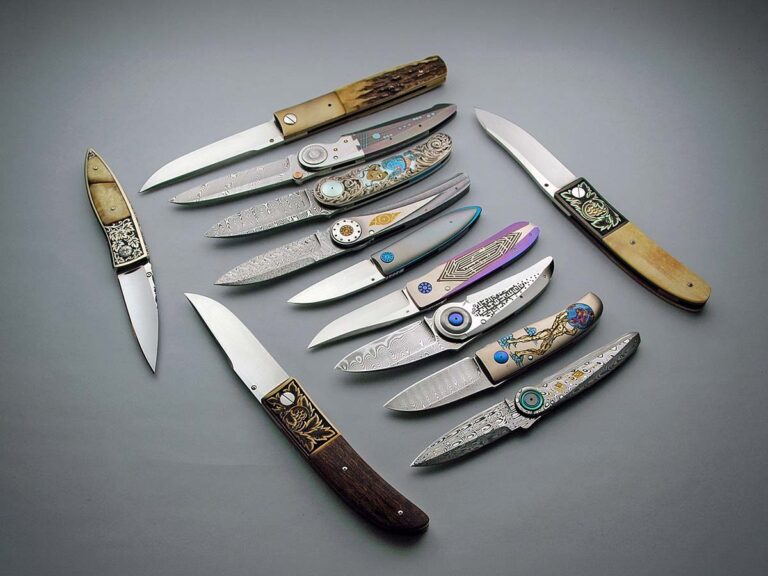
The masterful and meticulous impact of the Hall of Famer.
The knife world changed forever on New Year’s Day in 1980. In a geodesic dome house, situated in the mountains high above Taos, New Mexico, Michael Walker proclaimed, “Today, I am a knifemaker!”
Not that he had a ton of experience in the field prior. Up to the roaring ’80s, Walker’s resume was dotted with employment common among many of the free-spirited residents of Northern New Mexico—sculptor, jewelry maker and purveyor of firewood. Perhaps this eclectic background of the aesthetic ideal and practical application was the right balance for him to make his mark in the world of cutlery. The maker has spent a career marrying the beautiful and functional, something that might have only come from someone who not only designed rings and necklaces, but also split logs.
Locking In

Even on the BLADE Magazine Cutlery Hall of Fame® member’s most artistic designs, there is always an undercurrent of practicality. In particular, his locking mechanisms have shaped modern folding knives. But even turning to innovation as a hallmark had a streak of sensibility. According to Walker, in his 128-square-foot log cabin workshop, he minted 10 fixed-blade knives to start his career. He then realized he’d have to make 10 sheaths to house them. Not wanting to go down the leather-working rabbit hole, he immediately switched his focus to folding knives.
At first, Michael’s work—at least mechanically—was somewhat rote, mainly slip joints and folders. But soon after his knifemaking endeavor started, he began revolutionizing how a blade locked in place. Arguably, his most weighty invention came early, when the “Walker Liner Lock” was born around 1981. Walker’s inspiration for creating the linerlock was a knife that could open with one hand without repositioning it.
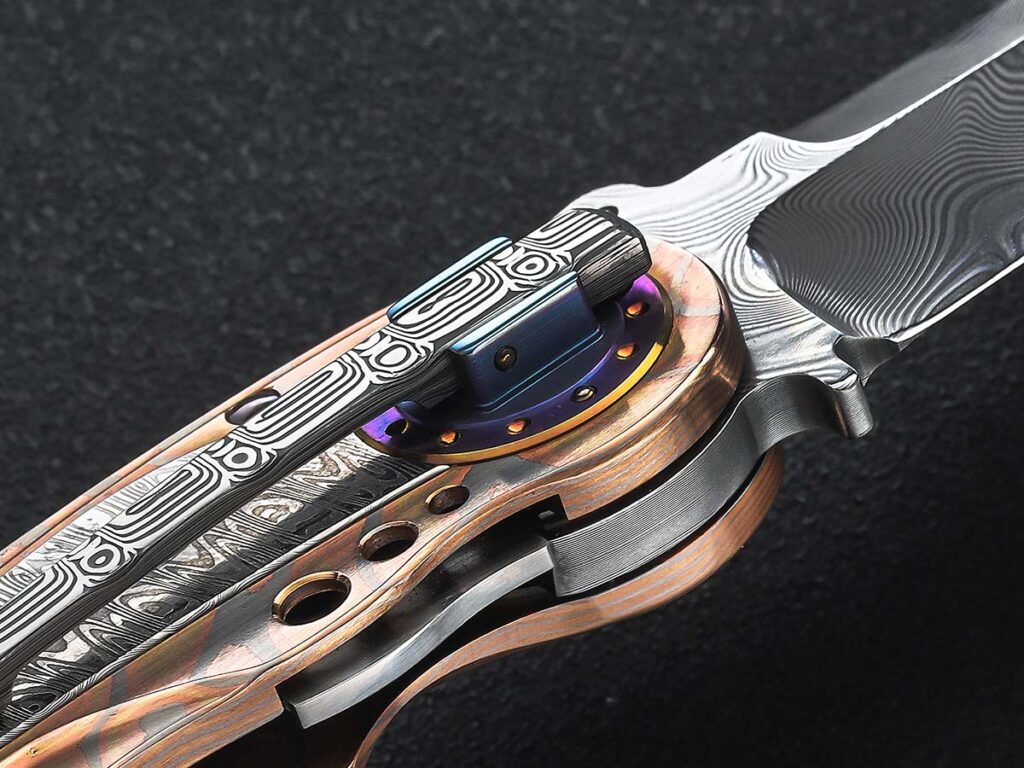
Most knife enthusiasts are familiar with the locking system, prevalent as it is today. Steve Shackleford described it thusly, in his section on Michael in Greatest Living Knifemakers: “Basically, the linerlock consists of a spring cut out of the titanium liner of a knife handle that, when the blade is opened, is released and moves under the blade tang to hold it open. To close, simply push the spring back toward its original position in the liner and pull the blade closed.”
While Walker is known for his titanium liners, to start, his folders had liners of 440C steel, which he split with a jeweler’s saw and hardened on the tip. Initially, the hardened liner did the trick, but once moving to titanium springs around 1984, he found the material had a tendency to gall, leaving marks or trails on the blade. Incorporating a ball left the blade pristine and, as he found, assisted the closing of the blade. After using the ball detent for a year, Michael discovered a pin was more suitable for the job, and to this day, Walker still uses a press-fitted pin as he can put a bevel or a radius on it so that the operation is better than if a ball were used.
It’s worth noting that some greats have worked personally or drawn inspiration from Walker’s liner lock. Walker inspired such notable makers as Bob Terzuola and Ernest Emerson, to name just two. The liner lock was just the start for Walker’s refinement of locking mechanisms and knives in general. At present, he holds numerous patents and trademarks pertaining to design elements within knives.
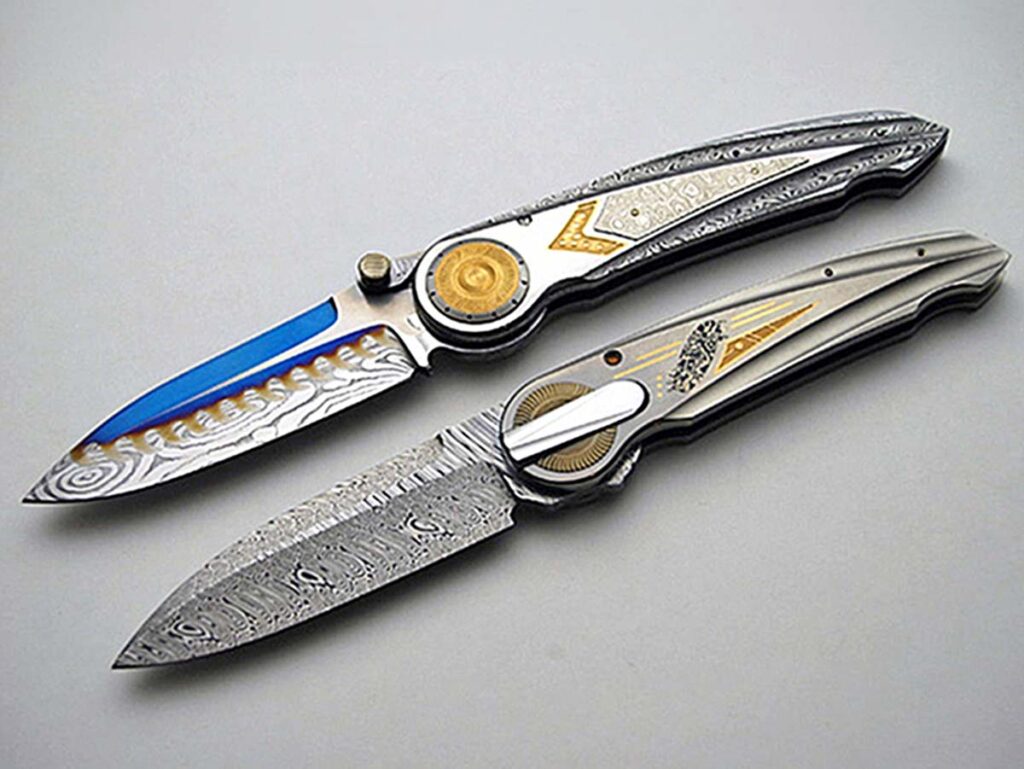
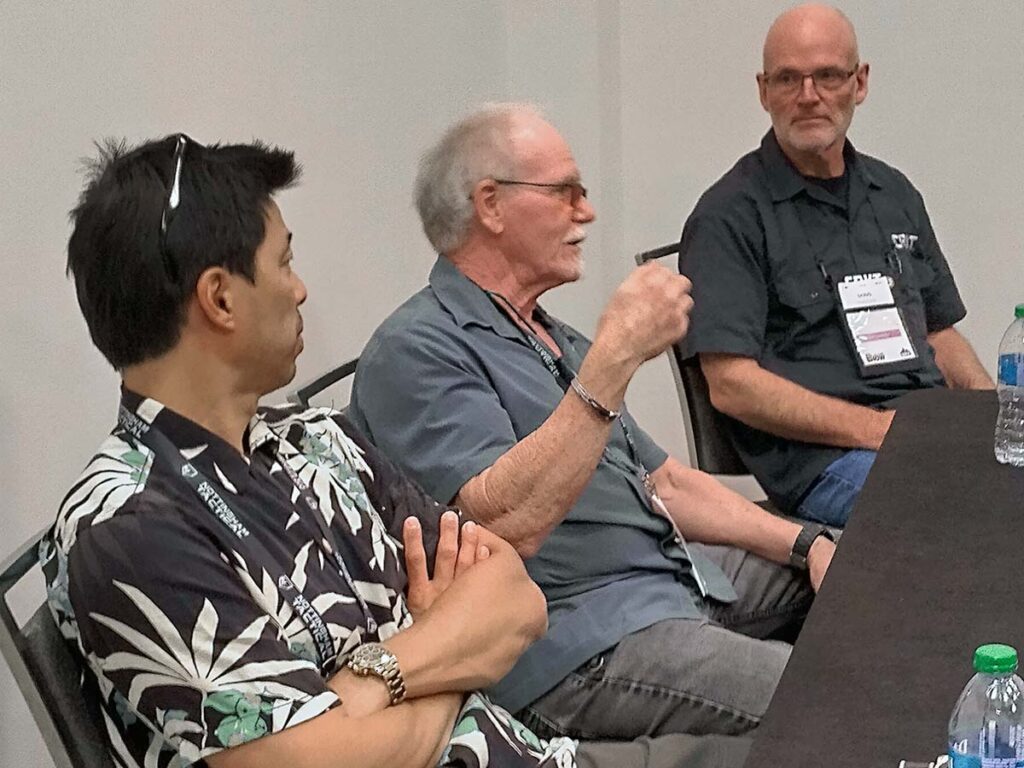
Appraising his career at the Solvang Show 2025, Michael believes two patents are his most significant—the Zipper blade and the blade lock folder. The Zipper is the process of fusing two different metals so a blade has a hard edge and a tough back. While the blade lock is a button lock, with the button situated on the blade and doubling as a thumb stud.
Walker’s first Zipper blade was made from 416 stainless steel with a Vascowear cutting edge. The two were Tig-welded together. Eventually, Michael began to use titanium for the spine, but as it could not be Tig-welded to steel, he used a wire EDM machine for the task. Generally, ATS-34 or 440C was used for the cutting edge on his Zipper blades. Over the years, he has used zirconium, with Walker pointing out that wire EDM can be used to mate most disparate metals. Of his Zippers, Walker’s “Sharktooth” is among his most desirable and his first to attain two patents, both for the composite blade and the blade lock design.
As for his blade lock, here’s my take on one of my favorite Walker designs. When you first hold it in your hand, there is an immediate connection. Typically made with a Damasteel frame, featuring multiple precious-metal inlays, it’s striking in appearance. The blade lock itself—typically fashioned from a rare metal—is simple, quick and silent. The blade grinds are always precise, and the work is as tight as a Swiss watch.
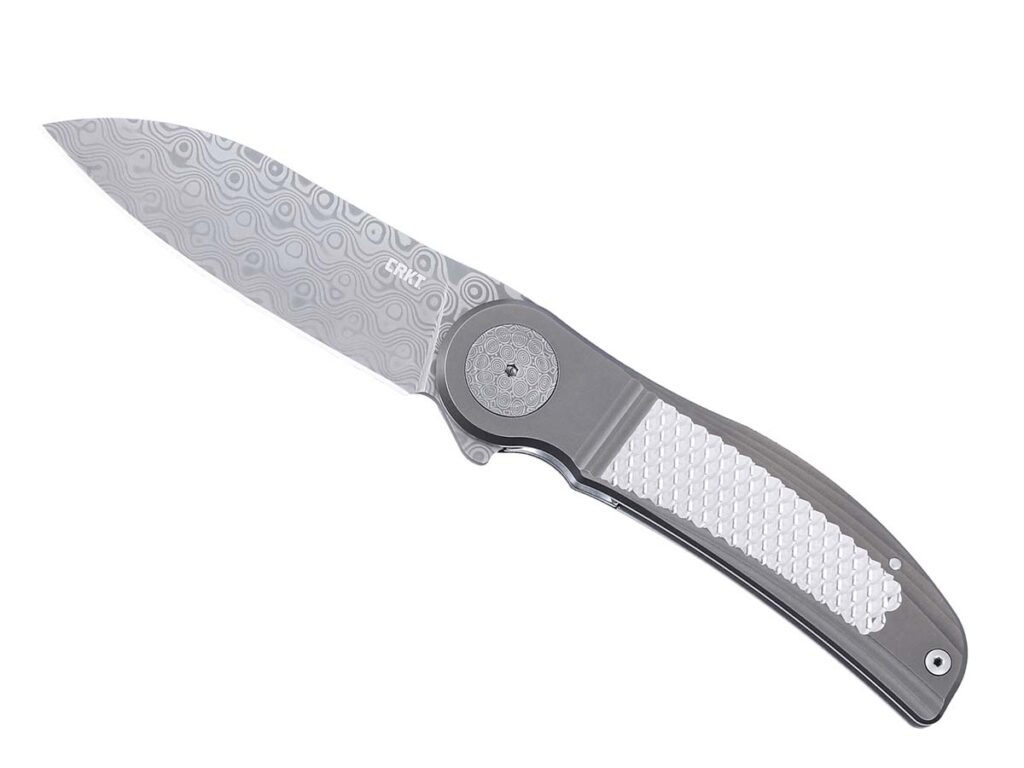
In addition to these advances in knife design, blade aficionados also have Walker to thank for the Crowbar Lock, Lake and Walker Knife Safety (designed in conjunction with Ron Lake), ball bearing lock, and Toughlock. It’s worth noting that many of these intriguing mechanisms can still be found in production knives by Spyderco, CRKT, Schrade, Boker and Klotzli.
Material And Design
Walker’s impact on knife engineering is undeniable, but shouldn’t overshadow his artistic flair. His initial tools when he first ventured into knifemaking were a belt grinder and jewelry-making tools. He may have upgraded his equipment over the years, but he never lost his jeweler’s eye in executing cutlery.
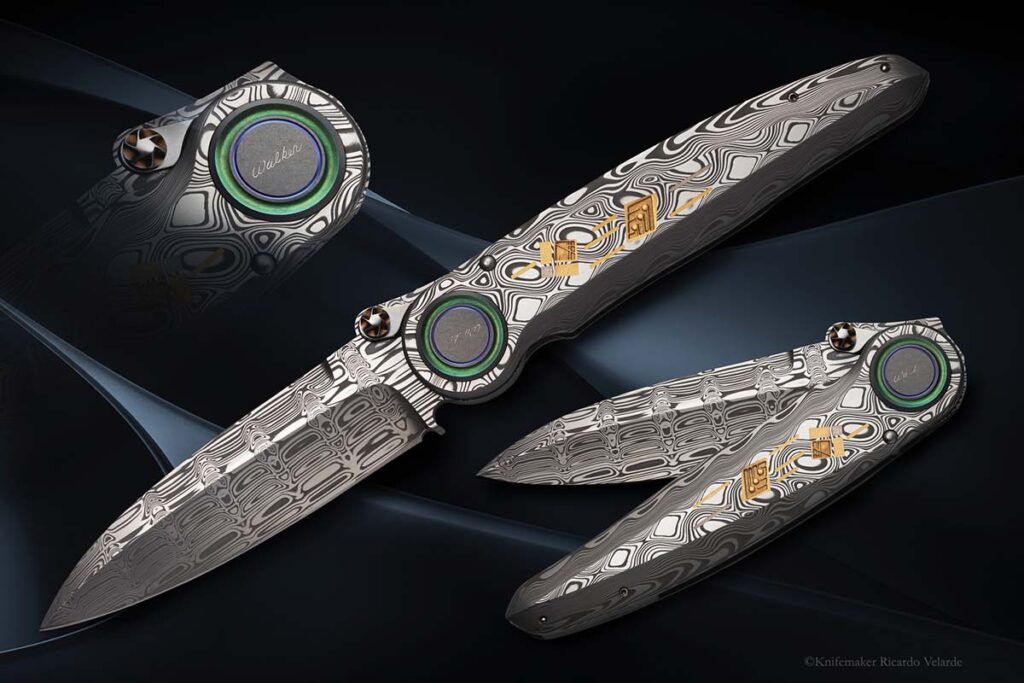
A defining moment for Walker came roughly in 1984, when he brought titanium and anodized titanium to custom knife making. His wife, Patricia, was using the material in her jewelry at the time and played a role in some of his earlier work. Michael said he did the solid anodizing of titanium elements (he credits Reactive Metal Studio for refining his skills), while his wife did the multicolored selective anodizing. Patricia’s contributions remain striking today.
Titanium brings up an interesting anecdote Michael relayed about those early years. Sans a phone in his home, his early business was conducted over a local pay phone—including acquiring 100 pounds of scrap titanium for the princely sum of $100. Anyhow, Michael poured quarters into the phone, attaining material, and laughingly said that it was tough to remain professional in the winter with the snow and wind blowing and the operator coming on the line to ask him to deposit more money.
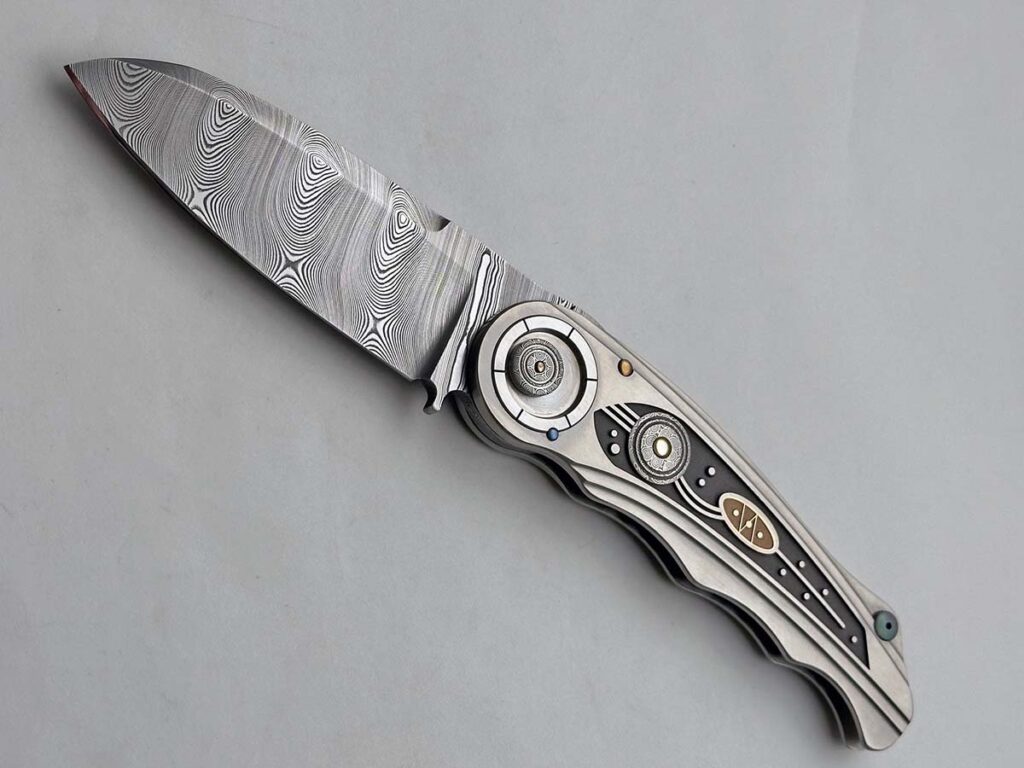
Material is far from the only defining aspect of Walker’s design language. The form of his knives is distinct and recognizable as a “Walker,” drawing from wellsprings of different influences and mentors. Among the most important, Walker chalks up Charles Loloma, an Indian jeweler and silversmith, who, Michael said, “really thought out of the box.” Frank Lloyd Wright and the Art Deco movement play undeniable roles in the development of his knife forms.
As for knifemaking mentors, Michael said he made his knives by trial and error and quickly learned from his mistakes. He joked, Joe Cordova signed his Knifemaker’s Guild sheet, but Joe made totally different knives than Michael, so he was not really a mentor. Those closest to him had an impact. Outside his initial customer base of friends and family, Walker pointed to retailer/collector Don Buchanan as playing an important role. Walker would bring his knives to Buchanan’s shop, and Don would give him his opinions on things to improve. Buchanan began to sell Walker’s knives and would keep the No. 1 from the lot and sell Nos. 2-10 of each model.
Collecting Walker
I have known Michael for many years. He is very interesting to talk to and approachable when you can find him behind the table at a knife show. I have been a fan and collector of his work for as long as I can remember. Seeing Michael and his knives at the late Phil Lobred’s Art Knife Invitational Show was as exciting as chatting with Bob Loveless or Bill Moran. When the greats of custom knifemaking are mentioned, Michael’s name certainly will be at the top or near it.
Any astute collector would be interested in the value of his creations. Will it hold its value? Can I resell when I need to? Early on, I saw Michael’s work moving for $3,000 plus. Not long after, those same style knives doubled. Michael’s Zipper folders climb from $12,000 to over $100,000 in an incredibly short period of time. Currently, a Michael Walker folder is not inexpensive. A nice Bladelock might run you close to $20,000. Rest assured that in time, and that could possibly be a very short time, there will be a buyer, and with some patience, you should be able to turn a nice profit. That said, I caution buyers to always select a knife based on its likability more than turning a quick profit. This goes for any knife!
Michael Walker will go down in history as one of the greatest knifemakers … ever. His remarkable talents, as well as his innovative lock designs, have revolutionized and invigorated the custom knife world.
Check Out More Cool Customs:
- Cool Custom: Jesse Hu’s Thorfinn Daggers
- Cool Custom: Stuart Kerr’s Cu Mai Dragon Is Built To Slay Beards
- Cool Custom: Robert Logan’s Tiny Fighter
- Cool Customs: Rocco Nawrocki’s Knife For Sergeant Bunker





