Home Knife Collecting

Knife Collecting

Knife collecting is an extremely rewarding experience for knife enthusiasts. There truly is a knife for everyone. Many increase or hold their value throughout the years, making collecting knives something to pass on to the next generation of knife collectors.

Cool Custom: Jon Christensen’s Mythical Undertaking

Guardian Sword proves a painstaking quest.

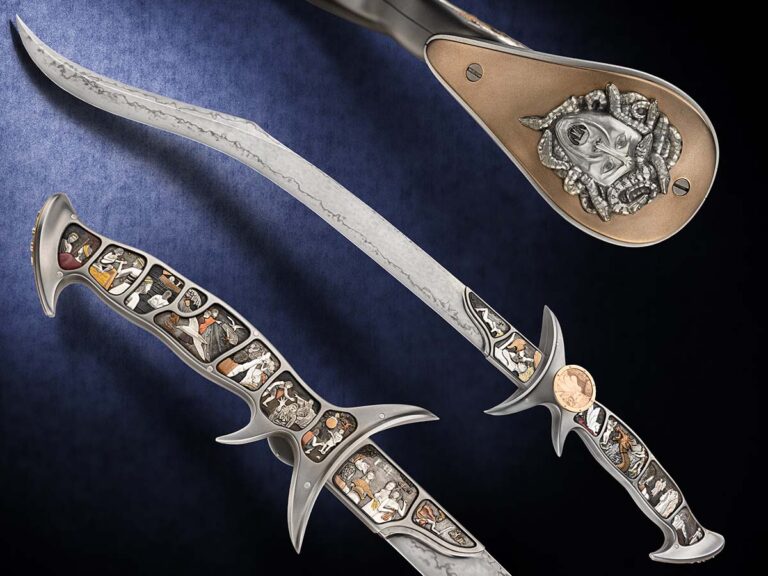
It’s easy to toss around the word epic and difficult to describe Jon Christensen’s recent work any other way. Of course, the subject material for his two-handed sword made it challenging for the results of the project to be anything other than mythical.

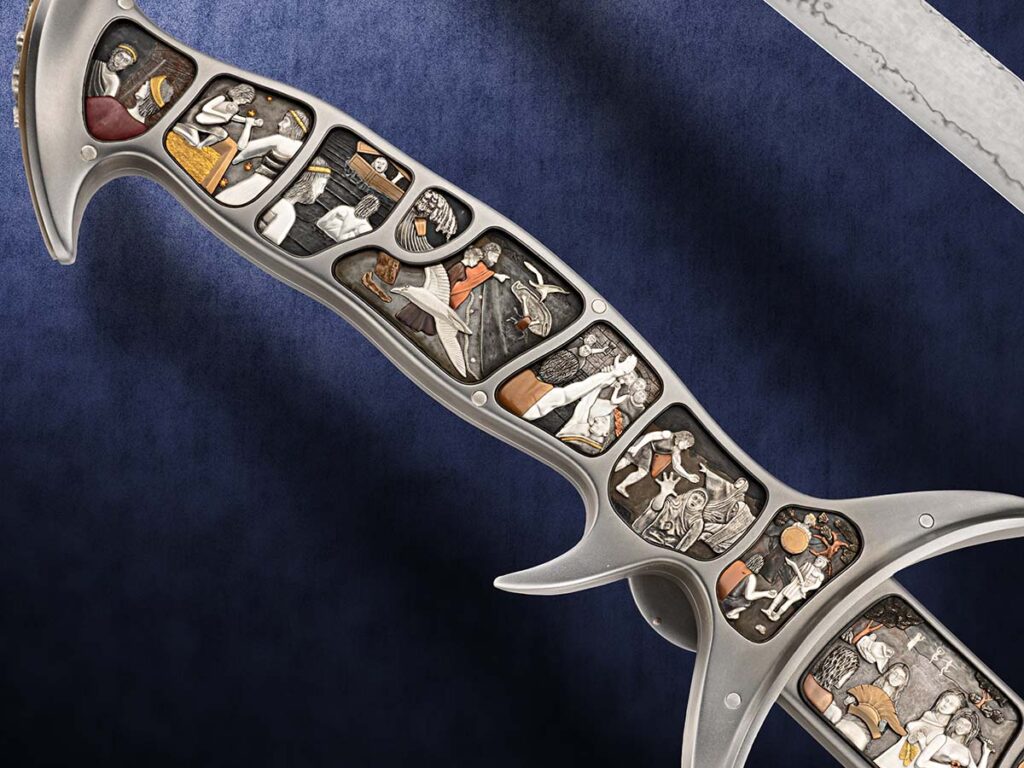
The Montana-based ABS master smith captures the ancient Greek myth of Perseus and Medusa in 16 hand-engraved iron panels inset into the 410SS handle and a bulino-engraved bronze shield on the guard of his Guardian Sword. Among other things, the handle features gold, bronze, copper, silver, custom alloy and mother-of-pearl inlay and is punctuated with Medusa’s head on the butt.

Jon Christensen
Jon Christensen

“The bulino engraving was very challenging as it was my first,” Christensen confessed. “There was a ‘paying my dues’ stage of time spent, which I just had to accept.”

It might be said that the entire project was an exercise in dues-paying. In addition to challenging himself with a new engraving technique, he was also delving into an unfamiliar subject. Christensen gave himself a crash course in the story of Medusa before conceptualizing the panels. But the client who commissioned the sword raised the bar on his retelling of the myth.

“Before starting on the project, the collector requested my interpretation of the story be approved by Tufts University, which is known for a strong program in classical mythology,” he said. “I compiled and submitted a document of the concept showing drawings and descriptions for each scene, as well as the overall sword. They replied saying, ‘It was a masterful interpretation.’”

The Guardian Sword handle, with the panels depicting the Greek myth of Perseus and Medusa.

The sword is reminiscent of the one featured in Benvenuto Cellini’s sculpture of Perseus, showcasing the same unique shape in its 37.5-inch W2 blade, with a hamon. While this aspect of the sword presented challenges, Christensen admits it was the easy part of the Guardian. Much of the 4,000 or so hours he dedicated to the work were focused on the handle, engravings and accurately retelling the ancient myth.

“The time on completing the blade would be measured in weeks, the handle scenes in years working under a microscope,” he said.
Epic, indeed.

“Yes, the scope of the project was very intimidating at times. I had to constantly manage my thoughts to the task at hand,” Christensen said. “As the saying goes, ‘How do you eat an elephant? One bite at a time.’”

Check Out More Cool Customs:

Military Knives: Historic Star-Spangled Steel

Few knives have served America more than those of the U.S. military.

Editor’s Note: This is the first of a two-part series on the most influential knives to serve the U.S. Military and explores some of the early influences on military knife design.

As what many call the greatest country in the history of countries approaches its 250th birthday, now’s a good time to salute some of the top knives that played pivotal military roles in the forging of the world beacon that is the United States of America.

It is, of course, impossible to recognize in one magazine story every single knife that played a crucial role in the many battles of the wars fought by the USA. However, with the help of some of the knife industry’s leading military authorities—including several of whom have seen the elephant in service to our nation—BLADE® will endeavor to touch on some of the more consequential knives of U.S. military history.

Before embarking on such a quest, the first task is to identify a basic group of the most indispensable knife types over two-and-a-half centuries of American land warfare. At the risk of omitting one or more, five stand out: bayonet, all-purpose utility fixed blade and/or bowie, dagger, machete/chopper and utility folder.

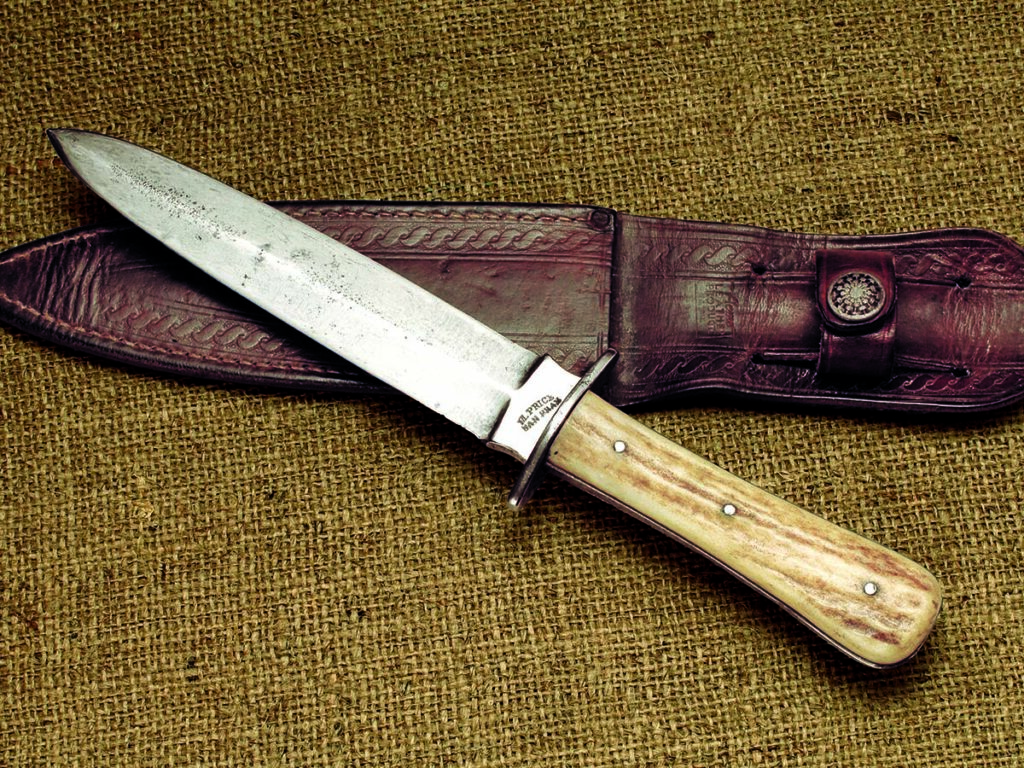
Michael Price recognized that to create a viable knife for self-defense and combat, form must follow function. His solution was to use the full-tang construction method, here on one of his classic mid-19th-century daggers. (Image courtesy of Louis Chow)

“These encapsulate everything that an infantryman used during the 250-year history of our country,” noted Louis Chow, a 24-year U.S. Army veteran who retired with the rank of major and is one of the leading collectors of the knives of BLADE Magazine Cutlery Hall-of-Fame® member Bob Loveless. “The bayonet, of course, from the get-go, from the Revolution to today.”

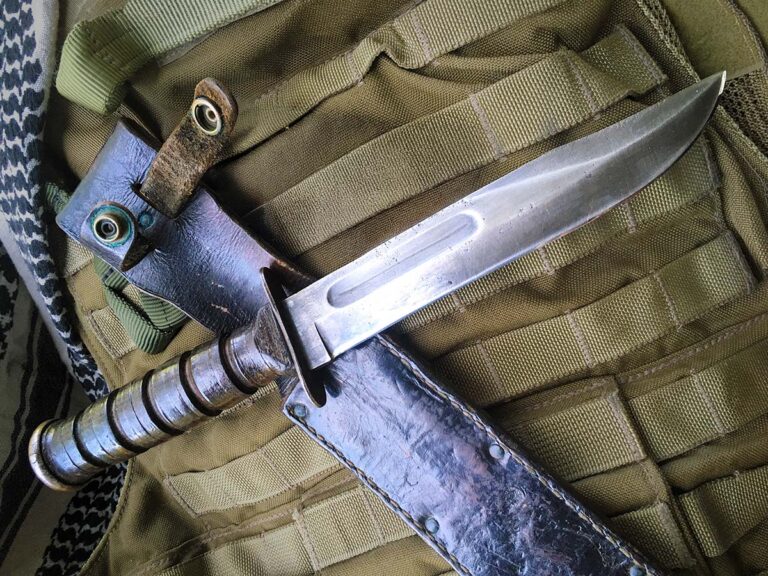
Louis indicated the all-purpose utility fixed blade/bowie could include privately purchased knives such as the Randall Model 1 and, of course, double-guard bowie types like the USMC fighting utility knife, aka the Ka-Bar. He pointed to the mid-19th-century designs of Michael Price as highly influential on daggers through to today, and machetes such as those made by Collins used in the Spanish-American War and before to Vietnam as vital to U.S. war efforts. Though pocketknives were indeed carried by American patriots during the Revolutionary War, the utility folders to which Louis referred are more of the modern Leatherman/Gerber multi-tool type, not to mention the Buck 110, Al Mar SERE, CRKT M-16 and others. As Louis noted, almost every soldier, male or female, in the modern military carries a multi-tool folder.

Many knife enthusiasts know that bayonets are rarely, if ever, used in combat today, nor have they been for well over a century. “It’s hard to actually find someone who used one in combat,” Louis said. Probably the most legendary American bayonet charge was the eminently successful one by Union forces led by Col. Joshua Chamberlain against Confederate troops down a hill called Little Round Top, a major turning point in the Battle of Gettysburg and, of course, the entire Civil War. Ironically, as Louis noted, “the most famous bayonet charge of all was the last one.”

While bayonets have rarely been used in American combat for many decades, that does not mean they do not remain significant teaching tools in today’s U.S. military. “When I was a company commander in 1990, we trained with the bayonet,” Louis recalled. “There are established bayonet courses on every installation, such as Fort Hood in Texas and Fort Benning in Georgia, and we would go there and train with the bayonet.” The rifles and bayonets have changed over the years but the bayonet training techniques remain the same.
Throughout U.S. and nearly all other nations’ histories, governments have been responsible for the issuance of combat knives in the form of bayonets for their infantry fighting forces. During World War II, the USA issued all-purpose fighters and utility knives to many soldiers, sailors and airmen. However, as Louis noted, privately purchased edged tools and weapons have always been the mainstay of our servicemen. During the earliest American conflicts, including the Revolutionary through the Civil Wars, kitchen, utility, farrier-forged and European-imported cutlery were the sidearms of the multitude of militiamen and patriotic volunteers.

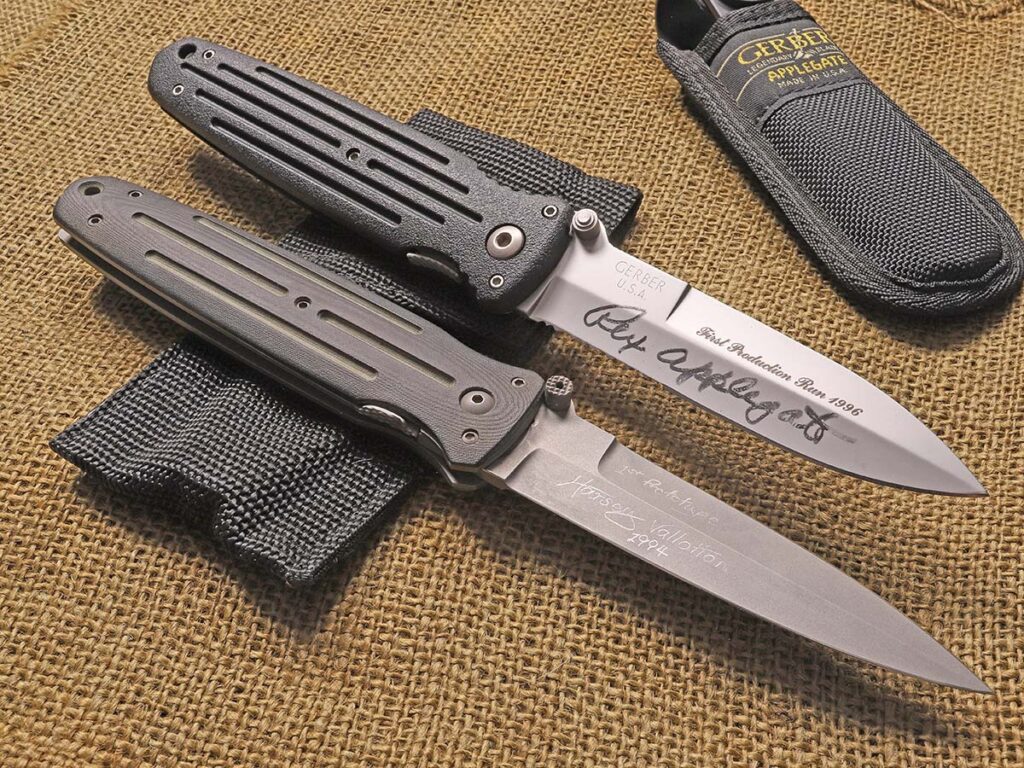
The original Applegate-Fairbairn Folder was a collaboration between Col. Rex Applegate and knifemakers Bill Harsey and Butch Vallotton. Harsey stated that a Gerber official said the Army ordered 50,000 of the knife at one time for the troops. At bottom is the original prototype and at top is a first-production Gerber version autographed by Applegate. (From the collection of Michael Janich)

The knife carried and made famous by Cutlery Hall-of-Famer James Bowie in the 1820s and 1830s was copied in various forms by makers worldwide and served as inspiration to any number of fixed blades carried in the U.S. military. Another large fixed blade that met with success in military circles was the Rifleman’s Knife made by the Ames Mfg. Co. circa 1860. Ames also made the Dahlgren Bowie Bayonet around the same time. Collins & Co. made a variety of bowies/machetes, the most famous probably being the No. 18, also incorrectly called the V-44 by many (according to D.E. Henry in his book Collins Machetes and Bowies 1845-1865, V-44 was the real name of a 1944 Case Survival Knife, not the No. 18).

Generational Blades

Circa the mid-19th century, Michael Price was considered one of the premier cutlers in the western United States. He was best known for exquisite presentation knives that incorporated marine ivory and a variety of beautiful shells. However, as Louis wrote, to create a viable knife for self-defense and combat, Price recognized that form must follow function. His solution was to use the full-tang construction method. And for a century and a half, some of the most notable American cutlers adopted the full-tang method that significantly improved a knife’s dependability and durability.

Early in 20th-century Michigan, Cutlery Hall-of-Famer William Scagel began forging axes and knives of various sizes and styles. He made most of his utility, hunting and bowie knives via the hidden-tang method. Though some of his combat knives were also hidden tang, many others employed the full-tang method.

“It was purported that the Scagel hidden-tang fighters with stacked leather washers were made for the European theater, while the full-tang fighters with wood-slab handles were made for the Pacific theater,” Louis wrote. “It was believed that stacked leather washers would be too susceptible to the humidity, high temperatures and salty air” of the applicable Pacific region. As a testament to Scagel’s outstanding craftsmanship and exceptional design, many of his fighters survived the war in good condition.

William Scagel’s hidden-tang fighters with stacked leather washers reportedly were made for the European theater during World War II, while the full-tang wood-slab fighters were made for the Pacific. The stacked leather washers were thought to be too susceptible to the humidity, high temperatures and salty air of the applicable Pacific region. (Image courtesy of Louis Chow)

In 1937, Cutlery Hall-of-Famer W.D. “Bo” Randall observed an older man scraping the bottom of a boat with a knife that appeared undamaged by the abuse. Intrigued by the improvised tool, Bo purchased it from the owner and contacted its maker, who just so happened to be Scagel. Randall eventually became Scagel’s student and soon opened his own shop, making Scagel-style knives.

“At the onset of World War II, Randall designed and produced some of the most recognizable combat knives ever made,” Louis stated. “Nonetheless, all were made with the hidden-tang method. It was not until the early 1960s that Randall introduced the full-tang Model 14-Attack and the Model 15-Airman combat knives.”
Continuing the generational theme, Cutlery Hall-of-Famer Bob Loveless read a magazine article about Randall knives in 1953. He corresponded with Bo and made his interpretations of Randall knives before experimenting with and then making his own full-tang models.

From the mid-1960s through the early ’70s, Loveless accepted many orders from service members awaiting assignment to Vietnam. He also received bulk orders from units stationed there. One bulk order in early March 1967 from a unit commander in the 1st Cavalry Division was for 37 fighting knives.

“The unit commander and his troopers were stationed in Saigon and were supporting Operation Junction City, one of the largest airmobile operations in the war,” Louis wrote. “As a patriot and former veteran himself, Loveless would temporarily halt all other orders and place top priority on knives destined for combat. As for those 37 fighters, he worked day and night and completed the order in less than a month. For the next four decades, the Loveless full-tang designs were copied and reinterpreted by countless knifemakers and knife companies in the United States and abroad.”

In addition to the foregoing cutlery legends, the full-tang method was also preferred by many other U.S. World War II knifemakers. Among them: Alfred Bimson, John Ek, Taylor Huff, A.R. Kephart, Kennedy Arms, Bob Riggs, Ernest Warther and Cutlery Hall-of-Famer M.H. Cole. Cole also authored the comprehensive U.S. Military Knives, Bayonets & Machetes series of books and has been dubbed the “Sage of Military Knives” by Cutlery Hall-of-Famer Bruce Voyles. Continuing Cole’s legacy is knifemaker/author Michael Silvey through his reproductions of Cole’s designs and his lavishly illustrated books on the knives of the United States military in World War II and Vietnam, and other works.

More On Military Knives:

U.S. Military Daggers: Blades That Have Taken Point

Daggers have struck home the U.S. military’s point from the trenches of Europe to the jungles of Vietnam.

Through the years, the military dagger has been considered an essential piece of equipment for the soldier on the ground and the pilot in the air. As a second line of defense, the dagger must be accessible and capable of quick deployment, not to mention efficient at its job.
As U.S. military personnel have gone into action, their choice of daggers provides a window into their operational history and a view of their actual aptitude when seconds count. Design and dexterity are hallmarks of dagger use in the heat of a life-and-death situation, and these storied weapons of war have gained their place in the annals of close combat.

“A good friend of mine was a chopper pilot in Vietnam,” recalled BLADE® Magazine field editor Kim Breed. “The pilots carried the Gerber MK II upside down on their flight vests. When he was shot down, he and his crew chief went through their ammo; then they drew their daggers while they waited for pickup. They locked onto the enemy, rammed them through the side [with their daggers] and hung on. Then they took [the enemy’s] AK-47s away from them and got back into the fight. They defended themselves while Cobra gunships laid down suppressing fire and a rescue bird, a Huey, came and got them.”

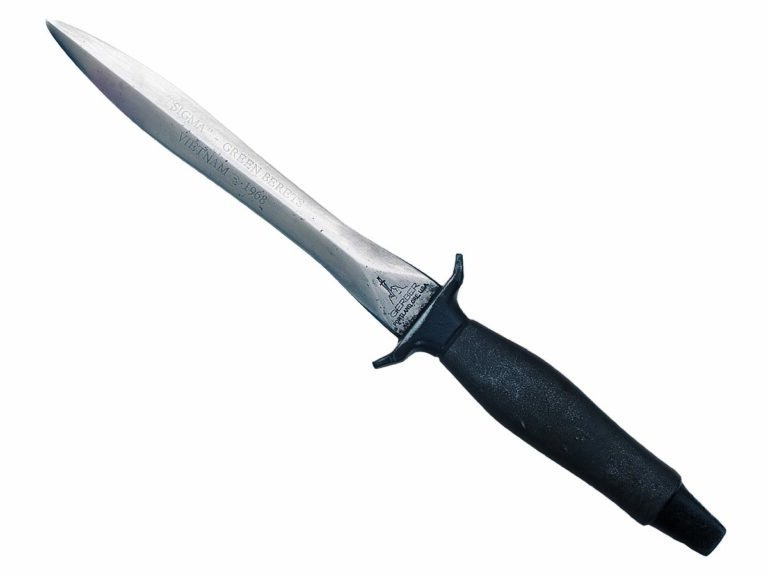
Kim’s comrades might well have been killed in the melee had they not had their Gerber Mk II daggers when needed. Designed by Clarence “Bud” Holzmann, the knife gained legendary status during the Vietnam War, and though it was not standard issue, the Gerber Mk II was popular with U.S. troops—from airmen to special forces and everything in between. The wasp-waisted blade of the original remains a symbol of the close combat sometimes experienced in Southeast Asia, while its intimidation factor led to a redesign for the consumer market.

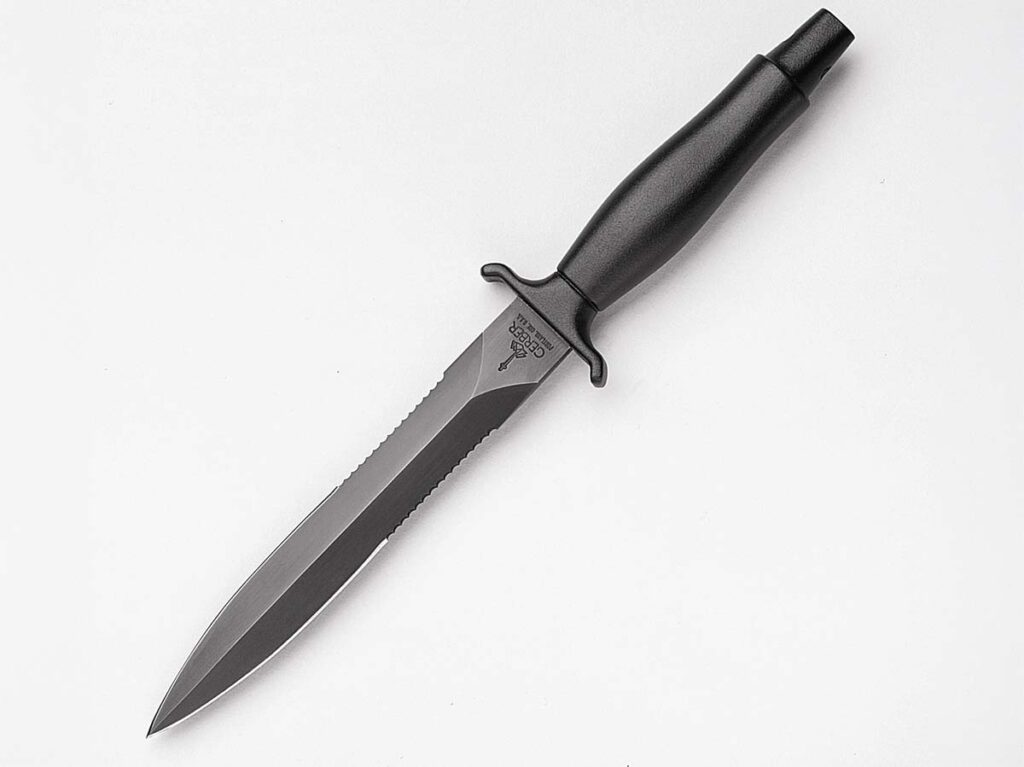
Later variants of the MK II included saw teeth, a feature added by Al Mar, who worked at Gerber at the time. This allowed the company to market it as a survival knife, not a fighting knife. Sporting goods stores and PXs were more likely to sell the latter. (Les George image)

“It was designed the same as the [original] Mk II except it had serrations on both sides. The serrations might be considered a weak point,” Breed explained. “They had cast aluminum handles and a little thinner blade with that wasp waist. When you actually penetrated something, [the waist] helped along with a bit of extra weight up front.”

While the original Mk II may have been a stronger choice back in the day, the serrated Mk II is also a sought-after collectible. A knifemaker, Kim relates some owners have asked him to grind the serrations completely off this Gerber dagger. He declined to do so.
One more story Kim recounts is of a friend who found himself in hand-to-hand combat during a recon deployment in Vietnam. A Viet Cong patrol was walking past, and the last man in their line spotted the Americans in their cover. “Rather than alerting the whole enemy patrol, my friend took the last man down and used his knife,” said Breed.

Regarding the Mk II, knifemaker Les George added, “Al Mar was a designer at Gerber at the time and he added ‘saw teeth’ to the blade to make it a survival knife. The PX was happy to sell it as such since they didn’t want to sell a ‘fighting knife.’”

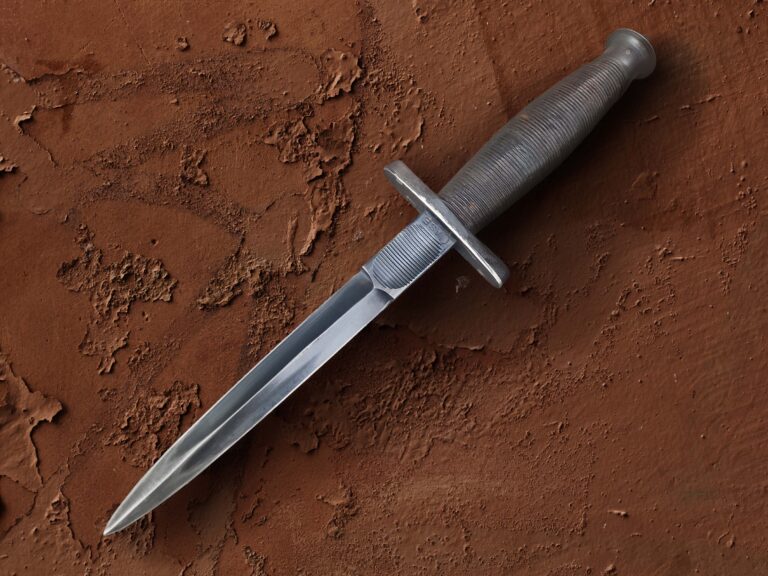
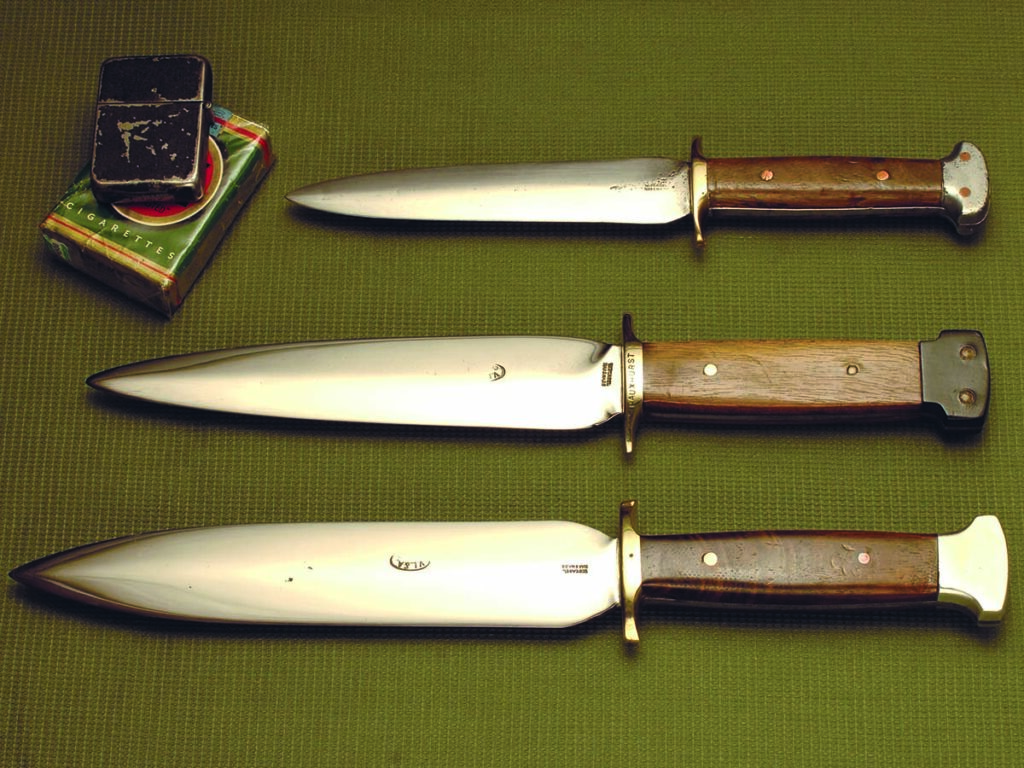
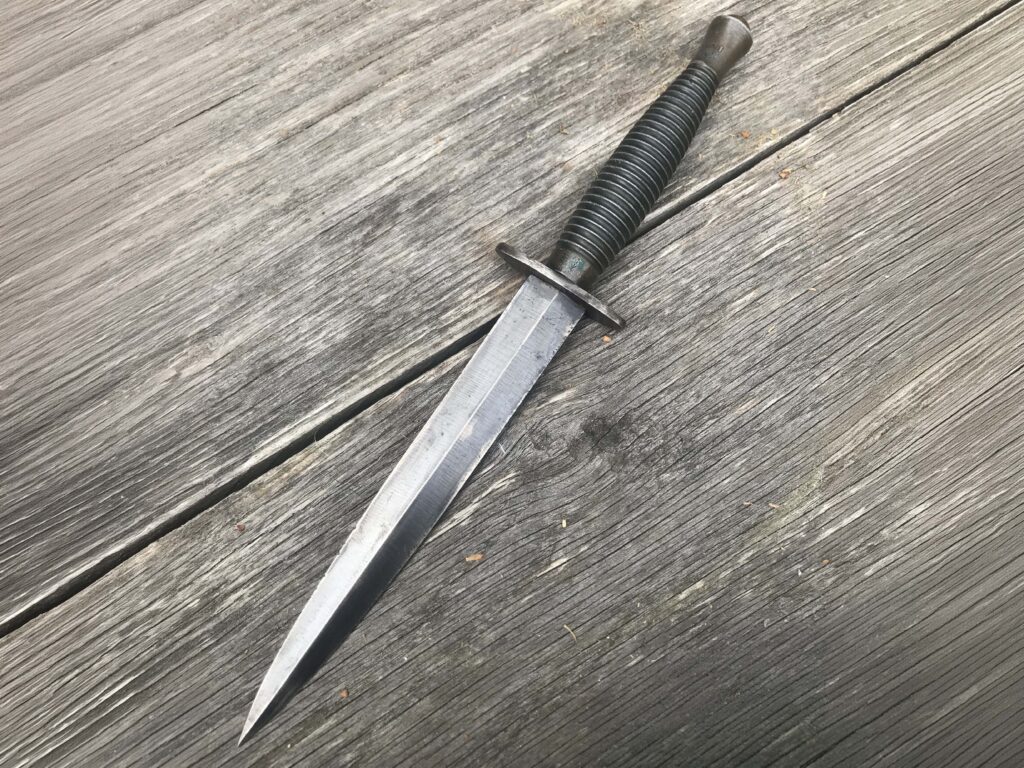
A great many modern military daggers trace their roots back to the legendary English Fairbairn-Sykes dagger. The one pictured is a third-pattern variant with a ring grip. (Les George image)

Industry veteran Bill Harsey also tells a story of combat survival with the Gerber Mk II in Vietnam. “I heard from a Medal of Honor recipient over dinner that his team was overrun by enemy combatants. In close-quarter combat, he drew his knife and stuck it in an enemy soldier. The knife stuck. Even with both hands he couldn’t withdraw it. I have no idea why the knife stuck and he didn’t offer any thoughts. But just to be careful, we have never made a wasp-waisted blade.”

Fairbairn-Sykes And Beyond

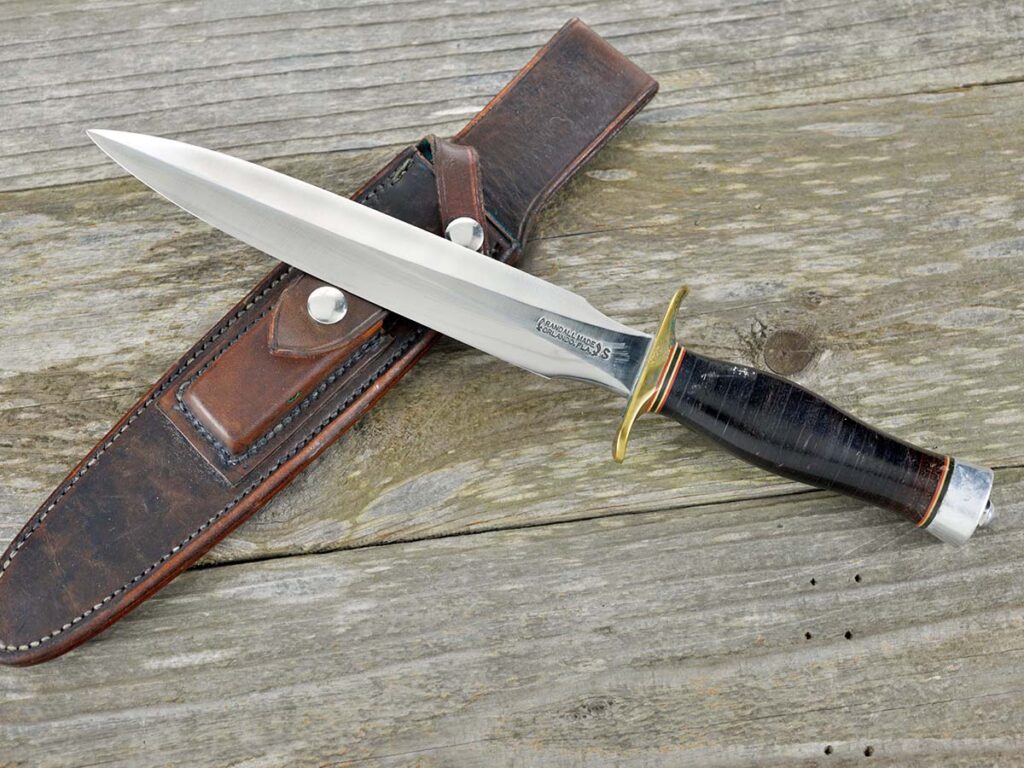
The Randall Knives Model 2 Fighting Stiletto bears the name of one of the most famous knifemakers in history and was developed as a robust alternative to the legendary Fairbairn-Sykes dagger. Randall has gone to war with several memorable designs, and according to Breed, the Model 2 is one of the best remembered.

“The blade is a little wider than the well-known Fairbairn-Sykes dagger,” said Kim. “The Randall was more handle-heavy, with only about a 5-inch blade, as I remember. It feels good in the hand. The guard is not sharp on the fingers, which was a challenge with some of the others. Any Randall daggers are collectible, just like Randalls in general. They didn’t make many of them. The Model 2, to me, is a cross between the Fairbairn-Sykes and the V-42 with a leather stack handle.”

The Randall Knives Model 2 bears the name of one of the most famous knifemakers in history—Bo Randall—and was developed as a robust alternative to the legendary Fairbairn-Sykes dagger. (Les George image)

The Marine Raider Stiletto remains a classic weapon of the World War II era, and it is said to have been the first Marine knife in the Corps’ history designed by a Marine, designed by Lieutenant Colonel Clifford H. Shuey. The story goes that this dagger was developed because the elite Raiders specifically requested a knife for close fighting.

Les offered some observations concerning the Marine Raider stiletto’s proper mission. “When the Marines were issued the Raider Stiletto in World War II, they had been specifically told not to pry with them or throw them,” he said. “So, obviously, they threw them at the first tree they could find and broke the tips off many of those knives.

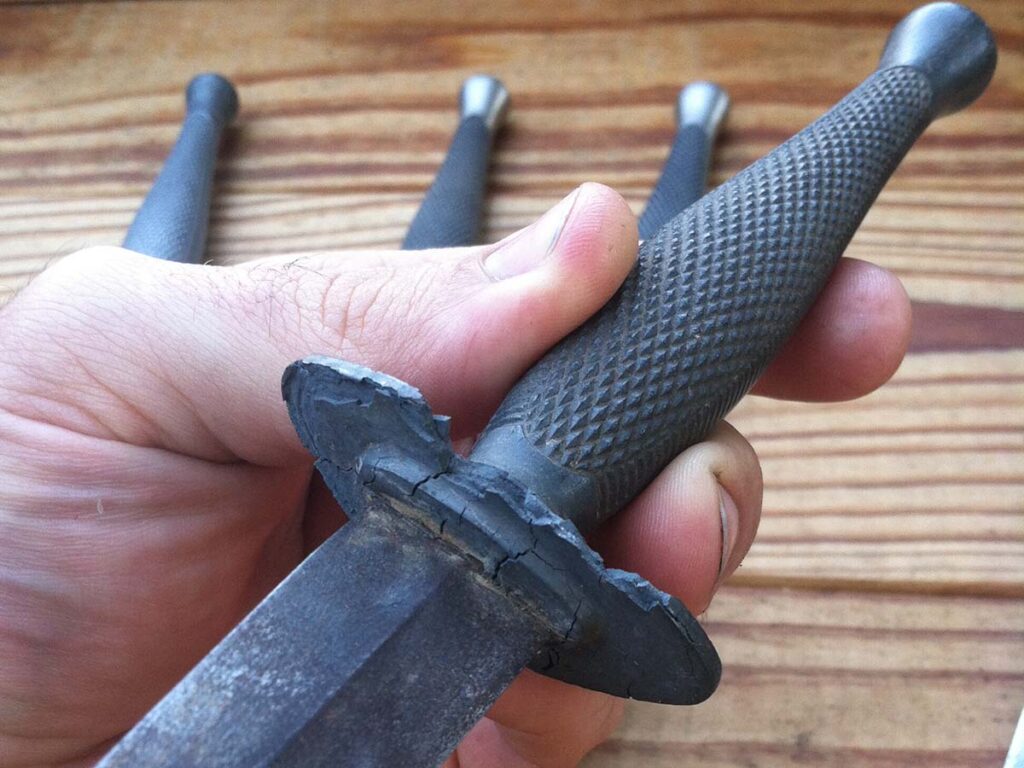
“I think the Marine Raider Stiletto has the best handle design of all the many knives derived from the Fairbairn-Sykes daggers,” George continued. “It’s not just round. It has features and a shape allowing the blade to be indexed by feel. But the blade is very thin, the tip was fragile and the metal that they cast the handles out of reacts with air. They are all disintegrating. Eventually, we will lose them all.”

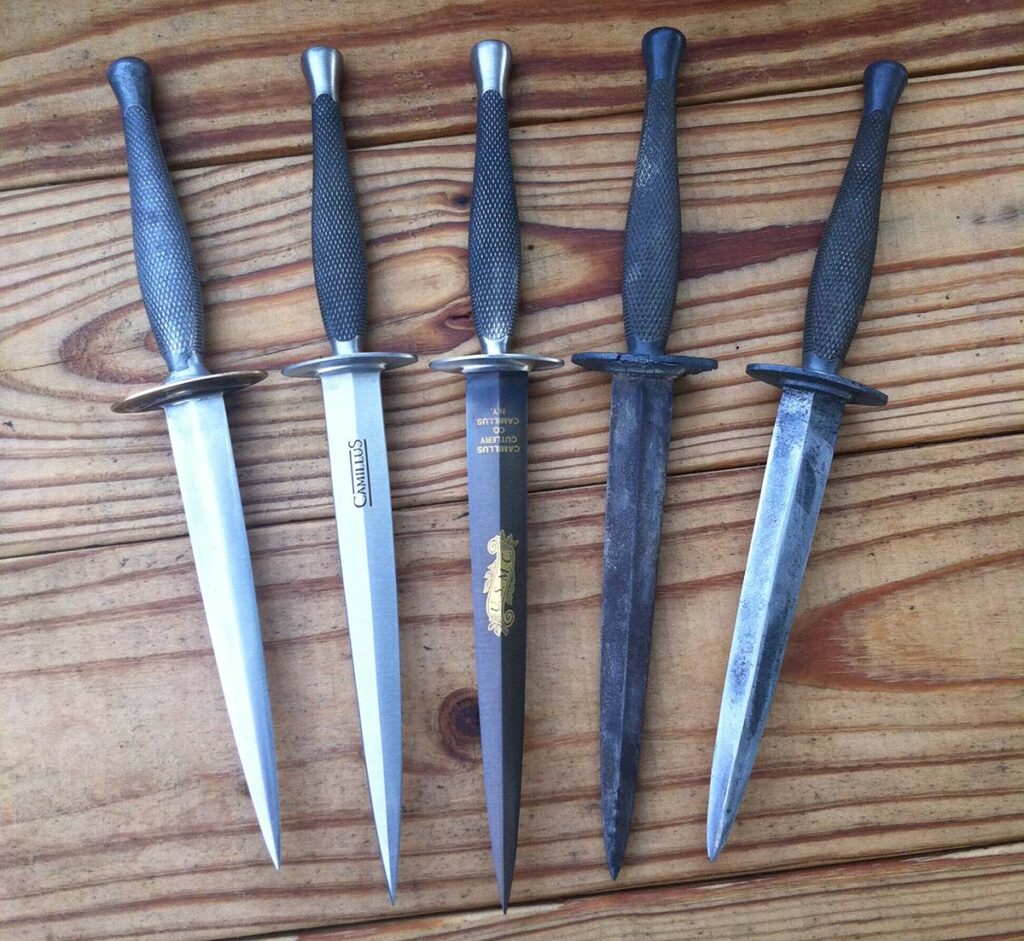
Knifemaker and military dagger aficionado Les George is a fan of the Marine Raider stiletto, seen by his collection of the dagger—new and old. (Les George image)

The handle of the Camillus-made Marine Raider Stiletto was fashioned with a die-cast zinc alloy, while the 7- to 7 ½-inch blade was made of blued or bright steel. The overall feel of the stiletto was hilt-heavy for optimal balance.

“The Marine Raider Stiletto has probably the smallest group of collectors since it primarily appeals to Marines,” commented George. “The rest can be categorized in different ways and have broader appeal. These knives and their more modern counterparts may not find their way to the battlefield as a matter of course, but the history they represent is invaluable.”

Knuckled Under

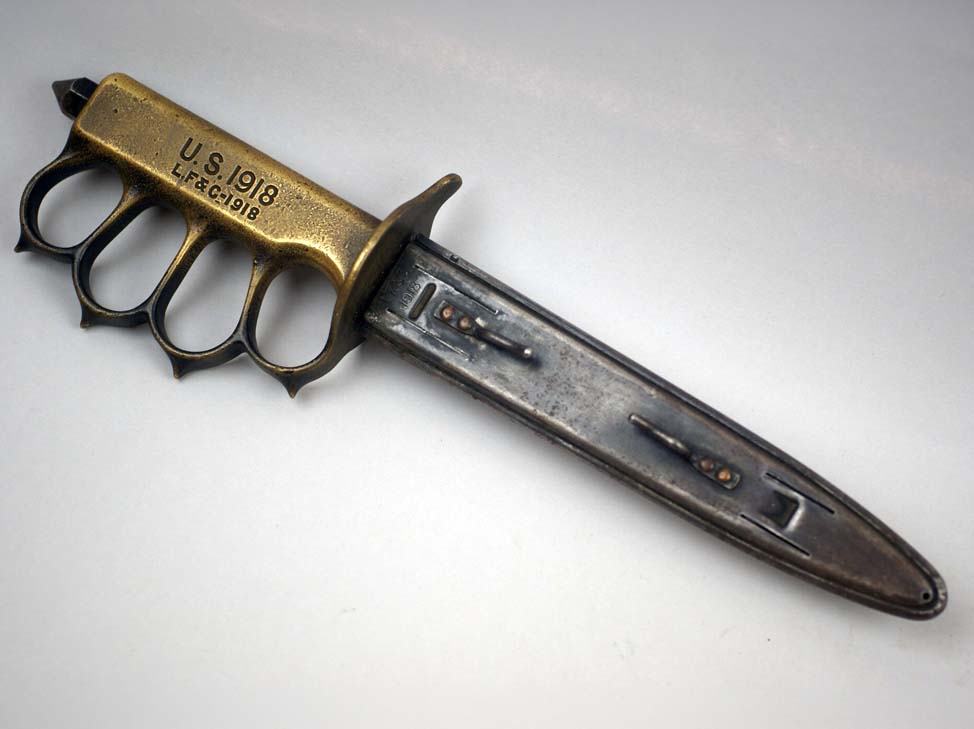
Les includes the iconic M1918 trench knife among those favored few military daggers carried in wartime by American soldiers. Its design was based on the French M1916 Avenger, and the military held field trials after initial 1917 and early 1918 variants were found inadequate. The M1918 was first made by Landers, Frary & Clark, a housewares and hardware company, production was later increased with Oneida, Henry Disston & Sons and the French manufacturer Au Lion.

George considers the knife's handle the best designed of all the Fairbairn-Sykes derivatives. Unfortunately, this is also the dagger’s weak point as the metal used for the handle reacts with the air and disintegrates. (Les George image)
George considers the knife’s handle the best designed of all the Fairbairn-Sykes derivatives. Unfortunately, this is also the dagger’s weak point as the metal used for the handle reacts with the air and disintegrates. (Les George image)

“The LF&C M1918 trench knife did not see action in World War I,” George explains. “It was made for that war, but it ended before the knives made it to Europe. A lot of them were melted down to reuse the handle material. When the Japanese attacked Pearl Harbor, they were the only knives in the system available to be issued to Marines … The M1918 saw use in World War II, Korea and Vietnam. I’m not aware of any combat use of the knife since then, but it is possible.”

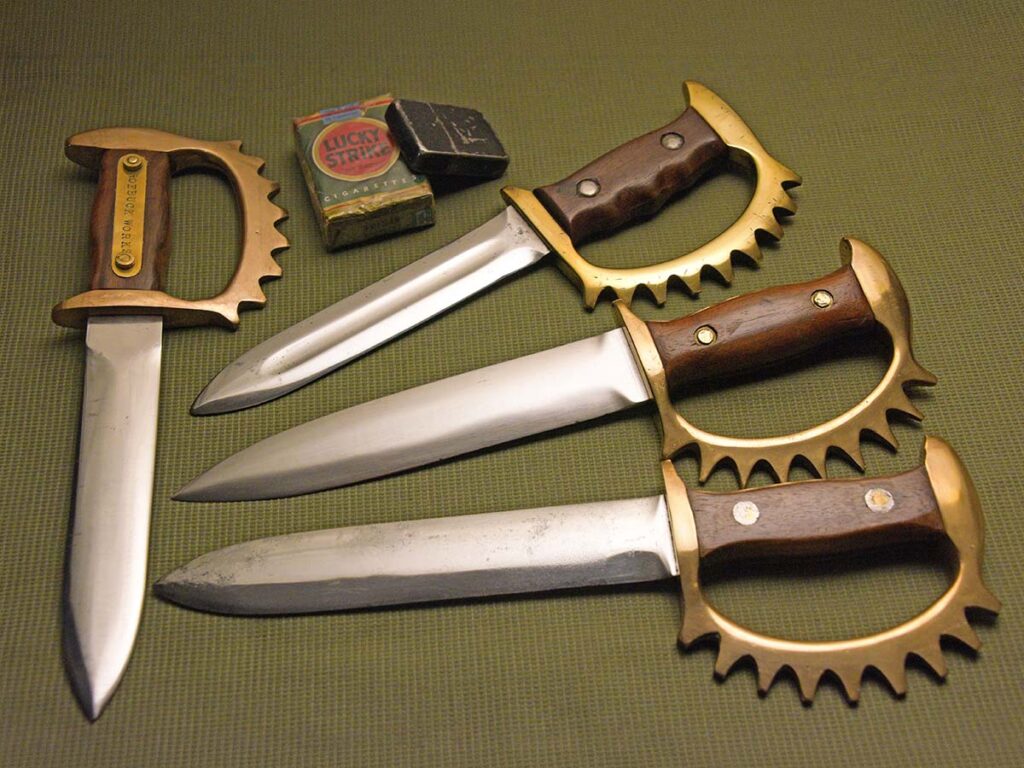
The M1918 is distinctive with its integrated cast brass handle and brass knuckle grip designed for close combat, along with small spikes on the finger bows and a skull crusher pommel. The medium carbon steel blade has been criticized at times for being brittle, but nevertheless the knife is recognized as formidable in a hand-to-hand brawl.

“The M1918 was designed to be an effective tool for close fighting,” observed Breed. “With a positive grip and the brass knuckle guard, you didn’t have to stab, or you could hit your opponent with the skull crusher. There were dozens of confirmed kills with this dagger. It was not recommended to dig with them because they were prone to breakage or ‘bendage.’ You could drive that big brass handle into the dirt, but that half shaft that came down from the blade was short on steel and weakened the knife around the tang.”
The eye appeal of the M1918 makes the dagger collectible. “It’s pretty popular and one of the iconic knives of its type,” Kim concluded.

Many think of the M1918 as the quintessential World War I trench knife, though the variant didn't see action in that conflict, adopted too late. Based on the French M1916 Avenger, it was meant to replace the 1917 and early 1918 variants, which were found inadequate. (Les George image)
Many think of the M1918 as the quintessential World War I trench knife, though the variant didn’t see action in that conflict, adopted too late. Based on the French M1916 Avenger, it was meant to replace the 1917 and early 1918 variants, which were found inadequate. (Les George image)

Representative of the fighting men who carried them into harm’s way, these U.S. military daggers of the 20th century continue to fascinate with their double-edge blade, balanced feel and handle characteristics. Their place in history is secure, while collectors and knife industry veterans are doing their best to preserve and retell the stories that surround them.

More On Military Knives:

Custom Cleavers That Have Culinary Chops

Four custom makers push the boundaries of the tried-and-true cleaver.

An inclination toward the kitchen and a desire to design and deliver cutlery used on a regular basis has spurred a number of custom knifemakers to try their skill with the cleaver. It’s a staple in most kitchens and its uses are as varied as the food prepared there.

Robert Wayman of Middleburgh, New York, sees his cleavers as complementing years of food preparation. “I’ve done a lot of my own food processing, and I spent several years in commercial kitchens when I was younger,” he commented. “So, I’ve always had an affinity for culinary knives and especially cleavers. The cleaver is such an iconic blade. I love to make everything from heavy-duty butcher cleavers to medium-duty kitchen cleavers, Chinese cleavers and lighter-duty veggie cleavers for the kitchen.”

Robert’s featured cleaver is 14 inches in overall length with an 8-inch blade of pattern damascus go-mai five-layer steel. The core is a 100-layer random pattern damascus made of 1084 and 15N20 high-carbon steel and a layer of nickel and matching damascus cladding. The handle includes a damascus collar, stainless steel and G-10 spacers, crosscut carbon fiber, green malachite and blue coral accents, stabilized amboyna burl and a damascus butt cap with stainless mounting pins inset with blue coral framed with green malachite.

“I packed a lot into that one,” Wayman smiled. “As a maker, I’m all about sole authorship. I make all of my own high-carbon damascus steel in-house, and a cleaver provides a great opportunity to showcase that steel. One of my favorite things to forge is a large cleaver with an integral bolster.”

Wayman sees large blades, such as those associated with cleavers, as inherently challenging, while making a task-specific blade, such as a cleaver, adds another layer of complexity. Although they are labor-intensive and involve a lot of time in the shop, performance remains the key.

 “Overall weight needs to be taken into consideration, as well as how that weight is distributed for the style cleaver you are making,” Robert advised. “Ergonomics is an important consideration for any knife or tool, but especially for kitchen cutlery. Whether it’s in a professional or home kitchen, you’re making a handle that a chef or cook could use for hours of food prep on any given day. So, it must be comfortable.”

Edgy Ebony

Having served time in professional food service, practical utility is never far from David Jacobson’s mind. However, he isn’t afraid of adding some flourish to his creations, such as the gold-inlay signature near the spine of his mosaic damascus bladed and ebony scaled cleaver. (SharpByCoop image)

David Jacobson’s integral 13-inch cleaver with ebony handle scales sports an 8¼-inch mosaic damascus blade of 1085 and 15N20 steels and a gold inlay signature—his first such accent. He used brass bolt pins to finish the ebony scale attachment.

“I love cooking and making cool chef’s knives and kitchen tools,” Jacobson related from his Felton, California, shop. “Edge geometry for chopping and balance are challenges, and fullers are nice when slicing vegetables for food release. Cleavers are not only for the kitchen. They are great for large fish processing at the dock, chopping through bone and restaurant back-alley butchering. The wide blade shows off the many designs in the damascus steel, and I chose a traditional profile for this particular cleaver. I’ve always liked a black handle with big brass pins—old school.”

Cutting Mustard

Given the amount of steel and the need to pay attention to minutia is what Bill Tyc figures steers most makers away from cleavers. Tyc achieves an intricate pattern on his cleaver-chef’s knife set through a simple mustard patina, but applied with a straight edge for a pattern he calls “Lines of Insanity.” (SharpByCoop image)

The pairing in Bill Tyc’s featured ensemble is stunning in its presentation. “The cleaver as well as the chef’s knife are made of 52100 high carbon steel from the NJ Steel Baron,” he remarked. “The handles are stabilized spalted tamarind from Wood Dynamics fastened with brass Corby bolts. The pattern on the steel is a mustard patina done with a ruler edge, hence the name “Lines of Insanity” pattern. The cleaver is 11½ inches overall with a 6¼-inch blade. It’s 3 inches tall and ¾ inches at the heel. I felt the spalted lines of the tamarind wood would look perfect with the mustard patina.”

Tyc, who resides in Waterbury, Connecticut, remembers making kitchen knives that did something no other creations had generated. He got immediate feedback from users.

“In fact, the first ‘kitchen’ knife I sold was a cleaver at the Mystic Knife Show in Connecticut,” Bill remembered. “A gentleman circled the floor three times, every time touching a cleaver I had on the table. Last pass, he picks it up and just says, ‘I’ll take it.’ My wife and I look at each other with a thumbs up, and off he goes. Well, the following year, the gentleman comes into the show, right up to my table, and says, ‘Last year I bought a cleaver from you.’ The wife and I again look at each other because we most certainly remembered. He says, ‘I have so much fun using that cleaver every day!’ I reached across the table, shook his hand and said, ‘I’ve been waiting 20 years to hear that! I could pack up and go home, I feel so good.’”

According to Tyc, many custom knifemakers shy away from cleavers because they require a lot of work. At just about any knife show, only a relative few are seen for sale. But he adds cleavers’ utility far exceeds their supposed kitchen niche, pointing out they are handy for camping, survival exercise, yard work and bushcraft as well.

“The most important things are balance and weight,” Bill observed. “A knife used as often as a kitchen knife or cleaver has to feel good in the hand, not just initially, but long term. You may find yourself using your kitchen knives for many hours through the week. You want it to be comfortable, not a labor.”

Veggies Beware

One of the unique advantages of the cleaver, Dan Tomplins points out, is the large canvas it allows for the steel. In the case of his nakiri—vegetable cleaver—its 81/2-inch copper mai blade can’t help but catch the eye, particularly with the steel’s blacked-out finish enhancing the patina'd copper. Note too, the hybrid octagonal/western-style handle made from amboyna burl. (SharpByCoop image)
One of the unique advantages of the cleaver, Dan Tomplins points out, is the large canvas it allows for the steel. In the case of his nakiri—vegetable cleaver—its 81/2-inch copper mai blade can’t help but catch the eye, particularly with the steel’s blacked-out finish enhancing the patina’d copper. Note too, the hybrid octagonal/western-style handle made from amboyna burl. (SharpByCoop image)

In 2016, Dan Tompkins began making knives, and three years later, he started Evolution Cutlery in Highland, New York. His kitchen knife work began simply because he wanted to make cutlery used on a daily basis, and his cleaver immediately attracts attention.

“The big square profile is a great canvas to show forging skills, especially if using mosaic damascus. It allows a lot of room to see the details in the patterning,” said Dan. The subject steel is Baker Forge copper mai with a blacked-out finish and layers of patina’d copper in the nakiri, or veggie cleaver, design. The handle is Tompkins’ hybrid octagonal/western style made from amboyna burl, heirloom fit to a copper and G-10 bolster. The cleaver blade measures 8½ inches, and the overall length is 13 inches.

“One challenge in making cleavers is getting the edge geometry perfect for the intended purpose,” explained Dan. “There are many different types of cleavers, so the proper geometry is an important consideration. Heavy-duty blades require a heavy convex edge, while veggie cleavers are best with a laser-thin edge. When it comes to kitchen knife ergonomics, not only do you have to have a good feel in the handle’s shape and contour, but you also have to have proper balance to make the knife comfortable to use all day. While cleavers will almost always be slightly blade heavy in balance, they should still be balanced not far in front of the handle … Balance can make a light knife feel heavy or a heavy knife feel light. In my opinion, even a heavy knife with proper balance is far more comfortable to use than a light knife with improper balance.”

 Tompkins sees the cleaver in action in varied settings, not just the kitchen. Camp chores like chopping wood or preparing food outdoors can be handled easily with a cleaver made for such adventures, and he makes the cleaver to fit the anticipated tasks.

Versatility is readily apparent in these custom cleavers, and their functionality is in lockstep with good looks driven by their makers’ creativity.

Check Out More Cool Customs:

Custom Gallery: Customs That Demonstrate Martial Mastery

From historic clashes to modern conflict, these fierce custom blades prove there is still a profound amount of art in the tools of war.

Since the dawn of man, the edge of the blade has been used to hash out disputes between everything from clans and tribes all the way to nations. While not the main battle implement in today’s conflict, the martial nature of the knife remains. This particular collection of fierce customs demonstrates there is a heap of art in war.


Caleb Ledford Long Sword

Caleb Ledford Long Sword

An electric 1084/15N20/mild steel Turkish-twist damascus defines the 31-inch blade of Caleb Ledford’s long sword. Lightening the sizable slicer’s load is a tapered fuller running on its midline. The handle is a pitch-black ebony, and the guard and pommel are cold-blued mild steel.


Jacco Van de Bruinhorst San Francisco Bowie

Jacco Van de Bruinhorst San Francisco Bowie

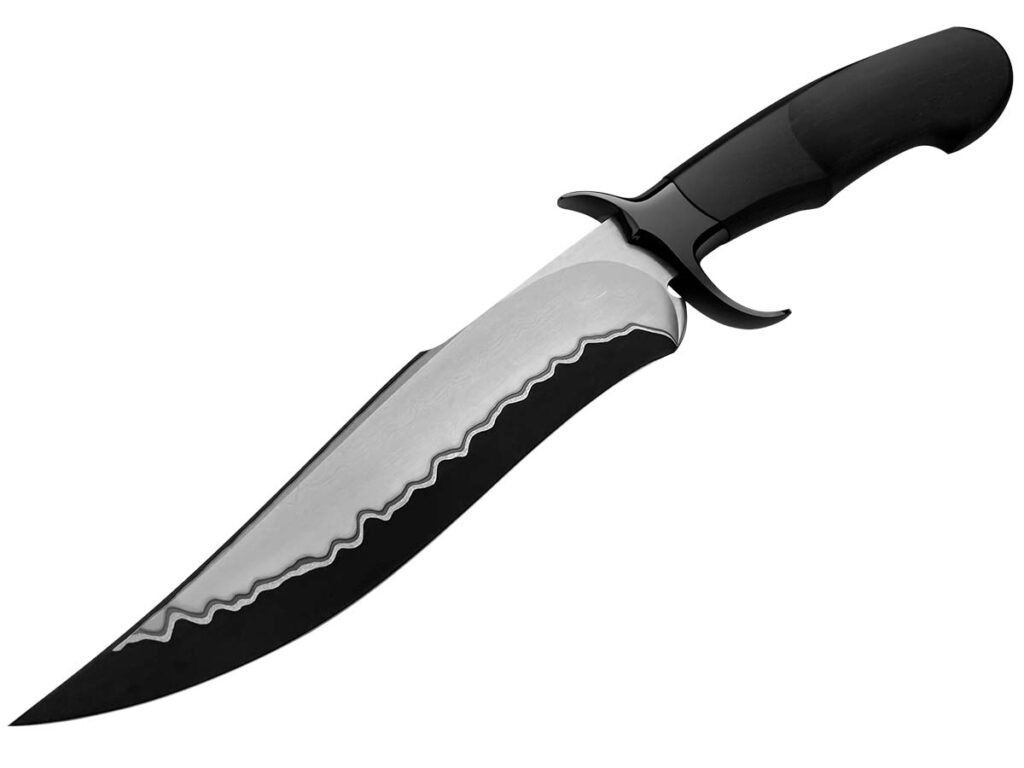
With matching blade and inserts, Jacco Van de Bruinhorst’s take on the San Francisco bowie is an elegant Barbary Coast brawler. The Canadian maker used ProCut/1084 to create what he calls a “snakeskin pattern.” If you study closely, the inserts harken back to the gold rush days with 24k gold inlay.


Jim Poling Dirk

Jim Poling Dirk

Commissioned by a descendant of King James IV of Scotland, journeyman smith Jim Poling’s walnut-handled dirk appears freshly plucked from the highlands. The dagger boasts a 13-inch 1084/15N20 twist damascus blade, antiqued mild steel fittings and coin-edged nickel spacers.


Andrew Blomfield Pesh Kabz

Andrew Blomfield Pesh Kabz

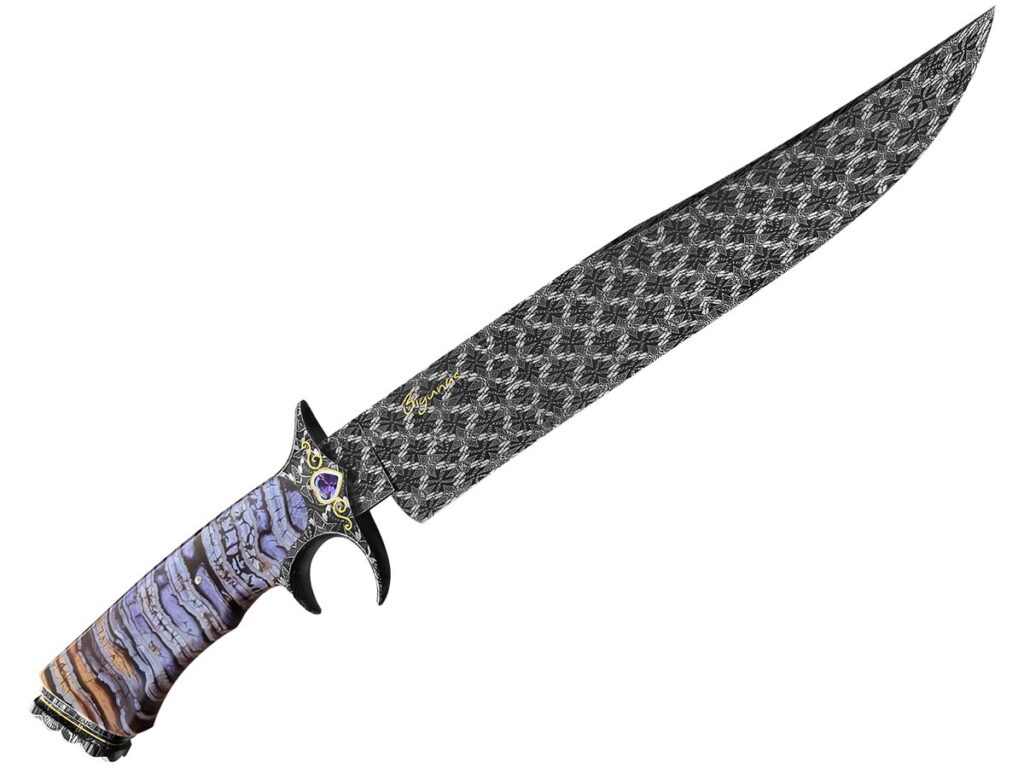
Master smith Andrew Blomfield has taken more than one stab at the pesh kabz in his career, and lands the blow with this 11.5-inch bladed example. The eye-catching mosaic blade is contrasted by the very conservative tones of the purple gidgee handle and blackened steel bolster. A traditional flourish, brass blossoms are on the handle’s pins.


Michael Deibert Wakizashi

Michael Deibert Wakizashi

Alabama-based journeyman smith Michael Deibert brings traditional Japanese styling to life with this striking Wakizashi. The 18-inch blade features 1,100 layers of 1080/15N20 steel, paired with a wrought iron bolster. A classic stingray and an Ito-wrap handle complete the 28-inch overall build.


Nate “Tuna” Grant Pocket Fixed Blade

Nate "Tuna" Grant Pocket Fixed Blade
Nate “Tuna” Grant Pocket Fixed Blade

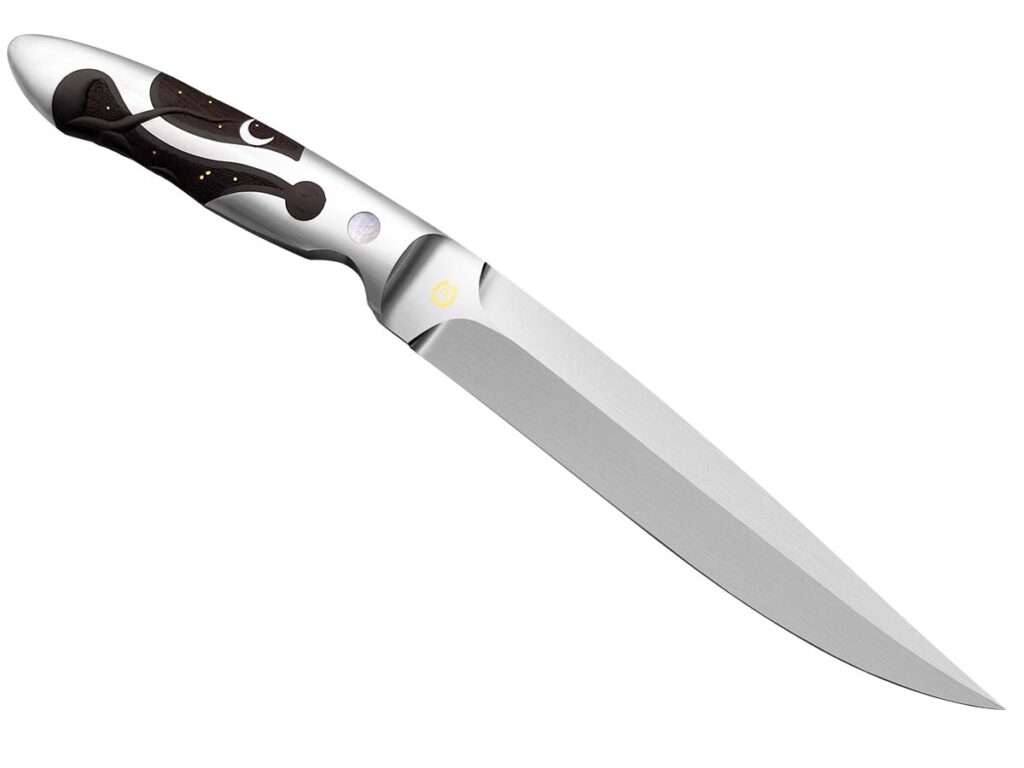
Journeyman smith Nate “Tuna” Grant delivers a compact powerhouse with the Defender. This 7.375-inch overall fixed blade features a 4-inch flat-ground blade forged from 1084/15N20 steel in a striking diamond drop pattern. The build is finished with rich Mun ebony scales.


Emmett Eitreim Dagger

Emmett Eitreim Dagger

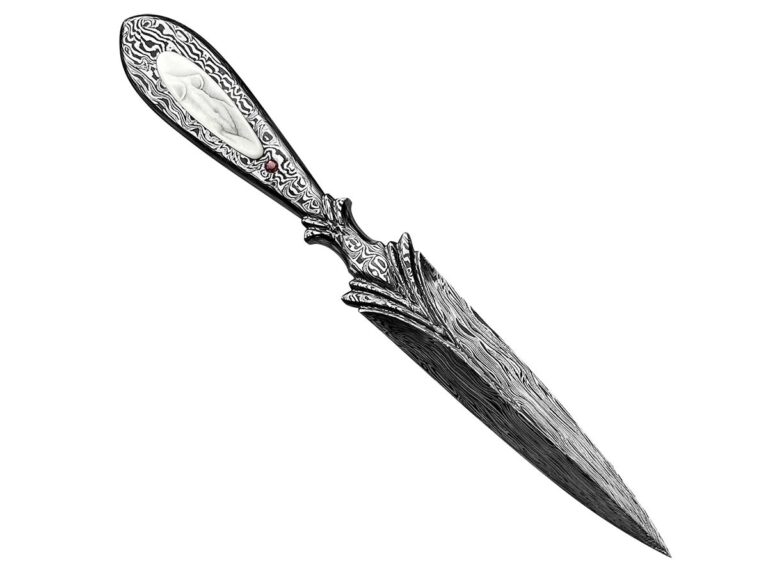
Emmett Eitreim presents a refined 12-inch overall dagger featuring a 7-inch flat-ground blade. The steel is a striking rose pattern forged from 15N20/1084, complemented by a 954 aluminum bronze guard and pommel. A stabilized spalted maple handle completes this elegant, high-contrast build.


Check Out More Cool Customs:

Colonel Blades Contingency Dagger Review: Sharp Little Backup

Daring little dagger takes a stab as a defensive secondary.

This was a challenging review. Not so much because of the knife, but the usual tests I do. I’ve focused mainly on the cutting ability of knives and a lot of what passes through my hands falls on the larger side. The Contingency Dagger from Colonel Blades is a small knife. On top of that, daggers are made for, err … penetration—I’ll leave it at that.

From my knowledge, the dagger would be excellent for a backup, self-defense blade. It’s light, concealable and with sturdy AUS-8 steel can and will penetrate. Right off, I like the overall feel of the knife, designed by veteran and author* Tom Marshal, and find the handle very well thought out. It comes with a Kydex sheath, fully adjustable for great security. But the way it shipped, it already had excellent positive lockup.

 The Contingency comes with a Kydex sheath with a clip that make inside and outside the waistband carry simple and convenient.
The Contingency comes with a Kydex sheath with a clip that make inside and outside the waistband carry simple and convenient.

All that said, no matter what a knife has to cut. I recommend that everyone test their knives to see how well they perform. It’s like going to a gun range with a new pistol—know its capabilities, both good and bad. I don’t like surprises and do not think you do either. Let’s find out the Contingency Daggers’ cut-abilities.

Light-Duty Cutting Tests

My regular bond paper was soggy after a rainstorm, so I used graph paper. It has the same thickness as 20-pound bonded, so it offers a comparable initial edge test. At first, the dagger ripped the paper, given that I approached the slices at too shallow an angle. Once I corrected for the knife’s steep grind angle, it cleanly shared the paper. The factory edge seemed like a 220-grit, sharp but not fine.

Next on the roster came thin cardboard, single-walled. The dagger quickly sliced through the material without any problems. The cut ends had a full curl to them because of the grind, which was expected. The diamond-shaped texture on the handle proved its worth here, giving the dagger a positive feel and great control.

The dagger quickly sliced through cardboard without any problems. The cut ends had a full curl to them because of the grind, which the author expected.

I grabbed some 8-ounce leather for skiving and the Contingency’s blade made nice crunching sounds as it parted the hide. It was easy to control the thickness of each cut as the AUS-8 blade steel found the medium it liked. While I had the leather out, I did some straight slicing. WOW! Here, the dagger cut aggressively. Again, the handle texturing made control easy.

Heavy-Duty Cutting Tests

I couldn’t resist doing a little whittling with the dagger. It made coarse curly cues after I adjusted the cut angle more steeply. After settling into a rhythm, the dagger comfortably shaved through. Using it in this fashion reminded me of a survival school trick for making the base wood for a hand or bow drill. A dagger excels at making these fast. I carried a small dagger for survival, they are excellent in the role, if you know how to utilize them correctly.

Not exactly designed for making push cuts, the Contingency nevertheless made mincemeat of ½-inch sisal rope.

I knew I would be taking a chance with 1/2-inch sisal rope, but I had to give it a shot. A lot of pressure is required to get a full cut on the material, and it made the edge prove its retention. The dagger gave a nice sounding crunch with 20 cuts. I switched to 1/4-inch braided cord, where it made 50 cuts in all. Not bad for this small dagger.

Overall Take

As a backup blade, the Contingency Dagger is phenomenal. I really enjoyed the handle’s texturing while cutting. The blade is wide enough to bring down the grind angle for a better cutting edge, or it could be hollow ground.

Contingency Dagger Specs
Blade Length: 3.5”
Overall Length: 75/8”
Steel: AUS8
Grind: Flat
Blade Shape: Dagger
Handles: Textured G-10
Coating: TIN black
Sheath: Kydex
MSRP: $80

*Tom Marshall authored the book Close and Destroy, published by our sister publication, Gun Digest, and is available at GunDigestStore.com.

More Reviews:

50 Years Ago In BLADE: Big Bucks Bowie

Harvey McBurnette etched his name in high-dollar knife sales.

Harvey McBurnette of Piedmont, Alabama, landed in the July-August issue of the 1976 American Blade for somewhat patriotic reasons. Somewhat, because the lead of Harry K. McEvoy’s exposé on the maker was McBurnette’s celebrated Bicentennial Bowies. But there’s more to the matter than a simple commemoration of the nation’s birthday in steel.

McEvoy hooks readers by showing what the artistically talented knifemaker’s work commanded back when your dollar went a long way. In 1976, the exact sum was $4,500. As McEvoy wrote, “[O]ne of his fabulous, hand-crafted Bicentennial Bowie knives appraised at that substantial figure after he had sold the weapon to a collector for $1,300.”

The lead image of the profile on Harvey McBurnette shows him studying his original knife design and free handing it to the steel. The maker had a strong artistic streak and was known, in part, for the embellishments he etched onto his knives.

For context, that’s roughly $26,000 in today’s dollars. What likely made the run of 76 bowies desirable was McBurnette’s unique system of adorning the knives—etching. This system, seen on many of his knives, was a very conscious choice on the maker’s part, as the story reports, serving to differentiate his work from other custom craftsmen of the day.

“I wanted to do something unique, or at least different, with my knives,” McBurnette was quoted as saying in the article. “And since I was an artist I thought if I engraved or etched my blade, I would add a touch I felt was needed to make them stand out. I chose the art of etching because there were a few other knife makers who engraved their knives. Besides, even a master engraver cannot do what an etcher can do.”

McBurnette’s Bicentennial Bowies had quite a motif etched on either side of their D2 tool steel blades. On one side of the 16.25-inch knife is an image of the Liberty Bell, and on the other a battle scene depicting Bunker Hill. The images are the same on all 76 knives, and 75 of them had elephant ivory handles. The knife appraised for the then astronomical sum did differ; the No. 1 of the series was a prototype with a walrus ivory handle.

More Knife History:

Advertisement

Must Read Articles

Read this before you make a knife

Knifemaking 101 – Read This Before You Make a Knife

  by Wayne Goddard My experience has taught me that there's nothing like digging in and getting started. I've often said the hardest part of the...
how to forge damascus steel

How to Forge Damascus

Advertisement
Advertisement