

Military Knives: Historic Star-Spangled Steel

Few knives have served America more than those of the U.S. military.

Editor’s Note: This is the first of a two-part series on the most influential knives to serve the U.S. Military and explores some of the early influences on military knife design.

As what many call the greatest country in the history of countries approaches its 250th birthday, now’s a good time to salute some of the top knives that played pivotal military roles in the forging of the world beacon that is the United States of America.

It is, of course, impossible to recognize in one magazine story every single knife that played a crucial role in the many battles of the wars fought by the USA. However, with the help of some of the knife industry’s leading military authorities—including several of whom have seen the elephant in service to our nation—BLADE® will endeavor to touch on some of the more consequential knives of U.S. military history.

Before embarking on such a quest, the first task is to identify a basic group of the most indispensable knife types over two-and-a-half centuries of American land warfare. At the risk of omitting one or more, five stand out: bayonet, all-purpose utility fixed blade and/or bowie, dagger, machete/chopper and utility folder.

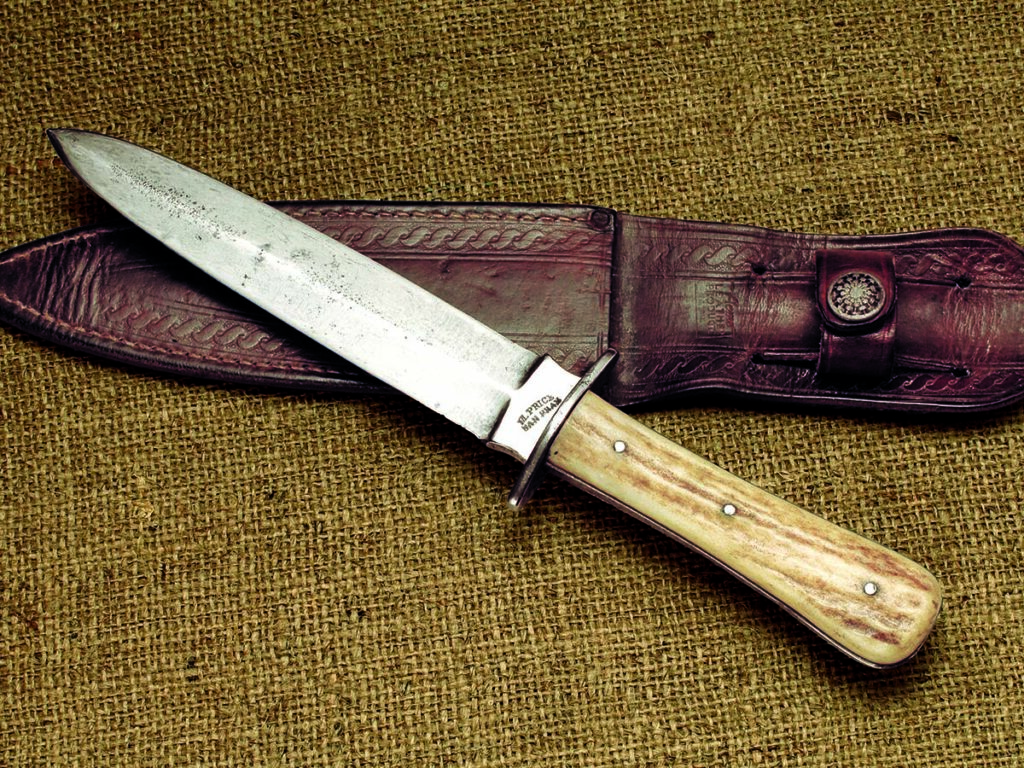
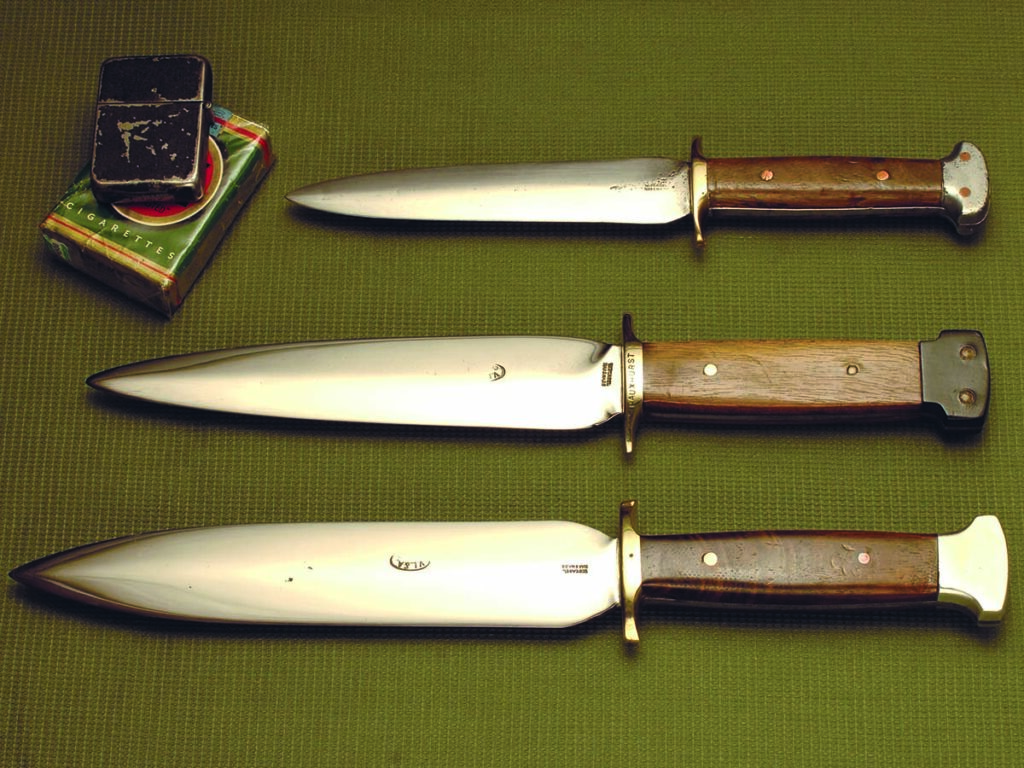
Michael Price recognized that to create a viable knife for self-defense and combat, form must follow function. His solution was to use the full-tang construction method, here on one of his classic mid-19th-century daggers. (Image courtesy of Louis Chow)

“These encapsulate everything that an infantryman used during the 250-year history of our country,” noted Louis Chow, a 24-year U.S. Army veteran who retired with the rank of major and is one of the leading collectors of the knives of BLADE Magazine Cutlery Hall-of-Fame® member Bob Loveless. “The bayonet, of course, from the get-go, from the Revolution to today.”

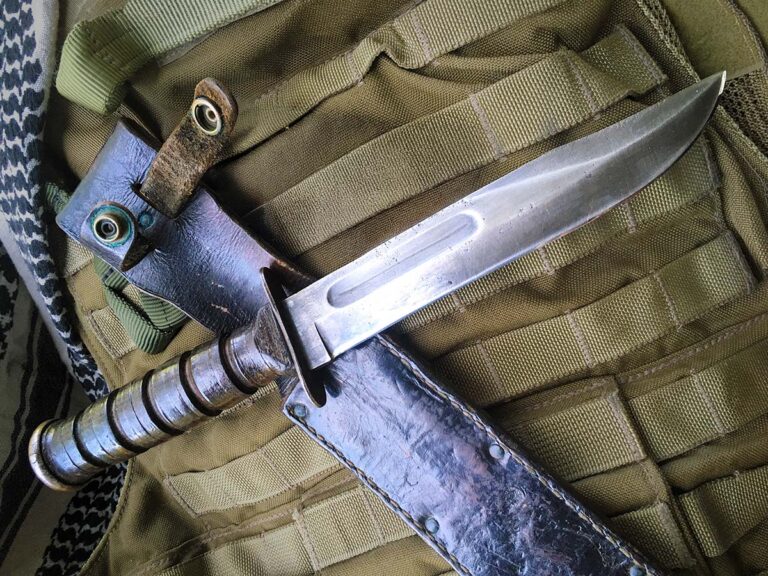
Louis indicated the all-purpose utility fixed blade/bowie could include privately purchased knives such as the Randall Model 1 and, of course, double-guard bowie types like the USMC fighting utility knife, aka the Ka-Bar. He pointed to the mid-19th-century designs of Michael Price as highly influential on daggers through to today, and machetes such as those made by Collins used in the Spanish-American War and before to Vietnam as vital to U.S. war efforts. Though pocketknives were indeed carried by American patriots during the Revolutionary War, the utility folders to which Louis referred are more of the modern Leatherman/Gerber multi-tool type, not to mention the Buck 110, Al Mar SERE, CRKT M-16 and others. As Louis noted, almost every soldier, male or female, in the modern military carries a multi-tool folder.

Many knife enthusiasts know that bayonets are rarely, if ever, used in combat today, nor have they been for well over a century. “It’s hard to actually find someone who used one in combat,” Louis said. Probably the most legendary American bayonet charge was the eminently successful one by Union forces led by Col. Joshua Chamberlain against Confederate troops down a hill called Little Round Top, a major turning point in the Battle of Gettysburg and, of course, the entire Civil War. Ironically, as Louis noted, “the most famous bayonet charge of all was the last one.”
While bayonets have rarely been used in American combat for many decades, that does not mean they do not remain significant teaching tools in today’s U.S. military. “When I was a company commander in 1990, we trained with the bayonet,” Louis recalled. “There are established bayonet courses on every installation, such as Fort Hood in Texas and Fort Benning in Georgia, and we would go there and train with the bayonet.” The rifles and bayonets have changed over the years but the bayonet training techniques remain the same.
Throughout U.S. and nearly all other nations’ histories, governments have been responsible for the issuance of combat knives in the form of bayonets for their infantry fighting forces. During World War II, the USA issued all-purpose fighters and utility knives to many soldiers, sailors and airmen. However, as Louis noted, privately purchased edged tools and weapons have always been the mainstay of our servicemen. During the earliest American conflicts, including the Revolutionary through the Civil Wars, kitchen, utility, farrier-forged and European-imported cutlery were the sidearms of the multitude of militiamen and patriotic volunteers.

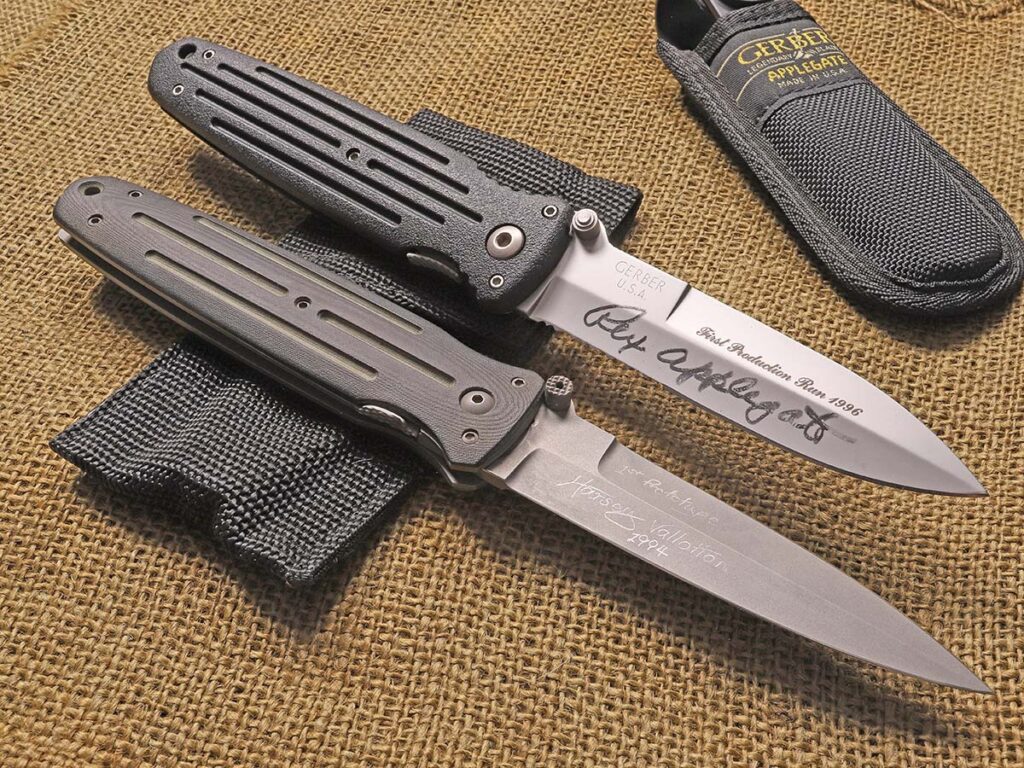
The original Applegate-Fairbairn Folder was a collaboration between Col. Rex Applegate and knifemakers Bill Harsey and Butch Vallotton. Harsey stated that a Gerber official said the Army ordered 50,000 of the knife at one time for the troops. At bottom is the original prototype and at top is a first-production Gerber version autographed by Applegate. (From the collection of Michael Janich)


The knife carried and made famous by Cutlery Hall-of-Famer James Bowie in the 1820s and 1830s was copied in various forms by makers worldwide and served as inspiration to any number of fixed blades carried in the U.S. military. Another large fixed blade that met with success in military circles was the Rifleman’s Knife made by the Ames Mfg. Co. circa 1860. Ames also made the Dahlgren Bowie Bayonet around the same time. Collins & Co. made a variety of bowies/machetes, the most famous probably being the No. 18, also incorrectly called the V-44 by many (according to D.E. Henry in his book Collins Machetes and Bowies 1845-1865, V-44 was the real name of a 1944 Case Survival Knife, not the No. 18).

Generational Blades

Circa the mid-19th century, Michael Price was considered one of the premier cutlers in the western United States. He was best known for exquisite presentation knives that incorporated marine ivory and a variety of beautiful shells. However, as Louis wrote, to create a viable knife for self-defense and combat, Price recognized that form must follow function. His solution was to use the full-tang construction method. And for a century and a half, some of the most notable American cutlers adopted the full-tang method that significantly improved a knife’s dependability and durability.

Early in 20th-century Michigan, Cutlery Hall-of-Famer William Scagel began forging axes and knives of various sizes and styles. He made most of his utility, hunting and bowie knives via the hidden-tang method. Though some of his combat knives were also hidden tang, many others employed the full-tang method.

“It was purported that the Scagel hidden-tang fighters with stacked leather washers were made for the European theater, while the full-tang fighters with wood-slab handles were made for the Pacific theater,” Louis wrote. “It was believed that stacked leather washers would be too susceptible to the humidity, high temperatures and salty air” of the applicable Pacific region. As a testament to Scagel’s outstanding craftsmanship and exceptional design, many of his fighters survived the war in good condition.

William Scagel’s hidden-tang fighters with stacked leather washers reportedly were made for the European theater during World War II, while the full-tang wood-slab fighters were made for the Pacific. The stacked leather washers were thought to be too susceptible to the humidity, high temperatures and salty air of the applicable Pacific region. (Image courtesy of Louis Chow)

In 1937, Cutlery Hall-of-Famer W.D. “Bo” Randall observed an older man scraping the bottom of a boat with a knife that appeared undamaged by the abuse. Intrigued by the improvised tool, Bo purchased it from the owner and contacted its maker, who just so happened to be Scagel. Randall eventually became Scagel’s student and soon opened his own shop, making Scagel-style knives.

“At the onset of World War II, Randall designed and produced some of the most recognizable combat knives ever made,” Louis stated. “Nonetheless, all were made with the hidden-tang method. It was not until the early 1960s that Randall introduced the full-tang Model 14-Attack and the Model 15-Airman combat knives.”
Continuing the generational theme, Cutlery Hall-of-Famer Bob Loveless read a magazine article about Randall knives in 1953. He corresponded with Bo and made his interpretations of Randall knives before experimenting with and then making his own full-tang models.

From the mid-1960s through the early ’70s, Loveless accepted many orders from service members awaiting assignment to Vietnam. He also received bulk orders from units stationed there. One bulk order in early March 1967 from a unit commander in the 1st Cavalry Division was for 37 fighting knives.

“The unit commander and his troopers were stationed in Saigon and were supporting Operation Junction City, one of the largest airmobile operations in the war,” Louis wrote. “As a patriot and former veteran himself, Loveless would temporarily halt all other orders and place top priority on knives destined for combat. As for those 37 fighters, he worked day and night and completed the order in less than a month. For the next four decades, the Loveless full-tang designs were copied and reinterpreted by countless knifemakers and knife companies in the United States and abroad.”

In addition to the foregoing cutlery legends, the full-tang method was also preferred by many other U.S. World War II knifemakers. Among them: Alfred Bimson, John Ek, Taylor Huff, A.R. Kephart, Kennedy Arms, Bob Riggs, Ernest Warther and Cutlery Hall-of-Famer M.H. Cole. Cole also authored the comprehensive U.S. Military Knives, Bayonets & Machetes series of books and has been dubbed the “Sage of Military Knives” by Cutlery Hall-of-Famer Bruce Voyles. Continuing Cole’s legacy is knifemaker/author Michael Silvey through his reproductions of Cole’s designs and his lavishly illustrated books on the knives of the United States military in World War II and Vietnam, and other works.

More On Military Knives:

First Look: Bear OPS Nekema II Tactical EDC

An American-made tactical EDC folder featuring a Sandvik 14C28N blade and lightweight aluminum handle.

Bear OPS, the tactical division of Alabama-based Bear & Son Cutlery, is expanding its everyday carry lineup with the release of the Nekema II. Manufactured entirely at the company’s facility in Jacksonville, Alabama, this new folder is designed as a streamlined, budget-conscious option for tactical use, concealed carry, and general daily wear.

At the center of the design is a 3.5-inch modified drop-point blade made from Sandvik 14C28N stainless steel. This Swedish steel has become a staple for modern EDC knives due to its balanced performance, offering high corrosion resistance, user-friendly sharpening, and respectable edge retention. For users seeking extra protection and a non-reflective finish, Bear OPS is offering the blade with a black DLC (Diamond-Like Carbon) coating.

Bear OPS Nekema II

To keep the knife pocket-friendly, the Nekema II utilizes a lightweight aluminum handle, keeping the overall weight to a nimble 3.5 ounces. For deployment and lockup, the folder is equipped with dual thumb studs, ball-bearing washers for a smooth pivot action, and a secure slide-lock mechanism. A reversible pocket clip and Torx screw construction finish off the assembly.

The Nekema II is available in either Black & Copper or Gray & Blue colorways, with retail pricing set between $92.49 and $97.49 depending on the specific finish. For more details, visit local retailers or head over to the Bear & Son Cutlery website.

Knife Reviews:

EDC Clip Points: Little Big Clips

Small-in-stature clip points that punch above their weight.

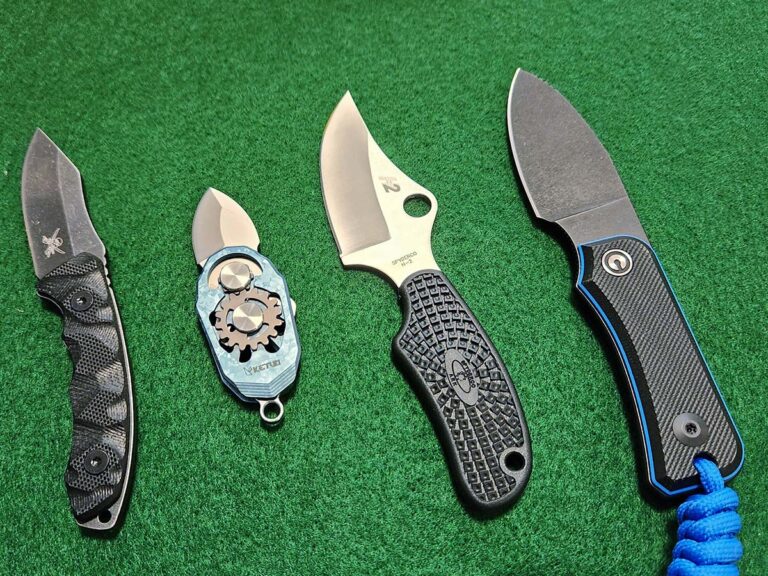
There’s a reason Buck Knives chose a clip-point blade for their iconic, mega-selling Model 110 as the blade style for their folding knife. The profile has a history of being a hard-working blade. The clip point’s most distinguishing characteristic is a noticeable change in the downward angle of the blade in its spine, which makes for a sharper angle of the blade toward the tip. This change can be subtle to severe, but it always results in a thinner blade height. In essence, the break in the blade angle “clips” it to a thinner, sleeker, more pointed shape. In this BLADE® feature, we’ll look at four modern and totable clip points and their attributes to see how they fit your needs.

Civivi Slippy Sendy

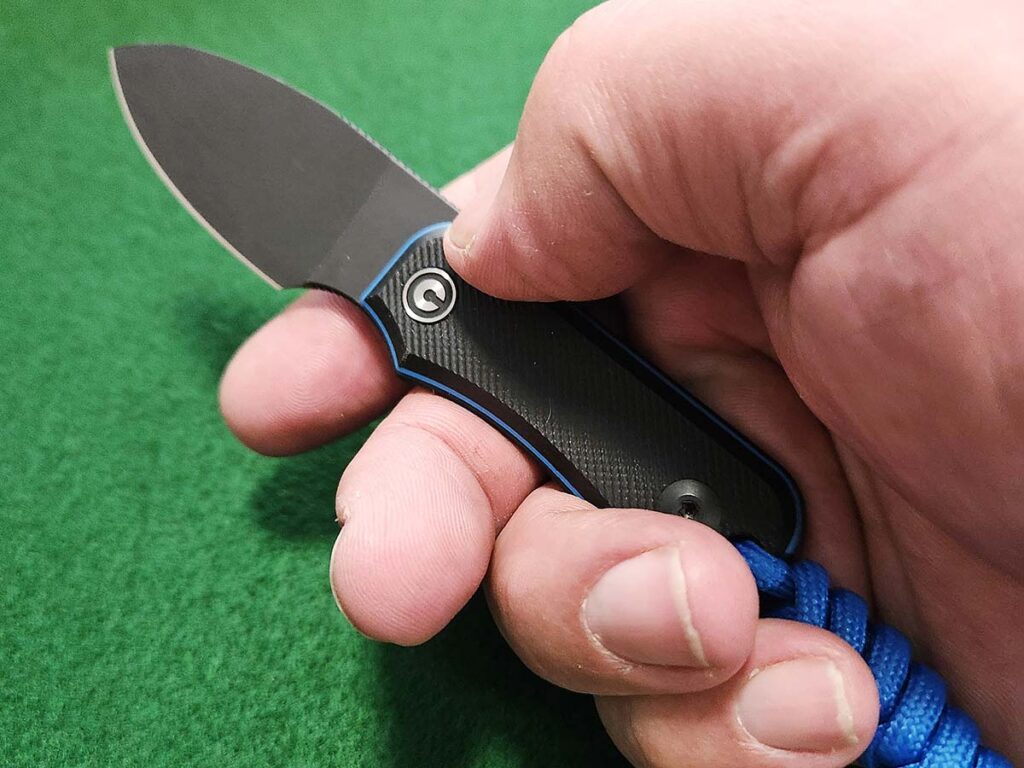
The Civivi Slippy Sendy weighs a paltry 1.90 ounces, making it an ideal light pocket carry or unobtrusive desk companion. If you don’t need a rough-and-tumble brawling knife, this is a good, lightweight option.

The Civivi Slippy Sendy is the only gentleman’s folder of our test group, and it carries the banner well. Having no pocket clip, it is made for pure loose pocket carry, and at just 1.90 ounces, its weight is no issue. The Micarta handle is a simple slab-style with an overall length of 3.7 inches with a flat, rounded-cornered top that ends in a 1-inch, semi-circular base. The backside scale has a 1/2-inch cut-out that allows the user to access the blade’s rectangular nail nick to engage the blade.

The 2.8-inch blade has its clip breaking 0.80 inch from the tip, while the cutting edge is 0.60 wide, flat-ground and is rounded toward the tip. The blade is Nitro V stainless, a very respectable proprietary knife steel from New Jersey Steel Baron that allows the Civivi Slippy Sendy to punch above its class.

The author kept the Civivi Slippy Sendy on his office desk for a few days and tested it cutting various and sundry “desk stuff.” The 2.8-inch Nitro V stainless blade was plenty sharp and did a good job of cutting crisp, sharp lines on this card stock.

This is an all-round lightweight pocketknife that is very good for light duty around the home, office or on the go. It is not a tactical knife because it doesn’t lock up or have a fighting blade style of thick blade steel. That said, the Civivi Slippy Sendy is handy for tackling mail duty, light meal prep and other unexacting duties encountered daily. I tested it on heavy card stock, packaging twine and thick packing tapes of all types and found the upgraded steel and comfortable ergonomics both handy for all-around use daily.

Cold Steel Engage 2.5

The Cold Steel Engage’s 2.5 sports a 4116 stainless steel made by Böhler of Germany. Of all the knives tested, this is the one that most resembled a modern-day tactical knife.

The Cold Steel Engage 2.5 may be small, but it’s a lot of knife in a 6-inch package. The blade width is just shy of 1-inch wide (0.90-inch), and it looks like a scaled-down tactical, which, in fact, it is. This knife is a shrunken version of the Engage 3.5 and is part of a whole series of varied models in the same platform. The Engage 2.5 is named for its blade length, leaving 3.5 inches for the handle.

The 2.5-inch clip-point blade is 4116 stainless steel made by Böhler of Germany, which opens via ambidextrous thumb studs on either side of the blade. The handle features Cold Steel’s patented Atlas slide lock located on the upper spine. An ambidextrous 1.5-inch pocket clip is located on the rear base.

Even though its steel didn’t sport an upscale moniker, the Cold Steel Engage 2.5 did a yeoman’s job of cutting sharp, crisp lengths of this tough leather.

I tested the Cold Steel Engage 2.5 on some thick, cured boot leather. Taking off lengths of the tough material in strips using a metal ruler as a guide, the blade of the knife never wavered or tried to change angles as lesser steels are prone to do. The curved front tip of the blade dug in at an angle and stayed on course with each slice and despite the blade not being a glitzy name brand, the 4116 stainless did its job well and the Engage 2.5 proved its worth.

Demko Knives Nano Shark

Demko Knives’ Nano Shark is a lot of knife packed into a short, 5.8-inch package. The Nano Shark's 2.25-inch blade sports a large blade for its size.
Demko Knives’ Nano Shark is a lot of knife packed into a short, 5.8-inch package. The Nano Shark’s 2.25-inch blade sports a large blade for its size.

The Demko Knives Nano Shark is a pint-sized EDC designed for serious slicing. The very slightly curved blade has always been a workhorse, but during the modern tactical knife era, many edged weapons specialists embraced the blade for its ability to grab and not let go until it had done serious damage.

The Nano Shark has a 2.25-inch blade that breaks to its clip 1 inch into its traverse forward, then breaks downward again where it meets the blade’s flat-ground edge. The upper rear portion of the blade features a healthy, rounded cutout for opening the blade once the user has released it via a pull-down thumb lock. The Nano Shark’s 3.5-inch GRN handle is ample enough to house the entire blade with only the thumb cutout protruding. A reversible 1.75-inch pocket clip completes the package.

The Nano Shark may be a short knife, but it acts like a behemoth thanks to its tall profile and blade thickness. The blade is similar to a short bowie, which makes it a serious small work knife. I tested it as such on a stubborn 3/8-inch synthetic rope. I started by just taking off short lengths on a flat surface before tying a large knot into both ends and free-handing the excess off each knot. I ended up with two tidy knots at each end. When in doubt, practice first!

Big Idea Design TI Lookout

The only fixed-blade in the group, the 6.2-inch Big Idea Design TI Lookout sports a full tang underneath its scales.

The 6.2-inch Big Idea Design TI Lookout is a simple fixed-blade knife with very few parts to break so it is better for stronger tasks. The Ti Lookout is basically one large piece of premium CMP MagnaCut stainless steel from tip to base with two lightweight, diagonally textured Grade 5 Titanium handle scales for gripping. Aside from the few pieces of hardware holding the handle together and forming its lanyard fitting at the base, that’s basically the sum of parts.

With so few parts to break, the fixed-blade can handle larger, tougher tasks. The downside is the user doesn’t have the compact convenience of a folding knife, but sometimes it is necessary to get the job done. The Lookout comes with a small 4.5-inch black Kydex sheath with a steel hanger fitted to the rear for added strength.

The Ti Lookout fixed-blade offers the safety of having no moving parts to break under extreme pressure whereas the folding knife can be vulnerable at its blade pivot. When in doubt, call on a fixed blade for the tough chores.

I gave the little fixed Ti Lookout a run for its money on a length of dried redwood 2-by-4. Holding the plank vertically, I dug the blade in at an angle, taking off shavings and holding in consecutively longer and deeper lengths. The Big Idea Design fixed-blade bit in and did its job until its size was simply outweighed by the larger length of wood, but not before the small fixer had proven its worth. I never felt during the process that the Ti Lookout was going to fold or break. That’s why you use a fixed-blade for the tough jobs.

More Reviews:

First Look: Civivi Brova And Civivi Elite Line

Elite Line debuts with premium CPM S35VN steel, aluminum scales and an innovative top-liner lock mechanism.

Civivi has always aimed at more budget-conscious knife enthusiasts, arming them with stout yet affordable blades. The company, however, recently announced a new tack with the introduction of its Civivi Elite Line of knives.

Inaugurated with the Brova model, the line of knives offers a higher grade of materials and is meant to fill the gap between Civivi and its top-tier sister brand We. For some perspective, a good section of Civivi’s catalog falls below the $100 mark, while most of We’s are premium $200-plus models. Elite fills the hole in the middle and, as Civivi’s release puts it, is designed for its customers “ready to take the next step.”

Civivi Brova open

Civivi doesn’t spell out its overall ethos for the entire line, but the Brova insinuates some of the notes Elite knives aim to hit. One of the more notable material upgrades is the knife’s blade steel—CPM S35VN. The brand has used the top-line Crucible Industries steel previously, but generally in premium editions of established models. Civivi’s go-to blade steels are typically 14C28N, Nitro-V and D2.

Furthermore, the vanguard knife of the Civivi Elite line features an entirely new lock for the brand—a top-liner lock. Operated via a button near the spine of the handle, the mechanism should prove convenient. Smartly, Civivi recessed the button to ensure the blade isn’t inadvertently retracted when in use.

The Brova cuts a bellicose profile, with a subtle 3.41-inch clip-point blade coming down to a fine point. It certainly should have decent penetration potential with this design, but with a respectable amount of belly on its edge and a good length of straightaway before the handle, it should prove adept at slicing or with push cuts.

Civivi Brova half open

The handle is well contoured, featuring a notch for locking the knife in with the index finger and thumb. It’s dressed in smooth aluminum scales with the choice of three colors that house stainless-steel liners. The hardware and clip are also stainless steel, and the action is run on caged ceramic ball bearings.

As for Brova’s price, all three colorways come in at $145. The EDC looks like a solid start for the Civivi Elite Line; it will be interesting to see what comes next.

Brova Specs
Overall Length: 8.08”
Width: 1.33″
Overall Height (Including Clip): 0.65″
Blade Length: 3.41″
Closed Length: 4.67″
Blade Thickness: 0.13″
Handle Thickness: 0.44″
Knife Weight: 3.78 oz.
Blade Material: CPM S35VN
Blade Hardness: 58-60HRC
Blade Grind: Hollow
Blade Finish: Black and Dark Brown Stonewashed
Blade Type: Clip Point
Handle Material: Aluminum
Handle Colors: Forest Green, Black, Grey
Liner Material: Stainless Steel
Liner Color/Finish: Black or Grey
Pocket Clip: Tip-Up, L/R
Clip Material: Stainless Steel
Screws Material: Stainless Steel
Pivot Assembly: Caged Ceramic Ball Bearing
Locking Mechanism: Top Liner Lock
MSRP: $145

Knife Reviews:

2026 BLADE Show Knife Drops: Hot In Atlanta

Get a look at the new knives released at BLADE Show, the world’s largest knife show.

More than simply the foremost industry event and knife axis mundi, BLADE Show is also the preferred venue to launch knives. Makes sense, when for three days straight, Atlanta’s Cobb Convention Center sees a steady stream of thousands of knife fanatics. We’ll have more down the road, but here is some of what was dropped at the world’s largest knife show.


Bradford Knives Guardian 3.5XL

Bradford Knives Guardian 3.5XL profile

RARE BREED GUARDIAN—Bradford Knives’ fan asked for it and at BLADE Show they’ll get the shot to own the Guardian 3.5XL with a 4-inch MagnaCut blade. This limited run comes with a new sheath design, offering both vertical and horizontal carry options. Overall Length: 8.25 inches. Blade Profile: Sabre. Weight: 4.7 ounces. MSRP: TBD. Available: June


Ansø of Denmark Mudtrack Exoframe

Ansø of Denmark Mudtrack Exoframe

FRAME JOB—Stripped down in material, the Toko features Ansø of Denmark’s skeletonized black titanium Mudtrack Exoframe, stripping the flipper’s weight to a scant 2.86 ounces. Outfitted with a do-all drop-point blade of RWL34 steel, the build had versatile built in. Lock: Button. Blade Length: 3.35 inches. MSRP: $995. Available: June


McNees Knives Mini Dixon

McNees Knives Mini Dixon profile

MIGHTY MITE—A scaled-down version of a McNees classic, the Mini Dixon boasts a compact 3.35-inch MagnaCut blade matted to a Grade 5 titanium handle. The modified clip point has a hollow grind and comes in a very svelte 4.5 ounces. Lock: Framelock. Overall Length: 7.75 inches. MSRP: $549. Available: June


UG Tools EKM Fighting Knife Set

UG Tools EKM Fighting Knife Set profile

DOUBLE TROUBLE—The UG Tools EKM Fighting Knife Set was developed Special Mission Units and is already being supplied to a German Tier 1 unit. The set comes with a 2.4-inch blade dagger and 4.7-inch blade drop point, highly modular sheath, attachment system and full contact training knives. Blade Material: CPM MagnaCut. Weight: Dagger 1.6 ounces, Drop Point 4.6 ounces. Country of Origin: German. MSRP: ~$1,000 Available: Autumn 2026


Spartan Blades Pandia

Spartan Blades Pandia

MOONLIT PRECISION—Named for the Greek goddess of the full moon, the Spartan Blades Pandia features a 3.25-inch CPM MagnaCut spear-point blade optimized via a proprietary double deep cryogenic treatment. The 8.25-inch Curtis Iovito design utilizes an IKBS bearing system for fluid flipper deployment. Handle Material: Titanium. Clip: Titanium. Weight: 4 ounces. Country of Origin: USA. MSRP: $495. Available: Now


Maserin Outback

Maserin Outback

BUILT FOR THE BUSH—Featuring a Böhler N690 steel blade and paired with an ergonomic G10 handle, the Maserin Outback is available in three colours: black, gray, and orange. It comes with a black Italian cordura sheath, and a sharpener and a survival saw. Blade Length: 5.51 inches. Overall Length: 10.9 inches. Country of Origin: Italy. MSRP: $239. Available: Now


Scorpion 6 Jörmungandr

Scorpion 6 Jörmungandr

SHARP LEVIATHAN—Named for a sea serpent of Norse mythology, the Jörmungandr from Scorpion 6 is made completely without any CNC machining and features 5.3-inch a double hollow grind freehanded by Shane Magnussen. Blade Steel: CPM S90V. Overall Length: 8.82 inches. Clip: Titanium. Internals: Delrin Caged Ceramic Bearings. MSRP: Starts at $1,500. Available: Now


QSP Badger

QSP Badger

BRIDGING OVER—The QSP Badger gives a reason for righties and lefties to cheer with the company’s Bridgelock. Essentially a crossbar lock, it features a saddle that runs on the back of the handle for an oversized and ambidextrous release. Blade Pattern: Wharncliff. Blade Steel: Nitro V. Handle Material: G10. Blade Length: 3.35 inches. MSRP: TBD. Available: September


Opinel No. 8 Horizon

Opinel No. 8 Horizon

MODERNIZED CLASSIC—Designed to brave the outdoors, Opinel’s No. 8 Horizon features several element-resistant features, including a stainless steel Yatagan blade, fiberglass-reinforced polymer handle and a light 2.2-ounce weight. Blade Length: 3.15 inches. Lock: Friction, Virobloc Safety Ring. Grind: Convex. MSRP: $40. Available: June.


Buck Knives Heritage Slim Elite 110

Buck Knives Heritage Slim Elite 110

CLIPPING CALL—A refined evolution of Buck Knives’ classic 110 Folding Hunter, the Heritage Slim Elite is nearly .25-inch slimmer, 3-ounces lighter and featuring a deep carry pocket clip and BOS heat-treated MagnaCut steel blade. Blade Pattern: Clip Point. Blade Length: 3.75 inches. Scale: Ebony. MSRP: $250. Available: May


Crescent Edges Celestial Entity

Crescent Knives Profile

STAR STRUCK—A 3.5-inch tanto blade of MagnaCut steel, milled titanium scale, satin DLC blade finish and a solid frame lock, the Crescent Edges Celestial Entity is an otherworldly EDC option. Overall Length: 8.23 inches. Weight: 4.5 ounces. Country of Origin: China. MSRP: $375 Available: Now


CRKT Grvitic Flip

CRKT Grvitic Flip

FIDGET FACTOR—Not your typical OTF, the CRKT Garvitic Flip utilizes a vintage-inspired flip-insert mechanism to deploy its 3.18-inch blade. Once out, tabs on the blade insert into recesses to keep the blade in place. Blade Steel: 5Cr13MoV. Blade Pattern: Spearpoint. Overall Length: 7.5 inches. MSRP: $50. Available: Now


Lionsteel Emmet

Lionsteel Emmet

INTREPID INTEGRAL—Gentlemanly in appearance, the 2.83-inch LionSteel Emmet features a solid integral handle in either titanium or aluminum. The titanium model comes with carbon fiber inlayed scale, the aluminum with a hammertone texture. Blade Material: MagnaCut. Blade Pattern: Drop Point. Overall Length: 6.73 inches. Country of Origin: Italy. MSRP: Ti $225; Al: $130. Available: Now


NortoriousEDC Dirty Deed Pry Bar

NortoriousEDC Dirty Deed Pry Bar

DOWN AND DIRTY—Constructed from Grade 5 titanium and a solid 3.5 inches in length, the NotoriousEDC Dirty Deed Pry Bar is ready every day for jimmying chores. The tool ships with a deep carry clip installed and includes an optional filler tab. Thickness: 3/16 inch. Width: 5/8 inch. Finish: Stonewashed. MSRP: $75. Available: Now


Vero Engineering Slip Joint

Vero Engineering Slip Joint

UNKNOWN SOLIDER—Vero Engineering’s new Wharncliffe is so recent that at writing it was yet have a name. What is known is that the slip joint will have a 2.75-inch MagnaMax blade, with the Vero trademark rectangular milling serving as the nail nick. Overall Length: 6 inches. Weight: 2.6 ounces. Handle Material: Titanium. Country of Origin: U.S.A. MSRP: $198. Available: June


GiantMouse ACE Pontius

GiantMouse ACE Pontius

HARPOONS AWAY—Designed with input from Chris Pontius, the GiantMouse ACE Pontius features a 3.2-inch harpoon-inspired clip point blade and titanium scale. The linerlock will also be available in Green G10 or Black Canvas Micarta. Blade Steel: Elmax. Overall Length: 7.7 inches. Liners: Hardened 420 Stainless Steel. MSRP: $325. Available: June


Shirogorov F95 Ursus

Shirogorov F95 Ursus

BEAR OF THE NORTH—The Shirogorov F95 Ursus offers a rugged, work-oriented take on the refined F95 pattern, featuring a 3.74-inch Elmax stainless steel blade with a 5/6ths grind. This iteration utilizes a Multi-Row Bearing System (MRBS) for smooth deployment and a dependable liner lock. Scale: Micarta. Overall Length: 8.66 inches. Weight: 4.69 ounces. MSRP: $650–$700. Available: June


StraightLine EDC Bigger Digger

StraightLine EDC Bigger Digger

GOLDEN DIGGER—The StraightLine EDC Bigger Digger is a purpose-built fixed blade designed for daily carry, featuring a 3.74-inch drop-point blade of 14C28N stainless steel. Ensuring a secure grip in all conditions, the 7.52-inch profile is outfitted with green canvas Micarta scales and a flat grind for efficient slicing. Weight: 3.17 ounces. Grind: Flat. Sheath: Kydex. MSRP: $80. Available: June.


Rothman Knives Fabricator Series Gentlemen’s Trapper

Rothman Knives Fabricator Series Gentlemen's Trapper

BLUE-COLLAR GENTLEMAN—The Rothman Knives Fabricator Series Gentlemen’s Trapper is a modern, lightweight take on the classic slip joint, weighing in at just 1.6 ounces. The 2 7/8-inch Nitro-V stainless steel blade features a deep 14-inch hollow grind for exceptional slicing geometry. Overall Length: 7 inches. Scale: Carbon Fiber. MSRP: $400. Available: June


Browning Stormy Pass Trapper

Browning Stormy Pass Trapper

STORM A BREWIN’—The Browning Stormy Pass Trapper is a traditional slip joint built with an emphasis on longevity and classic aesthetics. It features a 3-inch damascus steel blade with a hollow grind, paired with stainless steel liners and wood scales. Overall Length: 6.25 inches. Weight: 2.4 ounces. Blade Pattern: Trapper. MSRP: $100. Available: September


Bestech IKA Dagger

Besttech IKA Dagger

FRANKISH FLARE—Bestech’s IKA Dagger is the first integral handle design from French designer Tashi Bharucha. This folder features a 3.9-inch M390 stainless steel blade and ceramic ball bearings for fluid deployment. Overall Length: 8.85. Frame Material: Titanium. Blade Pattern: Dagger. Blade Thickness: 0.16 inch. Closed Length: 4.95 inches. MSRP: $580. Available: June


More On BLADE Show:

First Look: GiantMouse Ace Pontius Collaboration Knife

Jackass star and knife fanatic teams up with GiantMouse on tactical-style folder.

Chris Pontius is known for many things—his stunt work, crazy pranks, often appearing in little more than his underwear. With a collaboration with GiantMouse, it’s likely the former Jackass and Wildboyz star will be known for more. A life-long knife fanatic—he does a ton of knife content on his social media channels—Pontius teamed up with GiantMouse co-founder Jesper Voxnaes to create a fairly unique knife—the ACE Pontius. The project was two years in the making, as the Pontius and Voxnaes worked out the details of the knife. And the pair put some high design bars up for themselves.

In a blog post at GiantMouse, Pontius said rather than leaning into standard production aesthetics, he wanted a tool that mirrored the functional art of a musical instrument. He drew design cues from a vast array of historical and functional blade styles, weaving subtle elements of upswept hunters, classic skinners, Scandinavian puukkos, Nessmuks and harpoon-style blades into a single cohesive outline.

The result is a highly distinct silhouette that Voxnaes notes looks like something a futuristic space marine would carry into a culture that hasn’t happened yet. Built for everything from tactical applications to bushcraft, the blade features a strong piercing point matched with a generous, sweeping curved belly to maximize the usable cutting edge.

Giant Mouse Pontius - Titanium

Mechanically, the folder is balanced for reliable utility, intentionally keeping the choil small to ensure the lines remain fluid when closed. The 3.2-inch Elmax steel blade is housed in an ergonomic 4.5-inch handle, making it highly pocketable for daily carry. It features a secure liner lock mechanism for solid lockup during heavy use, an ambidextrous reversible steel wire pocket clip and distinctive brass backspacers that add a splash of ornamentation to the build.

The knife is debuting in three specific material configurations to match different preferences. The premium titanium model (MSRP $335) pairs a sleek satin blade finish with full titanium handle scales, coming in at a solid 4.7 ounces. For those tracking a lighter pocket presence, the Green G10 version ($285) features OD green G10 scales, a rugged stonewash blade finish and weighs 4 ounces flat. Rounding out the trio is the Black Micarta model ($285), which matches a satin blade finish with black canvas Micarta scales for a classic tactile feel, tipping the scales at a nimble 3.7 ounces.

Giant Mouse Pontius Challenge Coin

The ACE Pontius marks a significant operational shift for the company, launching exclusively through a Kickstarter campaign that coincided with the opening day of BLADE Show Atlanta. Fans who back the project early gain access to exclusive launch-day add-ons that ship alongside their orders later this year, plus a discount on final pricing. At time of writing, the campaign had 185 backers and had $57,729 of pledges.

Knife Reviews:

Pull Of The Push Dagger

Master smiths explore the symmetry, skill and survivalist roots of a classic.

It’s part adventure with a bit of notoriety and a dash of creativity. For the modern custom knifemaker, several styles are brought to life with history in mind. And the push dagger is one of them.

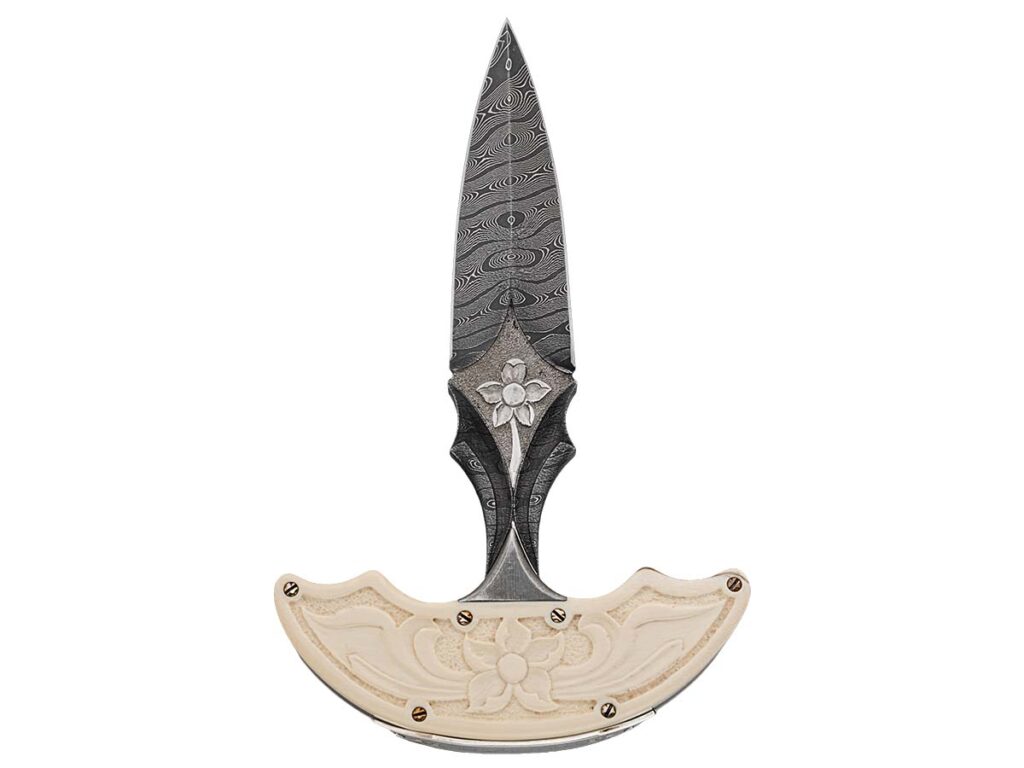
Maybe seldom seen, but always intriguing, push daggers trace their lineage to a bygone era when self-defense at the card table or on the street meant quick deployment from a vest pocket. For sure, that perspective spurs some custom makers to insert the push dagger into their repertoire while the stylized and subtle blend of blade and handle combine for a unique test of shop skill.

“They’re a backup tool,” explained ABS master smith and BLADE Magazine Cutlery Hall-of-Fame® member Steve Schwarzer. “They were typically carried in the 1700s and 1800s along with a one-shot pistol. After that shot, the push dagger was the next position. It’s been around for a long time as an extension of your arm with a blade, and it is hard to take away from somebody that is skilled in its use.”

Schwarzer’s featured push dagger with stag handle and evocative faces carved on both ends is 5¾ inches long with a 3¾-inch blade of mosaic damascus steel. He has actually made two push daggers in this style and designed another for Benchmade about 20 years ago. “For me, they’re fun, and that’s why I like to make them,” he commented. “I’ve always had a fascination about them and adapted my martial arts background to training with them. The design traditionally is with a very short blade, and in martial arts, it has to do with the alignment of the hand and arm bones, along with the shape of the blade, which is double-edged traditionally. Everything in nature is curved for an effective cutting surface.”

Harvey Dean Tejas

Why a push dagger? Harvy Dean (inset) puts it succinctly, “They’re just cool.” That certainly holds true for his Tajas push dagger, with an elegant feather damascus blade, 24k gold raised vine work and a fossilized walrus tusk handle. At 16 1/2 inchces in length, Dean gave himself plenty of knife to decorate. (SharpByCoop image)

Legendary master smith and Hall of Famer Harvey Dean enjoys the historical aspect as well. “They’re just cool,” he offered. “A lot of people made them back years ago, and there was the idea of concealing them in the vest. Some were made with nickel-silver scabbards and called lapel knives because they were pinned under the vest or coat lapel.”

Dean’s pictured Tejas push dagger is a departure from standard sizing, with an overall length of 16¼ inches, with an 11-inch ladder pattern damascus blade and handle of fossilized walrus ivory. But then, everything is bigger in Texas.

“I’ve always liked [master smith] Larry Fuegen’s push daggers, and his work has had a lot of influence on mine,” Harvey said. “You really make them like any other knife, and I usually do around two or three a year. I like to use ivory and damascus and a stag handle is next up. I don’t do many plain ones, and most of mine are with two-piece handles. As far as marketing is concerned, you’ve got to have that special person who likes them–but they do usually sell quick.”

Hawks Nest Custom Push Talon

Matt Hunter (inset) has always had a thing for concealed carry knives, but admits his mother-of-pearl handled push daggers were his first crack at the style of knife. Angular and wickedly attractive, the Nichols Slither Armor Core stainless damascus daggers were designed as a matching set with his HawkWing knife, also pictured. (SharpByCoop image)

Damascus blade, mother-of-pearl handle and variations on the push dagger theme highlight Matt Hunter’s work at Hawks Nest Customs. He is a huge fan of concealed carry knives and started down the road with a boot dagger, neck knife and then his Push Talon.

“I think any dagger is challenging due to the symmetrical grinds that are required,” he noted. “You’ve really got to nail each and every one of them or the entire build needs to be scrapped. These push daggers are made with Nichols Slither Armor Core stainless damascus and mother-of-pearl on Westinghouse black canvas Micarta liners.
“Believe it or not, these were my first push daggers,” Matt added. “These were originally made for a customer to match the HawkWing, which is also in this photo. I told him I was planning on doing a pair of matching push daggers, and he asked if we could do the mother of pearl to match his knife. So, I obliged.”

Zack Jonas Totem

A study in starkness, Zack Jonas’ Totem push dagger grabs the eye with its clean lines and depth of damascus. That’s a san mai steel with laddered W’s and faces in a 1,000-layer laminate with pure nickel. Adding to its Spartan charm are its gold handle accents. (SharpByCoop image)

The Zack Jonas push dagger featured is his Totem model with a blade length of 4 inches and an overall length of 6½ inches. Its gold handle accents complement a san mai steel with laddered W’s and faces in a 1,000-layer laminate with pure nickel.

“The push dagger is one of the few knives that is actually designed to be folded into a tightly closed fist,” the master smith explained. “That means you have to make sure the handle comfortably conforms to the shape of the human hand in that unusual position. A push dagger is not a particularly functional tool outside the very limited frame of hand-to-hand combat; if you don’t have a secure grip when you need it, you’ve got a real problem.

“There are few makers that come to mind as design influences,” Jonas concluded. “[Master smith] J.D. Smith’s early influence on my career is never far from my hand or eye. I also think of Peter Johnsson’s work as I’m designing. He has never done a push dagger that I’m aware of, but I like to try and channel the way he conducts tension through his lines. Peter and [master smith] Kevin Cashen both come to mind when I think of the functionality in any dagger.”

Andrew Meers Rose Of Sharon

A bold mix of materials, Andrew Meers utilizes carbon fiber, stainless steel,  gold and a splintered mosaic damascus to bring-together this 9-inch push dagger. The centerpiece of the knife is its elegant Rose of Sharron engraving with the gold backing. (SharpByCoop image)

Andrew Meers included a push dagger in his ABS master smith set, which was complete with forged trout iron texture engraved with pangolins. “Push daggers have a place in my childhood memory,” he related. “I remember seeing one at a museum and being fascinated. In retrospect, I think having mostly seen conventionally handled pieces in media and collections, the manner in which the hand engages the handle is what is attractive to me.”

Meers’ featured push dagger is his first with a carbon fiber handle and a groove in the blade. Its 7-inch damascus blade is framed in stainless steel, and the engraving depicts the Rose of Sharon with a gold-plated relief background. The entire push dagger is 9 inches long. Andrew produced his first push dagger in 2014 and has made several since. His longest measured between 23 and 24 inches.

Jean Potvin Romanesque

Since push daggers are illegal in Jean Pierre Potvin’s homeland of Canada, he had to come up with a clever trick to get his his Romanesque push dagger past airport security and to a buyer at a show in Las Vegas. His solution, remove the illicit handle and replace it with a toilet plunger handle. (SharpbyCoop image)

“This push dagger is Roman in style,” remarked Jean Pierre Potvin. “It came about quite by chance. I rarely design in advance when I create. I prefer to let my imagination run free and follow new ideas that present themselves during the making process. During the making, I saw that it had a somewhat Roman style, and I continued in that direction with this result.”

Potvin’s push dagger measures 8 inches overall with a 4½-inch blade of damascus in 15N20 and 1084 carbon steel. The handle is fashioned from stabilized walnut burl and brass furniture. He had previously made only one push dagger. That was in 2022, and it was much smaller. “I had a buyer at the Nashville knife show,” he remembered, “and I had packed it in my luggage to take there. But when I got to the Montreal airport, it was confiscated by airport security.”

Since push daggers are illegal in Canada, that experience inspired Jean Pierre to remove the actual handle and replace it with a toilet plunger handle the next time he traveled with a push dagger. He made it to Las Vegas that second time and reattached the original handle after arrival. “It’s really funny because it’s the same dagger, but having a cross handle makes it illegal,” he smiled. “Sometimes you have to use tricks to get what you want.”

Somehow, the push dagger and its adventurous history seem to fit right in with Potvin’s novel experience.

Check Out More Cool Customs:

Advertisement

Must Read Articles

Read this before you make a knife

Knifemaking 101 – Read This Before You Make a Knife

  by Wayne Goddard My experience has taught me that there's nothing like digging in and getting started. I've often said the hardest part of the...
how to forge damascus steel

How to Forge Damascus

Advertisement
Advertisement