

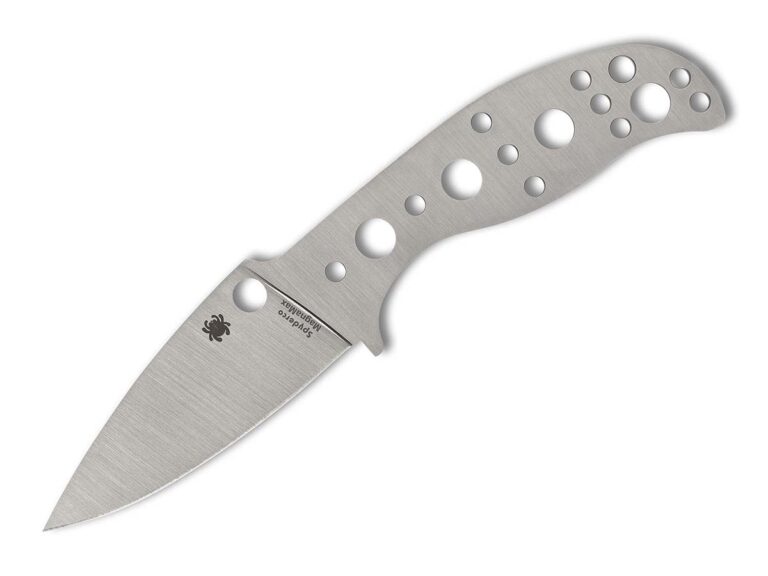
Specially engineered for knife blades, the two alloys are at the cutting edge of metallurgy.
Editor’s note: The genius behind MagnaCut—arguably today’s most popular blade steel for both custom and factory knives—the author has helped create two new blade materials that he fully expects to meet with wide-ranging acceptance as well. Following is his story on his latest voyage into his favorite subject.
I pitched the idea of MagnaCut steel to Crucible Steel and Niagara Specialty Metals in 2019. I said I had an idea for a steel that would match the best of the non-stainless powder-metallurgy steels in terms of wear resistance and toughness. This would be a big deal because there has been a longstanding gulf between the performance of carbon steels and stainless steels. My team and I successfully turned the idea into MagnaCut, released in 2021, which had a microstructure like a non-stainless steel while being stainless—offering the best properties of both.
I intentionally sought balanced properties with MagnaCut so it was both tough and wear-resistant, similar to non-stainless grades such as CPM 4V, CPM CruWear and Vanadis 4 Extra. Knife enthusiasts, especially those into folders, often seek higher-wear-resistance steels for maximum edge retention. Instead, I tried to push for a more balanced set of properties so knife buyers could see the benefits of having high toughness in addition to good wear resistance. This can allow knives to be made with thinner edges for better cutting ability, because toughness helps thinner edges resist chipping. In my edge retention tests with the CATRA (Cutlery Allied Trades Research Association) edge testing machine, thinner edges with smaller angles lead to larger differences in edge retention than the steel choice, or even the heat treatment! It seems many knife buyers have seen the light as MagnaCut has gained quite a bit of popularity since its release.
MagnaMax Steel
Nonetheless, I also knew knife enthusiasts would ask for something more wear-resistant. The folder crowd is not as worried about toughness and are seemingly always asking for greater wear resistance and edge retention. However, when the wear resistance gets too high, the steel becomes “unbalanced,” and the toughness becomes a significant issue. I see images of broken folders semi-regularly from the most extreme wear-resistance grades.
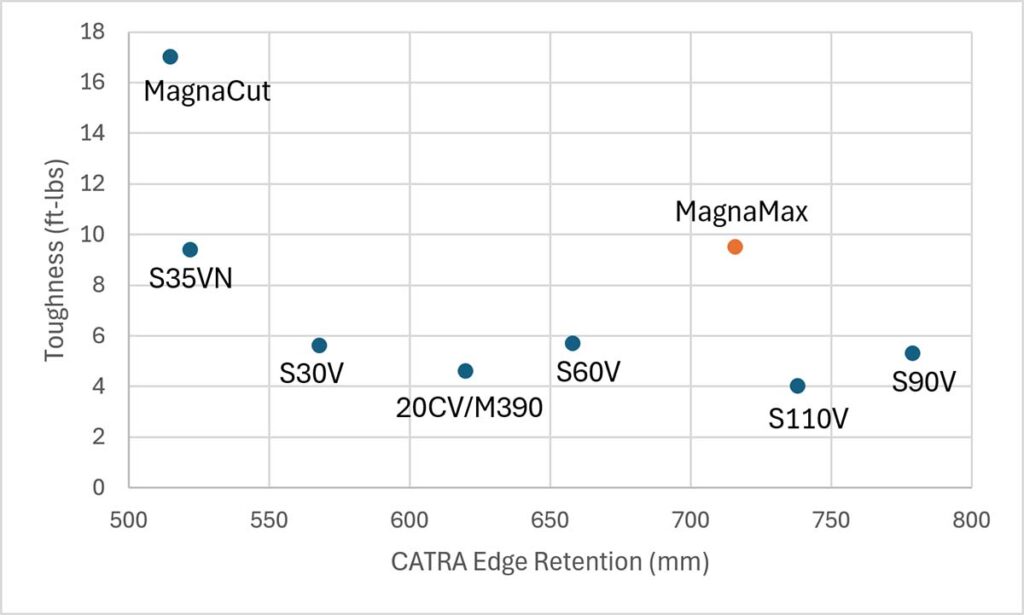
The “sweet spot” for higher-wear-resistance products seems to be in the family of non-stainless alloys such as CPM 10V, Vanadis 8 and K390. In particular, K390 has been building in popularity through Spyderco knives in recent years for its excellent combination of properties. I had actually proposed to Crucible and Niagara way back in 2019 that, after we were successful with MagnaCut, I had another idea I was calling stainless 10V at the time.
This led to a new product called MagnaMax, a higher-wear-resistance steel in the same family as MagnaCut. It shares the same high corrosion resistance and good hardness potential as MagnaCut, but has higher wear resistance at the cost of some toughness. Because it shares a similar microstructure to non-stainless steels, its toughness level for that high wear resistance is excellent.
Two of the highest-toughness stainless powder-metallurgy steels before MagnaCut were CPM S35VN and CPM 154. MagnaMax matches the toughness of those grades while being much more wear-resistant. In recent years, one of the more popular folding knife steels has been M390, and MagnaMax has over twice the toughness and substantially higher slicing edge retention. Spyderco used the second prototype heat of MagnaMax in a series of its Mule series knives intended for enthusiasts to try out different steels. A Spyderco Forum member known as vivi said he cut 325 gallons worth of cardboard strips with one of these knives. He reported, “Even without adding the numbers up, I can say this steel has the best edge retention of any steel I’ve tried.”

The development of MagnaMax was not without its issues, however. The first two test heats of the steel were made by Crucible, a longstanding U.S.-based steel company that unfortunately went out of business in 2025. Crucible is the company behind many of the industry’s leading knife steels like 154CM, S30V, S35VN and 3V. Crucible is the company that invented powder metallurgy itself, a significant innovation providing the excellent properties of all the “CPM” (Crucible Particle Metallurgy) grades. Crucible went under basically right while it was making the second test heat of MagnaMax. A couple of slabs were even recovered from a pile of scrap after the company was dismantled so my team could test it. We made the first test heat of MagnaMax back in March 2023, and we are just now approaching the product’s wide release.
Niagara Specialty Metals (NSM), the company that hot rolls, anneals and distributes the majority of the leading steel grades, has played a key role in keeping these steels alive. Crucible relied on NSM for hot rolling the high-end, complex grades, as it is the only facility in the United States capable of processing them.
Niagara had already assumed an active role in the knife industry many years before, taking over the distribution of blade steels over a decade ago after Crucible’s first bankruptcy in 2009. It pushed for new grades like CPM S45VN, and without NSM, I’m not sure MagnaCut would ever have been made. Niagara is working with other suppliers of powder-metallurgy steel, including Carpenter and Erasteel, to ensure these grades remain available. My team has been working closely with these partners on the development of MagnaMax, but that also means we almost had to start over after Crucible’s unfortunate demise. The good news is I have been testing MagnaMax made by Erasteel, and the properties look excellent, at least as good as the Crucible-made material. And it’s actually looking a little better.
Pop’s ProCut Steel
Perhaps sometimes I get carried away working on new knife steels that push the boundaries for wear resistance. Some knifemakers are looking for simpler grades that are easy to forge, grind and finish.
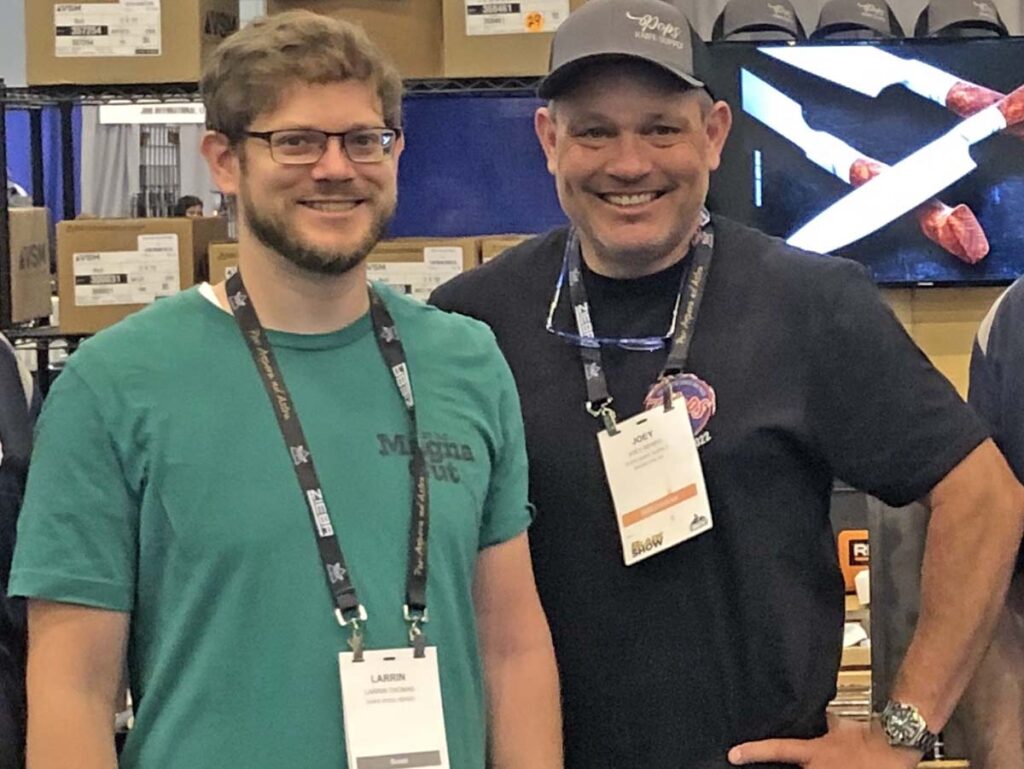
Joey Berry of Pop’s Knife Supply contacted me in March 2024 asking for an improved version of Pop’s most popular grade, 80CrV2, which is known for being very easy to work, high in toughness and low in cost. I told Joey I would need to think about it because I had no idea off the top of my head what version of 80CrV2 would fill the niche of bladesmiths who want something inexpensive and easy to work. However, I have always enjoyed working with Pop’s Knife Supply, so I gave some serious thought to what kind of steel would be ideal for Joey’s request.
Pop’s is growing rapidly and has been a big supporter of mine, selling copies of my books—Knife Engineering and The Story of Knife Steel. It has been expanding its steel offerings and its steel education base to better serve customers, and I knew a steel along these lines would be a good fit for it. One of the trade-offs with knife steel design is when you add some elements like vanadium in significant amounts, things like forgeability and finishability go down. How could I make something new and exciting without pushing so much it becomes difficult for knifemakers to work with?
I thought about how high-nickel steels like 15N20, L6 and 8670 are known for their excellent toughness—at the top of my charts—but also have very limited wear resistance. I also knew some relatively rare steels like Blue #1, V-Toku2 and Wolfram Special have small additions of tungsten and vanadium for wear resistance. In grades with higher amounts of those elements, I start to see complaints from makers about the difficulty of working with them, though they seem to be at a place where they hit the right balance before forging and hand sanding become issues. These tungsten-vanadium steels are relatively challenging to find, often expensive when you do, and their toughness is much lower than the high nickel grades. As a result, the idea was to combine the high nickel approach for toughness with the controlled additions of tungsten and vanadium for wear resistance.
Another major factor for this development was the ease of heat treating. Often, steels like 1084 are recommended to novice makers for heat treating in a forge because it is dead simple to harden—just heat it to nonmagnetic and dunk it in oil. However, these grades are also very easy to overheat; they come out hard, but the toughness is greatly reduced. Only a few seconds in a forge past nonmagnetic can lead to a reduction in toughness.
On the flip side are grades like 80CrV2 that have chromium and vanadium additions to limit grain growth, so overheating isn’t as much of an issue. But the chromium also means you must heat past nonmagnetic and hold it there to ensure the carbides dissolve. The chromium slows everything down. However, I thought if we kept the chromium content very low the new steel could still be quenched from nonmagnetic and achieve full hardness, while the tungsten and vanadium additions would create tiny carbides that “pin” the grain boundaries so overheating and grain growth are not issues. This would make the easiest-to-heat-treat knife steel ever. Just heat it past nonmagnetic and quench it, and you will get high hardness and toughness every time.
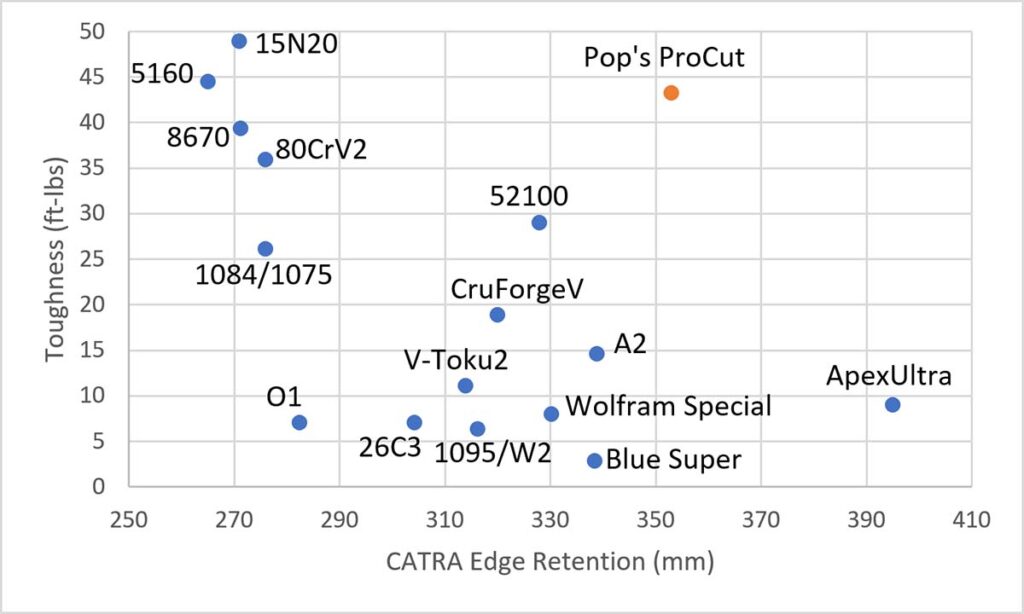
My team and I got a steel company to agree to try the composition I proposed and waited (im)patiently for the steel to arrive. This was a major investment for Pop’s Knife Supply, and there was no guarantee the new steel would work just because it sounded good on paper. Fortunately, however, when we tested the steel, its toughness matched steels like 8670 and 5160, known for their excellent toughness. The edge retention was better than the majority of forgeable grades outside of ApexUltra, a high-performance forging grade I developed with makers Marco Guldimann and Tobias Hangler. And in testing the heat-treating range, we found it could be quenched anywhere from 1400°F up to 1750°F—over 300°F! This met our target of making a steel that is easy to heat treat.
Reports from makers have been very positive for Pop’s ProCut. They have praised the ease of working as well as the tested performance. Dawson Knives related: “We found it to be an excellent steel that 1) Offers a razor-sharp edge on par or better than other modern steels; 2) Holds that edge cut after cut; 3) Displays excellent lateral strength (it flexed close to 20 degrees in either direction and returned to true); and 4) Extreme impact resistance (edge resisted chipping, cracking or rolling when driven into a piece of steel Unistrut with a sledge hammer). We are able to get our edge hardness to Rockwell C of 62-63 and still retain superb flexibility.”
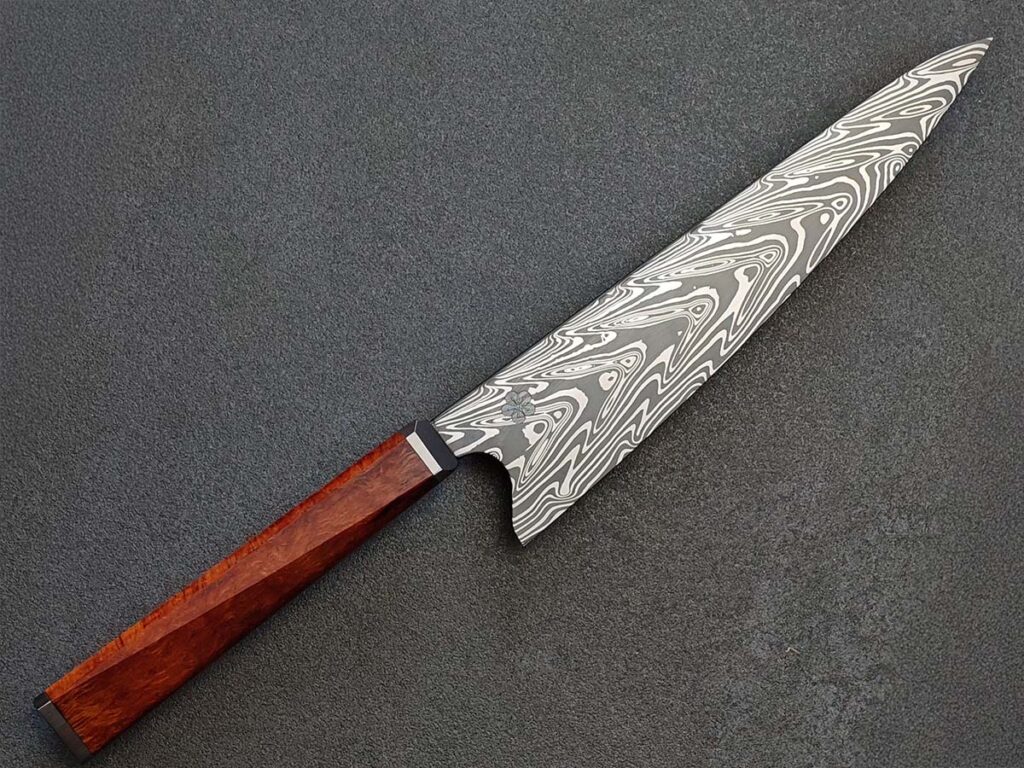
Another exciting aspect of ProCut is the high nickel content (2 percent like 15N20) allows it to be used in pattern-welded damascus as a “bright” layer. This gives a new, higher-edge retention steel for use in damascus. As noted, previous high nickel grades have very low wear resistance. It can even be used in combination with other high-wear-resistance grades to make superior edge-retention damascus. I have seen a couple of knives using both ProCut and ApexUltra for some excellent-looking and performing damascus.
More To Come?
I’m constantly working on new ideas, though it’s hard to predict which projects will pan out or when they’ll be released. It’s been incredibly rewarding to see the steels I’ve developed used by top knifemakers and major knife companies, and to hear from end users who genuinely love them. When my dad, BLADE Magazine Cutlery Hall-of-Fame® member Devin “Hoss” Thomas, took me to my first knife show as a teenager, I never would have thought I would be working on such cool stuff.
More On Knife Steel:
- Best Steel For Knives: How To Choose
- Knife Steel Trends: What To Look Forward To In 2025
- Knife Steel Alloys: A Down-And-Dirty Guide
- Damascus Steels: What To Use And When





