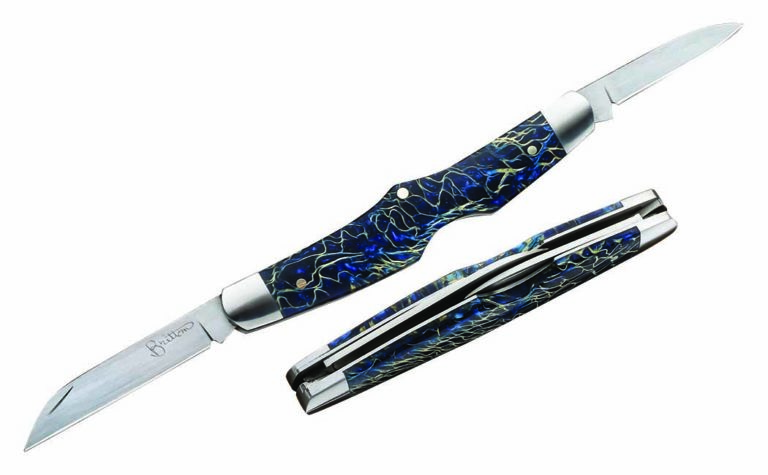
A sensational slip joint, Tim Britton’s Badger revives the Keen Kutter pattern with a ton of flare.
When ABS master smith Bruce Bump showed an old Keen Kutter penknife pattern to veteran knifemaker Tim Britton, Tim fell in love with it and immediately set to making his own iteration.
The blades are BG-42 stainless steel that, as Tim noted, has high ductility and holds an edge forever. He flat ground them on his “ancient” 18-inch, 200-pound Porter Cable disc sander. However, it’s the handle that really stands out. Consisting of stabilized diseased ash burl from Whistle in the Woods, the material looks synthetic but isn’t.
Tim Britton , 80, has been making knives since 1971 and has focused a lot in recent years on slip joints, with the Badger being the latest. He’s got about six antique pocketknife designs on his to-do list for this year, including a peanut and a copperhead. (knife image courtesy of Tim Britton)
“The light stuff in it looks like explosions,” Tim said. “I’ve never seen anything like it.” The projection on the spine fits right in between the user’s index and middle fingers and the groove on the underside cradles the latter for a comfortable, secure grip.
Calling it the Badger, Tim said he made 10 of them and had four or five at BLADE Show 2022.
Badger Spec Check Knife Name: Badger Maker: Tim Britton Blade Steel: BG-42 stainless Blade Grinds: Flat Handle Material: Stabilized diseased ash burl from Whistle in the Woods Closed Length: 3.5 inches Maker’s Price For A Similar Knife: $375
Acclaimed Knifemaker And Cutlery Hall Of Famer D’Alton Holder Passes Away At The Age Of 82.
D’Alton Holder, whose knifemaking career spanned almost 60 years, served decades on the Knifemakers’ Guild board of directors and enjoyed almost 20 years as a member of the BLADE Magazine Cutlery Hall Of Fame®, passed away Nov. 19.
Known simply as “D’,” Holder was a consummate maker of fixed-blade knives, especially hunters. Among the latter, his “My Knife” in a stacked handle of oosic and amber was probably his best-known model and one of the most recognizable knives of its time.
He made his first knife in 1966, selling mostly at gun shows until 1973 when he joined the Guild. He was elected as a Guild board director in 1976 and served on the board for 23 years, during which time he held every board position, including three terms as president. His leadership helped sustain the Guild through the early years of its existence.
Holder organized the Arizona Knifemakers Association in 1975 and was its president for five years. He received the Guild’s Red Watson Award in 1982 and the American Firearms Industry Award of Merit in 1983, the only knifemaker to receive the honor. He was presented the Beretta Award for knifemaking excellence in 1994. He also served three years as president of the Arizona Knife Collectors Club.
He was a charter member of the board of regents of the American Knife & Tool Institute. Holder also was one of the winners of the 1998 Blade Magazine Publisher’s Award for his efforts on behalf of the AKTI.
He taught dozens of knifemakers how to fashion knives and helped dozens of other makers become more accomplished at the craft.
D’ was a very close friend of Cutlery Hall-Of-Famer Buster Warenski. When not making knives the two spent much time hunting and fishing together. In fact, D’ lent a lot of support to Buster during the latter’s making of the King Tut Dagger reproduction, probably the most famous knife of the modern custom era. Despite many delays caused by production problems and other setbacks, Buster finally finished the monumental project, much to D’s delight. “With it, he stood head and shoulders above anything else that had been done,” D’ noted. “I think he did a better job than the original guys, the Egyptians!”
In his speech inducting Holder into the Cutlery Hall Of Fame at the BLADE® Magazine awards banquet of the 2003 BLADE Show, ABS master smith Tim Hancock, a long-time friend of the inductee’s, may have said it best.
“His knives embody his philosophy of art and his dedication to great work and business ethics,” Hancock said of D’. “He has no doubt made a friend of everyone he has sold a knife to.
“He also saw the need to shape the future of the industry that he loved. In his spare time, he has advised, helped, and counseled volumes of fellow knife enthusiasts, knife promoters, and budding knifemakers in their pursuits in this industry. To put it simply, those of us who know him personally would say that his most amazing trait is his unselfish devotion to helping others.”
Arrangements to recognize D’s passing were ongoing, though whether there will be any kind of memorial service for him was unclear as these words were being written.
The holidays are around the corner and besides spending time with family and stuffing ourselves with excellent food it is a time to give gifts and celebrate those we love. For the knife lovers in your family, whether they prefer a folder or a rugged fixed blade, now is the time to take advantage of Black Friday and Cyber Monday deals. Below are BLADE’S top picks for the best knife deals this holiday season.
This article will be updated as more deals become available, so be sure to check back often.
Amazon
Of course, Amazon has a ton of deals and is worth a look daily—especially if you’re on the hunt for a knife deal.
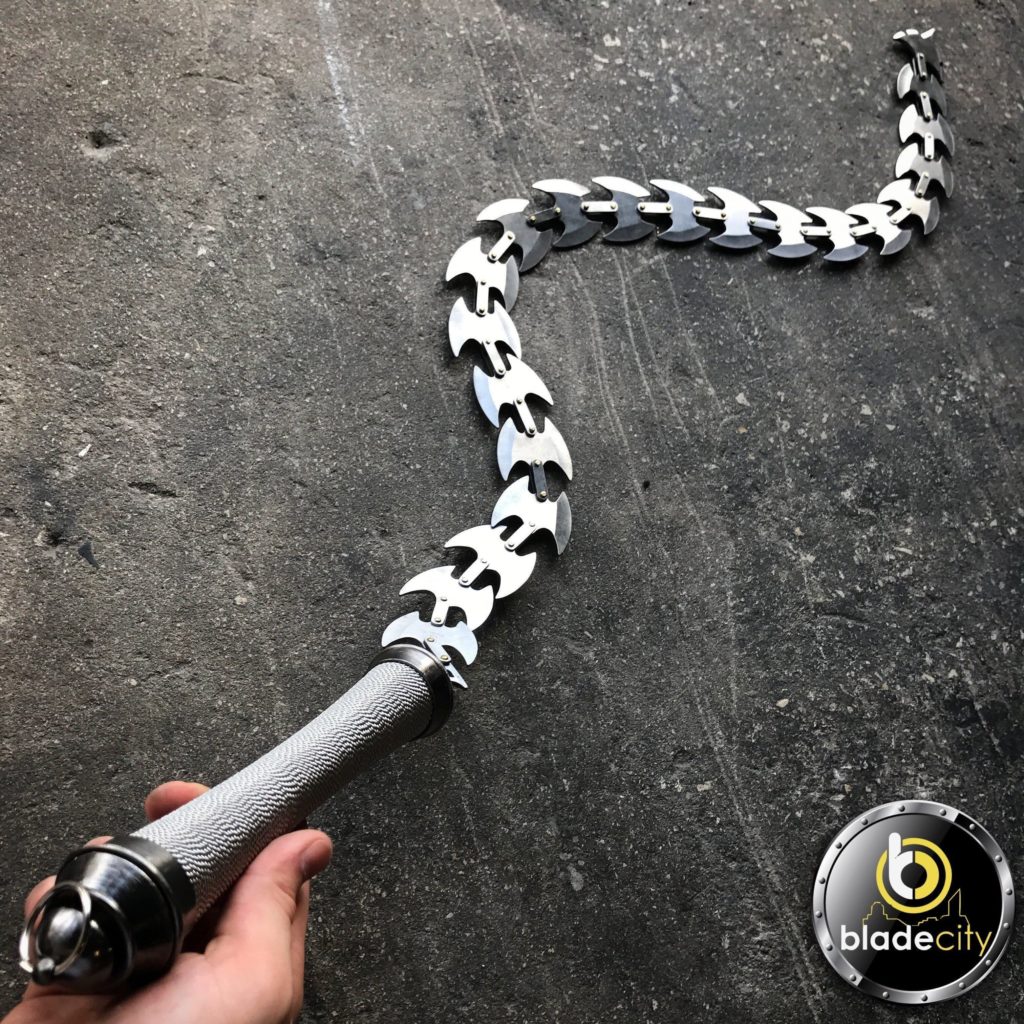
If the knife enthusiast in you life has more exotic tastes, Blade City will like scratch their itch. The site has its Christmas deals page up and running.
Blade HQ has a number of Christmas promotionals up and running. One of the more intriguing is laser engraving for an extra $9.99 on a purchase. Also, they’re giving away Winchester Shotgun Shell knives with a purchase over $75. Pretty Sweet.
The HQ also has a number of categories to shop their deals during the holidays:
SMKWis bursting at the seams with deals, with nine pages of site busters. You’re certain to find something for the knife lover in your life—even if that happens to be yourself.
Knifemakers From Around The World Share What Equipment They Can’t Live Without And How It Helps In Creating Their Knives.
There are high-quality knifemakers on every continent. We chatted with some of the world’s best makers about what equipment and tools are must-haves for them in their shop.
Bertie Rietveld
Bertie’s Legacy Roman pugio in Dragonskin damascus with a Stanhope lens just below the guard and lapis lazuli cylinders with titanium spacers in-between is spectacular even by his high standards. Overall length: 16 inches. (SharpByCoop image)
One of the world’s leading makers of art knives, South Africa’s Bertie Rietveld is known for magnificent custom daggers and fixed blades, many in his Dragonskin damascus and with a Stanhope lens at the ricasso, a peek into which reveals whatever image Bertie likes to put there—usually the Stanhope logo.
Among his knifemaking equipment that proves invaluable to building his award-winning knives are his Rosa Italian precision drill presses.
“I have three of them,” he wrote, “each one set up with a different-diameter drill bit so I don’t have to change bits. The speeds are set to match the ideal speed of each drill bit in the chuck of each machine. They are super accurate and an absolute pleasure to use when drilling small holes. Each one has a light that automatically comes on when you start the drill. They’re probably 30 years old but I have rebuilt them to their former glory.”
Next on Bertie’s list of top knifemaking machines is his Schaublin 102 plain lathe.
“It was manufactured in 1961, which makes it a year older than me!” he grinned. “I have a full set of collets and chucks for it and use it a lot to turn small pins and pivots for my folders. It’s one of those machines built in the golden area of mechanical excellence: the 1960s. I love working on it because it’s very accurate and just a solid, well-built machine.”
Third among his most valuable knifemaking machines is his Cutlermatic belt grinder, which he built about 20 years ago when he ran Batavia Engineering.
“We built some 300 of these grinders for knifemakers at the time,” he recalled. “This machine has a whole myriad of contact wheels, from 2 inch to 20 inch, and is fitted with an inverter speed control. I use it to grind all my knives and also for hundreds of other grinding jobs. It’s probably the most used machine in my shop. It has a foot pedal to change belts and also some really bright LED lights on stalks so I can see where I’m grinding.”
The fourth machine is “Shaya,” Bertie’s “famous” 500-pound Massey power hammer. It was built in 1941 and he completely rebuilt it in 2000, a process that took eight years.
“I make all my damascus on this hammer, Dragonskin, Nebula, and Fracture, as well as other laminar damascus. It is a gentle giant but packs a mean punch when at full speed. Hardly a week goes by when I don’t have two or three forging sessions.”
Murray Sterling
Murray makes nothing but folders, including slip joints, linerlocks, and lockbacks. Among the latter is this fileworked and engraved straight-edge model in mother-of-pearl.
Murray Sterling turned 93 the first day of Spring and still makes knives like he’s 39. What are the most important pieces of knifemaking equipment for the self-described “old-school machinist” on the low side of 100 who’s been making knives for over three decades?
First are his four 2×72 belt grinders. He made three of them, including one he built 25 years ago that he uses 90 percent of the time.
“I hollow grind and profile all my folders and finish all my folders with it,” he wrote. “The only other grinder I bought new was a square wheel in 1989. I only use it for 45-degree scales.”
Next on Murray’s list is his Taft Pierce surface grinder. “This is probably the most important machine in the shop for making folders, and that’s all I make now,” he wrote.
The machine is over 50 years old and Murray bought it 20 years ago when it came available from a company his son worked for that was in the process of upgrading its machinery.
“In making folding knives, everything has to be flat,” Murray observed. “This machine is one of the best ways to achieve that. It has upgraded the quality of my folders by 100 percent. It also has a 2×72 belt attachment and, with a 60-grit belt, you can remove a lot of material fairly fast.”
Murray has four disc grinders, including two side-by-side models with 9-inch and 12-inch discs, the former with a 100-grit abrasive and the latter with a 320-grit one. Murray made the tables for the grinders 20 years ago. The motor for the 12-inch grinder is the original one from his square wheel grinder, the latter which he reoutfitted with a DC motor a couple of years after he bought it. The grinder on the fixed 45-degree table he uses for knife parts that need to be made square, such as backsprings for slip joints and lockbars.
The handiest machine in Murray’s shop is his Burgmaster drill press. He bought it in 1967 and uses it to drill 90 percent of the holes in his knives. It has six spindles, each of which runs at a different RPM.
“I can set it up with a tap drill, clearance drill, and counter bore for .080-inch screws,” he wrote. “It makes things quick and easy. I would hate to do without any of these machines. I also have a lathe and make my own bushings and pivot pins.”
Brian Tomberlin
An example of Brion’s knives is his Nagabowie—a Japanese-style blade with hamon complemented by a bowie handle.
ABS master smith Brion Tomberlin makes a lot of hidden-tang knives in his shop in Norman, Oklahoma, and a set of handle broaches he got from fellow ABS master smith John Perry are a must-have for that style of knife construction.
“They do a great job of opening up the slot for the tang in handle blocks,” Brion observed. “I bought the first two from John way back when there was a Spirit of Steel knife show in Mesquite, Texas, probably his first or second batch of them. I still use them all the time. They’re very finely crafted tools.
“Another must-have tool for me and most makers is a set of calipers. In order to get things fitted correctly, such as guards and getting the measurements on things like the depth of clips even on both sides, you need to have accurate measurements. A good knifemaker thinks in thousandths and you need to be able to accurately measure them. So, I have calipers everywhere. I’ve got to have them.”
Brion uses a Foredom tool on every knife that leaves his shop.
“It’s a super versatile tool,” he noted. “I’m sure everyone has used Dremel tools, especially the variable-speed models. But the Dremel tools wear out and I hear all the time that people keep buying them every two or so years because the tools stop working. So, save money and get the standard rotary-flex-shaft tool used in the jewelry trades. Just get a Foredom tool and you will not regret it.
“Mine is variable speed and reversible and that is what I suggest. I bought it from an old name in knifemaking supplies, Mick Koval [of Koval Supply], over twenty years ago. It’s still going strong. There is so much you can do with them and they have so many attachments. Rio Grande and Gesswein jewelry supply are knifemakers’ friends. I use this tool for guards, contouring buttcaps to match stag, polishing things, carving, etc. It has so many uses.”
Another tool Brion uses on every knife he makes is his trusty file guide.
“The shoulder filing guide or just plain file guide should be standard in every maker’s shop,” he advised. “My main one is a carbide-faced model from Riverside Machine in DeQueen, Arkansas.
“You need to get the shoulders on a blade flat in order to get the guard to fit up correctly,” Brion wrote. A file guide will do that. “Also, with the carbide faces you can use the guide with grinding belts to get the plunges even. I bought this years ago when Uncle Al [Alton Lawrence of Riverside Machine] first started making them. It has served me well. You don’t have to have the carbide faces as there are hardened steel file guides too, but pay the extra money and get the carbide—you will not regret it.”
Rounding out Brion’s top knifemaking tools are his machinist squares.
“You have to be able to lay out lines and have them be true, everything from laying out guard slots to making sure things are 90 degrees, such as platens on grinders,” he advised. That’s where the machinist squares come into play. “You have to have them and they aren’t expensive. Making sure your layout lines are correct will help you make better knives,” Brion concluded. “Every knife shop should have them.”
Makers And Knife Aficionados From Around The Globe Are Set To Descend On Salt Lake City For Blade Show West In October.
Premier custom and factory knifemakers, a seminar on a new canister pattern technique that could revolutionize the knife industry and the 3rd Annual West Coast Flipping Championships will be but a few of the highlights of BLADE Show West Oct. 7-8 at the Salt Palace Convention Center in Salt Lake City.
It will be the first-ever BLADE Show West in the great state of Utah. The show was held at the Long Beach Convention Center in Long Beach, California, last year.
The doors will open to the public each day at 10 a.m. and close at 6 p.m. Leading custom and factory makers, knife accessory companies, suppliers of various materials, equipment, and tools to make knives and more will exhibit their latest wares for your perusal throughout the weekend.
The Stars Of Blade Show West
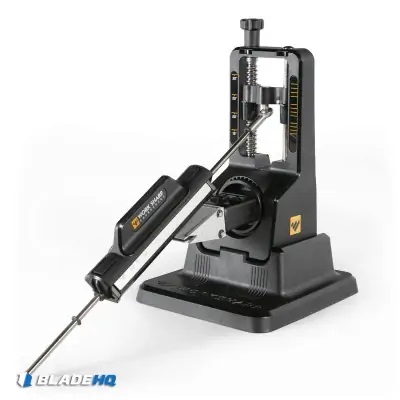
As with all BLADE Show events, BLADE Show West will have a state-of-the-art seminar schedule. The schedule kicks off Friday at 1 p.m. with one on how to bring your blade back from the edge of dull by Clay Allison of Wicked Edge Precision Sharpeners.
At 2:30 p.m. ABS master smith Steve Schwarzer and Ron Hardman will present 3D Printing for Canister Patterns. In this exclusive seminar for BLADE Show West, Steve and Ron will outline how 3D printing plays a role in bladesmithing and how it may affect the future of the craft in general.
It was just this past February that Steve, Ron, Ben Bannister, and Kyrie Schroetin posted test results where 3D printed designs were combined with powdered steels to lay out complex canister patterns—all in record time.
With relatively inexpensive printers, free design software, and easily sourced printing materials, 3D printing is more accessible to the general public than ever, and it’s something most anyone can do in a shop setting. Join Steve & Co. as they demonstrate how to do it, compare and contrast different methods of developing patterns, the types of metals that can be used, how to set up your own 3D print lab, and more.
ABS master smith Neels Van Den Berg of South Africa was the star of the annual meeting of the ABS at BLADE Show ’22 in Atlanta, not only earning his ABS master smith stamp but capturing the coveted B. R. Hughes Award for the best knife by a master smith applicant. Join him as he shows you how he makes knives in the design of his award winner in Symmetrical Quillon Dagger.
The gang was all there for last year’s 2nd Annual West Coast Flipping Championships and a large number are expected to compete this year in the 3rd annual rendition sponsored by Squid Industries. (group shot courtesy of Squid Industries)
Saturday’s seminars kick off with Let The Pros Critique Your Knife, the latest in the BLADE Show’s series of discussions in which some of today’s leading makers examine one knife of one or more show attendees. This time the panel consists of BLADE Magazine Cutlery Hall-Of-Fame® member Bill Ruple, slip-joint maker Enrique Pena, ABS master smith/past Forged in Fire judge Jason Knight, and bladesmith Will Stelter. Shane Magnussen will follow that up with a reboot of his popular seminar, How To Texture Titanium Knife Handles.
The seminar schedule closes with a bang on show Saturday with the 3rd Annual West Coast Flipping Championships sponsored by Squid Industries. Contestants ranging in age from teenagers to 30 will show their stuff in a series of timed balisong-flipping competitions. Attendance is free to all show ticket holders.
Award Categories And Rules
At a time to be determined on show Friday, the custom knife and factory knife judging competitions will be held.
Categories in the custom knife category are: Best Slip Joint, Best Locking Folder, Best Damascus, Best Kitchen Knife, Best Bowie, Best Hunting Knife, Best Tactical Knife, Best Chopper, and Best In Show. Categories in the factory knife category are Best Folder, Best EDC, Best Hunting Knife, Best Tactical Knife, Best of the Rest, Best Non-Knife Tool, and Best In Show.
Special rules for the factory judging include:
•Best EDC is open to both folders and fixed blades.
•Best of the Rest is for any knife not covered by the other categories.
•Best Non-Knife Tool, as its name suggests, must be for any non-knife tool.
Special rules for the custom judging include:
•Best Locking Folder is for any folder that locks, including linerlocks, lockbacks, etc.
•Best Chopper includes any edged tool that excels at chopping, including but not limited to competition cutters, kukris, cleavers, hatchets, tomahawks, axes, etc.
Special rules for both custom and factory include:
•Best Hunting Knife and Best Tactical Knife are open to both folders and fixed blades.
All award winners will receive trophies and coverage in the BLADE Show West recap edition of BLADE®. The winners will be announced at 8 p.m. on show Friday at the BLADE Show Awards After Party presented by Black Rifle Coffee. (See the show program and/or the show staff at the show for the party’s location.)
New Venue For Blade Show West
Tobin Hill will be among a strong contingent of exhibiting slip-joint makers. His folding-guard hunter features CPM 154 stainless blade steel in a hollow grind and an amber stag handle. His price for a similar knife: $2,500. (SharpByCoop image)
Many outstanding restaurants and watering holes are within easy walking distance of the Salt Palace Convention Center, a venue that is cutting edge in terms of exhibitor space and other amenities. The area is also home to an energetic nightlife scene, national parks, museums, and other attractions.
Meanwhile, there will be raffles and giveaways, vintage custom and factory knives on display, knife swapping galore, old friends renewing acquaintances, and new friends making new ones—all at BLADE Show West 2022.
Friday, October 7 1-to-2 p.m. BACK FROM THE EDGE OF DULL—Meeting Room 150: Maintaining a keen edge on your knife requires sharpening on a regular basis. However, that isn’t always done and the edge may go almost completely dull as a result. According to Clay Allison of Wicked Edge Precision Sharpeners, his company has the tools to bring your blade back from the edge of dull. Let him show you how. 2:30-to-4 p.m. 3D PRINTING FOR CANISTER PATTERNS—Meeting Room 150: Learn how to leverage 3D Printer Technology to make canister damascus patterns. ABS master smith Steve Schwarzer and Ron Hardman show you how to use this game-changing advancement to forge patterns that were previously unthinkable—and all on a budget, too. 4:30-to-5:30 p.m. SYMMETRICAL QUILLON DAGGER 101—Meeting Room 150: ABS Master Smith Neels Van Den Berg takes you through the making of a Symmetrical Quillon Dagger, including design, proportions, aesthetics, materials, fluting and finally the entire production process, sharing useful tips and tricks to save you time, money and frustration.
Saturday, October 8 1-to-2 p.m. LET THE PROS CRITIQUE YOUR KNIFE—Meeting Room 150: Award-winning knifemakers share their decades of knowledge and experience in critiquing your custom knife. Jason Knight, Enrique Pena, Bill Ruple, and Will Stelter go over your knife and tell you what is good about it, what is not and how you can make it better. This will be a limited-seating event. Bring one knife only. Questions from attendees will be entertained throughout. 3-to-4 p.m. HOW TO TEXTURE TITANIUM KNIFE HANDLES—Meeting Room 150: Shane Magnussen of Scorpion 6 Knives covers the use of a 2×72 grinder to sculpt various patterns and textures on materials such as titanium, steel, and other alloys. He will cover the setup and techniques of sculpting freehand or by using a fixture, provide the information needed to safely use and select a grinder for sculpting, and outline the mechanics of varying angles, wheel size and abrasive belt options, and how they influence the finished look of the materials. 4-to-6 p.m. 3rd ANNUAL West Coast Flipping Championships—Meeting Room 150: Hosted by Squid Industries, the championships will feature head-to-head live blade flipping in an elimination bracket-style competition.
Hogue’s Newest Fixed Blade Is Visually Spectacular And Ridiculously Light. Part Of The Company’s New Line Of Hunters, The Extrak Does Far More Than Asked Of It.
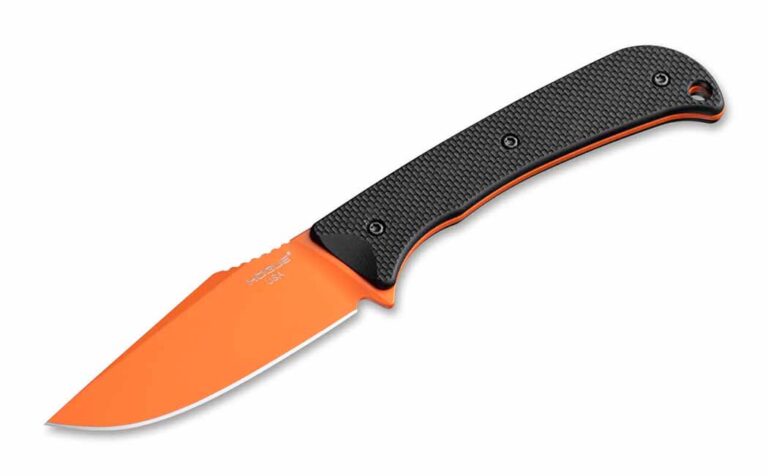
Every hunter knows that a good knife is worth its weight in gold. Hogue’s newest line of hunting field knives includes the Extrak. This fixed-blade wonder is amazing for what it can do at just 1.9 total ounces. The fixed blade is made from CPM M4 Tool Steel and has a vibrant Hunter Orange Cerakote finish. The clip point has a flat grind on its cutting edge and is hardened to a 62-64 HRC.
To learn more about this new line from Hogue, take a look at the video below.
The G10 handle scales provide excellent grip but are also removable to make the knife even lighter. The included nylon blade guard does its job admirably in keeping the blade secure in transport.
Overall this knife really is remarkable. The combination of hardness and weight alone makes it excellent for skinning hides and processing kills. It’s so light, so strong, and so versatile that it is absolutely worth the price and would make life easier for hunters of all types and skill levels.
MSRP: $189.95
Editor’s Note: This article was written by Mike Ableson.
SOG Has Made A Hatchet That’s Compact, Lightweight, And A Joy To Use For Smaller Tasks In The Backyard Or Out Camping.
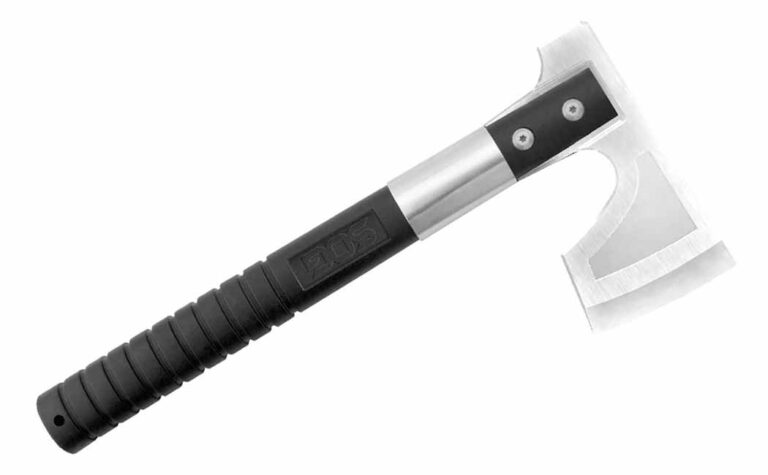
The new Camp Axe from SOG is exactly as advertised. No, this axe won’t fell a 40-foot-tall tree, but if you’re looking to cut through some small brush, chop up kindling for the fire, or hammer in some tent posts, the Camp Axe can do it all with ease.
It’s small at just a shade over a pound in weight and a shade under a foot in length. This means it’s great for chopping in close quarters. The stainless blade has a black stonewashed finish and will stay sharp in the elements.
The glass-reinforced handle is strong and can hold its own if you need a makeshift hammer to drive in a spike or a post. The included GRN safe quickly wraps around the blade and stays snugly in place so you won’t have to worry about stepping on a rogue axe late at night.
At an MSRP of $59.95, the Camp Axe feels fairly priced. This axe might not be for Paul Bunyan, but it’ll be perfect for you the next time you want to sleep under the stars.
Editor’s Note: This article was written by Mike Ableson.