Here are BLADE Magazine’s Featured Knives of the Week. Browse through these articles to find the best knives available from both custom knifemakers and factory knives.
Is the assortment of knives in your house as appropriate as it should be?
At one time I thought I wasn’t a knife collector. I am a knife enthusiast, knife user, knifemaker, knife writer, maybe even a reluctant knife expert, but not a knife collector.
Back when I thought that way, I looked around and noticed I had a dozen knives within arm’s reach, plus the tools in the kitchen, plus the customs of my own and a few from others, plus all the factory knives. Turns out I had nearly 100 knives, which means I’m definitely a knife collector, or at least an accumulator.
In my usual ADHD stream-of-consciousness fashion, my next thought was, “I wonder if I have a knife in every room of the house?” followed immediately by thoughts of which kind of knife would go in each room. Come along on my imaginative journey as we explore the idea of a knife for every room.
Kitchen
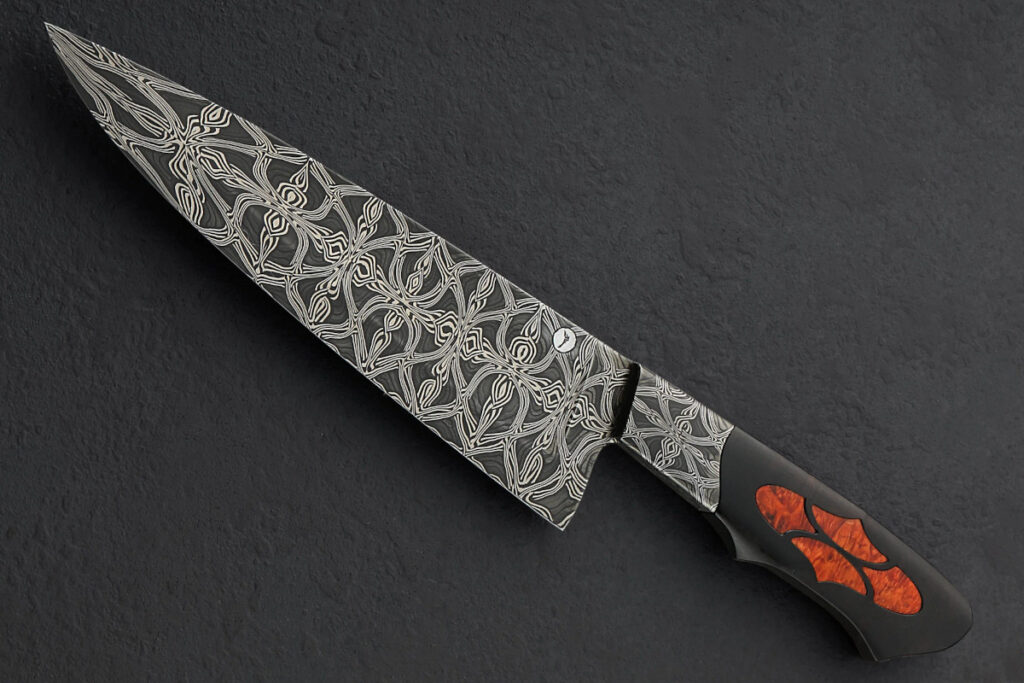
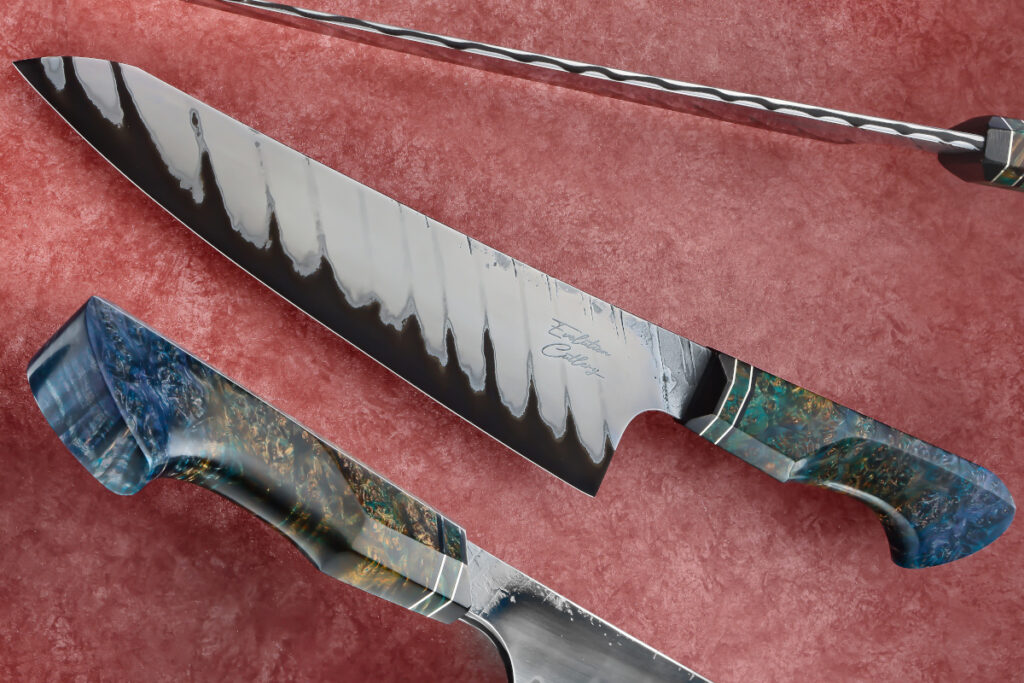
Knives in the kitchen are a given but including one by bladesmith Salem Straub is not. In the author’s perfect household cutlery world, one would be. An example: Salem’s Guimard chef’s knife in mosaic damascus. (EatingTools.com image)
The kitchen is intuitive. Most people have knives there, whether the knives are economy store cheapies, a mishmash random drawerful accumulated over years, a matching production set, or even dedicated custom household cutlery. On my imaginary journey, I can afford the good stuff, like a damascus chef’s knife from bladesmith Salem Straub. But that’s too easy. Why not a whole knife-fork-and-spoon-damascus set, like one from Nate “Tuna” Grant?
Garage
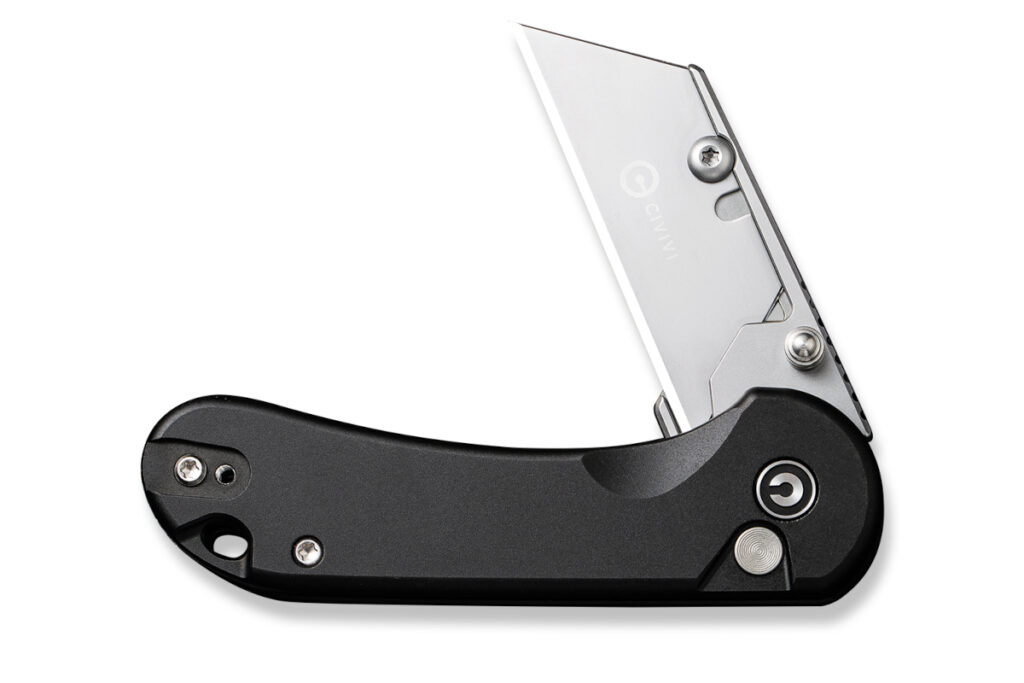
For the garage, the author suggests a factory utility knife of the replaceable-blade variety such as the Civivi Elementum.
The garage isn’t too tough either. My first thought was a utility knife of the replaceable-blade variety. In the past few years there’s been innovation in the custom knife world when it comes to replaceable blade knives, but for utilitarian and “I can use this and not be sad if I scratch it,” I think I’ll go with the Civivi Elementum that uses standard box cutter blades.
Living Room
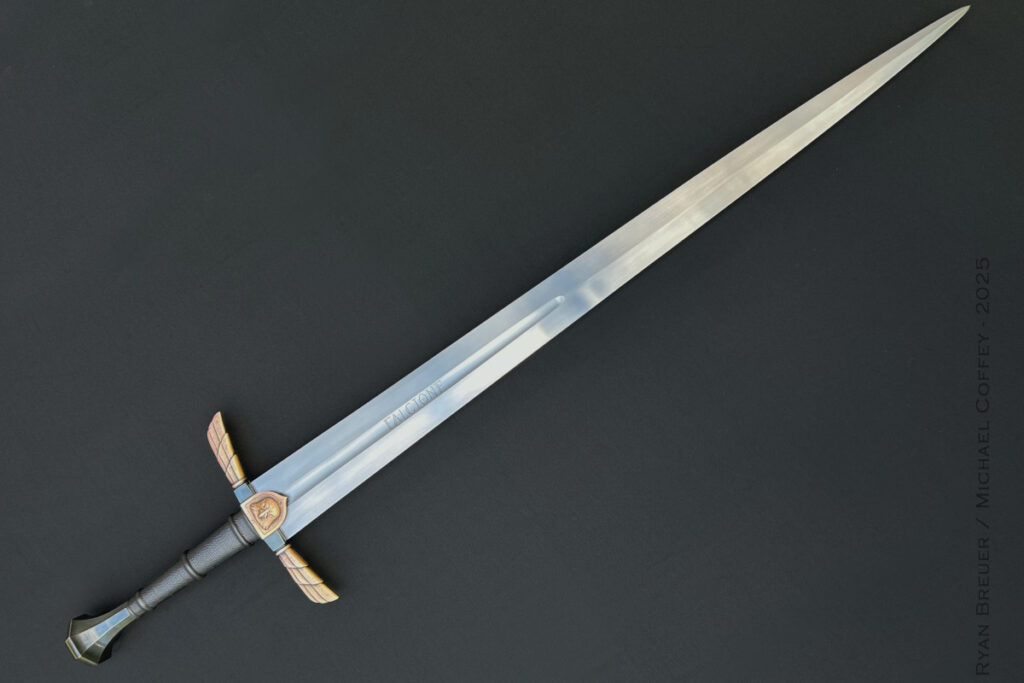
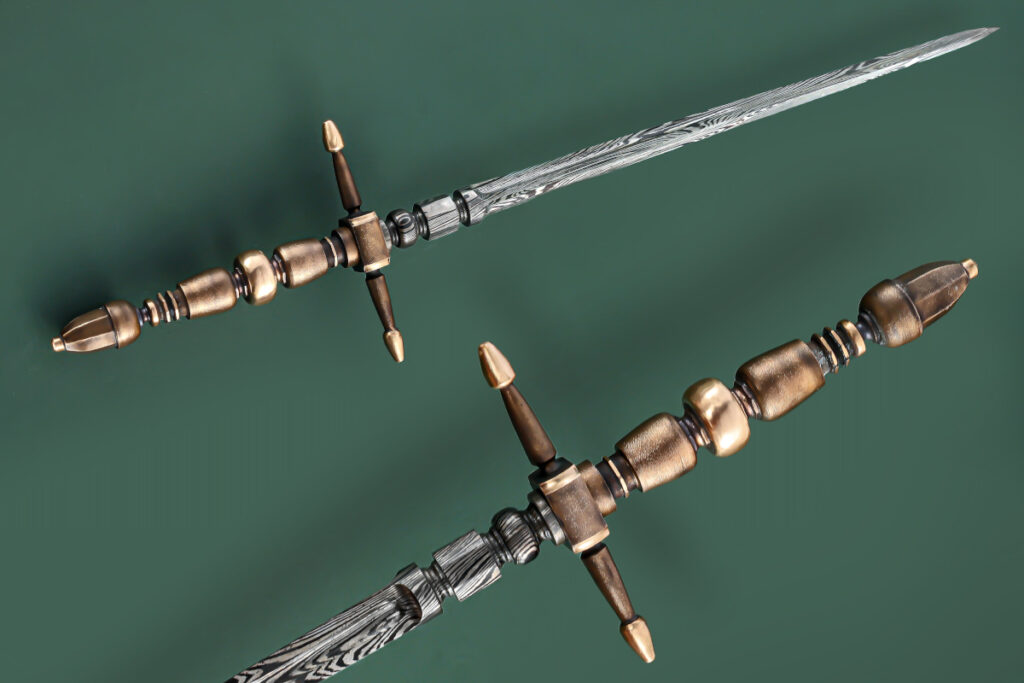
If the living room has a fireplace mantle, it’s a great place to display a custom sword. If you’re feeling medieval, the author recommends something like a hand-and-a-half piece by Ryan Breuer. (Ryan Breuer image)
The living room has the fireplace mantle, which is a great place to display a custom sword. If I were feeling medieval, I’d choose something like a hand-and-a-half piece from Ryan Breuer. Conversely, if I were feeling loud and Japanese, I might choose a fine bright katana like one from David Goldberg with an epic hamon.
Study
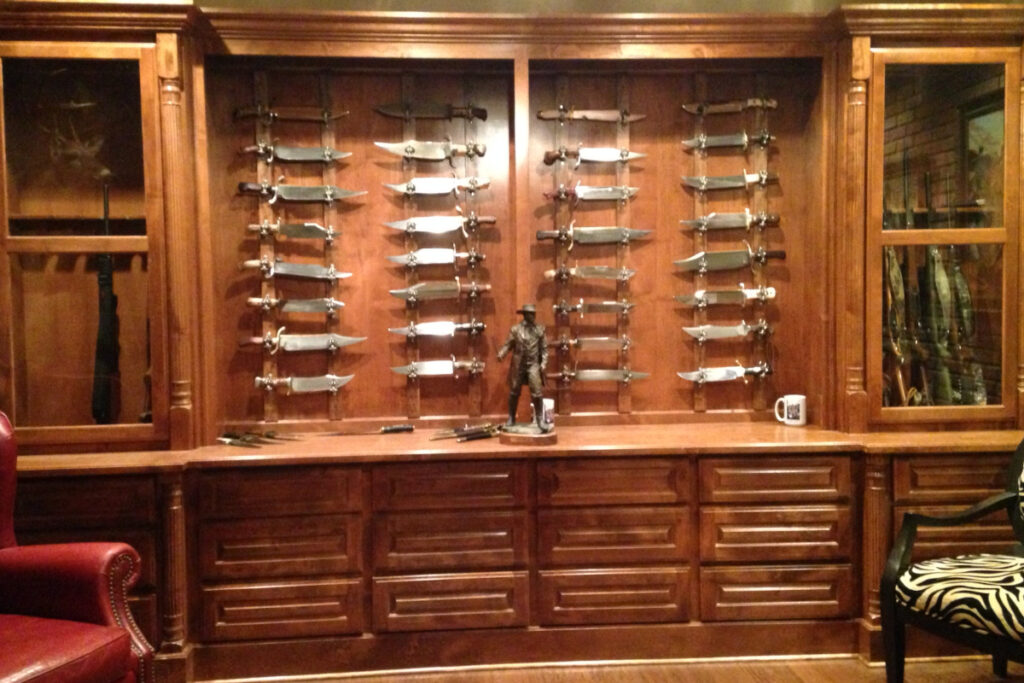
Along with studies, game rooms are also great for storing knife collections. Avid bowie collector Chris Nolen keeps his collectibles in a game room display designed by his son-in-law, replete with a statue of Jim Bowie and slide-out drawers that hold around 10 bowies each. (Chris Nolen image)
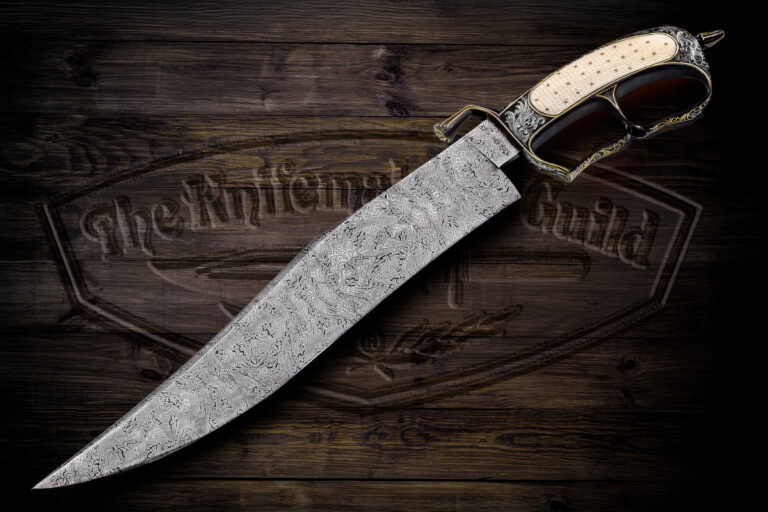
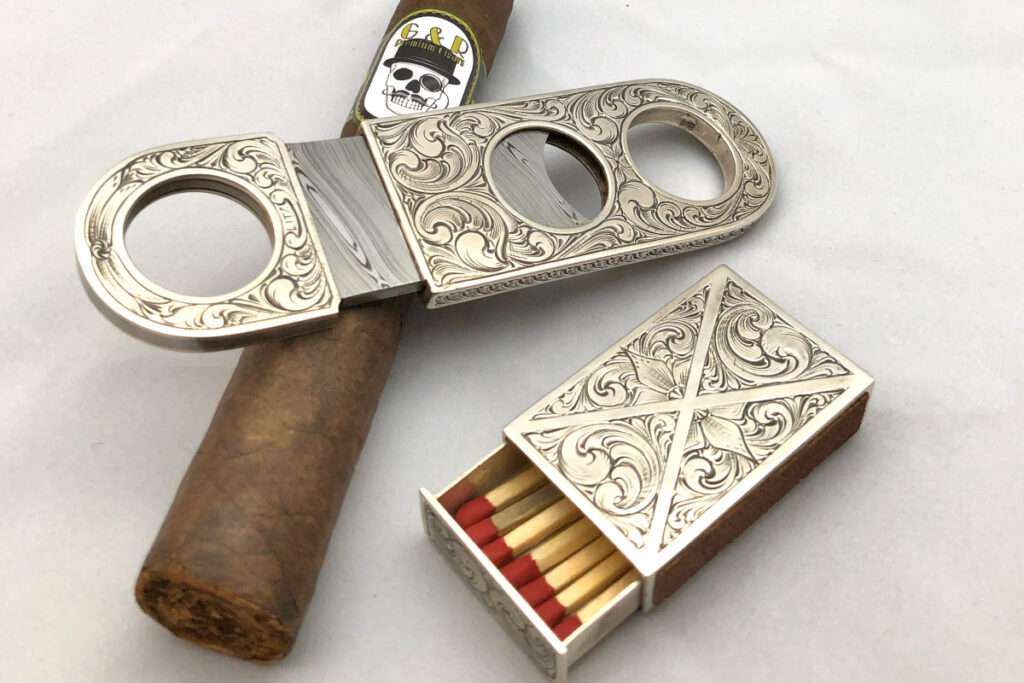
The gentleman’s study is dark, filled with books and memorabilia—the perfect place to store and display the “real” knife collection. Personally, I’d like a collection of custom bowies. I’d include pieces like a fully forged integral mosaic model from ABS master smith Mike Quesenberry, or an exquisite collaboration like The Knifemakers’ Guild award-winning piece by Nick Orr and Bailey Bradshaw. Or maybe I’d go rustic like ABS master smith Lin Rhea’s Preacher Bowie named after a mountain man. I’d round out the room with an engraved silver cigar-cutter-and-match-box set by Travis Payne engraved by Matt Litz for when the guys and I want to relax with a puff.
An engraved silver cigar-cutter-and-match-box set by Travis Payne engraved by Matt Litz for relaxing with a puff among friends would round out the author’s dream study. (Matt Litz image)
These days most tend not to receive letters, only junk mail and bills, and most of the junk mail goes straight to the trash unopened. But if I had a home office and I received good mail, I’d have to open it with a custom letter opener like one in a set from Deon Nel. He made a matching set of 16, so I bet he could spare one.
Outdoors
The backyard isn’t exactly part of the house, but that doesn’t exempt it from being a part of the author’s imaginary knife journey. If you have a standard grill, consider something like a san-mai brisket slicer from Dan Tompkins. (SharpByCoop image)
The backyard isn’t exactly part of the house, but that doesn’t exempt it from being a part of my imaginary knife journey. For those with a standard grill, you might consider something like a san-mai brisket slicer from Dan Tompkins. Or if you’ve got a fire pit, don’t forget Will Stelter’s damascus and mammoth ivory marshmallow fork. Or if you live in the woods, you might want a forged axe like a laminated wrought iron one from Nick Bachtel.
Bedroom
The author’s dream bedroom pillow dagger would be like Buttercup’s in The Princess Bride. If he were Buttercup’s beau, Dread Pirate Roberts, the author stated he might give his lady something like a poignard by Jamie Bishop. (SharpByCoop image)
Bedroom knives are a bit of a stretch. Personally, I have my hunting knives in my bedroom closet. If I were rich and fancy, though, I’d have to have a pillow dagger—you know, the dagger you keep under your pillow just in case. I’m reminded of the scene in The Princess Bride when Buttercup pulls out a fine stiletto in the bedroom, and the great Dread Pirate Roberts line that goes with it: “There is a shortage of perfect breasts in this world. It would be a pity to damage yours.” If I were Dread Pirate Roberts, I might give my lady friend something like a poignard by Jamie Bishop, or even something dainty and feminine like a fine small piece from ABS master smith Veronique Laurent. For under my personal pillow, I’d go with something extravagant like an art dagger from the Sobral Brothers.
Bathroom
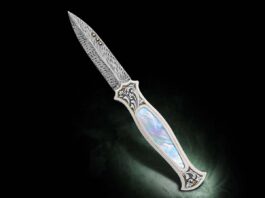
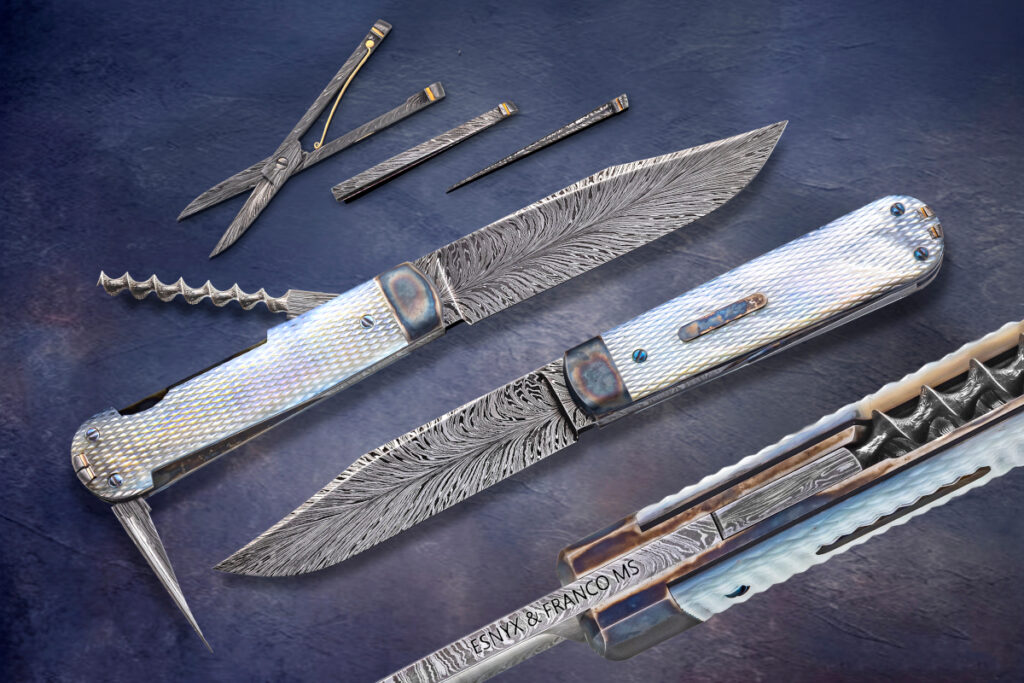
Bathrooms are for hygiene and sometimes that takes a knife. To clean your fingernails or pull a splinter in style, the author recommends something like the fine Dourado collaboration between ABS master smith Dionatam Franco and Evan Nicolaides. (Mitchel Cohen image)
Bathrooms are for hygiene and sometimes that takes a knife. If you want to clean your fingernails or pull a splinter in style, I recommend something like a fine collaboration between ABS master smith Dionatam Franco and Evan Nicolaides. The pearl scales will shimmer in the vanity lights, and there are enough tools included to take care of many different tasks. Or if you want to play “Mack the Knife” in a dark alley then come home and comb your hair, Rick Lala can hook you up with his two-tool blade/comb folder.
How Close Are You?
You may not have a knife for every room, but I suspect that many BLADE® readers come very close. Here’s to improving the quality of your knife collection—even the bedroom knives!
Marine Corps hero feted with Nawrocki knife at The Battleship Ball.
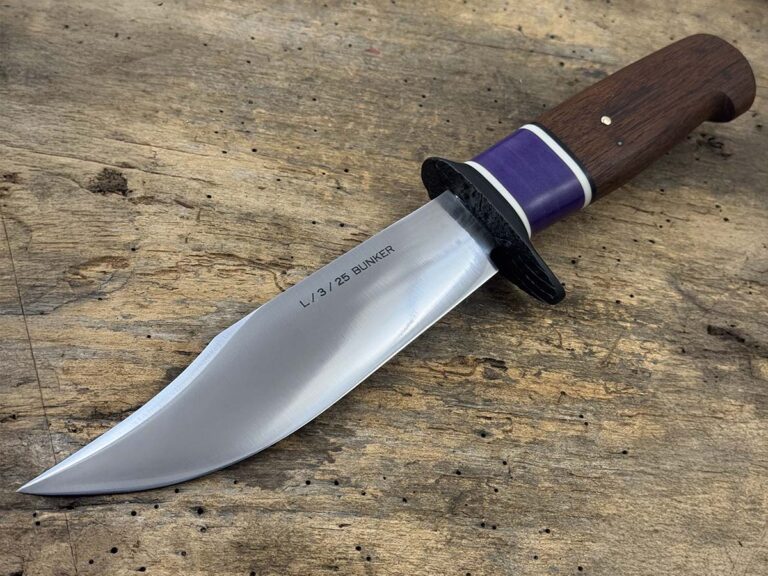
An unforgettable setting for a memorable event celebrating an American hero—all complemented by a beautiful knife by Brian “Rocco” Nawrocki—completed a tribute to USMC Sergeant Scott Bunker during last year’s 250th anniversary of the United States Marine Corps.
Assigned to Lima Company in 2005 during the Iraq War, Sergeant Bunker took multiple machine-gun rounds at point-blank range in house-to-house fighting, resulting in the loss of an eye, half a lung, several ribs and soft-tissue damage to his left arm. He was the guest of honor at The Battleship Ball 2025 on November 1, held on the deck of the vintage World War II Battleship USS North Carolina in Wilmington, North Carolina.
Event organizer/USMC veteran Dean Smith (left) congratulates Sgt. Scott Bunker after delivery of the Nawrocki tribute knife (in display case on the dais) during The Battleship Ball.
The handsome fixed blade Rocco made for Sergeant Bunker includes steel from the North Carolina for the blade and guard. The wood handle is teak from the battlewagon’s deck, along with purple heart ribbon spacers.
BLADE Show West ’25 leaves them smiling in Salt Lake City.
What a difference a year makes—and most involved with BLADE Show West October 10-11 in the Salt Palace Convention Center in Salt Lake City probably would be the first to agree.
While BLADE Show West ’24 didn’t exactly bomb, neither was it one of the best. Among the reasons for what some fairly or unfairly portrayed as an average event was the uncertainty surrounding the presidential election and how it would affect consumer spending, and the proximity of the show dates to the beginning of hunting season, among others. Whatever the excuses last year, no excuses were needed for the ’25 show as it met with approval from a large segment of exhibitors.
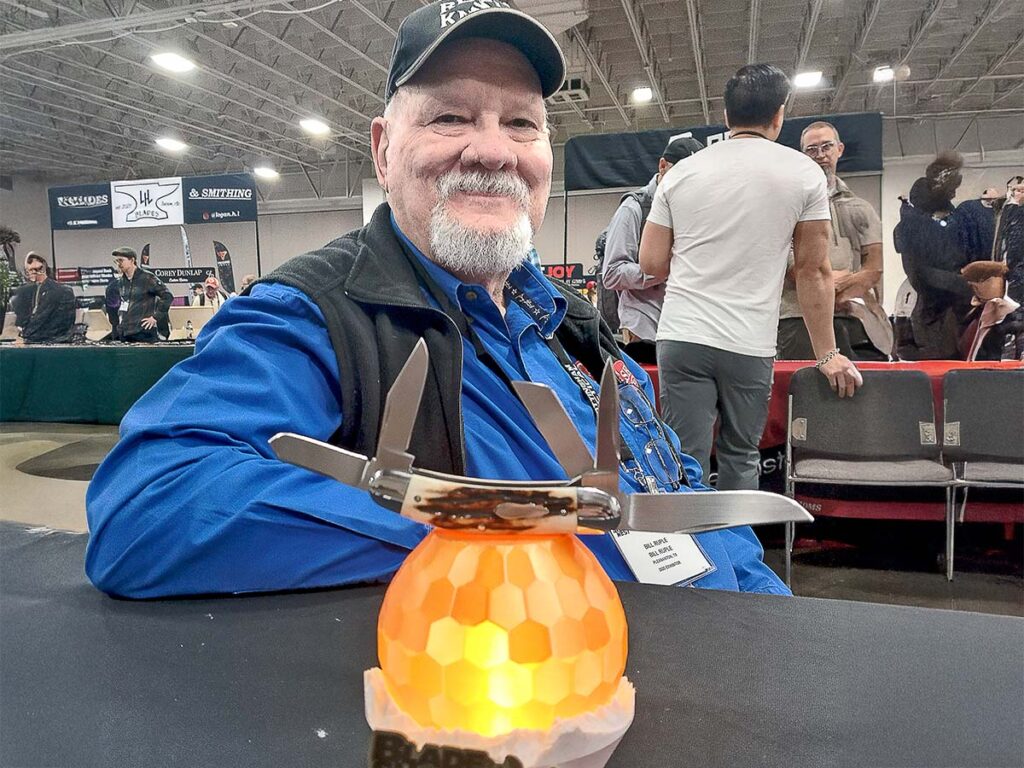
One of those exhibitors was BLADE Magazine Cutlery Hall-of-Fame member Bill Ruple. He was very pleased—and not just because he won Best Slipjoint in the custom judging.
“I thought the show was really good!” he exclaimed. “Attendance seemed a little higher than last year, but I think sales were much higher. I took six knives and sold them all on Friday. All the [South Texas] Slipjoint Cartel guys sold out.”
BLADE Magazine Cutlery Hall-of-Fame® member Bill Ruple won Best Slipjoint for his five-blade stockman (see page 60). Bill’s winning knife sits atop one of the trophies made especially for the show by Princeton Wong.
Counting Bill, those included Tanner Couch, Toby Hill and Luke Swenson.
Though there were the usual number of exceptions, exhibitor sales seemed up almost across the board, both custom and factory.
“It was a really good show for us with increased sales,” Jonathan McNees noted of his McNees Knives production knife company. “We brought about 100 knives and sold about 25 to 30 percent to customers and the rest to dealers.”
Custom maker Jared Oeser brought 11 knives and sold them all.
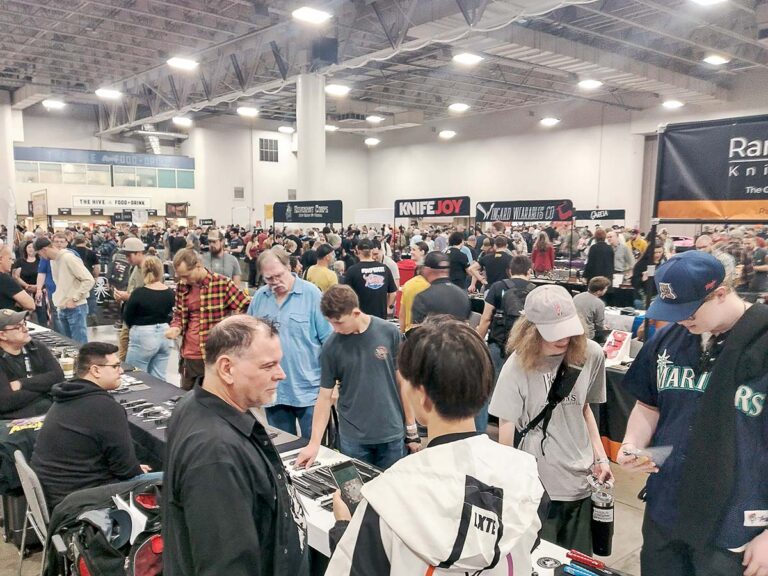
Lots of folks handled lots of knives at the TOPS Knives booth.
“I had a mix of FCFS [first come, first served], lotto and auction knives,” he observed. “I was busy pretty much the whole time. I judge it based on whether I can get away from my table, and I never had a chance to leave.”
It was the first-ever BLADE Show West in Salt Lake City for Cutlery Hall-of-Famers Daniel Winkler and Karen Shook, and they sold every production knife they brought.
“About half to individuals and half to dealers. We were well stocked,” Daniel wrote. “There were good sales and traffic. It seemed to be more of a user clientele than the collectors at the BLADE Show, which is good for us. Our focus is users rather than collectors.”
Maker Princeton Wong—who made the cool custom and factory award trophies for the judging competition winners—brought 12 knives and sold out. John Cammenga of White River Knife & Tool also sold out—about 90 percent to attendees and 10 percent to dealers. Maker Frank Edwards brought six knives and sold four. ABS Master Smith Shane Taylor brought six and sold only one, but was happy because it was the most expensive of the six. Zach Thull of Dauntless Manufacturing said his company sold about 30 knives and Eddie Johnson of CobraTec enjoyed another banner sales show.
Old friends Mick Strider of Strider Knives (left) and BLADE Magazine Cutlery Hall-of-Fame member Paul Bos (right) got caught up at the show.
“We always bring an overabundance of knives to the BLADE Shows, trying to ensure the customer’s experience is satisfying,” Johnson observed. “We sold 30 percent more knives this year over last year.”
As for customer experiences, Eddie’s favorite show moment consisted of a most satisfying one.
“[It was] when the son came to the table several times with his dad,” Eddie related. “The son was enamored with a particular model that was a little more expensive than our others. His mother was being ‘Mrs. No.’ After the father and son touched every knife we had displayed, dad looked at son and told him to go ahead. The genuine joy and appreciation were evident in the son’s facial expression and body language. Then hearing, ‘Thank you, I love you, Dad,’ was the best experience I had and witnessed.”
Fast Start
The show got off to a fast start Friday, no doubt sparked by many who thought the best knives might go quick—which in a number of cases they did. While opinions varied on which day and time were busiest, most seemed to think attendance was up markedly over last year.
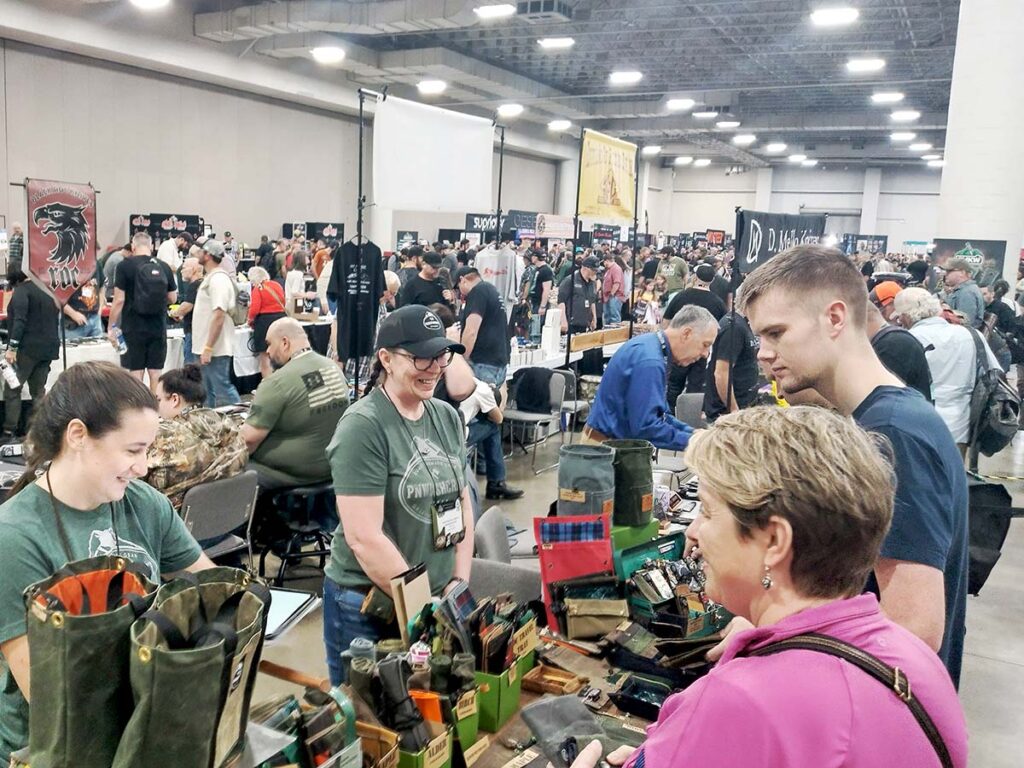
Knife accessories moved fast.
“It was way better than last year for sure,” Edwards noted. “It seemed like from opening till 3 p.m. both days were pretty busy.”
McNees indicated his booth had the most sales on Friday morning, but probably more traffic on Saturday morning. According to Ruple, attendance was about the same on both days. Taylor stated that while traffic was impressive and has been every year at BLADE Show West in Salt Lake City, Friday morning to mid-day was the busiest. Wong remarked that the opening times, the initial rush from early bird and general admission, were most hectic for him.
“Friday appeared to carry more steady foot traffic,” he stated, “with more people stopping by the table than Saturday.” Johnson indicated the inclement weather may have affected the crowd a little on Saturday, though overall attendance was definitely better than the previous year.
“For us, Friday was the busiest, fairly steady beginning an hour after the show opened until the later afternoon. Saturday had small flurries of activity followed by slow times. It seemed like a better Friday than last year and a slower Saturday than last year,” Cammenga assessed. “We definitely saw more return customers than in the last few years. We assume that’s from being in the same place a few years in a row.”
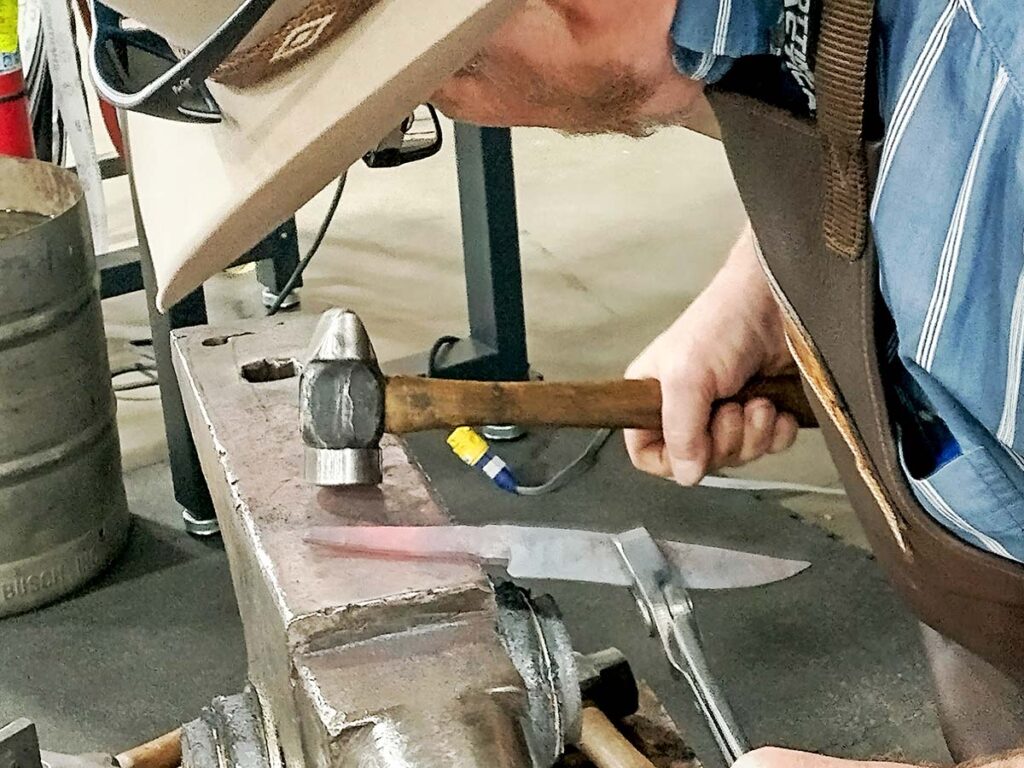
ABS Master Smith James Rodebaugh puts the finishing touches on a rough-forged hidden-tang knife at the indoor forge of Lonnie Jensen’s Mountain Shadow Forge.
“The show seemed like the busiest of the Salt Lake shows,” Oeser commented. “There were surprisingly a lot of locals coming through on Saturday and the line outside was down the street.”
When asked to rank the attendance on a 1-to-10 scale, with 10 the busiest, Jared qualified his answer.
“Of my limited time at shows the attendance at this one was about a 6, but I feel like shows and the knife market right now are not high,” he opined. “For current show standards I would adjust it to an 8 or 9.”
All the exhibitors but one quoted for the story said they would be back next year, which may be the best sign of a successful show of all.
Only Time?
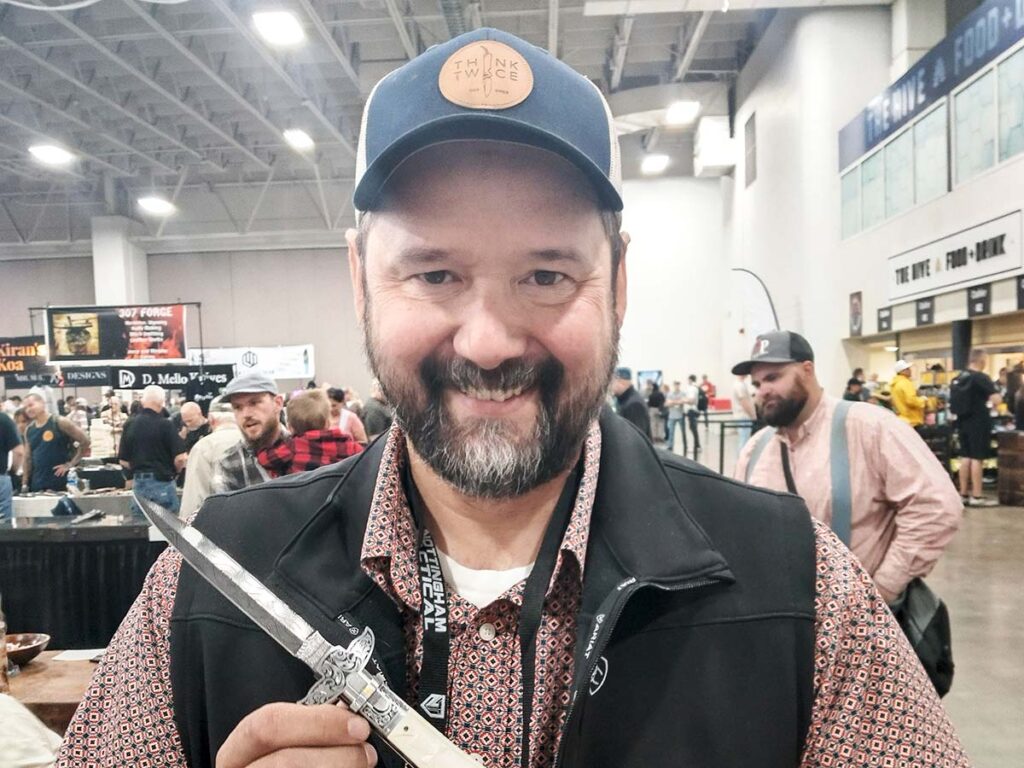
Frank Edwards displayed his heavily engraved damascus automatic dagger.
Enthusiasts came, they saw knives, they talked knives and, perhaps most important of all, spent time catching up and talking with each other at an event that may be the only time they see each other all year. But then that’s the way it is with a lot of knife shows, including the year’s last event in the BLADE Show triad of shows—BLADE Show West. Speaking of, plan now to attend next year’s sharp gala, Oct. 9-10, once again at the Salt Palace Convention Center in Salt Lake.
The Hawkbill Is An Excellent Multi-Purpose Blade, Great For Cutting, Carving And More.
Of all the blade styles at the modern aficionado’s disposal, the hawkbill may be one of the most peculiar.
As its name suggests, the blade is reminiscent of a raptor’s appendage, namely it’s beak. The point curves around, in most cases to a nearly 90-degree angle from the back, creating a hook shape. Overall, pretty dang cool. But it raises the question, exactly what the heck is it good for and why does it look this particular way?
In this article, we’ll delve into the origins, usage and modern iteration of this blade and what the heck it’s actually good for. Along the way, we’ll also perhaps help you pick out the best hawkbill blade for your needs.
Origin Of The Hawkbill
Many blade styles are rooted in history or evolved from another type of knife. The hawkbill, however, doesn’t have the clearest provenance.
The blade style is widely believed to have started as a farming and outdoor tool, an evolved version of the pruning hook. Somewhere along the line some industrious maker most likely figured a pocket sickle might prove right handy.
Likely it did for a classy vintner out among the grapes who did not want to slum it by asking for the help’s pruning hook. Heaven forbid. But as the greater part of humanity has broken free from its agrarian roots the utility of the hawksbill has expanded.
Modern Uses Of The Hawkbill Blade
True enough, rose growers and avocado ranchers likely still find the hawksbill handy. But the quirky style of knife has found a place for those not tilling their living from the soil.
Utility
Today, the hawkbill is best known for its utility role, prized by electricians, roofers, floorers and other craftsmen. The hook shape of blade helps it excel at certain tasks a straight blade might struggle. A few of the obvious are cutting carpet or shingles without scoring the unlaying material. Stripping wire is another area it earns an “A”.
Its curved tip also prevents it from being a hazard to its user in precarious positions—say crammed in a crawlspace or dangling on a rafter—where a clip point or the like might prove a bit pokey.
Carving
While not generally the go-to whittling or carving knife, the hawkbill earns its keep in this arena. For those who strictly practice this craft with knives, the style of blade is particularly good a removing large pieces of material at the begining of a project.
Tactical
Well… there are certainly companies out there selling their version of hawkbill knives with this in mind. Though, with healthy supply of DLC anything can be tactical—including a paring knife.
Given the vagaries of the word “tactical,” it’s difficult to claim it doesn’t fill this role. And certainly, there’s probably been more than one farmworker who’s thrown their hawkbill—or pruning hook—in his back pocket as Friday-night-on-the-town insurance. For the average Joe, however, it might not prove a prime choice in this role.
Unless specially trained, the hawkbill—like the karambit—is not the easiest blade to wield as a self-defense option. Funny thing is, many of the tactical “hawkbills” have nearly lost their defining feature—a truly hooked point. Some might argue, they are hawkbills in name only.
On the other hand, in more specialized “tactical” situations this style of blade could have chops. What comes to mind here is perhaps situations involving ropes—maybe nautical or mountaineering. The idea here is cordage could be cut one-handed in a switch, using the hawkbill to both hook and cut. A similar point on this, some law officers have favored a modified hawkbill given it works well to cut a motorist out of their seatbelt in an accident, without causing injury.
Those wed to the idea of a EDC Hawkbill, Spyderco has among the most time-tested renditions. The Byrd’s modified hawkbill blade lends itself to aggressive cutting tasks and its hollow-ground serrated edge makes mincemeat of anything its pulled against. Yet, there is enough of a tip available to puncture or pry, if the situation calls for it.
Like everything that rolls out of the Golden, Colo., concern, the Byrd is ruggedly made—constructed with a chrome-moly steel blade and fiber-reinforced handle. Its tear-drop shaped thumb hole gets the knife into the fray quickly and its four-position clip allows you to keep it at hand.
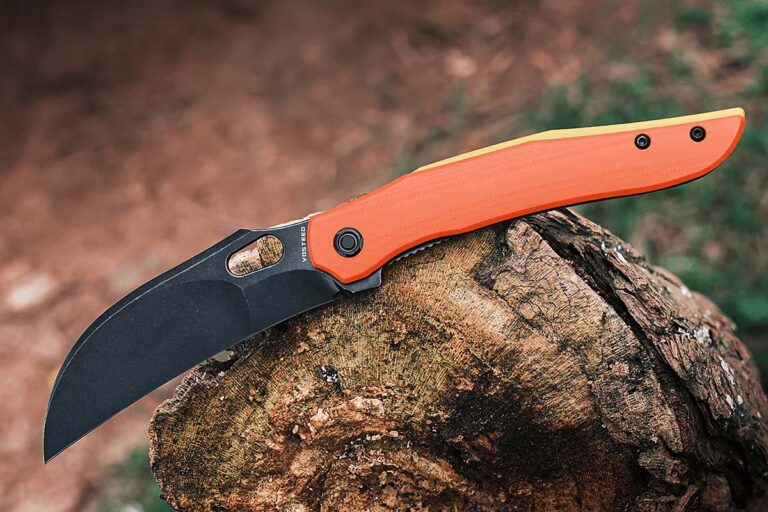
Of all the hawkbills, the Griffin is among the most EDC-friendly. Vosteed pars back the hook on the blade massively, making something at first blush look like an oversized sheep’s foot. But at closer inspection, the edge has a very slight obliqueness to it, so the tip curves in as you’d expect in a hawkbill. The baby is great at tip cuts, slicing, and stripping—about anything you’d expect out of a curved blade. But, it also can pierce straight on, much like a more conventional blade profile.
The knife is a production version of R.S. Knifeworks’ custom knife. It shows in some of the well-thought-out points of design. Chief among these is the handle that naturally follows the curvature of the palm and features an attractive and durable G10 scale. Another point I like is the compound grind on the blade, with more material at the heel for more rugged cutting tasks. The knife is a liner lock, with a clip (tip-up carry) and multiple deployment options—thumb hole, front flipper and back flipper. The only complaint I have is the clip isn’t reversible, but other than that the knife really hits the mark.
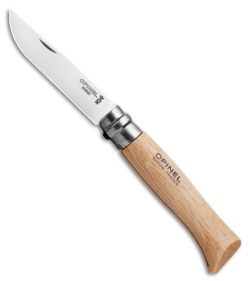
It’s difficult not to love the classic look of this hawkbill—one of the perks of Opinel. While I don’t use the knife mainly for garden chores, the French cutler has aimed the folder at that. The company calls it a pruner, and after testing it on a few wild rose saplings, it more than fills this role. However, with a sharp tip and a good edge, the No. 8 Hawkbill is adept in many other tasks. One of my preferred uses is as a fishing knife and believe it or not it guts your catch in the blink of an eye.
Nice point on this model, Opinel uses stainless steel in the blade (12C27), so if you take it into wet conditions you don’t have to fret about the blade tarnishing. It also keeps a nice edge, albeit one you’ll have to touch up now and again—especially if you use it in its pruning role. The knife’s wooden handle can lose its finish over time and retain moisture. Pro tip, have one this long and use it in wet conditions, you can sand down the handle and oil it to keep it safe. The only real bone I have to pick with the No. 8—away from yard chores—is the handle; it flares back like a traditional pruner, which isn’t always great for other tasks.
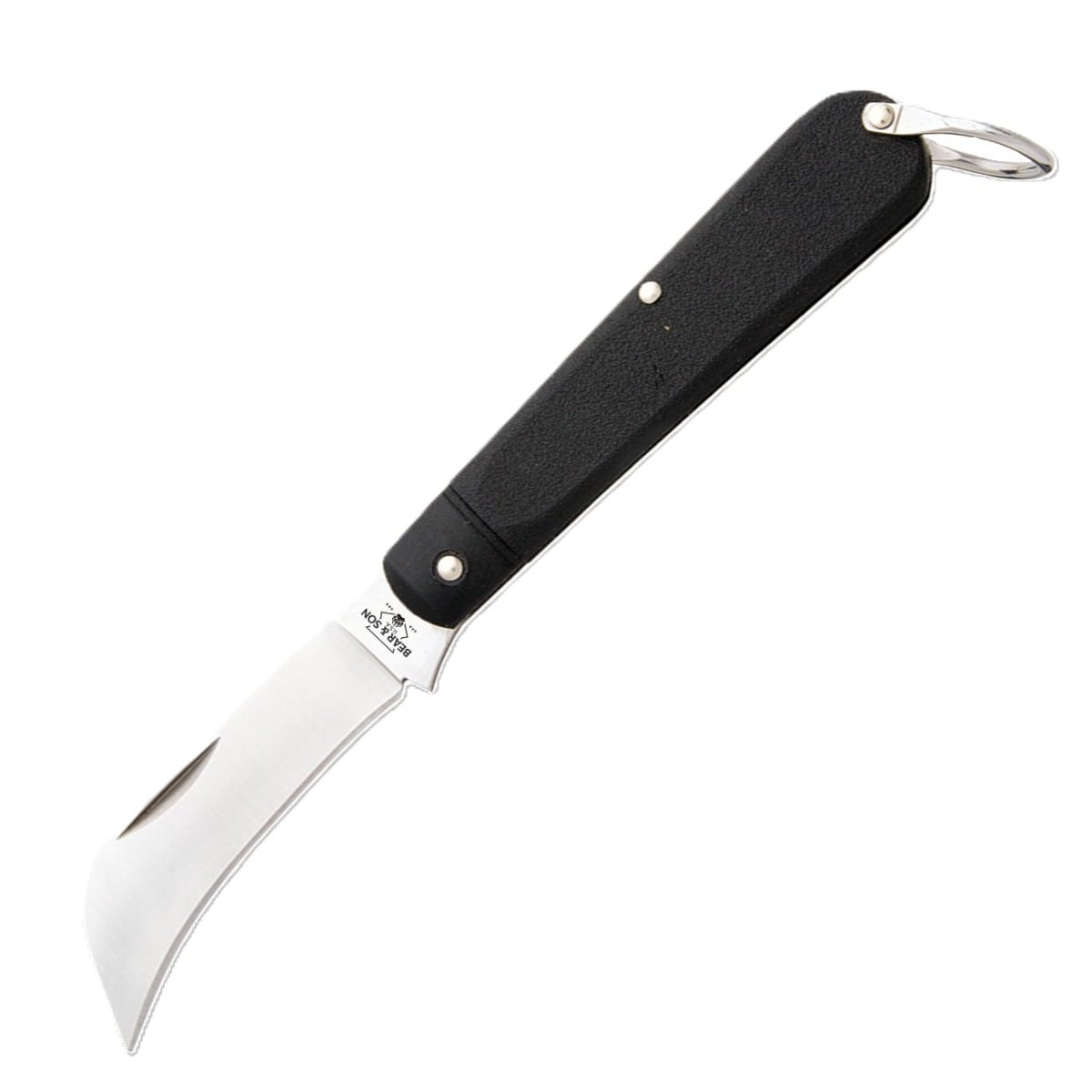
Perhaps the perfect handyman’s helper, this little hawkbill is designed to always be at hand. I think that’s the beauty of what Bear & Sons has created here, a right-sized utility knife. Personally, it’s a little small for my tastes as a primary knife and it’s a folder—which doesn’t make it quite as handy, it works great as a secondary cutting tool. I like the idea of this and plenty of folks who make their living with their hands back me up on the concept.You drop your main knife or leave it in your toolbox at another area of the work site, well, the Bear & Sons knife gives you a backup. Using it to help me rewire some outlets, the high-carbon stainless steel blade made quick work stripping. And while wasn’t reflooring, I did have carpet scraps around, of which the blade made mincemeat.
A big asset in both tasks is the hawkbill’s handle-to-blade ratio. The handle is an inch longer than the 2.75-inch blade, which gave me supreme control over the knife and the ability to choke up on the blade when required. To boot, Bear & Sons includes a large bail loop allowing you to tether it to your person or at the very least retrieve it from your pocket quickly. The only nit I had to pick is it’s a slipjoint with a nail nick opener. Most of the time this won’t prove an issue, but there are jobs where one-handed opening is a godsend.
I like this knife for something different in pocket carry. As Victorinox makes apparent, it again pegs this hawkbill as a pruner and it’s just about perfect for the weekend garden warrior. But this slim, light and small slipjoint makes the cut as an EDC option with a twist. A very straightforward design, the knife is elegant in its simplicity and has a very functional blade. The hook is enough for its designed purpose of pruning limbs, yet it’s angled just right to make it a near-perfect box cutter. At just 4 inches folded, with a 2-inch blade, it could be a warehouse worker’s—or anyone who has to break down cardboard on the regular—best friend.
Blue-collar tasks aside, like all Swiss Army Knives, it’s gentlemanly enough to handle more refined tasks—such as removing the foil from a wine bottle. It also has a nice section of straight edge to it, so it can accomplish pull-through cuts adeptly. Again, a nail nick opener cuts some of the knife’s utility, since it requires two hands to get into the fray.
This lockback knife from Klein Tools shows what the hawkbill is capable of as a utility tool. It easily opens one-handed thanks to a thumb stud and the stainless blade holds a mighty edge. It’s capable of being a do-everything tool on the job site or an excellent utility knife around the house. It’s made with longevity in mind, with Klein utilizing AUS8 stainless steel in the blade, and the impact-resistant nylon resin handle can stand up to the beating of being a work tool. The low-carry pocket/belt clip lets you carry the knife with ease and in a way that best suits you.
Schrade offers excellent knives and the company’s hawkbill folder is no exception. With a rustic, rugged look, the 16 UH, which stands for Uncle Henry, is designed to prune shrubs and cut through wood with ease. Its staglon synthetic handle gives the knife a natural look that you wouldn’t get with G-10, aluminum or other handle materials. The stainless steel blade makes quick work of a variety of woods, and the 3-inch blade is big enough for longer cutting strokes and small enough for precise, finite work. At under $40, it’s well-priced. This is a knife that most any woodworker would want to have.
What the best way to bid adieu to the old year and ring in the new? New knife drops, of course!
The year is almost over, but knife debuts are just heating up. We found a slew of production and custom knives dropped to finish 2024 or slated for release in early 2025. Any way you cut it, these blades are more than enough to get you drooling!
Model: EDC fixed blade Blade length: 3” Blade steel: 440C stainless Rockwell hardness: 59 HRC Blade grind: The “Davis Grind” by the maker Handle material: Black Micarta® w/black and white Micarta spacers Handle pins: 1/16” 440C Overall length: 7” Sheath: Pouch type of tooled leather and rattlesnake inlay Maker’s price for a similar knife and sheath: $400 Knife to know: Matt Davis is an ABS journeyman smith Maker: Matt Davis, daviswacoknives.com (Jocelyn Frasier image)
Adam Gray Micro Bushcrafter
Model: Micro Bushcrafter Blade length: 2.5” Blade steel: CPM 154 stainless Blade grind: Convex saber, what Adam Gray calls sabervex Handle material: Wenge w/yellow G-10 liners Overall length: 5.5” Sheath: By Badgerclaw Outfitters Maker’s price for a similar knife and sheath: $305 Maker: Adam Gray, aaforge.com (Jocelyn Frasier image)
Bear & Son Cutlery D2 Rancher Sideliner
Model name: D2 Rancher Sideliner Knife type: Flipper folder Blade length: 3 3/8” Blade material: D2 tool steel Blade grind: Flat Handle material: India Stag Bone (also in G-10, cocobolo or titanium) Lock: Linerlock Pocket clip: Deep carry Weight: 3 ozs. Closed length: 4.25” Knife to know: Torx screw construction Country of origin: USA MSRP: $95.99-$125.49 Company: Bear & Son Cutlery, bearandsoncutlery.com
RMJ Tactical BUB (Back Up Blade)
Model name: BUB (Back Up Blade) Knife type: EDC push dagger Blade length: 2.5” Blade steel: Nitro-V stainless Rockwell hardness: 58-60 HRC Blade @thickest: .135” Blade finish: Tungsten Cerakote® Handle: G-10 (in three color options) w/Grade 5 titanium fasteners Weight: 3.1 ozs. Overall length: 4 13/16” Sheath: Kydex w/1.5” belt clip Knife to know: The scales remove to expose a skeletal handle Country of origin: USA MSRP: $185 Company: RMJ Tactical, Dept. BL1, rmjtactical.com
James Ingram Linerlock Folder
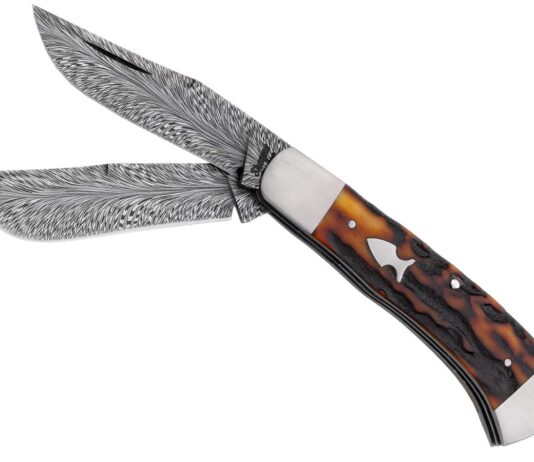
Knife type: Linerlock folder Blade length: 3” Blade steel: Feather damascus Blade grind: Flat Blade pattern: Harpoon Handle: Mammoth ivory w/titanium liners Frame: Engraved stainless steel Bolster: Stainless Closed length: 4 5/16” Maker’s price for a similar knife: In the $1,500 range Maker: James Ingram
Bobby House Swell-End ack
Pattern: Swell-end jack Knife type: Slipjoint Blade length: 2 5/8” Blade material: Ladder pattern damascus Blade grind: Hollow Blade pattern: Spear point w/long-pull nail nick Backspring material: CPM 154 stainless steel Handle material: Cracked mammoth ivory w/polished acorn shield Bolster: 416 stainless steel Liners: 410 stainless, jewel relieved and soda blasted Approximate closed length: 3 5/8” Maker’s price for a similar knife: $1,650 Maker: Bobby House
Knife name: Bromen Knife type: Flipper folder Blade length: 3.13” Blade material: Mosaic damascus of 1080 carbon and 15N20 nickel-alloy steels Blade grind: Flat Handle material: Emerald paper Micarta® Pocket clip: Yes Closed length: 4.39” Maker’s price for a similar knife: $3,500 Knife to know: The knife is also available in a more subdued mosaic damascus blade and a butterscotch paper Micarta® handle by Lucas Gumbiner Maker’s contact information: Will Stelter/Lucas Gumbiner, willstelterbladesmith.com (SharpByCoop image)
Bob Merz Lockback Folder
Knife type: Lockback folder Blade length: 2.5” Blade steel: CPM 154 stainless Blade grind: Flat Handle material: Mother-of-pearl Bolsters: 416 stainless w/24k-gold-inlaid scroll engraving by Wes Griffin Closed length: 3.5” Maker’s price for a similar knife: $2,300 Maker: Bob Merz, bobmerzknives.com (Jocelyn Fraiser image)
Brian Milinski Folder
Knife type: Folder Blade length: 2.75” Blade material: Damascus of Swedish and German stainless steels Handle material: Mammoth tusk w/anodized and jeweled titanium liners Bolster: Stainless steel scroll engraved by Tyler Poor Thumbstud: Damascus w/mammoth inlay Maker’s price for a similar knife: Contact maker for pricing Knife to know: Brian Milinski is an ABS apprentice smith Maker: Brian Milinski, mrknives.com (Jocelyn Frasier image)
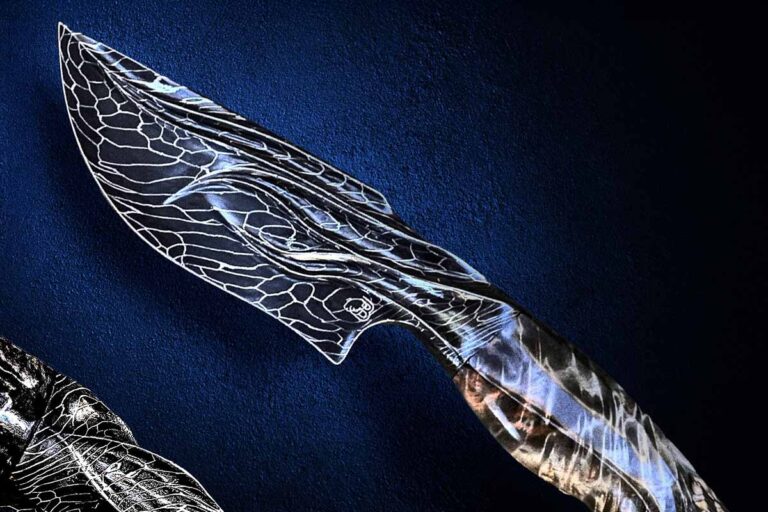
Jordon Berthelot marries two electric materials in one knife.
Jordon Berthelot achieves a hypnotic union of blade and handle materials in his integral hunter.
The blade is his HHH lightning damascus and the handle is cottonwood from Robswildwood.
“I used a wide variety of different bits and burrs with Foredom and Dremel tools to freehand carve the blade and handle,” he wrote.
“As my teacher Spencer Aplin always says, the most difficult part is deciding what to carve and how to give it the flow I want, which is so true,” Berthelot said. “I decided to incorporate the blade carving into the handle so it gave the whole piece a complete look, and also added some great purchase of the handle in multiple different grips.”
Berthelot Integral Hunter Specs Blade length: 4.5” Blade material: HHH lightning damascus forged from W1 tool steel/nickel rods w/4800 powder Handle material: Cottonwood from Robswildwood Overall length: 9” Maker’s price for a similar knife: $3,500
Editor’s note: The author (Josh Wayner) spent the better part of five years working in a high-end specialty butcher shop in coastal west Michigan. That shop is no longer in business, though what he learned there has stayed with him and, as he noted, is very dear to his heart. We thought him to be the ideal writer to do a story on five of today’s factory boning knives. We think you will agree.
A former butcher’s mate gives boning knives the full test treatment to find the best boning knife.
I hunt deer and other large game regularly and own all my own professional processing equipment. Among these items is the most basic and essential tool: the boning knife. As a butcher’s mate and now as a full-time outdoor writer, I have some opinions on these blades and how to best use them.
A boning knife is a rather specialized tool, and getting the right shape for removing meat from bone is the name of the game. In my span hunting I’ve either shot or helped process hundreds of deer. I hunt the most game-rich areas in Michigan, and it’s common for my party to land a dozen deer in a night. The best knife for working on a deer is a 5-to-7-inch saber-ground blade of a steel about 3/16 inch thick that features an ample, comfortable handle.
The knife you absolutely do not want is a boning knife for this type of work. In my experience, a boning knife is for kitchen work, though I favor it as a primary knife for game under 50 pounds live weight.
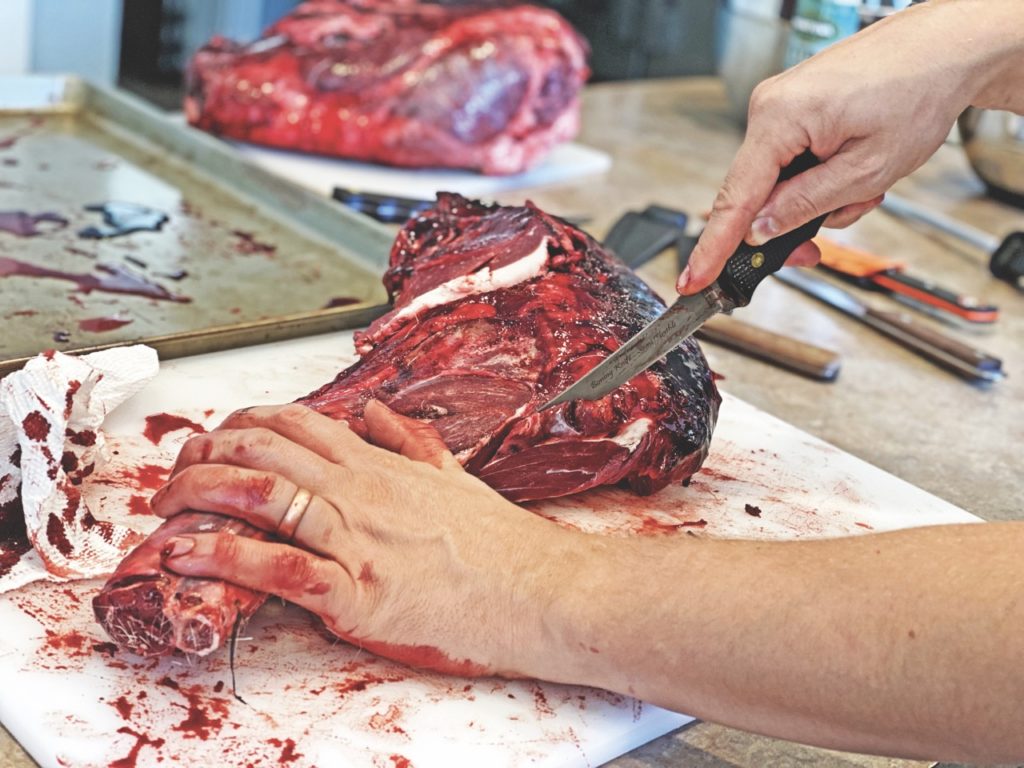
The reason I offer here is that I’ve never seen an injury with a proper large-format field knife. Where I have seen horrible injuries is with thin-bladed knives like those in this article. They have the sickening tendency to snap off when going through sternums and joints; the flexibility has a limit and I’ve personally witnessed a dozen snapped blades, with half of the snaps resulting in a serious hand injury. Extreme care must be taken with ultra-thin, razor-sharp blades. In the process of creating this article, my friend who helped me process the deer meat in the photos was cut to the bone himself with an errant flick of the blade.
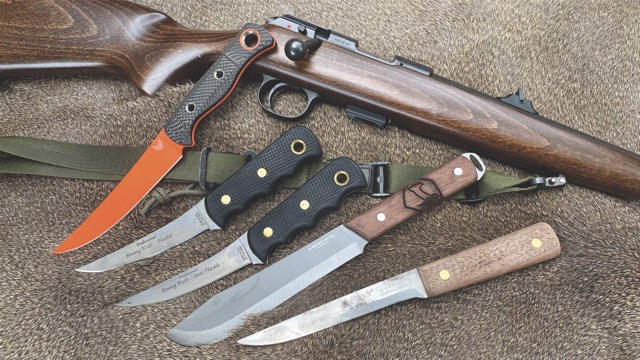
Best Boning Knives
Best Dedicated Boning Knife: The Knives of Alaska (KoA) Professional Boning Knives
Kitchen Functional Boning Knife: Ontario 72-6
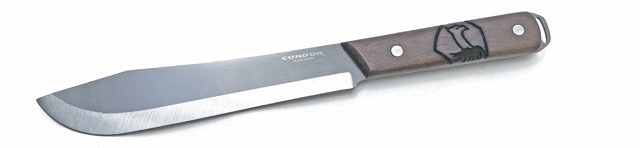
General Use Boning Knife: Condor Tool & Knife Butcher Knife
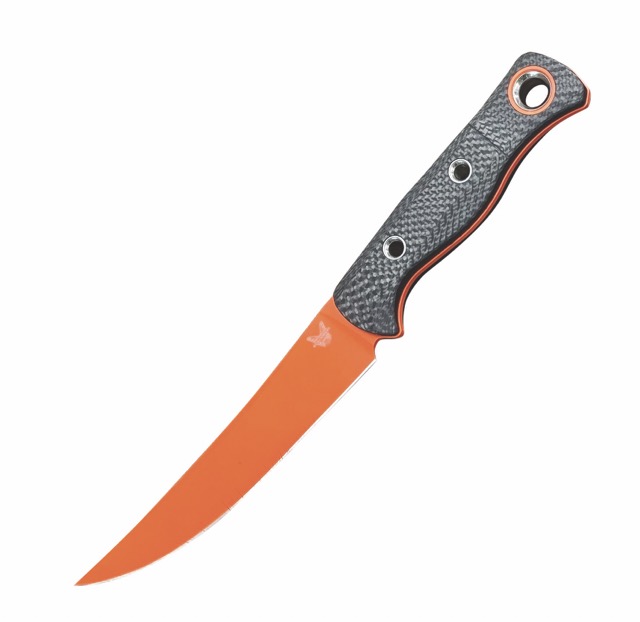
Scalpel Sharp Boning Knife: Benchmade Meatcrafter
Best Boning Knives Specs Comparison
Knife
Blade Length (inches)
Blade Material
Handle Material
Weight (ounces)
Overall Length (inches)
Sheath
Country of Origin
MSRP
Ontario 72-6
6.25
1095 spring
Hardwood
4.8
10.75
N/A
USA
$15
Condor Tool & Knife Butcher Knife
7
1075 carbon steel
Walnut
5.3
12
N/A
El Salvador
$38
Benchmade Meatcrafter
6.08
CPM S45VN stainless
Carbon fiber
4.52
11.06
Black and orange polymer
USA
$400
Knives of Alaska (KoA) Professional Boning Knives
5
D2 tool steel
Hard rubber
4.2
9.625
Black Kydex
USA
$50
Best Dedicated Boning Knife: Knives of Alaska Professional Boning Knife
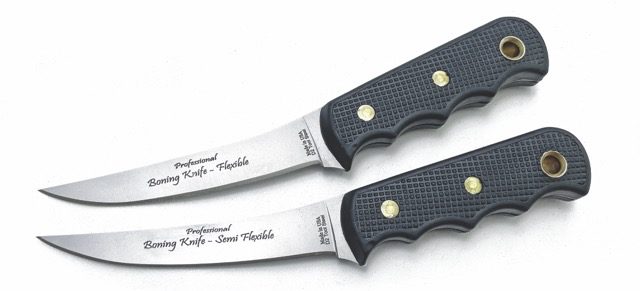
The two versions flexible and semi-flexible-of the Knives of Alaska boning knife come in what the author calls a choice size and profile for medium-duty processing.
Pros
Designed For The Job
Ergonomic Handle
Great Value for Performance
Cons
Limited Versatility
KNIVES OF ALASKA PROFESSIONAL BONING KNIFE BLADE LENGTH: 5″ BLADE MATERIAL: D2 tool steel HANDLE MATERIAL: Hard rubber SPECIAL FEATURES: Available in two different flexes: flexible and semi-flexible WEIGHT: 4.2 ozs. OVERALL LENGTH: 9.625″ SHEATH: Black Kydex COUNTRY OF ORIGIN: USA MSRP: $49.99
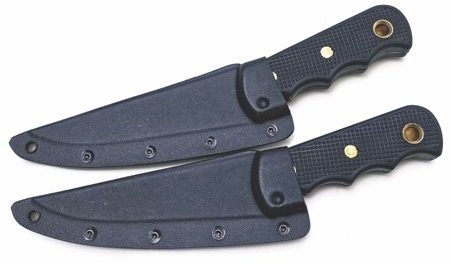
The KoA knives ship with polymer sheaths.
The Knives of Alaska (KoA) Professional Boning Knives—I tested both flexibility models—are exactly as their name implies. They are a bit more of an investment at about $50 each. They are however, inexpensive enough that they can be easily replaced if broken or lost in the field. These are truer dedicated boning knives and display a curved, upward-swept profile that forces the whole edge into use. The handle angle promotes a full grip while working on both meat on the bone and on a flat prep surface such as a cutting board.
These knives are superior to the first two reviewed in this story. They have an extremely fine point that gets into the bone and allows you to clean off nearly every meat bit. For the price, they are eminently functional and require minimal maintenance. They are my choice out of the bunch. They are an exact fit for their role, while not pretending to be something else. I like that the KoAs felt the closest to what I had in the butcher shop all those years ago.
“The KoA knives performed the best for the dollar in boning tasks,” the author assessed. “They are shaped properly for butchering tasks and don’t fatigue the hand thanks to the blade angle.”
KoA
$69
DLT
$70
Kitchen Functional Boning Knife: Ontario 72-6
Above: The Ontario 72-6 appears as it arrived at the author’s. “It is a good cutter and excellent for breaking down large sections of meat.”
Pros
Affordable
Durable Edge
Effective Breaking Down Large Cuts
Cons
Corrosion-Prone Steel
Unsealed Handle
ONTARIO OLD HICKORY 72-6 BONING KNIFE BLADE LENGTH: 6.25″ BLADE MATERIAL: 1095 spring HANDLE MATERIAL: Hardwood SPECIAL FEATURES: Inexpensive and available in bulk quantities for rants and kitchens WEIGHT: 4.8 ozs. OVERALL LENGTH: 10.75″ COUNTRY OF ORIGIN: USA MSRP: $14.99
Boning knives are a relatively distinctive category in that they span the range from essentially disposable to extremely high-end, yet are intended for the same purpose. Looking at the four in this article, the least expensive is the Ontario 72-6, which is available in bulk quantities and can be had for as little as $8. It is a good cutter, and excellent for breaking down large meat sections. The straight edge is less ideal for getting into ridges in the shoulder bone, but it is serviceable. In the case of this knife, the steel is very prone to corrosion and the handle is likewise unsealed or treated. To fight the corrosion, wash and dry the knife thoroughly after each use. Apply a light coat of oil on the blade on occasion as well.
“The Ontario has a mostly straight edge and handle, making it hard to work with in organic curves or between bones,” the author stated. “It is a good slicer, but beware of your grip as there is nothing to stop your hand from sliding onto the blade.”
The ‘Old Hickory’ lettering on the handle came off after I washed the knife, and the steel began to spot immediately. This knife has a somewhat textured blade and is not smooth and even. Fat and blood can easily build up on the blade flats. That said, the edge out of the package was sharp, if not a little obtuse in terms of geometry. Despite my best efforts to dull it in use, it stayed sharp and functional. It has no guard or projection and is similar to a puukko in terms of the care that must be taken to not allow the hand to slip up and onto the blade. My impression of this blade is that it is a functional but essentially disposable kitchen tool.
OKC
$18
Optics Planet
$22
General Use Boning Knife: Condor Tool & Knife Butcher Knife
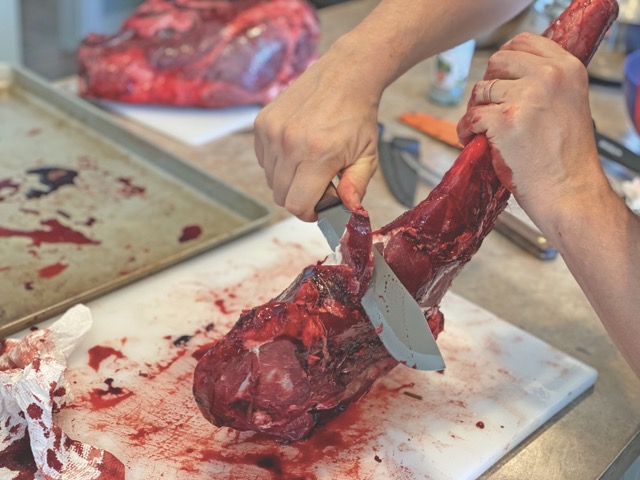
The curved belly of the Condor Butcher Knife’s bowie blade pattern does most of the cutting work.
Pros
Sharp And Durable Edge
Effective For Large Cuts
Durable Construction
Cons
Handle Logo Fouls
Uneven Edge Usage
CONDOR TOOL G KNIFE BUTCHER KNIFE BLADE LENGTH: 7″ BLADEMATERIAL: 1075 carbon steel HANDLE MATERIAL: Walnut SPECIAL FEATURES: Thin, light and practical for kitchen tasks WEIGHT: 5.3 ozs. OVERALL LENGTH: 12″ COUNTRY OF ORIGIN: El Salvador MSRP: $37.78
The Condor Tool & Knife Butcher Knife has a similar handle to the 72-6, but the blade is longer and wider. The edge out of the box was sharp and held up. An immediate point of concern for sanitary purposes is the deeply cut logo in the grip. The logo is somewhat uneven and large and is a collection point for fat and blood. It also digs into the fingers a bit when cutting, something that is not a major comfort issue, just a moderate annoyance.
As the author noted, the Condor Butcher Knife struggles from the same straight-edge problems as the 72-6—it is a better general-purpose kitchen knife than a boning knife, but can be a jack-of-all-trades.
The blade is oddly shaped for use as a boning tool. The bowie-style point is hard to use in tight spaces and doesn’t allow for the “scoop motion” when getting meat out of valleys in the bones. Where it does well is in breaking down large sections of meat on the table. The blade shape puts virtually all the pressure on the belly near the tip; the rear edge nearest the handle is seldom used due to the blade’s inability to get close to the cutting board for slicing strips. Once the belly of the blade gets dulled, its ability to cut and slice dramatically decreases and it needs to be sharpened. I’d rate this as a functional general-use knife for the kitchen, but its utility as a boning knife is questionable.
Condor
$40
Amazon
$34
Scalpel Sharp Boning Knife: Benchmade Meatcrafter
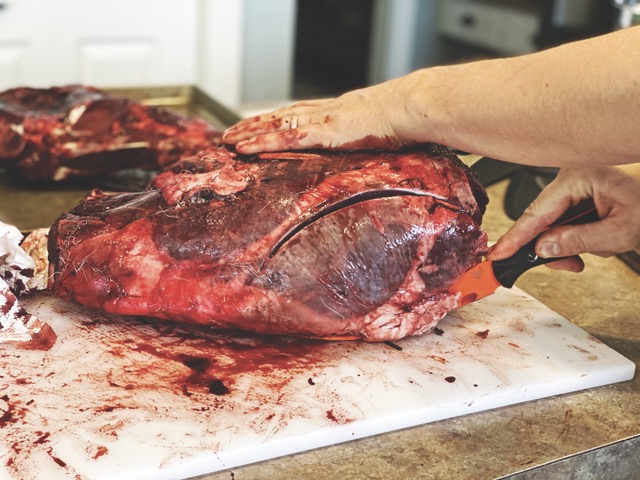
The Benchmade Meatcrafter is scalpel sharp and razor thin. The orange coating allows for visibility in the field.
Pros
Exceptional Sharpness
Premium Craftsmanship
High-Visibility Design
Cons
High Price
BENCHMADE MEATCRAFTER BLADE LENGTH: 6.08″ STEEL: CPM S45VN stainless FINISH: Cerakote™ coating HANDLE MATERIAL: Carbon fiber SPECIAL FEATURES: Ergonomic and extremely sharp WEIGHT: 4.52 ozs. OVERALL LENGTH: 11.06″ SHEATH: Black and orange polymer COUNTRY OF ORIGIN: USA MSRP: $400
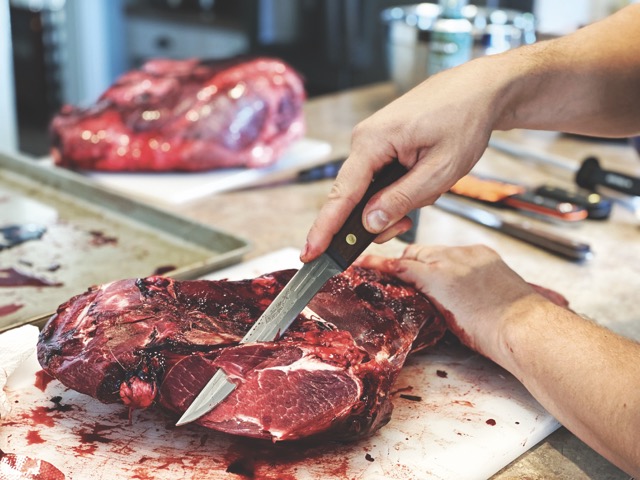
The Benchmade Meatcrafter* in this story is the first production version of this particular model from the company, literally the first of its kind off the line. It is a high-end knife eight times the price of each of the Knives of Alaska models tested. Benchmade’s quality is evident and this status symbol is not a “safe queen.” It is one of the sharpest—if not the sharpest—knives I have ever seen from the factory. I was actually taken aback when it went through a huge deer ham with no effort. It is scalpel sharp and held that level of sharpness the entire test. I for one was not used to a knife this sharp. I had to retrain my hand to use less force in cuts because it was risky.
This is a knife I would proudly use and display, but even with its orange blade (for higher visibility). I would be very cautious in its use for fear of breaking it. This is one that I know I’d fear losing at the cost alone. Things happen in the field, and I’ve lost a lot of gear. The reality is I’d rather break or lose a $50 knife than something like this.