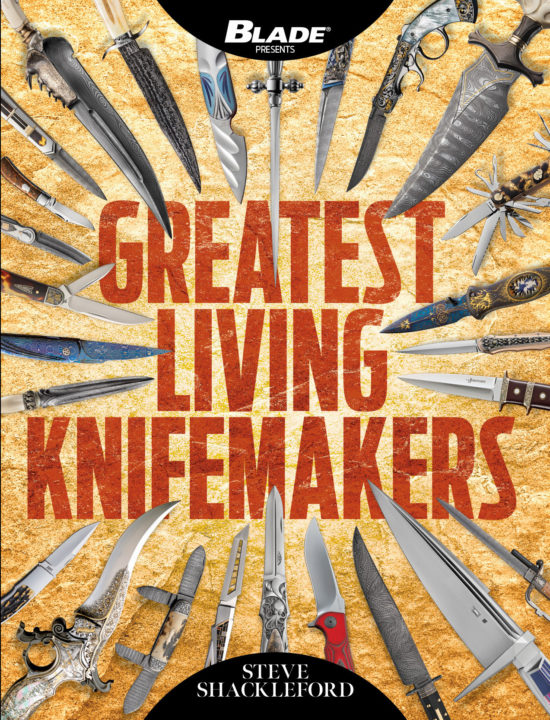
A new book from the publishers of BLADE magazine, Greatest Living Knifemakers, celebrates today’s legends who make knives in ways that most can only dream about. They make knives that can easily fetch tens of thousands of dollars, and even more.
Given all that talent, how does a book like this come together? Who gets to decide who is counting among the “Greatest Living Knifemakers” anyway? If you’re someone looking to collect or make knives, you’ll enjoy this interview with the editor of the book, Steve Shackleford, who is also a member of the BLADE Magazine Cutlery Hall of Fame®.
Many talented people make knives of outstanding quality. How did you go about choosing who should appear in this book?
Steve Shackleford
The hardest part was choosing who NOT to include. I’ve been covering the knife industry for BLADE®, the world’s No. 1 knife publication, since 1985, so I’ve had the privilege of seeing and handling some of the world’s greatest knives, and meeting some of the world’s greatest knifemakers.
As a result, some of the makers I picked peaked years ago and don’t even make that many knives anymore. On the other hand, some are peaking now. However, at some point in their careers each has made knives that are among the world’s best.
In addition, each has either made knives and/or introduced designs, techniques, folding mechanisms, damascus or other steels and other materials, etc., that in turn have set a standard or inspired other makers in the way they make knives.
And, of course, to qualify as per the book’s title, each must be living, though Tony Bose passed away after the book was finished. We decided to include him as a tribute to his fantastic slip joints and the overall impact he had on the knife industry, which was and remains monumental.
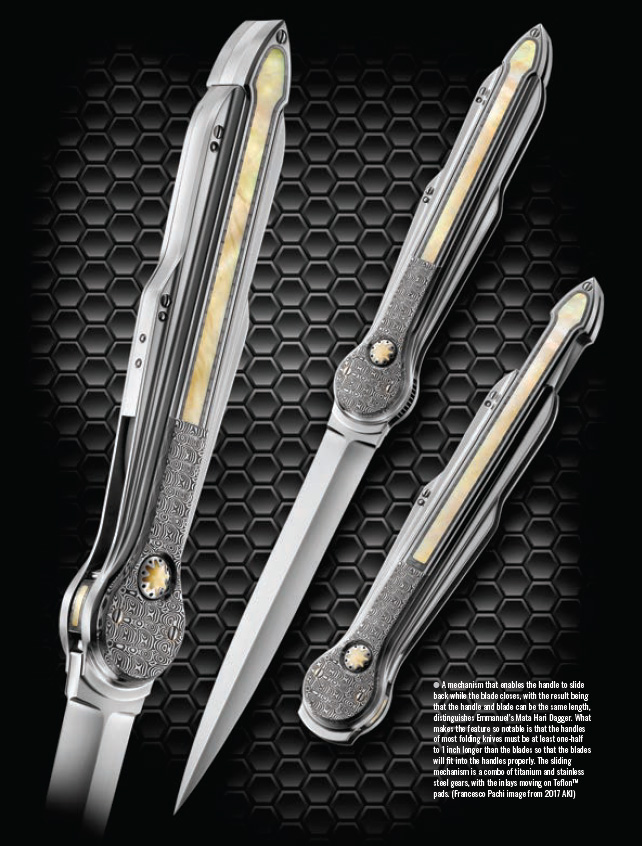
A mechanism that enables the handle to slide back while the blade closes, with the result being that the handle and blade can be the same length, distinguishes Emmanuel’s Mata Hari Dagger. What makes the feature so notable is that the handles of most folding knives must be at least one-half to 1 inch longer than the blades so that the blades will fit into the handles properly. The sliding mechanism is a combo of titanium and stainless steel gears, with the inlays moving on Teflon™ pads. (Francesco Pachi image from 2017 AKI)
What makes a knifemaker “great”?
Some of that is covered in my first answer above but there are other things as well. They must have a lifelong dedication to making knives, which all of those profiled have exhibited, as well as a passion to make knives for much more than just the money.
It’s kind of hard to explain unless you’ve followed knives for a long time, but, in a nutshell, most great knifemakers make knives because they sweat the load, they agonize over the details, and they don’t provide just a “product”—they produce a knife that almost always acts, looks and feels like it’s the best knife that maker makes. There’s much more but that’s part of it.
Are there any names that couldn’t make it into the book due to space limitations?
As noted above, yes, many make knives worthy of inclusion. However, I won’t name names here in case we decide to do a second volume of the book.
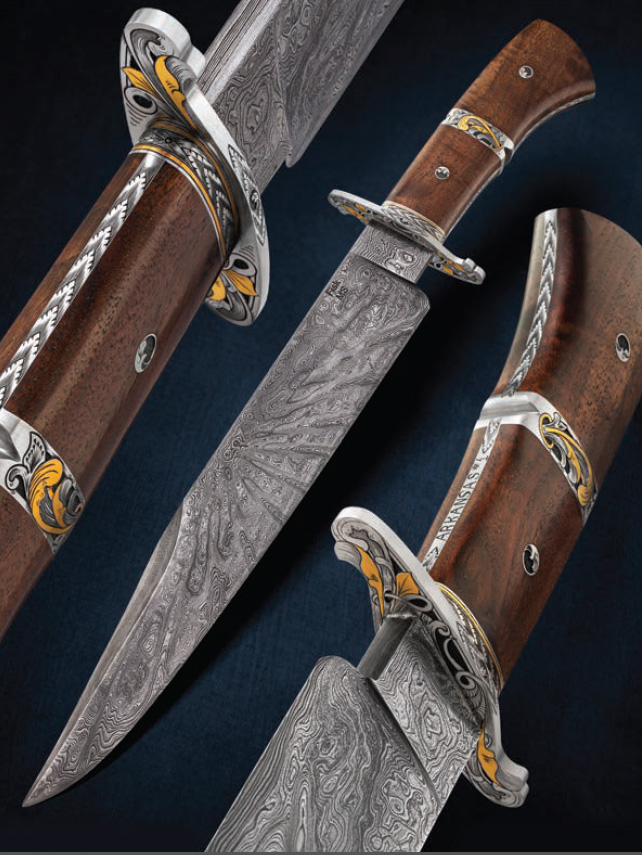
The Razorback State is the theme for Jerry Fisk’s Arkansas #1. The 11-inch blade has a Dog Star-pattern damascus with 1836 layers to represent the year Arkansas became a state. The blade also has steel welded into it from the Statue of Liberty. The walnut handle is from the official James Black walnut from the cemetery where Black is buried in Historic Washington Arkansas. Some believe Black made a bowie knife for James Bowie. The mountings are fully engraved and carved, including deep relief scrollwork and 24k-gold inlay—all by Jerry. (Whetstone Studio image)
Are the names ranked or is this just a collection of noteworthy knifemakers?
Since they are all great and, as John Wayne’s character once said of two great gunfighters in the movie Rio Bravo, “I’d hate to have to live on the difference,” I decided to list them all in alphabetical order—with the exception of R.J. Martin.
His profile appears first in the book because it is the only profile written by the maker himself. I did not ask him to write it, he volunteered to do it. I was so taken by the quality of his writing and the information he provided on what being a great knifemaker is really like that it was a no-brainer to include it.
In my opinion, it’s one of the best ways for the reader to truly appreciate what it’s like to be a great knifemaker—done from a great knifemaker’s point of view. I think it’s the best profile in the book, hands down.
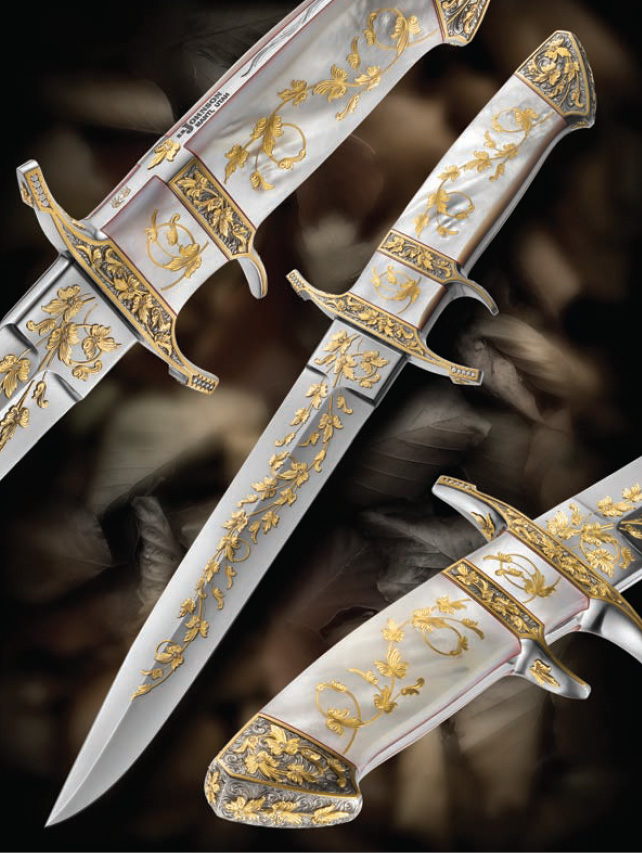
Steve Johnson’s spectacular repro of a Loveless Big Bear sub-hilt fighter is highlighted by Barry Lee Hands engraving that includes 24k-gold inlays and overlays set with diamonds and gilded mother-of-pearl. The knife is made from one block of 5/8-inch thick, 4-inch-wide and 16-inch long CPM 154 stainless steel. The blade is a quarter-inch thick and 8.5 inches long. Overall length: 14 inches. Steve made it for the 2015 Art Knife Invitational. (Francesco Pachi image)
Do great knifemakers have a peak or a golden era within their careers, or are they great throughout their careers?
As with most all great talents, they do indeed seem to peak at certain times. Some peak for longer periods than others and some even seem to have more than one peak. Some may burn out early and then something happens to help them regain their mojo.
However, in most cases the great ones maintain varying levels of greatness throughout their careers, and I think that’s the case with all of those featured in the book.
Is there a list of the knifemakers featured in this book posted somewhere for people to check out?
Jay Hendrickson and the husband-and-wife team of Billy and Beverly Mace Imel are the 2021 inductees into the BLADE Magazine Cutlery Hall Of Fame®.
Nominated by, and then elected in a vote of, sitting members of the Cutlery Hall Of Fame, the three comprise the 63rd, 64th and 65th members of the world’s only shrine recognizing all segments of the knife industry.
The Imels are the first-ever husband-and-wife team—or any pair, for that matter—to join the Hall simultaneously. A.G. and Goldie Russell are Hall-Of-Fame members but were inducted in separate years.
Along with the 2020 inductees, Joe Keeslar and Jim Sornberger, the 2021 inductees will be formally enshrined the Saturday of the BLADE Show, June 5, in Atlanta. Joe and Jim could not be formally enshrined last year because the BLADE Show was canceled due to the pandemic.
Jay Hendrickson
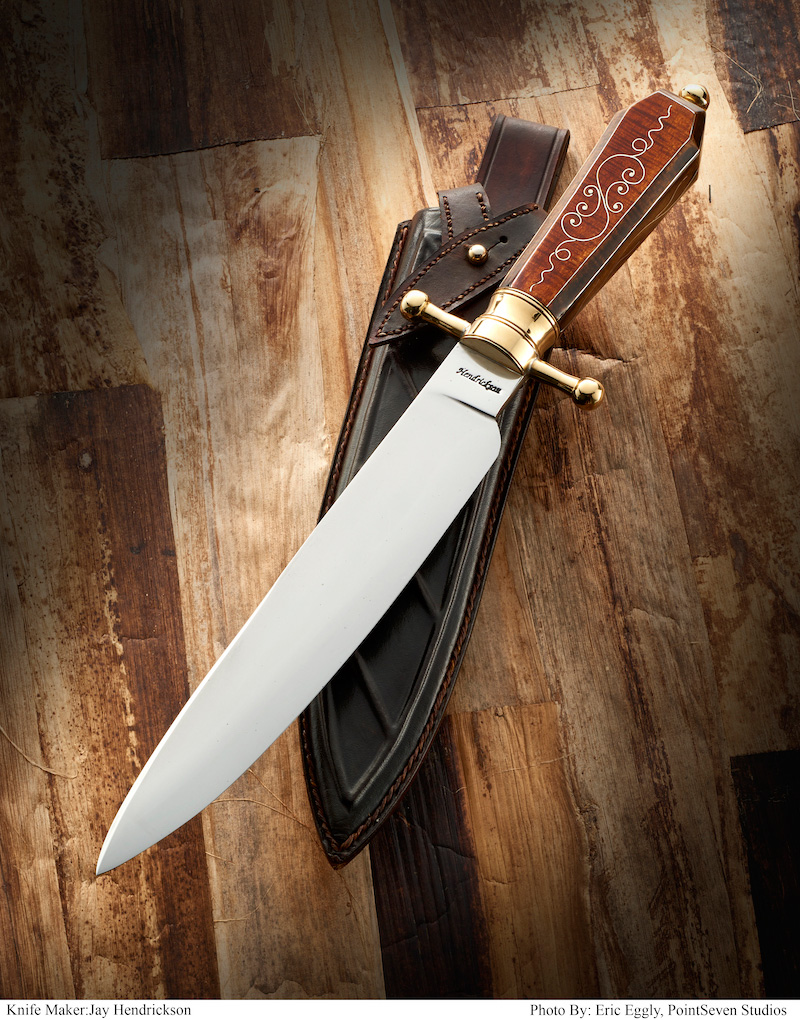
Impeccable fixed blades in the Moran style with matching sheaths are a Jay Hendrickson staple. (Eric Eggly/PointSeven image)Jay Hendrickson
Jay is an American Bladesmith Society (ABS) master smith who succeeded Cutlery Hall-Of-Fame member Bill Moran as ABS president in 1991—as a nominator noted, “a trying task to be sure, and Jay succeeded Bill very well.” The nominator went on to write Jay is a good bladesmithing teacher who has taught at many venues in the USA and France, and also served as director of the Moran Foundation for 10 years, helping to preserve Bill’s legacy.
Early on, Jay and Bill conducted a forging demonstration that was one of the longest running of all BLADE Show demos. The first installment was in 1987 on the sidewalk outside the show’s former Holiday Inn & Convention Center site in Knoxville, Tennessee, and continued at each succeeding BLADE Show in Knoxville and then at the Cobb Galleria in Atlanta until Bill passed away in 2006. Not only was it one of the BLADE Show’s longest running demos, it was also one of the most popular.
In 1995, Jay was presented with the ABS’s highest honor, the Don Hastings Award. The annual honor goes to an individual “who has performed outstanding service on behalf of the forged blade in the tradition of Don Hastings,” one of the founders of the ABS. In 2004, Jay won the William Wales Scagel Award, presented by the ABS to a bladesmith “for longtime service to promote the forged blade.” Another Cutlery Hall Of Famer, Scagel is considered the grandfather of custom knifemaking.
Jay was voted into the ABS Hall Of Fame in 2006 and a year later wrote the how-to guide, Introduction to Bladesmithing, with tips on how to forge various blade styles “exhibiting balance and aesthetic appeal,” how to understand the basic metallurgy of popular blade steels and more. Concluded the nominator, “Jay is a fine bladesmith, a fine teacher helping to preserve the art of bladesmithing, and a splendid ambassador of knives and knifemakers.”
Last but certainly not least, Jay forges magnificent fixed blades in the classic Moran style, including expertly ground bowies, camp knives, fighters, hunters and more, often in curly maple handles with intricate silver wire inlay, all accompanied by superb leather sheaths.
Beverly and Billy Mace Imel
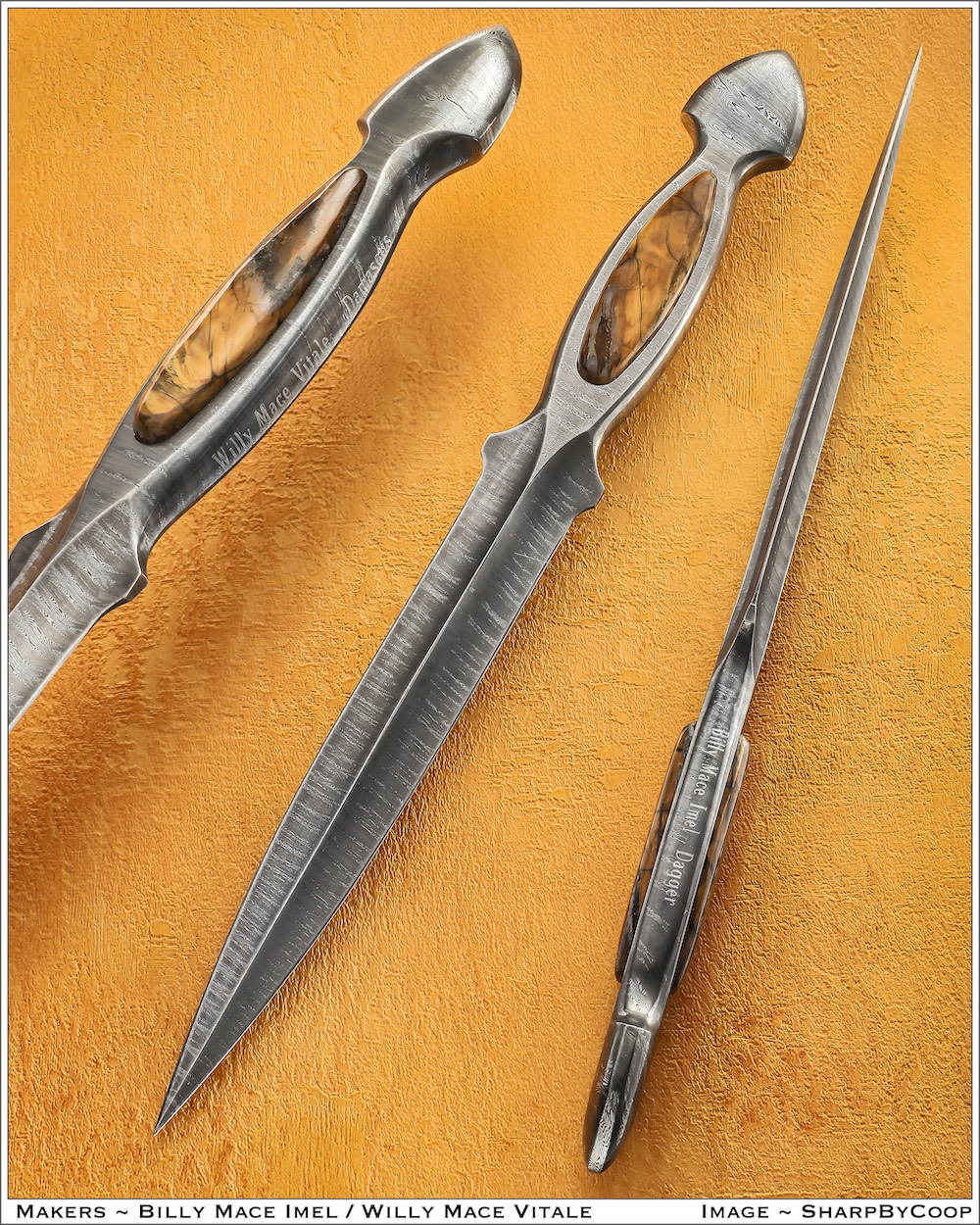
An example of Billy’s premier dagger work is this collaboration with Mace Vitale. (SharpByCoop image)Beverly and Billy Mace Imel
Beverly and Billy Mace are the first pair of Cutlery Hall-Of-Famers ever to be inducted simultaneously. They also join A.G. and Goldie Russell as the only husband-and-wife team in the Hall.
Billy makes fantastic fixed blades yet is perhaps best known for his sleek daggers with stainless steel blades in clean, crisp grinds and slender handles in a variety of gorgeous materials. To augment that knifemaking talent is his many hours of service to The Knifemakers’ Guild.
“What can you say about those who have worked so many hours and years to help so many?” wrote a nominator. “Billy was the secretary of the Guild during a huge building phase of the longtime maker association. Every year many new applicants had to be processed. Those of us who sat on the Guild’s board of directors during many of those years can testify to the energy and effort Billy put forth. The heavy load of accounting, stopping his own work to help discuss an issue—and those issues were many—and still be able to arrive at the Guild Show venues two days early with his own knives and to help set up each show’s exhibition room was a remarkable achievement. I think Billy is a gold standard for the Cutlery Hall Of Fame in terms of working hard for others.”
Beverly, meanwhile, served with distinction for many years on the Guild board as the organization’s secretary-treasurer.
“You can’t mention Billy’s name without mentioning Beverly’s,” the nominator continued. “The Guild board of directors was a large wheel, with every director a spoke in that wheel, but it was Beverly who kept the wheel’s hub lubricated and in motion. She maintained the Guild’s records in perfect order, and if there was a question about something from the past, she either looked it up or could recall it from memory—often smack dab in the middle of a Guild business meeting.”
Beverly’s familiarity with and recollection of Guild bylaws was legendary. Indeed, anytime a Guild president was asked a question he didn’t know the answer to during a Guild business meeting, he would often turn from the microphone and say, “Beverly, do you know?” Invariably she did and more than a few members in attendance would smile and wink at each other as a result.
The nominator went on to state that he wanted the Cutlery Hall of Fame to step out of the mold and do something different in considering Billy and Beverly for enshrinement. “It would be honorable for us to induct both of the Imels as one,” he wrote. Enough sitting Hall Of Famers agreed and the Imels are now members of their august group.
People Who Like to be Prepared Will Love the latest EDC Tools
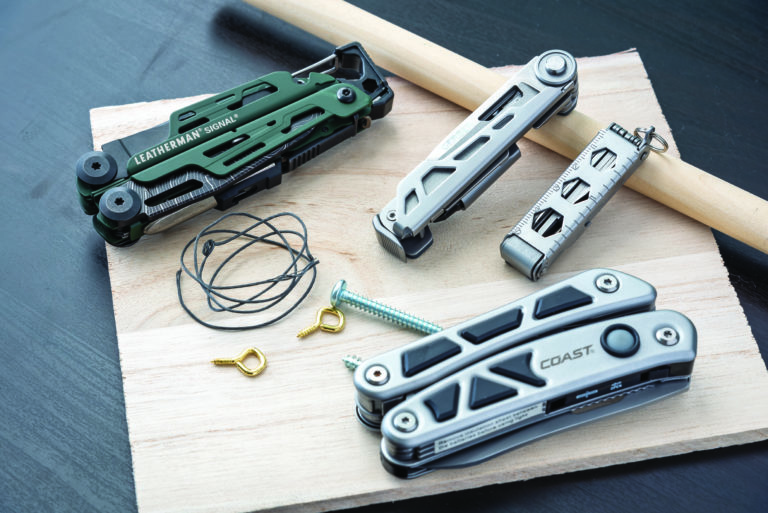
Knife guys love gadgets, fix-it people love gadgets and DIY-ers love gadgets, so it’s easy to see why multi-tools do so well in the knife market. Though not knives per se, they off er more versatility than just cutting ability by offering on-board tools. With broader appeal than knives, multi-tools have a further reach and encompass more markets, too. They appeal to folks who like to be prepared.In addition to DIY-ers, campers, hunters, fishermen, hikers, mountain bikers and anyone who enjoys outdoor activities benefits from owning and using a multi-tool. It performs in-fi eld repairs on equipment when you do not have access to regular tools. It can mean the difference between bowing out of a camping trip because of equipment failure, or performing an expedient in-field repair or adjustment and carrying on with your adventure. As with knives, advances in multi-tools have made them stronger and more user friendly and versatile.
FLASH in the HAND: Coast’s LED150 multi-tool
When you think of multi-tools, what immediately comes to mind is a pliers-based tool with little fold-out implements nestled inside the handle. Truth is, multi-tools can take on any form as long as they incorporate the implements necessary for field-expedient repairs and adjustments.
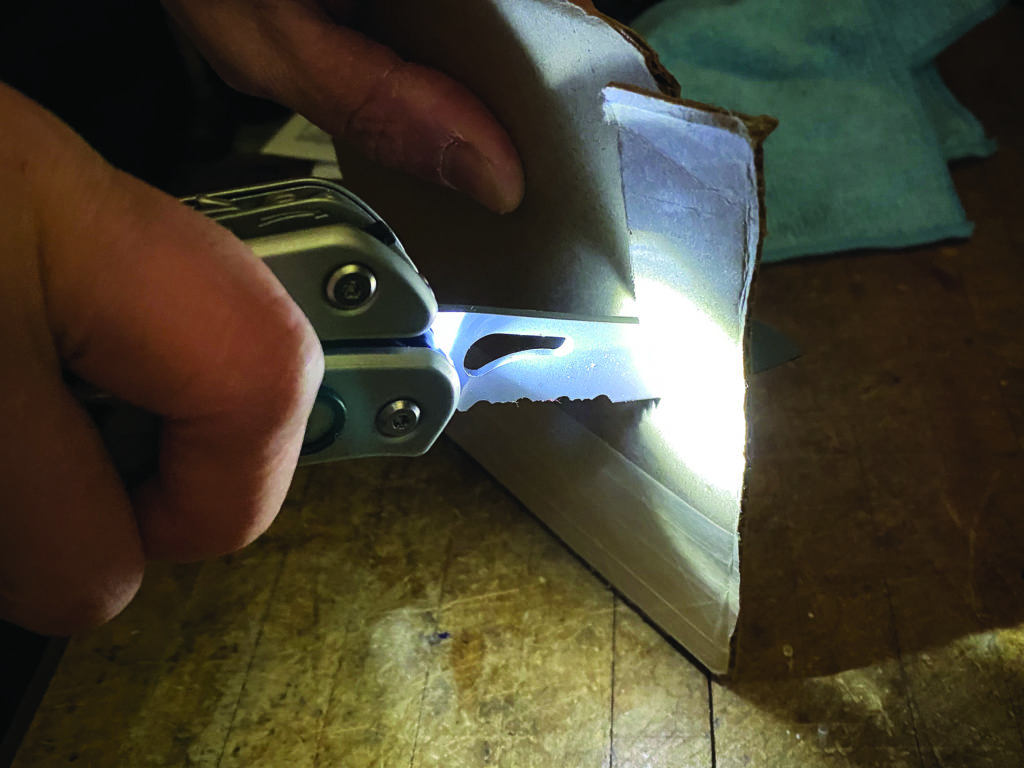
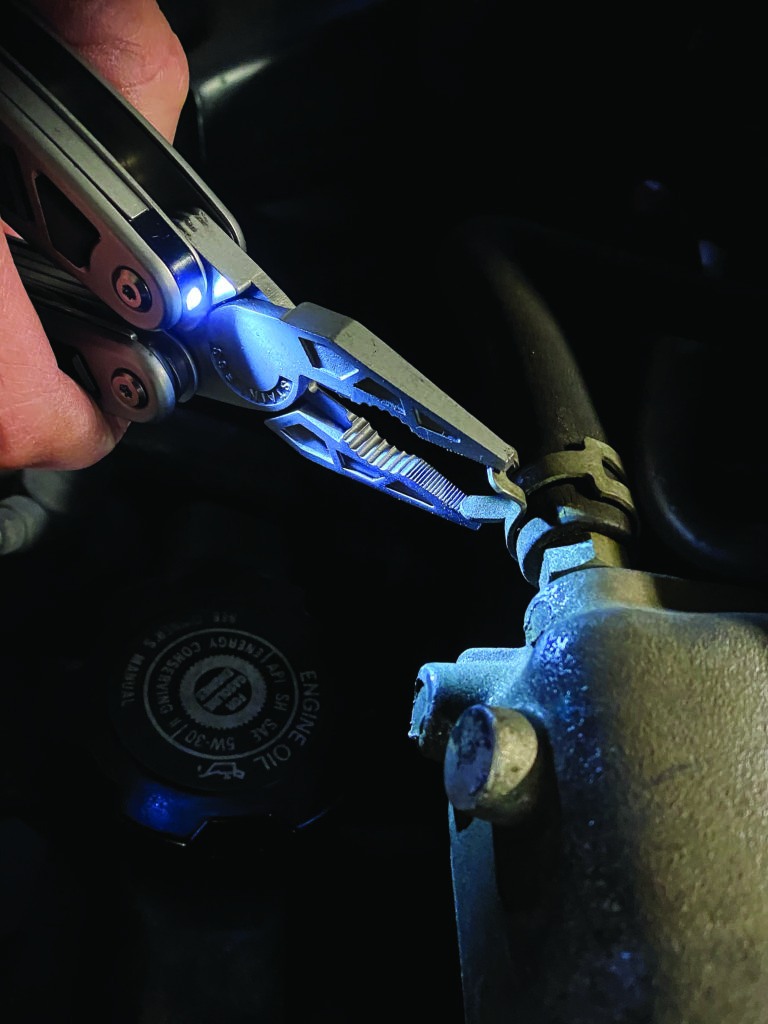
At first glance, Coast’s LED150 multi-tool might appear like any other pliers-based multi-tool, except for one thing: it incorporates not one but two LED lights. One LED is on the pliers jaw end and the other is on the partially serrated end of the knife blade. This way, you can confidently work in tight and dark spaces with confidence thanks to the illumination. The lights are activated by a recessed push button located on one side of the handle. Press once to activate the light by the main blade. Press again and the light turns off and, at the same time, the light on the pliers jaws end turns on. Press again and the jaws light turns off. With the multi-tool closed, you can use either light as a stand-alone flashlight, further expanding the multi-tool’s versatility. The lights are powered by two CR1616 lithium button batteries. The batteries replace easily.
The light on the end of the Coast LED150’s handle illuminates what you’re cutting.
The pliers jaws have different gripping surfaces for smaller objects and larger nuts/round objects. The jaws themselves are spring loaded, which helps to open them by spring tension, reducing hand fatigue. When closed, all the fold-out tools are easily accessible: a partially serrated main blade that works on a linerlock, spring-loaded scissors, large and small flat-head screwdrivers, can opener, Phillips head screwdriver and the pliers jaws—most all the common implements necessary for field repairs and adjustments.
The handles are aluminum and feature raised hard rubber for a non-slip grip. The LED150 has a good heft and the heavy-duty build will withstand normal use. The sturdy ballistic nylon belt pouch has a fabric-fastener flap closure. Manufacturer’s suggested retail price (MSRP): $49.
One of the LED lights on Coast’s LED150 multi-tool shines on the pliers jaws end so you can effectively work in dark areas easily without the need for a separate flashlight.
AFFORDABLE SOLUTION: Gerber’s Armbar
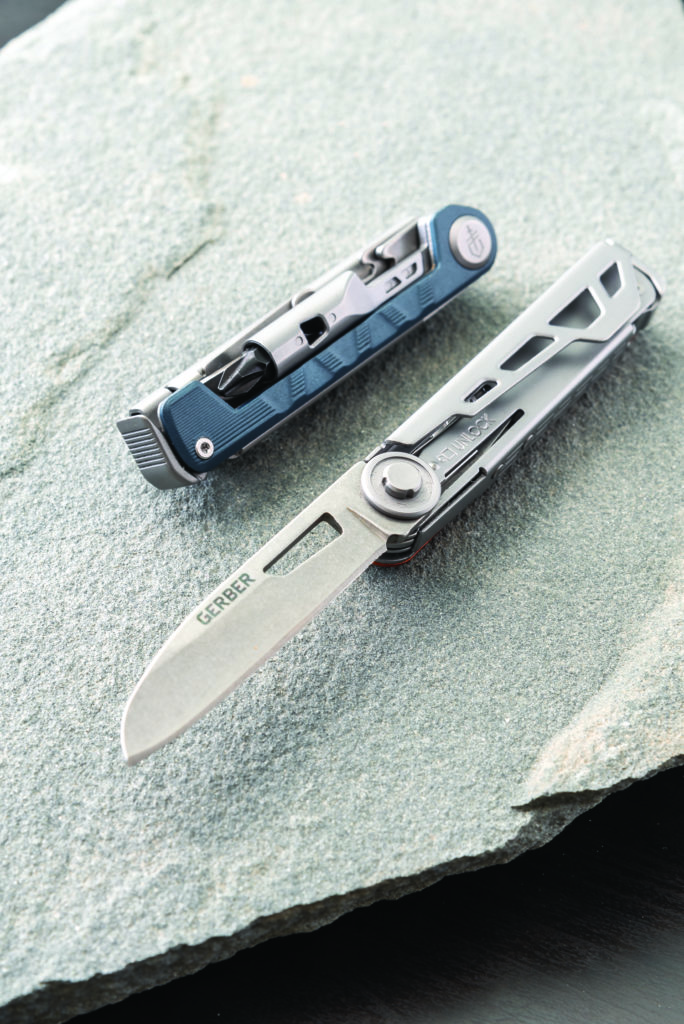
Gerber’s Armbar series incorporates the fold-out implements of pliers-based multi-tools like the Coast LED150—minus the pliers. Sometimes, you just need the versatility of screwdrivers, a knife blade and scissors. About the same size as a large multi-blade pocketknife, the Armbar Drive features seven on-board fold-out tools: 2.5-inch plain edge sheepsfoot blade with opening hole and framelock, 2.5-inch extension driver with a double-sided bit of Phillips and flat-head screwdrivers, a prybar, bottle opener, hammer, scissors and awl.
The Gerber Armbar Drive features a sturdy main blade. The entire package has about the same dimensions as a medium-sized traditional pocketknife.
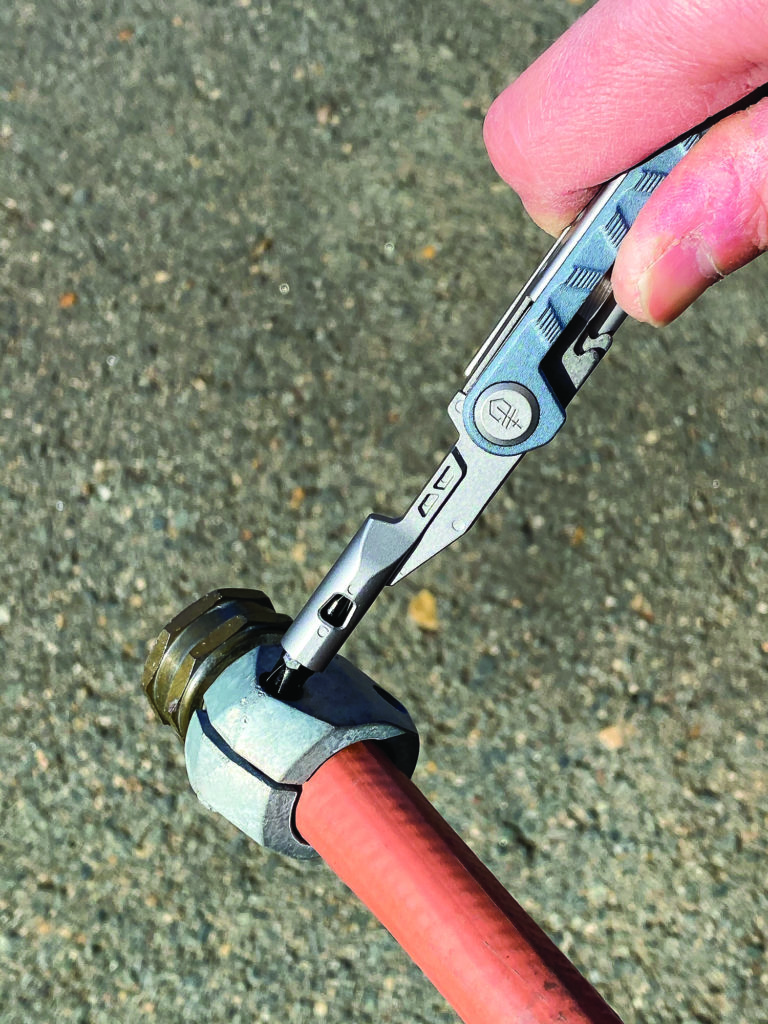
The extension driver has a magnet that holds the double-sided bit and allows for fast flip-over when transitioning to different screws. The driver socket can accept aftermarket quarter-inch drive bits, too. Hence, you can customize your Armbar Drive just about any way to fit your tasks. The spring-loaded scissors provide enough blade length for cutting coupons, stray threads and duct tape. The plain edge sheepsfoot blade thumbs open easily like any lock blade. The blade is mostly exposed even when closed, but the metal channel protects it from damage and you from accidental cuts.
Perhaps the neatest implement is the combination hammer/prybar/bottle open-
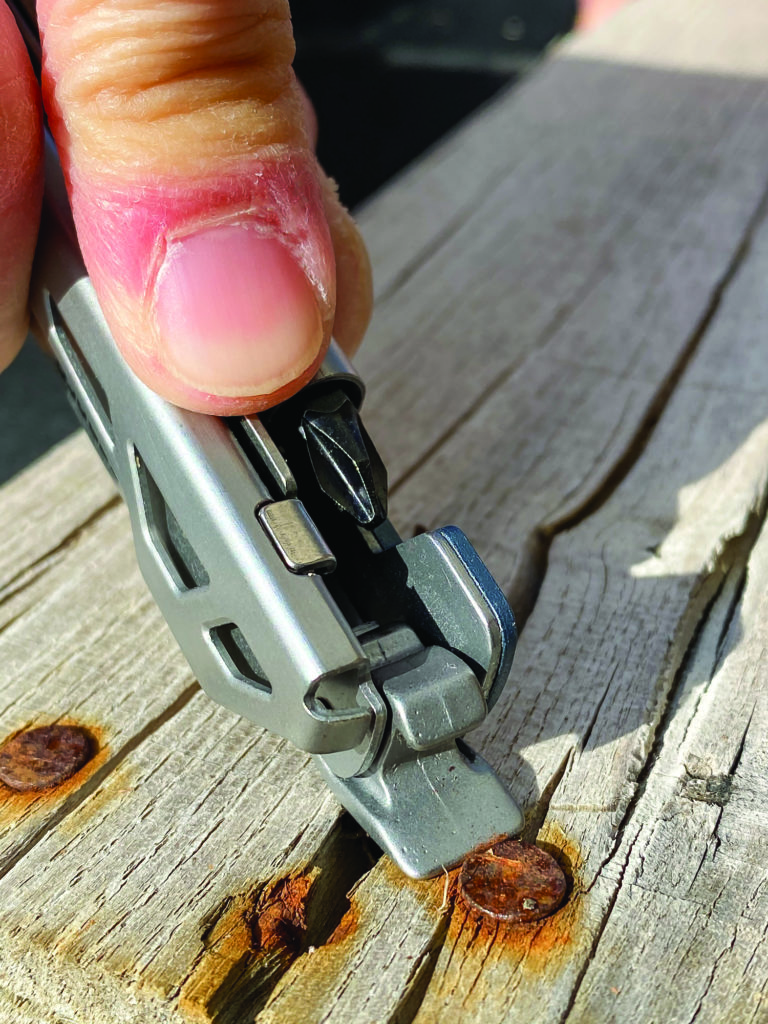
er, which in the closed position is in the hammer mode by default. The squared-off back end takes care of light hammering. The prybar function is rather limited as you’re not going to get a ton of leverage. However, if you need staples removed or to pry open a casing and such, it does the job.
A fold-out prybar/bottle opener on the Gerber Armbar Drive performs light-duty prying when needed, saving the blade tips on your standard knives.
One thing I wish Gerber would have included is the ability to lock the screwdriver in the fully open as well as the 90-degree position. When you torque down with the driver, your hand may move and this will cause the screwdriver to fold a bit. Also, when you use the tool in the 90-degree position, you apply more torque. Having it lock in the 90-degree position would make it easier to use—if not lock in both positions, then a strong detent and a half stop, like a slip joint, would be better than nothing. The form factor permits easy carry in your pocket, toolbox, glove box or a backpack.
At 3.1 ounces the smallest multi-tool in the Armbar line, it comes in an aluminum handle anodized in a choice of urban blue, orange or onyx. With an MSRP of $39, it presents an affordable solution to a typical pliers-based multi-tool by reducing bulk and weight—that is, if you don’t need pliers.
The screwdriver tool on the Gerber Armbar Drive is easy to manipulate. The magnetic socket allows you to flip the double-end bit over, as well as use most any aftermarket quarter-inch driver bit.
TINY TOOLBOX: Utica Minimaster
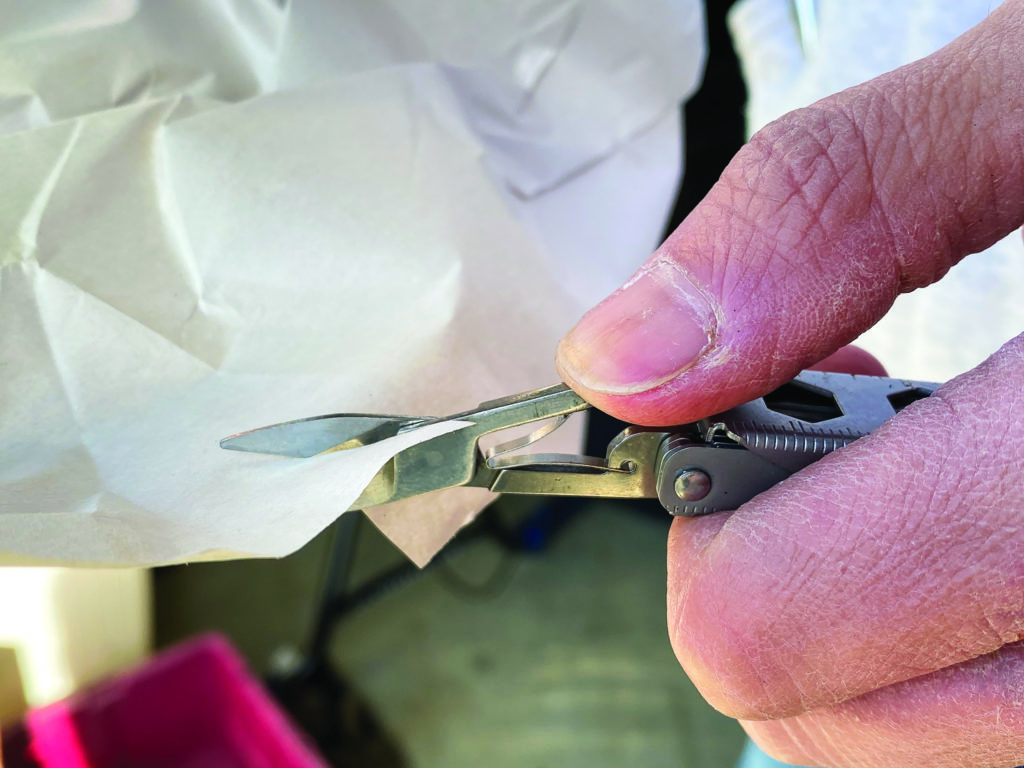
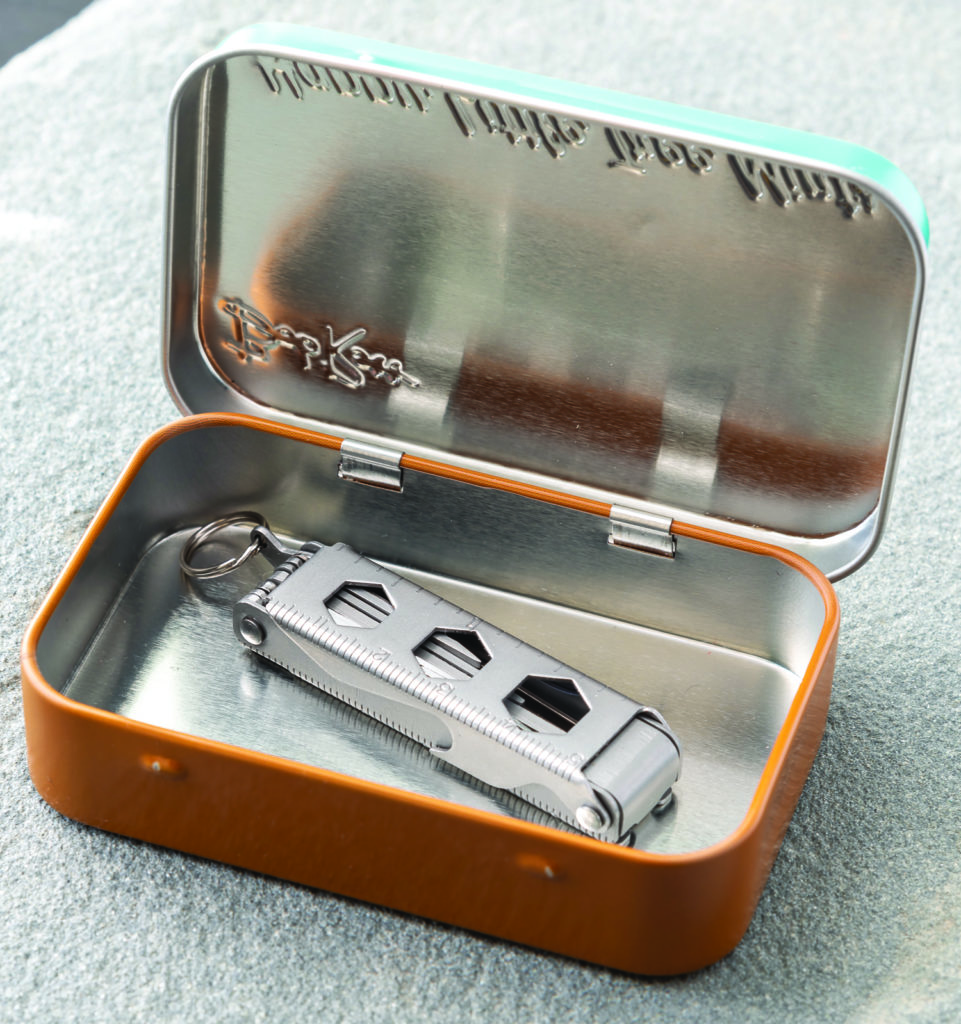
Utica primarily manufactures knives for hunting and tactical but also makes multi-tools. The Minimaster is the smallest multi-tool of the test bunch. It’s loaded with many small fold-out implements: a pair of tweezers, large and small flat-head screwdrivers, a Phillips screwdriver, scissors, fingernail file/cleaner, knife blade, bottle opener, and ⅜-, 11/32- and ⅝-inch wrenches integrated into the folding cover. Made in the USA, it’s roughly the size of a Victorinox Classic, so it fits well on a keyring, its preferred method of carry.
The scissors may be tiny on the Utica Minimaster but it is effective.
None of the tools lock in the open position. You pull one out and then close the cover; the cover held closed by your grip acts as the lock so the tools won’t fold on you. The tweezers are pretty neat—this is the only compact multi-tool I know of that integrates one. The tips are not textured or ground precise like regular tweezers, so grasping some things with it can be a bit difficult, though having one is better than not. As for the rest of the tools, they are handy to have and definitely will work in a pinch when you need them.
The ultra-compact size of the Utica Minimaster makes it a great candidate for improvised tin-based survival kits.
The only down side to the Minimaster is the hinged cover. It needs to detent tighter in the closed position, as the sample sent to us for review had a tendency to open partway easily. This could present a safety issue, especially if the tools open inadvertently. MSRP: $60. There’s also an imported version that retails for $9.95. Same construction and implement selection, except the multi-tool is made overseas.
MAPPED MULTI-TOOL: Leatherman Signal
When it comes to an article about multi-tools, I would be remiss to not include Leatherman Tool Group, the brand that pioneered the concept. It is the originator of the pliers-based format, and still among the best of them after all these years.
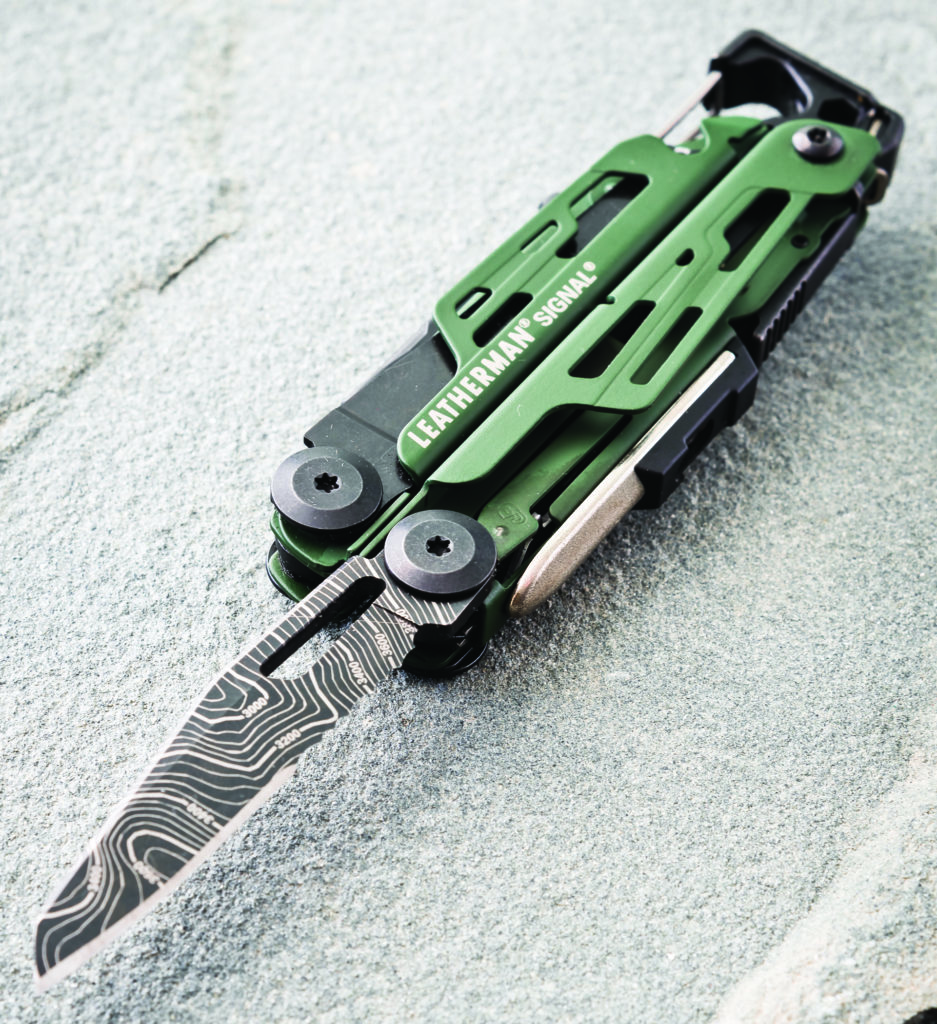
The main blade of the Leatherman Topo Signal features a map-topography laser etching, hence the multi-tool’s name.
The limited-edition Topo Signal is a variant of Leatherman’s Signal multi-tool. The Signal was developed specifically for the outdoor enthusiast, integrating features like a ferrocerium fire starter rod, saw, survival whistle, diamond sharpener and hammer, along with standard Leatherman features such as pliers jaws with replaceable cutting inserts, fold-out driver with reversible bit, awl and can opener. There’s also an integrated quarter-inch-bit socket built into the hammer portion of the handle, which will accept any standard quarter-inch bit driver.
The main blade is a partially serrated 420HC stainless sheepsfoot pattern that locks open via a linerlock. The blade features an oblong opening hole, while the partial serrations eat through tough and fibrous materials with ease. The blade has a map-topography-style laser etch, hence the name. The distinctive appearance is pretty neat and fits in perfectly with the outdoor theme. Speaking of outdoor theme, the Topo Signal comes in a nice dark green Cerakote coating for the aluminum handles and pliers jaws, fold-out implements, and all-black hardware.
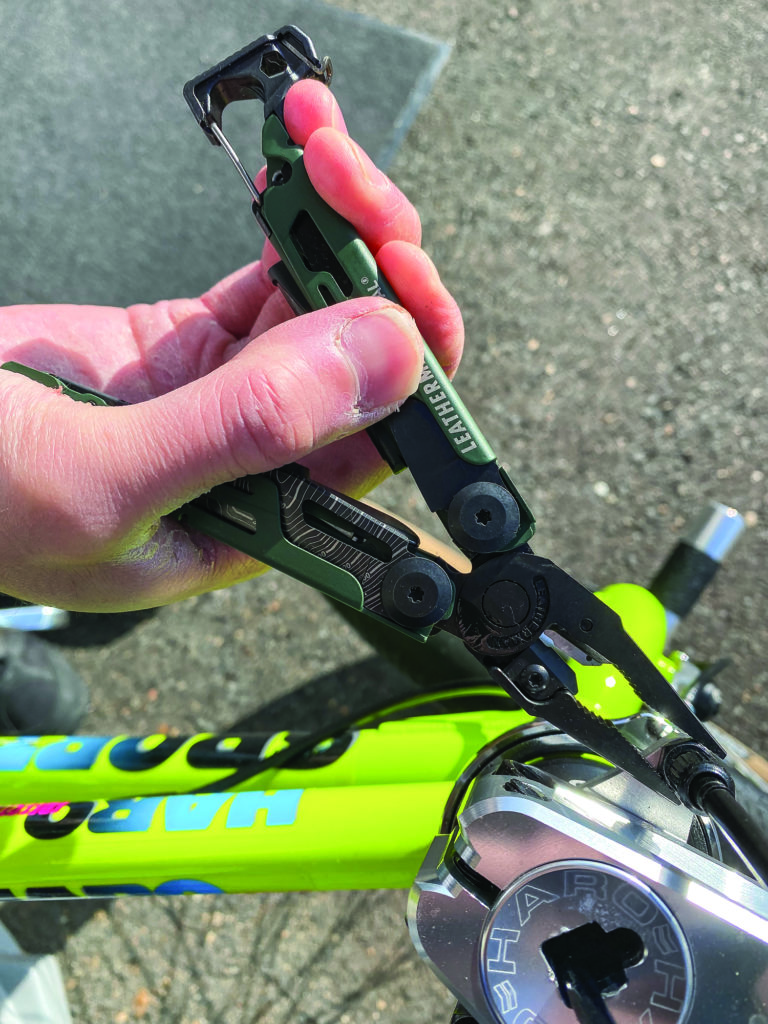
Making on-the-spot repairs and adjustments are a multi-tool specialty. The needle-nose pliers of the Leatherman Topo Signal works great at accessing small nuts in cramped places.
Each one comes with a nice ballistic nylon belt sheath withbutton snap closure. It has a steel pocket clip. There’s also an integrated carabiner in the hammer portion so the tool can be clipped on a D-ring, etc.
Comparatively speaking, a Leatherman multi-tool is engineered better than most on the market. MSRP: $119.95. Country of origin: USA. It is the most expensive of the test group, but the quality of the manufacture and fit and finish justifies the price.
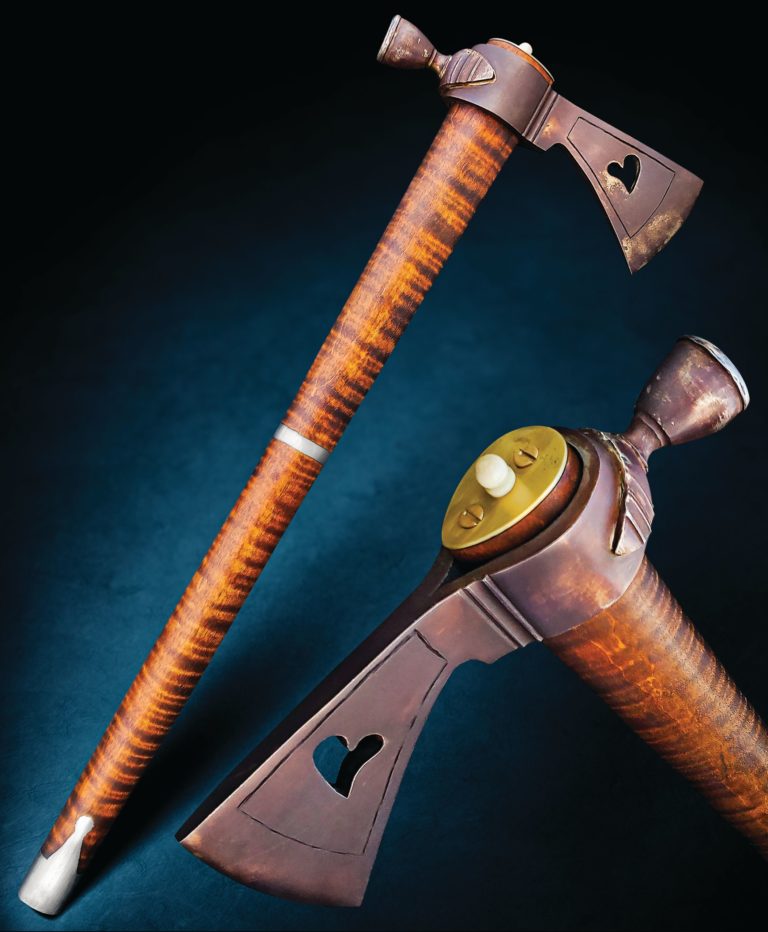
Since 21-year-old Jarrod Fiscus won with an axe in his appearance on Forged in Fire and also participates in frontier rendezvous events, it seems most appropriate that he would build a traditional pipe tomahawk.
Jarrod handforged the head of 1080 carbon steel and the body of mild steel. He then forge-welded the pipe to the body. He said the “weeping heart” cutout is a design used frequently in Colonial days, from the Eastern woodlands to the Great Plains. Jarrod dyed the curly maple haft in the traditional manner with nitric acid. He poured the pewter inlays directly into the wood. He finished it all up with a brass cap and a mule deer antler plug. As Jarrod noted, “This hawk is a fully functional, smokable piece of art.”
SPEC CHECK
ODEL: Pipe tomahawk
MAKER: Jarrod Fiscus
HEAD LENGTH: 4”
EDGE LENGTH: 3”
HEAD/EDGE MATERIAL: 1080 carbon steel
HAFT: Curly maple
OVERALL LENGTH: 19.5”
MAKER’S LIST PRICE FOR A SIMILAR
PIECE: $550
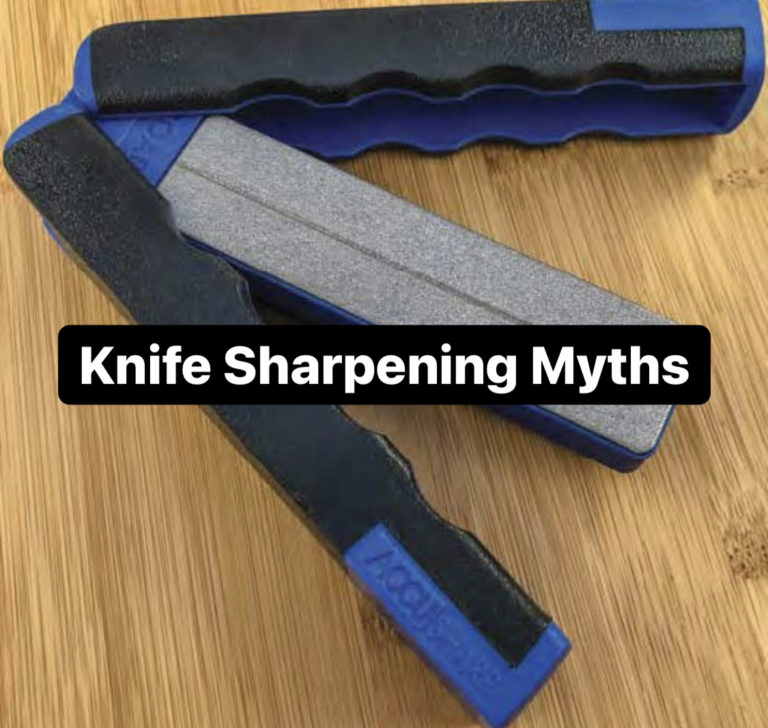
Knife sharpening is, on its surface, a simple thing. That hasn’t prevented a few myths from popping up, though. Here are five knife sharpening myths, busted.
Myth: You Need Expensive Knife Sharpening Tools
Fact: Quality knife sharpening stones, sticks, oils, and other gizmos can help quite a bit. However, you can’t buy your way to sharpening success. Technique is 90 percent of it. Humans have been sharpening knives without manufactured products for centuries. How did they do it? They knew how to work an edge.
Here are knife sharpening tips for the uninitiated. All you need are some junky practice knives, a sharpening stone, a Sharpie and some patience to get started.
Myth: Diamond-Infused Knife Sharpening Stones Last Forever
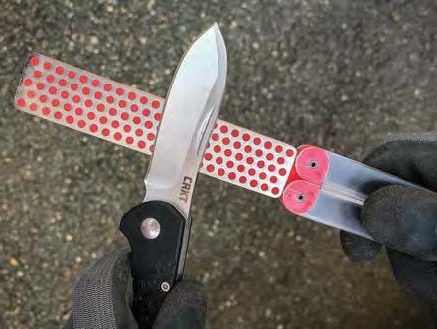
A DMT Diafold in action.
Fact: Diamonds might be forever, but knife sharpeners are a different story. Here’s DMT with the answer:
For those that use stones on a daily basis and maintain them properly, the diamond will likely last for a few years. For those that use them less frequently, it’s likely the stone will last from ten to twenty years.
Still, you can’t beat the value of a $40 knife sharpener that gets the job done over several years.
Myth: Using a Sharpening Stone Dry Works Faster Than Using It Wet Because It Removes More Metal
Fact: Don’t confuse friction with progress. Adding a little water or oil to maximizes your effort with every stroke on a knife sharpening stone. Remember, knife sharpening isn’t necessarily about scraping metal away; it’s about refining or creating an edge.
The results were clear. Use your stones wet. The stones used wet worked far better than the ones used dry.
That isn’t to say that every knife sharpening stone needs to be used wet. It’s more that this is not an either-or proposition. Some can be used dry, too, as Cutlery-Hall-of-Fame Member Dan Delavan demonstrates in this video.
On that note, if you use water on a stone, always use water. If you use oil, always use oil. Oil and water don’t mix, and that goes for knife sharpening, too.
Myth: Electric Knife Sharpeners Can Sharpen Almost Any Knife
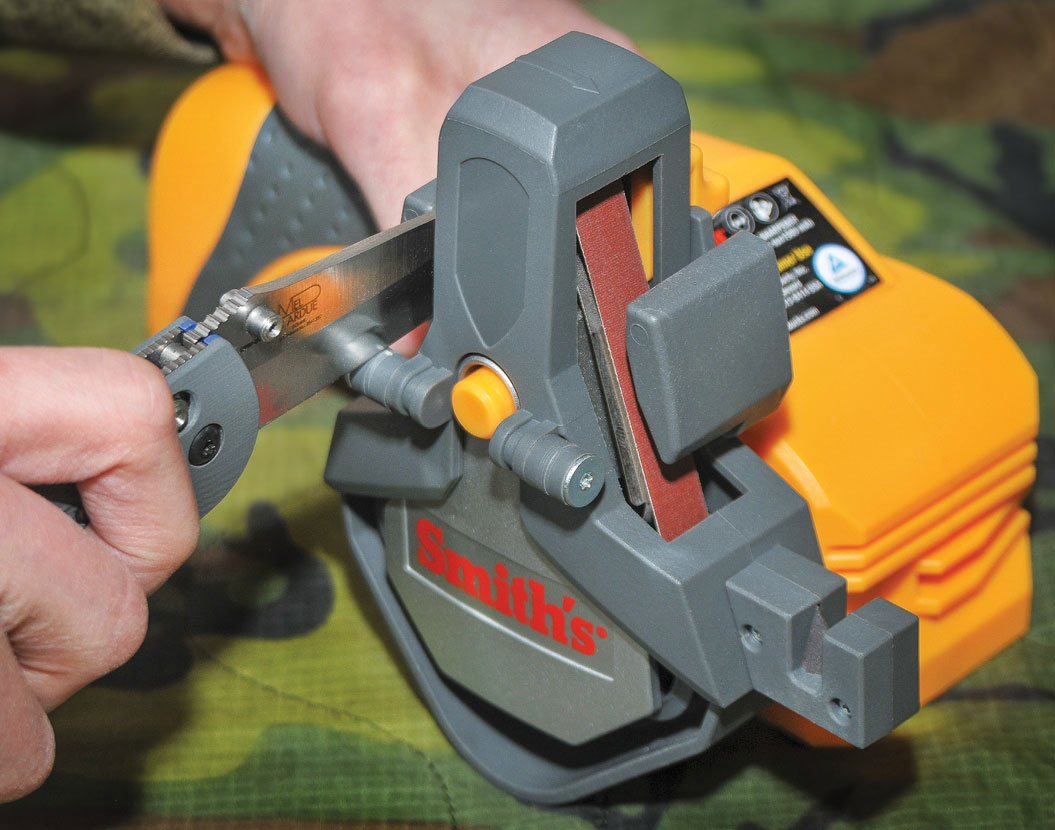
The Cordless Knife & Tool Sharpener from Smith’s Products features easily adjustable angle guides that hold the knife at the proper set angle for a consistent edge. (DMS Captures image)
Fact: Electric knife sharpeners can sharpen most knives, but that doesn’t mean that they should.
Electric knife sharpeners have fixed angle positions. If your favorite knife’s edge is set at 20 degrees, and the electric knife sharpener is set at 15 or 30 degrees, you might need a new favorite knife.
The type of grind is also left unconsidered with electric knife sharpeners. For example, a blade’s convex edge will be reset by a sharpener tuned to a flat grind.
Edges aren’t set by accident. They are tied to the purpose and performance of a knife.
Matching the knives you intend to sharpen to the features of an electric knife sharpener is important. So is learning how to use manual knife sharpeners!
Myth: Diamond Knife Sharpeners Aren’t Really Made Out Of Diamonds — That’s Just Marketing
Fact: Diamond knife sharpeners use real diamonds.
On first glance, this knife sharpening myth seems to make sense. Walk into a jewelry store and you’ll see diamonds with four-figure price tags. A sporting goods store, on the other hand, offers diamond knife sharpeners for less than 100 bucks. Maybe you should’ve reconsidered financing that engagement ring.
Knife sharpening companies often use monocrystalline diamonds, which are not the same as jewelry-grade diamonds. Here’s DMT again with the explanation:
Monocrystalline diamonds are diamonds of high quality that are not fractured. These diamonds are uniformly sized. DMT® bonds these to a nickel backing to provide a long lasting very flat surface. The alternative is to use polycrystalline diamonds. These diamonds are fractured and will not wear as long as the higher quality monocrystalline.
Half Myth: When Sharpening, Use an Equal Number of Strokes on Each Side
Fact: This one could cut either way. It’s right on the line of myth versus reality.
It’s generally accepted that an equal number of strokes on each side of the blade will result in an even edge. However, hands don’t work exactly the same way in both directions. As Delavan states in the video above, most people’s backhand stroke isn’t as sturdy, and that could result in an uneven edge.
The trick is to compensate with a few more strokes on that backhand.
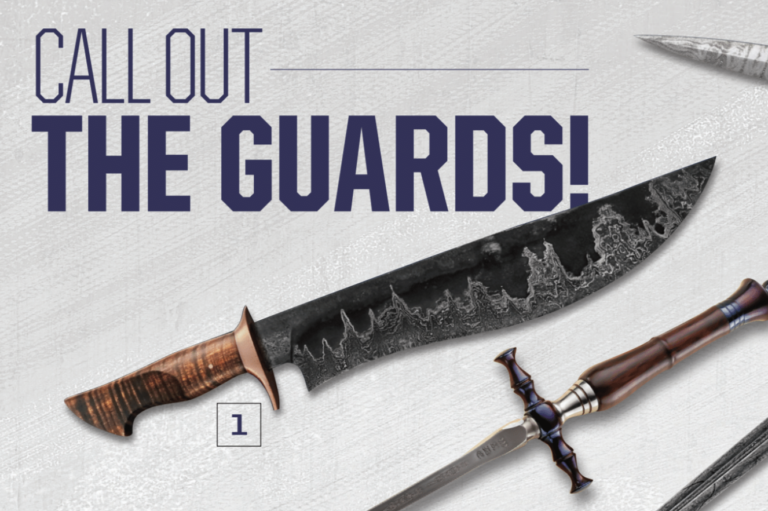
Constantly on the lookout for something that will make their knives better and stand out at the same time, many of today’s custom makers don’t hesitate to jazz up the guard.
And why not? A handsome, well-made guard adds to a knife’s looks, and, more importantly, serves as a sure safety feature in helping keep your hand where it needs to be—on the handle.
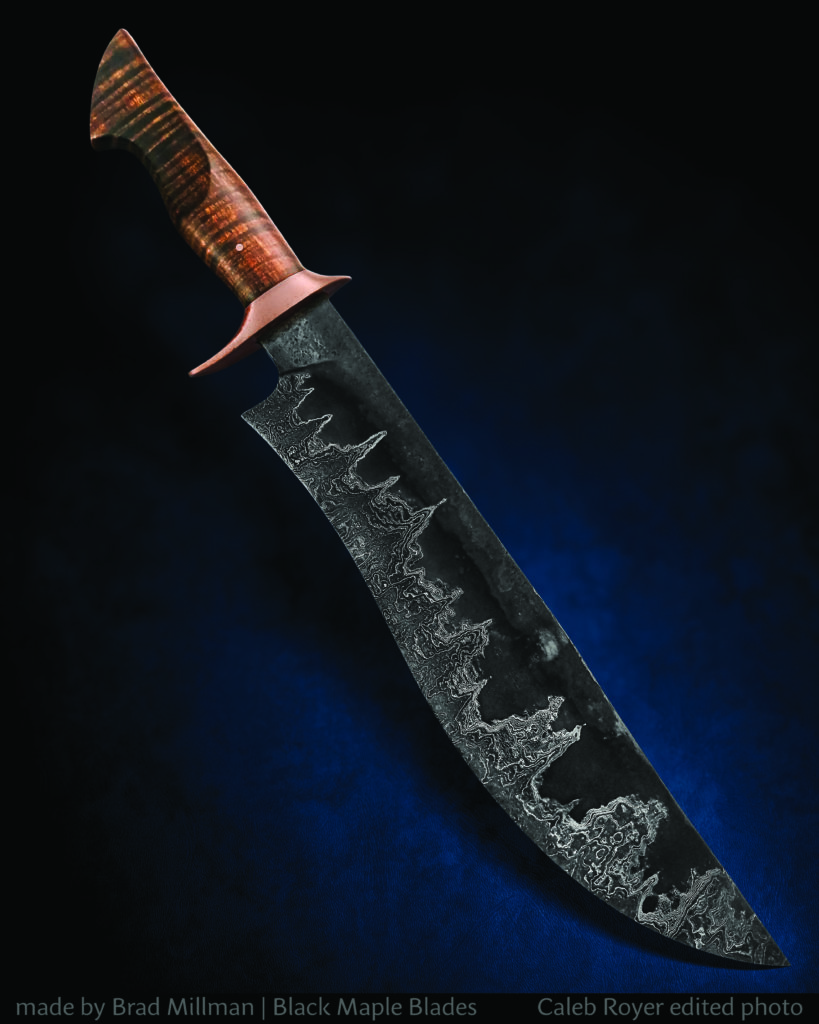
Above: Brad Millman forged the hammer-finished copper guard of his Wolftooth bowie. The 12-inch recurve blade is a san-mai construction of 360 layers of 1095 carbon and 15N20 nickel-alloy steels for the core sandwiched in a jacket of 1084 carbon steel. The bird’s-beak handle is curly Tasmanian blackwood. Overall length: 18 inches. (Caleb Royer edited image)
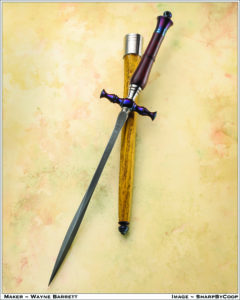
Above: Wayne Barrett heat-colored the shapely mild-steel crossguard of his 14.56-inch stiletto. The 10.6-inch blade is vintage butcher’s steel by F. Dick of Germany and features a classic triangular grind. The handle is Merino ram’s horn. (SharpByCoop image)
.
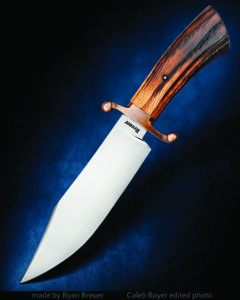
Above: It’s easy to see how Ryan Breur’s Ball-Guard Bowie got its name. The guard is cast bronze and the handle is flamed white oak with a domed inconel pin. The blade has a sharpened clip and is forged from 80CrV2 carbon steel. (Caleb Royer edited image)
Above: A stylish guard of wrought iron helps put the finish- ing touches on an ancient-walrus-ivory bowie by ABS master smith Tad Lynch. The 11.25-inch clip-point blade is W2 tool steel—a material some leading smiths consider ideal for producing a handsome hamon—and the knife is 16.375 inches overall. (SharpByCoop image)
Above: An upturned guard with a finger ring—each of hot- blued 4340HT steel—and a ladder-pattern damascus blade of 1095 carbon and 15N20 nickel-alloy steels help complete a quillon dagger by ABS journeyman smith Paul Savage. The handle is buffalo horn. (SharpByCoop image)
Above: Black mirror accent balls cap the stainless steel quillons on ABS master smith Kyle Royer’s Maiden Voyage Stiletto. The 11.75-inch damascus blade features an extra-deep hollow grind, a fuller and a reinforced piercing tip. The sculpted, fluted handle is wrapped in 24k-gold twisted wire. Overall length: 17.5 inches. (Caleb Royer image)
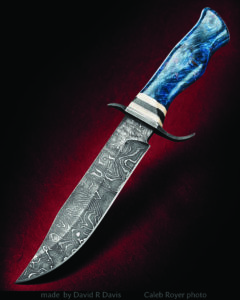
Above: The handforged nickel-silver finger guard “with curls” gives a damascus bowie by David Davis a curvaceous look. The 7.25-inch blade is pattern-welded steel forged by Alabama Damascus. Blade finish: acid etched. The handle is stabilized buckeye burl and the spacers/ liners are ebony and bone. Construction: hidden tang. Overall length: 12.25 inches. (Caleb Royer image)
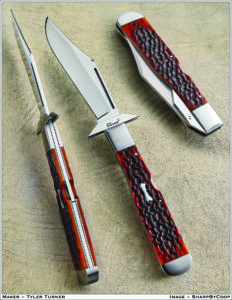
Above: Tyler Turner outfits his coke-bottle-pattern pocketknife with a folding swing guard of 416 stainless steel. The 4-inch blade is CPM 154 stainless steel in a hollow sabre grind and the scales are jigged bone. Closed length: 5 3/8 inches. (SharpByCoop image)
The Art Knife Invitational—the biennial knife event that made biennial knife events cool—is now under the direction of Barry Lee Hands, and will be Oct. 30, 2021 at the M Hotel Casino Resort and Spa in Las Vegas.
Consisting of some of the world’s top custom knifemakers, each of whom votes on any additions to the group’s membership, the show had been held for many years in San Diego. Spearheaded by BLADE Magazine Cutlery Hall-Of-Fame® member Phil Lobred when it started in 1983 in Reno, Nevada, the AKI was held again in 1984 before undergoing a hiatus until 1993, when it was moved to San Diego. It had been there every other year since.
When Phil passed away in 2016, his daughter Sandee took over the reins and coordinated the show in 2017 and 2019. In a meeting in July, Barry and Sandee discussed moving the show, for one reason because the member makers wanted to try something new. Meanwhile, one thing led to another and the show was in new hands—Barry’s. “I knew my dad admired Barry’s work [Hands is a leading knife and gun engraver], Barry’s experience with running shows, [and his] being the president of the Firearms Engravers Guild of America,” Sandee wrote. “So, we made a deal.
“I will admit it was heartbreaking at first, but when I see the good job Barry is doing on social media, managing things, the new hotel location in Las Vegas—wow!—and with the members voting in really good people, I know that we made the right choice.”
Barry is equally complimentary of Sandee. “I would like to say on behalf of our members that Sandee has been very helpful in the transition,” he observed, “and at AKI she will be an honored and respected show guest.”
Barry indicated the biggest change about AKI is the Vegas move.
“The members voted for a location change before I took over,” he noted, “and when I came in they let me know they still wished to move. With that in mind, and on the suggestion of one of our collectors, which happened to coincide with my own opinion, we chose the M Hotel Casino Resort and Spa. The M is a beautiful hotel and is the closest major property in Las Vegas to Los Angeles.”
Barry takes an aggressive approach to marketing, including a “beefed up” online presence with a “dramatic yet functional” new website. “We also have linked our Instagram @artknifeinvitational page to our Facebook page and are creating new graphics about our members and their work, which we post most every day,” he wrote.
Voting for AKI membership also has been updated. “Some members of the AKI advisory panel told me that since they are busy at the bench and the knife world is so large compared to the past, it is hard for them to know who may be the best to vote in,” he stated. Hence, after many communications they formulated a standard procedure for nominating and voting in new members. The panel approved the proposed rules, put them to a vote and a majority of the members approved them.
If you are a member of AKI, an invited guest or a maker who would like to be considered, submit your nomination at [email protected]. After a review of the nominations, Barry vets and selects a group of six or more. Biographical sheets are written on each maker and sent to the membership and panel for review. After 48 hours, if there are no objections, the group becomes nominees and is voted on by the membership. “The process has occurred four times since July,” Barry wrote. “It has been working very well and our membership seems highly pleased with the results.”
During the changeover, a few members resigned. “Some requested privacy, so respecting that, we will not list their names,” Barry noted. “Their reasons were varied. Some cited age, some preferred other opportunities, and others were not in full agreement with the rules voted in by fellow members.”
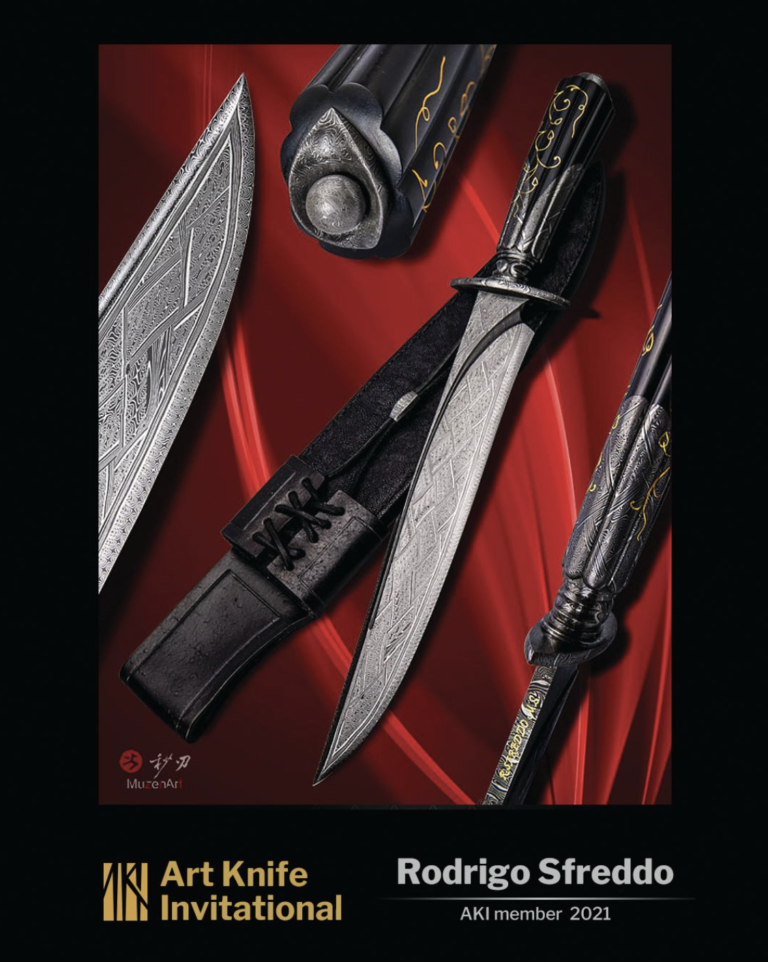
The present members are: Ron Appleton; Edmund Davidson; Harvey Dean; Jerry Fisk; Alex Gev; Shaun and Sharla Hansen; Anders Hedlund; Steve Hoel; Dietmar Kressler; Elizabeth Loerchner; Andrew Meers; Tom Overeynder; Bertie Rietveld; Rodrigo Sfreddo; Fabrizio Silvestrelli; Jürgen Steinau; Vasiliy Vorobiev; Owen Wood; and John Young. Guest makers for the 2021 AKI will include Corrado Moro, Veronique Laurent and others.






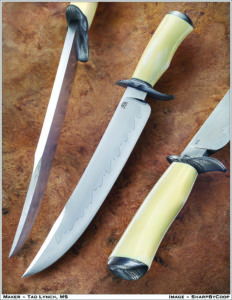 Above: A stylish guard of wrought iron helps put the finish- ing touches on an ancient-walrus-ivory bowie by ABS master smith Tad Lynch. The 11.25-inch clip-point blade is W2 tool steel—a material some leading smiths consider ideal for producing a handsome hamon—and the knife is 16.375 inches overall. (SharpByCoop image)
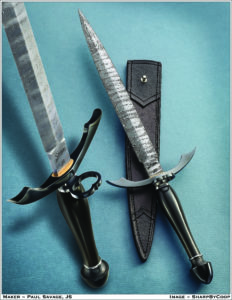 Above: An upturned guard with a finger ring—each of hot- blued 4340HT steel—and a ladder-pattern damascus blade of 1095 carbon and 15N20 nickel-alloy steels help complete a quillon dagger by ABS journeyman smith Paul Savage. The handle is buffalo horn. (SharpByCoop image)
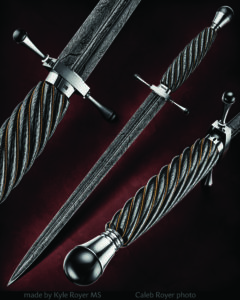 Above: Black mirror accent balls cap the stainless steel quillons on ABS master smith Kyle Royer’s Maiden Voyage Stiletto. The 11.75-inch damascus blade features an extra-deep hollow grind, a fuller and a reinforced piercing tip. The sculpted, fluted handle is wrapped in 24k-gold twisted wire. Overall length: 17.5 inches. (Caleb Royer image)