See who took top honors in Long Beach for the 2021 Blade Show West Awards.
BLADE Show West took place Oct. 8-9, 2021, at the Long Beach Convention Center in Long Beach, Calf. It was the show’s inaugural year in California and drew custom makers, manufacturers and collectors from around the county.
It also drew an impressive cadre of entrants for the BLADE Show West Factory and Custom Knife Awards. For Factory Knives, awards were given in five categories, while the Custom Knives awarded six categories.
The Factory section was evaluated by a panel of undisclosed industry experts who judged the blades on a number of factors, including utility, design, creativity, materials and other traits. The Custom section was judged by a number of expert knifemakers along similar lines.
Factory Knife Award Winners
Best Tactical and Best In Show
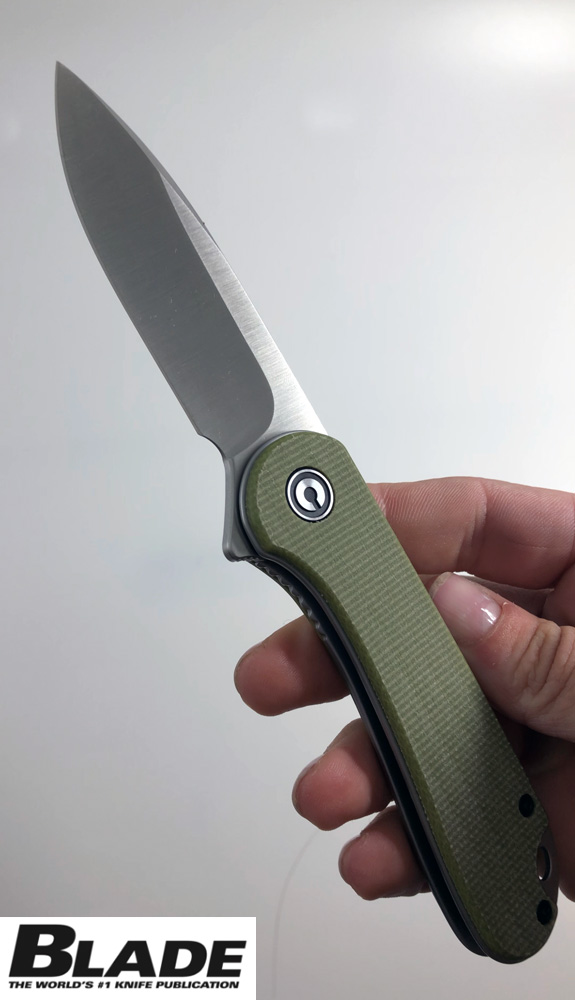
Civivi Tamashii designed by Bob Terzuola, SharpByCoop Image
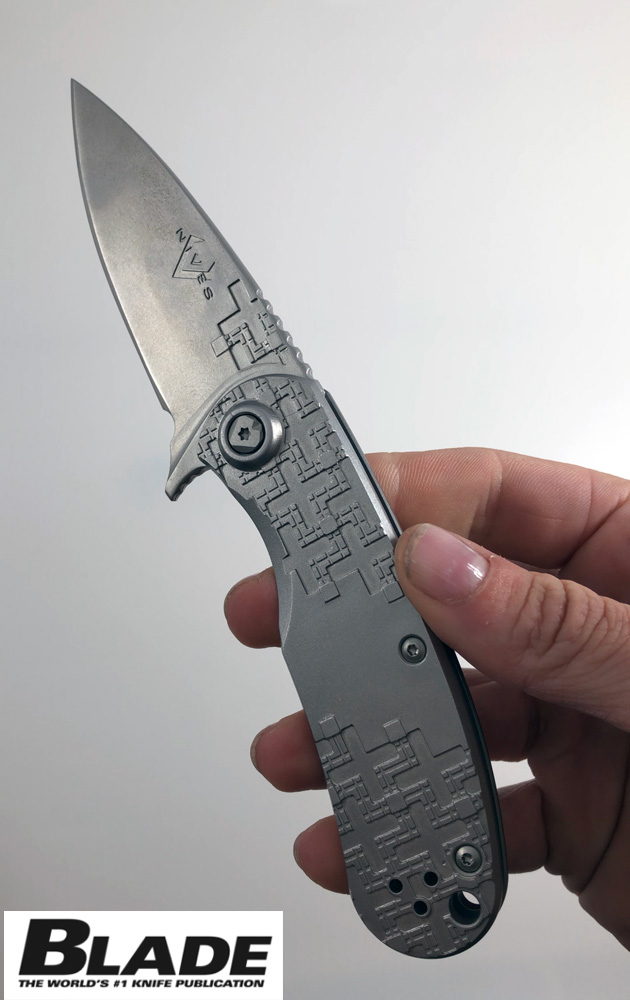
Monterey Bay Knives wharncliffe flipper folder, SharpByCoop Image
Custom Knife Award Winners
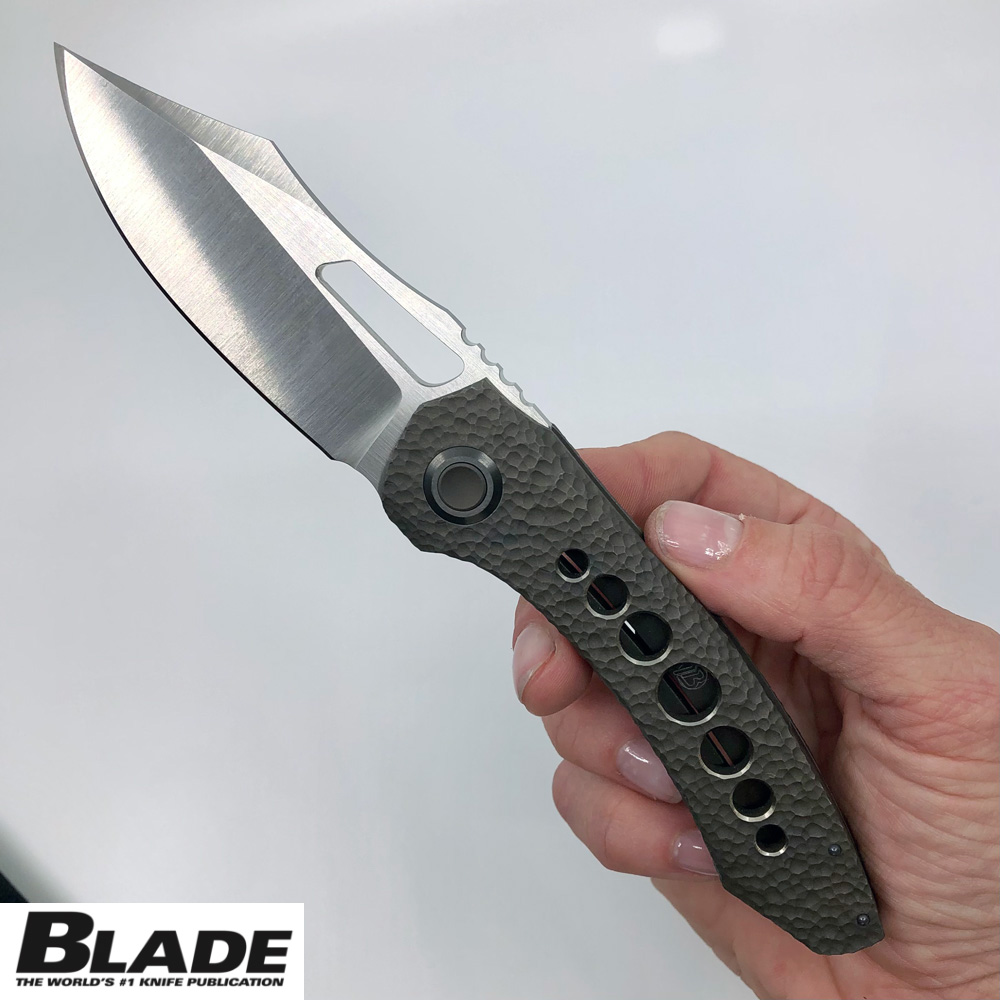
Best Folder and Best In Show
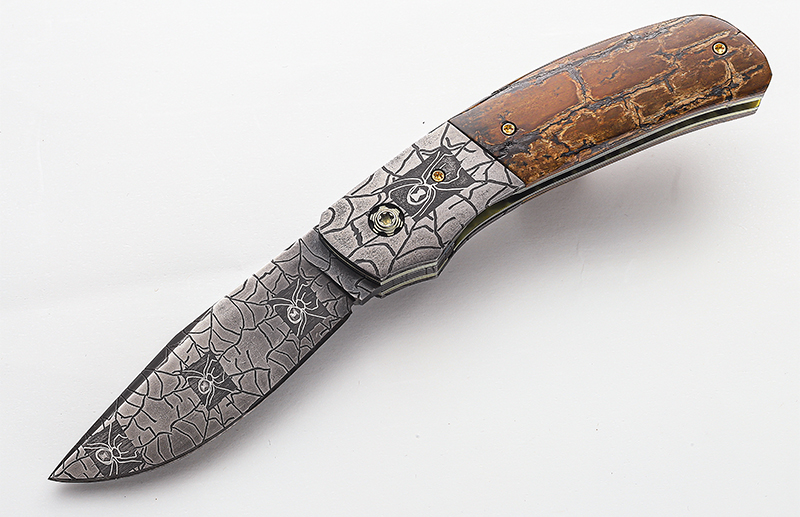
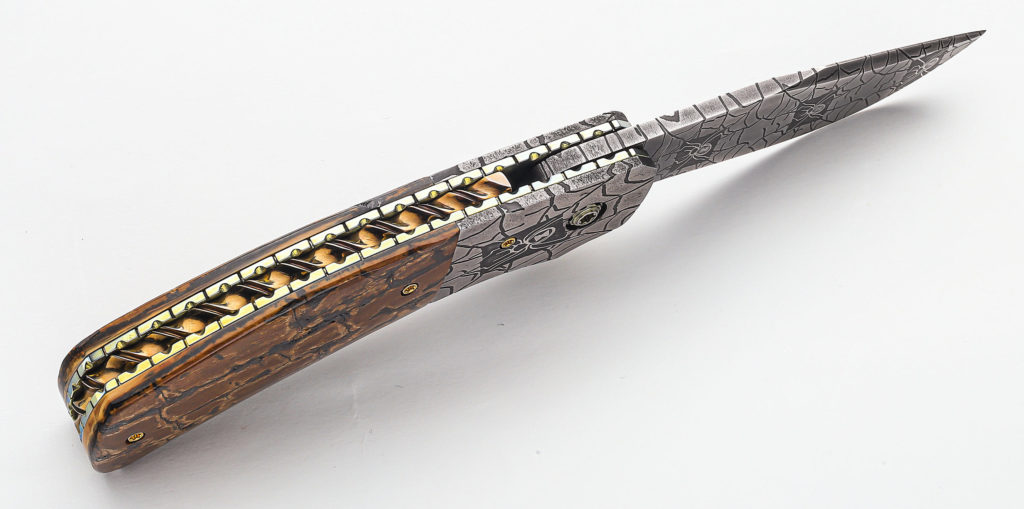
Mike Tyre mosaic damascus folder, SharpByCoop Image
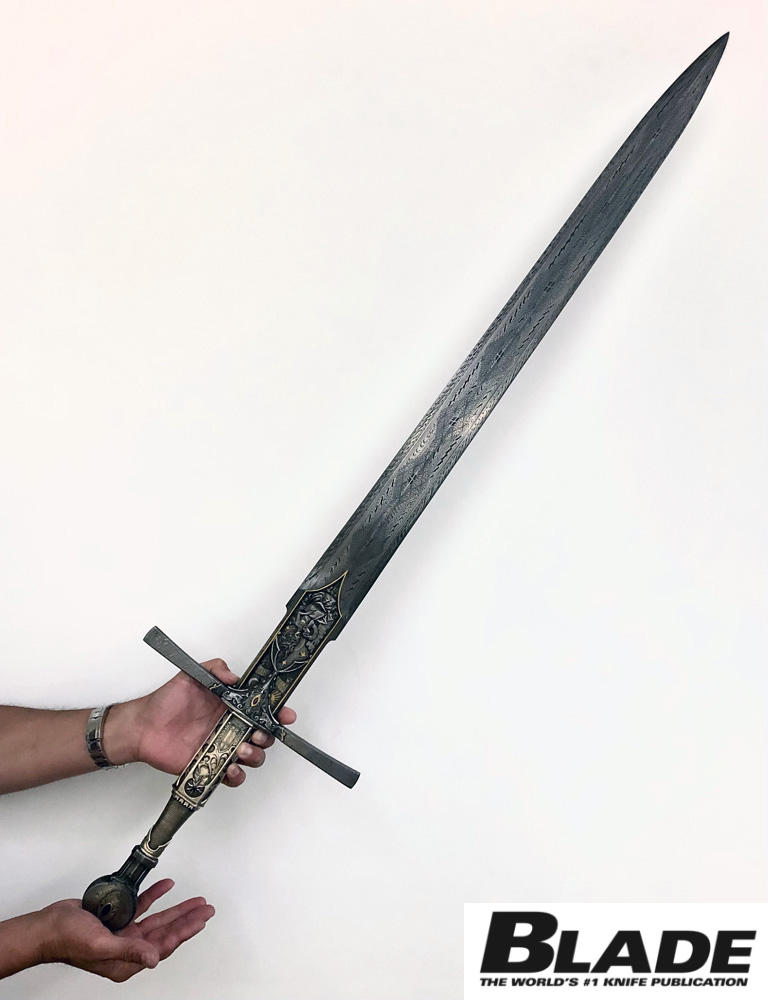
Best Damascus
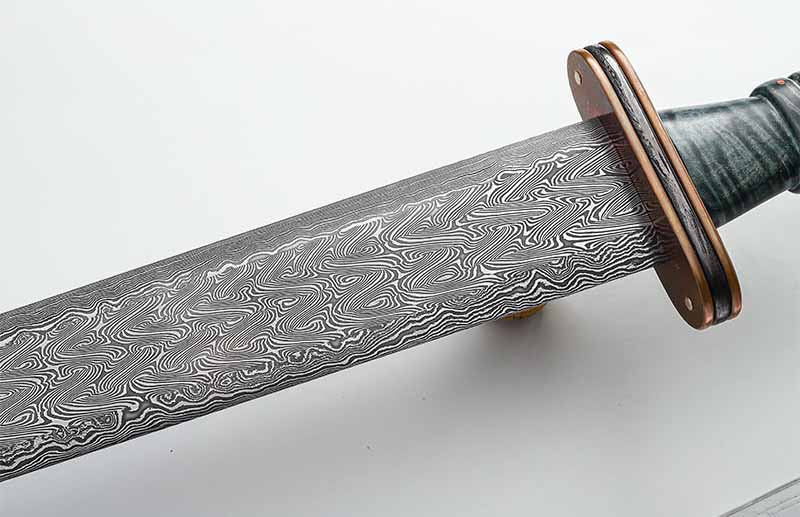
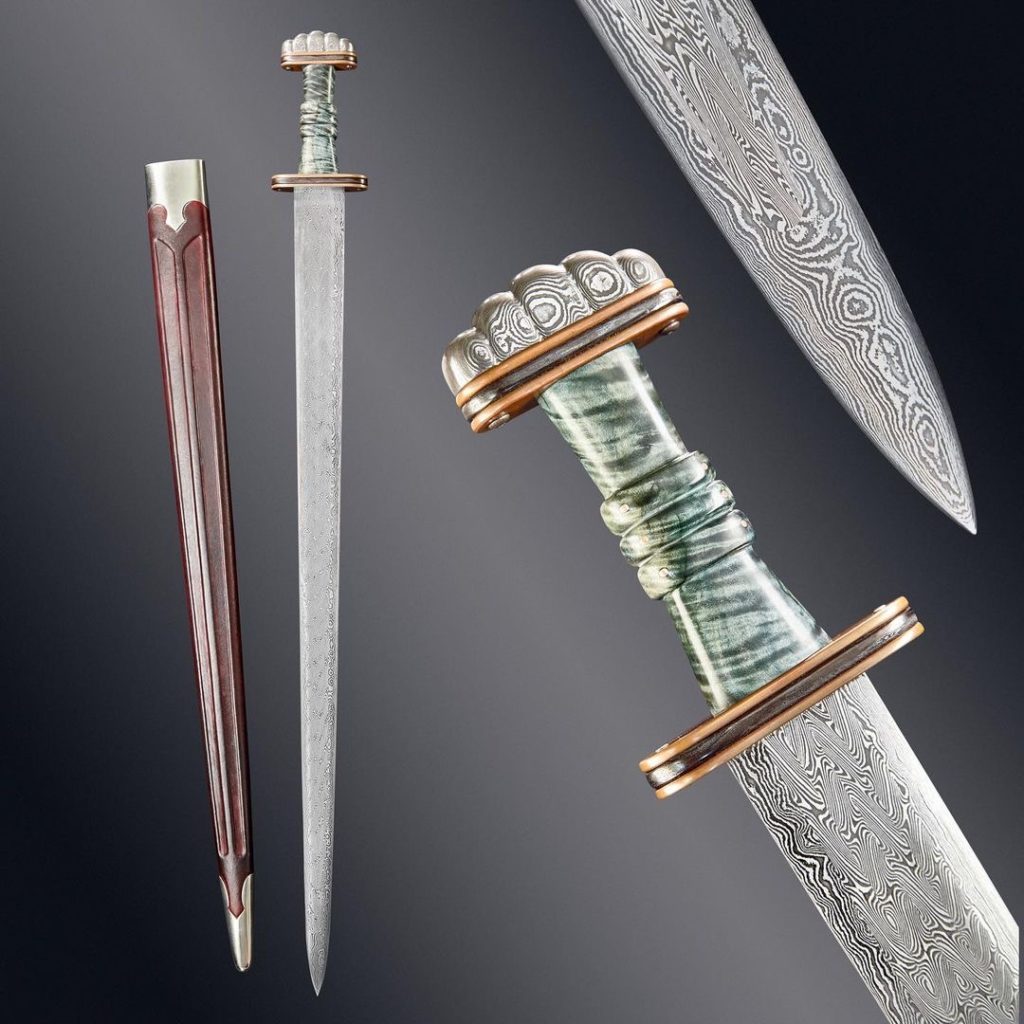
Mike Shindel Merovingian Sword in a 4-bar Turkish twist, and a random-pattern wrap-around edge of 1084 and 15N20 carbon and nickel-alloy steels, SharpByCoop Image
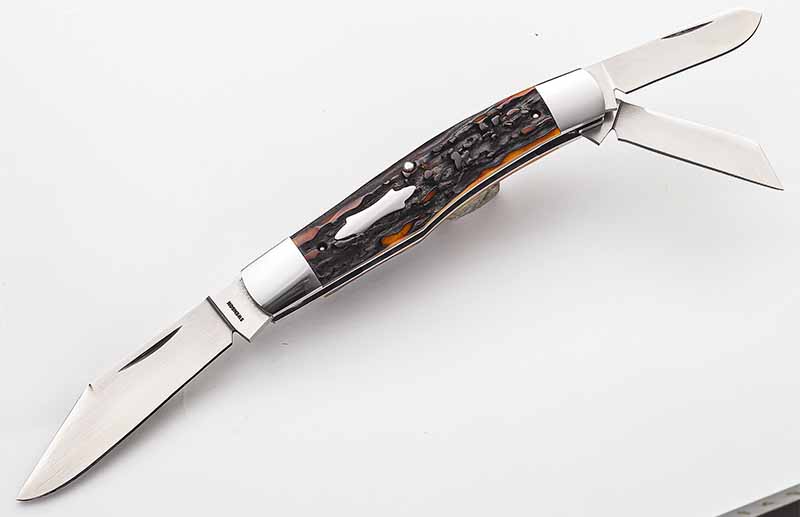
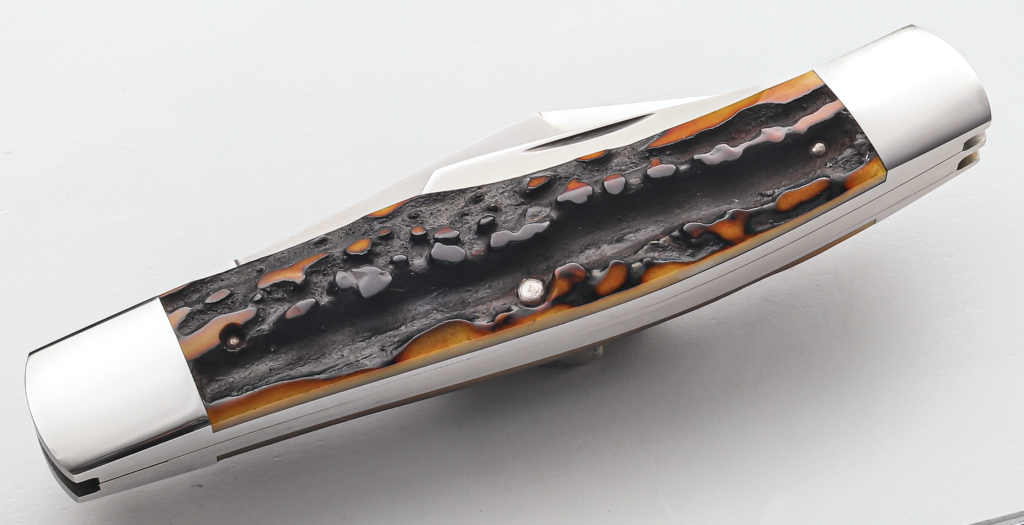
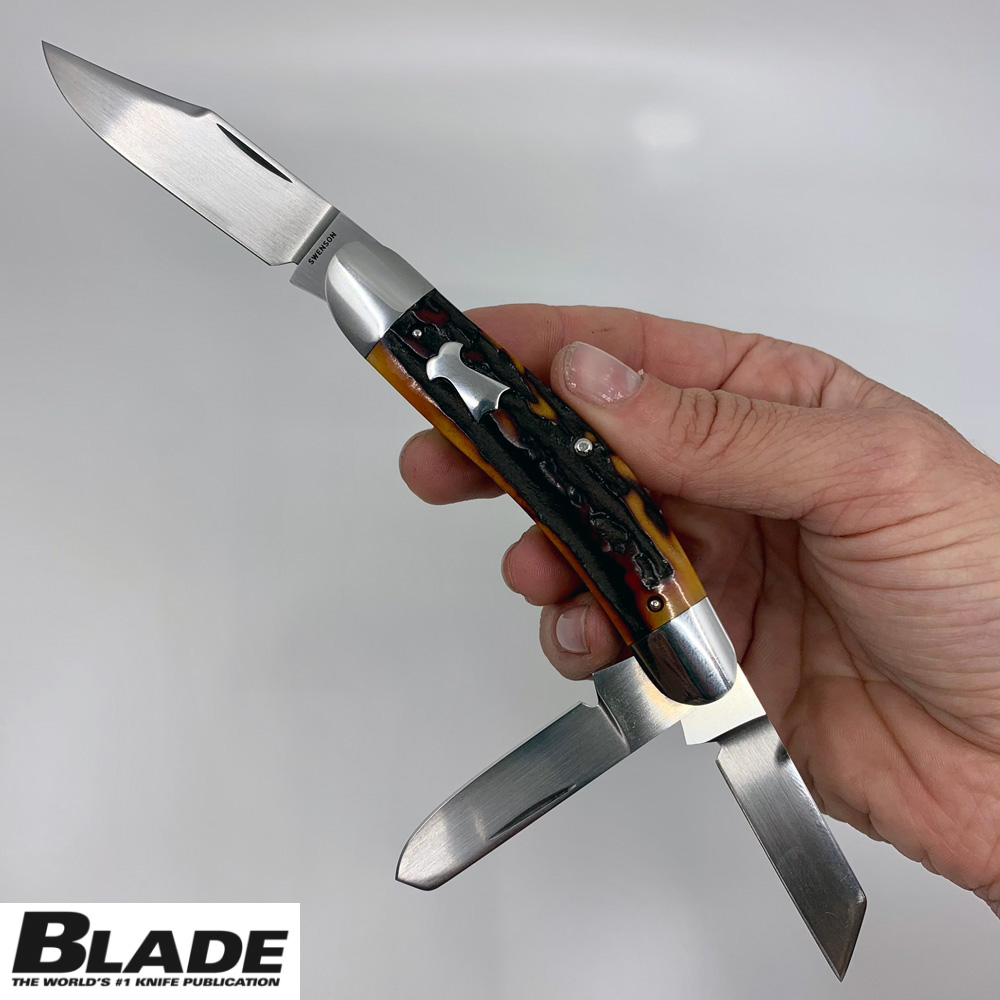
Best Slip Joint
Luke Swenson split-backspring whittler, SharpByCoop Image
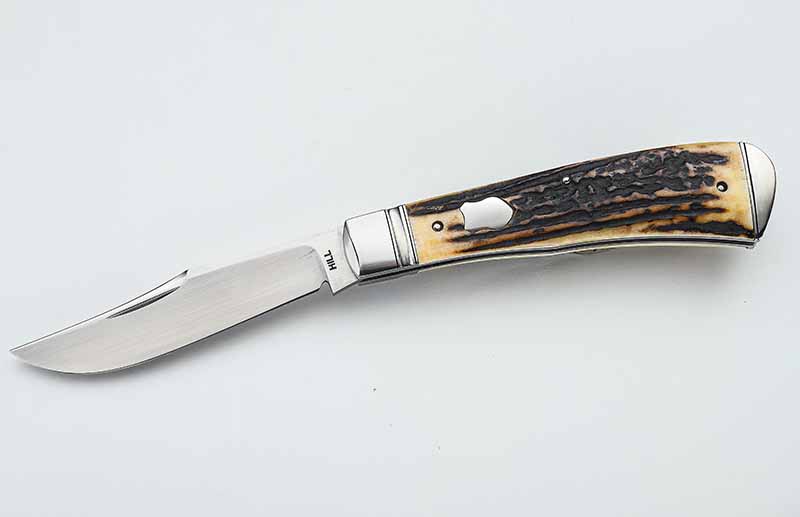
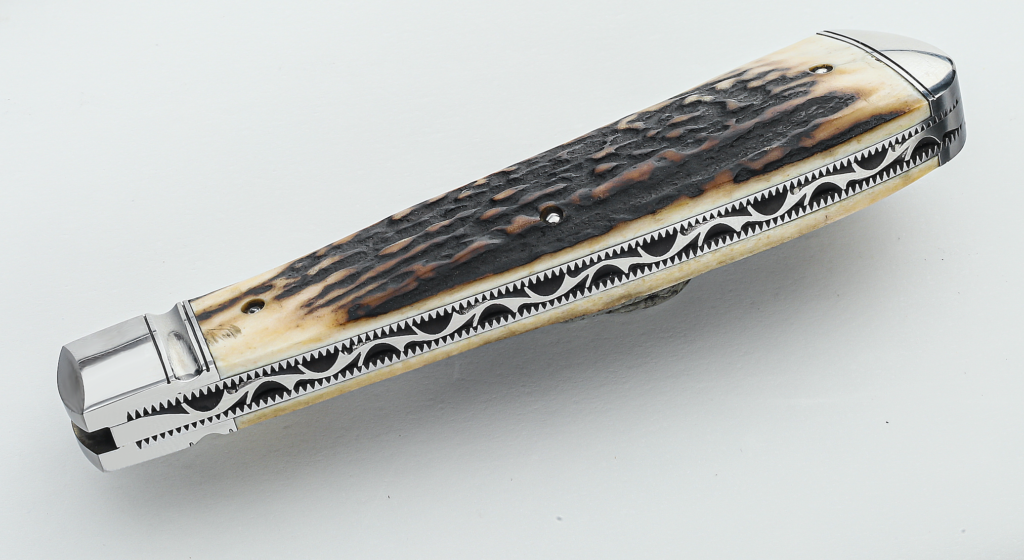
Best EDC
Tobin Hill one-blade trapper, SharpByCoop Image
Best Chef’s Knife
Nicholas Berkofsky/Fell Knives 7.5-inch Protein Petty, SharpByCoop Image
Best Hunter
Mike Shindel integral bolster hunter, SharpByCoop Image
Sometime in the early 1990s, a journalist—to the chagrin of the handful of other knifemakers also still working in Sheffield, England—described Stan Shaw as “The Last Little Mester,” and the title stuck until Stan’s passing in February. Stan made many fancy pocketknives but “Little Mester” was never simply a title that denoted mastership of a craft skill.
Historically, workers in the Sheffield cutlery industry were notoriously independent. As the industry moved from craft-based to industrialization, nearly all cutlers were on piece-work and would rent space in the workshop—a yard of bench or a “trough” for grinding. Work came from other workers, and each worker did a very specific task on the knife before it was passed to the next worker. The process was efficient because of the hyper-specialization of all of the workers in the chain. There was a complicated, ever-changing network of subcontracting, renting, supplying and rivalries, but no one learned all the processes to make a knife—there was no concept of sole-authorship.
In her thesis, Sally-Ann Taylor* states that the “differing opinions regarding the status of the little mester reflected the actual diversity in his possible position and role. Some felt that the title implied that his enterprise should involve him in a certain number of commercial risks and liabilities. Sometimes he was an actual workman himself, obtaining orders from larger factors, merchant or manufacturers, and then employing a few men to help him … sometimes even these workers would employ others beneath them, but usually only members of their own family—particularly women and children.” Hence, little mesters were small-scale flexible employers, recruiting workers to supplement their own labor as required.
In 1844, a commentator on the cutlery trades stated that “there are several modes of conducting the manufacture, but the factory system is not one of them … there is no large building, under a central authority, in which a piece of steel goes in one door and comes out at another converted into knives, scissors and razors. Nearly all the items of cutlery made at Sheffield travel about the town several times before they are finished.”**
HE KNEW at 14
Stan didn’t come from a cutlery background. He was born in 1926 in a small village outside Sheffield, and, after seeing a market stall of knives, decided at 14 that that was what he wanted to do. By chance, he walked into the prestigious company, Ibberson, and spoke to the owner, Billy Ibberson.
Pointing to a showcase displaying the firm’s best pocketknives, Stan said he’d like to learn how to make such knives. As Stan recalled, “Billy then fetched up one of the cutlers, Ted Osbourne—a little bloke about 5 feet or so tall—and asked, ‘Will you have him?” He said, ‘Yes.’ And I started on the Monday at an apprentice’s wage of 10 shillings a week.”
When Stan joined the firm, the old patterns of working had long gone; “little mesters” and “factors” had morphed into the more familiar patterns of factory working, with all the workers employed by the company and paid a wage. He was one of the last apprentices to be taken on and his curiosity about the entire process of making folding pocketknives was insatiable. As he moved through Ibberson and other companies over the years, he actively approached other workers to learn their processes as well as his own. It was this breadth of training that made him unique and was vital to him in later life.
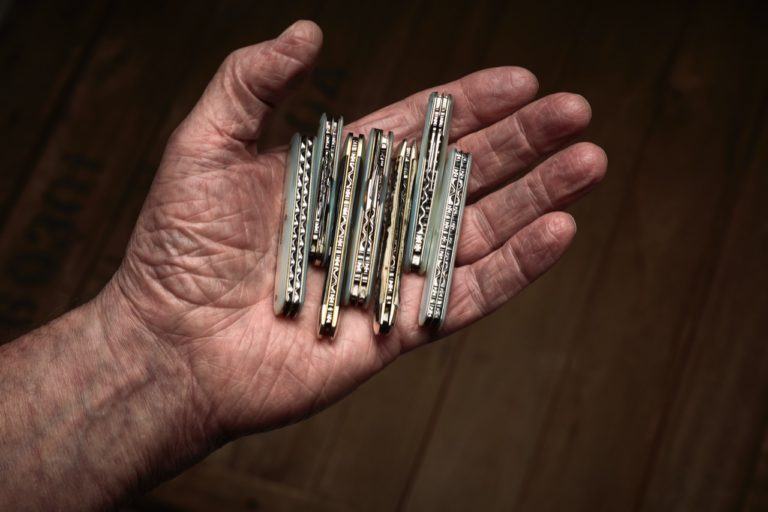
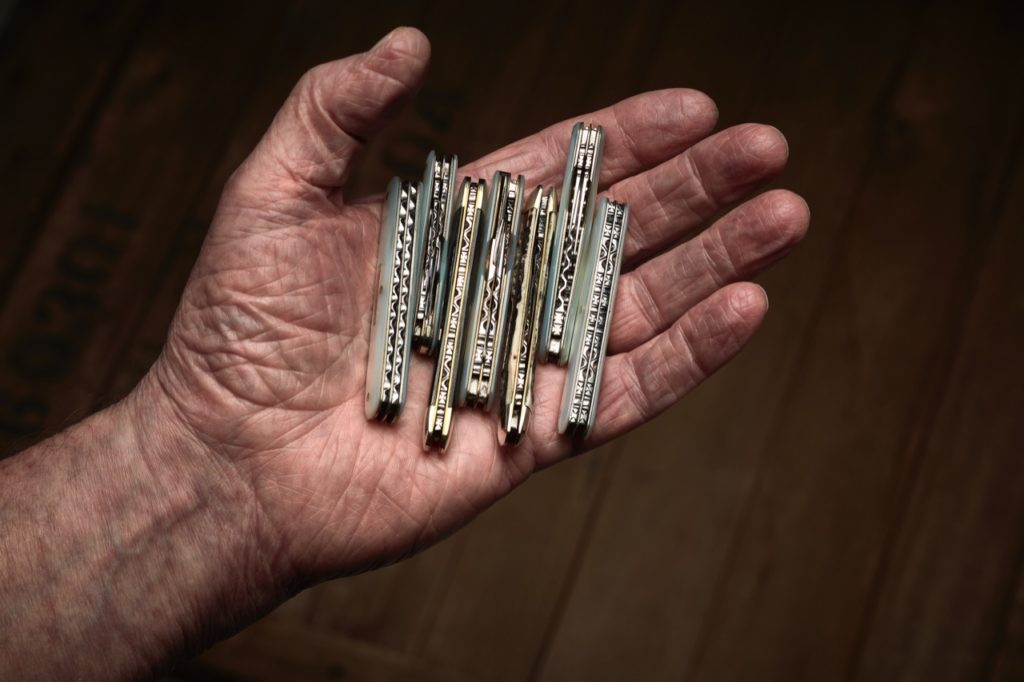
A sampling of Stan Shaw’s pocketknives with richly fileworked blade spines and backsprings. Look close and you can see the Maltese crosses for which Stan was so well known. (image by Carl Whitham, Sheffield)
THEIR PATHS CROSS
By the beginning of the 1980s, the contraction of the Sheffield cutlery industry was such that there were no more companies left to employ him, so he set-up his own workshop in Garden Street. It was there, 10 years later, that our paths crossed.
I had made a set of three folding knives for a college project and hadn’t been able to find anyone still making traditional Sheffield slip joints to ask for advice. A couple of years later, I heard Stan being interviewed on the radio and realized that I still desperately wanted to learn to make knives. I packed up my workshop in London and moved to Sheffield to persuade him, in person, to take me on as his apprentice. He welcomed me into his workshop but said that he was nearly 70 and too old for an apprentice. Instead, he offered me his bucket of old, handforged blades and springs, told me to select a handful and “go and figure it out yourself because it’s not that hard.” He would always be there to help if I got stuck.
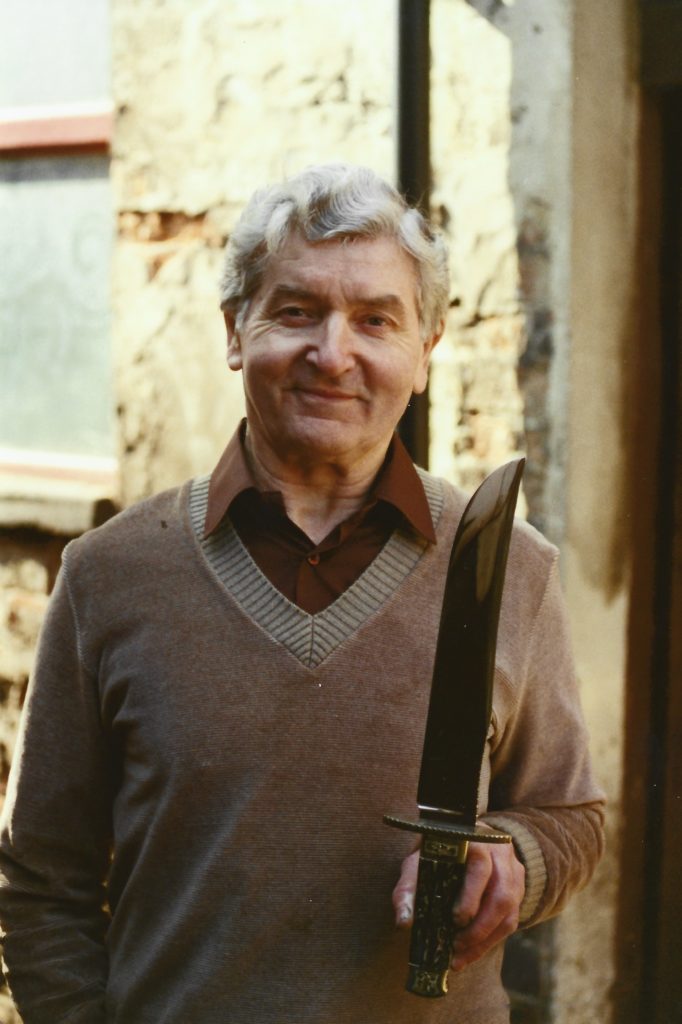
Stan Shaw as he appeared in the early 1990s. (Geoffrey Tweedale image)
A few years ago, when I was gently teasing him about still having a 10-year waiting list for his knives, he said, “I should have taken you on then, lass, you’d just about be useful to me now!” So, for all the times our paths crossed, for all the gentle encouragement and for completely changing my life’s path when I was 23 years old, thank you, Stan.
Stan was not a “little mester.” He was a master and was proud that he could make his knives from start to finish, a concept that would be completely alien to Sheffield knifemakers a hundred years ago.
Stan Shaw, whose career of making classic pocketknives spanned almost 80 years, passed in late February at the age of 94.
He started work for W.G. Ibberson in Sheffield, the old knifemaking capital of England, in 1941. Apprenticed to Fred and Ted Osborne, men Stan described as the two best cutlers in Sheffield, he eventually succeeded them in 1954 as the company’s top maker of pocketknives. Though the Sheffield knife industry was in rapid decline, he continued making knives, renting an old workshop in 1983 and becoming an independent cutler.
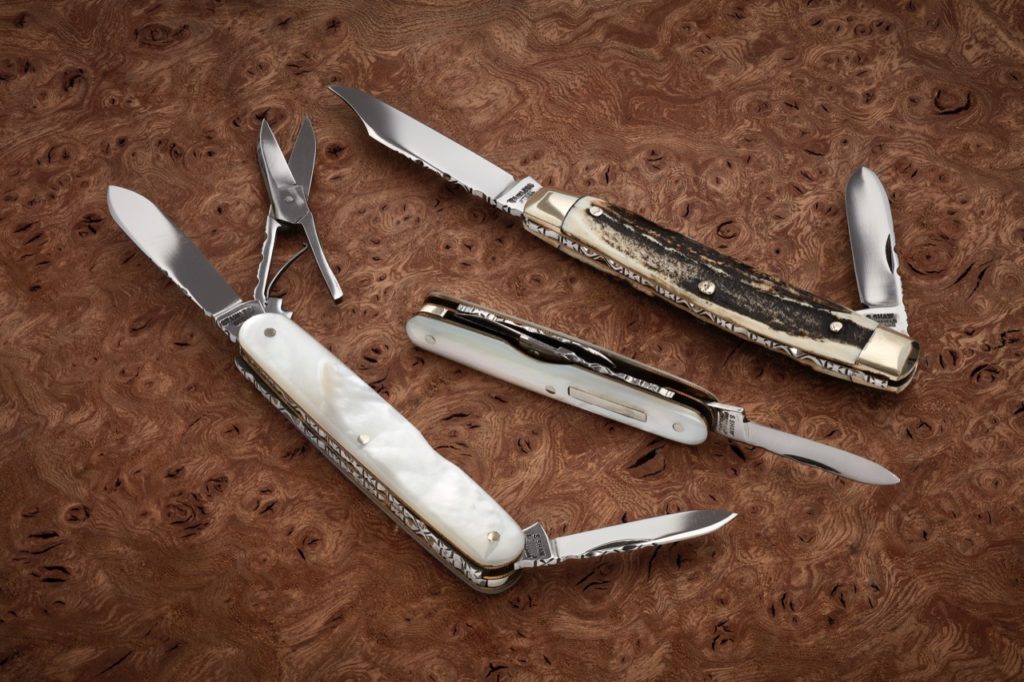
As Stan moved through Ibberson and other companies over the years, he actively approached other workers to learn their processes as well as his own. It was this breadth of training that made him unique and was vital to him in later life. (image by Carl Whitham, Sheffield)
As an independent he did it all in the making of his pocketknives, and he did it all quite well. As he said in “Stan Shaw: Little Mester of Sheffield” in the May 1994 BLADE: “I have to do everything now because there are no forgers, grinders, scissor-makers and so on left. My earlier experience with Ibberson’s has proved invaluable in that respect. All my knives are hafted, ground and assembled by me. It’s harder work but the satisfaction is greater. Scissors, files, punches, shields, shackles, handles, scales, bolsters—the list is endless—but each part is made by me on these wheels and dollies with only hacksaws, files and a few other traditional tools, such as my parser. The only job I don’t do is the occasional engraving I have done on the bolsters.”
His knives are testaments to the classic exhibition pieces, many with a host of blades and other tools and implements. In 2003 he became an honorary freeman of the Company Cutlers and in 2017 was awarded the British Empire Medal. As late as 2019, into his 90s, he continued to clock in bright and early in the mornings to make pocketknives at Kelham Island Museum. In the interim he served as a mentor to many makers, including award-winner Grace Horne, among others.—by BLADE® staff
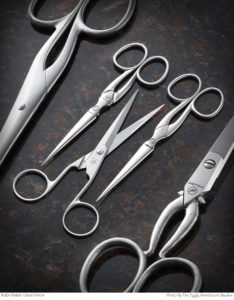
In addition to pocketknives, the author is also well known for her award-winning custom scissors made in the original knifemaking center of the United Kingdom—Sheffield, England. (Eric Eggly/PointSeven image)
The Author, Grace Horne
Editor’s note: An award-winning knifemaker from Sheffield, England, the author currently makes traditional folders. For more information contact her at Dept. BL9, The Old Public Convenience, 469 Fulwood Rd., Sheffield, United Kingdom, S10 30A [email protected], gracehorn.co.uk. Also: Steven and Kylie Cocker, Instagram @steven_cocker_sheffield; Michael May www.michaelmayknives.com; and/or Michael and Ashley Harrison plus apprentice at A Wrights & Sons www.penknives-and-scissors.co.uk.
*Tradition and Change: The Sheffield Cutlery Trades 1870-1914; Sally-Ann Taylor
**The Penny Magazine Supplement, April 1844, p.168; Thomas Allen
Are you up to the challenge of frame handle construction?
Frame handle construction for knives has been around for centuries. Historical examples of many Eastern styles like the kard, khyber and yataghan often feature ornamented frame handles. Nineteenth-century knives attributed to James Black and some of the early American bowies also had frame handle construction. Though it’s been around a long time, the frame handle remains a viable modern construction method for today’s custom knifemakers.
There are many ways to crack the nut/skin the cat on frame handle construction. This article will walk through the frame handle process and point out particular problems and potential solutions for those who wish to pursue building a frame handled knife.
3 REASONS WHY
Frame handle construction is best defined as using a wrap-around “frame” to conceal the tang of a hidden tang knife. The first question many people ask regarding a frame handle construction is, “Why would you want to do it that way?”
My first thought goes back to the earlier days of the internet when forums were at their peak, and fine makers like ABS master smith Bruce Bump took the time to document “work in progress” (WIP) threads. Bruce had a fine frame handle WIP on the KnifeDogs.com forum in 2013, and the consensus at the time was that you build a frame handle for quite a few reasons, though the first one is “because you can!”
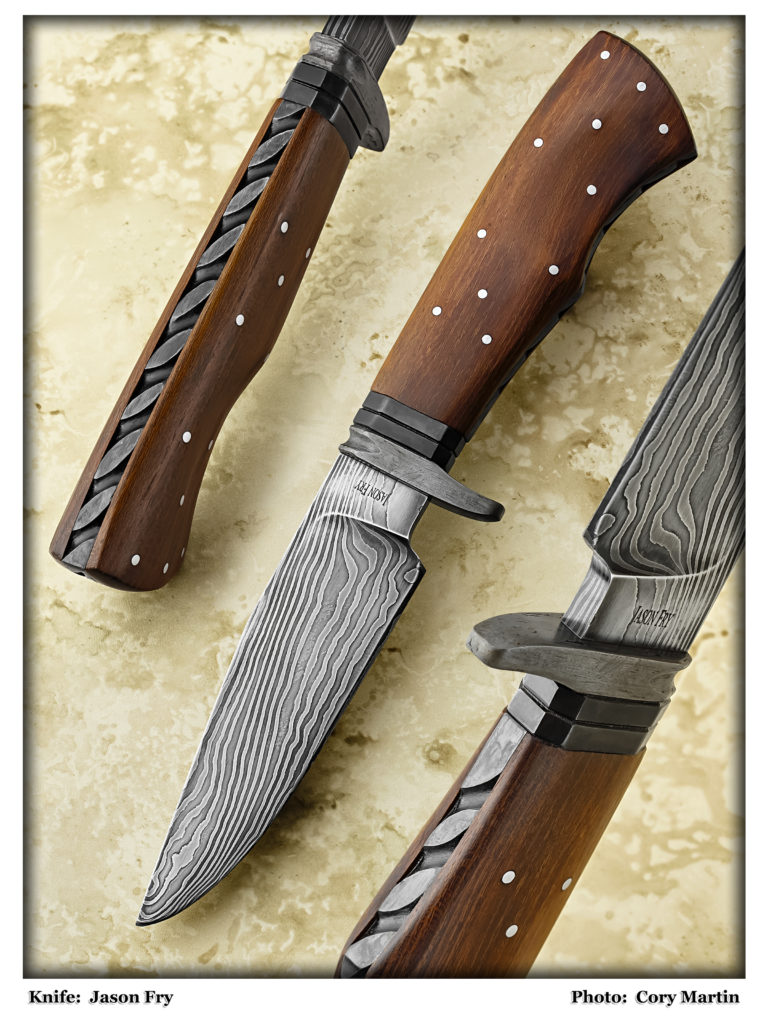
The author used frame handle construction for his hunter in a blade of 33-layer damascus, a wrought iron guard and scales taken from a fence post made in 1912 from bois d’arc wood, aka osage orange. The spacers are World War II practice bomb material. (Cory Martin knife image)
A frame handle is a much more complex build process than your standard full- or stick-tang knife. However, in addition to the show of skill by the maker, frame handle construction has a few distinct advantages that make the complexity worth the effort:
A frame handle allows for the look of a full tang, but with the guard-fitting techniques of a stick tang. For a forged stick-tang-knife design that needs a guard, a frame handle allows the use of full-tang-style handle construction;
A frame handle is a good way to use scales or slabs on a stick-tang knife. If you have a good set of stag or mammoth slabs, or if you have stabilized wood slabs that might be too fragile for through-tang construction, the frame handle allows you to use the materials on a stick-tang knife; and;
The use of a frame handle gives the maker another area to embellish the knife. Some frames are great for engraving, while others may highlight a damascus pattern. Either way, the frame makes the embellishment stand out in ways that are harder to accomplish on a full-tang knife.
HOW to DO IT
At a basic level, the frame of a frame handle is a piece of material, usually metal, that wraps around a stick tang and mimics the look of a full-tang knife. This presents some challenges that have resulted in a few different creative solutions.
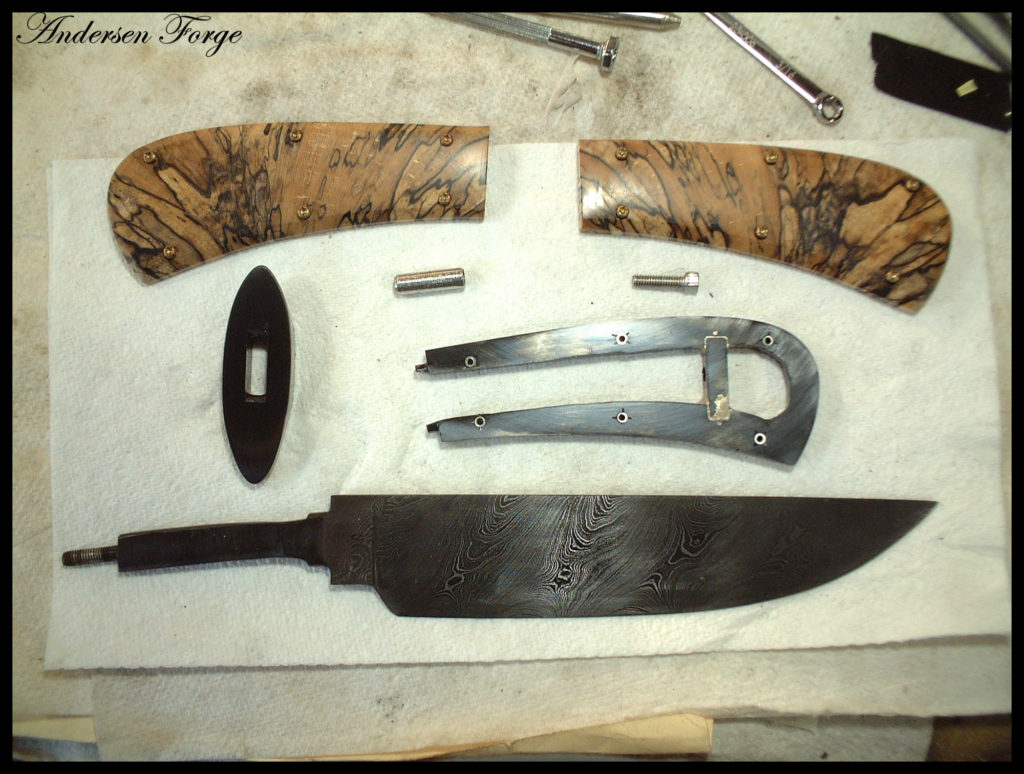
An exploded view shows an ABS journeyman smith Karl Andersen frame handle construction knife before assembly. (Karl Andersen image)
Challenge 1: The tang must fit inside the frame. Some makers insist on precision so there are no gaps and the fit is tight. Others concede that the handle will be held together with mechanical fasteners and sealed with epoxy, so a precise fit between the frame and the tang is not necessary.
Challenge 2: All parts of the handle must be securely fastened together. I sat through a class with ABS master smith Mike Williams in which he admonished the students, “Don’t trust in the magic of chemistry” by putting your faith only in the strength of glue. Likewise, veteran bladesmith Jerry Fisk challenges makers to think ahead to what their knives might be like in 100 or 1,000 years, and recommends a mechanical connection that won’t fail over time.
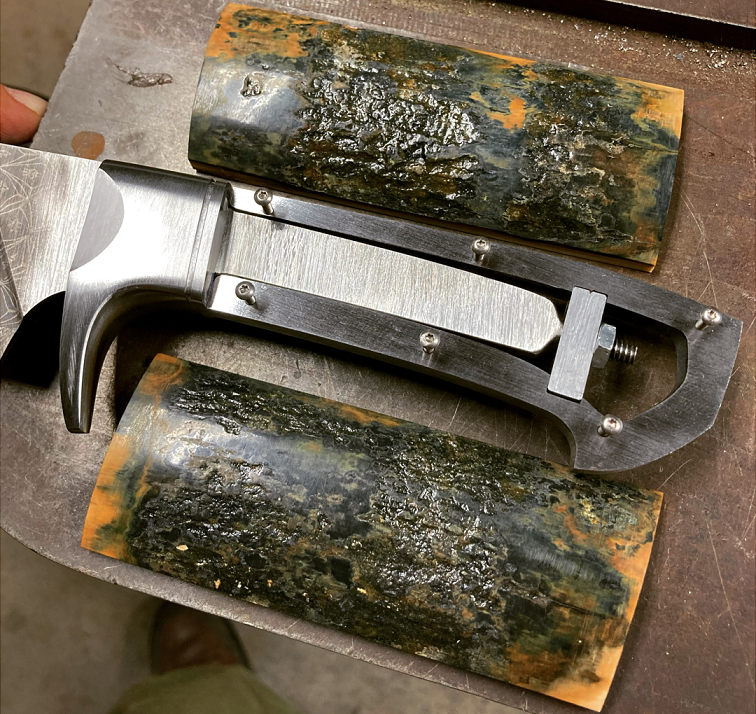
One way to address this challenge is to use pins. If you pin the scales to the frame, pin the completed handle assembly to the tang and follow up with glue, there’s no opportunity for failure. Some choose to make all the pins visible as an artistic element, while others take advantage of hidden pins for all but the one through the tang. Another way is to use a threaded fastener. Bladesmith Salem Straub recently illustrated the technique on a frame handle WIP on his Instagram feed. Salem used a threaded fastener in an internal slot in the frame to mechanically lock all the parts together tightly (Image 1). The handle material is relieved on the inside to accommodate the fastener.
Another way to use a threaded connection is to thread the end of the tang and use a fastener on the handle butt. An advantage of this approach is that the fastener itself can become part of the embellishment.
Challenge 3 is the complex fit-up between all of the knife’s elements. Frame handle construction naturally doesn’t excuse a poor guard fit, but it also provides other places for gaps and misalignment. Once again, there are several potential solutions to alignment problems.
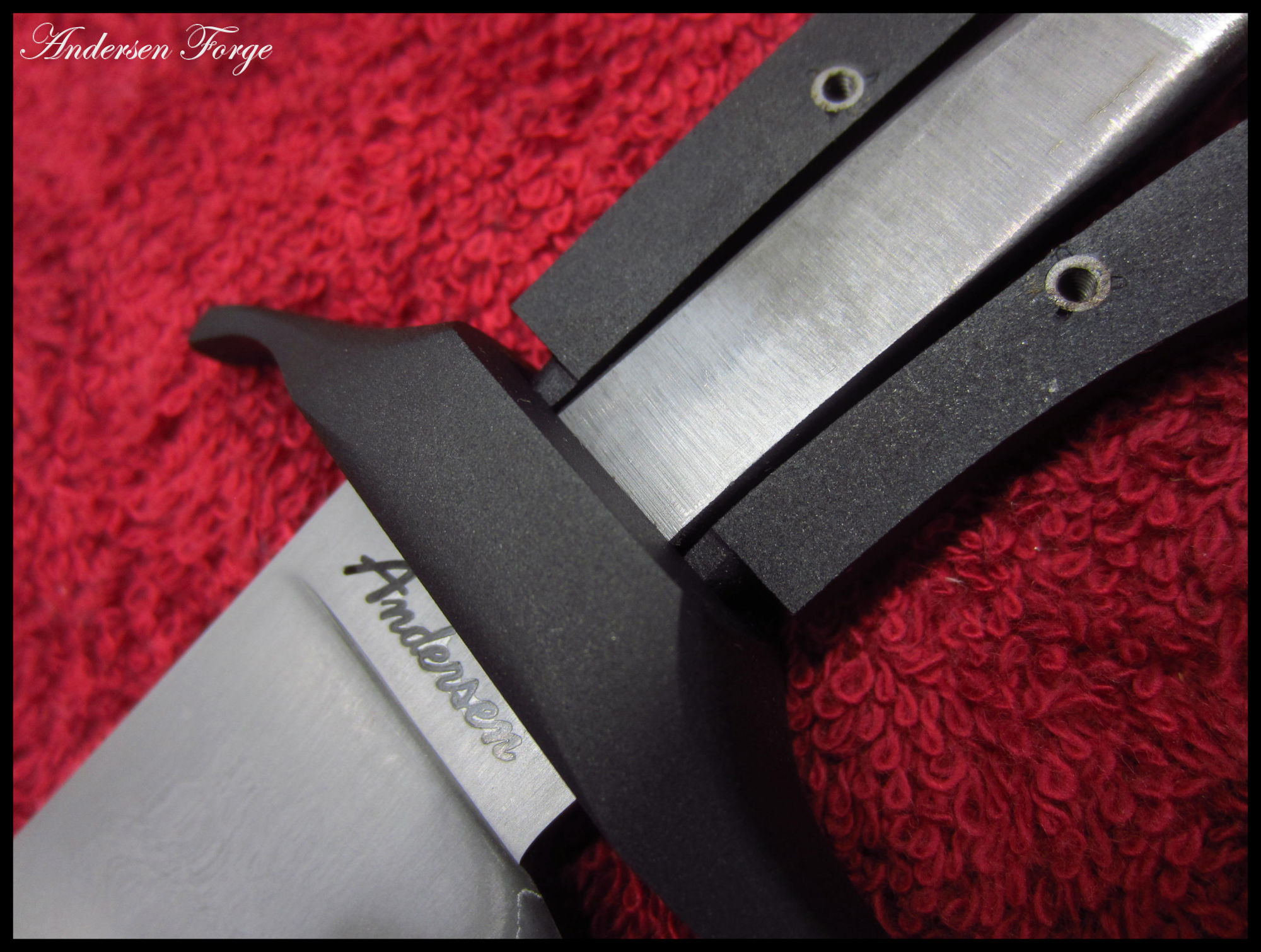
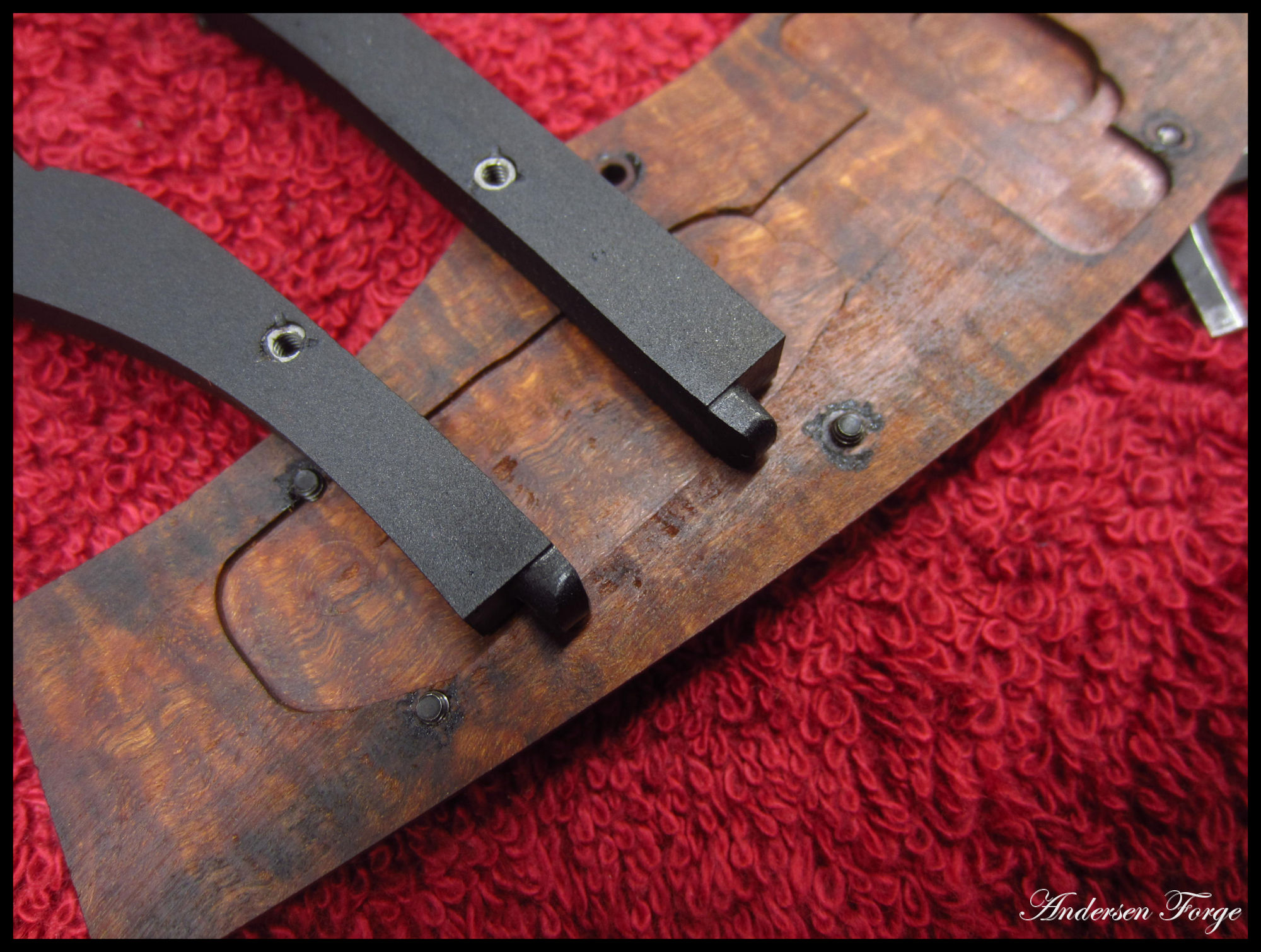
One is the use of alignment pins to make sure everything is secure. Pins on the end of the frame go through any spacers and into holes in the back of the guard so that each part indexes the same during assembly. Some makers, including Bruce Bump in the aforementioned epic WIP, advocate for leaving metal tabs on the end of the frame and fitting the tabs into similar holes on the back of the guard (Images 2 and 3). In both cases, there’s a mechanical connection that prevents the guard, spacers and frame from rotating out of alignment around the center axis of the handle. Either way, when you build a frame handle, the construction will require you to assemble and disassemble the knife repeatedly, so you’ll need some mechanical way to keep things lined up.
1 of 2
Above: Some makers advocate for leaving metal tabs on the end of the frame and fitting the tabs into similar holes on the back of the guard. In both cases, there’s a mechanical connection that prevents the guard, spacers and frame from rotating out of alignment around the center axis of the handle. (Karl Andersen images)
Another fit-up challenge is the overall requirement for clean-fitting joints with no gaps. It sounds simpler than it is, but two surfaces that are dead flat will join together without a gap. The challenge of a multi-piece frame handle with a guard and a few spacers is that you are creating a multitude of surface joints, and every single surface must be dead flat. At a minimum, you’ll have a joint between the guard and frame, and also between the frame sides and the handle material. Any bump or wiggle on any surface and you’ll have a gap in the final product. Flatness comes in degrees. You can get a fairly flat surface on a platen, flatter on a disk, and still flatter on a surface plate or surface grinder. You have to make the joints as flat as you can with the tools you have available if you want a gap-free fit.
I tend to prefer the look of a tapered tang on a full-tang knife, so I’ve started tapering the frame of my frame handles as well. Others stick with a full thickness frame, where the thickness closely matches that of the blade at the ricasso. Some add spacers between the tang and handle material, while others choose to go with the frame and handle slabs only.
Another fit challenge is presented by the frame itself. In order to adequately finish the visible surface of the frame, whether by simple polishing, bluing or etching, or by engraving, the frame must be 100 percent at final-grit finish prior to final glue up. Many makers learned to make a full-tang knife by finishing the front edge of the scales, gluing the knife together, shaping the scales down to the exposed tang, and then polishing the handle and the tang at the same time. That method will not work for a frame handle that needs to be blued or etched. Personally, I tend to use dummy pins to fit the entire handle assembly together, then grind the scales down to the frame. In his recent Instagram example, Salem Straub used small screws to hold the handle material to the frame.
With regard to the relationship between the handle material and the frame itself, whichever method you choose, it is important that the fit be maintained consistently all the way around the frame. (Jason Fry image)
With regard to the relationship between the handle material and the frame itself, some choose to leave the material slightly proud of the frame for a “museum” or “heirloom” fit. Others prefer the material to fit flush to the tang. Less commonly, some makers round the frame and leave it slightly proud of the material. Whichever you choose, it is important that the fit be maintained consistently all the way around the frame, from the joint at the guard on the top all the way down to the joint at the guard on the bottom.
Once the profile is set, I polish the handle and the frame together down to final grit, and then apply any surface finish to the frame itself. Once all parts are 100 percent complete, they can be glued together as a final step.
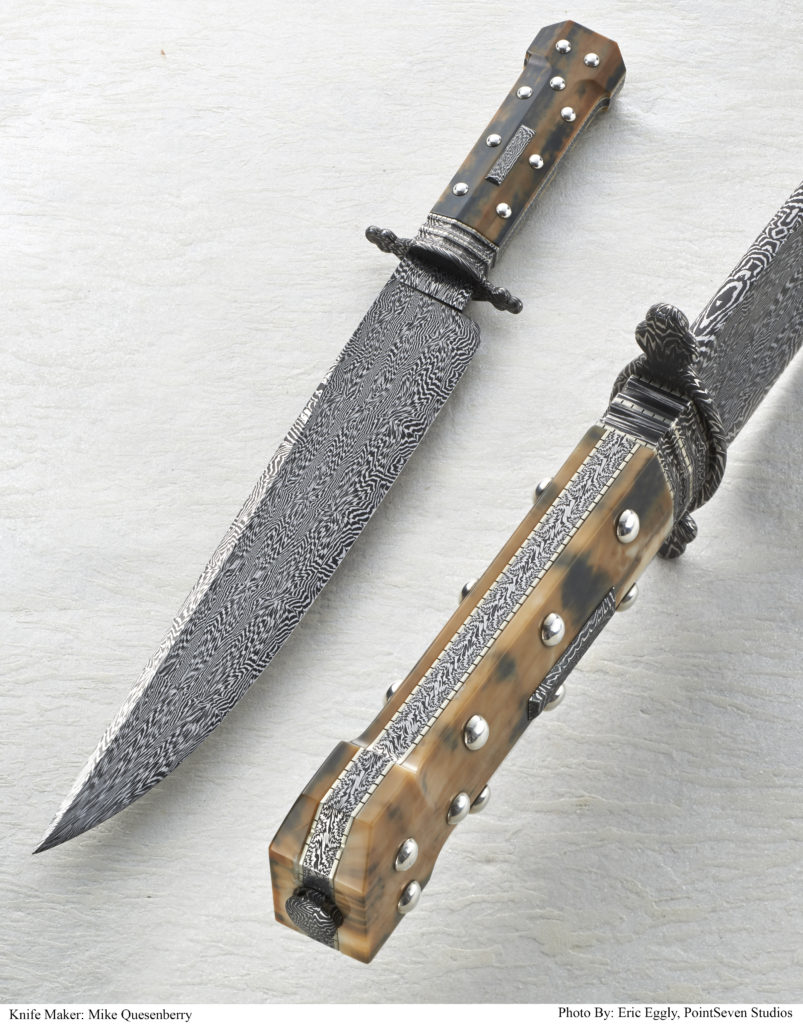
ABS master smith Mike Quesenberry used frame-handle construction on his dog-bone bowie. (Eric Eggly/PointSeven image)
WHEN to DO it
So when should you try making a frame handle? In my mind, if you can make clean full- and stick-tang knives, you could be up to the challenge. If you have slabs of exceptional handle material that deserve more than a simple full-tang knife, a frame handle is a way to step up and put the materials on full display. If you have a knife in mind where the frame and guard need to be blued, damascus or engraved, a frame handle is the way to go.
A frame handle knife has its advantages, but the complexity of the construction presents plenty of challenges. As a skilled maker, you may choose to rise to the challenge of a frame handle just to show that you can.
For more information on frame handle construction contact the author at [email protected].
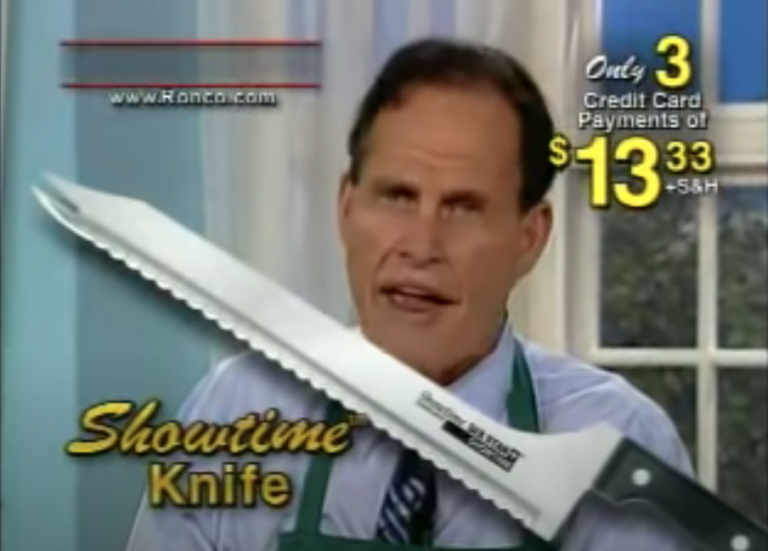
Ron Popeil, best known as a TV infomercial pitchman, passed away on July 28, 2021, at the age of 86, according to multiple news media outlets.
The company Popeil founded, Ronco, is synonymous with as-seen-on-TV products, and the “set it and forget it” and “but wait, there’s more” catchphrases. While he wasn’t the first to apply salesmanship to the screen, Popeil did popularize the personality behind the product.
Popeil’s Showtime knife set is a perfect example. Well into his career as a “name” on TV, Popeil brought on his family to pitch his blades:
While Popeil’s contributions to all things sharp didn’t bring him to BLADE Show, there’s no doubt that his ubiquitous media presence influenced the consumer knife market and countless imitators.
There’s never a bad time for outside fun, but the COVID era provided a serious force multiplier for fresh air. For instance, golf surged in popularity in the United States since the start of the pandemic, adding 500,000 new sand trap junkies to the sport.
From the perspective of the knife world, that begs a question: what blade is in your pocket when you’re working on that birdie?
Enter Golphers, a company turning out everyday carry (EDC) knives worthy of a PGA tour.
EDC Knives for Golfers
It was nearly guaranteed that the push in recent years toward urban EDCs—high-performance folders that don’t raise eyebrows—would yield knives tailored to sports and hobbies. Golphers got out ahead of the curve with its catalog of blades purpose-built for the putting green.
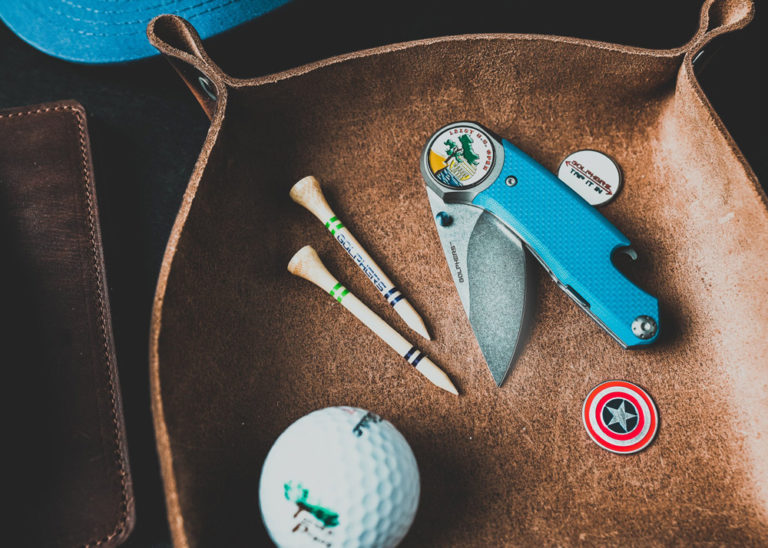
In addition to being tidy EDC designs, the three knives that make up the core of Golphers—the Ace, the Scottsdale and the Wichita—feature a bottle opener, a fold-out divot tool and a detachable ball marker.
How Not to Lose Your Ball Marker while Golfing
The detachable ball markers can be customized. This excellent feature makes it harder to lose these small discs.
The built-in marker is a stroke of genius I didn’t fully appreciate until talking with a few golf enthusiasts. These small discs constantly get lost or misplaced through nine or 18 holes.
Attaching the marker to something with presence clipped into a pocket, like one of these Golphers knives, solves that problem with style.
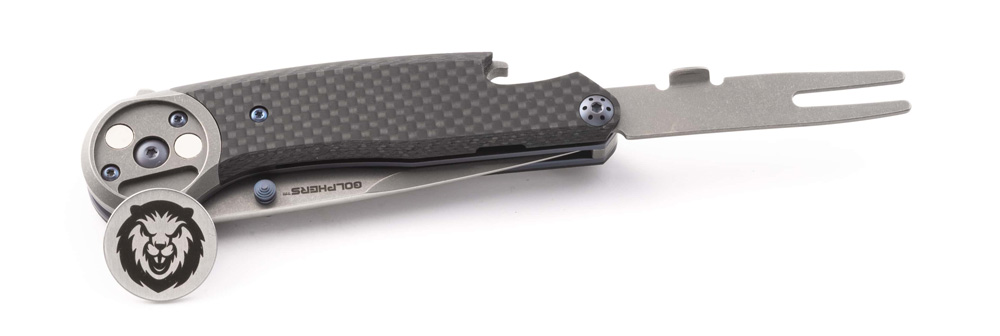
The fold-out divot tool on the trio of Golpher knives is the icing on the cake.
The Ace, Scottsdale and Wichita come with fold-out divot tools, the lemonade to the iced tea of these knives. Some designs are smarter by half when it comes to multitools, but this addition is entirely necessary and baked in seamlessly between the frame and the handle scale.
A person could start to feel spoiled by the time and attention spent on these designs. But how do they actually perform?
How Do They Perform? The Ace
The Ace is the largest of the trio, sporting a three-inch blade and 7.5-inch OAL.
Golphers sent in three knives for this review. I’ll tackle each one at a time.
The Ace is an Eric Ochs-designed flipper with a three-inch S35VN blade, available with a variety of handle materials. I received the blue carbon fiber version, much to my enjoyment. The Ace includes a bottle opener, ball marker and divot tool.
Three-inch blades are the right size for EDC, and this flipper snaps into place with a crisp “click.” It’s infinitely fidget-able (not a technical term, but close enough), which isn’t to be discounted while waiting for the duffers up ahead to finish.
When I showed off the knife, the divot tool always surprised and delighted. It waits inside the Ace for a sneak attack. It’s a simple thing, sure, but this divot tool could’ve easily been bungled in the design. Simple is hard to do.
The Ace works well as an EDC even if you never touch the golf-centric features.
Honestly, the Ace would be a respectable EDC on or off the course. I’d be happy to include this in my regular rotation.
That said, I wish the design allowed my index finger to choke up on the blade a bit more. I’m missing a little jimping, too. That’s my personal preference, though, and certainly not a knock on the knife itself.
Along the same lines, a three-inch blade may be overkill for the golf course. This feels to me more like a knife that plays to the culture of golf, like a T-shirt with a logo on it, than something to be used for its stated purpose.
Again, that’s a personal preference. If three inches is your style, you won’t be disappointed with the Ace.
If not, Golphers still has you covered.
The Scottsdale
The Scottsdale was this reviewer’s favorite of the three knives, but that comes down to personal preference.
The Scottsdale is the 2.5-inch blade version of the Ace. It sports the same golf-friendly features, but in a more compact package. For me, this is the sweet spot, and it made the Scottsdale my favorite of the three.
Golphers wisely went with framelocks on each of their knives, and the Scottsdale I received made it clear why that’s the right choice. The blade locked up nicely each time, maintaining its sturdiness for each task I put it through.
The detent arrived hard out of the box, too, which is always a plus for staying secure in the pocket.
Other than the blade length, the key difference between the Ace and the Scottsdale is the flipper tab. The Ace has it, while the Scottsdale doesn’t. This isn’t necessarily good or bad. It’s a preference thing, and it’s worth keeping in mind in case thumb studs alone won’t do.
And if you don’t want thumb studs at all, Golphers didn’t stop at the Scottsdale.
The Wichita
The Wichita wouldn’t look out of place at the Masters. This is what the urban EDC category is all about.
Like the Scottsdale, the Wichita also wields a 2.5-inch blade. However, the belly on the Wichita’s blade is a bit beefier, and a thumb hole is in place of the studs.
Golphers calls the Wichita the “holy grail” of its knives, and it’s hard to disagree. The Wichita is the most classed up of the trio, ready for an experienced caddy to open with two gloved hands. Of course, the Wichita can be opened with one hand, too, but this is the picture it paints in my mind.
To the point, the Wichita is only offered with G10 handles in swatches that shout “urban EDC.” Were this knife to pop up on TV during the Masters, I doubt anyone would find it out of place.
That’s saying something for a knife that retails a hair under $100, as of this writing.
The Verdict
The Scottsdale takes the cake as the best of Golphers’ three knives, but that’s just me. Golfers will find at least one Golphers knife to suit their tastes.
Golphers shows why there’s so much vitality in the knife industry. Just when you think you’ve seen everything, along comes another wave of innovation and creativity. Golphers is good news for every knife enthusiast, whether they golf or not.
If you do hit the links, you seriously need to consider getting one of these knives. They may not stop you from pulling too hard to the left on your drive, but they will make your time on the green more enjoyable.
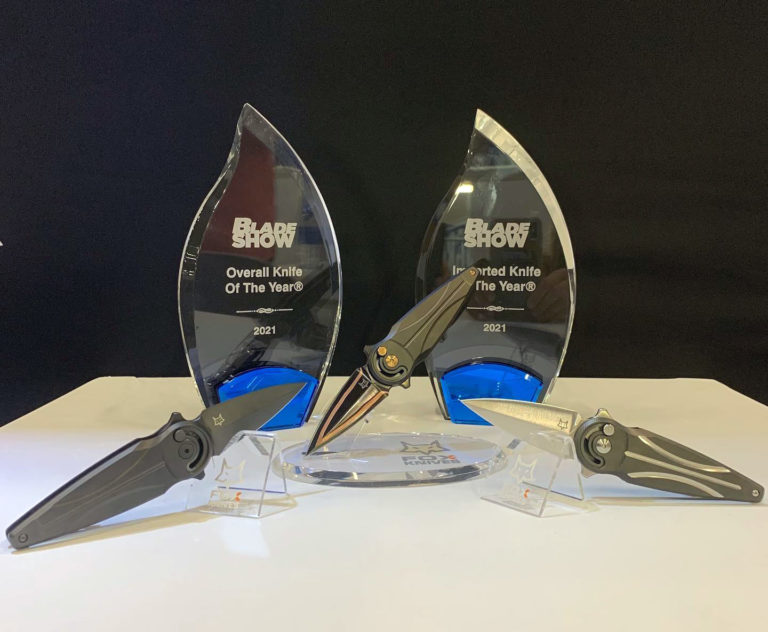
The 2021 Overall Knife of the Year® is the Fox Saturn. The 40th BLADE Show took place June 4-6, 2021, at the Cobb Galleria in Atlanta, Georgia. The event is the largest knife show on Earth, with attendees and exhibitors from around the world.
This prestige is what makes the awards at BLADE Show so vital to the knife industry. Below are the factory and custom award winners.
2021 BLADE Show Knife-Of-The-Year® Award Winners
Representatives from BLADE (www.blademag.com) distributedBLADEMagazine Knife of the Year® awards in 11 categories, plus awards for individuals’ career achievements. All entrants in the Knife of the Year® competition were evaluated by a super panel of undisclosed judges on a number of factors, including utility, design, creativity, materials, aesthetics, feel and other traits.
BLADE Show is home to countless knives and just as many exclusive deals. Here are some outstanding highlights from our sponsors you don’t won’t want to miss.
Smoky Mountain Knife Works
WE Knife
Work Sharp
Big Daddy Unlimited
Wicked Edge
W.R. Case & Sons Cutlery
Hogue Knives
Kizer Cutlery
Microtech Knives
Smoky Mountain Knife Works Get Your Free Swag Bag at Booth 29
Stop by SMKW’s Booth (29) at BLADE Show, and we’ll give you an awesome free swag bag (while supplies last). Don’t wait!
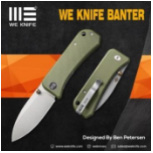
WE Knife WE KNIFE BANTER at Booth 725
See more of our new knives at Booth 725.
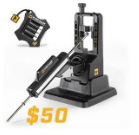
Work Sharp Precision Adjust Special $50 (Only 300 Available) – Booth 312
All orders over $50 include a FREE Micro Sharpener. Precision Adjust on sale for $50 while supplies last.
Big Daddy Unlimited We’ve SLASHED the price on our Big Daddy Unlimited annual membership!
Take a STAB at these savings ($79.41) & Sign up NOW! Click here.
Wicked Edge 10% Off – Booth 42
Come see us and our newest arrivals in Booth 42 and pick up your BLADE Show 2021 coupon for 10% off your favorite tool.
W.R. Case & Sons Cutlery FREE “Made in Bradford” Stickers from Case Knives! – Booth 109
Get a free “Made in Bradford” sticker when you stop by Booth 109 to check out the all-new Marilla™ and Kinzua™ EDC knives from Case!
CPM 20CV stainless steel blade with a Glow Rhino Tritium infused ABLE Lock® carbon fiber frame and blue titanium hardware. Exclusively available at BLADE Show at Booth 52.
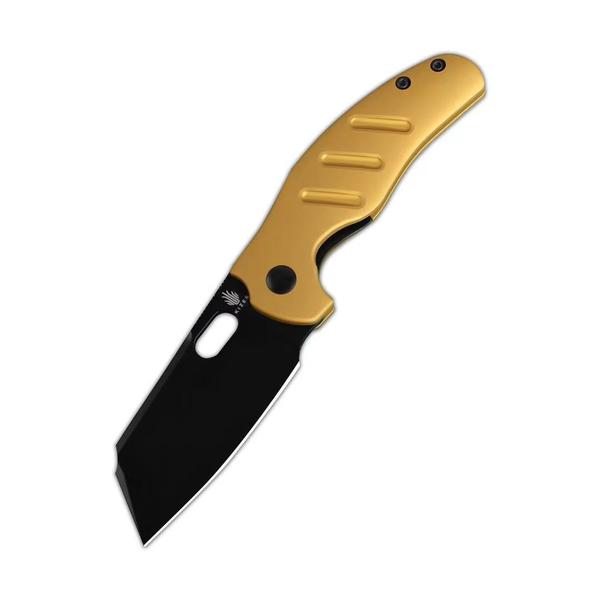
Kizer Cutlery 2021 BLADE Show knife – Kizer Sheepdog Mini C01c, 40th Anniversary Special edition
This special edition of the Sheepdog mini C01c is equipped with 154CM steel and champagne handles, only 300 available with a serial number. Get it here.
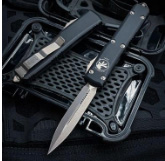
Microtech Knives Ultratech D/E for Only $160 – Booth 324
This year’s BLADE Show Special from Microtech Knives is the Ultratech D/E. Price is $160. Cash only. Limit one per person. Available at Booth 324.






















 Smoky Mountain Knife Works
 WE Knife
 Work Sharp
 Wicked Edge
 W.R. Case & Sons Cutlery
 Hogue Knives
 Microtech Knives




