Home Authors Posts by Bobby Branton

Bobby Branton

Competitive Knife Throwing: Girl Power On The Fly

0

Women are leading the rise of knife throwing across the country and the world.

As an accessible and affordable hobby, knife throwing is seeing a surge in development and an astounding cultural impact. Since my first knife-throwing tournament over 30 years ago, the sport has steadily grown. One of the largest gatherings of knife throwers began in Berwyn, Pennsylvania, guided by knife designer and champion thrower Joseph “Brokenfeather” Darrah. Now known as Brokenfeatherpallooza, it has evolved into a top national event.

The Quaker State event isn’t alone in rallying throwers in the spirit of camaraderie and friendly competition. The Columbia City, Indiana-based Dangerfest—led by online knife-throwing sensation Brandon “Danger” Dillon—has become a mainstay on the throwing circuit.

It’s unsurprising these major events have taken root where they have, given throwing’s deep roots in the region. Michigan is among knife throwing’s historic epicenters, thanks in large part to BLADE Magazine Cutlery Hall of Fame® member Harry K. McEvoy. As a result, the state has long been home to devoted McEvoy and Tru Balance knife enthusiasts.
During my time at the helm of the Tru Balance Knife Company, I met countless throwers—many of them members of a group known as the Michigan Blade Throwers. This group held frequent tournaments and became a driving force in the regional throwing community. From this large and passionate collective emerged a group of women who would soon redefine knife throwing in Michigan and beyond.
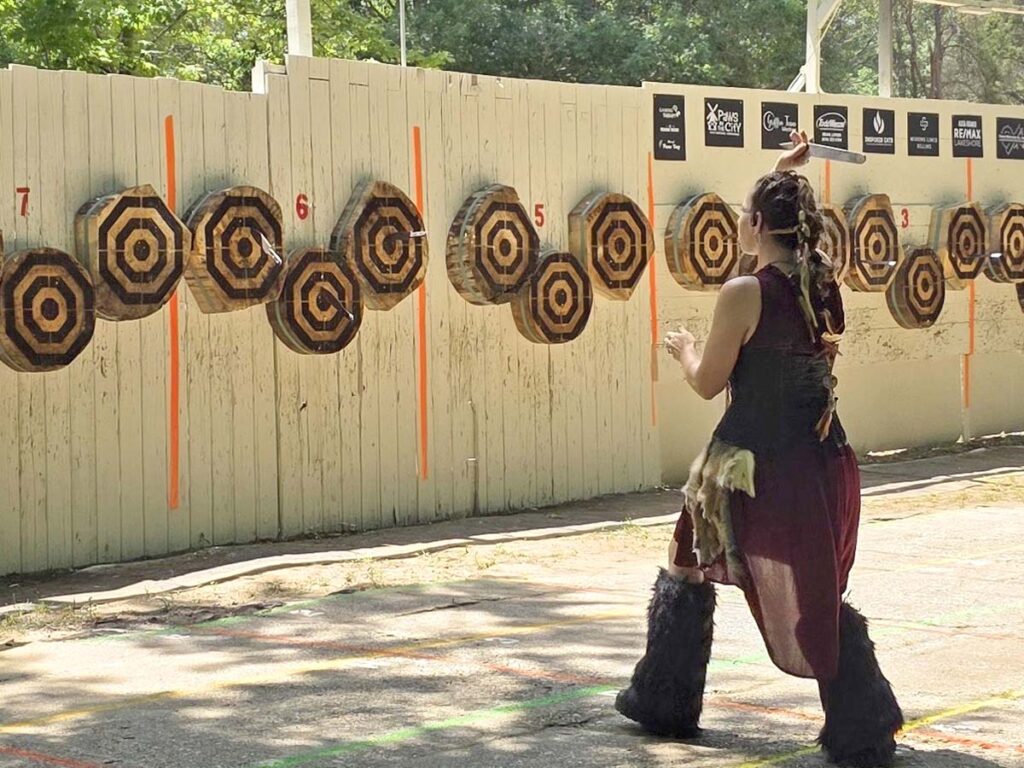
Among the attractions women have found in knife throwing is empowerment, stress relief and camaraderie, according to the author.

Birth Of A Movement

In 2015, Kelly Grove launched Women With Knives (WWK), igniting the world’s largest women-only knife-throwing league. What began as informal backyard sessions with her husband, Jeff, quickly evolved into a grassroots movement. Long before entering the competitive circuit in 2019, Kelly was already building the sport. In 2018, she organized her first league event, the Gung-Throw, which later became the now-iconic Battle of the Blade Maidens. Kelly’s influence extends even further. A founding member of the Michigan Blade Throwers, she helped establish the state’s first Throwstorm Tournament in 2020. Recognizing the importance of preserving and growing the community she had created, she converted WWK into a 501(c)(4) nonprofit organization in 2021.

Kelly officially retired from competitive throwing and league leadership in 2023 but continues to guide WWK as a member of its Board of Directors. Upon stepping down, Kelly appointed Dawn Solomon as Chair and Executive Director of WWK. Under Dawn’s leadership, WWK continues to set record-breaking benchmarks for women’s participation in competitive knife throwing.

Dawn, who entered the sport in 2019, is a dedicated competitor and a member of the Michigan Blade Throwers. Together with her husband, Tim, she operates MBT Range, the largest outdoor throwing range in Michigan. MBT has grown into a hub for seasoned athletes and newcomers alike.
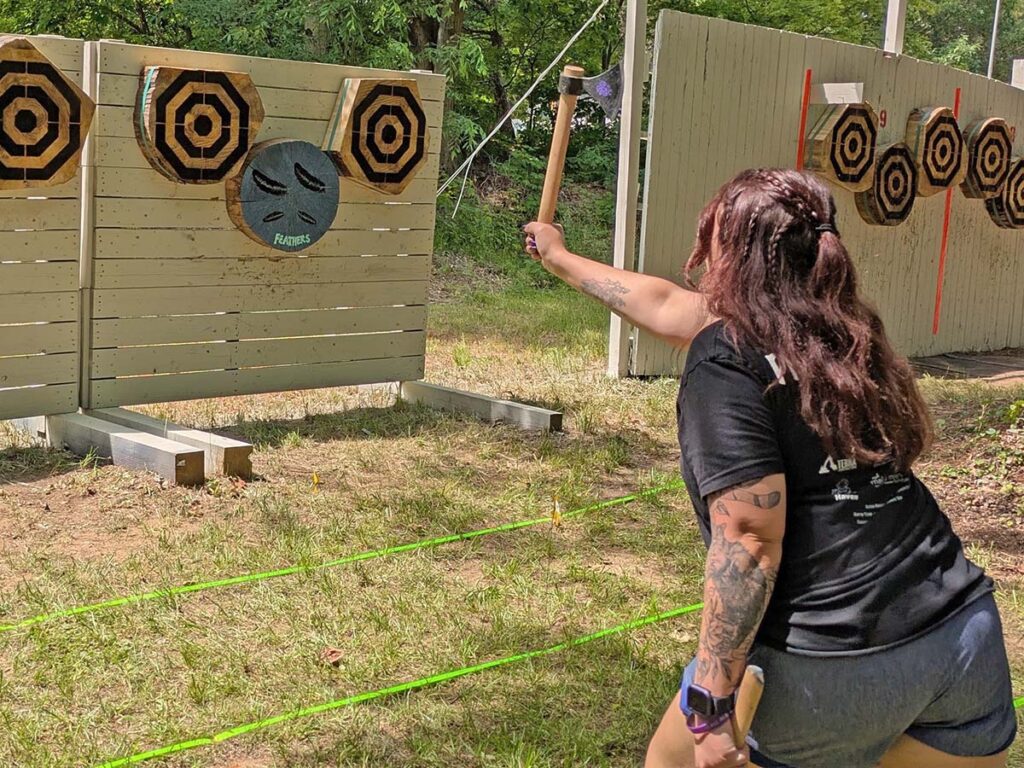
Most women’s knife throwing organizations began as grassroots endeavors. The inspiration of WWK, for instance, came in founder Kelly Grove’s backyard in informal throwing sessions with her husband.

Membership in the WWK is diverse. Teachers, nurses, small business owners, corporate executives, stay-at-home moms, retirees and more fill its ranks. This includes throwers of all ages, ethnicities, fitness levels, abilities and disabilities. All find a place within the league.

The attraction of knife throwing is as distinct as WWK’s members. For some, it’s a release of daily stress; for others, a confidence booster. For practically all, slinging steel is a way to forge lasting friendships. Adding to the escapism knife throwing allows, each member adopts a unique alias. These are proudly displayed on league T-shirts—adding an element of fun, freedom and identity to the experience.

At its core, WWK empowers women by teaching the art of knife throwing while fostering strength, confidence and community. Whether members aspire to compete in sanctioned events or simply want to unleash their inner warrior in a supportive environment, the organization offers a place to belong.
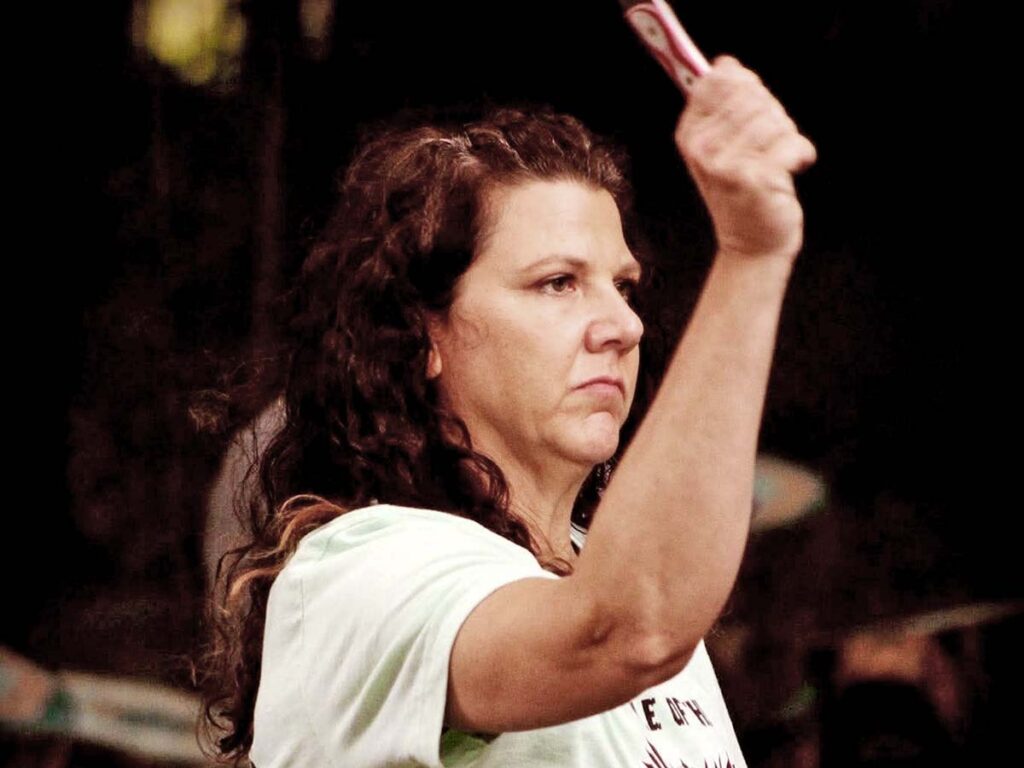
More than holding their own, women have become among the top competitors in all ranks of knife throwing competitions.

Today, WWK continues to thrive under the guidance of a dedicated Board of Directors and leadership team who share Kelly and Dawn’s mission. Together, they travel the country competing, coaching and championing the sport—ensuring knife throwing continues to grow and welcomes new women into the community.

Live Nationwide

Women have also stepped forward to lead major tournaments across the country. One such event is Blades Out Or Bust (BOOBS), founded by Jessica Gold McClain. A longtime supporter and advocate of the sport, Jessica—also known as “Goldi Lox”—sponsors at least two tournaments annually near her home in Bastrop, Texas.

For Jessica, the passion for knife throwing began in her teenage years. She spent countless hours honing her skills in a friend’s backyard before eventually setting up her own target at home. When she began competing, she was often the only or part of a handful of women at most events.

After a five-year hiatus from the sport, the seed was planted for what would become a powerful new community. In 2019, Jessica founded the Bladed Sisterhood with a bold vision: to unite women around the globe who share a passion for blades. This small idea has grown into a thriving international network where women connect, learn and
celebrate knife, tomahawk and axe throwing.
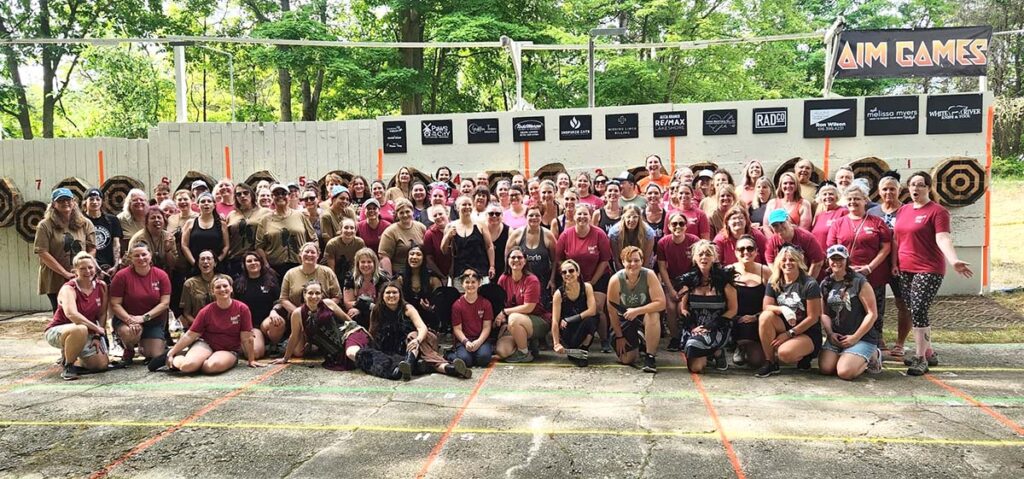
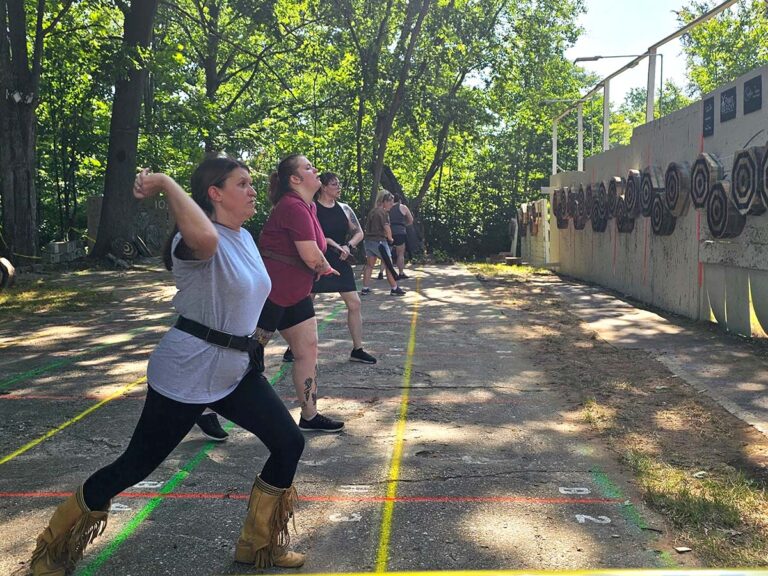
Michigan is among the knife throwing epicenters and, as the author points out, is the home to WWK and other women-focused knife throwing organizations. (Felicia Mulder image)

The organization’s dream is ambitious—to see these disciplines recognized worldwide, including as Olympic events. Until then, the Bladed Sisterhood continues building a community that inspires women, celebrates skill and honors tradition.

While women like Kelly and Jessica built strong foundations at home, others were already taking knife throwing onto the world stage.

Throwing Goes Global

One of those women is Melody Emel, a multi-award-winning champion with more than two decades of experience in the sport. After attending stunt school, Melody developed a deep interest in Western arts, which naturally led her to knife throwing.

Far from an American endeavor, knife throwing has become a global phenomenon and has seen a large influx of women throwers worldwide. (Dawn Soloman image)

Following multiple first- and second-place finishes in major tournaments, Melody founded Blade Aces in Las Vegas to serve and grow the local throwing community. In 2015, she traveled to Europe to compete in the Eurothrowers World Championships for the first time, marking a significant milestone in her international career.

Melody’s passion for both throwing and teaching continues to drive her involvement in events around the world. She actively supports competitions that empower women and raise funds for breast cancer awareness and other causes dedicated to uplifting women.

From backyard grassroots to the global stage of professional competition, women have redefined the sport. With a growing international network and a dedicated leadership, the future of female knife throwing is certain.

More Knife Throwing:

Tru Balance Knife Co.: 75 Years And Still On Target

Born as a side hustle, the legendary throwing knife company continues to hit the mark.

Small businesses that have operated continuously for 75 years are a testament to the quality of their products and the dedication of their founders and owners. Such businesses have stood the test of time and have been able to adapt to changing market conditions and consumer preferences. Knifemaking is no different.

In 1949, Harry K. McEvoy, who would soon be considered the father of modern-day knife throwing and one day be inducted into the BLADE Magazine Cutlery Hall of Fame®, was a long-time resident of Grand Rapids, Michigan. He worked for the Meyercord Co. as a traveling district salesman selling decals to wallpaper and decorating stores. In his spare time, Harry spent hours in his shop designing and crafting knives. His passion for knifemaking was fueled by his ongoing search for the perfect throwing knife.

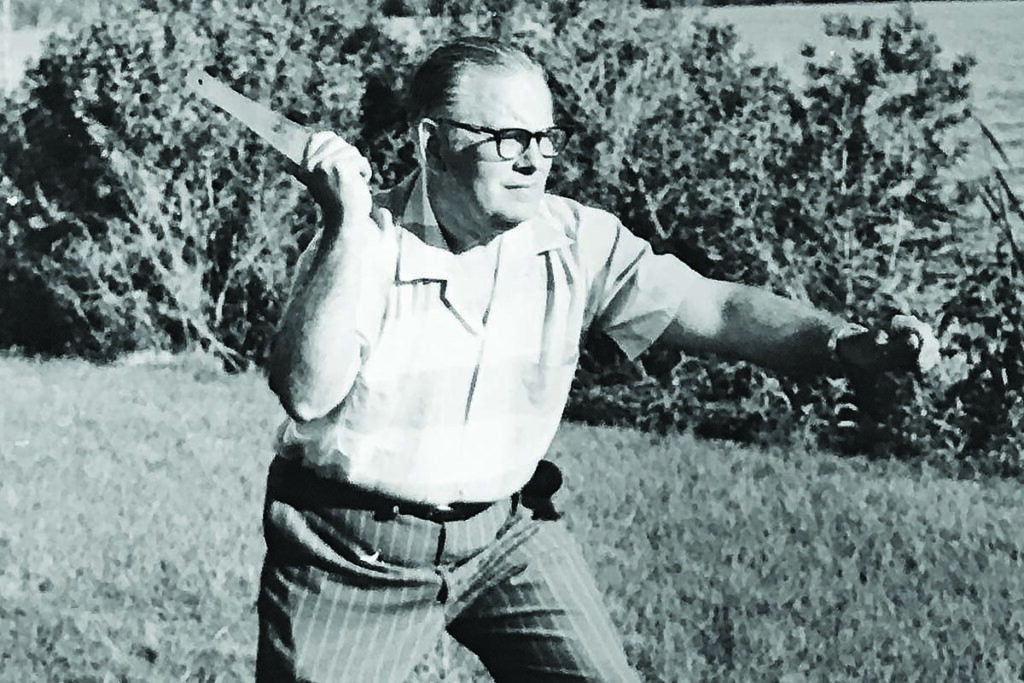
Harry McEvoy shows the form and throws one of the Tru Balance knives
BLADE Magazine Cutlery Hall-of-Fame® member Harry McEvoy shows the form and throws one of the Tru Balance knives that helped revolutionize knife throwing.

Knife throwing as a modern sport began shortly after World War II and centered around a few individuals who threw knives at stumps or targets in their backyards. The knives they used consisted of very primitive homemade throwers that were often much smaller than the ones you see today. Harry began making his own knives around this time because he was unable to find any commercial knives suitable for throwing.

While he practiced throwing knives in his backyard, neighbors would gather to watch. Intrigued by how well his throwers performed, the onlookers were compelled to discover the source of his knives. When he responded that he, in fact, had made them himself, they asked him to make knives for them and others who were interested, and thus was born the Tru Balance Knife Co.

Randall & Scagel’s Influence

Bobby Branton and Stephen McEvoy
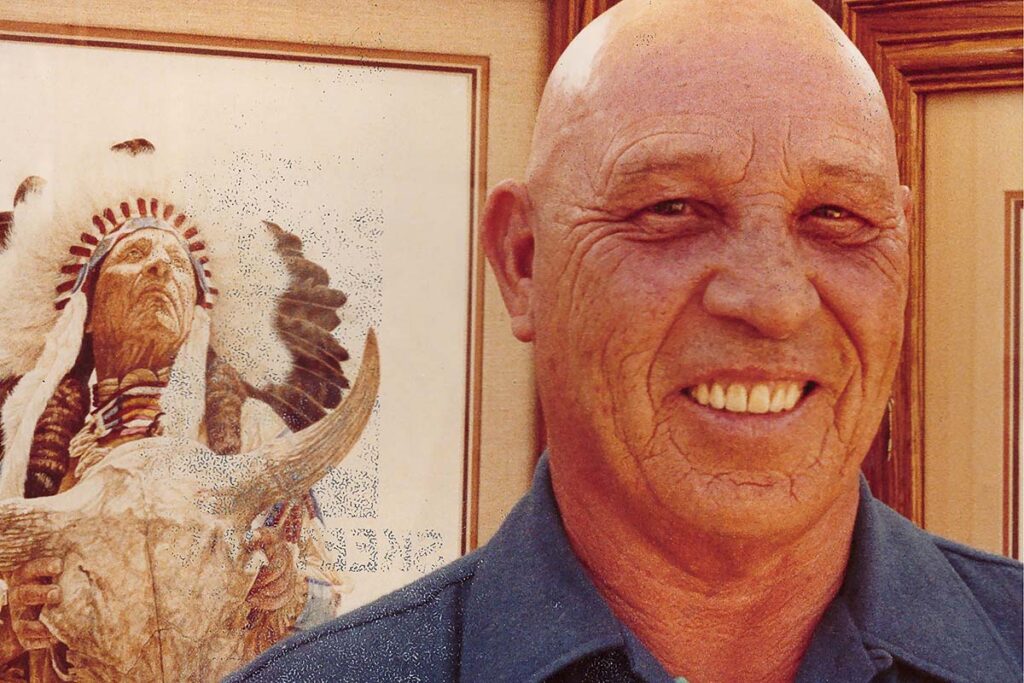
The author (left) bought Tru Balance Knife Co. from Stephen McEvoy (right) in 2017. The business continued to grow but the author had to sell in 2021 due to physical issues.

Around 1951, Harry learned of a knifemaker from Orlando, Florida, and another future Cutlery Hall-of-Famer by the name of W. D. “Bo” Randall. As a fledgling hobby knifemaker, Harry decided to write to Bo about his knives and the two became fast friends, exchanging letters regularly.

McEvoy soon found out that Bo had an interest in throwing knives and was surprised to learn that a throwing knife could even be found in Bo’s catalog. As a father with young children, money was scarce for Harry, so he convinced Bo to trade a Randall thrower for a couple of McEvoy throwers. Generous and willing to help a fellow knifemaker, Bo was happy to oblige.

George E. “Skeeter” Vaughan
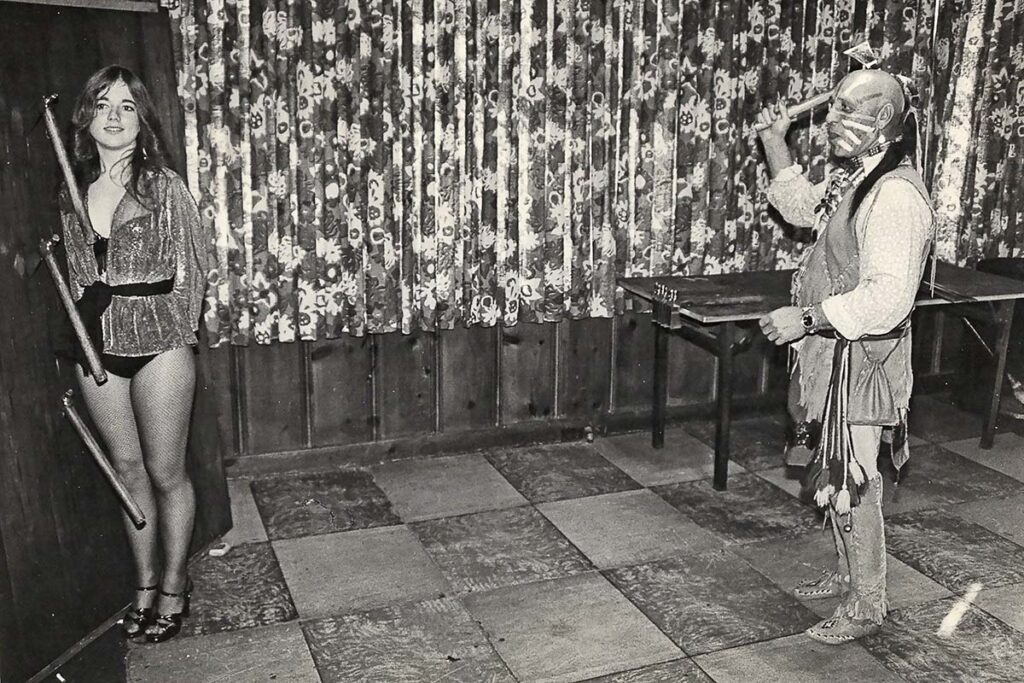
George E. “Skeeter” Vaughan made the most fantastic knife throw in recorded history, taking out a German sentry with a modified bayonet from 87 feet during World War II. Skeeter was also an outstanding tomahawk thrower, showing his skills here with the help of a “target girl.”

Around 1952, Bo asked Harry if he would visit yet another future Cutlery Hall-of-Famer, William Scagel, who lived very close to McEvoy in Fruitport, Michigan, and buy some of Scagel’s knives for his collection. McEvoy was more than happy to do his friend a favor. Harry would eventually befriend the reclusive Scagel, too, and on his visits watched him make knives and bought knives for himself and Bo. 

As their friendship grew, Harry would visit Bo at the Randall summer home in Michigan and would even travel to the Randall home in Orlando, Florida. The two became quite close and eventually, Bo decided to feature two Tru Balance Models in the Randall catalog. The Model #1 Professional Thrower and the now world-famous Bowie-Axe Throwing Knife made their catalog debut in early 1960, which resulted in a spike in sales for Harry.

Harry McEvoy grinding a knife
In his spare time, Harry McEvoy spent hours in his shop designing and crafting knives.

Bo thought so much of Harry’s work that he gifted one of Harry’s Tru Balance Bowie Axe throwers to astronaut Gordon Cooper. He also took Harry’s popular Bowie Axe design and modified it into a large machete-style knife and submitted it to NASA in the 1960s when NASA was looking for a machete for astronauts to carry on the Gemini missions. Unfortunately for Harry, NASA required a much thinner design and eventually chose another manufacturer, Case Knives, to make the machete.

AKTA 

Meanwhile, Tru Balance soon became the go-to company for anyone who wanted a high-quality professional throwing knife. Tru Balance throwing knives became highly sought after by soldiers heading to Vietnam, professional knife throwers and knife collectors around the world.

In 1971, Harry started the American Knife Throwers Alliance (AKTA) to aid and offer guidelines to individuals and groups who wished to organize competitively in their local areas. Harry became very close friends with professional knife throwers like Kenneth Pierce, aka Che Che Whitecloud, Paul LaCross and George E. “Skeeter” Vaughan, who holds the distinction of making the most fantastic knife throw in recorded history. Considering the circumstances surrounding his legendary feat of taking out a German sentry during World War II with a modified bayonet from 87 feet, he most likely will maintain his grasp on that honor for a long time to come. “The Saga of Skeeter Vaughan” is told by McEvoy in the April 1982 BLADE®.

Harry went on to author such books as Scagel: The Man and His Knives; Archery Today; Crusader in the Wilderness; Knife Throwing: A Practical Guide; Knife and Tomahawk Throwing: The Art Of The Experts; For Knives Lovers Only; and co-authored Knife Throwing a Modern Sport, with Charles Gruzanski. McEvoy also held two design patents and trademarks for his knife designs. He also authored other articles for BLADE, as well as for Knife World (today’s KNIFE), Muzzleloading Magazine, Fighting Knives Magazine and many more.

McEvoy Legacy

In 1991, McEvoy was inducted into the Cutlery Hall of Fame for his exceptional contributions to the world of knives. It was around this time McEvoy’s son Stephen had taken an interest in his father’s knives and had begun learning more about the business. Stephen eventually took over the company in 1993 following Harry’s passing from an illness.

Harry McEvoy surrounded by thrown knives
When McEvoy—here mugging during a lighter moment—practiced throwing knives in his yard, neighbors would gather to watch. The onlookers showed interest in the knives, and Tru Balance Knife Co. was born.

This writer, a friend of Harry’s and a fellow knifemaker, reached out to Stephen via telephone to offer condolences and advice. We chatted regularly and, over time, as we shared stories, we developed a friendship. Our phone conversations led to Stephen’s yearly visits to my home. During one of those visits, I asked him if I could take over the defunct American Knife Throwers Alliance (AKTA) and Stephen agreed.

Stephen would continue to run Tru Balance Knife Co. the same way his father ran it for many years. In 2015, after retiring from his job as an executive at a major insurance company, Stephen began speaking to me about slowing down and retiring from making knives. Already a full-time knifemaker with my own line of throwing knives, I envisioned bringing Tru Balance Knife Co. into the 21st century by selling Tru Balance knives on its own website and promoting the business via social media.

Skeeter Vaughan’s Cherokee Indian name is Grey Otter.
Skeeter Vaughan’s Cherokee Indian name is Grey Otter. He served as a chief of the Federated Indian Tribes for a number of years.

With the newfound success spearheaded by the new business plan, Stephen finally decided to fully retire from the business. A deal was brokered and I bought Tru Balance Knife Company in 2017, moving it to my hometown of Awendaw, South Carolina. The business would continue to grow but, not long thereafter, I developed some knee issues and struggled to keep up with the company’s new customer demands. Unable to find a qualified apprentice to help me fill orders, I decided to sell the business in 2021.

Tru Balance Heads Home

Though several companies made offers to buy the company, I decided I wanted to hand-pick my successor to ensure the legacy of the Tru Balance Knife Co. and that the knives would continue to be made in the USA. As the search for the right successor was underway, a mutual friend brokered a connection between me and two brothers from Michigan who had an interest in the business and the revitalization of the AKTA. The brothers made knives as a hobby and also happened to be skilled knife throwers.

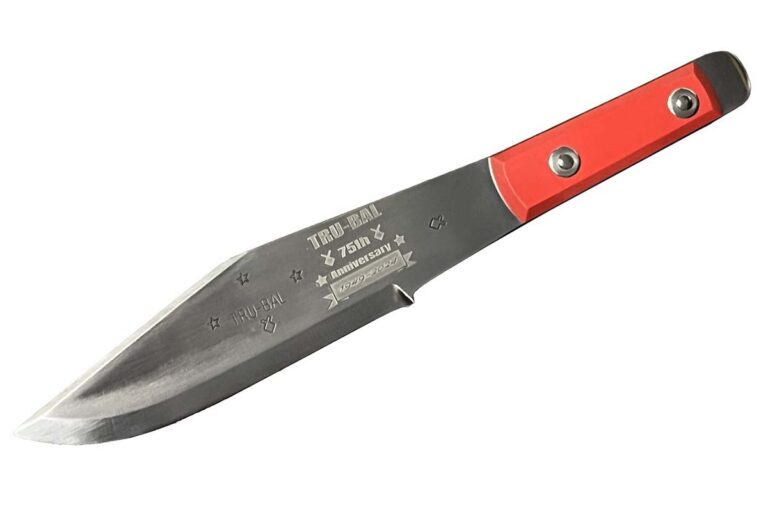
Bill and James Bednarick turned out to be the perfect choice to preserve the company’s legacy and bring it back to its original home in Michigan. With their keen eye for detail, quality and passion for knife throwing, their dedication has ensured that the Tru Balance Knife Co. has lived on to see its 75th anniversary in 2024.

Advertisement

Must Read Articles

Read this before you make a knife

Knifemaking 101 – Read This Before You Make a Knife

  by Wayne Goddard My experience has taught me that there's nothing like digging in and getting started. I've often said the hardest part of the...
how to forge damascus steel

How to Forge Damascus

Advertisement
Advertisement