How the legend of Loveless-style fixed blades makes them sharp.
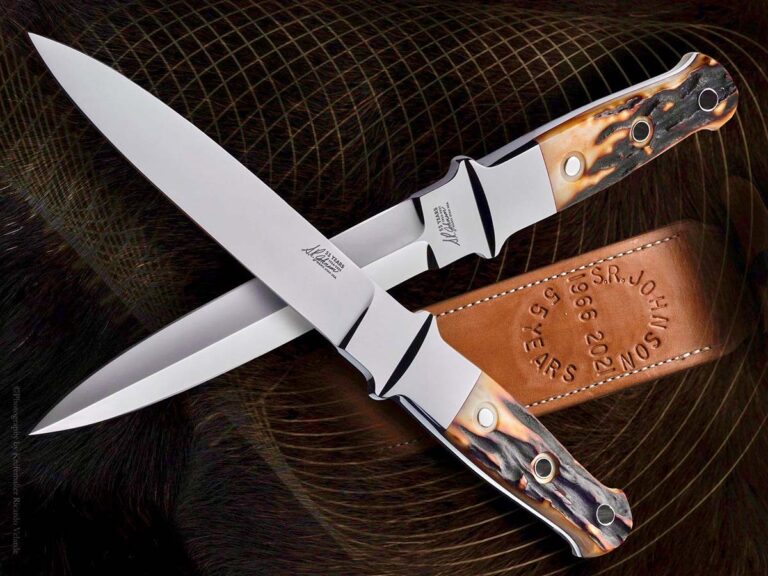
Steve Johnson began his journey in 1966 under Gil Hibben and refined his knifemaking skills under the iconic Bob Loveless. Today, he is world-renowned for his “Loveless-style” fixed blades, specifically his sub-hilt fighters and drop-point hunters. With 60 years of experience, Steve’s grinding process is a study in precision:
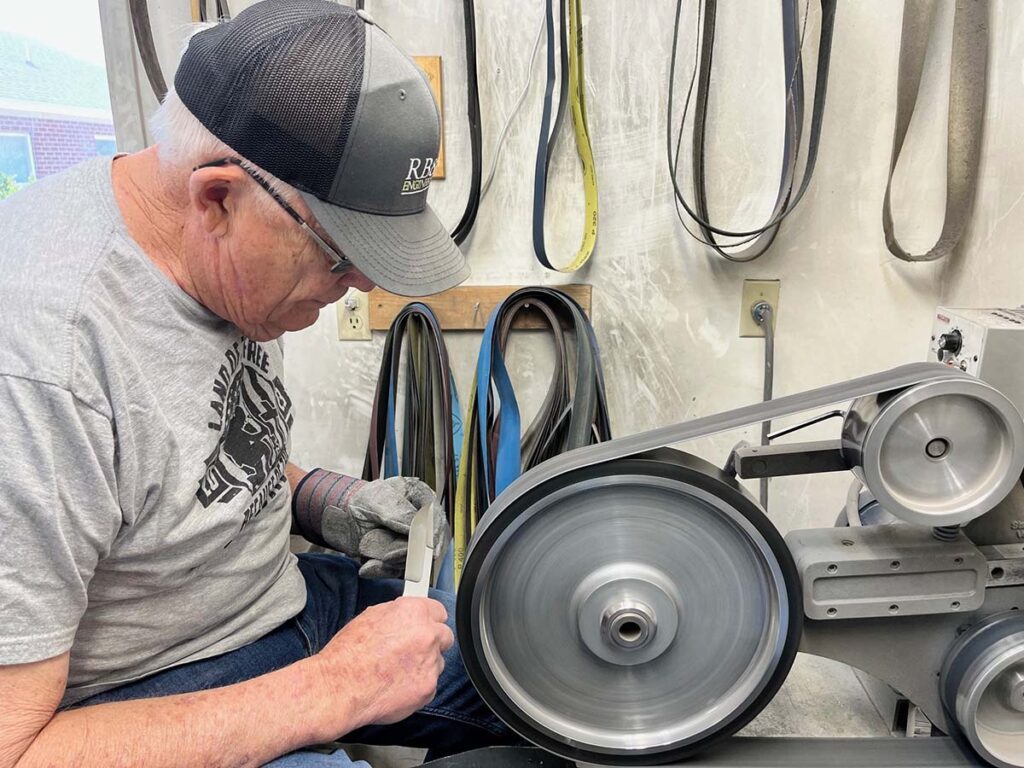
According to the columnist, Johnson is particular about the wheel diameter in crafting each of his knives, matching them specifically to the style he’s working on. (Steve Johnson image)
Initial Setup: After scribing edge lines, he “pre-grinds” the blade to its final edge thickness at an acute angle to establish a consistent target dimension.
The Hollow Grind: Working edge-up, Steve engages the contact wheel from back to front. He feathers the pressure at the point, where there is less steel resistance, to maintain symmetry.
Wheel Selection: Wheel diameter is dictated by each knife model’s blade height and thickness: 3-inch smooth-face for boot knives, 4-inch serrated for ‘Big Bear’ fighters, 8-inch serrated for wilderness knives, 14-inch serrated for large hunting knives and camp choppers. Note, all of his serrated wheels have a 2:1 land-to-groove ratio.
Finishing: Regardless of the initial wheel, all post-heat-treat finishing is done on smooth-face wheels.
Tapered Tangs: Steve tapers his tangs by hand on a flat platen, truing them on a 120-grit flat disc before heat treat. Instead of using a surface grinder to true his knife blanks, Steve trues them on his platen and disc.
Making Them Shine
Grinding is a large part of Johnson’s process, which he does while seated. Even so, the columnist points out he lines the floor of his shop with interlocking playmats to lessen the stress on his body. He also has his bench and tools set up to his natural working heights to increase his efficiency. (Steve Johnson image)
Steve transitions from grinding to polishing and buffing using a specific sequence. Last in his grinding sequence is 600-grit aluminum oxide, transitioning to a worn 3M Trizact A45 (400-grit) J-weight belt. Next is a broken-in 400-grit cork belt with Maverick white SS300 compound. Then, to either a 600- or 800-grit cork belt with the same SS300 to remove all the scratches. For his final buff, he uses 8-inch diameter yellow unsewn buffing wheels with the same SS300 compound. Steve remarked, “It’s the only buffing compound I have in my shop.”
Shop Playtime
If Steve has any one suggestion for improving your work, it’s interlocking rubber playground mats over concrete shop floors. Even if you grind seated like Steve, comfortable flooring reduces long-term physical stress. In addition, he says to set up your work areas at natural heights for optimal work efficiency and comfort.
This issue highlights the expertise of the national living treasures, Jerry Fisk and tactical maker Shane Sibert. Their insights focus on the construction of mortised-style handles and the professional mindset required for success.
Getting A Handle
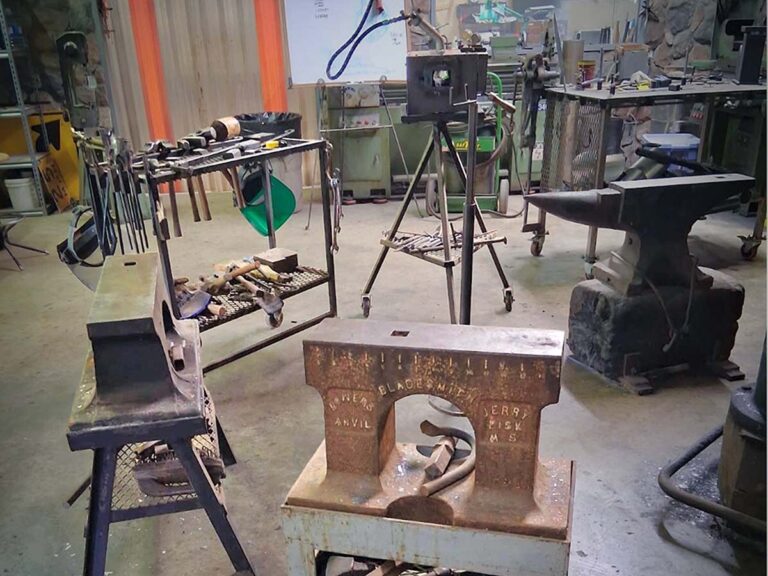
A trailblazer and visionary since becoming the 17th ABS master smith in 1989, Fisk’s philosophy centers on the idea that a knife isn’t just an art piece; it is a tool that must survive the most extreme (and sometimes bizarre) conditions.
To this mindset, the mortised handle has served him well, consisting of two flush-matching scales equally inletted to create a tight pocket for a hidden tang, then positioned directly against the guard. He mechanically secures the scales by pins or screws with epoxy. Fisk prefers this method because it offers the profile of a full-tang knife incorporating a narrow-tang guard.
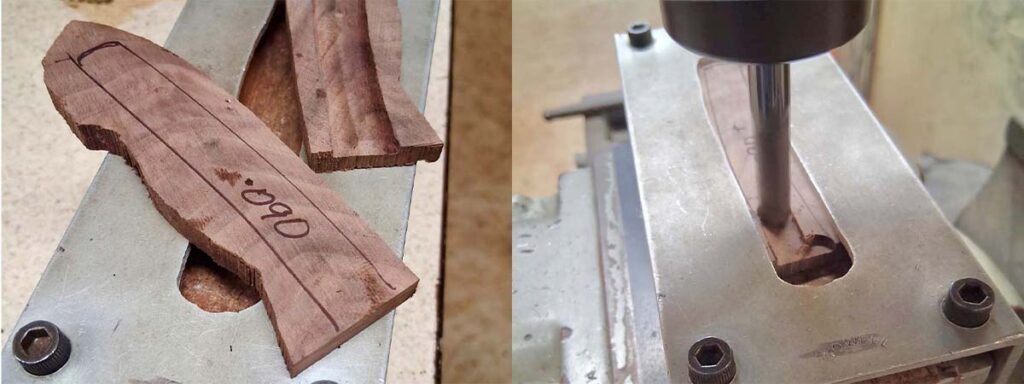
Precision Prep: Grinding a tang taper aids in fitting the slip-on guard. Radiusing blade corners and edges prevents stress fractures in the handle. Fisk routs cavities along the tang outline to a depth of 0.004 inch beyond half the tang’s thickness.
The Dovetail Secret: Using a Dremel to undercut the inner corners of the handle cavities creates a “mechanical lock” for epoxy, strengthening the bond significantly like an internal pillar.
Mechanical Retention: Fisk advocates for screws over pins to provide superior clamping force.
Minimal Epoxy: Epoxy should act as a sealer and secondary bond, not as a structural gap-filler. Using as little epoxy as possible is key.
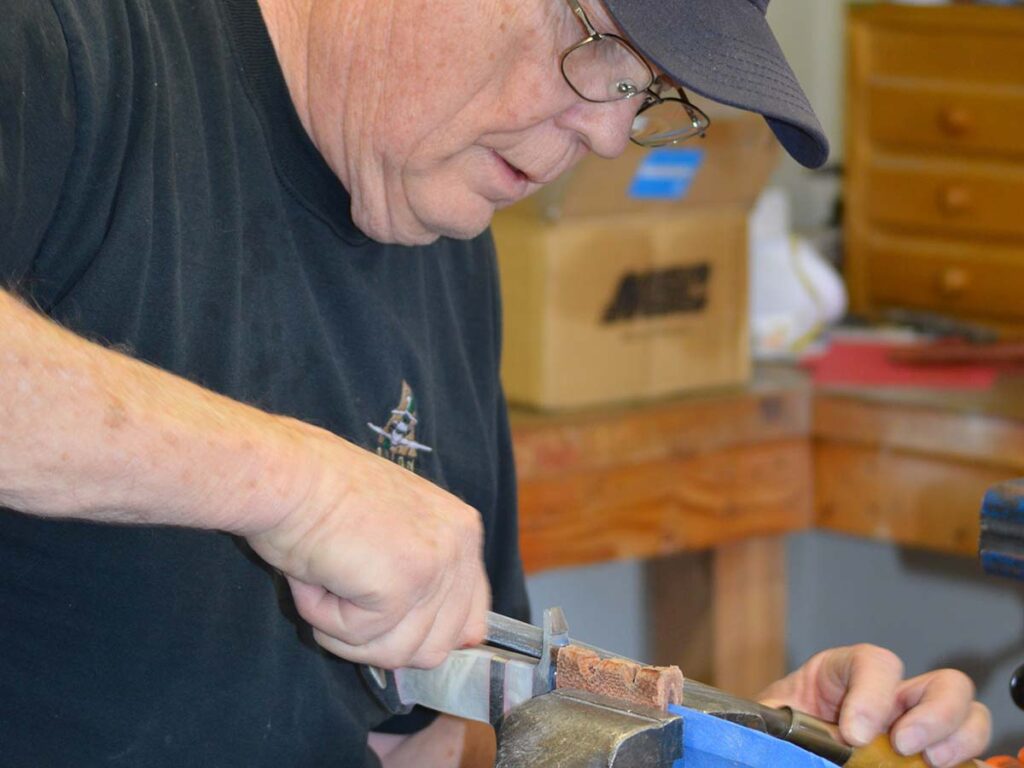
According to the columnist, Fisk prefers a mortised handle consisting of two flush matching scales, equally inletted for a tight hidden tang. No easy task. Not only does it require precise placement of the tang outline (left) on the scale, but exacting router work (right). (Images courtesy of Jerry Fisk)
Destruction Testing
Fisk’s designs are forged through failure. After a customer drove a cement mixer over his knives—finding that only the mortised handles survived versus narrow tang—the value of testing was clear: If you don’t test, you won’t know your knife’s limits. In his first year, Fisk sacrificed 54 knives to find their failure points. And he continues to utilize a panel of professionals (trappers, police and military) to vet designs for real-world skinning, tactical and survival use.
Press Fit Guards
Fisk treats the guard as a structural component rather than just decorative. In turn, he goes the extra mile in their construction. Despite having a milling machine, he file fits the guard slot by feel—practiced precision to ensure a seamless transition. He believes retention should never rely on solder or epoxy—these seal but do not hold. Fisk hammers the guard into place using a slotted Micarta block to ensure a true mechanical fit. And he uses JB Weld to seal seams, noting its robustness and machinability compared to standard epoxies.
Business Of Bladesmithing
Fisk warns that many makers fail by focusing 100 percent on the steel while ignoring the sale. To be a full-time maker, you must understand how to move product. Fisk emphasizes that marketing is often the missing element in a maker’s strategy. Without it, you risk becoming the primary collector of your own work.
At shows, you are the brand ambassador for your knives. Stand up and make eye contact. Sitting down signals a lack of energy. Further, your attire and interaction should reflect the quality of your blades. Buyers are purchasing you as much as they are the knife.
For Jerry Fisk, his philosophy as to why he makes knives captures the legacy of a master smith—every hammer blow is a permanent record of existence. A well-crafted knife serves as a testament to the maker’s life and skill, surviving long after they are gone.
Technical Signature Features
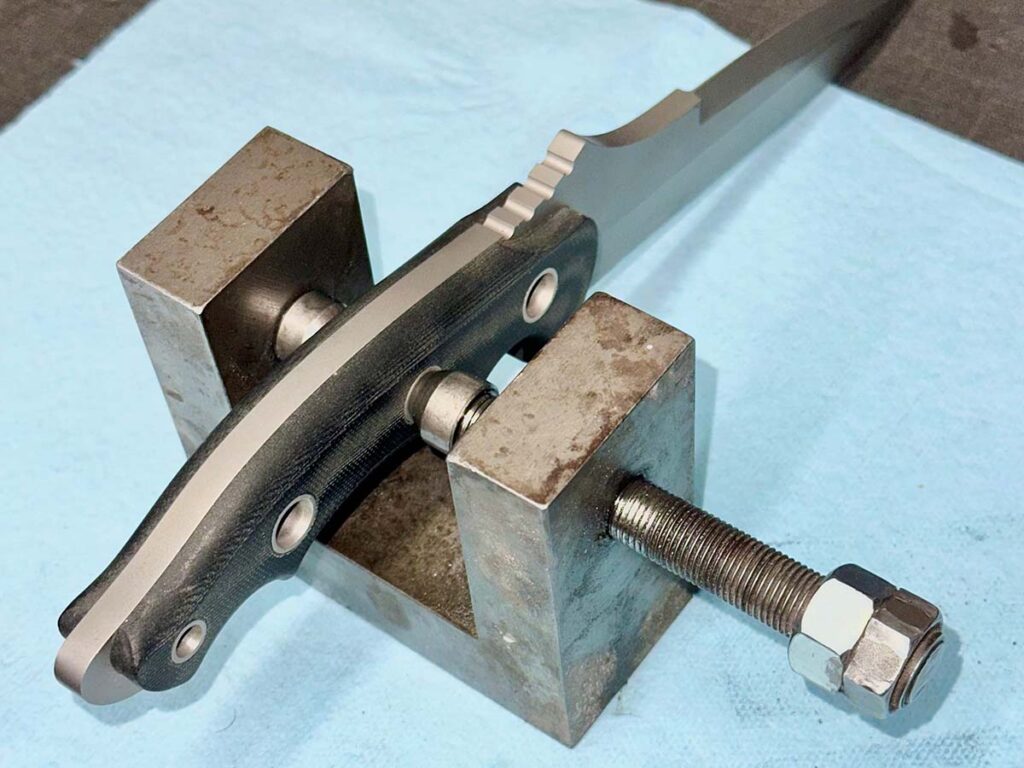
Sibert came up with a custom jig (left) to compress and flare 3/8-inch Grade 2 seamless titanium tubing on mortised scales. (Image courtesy Shane Sibert)
Shane Sibert has been a full-time maker since 1994, building innovative fixed-blade and folder designs for hostile environments.
Inspired by my use of 3/8-inch tubing as a signature design element in my SEALTAC™ fighting knives, Shane wanted to do a similar feature—but with a different twist: a mortised-style handle with flared 3/8-inch Grade 2 seamless titanium tubing.
The Problem: Straight-walled tubing can allow for handle-scale separation over time.
The Preparation: Use a single-flute tapered reamer to create a shallow flare in the handle material.
The Solution: Use a custom jig to compress and flare the extended tubing into that taper to create a mechanical rivet effect that sandwiches the mortised scales to the tang.
Accidental Pivot Accent
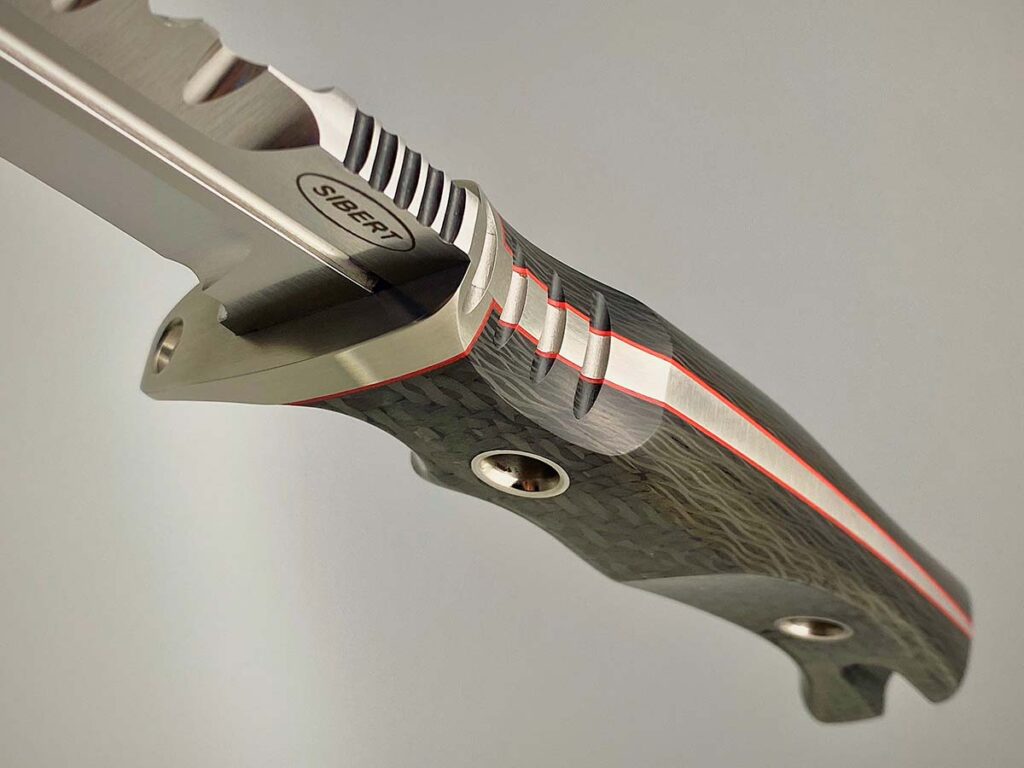
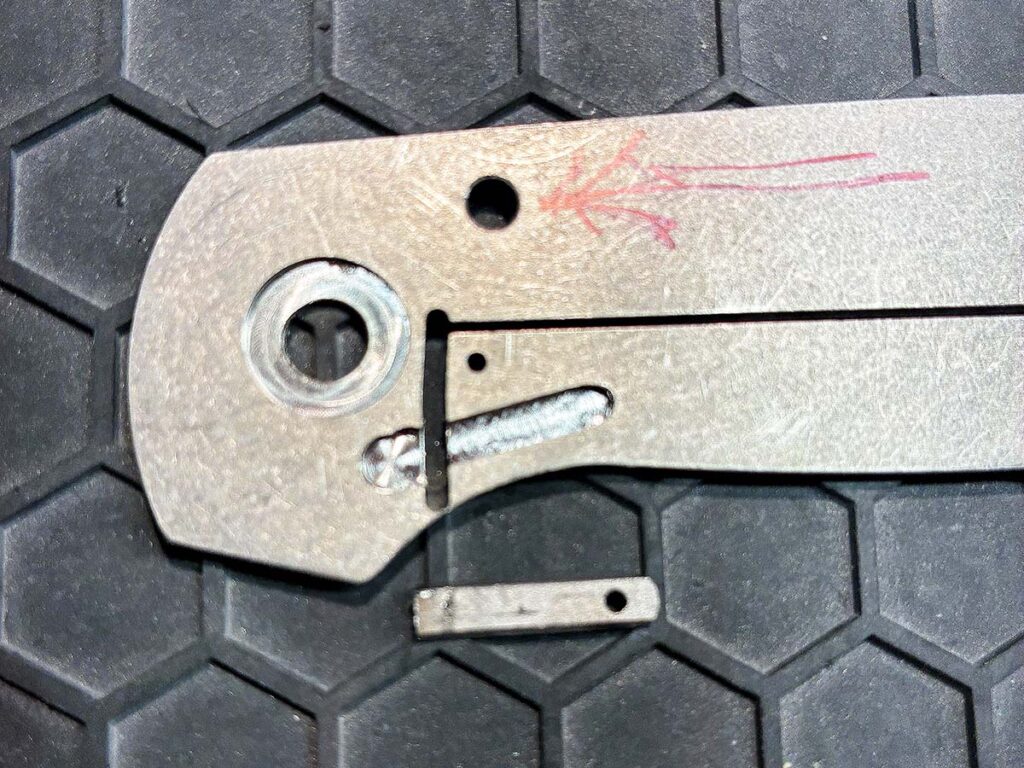
A hallmark of many of Sibert’s knives—fixed and folder—is an accent fuller (right) running into the handle. This causes an issue with fixed-blade knives, one he cures with a bit of JB weld to cover up the gap. (Image courtesy Shane Sibert)
Born from a mistake (drilling a pivot screw head hole too large), Shane pivoted by creating ½- to 5/8-inch bottoming pocket inlays around it. For aesthetics, he uses contrasting materials around the pivot-pin head. Further, he uses a decorative blind pivot screw on the obversed side with an embedded disc of color, hiding the mechanical nature of the fastener.
Famed sole-authorship folder maker Harvey McBurnett once said, “Knifemaking is the fine art of camouflage,” when amending such mistakes. Shane did so in a creative way, born out of necessity.
Another example of this is Shane adds accent fuller grooves on both folders and fixed blades that extend back underneath the handle or guard. The challenge is on fixed blades, where this creates a gap where the guard meets the fuller. His fix is to use black JB Weld epoxy to seal the transition, ensuring a seamless look that maintains the illusion that the fuller vanishes into the hilt.
Getting Off The Ground
Sibert has a grounded, no-nonsense perspective on entering the craft. He suggests that new makers don’t over-invest in high-end machinery immediately. Instead, focus on development and growth first. They also need to get ready for the grind; knifemaking is dirty, repetitive and requires immense discipline. It isn’t always “glamorous” shop work. Dedication is non-negotiable. If you want to be good, you have to be obsessed with the details. And starting out, keep your day job! The pressure to pay rent often stifles the creativity needed to make world-class blades.
Shane is old school with modern touches in his approach to knifemaking. That is the basis for the beauty in his knives.
Schwarzer’s blister busters and Terzuola’s effective efficiencies.
Editor’s Note: Jim Hammond has been a full-time knifemaker since 1977 and a member of the Knifemakers Guild since 1978. He was the first maker to work with CRKT and has many well-known designs to his name. This is the first of an ongoing column in which he uncovers the tightly held secrets of master knifemakers.
Welcome to Secrets of the Shop, where we dive deep into specific techniques and tips highlighted in the work of premier makers and knife smiths. While trade secrets often imply guarded formulas, for knifemakers, they are keystone discoveries that hone processes and perfect craftsmanship. This column seeks to turn these unrevealed secrets into shared solutions.
Popping Blisters
A veteran ABS master smith and BLADE® Magazine Cutlery Hall of Fame® member, Steve Schwarzer is probably best known for his pioneering work in the canister method of forging mosaic damascus. He is considered one of the finest instructors and ambassadors of the forged blade and of mosaic damascus, teaching at seminars and hammer-ins on the subjects for decades in Europe, South Africa, the USA and elsewhere.
During welding, a cold shut—a spot of incomplete merging of steel—can produce a trapped-gas bubble known as a blister. The spots where these void occur heat at different rates than the surrounding material and turn black. Often caused by worn and cupped dies, these blisters typically form along the billet’s perimeter.
Steve’s solution to addressing blisters is as follows:
Release the Gas: Punch a hole directly into the blister.
Flux and Forge: Drop borax into the hole and use a small rounding hammer to forge the area, pressing air out of the seam to recreate a uniform weld.
Refinement: Check the surface for flatness. Steve utilizes belt and stone surface grinders to achieve trued flats and maximize uniform contact.
To prevent blisters, Steve welds the edges of a billet before the center using a radiused fullering die. Going this route is less prone to create blisters than a flat die, though more apt to distortion. This technique was vital when Steve and Neil Kamimura created a million-layer billet that was folded rather than stacked, requiring the resolution of numerous small cold shuts.
Mosaic On A Budget
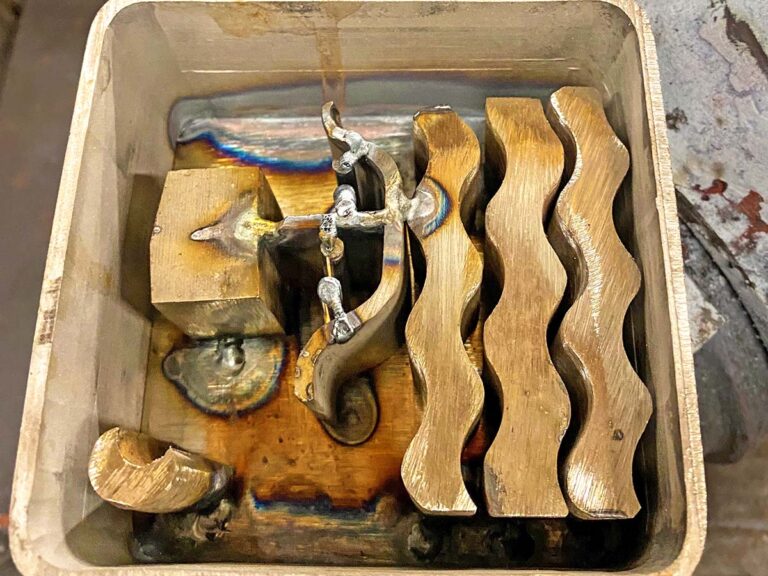
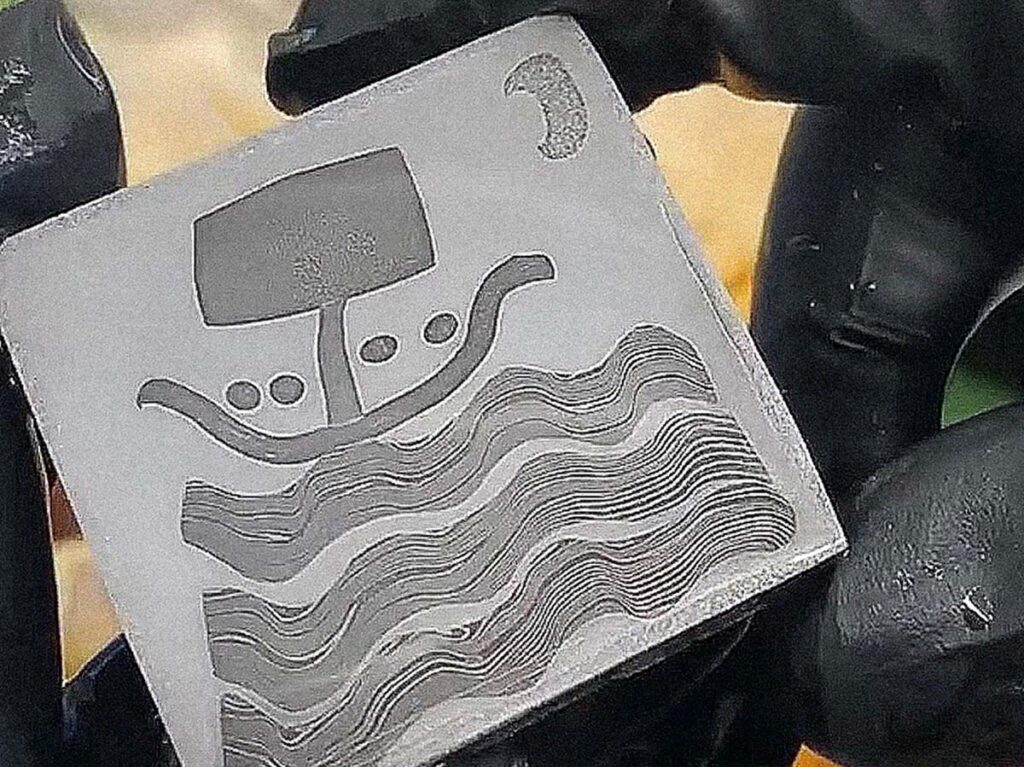
Schwarzer uses what he calls a “tiling” process with his canister damascus, sawing off the end to expose the image, and forge-welding them side-by-side to maximize the visual impact across the blade’s surface. (Steve Schwarzer image)
While CNC and EDM equipment can create intricate designs, a more affordable approach involves the sintering process of canister welding damascus, a method originated by Steve and Daryl Meier.
Steve’s canister process is as follows:
Composition: A square canister is preferred to maintain the image’s shape using flat dies. Content determines the pattern—solid metals form the primary image, while powder fill creates the background.
Preparation: Both ends must be welded shut to exclude oxygen.
Release Agents: To free the billet from the canister, Steve uses white spray paint; the titanium dioxide acts as an immediate release agent, oxidizing upon heating. Other options include White Out and stainless-steel foil.
Sintering: Steve recommends a soak time of at least 30-plus minutes. Expect a size reduction of roughly 30 percent as micro-spaces between particles collapse.
To expose the end-grain imagery, Steve uses what he calls a “tiling” technique. Band sawing sliced off the billet exposes the faces of the pattern. Then, forge-welding them side-by-side, he maximizes the visual impact across the blade’s surface. Note flat grinds are customary with this process, as deep grinding can distort the integrity of the imagery, especially with twisted materials.
For New Makers
Steve offers two foundational tips for those entering the craft. First bit of advice Schwarzer makes is to, “Avoid unknown materials, even if they’re free.” Without knowing the composition of “mystery steel,” you can never accurately repeat your results. He also suggests makers define their own path, saying, “Don’t chase anybody else’s dreams. Chase your own.”
Cutting Coupons
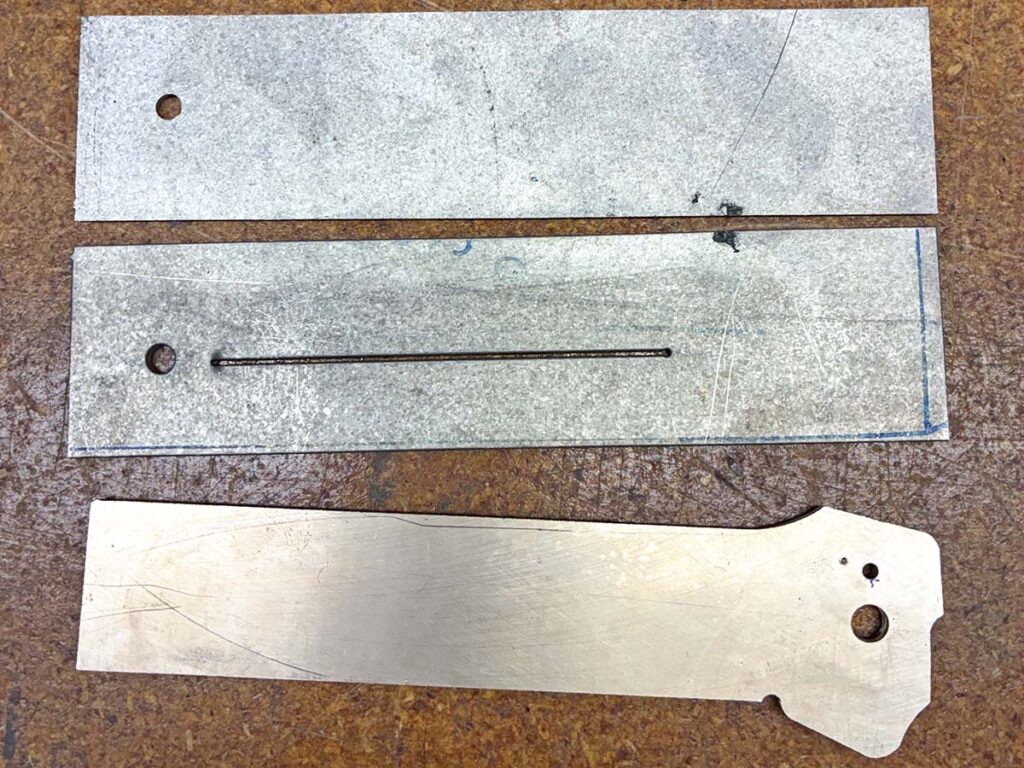
Bob Terzuola was a pioneer in using lasers and waterjets in his manufacturing process. Among the efficiencies he incorporated in using these tools was cutting what he calls “coupons.” These are simply uniform blade blanks and liner sections. Keeping a load of these on hand speeds up the manufacturing process, while maintaining the integrity of the knife. (Bob Terzuola image)
Known as the “Godfather” of the tactical folding knife, Bob Terzuola has been a full-time maker since 1980 and was inducted into the Cutlery Hall of Fame in 2023. His longevity in the craft stems from a blend of old-school design and modernized production efficiency. Terzuola was a pioneer in the mid-’80s, becoming the first maker to utilize laser cutting for components. Today, he uses waterjet cutting to create generic rectangular blade blanks and liner sections, which he calls “coupons.”
For the blade blanks, Terzuola profiles the rear area with the lock face, thumb ran and pivot/stop pin holes (roughed to 80 percent diameter). The rest remains rectangular, allowing him to incorporate any pattern with minimal grinding. Bob has his CPM 154 stainless steel blanks commercially surface ground to 0.135-inch before heat-treating them himself to HRC 59. For the liners—0.080-inch titanium in our discussion—the coupons are left square, containing only the pivot hole and the horizontal slot for the locking spring arm.
Notably, Terzuola grinds his blades after they are hardened. He argues grinding annealed steel can lead to warping during heat treat and causes the belt to gouge material. Grinding hardened steel, by contrast, is like slicing meat with a razor blade rather than digging dirt from a hole. Despite these modern efficiencies, he said he remains a “pencil-and-paper guy,” eschewing CAD for hand-drawn patterns to maintain design commonality.
Finishing Simplified
Despite modern efficiencies Terzuola has incorporated into his manufacturing process, he remains traditional in his designs. That is, he avoids CAD, instead using pencil and paper to hand-draw all of his knives. (Bob Terzuola image)
Bob’s finishing process for CPM 154 is remarkably lean. He utilizes a 90-durometer smooth-face rubber contact wheel and a simple two-belt sequence. First, he does a rough grind with an 80-grit ceramic belt, then finishes with a 3M Trizact A16 (1,200-grit) belt. He specifically avoids 60-grit belts, noting that their mesh size is twice as large as 80-grit, creating scratches that are twice as deep and significantly harder to clean up. To ensure blade-lock longevity, he now uses a heat-treated 440-C stainless steel insert in the titanium spring arm. This provides a steel-on-steel lockup, eliminating the wear issues common with titanium.
For New Makers
Terzuola encourages beginners to find their own niche and not get locked into a single model. He emphasizes mastering the fundamentals with hand tools: learn to tap holes, use files and sharpen twist drills. He and I agreed, new makers should also gain proficiency with mills, lathes and surface grinders to be old-school efficient rather than purely CNC-reliant.