

Mortised handles and excellent accidents.
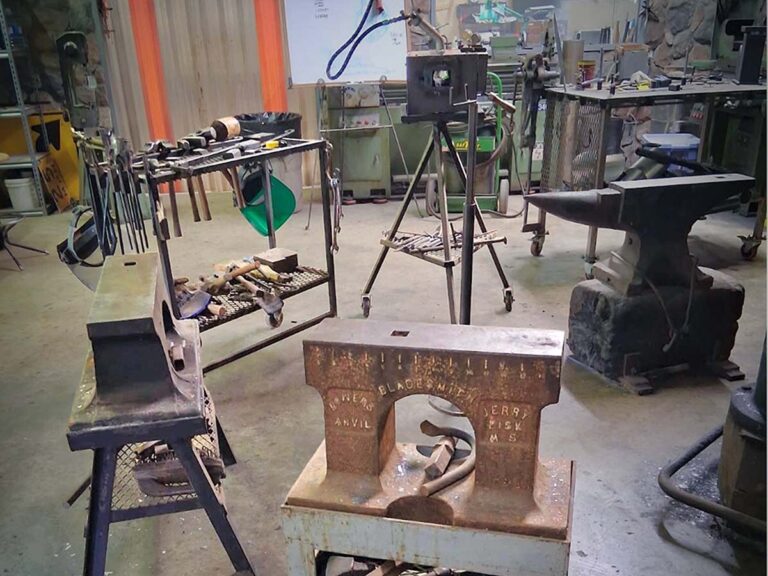
This issue highlights the expertise of the national living treasures, Jerry Fisk and tactical maker Shane Sibert. Their insights focus on the construction of mortised-style handles and the professional mindset required for success.
Getting A Handle
A trailblazer and visionary since becoming the 17th ABS master smith in 1989, Fisk’s philosophy centers on the idea that a knife isn’t just an art piece; it is a tool that must survive the most extreme (and sometimes bizarre) conditions.
To this mindset, the mortised handle has served him well, consisting of two flush-matching scales equally inletted to create a tight pocket for a hidden tang, then positioned directly against the guard. He mechanically secures the scales by pins or screws with epoxy. Fisk prefers this method because it offers the profile of a full-tang knife incorporating a narrow-tang guard.
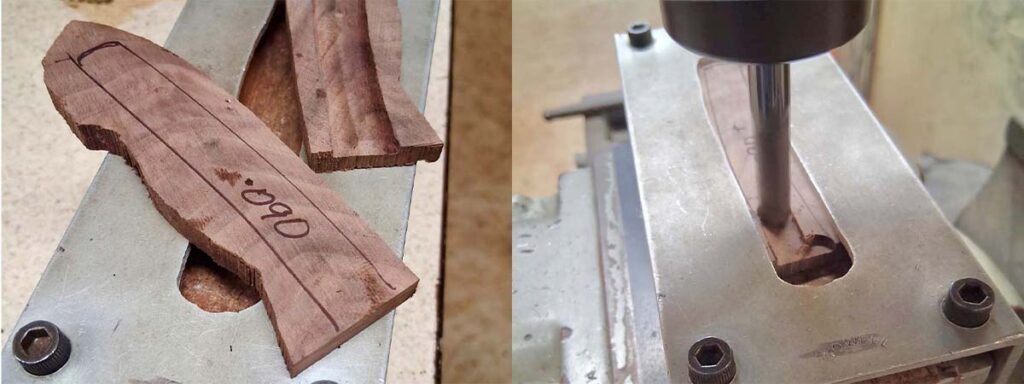
- Precision Prep: Grinding a tang taper aids in fitting the slip-on guard. Radiusing blade corners and edges prevents stress fractures in the handle. Fisk routs cavities along the tang outline to a depth of 0.004 inch beyond half the tang’s thickness.
- The Dovetail Secret: Using a Dremel to undercut the inner corners of the handle cavities creates a “mechanical lock” for epoxy, strengthening the bond significantly like an internal pillar.
- Mechanical Retention: Fisk advocates for screws over pins to provide superior clamping force.
- Minimal Epoxy: Epoxy should act as a sealer and secondary bond, not as a structural gap-filler. Using as little epoxy as possible is key.
Destruction Testing
Fisk’s designs are forged through failure. After a customer drove a cement mixer over his knives—finding that only the mortised handles survived versus narrow tang—the value of testing was clear: If you don’t test, you won’t know your knife’s limits. In his first year, Fisk sacrificed 54 knives to find their failure points. And he continues to utilize a panel of professionals (trappers, police and military) to vet designs for real-world skinning, tactical and survival use.
Press Fit Guards
Fisk treats the guard as a structural component rather than just decorative. In turn, he goes the extra mile in their construction. Despite having a milling machine, he file fits the guard slot by feel—practiced precision to ensure a seamless transition. He believes retention should never rely on solder or epoxy—these seal but do not hold. Fisk hammers the guard into place using a slotted Micarta block to ensure a true mechanical fit. And he uses JB Weld to seal seams, noting its robustness and machinability compared to standard epoxies.
Business Of Bladesmithing
Fisk warns that many makers fail by focusing 100 percent on the steel while ignoring the sale. To be a full-time maker, you must understand how to move product. Fisk emphasizes that marketing is often the missing element in a maker’s strategy. Without it, you risk becoming the primary collector of your own work.
At shows, you are the brand ambassador for your knives. Stand up and make eye contact. Sitting down signals a lack of energy. Further, your attire and interaction should reflect the quality of your blades. Buyers are purchasing you as much as they are the knife.
For Jerry Fisk, his philosophy as to why he makes knives captures the legacy of a master smith—every hammer blow is a permanent record of existence. A well-crafted knife serves as a testament to the maker’s life and skill, surviving long after they are gone.
Technical Signature Features
Shane Sibert has been a full-time maker since 1994, building innovative fixed-blade and folder designs for hostile environments.
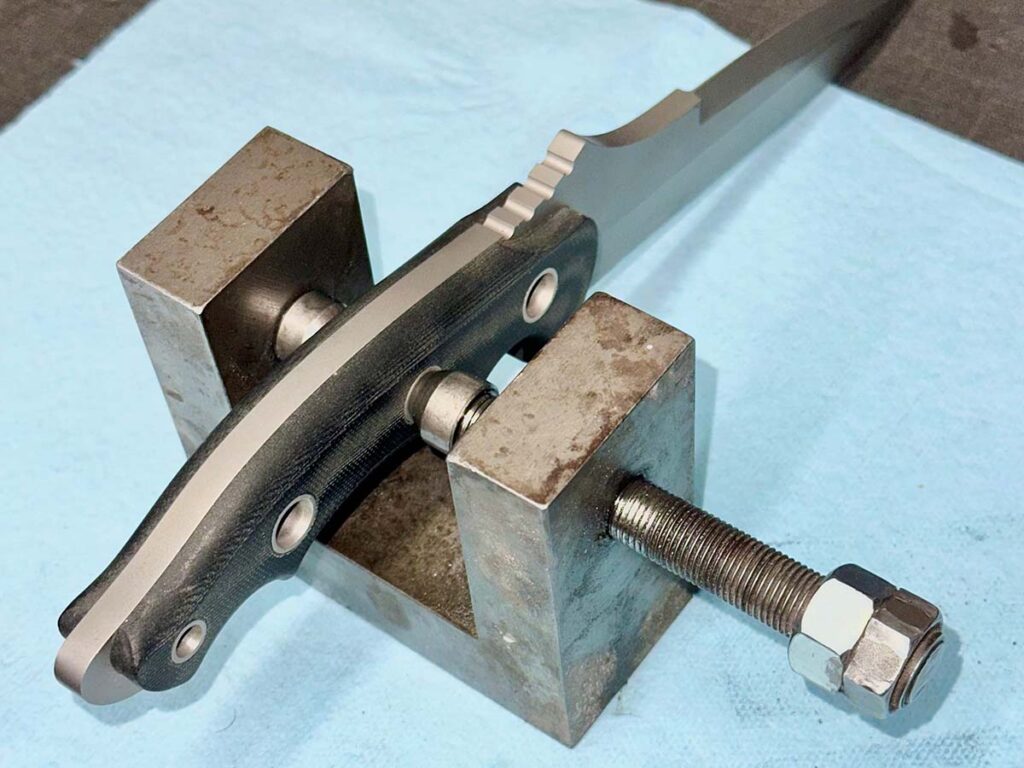
Inspired by my use of 3/8-inch tubing as a signature design element in my SEALTAC™ fighting knives, Shane wanted to do a similar feature—but with a different twist: a mortised-style handle with flared 3/8-inch Grade 2 seamless titanium tubing.
- The Problem: Straight-walled tubing can allow for handle-scale separation over time.
- The Preparation: Use a single-flute tapered reamer to create a shallow flare in the handle material.
- The Solution: Use a custom jig to compress and flare the extended tubing into that taper to create a mechanical rivet effect that sandwiches the mortised scales to the tang.
Accidental Pivot Accent
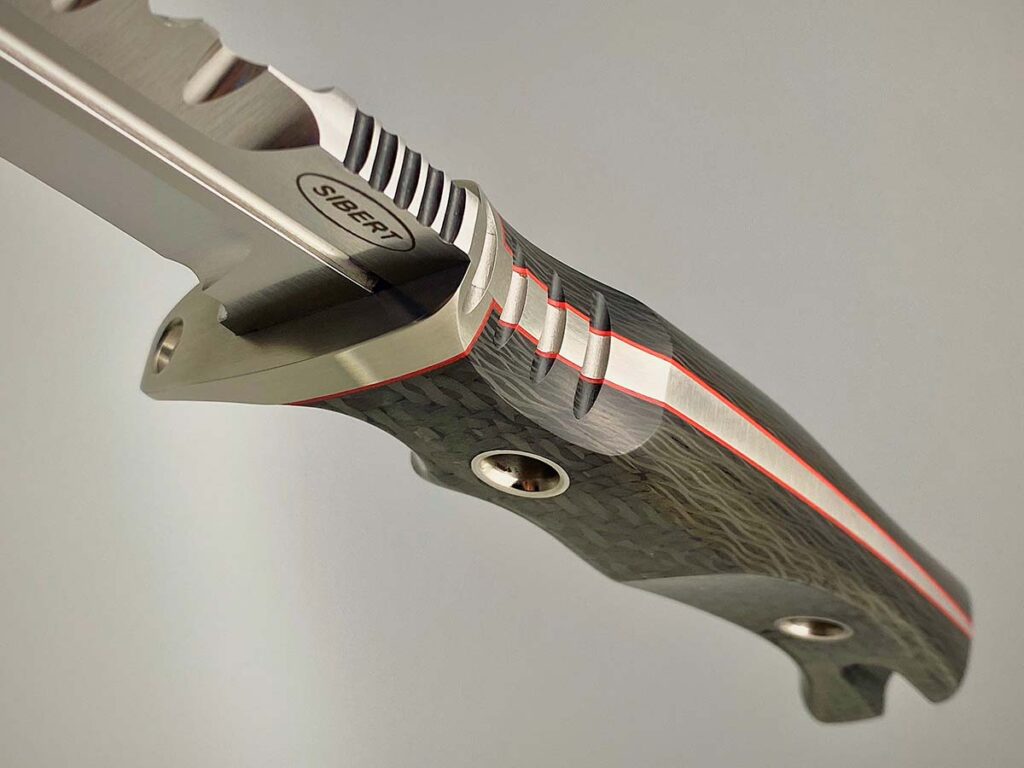
Born from a mistake (drilling a pivot screw head hole too large), Shane pivoted by creating ½- to 5/8-inch bottoming pocket inlays around it. For aesthetics, he uses contrasting materials around the pivot-pin head. Further, he uses a decorative blind pivot screw on the obversed side with an embedded disc of color, hiding the mechanical nature of the fastener.
Famed sole-authorship folder maker Harvey McBurnett once said, “Knifemaking is the fine art of camouflage,” when amending such mistakes. Shane did so in a creative way, born out of necessity.
Another example of this is Shane adds accent fuller grooves on both folders and fixed blades that extend back underneath the handle or guard. The challenge is on fixed blades, where this creates a gap where the guard meets the fuller. His fix is to use black JB Weld epoxy to seal the transition, ensuring a seamless look that maintains the illusion that the fuller vanishes into the hilt.
Getting Off The Ground
Sibert has a grounded, no-nonsense perspective on entering the craft. He suggests that new makers don’t over-invest in high-end machinery immediately. Instead, focus on development and growth first. They also need to get ready for the grind; knifemaking is dirty, repetitive and requires immense discipline. It isn’t always “glamorous” shop work. Dedication is non-negotiable. If you want to be good, you have to be obsessed with the details. And starting out, keep your day job! The pressure to pay rent often stifles the creativity needed to make world-class blades.
Shane is old school with modern touches in his approach to knifemaking. That is the basis for the beauty in his knives.
Read More:
- Japanese War Swords Part
- Scottish Swords: Cold Steel And CAS Iberia’s Tartan Edge
- Scissor Sword: Scissor Maven Grace Horne’s Prized Collectable
- Master Bladesmiths Showcase Their Best Long Swords
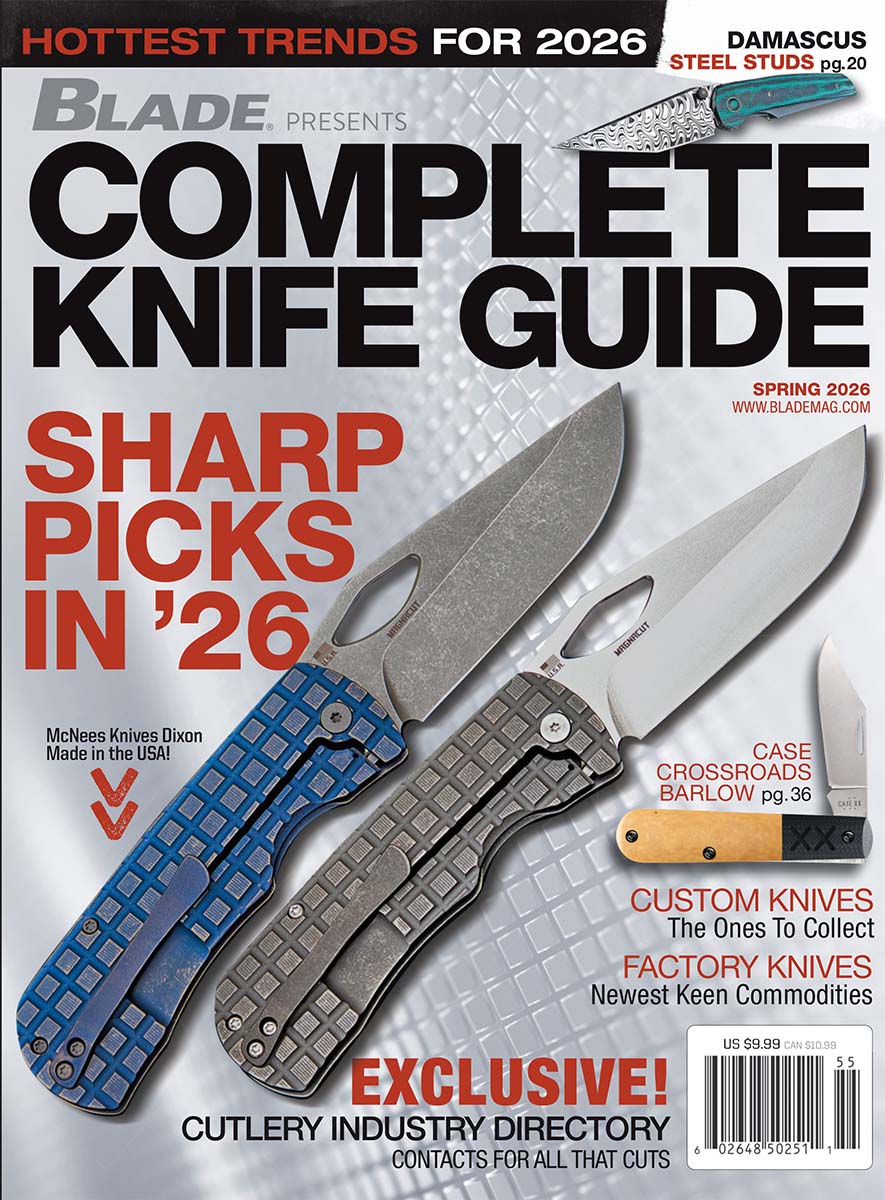 NEXT STEP: Download Your Free KNIFE GUIDE Issue of BLADE Magazine
BLADE’s annual Knife Guide Issue features the newest knives and sharpeners, plus knife and axe reviews, knife sheaths, kit knives and a Knife Industry Directory.Get your FREE digital PDF instant download of the annual Knife Guide. No, really! We will email it to you right now when you subscribe to the BLADE email newsletter.





