Home Authors Posts by Joe Kertzman

Joe Kertzman

DMT Brings You: Two Ways to Sharpen Your Hunting Knife

As every hunter knows, a hunting knife needs proper care, and there are countless methods for sharpening a hunting blade, depending on how the knife is used in the field or on the trail. The experts at Diamond Machining Technology (DMT) have composed a “how to” article below to help knife users understand which sharpening techniques are best for different hunting-knife tasks. If you enjoy the below, you’re also certain to like: “Sharpen a Knife & Care For Your Collection.”

Two Ways to Sharpen Your Hunting Knife

By Stan Watson

The hunting knife, whether the folding or fixed-blade type, is an invaluable tool for hunters since its hard, strong steel blade is made for cleaning and butchering game. But, truth be told, many outdoorsmen like to carry a hunting knife as an all-purpose cutting tool. So, when you think about the best way to sharpen your hunting knife, first think about how it will be used.
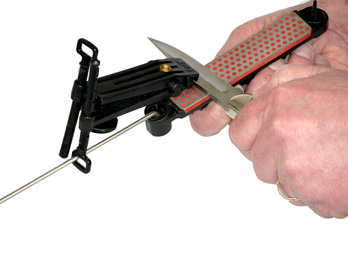
If you plan on using the blade for gutting and field dressing animals, you need a razor sharp blade. The hide of an animal is tough and you want your knife to make easy, smooth cuts through the skin and muscle. To get that result you want to sharpen at a shallower angle.

I always recommend manual sharpening on a diamond stone, because it removes only the necessary amount of metal—protecting your knife and prolonging its life. With diamond stones from DMT Diamond Machining Technology, you never need oil. If you want to moisten the stone, you can use water, but it’s not necessary. Start with a coarse grit diamond stone and, holding the knife so the blade meets the stone at a 20- to 22-degree angle, stroke the blade with modest pressure across the stone six or eight times; then change direction (if you began by stroking away from you, switch and carefully stroke the blade towards you using the same motion). Diamond stones sharpen blades quickly, so there’s no need to rush your strokes. Take the time to handle your blades and edges in a safe manner.

Once you’ve finished with the coarse grit, move on to a fine grit and repeat the process. Then, to get the razor edge you need, give the blade a few strokes along an extra-fine grit. Remember, the finer the grit, the lighter your strokes should be. The result will be a blade that has a straight, true sharp edge for cleaner cutting and dressing.

For those of you who like the feel and performance of a hunting knife, but want to use it as an all-purpose cutter, you don’t need the razor sharpness that comes with an extra-fine grit stone and a shallow sharpening angle. It’s better to have a micro-serration on the blade.

To get that result, use just a coarse grit diamond stone and hold the knife so the blade is at a steeper angle, about 24 to 28 degrees. This will give your blade greater strength to stand up to tough cutting tasks. A surface with tiny serrations allows the blade to work in a sawing motion—unlike the straight razor-sharp cuts you need when gutting a deer, for example.

Whether you’re a pro or novice hunter, it can be hard to maintain a precise and consistent angle throughout the sharpening process. One solution is DMT’s Aligner Blade Clamp, which provides for guided sharpening to help you set and keep the correct angle for the task at hand. The Aligner is easy to use, offers seven-angle adjustability and accommodates wider and thicker blades. Plus, the clamp won’t damage your blades.

A well-made hunting knife can last for years, especially if you keep it sharp. With diamond sharpening stones from DMT, you will be able to quickly, simply and safely get the edge that keeps your knife working to its fullest potential.

Stan Watson is the technical director for Diamond Machining Technology, manufacturer of a full line of Made in the USA diamond sharpening tools for use in woodworking, camping, fishing, hunting, outdoor and winter sports, culinary arts, gardening, police/security and industrial applications. He is the holder of 11 engineering patents in the sharpening industry. He can be reached at [email protected].

If you enjoyed the above, you’re also certain to appreciate: “Sharpen a Knife & Care For Your Collection.”


Introduce Young People To Knives

The American Knife & Tool Institute (AKTI) takes its job seriously of promoting understanding and cooperation within the knife industry, as well as among those who simply utilize mankind’s oldest tool. In acknowledgment of that role, the organization presents a series of informative articles appearing on its website, www.akti.org, detailing the knife owner’s experience.

The first of the series gives tips and advice on introducing young people to knives.  “I was always taught that the age of reason was seven, which is also Cub Scout age, when I got my first knife.  Safety was always stressed, and supervised use of a knife is a must.  Also, one must insist that the knife never be taken to school no matter how much you want to show it off,” commented Dan Piergallini, President of the Gator Cutlery Club.

Along with Piergallini, AKTI Executive Director Jan Billeb, Becky Reid of Shepherd Hills Cutlery, and legendary knife dealer A.G. Russell provide insights into their experiences in promoting knife safety, awareness, respect, and proper use among young people.   

Pictured at left, A.G. Russell shares with a friend.  Photo courtesy A.G. Russell Knives.

“We are excited to bring these informative articles to AKTI members and knife enthusiasts everywhere through our website,” remarked Billeb.  “Introducing knives to the next generation is a key element in promoting their safe use and increasing the understanding of knives as valuable tools that are important in our everyday lives.”

To read the article on Kids and Knives, visit www.akti.org/education/kids-and-knives.


Nat Geo’s Lords Of War Features Knifemaker Larry Harley

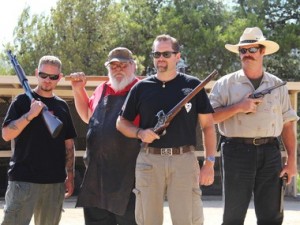
The National Geographic Channel’s Lords Of War program features knifemaker Larry Harley as an antique knife and edged weaponry expert. Lords Of War focuses on historic weaponry as depicted by a team of experts that travels across the country in search of the best in antique weapons and militaria. The experts allow you to relive history as they test, assess and auction the bounties of war. 

Larry “Hammer” Harley, as he’s called, second from left in the photo, is quoted by Nat Geo as saying, “I haven’t worked a day in my life.” A third-generation bladesmith, he began experimenting with steel, thanks to the influence of his grandfather, at a young age. During hunting season, he hunts wild hogs, and during the hunt, uses knives he has fashioned. In the summer, he teaches children about the craftsmanship of knifemaking. This is his passion, being more enthusiastic about making knives than most people are about anything. 

The all-new series, Lords Of War, debuts January 23rd at 9 p.m. and 9:30 EST on Nat Geo.

Knife Rights-Sponsored Pro-Knife Bill Filed in Indiana

Starting off the New Year right, Indiana State Senator Jim Tomes has forwarded Senate Bill SB181, a Knife Rights-sponsored, pro-knife bill that would repeal Indiana’s outdated ban on the sale and possession of switchblades and automatic knives. The bill is co-sponsored by Senator Brent Steele, Chair of the Corrections, Criminal and Civil Matters Committee that will hear the bill, and Senator Johnny Nugent.

SB181 is identical to an earlier bill that was passed overwhelmingly last session in the Senate by a bipartisan vote of 46-1. It, however, was bogged down in election year politics and never heard by the Indiana House. There are high expectations that it will pass this year.

If you live, work or travel in Indiana, please contact your Senator and ask them to support SB181. Click here to locate your Senator.

Golden Engraving Highlights Favorite Folder

0

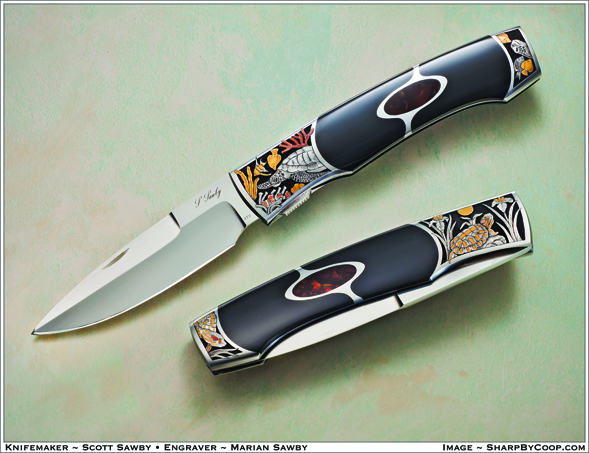
Honestly, it’s not difficult to choose the “Editor’s Favorites from the Knives 2013 Book,” not because there are only a couple dozen great knives in the publication, but instead they’re all incredible (at least to this humble editor), so how could one go wrong? Such is the case with a sea-worthy locking-liner folder from the hands and genius of Scott Sawby and his favorite engraver, wife Marian.

Llannoite Proves Inspired Knife Handle Choice

Bill Keller custom knife

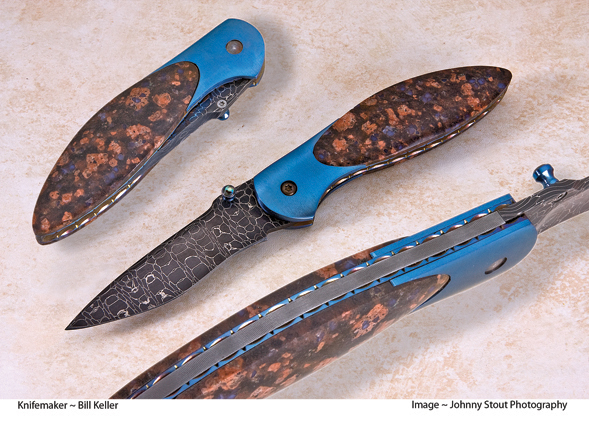
OK, take off the dirty shop apron, remove the safety glasses, and go to the workbench and pull out the notepad and pencil. Now, add Llannoite to the list of incredible knife handle materials available to honest, hardworking knifemakers across the land. While you’re at it, add the Bill Keller locking-liner folder to the list of “Editor’s Favorites from the Knives 2013 Book.”

Knifemaker Bill Keller not only saw the brown hues within the makeup of Llannoite, but the blue, as well, and brought it out nicely through the use of blue-anodized bolsters and liners. Each complements the Chris Marks “lizard-skin”-damascus blade, filework and inlaid blued-titanium thumb stud. (Johnny Stout photo)

A Presentation Dagger Fit for a Commanding Officer

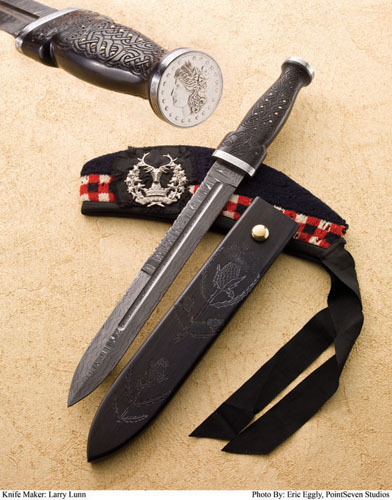
There are knives and then there are presentation daggers that would look right at home in a general’s belt sheath, sash or shoulder sling. Larry Lunn’s interpretation of a Scottish officer’s dirk showcases a carved-ebony handle in a Scottish modified-knotwork-style motif, an engraved guard, silver dollar pommel (literally) and a foot-long damascus blade. It stands up, salutes and qualifies itself, volunteering actually, as an editor’s favorite from the Knives 2013 book.

Advertisement

Must Read Articles

Read this before you make a knife

Knifemaking 101 – Read This Before You Make a Knife

  by Wayne Goddard My experience has taught me that there's nothing like digging in and getting started. I've often said the hardest part of the...
how to forge damascus steel

How to Forge Damascus

Advertisement
Advertisement