



The private equity company, Black Orchid Equity, LLC (a South Dakota company), has acquired the assets of Moteng and has plans to grow the company’s volume dramatically. “We are thoroughly capitalized and in the process of doing three things – stocking up on inventory, selling at the most competitive prices allowable and becoming the largest knife distributor in the country,” says Blake Whitney Thompson, one of the new owners. The new owners of the company, based in San Diego, plan to use Moteng as a platform to acquire other distribution companies in the industry and to fund/invest in certain manufacturers that they represent.
Moteng has launched its new look at www.Moteng.com <http://www.Moteng.com> and plans a major dealer/vendor show in the fall for all of its customers.
Black Orchid Equity Buys Moteng
Inspired By William Scagel? These Knives Were
Inspired by pieces designed and made by BLADE Magazine Cutlery Hall-of-Fame® member Bill Scagel, the grandfather of the custom knife industry, the Scagel Knives brand includes a line of production/factory knives in the style of Scagel. This superior style of knife design can be seen in this fantastic Sambar Stag Hunter.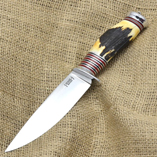
The specifications of this outstanding knife:
- Overall Length: 10.125″
- Blade Length: 5.5 Inches
- Blade Steel: A-2 @ 58rc
- Blade Thickness: .217 Inch
- Weight: 7.5 oz
- Convex Ground
To get your Scagel-style hunter, go to: http://www.shopblade.com/scagel-knives-hunter-sambar-stag-u1216?lid=bljkbl060612
Others in the line include a Scagel Knives “Medium Bowie” and “Medium Hunter – O Style.”
How To Build a Survival Shelter
The following is excerpted from a feature article by James Morgan Ayres that ran in the April 2013 issue of BLADE® Magazine.
Over 90 percent of wilderness deaths by mischance are caused by hypothermia. Knowing how to build an emergency shelter quickly can mean the difference between freezing to death and surviving. You can build a survival shelter that offers protection from cold and snow or rain in no more than 30 minutes, and with only the tools at hand—which is where knives can make the difference in getting the shelter up before it is too late.
5 Keys to An Emergency Shelter
1) Evaluate your situation and decide if you need to spend the night out before it gets so dark you cannot see to build a shelter; 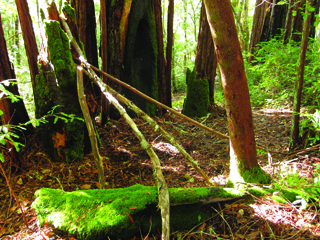 2) If available, select a level spot that provides natural shelter—a large tree or boulder, for example. Barring that, choose a place that has building materials such as saplings or brush nearby; 3) Build a framework using the natural shelter as a base; 4) Cover the framework with branches, leaves, brush and whatever materials are available. If possible make the covering 6 inches to a foot thick; the thicker the covering, the better the insulation. If you are in an area where there are limited building materials, having a reflective blanket in your pocket could be a lifesaver. It weighs only about 3 ounces, is no larger than a handkerchief and can make a difference of up to 20°F, and; 5) Cover the floor with six-to-12 inches of leaves, pine needles, duff (decaying leaves and branches), or whatever is available for insulation. Leave the area near the entrance clear of debris. After making the cleared area safe for burning small pieces of kindling, build a small fire in it. The fire should be no larger than a soup bowl.
If you are properly dressed for the climate, you can spend the night in such a shelter with a tiny fire not only safely but also comfortably. Having the know-how to build the shelter is critical. Having a good knife can make building the shelter quick and easy.—by James Morgan Ayres
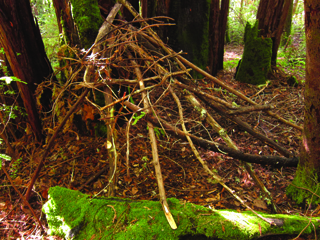 Author’s note: The shelter in the photos using pine boughs was built in a national park, not a true wilderness area. We were required to “leave no trace” and return everything as it was. Therefore, we did not thatch the roof nor build up the floor with boughs and leaves as described in the text, as you would in a survival situation.
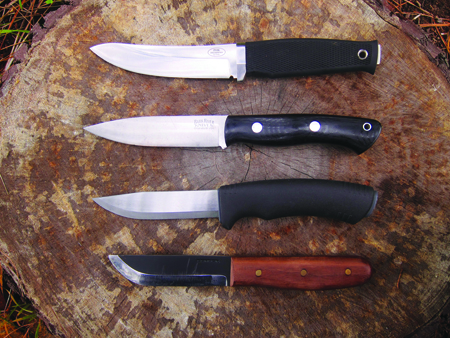
My associate and I used and evaluated four very different knives to construct two survival shelters. The review knives fall into two categories. The Mora and Condor both have ‘Scandi’ grinds and are economical. The Bark River and Fallkniven have convex grinds and are priced like the premium knives they are. 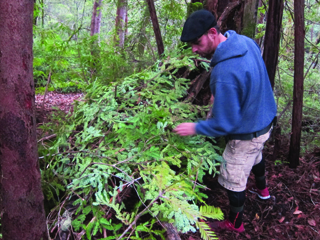
CONDOR BUSHCRAFT
The Condor Tool & Knife Bushcraft Basic Camp Knife has a comfy wood handle, a 4-inch blade of 1075 carbon steel with a lot of belly, and a full tang. When driven into a tree it was strong enough for a 200-pound guy to do a pull-up on; we tried it, no problem. The belly of the black-epoxy-powder-coated blade proved its worth in general use, but a little more tip would have been welcome. In knife design everything is a compromise and this is a good one. The welted leather sheath holds the El Salvador-made knife securely and is unusually nice for a package in this price range ($34.98 MSRP). 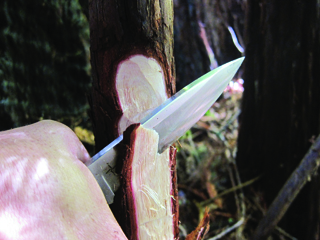
BARK RIVER AURORA
The Bark River Aurora ($239 MSRP) is Bark River honcho Mike Stewart’s personal design for an all-around bushcraft knife. The American-made fixed blade displays excellence in design and use. The convex blade of A2 tool steel provides easy, controllable push cuts, supports the edge for batoning, gets into a cut aggressively, and has a centerline point for precise control. The handle is ergonomically contoured, does not slip and is comfortable in hard use. The balance is so good and the 9.5-inch knife feels so lightweight and quick that it seems to weigh less than the specs (6 ounces) would indicate. The pouch-type leather sheath is handsome, secures the knife well, carries comfortably and has a loop for a firesteel.
I suspect the Aurora has a reserve of strength that we did not come close to tapping in our review. Though not billed as one, I think the Aurora is an excellent choice for a wilderness survival knife. 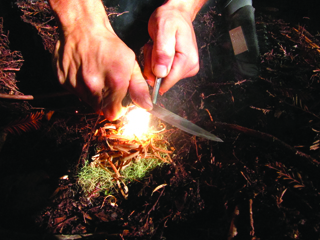
MORA BUSHCRAFT
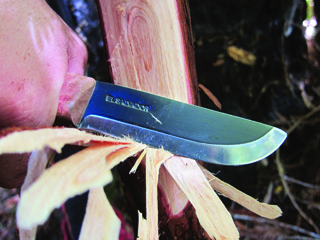
Made in Sweden, the Mora Bushcraft Survival Knife ($57.95 MSRP) comes with a firesteel and diamond sharpener—both valuable tools—in a composition sheath. The thick, 4.25-inch blade sacrifices nothing in slicing and wood-shaving ability. It has a good, usable point and is strong enough for batoning. The handle is very comfortable. The knife popped out of the sheath, which was worn on a belt, while we were jumping over a log. A cut or the loss of the knife could have resulted.
FALLKNIVEN PHK
Fallkniven markets its Professional Hunter (PHK) as “one of the best hunting knives in the world.” It is also a very good all-purpose bushcraft and survival knife. The convex grind and long, curved edge combine to make a strong 5-inch blade of 3G steel that just wants to cut. It batons well, makes good push cuts and snap cuts efficiently on small branches. It would even do a little light chopping, though no knife this size (9.4 inches overall) can be an efficient chopper. The PHK’s nonslip Thermorun™ thermoplastic handle is comfortable in any grip, even during hard use.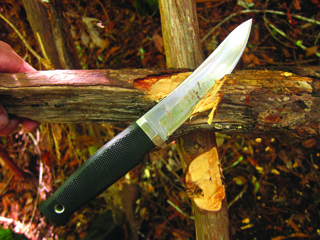
Made in Japan, the knife offers a choice of a leather or Zytel® sheath. I much prefer the leather one since the Zytel sheath must be snapped to secure the knife, as we learned when the knife fell from the unsnapped sheath while we were running. MSRP: $470.
HOW THEY FARED
In general, we found the knives with the Scandi grinds to be somewhat better for fine woodwork, such as making fuzz sticks, while the convex-ground blades cut more efficiently and with less drag in deep cuts. All the knives’ handles were comfortable and did the job. On the other hand, each knife had its own character and pros and cons.
The Bark River was everyone’s all-around favorite, and if there had been a prize for most handsome, it would have won. The Fallkniven displayed the high level of function for which the brand is known, and clearly had enough reserve strength to serve as an urban destruction tool. The standard Mora is a good all-around bushcraft blade at a very low price. It is a bit stronger than other Mora models we have seen, and the inclusion of a firesteel and diamond sharpener produces a very nice package. However, the sheath needs work—otherwise you had better use duct tape to secure the knife, as we did. The Condor brings a welcome alternative to the bargain-priced market and stands on its own merits as a strong, efficient choice for the bush.
The premium-priced Bark River and Fallkniven exhibit higher-quality construction and did almost everything better than the less expensive Mora and Condor. Nonetheless, the difference was a matter of degree. All would serve to build a shelter and produce firewood, and maybe save your life.
SOG Tools Featured On Discovery Channel
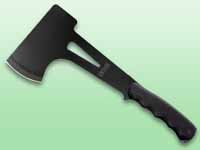 SOG® Tools was featured on Discovery Channel’s Unchained Reaction, a new show from the hosts of MythBusters.
The hosts chose SOG to be part of the Jack of All Trades episode, which originally aired April 15, 2012 at 10 p.m. EST.
Unchained Reaction is a new series executive produced and judged by Adam Savage and Jamie Hyneman of MythBusters. The show pits two teams of varying backgrounds against each other to build an elaborate chain reaction contraption. In this Sunday’s episode, a team of designers and a team of construction workers square off to build the most impressive multi-step machines using the theme of “tools.” SOG provided the teams with a wide array of tools to use during the episode, including the Hand Axe, Double Headed Axe, FastHawk, Tomahawk, Pocket PowerPlier, PowerLock and the PowerAssist.
SOG was founded in 1986 by Spencer Frazer, a former R&D tool and die maker for the Top Secret Black Projects Division of the aerospace defense industry. SOG’s name was inspired by elite joint services military unit – the Studies and Observation Group – formed in advance of the Vietnam War to conduct covert operations and authorized to develop and purchase their own weapons.
Click here to browse BLADE-approved knives and tools at ShopBlade.com.
Llannoite Proves Inspired Knife Handle Choice
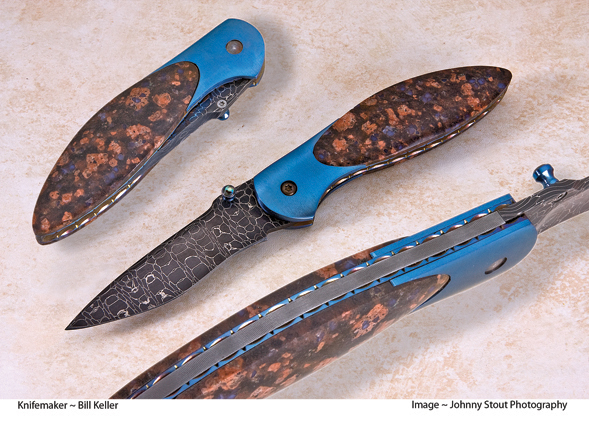
OK, take off the dirty shop apron, remove the safety glasses, and go to the workbench and pull out the notepad and pencil. Now, add Llannoite to the list of incredible knife handle materials available to honest, hardworking knifemakers across the land. While you’re at it, add the Bill Keller locking-liner folder to the list of “Editor’s Favorites from the Knives 2013 Book.”
Knifemaker Bill Keller not only saw the brown hues within the makeup of Llannoite, but the blue, as well, and brought it out nicely through the use of blue-anodized bolsters and liners. Each complements the Chris Marks “lizard-skin”-damascus blade, filework and inlaid blued-titanium thumb stud. (Johnny Stout photo)
Kershaw Signs On for a Rough Ride

You can take that headline literally. Kershaw Knives has become a premier sponsor of the Professional Rough Stock (PRS) series. Most folks are aware that professional bull riding is among the fastest growing sports in the United States, yet some rodeo fans can’t get enough, and are looking for even more excitement. That’s where the Professional Rough Stock (PRS) Series comes in. 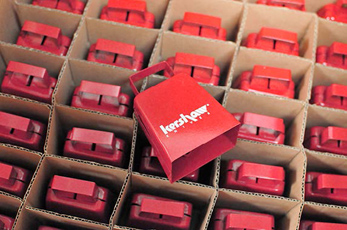
In addition to bull riding, Professional Rough Stock incorporates bareback and saddle bronc riding—yes, you read that right, BAREBACK and saddle BRONC riding. The combination of events gives rodeo lovers more variety and more heart-pounding thrills.
Kershaw Knives, a brand of Kai USA Ltd., has recently signed on as a major sponsor of the 2013-2014 PRS season. Founded by Pete Kershaw in 1974, Kershaw Knives was born on the Officer Ranch in eastern Oregon and boasts a proud cowboy tradition.
“Sponsoring Professional Rough Stock is a natural for Kershaw,” said Thomas Welk, Director of Sales and Marketing, Sporting for Kai USA. “Every rider, every cowboy and cowgirl, and every PRS fan needs a good knife; they need a Kershaw.”
The Kershaw Kowbells (left), are ready for the next PRS event.
At each PRS event, a group of lucky PRS attendees will find themselves sitting in the “Kershaw Korner.” Everyone sitting in the randomly selected Kershaw Korner will receive either a Kershaw Kowbell or Kershaw BamBam Sticks to help them cheer on their favorite riders. Kershaw will also be giving away logo t-shirts and several Kershaw Zing SS knives at each event.
Presence like this at nationwide PRS events, along with television coverage, social media promotions, and more made the PRS sponsorship attractive to Kershaw. “The athleticism of these rough stock cowboys is outstanding,” said Welk. “We’re proud to help bring the excitement of Professional Rough Stock to rodeo fans and families all across the nation.”
Televised PRS events begin airing on RFD-TV on Friday, May 3rd at 10:00 p.m. EST time, with replays on Sundays at 2:30 p.m. eastern.
Take A National Knife Museum Tour
Take a couple of minutes out of your busy schedule to relax and participate in a spectacular tour of the National Knife Museum housed in Smoky Mountain Knife Works. It’s a well-done, albeit homemade, video set to a couple of catchy tunes, and will definitely renew your energy and give you a fresh outlook on life, whether it’s to start or end your day. Enjoy! http://www.youtube.com/watch?v=ehSTQ03_ICE
Must Read Articles





