


Utility knives are among the most essential of kitchen cutters.
Food is life, and cooking is a vital part of your daily routine. Having the right tools can transform your kitchen experience, and kitchen utility knives are among the most essential. With the right one, even the toughest tasks can become a breeze.
Kitchen Utility Knives Defined
A kitchen utility knife is a versatile tool designed for a variety of food preparation tasks. Typically, it features a blade ranging from 4 to 7 inches, making it larger than a paring knife but smaller than a chef’s knife. It’s ideal for slicing, dicing and chopping a wide range of foods, such as vegetables, fruits and meats. The utility strikes a balance between precision and strength, allowing it to handle chores that require both detail and some heft. It’s a great all-around option for anyone looking to tackle everyday kitchen jobs efficiently.
Vero Engineering Utility 5
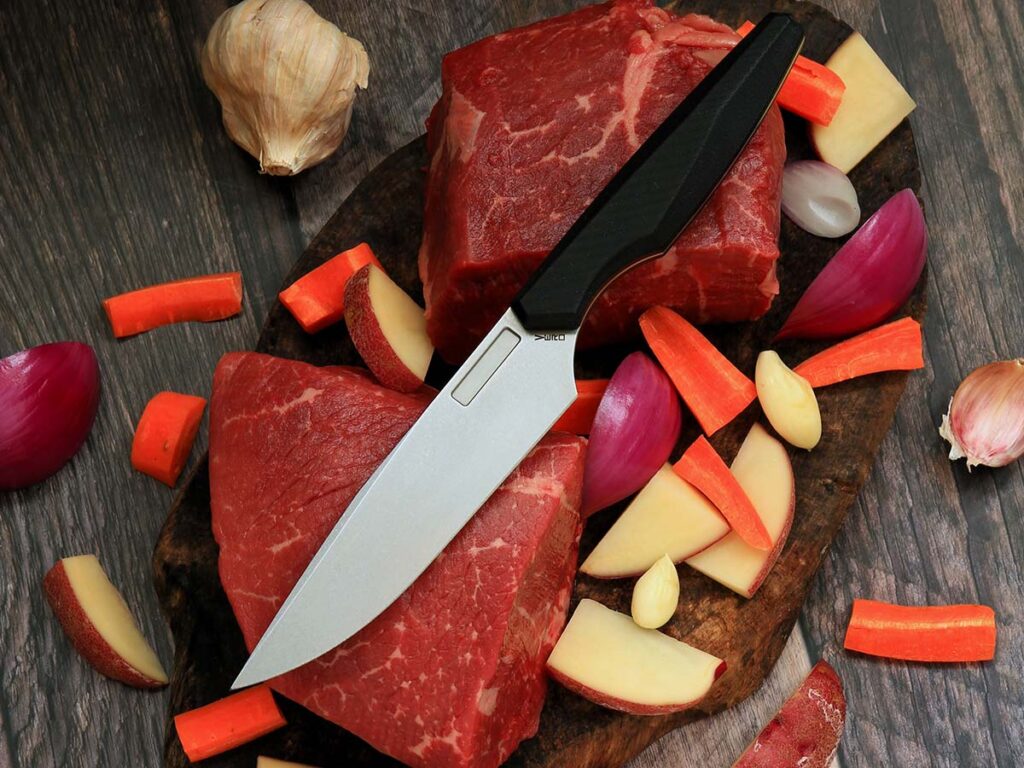
Utility 5 Specs
Blade Length: 5.27”
Blade Steel: Nitro-V stainless
Blade Grind: Full flat
Blade @ Thickest: .138”
Blade Finish: Stonewashed
Handle Material: G-10 black
Overall Length: 10.08”
Knife to know: Multiple options in blade finishes and handle materials
Country of Origin: China
MSRP: $174
The Vero Engineering Utility 5 doesn’t just show up—it sharpens your kitchen game with precision and style. The fixed-blade slicer offers excellent corrosion resistance and edge retention, making it a reliable workhorse for a wide range of tasks, from citrus to sirloin. The drop-point pattern and full flat grind give it slicing versatility, while a milled pocket on the blade adds grip and control for those who favor the pinch-grip life. At just 4.75 ounces it’s light in the hand but heavy on performance.
The handle options—black G-10, ebony or marbled carbon fiber—aren’t just aesthetic choices, they are also ergonomic, moisture resistant and designed for comfort across various grip styles. Blade finishes include stonewashed, belt satin and hand satin, allowing you to match your knife to your mood or your cutting board. Whether for preppers or perfectionists, the Utility 5 slices with purpose and looks good doing it.
At first, the Vero resembles a combat knife. And if you call slicing roast beef, potatoes, onions, garlic and carrots combat, then this blade is your trusty weapon of choice. It is designed to transform simple ingredients into a champion-worthy feast with accuracy and panache.
I sliced a hefty cut of beef roast and all the fixings. Root veggies are hard, so sharpness is key. The test knife had an excellent grind and an ultra-sharp blade, which puts less stress on the hand when cutting. It truly was a meat-and-potatoes meal, with carrots, onions and garlic. The handle remained slip-proof despite exposure to blood and vegetable juices. The steel never stained and at press time I had yet needed to sharpen this culinary champion.
Bradford 6-inch Utility Knife
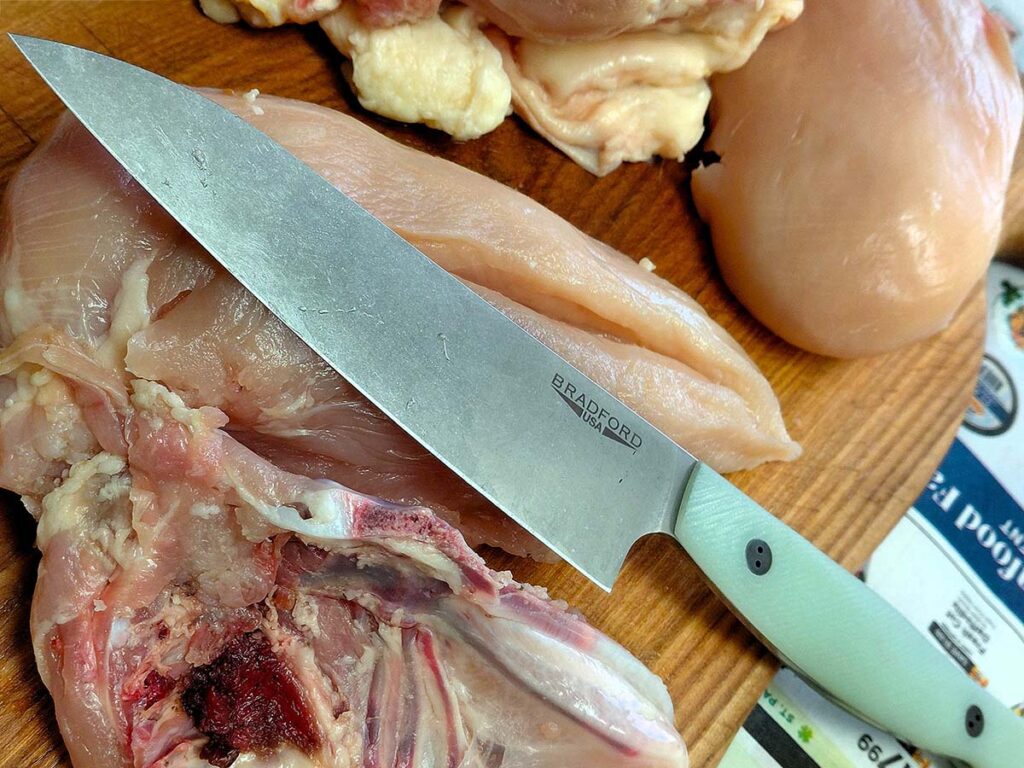
6” Utility Knife Specs
Blade Length: 6”
Blade Steel: MagnaCut stainless
Blade Grind: Full flat
Blade @ Thickest: .10”; distal tapered
Blade Finish: Satin stonewash
Handle Material: 3D microtextured
Overall Length: 11”
Country of Origin: USA
MSRP: $209
Bradford’s 6-inch Utility Knife slices through kitchen monotony with surgical precision and unapologetic style. Its CPM MagnaCut stainless steel blade has a Rockwell hardness of 61-to-63 HRC and delivers top-tier edge retention, corrosion resistance and toughness—ideal for everything from delicate herbs to dense proteins. The blade features a stonewash finish that hides scuffs like a pro, keeping your knife looking fresh even after a week of hard prep. Weighing just 5 ounces, it strikes the perfect balance between nimble and substantial and will fit in most kitchen blocks.
The ghost (light blue) handle is ergonomic, moisture-resistant and built to withstand heat, wear and long prep sessions without losing grip or comfort. Thin, full-tang construction keeps the profile sleek and strength solid. Meanwhile, the design makes it a welcome tool for lefties and righties alike.
This fixed-blade kitchen essential is proudly made in the USA and designed to feel like an extension of your hand—whether you’re dicing vegetables or breaking down wild game. It’s not just a knife, it’s a daily driver for the serious slicer.
I spend a lot of time in the kitchen, a big part of it prepping and freezing foodstuffs for later dates. Chicken and veggies get the most attention. I received the Bradford 6-inch Utility Knife at the right time. I had a large quantity of split bone-in chicken breasts that needed deboning and freezing. The idea of a utility knife is to be versatile. I stick to the rule of whatever’s on the cutting board gets used for everything. Hence, the Bradford was now a deboning knife.
The blade was nimble and the low 5-ounce weight glided through the protein with ease. I felt what the handle was all about and liked it. I trimmed the fat and extra unsavory bits using a variety of grips, mostly modified chef’s pinch grips. The wharncliffe-style blade was a huge help when drawing back for pinpoint slices.
The Bradford definitely fits the bill for a kitchen utility knife. From handle comfort, grind and overall design, this is your utility cutter for several occasions.
White River Knife & Tool Liong Mah
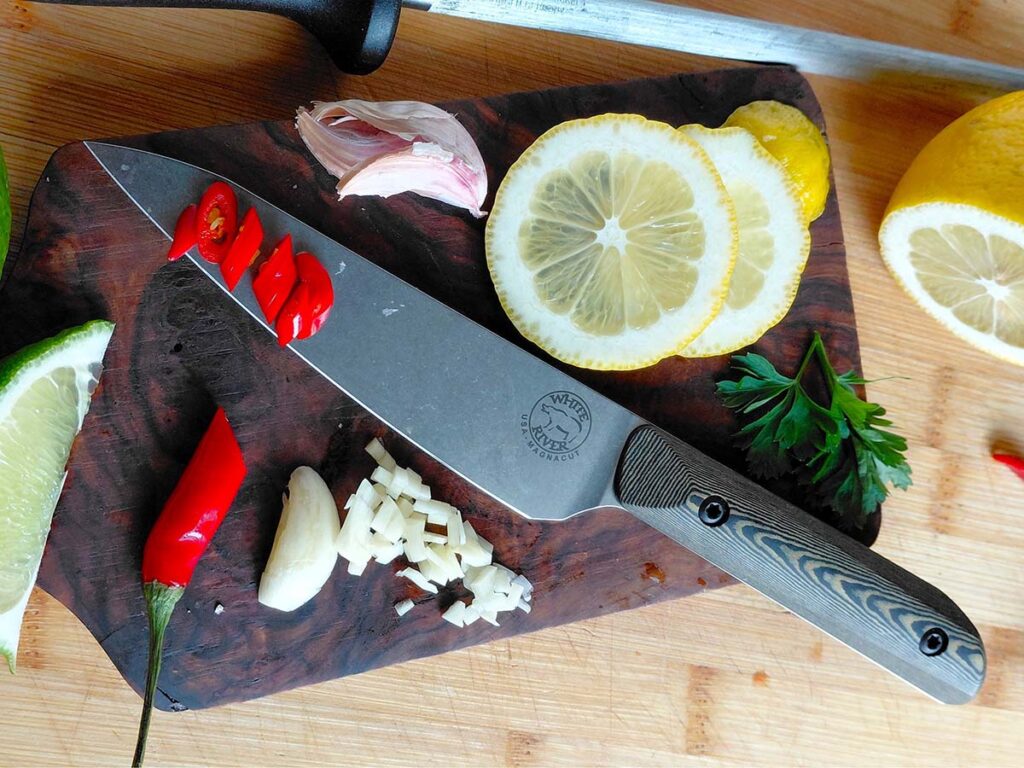
Liong Mah Utility Specs
Designer: Liong Mah
Blade Length: 4.75”
Blade Steel: MagnaCut stainless
Blade Grind: Full flat
Blade @ Thickest: .095”
Blade Finish: Satin
Handle Material: Maple Richlite
Overall Length: 9.12”
Country of Origin: USA
MSRP: $200 ($475 for it and the Liong Mah Chef Knife in a set)
The White River Knife & Tool Liong Mah series isn’t just household cutlery—it’s a chef’s dream set in MagnaCut. Designed by Liong Mah, a former New York City chef turned knife architect, these blades blend culinary intuition with precision engineering.
The smaller 3.8-ounce Utility Knife offers nimble control while the larger 6.2-ounce Chef Knife addresses the bigger stuff. Both blades feature MagnaCut at a Rockwell hardness of 62-to-63 HRC, delivering elite edge retention, corrosion resistance and toughness that scoffs at daily abuse. The modern handle tapers toward the blade for a natural, comfortable grip—ideal for vertical chopping and pivoting like a pro. Whether dicing shallots or tackling a brisket, these USA-made tools feel like an extension of your hand, packed in a custom wooden box that says, “Yes, I take prep seriously.” No sheath, no nonsense—just pure slicing satisfaction.
For small tasks like slicing cheese, limes and herbs, it doesn’t get any better than the Liong Mah Utility Knife. Brie cheese is soft, while garlic mincing takes precision and sharpness. However, fret not using the White River entry. For small kitchen tasks and the ability to share a cutting board with other food and garnish, it’s excellent. Hors d’oeuvres, anyone?
The Liong Mah Chef Knife was my pick for long sweeping slices for butterflying chicken breasts. I wanted the full length of a chef’s knife and was delighted with my pick for the task. It sliced with authority and made clean cuts.
CRKT Onion Utility Kitchen Knife

Onion Utility Kitchen Knife Specs
Designer: BLADE Magazine Cutlery Hall-of-Fame® member Ken Onion
Blade Length: 5.5”
Blade Steel: Damasteel damascus
Blade Grind: Full flat
Blade @ Thickest: .10”
Blade Finish: Acid etch
Handle Material: FatCarbon Dark Matter carbon fiber
Bolster: Titanium
Overall Length: 10.19”
Country of Origin: Italy
MSRP: $850
The CRKT Onion Utility Kitchen Knife in Damasteel® damascus isn’t just a kitchen tool, it’s a precision instrument dressed for a gala. Built in Italy, the fixed-blade beauty features a Damacore® Hugin-pattern blade with a finish that highlights the layered steel like a fingerprint of craftsmanship. It’s slim enough for finesse work but long enough to handle serious slicing. The synthetic handle and bolster help keep the weight featherlight at 3.3 ounces so it won’t tire your hand during marathon prep sessions. The construction resists thermal stress, meaning it won’t warp when the kitchen heats up.
Packaged in a laser-engraved walnut box because even your kitchen drawer deserves a little class, it’s a limited-edition blend of performance and polish that says, “Yes, I julienne with style.” The knife isn’t just a pretty face, it’s a high-performance hybrid that bridges the gap between a chef’s knife and a paring knife, ideal for tasks that demand both precision and power.
I make a lot of soups and braised meat dishes, especially when it’s cold outside. Carrots are a no-brainer for such meals. Beef roasts and chicken soup all require onions, celery and carrots. The Onion Utility looks too classy to use. However, it’s purpose-built for hard kitchen work. BLADE Magazine Cutlery Hall-of-Fame® member Ken Onion designed the handle to be stable in the hand when the kitchen heats up, and the grip withstood the heat and then some.
Slicing carrots was a breeze with the super thin blade, and not one piece split or wedged apart as can happen with thick-beveled knives. I sectioned long carrots for freezing and julienned them for stir fry and noodle dishes. The handle comfort and edge retention are stellar. There’s a lot going on in Ken’s design. The best thing I can say is, pick one up and try it.
More Kitchen Knives:
- Best Japanese Kitchen Knives Worth A Look
- Best Chef’s Knife Options Available Today
- Best Serbian Chef’s Knives
- Best Kitchen Knife Set To Upgrade Your Galley
 NEXT STEP: Download Your Free KNIFE GUIDE Issue of BLADE Magazine
BLADE’s annual Knife Guide Issue features the newest knives and sharpeners, plus knife and axe reviews, knife sheaths, kit knives and a Knife Industry Directory.Get your FREE digital PDF instant download of the annual Knife Guide. No, really! We will email it to you right now when you subscribe to the BLADE email newsletter.





