

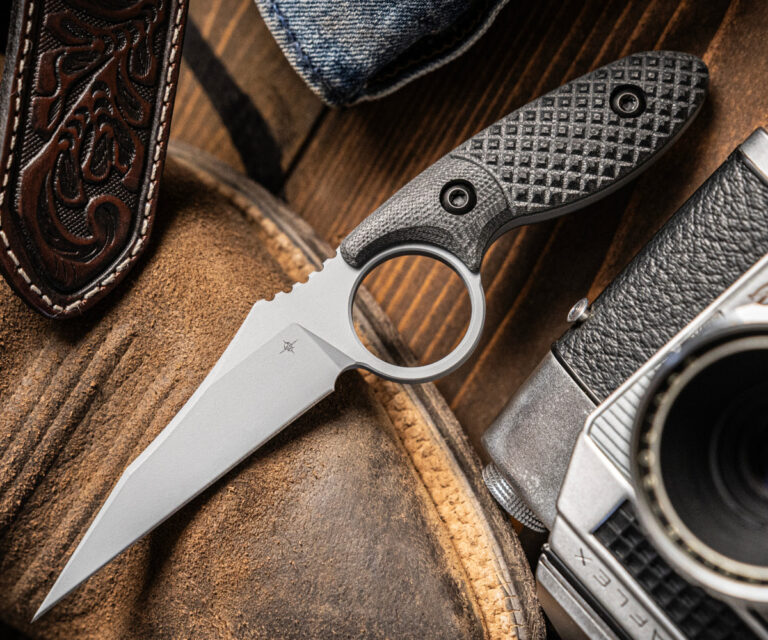
From tactical rings to signature openers: analyzing the practical advantages of negative space in blade engineering.
The hole in the handle or blade, or anywhere in knife construction, has something to tell the user. But what is it trying to say or do?
It is eye-catching but the hole and/or ring and the science that goes along with it complement the visual and the practical in knife use. Aesthetics, mechanics and utility are factors. After all, the essence of the knife is in its use as a tool, and who wouldn’t mind a prettier profile at the same time?
Original Hole
The story of the hole in the blade cannot be told without including Spyderco and its legendary leader, BLADE Magazine Cutlery Hall-of-Fame® member Sal Glesser. In the decades since Spyderco introduced its iconic hole in the blade, the company has produced countless folders that characterize the ease of opening inherent in the hole itself.

Sal said he well remembers the inspiration to step out with his company’s blades.
“The Buck 110 and Gerber Folding Hunter were the watershed change to locking knives, in my opinion,” he recalled. “I purchased a Buck 110 when they first came out. As a young man I learned to open the Buck and Gerber lockers with one hand using my thumb, pushing on the side of the blade. I was working late in the shop one night, payables, payroll, etc., and I thought to try to figure out a way to modify a folding knife so that anyone could learn to open [it] with one hand more easily and more safely than the way I was doing it.”
From that single thought, Glesser went to work. He experimented with adding to the blade for leverage—studs, discs, hoods and other things—but found they got in the way when cutting or sharpening and could “wave” the knife open unintentionally when deploying.
“So I started taking things away from the blade to create purchase for the thumb,” Sal continued. “I first roughed up the side of the blade, which worked, but not very well. Then I drilled a dent into the blade. A dent on both sides became a hole.”
Eureka!
Sal plowed ahead, making a rough prototype using a Japanese folder and welding a piece of drilling rod to the spine of the blade to add height. He ground it down to the thickness of the blade and then drilled the hole to test his ease-of-opening theory.
“We applied for a patent claiming a ‘ledge’ created by the edge of the hole that could be used by the fleshy part of the thumb to urge the blade open with one hand,” Sal recalled. “I chose to use a round hole because it was easier to make and was easily identifiable.”
The rest, as they say, is history.
From the first blade-hole model in 1981, the Spyderco Worker, the distance from the center of the pivot to the hole was analyzed while the optimal size of the hole for the average thumb was measured. Enhanced trademark work was successful in securing the round shape since copies were notable with different shapes to get around the word “hole” in the original Spyderco patent language. Hence, the company introduced the hole into its fixed blades as an identifier “large enough to be cleaned and small enough to be noticed.”
Perfecting the hole for its primary purpose of easy opening meant leaving a certain amount of steel above the hole to compensate for the space. “Some steels that are more brittle could be broken through the hole if pried with hard enough,” Sal concluded. “But the truth be told, there are millions of Spyderco knives in the marketplace over the past almost 50 years and there have been very few that were broken.”
Where & Why Of Holes
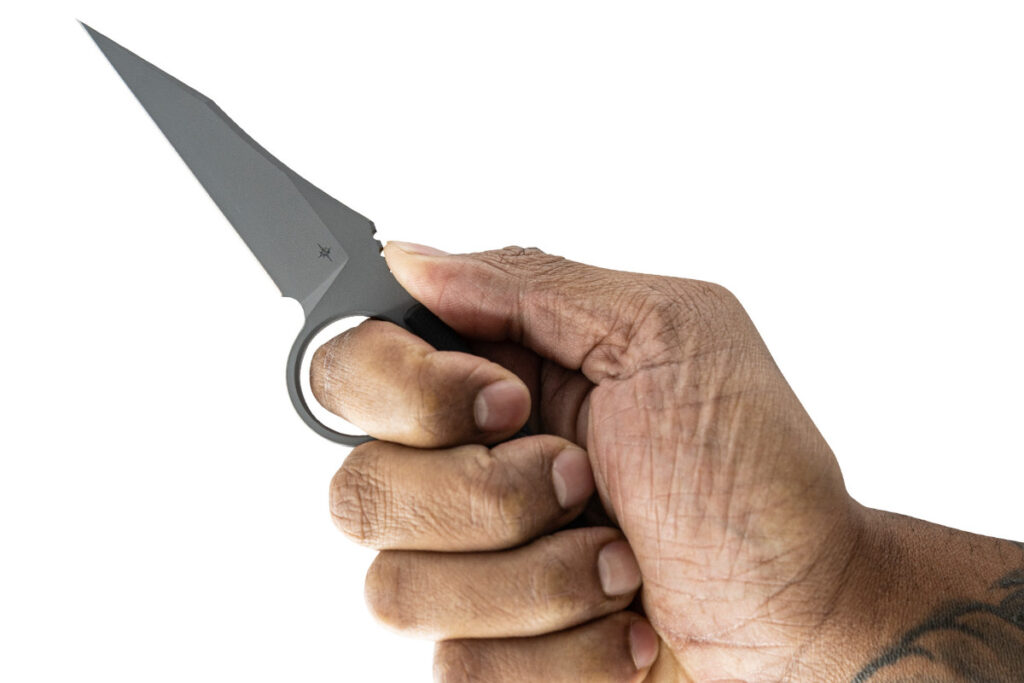
In overall perspective, the hole has its place in the fixed blade as well. The Toor Corporation Cortano sports the hole/ring for a simple reason according to CEO Connor Toor.
“A hole allows fast, ambidextrous one-handed deployment without extra hardware,” he explained, “and it keeps the blade profile clean and snag resistant. It also slightly reduces weight and manufacturing complexity compared with an added stud or thumb disc.”
The hole in the Cortano is located between handle and blade for several reasons, including deployment and retention, a tactile index for consistent hand placement, a lanyard attachment point, and an unmistakable visual signature that differentiates the knife. An added bonus, says Connor, is the ability of the user to choke up for precise cuts without losing positive control.
“We typically call it an ‘index/retention ring’ or simply the ‘deployment hole,’” Toor commented. “The concept is rooted in historic ring knife forms and modern karambit/utility designs more broadly, so while makers like Steve Likarich are part of that lineage, our design pulls from both traditional ring knives and contemporary tactical needs rather than a single source.
“Any aperture introduces stress concentration,” Connor continued, “but proper blade geometry, material selection and heat treatment mitigate that risk. We designed the Cortano so overall material thickness preserves strength around the hole. Real world testing and appropriate use show no practical durability issues when those engineering details are respected.”
Holes For Balance

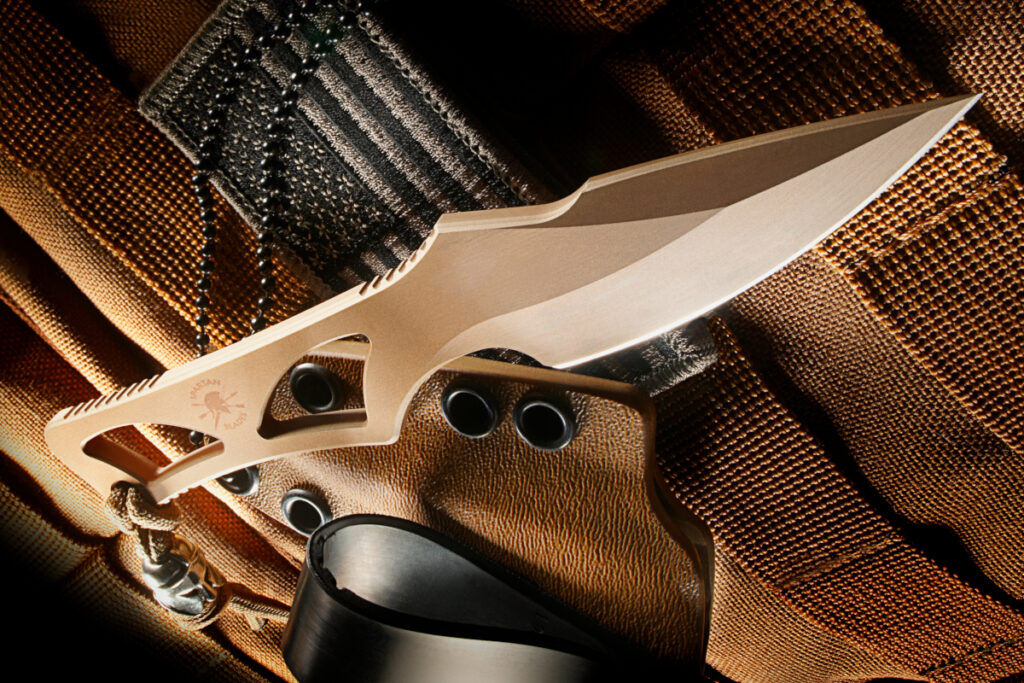
The Formido fixed blade from Spartan Blades comes with a series of holes in the handle, and company president Curtis Iovito readily points to the advantages of the design.
“It’s primarily to tune balance by reducing handle weight,” he advised, “often to place the balance over the index finger. We’ll enlarge or shrink hidden holes under the scales to shift weight where it best serves the knife’s purpose. Looks can be a secondary benefit. Along with weight reduction, there are options for lashing or paracord wraps, and added indexing/traction without introducing weak corners. In some cases, they also enable spear mounting or other field attachments.”
Curtis adds that the parameters for the introduction of holes in the blade or body of the knife vary as to the designer’s objectives.
“There is no universal formula,” he related. Holes, however, must measure up to certain standards to “maintain strong ‘webs’ of material around fasteners and stress points, and scales must be clamped well to prevent lifting and contamination. Round holes are favored because they machine easily and avoid sharp internal corners that become stress risers during heat treat. Arched/rounded cutouts can add torsional strength as seen on our Enyo and Formido.”
Holes In Karambit
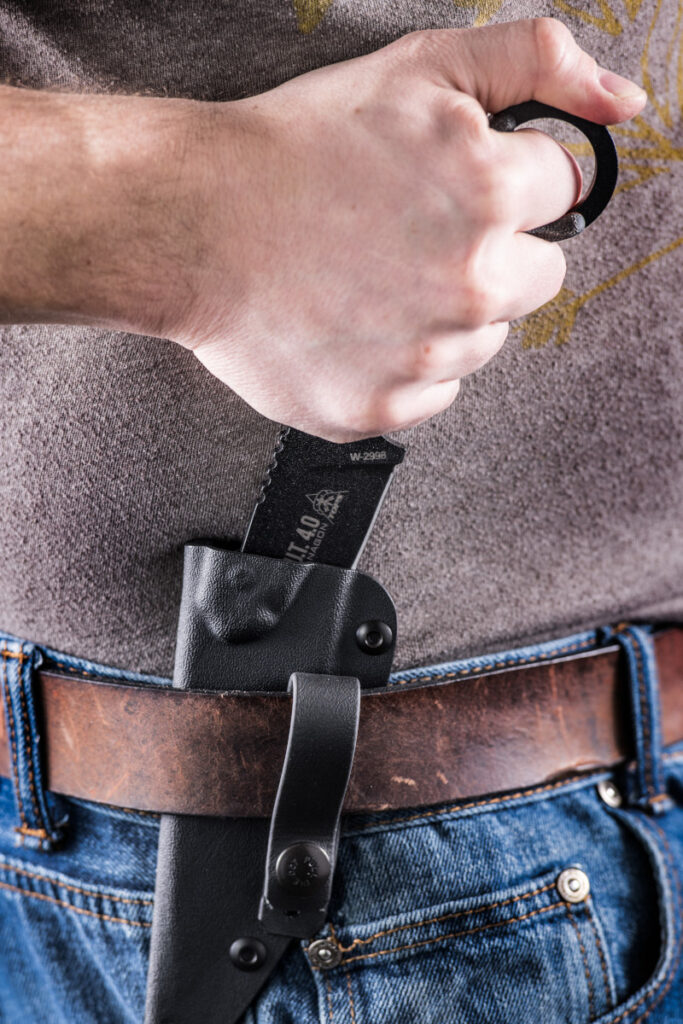
At TOPS Knives, the C.U.T. 4.0 is a hybrid karambit that combines the practicality of the utility knife with the defensive and combat features of the karambit. Its ringed handle is common to the karambit lineage while the utility drop-point blade is more of a traditional design element. The karambit hole itself is probably a derivative of agricultural use.
“It does seem to be the case that many karambits used in Asia were used as a tool first, cutting cane or other crops” said Craig Powell, TOPS general manager. “As a tool, the pinky is usually in the hole so that the knife can hang down from the hand while the user is picking up the harvest, and then it is swung back into the hand to use the cutting edge.
“I wouldn’t say there is a set rule on the size of the hole,” he added, “but too small makes it easy for fingers to get stuck, which can equal broken fingers or de-gloved fingers in situations where the knife can’t be dropped when needed. Too large makes the knife clunky to use and manipulate properly and too easy to drop. Definitely, there is a balance to be struck. The hole size we use for our karambits does vary somewhat with the overall size of the knife. Typically, the smaller the overall size, the less likely someone is going to use the knife while wearing gloves, so you can use a smaller hole to keep the overall profile of the knife smaller.”
The characteristic ring in the butt of the karambit adds versatility, and Iovito sees advantages in several areas.
“The ring allows rapid grip changes, secure retention of a short blade under stress, and manipulation without dropping the tool. On our CQB Tool, for example, the ring lets a user transition to a pistol grip in a pinch without discarding the blade. We use PEO Soldier [U.S. Army Program Executive Office] data on the average-gloved-finger size for reliable use with gloves. Our research points to about a 1 1/8-inch internal diameter as optimal—big enough for manipulation and glove use without binding, yet not so large that control gets sloppy or the blade flops on the finger. Too small risks pinching, circulation issues, and snagging; too large compromises indexing and retention.”
Michael Janich, special projects coordinator at Spyderco, agrees that the karambit has an agricultural lineage but adds that the island archipelagos of the Pacific, where the design developed, will often provide different cultural backgrounds to its story.
“After harvesting a bundle of vegetables, the handle was released, allowing the knife to hang from the pinky, freeing both hands to tie the bundle,” Janich reasoned. “In contrast, sheathing the knife every time was inefficient and would require the blade to be cleaned to prevent soiling the inside of the sheath. Logically and practically, this makes sense. Some stories of the origin of the karambit, though, suggest that it was developed primarily as a weapon.”
As for the dimensions of the karambit and its characteristic hole, Janich points out that some tools defined as karambits of Southeast Asian origin do not even sport the hole. Nonetheless, the hole defines the karambit today.
“The karambit is not the only historical knife to have a ring,” Michael added. “The Japanese kunai was a trowel-like tool that had a ring at the end of the handle. The ring could be used to enhance grip retention. It also allowed the tool to be hung from a cord for easy transport or for the attachment of a lanyard. The Chinese martial arts also had daggers with butt-mounted rings. In some systems of kung fu, the rings had no specific purpose and only served as pommels. The bird and trout knife, first introduced by Marble’s, also had a pommel ring. Of integral construction, the handle portion of the knife was very narrow, so the ring provided both retention and grip stability.”
Attraction Of The Design
Universally in the world of knives, the hole or ring has its place, its moment, its degree of usefulness. Ultimately, the user chooses the tool that suits the task at hand, and the presence of the hole, for easy opening, control or enhanced utility, is always a candidate for deployment.
More Knife Reviews:
- Sharps Bros. Meanstreak Review: Keen, Mean Cutting Machine
- Relentless Knives Curved Fillet Knife Review
- Cold Steel Finn Bear Review: Light, Sharp And Up To Snuff
- Spartan Blades Clandestina Review: 2024 Blade Knife of the Year
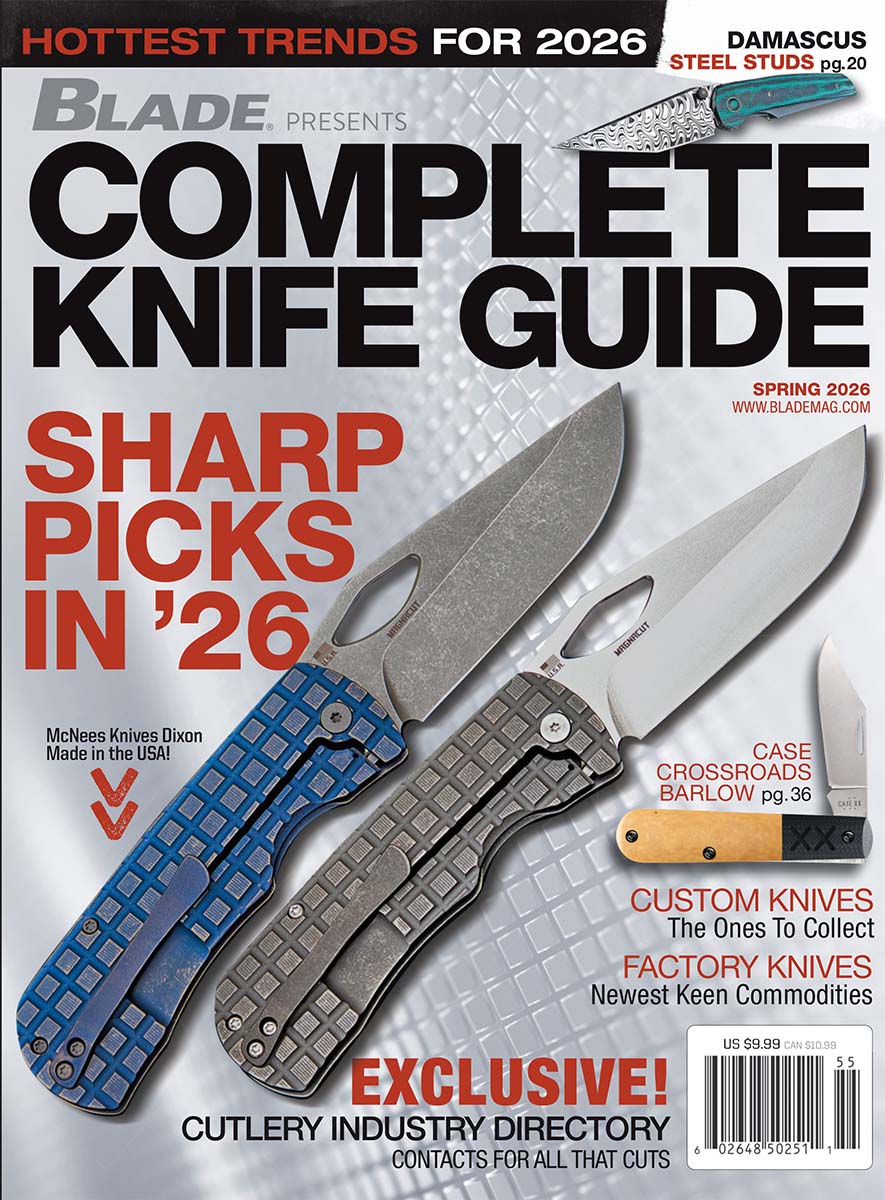 NEXT STEP: Download Your Free KNIFE GUIDE Issue of BLADE Magazine
BLADE’s annual Knife Guide Issue features the newest knives and sharpeners, plus knife and axe reviews, knife sheaths, kit knives and a Knife Industry Directory.Get your FREE digital PDF instant download of the annual Knife Guide. No, really! We will email it to you right now when you subscribe to the BLADE email newsletter.





