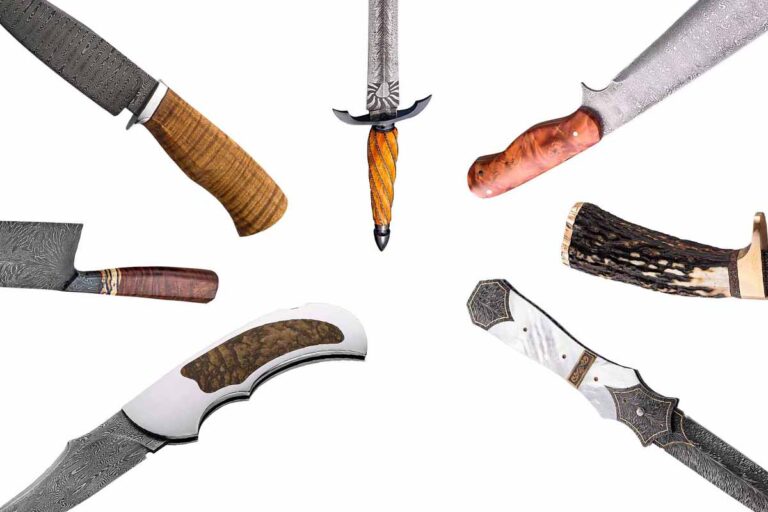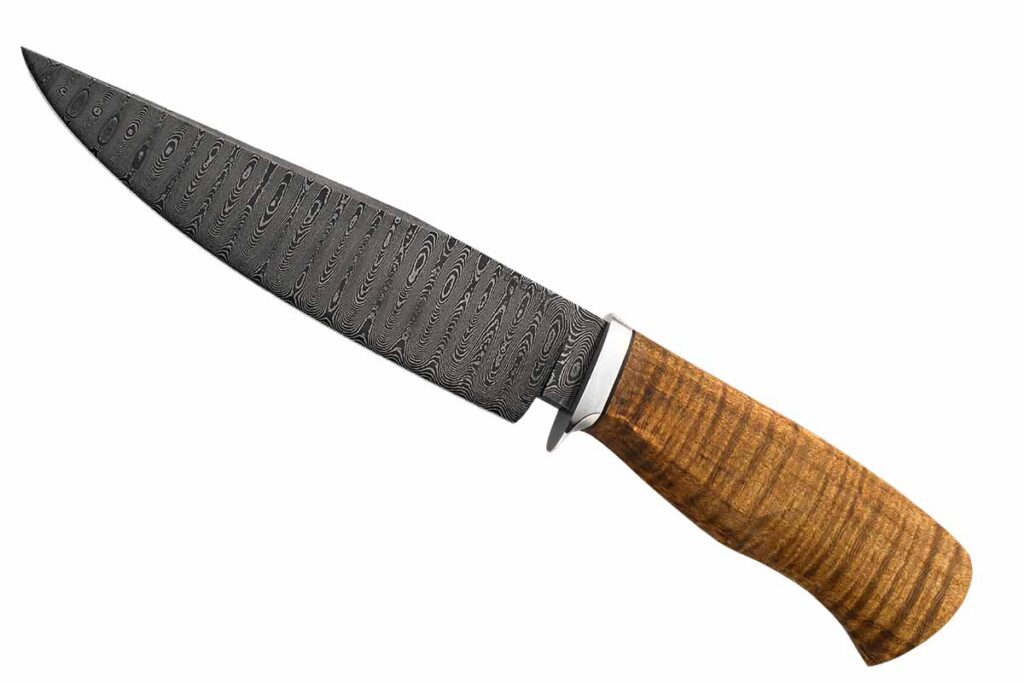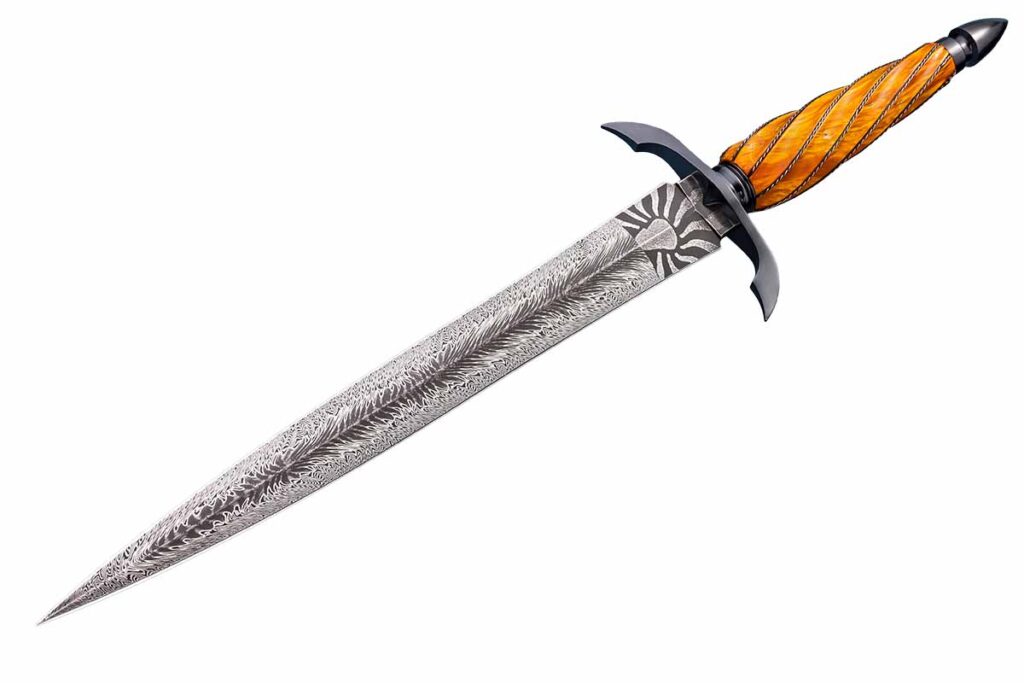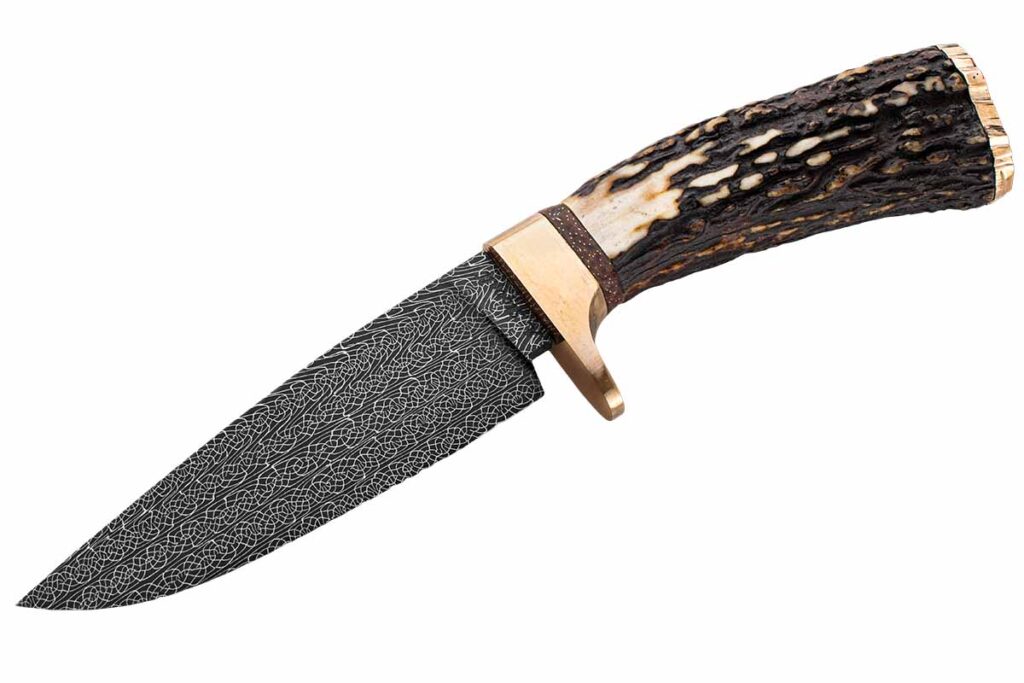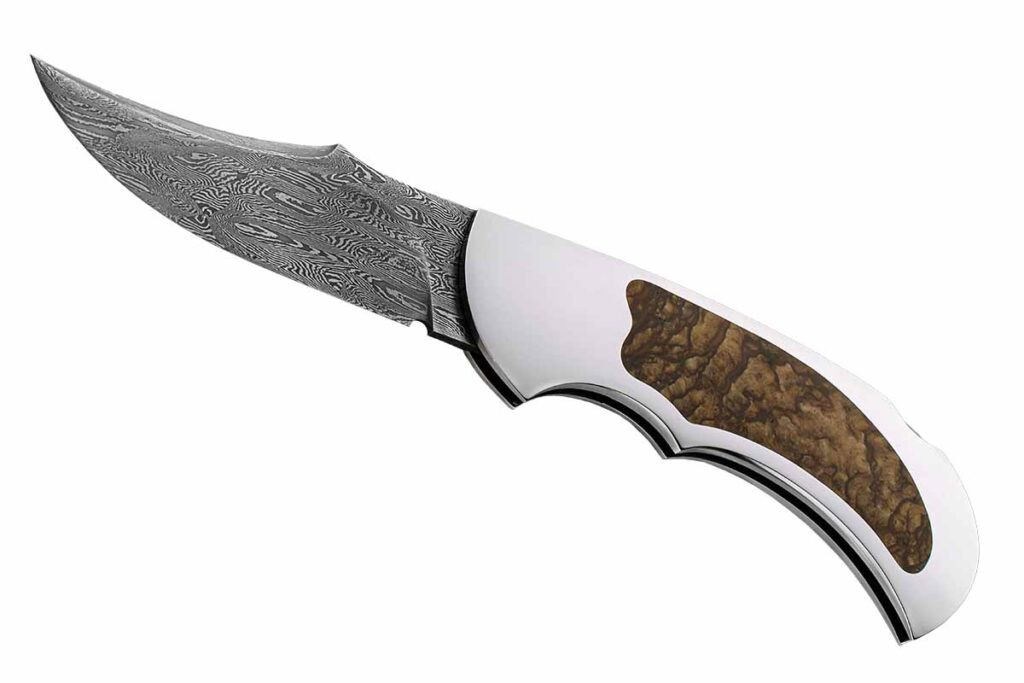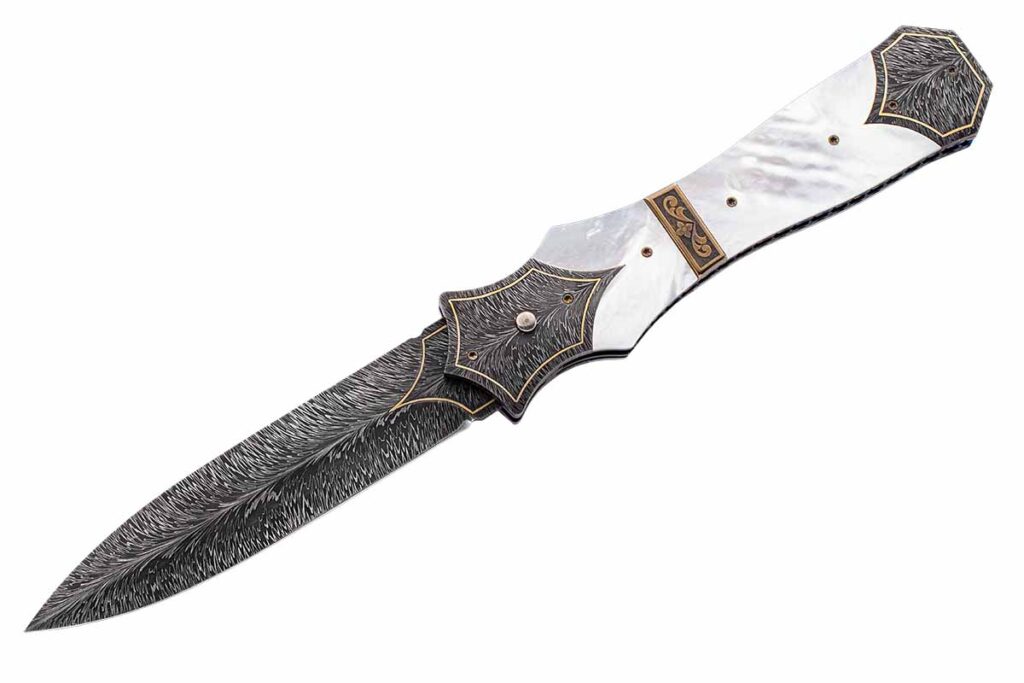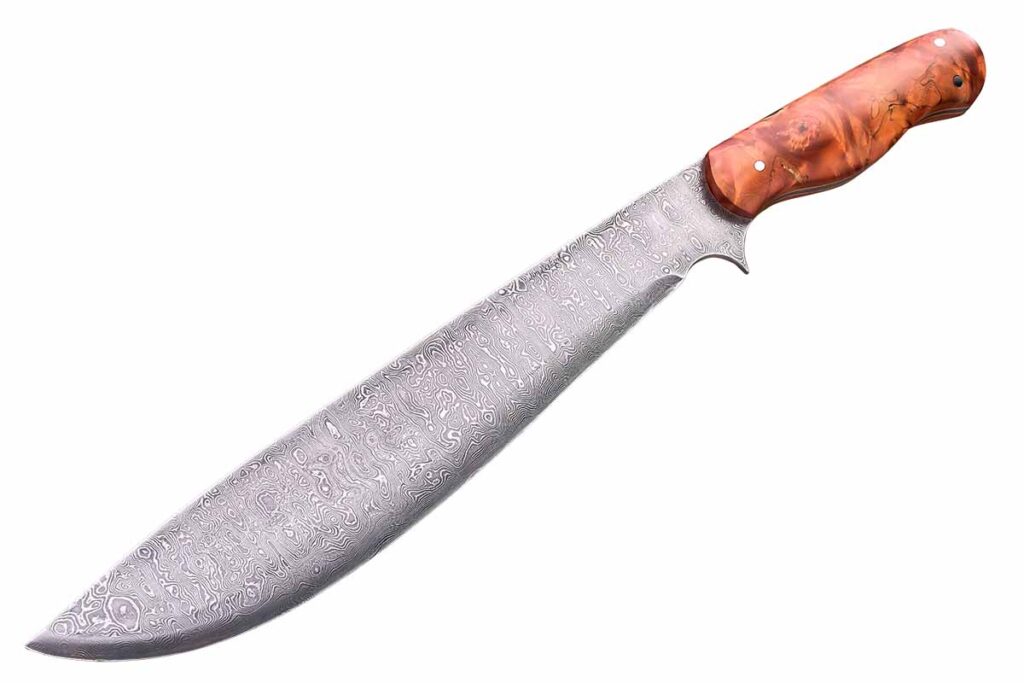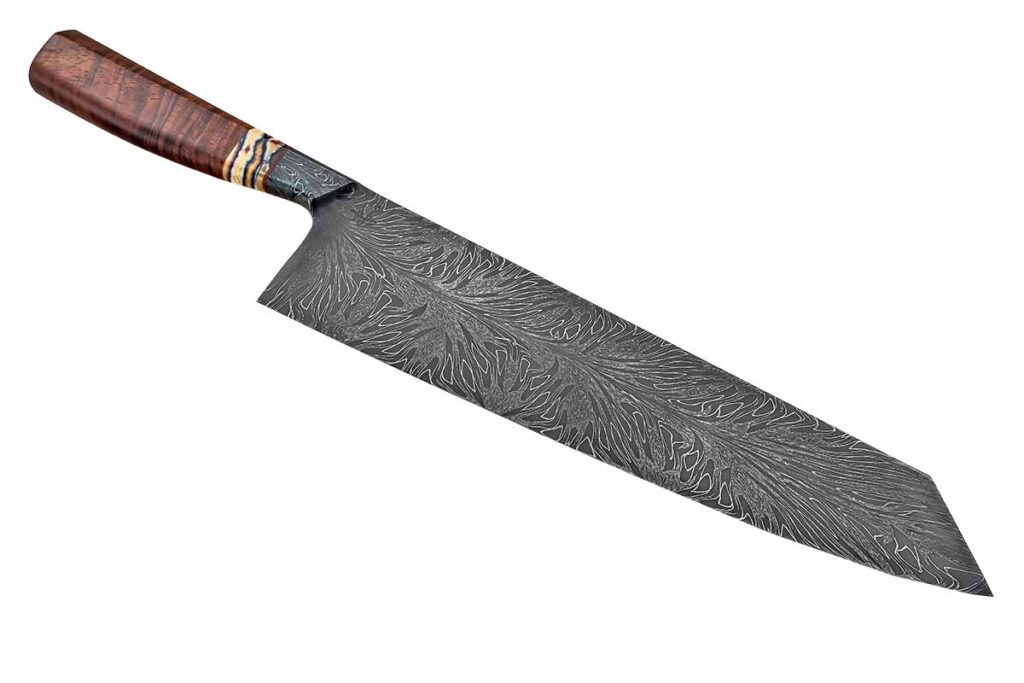
Handsomely pinned and with a handle to die for, Richard Dawes’ dog-bone bowie finds nearly the perfect chemistry.
Richard Dawes got a double pump of inspiration from the late, great ABS master smith John White for a long, lanky dog-bone bowie.
Dawes helps oversee an annual competition in White’s memory on Bladeforums for antique bowie repros. In so doing he came across one of White’s old work-in-progress frame-handle dog-bone projects on the web and found it most useful.
The resulting knife has a handsomely pinned dog-bone handle with a clip-point cable damascus blade, and it’s accompanied by a shark-skin-inlaid sheath by Paul Long. It’s Richard’s first frame-handle knife and first with pins, too.
Richard Dawes
“The key part of this knife looking good is to get a good fit on the guard,” he explained. “Once you’ve got that you want the rest of the parts to line up, and if you’ve got some 1/16-inch guide pins in there and got them all drilled for when you do the assembly, everything lines up, and that’s the key.”
A full-time chemistry professor at the Missouri University of Science and Technology who at press time was working for the National Science Foundation, Richard makes knives “on the side.” If this one is any indication, he has a career option waiting on him.
Dog-Bone Bowie Specs Maker: Richard Dawes Blade Length: 11” Blade Material: Cable damascus Handle Material: African blackwood Handle Frame: Mild steel and nickel silver Overall Length: 16” Sheath Material: Custom leather inlaid w/shark skin, all by Paul Long Maker’s Price For A Similar Knife And Sheath: $2,500
Today’s gent’s knives are what they are instead of what they used to be.
In years past, there was a genre of knife small, fancy and unobtrusive. It went by gent’s knife or Sunday-go-to-meeting knife, the latter where the hard-working sodbuster was laid down on the day of rest for something to better match the formal Sunday duds. Loosely defined, that knife consisted of fancier materials and a blade less than 3 inches long
However, the argument can be made that today’s gent’s knives are exclusively gent’s knives no more. According to officials of the knife companies that make them, all kinds of people spring for the knives popularly known as gent’s knives. There are sub genres, and their popularity is growing.
Take, for instance, A.G. Russell Knives, whose customers tend to gravitate not toward EDCs or tactical knives but smaller gent’s-type knives.
“In the past year or so, we are seeing an increase in interest in these smaller knives that can be carried unobtrusively, both with pocket clips and without,” the team at A.G. Russell wrote in an e-mail. The knives worn with the Sunday best tend to be more traditional, according to the company’s spokespeople. It’s a subcategory of small knives that sport a sharp appearance that includes premium handle materials. Added the Russell team, “A great gent’s knife is not too large, has an elegance about it, but still performs well.”
A.G. Russell Knives Vest Pocket Semi-Skinner
Bob Loveless introduced A.G. Russell to the semi-skinner blade shape and Russell fell in love with it, pairing it with a sparkling carbon-fiber handle in the Vest Pocket Semi-Skinner.
For an example of a piece that represents the new generation of gent’s knife, look no further than the A.G. Russell Vest PocketSemi-Skinner. Designed by the late company founder and BLADE Magazine Cutlery Hall-Of-Fame member® A.G. Russell, the knife is a mix between classic design and contemporary materials—the latter being a carbon-fiber handle and premium CPM S35VN stainless blade steel.
The heart of the knife is the bigger-than-it-should-be semi-skinner blade. As the company website noted, A.G. loved the semi-skinner blade, a pattern he credited Cutlery Hall-Of-Famer Bob Loveless for introducing to him. “A.G. saw the need for a small, lightweight pocket knife that would sit comfortable in any pocket, especially vest pockets, and the opportunity to create one with the blade he liked so much,” the site explains.
It is a blade shape that excels with work done at the tip, which is critical for a smaller knife.
“A good gent’s knife is really good at detail work,” the site notes,“in which blade and tip control are very important.” As a result, the Vest Pocket’s blade is at ground and boasts a thin edge geometry ideal for slicing cuts.
The stainless steel bolster is also critical to the design, as it covers the squared-off heel of the blade that connects with the lockbar. Unprotected, the heel could wear away at the fine fabrics of a vest pocket, for instance.
A.G.’s sketch of the knife (pictured below) was scanned into a CAD program in March 2018. Un-fortunately, he didn’t get to see the knife in production, as the iconic knife entrepreneur passed away in October of the same year before the design could be fully realized.
A.G. Russell Knives Vest Pocket Semi-Skinner Specs: Designer: A.G. Russell Blade Length: 2.53” Blade Steel: CPM S35VN stainless Blade Grind: Flat Handle Material: Carbon fiber Pocket Clip: None Bolsters: Stainless steel Lock: Lockback Weight: 2.5 ozs. Closed Length: 3.125” Country Of Origin: China MSRP: $100
Maserin Knives Turtle
Some of the more notable features of the Turtle by Maserin Knives are the pivot pin with its concentric lines and the skeletonized titanium clip anodized blue.
No discussion of gent’s knives would be complete without mentioning the classic designs that hail from all over the globe. Take for example the Turtle, a timeless design Maserin injected with traditional materials and refinement throughout.
In 2006, Italian knifemaker Claudio Volpato designed a small knife with a blade under 2 inches and sent the prototype to Maserin. “We industrialized it,” recalled Claudia Maserin, along with her two brothers owner of Maserin, and the Turtle was born. “ The knife is still popular considering we first showed it long ago. The best handles are ebony and briarwood, and the damascus blade version is still very appreciated.”
Some of the small knife’s more notable features are the pivot pin with its concentric lines, and the skeletonized titanium clip anodized blue. Part of the goal was to take classic materials and transform them “We looked for elegant and traditional materials,” Claudia explained, “wooden handles like ebony and olive.”
Realizing that some women were gravitating to the Turtle because of its small size, Maserin officials handled the knife in pink giraffe bone several years ago. “We don’t design a knife thinking of final users in terms of gender but in projecting elegant knives,” Claudia stated. “We know they can be perfect both for women and men.”
Early versions of the blade were at ground of 440C stainless steel. Now, they are N690 stainless. The result is a knifes mall enough to slip into the small pocket of a pair of jeans and that opens easily one-handed.
“Our gent’s knife is good for everyday carry,” Claudia maintained. “You can open an envelope, a parcel, cut a fruit. It is the knife you need when you find yourself saying ‘If I had a knife …’
Maserin Knives Turtle Specs: Designer: Claudio Volpato Blade Length: 1.56” Blade Steel: N690 stainless or stainless damascus Blade Grind: Flat Handle Material: Woods of bocote, briar, ebony, olive or walnut Pocket Clip: Skeletonized titanium anodized blue Lock: Linerlock Weight: 2.05 ozs. Closed Length: 2.5” Country Of Origin: Italy MSRP: Depending on options, from about $77 to $19
Spyderco Pochi
Like many small Spyderco knives, the Pochi is designed to offer large cutting power in a small package. “The dog tail rotates out to create a pinky shelf,” Joyce Laituri noted of the extension on the butt, “adding length to the handle for a better grip.”
Rigid definitions of a gent’s knife don’t quite cut it in Joyce Laituri’s book. The Spyderco spokesperson met a knife enthusiast at a knife show out to acquire some knives. The man towered well over 6 feet and was “built like an NFL linebacker, with paws like a bear,” she recounted. Though he appeared gentle-manly, a blade under 3 inches would be too small for him.
“In today’s industry,” Laituri began,“there is a broader view of what constitutes a dress knife. Is it its size, cost, function, materials, appearance? That definition is unique to each knife carrier.”
For some, a gent’s knife may be a small, elegant knife. Others, Laituri points out, decide that the most gentlemanly knife they can carry on their wedding day is a 5-inch folder or even a Spyderco Military model. The company eschews the term gent’s knives for prestige knives, Laituri said, in order to better describe the breadth of people who carry such edged tools. Meanwhile, a Spyderco knife that has attracted knife carriers for a whole slew of reasons is the Pochi, a flipper-folder collaboration with Japanese custom knifemaker Kazuyuki Sakurai.
“There is a market for anyone look-ing for the non-traditional,” Laituri said,“and the Pochi has been well received—surprisingly so—because it is so different from traditional pocketknives.
Some Pochi users, she added, like the design because they find it both charming and functional. Others are attracted to its upswept blade hollow ground from high-end CPM S45VN stainless steel. Some, attracted to the zoomorphism of the design, carry it because they like dogs, Laituri said.
Pochi, which roughly translates to the most common name for a dog in Japanese, has all the essential canine elements, resembling something like a pug on the go. Like many small Spyderco knives, Laituri said the Pochi is designed to bring large cutting power in a small package. “ The dog tail rotates out to create a pinky shelf,” Laituri noted, “adding length to the handle for a better grip.”
Spyderco Pochi Specs: Designer: Kazuyuki Sakurai Blade Length: 1.58” Blade Steel: CPM S45VN stainless Blade Grind: Hollow Handle Material: Titanium Pocket Clip: Titanium anodized blue;closed knife carries blade tip up Lock: R.I.L. (Reeve Integral Lock)WEIGHT:1.7 ozs. Closed Length: 2.6” Country Of Origin: Taiwan MSRP: $270
Bear & Son’s Bold Action
The Bear OPS Bold Action 14 comes in a wealth of different colors thanks to the anodization of its aluminum handle.
According to Matt Griffey of Bear &Son Cutlery, the world of gent’s knives has been changing and part of that has been due to the evolving nature of the workplace.
“We see less manufacturing professionals and more office setting careers,” he said. “Gentleman’s knives t the workforce movement and the lifestyles that come with it—accounting, computer techs, engineers and so on—with the knife having a small or slim physique and constructed from higher quality materials.”
At the same time, Griffey notes some of the slim knives are growing in size, and in the forefront of that change has been the increase in autos.
“Automatic knives have always intrigued both the traditional and modern knife enthusiast,” Griffey wrote, “and to-day more states are approving the daily carry and ownership of these types of knives.”
Trying to comply with many of the new auto laws, Bear & Son introduced the BearOPS Bold Action 14. The result is a knife available in a selection of color choices with its anodized aluminum handles and also the Sandvik 14C28N stainless steel blade, all made at Bear’s plant in Alabama.
Aluminum is a lightweight, low-maintenance material and 14C28 has a reputation of being corrosion resistant, durable and “an awesome performance steel”—essential features on a knife with a smaller blade and plenty of tasks to do.
“The Bold Action 14’s typical use would be common cutting chores around the office/home like opening small packages, cutting cordage and opening envelopes,”Griffey said, noting the knife can handle bigger tasks, too.
Meanwhile, expect more gent’s knives—or whatever you want to call the small fancy folders—in the future
“There is a market space for gentleman’s knives,” Griffey said. “Today, there are a lot of different choices and we’re lucky to and so many knife designers pushing the limits with materials, sizes and overall de-sign in the category.
Bear & Son’s Bold Action Specs: Designer: N/A Blade Length: 1.75″ Blade Steel: 14C28N Sandvik Blade Grind: Hollow Handle Material: Stainless Steel Pocket Clip: Reversable Bolsters: N/A Lock: Auto Weight: .14 oz Closed Length: 2.50″ Country Of Origin: USA MSRP: $140
CRKT Pilar
Designed by Danish knifemaker Jesper Voxnaes of Vox Knives, the size and blade shape of the CRKT Pilar are well matched for heavy cutting jobs. The handle is very comfortable and secure in the hand.
How could CRKT and Voxnaes make the knife even better? The answer is to offer a new larger version for 2019. The Pilar II offers the same performance and ergonomic advantages as the original, including robust framelock construction with an all-steel handle. The 2.6-inch blade is 8Cr13MoV stainless steel and offers a great balance of edge holding and maintenance ease. It is the Chinese equivalent of the Japanese-made AUS- 8. Due to the increase in size and blade mass, the Pilar II features a flipper, something the Pilar lacks.
Voxnaes is known internationally for his straightforward designs with a nod to utility and outdoor applications. Originally he made prototypes of the Pilar in two versions: one with a flipper tab and one without. “With lots of people asking for a flipper version, it was an easy fix,” Jesper notes. The blade rides on Teflon washers and flips open nicely without the use of pivot bearings. It also sports an oblong hole for ambidextrous opening.
The stainless steel handle supplies heft and a solid backbone. The grip’s edges are chamfered, offering comfort and eliminating hot spots or general discomfort. A solid steel spacer adds handle strength. A steel pocket clip carries the knife tip up or down for right-hand carry only. If you prefer half-and-half-type handle construction with your framelock folder—that is, each handle side comes in a different material, in this case stainless steel and lightweight G-10—the Pilar II is so equipped. The G-10 offers a bit more weight savings plus a nice grippy texture. The all-steel-handle version has weight-saving pocket reliefs milled into the inside of the scale.
“At first it may seem we simply upscaled the original Pilar design, but the knife was actually redesigned from scratch to make the ergonomics feel perfect,” Jesper concludes.
Don’t let the gent’s knife label for the large Pilar fool you. It’s a knife that isn’t afraid to get down and dirty with its rugged build and utility-friendly blade shape. Like its little brother, the large Pilar is easy to carry and rides securely in a pocket. The choil indexes your grip and the rest of your fingers fall naturally around the handle. Due to the handle shape and size, those with larger hands may find the knife too small.
However, for those whose hands are filled nicely by the grip, the large Pilar is very comfortable to hold.
CRKT Pilar Specs: Designer: Jesper Voxnaes Blade Length: 2.40″ Blade Steel: 8Cr13MoV Blade Grind: Plain Handle Material: Stainless Steel Pocket Clip: Stainless Steel Bolsters: N/A Lock: Frame Lock Weight: 4.20 oz. Closed Length: 3.53″ Country Of Origin: China MSRP: $39
Fallkniven FH9 MOP
The Fallkniven FH9MOP is dressed to the nines with a mother-of-pearl handle accented by abalone and a mirror-polished blade. This is the knife you want to carry to dressy social functions, as the handle treatment sets the tone for an upscale outing or maybe even church on Sundays. According to Peter Hjortberger, Fallkniven president, the design is based on a folding hunter and a traditional lockback system.
Employing Fallkniven’s best blade material, a laminated 3G powder steel with a Super Gold steel core with a Rockwell hardness of 62 HRC, the FH9MOP is built for use. The 2.5-inch drop-point blade is neither too small nor too large. The knife is by far the best looking of the test bunch. The pearl handle and abalone accents create a stunning visual effect.
Structurally, the FH9MOP is built quite solid with dual stainless steel liners, steel bolsters and a steel handle spacer. Inlaid Fallkniven logo shields in the handle cap things off, and the blade sports a nail nick on each side for easy ambidextrous opening. A nice suede slip sheath protects the knife from rubbing up against keys, coins, etc., in your pocket.
The blade came out of the box razor sharp. I had no problem using it to open mail, cut stray threads, or any other similar gent’s knife duty. It is too beautiful a knife for the same jobs as a tactical folder, so use would be limited.
It sure is an eye-catcher, though. For a model more suited for general utility needs, step down to the standard FH9, which gives you the same blade steel but with the more work-friendly Micarta® handle material. Either way, the knives are sharpened pocket jewelry at its best.
Fallkniven FH9 MOP Specs: Designer: N/A Blade Length: 2.6″ Blade Steel: 3G Blade Grind: Plain Handle Material: Mother Of Pearl Pocket Clip: None Bolsters: Steel Lock: Lockback Weight: 3.35 oz. Closed Length: 3.625″ Country Of Origin: Sweden MSRP: $540
GiantMouse ACE Nibbler
Designed by custom knifemakers Jesper Vox and Jens Anso, the Nibbler holds fast via a reversible wire clip.
“A great gent’s knife is a fully functioning tool that stands strong in the ‘looks and class’ department,” explained Jim Wirth of GiantMouse. “It’s a knife that is capable of cutting tasks but also for social events, Sunday church or a Thursday evening cocktail.”
GiantMouse makes a bold statement among gent’s knives with the Nibbler, a compact, efficient folder that Wirth says works as a great EDC in areas and situations where size matters. “Although the Nibbler is small, it packs a serious punch,” he pointed out. “Our definition of a gentleman’s knife is a knife that you can EDC in almost any environment, from the church to the office so to speak, a knife that does not raise eyebrows but will be welcomed when put to use. This could very well be the modern definition of this type of knife.”
The Nibbler is bound to fill the bill for that light-cutting job and to exude a positive image. “It’s inspired by the fictional character Nibbles ‘Tuffy’ Mouse from the hit cartoon series Tom and Jerry,” Jim explained. “Nibbles may be small but he sure is mighty, just like our new ACE Nibbler, a petite folder that packs a serious punch and doesn’t lack in the fun department, either.”
Wirth concludes that both men and women will find the Nibbler a great choice for EDC. “We don’t think that making a pink handle on a knife will make it more suitable for women,” he reasoned. “We don’t believe in designing specifically for a gender; all our knives are equally suited for men or women.”
The thoughtfully designed deep carry clip and the thin, lightweight nature of the Pro-Tech Newport 3405 make it a good choice for wearing dress slacks, as it won’t tear up the pocket or be heavy enough to make it sag.
At Pro-Tech, Dave Wattenberg takes pride in the Newport, a gent’s knife that exudes personality. “It’s our thinnest and lightest full-size auto,” he commented. “It packs three inches of S35VN steel for all your EDC tasks into a precision-machined aircraft-aluminum frame that is only .38 inch thick.
The thoughtfully designed deep carry clip and the thin, light carry of the Newport make it a great choice for someone wearing a nice trouser or dress slacks, as it won’t tear up the pocket or be heavy enough to make it sag.”
Dave is excited about the versatility of the Newport, its swift deployment, unobtrusive profile, and variety when it comes to materials while running the gamut from EDC to investor/collector-grade presentations.
“From solid aluminum handle/stonewash base models all the way to investor customs, there’s a Newport model to suit just about any taste and budget,” he remarked. “Pro-Tech is well known, of course, for superior coil-spring-action auto knives, and while the Newport is no exception to this, users will find the action controlled, smooth and satisfying—not the huge snap of one of the tactical response series, but a more gentlemanly switchblade action.”
Pro-Tech Newport Specs: Designer: N/A Blade Length: 3″ Blade Steel: S35-VN Blade Grind: Plain Handle Material: Aluminum Pocket Clip: Tip-Up Bolsters: N/A Lock: Auto Weight: 2 oz. Closed Length: 4.125″ Country Of Origin: USA MSRP: $240
Sandrin Torino
The polyhedral tungsten carbide blade of the Sandrin Torino is designed to retain its razor-sharp edge far beyond that of steel blades in Sandrin’s “StaySharp Technology.”
The Sandrin Torino exemplifies the ideals of the gent’s knife, and Sandrin’s Rob Bianchin says he knows why. “The Torino is exceptionally lightweight at only 2.29 ounces,” he remarked. “It’s pretty easy to forget that you have it in your pocket. The lightweight characteristics are deceiving as the blade performance exceeds that of a steel knife for edge retention. For anyone who can appreciate metallurgy, the polyhedral tungsten carbide blade is a state-of-the-art super metal and was not thought possible just a few years ago.”
According to Rob, the entire Sandrin knife experience is centered around the blade material. Polyhedral tungsten carbide is not steel. Instead, according to Sandrin, it is an engineered “super metal” invented and patented for blades by Sandrin director Alessandro Colombatto. “Tungsten carbide can be used for cutting steel or for wear parts that undergo extraordinary stress and corrosion,” Bianchin added. “Polyhedral tungsten carbide has advantages over steel, such as consistent molecular structure. It cannot rust and typically is in the 71 [HRC] Rockwell hardness range* or higher.”
The polyhedral tungsten carbide blade lends itself nicely to the Torino gent’s knife presentation, and Rob sees a natural fit. “In my view, the definition of a gent’s knife has evolved with the times and includes knives of quality that are also effective cutting instruments and not just for show. The Torino can be carried and used daily but is also a point of conversation as it is still exceedingly rare to own a knife made from new metal.”
The appeal of the Torino once again embraces the spectrum of potential users—both men and women, factory or office workers. “Gender is not a design consideration,” Rob said. “The Torino is suited for men or women. Men are the predominant consumers of pocketknives, but I suppose in today’s world the industry should call such knives a ladies’ or gentlemen’s folder.”
Sandrin Torino Specs: Designer: N/A Blade Length: 2.95″ Blade Steel: HRC71 Blade Grind: Plain Handle Material: G-10 Pocket Clip: Titanium Bolsters: N/A Lock: Recoil Weight: 2.29 oz Closed Length: 4″ Country Of Origin: Italy MSRP: $260
Case Black Sea Dichrolam Tear Drop
The Case Tear Drop Black Sea Dichrolam spear-point blade is designed with a strong tip for piercing, which comes in handy for such gent’s knife jobs as opening mail, packages and the like.
Case has long been a star performer in the manufacture and presentation of gent’s knives, and the company continues the tradition with the Black Sea Dichrolam Tear Drop, a beauty with a composite handle material that mimics the luster of an opal gemstone. Fitting nicely within the spectrum of gent’s knives, the Black Sea Dichrolam Tear Drop brings excitement to the Case fan base.
“Based on our interactions with knife enthusiasts at consumer events, our Classic Case folding patterns like the tear drop are considered by many as a ‘Sunday-go-to-meeting knife,’” commented Fred Feightner, Case director of marketing communications. “But more modern knives are more and more often carried and considered to be a ‘gentleman’s knife.’ The definition lies in the eye of the beholder.”
With the new tear drop entry, Case has bridged any perceived gap between men and women as far as carrying a dressy, functional knife. “We’ve definitely seen an uptick in people carrying Case pocketknives over recent years,” Fred continued, “and they realize that a good, sharp knife is handy to have on your person for all kinds of reasons, from hiking and camping to doing detail work that’s done by hand. Whether kept in a pocket, purse or hanging on a carabiner, a pocketknife is a must have for most any person.”
For occasions when an unobtrusive EDC knife is in the mix, Case fashioned the Black Sea Dichrolam Tear Drop. “Our tear drop pattern has a single spear-shaped blade,” Fred related. “The long, sharp edge can cover everything from cutting threads on clothing to gathering fruit or nuts outdoors. The tip adds functionality for tasks like piercing through a clam shell package or scoring leather to fashion a sheath.”
Case’s tear drops, particularly the Black Sea Dichrolam, perform as excellent light-duty tools, according to Fred. The slim design and small “form factor” make them great for close-up and close-in work, handy little EDC knives that are not only up to the tasks a gent’s knife is meant to perform, but easy on the eyes as well.
Case Black Sea Dichrolam Tear Drop Specs: Designer: John Blazy Blade Length: 2.44″ Blade Steel: Trusharp Surgical Steel Blade Grind: Plain Handle Material: Dichrolam Composite Laminate Pocket Clip: None Bolsters: N/A Lock: Slip Joint Weight: 1.4 oz. Closed Length: 3.63″ Country Of Origin: USA MSRP: $106
Editor’s Note: Dainel Jackson, Dexture and Mike Haskew contributed to this post.
Master smith Harvey Dean teams up with Turnbull Restoration Company to produce a throwback set made to droll over.
An 1873 knife/restored-pistol-and-rifle set collaboration from ABS master smith Harvey Dean and Turnbull Restoration Co. is sure to set the knife-and-gun collector world on fire.
The 24k-gold arrow inlay on the spine of the damascus handle frame is in the style of famed 19th-century pistol engraver L.D. Nimschke. The XIT is a repro of an old cattle brand.
In a spinoff of Harvey’s Olympus dagger design, the 9-inch blade is his thunderstorm damascus. It’s complemented by a guard based on an antique one Harvey modified a bit to resemble a cloud that ties in with the thunderstorm theme. He picked the coffin handle because it was a design popular circa 1873. The damascus cross features a 14k-gold pin, as does the balance of the walrus ivory handle, and 24k-gold inlay. The handle frame is 42 layers of twist damascus to tie in with the fact that Harvey is the 42nd U.S. ABS master smith.
The guard is based on a modification of an antique one. The 24k-gold inlay is by Harvey Dean, as is all the knife engraving. Fittingly, Harvey inlaid the damascus cross with 24k-gold inlay on Good Friday last. The pins are 14k gold.
The restored pistol and rifle pair are part of a 150th anniversary set by Turnbull Restoration Co. The pistol is a Colt M1873 Peacemaker 1907Model P Single Action Army. Some of the most famous outlaws and lawmen of the Old West carried original examples of the handgun, including Billy The Kid, Jesse James, Butch Cassidy, Doc Holliday and Wyatt Earp. The rifle is a Winchester Model 1873 lever action from 1904. Originals of which also were extremely popular in the Old West, it was the go-to for market hunters, cowboys and stagecoach drivers through the remainder of the 19th century and into the 20th.
See who took home the hardware from the 2023 Custom Knife Awards at BLADE Show.
As usual, the Custom Knife Of The Year® Awards at the June 2-4 BLADE Show at the Cobb County Gallery gather together some of the best examples of bladesmithing in the knife world. The difficulty was choosing which would rise to the top.
In a highly competitive field, a panel of expert judges sorted out the top knives in XX categories for the best of the best. Below are the winners, including the coveted Hugh Bartrug Best In Show.
Hugh Bartrug Best In Show & Fixed Blade: Vince Evans
Photo: Jocelyn Frasier
Best Fighter: Samuel Lurquin
Photo: Jocelyn Frasier
Best Kitchen Knife: Lucas Gumbiner
Photo: Jocelyn Frasier
Best Folder: Owen Wood
Photo: Jocelyn Frasier
Best Tactical Folder: Thomas Gony (Grind Tactical Knives)
Photo: Jocelyn Frasier
Best Handle: Fabio Barros
Photo: Jocelyn Frasier
Best Utility Hunter: Oliver Goldschmidt
Photo: Jocelyn Frasier
Best Slipjoint: Luke Swenson
Photo: Jocelyn Frasier
Best Damascus: CAS Knives (Sobral Brothers)
Photo: Jocelyn Frasier
Best M.A.C.K.: Shirogorov Knives
Photo: Jocelyn Frasier
Best Collaboration: Raul Sartorial Filho (Engraver) & Fabio Barros (Bladesmith)
Photo: Jocelyn Frasier
Best Art Knife: Mauricio Daletzky
Photo: Jocelyn Frasier
Best Bowie: Dionatam Franco
Photo: Jocelyn Frasier
Best Sword: Vince Evans
Photo: Jocelyn Frasier
Best Miniature: Chuck Gedraitis
Photo: Jocelyn Frasier
Most Innovative: GTC Knives
Photo: Jocelyn Frasier
Best of The Rest: Will Stelter
Photo: Jocelyn Frasier
Best New Maker: Zane Dvorak
Photo: Jocelyn Frasier
See Past 2023 Factory Knife Of The Year® Awards Winners:
See who took home the hardware from the 2023 Factory Knife Of The Year® Awards at BLADE Show.
The June 2-4 BLADE Show at the Cobb County Gallery hosted what might have been one of its fiercest Factory Knife Of The Year® Awards competition.
Seemingly every maker—at least a healthy cross-section—threw its hat in the ring to make a run for the coveted hardware. This was evident with the display cases outside the main hall that house the entrants at full capacity and nearly brimming over. Volume, however, wasn’t the lone variable. From knife accessories to the blades making a run at Knife Of The Year, the quality of work, innovation and craftsmanship proved top shelf.
Sufficed to say, the 10 judges—industry experts from knife writers to makers and Cutlery Hall Of Famers—who cast their ballots had their work cut out for them. Below are the knives that lived up to their exacting standards to take home 2023 honors in 10 categories and the overall Knife Of The Year award winner.
Knife Of The Year: GiantMouse GMX
Photo: Jocelyn Frasier
American-Made Knife Of The Year: Benchmade Narrows
Photo: Jocelyn Frasier
Imported Knife Of The Year: Rosecraft Blades Clinch River Swayback
Summer school never looked so good with the 10th Annual BLADE University.
Cutlery classes taught by Michael Walker, the inventor of the linerlock, Bob Kramer, world-class maker of chef’s knives, and father-and-son damascus wizards Devin and Larrin Thomas are among the highlights of a full slate of knifemaking instruction for the 10th Annual BLADE University.
Sponsored by Work Sharp, BLADE University will be held in conjunction with the 42nd Annual BLADE Show June 2-4 at the Cobb Galleria Centre. Classes begin Friday, June 2, and conclude Saturday, June 3.
While most classes are held in the Cobb Galleria, some also are conducted under the tent in The Courtyard, aka the parking lot of the show’s host hotel, the Renaissance Atlanta Waverly.
BLADE University gathers some of the world’s best knifemakers, bladesmiths and other cutlery professionals to teach a wide range of subjects for the knife aficionado and novice alike. If you love knives, BLADE University has a related topic that will interest you.
8-9:30 a.m. Fundamentals of Grinding, The Courtyard. AmeriBrade and guest makers provide a general overview on grinds, technique and different equipment. The class is interactive and the AmeriBrade team answers questions and demonstrates suggestions for common grinding issues.
BLADE Magazine Cutlery Hall-Of-Fame® member Michael Walker (inset), maker of this stunner in damascus and anodized titanium, will present his first-ever BLADE University class on several topics, including his revolutionary linerlock. (SharpByCoop knife image)
10-11 a.m. Exploring the Performance of Pattern-Welded Steel, Room 103. How does damascus perform? What are the best steel combinations for high-performance damascus? Is there really a “damascus cutting effect”? Learn about the experiments Devin and Larrin Thomas have performed on the strength, toughness and edge retention of damascus steel.
10:30 a.m.-12 p.m. Designing Kitchen Knives, Room 104. ABS master smith Bob Kramer reviews some of the considerations to ponder when designing kitchen knives. He explains the path he took to make household cutlery and why he made the choices he did.
1-2 p.m. CRKT Presents Q&A with Michael Walker, Room 104. BLADE Magazine Cutlery Hall-Of-Fame® member Michael Walker answers questions regarding the linerlock he developed in 1981 that revolutionized folding knives. He also discusses the evolution of the many other locking systems he designed post-linerlock, how to secure a patent, and his process for fine-tuning details on his knives. Questions are determined in advance, though Michael entertains limited questions from those attending as well.
1:30-2:30 p.m. Dancing with the Devil: Algorithms, SEO and Ecommerce, Room 103. Ben Petersen, co-founder of Knafs, a “goofy brand of knife-related products and ideas,” explains how to sell knives online and build your brand while navigating Google, Amazon and Meta.
In “3D Printing for Canister Patterns,” ABS master smith Steve Schwarzer (right) and Ron Hardman (left) show you how to use a game-changing advancement to forge patterns on a budget that were previously unthinkable.
2-3 p.m. What’s Hot in Knife Steels, Room 103. The heart of the knife is the blade steel, and few know steels like those who produce and sell them for a living. Three among the leaders in the field are Mike Norris Damascus, Nichols Damascus and Vegas Forge Damascus. Join representatives from each company as they discuss today’s hottest steels and what makes the steels so much in demand. They explore each steel’s performance, ease of sharpening, looks, other desirable traits and more.
3-4 p.m. Forging Ancient Materials and Why It’s Important Today, Room 107. Hosted by award-winning knifemaker Ilya Alekseyev, the panel explores how and why practicing forging methods used by the craftsmen of old translates into modern materials, and why it is important to establish proper forging techniques with such materials.
3:30-4:30 p.m. Hands-On Knife Sharpening, Room 113. Bring your knife or a borrowed one and learn the progression of shaping a bevel, sharpening and edge maintenance from the team at Work Sharp. You get hands-on practice and experience sharpening blades using a variety of sharpeners and abrasives, from whetstones to belts.
4:30-5:30 p.m. Unlearning Bad Habits: My Unique Path to JS, Room 107. Matt Stagmer focuses on knifemakers that have been in the craft for many years and how the path to becoming an ABS journeyman smith differs from someone learning those standards from day one. Included are tips and tricks to retrain your hands and mind.
BLADE University Saturday
8:30-9:30 a.m. Decorative Custom Knife Filework, Room 113. Knifemaker Kyle Daily of KHDaily Knives shows you his preferred files and the equipment he uses to make his five most popular filework patterns. The class outlines how to lay out your pattern and takes you step-by-step to being successful. Kyle does a hands-on demo and fields more-detailed questions at the end.
In “Reproducing Traditional Pocketknives,” Tim Robertson covers patterning traditional slipjoints from original factory knives in detail, including methods of disassembly, correct scribing techniques and proper hole layout. His three-blade stag slipjoint is a textbook example of his award-winning work. (SharpByCoop image)
8:45-9:45 a.m. How To Forge a Hunting Knife, The Courtyard. ABS master smith Timothy Potier demonstrates how to forge a full-tang drop-point hunter. Using his propane forge, Timothy goes through the entire process, including forging the blade to shape from tool steel. He also discusses heat treating, normalizing and more.
9:30-11 a.m. How To Run a Successful Knifemaking Business, Room 104. ABS master smith Bob Kramer shares his 35 years of experience running a successful knifemaking business and tips to employ along the way.
9:45-10:45 a.m. Reproducing Traditional Pocketknives, Room 107. Tim Robertson covers patterning traditional slipjoints from original factory knives in detail, including methods of disassembly, correct scribing techniques and proper hole layout (including changing the hole diameter). He also covers methods of using paper patterns commonly found on the Internet.
11 a.m.-12 p.m. 3D Printing for Canister Patterns, Room 113. Learn how to leverage 3D printer technology to make mind-blowing canister damascus patterns. ABS master smith Steve Schwarzer and Ron Hardman show you how to use this game-changing advancement to forge patterns on a budget that were previously unthinkable.
AmeriBrade and guest makers provide a general overview on grinds, technique and different equipment in “Fundamentals of Grinding.”
2-3 p.m. Let the Pros Critique Your Knife, Room 104. A panel of top cutlery craftsmen share decades of knowledge and experience in critiquing your custom knife. Award-winning makers Lucas Burnley and Luke Swenson, ABS master smiths David Lisch and Mike Quesenberry, and damascus-forging pioneer Devin Thomas examine your knife and tell you what’s good about it, what’s not and how you can make it better. Bring one knife only. Questions from attendees will be entertained throughout.
2:15-3:15 p.m. Hands-On Knife Sharpening, Room 113. Bring your knife or a borrowed one and learn the progression of shaping a bevel, sharpening and edge maintenance from the team at Work Sharp. You get hands-on practice and experience sharpening blades using a variety of sharpeners and abrasives, from whetstones to belts.
2:30-3:30 p.m. Writing for a Knife Publication, Room 107. Author/knifemaker Jason Fry and a panel of industry insiders share the tips and tricks it takes to get into the knife writing industry. Topics include idea submission and topic selection, interviews and content generation, methods for obtaining quality pictures and more.
4-5 p.m. Folder Design, Room 104. David Carver of Carver Knife Company teaches techniques on making a folding knife that works well, looks good and feels great in the hand/pocket.
Machine Assisted Custom Knives (M.A.C.K.) are at the cutting-edge of custom knife manufacturing.
For many, a knife resides in one of two manufacturing categories—handmade or machine-made. In the world of custom knives, historically there hasn’t been a lot of middle ground between the two and occasional animosity. Understandable, especially for the folks ringing an anvil to wrought a dazzling creation from sweat and steel. However, times are changing.
To that end, Machine Assisted Custom Knives (M.A.C.K.) have grown in popularity from a number of intrepid pioneers who—for lack of a better description—utilize the best of both worlds. Quite simply, knives in this category aren’t completely handmade, nor are they 100-percent machine creations. Combining the two disciplines of the same craft has proven a boon for the knife industry, creating a diverse and wonderful center course—one BLADE® Magazine and BLADE Show celebrate.
Starting at the 2023 BLADE Show Texas, the event expanded its Custom Knife Awards to include M.A.C.K.’s. And again, the Custom Knife Of The Year Awards at the June 2-4 BLADE Show at the Cobb County Convention Center will include this burgeoning category—most likely in all its glory. So, what exactly does it take to qualify a knife in the M.A.C.K. class? Certainly more than taking a production knife and scratching a design on its scale by hand.
We explained the category thusly in custom knife competition rules:
“The knife must be of the folding/locking, non-slip-joint, EDC variety that is first and foremost a cutting tool. It must be functional, beautiful and have great ergonomics, yet still have practical applications and uses. It must consist of both at least one handmade feature—such as hand-ground blades, hand-contoured scales, manually machined parts, etc.—and of automated features such as waterjet-cut liners/scales, CNC’d handles, etc. … The blade should open and close easily and smoothly, and lock open properly and securely. All aspects of quality folder design—line and flow, blade centering and clearance, proper fit and finish, a comfortable handle, etc.—apply as well.”
Of course, given the skill of the craftsmen who enter the competition, it’s potentially difficult for the judges—almost all Master Bladesmiths themselves, mind you—to tell the machined parts from the handmade. Thus, there’s a bit of a twist found in this category, as compared to others.
“Each entry must be accompanied by an informative, to-the-point description of which part/parts is/are handmade and how. For example, “I did the filework by hand with such-and-such type of file.” The description must be 100 words or less so the winner will be judged on the knife and not on his/her writing skills. The judges will assume that the knife’s parts that are not handmade are made through a machine-aided process.”
Already, in one show competition, the entrees have been stunning. At the 2023 Texas show Keanison Knives took home the hardware in the category with a stellar flipper in what proved a competitive field. We expect the pow-wow in Atlanta will produce an equally as hot, if not hotter competition in this class.
If you’re an exhibitor at BLADE Show, and you have a knife that falls in this category, you should bring the best of kinetics, aesthetics and handcraft to the custom knife competition. If you’re a knife aficionado and look to keep your collection at the cutting edge of the industry, keep your eyes peeled for M.A.C.K.’s when you’re walking the floor. The style of the knife is certainly progressing what’s possible in the knife world.