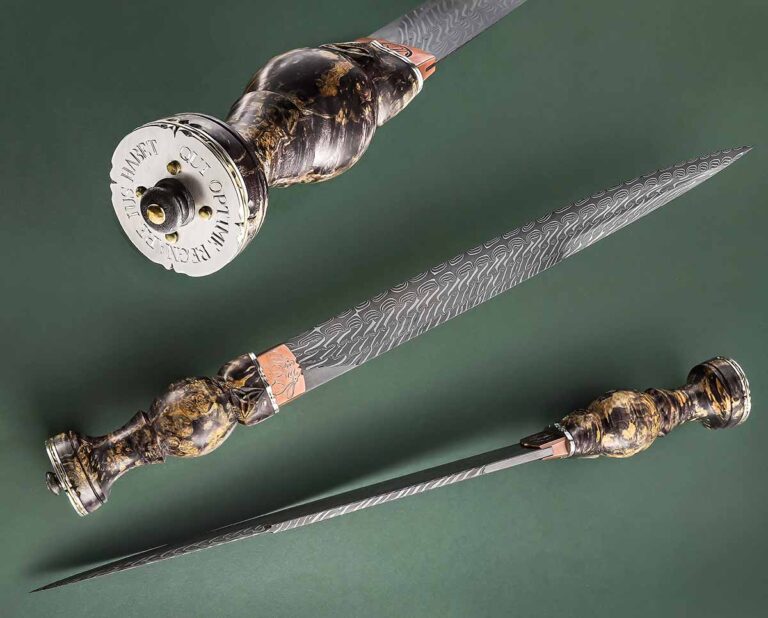
A bonnie blade to be sure, Kemper makes a statement with his Scottish dirk.
Derick Kemper celebrates his Scottish heritage with his sprawling reproduction of a Scottish dirk. It’s overstated to salute the legend and lore of his Scottish Highlander ancestors who fought so valiantly for their independence from Great Britain, beginning with the Jacobite rising of 1745.
The edge of the stunning damascus blade is a simple twist pattern of W2 carbon and 15N20 nickel alloy steels. The three bars above it are Derick’s version of Robert Eggerling’s paisley pattern—a modified twist of 203E carbon steel for the bright section and W2 and 15N20 as well.
The habaki has Derick’s Damselfly Forge stamp of two damselflies and his initials in the middle engraved on one side, and the white rose of Scotland’s “Bonnie Prince Charlie” (1720-1788) on the other.
Derick Kemper
The chess-piece-like handle is oversized as well, with the pommel engraved in Latin, Qui Optime Regnare Ius Habet. The English translation is “Who hath best right to reign,” a slogan that appeared on the flags and accouterments of many of the Highlanders in the 18th century.
Damascus, high-performance stainless and straight carbon steel standouts.
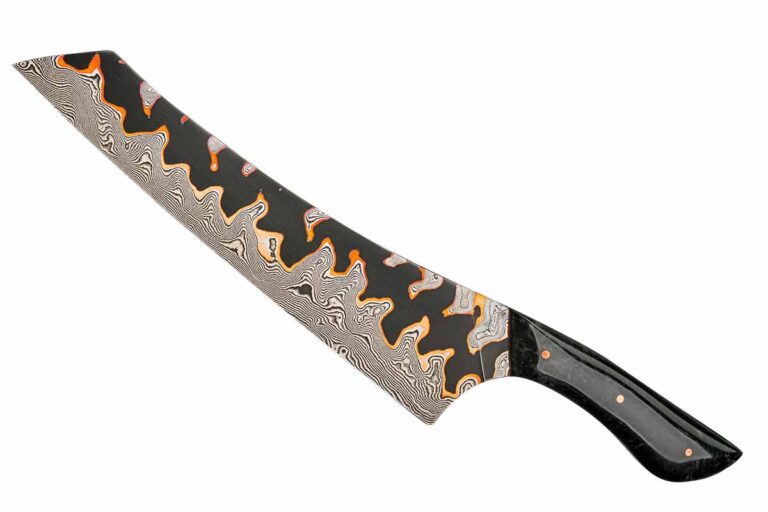
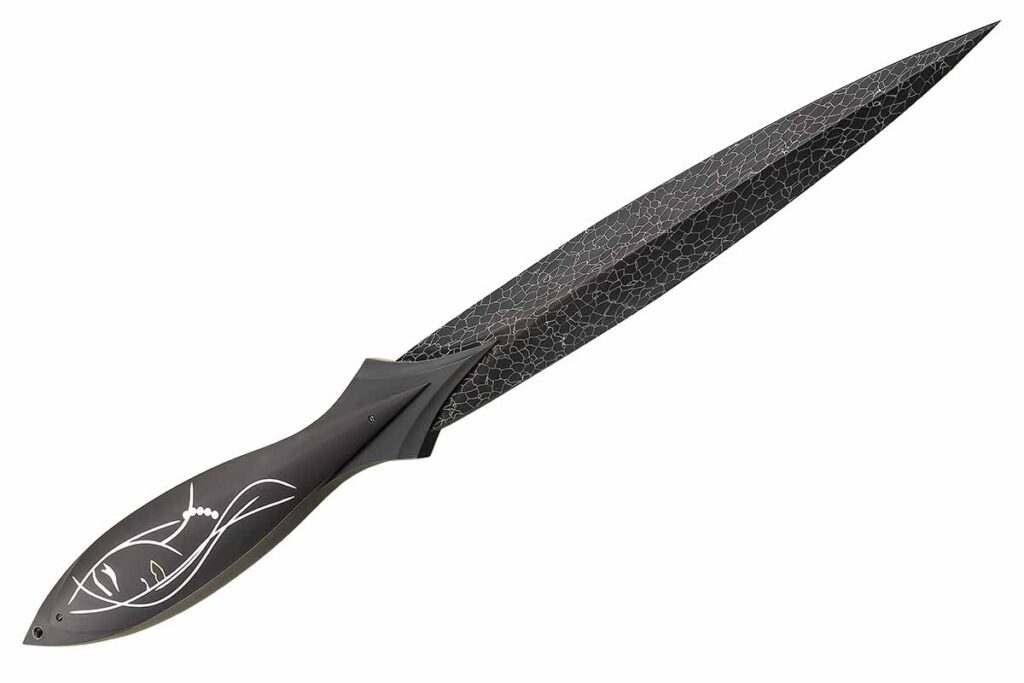
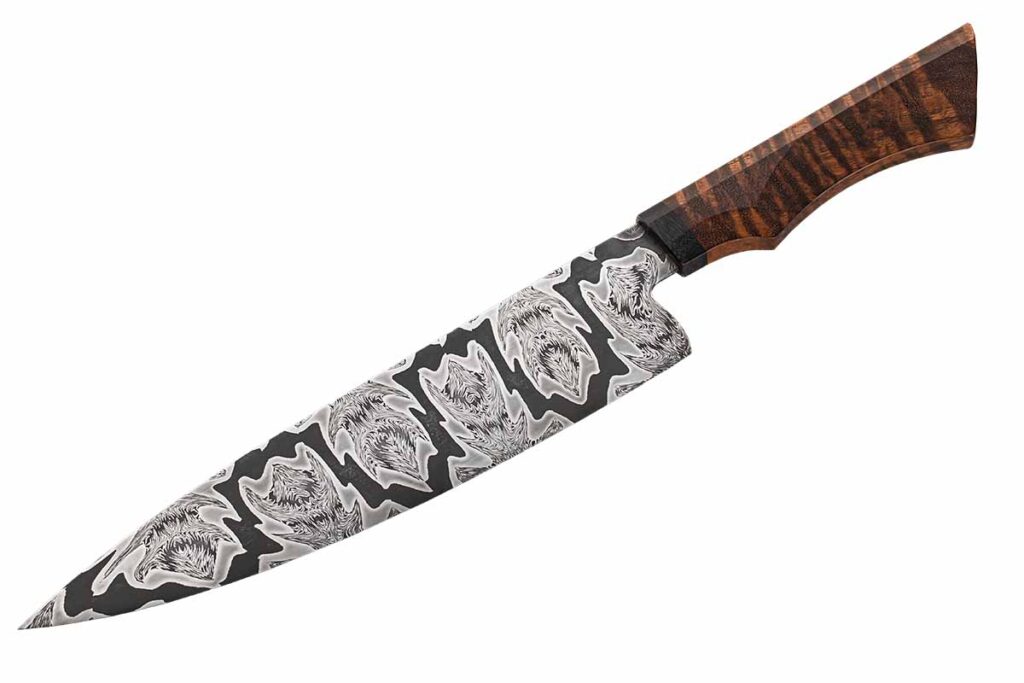
Always on the lookout for the new and exciting when it comes to edged gems, Blademag.com has collected a bevy of beautiful new knives hitting the market. This includes both custom and factory knives with a particular eye towards damascus, high-performance stainless and straight carbon steel standouts in this round.
Bertie Rietveld: Flirt
BLADE LENGTH: 7” BLADE MATERIAL: Nebula damascus BLADE GRIND: Hollow FRAME MATERIAL: Zirconium BOLSTER: Zirconium ENGRAVING: Of fine silver by Bertie Rietveld KNIFE TO KNOW: Stanhope lens in butt of handle OVERALL LENGTH: 12” MAKER’S PRICE FOR A SIMILAR KNIFE: $6,000 MAKER: Bertie Rietveld, rietveldknives.com (SharpByCoop image)
Keith Barthelmes: Serpent Chef’s Knife
BLADE LENGTH: 9.5” BLADE GRIND: Flat that tapers to a convex edge BLADE MATERIAL: Serpent damascus of 1084 carbon and 15N20 nickel steels HANDLE MATERIAL: Curly koa BOLSTER: Black canvas Micarta® OVERALL LENGTH: 15” MAKER’S PRICE FOR A SIMILAR KNIFE: $1,600 KNIFE TO KNOW: Keith is an ABS apprentice smith and hopes to take his ABS journeyman smith test in two years MAKER: Keith Barthelmes (Jocelyn Frasier image)
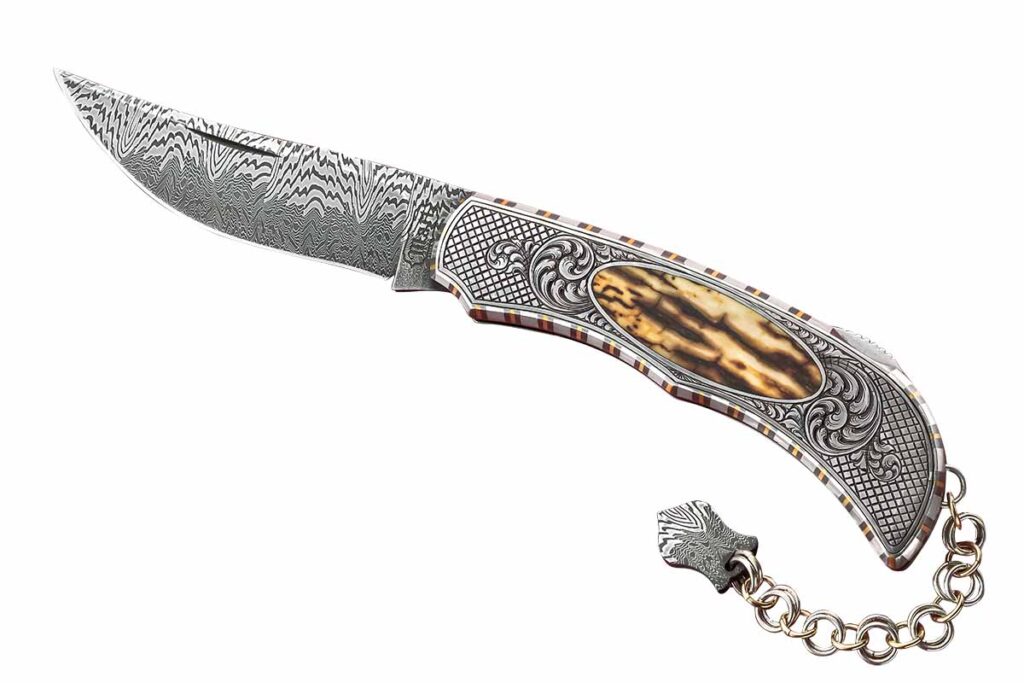
Matt Humphreys: Lockback Folder
BLADE LENGTH: 3.5” BLADE MATERIAL: Damascus forged by Jim Poor BLADE GRIND: Hollow HANDLE MATERIAL: Ancient ivory inlay, 24k-gold and fine silver inlay, 14k-gold and sterling silver chain FRAME MATERIAL: 4130 carbon steel ENGRAVING: By Matt Humphreys CLOSED LENGTH: 4.5” MAKER’S PRICE FOR A SIMILAR KNIFE: $5,500 MAKER: Matt Humphreys, outlawwaterjetdesign.com (SharpByCoop image)
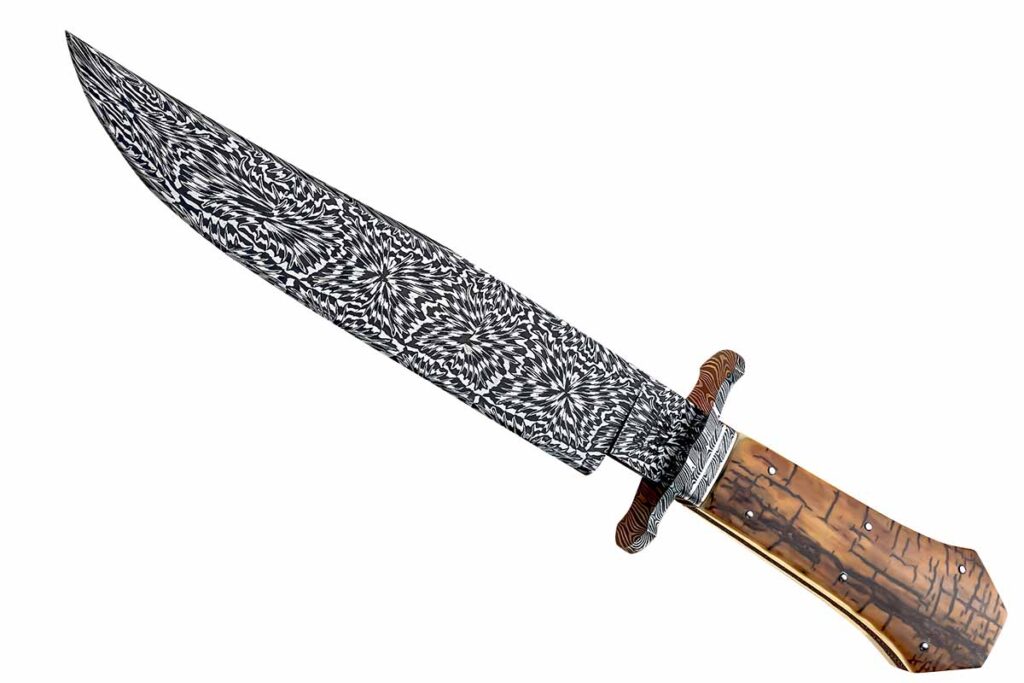
Shayne Carter: Coffin-handle Bowie
BLADE LENGTH: 8.25” BLADE MATERIAL: A mosaic explosion damascus pattern of 1084 carbon and 15N20 nickel-alloy steels BLADE GRIND: Flat HANDLE MATERIAL: Mammoth ivory FRAME MATERIAL: Damascus OVERALL LENGTH: 13.25” MAKER’S PRICE FOR A SIMILAR KNIFE: $3,200 KNIFE TO KNOW: Shayne Carter is a master smith in the American Bladesmith Society (ABS) MAKER: Shayne Carter, (SharpByCoop image)
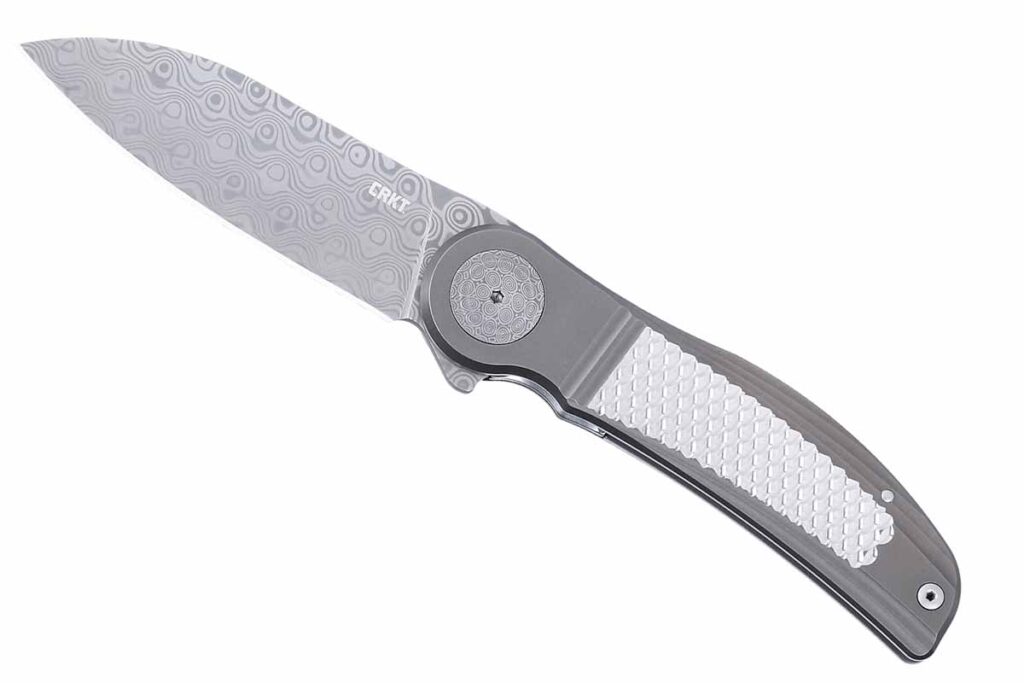
CRKT: Monument 4001
DESIGNER: BLADE Magazine Cutlery Hall-Of-Fame® member Michael Walker BLADE LENGTH: 3.07” BLADE MATERIAL: Rose damascus by Damasteel BLADE GRIND: Flat BLADE PATTERN: Modified sheepsfoot HANDLE: Titanium w/white dragon scale inlay PIVOT: Damascus in a Bluetongue pattern by Damasteel ACTION: IKBS ball bearings LOCK: Linerlock POCKET CLIP: Deep-carry design WEIGHT: 3.9 ozs. CLOSED LENGTH: 4.17” COUNTRY OF ORIGIN: Italy MSRP: $500 COMPANY: CRKT, crkt.com
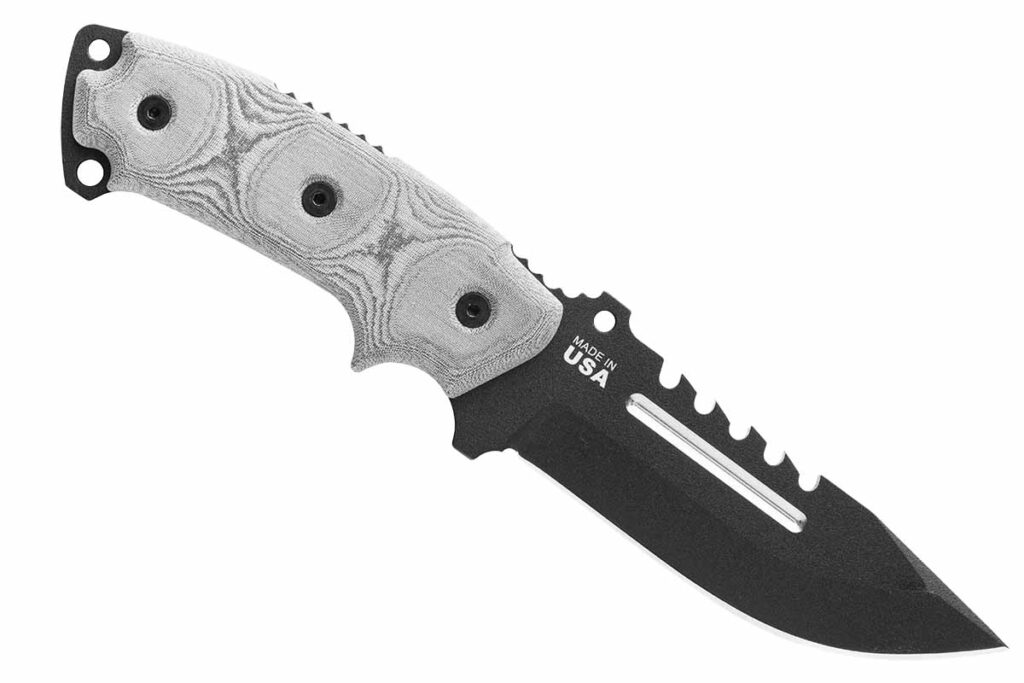
TOPS Knives: Steel Eagle 105C
BLADE LENGTH: 5.13” BLADE MATERIAL: 1095 carbon steel BLADE THICKNESS: .25” BLADE FINISH: Black Traction Coating HANDLE MATERIAL: Black linen Micarta® WEIGHT: 15.3 ozs. OVERALL LENGTH: 10.5” SHEATH: Black Kydex w/rotating spring clip WEIGHT W/SHEATH: 18.6 ozs. MSRP: $240 KNIFE TO KNOW: Sawteeth, full-tang construction COUNTRY OF ORIGIN: U.S.A. COMPANY: TOPS Knives, topsknives.com
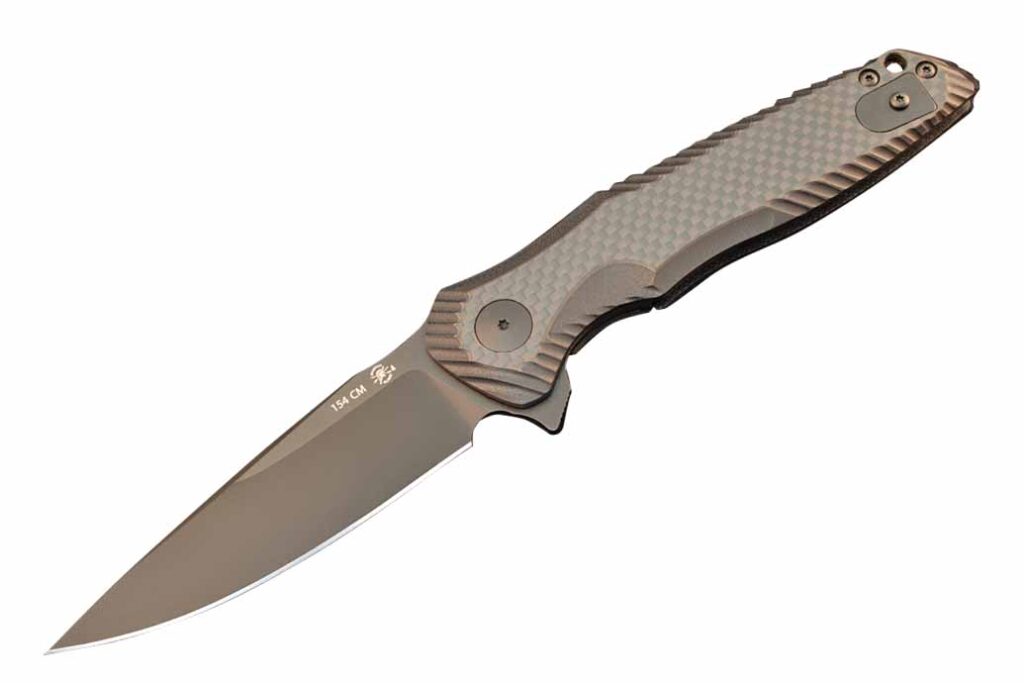
Spartan Blades: Poros
DESIGNER: Curtis Iovito KNIFE PATTERN: Flipper folder BLADE LENGTH: 3.75” BLADE Steel: 154CM stainless BLADE GRIND: Flat BLADE FINISH: Black titanium nitride coating BLADE PATTERN: Drop point PIVOT: Ikoma Korth Bearing System (IKBS) HANDLE MATERIAL: Scalloped black G-10 LOCK: Linerlock HARDWARE & LINER: Stainless steel w/electro-deposit powder coating POCKET CLIP: Deep carry WEIGHT: 5.28 ozs. CLOSED LENGTH: 5.25” MSRP: $180 COUNTRY OF ORIGIN: U.S.A. MAKER: Spartan Blades, spartanbladesusa.com
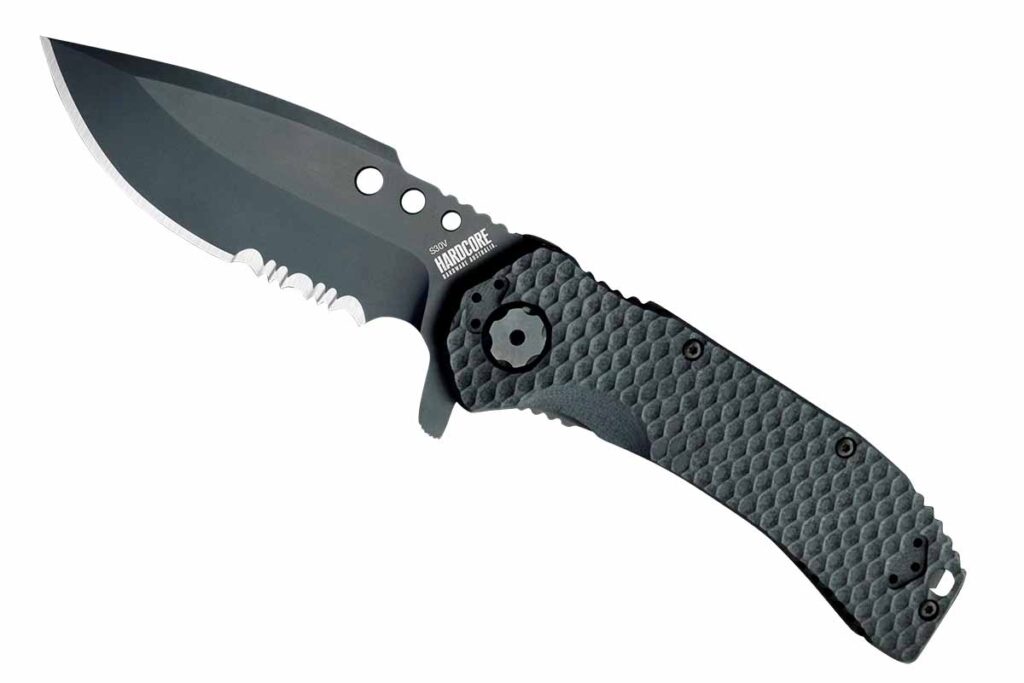
Hardcore Hardware: MILF-02PS
KNIFE TYPE: Tactical flipper folder BLADE LENGTH: 3.54” BLADE STEEL: CPM S30V stainless BLADE @ WIDEST: 1.18” BLADE GRIND: Hollow BLADE FINISH: PVD coated WASHERS: Phosphor bronze HANDLE MATERIAL: G-10 FRAME & LINER: 420J2 stainless LOCK: Framelock POCKET CLIP: Reversible tip up or down, ambidextrous WEIGHT: 7.34 ozs. CLOSED LENGTH: 5.51” MSRP: $280 COUNTRY OF ORIGIN: Australia and Taiwan COMPANY: Hardcore Hardware Australia, hardcorehardware.com.au
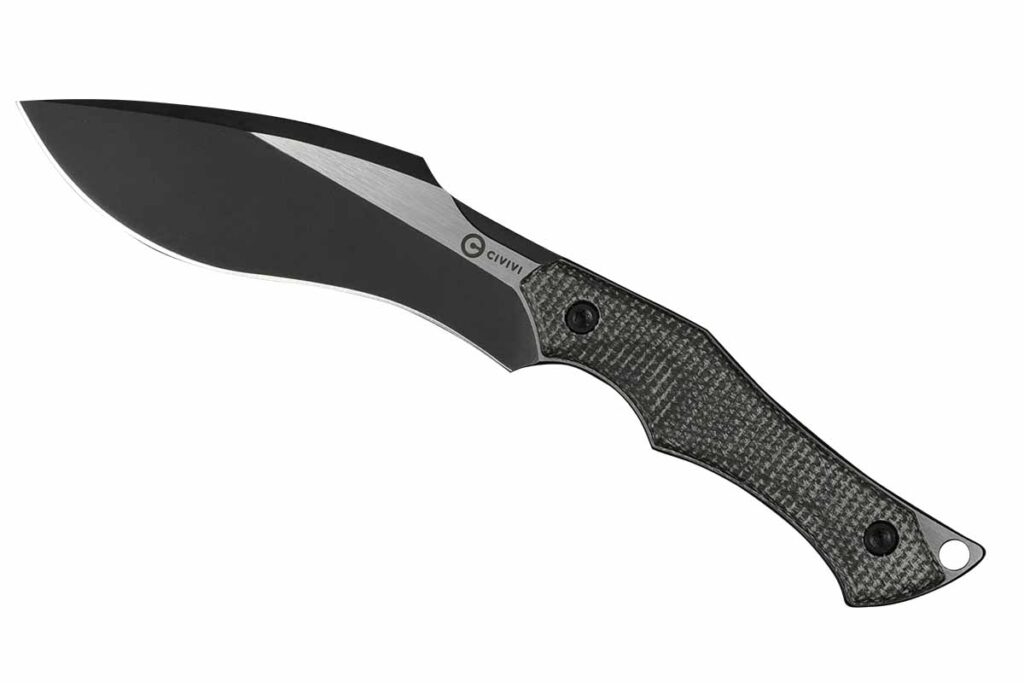
Civivi: Vaquita II
DESIGNER: Nate Matlack KNIFE TYPE: Fixed blade BLADE LENGTH: 3.2” BLADE Steel: Nitro-V stainless BLADE GRIND: Flat BLADE PATTERN: Kukri BLADE FINISH: Black stonewash HANDLE MATERIAL: Dark green canvas Micarta® WEIGHT: 1.28 ozs. OVERALL LENGTH: 6.23” SHEATH: Black Kydex COUNTRY OF ORIGIN: China MSRP: $69.40 COMPANY: Civivi, civivi.com
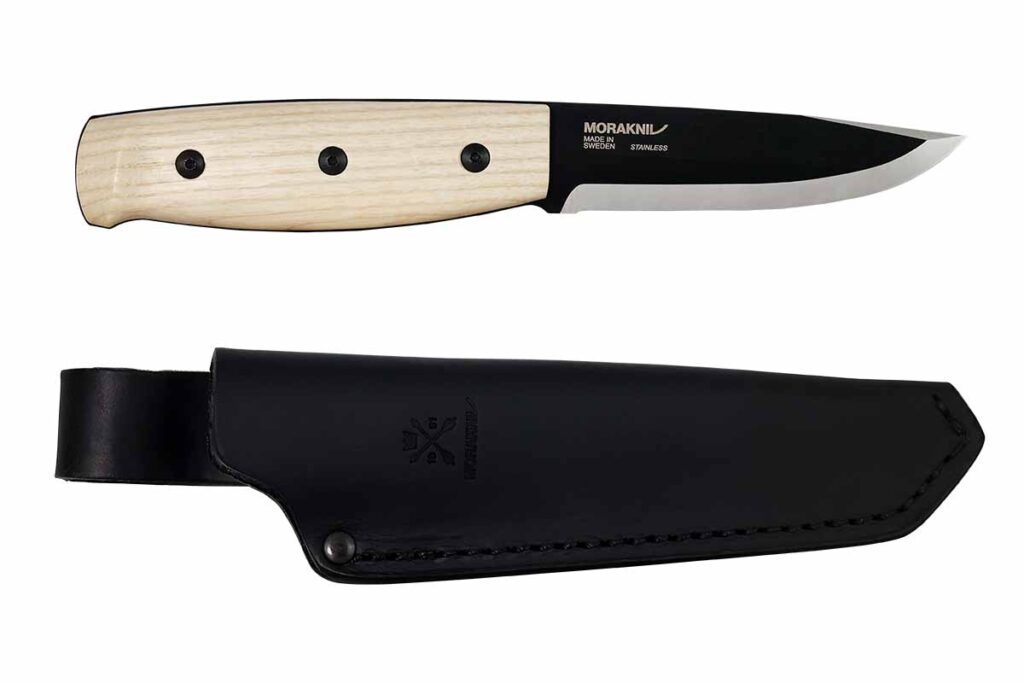
Morakniv: Bushcraft Knife
BLADE LENGTH: 4.05” BLADE STEEL: Recycled Swedish stainless BLADE THICKNESS: .098” BLADE PATTERN: Drop point HANDLE MATERIAL: Bright ash wood CONSTRUCTION: Full tang WEIGHT: 6.8 ozs. OVERALL LENGTH: 8.38” SHEATH: Vegetable-tanned leather w/belt loop; compatible with the Morakniv Dangler 10 w/button KNIFE TO KNOW: Blade spine compatible w/a fire starter MSRP: $240.07 (at press time rate of exchange) COUNTRY OF ORIGIN: Sweden COMPANY: Morakniv, industrialrev.com
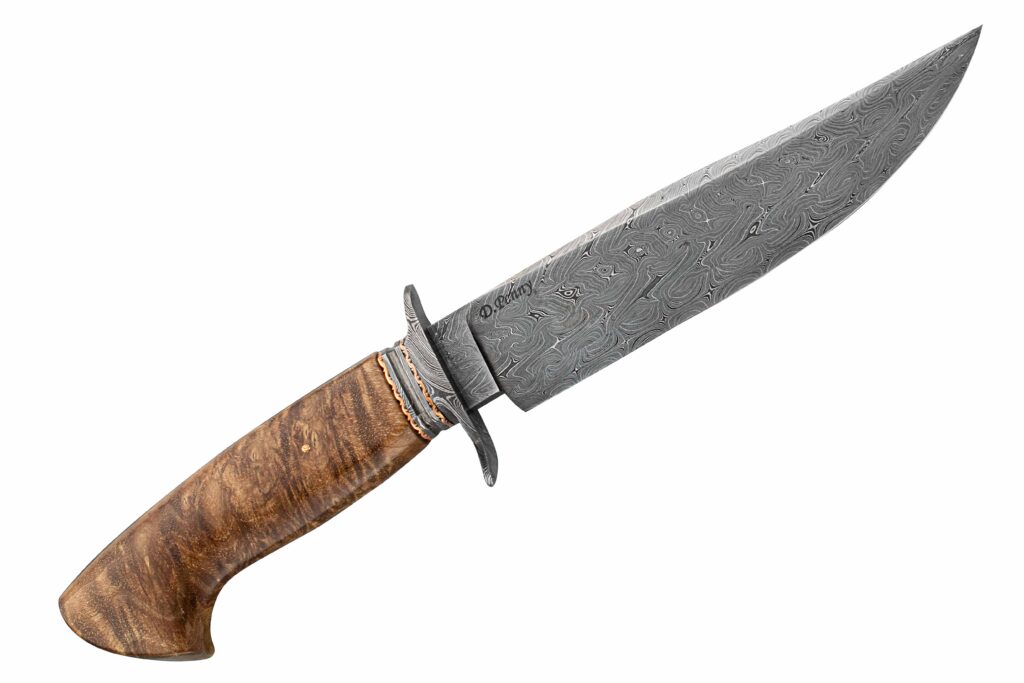
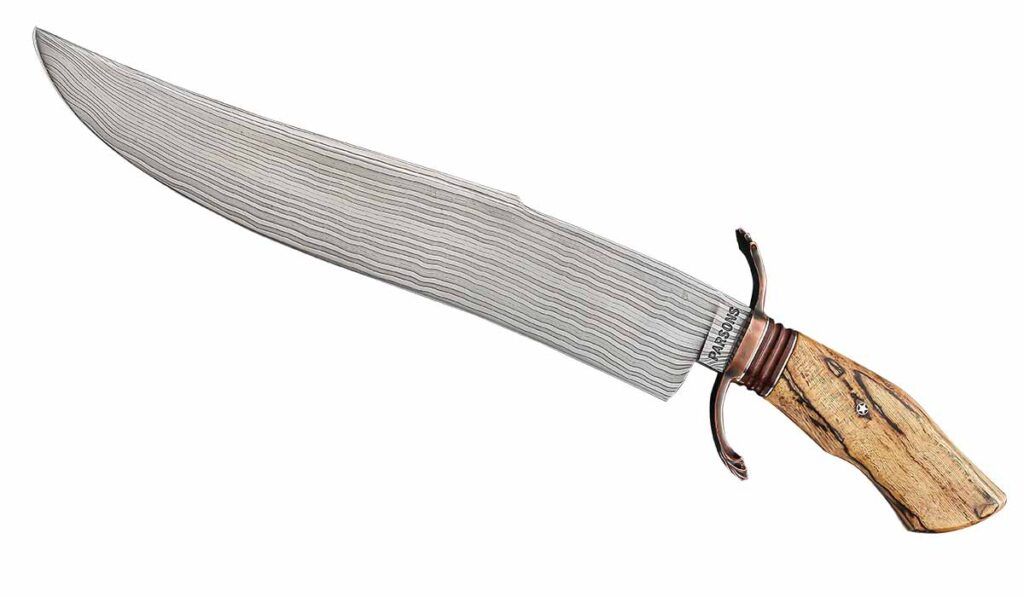
DP Custom Creations & Zero Down Forge: Fighter
BLADE LENGTH: 7.5” BLADE STEEL: 300-layer, 4-bar, alternating twist damascu BLADE GRIND: Flat HANDLE: Blond claro walnut, thorn and vine accent copper spacers, and copper pin FITTINGS: Twisted damascus guard and center spacer OVERALL LENGTH: 12.5” MAKER’S PRICE FOR A SIMILAR KNIFE: $1,100 KNIFE TO KNOW: Don Penny is an ABS apprentice smith MAKER: DP Custom Creations & Zero Down Forge, (Jocelyn Frasier image)
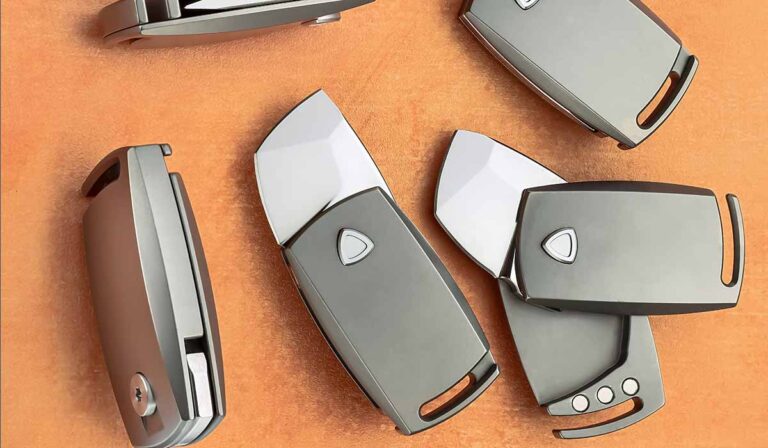
Barry Wood’s split-handle folder inspires Darriel Caston’s clever keychain knife.
Inspired by the split-handle folding knife made famous by the late, great custom knifemaker Barry Wood, the Imp by Darriel Caston is a clever keychain knife ideal for EDC.
Like the Wood folder, the blade opens by pivoting one of the scales clockwise and closes by pivoting the same scale counterclockwise. At the same time, slots at the ends of the Imp’s scales accept a keychain when they’re open and form an enclosed elliptical oval to hold the keychain when they’re closed.
Instead of a ball detent affixed to the blade to help hold the knife open and closed, Darriel uses magnets affixed to the handle. Darriel and his daughter, Bella, were trying to come up with names for the knife when she observed that it was “a little booger,” and he said, “Yeah, like a little imp.” And another knife name was born.
The Imp Specs Blade length: .82” Blade steel: M390 stainless Blade grind: Modified compound tanto Handle material: Titanium Closed length: 1.75” Maker’s price for a similar knife: In the $185-$200 range
We round up a dozen dazzlers that are certain to make your wish list grow.
One thing nobody has ever said: “I have enough knives.” In that sprite, we’ve gathered up a ton of new knives that have hit the market in recent months, each one sharp as a razor in looks and function.
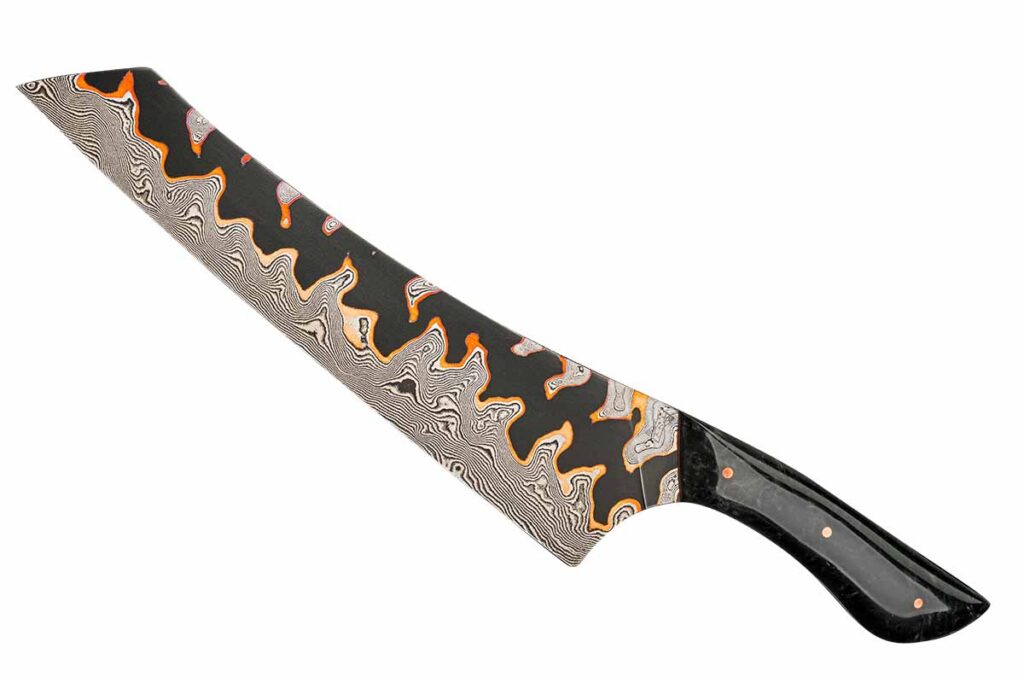
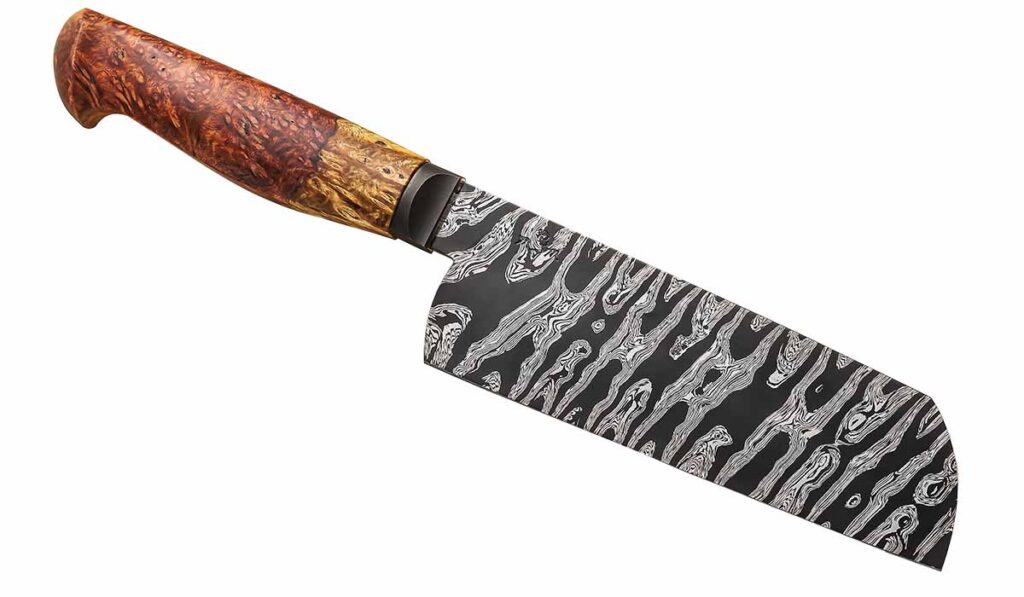
Maverik Knives Cleaver
KNIFE TYPE: Cleaver BLADE LENGTH: 6.5” BLADE MATERIAL: 1084 carbon and 15N20 nickel-alloy steels in a zebra-twist damascus pattern BLADE GRIND: Flat w/convex edge BLADE AT THICKEST: .135” HANDLE MATERIAL: Amboyna burl BOLSTER: Antiqued bronze OVERALL LENGTH: 12” KNIFE TO KNOW: Maverik Murdock is an ABS apprentice smith MAKER’S PRICE FOR A SIMILAR KNIFE: $1,400 MAKER: Maverik Knives (SharpByCoop image)
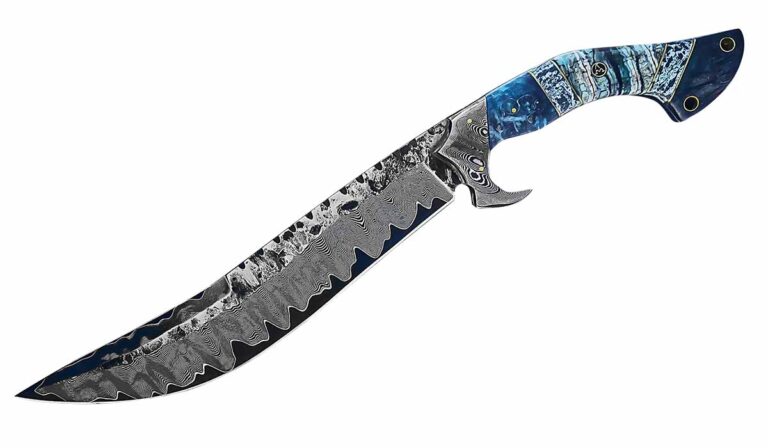
S.K.MO Knives Fi
KNIFE TYPE: Fixed blade BLADE LENGTH: 13.25” BLADE MATERIAL: Canister damascus of 1095 powder and nails BLADE PATTERN: Harpoon HANDLE MATERIAL: Black palm and water buffalo horn w/nickel spacers and star pin GUARD/BOLSTER: Stainless steel OVERALL LENGTH: 17.75” KNIFE TO KNOW: S-guard and dropped-handle designs MAKER: S.K.MO Knives (SharpByCoop image)
KNIFE NAME: Viking/Nordic seax KNIFE TYPE: Fixed blade BLADE LENGTH: 9.33” BLADE MATERIAL: Sup9 by Jake Mantel/Firepants Fabrication, w/proximal and distal tapers BLADE GRIND: Flat; secondary bevel w/convex edge BLADE AT THICKEST: .177” HANDLE MATERIAL: Stabilized, Northern-Territory-grown, figured coolabah wood OVERALL LENGTH: 14.96” MAKER’S PRICE FOR A SIMILAR KNIFE: $500 KNIFE TO KNOW: Francois Mazieres is an ABS apprentice smith and a member of both the Australian Knifemakers Guild and The Knifemakers’ Guild MAKER: Yandiwa (Rod Hoare image)
Tobin Hill Comanche
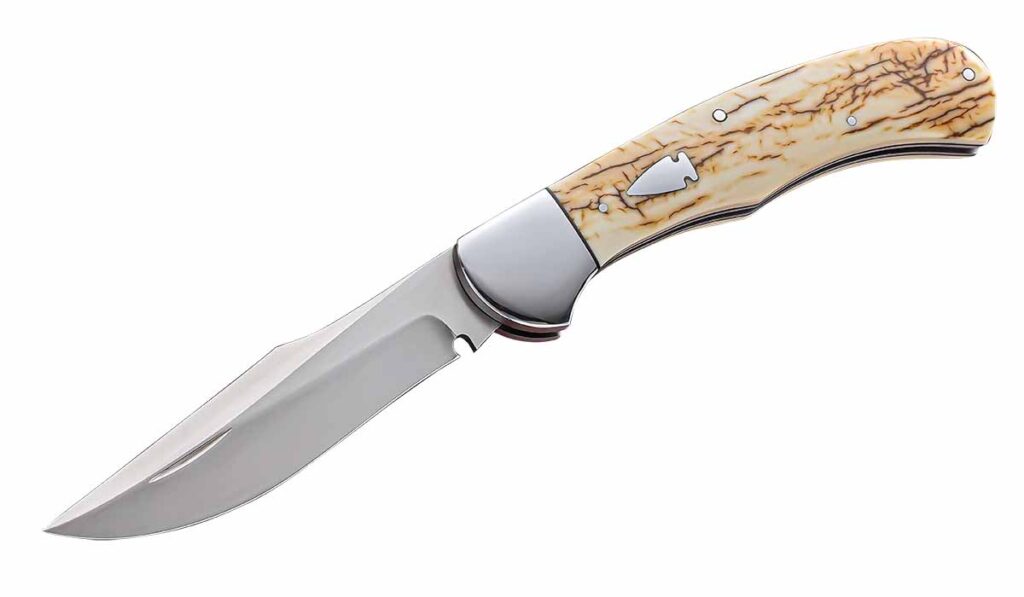
KNIFE NAME: Comanche KNIFE TYPE: Folder BLADE LENGTH: 3.75” BLADE STEEL: CPM 154 stainless BLADE GRIND: Hollow HANDLE MATERIAL: Ancient mammoth ivory GUARD/BOLSTER: 410 stainless CLOSED LENGTH: 4.75” KNIFE TO KNOW: The knife is a collaboration between Tobin Hill and ABS master smith Jason Knight MAKERS’ PRICE FOR A SIMILAR KNIFE: $3,500 CONTACT: Tobin Hill (SharpByCoop image)
Steve Gatlin Chute
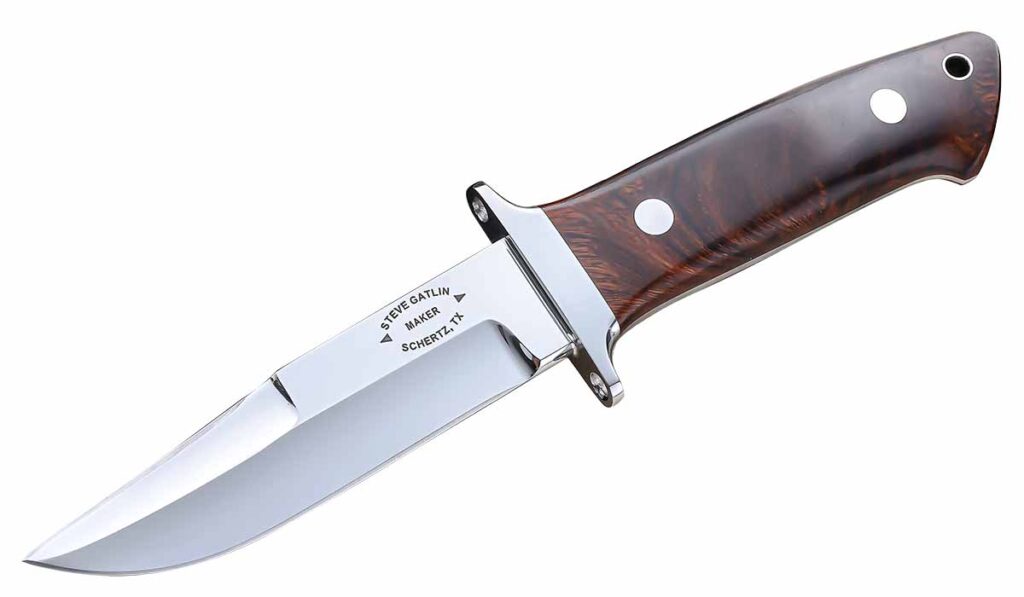
KNIFE NAME: Chute KNIFE TYPE: Fixed blade BLADE LENGTH: 4.5” BLADE STEEL: CPM 154 stainless BLADE GRIND: Hollow BLADE FINISH: Mirror polish HANDLE MATERIAL: Desert ironwood w/red liners GUARD/BOLSTER: 416 stainless OVERALL LENGTH: 9.125” SHEATH: Custom made of leather MAKER’S PRICE FOR A SIMILAR KNIFE: $1,400 MAKER: Steve Gatlin, (SharpByCoop image)
Allen Matthew Custom Knives Bushman’s Knife
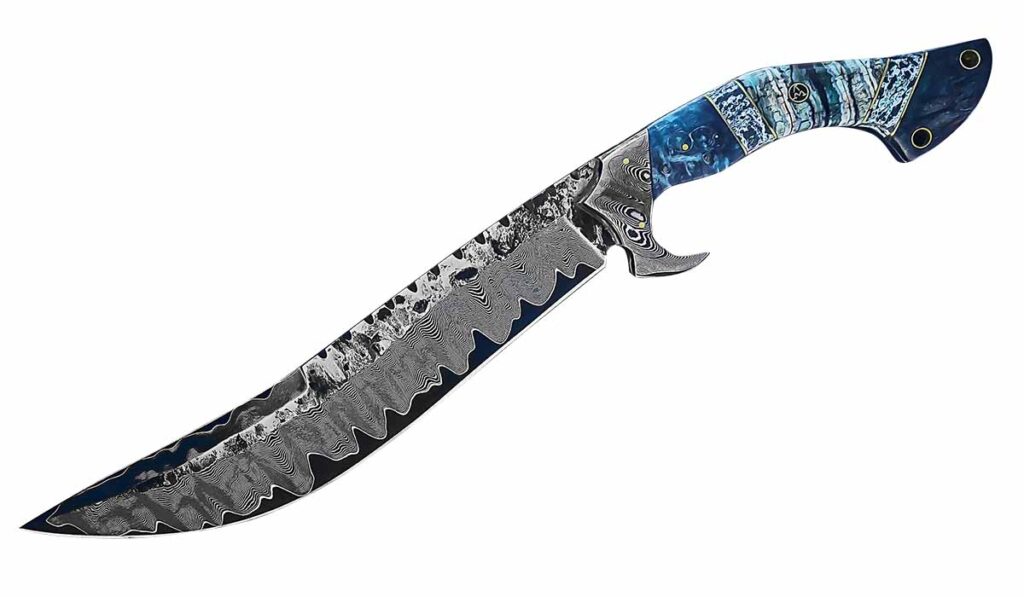
MODEL NAME: Bushman’s Knife KNIFE TYPE: Fixed blade BLADE LENGTH: 12” BLADE MATERIAL: 1095 carbon and 15N20 nickel-alloy steels in a damascus-clad san-mai construction HANDLE MATERIAL: Ancient mammoth molar tooth w/stabilized and dyed amboyna burl and yoskizaki; Starmascus glow in the dark spacers & brass highlights GUARD/BOLSTER: Damascus OVERALL LENGTH: 19” KNIFE TO KNOW: Bulldog Damascus forged the blade material MAKER’S PRICE FOR A SIMILAR KNIFE: $2,300 MAKER: Allen Matthew Custom Knives (Rod Hoare image)
J.R. Cook Vaquero
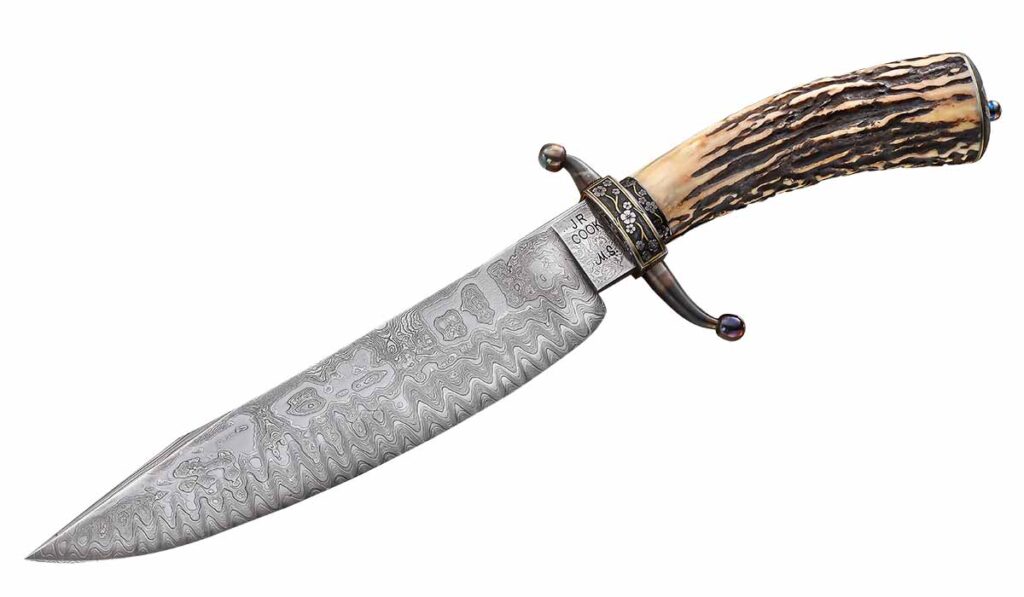
KNIFE NAME: Vaquero BLADE LENGTH: 8” BLADE MATERIAL: Damascus steel in a wolf-tooth pattern HANDLE MATERIAL: Stag FITTINGS: 416 stainless steel engraved in 24k gold by J.R. Cook OVERALL LENGTH: 10.25” SHEATH: Custom-fitted, tooled-leather belt model KNIFE TO KNOW: The knife is sole authored; J.R. Cook is an ABS master smith and a past Arkansas Living Treasure MAKER’S PRICE FOR A SIMILAR KNIFE: $6,200 MAKER: J.R. Cook (SharpByCoop image)
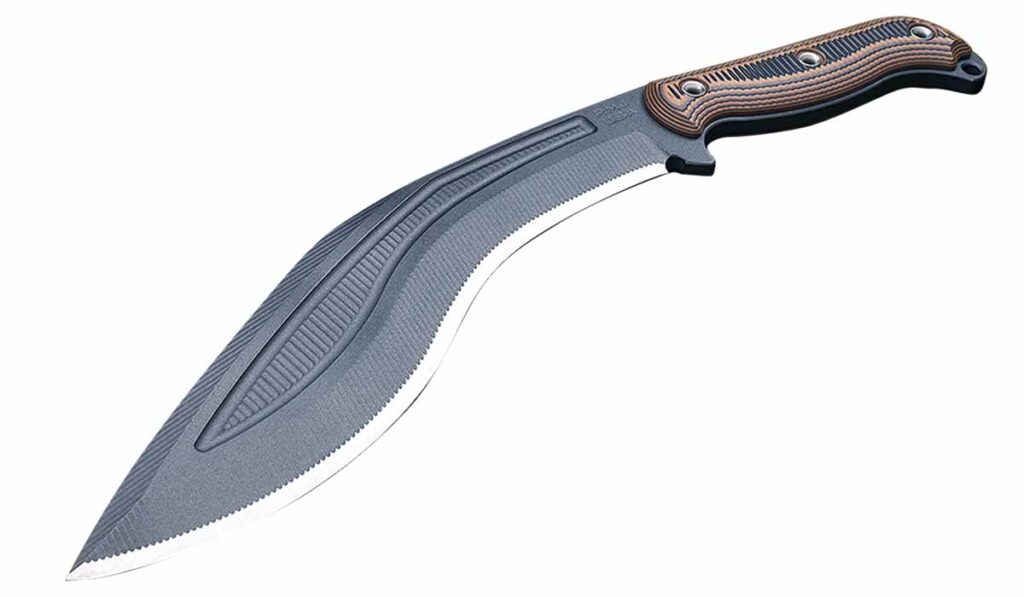
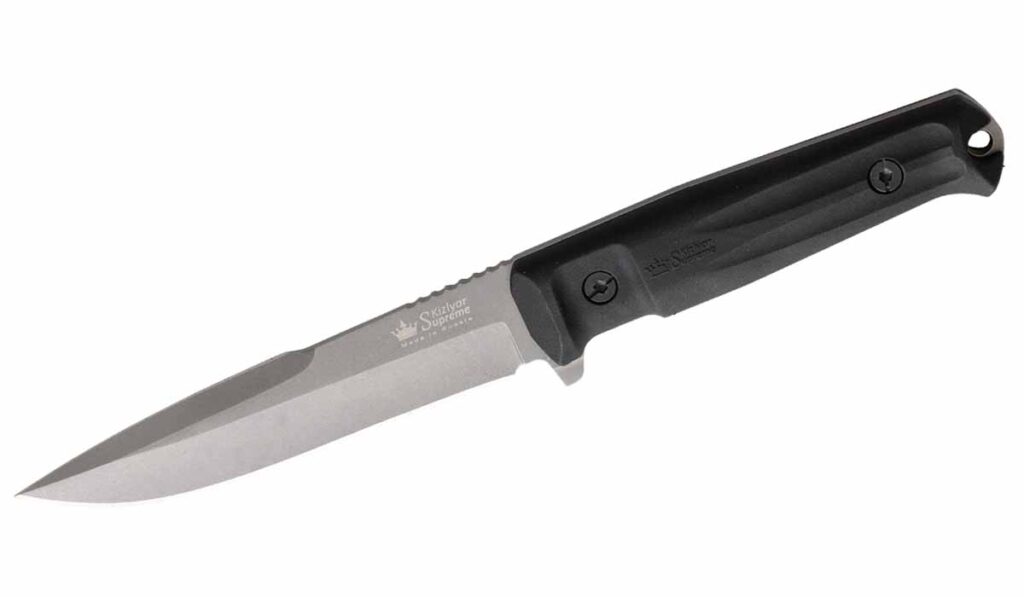
Kizlyar Supreme Delta AUS8 Black Titanium
KNIFE NAME: Delta AUS8 Black Titanium KNIFE TYPE: Tactical fixed blade BLADE LENGTH: 6” BLADE MATERIAL: AUS8 stainless steel BLADE GRIND: Hollow BLADE THICKNESS At GUARD: .185” BLADE PATTERN: Harpoon HANDLE MATERIAL: Contoured black Kraton/ABS synthetic w/lanyard hole CONSTRUCTION: Full tang OVERALL LENGTH: 11.1” SHEATH: MOLLE compatible w/three-point locking system KNIFE TO KNOW: Integral single guard, finger traction ridges on blade spine COUNTRY OF ORIGIN: Russia MSRP: $149 COMPANY: Kizlyar Supreme
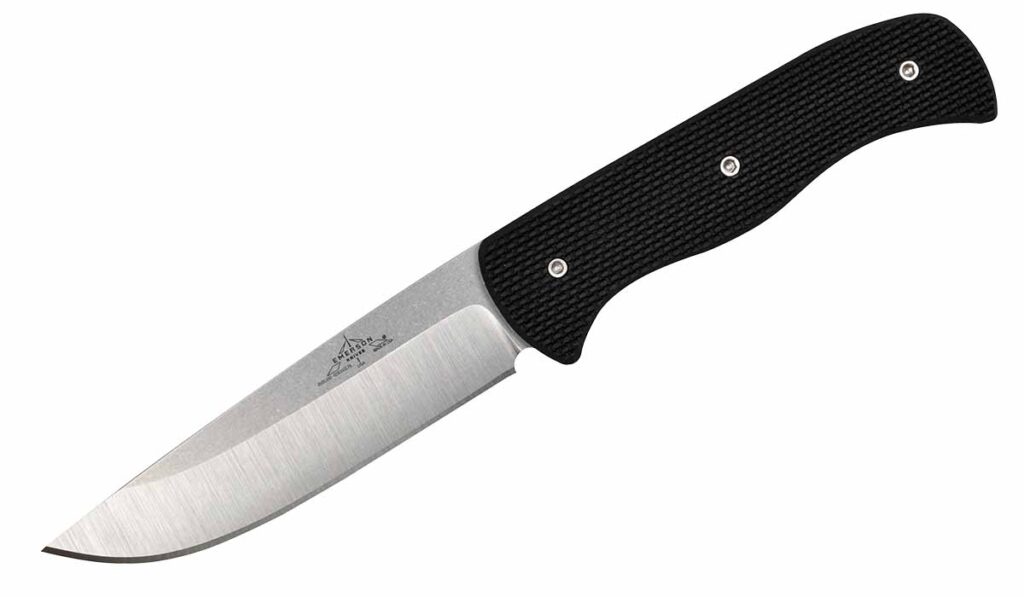
Emerson Knives Overland Renegade
KNIFE NAME: Overland Renegade KNIFE TYPE: Fixed blade BLADE LENGTH: 4.3” BLADE STEEL: 154CM stainless ROCKWELL HARDNESS: 57-59 HRC BLADE GRIND: Conventional “V” BLADE AT THICKEST: .125” BLADE FINISH: Stonewashed HANDLE MATERIAL: Black G-10 (also in Richlite) OVERALL LENGTH: 9” KNIFE TO KNOW: The Renegade is also available in a folding configuration COUNTRY OF ORIGIN: U.S.A. MSRP: $262.95 COMPANY: Emerson Knives
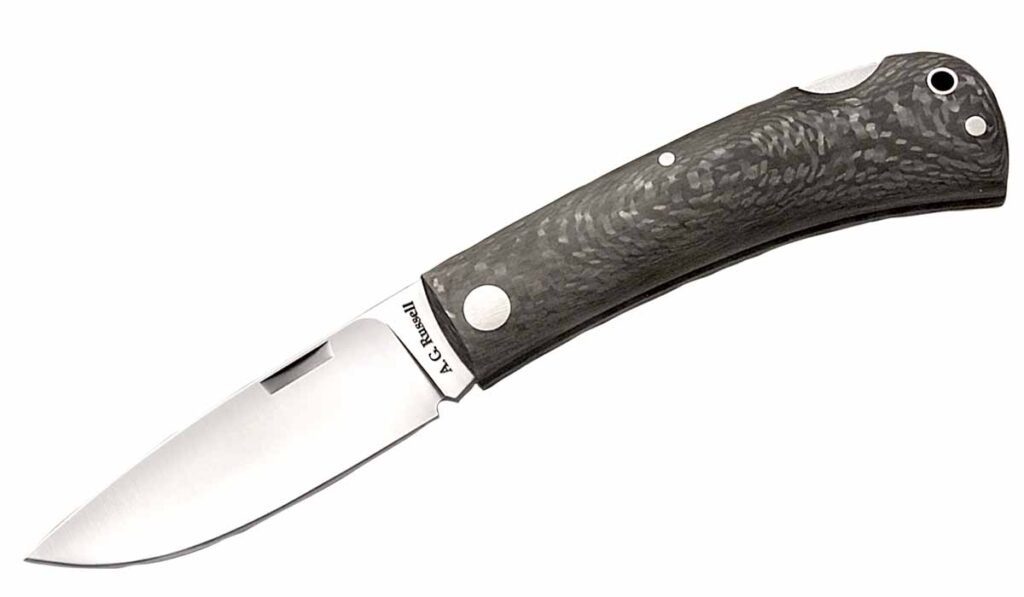
A.G. Russell Knives Skinny Brute
KNIFE NAME: Skinny Brute KNIFE TYPE: Utility folder BLADE LENGTH: 3.25” BLADE STEEL: CPM S35VN stainless BLADE GRIND: Flat BLADE PATTERN: Drop point BLADE FINISH: Satin HANDLE MATERIAL: Carbon fiber (also comes in green G-10) POCKET CLIP: None LOCK: Lockback CLOSED LENGTH: 41/8” KNIFE TO KNOW: The knife is an update from the original released in the 1970s; the handle is a “skinny” linerless design that is just over .5” thick at the center swell COUNTRY OF ORIGIN: China MSRP: $135 ($99 in green G-10) COMPANY: A.G. Russell Knives
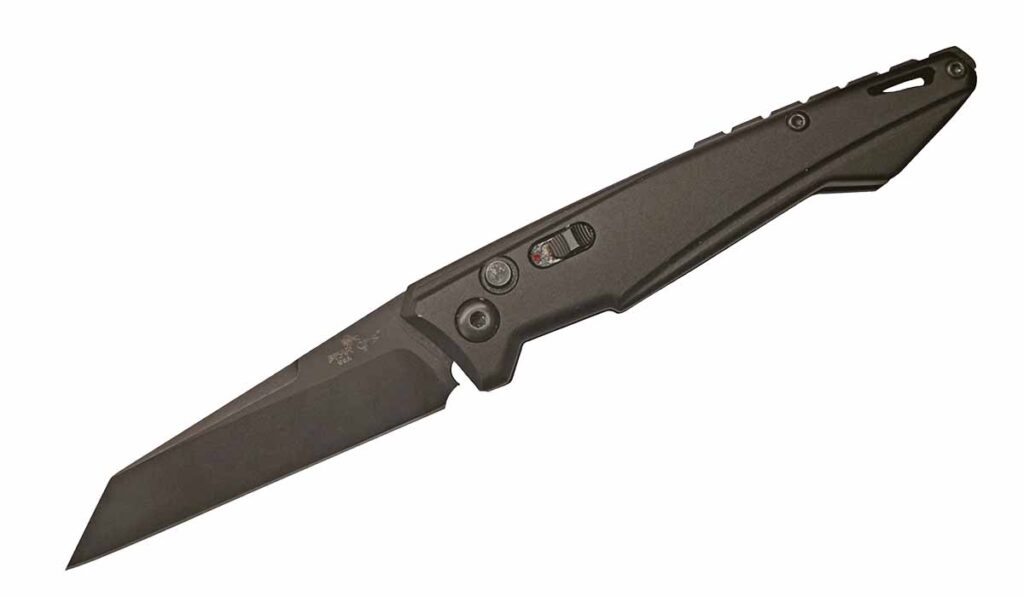
Bear & Son Cutlery Auto Bold Action XV
KNIFE NAME: Auto Bold Action XV KNIFE TYPE: Automatic folder BLADE LENGTH: 31/8” BLADE STEEL: Sandvik 14C28N stainless ROCKWELL HARDNESS: 58-60 HRC BLADE GRIND: Hollow BLADE PATTERN: Reverse tanto BLADE FINISH: Black HANDLE MATERIAL: Black aluminum POCKET CLIP: Carries blade tip up LOCK: Lock safety WEIGHT: 2.6 ozs. CLOSED LENGTH: 4.5” KNIFE TO KNOW: Ball-bearing pivot; safety lock switch just below the push button opener COUNTRY OF ORIGIN: U.S.A. MSRP: $179.99 COMPANY: Bear & Son Cutlery
Peyton Ramm uses the 3D printing process for canister patterns to make his dream knife.
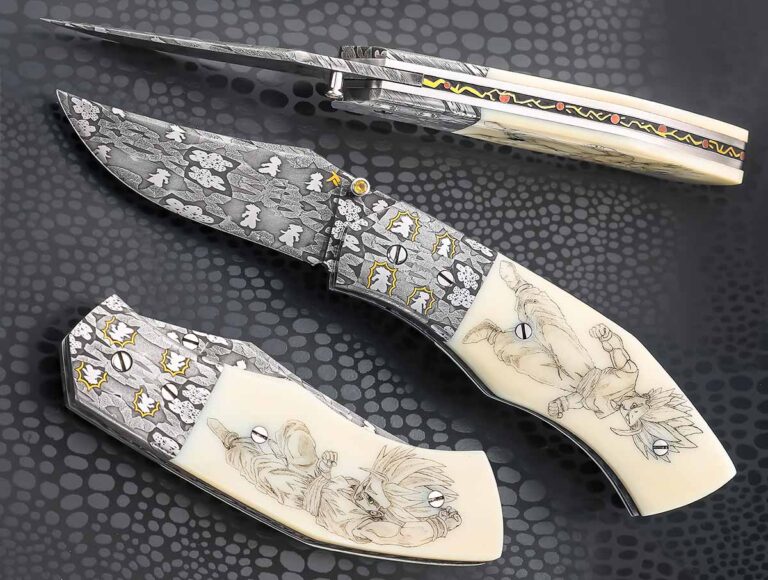
It was ABS journeyman smith Peyton Ramm’s dream to make a knife themed after his favorite childhood TV show, Dragon Ball, and the new 3D printing process for canister patterns provided him with the perfect vehicle to do so.
“Before I heard about 3D printing, I dreaded the idea of paying someone to wire EDM every single dragon ball out, but my good friend Ron Hardman introduced the idea,” Peyton wrote. “I sent him pictures of Gohan [a prominent character in the Dragon Ball series] and the dragon balls, and asked him to recreate the image in the best way possible to forge down. His students at Kilroy’s Workshop got a rough draft for me and once I approved it, they printed and sent it.”
Peyton stated he had to build a new forge just to do the canisters, as he only had a vertical forge and it’s important to forge weld lightly on the two end caps first before welding the sides.
“My first billet fell apart because of this, a mistake I didn’t [repeat],” he wrote. He combined the two images with a flower mosaic he made with a damascus of 1095 carbon and 15N20 nickel-alloy steels to break the pattern up, and finally had his damascus. From there he matched the blade and bolsters as best he could so it would look like an uninterrupted transition.
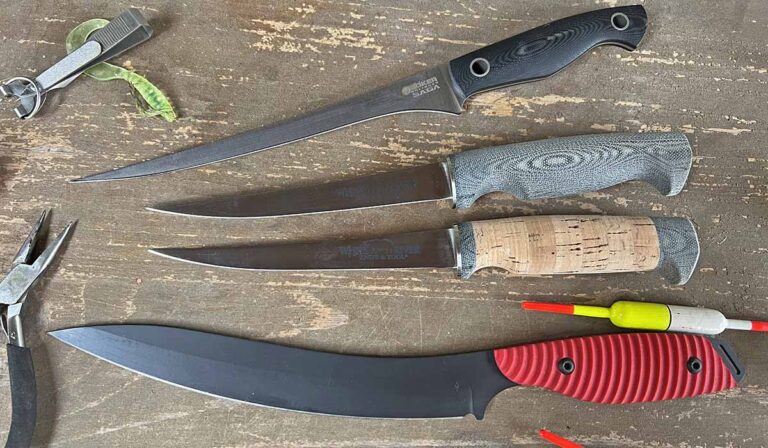
While you may think a fillet knife has only one purpose, there’s as much variation in fillet knives as there is with any other knife type. Just as there’s no one type of pocketknife, neither is there one type of hunting knife. Treating the fillet knife as an afterthought for your fishing is a mistake. In other words, you want to match your quarry to your blade.
Fillet Knife Size
The vast majority of American anglers, and most in Europe, fish either in inland waterways or along coastal waters. While it is certainly possible to catch large fish in these places, few people realize just how large of a difference there is between a 5-ounce bluegill and a 50-pound sturgeon. When you get above 10 pounds, you run the same risk of breaking fillet blades as you would breaking hunting blades on large game like deer. The flesh, bone and scales of fish are far tougher than many realize and a fragile blade can and will break if you put too much pressure on it. Heavy-duty fillet knives exist and are specially designed for larger fish.
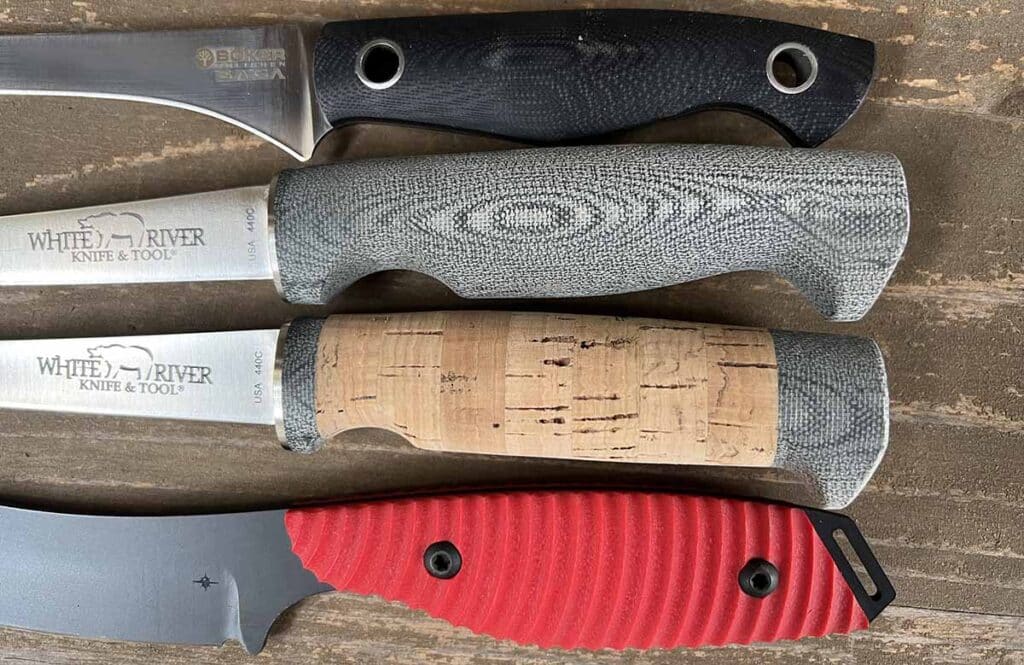
Handles are an important consideration. Texture matters on these fine knives and for some outings you need a very sure grip.
Likewise, small fish do not benefit from larger knives. This should seem like common knowledge, but I see anglers with 8-to-10-inch knives going after panfish. This is not a bad thing overall, just really unnecessary for the task. In my experience, large work like skinning deer and breaking down large game needs a 7-inch blade; you want to be able to see what you’re working with and keep your hand out of the body and highly visible. With small fish, you want the tip closer to your hand to better control your cuts. Fish cleaning is an activity that leads with the tip. You need to have it cut in easily and then glide. A paper-thin blade isn’t meant for chopping or sawing, unlike what you can accomplish with a thick-spined hunting knife.
Blade Flexibility
Flex is another important aspect of a fillet knife. Because of the way fish are shaped you want a blade that has the ability to match contours and glide along the spine or under the skin. Flex varies depending on the task. On large fish you’ll want the least flex, on small ones you’ll want the most. As for the tip, the largest fish need a reinforced tip because skin and fat can be extremely thick, and a thin tip is more likely to bend or break. Ideally, the tip should be as fine as possible and come to a narrow-angle. However, this becomes a hard thing to accomplish when you need a fillet knife that is also very strong. To get this, you need something like the tip of a wharncliffe pattern that provides a fine point while maintaining a thick blade.
Some Of The Best Fillet Knives
Toor Cardiff
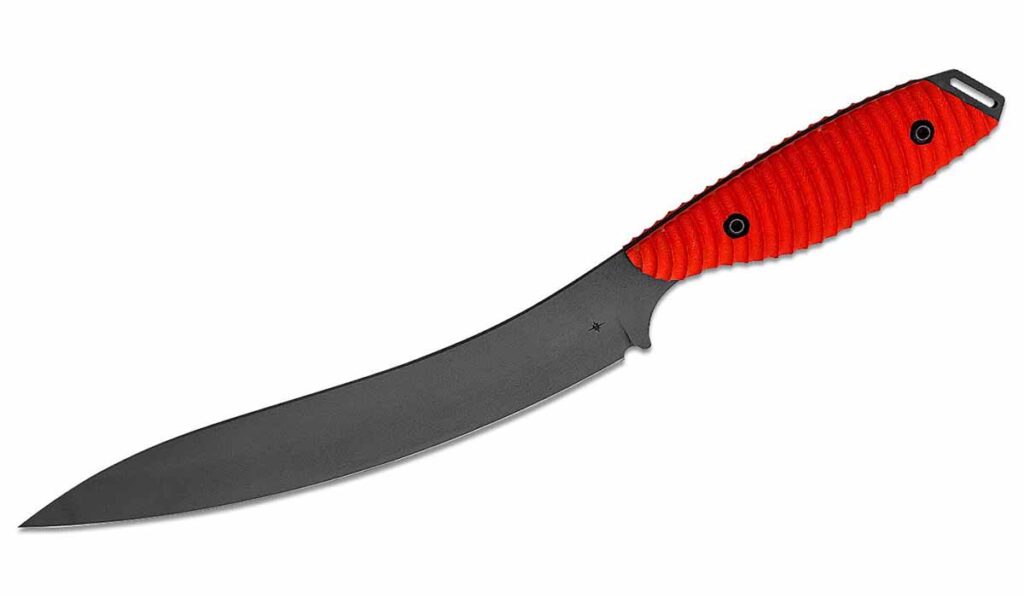
The Toor Cardiff is perhaps the most well-designed and best-thought-out knife for large fish. Just about every part of the knife is properly contoured and ground to achieve a light, thin blade that is also very strong and razor-sharp. It is the thickest knife of the test bunch, but, at just .09-inch thick, is still considerably thinner than standard blades. It does not taper substantially from pommel to tip. The point of the knife is quite fine but shaped with strength in mind. Its edge geometry enables it to be used on most sizes of fish, though it is at a slight disadvantage on the smallest bluegill or anything you would throw in the pan as one piece. This has more to do with the overall size of the knife than it does cutting ability.
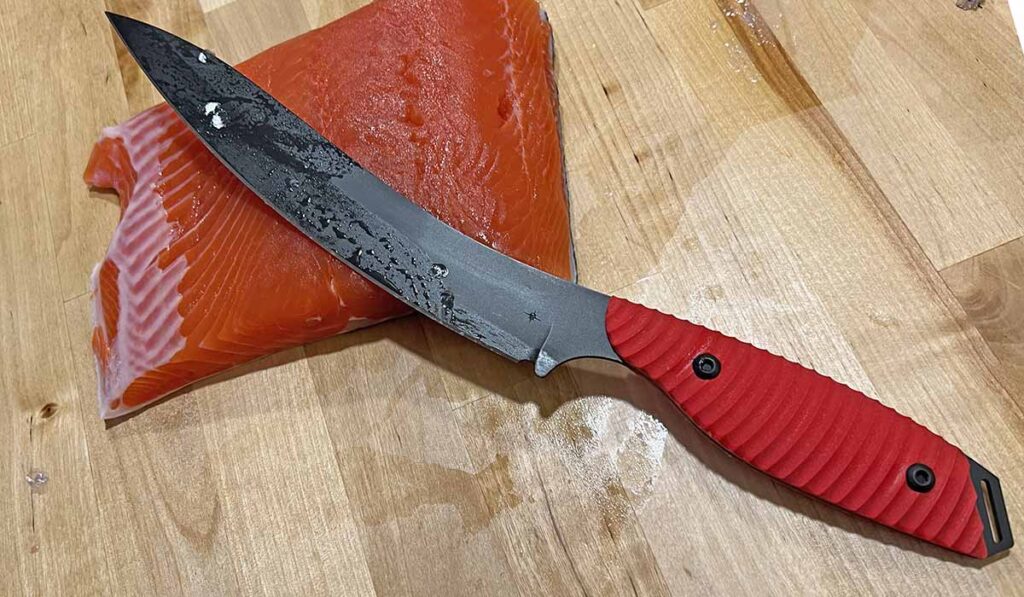
Large salmon were no match for the Cardiff, a well-thought-out, hard-use fillet knife that can also be used for large game. It is a crossover knife meant for the field, not just light work at the dock.
The blade has a curve with a deep belly. It permits the hand to sit at a more relaxed angle if you are cutting steaks or slicing a thick fish along the spine. The grip is very aggressive and promotes a firm hold even when your hands are covered in fish slime, water and blood. The knife is ruggedly designed and a suitable tool even for large game, including deer. While it does have some disadvantages as compared to a dedicated hunting knife, you could certainly get away with it as your primary blade for a mixed-bag hunting/fishing adventure. It does very well in the kitchen but you can tell it needs to be in the field.
White River Knife & Tool Traditional Fillet
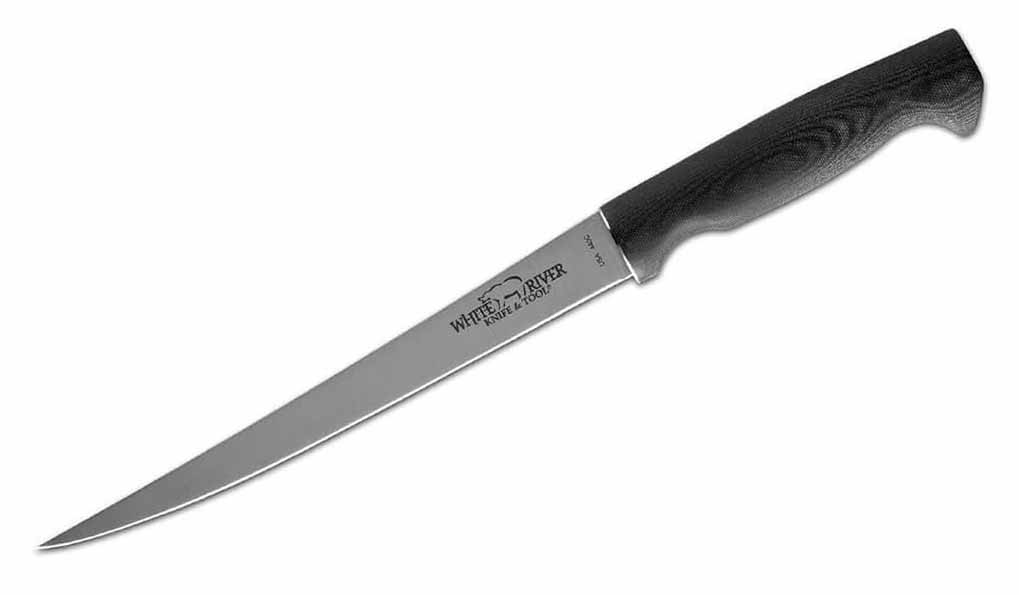
When you think of a fish knife, the White River Knife & Tool Traditional Fillet is probably what comes to mind. White River is excellent when it comes to delivering traditional appearance with modern function. I have been using White River knives almost exclusively in the field for years for deer hunting, and I jumped at the opportunity to look at its fillet knives. Not only are White River fillets some of the best money can buy, they also are the best across-the-board for general fishing use. Moreover, they display some noteworthy properties.
While there are two White Rivers in the review group, they are for all purposes the same except for the fact that the cork-handle version will float. I especially like this feature considering I spend some time in kayaks and canoes. A cork handle is not as durable as the full Micarta® version but will last a lifetime if properly maintained and not abused. The two are not for hunting. They are dedicated for fishing and should be used as such.
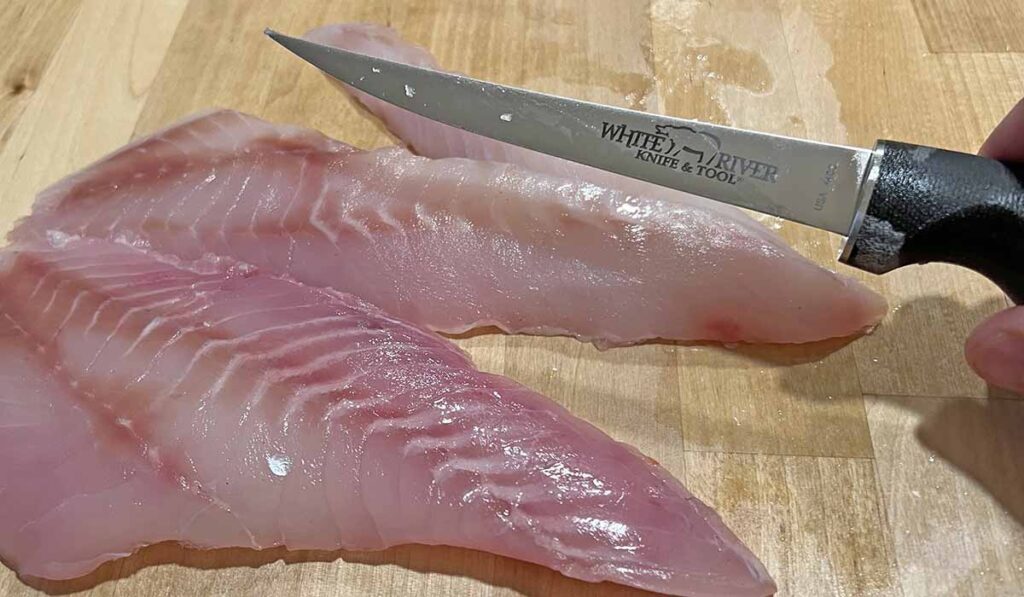
The White River fillets performed well for all general use.
As far as overall performance, the White Rivers will do everything you need and nothing you don’t. They are dedicated fillet knives that are, at least in the 6-inch size, best on intercontinental species. There really isn’t anything you can fish for in an American river that you can’t process with these knives. They are a tad thin for heavy-boned fish and the largest river catfish, but if you’re careful you should be just fine.
The knives come in an excellent wooden presentation box and have a functional, adjustable sheath with multiple mounting options. When sheathed, the blade can be used as a line cutter thanks to a small cutout toward the end that you can slip a line into. For dock work these knives are great. I eventually came to prefer the cork-handled version even though it is a little harder to keep clean. In the kitchen, they performed equally and stayed razor-sharp for the duration of testing.
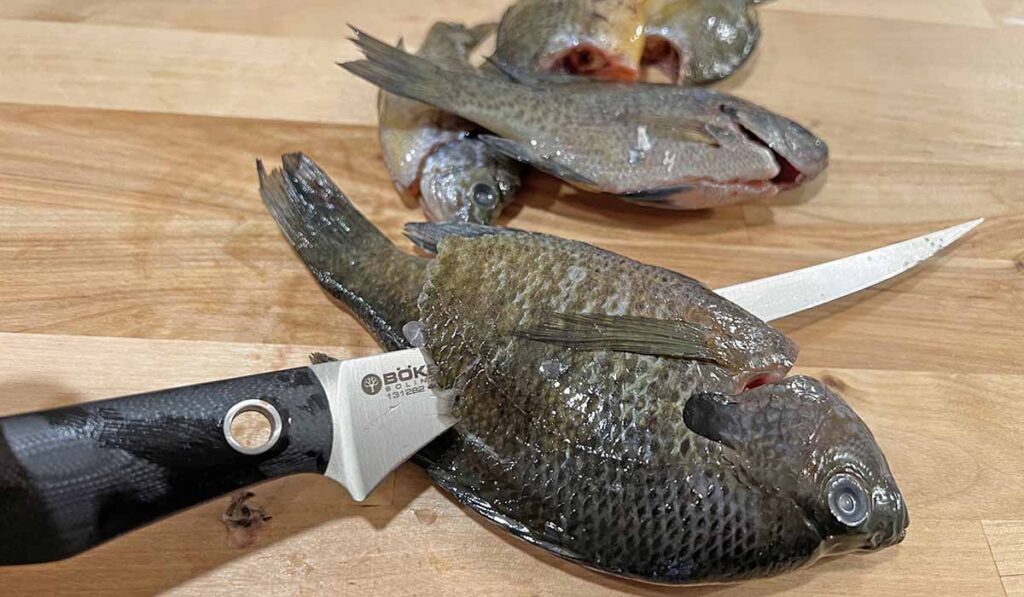
Boker Solingen Saga Filetiermesser
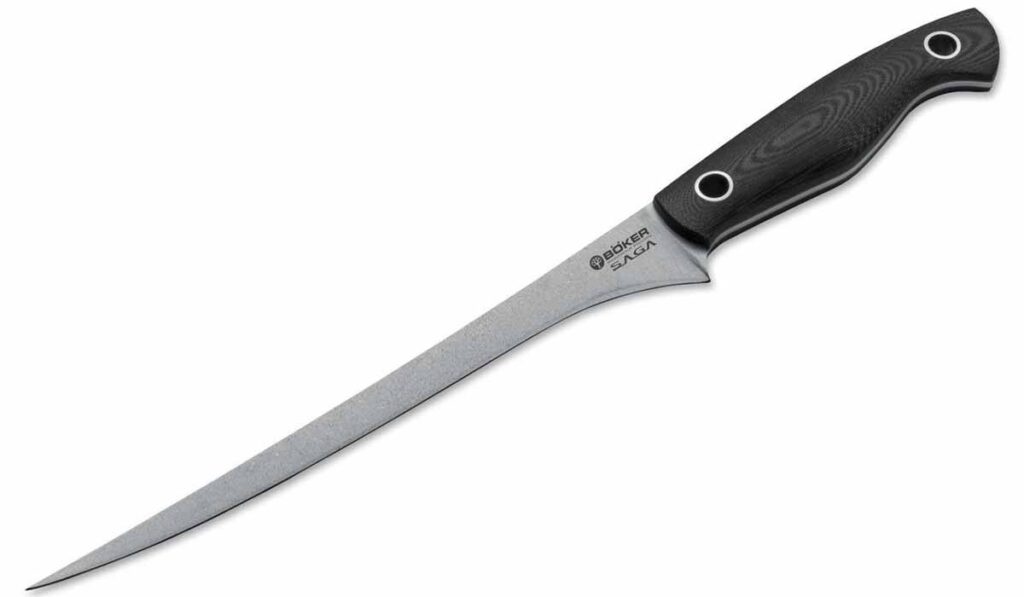
From the moment you open the box, the quality of the Boker Solingen Saga Filetiermesser is immediately apparent. You can tell it was made with great attention to detail and is a singularly specialized tool. Unlike the other test models, it does not come with a sheath. It is also quite smooth in the grip and clearly meant for end processing in the kitchen.
It is the sharpest test blade and also the thinnest. The thickness at the choil is just .07 inch, and it tapers from grip to tip quite aggressively considering how thin it is to start. The tip is like a scalpel point. It is so incredibly fine that you must be aware of its presence when working. If you cut yourself with it, you probably wouldn’t even know. I didn’t.
The Boker’s narrow edge makes it excellent on even the smallest catches.
Working with this knife in the kitchen is effortless. It is so sharp that it cut through all the fine bones in salmon; it simply glided right through. The blade is the most flexible in the review and bends quite a bit, though this is not a concern. The quality of steel and manufacture ensures it goes back to true even after substantial use. Because it has a smooth grip and is so incredibly fine at the tip, I would not immediately recommend the Boker for use in the field. If you decide to take it to camp, I would suggest either transporting it in a dedicated case or find a sheath that fits it.
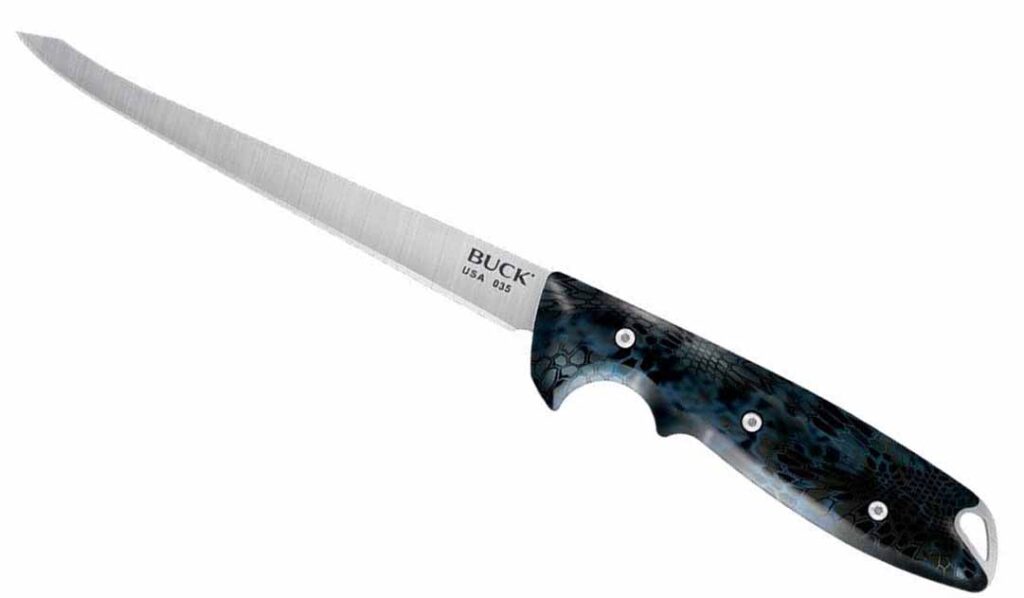
Buck Abyss
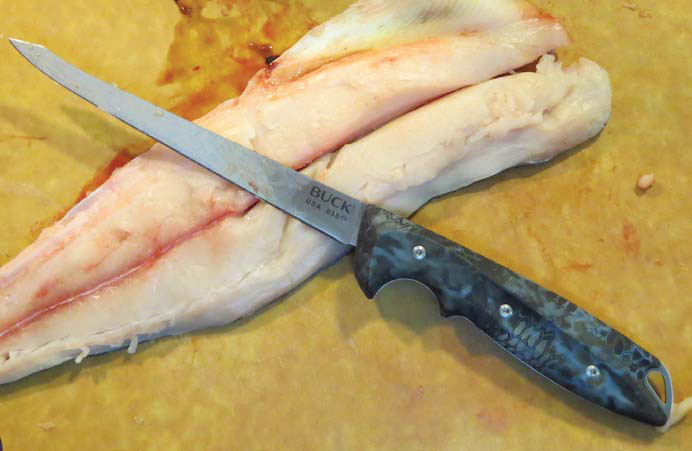
The Abyss is a fillet knife Buck brought a little style to by using a Kryptek Pontus camo handle. Normally you just get some kind of bright rubber but this handle has some style to it. Overall length is 12 inches and the blade measure 6.5 inches. Buck lists it as a 6-inch blade but I can tell you my tape measure isn’t broken.
The 420HC stainless steel blade features a double-ground tip and a distal taper. The double grind gives you an edge on the back of the tip to make puncturing and entry cuts easier. The distal taper gives the blade stiff ness toward the handle for use with large game fish. A more flexible tip area makes it useful for smaller fish. By using a distal taper, Buck can get away with having the Abyss straddle the fence between a stiff fillet knife and a flexible one.
The Kryptek scales have a slight texture but they also sport lateral contouring to aid in a secure grip. Sure, the Abyss does not have a super blade steel, but 420HC has been holding its own for years. During testing the Abyss did fine for handling and cutting—in fact, I like the knife very much.
Buck’s Kryptek Pontus handle has style and utility. The appearance is somewhat reptilian and features a subtle texture. To add to the user friendliness, the contouring is well designed.
I would have to say my only doubts are about the sheath. Buck provides a simple pouch sheath with a plastic insert to carry the knife. Though I’m not planning any long adventures hauling it around with me, I still find the sheath lacking. Inserting and drawing the knife is a clumsy affair, as the fit is tight. I also find the material, in my opinion, not robust enough to take years of use.
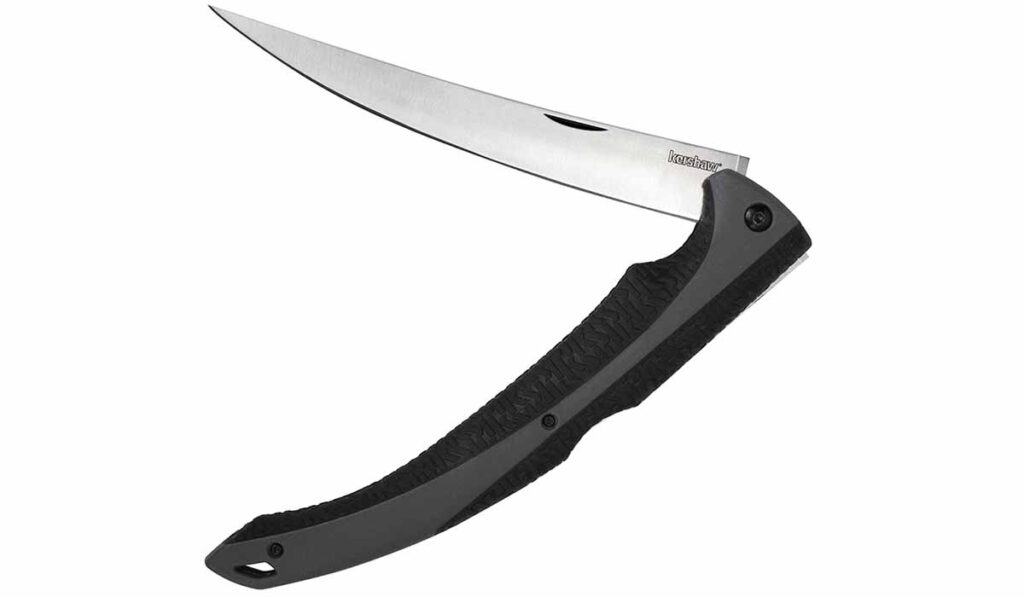
Kershaw Folding Fillet K-Texture
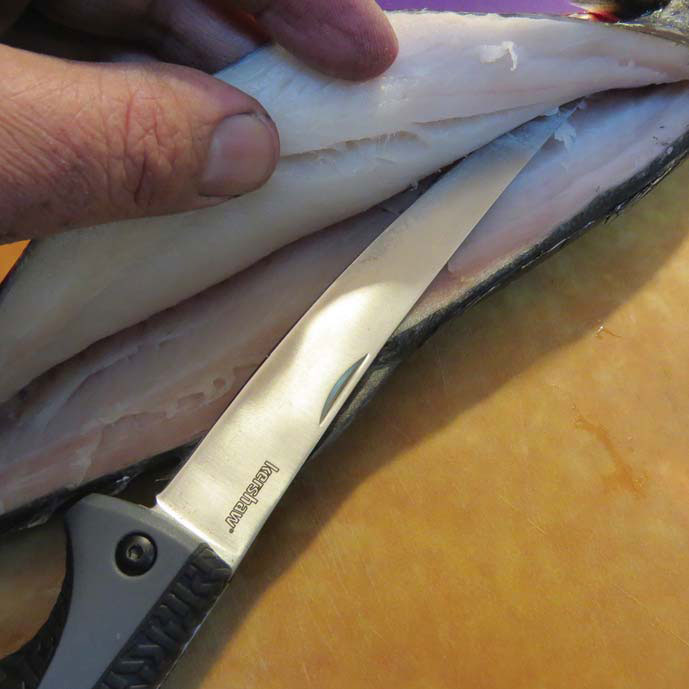
As with many folding fillet knives, the excessively large handle of the Kershaw Folding Fillet K-Texture tends to be disproportionate to the entire design. The 6-inch blade has a slight distal taper and is 420J2 stainless steel.
Even with a distal taper the blade has a mid-range flex—not really stiff but not very flexible, either. The lockback folder’s closed length is 7.75 inches. The knife does not come with a sheath. I like to test the blade’s edge right out of the box. One of the most difficult things to do with a knife, believe it or not, is put the first edge on the blade. To the best of my knowledge, with all the CNC machinery out there, this is an operation that is still predominantly done by hand. Out of the box, the Kershaw was razor sharp.
Kershaw’s fillet knife follows the spine bones for a perfect cut so you get the most from your catch.
Even before I took it fishing, I put it through some paces in the kitchen by skinning a tomato. I was impressed with the initial edge. Holding the knife is easy thanks to the duel-textured, or “K-Textured,” handle. The rubber has many small “K’s” patterned into it for the texture while the main plastic part of the scales is slightly textured. Accompanying the texture is an ergonomic handle, which seals the package.
Overall, I like the knife. It can be used for fishing under most any condition, but I see it as a great tool for fishing holes that require a long journey to access. The fact the knife folds gives you a fillet model in a smaller, safer and more convenient carry package.
Gerber Controller
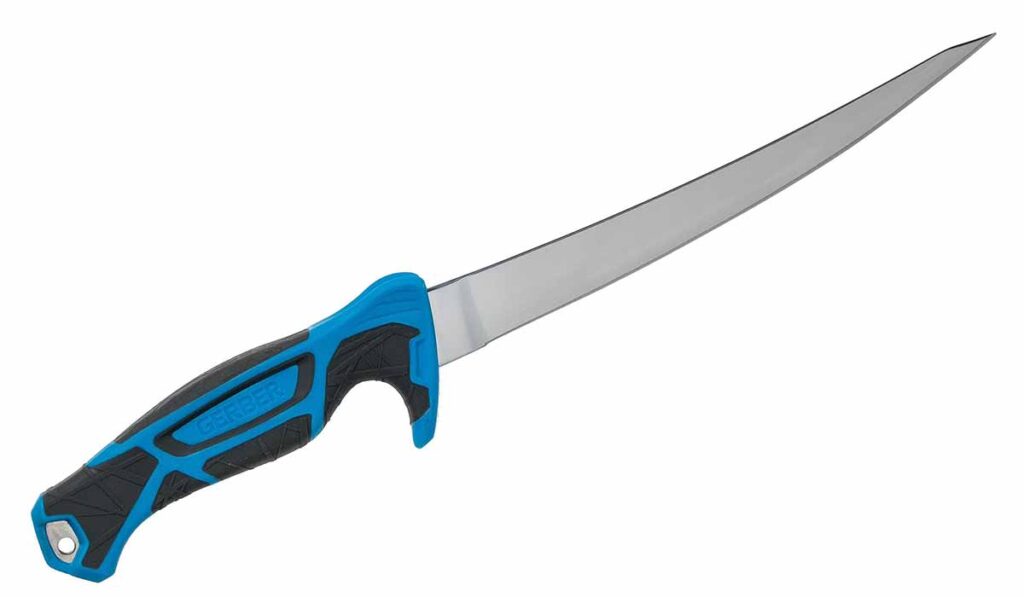
I am not in favor of loading a knife down with too many features. In the case of the Controller 10-inch fillet knife, Gerber has provided more than a knife but did not get carried away. The Controller is a full system fillet model. At 15.5 inches overall, it has a 10-inch blade of 9Cr18MoV stainless steel.
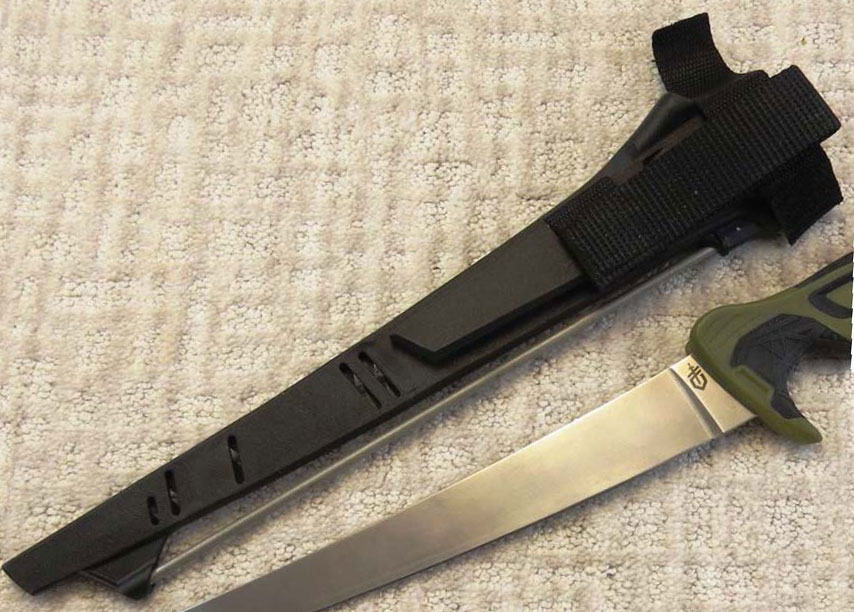
There are three knives in the series: the 10-inch and also 6- and 7-inch blades. I wish I had gotten the 6-inch model to test as well. All have a plastic molded sheath that provides secure carry and is puncture-resistant. Along the sheath’s body are multiple drainage points. On the sheath’s edge is a diamond rod sharpener for quick blade touch-ups.
The Gerber Controller sheath features a diamond rod sharpener, plenty of drainage points and two carrying systems.
Here is where the devil is in the details. The sharpener is not fixed and can be rotated by hand so you won’t wear down one side of the diamond rod. The sheath impresses me. It comes with a nylon belt dangler and a clip molded in the back for belt carry. To finish it off they built in a natural thumb push-off that matches up with the handle. The knife clips into the sheath as well as having a fabric-fastener retaining loop.
If the sheath isn’t enough, Gerber hit it on the head with the knife. The handle consists of two materials: a hard plastic at the core and soft, textured rubber inlays at all the tactile points. The blade has a full flat grind with medium flexibility. The Controller sports the same style tip as the Buck Abyss except the edge is not ground back. I am very impressed with the whole system.
Editor’s Note: Josh Wayner contributed to this post.
Here’s your shot to show off your prized carry knife to the world!
What’s better than carrying a knife? Showing the world exactly what knife you carry. Now, this little act of gratification might earn you—what else—a new knife.
Show us your carry knife—be it slip joint, fixed-blade, or whatever—for our The Knife I Carry feature in BLADE® Magazine. The monthly feature focuses on knife enthusiasts who carry knives but who do not have the wherewithal to make their own. We’re looking for the folks who comb through the knifemakers, knife companies and knife retailers to find the gem they always have at hand. You know, your everyday, average knife nut.
Here’s the best part, if you enter a picture of your knife and a short writeup and we publish it, you’ll be entered in a drawing for a free knife! Brag up your present blade and possibly add a new one to the collection, what could be better? Just follow the instructions below to potentially become part of the “World’s No. 1 Knife Publication” and be entered to win a free knife.
Don’t be shy, show us the knife you carry!
How To Submit Your Blade For The Knife I Carry Feature:
Compose a short write-up about the knife you carry, with a little history or an anecdote about it.
Include a photograph—at least 600 KB but no larger than 2 MB—of you holding your knife.
Send both to [email protected] and include your physical address (this is for the knife drawing and will not be published).
Selected submissions will be published in an upcoming “The Knife I Carry.” If selected for publication, we will enter your name in a drawing to win a free knife, which will take place on November 15, 2023.
The Knife I Carry Examples
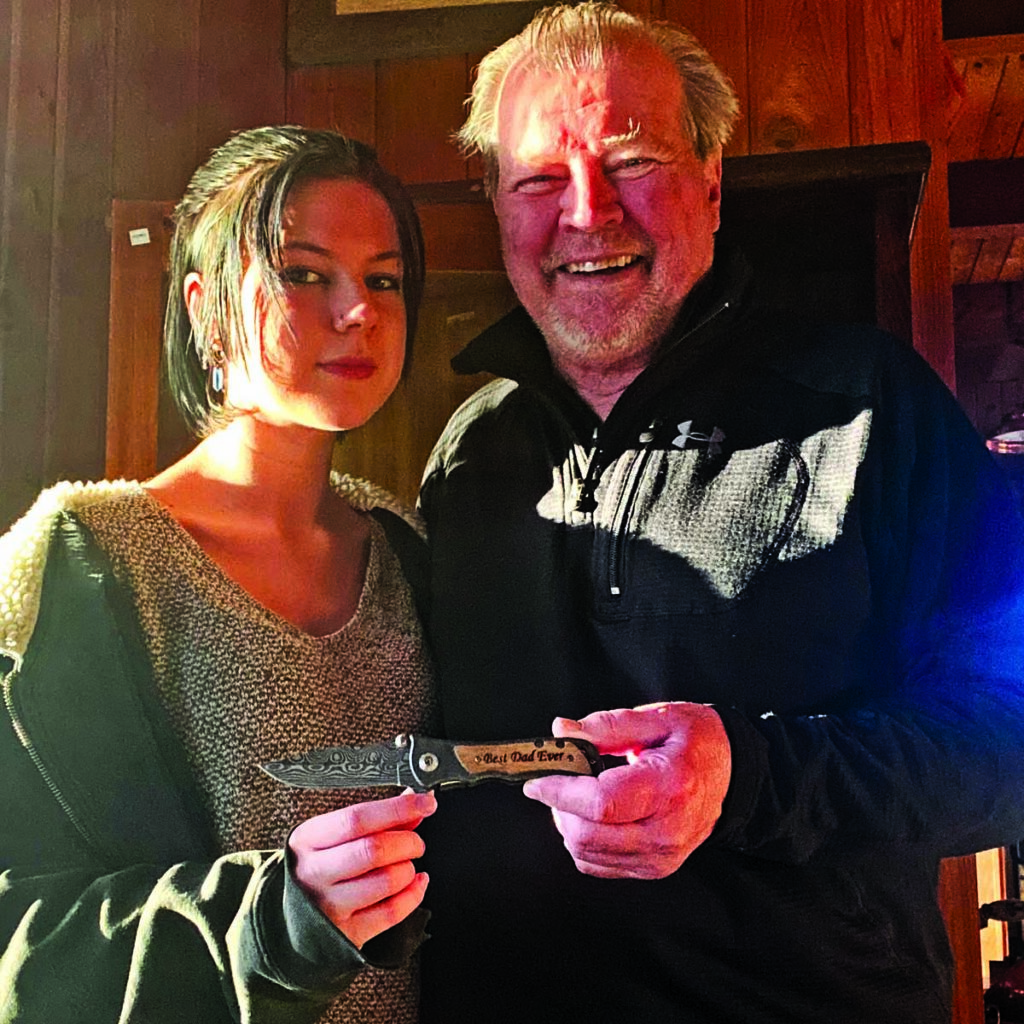
“My name is John Schwanke. My daughter, Eden, got me this knife for Father’s Day 2018. There are no identifying marks as to who made it, but on the slab scale it reads, ‘Best Dad Ever.’ The damascus blade is beautiful and I cherish and carry it every day. It walks and talks, is a flipper folder and of the highest quality you can imagine.” John and Eden Schwanke, Danbury, Connecticut
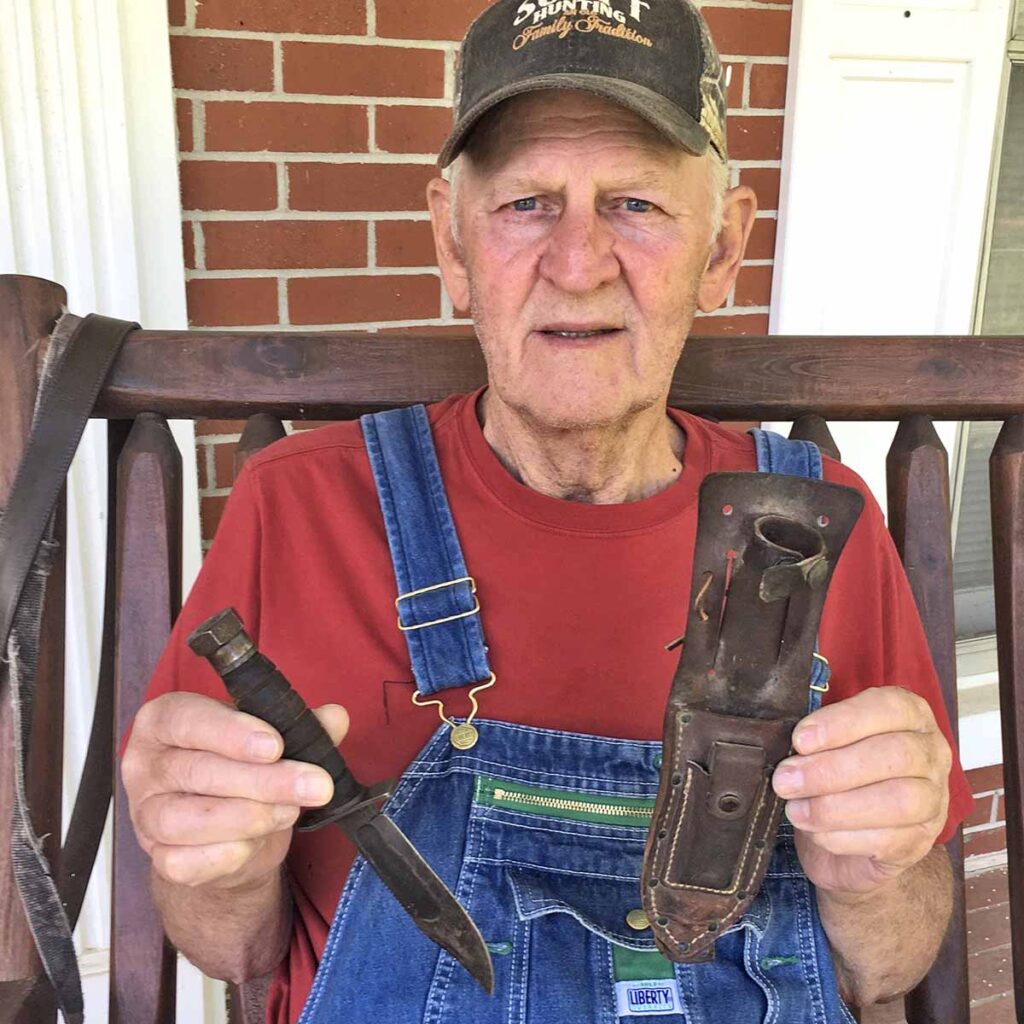
“My tour of duty in Vietnam was from April 4, 1967, to April 4, 1968. My constant companion was my Camillus ‘k-bar.’ I left the country at the end of the 1968 Tet Offensive and brought my knife home with me. It continued to serve me well for several more years. It meant so much to me and had become like a trusted friend. It was always there to do whatever job was asked of it. One day I got to thinking, what if I lose it or break it after all this time? So, I reluctantly retired my knife, scabbard and stone. It now has a front-row seat in my showcase of mementos. It has a date stamped on the buttcap: 1-1967. Money can’t buy it. I know this is supposed to be about a knife I carry now and not an old relic, but I just had to tell you about my ‘old friend.’ I did carry it many, many years. I’m 76 years old.” Danny L. Scott, Tiptonville, Tennessee
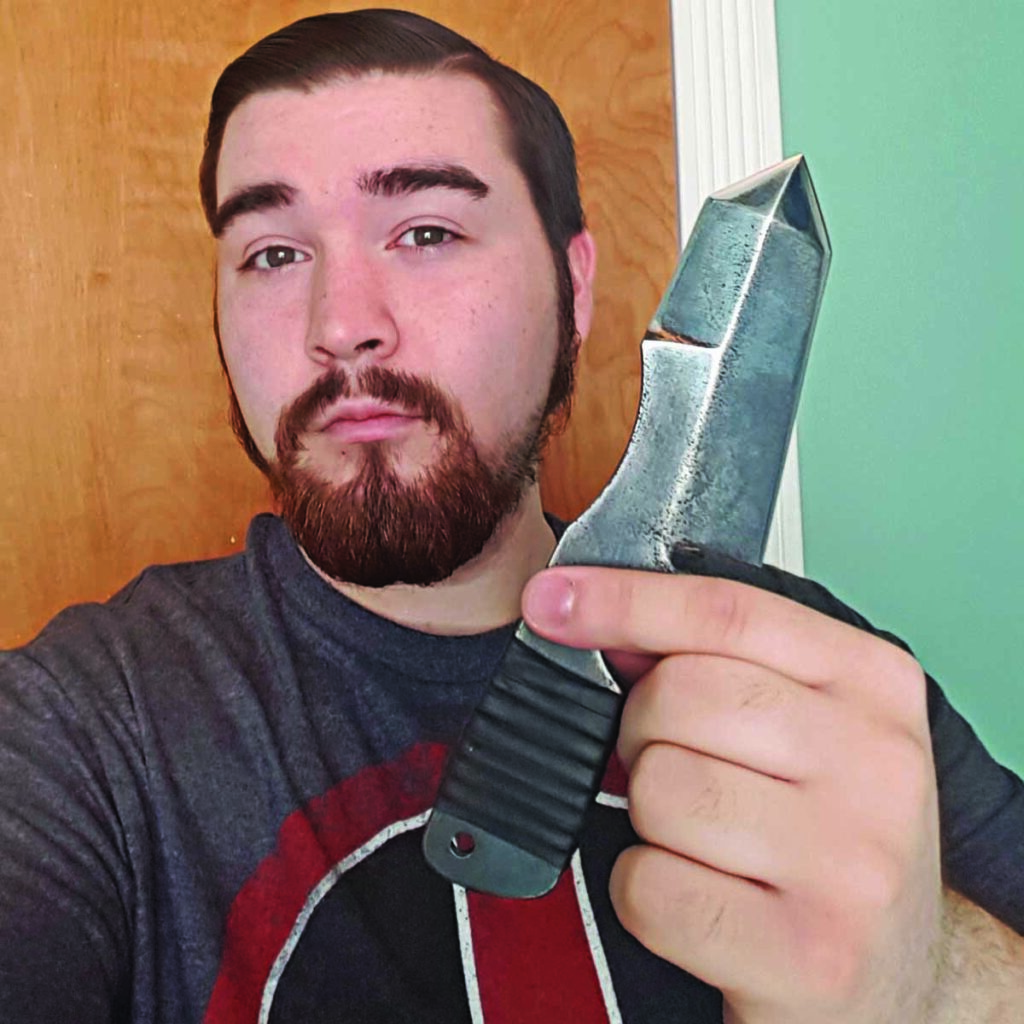
“My EDC has a blade of .220-inch-thick Spectrumwear steel and was hand made in California. I designed the knife ground up. Originally, I wanted a chopper. However, I wanted it to also have a dagger tip profile. Matt Freeman did an amazing job and had my knife done in under two weeks. He is the first maker I worked with who would email me pictures of the knife’s progress without me asking. He jokingly said it was the hardest blade to grind out, reason being it has four edges. He laid out the knife almost like a Roman gladius. I then angled the main edge to make it longer and then shortened the top edge. After that, Matt worked out the size and handle. The knife is just over 8 inches with a handmade leather sheath. We decided an old finish would look nice, so he Parkerized it, then gun blued it to protect against rust.” Caleb Hoskins, a letter via e-mail
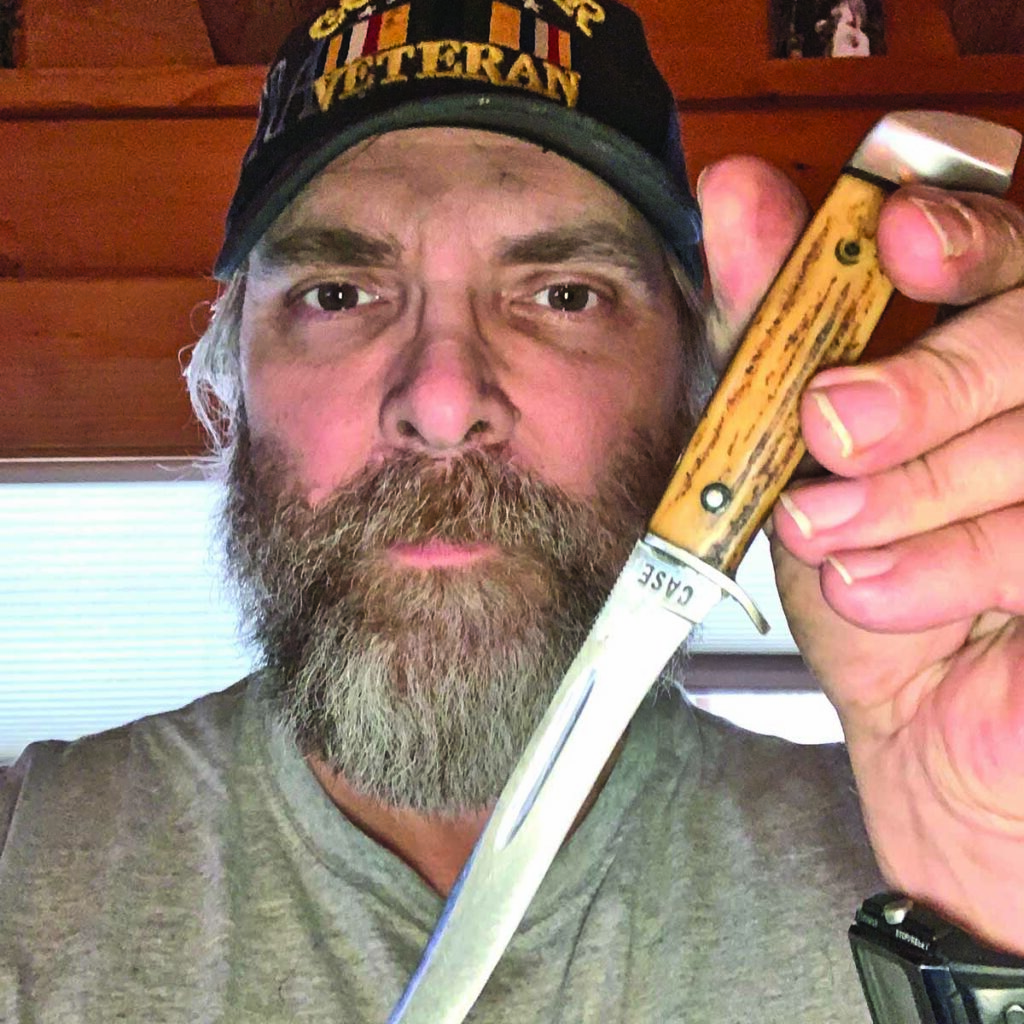
“The knife I carry into the woods each fall is my beloved Case fixed blade. She’s showing her age and has been passed down for three generations. Dad inherited her from my grandfather and then when Dad passed away in 1996 she was handed to me. Though I can’t tell exactly how old she is, I know she is well over 55 because that’s my age. For all I know the knife may be close to 100. She has been well used and processed more wild game over the years than I can count. She’s a true testament to Case quality and reliability. So many wonderful memories come to mind each time I draw this knife.” Stacey Roberts, Bridgewater, Vermont