The sword is 2,100 years old. Click for a larger view.
A rare Roman cavalry short sword made before the time of Christ that has been preserved in its entirety and still cuts is one of several recent highlights of the Celtic Collection Program in Milner, Georgia.
The ancient short sword is from the La Tène III (circa 2nd to the 1st century B.C.) timeline. It was in the H. Liebert private collection, Cologne, Germany, and was acquired during the 1960s and ’70s.
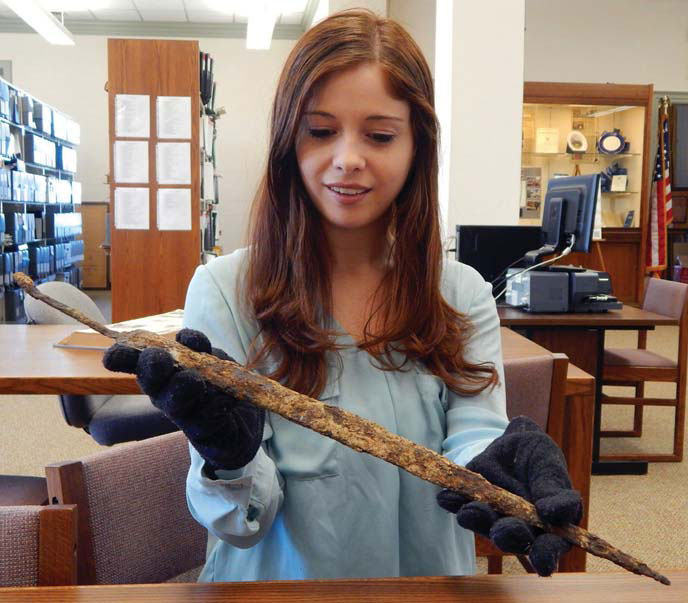
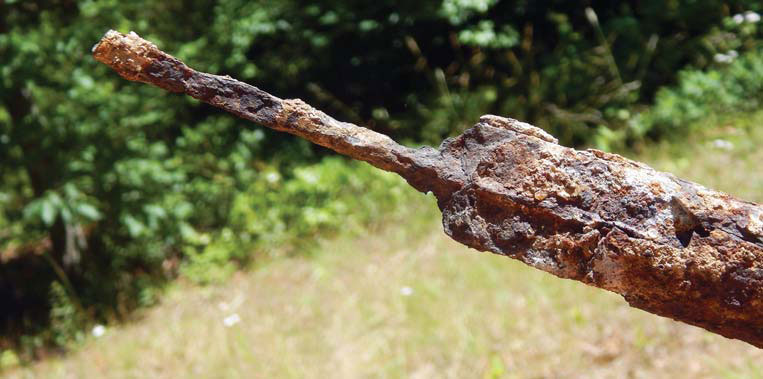
The iron sword is completely intact and is 20.5 inches long. Over time it has become permanently attached to its iron scabbard, and the buckle remains from where it once hung from a belt. Its thin hilt, which terminates in a small pommel, would have once been encased in wood.
According to a spokesperson, the sword has a double-edged blade still sharp enough to cut.
Though the ancient sword is believed to be from Gaul (modern France), Peter Connolly reports comparable swords in his book, Greece and Rome at War.
Similar swords reportedly have been recovered from Switzerland, France, the Thames in London, and Embleton, England.
The sword belonged to either a male or female warrior specializing in close combat tactics, a spokesperson stated.
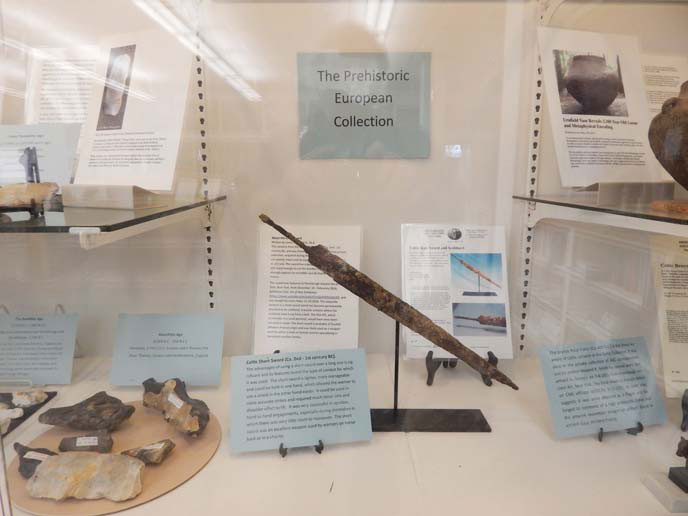
Jamesan Stuckey, director of the Thomaston-Upson Archives, examines the Roman short sword relic. (Lewis Hales image)The sword’s thin hilt, which terminates in a small pommel, would have once been encased in wood. Part of the sword’s edge, which has remained sharp all these centuries, is exposed above the guard. (Lewis Hale image)The buckle remains from where it once hung from a belt. (Lewis Hales image)The sword relic as contained in the Prehistoric European Collection at the Thomaston-Upson Archives. (Lewis Hales image)
Learn More About Knife History
BLADE gathered 14 years of Knives annual books into a single collection. Get it here.
The Cutlery Hall Of Fame is the only such body to recognize all members of the knife community. Nominated and voted on by living Cutlery Hall Of Famers, the inductees must have a) demonstrated extraordinary service to the knife industry; b) displayed honesty, character and integrity; c) advanced the industry by the creativity and originality of their works or contributions; d) as ambassadors or outstanding contributors furthered the positive impact of the knife industry on the world at large; and e) in summary, demonstrated a worthiness to be a member of such a prestigious group.
Dan Delavan
Dan Delavan
Along with his wife Pam, Dan closed the Plaza Cutlery retail knife shop in the South Coast Plaza Shopping Resort in Costa Mesa, California in January after 44 years as one of the world’s most forward thinking of brick-and-mortar cutlery stores. Dan was in on the ground floor, helping his parents, Del and Lois, open the store in 1974.
From the outset, Plaza was a pioneer in selling knives in a mall setting and custom knives in general—the latter at Dan’s insistence and something only a handful of stores at most did at the time. Plaza was a leader in hands-on customer service; sharpening while you waited; in-store meet-the-knifemaker events; custom and factory knife exclusives; the latest factory knives, swords, kitchen knives and assorted knife accessories; and later and through to today, online knife sales, including Randall knives and customs.
The Delavans started what would become the California Custom Knife Show in the early 1980s and made it into one of the industry’s premier cutlery events, including a visit from Sylvester Stallone that helped pave the way for the Rambo knife revolution that transformed the knife culture in general. Dan and Pam sold that show and started another one that was very successful. They recently sold the latter and it will continue under new management.

Dan also helped start the National Independent Cutlery Association, a buying group for domestic cutlery shops that boasted 100 member stores at its height. NICA helped its members in their business relationships with knife manufacturers and importers, had an annual knife and knife exclusives, and otherwise aided in furthering the availability of fine cutlery to its members’ customers nationwide.

An image from 1975 of Dan Delavan in the old Plaza Cutlery knife store one year after it opened.
Phil Lobred
Phil Lobred
Phil may be best remembered for commissioning what is arguably the most important knife of the modern custom era: the King Tut Dagger Reproduction by fellow Hall-Of-Famer Buster Warenski.
Beginning in 1983 Phil coordinated the annual Art Knife Invitational, an intimate gathering of the world’s elite knifemakers in San Diego, who in turn offered their knives for sale to the world’s elite custom knife collectors. The show took about a 10-year hiatus but returned as a biennial event and continued to draw the elites worldwide. It continues under the direction of Phil’s daughter, Sandee.
For a time in the 1970s Phil shared his home with Hall-Of-Famer Gil Hibben. Hibben made knives in Phil’s garage, with Phil by his side. Later, with Phil in tow, Gil enjoyed an audience with a special fan of Hibben knives: Elvis Presley. Phil and Gil visited with Elvis until the wee hours, a meeting that remains the stuff of legend.
Phil’s vast knowledge of custom knives and also 19th-century dress bowies proved an invaluable source of information for many, including BLADE. Perhaps Phil’s most important contribution was his faithful patronage and support of the custom knife industry. He bought and collected the knives of many makers from the early 1970s on at a time when the industry needed such buyers/collectors desperately to survive. As a Hall-Of-Fame nominator noted, “Phil was the definition of a knife collector, always talking and promoting knives. Then he started his Art Knife Invitational and that changed the custom knife industry forever.”
The King Tut dagger repro Lobred commissioned Buster Warenski to create.
SHEATH: Tri-Composite System Kydex w/3” nylon webbing, Box X stitching, stainless hex fasteners and liners; locks blade in; MOLLE system sheath also available
The Yakuza Flipper by Chuck Gedraitis includes a hand-rubbed blade finish, titanium frame and liners, and a Timascus™ pocket clip. Yakuza is a nickname for “transnational organized crime syndicates”—i.e., the mafia—in Japan. Click for larger view. (SharpByCoop knife image)
Chuck Gedraitis Flipper Meshes Modern Materials with Traditional Style
The Yakuza Flipper by Charles “Chuck” Gedraitis meshes classic styling with an unusual modern handle material in a folder that reflects both the traditional and the modern. The traditional is the Japanese-style instead of an American-style tanto blade.
“The American style would have more of a straight cutting tip,” Gedraitis noted. “This one has a little curve to it.”
The modern is the circuit board scales. Gedraitis highlights the copper of the circuit board with the bronze bolsters and a copper spacer, the latter two both in an orange-peel finish. He exposed the pattern of the circuit board by grinding into it, thus revealing the copper in the different layers of the scale material.
For more information contact Chuck Gedraitis, Dept. BL4, 444 Shrewsbury St., Holden, MA 01520 508-963-1861 [email protected], gedraitisknives.com, Facebook/Instagram: @gedraitisknives gedraitisknives.
Meet the Maker at BLADE Show
Balisongs are a Chuck Gedraitis specialty and he will show you how he designs and makes them in his special class “How To Make a Balisong” at 2 p.m. June 2 at BLADE University in the Cobb Galleria Centre in Atlanta.
Held in conjunction with the 37th Annual BLADE Show June 1-3, also at the Cobb Galleria, BLADE U. is the most comprehensive array of classes on knives and knifemaking of any knife show. Click here for more information.
The gentle rise of the tip area of the blade is the classic sign of a skinner—or in this instance, the Semi Skinner #2 by H.L. Holbrook. The 3.5-inch blade is CPM 154 stainless and the handle is stabilized maple. Overall length: 8 inches. Contact H.L. Holbrook, Dept. BL3, POB 483, Sandy Hook, KY 41171 606-794-1497. (Chuck Ward image)
Scott Gallagher employs a 3-inch damascus blade, a damascus single guard and a handle of Arizona ironwood for his hunter. Overall length: 6.5 inches. Contact Scott Gallagher, Dept. BL3, 335 Winsten Manor Rd., Santa Rosa Beach, FL 32459 850-865-8264. (Chuck Ward image)
A 4-inch clip-point blade of W2 tool steel with hamon and a spalted sycamore handle and fileworked copper spacer distinguish Ben Breda’s hunter. Overall length: 9 inches. Contact Ben Breda, Dept. BL3, 56 Blueberry Hill Rd., Hope, ME 04847 [email protected]. (Caleb Royer image)
A gorgeous Arizona ironwood handle with a domed/curved 416 stainless steel butt plate and G-10 spacer, and a 5.75-inch blade of 1084 carbon steel help complete Eli Jensen’s Forester MKII hunting knife. Overall length: 10.75 inches. Contact Eli Jensen, Dept. BL3, 2840 W. Dreamscape Way, Chino Valley, AZ 86323 928-606-0373 [email protected], Facebook/Instagram: Eli Jensen. (Sharp-ByCoop image)
Kenneth Lange received an order for this hunter by a family friend whose husband is celebrating 10 years on the police force—thus the thin blue line on the black G-10 handle. The 4.5-inch blade is 1095 carbon steel. Overall length: 9 inches. Contact Kenneth Lange, Dept. BL3, 1200 County Road 5711, LaCoste, TX 78039 210-218-9415 [email protected], Facebook/Instagram: kjl_handmadegoods KJLhandmadegoods. (SharpByCoop image)
Peter Pruyn reproduced John Horrigan’s Bob Horrigan Fighter as a present for his son Jack who is considering going into the military after he graduates high school. The knife is named in honor of John’s brother, Bob Horrigan, 1st Special Forces Group, who was killed in action in Iraq in 2005. (SharpByCoop image)
With his son Jack expressing an interest in joining the military once he graduates high school, Peter Pruyn figured a reproduction of the Bob Horrigan Fighter by one of his mentors, ABS master smith John Horrigan, would be just the ticket as a gift form his military son in waiting.
“ABS master smith Red St. Cyr, another one of my mentors, said when you feel you’re good enough to make a knife in the style of one or more of your mentors, do it,” said Pruyn (Pruyn rhymes with pine).
Horrigan, a U.S. Army Ranger veteran, law enforcement officer and firefighter, is one of Peter’s mentors, ergo Pruyn’s version of the Bob Horrigan Fighter. Peter’s version has a few differences—among them a 5.5-inch blade, 154CM stainless steel, flat grind, embellished red skulls and a Cerakote® finish by Jesse Ruiz of Legendary Coatings instead of John’s 6.5-inch blade, 440C stainless steel, hollow grind and sand-blast finish.
Peter’s daughter Sophia fashioned the lanyard and attached the Emerson skull bead.
For more information contact Brothersville Custom Knives, c/o Peter Pruyn, Dept. BL3, 110 Reel Ln., Grants Pass, OR 97527 631-793-9052 [email protected], Facebook/Instagram: Peter Pruyn.
SPECS
KNIFE: Reproduction of John Horrigan’s Bob Horrigan Fighter
MAKER: Peter Pruyn
BLADE LENGTH: 5.5”
BLADE STEEL: 154CM stainless
BLADE GRIND: Flat
BLADE COAT: Emerson skull embellishment w/Cerakote® finish by Jesse Ruiz of Legendary Coatings
HANDLE: Micarta SHEATH: Kydex under leather w/red skull embellishment, felt inside Kydex, snaps, MOLLE compatible, multiple carry options, by Will Elmore
Each Tuesday in April, KA-BAR will release a video documenting a piece of its storied 120-year history. What, you thought it started with the USMC knife in the ’40s? You’d be wrong.
The KA-BAR website will host the videos, but you can also catch the installments on YouTube. Here is the first episode.
Beyond the marketing value of such a series, these episodes should serve as a history lesson for knife collectors. Often, the provenance of a knife, or a line of knives, is tied to its value or collectibility. And there are few companies with the kind of history that KA-BAR brings to the table.