Home Authors Posts by Joe Kertzman

Joe Kertzman

Fish Knives Combine Form & Function

Here’s plenty of proof that a fillet knife can be put to extreme use, and still be a work of art.

The following is written by Tom Carpenter, and reprinted from the June 2013 issue of BLADE® Magazine.

Filleting fish under wet, sometimes salty conditions isn’t the kind of work or environment you want for your best knives. So you might suffer through with a mass-produced imitation of the real thing. But there’s no need to use an inferior tool. Consider the fish and fillet knives of Phil Wilson, Todd Kopp, Kevin D. Cross and John Cammenga of White River Knife & Tool. First, let’s get right down to the fish knife fundamentals.PhilWilson2
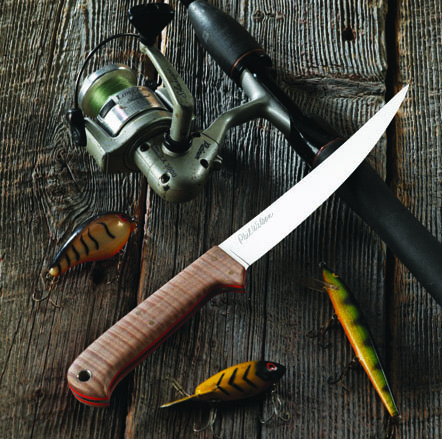
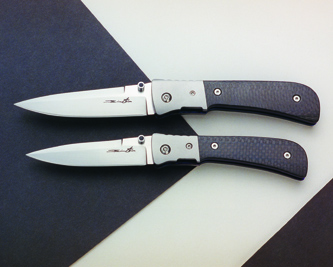
Knifemaker Phil Wilson’s “Shelter Cove” fillet knife (left) sports a 7-inch N690 blade, a fiddleback-maple handle and red spacers. He says a fillet knife should have some flexibility and be ground thin.


The basic features that make for a functional and efficient fillet knife are: a comfortable, secure grip that won’t slip and slide in your hand while doing wet, slimy chores; a sharp blade that is relatively thin and flexible for precision work, and holds an edge; and materials that can stand up to abuse like moisture, blood, and frequent washing and drying.

Wilson, Kopp, Cammenga and Cross craft fish and fillet knives that fit all these criteria and more. Here’s where they put their focus.

Working under the business name Seamount Knife Works, Wilson has been making fillet knives for almost 30 years. “A simple design is best,” he says, “clean and smooth without a lot of holes and crooks and crannies to get packed up with gunk. A good finger guard and a butt end on the handle prevent slippage under wet and slimy conditions.”kc3
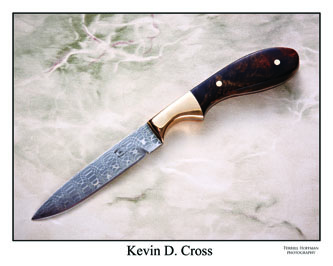
As far as the stainless-damascus blade Kevin D. Cross used for his bird and trout knife (left), the maker says there is a segment of sportsmen who appreciate a beautiful and functional knife. The piece also includes a desert-ironwood handle and bronze bolster. His list price: $400. (Hoffman photo)


As for blade material, “stainless steel is mandatory,” stresses Wilson. “I have used 440C, 154CM, AEBL, CPM-S90V, 12C27, CPM-S60V, CPM-S30V and CPM-154. Yes CPM-S90V—it still makes an awesome fillet knife, but now I feel it is overkill for the application. Given proper heat treatment, they all make a good fillet knife. These days I am using CPM-154, CPM-S30V and N690 mostly. These steels are in pretty much the same category for edge holding and ductility. A [reading] of 60 HRC seems to be the best target hardness for all of them.”

Blade characteristics are important, too. “A fillet knife should have some flexibility and be ground pretty thin,” says Wilson. “I like a springy feel in the first half of the blade from the tip back. Flex is a function of the blade geometry rather than hardness or steel grade.Mike Mooney Best Filet

Mike Mooney’s “Coho” model (left) won Best Fillet Knife at the 2011 Professional Knifemakers Association Show. It sports a 6-inch CPM-S30V blade, a dyed and stabilized redwood burl handle, and a 416 stainless steel bolster. (Buddy Thomason photo)

“Blade lengths from 6 to about 9 inches will handle most fillet work,” he adds, “and also double as boning, slicing and carving knives in the kitchen. Edge holding on a fillet knife is not quite as important as on a hunting/utility knife. A fillet knife can clean a box of fish and then get touched up at home or on the boat later. So a little lower hardness can be traded off for some added ductility on a thin, flexible blade.”


Non-Slip Grips

Handle material is critical. “I’m using mostly canvas Micarta® handles,” states Wilson. “An option is G-10. Both are naturally non-slip and do not soak up moisture.”

Kopp earned “Best Fillet Knife” honors at the 2010 Professional Knifemakers Association Show with his damascus fillet knife. He strayed from traditional stainless steel for his award-winning knife, opting instead for a damascus of 1084 and 15N20 carbon steels.StepUp_8_Maple_02
John Cammenga of White River Knife & Tool offers wood-handle fillet knives like this model (left) with a SM-100 blade and tiger-maple handle. Cammenga explains, “At the BLADE Show and SHOT Show, we introduced the world’s first fillet knife made with a blade of SM-100, a corrosion-proof alloy. This particular custom measures 63 HRC on the Rockwell hardness scale, features a 3/16-inch-thick spine and is still flexible! It is a ‘step-up design’ where the handle is notably higher than the cutting edge. The knife was designed by Steve Geelhoed, and while the original is not for sale, replicas sell at $750 each.”

“I used carbon steel on this because it holds an edge better than some of the stainless steels,” Kopp explains. “It does, however, require more care than stainless blades.”

The attractiveness of the damascus pattern is certainly inviting. “Yes, it’s kind of unique seeing a damascus blade on a fillet knife,” he admits. And what about function? “My brother used it on a fishing trip,” Kopp relates, “filleting 30 or so fish with it, and he was pleased with its performance. In fact, I think it outperformed an electric fillet knife!”Kopp Best Fillet orig
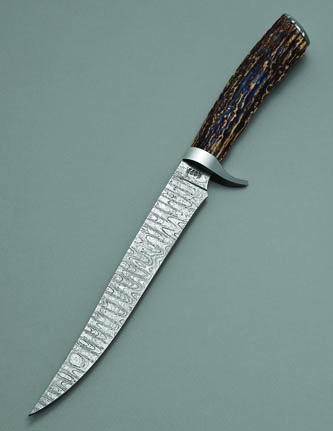
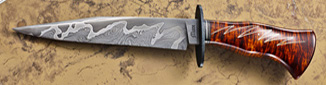
Maker of the Best Fillet Knife at the 2010 Professional Knifemakers Association Show, Todd Kopp chose a 7.5-inch damascus blade and sambar-stag handle for this particular model (left). Note the small details like how he carved the 416 stainless steel buttcap to match the natural grooves of the stag. The maker’s list price: $475. (Buddy Thomason photo)

Cammenga runs White River Knife & Tool, a family-owned business with a full array of fillet knives in its line. “A strong case can be made for many great alloys available today,” he says. “We chose 440C for our Limited Production and Custom Finished versions in 2013. This high-carbon, stain-resistant steel retains our hand-sharpened, leather-honed edge for a very long time. It also provides reasonable corrosion resistance.”

Cammenga uses wood handles on the fillet knives. “The wood is stabilized and will not shrink, swell, or absorb blood or oil,” he explains. “We also offer a cork handle with a wooden pommel. The cork handle with a 6- or 8-inch blade will float [if the knife is dropped in the water]. Also, our unique ‘step-up design’ helps to keep the handle [and knuckles] a little farther off the cutting area, a nice feature when filleting on less than ideal surfaces.”

Flexible On Flexibility

Cammenga says he thinks blade flexibility on fillet knives is largely a personal preference. “At the 2013 SHOT Show, we received some comments that our blades could be a little more flexible, and some that they could be less flexible,” he recalls. “Our current offering tends to be more rigid on the 11-inch blade, moderate on the 8- inch blade and more flexible on the 6-inch.

“That which makes a good knife makes a good fillet knife.”

Bird and trout knives certainly fit in the fillet knife family. Cross uses straight stainless steel on some of his knives, but adds a beautiful twist to others.

“Yes, actually I use both straight stainless and stainless damascus, depending on the customer,” Cross remarks. “With exposure to the water, the stainless aspect is important. As for stainless damascus, it looks a bit classier and there is a segment of sportsmen who appreciate a beautiful and functional knife to go with their Parker shotgun or Sage reel.”

Bird and trout knives have to pull double duty. How does damascus steel perform on the fishing half of that equation? “This knife works well for its appointed tasks,” he concludes. “But as with any short blade, there is not a great deal of flex. It is certainly possible to make the blade thin and flexible, though.”

Cross’s bird and trout knife employs bronze fittings. “Bronze is tough, and stain and corrosion resistant, especially to salt water. It is harder than brass, develops a nice, warm patina, and is easy to care for.” Function plus beauty: just the things knife lovers tend to value.

You make fillet knives do their work under tough conditions. But don’t suffer with low-quality knives. Craftsmen such as Wilson, Kopp, Cammenga and Cross have proven that you can combine function and form in beautiful fish knives.

Educating the Future Of Knives

The American Knife & Tool Institute (AKTI) recently announced it will present a series of informative articles on its website, www.akti.org, that address various aspects of the knife owner’s experience. The first of the series will relate tips and advice on introducing young people to knives.

2-Customer-son

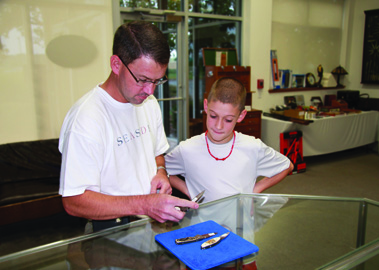
Among those giving insights in the new AKTI youth knife series will be A.G. Russell. Here a father demonstrates a knife for his son at A.G. Russell Knives retail store in Rogers, Arkansas. (A.G. Russell Knives photo)

“I was always taught that the age of reason was 7, which is also Cub Scout age when I got my first knife,” commented Dan Piergallini, president of the Gator Cutlery Club. “Safety was always stressed, and supervised use of a knife is a must. Also, one must insist that the knife never be taken to school no matter how much you want to show it off.”

Billeb-Jan-2012Along with Piergallini, AKTI Executive Director Jan Billeb, Becky Reid of Shepherd Hills Cutlery, and Blade Magazine Cutlery Hall-Of-Fame© member A.G. Russell will provide insights on their experiences in promoting safety, awareness, respect and proper knife use among young people.

AKTI Executive Director Jan Billeb (left).

Look for the story on kids and knives and subsequent offerings from AKTI to provide timely and relevant perspective on topics of interest to the cutlery community.

“We are excited to bring these informative articles to AKTI members and knife enthusiasts everywhere through our website,” Billeb said. “Introducing knives to the next generation is a key element in promoting their safe use and increasing the understanding of knives as valuable tools that are important in our everyday lives.”

To read the article on kids and knives visit www.akti.org/education/kids-and-knives.

For more information, call 307-587-8296 or visit www.AKTI.org. Follow AKTI at http://www.Facebook.com/SaveOurKnives and http://twitter.com/SaveOurKnives.

Kershaw Signs On for a Rough Ride

You can take that headline literally. Kershaw Knives has become a premier sponsor of the Professional Rough Stock (PRS) series. Most folks are aware that professional bull riding is among the fastest growing sports in the United States, yet some rodeo fans can’t get enough, and are looking for even more excitement. That’s where the Professional Rough Stock (PRS) Series comes in.ker horse KershawSponsorsPRS

In addition to bull riding, Professional Rough Stock incorporates bareback and saddle bronc riding—yes, you read that right, BAREBACK and saddle BRONC riding. The combination of events gives rodeo lovers more variety and more heart-pounding thrills.

Kershaw Knives, a brand of Kai USA Ltd., has recently signed on as a major sponsor of the 2013-2014 PRS season. Founded by Pete Kershaw in 1974, Kershaw Knives was born on the Officer Ranch in eastern Oregon and boasts a proud cowboy tradition.

“Sponsoring Professional Rough Stock is a natural for Kershaw,” said Thomas Welk, Director of Sales and Marketing, Sporting for Kai USA. “Every rider, every cowboy and cowgirl, and every PRS fan needs a good knife; they need a Kershaw.”

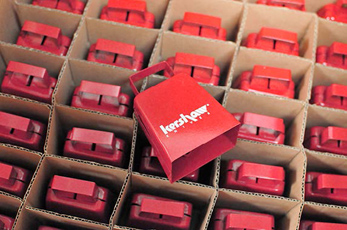
The Kershaw Kowbells (left), are ready for the next PRS event.

At each PRS event, a group of lucky PRS attendees will find themselves sitting in the “Kershaw Korner.” Everyone sitting in the randomly selected Kershaw Korner will receive either a Kershaw Kowbell or Kershaw BamBam Sticks to help them cheer on their favorite riders. Kershaw will also be giving away logo t-shirts and several Kershaw Zing SS knives at each event.

Presence like this at nationwide PRS events, along with television coverage, social media promotions, and more made the PRS sponsorship attractive to Kershaw. “The athleticism of these rough stock cowboys is outstanding,” said Welk. “We’re proud to help bring the excitement of Professional Rough Stock to rodeo fans and families all across the nation.”

Televised PRS events begin airing on RFD-TV on Friday, May 3rd at 10:00 p.m. EST time, with replays on Sundays at 2:30 p.m. eastern.

Knives Save Lives, Period.

The following is written by Jenn Coffey and is excerpted from the June 2013 issue of BLADE, which hit newsstands and subscribers’ doorsteps on March 26th, 2013.

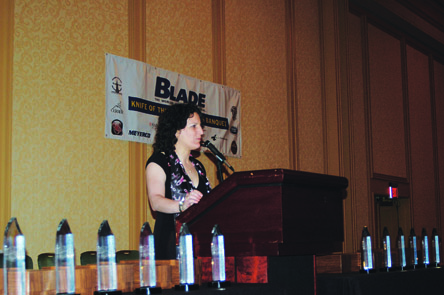
About two years ago many of you read a story about a baby who was sadly lost in a traffic accident. The added pain of the story was that they had tried to save the child, who was trapped by a seatbelt, but no one had a knife. This simple tool, if present, would have allowed the child to be cut free from the seatbelt, able to survive another day.jenn coffey at 2010 BS banquet

This is the story that I just cannot get out of my mind. Now, two years later, I continue working to raise awareness. I hope that when you finish reading this you will share my passion and belief.

This is something all of us can do. It does not matter if you are a collector, a manufacturer or, like me, an EMT who uses knives on the job to save lives. The simple fact is if you use, make or just appreciate knives, you should work to educate and help others avoid similar tragedies.

Not long ago I took some time out of a very busy week to drive to the New Hampshire Auto Dealers Association’s annual event. I met a huge number of folks from the industry, many of them business owners. We spoke about many things, but I always went back to the story of the child trapped in a seat for lack of something to cut away the restraints. I discovered the auto dealers had never considered a seatbelt cutter as a safety promotional item to give away with every vehicle purchase. I heard the phrase “I’d never thought about that” in almost every conversation.

Now, we all know that even if new ideas are well received, implementation of anything new does not happen quickly. It takes repeated exposure and many people to agree that a change is positive and worth making. It is difficult to get people who are accustomed to and comfortable with a current standard to accept change.

My pitch to dealers of both new and used vehicles in the auto industry was simple: include a knife designed to release a restraint when the circumstances require quick and definitive action. All customers appreciate trinkets like the little ice scrapers with the dealership name and phone number. For most people, however, the trinkets end up in the glove box or trunk, unused and forgotten. Until folks find themselves in an icy parking lot with a broken scraper, they do not think of or even see it again. But showing the car dealers how they could put a potentially lifesaving tool, with their company logo, on the sun visor, the dash, or attached right to the seatbelt received a great deal of interest. The reason was simple: the customer would be driving around with the dealer’s logo in plain view.

In Praise of the Exitool 

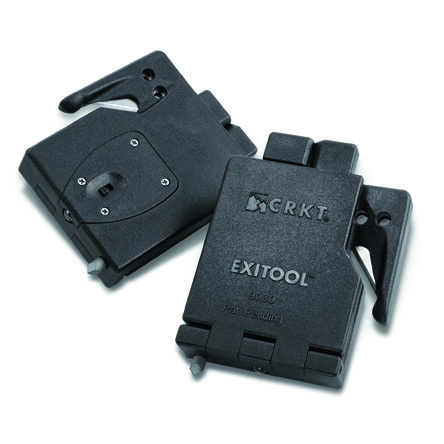
I am impressed with the fact that CRKT’s Exitool fits right onto my seatbelt. It is easy to put on and take off with a simple click. It is compact and contains lifesaving tools. I have had one in my vehicle now for about a year and no matter what I am wearing—be it jeans and T-shirt or a fancy silk dress—it has never snagged on my clothing, which is a major plus in my book.

The CRKT Exitool comes with a shrouded seatbelt cutter, L.E.D. flashlight and tungsten carbide window breaker and, perhaps best of all, attaches directly to your seatbelt where it is handy at a moment’s notice. MSRP: $26.99. For more info visit www.crkt.com or call 800-891-3100.  

9030_duo

Now I am known for having knives just about everywhere, and I do—guilty as charged! But here is the thing: I am an EMT. I have handled countless patients involved in vehicle crashes that left them upside down trapped in a car. When your vehicle goes upside down or flips, everything goes flying. The Exitool will still be on your seatbelt easy for you to access and simple to use. Within moments you can cut yourself free, break your window open and even have the use of a flashlight to help you see your way to safety. The flashlight batteries can be replaced and are widely available for just a couple of dollars, enabling the tool to have a long life and be well worth the buy. The blade is shrouded and will not cut you or get caught on clothing, and the window break is perfectly placed for ease of use.

It is not expensive—and who can put a price on survival? Everyone I care about is getting an Exitool in their vehicle.—by Jenn Coffey

If you add to sales or advertising incentives just one news report of a person saved by that tool, it would have a ripple effect. One of the major selling points for vehicle sales is safety. What better way to show your customers you care about their safety than replacing the little ice scraper with a small, inexpensive safety tool? For me, using the promotional ice scraper meant reaching across the windshield to add winter salt to my brand new black dress coat! OK, maybe not all of you are as short as me and do not have that issue. But I know I found it amusing when they gave me one of those little scrapers when I bought my SUV. I would have had better luck driving around in a circle, hoping the wind would blow off the ice, rather than trying to reach more than 2 inches of the windshield with that silly piece of plastic.

A LITTLE GRASSROOTS WORK

I can tell you it was worth my time to reach out to the auto industry. I did a short presentation, opening a channel of communication with a little grassroots work. Now consider the fact that every state has an auto dealers’ association, which means each one has a central marketing staff that bulk-buys promotional items, and adds the individual dealer logos with either stickers or special-order engraving. If this is explained properly to these folks, we can help change the image of our tools and gain many new networks not there before, bringing the knife industry into new avenues.

If we all share the same message of safety and logo recognition to our respective locations, it will have a positive effect. With time, promotionally marked seatbelt cutters can grow to the level of a “must have” for auto dealers and repair services, and it will be serving a purpose that is good for people.

As a state representative serving as vice-chair of our Commerce and Consumer Affairs committee, I acquired knowledge of various businesses, and had a lot of contact with the auto dealers. Like many of you, they strive to earn a positive image. They fare much better in the public eye with stories of survival instead of tragedy. I found the dealers to be very receptive to the idea of adding safety tools, but I lacked the ability to close the deal by myself. I need help from those of you in the promotional field to show them what is possible from an advertising and sales point of view. Though the products they are likely to seek are on the lower end of the price scale, the quantity would surely make all the difference, and you just cannot put a price on what effect it would have on public perception. Think about just one life saved through this effort, and what effect that would have not only on a single business, but on the entire industry.

This simple idea, to reach out to auto dealers and sell them a product that is better than what they have now, can save lives and help both the knife and auto dealer industries. That’s a win-win situation. Time is precious to us all; most of us have many things going on in our day-to-day lives. Our jobs, our families, and our familiar pastimes usually fill up our days and weeks. But this volunteer project was well worth the time I made for it, and it can be the same for each of you; you have the same ability.

Now, stop for a moment and think: If even a few of the people who subscribe to BLADE® took just a fraction of their normal day-to-day activity to work on this, it would accomplish awareness, change the perspective of the public on our tools and, most importantly, save lives. I hope you agree to work on it or help those who are willing, maybe by just writing a letter to your local auto dealer. Perhaps you can write a letter to the editor of your local paper, or work with a cohesive team to help educate on the positives, both safety and business-promotion related.

I hope to be reading about your efforts in BLADE.

Editor’s note: The author is a former New Hampshire state representative who championed the passage of knife law pre-emption in her state, author of Knives, Lipstick and Liberty: One Woman’s Journey, and winner of the Blade Magazine 2011 Publisher’s Award for her efforts on behalf of knife enthusiasts in her state and for being an inspiration to knife enthusiasts everywhere. Her website is www.kniveslipstickandliberty.com. She is also on Facebook.


Change The Types Of Knives You Collect?

Read this before deciding whether to change the types of knives you collect. (Written by Mike Haskew and excerpted from the March 2013 issue of BLADE®).

You may face a crossroads, a time of decision involving the realization that interests, tastes and possibly buying power change. In such situations, you may decide to begin collecting a different genre of knives, departing from what you have collected. If and when that time comes, evaluating your situation and making informed decisions is crucial.Hale_120608

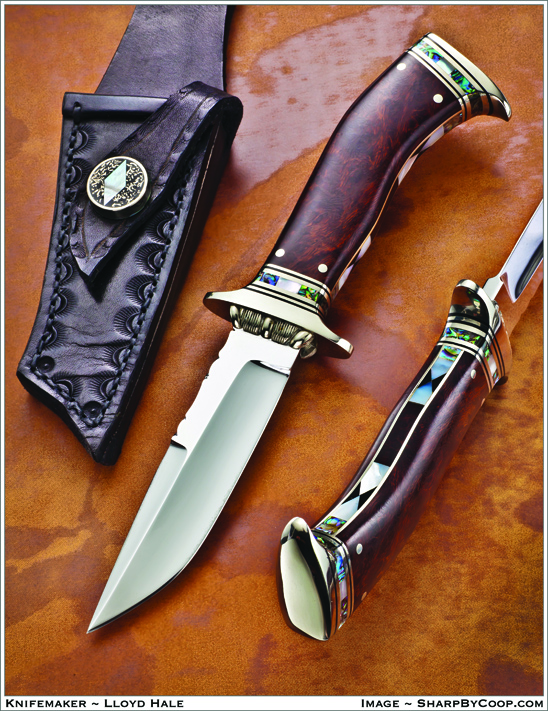
Well-made vintage knives by legendary makers can be very attractive to collect. Lloyd Hale does the honors here in a chute knife sporting an ironwood handle with pearl and abalone inlay. (SharpByCoop.com photo)

Some basic questions loom large, from deciding what to collect to getting the best education on what is available, selling or retaining an existing collection, and, if the choice is to sell, then maximizing the revenue generated.

First, the decision to make a change deserves due consideration. “You should have a very good reason for it,” remarked Peter Gill, who has been collecting knives for 15 years, “no whims.”

While some are into knife collecting for profit, it is always prudent to collect what you like. After all, you may own it for a lifetime. 08BL0313

“I believe a collector who is going to start collecting another type of knife should buy and collect what he’s attracted to,” reasoned Ken Potolicchio, who bought his first handmade tactical folder, a large Tighe Pan by Brian Tighe, in the fall of 2001. “In other words, buy something you would like to own, handle or even use. Research the new type of knife to be collected and be comfortable with the effort and costs to start a new or additional collection.

“If you’re going to start collecting another type of knife, buy and collect what you’re attracted to,” reasoned Ken Potolicchio, who bought his first handmade tactical folder, a large Tighe Pan (above) by Brian Tighe, in the fall of 2001. “In other words, buy something you would like to own, handle or even use.” (Brian Tighe photo) 

“Ask yourself why you want to collect the new type of knife,” Ken continued. “Is it simply to make money, to carry and use the new knives, or is it in the pursuit of desirable knives of a new type? What if you change your mind? You need to be very sure, especially if the sale of your current collection is a factor.

“As to resources, I would recommend reading the magazines and contacting purveyors you may have dealt with, trust and have a relationship with, or that deal in the type of knives you’re planning to collect. Direct contact with the makers of the knives to be collected is a good idea. I’ve found that most are willing to talk about all aspects of their knives.”

Though you may be financially capable of retaining your current collection, you may have to liquidate your existing holdings to be able to afford to collect something new. Opinions vary on the best way to sell, and some experts tend to think that holding on to what you have already collected is the best of all options.ed's dad's wwII Ek

“Don’t buy knives that are damaged or of poor condition unless they are very old and rare, such as [antique] bowies, Civil-War-era knives, and rare military knives,” Marvin Clyncke commented. Ed Fowler’s dad carried this World War II-era Ek Model 3 during World War II. (Fowler photo)  

“If you decide to shift gears and like another kind of knife, you might consider the following,” advised Pete Cohan, a serious collector since the early 1960s. “Trade the knives you have for those you now wish you had, but be sure you know who you are trading with and be firm when it comes down to the final details. You could try to sell your old collection to somebody you know, but don’t let anyone talk you out of a few pieces. You may be left with the rest and can’t hardly give them away.”

If you are an informed collector, you have a solid sense of what your collection is worth and what you will take for it. Unless such a solid base is in place, the hazards of selling or trading are substantial. Tactics also will vary depending on your motivation—simply to recover your initial investment or to make as much profit as possible to plow into the acquisition of your newfound favorite knives.

Though selling your knives as a collection may move the transition process forward more rapidly than selling in ones or twos, there is a trade-off. Marvin Clyncke’s father worked for Western Cutlery in the late 1930s, and Marvin has been a collector for more than half a century.

“If you want to sell your existing collection, you should sell on eBay, as you reach the whole world there,” he recommended. “Selling as a collection is not a good idea unless you have a specific buyer who is willing to pay a good price. Selling as a collection, you are essentially eliminating a lot of folks who may have some of the same knives and don’t want to buy a whole collection just to get a few that they need. Also, the price of the whole collection could eliminate many buyers, especially if the collection is large. Selling individually definitely would realize top dollar for each piece.”

Cardinal Rules

• Collect what you like or even use;

• Chasing trends is a fool’s errand;

• Collecting knives that are hot now means paying top dollar now as well;

• Know which knives are collectible in specific geographic locations of the country;

• Inexpensive, low-end knives will never appreciate to any degree;

• Well-made, fine-condition knives should not lose you any money;

• Don’t buy damaged/poor condition knives unless they are very old and collectible, such as antique bowies and rare military knives.

A FOOL’S ERRAND

In the continuing debate of present vs. future value, collectors heading down a new road are regularly challenged with a values proposition. Collecting what is hot today by no means ensures an appreciation in price down the road, while collecting something that is under the radar now provides no assurances on an increase either.

“A collector should only collect what pleases him or her,” reiterated Gill. “Chasing trends is a fool’s errand.”

Cohan advised, “What is hot now and what will be hot in the future is the classic question asked by every stock market trader. The question and its answer in the case of pocketknives or knives in general is further complicated by such things as the geographic location of the collector. What is hot on the West Coast and what is hot in the South are often very different. This can provide opportunity as well as risk for the collector who is starting in another direction. It is still, in my opinion, better to collect knives that you like for whatever reason. The collectibility of knives and their ‘rarity’ at some future date remains an elusive projection.”IMG_1207 Pic 19

Potolicchio leans toward the long view and collecting for the future rather than some notion of today’s “hot” commodity. He provides an illustration of future value with a firearm that he bought some years ago. “I gave my son a Ruger 10/22 rifle that currently [fetches] about $275, and I have the original receipt for the rifle when I bought it new for $38.50,” he laughed.

What’s hot in the West and South are often very different, Pete Cohan observed. This can provide opportunity as well as risk if you’re starting over. For instance, at the G4 Show in Las Vegas, tactical folders such as those by Jeremy Marsh (including the one at top just above photographed by Mike Searson) turned heads. In the South, antique pocketknives such as those by New York Knife Co. (immediately above) remain collectible. 

According to Clyncke, collecting knives that are hot now means paying top dollar now as well. Whether such knives will even hold their value or simply become yesterday’s fad is anybody’s guess. He does, however, see the thrill and allure of collecting something reasonably priced today that may in fact appreciate in the days to come.

“It is a guessing game,” Marvin warns, “but quality is everything. Cheap-made, low-end knives will never appreciate to any degree. Well-made, fine-condition knives will surely not lose you any money. Again, research is a big help.”

Sources To Use

• Read knife publications and websites you trust;

• Contact purveyors with whom you have dealt, trust and deal in the types of knives in question;

• Have direct contact with the makers of the knives in question;

• Let as many people as possible know what new collectible you want;

• Ask your friends to be on the lookout for examples.

Knives2013

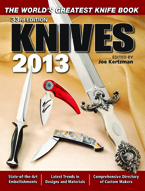
One of the best ways to research what is best to collect is to read publications you trust, such as the new KNIVES 2013

Experienced collectors may already have a feel for the do’s and don’ts of collecting a new style of knife. However, it pays to remember lessons learned and to benefit from the experiences of others.

“Don’t buy knives that are damaged or of poor condition unless they are very old and rare, such as [antique] bowies, Civil-War-era knives, and rare military knives,” Clyncke commented. “Junkers are a dime a dozen and will sell for a dime a dozen in 10 years. I would let as many folks know as possible what you’re looking for. Never tell them what you will pay, just what type of knives you want. If you tell them what you will pay and they’re surprised at the price, they may just keep the knives as an investment. Some good ones may pop up right away. It never hurts to have friends looking for you.”

Potolicchio added that research is a key element before the final decision to switch the type of knife being collected. Without investing enough time to understand the market for the new type of knife, you may never find your comfort zone, particularly if you have liquidated your existing collection in the process.

For Cohan, the collecting transition should be something of a soul-searching process. He advises considering several aspects of embarking on a new frontier in collecting.

“How available are the knives that you now fancy, and are they of recent vintage?” he asks. “Are they still in production or are they a ‘short run,’ which may or may not permit a wide distribution of the knives, directly affecting their collectibility? If the knives are antique, where will they be found and can they be found without undue cost? What are the prices typically asked for these knives in collectible condition? Are you going to collect only the mint or near mint/excellent examples, and can you afford to pay premium prices for this type of knife?”

Questions YOU NEED ANSWERED

• Do you have a very good reason for starting over?

• Are you comfortable with the effort and costs it will take to build a new collection?

• Do you want to make money or collect, carry or use the knives?

• What knives should you collect, and how do you best research them?

• How available are they and are they of recent vintage?

• Are they still in production or limited in distribution, both of which influence collectibility?

• If antiques, where can they be found and can they be found without undue cost?

• What are the prices typically asked for the knives in collectible condition?

• Are you going to collect only mint or near-mint examples, and can you afford to pay premium prices for them?

HAVE/EXECUTE A PLAN

Early in the collecting transition process, there may actually be more questions than answers. Nonetheless, if you plan appropriately and execute the plan, you continue to find your passion for knives rewarding, whatever type you seek.

Guilford Art Center Holds Juried Knife Exhibit

Calling all bladesmiths and knifemakers: the Guilford Art Center in Guildford, Connecticut, announces “Contemporary Knife Smithing: A Juried and Invitational Exhibition,” and is calling for submissions.

Bladesmithing is a thousands-year-old craft practiced in diverse cultures across the world. It has survived as an art form despite modern industrialization, with artisans dedicated to preserving and expanding traditional techniques. This exhibit will explore and highlight the artistry of the contemporary hand-crafted knife, as an object with both functional and aesthetic value.

Exhibit Dates: July 10-August 18, 2013 

Juror: An ABS journeyman smith, Mace Vitale practices blacksmithing and is a copper smith. He has a background in architectural pre-cast concrete, is owner of Laurel Rock Forge in Guilford, and is an instructor at the Guilford Art Center.Vitale_120608

Eligibility: This exhibition is open to knives made by U.S. residents.

Entries: Each artist may submit up to three (3) works. Each work may be represented by two separate images: one full view and one detail view. Work must be submitted in high-resolution digital format. For each entry please note dimensions of knife, and a maker’s list price (retail price), or not-for-sale/insurance value. Email entries to: [email protected].

Entry Fee for Applicants: $20. Includes up to three (3) submissions. Make check payable to Guilford Art Center and mail to 411 Church St., Guilford, CT 06437. Or call the Center with credit card number 203-453-5947. Payment must be received for entries to be eligible.

Entry Deadline: June 10, 2013. Digital images and entry fee must be received by this date.

Conditions:  All accepted works must arrive with a display case that closes for safety purposes during exhibition. All entries must be original and must be completed within the last 3 years. The Center reserves the right to reject entries that do not meet these requirements or is deemed unstable. Shipped work that differs from submitted images will not be accepted. Work damaged in shipping will regretfully not be presented. All accepted work must have proper identification. No accepted work may be picked up before the closing of the exhibition.  Work may be available for sale or must be identified as NFS. The retail price or insurance value provided on the entry form will be used; no changes may be made after the work is shipped.

Shipping: Shipping costs are the responsibility of the artist. A check for return shipping, including the cost of insurance, must accompany delivered work, payable to Guilford Art Center. Work damaged in shipping will not be presented. Detailed packing/handling instructions must accompany all works.

Hand Delivery: Please call the Center to make an appointment for hand delivery/pickup at 203-453-5947, Ext. 12, or email [email protected].

Receiving Deadline: All work must be received no later than these dates.

Sales/Insurance: A 40% commission on all sales will be retained by the Center. Artists must indicate sale price and insurance value or, if NFS, just insurance value. Submission of work to this exhibit is done so at the artist’s risk and implies an agreement on the part of the artist to all the conditions of this Call for Submission. GAC will not be responsible for loss or damage to work in transit, however, work will be insured while in the Guilford Art Center facility.

Publicity: Guilford Art Center reserves the right to photograph entries for the purposes of documentation, education and publicity. Accepted artists are encouraged to send to the Center a resume, artist statement, brochures, and additional photographic materials of the accepted work for publicity purposes.


Show Schedule:

Application due: June 10, 2013    

Artist Notification: June 14, 2013   

Receiving: June 24-28, 2013  (10am-4pm)  (Shipped/by appointment) 

Opening reception: July 10, 2013 (5-7pm) 

Closing:  August 18, 2013   

 Deinstallation: August 19-23, 2013 (10am-4pm) (Shipped/by appointment) 

For more information please contact Guilford Art Center at 203-453-5947, or visit www.guilfordartcenter.org.

How To Build a Survival Shelter

The following is excerpted from a feature article by James Morgan Ayres that ran in the April 2013 issue of BLADE® Magazine.

Over 90 percent of wilderness deaths by mischance are caused by hypothermia. Knowing how to build an emergency shelter quickly can mean the difference between freezing to death and surviving. You can build a survival shelter that offers protection from cold and snow or rain in no more than 30 minutes, and with only the tools at hand—which is where knives can make the difference in getting the shelter up before it is too late.

5 Keys to An Emergency Shelter

1) Evaluate your situation and decide if you need to spend the night out before it gets so dark you cannot see to build a shelter; Expanding the framework of the shelter.2) If available, select a level spot that provides natural shelter—a large tree or boulder, for example. Barring that, choose a place that has building materials such as saplings or brush nearby; 3) Build a framework using the natural shelter as a base; 4) Cover the framework with branches, leaves, brush and whatever materials are available. If possible make the covering 6 inches to a foot thick; the thicker the covering, the better the insulation. If you are in an area where there are limited building materials, having a reflective blanket in your pocket could be a lifesaver. It weighs only about 3 ounces, is no larger than a handkerchief and can make a difference of up to 20°F, and; Expanding the framework of the shelter.5) Cover the floor with six-to-12 inches of leaves, pine needles, duff (decaying leaves and branches), or whatever is available for insulation. Leave the area near the entrance clear of debris. After making the cleared area safe for burning small pieces of kindling, build a small fire in it. The fire should be no larger than a soup bowl.

If you are properly dressed for the climate, you can spend the night in such a shelter with a tiny fire not only safely but also comfortably. Having the know-how to build the shelter is critical. Having a good knife can make building the shelter quick and easy.—by James Morgan Ayres 

Shelter framework ready for thatching with available material.Author’s note: The shelter in the photos using pine boughs was built in a national park, not a true wilderness area. We were required to “leave no trace” and return everything as it was. Therefore, we did not thatch the roof nor build up the floor with boughs and leaves as described in the text, as you would in a survival situation.

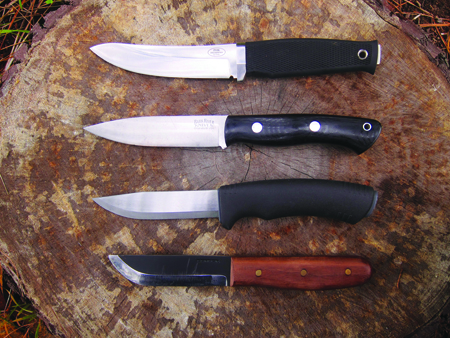
My associate and I used and evaluated four very different knives to construct two survival shelters. The review knives fall into two categories. The Mora and Condor both have ‘Scandi’ grinds and are economical. The Bark River and Fallkniven have convex grinds and are priced like the premium knives they are. Covering shelter framework with pine boughs.

CONDOR BUSHCRAFT

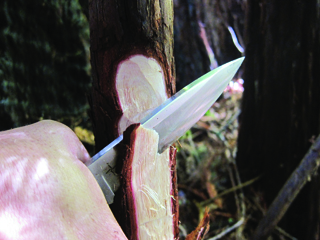
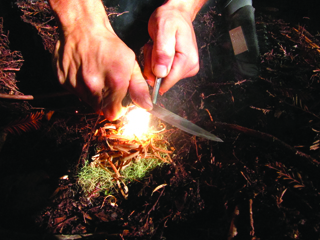
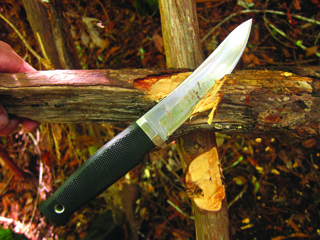
The Condor Tool & Knife Bushcraft Basic Camp Knife has a comfy wood handle, a 4-inch blade of 1075 carbon steel with a lot of belly, and a full tang. When driven into a tree it was strong enough for a 200-pound guy to do a pull-up on; we tried it, no problem. The belly of the black-epoxy-powder-coated blade proved its worth in general use, but a little more tip would have been welcome. In knife design everything is a compromise and this is a good one. The welted leather sheath holds the El Salvador-made knife securely and is unusually nice for a package in this price range ($34.98 MSRP).  Bark River Aurora illustrating an efficient push cut on a sapling.

IMG_0316BARK RIVER AURORA

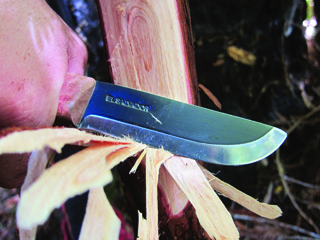
The Bark River Aurora ($239 MSRP) is Bark River honcho Mike Stewart’s personal design for an all-around bushcraft knife. The American-made fixed blade displays excellence in design and use. The convex blade of A2 tool steel provides easy, controllable push cuts, supports the edge for batoning, gets into a cut aggressively, and has a centerline point for precise control. The handle is ergonomically contoured, does not slip and is comfortable in hard use. The balance is so good and the 9.5-inch knife feels so lightweight and quick that it seems to weigh less than the specs (6 ounces) would indicate. The pouch-type leather sheath is handsome, secures the knife well, carries comfortably and has a loop for a firesteel.

I suspect the Aurora has a reserve of strength that we did not come close to tapping in our review. Though not billed as one, I think the Aurora is an excellent choice for a wilderness survival knife. IMG_0305Condor Bushcraft makings shavings for a fire.

MORA BUSHCRAFT

Made in Sweden, the Mora Bushcraft Survival Knife ($57.95 MSRP) comes with a firesteel and diamond sharpener—both valuable tools—in a composition sheath. The thick, 4.25-inch blade sacrifices nothing in slicing and wood-shaving ability. It has a good, usable point and is strong enough for batoning. The handle is very comfortable. The knife popped out of the sheath, which was worn on a belt, while we were jumping over a log. A cut or the loss of the knife could have resulted.

FALLKNIVEN PHK

Fallkniven markets its Professional Hunter (PHK) as “one of the best hunting knives in the world.” It is also a very good all-purpose bushcraft and survival knife. The convex grind and long, curved edge combine to make a strong 5-inch blade of 3G steel that just wants to cut. It batons well, makes good push cuts and snap cuts efficiently on small branches. It would even do a little light chopping, though no knife this size (9.4 inches overall) can be an efficient chopper. The PHK’s nonslip Thermorun™ thermoplastic handle is comfortable in any grip, even during hard use.IMG_0181

Made in Japan, the knife offers a choice of a leather or Zytel® sheath. I much prefer the leather one since the Zytel sheath must be snapped to secure the knife, as we learned when the knife fell from the unsnapped sheath while we were running. MSRP: $470.

HOW THEY FARED

In general, we found the knives with the Scandi grinds to be somewhat better for fine woodwork, such as making fuzz sticks, while the convex-ground blades cut more efficiently and with less drag in deep cuts. All the knives’ handles were comfortable and did the job. On the other hand, each knife had its own character and pros and cons.

The Bark River was everyone’s all-around favorite, and if there had been a prize for most handsome, it would have won. The Fallkniven displayed the high level of function for which the brand is known, and clearly had enough reserve strength to serve as an urban destruction tool. The standard Mora is a good all-around bushcraft blade at a very low price. It is a bit stronger than other Mora models we have seen, and the inclusion of a firesteel and diamond sharpener produces a very nice package. However, the sheath needs work—otherwise you had better use duct tape to secure the knife, as we did. The Condor brings a welcome alternative to the bargain-priced market and stands on its own merits as a strong, efficient choice for the bush.

The premium-priced Bark River and Fallkniven exhibit higher-quality construction and did almost everything better than the less expensive Mora and Condor. Nonetheless, the difference was a matter of degree. All would serve to build a shelter and produce firewood, and maybe save your life.

Advertisement

Must Read Articles

Read this before you make a knife

Knifemaking 101 – Read This Before You Make a Knife

  by Wayne Goddard My experience has taught me that there's nothing like digging in and getting started. I've often said the hardest part of the...
how to forge damascus steel

How to Forge Damascus

Advertisement
Advertisement