Home Authors Posts by Mike Haskew

Mike Haskew

8 Affordable, Cool, And Compact Keychain Knives [2022]

Updated 5/25/2022

Keychain Knives Provide Utility And Protection In A Compact Package. There Are Many Quality Keychain Knives At An Affordable Price.

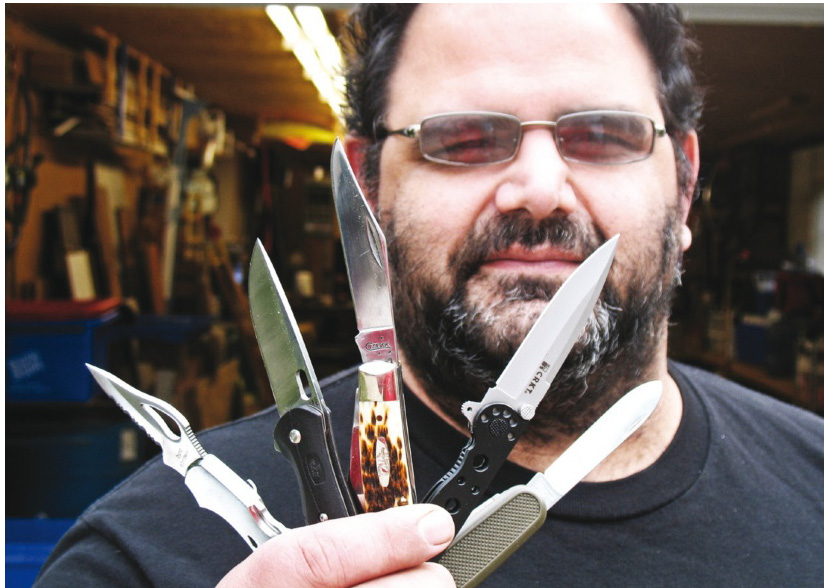
From a conversation piece to the handiest blade available, nothing adds to the everyday carry equation better than the right keychain knife. With little notice until needed, a keychain cutter is ready for action but doesn’t weigh down the pocket or take up too much space in a purse.

Coming in different sizes and blade types, keychain knives are as varied as any other type of everyday carry knife but is smaller and more nimble.

8 Best Affordable Keychain Knives

Outdoor Edge MiniGrip

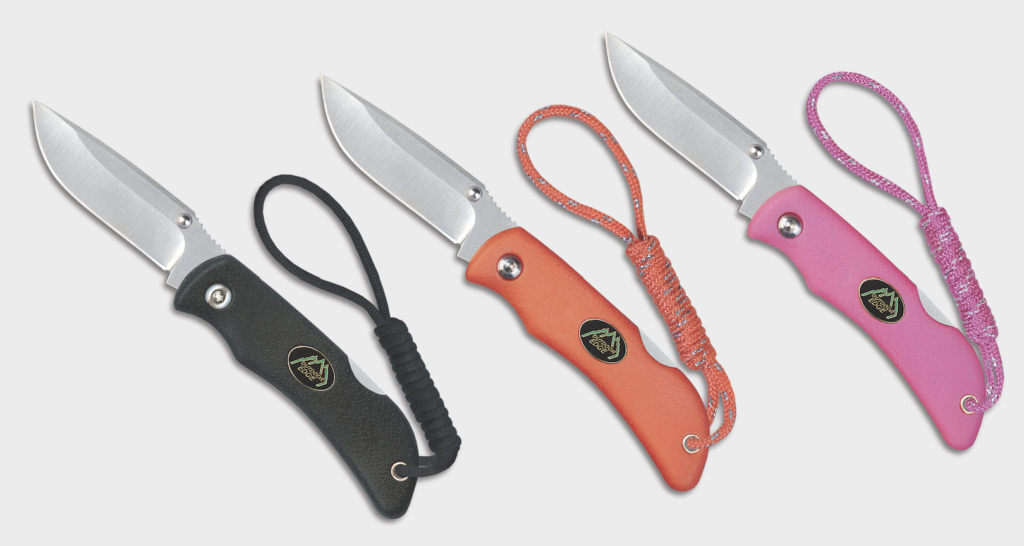
At Outdoor Edge, the MiniGrip, MiniBlaze, and MiniBabe are the same knife differentiated only by color in black, blaze—an orange shade—and pink, respectively. “They’re designed to meet the needs of anyone who needs a small lightweight blade that is always within reach,” Outdoor Edge marketing director William Morgan said. “We designed these knives in three colors to cater to all knife enthusiasts. When we developed this series of knives, we noticed a gap in the market for an affordable and mostly practical small knife that can be easily attached to a keychain or carried in one’s pocket.

The Outdoor Edge MiniGrip, MiniBlaze, and MiniBabe are the same keychain knife differentiated only by color in black, blaze—an orange shade—and pink, respectively. “They’re designed to meet the needs of anyone who needs a small lightweight blade that is always within reach,” related Outdoor Edge marketing director William Morgan. 

“We opted to make three colors to accommodate a larger audience,” William continued. “Obviously, the orange is great for high visibility, reducing the chance of losing the knife, while the black is a little more inconspicuous, and the pink seems to be a hit with the female audience.”

Designed in Colorado and sporting a low MSRP, each knife in the Outdoor Edge series includes a 2.2-inch 8Cr13MoV stainless steel blade, rubber TPR handle, 1.4-ounce weight, and 2.9-inch closed length. Each model comes complete with a lanyard that makes attaching it to a keychain easy. Each has an ambidextrous thumb stud for easy one-hand opening as well.

“The razor-sharp blade is up to any task, from opening the latest round of Amazon Prime boxes to cutting rope or even performing field-dressing tasks,” Morgan said. “The rubberized TPR handle serves a few functions. First, this is a small knife, and we were concerned about creating a secure, non-slip grip to avoid accidents. Second, the handle does not jingle against the keys on your keychain, making it a perfect silent addition to anyone’s keys.”

MSRP: $23.95

The Bear Edge 71523

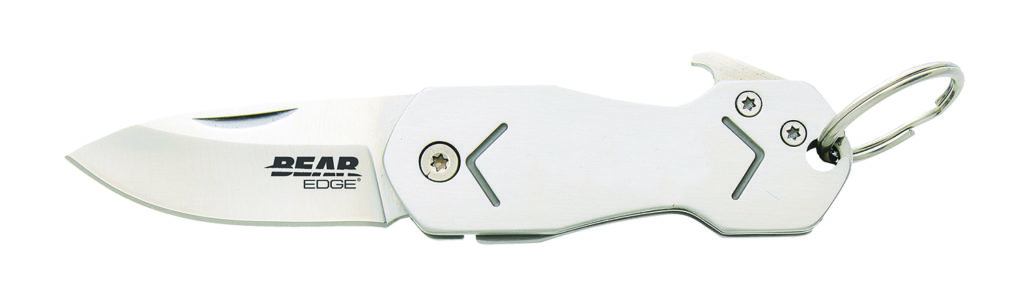
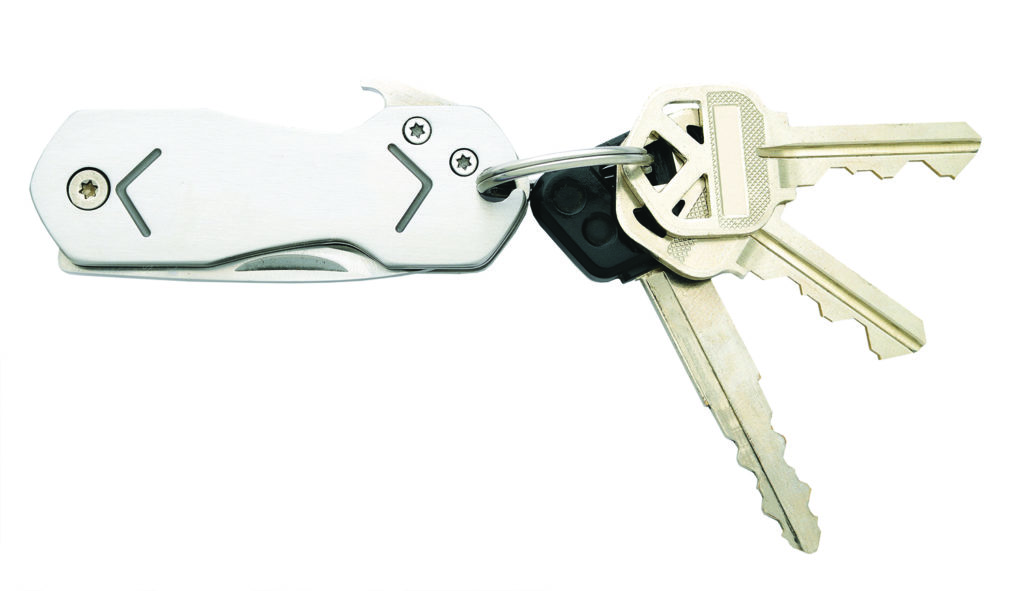
The Bear Edge 71523 from Bear & Son Cutlery complements a substantial line of knives, and company spokesperson Jacob Eaton says it’s a hit. “It’s affordable, compact and a functional tool,” he said. “Customers really like it because it’s lightweight, sharp and just the right size. Plus, you will always know where a knife is when it’s attached to your keys. We find both genders purchasing the Bear Edge 71523, and it fits everyone’s lifestyle.”

The Bear Edge 71523 is a framelock-folding keychain knife with a 2-inch blade of 440 stainless steel and a stainless handle. Weight: 2.3 ounces. Closed length:2.875 inches. The imported knife has an MSRP of $17.99.

The imported 71523 is complete with a two-inch blade of 440 stainless steel, stainless handle, and closed length of 2.875 inches. It’s almost lighter than air at just 2.3 ounces. According to Eaton, the blade length is ideal for typical cutting tasks encountered on a daily basis. “Cutting boxes open, adjusting cordage length and other similar chores are easy with the sturdy framelock design,” he said. “And one can cut confidently.” Another utilitarian feature is the built-in bottle opener.

"As

The company chose the stainless components for durability, and the knife is sized for maximum versatility. “Stainless steel is a timeless design element and proven to stand against wear and tear,” Eaton said. “The finish looks natural on a keychain and doesn’t call attention. The frame pattern was developed to fit comfortably into both large and small hands. The blade is a drop point shape, allowing it to complete most tasks, and the 71523 attaches with a standard split key ring.”

MSRP: $21.49

Al Mar Knives Stinger

The Al Mar Knives (AMK) approach to keychain knives involves easy access and long-term performance, and the Stinger was developed to deliver classic AMK design and function.

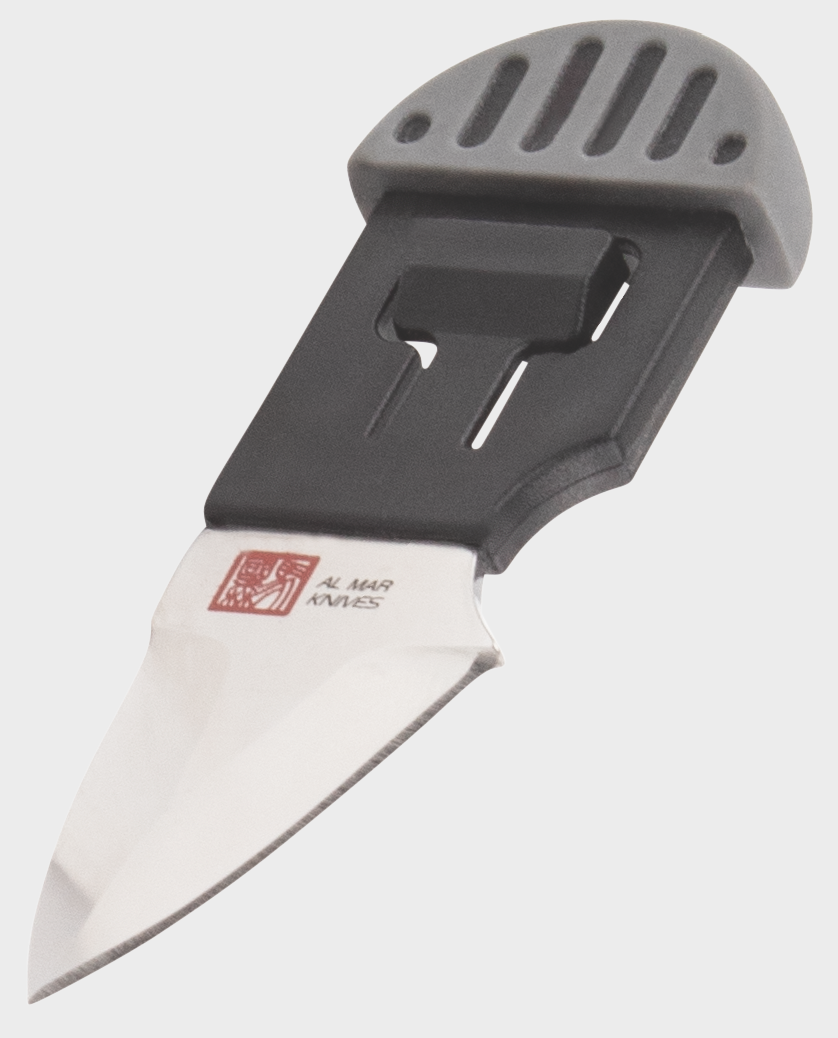
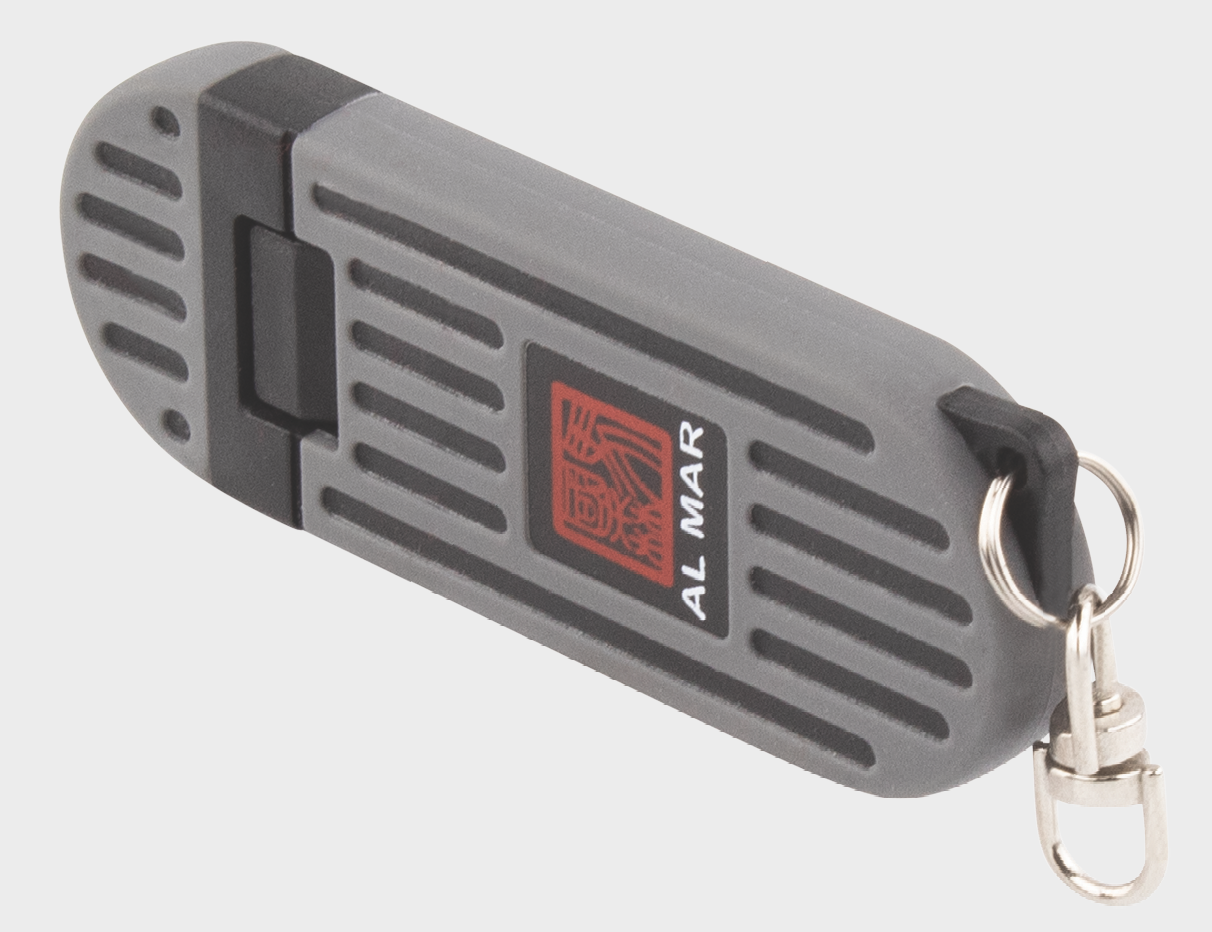
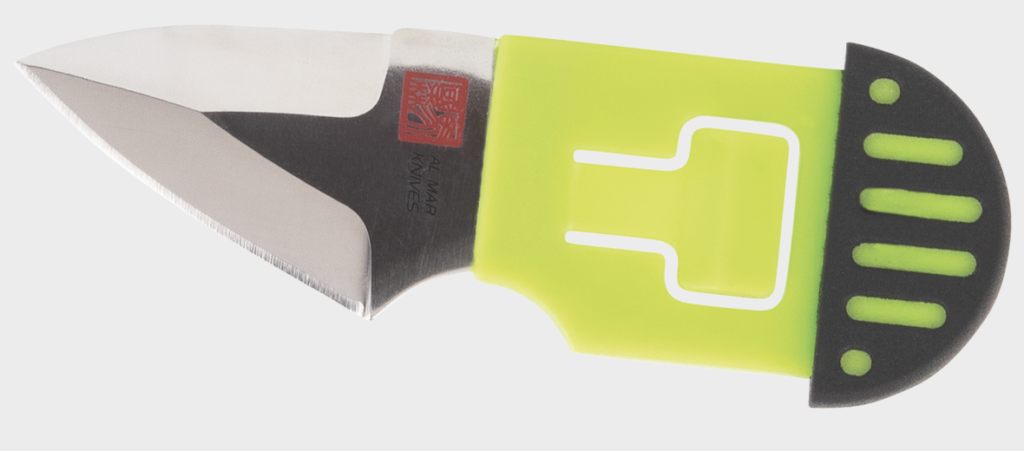
Above: The Stinger fixed-blade keychain knife from Al Mar Knives features a 1.3-inch D-2 tool steel blade in a flat grind, a synthetic PP+TPR rubber handle, and dual-injected sheath of the same material. It weighs just .7 of an ounce. Overall length: 3.1 inches.

“This knife is designed to be great at slicing and fast cuts.” — Justin Rabon

“Our Stinger keychain knife is designed for anyone looking for a durable blade they can keep concealed and on hand, with or without pockets,” AMK representative Justin Rabon said. “Our users find creative ways to incorporate these on their bags, gear and keys. We feel this versatility can help reach a wide range of users across many different lifestyles. We want our keychain knives to be practical for the majority of our users. We want to find the needs in the industry and have our knives be the solution to those needs.”

The fixed-blade Stinger comes complete with a snug-fitting sheath and deploys with a push of a button. It features a 1.3-inch D-2 tool steel blade in a flat grind, a PP+TPR rubber handle, and dual-injected sheath of the same material. It weighs just .7 of an ounce. Overall length: 3.1 inches.

“This knife is designed to be great at slicing and fast cuts,” Rabon said. “It can be used for anything where a short, sharp knife is needed. To accomplish these tasks easily and repeatedly, we gave the knife a D-2 blade. D-2 is known for retaining a sharp edge after repeated use. We also designed the Stinger to have Al Mar’s Wedge-style blade. This provides a superior dagger point where needed.”

The AMK Stinger comes complete with a snug-fitting sheath and deploys with an easy push of a button. It comes in red, blue, black and green—and the green really stands out in a crowd.

The Stinger’s finer points add flair and good looks as well. “The four colors that were chosen for the four Stinger knives—red, blue, black and green—were picked to provide variety while staying true to the traditional red and black of Al Mar Knives. The plastics in the handle were chosen to add extra grip and durability.”

Integral to the Stinger design is an eyelet built into the sheath, and sturdy construction prevents failures. “This makes sure the sheath doesn’t detach from the eyelet,” Rabon said, “and also allows you to replace the smaller key loop with a smaller diameter cord if desired. The Al Mar Wedge provides a superior point if needed, and the finger groove at the base of the blade allows the Stinger to sit comfortably in most hands. This improves the fit, feel, and functionality of the knife.”

MSRP: $12-23

Gerber Key Note

Gerber spokesperson Josh Headley said the focus on the company’s Key Note keychain knife is compactness. “We also wanted to add some chisel/scraping capabilities for additional functionality,” he said. “Gender wasn’t a big consideration. We just wanted to make a tool that was worthy of a place in your pocket or purse.”

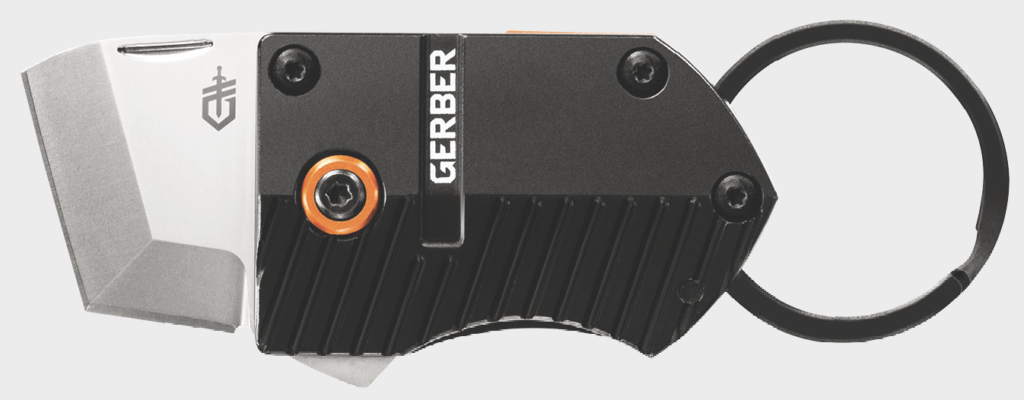
Also available in black as shown, the Gerber Key Note linerlock keychain knife has a 1-inch blade of satin-finished 5Cr stainless steel that is designed to scrape as well as cut. Handle: aluminum. Weight: 3.98 ounces. Closed length: 2 inches.

Features inherent in the Key Note design brought that idea from the drawing board to reality. “We added the wide clip so that you can also hang keys on your belt,” Headley said. “The knife was designed to not draw too much attention when worn on the clip, but still have a pleasing and almost symmetrical shape. We took a lot of inspiration from the history of Gerber. The overall profile is inspired by the shield logo, as well as Gerber’s past logos and heraldic-naming conventions with a modern twist.”

The Key Note combines function with a tip of the cap to Gerber tradition. With a 1-inch blade of satin-finished 5Cr stainless steel, the knife weighs just 3.98 ounces, and its aluminum handle scales are built to last.

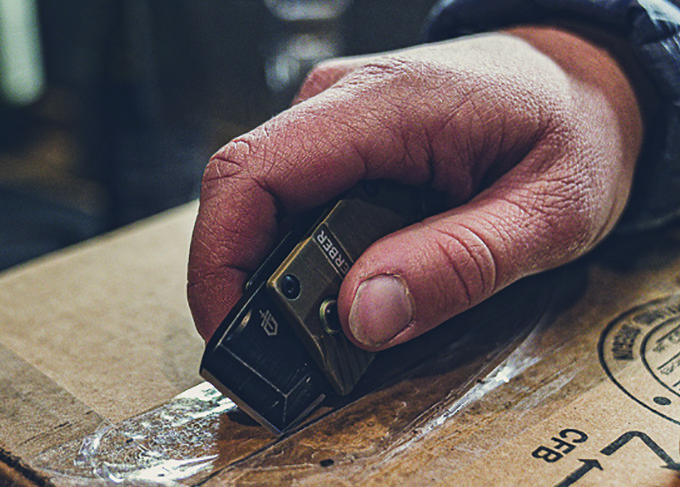
“The primary function of the Key Note is to open packages,” Headley said. “The thought was you get home, grab a package off your porch and open your door. You have the tool set to open your door and open your package in hand.”

The Key Note's tanto-style blade allows for scraping & chiseling along with cutting.
The Key Note’s tanto-style blade allows for scraping & chiseling along with cutting.

Available colors add to the Key Note’s appeal for those who look for discretion or want a bit of flash. “We set out to have a modern option and an old-school option for the EDC community,” Headley commented. “The matte-black anodize with the bright contrast from the orange is meant to look at home next to your key fob. The coyote and sage is designed to camouflage among a set of brass keys. We made the scales out of aluminum to increase the strength of the lockup, and so that the weight of the keys won’t knock the blade off balance. To improve longevity, the blade runs on brass washers and operates on a classic linerlock.”

The blade is in a compact tanto style to provide two flat edges that are easy to sharpen. A flat key ring gives an appropriate amount of flexibility between the ring and scales. Several different diameters of rings were tested to determine the best component. A kick-out tab is incorporated to assist in deploying the blade and allow easier opening rather than solely depending on the nail nick.

“The Key Note should be suited to light and medium opening and cutting tasks,” Josh said. “The flat edge on the front can be used to scrape everything from a label to that last bit of errant head gasket. In addition, the front of the scale can be leveraged so that the midpoint of the blade will puncture tape without damaging the contents of a box.”

MSRP: $21.60

Kershaw Cinder

Kershaw Cinder keychain knife.

If there was a knife out there that could be called adorable it’s the Kershaw Cinder, but don’t judge a book by its cover. This knife comes with a blade of 3Cr13 blade steel, and you know with the Kershaw name that it will be a quality knife from blade to handle. An excellent box cutter and utility knife or a protection piece for your keychain or purse, the Cinder plays far bigger than its size. Also, it has an integrated bottle opener and we could always use another of those.

MSRP: $13.99

Spyderco Bug Micro-Size Folding Knife 1-5/16″ Blade

Spyderco Bug Micro-Size Folding Knife 1-5/16" Blade
Spyderco Bug Micro-Size Folding Knife 1-5/16″ Blade

Sypderco has made a nimble keychain knife that feels like it should cost more than it does. At less than three inches in total length, the Bug easily slides onto a keychain and works as an excellent low-profile EDC for protection and whatever else life throws at you.

A flat-ground blade made of 3Cr13MoV stainless steel, the Bug also features a flat, stainless steel handle great for engraving or personalizing for yourself or a friend as a gift. The smallest folding knife made by Spyderco, the Bug delivers in nearly every way.

MSRP: $24.50

SOG Centi II Knife

SOG Centi II Knife
SOG Centi II Knife

Featuring a lockback design, and a blade coming in at 2.1 inches, the Centi II is a versatile knife fit for your pocket, keychain, or even on a necklace. Strong yet thin, it’s even thinner than your car key, the Centi II is robust enough to tackle any day-to-day tasks you’d expect from any other EDC. The hardcased black finish is gorgeous and adds a sleek design touch to the knife.

Victorinox Classic Swiss Army Knife

Victorinox Classic Swiss Army Knife

When it comes to keychain knives it’s impossible to make a list without the famous Swiss Army Knife. With seven tools and functions built into a body just 2.3 inches in length, the Swiss Army Knife is famous for its versatility and is still one of the gold standards of keychain knives.

With tools made of stainless steel that include a small blade, scissors, and a nail file with a screwdriver, the Swiss Army Knife can handle pretty much any situation life can throw at you where you’d need a quick tool. The classics become classics for a reason, and you can’t go wrong with a Swiss Army Knife on your keychain or in your pocket.

MSRP: $19.99

Mike Abelson contributed to this piece.

Bob & John Horrigan: Brothers In Arms And Blades

Bob & John Horrigan Made Knives Together. After The Former Died Defending The Country, John Kept Their Knifemaking Legacy Alive

It was a night mission, and it was dangerous—just like every mission, every moment in the deserts and villages of western Iraq or the mountains of Tora Bora in Afghanistan.
“You don’t have to come,” the others said matter-of-factly to Master Sergeant (MSG) Bob Horrigan. “You’ve only got two weeks left in the country.” The veteran Delta Force NCO, with 19½ years in the U.S. Army, three tours in Afghanistan, and a fifth in Iraq coming to an end, simply replied, “If you’re going, I’m going.”

True enough, Horrigan was just days away from returning to the USA, and he planned to retire from the Army in six months, then, in peace, to make custom knives in his shop and share that time with his twin brother, ABS master smith John Horrigan.

This night, however, there was dangerous work to be done. A raid was planned on a safehouse known to be frequented by terrorists, particularly Iraqi al Qaeda leader Abu Musab al-Zarqawi, a ruthless murderer pledged to support Osama bin Laden. Horrigan

A veteran Delta Force NCO, Bob Horrigan served 19½ years in the Army, including three tours in Afghanistan and five in Iraq. He was killed during a raid on a safehouse frequented by terrorists, including Iraqi al Qaeda leader Abu Musab al-Zarqawi. Bob was laid to rest with full military honors at Arlington National Cemetery.

When the call went out for someone to serve as a master breacher during the mission, blasting doors and first inside a building where hostiles might be hiding, Bob Horrigan said without hesitation, “I’ll breach.” In the town of al Qaim in western Iraq, the Delta Force team, accompanied by additional Special Forces personnel, moved toward the suspected Zarqawi safehouse. With MSG Michael McNulty at Bob’s side and the rest of the team close by, the two were first to enter the enemy compound.

Bob made it into a nearby room, and a machine gun opened up. McNulty was hit in the doorway. Bob was fatally wounded seconds later. Both died within a few hours.
“It was about 7 in the morning. I was at home, and Bob’s brother-in-law, Mark England, came to the house,” John Horrigan recalled. “Our sons were best friends, and I thought he was coming to tell me that my son had gotten into trouble. He said, ‘No, John. It’s Bob.’”
The news was devastating, and Bob Horrigan was laid to rest with full military honors at Arlington National Cemetery, following a funeral service in Austin, Texas. He left behind his wife, Denise; young daughter, Courtney; older sister, Lisa; younger brother, David; many friends and relatives; and, of course, twin brother John.

To say Bob and John shared a special bond, even as identical twins, would be an understatement. Their mannerisms and speech patterns were so alike, and they experienced the joy of growing up inseparable. They also shared their love of service to their country, and later came a great interest in custom knives.

First Drop Zone

The brothers were born in Limestone, Maine, on Jan. 13, 1965. “I came into the world seven minutes before Bob, so I cleared the drop zone. We always said he was a hung jumper,” John smiled. “We’re identical twins, so I got into fistfights for him, and he got into fistfights for me. It was like the Doublemint®-Spearmint commercial, and it was that way in school and in the Army. He continues to be half of me. He is still here, and I can feel his presence out in the shop now and then.”

John made his first knife in high school. Instead of making a planter as his shop project, he found a piece of O1 tool steel and went to work on the knife. His son carries the same fixed blade today, first with a cherry handle and later with one of maple. For 24 years now, John has worked as a firefighter with the Austin Fire Department, the family’s hometown after moving from Maine to Florida and then to Texas years ago.

John enlisted in the Army in 1984, six months ahead of Bob. The two became Rangers, elite soldiers engaging in demanding training programs and taking on the most hazardous combat operations. They served in the 3rd Ranger Battalion, 75th Ranger Regiment, and Captain Stanley McChrystal, who later reached the rank of general and commanded American forces in Afghanistan, led Company A.

John spent three years on active duty as an Army Ranger. Bob stayed in and spent about eight years with the 7th Special Forces Group and 9.5 years with Delta Force. Even among the elite of the 7th Special Forces and the clandestine Delta Force, Bob stood out. He attended just about every training school imaginable, including the Basic Airborne Course, Jungle Warfare Training Course, Special Forces Qualification Course, Military Freefall Jumpmaster Course, and several others. In 1987, he competed in the Best Ranger competition at Fort Benning, Georgia, and placed second.

He was a leader of hardened, highly trained military professionals, and among his numerous decorations were the Bronze Star, Purple Heart, Legion of Merit, Combat Infantryman Badge, and Expert Infantryman Badge. The full list of his accomplishments during a distinguished two-decade career is literally too long to include in this story.
Several well-known authors have written about his exploits, including Brad Thor, Pete Blaber, Sean Naylor, and George Hand IV. In writing of the funeral of a central character in one of his novels, Thor is actually describing Bob’s funeral, an all-too-real and somber event.

In his book The Mission, The Men, and Me, former Delta Squadron Commander Blaber remembered Bob and wrote, “After unshouldering his ruck, Bob H. scotched forward on his belly. He stopped behind a small pile of rubble. Canting his head slowly, he spied the valley below. His eyes and ears strained to detect any unnatural noise or movement; Bob was focused like a man whose finely tuned autonomic nervous system is programmed to maintain perfect equilibrium between the thrill of the hunt and the thrill of the chase. Bob understood his status as both the hunter and the hunted. He liked it that way … Courage has been called a contradiction in terms, meaning a strong desire to live manifesting as a readiness to die. It described Bob and his mates to a tee.”

During those long deployments to combat zones, Bob stayed in touch with John, mostly via email. “He would send one to me, and I would respond,” John said. “The next morning there was another one waiting for me. Robert downplayed a lot of what was going on. He’d say, ‘Not much happening here … I’m bored.’ But he was lying. They were in firefights every day; he just didn’t want people to worry about him.”

 In his book The Mission, The Men, and Me, former Delta Squadron Commander Pete Blaber wrote of Bob Horrigan (above): “Bob understood his status as both the hunter and the hunted. He liked it that way … Courage has been called a contradiction in terms, meaning a strong desire to live manifest as a readiness to die. It described Bob and his mates to a tee."
In his book The Mission, The Men, and Me, former Delta Squadron Commander Pete Blaber wrote of Bob Horrigan (above): “Bob understood his status as both the hunter and the hunted. He liked it that way … Courage has been called a contradiction in terms, meaning a strong desire to live manifest as a readiness to die. It described Bob and his mates to a tee.”

Meanwhile, there were those precious times that Bob came home, mostly during the Christmas season, and the twin brothers picked up where they had left off during a prior visit. One of their primary topics was—of course—knives.

$50 Sander

John was 21 when he left the military, and he visited a knife and gun show in Austin with a pair of his own custom knives and a couple of makeshift cardboard wheels under his arm that he used as sharpeners. He met Houston-based custom knifemaker Ed Thuesen, who also owned Texas Knifemakers Supply.

“Ed saw those under my arm and said, ‘Don’t use that crap!’” John recalled. “I told him I couldn’t afford a new sander, and he said that he had a used one in Houston that he would sell for $50, but I would have to drive there to pick it up, and he wanted cash. I said, ‘Deal!’” Later, John bought a brand-new Bader sander and sold the used one to Bob—
for $50.

“I got into knifemaking, and then I got Bob into it,” John smiled. “He mainly made military fighters for guys in his unit, for Navy SEALs or whoever. He had more business than I did.”
At Fort Bragg, North Carolina, home of the Army’s Airborne and Special Operations Forces, Bob set up a knife shop in a lawnmower shed. Power was supplied with an extension cord, running through a sliding glass door to the shop’s tools. He enjoyed working with 440C and 154CM stainless steels, but he couldn’t forge on the Army post. Hence, when he needed a piece of damascus, John gladly supplied it.

“He wrote me a letter once telling me how much he loved coming home, coming to the shop and learning new things,” John remarked. “He would tell me that copying someone else was the highest form of flattery, and if you look at Robert’s knives they were similar to the knives I made. But he’s my brother, and I don’t care. Later, he got into his own designs, and now my best-selling knife is one of Robert’s designs.”

That legacy design is the Robert “Bob” Horrigan Military Fighter, available from John today in the notable style that has become popular in the military as well as the general public. The fighter is 11.25 inches overall with a 6.375-inch blade of 440C stainless steel and a handle of black linen Micarta®. The knife weighs 8.7 ounces and is accompanied by a Kydex sheath.

“I actually didn’t make the Bob Horrigan,” John related. “I made my Model 1 and others, but there were some guys from the 160th Night Stalkers who were on the mission that night and asked if I would make the Bob Horrigan knife. Now I make the Bob Horrigan, and I make them the way he did.”

Through the years, John has established himself among the best bladesmiths and custom knifemakers around. His daggers, tomahawks, and fighters are acknowledged as fine work, and his dazzling inlay with precious metals is something to behold. “I tell everybody that is my Picasso work,” he laughed.

Tremendous Spirit

Living quietly in Burnett, Texas, about an hour outside Austin with Donna, his high school sweetheart and wife of 33 years, John works in a 30×40-foot shop on his farm, dotted with chickens, goats, and bees. Donna says the shop is as big as the couple’s first house. They have two grown children, Matthew and Krystal, and two grandchildren, whom they adore.
Reflecting quietly, John observes, “The greatest thing that has happened since Bob’s death is that he brought me back to God, and that is the best thing he could ever leave me. Being twins, it was pretty rough, and it felt like half of me was gone. Bob came to me at the BLADE Show* two years before he was killed and said, ‘I’m coming back to God. At the time I just said, ‘Great!’ but when he was killed, God was what got me through it.

 Designed by Bob Horrigan, the Robert “Bob” Horrigan Military Fighter is ABS master smith John Horrigan’s best-selling model. “I make them the way he did,” John said, including a 6.375-inch blade of 440C stainless steel, a black linen Micarta® handle and a Kydex sheath.
Designed by Bob Horrigan, the Robert “Bob” Horrigan Military Fighter is ABS master smith John Horrigan’s best-selling model. “I make them the way he did,” John said, including a 6.375-inch blade of 440C stainless steel, a black linen Micarta® handle and a Kydex sheath.

“I started living for Robert, for my family and doing what God wanted me to do,” John continued. “I know where Robert is now, and I know where I’m going. Bob killed a lot of people and that worried him. So he went to the chaplain, who told him that the Bible said not to murder. It didn’t say not to kill in defense of your country. So, he was good with that. I don’t think my brother ever had PTSD because he had God.”

John received his ABS master smith rating shortly before Bob was killed, and as he continues to live his dedicated life, he takes comfort in the fact that his brother, who also wanted the ABS designation, knew that John had achieved it.

In recent years, John has made presentation knives depicting the American flag for Delta Force and for former President George W. Bush, whom he met at Fort Bragg during a visit after Bob’s death. He presented the knife to “W” sometime later in Dallas.

John is generous with Honor Flight Austin, donating knives that raised $19,000 at auction, paying for 19 veterans of World War II to visit their memorial in Washington, D.C. At one auction event, he presented a Bob Horrigan fighter to Admiral William H. McRaven, commander of U.S. Special Operations Command. At an auction the following year, he presented a Bob Horrigan fighter to Medal of Honor recipient Sergeant Salvatore Guinta of the 503rd Infantry Regiment, 173rd Airborne Brigade Combat Team.

During each of these events, John has felt his twin brother right there with him. In service to his country, Bob made men. In the shop, he made knives with lasting, honorable attributes like those who carry them today. Noted John, “The sacrifice of these young men and women is incredible.”

For the elder Horrigan, every day is a tribute to his brother. Their love of the custom knife is an unbreakable link, and to be sure, every knife that John will ever complete carries something of Bob’s tremendous spirit with it.

Read More About The Horrigans

Modern Period Knife: A Link To The Past And Present

Blending old and new, the modern period knife brings history alive in masterpieces.

Historical perspective is a relevant component in just about any undertaking. In the realm of cut, incorporating an appreciation of the past into the work of today brings another dimension to the custom knifemaker’s statement.

Interest in the knifemaking of a bygone era offers a window into the true artistry required to reproduce the knives of yesteryear, particularly with the absence of modern conveniences in the shop. Along with the interest in the historical knife, several custom makers bring famous designs, styles and patterns to life once again in tribute to those who have gone before.

The idea of the period knife blends old and new. “I’ve been making knives seriously since about 2002 when I took a class with the American Bladesmith Society in Washington, Arkansas,” related ABS master smith Lin Rhea. “Joe Keeslar and Greg Neely lit a fire under me and got me on my way. Since then the town of Washington has been like a second home, and I’ve even added to the personal connection between me and the area by interest in one of the town’s historical residents who was also a knifemaker. His name was James Black.”

A resident of Prattsville, Arkansas, Lin gained an appreciation for Black’s distinctive body of work*, using contrasting materials and techniques to create a bold, attractive look. “I’m grateful to get to know Mr. Black by studying his work,” Lin continued. “This intense study led me to try to recreate one of his knives, the Carrigan Knife. The original knife, a guardless coffin-handled bowie, was made by Mr. Black in the early 1830s in Washington, Arkansas. I chose the Carrigan as my first attempt because of its less intimidating size; however, as is often the case I found it to be just as intimidating once I started into the project.”

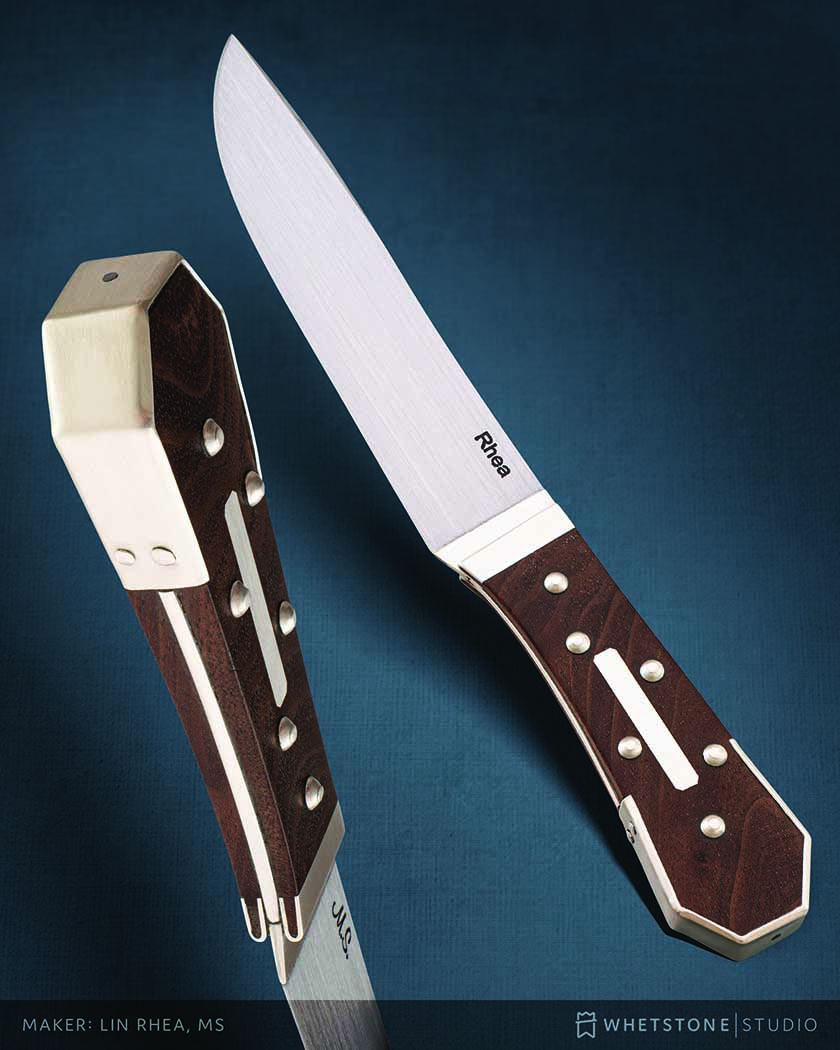
Lin Rhea’s period knife, a reproduction of the Carrigan Knife is based on a dress bowie James Black is thought to have made in the early 1830s in Washington, Arkansas. The original Carrigan includes a black walnut handle with coin silver pins and trim. The blade is about 6 inches long and the overall length is approximately 10.25 inches. (Whetstone Studio image)

The original Carrigan includes a black walnut handle providing a nice contrasting background to the coin silver pins and trim. The blade is about 6 inches long, and the overall length is approximately 10.25 inches. The full tang is virtually covered entirely by the walnut scales and the silver wrap.

When Rhea undertook his homage to Black and the Carrigan, he chose stabilized walnut, which he harvested himself several years ago, and trim in sterling silver. He forged the blade from 80CrV2 carbon steel and included at least 30 separate parts while attempting the same techniques used by Black nearly two centuries ago in fastening and assembling the finished knife.

“There is so much to be said about not only this knife but also Black’s work,” Lin concluded. “He was able to create a knife design utilizing only three materials yet impacting the knife world as few others could. His ability to arrange these materials into a functional, long lasting, beautiful tool is only enhanced by the knowledge that he also built in other qualities like moisture resistance, logical assemblage and ergonomics. All of this was done in a historic setting without modern equipment and epoxies. In my opinion, his design is ingenious.”

The Gold Rush Period Knife

Recently inducted into the BLADE Magazine Cutlery Hall of Fame® (September BLADE®, page 52), knifemaker Jim Sornberger has assimilated his gold and silversmith skill sets into custom knifemaking while helping introduce the modern world to the classic design, luster and embellishment of the Gold Rush era and boomtown San Francisco of the mid-19th century.

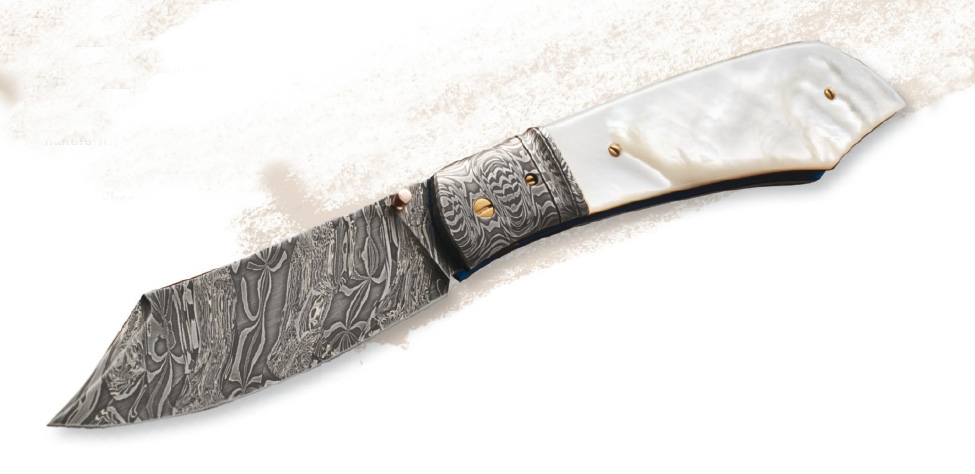
BLADE Magazine Cutlery Hall-Of-Fame® member Jim Sornberger’s interpretations of the Michael Price San Francisco/small dress bowie have won awards at various venues, including Best of Show at the 2019 International Custom Cutlery Exhibition in Fort Worth, Texas. This period knife features a blade in Vegas Forge stainless barstock AEBL and 412 stainless steels and san-mai damascus with a solid core. The guard and wrap handle are in Mike Sakmar mokumé barstock. Jim’s price for a similar knife: $3,500. (SharpByCoop image)

“I’ve been making knives since 1975 with the help of the late Les Berryman, an early Guild member, and with some guidance from Bob Loveless, Herman Schneider and Barry Wood,” Jim recalled. “The last three signed for me to join The Knifemakers’ Guild.”

For Sornberger, the style, embellishment and decoration of the canes, jewelry and knives of the Gold Rush era are most appealing. “San Francisco from 1850 to 1904, the Gold Rush period, was one of the wealthiest cities in the world, attracting some of the greatest artists, jewelers, carvers and engravers to ply their trade to a wealthy clientele. The work done in that period,” he opined, “rivals the best ever done.”

In the knifemaking genre, Michael Price and Will & Finck were among the most successful and prolific of the Gold Rush. Their work remains emblematic of the great migration to settle the American West, and the riches and ruin that were found with the experience.

“Price was Irish, and both cutlery firms hired workers who were English, German and possibly Scottish,” Sornberger explained. “Their dress knives are probably the most embellished American knives made in the 1800s-1900s. The dress knives had two common handles: an interesting, modified coffin shape and a more rounded, subtle taper shape. The blade shapes are spear-point dagger and San Francisco clip spear point.”

Sornberger is recognized as an authority on original San Francisco knives, as well as the magnificent gold quartz that was used so well by Gold Rush artisans. His modern interpretations of the Michael Price San Francisco/small dress bowie have won awards at various venues, including Best of Show at the 2019 International Custom Cutlery Exhibition in Fort Worth, Texas.

Jim’s dress fixed-blade bowie in the accompanying picture was made with Vegas Forge stainless barstock AEBL and 412 stainless steels, and san-mai damascus steel with a solid core. The guard and wrap handle are in Mike Sakmar mokumé barstock. Jim’s made such handles in gold and silver and nickel silver, also. The inlays are tortoise celluloid and California native gold/gold quartz.

According to Sornberger, the biggest challenge in his stunning creation was grinding the blade to show the distinctive pattern of the shell and the hardened core. The san-mai laminated blade was etched with ferric chloride, rinsed and color set with WD-40®.

Frog Knife

“The style of Michael Price’s work is a really good canvas with flowing lines, and there is a lot you can do with it,” observed ABS master smith Jon Christensen, who is in his 22nd year of making knives. “I wouldn’t call my San Francisco-style knives replicas. I do like to keep to the original form and honor the style of the maker, though.”

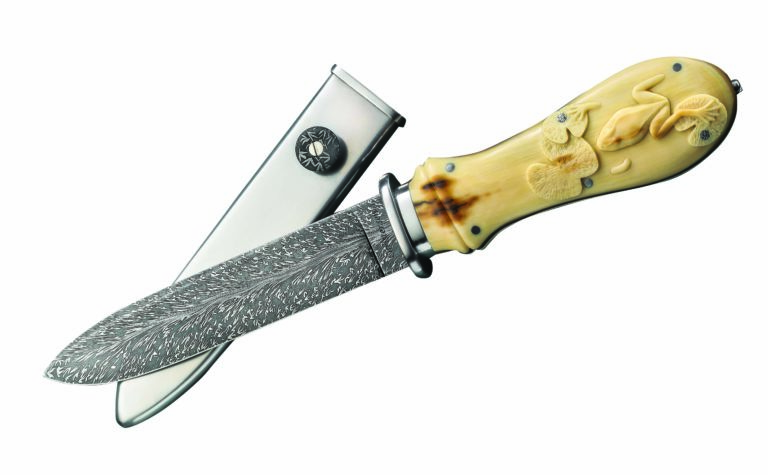
Jon Christensen’s San Francisco-style folder includes a blade of feathered leaf damascus steel and a handle of carved mammoth ivory with inlay of 4,500-year-old bog oak. Quite a period knife. (ChantryLeePhotography.com image)

One of Christensen’s most evocative pieces to date is referred to simply as the Frog Knife. However, the piece is far from simple, and Jon manages to convey the spirit of the Michael Price style while also imprinting some of his own personality.
“I built the feathered damascus for the blade with 1080 and 15N20,” he advised. “It’s a canister damascus. I forged the bamboo leaves and placed them in the can, welded it up, reduced it, and feather cut it so it would produce feather-cutting smears and leaves, and form branches to look like a little grove of bamboo leaves.”

The 10-inch knife has a 5.5-inch blade and a frame and sheath incorporating 410 stainless steel. Christensen utilized the “canvas” of the handle to the fullest, carving the mammoth ivory into a pleasing vignette of frogs and lily pads.

“The handle has something of a back story,” he smiled. “I had seen the Poppy Knife that Michael Price made and thought I would do my version. I took the knife to the BLADE Show and it didn’t find its owner. Then, the handle got ruined, and I just took the opportunity to rehandle it with the frogs and lily pads.”

Christensen got his start making stock removal knives after a career as a horticulturist. He learned to forge while working with ABS master smith Ed Caffrey and visited with knifemaker Rick Eaton and ABS master smiths Shane Taylor and Wade Colter. Jon also makes San Francisco folding knives and enjoys swordmaking. Plans for the future include more period knife examples.

Kimbll Style

ABS master smith Josh Smith owes his little league baseball coach, ABS master smith Rick Dunkerley, credit with getting him started making knives about 30 years ago. From the beginning, Josh has appreciated the thought process and craftsmanship of custom makers from a bygone era.

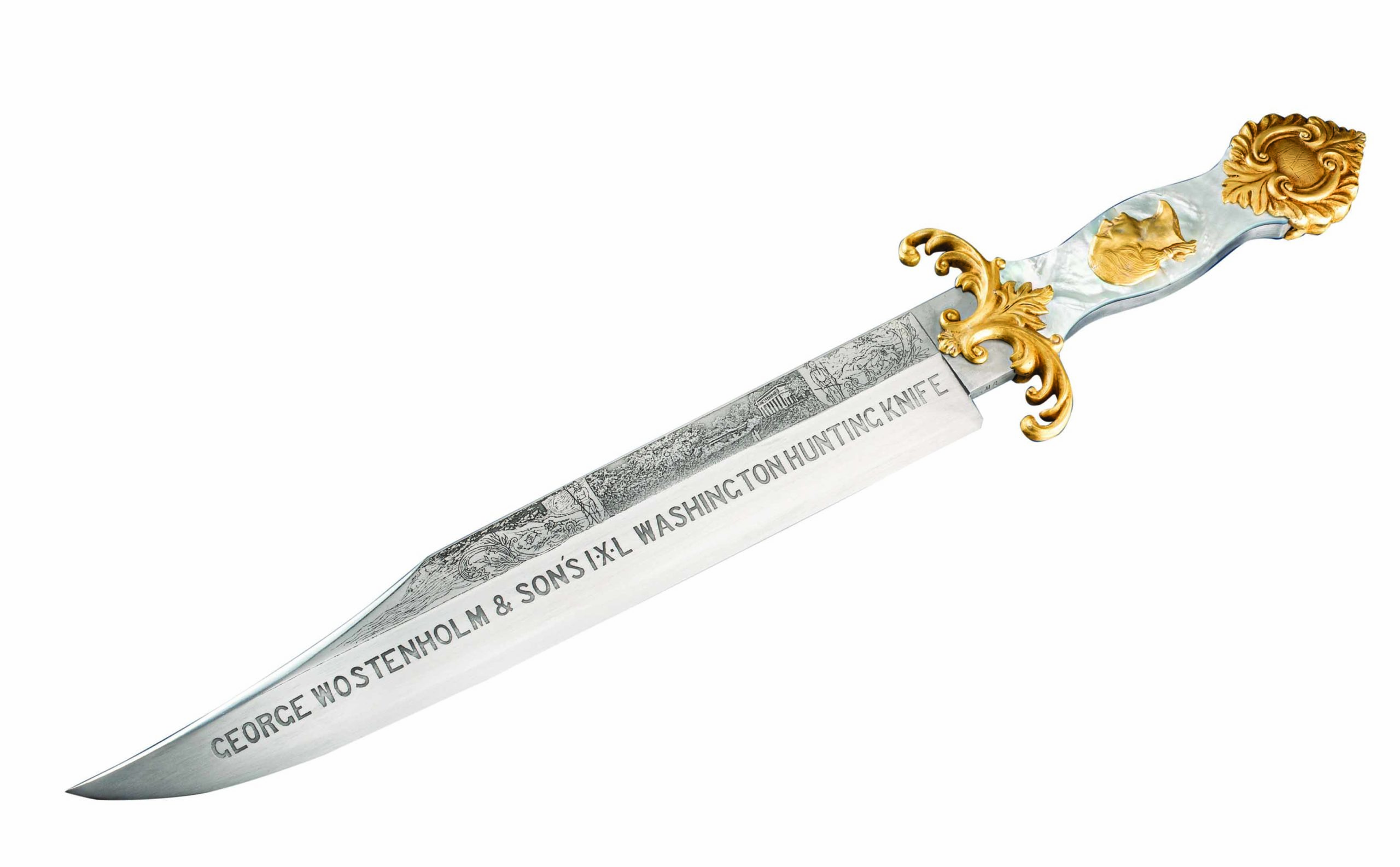
A period knife reproduction of the I*XL George Washington Hunting Knife by Doug Noren gets the full treatment in a 13.5-inch blade of 5160 carbon steel, a mother-of-pearl handle and 18k plated nickel silver. Overall length: 21.5 inches. (Whetstone Studio image)

“There’s something special about reproducing something that was built nearly 200 years ago,” he reasoned. “It’s easy to get lost in your thoughts while working on these knives, wondering what the makers were thinking about at the time. Was the knife going into battle? Was a rich man just wanting something unique? Was the maker just trying to be different and impress people? Were function and effectiveness of use the only factors that mattered? It’s really cool to think about.”

Josh has found the opportunity to consider historical context with a dagger in the distinctive dog-bone handle, recalling the mid-1800s when a gentleman named Loring Kimball of Vicksburg, Mississippi, owned several similar original pieces that were probably made by at least two different knifemakers in the New Orleans area. Knives in what many refer to as the Kimball style have been reproduced by a number of modern makers, mostly bladesmiths.

“The distinctive characteristic of the dog bone is clearly the shape of the handle,” Smith said, “but to me it’s more than that. The large domed pins and the flat facets on the handle provide such a neat look. One of the original Kimball daggers from the 1830s had silver wrapped around the butt of the handle and a small, thin silver guard. I never pretend to exactly reproduce these knives. I always put my own spin on the knife, trying to bring some of my style into it.”

Smith’s dog-bone dagger is fashioned from his own ladder pattern “W’s” damascus blade, African blackwood handle and 18k-gold pins and liners. The 9.5-inch blade is forged from 1080 carbon and 15N20 nickel-alloy steels, while a gold collar stretches over the back of the blade and bears the engraved name of the maker. Overall length: 14.25 inches.

“This particular knife was heavily influenced by Tim Hancock,” Josh said. “I feel Tim, Harvey Dean and James Batson are the three men who led the way in bringing these knives back to prominence, and Tim had the most influence on my construction of these knives. I love period knives and definitely plan on doing more. There are so many incredible weapons from the past that would be fun to recreate.”

*While a number of top industry authorities attribute such original 19th-century pieces as the Carrigan Knife, Bowie No. 1 and others to Black, no knives with Black’s mark are known to exist.

The Best Knife Handle-to-Blade Ratio

0

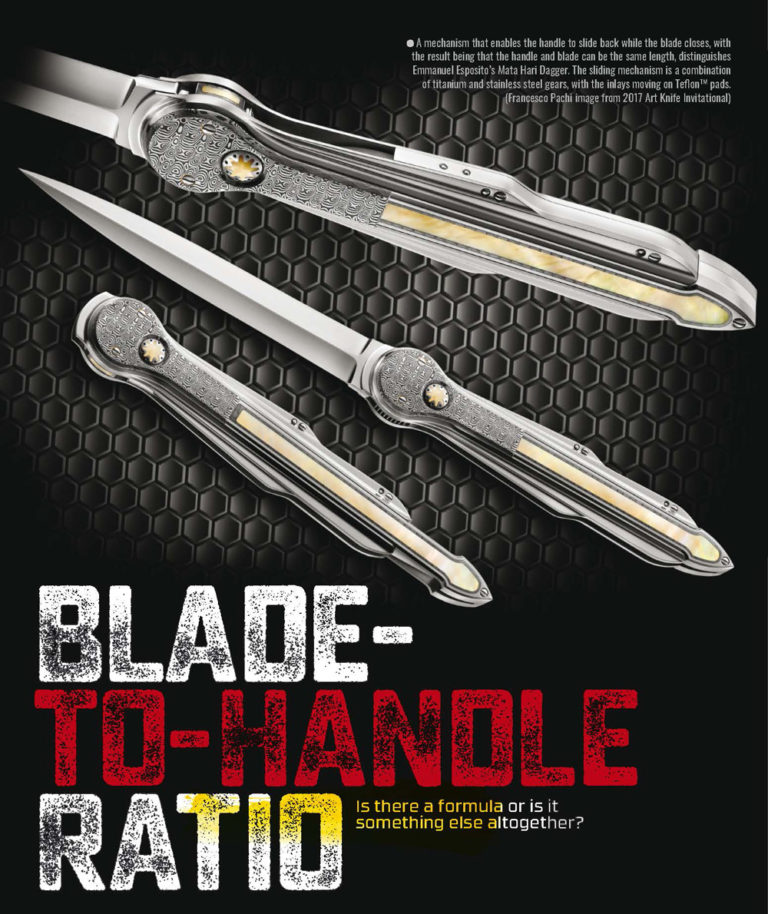
It’s the critical cooperation of handle and blade that makes the knife perform. One supplies the cutting edge, while the other allows you to exert control. So, then, the age-old question follows in finding the right ratio of length for each in a knife of proper construction.

In many cases, the experienced knifemaker follows his gut feeling to achieve the best knife handle-to-blade ratio, his understanding of just what it takes. Instinctively, the design brings balance and function to the piece.

Certainly, the process would be simpler if a formula existed to guide the maker in the optimal handle-to-blade ratio. However, according to those consulted for this story, there is no such formula.

The best knife handle-to-blade ratio, they reason, is driven by intended use.

Use, Not Size

Best knife handle size
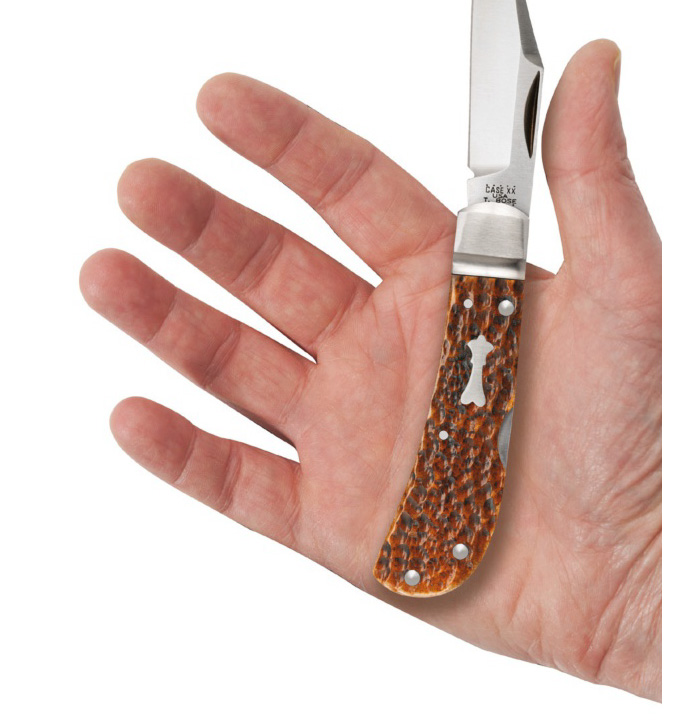
It’s hard to establish the best knife handle size because no two hands are the same.

“I base the ratio on use, not size,” explained knifemaker and BLADE® field editor Abe Elias. “For instance, when you look at the knife you carry every day, you’re not usually out there skinning animals or felling trees. You’re cutting open boxes and packages, snipping string or tape, and—if you trust the cleanliness of the blade—cutting a piece from a block of cheese or peeling an apple. In the end, everything is based on what you do with the knife.

“So when you look at all that, everyday use versus bushcraft or camp use, then you might say to yourself that you don’t need a lot of handle for torque or control if you’re cutting a piece of tape or your Amazon box open. If the blade is small, you don’t necessarily have to put a small handle on it; but, if the job doesn’t require a good, full grip, I’ll shorten the handle to make it easier to carry in an urban environment to do non-strenuous jobs.

“Bushcraft requires that you do strenuous stuff related to torque, and with carving or craft ing or skinning an animal,” Abe concluded. “Therefore, the handle must be full size to provide the ability to control the blade and put enough force behind it. Small jobs need control but not always a lot of force.”

Best knife handles
Instead of the knife’s size, knifemaker/BLADE® field editor Abe Elias bases handle-to-blade ratio on its use.

What Pleases the Eye

Don Hanson, making knives for three decades with the Sunfish Forge mark, has no exact, best knife handle-to-blade ratio formula, and he readily asserts that any standard such as a “handle length an inch longer than the blade” falls apart pretty quickly.

Ratio best knife handles
Don Hanson said he does not have a formula for the blade-to-handle ratio. “I just do what looks good to my eye,” he noted. “With folders I make the blade as large as possible to still be able to fit inside the
handle when closed.” (SharpByCoop image)

“I don’t have a formula for the ratio,” he commented. “I just do what looks good to my eye. With folders I make the blade as large as possible to still be able to fit inside the handle when closed. I don’t think making the handle an inch longer than the blade on a fixed blade is accurate. That would not work for bowies or fighters, where blades are typically seven to 12 inches. On these the handles are usually 5 inches.

Now, it could be true for a hunting knife if it has a 3.5-inch blade. A 4.5-inch handle would be perfect for that hunter.”

The Golden Mean

Hanson allows that the mathematical “Golden Mean” ratio may be helpful, though he does not specifically use it in his work. Without launching into a prolonged Algebra lesson, two quantities are in the Golden Mean if their ratio is the same as the ratio of their sum to the larger of the two quantities. Dust off that old high school math book for the actual formula and a clearer definition.

“Handle-to-blade ratio is function first,” Hanson added, “but in this time of images on the internet and magazines, the visual aspect is very important. Sometimes we see a knife that looks pretty good but just doesn’t seem right—and it’s not apparent why. In most cases the handle-to-blade ratio is off.

“The Golden Mean ratio is a good way to get handle-to-blade ratio right. I don’t use it, but most knives that look right will fall within the parameters of that ratio. Still, there is no rule or ratio in folding knives. The handle is always longer than the blade.

“A folder just looks bad when the blade is too small. I just design knives that function well and look good. I rarely measure anything or use any rules. The knife has to look good to get someone to pick it up. Then, if it feels good in the hand you have a winner.”

Best knife handle to blade ratio for knives
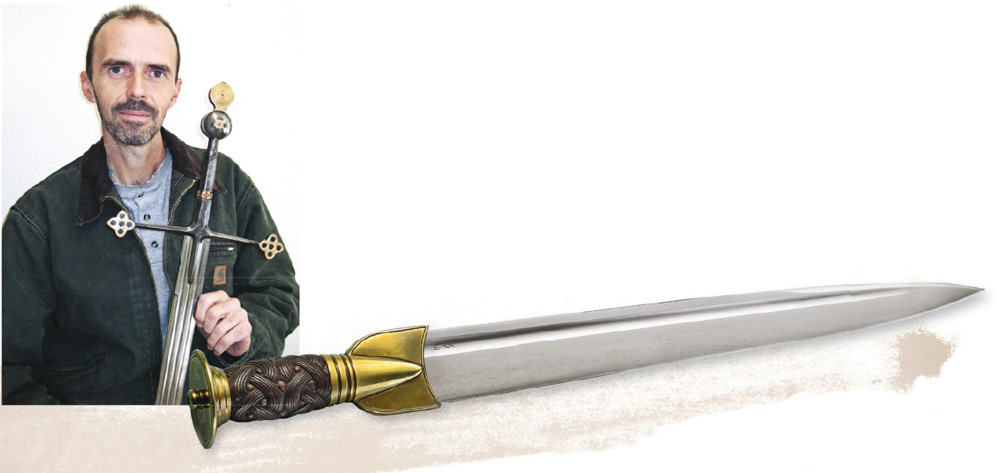
The old adage that the handle should be about 1 inch longer than the blade doesn’t work with large knives. “In period pieces such as an 18th century Scottish dirk, the grip was typically in the 4-to-5-inch range despite a blade length that could be up to 16 inches,” Vince Evans (inset) noted. His Scottish dirk repro was the cover for the March 2020 BLADE®.

Function, Comfort, Looks

According to Vince Evans, a full-time maker since 1981, some handles do require a certain length or shape depending on function, and some hunters prefer a small grip that is completely in the hand to avoid getting in the way when field dressing an animal.

“Personal preference probably plays a big part in that idea,” Vince said. “In period pieces such as an 18th century Scottish dirk, the grip was typically in the 4-to-5-inch range despite a blade length that could be up to 16 inches. Knives of the past tended to have more similar grips than modern ones.

“People carried a knife all the time for various purposes, so I would think that the ratio worked out naturally over time, and I would imagine that overall weight had a lot to do with the size.”

“Aesthetically, if you have a blade that is too big for the handle, it can become wonky,” Joe Flowers, a knife designer for Condor Tool & Knife, reasoned. “If you don’t balance the blade with the handle on a fixed blade, it can become messy. The human eye picks up on imbalance, so, if you have a short blade and a long handle, you’d better have a good reason.

“For fixed-blade bushcraft knives the most popular example is a 4-inch blade with a 4.5-inch handle, with a point down the center line. As a designer, especially recently, I’ve tried to jump out of the ‘rule’ rut that I’ve made more or less for myself.”

Best knife handle sizes
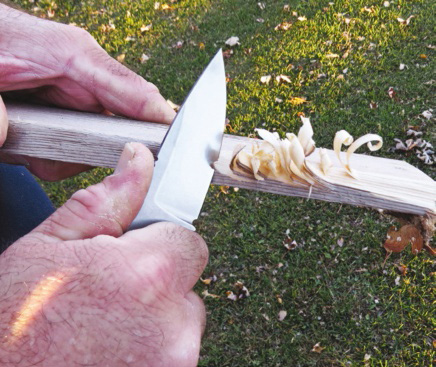
The White River Knife & Tool M1 Backpacker makes nice, tight curls. “Bushcraft requires that you do strenuous stuff related to torque and with carving or crafting or skinning an animal,” Abe Elias observed. “Therefore, the handle must be full size to provide the ability to control the blade and put enough force behind it. Small jobs need control but not always a lot of force.” (Abe Elias image)

Ergonomics are an integral component of the best knife blade-to-handle ratio, and the user surely appreciates that balance in the field.

“I’ve done a lot of research on human hands/tool use ergonomics,” Flowers offered. “More ergonomic knives have less geometry in their handle design for long-term use. Sometimes these handles don’t look very special, but after the third hour of whittling a kuksa [a Scandinavian drinking cup carved from birch burl] or an axe handle, you will appreciate them.”

Flowers adds that torque and dexterity dictate handle length in relation to a knife blade. In other words, if more force must be applied, then more surface area in the right points of contact with the hand allow the user to apply that torque.

“If it’s something like a neck knife,” he interjected, “you probably aren’t going to be applying that much torque, and are using it more for miniscule tasks such as cutting line rather than chopping down a tree. The handle length can sometimes dictate what the blade is capable of doing. An axe with a 3-inch handle would work differently than one with a 23-inch handle.”

The perfect combination of handle and blade is ultimately put to the test with intended use. In the absence of a formula, the true judgment may be found in the fatigue or the number of blisters on the palm when the job is completed.

Overthinking Handles?

Years ago, a well-known knifemaker offered Elias some advice.

“He said two things,” Abe smiled. “‘You’re spending too much time on your handles. You’ll never get your money back for it. And your handles are too long. They should be the bare minimum.’ Now, my whole thing is that the knife is only as good as your ability to control it.

“I will ask a customer what size their hand is. I’ll ask them to go to a store and find a pair of metric-sized gloves that fit and give me the number. That way I know the dimensions of their hand and can work from that accordingly.

“Still, it would be good to say that there is some kind of ratio that always applies, but like I’ve said, I don’t have a mathematical formula—I have a use formula.”

The best knife handle-to-blade ratio is, after all, the product of evolution, experience and the trained eye. Placing these elements in perspective produces the balance and control necessary for the knife to function as it should, while also making a pleasing presentation from a visual standpoint.

Chute Knife: Full-Spectrum Warrior

A fine example of a tool and weapon of war, the chute knife more than rose to fulfill the roles for which it was intended.

Harry Archer was a somewhat shadowy figure. At the height of the Vietnam War, he was engaged in nasty business—fighting a stealthy enemy in a steaming jungle, sometimes up close and all too personal.

Those who knew Archer acknowledged that some of his exploits were “larger than life.” They considered him an early non-movie version of author David Morrell’s fictional character of John Rambo*. Still, Archer was real, flesh and blood. And it seems altogether fitting that responding to his need for knives that “deliver” in a tight spot—survival, seconds along the fine line between life and death—he would come to know and rely on another legend.

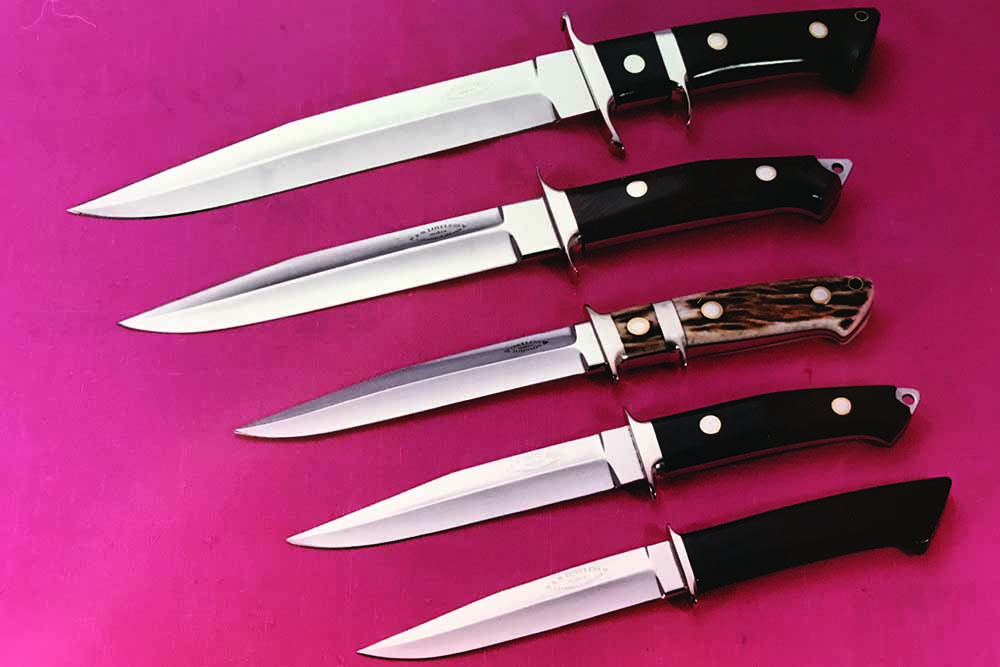
According to John Denton, perhaps the world’s foremost authority on the knives of BLADE Magazine Cutlery Hall-Of-Fame® member Bob Loveless, Loveless and the man he came to describe as the “head of CIA operations in Vietnam” were introduced to one another by knife writer/Cutlery Hall-Of-Famer Ken Warner. It followed that Loveless made several knives for Archer’s use in the field, among them a fine sub-hilt and stag-handle example of his well-known Big Bear, along with several other  Big Bears. Loveless’s close friend and fellow maker Steve Johnson was working in Bob’s shop at the time and participated in crafting these. A fighter in a tulip wood handle is another cold beauty.

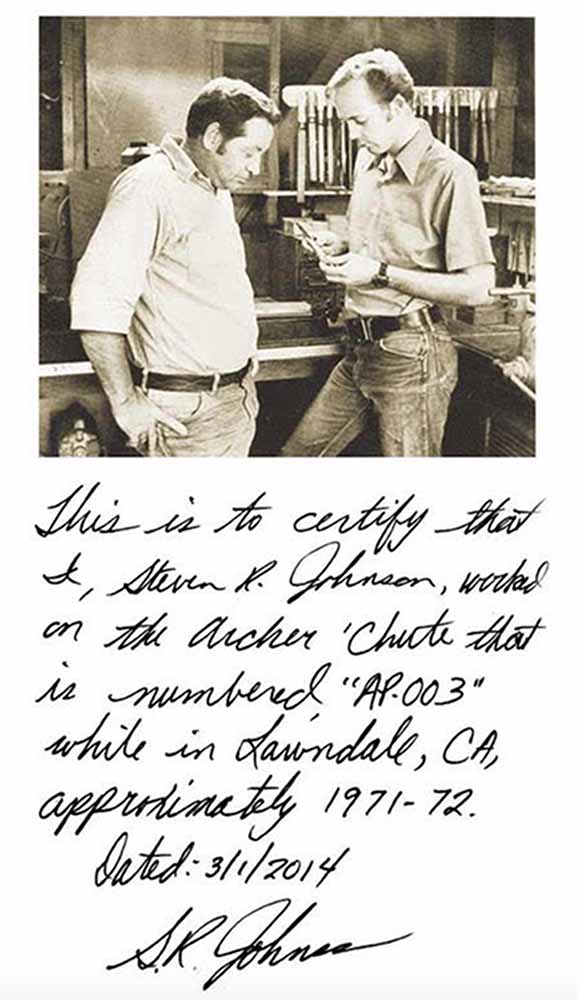
Johnson worked with Loveless from June 1971-October 1974 in the Lawndale and Riverside, California, shops. Steve had a hand in the production of the prototype chute knife in the earliest days, and 23 years later signed a photograph for John Denton attesting to his work on that piece of history. Steve’s inscription reads in part: “This is to certify that I, Steven R. Johnson, worked on the Archer ’chute that is numbered ‘AP-003’ while in Lawndale, CA, approximately 1971-72.”
Johnson worked with Loveless from June 1971-October 1974 in the Lawndale and Riverside, California, shops. Steve had a hand in the production of the prototype chute knife in the earliest days, and 23 years later signed a photograph for John Denton attesting to his work on that piece of history. Steve’s inscription reads in part: “This is to certify that I, Steven R. Johnson, worked on the Archer ’chute that is numbered ‘AP-003’ while in Lawndale, CA, approximately 1971-72.” (images courtesy of John Denton)

Then there is the well-known Harry Archer chute knife, a versatile fixed blade with good looks and the ability to travel light but cut paracord for a quick exit from a tangled parachute shroud, and with a stout spine for prying loose from the wreckage of a helicopter. The chute knife was made for the jungle. It was made for Harry Archer.

“It seems that Loveless had been left out of a book by Warner, and Loveless sent Ken some knives to review,” Denton recalled. “It just so happened that Archer was there with Warner. Harry saw the knives and bought them all.”

Johnson worked with Loveless from June 1971 to October 1974 in both the Lawndale and Riverside, California, shops. He had a hand in the production of the prototype chute knife in the earliest days and 23 years later signed a photograph for Denton attesting to his work on that piece of history. Steve’s inscription reads in part: “This is to certify that I, Steven R. Johnson, worked on the Archer ’chute that is numbered ‘AP-003’ while in Lawndale, CA, approximately 1971-72.”

Johnson explains that the chute knife is a fairly small, compact fighter and survival knife, short, light, double-edged and strong, but not made in stock thicker than 3/16 inch. Holes for thongs are placed in the rear of the handle and the guard for lashing the knife to a pole or limb to make an improvised spear. It rides into action atop a chest pack or secondary parachute for quick, easy access. Claims that Warner had a hand in the design are unconfirmed, but “the chute” simply looks the part of the warrior’s dependable asset.

“You’re able to cut both ways with the knife via the swipe of an arm or hand,” Johnson related. “Specifically, it’s for cutting parachute cord should it be tangled or caught in a tree. It’s a knife that a pilot, paratrooper or soldier should carry, and it would not be a burden but useful and available in every situation.”

HARRY ARCHER LORE
Stories of Archer’s combat prowess have been told and retold, but to raise awareness of the immediacy of a close-in fight, nothing is better than the harrowing tale that Denton remembers Loveless repeating. John points to a photo of a vintage Big Bear, identifies it as a knife that Archer took into combat, and says, “Harry and his men got into a hand-to-hand fight, and the tip of the blade was broken off inside the enemy. Harry took the knife back to Bob to fix, and Loveless said, ‘Where’s the tip?’ Harry replied, ‘It’s still in the rib cage of the Viet Cong soldier.’ So, Loveless fixed the blade.’”

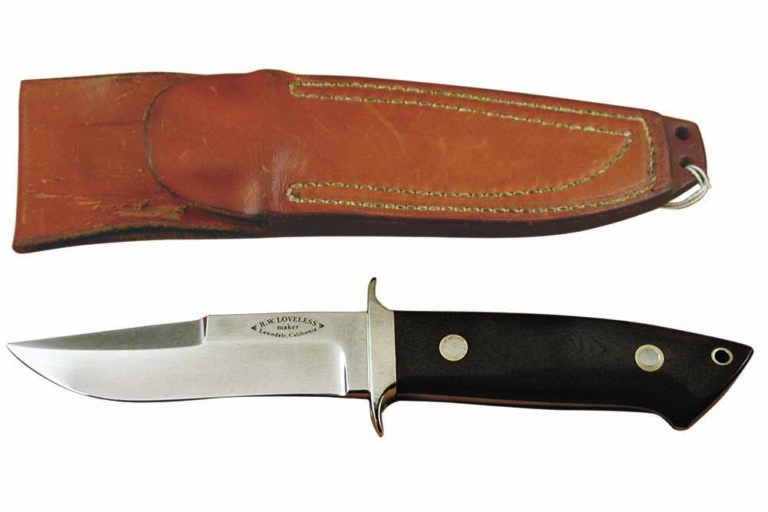
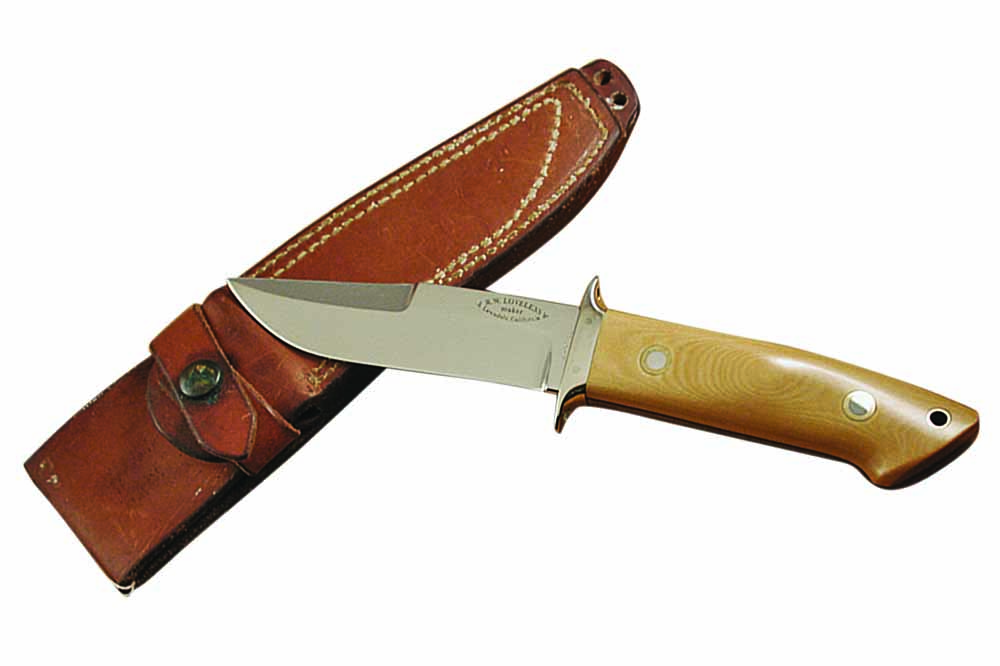
Made in Bob Loveless’s Lawndale, California, shop about 1973-74, this chute knife in ivory Micarta® is stamped BR-003. It was made for the Brass Rail, a famous gun shop in Hollywood, California, where all the celebrity types hung out to see guns and knives. Note the holes in the guard for lashing the knife to a pole to make a spear.
Made in Bob Loveless’s Lawndale, California, shop about 1973-74, this chute knife in ivory Micarta® is stamped BR-003. It was made for the Brass Rail, a famous gun shop in Hollywood, California, where all the celebrity types hung out to see guns and knives. Note the holes in the guard for lashing the knife to a pole to make a spear. (images courtesy of John Denton)

Like the Big Bear and other Loveless creations, the chute knife has its place in the lore of Harry Archer. After he collaborated to produce the prototype, Johnson continued to work with Loveless on more of the chute knives. He remembers meeting Archer in the California shops.

“Loveless really admired Archer and his adventures in the Vietnam War era, working with USAID**, the CIA and different assignments in various parts of the world,” Steve commented. “[Harry and I] discussed life in camp in Vietnam, interactions with Vietnamese soldiers and personnel with whom he was serving. That was quite interesting.”

Steve calls the chute “one great knife” and remembers conversations in Lawndale when the veteran operative praised it as light and small enough to carry so that it could always come along on a mission. Johnson also made a chute knife for Archer and continues to produce his own model today.

“We worked together on Archer’s order for a ‘Johnson’ version of a chute knife on a bench in the rear of Bob Loveless’s shop, in his garage in the back of his house in Lawndale,” Steve smiled. “Archer asked me to make my version, which we—mostly he—designed in the early 1970s. He did a drawing for me. The 154CM blade was about 4.5 inches long, the handle slim and a bit longer than normal, and it had a large thong tube, three handle screws, a stag handle, and checkering on the top and bottom of the tang just behind the guard.”

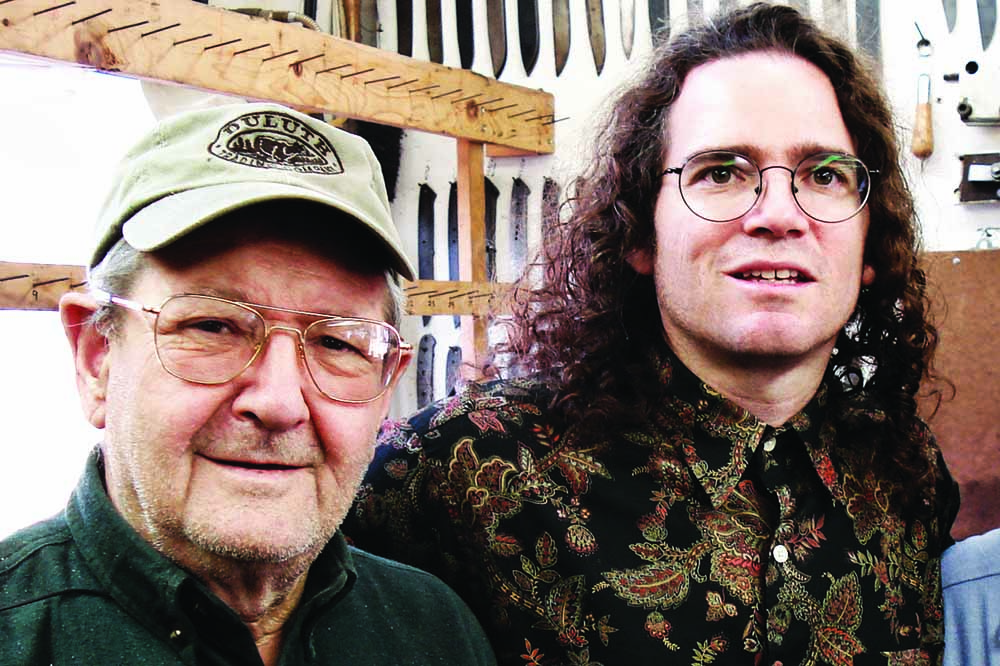
Bob Loveless (left) and John Denton (right)

For Johnson, working with Archer was a pleasure and a defining moment in his illustrious knifemaking career, which, after recovery from a serious accident, took him from Loveless’s shop to his own space in Manti, Utah, more than 40 years ago. “Harry Archer was a great guy who appreciated my work, as well as Bob’s,” Steve added, “and I made him a few knives after California. He was very easy to talk to, respected others, and he really was a man of intrigue and adventure. And Bob Loveless treated me like a son.

“I’m making a chute knife for Atlanta [Steve was interviewed prior to BLADE Show 2021] as we speak, with the blade polished so far, instead of the top grind being just the length of the clip,” Johnson concluded. “I use the pattern that Loveless gave me when I left his shop in Riverside in 1974 or 1975. This particular knife is going to have a stag handle and stainless steel fittings. I’ll make more when asked, and I still have a few on order in my books.”

Long-time maker and designer Bob Dozier was a friend of Loveless and went on to design a chute knife for Cutlery Hall-Of-Famer A.G. Russell. Though his only acquaintance with Harry Archer is through the recollections of A.G., who knew him, Bob says his version of the chute knife remains in demand for one simple reason: “It sells.”

Dozier turns out his chute knife with a 4.75-inch D2 tool steel blade and overall length of 9.75 inches. The handle is green canvas Micarta® “because Goldie [Russell] won’t let me put anything else on them. I’ve got some blades hanging right now, getting ready.”

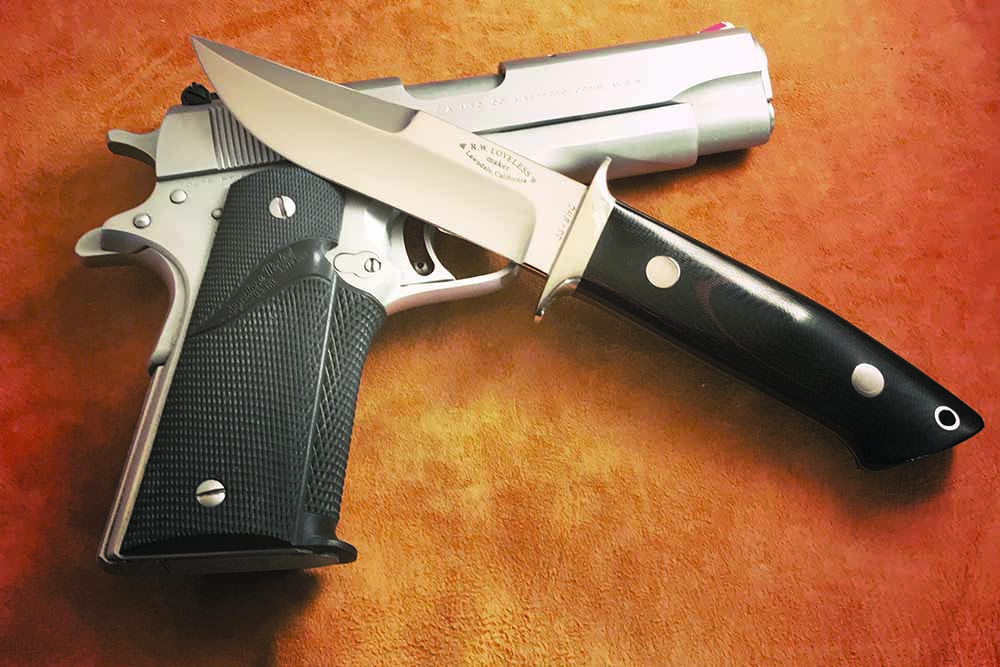
The “RR” on the guard of this Loveless chute indicates it was for the Ram Rod gun store in New Castle, Indiana. Early on Ram Rod sold knives by Loveless, Bill Moran, Ron Lake, W.W. Cronk and others. It appears here with a Smith & Wesson Model 41 modified by Loveless.

Dozier is familiar with the Loveless chute knife configuration but never had the Loveless pattern. He looked at the earlier chute knife profile and made some tweaks. “My handles are like the Loveless, but I don’t cut the butt off as square as he did. I leave more of a point on it than he did. Mine is still mostly like Bob’s, and he was one of the first to make a really good slab-handled knife. That’s one reason why most of us have copied him.” Dozier’s chute knife, designed and built for A.G. Russell Knives, has a manufacturer’s suggested retail price of $895.

SAGA of The CHUTE
The saga of the chute knife certainly has a human side. While Denton estimates that early Lawndale chute knives might fetch as much as $14,000 if found for sale today, and chute knives made in Riverside command up to $12,000 each, they are desirable on the collector market. Nonetheless, the greatest value of the chute knife lies in its lifesaving and protective capability in the hands of a dedicated professional such as Harry Archer.

Through those years of association, Loveless and Archer became friends, sharing a common bond of respect and admiration for the best in fighting and utilitarian knives.

“Loveless said that Harry would come by his shop after periods of being in the jungle for months at a time,” Denton remembered. “He used Bob’s place to unwind and try to become civilized again before heading home to Virginia. But Loveless also said, ‘Harry was like a wild animal when he came to the shop, trying to keep his head straight before he saw his family.’”

Whenever Harry Archer ordered several Big Bear fighters from Bob Loveless, Loveless said Archer told him to “send the bill to the Pentagon.” From top: the Big Bear Harry broke the tip off inside a Viet Cong soldier during the Vietnam War; tulipwood fighter with skull cracker; Loveless/Johnson sub-hilt with the initials HJA for Harry J. Archer; boot knife with skull cracker; and one Loveless called the Pig Sticker.
Whenever Harry Archer ordered several Big Bear fighters from Bob Loveless, Loveless said Archer told him to “send the bill to the Pentagon.” From top: the Big Bear Harry broke the tip off inside a Viet Cong soldier during the Vietnam War; tulipwood fighter with skull cracker; Loveless/Johnson sub-hilt with the initials HJA for Harry J. Archer; boot knife with skull cracker; and one Loveless called the Pig Sticker. (image courtesy of John Denton)

The chute knife is indeed a fine example of a tool and weapon of war rising to fulfill the roles for which it was intended. It remains a popular pattern because of its looks, quality and versatility. And for one other reason in particular: It helped men like Harry Archer survive the most desperate of situations and make it home.

*In actuality, Morrell based the Rambo character on Medal-Of-Honor recipient Audie Murphy.

**USAID is the acronym for United States Agency for International Development, with the inference here being that in this instance it functioned as a cover for the CIA.


More On Bob Loveless Knives:

  • 15 Best Bob Loveless Knives of All-Time
  • The Legacy of the Bob Loveless Dropped Hunter
  • Merritt-Loveless Knives Do Indeed Hold Merit
  • Fourth In Greatest Loveless Knife Designs Series
  • 9-11 Knives: Custom Memorials To The Tragic Day

    The atrocity that shocked the world continues to transform it, and knives, too. Here is a look at some of the memorials 9-11 spawned from that fateful day.

    It began as an ordinary Tuesday. It ended with the world changed forever.

    The atrocity of the terrorist attacks at 8:45 a.m. EDT on Sept. 11, 2001, will never be forgotten. Now, 20 years after planes crashed into the World Trade Center in New York, the Pentagon in Washington, D.C., and a field in Shanksville, Pennsylvania, retrospect brings not only memories of sadness and profound loss, but also an acknowledgment of the heroism of 9-11 and the humanity that emerged.

    A measure of that humanity took the form of custom knives made from the twisted and scarred steel of the World Trade Center (WTC) buildings—forged once in the conflagration of that terrible day and then again in tribute to lives lost, and for the benefit of those who miss them and live on.

     Keith Kaiser (right) was in Ladder Company 131 of the New York City Fire Department that reported to the World Trade Center on 9/11. In 2003 he enlisted several leading makers to produce knives with blades made from WTC steel. Those makers, with the exception of Mel Pardue, from left are: Bob Terzuola, Bob Dozier, Allen Elishewitz, Gil Hibben, and Pat and Wes Crawford.
    Keith Kaiser (right) was in Ladder Company 131 of the New York City Fire Department that reported to the World Trade Center on 9/11. In 2003 he enlisted several leading makers to produce knives with blades made from WTC steel. Those makers, with the exception of Mel Pardue, from left are: Bob Terzuola, Bob Dozier, Allen Elishewitz, Gil Hibben, and Pat and Wes Crawford. (Eric Eggly/PointSeven image)

    Ladder Company 131 (L131) and Engine Company 279 (E279) of the New York City Fire Department (FDNY) were housed in the Red Hook section of Brooklyn on 9-11. Keith Kaiser was a member of L131. Moved later to enlist the support of several custom makers to produce knives with blades made from WTC steel, Keith remembers the horrific day vividly.

    “Because of the proximity to lower Manhattan, both companies started to gear up,” he recalled. “As we were approaching the tunnel into lower Manhattan, we saw the second plane hit the south tower. The engine company went into the buildings first, and the ladder company soon followed. L131 was in the lobby of the hotel on the ground floor of the south tower when it fell. We breached a wall and got out a group of civilians before we realized what was going on. The engine company was never found.”

    Five members of E279 were killed, and the FDNY lost 343 firefighters in all. Since then, according to Kaiser, nearly as many have died from 9-11-related cancer and other illnesses. His older brother, Wayne Kaiser, an electrician who worked to restore communications in the wake of the terrorist attack, recently died of illness due to extended exposure to toxic dust and debris.

    Keith was seriously injured on 9-11. “Oddly enough, my getting injured probably saved my life because I was not able to dig in the pile subsequently,” he said. “I was looking for something to occupy my mind and time, and one of the men lost from my company, Christian Regenhard, was a knife collector. I thought I would try to get my hands on some steel and get knives made out of it for charity and to keep me involved.”

    Early efforts to get the project started were difficult, but Kaiser persisted. Eventually, he contacted several of the biggest names in custom knives and secured their commitment to contribute to a benefit for the New York Firefighters Burn Center Foundation. Bob Terzuola, Bob Dozier, Jerry Fisk, Pat and Wes Crawford, Allen Elishewitz, and BLADE Magazine Cutlery Hall-Of-Fame® members Gil Hibben and Mel Pardue made one knife each with blades incorporating steel from the fallen twin towers (page 90, August 2003 BLADE®).

     Murray Carter holds the last two knives he made of WTC steel as part of a special fundraising project that included FDNY343 (fdny343.org) and Building Homes For Heroes
    Murray Carter holds the last two knives he made of WTC steel as part of a special fundraising project that included FDNY343 (fdny343.org) and Building Homes For Heroes (buildinghomesforheroes.org). (Murray Carter image)

    “It was planned with the help of Christian’s father, who was a New York City police detective,” Terzuola said. “Seven knifemakers, including myself, volunteered their time and materials. Keith presented the idea to us and offered to supply a piece of steel from the wreckage of the fallen towers to each knifemaker, from which they could make a knife of their choosing.”

    The knives included signature works: a Dozier damascus folder; an Elishewitz folder; a CQB from Terzuola; a Hibben dagger with scrimshaw handle; a skeletonized folder from the Crawfords; a damascus folder from Pardue; and a damascus stag Sendero hunter from Fisk.

    The task brought the added challenge of making the Trade Center steel usable for knife blades. “It was low carbon structural steel,” Dozier related, “and I asked Daryl Meier to make damascus for me. At the first show after 9-11, Keith brought some steel to me and wanted me to make a knife with it. I wouldn’t take it. A friend of mine who was a state police investigator here in Arkansas said to leave it alone because it was evidence. Then about a month later, a big cardboard box came in the mail and there was the steel. I cut it into pieces and Daryl made some ladder-pattern damascus.”

    Once the knives were gathered, they became tangible remembrances. “They were placed in a beautiful cocobolo box with a beveled glass top that was etched with the World Trade Center,” Terzuola commented. “The idea then was to put them up for auction for the benefit of the burn center. Keith sent them around to various museums prior to the auction, and after several years they almost became permanent exhibits in some places.”

    Keith reached out again to Terzuola, who helped arrange an auction, and the set sold in June 2020 with the proceeds benefiting the hospital. “Keith sent me the knives, and I cleaned them up and got hold of Rock Island Auction in Illinois, one of the top auction houses for knives and firearms,” Bob states. “They did a beautiful two-page spread in their catalog and after the auction sent a check directly to the burn center.”

    Murry Carter Knives 9-11 Custom

    Like so many others, the atrocity of 9-11 touched custom knifemaker Murray Carter significantly. He was asked to partner with FDNY343, an organization of retired New York firefighters dedicated to keeping the memory of those lost on 9-11 alive, and Building Homes for Heroes, a charitable enterprise that provides homes for those injured while serving their country and in the 9-11 attacks.

    Ryan Johnson was just starting up his RMJ Tactical when 9-11 shook the world. The U.S. military was looking for something that would punch through body armor and the RMJ Eagle Talon hawk, featured on the cover of the March 2002 BLADE®, filled the bill. RMJ Tactical took off and is one of today’s leading hawk makers with such models as the Shrike.
    Ryan Johnson was just starting up his RMJ Tactical when 9-11 shook the world. The U.S. military was looking for something that would punch through body armor and the RMJ Eagle Talon hawk, featured on the cover of the March 2002 BLADE®, filled the bill. RMJ Tactical took off and is one of today’s leading hawk makers with such models as the Shrike.

    Carter has produced several kitchen and outdoor knives, each incorporating a laminate of Trade Center steel with a 1084 carbon steel core. The motivation to produce the knives was strong, and Murray notes that the components of fire, water and stone were present both in the 9-11 incidents and the making of the knives. He reasons that fire enabled the forge, water quenched the blades and stone honed them into tools. Conversely, fire brought the towers down, water hampered rescue efforts, and lives were lost in the crush of stone.

    “So, the same elements are here in the knives, and they bless people daily,” Murray explained. “When iron is red hot, that’s how we get steel, and some of the victims were burned, the elements fused in a chemical trade. The depth of the fusion was dependent on time and it was brief. So, I didn’t want to do much grinding in order to leave these elements in the surface of the steel.”

    One of Carter’s kitchen knives was auctioned for $10,500 and the proceeds were given directly to Homes for Heroes. He calls the effort, concluded in the spring and autumn of 2017, an honor and one of the most humbling tasks of his long knifemaking career.

    RMJ Tactical 9-11 Spike Hawk

    Ryan Johnson was just starting up his Chattanooga, Tennessee-based RMJ Tactical when 9-11 shook the world. He had always been interested in tomahawks, and was making pipe and spike hawks before that desperate day. Then, things changed quickly.

    “I had made a spike hawk and a gentleman saw one of them on my website,” Ryan remembered. “He was with Air Force security forces and said, ‘We’ve got some guys securing air strips, and we’re looking for something that will punch through body armor.’ He said my French-and-Indian-War-style hawk looked perfect for the job.”

    The seven knives from Keith Kaiser’s 9/11 memorial project were placed in a beautiful cocobolo box with a beveled glass top etched with the World Trade Center.
    The seven knives from Keith Kaiser’s 9/11 memorial project were placed in a beautiful cocobolo box with a beveled glass top etched with the World Trade Center. (Eric Eggly/PointSeven images)

    The first shipment of five spike hawks had just gone out before 9-11. “The same guy called me up and he was already in the Gulf,” Ryan said. “He said to get busy making these things because they would be big.”

    Like lightning, the demand for hawks soared—not only with the catalyst of 9-11, but also with the wars in Iraq and Afghanistan that followed. “I received a call from a gentleman working as an attaché to Donald Rumsfeld [Secretary of Defense] and made him a hawk. He sent me a picture back of him in his office at the Pentagon with a letter that said when the planes hit the towers, all the brass in the Pentagon were out in the hallway in front of his office passing that hawk around. A few moments later, a plane hit the Pentagon. Just before that happened, an admiral had walked by and said, ‘This war will be fought by hawks at the ends of the hands of soldiers.’”

    A short time later, a story on Ryan’s hawks appeared in the Chattanooga newspaper and was picked up by the Associated Press, ultimately appearing in countless media outlets. “The article was on making hawks for the military,” Johnson recalled, “and before long Green Beret units were getting in touch with me and asking why they weren’t getting hawks. When you look back at the early days of the wars, Task Force Dagger included the first 300 special forces and others into Afghanistan. We had hawks going in with them.”

    Orders kept coming, and civilian deliveries were postponed to fill the demand from the military as RMJ Tactical got started. Twenty-five Eagle Talon hawks went to Marines in the town of Najaf, Iraq, just before the battle for control of the city of Fallujah.

    “I got a phone call concerning those 25 hawks,” commented Ryan, “and it was from the wife of a Marine officer. She said there was a plane leaving that night with room aboard for the shipment if we could get it ready. I called my friend Richard Carmack and knew his kids might have the time to help wrap the handles if I could provide the pizza and a movie. Now, Richard makes sure things run right here, his son Jonathan is our production manager and I’m still working in design.”

    Conclusion

    The atrocity of 9-11 and the lengthy conflicts that emanated from it continue to echo through the lives of every American. Remembrance is tinged with vigilance and the pledge to never forget the sacrifices of those lost.

     Here are the beginning (bottom level), middle (mid-level bar of steel) and end products (top level) Murray Carter used to forge weld World Trade Center iron into a usable blade with a 1084 core. The blade is water-quenched for maximum sharpness and edge retention, and the blade surface still retains the soul-infused character of the WTC steel.
    Here are the beginning (bottom level), middle (mid-level bar of steel) and end products (top level) Murray Carter used to forge weld World Trade Center iron into a usable blade with a 1084 core. The blade is water-quenched for maximum sharpness and edge retention, and the blade surface still retains the soul-infused character of the WTC steel. (Murray Carter image)

    Though nothing is for sure at this time, there may yet be other knives produced with the venerated World Trade Center steel. Terzuola still has a small amount of the steel but probably not enough for another knife blade. He is considering a knife with Trade Center steel bolsters and G.L. Hansen Micarta® that includes a thin blue line in its composition. Proceeds from the sale of such a knife would go to benefit a law enforcement officers relief fund.

    Hunting Knife Sheath: Choosing The Right One

    1

    Expert craftsmen give insight on how to find the best hunting knife sheath for the best protection, performance and look.

    For the hunter in the field, a dependable and durable hunting knife is indispensable equipment, and it follows that the sheath that holds the knife must be equally up to the task.

    Secure carry, protection for the blade and handle, easy access, and the ability to stand up to the elements and hard use are essential. While there is a variety of sheaths available and each one contributes something to the equation, the sheathmakers themselves have come to eye-opening conclusions as to the making and deployment of the correct sheath for the hunting knife. Personal preference is still a prime mover, but the basics make the difference between cooperation and catastrophe in the field.

    “The best style for a hunting knife sheath is whatever the hunter wants,” explained veteran sheathmaker Paul Long. “Personal preference is very important. However, the knife that would best be described as a hunter would be best suited in a deep seat pouch with a loop that would carry relatively high on the belt. In most cases the deep pouch would preclude the need for a retention strap. For a double-guard hunter, a drop-loop belt sheath would probably be best with a snap strap for secure retention.”

    Depending on the style of the knife, the guard often dictates the best pouch configuration. “I favor the pouch-type sheath, and the hunting knife generally has a single guard as opposed to a double guard,” related sheathmaker Paul Lebatard, who also has found success with his custom knives through the years. “I make a lot of doubles, too. You would have to make a snap-type sheath with a keeper strap, but on hunting knives with single guards the pouch type is always best.”

     Knifemaker Paul Lebatard shows off one of his custom hunting-knife-and-sheath packages.
    Knifemaker Paul Lebatard shows off one of his custom hunting-knife-and-sheath packages.

    A sheathmaker for over 50 years, Chris Kravitt zeroes in on the personal preference perspective. “First and foremost, it’s a matter of the configuration of the knife, and then if more than one style will work it becomes a matter of personal preference,” he observed. “My preference is to go with the pouch because it is easier to draw and resheathe the knife without worrying about straps.”

    At the same time, Kravitt acknowledges varying hunting knife construction and its influence in sheath form and function. “If a knife has a double guard, it isn’t going to work on a pouch sheath, and if you have a knife with an integral handle, possibly,” he said. “Certain things don’t lend themselves to the traditional style, like when the blade is the widest part of the knife or there is no bolster or ricasso extending beyond the edge.”

    Kenny Rowe, owner of Rowe’s Leather in Hope, Arkansas, adds another option on the hunting knife sheath. “Ninety percent of these sheaths would be the pouch type because they cover most of the knife, and with the guard you can make a welt where the knife has some resistance coming in and out,” he noted. “Some sheaths will have a lid that has a snap on it, and that is as secure as you can get with the flap snapping over the front of the sheath.”

     Exotic leathers make great inlay materials, and Paul Long uses various animal skins, including snake, lizard, ostrich and others. He employs ostrich for the red inlay on the sheath of a fixed-blade utility knife by Julian Antunes.
    Exotic leathers make great inlay materials, and Paul Long uses various animal skins, including snake, lizard, ostrich and others. He employs ostrich for the red inlay on the sheath of a fixed-blade utility knife by Julian Antunes.(SharpByCoop images)

    The consensus with the pouch sheath makes sense for all the reasons that the hunter encounters in the field. For its toughness and the ability to shape and mold the sheath as desired during the construction process, cowhide reigns supreme among sheath materials. Most sheathmakers use 7-to-9-ounce* vegetable-tanned cowhide.

    Sheath Leather Types

    The use of exotics such as ostrich, stingray, alligator, crocodile or other hides is a continuing option, though for the most part they are used as accents, often in the form of inlays, rather than adding any performance-related component to the sheath.

    “Exotics are very useful in sheathmaking but primarily for aesthetics,” Long explained. “Elephant and shark are two that are tough enough to withstand very hard use and are usually built as an overlay on a vegetable-tanned base sheath. I work with various snakes, lizard, ostrich and many others.”

     In addition to standard sheaths, Paul Lebatard also makes doubles, many of vegetable tanned leather. “A lot of people say not to store knives in the sheaths, but as long as the sheath is made of good vegetable-tanned leather, I’ve never had a problem,” he noted.
    In addition to standard sheaths, Paul Lebatard also makes doubles, many of vegetable tanned leather. “A lot of people say not to store knives in the sheaths, but as long as the sheath is made of good vegetable-tanned leather, I’ve never had a problem,” he noted. (Paul Lebatard images)

    As Kravitt noted, “The basic sheath is going to be cowhide 99 percent of the time, but for overlays and inlays my favorite is stingray, which is near bulletproof but more expensive and harder to work with—but great stuff. Ostrich leg or shin is very nice, and Malaysian horned frog has a very nice texture to it. Snakeskin is not very durable, but it’s fine when the knife and sheath are for show since it won’t hold up with regular use.”

    Tooling and carving also provide style points and may be pleasing to the eye. However, neither actually contributes to the performance of the sheath in field use. “I occasionally do some tooling with stamps, but carving is a talent I don’t have,” Lebatard remarked. “Still, on almost every sheath I’ll put something in keeping with the theme of the knife, like a small deer. Someone might place an order and specify that they just want a bare, plain sheath, or they may want just their initials on it. That’s a good thing about leather. When it is wet it can be molded and stamped, and when it dries it will hold that impression.”

    Tanning Styles

    Vegetable tanning is essential when the blade meets the sheath leather for an extended period. In contrast to chrome-tanned leather, a vegetable-tanned leather is not known to corrode or stain a blade left in the sheath for any length of time. That old admonition to store the knife itself separately from the sheath will then get a longer look.

    “A lot of people say not to store knives in the sheaths, but as long as the sheath is made of good vegetable-tanned leather, I’ve never had a problem,” Lebatard noted. “I made a knife for a friend a few years ago and he didn’t want a sheath. He was going to get someone else to make the sheath for him. Several years later, he brought the knife to me and he had had it in a chrome-tanned leather sheath. It was nearly rusted through. The chrome-tanned leather is very corrosive.”

    Kravitt has had similar experiences. “I hear so many people say not to store knives in leather sheaths, but I have kept knives in sheaths for years and never had a problem,” he recalled. “My sheaths are all vegetable tanned as opposed to chrome tanned. Chrome-tanned leather may have salts and other things in it.”

    Sheath Extras

    Waterproofing is another essential element, and in the construction itself there are questions surrounding drainage holes and inserts as well.

    The different decorations Kenny Rowe offers with his sheaths include, from left: smooth; border tooled; basket weave; acorn and oak leaf hand carving; exotic skin overlay (gator); exotic skin inlay (beaver tail); and exotic skin full coverage (ostrich leg).
    The different decorations Kenny Rowe offers with his sheaths include, from left: smooth; border tooled; basket weave; acorn and oak leaf hand carving; exotic skin overlay (gator); exotic skin inlay (beaver tail); and exotic skin full coverage (ostrich leg). (Kenny Rowe image)

    Most sheathmakers shy away from inserts since contact with the blade may dull the edge. After all, the welt and/or strap should suffice for a snug fit. Inserts in and of themselves may be judged to provide some measure of redundancy, but contribute little to the overall stability of the lockup or in protecting the knife itself. Long says, “Even the best inserts, being rigid, will do more harm to a blade than top grain leather.”

    At first glance it might appear that a drainage hole is a good idea to help maintain cleanliness and prevent the buildup of moisture or debris within the sheath. Not so fast!
    “I do not ordinarily put a drain hole in my sheaths,” Long asserted. “Nor do I do any waterproofing of the interior of the sheath. Rather, I depend on the normal intelligence of my client to not go swimming with their sheath, and to at least try to clean the blood and guts off the blade before reinsertion.” Rowe agrees.

    “I don’t see any sense in it,” he commented. “I can count on one hand the number of sheaths I’ve made with drain holes in them, and I’ve been making sheaths for 35 years at least. The only time I would expect someone to have their sheath in really wet conditions would be if they accidentally rolled into a deep river or their boat sank. I wouldn’t expect someone to haul off into neck deep water with their hunting gear on. For debris, it’s easy enough to take a wire with a little hook in the end and just rake the sheath out, or blow it out with air, or stand it upside down and shake it or tap it on a table.”

     Ultimately, Chris Kravitt—here working on a sheath in his shop—stands by the individual perspective. “First and foremost,” he begins, “it’s a matter of the configuration of the knife, and then if more than one style will work it becomes a matter of personal preference.”
    Ultimately, Chris Kravitt—here working on a sheath in his shop—stands by the individual perspective. “First and foremost,” he begins, “it’s a matter of the configuration of the knife, and then if more than one style will work it becomes a matter of personal preference.” (Chris Kravitt image)

    Kravitt, on the other hand, will utilize a drain hole and an insert from time to time. Often, the insert itself is fashioned from leather to avoid additional friction against the knife edge. The employment of the drain hole is in direct response to the future use of the gear in the field.

    “If I know the sheath will be used in harsher conditions, I think it should have a drain hole,” he remarked, “not just for draining moisture, but also removing debris—especially when the user has spent a lot of time in the woods.”

    Sheathmakers do tend to rely on the owner of the product and of the hunting knife to exercise responsibility in the field. “Explain to the client, if they are a novice, about the ‘care and feeding of a leather sheath,’” Long smiled.

     On almost every sheath, Paul Lebatard puts something in keeping with the theme of the knife, such as a small deer. “That’s a good thing about leather,” he observed. “When it is wet it can be molded and stamped, and when it dries it will hold that impression.”
    On almost every sheath, Paul Lebatard puts something in keeping with the theme of the knife, such as a small deer. “That’s a good thing about leather,” he observed. “When it is wet it can be molded and stamped, and when it dries it will hold that impression.” (Paul Lebatard image)

    Finding The Best Option

    The well-crafted sheath is the constant companion of the hunting knife, either in the field or a collector’s cabinet, and the best measure of the sheath’s contribution is its role in that partnership. For the sheath to function properly, owners must remember the fundamentals of hunting knife care. Keep both the knife and sheath clean. Wipe away moisture and other fluids. Maintain the surfaces as needed. Don’t put the knife away wet and expect the sheath to do more than expected.

    Adhering to best practices will ensure long life for both the hunting knife and its all-important sheath.

    *According to the Montana Leather Co. website (montanaleather.com), leather thickness is typically measured in ounces. For instance, an ounce of leather is equal to 1/64 inch. As a result, 7-to-9 ounce leather will be in the 1/8 inch range, give or take a few millimeters.

    Advertisement

    Must Read Articles

    Read this before you make a knife

    Knifemaking 101 – Read This Before You Make a Knife

      by Wayne Goddard My experience has taught me that there's nothing like digging in and getting started. I've often said the hardest part of the...
    how to forge damascus steel

    How to Forge Damascus

    Advertisement
    Advertisement