Cutlery Hall-Of-Fame©

The world’s only shrine to the giants of the entire knife industry, the BLADE Magazine Cutlery Hall of Fame© is reserved for the best of the best. One inductee a year is honored at the BLADE Magazine Awards Banquet the Saturday night of the BLADE Show (tickets required.) Living Hall-Of-Fame members elect the inductee by a vote prior to the show.

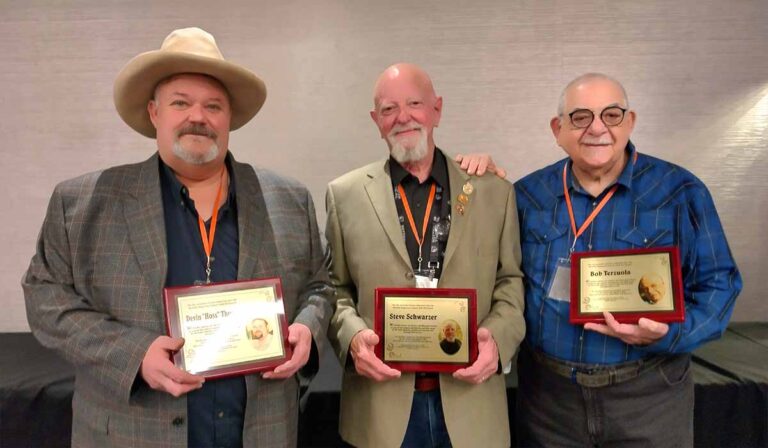
Cutlery Hall Of Fame Ushers In Thomas, Terzuola And Schwarzer

Cutlery Hall Of Fame ushers in a Hall Of Fame class at the 2023 BLADE Show.

There was much joy tempered by a tear or three as Devin Thomas, Bob Terzuola and Steve Schwarzer took monumental steps in their monumental knife careers with their formal inductions into the BLADE Magazine Cutlery Hall Of Fame® during BLADE Show ’23.

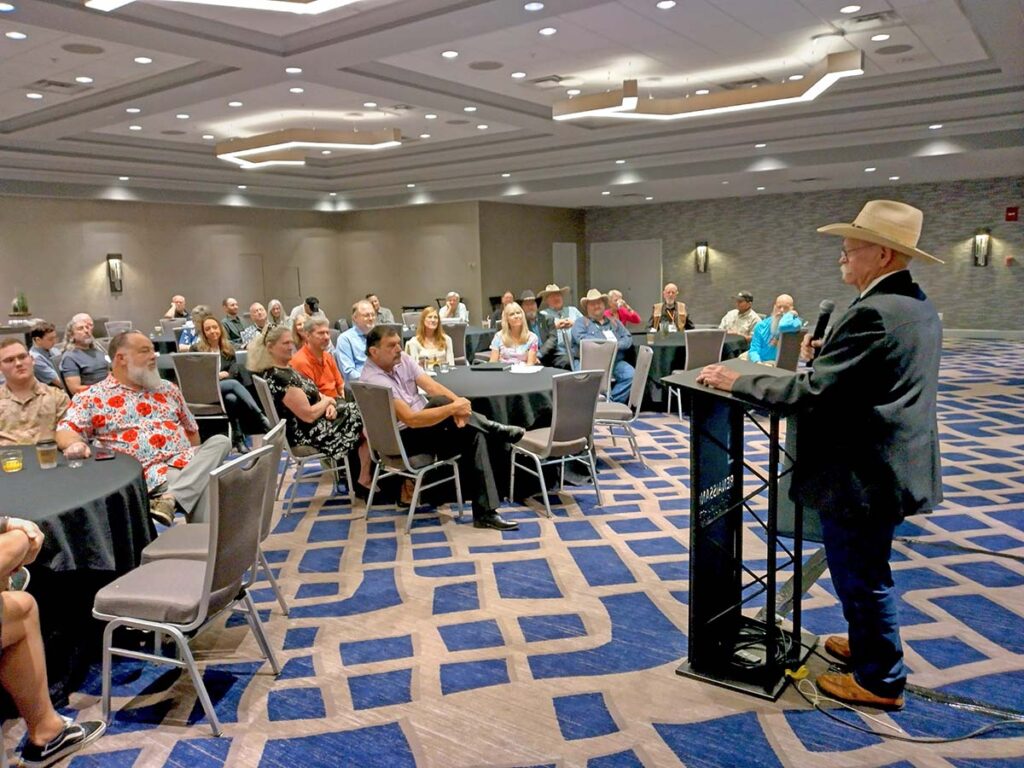
Celebrated with a combination breakfast/induction ceremony, the new inductees were saluted by an appreciative crowd of just over 100 that included family, friends, sitting Hall-Of-Famers, world-renowned knifemakers, knife collectors and various combinations thereof in the Kennesaw Room of the show’s host hotel, the Renaissance Waverly.

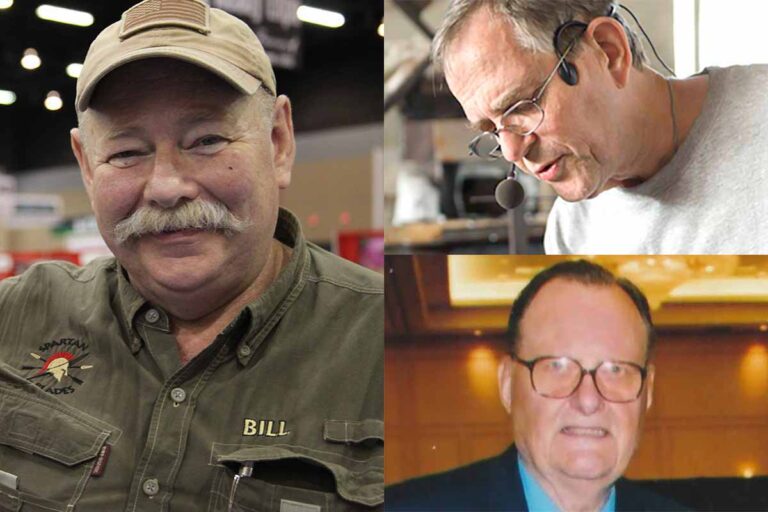
Providing induction speeches were those handpicked by the new inductees: Cutlery Hall-Of-Famers Bill Ruple and Ken Onion for Thomas and Terzuola, respectively, and award-winning bladesmith Neil Kamimura for Schwarzer. All, including the acceptance speeches, were genuine, entertaining and memorable.

Devin Thomas

While best known for his damascus steel, Devin’s first love was making knives. “The best kept secret about Devin is how good a knifemaker he is,” Bill Ruple said. “He’s known for his wonderful damascus steel, some of the best in the world, but he’s a heckuva knifemaker.”
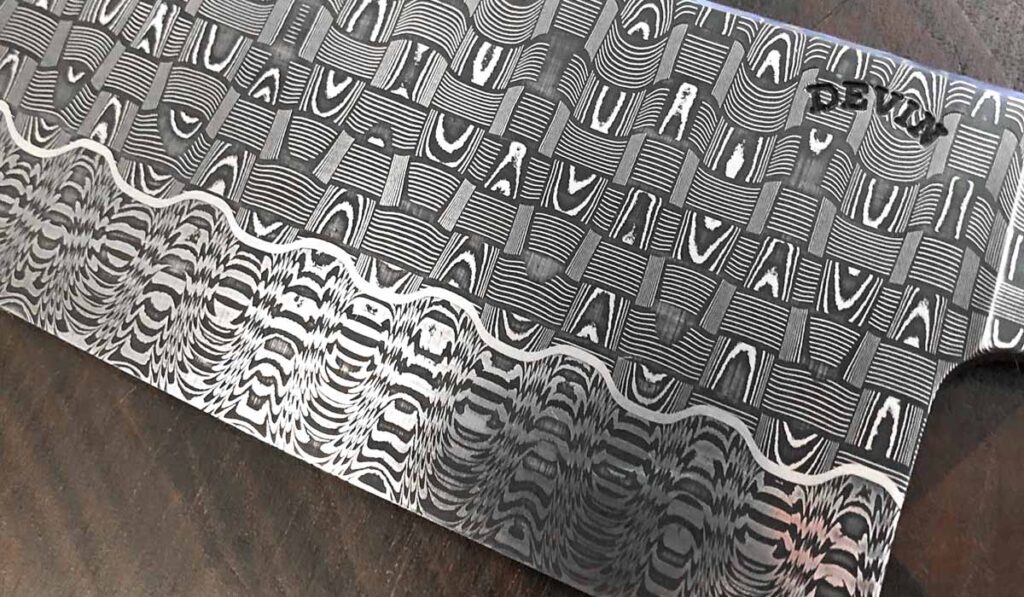
Devin Thomas blade
A Devin Thomas blade of Devin’s stainless damascus. (image courtesy of Devin Thomas)

Using a set of instructions his uncle gave him, Devin made his first knife at 13. At 16 he worked the whole summer making knives with long-time maker Bob Lofgren in Arizona. Devin did so without pay but didn’t care because of his affinity for knives. At 18 he won most impressive knife by a new maker at the California Custom Knife Show. At 21 he married Jackie. “She knew me in high school and knew I made knives, so when we got married she knew about the knife thing, so I didn’t surprise her or anything,” he recalled. “And I told her at the time I’m going to be a world famous knifemaker one day.” Devin and Jackie recently celebrated their 37th anniversary.

One of Devin’s inspirations was Cutlery Hall-Of-Famer Wayne Goddard. Devin read Wayne’s story on cable damascus in KNIVES ’86 and a career was born. “I thought I could forge-weld cable damascus, so I bought me some cable. I didn’t have any idea what I was doing, and I heated up the forge and got [the cable] to stick together,” Devin said. “That started my damascus career.”

His next great inspiration was Cutlery Hall-Of-Famer Buster Warenski. “I kept trying to get him to try some of my steel,” Devin related. “Buster said, ‘I’m not trying any of your steel unless you try to make stainless damascus.’ I started making stainless damascus and Buster used a piece in one of his art pieces and I thought, ‘I can quit today!’”

On the contrary, Devin was on his way.

“At one time I think I was making more steel than the entire ABS put together, not certain, but I could really pump it out,” he said. “I was doing 50 bars of steel a day on a regular basis. That hammer was wide open all the time.”

Family, friends and customers—that’s what it’s all about for Devin. “My oldest son [Larrin] is developing new steel so fast the industry can’t keep up,” he noted. “He developed MagnaCut— which some like but a few don’t—but the industry can’t absorb his new developments fast enough.”

Better designs, better manufacturing, an upcoming generation of makers that has him very optimistic—Devin sees a rosy future for the industry.

“We have more talent than we’ve ever had before, and younger talent, and more excitement,” he opined. “We’ve got a lot of bad designs and bad knifemaking too, but we’ve got to tolerate the good and the bad. We need more domestic manufacturing and we need better abrasives—they’re not keeping up with the steel we’re producing. My only regret? I don’t know, maybe I shoulda bought a truckload of stag scales when they were only two or three dollars a pair.”
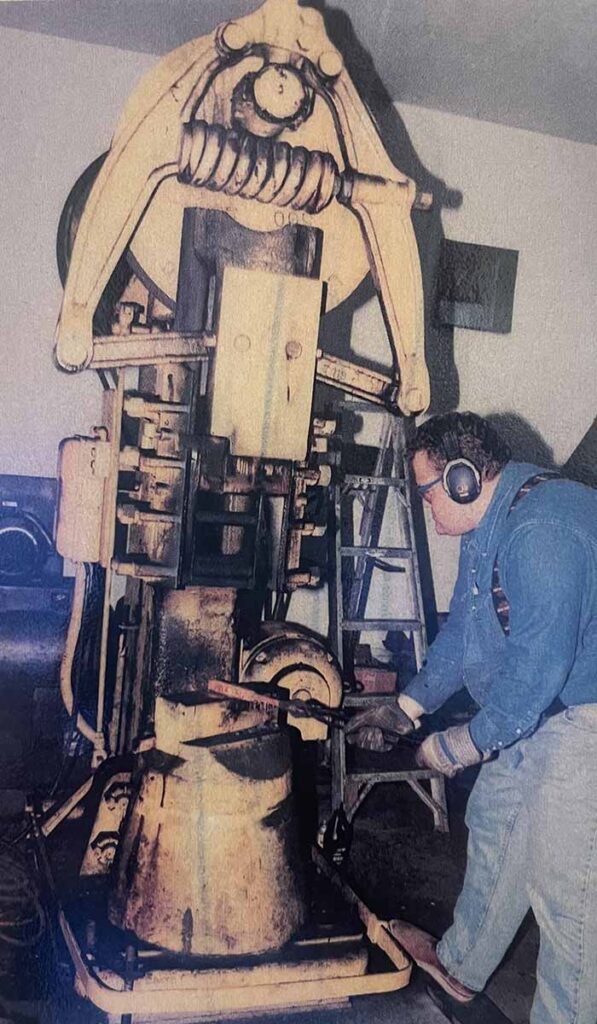
Devin Thomas at a power hammer
Devin Thomas at the helm. (image courtesy of Devin Thomas)

Ruple said he and Devin have a mutual respect based both on friendship and a shared desire to make the best the knife industry has to offer.

“Devin was always my go-to guy when it came to knowing anything about steel,” Bill said. “Anything I needed to know I’d call Devin. I learned a lot from the guy.”

Devin is nicknamed “Hoss” for his resemblance to the most endearing member of the Cartwright family on the long-running 1960s-’70s TV show, Bonanza. And, not unlike the TV Hoss, the new Hall-Of-Famer Hoss has never been beyond pulling a rabbit out of his 10-gallon hat. Bill recalled such a time at a long past BLADE Show.

“We were sitting at my table and this guy from Japan comes up and he’s trying to buy a knife from me and communication is not going well, and all of a sudden Devin’s talking Japanese to this guy and I’m thinking, ‘Hoss Cartwright speaks Japanese?’” Bill laughed at the memory.

Of course, the fact Devin is multilingual simply adds to his Hall-Of-Fame pedigree.

“Devin’s the guy who brought damascus steel to the masses,” Bill observed. “There were guys who made damascus steel but Devin aimed his steel at folder makers. He got it out there in dimensions that guys like me could use. There’s probably more of his steel in high-end collections around the world than anybody else’s. He’s been doing this a long time and he’s one of the best ever.”

Bob Terzuola

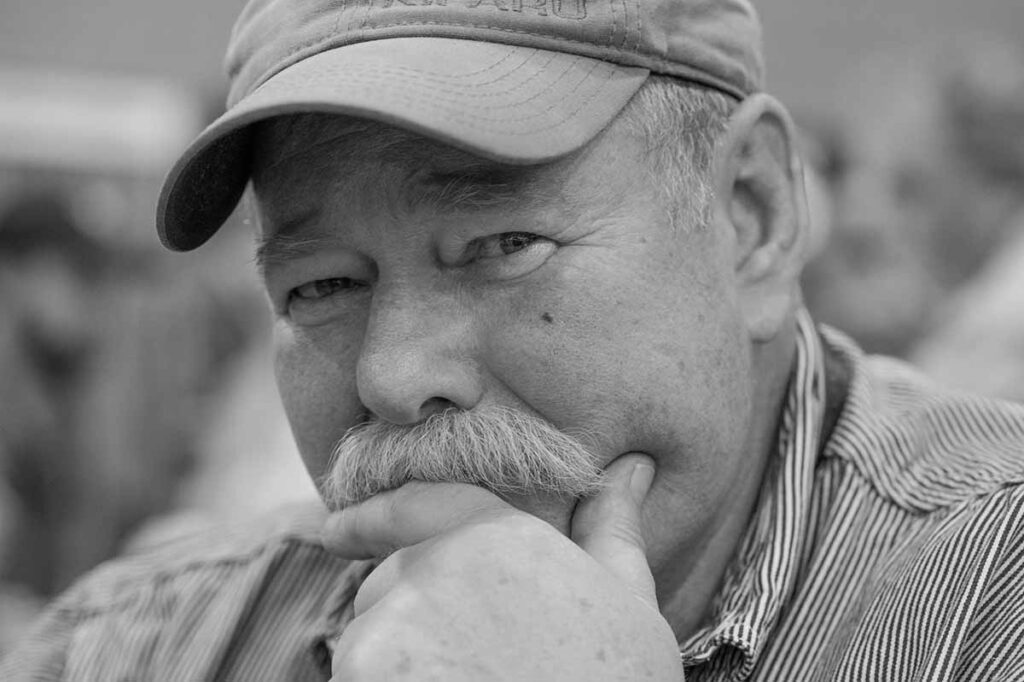
Bob Terzuola made his first knife in 1979, joined the Knifemakers’ Guild in 1981 and along the way served on the Guild’s board of directors for nine years. His relentless search for ways to improve his knives in terms of design, materials, mechanisms and more helped establish his place as one of the greatest knifemakers of his or any era, with his tactical folding knives at the summit.
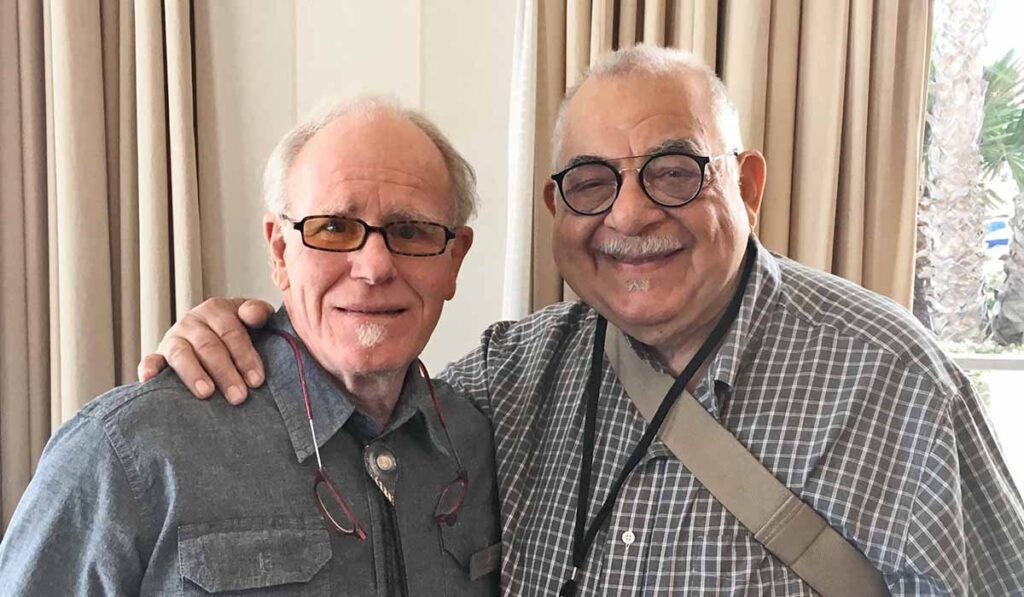
Michael Walker and Bob Terzuola
BLADE Magazine Cutlery Hall-Of-Fame® members Michael Walker and Bob Terzuola enjoy the 2019 Art Knife Invitational. (image courtesy of Bob Terzuola)

“In 1984 Bob moved to Santa Fe, New Mexico, and started making folding knives,” Ken Onion said. “Searching for a hard-use folder that could be used discreetly, Bob developed a model featuring Micarta® scales and bead-blasted titanium bolsters for which he coined the term tactical folding knife, which later evolved into his most popular model, the ATCF … which opened the market for the new category of folding knife, which arguably remains the largest and most popular category of knives in the industry.”

As Ken noted, Bob wanted to design a “robust knife as tough as he could,” so he set out to use G-10, carbon fiber, titanium and other advanced materials at a time when few if any were using them. He was a pioneer of the circular thumb disc for ambidextrous one-hand blade opening, multiple double grinds on folder blades, knives with laser-cut CNC parts and fine-tuned other areas that have molded the modern folding knife.

“Bob also focused a lot on the linerlock and did a lot of engineering advancements through a lot of trial and error, and then what does he do? He writes a book about it—The Tactical Folding Knife: A Study of the Anatomy and Construction of the Liner-Locked Folder—to teach the rest of us how to compete with him. How many of us have a copy of that book in their shop?” Ken asked the attentive audience. “How many have a dog-eared, highlighted copy, how many of us reference it regularly, and how many of us have read it more than once? It’s kind of like an important thing for all of us to have. All these contributions and advancements have earned him the affection of us all and title of the Godfather of the Tactical Knife.”
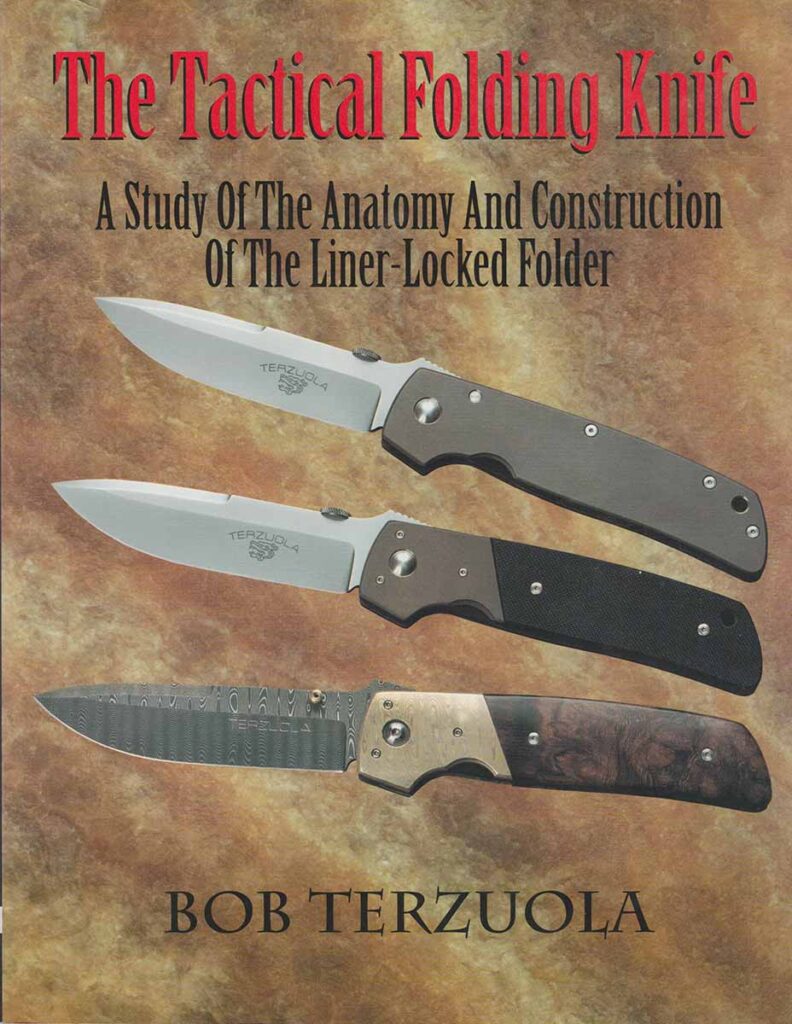
Bob Terzuola’s landmark book
The Tactical Folding Knife is Bob Terzuola’s landmark book of which Ken Onion said to an audience of over 100, “How many have a dog-eared, highlighted copy, how many of us reference it regularly, and how many of us have read it more than once?”

Bob reiterated Devin Thomas’s comment about the importance of the human element. “I’ve seen a lot of changes and met a lot of people and made a lot of really good friends, and had to say goodbye to some of them,” he said. “There were friends who meant a lot to me over the years, people like Bob Loveless, Carolyn Tinker, Howard Viele, Frank Centofante, Wayne Goddard, Bob Lum, Alex Collins. A lot of these names don’t mean anything to a lot of younger makers, but they all helped build the structure that we all rely on to take care of our families.”

He also addressed some in the audience in particular, including Cutlery Hall-Of-Famer Michael Walker. “He introduced me to the alchemy of the linerlock and working with titanium, which back in the mid-1980s was virtually unknown to knifemakers and now is so important not only to tactical folders but all sorts of pocketknives,” Bob noted of Michael. “And Ken Onion, who’s been a long-time friend and a guiding light … and I want to thank my children … but most of all I want to thank my wife, Susan, who has taken care of me over many years and … has been a powerhouse of the artistic critiquing of my knives, additions to design and so forth. And thanks to all of you for this honor and gathering here at the greatest knife show there is. Keep up the good work and let’s see where this winding, crazy, twisting road of surprises takes us in the craft of knifemaking.”

Steve Schwarzer

An ABS master smith, Steve Schwarzer and the ABS were meant for each other. The ABS is all about teaching and promoting the art of the forged blade, and so is Steve. “I want to say thank you to Billy Ray Hughes and the ABS that really helped me build a foundation,” he said. “They have a set of standards to follow and it really helped drive my business,” a business that includes a pioneering career in canister damascus, award-winning knives and teaching as many bladesmiths as he can how to forge blades
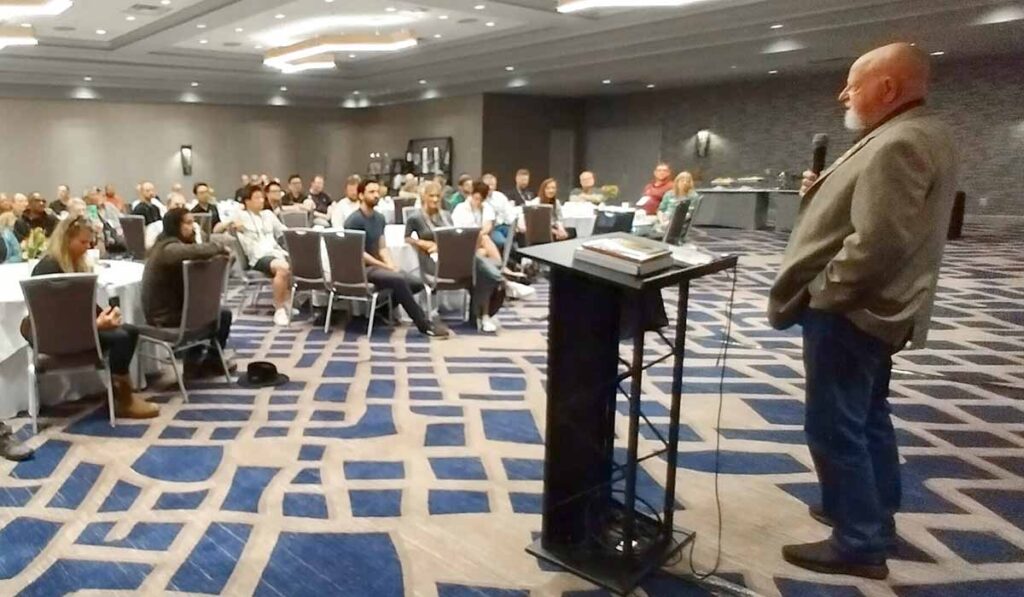
Steve Schwarzer speaking
Steve Schwarzer speaks of “knife-shaped objects,” his teachers, students and other sharp things.

Like Devin Thomas, Steve got a taste of what would become his life’s work in junior high school when he forged his first hot steel. Not long after high school in the late 1960s, he went to work in the aircraft industry and started making “knife-shaped objects.” He called them knife-shaped objects “because we took a piece of stainless steel we found on the job somewhere with no idea how to heat treat it or what kind of steel it was, and we’d grind it to what looked like a knife and put a handle on it.”

In 1972, he moved to Florida and bought a book by Alex Bealer that had a page-and-a-half on forging knives. “When I turned that page and read it, it lit a fire that never went out,” Steve said. He made knives as a hobby and sold them to his fellow shop workers for $15 and $20 apiece. “They told me I was wonderful and I believed them,” Steve said to a chuckling audience. It was then he learned of Bobby Tyson. “He was my original teacher,” Steve said. “I loved the guy. He could make two beautiful pocketknives in a day that walked and talked. Tony Bose would’ve been proud of them.”

Tyson actually had books on making knives, a novel concept at the time. Steve visited Tyson and learned all he could. “He put me ahead five years in one weekend and that’s what I try to do with Neil Kamimura and these guys here,” Steve said, pointing to some of his students in the audience. “I surround myself with people doing great things.” It is an approach that inspires Neil.

“Steve says surround your yourself with people that know your value,” he observed. “He has helped a tremendous amount of people and everybody wants to know his tricks because he’s the wizard of steel. But for me it wasn’t his tricks of welding steel but it was the lessons I wanted to learn, such as how does he keep his passion for that many years? How did he keep his willingness to want to keep on wanting to learn?” To absorb those things from Steve, Neil noted, “is to listen to his struggles, his hardships and the balance he took to maintain such longevity in this industry.”

Meanwhile, Steve the teacher remains, and always has remained, Steve the student.
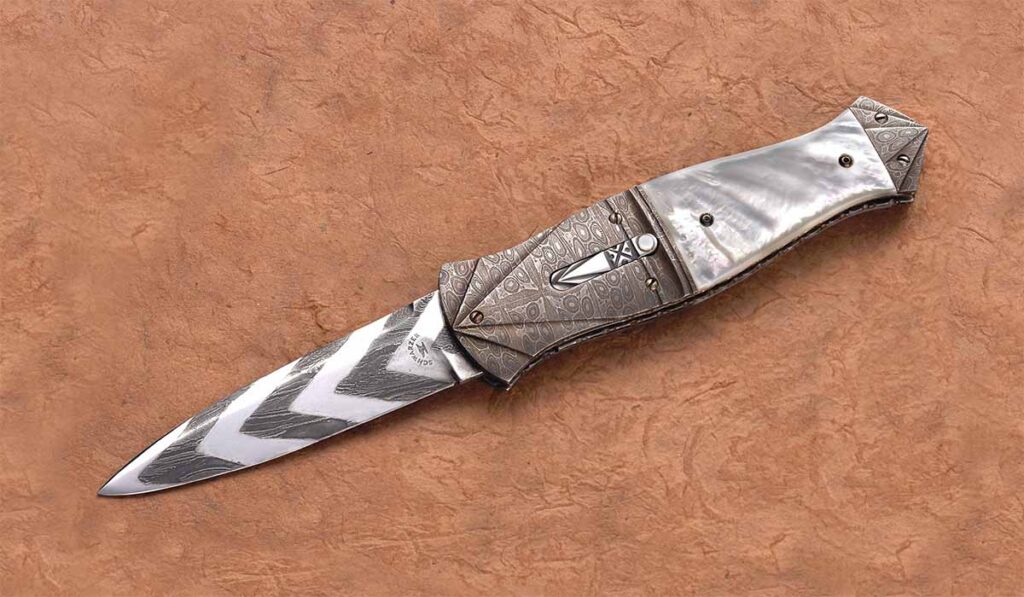
Steve Schwarzer folding dagger
A Steve Schwarzer folding dagger sports a chevron damascus blade, canister damascus furniture and mother-of-pearl scales. (PointSeven image)

“At 75 I’m hurrying, I promise you,” he stressed. “I wake up in the morning and it’s, ‘Man, I’ve got another day. Let’s go do something!’ And that’s what I do and then [my students] explore and come back with information. So everyone you teach in this business doubles your life in the business is the way I look at it. And that’s why I love what I do.”

Neil brought it all into full focus.

“How many careers were started because of him and how many lives he’s touched, many in this room,” he mused.

“Steve Schwarzer has truly changed bladesmithing forever and I believe that … A lot of these young makers and a lot of these Instagram people, we’re nothing without people like Steve and people that have been inducted [today]. So if you don’t know Steve, you should get to know him, and if you do know Steve, you should treasure him like I do.”

Read More On BLADE Magazine And Show:

Dowell, Fogg, Harsey Join Cutlery Hall of Fame

Dowell, Harsey and Fogg join the ranks of other greats.

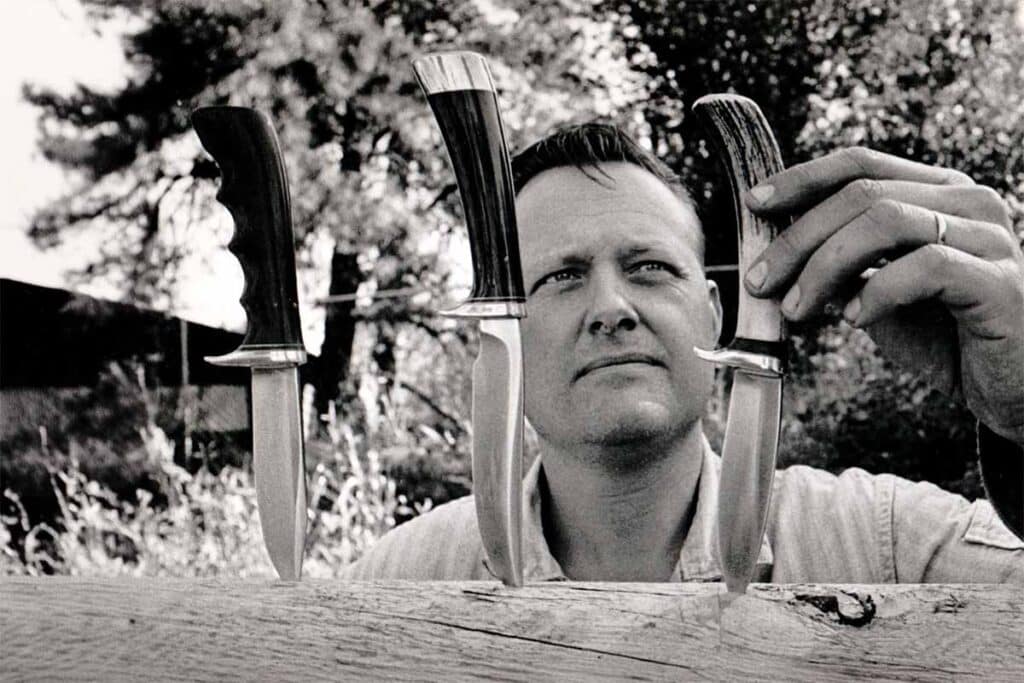
Custom knifemakers T.M. “Ted” Dowell and William “Bill” Harsey Jr. and ABS master smith Don Fogg have been voted the 2024 inductees into the BLADE Magazine Cutlery Hall of Fame®.

The three were elected by a vote of sitting members of the Cutlery Hall of Fame and a panel of industry authorities, the latter assembled by BLADE® Magazine. The vote was finalized April 25.

The trio will be inducted formally in a special ceremony during the 43rd Annual BLADE Show June 7-9 at the Cobb Galleria Centre in Atlanta. The ceremony will be held Saturday, June 8, at 8 a.m. in the Kennesaw Room of the Renaissance Atlanta Waverly Hotel, the host hotel of the BLADE Show. For ceremony ticket information, visit [email protected].

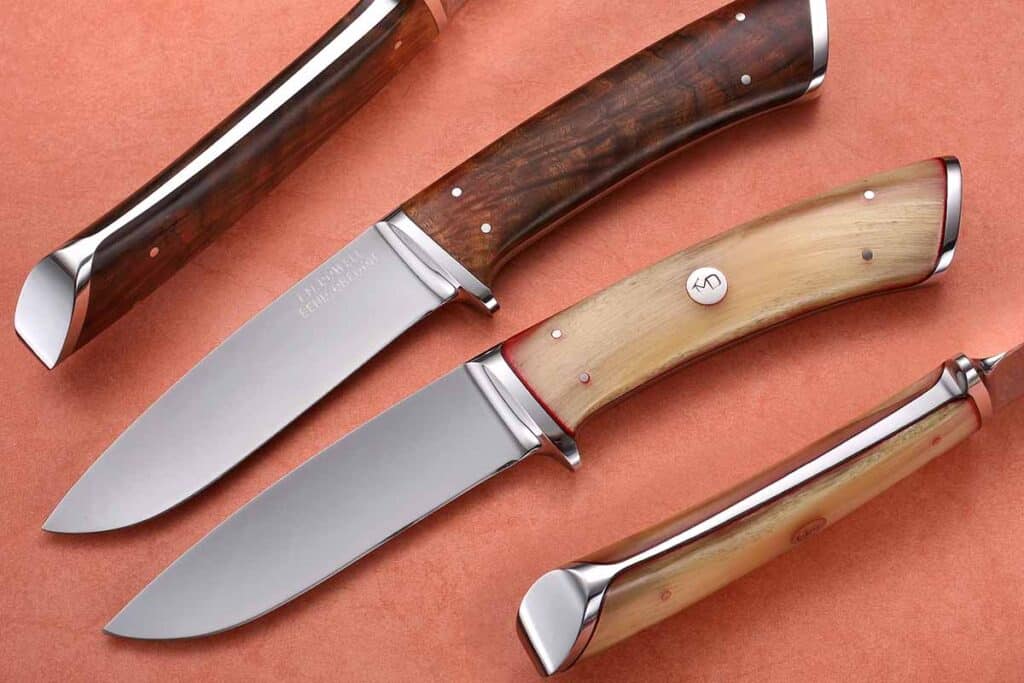
Dowell was one of the founding members who established The Knifemakers’ Guild, the grandaddy of all modern knifemaker organizations, in 1970. Along with fellow Cutlery Hall-Of-Famer Bob Loveless, Dowell wrote the Guild’s original bylaws. Ted was Guild president in 1975 and coordinated the organization’s first custom-knives-only-no-guns show. He helped Cutlery Hall-Of-Famer Phil Lobred establish the Art Knife Invitational in the early 1980s. Lobred credited Dowell with making the first modern integral knife, a design Ted introduced in 1972 in his basic hunting knives and which eventually evolved into some of the most ornate of integral art knives. Integral knives in general turned into a category of their own and remain popular to this day. Ted passed away in 2012.

Fogg and Murad Sayen formed a partnership called ‘Kemal’ in 1980. Kemal created some of the best art knives ever, including one pictured in Esquire Magazine. The accompanying article helped bring the beauty of art knives to the world. In 1981, Bill Moran and Fogg received the first ABS master smith ratings. In 2006 Don was inducted into the ABS Hall of Fame. He long has shared his vast knowledge. He revealed the art of Samurai and Viking sword making and developed the W’s damascus pattern. He shared the drawings of his best gas forge and his gas heat treat oven for swords. He built one of the first 20-ton hydraulic forging presses for making damascus. Today the press is as popular as a power hammer. He also was instrumental in starting the ABS bladesmithing school in Auburn, Maine.

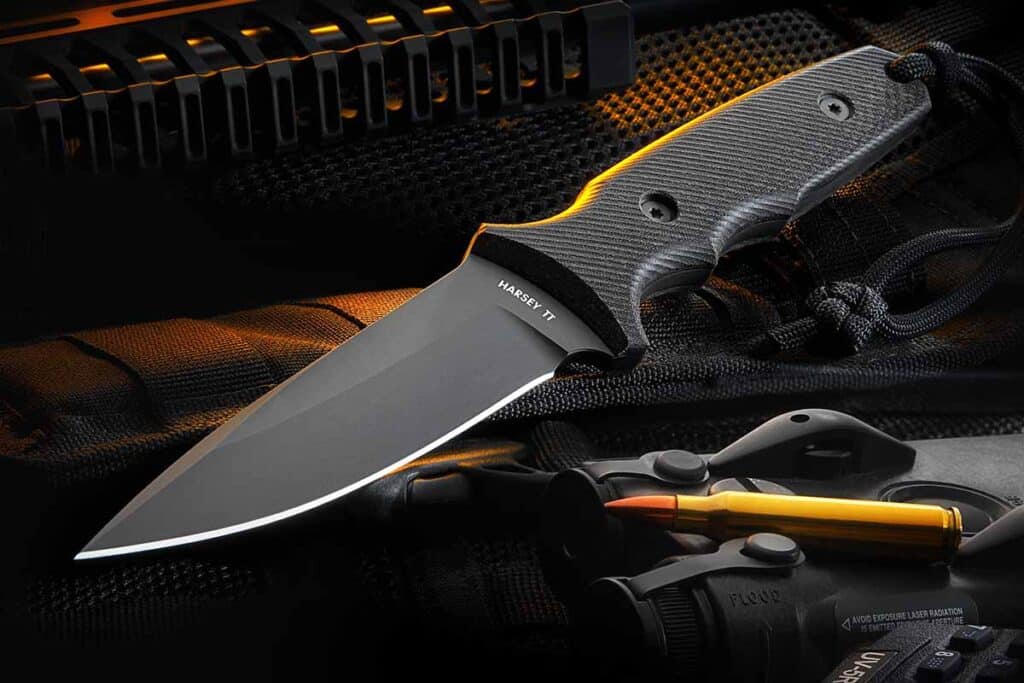
Harsey has made and designed knives for 38 years, during which time he has been one of the most prolific and recognizable names in the industry, working behind the scenes and designing for Al Mar Knives, Beretta, Chris Reeve Knives, CRKT, Gerber, Ruger and Spartan Blades. He worked and consulted with and designed for Cutlery Hall-Of-Famer Col. Rex Applegate, including the British SAS Collaboration Knife. Bill designed the U.S. Army Special Forces Green Beret Knife, aka The Yarborough, for Chris Reeve Knives, a serialized version of which was presented to each graduate of the Special Forces Qualification Course. He also designed the official knife of the Canadian Special Forces and the U.S. Navy SEAL Silver Trident knife, and worked on the Neil Roberts knife project.

The elections bring to 74 the number of members in the Cutlery Hall of Fame, the world’s only shrine to the giants of the entire knife industry.

See Other Hall Of Fame Members:

Cutlery Hall of Fame 2024: Dowell, Harsey And Fogg Enshired In Atlanta

Cutlery Hall of Fame enshrines three icons of cut in Atlanta.

The BLADE Magazine Cutlery Hall of Fame® brought three groundbreakers of the world of knives into the fold June 7 with the formal inductions of premier knifemakers Ted Dowell and Bill Harsey and ABS master smith Don Fogg.

About 75 patrons were on hand for the breakfast/induction ceremony held in the Kennesaw Room of the Renaissance Atlanta Waverly Hotel the Saturday morning of BLADE Show 2024. For the first time in recent memory for the Hall-of-Fame ceremony, none of the inductees were on hand. Fogg and Harsey were unable to attend for health reasons, while Dowell passed away in 2012.

However, somehow it didn’t seem to matter so much as friends, family and acquaintances of the inductees and others took up the slack to produce a memorable induction event. Present to formally induct the new Cutlery Hall of Famers were Jeff Dowell (his father, Ted); Anne and Tim Reeve of Chris Reeve Knives and Curtis Iovito of Spartan Blades (Harsey); and Cutlery Hall-of-Famer Steve Schwarzer (Fogg).

T.M. “Ted” Dowell

Ted Dowell examines his handiwork
Ted Dowell examines his handiwork in his backyard knife shop. (image courtesy of Jeff Dowell)

As a founding member of The Knifemakers’ Guild, Ted Dowell played a key role in helping to organize the Guild, the grandaddy of all modern knifemaker organizations, in 1970. Along with fellow Cutlery Hall-Of-Famer Bob Loveless, he wrote the Guild’s original bylaws.

A veteran of the United States Navy, Ted resigned his position as a full-time mathematics professor in 1974 to go full time making knives. As Guild president in 1975, overcoming opposition from some in the Guild’s ranks, he coordinated the organization’s first custom-knives-only-no-guns show. He also helped Cutlery Hall-Of-Famer Phil Lobred establish the Art Knife Invitational in the early 1980s. Lobred credited Dowell with making the first modern integral knife, a design Ted introduced in 1972 in his basic hunters and which eventually evolved into some of the most ornate of integral art knives. Integral knives became a category of their own and remain popular to this day.

As Jeff noted, his father was passionate about the Guild and “all the foundations that set the pace and the tone for a lot of us that sit here today and reaped those rewards.” Jeff said much of the credit for his father’s success was due to the support of Mrs. Betty Dowell, who, while unable to attend the induction ceremony, was there vicariously through her son.

“Mom had her 93rd birthday a couple of days ago,” Jeff said to cheers and applause from those in attendance, “and she’s doing pretty well for 93. She still lives in the house that she and Dad bought in 1962 in Bend, Oregon, and the shop is still in the backyard. It’s not as completely outfitted as much as it was when he was working but a lot of the core stuff is still there. I go out there and tinker around quite often, and his presence is still very much there.”

Phil Lobred credited Ted Dowell with making the first modern integral knife
Phil Lobred credited Ted Dowell with making the first modern integral knife, a design Ted introduced in 1972 in his basic hunters and which eventually evolved into some of the most ornate of integral art knives. (SharpByCoop image)

Jeff and his brother, Scott, worked in the shop making sheaths for their father’s knives before tragedy struck in 1975 when Scott was killed in a car accident. He was only 19. “That was a tough day,” Jeff recalled, “and it took both my dad and mom a while to recover.” Jeff soon assumed the sheath-making duties and Ted and Betty soldiered on with life, with Betty taking more of a lead role than ever.

“My mom was galvanized and determined to have a family to take care of and a household to run,” Jeff said, “and she ran every bit of the business. [Dad made the knives] but everything else she did. She attended to every detail of the business. She had two kids to take care of and she had a grieving husband and a knifemaker and a business to support, and she did so for another 40 years.”

Meanwhile, Ted continued to establish a reputation as one of the finest makers of custom knives. “During that time Dad produced some great hunting knives and was best known for his integral designs and Funny Folders and those types of things,” Jeff remembered. “It was really Phil Lobred that pushed him and got him into art knives, and Dad produced some absolutely stunning art knives over the years.” Many of those images are on the impressive tmdknives.com website for which Jeff provides updates when warranted.

Still, Jeff said, his mother loomed large in every knife her husband made. “I don’t know that Dad could have made all those knives if not for her,” he noted. “She was that influential and resolute in seeing this through. I was fortunate enough to be a big part in working in the shop before heading off to college, and I visited quite often during that time to see some of the great knives Dad was doing. They both felt he deserved to be in the Hall of Fame and it’s wonderful that he finally is.

“I thank everybody here who voted him in and the other inductees as well. It’s a great honor.”

William “Bill” Harsey, Jr.

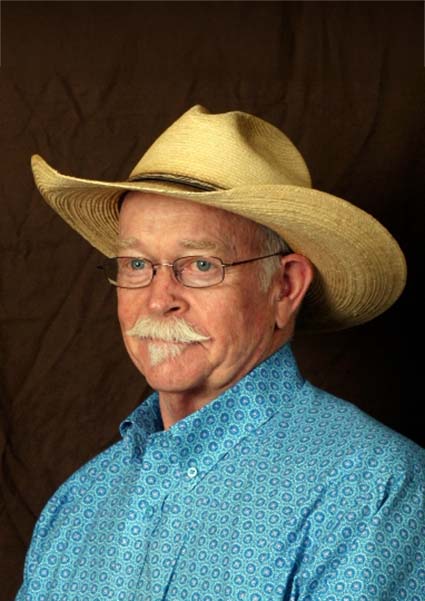
Bill Harsey
Bill Harsey (Ronald S. Smith image)

Bill Harsey has made and designed knives for 38 years, during which time he has been one of the most prolific and recognizable names in the industry, working behind the scenes and designing for Al Mar Knives, Beretta, Chris Reeve Knives, CRKT, Gerber, Ruger and Spartan Blades. He worked and consulted with and designed for Cutlery Hall-Of-Famer Col. Rex Applegate, including the British SAS Collaboration Knife. Bill designed the U.S. Army Special Forces Green Beret Knife, aka The Yarborough, for Chris Reeve Knives, a serialized version of which was presented to each graduate of the Special Forces Qualification Course. He also designed the official knife of the Canadian Special Forces and the U.S. Navy SEAL Silver Trident knife, and worked on the Neil Roberts knife project.

A fourth-generation lumberjack, Bill was born into a family of lumberjacks that, as Anne Reeve put it, was kind of a working ranch. “His grandparents taught him the importance of a knife,” Anne read from notes Bill had prepared beforehand. “His grandfather taught him very much, including how to hand sharpen tools for work.”

As Anne noted, Special Forces soldiers guided Bill’s knife work from the beginning. Bill met and was advised by Cutlery Hall-of-Famer Al Mar, and they worked together on knife projects for many years. “Bill credited Al Mar with teaching him to recognize good design,” Anne noted. It was Mar, a Green Beret in his own right, who introduced Bill to Col. Applegate, and the two struck up a working relationship that lasted 14 years. Among the fruits of that relationship was the Applegate-Fairbairn combat knife for which, Cutlery Hall-of-Famer Bob Terzuola noted, Harsey did the prototypes and grinding of the blades.

Curtis Iovito explained how and why Bill fulfilled the requirements (see sidebar) for Hall-of-Fame membership. “In an industry where trust is paramount, Bill exemplifies honesty, character and integrity,” Curtis said, citing how Spartan Blades and Harsey consummated their numerous collaboration agreements. “Every deal we’ve done with Bill Harsey has been sealed with a handshake,” he said as Anne Reeve nodded in agreement. “People are just supposed to do things right,” Curtis observed. “Bill set a standard for ethical conduct in the knife industry.”

Bill Harsey has designed knives for many companies, including the Tactical Trout for Spartan Blades
Bill Harsey has designed knives for many companies, including the Tactical Trout for Spartan Blades. Bill’s Clandestina design for Spartan is the BLADE Magazine 2024 Overall Knife Of The Year® (page 12).

Demand in one’s area of expertise is almost always a sure sign of success, and the demand for Harsey’s design skill is high—not only domestically but internationally as well.

“He is an ambassador of American knives. His collaborations have transcended awards as demonstrated by the Special Ops community seeking his work throughout the world,” Curtis observed of the new inductee. “Through his contributions he has elevated the status of American knifemaking but also positive relationships around the world. [Spartan Blades] is located near Fort Bragg and I’ve had people from the Italian Special Forces, German Special Forces, GSG 9, and a plethora of others visiting Fort Bragg to call our shop and ask for Bill.

“Finally, I believe Bill is more than worthy because of his dedication to the craft. He sets the example for everyone else to follow and that reaches far beyond the U.S. border, which I find really cool, and in the relationships he builds. His legacy is one that’s shaped our industry and continues to inspire future generations of knifemakers.”

Donald L. Fogg

Don Fogg
Don Fogg (Eric Eggly/PointSeven image)

A United States Marine Corps veteran of the Vietnam War, Don Fogg long has shared his vast knowledge of steel and making knives and swords. He helped further the art of Samurai and Viking sword making and developed the W’s damascus pattern. He shared the drawings of his best gas forge and his gas heat treat oven for swords. He built one of the first 20-ton hydraulic forging presses for making damascus. Today the press is as popular as a power hammer. He also was instrumental in starting the American Bladesmith Society-sanctioned bladesmithing school in Auburn, Maine. In 2005, he won the BLADE Magazine Industry Achievement Award. In 2006, he was inducted into the ABS Hall of Fame.

Steve Schwarzer said Don is like the “original Yoda of bladesmithing” and is “a genius in the knife business.” The new inductee has been a guiding light of bladesmithing instruction, including teaching classes at the Bill Moran School of Bladesmithing, damascus and swordsmithing at the J.C. Campbell Folk School, and at Montgomery College, to name but a few. He has written many stories on bladesmithing that have been published in magazines and books worldwide. Steve said Don was one of the first to spread bladesmithing information on the Internet, including hosting an international chat group that flourished for years teaching and spreading the good word of the forged blade.

Like Harsey did for Anne Reeve, Don wrote a timeline of his career to help guide Schwarzer’s induction speech. Don’s “knifemaking adventure” started in 1976 when he met and befriended Jimmie Fikes, a master blacksmith who “really knew his stuff.” Don soon met Jim Schmidt and they gathered at Fikes’ shop to forge weld a damascus billet. “It became apparent if we were really going to grow we were going to have to expand the market and the number of people making blades,” Don wrote. Added Steve, “And that’s what Don did. He was one of the few knifemakers early on that approached it as a business.”

The Ashokan seminar in New York in 1980 was a pivotal moment that brought together the few leading smiths of the day, including Don, from all over the country. The hammer-in was a way of teaching and sharing knowledge that each smith had learned individually, exploding the growth of bladesmithing. “There’d been a lot of discussion about creating standards for the craft and a ratings system was developed,” Don wrote. Cutlery Hall-of-Famer Bill Moran, who together with Bill Bagwell, Don Hastings and Cutlery Hall-of-Famer B. R. Hughes formed the American Bladesmith Society in 1976, announced the first ABS master smith ratings at the 1982 New York Custom Knife Show. Fogg was one of those ABS master smiths.

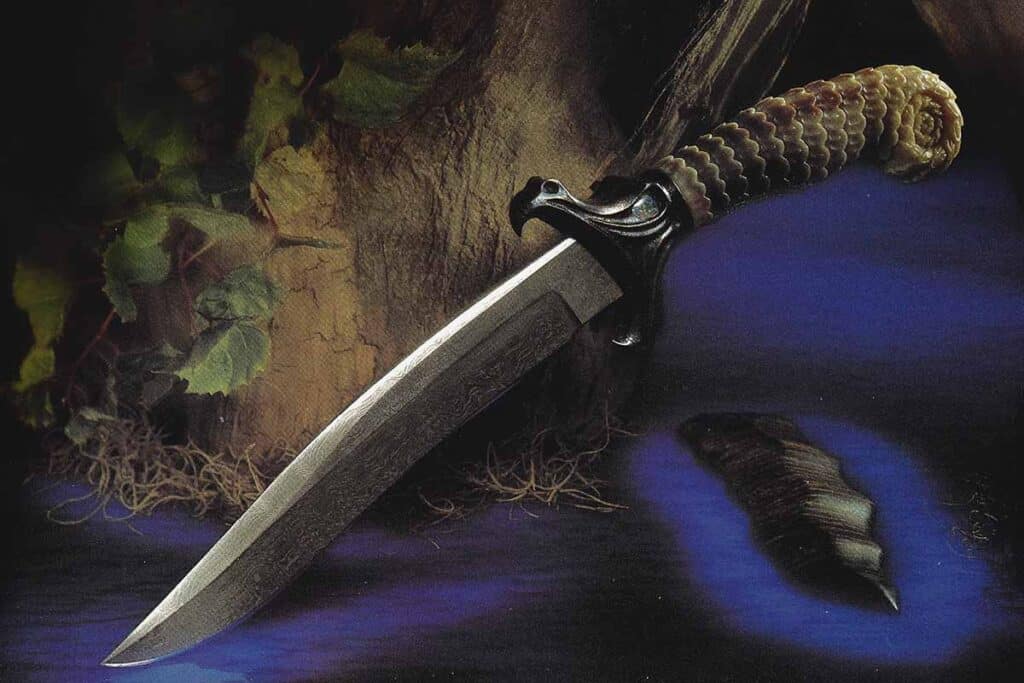
Kemal's pivotal knife was a dragon-handle damascus model
Together with Murad Sayen, Don Fogg comprised the knifemaking team known as Kemal. Their pivotal knife was a dragon-handle damascus model that appeared in BLADE® and Cutlery Hall-of-Famer Jim Weyer’s Points of Interest, Book IV. (Weyer International image)

Don’s main interest was steelwork, which soon exceeded his ability to make handles. Enter Murad Sayen, with the two forming the knifemaking team of Kemal. Don learned so much from Murad it opened his eyes creatively and he learned a whole new line of form, texture and contrast, which in turn changed his approach to making steel. One of their knives was pictured in the highly influential Esquire Magazine, which helped bring the beauty of art knives to the world outside the knife industry.

Don moved to Alabama, where he befriended Cutlery Hall-of-Famer Jim Batson. Fogg became a regular at Batson’s hammer-ins, sharing knowledge and also meeting bladesmith Chuck Patrick. Don and Chuck taught swordsmithing and worked together for years. In the interim Don dropped out of the ABS and lost his MS rating, but had grown and was “representing bladesmithing to the world.” With Batson’s encouragement he retook the MS test and passed it again.

“I feel privileged to have been at the beginning of what was to become a global rebirth of this ancient craft,” Don wrote. “I used to joke I have a well-developed set of archaic skills, but in truth I was so fortunate to have found my community and one that challenged me for my entire life and educated me in so many ways.”

Hall-of-Fame Requirements

To be inducted into the BLADE Magazine Cutlery Hall of Fame®, prospective members must have practiced all of the following during their careers:

  • Demonstrated extraordinary service to the knife industry;
  • Displayed honesty, character and integrity;
  • Advanced the industry by the creativity and originality of their works or contributions;
  • As ambassadors or outstanding contributors, have furthered the positive impact of the knife industry on the world at large, and;
  • In summary, have demonstrated a worthiness to be a member of this prestigious group.

See Other Hall Of Fame Members:

2025 Cutlery Hall Of Fame Welcomes Eight Inductees

Largest class as HOF honors living and deceased legends.

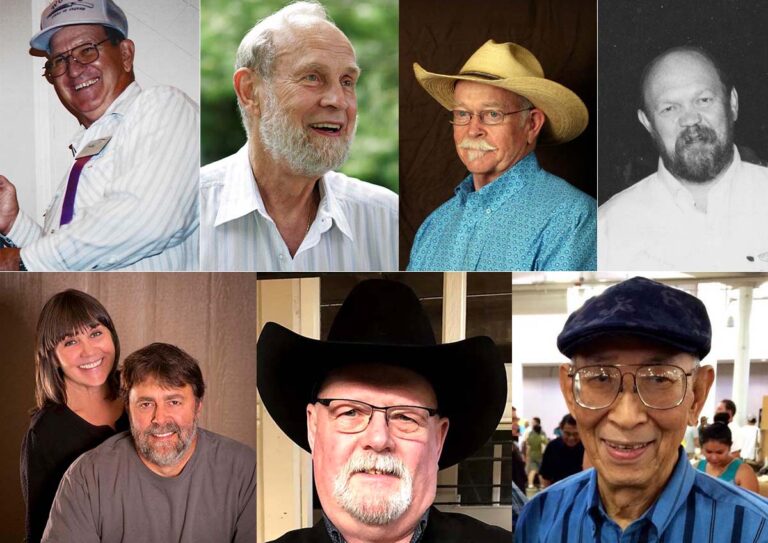
The BLADE Magazine Cutlery Hall of Fame® is proud to announce its new inductees for 2025: Harvey Dean, Stanley Fujisaka, Rick Dunkerley, Dr. James Lucie, Alfred Pendray, James Schmidt, and Daniel Winkler and Karen Shook.

In a procedural change new for this year, the Hall of Fame has expanded the number of annual inductees from three to seven, the latter including four living and four deceased individuals. (The team of Winkler and Shook is count as one inductee.) They, along with Dean and Dunkerley, are this year’s living inductees, with the balance being the deceased ones.

The new Hall of Famers will be formally inducted, including the posthumous inductions of the deceased members, during BLADE Show 2025 June 6-8 at the Cobb Galleria Centre in Atlanta. The induction ceremony will commence the Saturday morning of the show, June 7, at 8 a.m., and will include a breakfast in the Kennesaw Room of the show’s host hotel, the Renaissance Atlanta Waverly. Tickets are required in advance and are limited. For ticket information email [email protected].

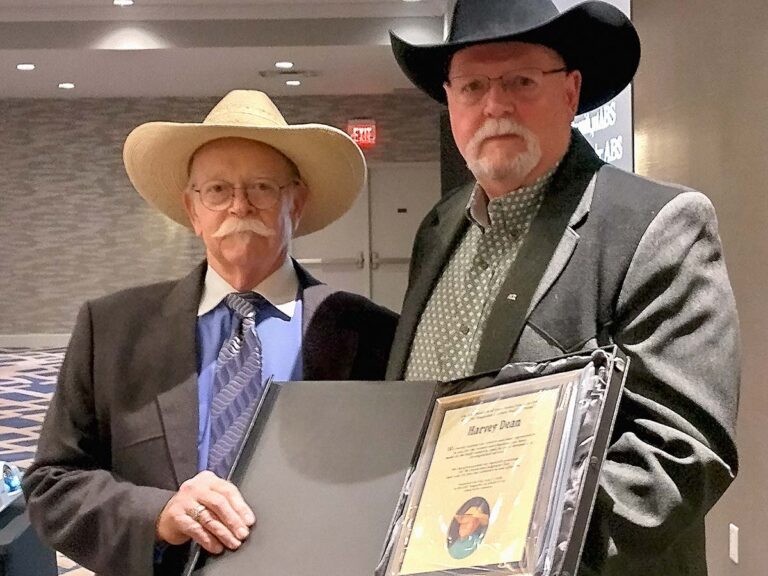
Harvey Dean

Harvey Dean
Harvey Dean

According to a nominator, “Harvey Dean earned his American Bladesmith Society master smith rating in 1992 and since then has taught an impressive number of students the art of bladesmithing. He became a member of the ABS Board of Directors in 2004 and served four years with distinction as ABS president from 2015-19. He continues to serve on the ABS board today. He was inducted into the ABS Hall of Fame in 2016. He has won an impressive number of judging awards for his knives, including at BLADE Show Texas, multiple times at the BLADE Show, from the Antique Bowie Knife Association and others. His knives have earned him membership in the prestigious Art Knife Invitational, limited to 25 of the world’s top knifemakers by a vote of the member makers.

He is a marvelous bladesmithing teacher, a master leader, a master administrator, and a master ambassador for the forged blade.” Along with award-winning knifemaker Johnny Stout, Harvey coordinated two annual knifemaking seminars in New Braunfels, Texas, for a number of years. He has also passed the knifemaking torch to his son Dillon, who creates utility fixed blades of his own. Concluded the nominator, “Harvey is among those named in the book Greatest Living Knifemakers written by Cutlery Hall-Of-Famer Steve Shackleford. I know of no one man deserving of being named to the Cutlery Hall Of Fame more than Harvey.”

Rick Dunkerley

Rick Dunkerley
Rick Dunkerley

Rick Dunkerley began making knives in 1983 and started forging them in 1992. He specializes in mosaic damascus folders, winning judging awards for a number of them, as well as an occasional fixed blade. Among others, he’s won judging awards for his knives at the Oregon Knife Collectors Association Show, Montana Knifemakers Association Show, BLADE Show and BLADE Show Texas. His knives have earned him membership in the prestigious Art Knife Invitational, limited to 25 of the world’s top knifemakers by a vote of the member makers. He held many hammer-ins during the ’90s and brought in the best instructors of the time.

Rick has always been generous with information and is an excellent teacher. He’s taught at such venues as the Texarkana College/Bill Moran School of Bladesmithing, the Batson Bladesmithing Symposium, the Massachusetts College of Art, Saskatchewan Western Development Museum, Northern Minnesota Blacksmith’s Association, Northern Rockies Blacksmith’s Association and Western Canada Knifemakers’ Symposium. One of his students, Josh Smith, was the youngest ever to achieve both ABS journeyman and master smith status, and today runs the Montana Knife Co., a factory knife production operation with 80 employees. According to a nominator, “Rick has been on the board of the ABS and does the top shows worldwide. He has paid his dues, is a hell of a guy, always willing to share his knowledge, and makes world-class knives.”

Stanley Fujisaka

Stanley Fujisaka
Stanley Fujisaka

Stanley “Stan” Fujisaka went full-time making knives in 1984 and was a prolific builder of award-winning folders and fixed blades. He was a beloved mentor in his Kaneohe, Hawaii, knife shop to a number of Hawaiian and other makers, including Scott Matsuoka, Les George, Cutlery Hall-Of-Famer Ken Onion and many more. Stan played a key role in encouraging Onion to patent his famous SpeedSafe assisted-opening mechanism. As a result and as Cutlery Hall-Of-Famer Dan Delavan wrote, “Ken went on to become the savior of Kershaw Knives.”

Stan also generously assisted knifemakers who fell victim to floods, shop fires, medical issues and more. He was a regular exhibitor at knife shows, donating many knives for door prizes. He collected custom knives and promoted them and the custom industry in general by supporting the Bay Area Knife Collectors Association Show, The Knifemakers’ Guild Show and other knife events. Together with his good friend, Cutlery Hall-Of-Famer Jim Sornberger, Stan co-hosted dinners for knife collectors, area celebrities and others, all of which helped promote custom knives. Finally, when it came to being a goodwill ambassador to the custom knife industry, few if any could rival Stan for his many gifts—including flowers, Hawaiian coffee and boxes of chocolate-macadamia nuts—that he doled out to friends, customers and other patrons at the shows where he exhibited.

Dr. James R. Lucie

Dr. James R. Lucie
Dr. James R. Lucie

According to a nominator, “Dr. James R. ‘Jim’ Lucie was Cutlery Hall-Of-Famer William Scagel’s physician and signed Scagel’s death certificate in 1963. This was the beginning of Dr. Lucie’s Scagel knife-collecting avocation. Scagel is considered by many the father of the modern custom knife. Dr. Lucie discovered his passion for knifemaking in 1990 when he took a class on bladesmithing from Cutlery Hall-of-Famer Bill Moran. Jim was a very talented maker and received several awards for his contributions to the knifemaking community. He assisted other makers often. In 2001, the ABS created the Dr. Jim Lucie Award, which it bestowed on Jim as its inaugural recipient. The award was ‘presented for the unselfish contribution to the preservation of the forged blade. The person receiving this award has gone far beyond the call … and exemplifies the type of person needed to keep … bladesmithing alive.’

Jim also received an ABS Special Service Award in 2002 ‘in recognition of his meritorious and unselfish services on behalf of … the forged blade.’ He also received the ABS Chairman’s Award for Outstanding Service more than once. He was a talented bladesmith, hand-forging mostly Scagel recreations of the highest quality. He improved on Scagel’s designs when it would enhance the knife. Jim dedicated three decades to researching Scagel’s life and collecting his works. Jim’s efforts culminated in Scagel Handmade, a massive hardbound book detailing Scagel’s life, with photos of over 200 knives and other Scagel items. Dr. Lucie hosted a hammer-in in 2001, with over 500 people in attendance. He shared his knowledge of Scagel’s techniques by giving speeches at many bladesmithing events. Late in life, Jim donated his blacksmithing, grinding and finishing equipment valued at $62,700 to the ABS. His actions consistently exhibited honesty, compassion for others and a dedication to the bladesmithing community.”

Alfred Pendray

Alfred Pendray
Alfred Pendray

Alfred “Al” Pendray was a rock to the many bladesmiths he taught and influenced over the decades. “I learned so much from him,” noted ABS master smith Charley Ochs, “not only about knives and metallurgy but also about life and social interaction as a person.” Softspoken but never at a loss for words on the subjects that mattered to him, Alfred possessed an intricate knowledge of many things, including wootz steel, bladesmithing/knifemaking and knife history in general. He had a solid work ethic and led as much or more by example than the spoken word. He knew when to express his views and when not to, a trait sadly lacking in much of today’s discourse. Alfred is co-author—along with Dr. John Verhoeven, a former metallurgical engineering professor at Iowa State University—of articles appearing in eight scientific journals, four bladesmith publications and BLADE on the nature of “genuine damascus,” or wootz steel.

Pendray was granted patent number 5,185,044 on a “method of making damascus blades.” He was a speaker at the Symposium on Damascus Steel at New York University in 1984. He also spoke at the International Conference on Damascus Steel in Germany in 1985 and the same conference in 1992. He lectured at the Imperial College in London, England, in 1992. He joined The Knifemakers’ Guild in 1982 and was awarded his master smith rating by the ABS in 1983. He received the ABS award for the Bill Moran Knife of The Year in 1991 and was elected to the Guild board of directors in 1992. He received the ABS W.W. Scagel Award in 1998 and is a past recipient of the Guild’s Red Watson Award. He served as Guild president from 1998-2004. In September 2001, he was featured on the nationally syndicated Paul Harvey radio show. In 2003, he was inducted into the ABS Hall of Fame.

James Schmidt

James Schmidt
James Schmidt

According to a nominator, James “Jim” Schmidt was instrumental in raising the level of knifemaking to compete with the finest crafts ever made. Most importantly, he elevated the pursuit to an art but never forgot the meticulous details of the craft. His knives are immediately recognizable and he influenced so many who came after him in meaningful ways. A spectacular book by BLADE® field editor Mike Haskew memorialized the man and his knives: JAMES A. SCHMIDT, The Great Master. A few passages from the book: “As a custom knifemaker he knew few peers. As a mentor and teacher, he was without equal”; “A man of few words, he allowed the results of his skill, precision, and limitless creativity to speak for him. In silent, stunning beauty, they thundered”; and “He welcomed those who were earnestly interested in improving their bladesmithing and knifemaking skills into his shop … and shared with them the light of precious knowledge that he realized should be readily and freely given rather than hidden.”

In the 1970s, along with Jimmy Fikes and Don Fogg, Jim formed the New England Bladesmith Society to promulgate the skills and techniques of knifemaking.  Before long the groundbreaking Ashokan Bladesmithing Seminar was born. Jim was a principal organizer, lecturer and demonstrator. He was one of the earliest members of the ABS and one of the earliest ABS master smiths, and a member of the ABS Hall of Fame. He was a constant member of the Art Knife Invitational, a winner of the Red Watson Award from the Knifemakers’ Guild, the Beretta Award for Outstanding Achievement, and many other honors from a number of custom knife shows. In time Jim decided to let someone else win an occasional award and became a judge at many shows. His approach was to be meticulously but fairly critical and always encouraging. He was indeed the ultimate teacher, his profession for most of his life.

Daniel Winkler And Karen Shook

Daniel Winkler And Karen Shook

ABS master smith Daniel Winkler and Karen Shook first made their mark in the world of knives with custom reproductions of historical knives and tomahawks. Daniel made the knives and hawks and Karen made the accompanying authentic period sheaths, and the two became internationally known for their work. Daniel and Karen taught for the ABS for many years and Daniel was in the vanguard of the Society’s early cutting competitions. The two were at the forefront of early American historical arms and their period pieces were among those featured in the 1992 feature film, Last of the Mohicans. In 1994 a Navy SEAL Special Warfare operator asked Daniel to make a tomahawk because there was nothing on the market that worked for the SEALs at the time. According to a nominator, “Karen designed a sheath the SEALs liked and over the years she and Daniel did more special projects for the SEALs, ultimately inspiring the two to form Winkler Knives II.” Added another nominator, Daniel and Karen’s operation “soon became the cutlery armorer of many top Special Ops teams, from the SEALs to Delta Force, and to those of other nations as well.

For many years Daniel and Karen quietly made the knives, axes and sheaths without seeking glory or publicity for their work. In fact, they insisted that their generosity and unselfishness remain a secret among those who discovered it. It was only upon mention of their work in the book No Easy Day, in which the SEAL Team member on the Bin Laden take-down mentioned he was carrying a Winkler knife, that Daniel and Karen’s work became known to the general public. With such demand, they have expanded into a mid-tech operation and from there into that of a cutlery producer.” Today, Winkler Knives has a 35,000-square-foot facility employing one part-time and 28 full-time workers. “Few have transitioned into the changing markets as well as Daniel and Karen,” the nominator noted, “and none have done so with such humility and class.”

See Other Hall Of Fame Members:

BLADE Magazine Cutlery Hall of Fame®: Largest Class Ever Full Of Iconic Names

Living and past greats highlight huge roster of inductees.

The BLADE Magazine Cutlery Hall of Fame® enjoyed its most prolific induction ceremony ever when it welcomed eight new members during BLADE Show 2025.

The total includes four living inductees—Harvey Dean, Rick Dunkerley and Daniel Winkler and Karen Shook—and four deceased ones: Stanley Fujisaka, Dr. James R. Lucie, Alfred Pendray and Jim Schmidt.

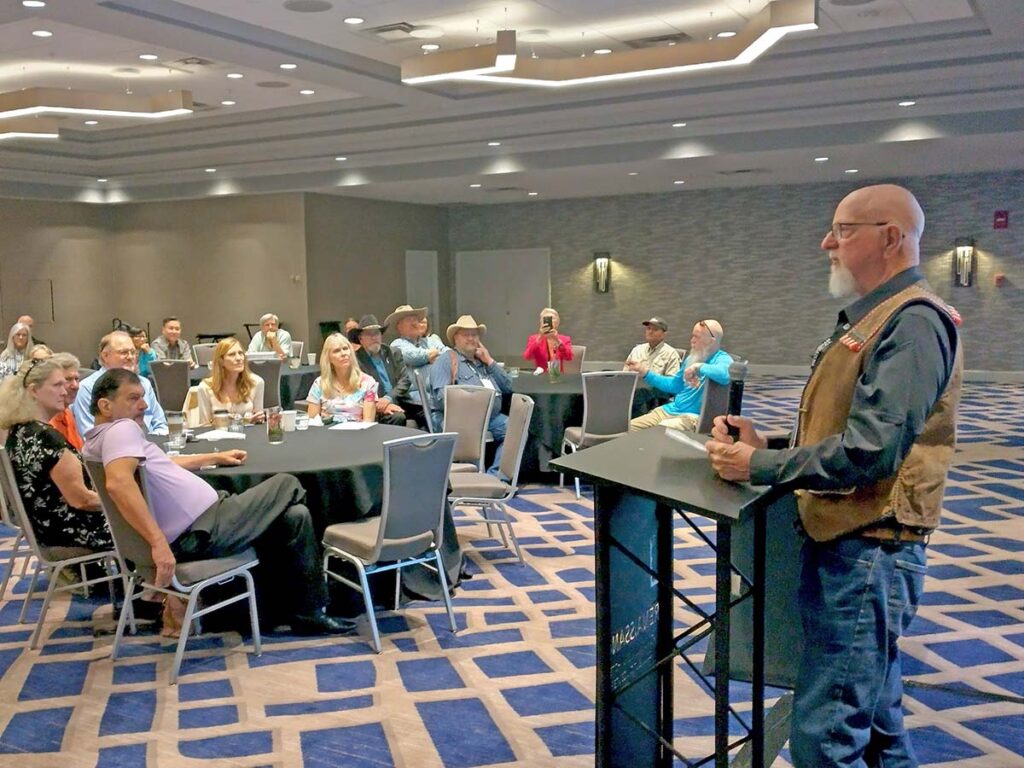
Induction speeches were provided by an array of Cutlery Hall of Famers—newly minted inductee Rick Dunkerley, Ken Onion and Steve Schwarzer; friends of three of the inductees, military veteran Kevin Holland and Josh Smith, founder of Montana Knife Co.; and Stephanie Lucie, daughter of inductee Jim Lucie.

Emotions understandably ran high, as did more than a few tears. It was a ceremony to remember.

Jim Schmidt

Cutlery Hall-of-Famer Steve Schwarzer enjoyed the honor of inducting two of his mentors: Jim Schmidt and Alfred Pendray.

As wrote Dellana, one of Jim Schmidt’s stellar students that also included Barry Davis, Cutlery Hall-of-Famer Steve Schwarzer, Larry Fuegen and more, Jim was “larger than life, truly a giant among men.” Added Schwarzer, Schmidt’s inductor, “Jim was like the father of filework. All of that filework in the business came out of him.” Schmidt made the first goblin folders, a unique style his students such as Dellana, Schwarzer, Fuegen and others emulated. “He was always willing to teach,” Schwarzer said. “His generosity with his time and knowledge was legendary … He was there at the rise of modern custom knifemaking and is one of the reasons the movement has risen to the heights that it has … He brought tool-and-die work to knifemaking and was an incredible artist.”

In the 1970s, along with Jimmy Fikes and Cutlery Hall-of-Famer Don Fogg, Jim was instrumental in forming the New England Bladesmith Society and organizing the Ashokan Bladesmithing Seminar. He was one of the earliest ABS members and ABS master smiths, a member of the ABS Hall of Fame, a constant member of the Art Knife Invitational (AKI), winner of the Knifemakers’ Guild’s Red Watson Award and the Beretta Award for Outstanding Achievement, and more. He was the ultimate teacher, his profession for most of his life. An outstanding book on Schmidt is James Schmidt: The Great Master, by Mike Haskew. As the book noted, Jim “welcomed those who were earnestly interested in improving their bladesmithing and knifemaking skills into his shop … and shared with them the light of precious knowledge that he realized should be readily and freely given rather than hidden.”

Alfred Pendray

“Alfred Pendray was a legend in the forging business,” Schwarzer began. “He was the pioneer in wootz research. I worked alongside him and 99 percent of the rediscovery of that material was by Alfred Pendray. Once he got his mind set on something he wouldn’t quit; he did it scientifically and that legacy will live on for a long time. He was just good to people—he was really good to people.”

Pendray taught and influenced many bladesmiths. “I learned so much from him,” noted Charley Ochs, “not only about knives and metallurgy, but also about life and social interaction as a person.” Alfred is co-author—along with Dr. John Verhoeven, former metallurgical engineering professor at Iowa State University—of articles in eight scientific journals, four bladesmith publications and BLADE® on the nature of “genuine damascus,” or wootz steel. Pendray holds patent number 5,185,044 on a “method of making damascus blades.”

He joined the Guild in 1982 and became an ABS master smith in 1983. He spoke at the Symposium on Damascus Steel at New York University in 1984, the International Conference on Damascus Steel in Germany in 1985, and at the same conference and the Imperial College in London, England, in 1992. He won the ABS Bill Moran Knife of The Year in 1991 and was elected to the Guild board of directors in 1992. He received the ABS W.W. Scagel Award in 1998 and is a past recipient of the Guild’s Red Watson Award. He served as Guild president from 1998-2004 and is a member of the ABS Hall of Fame.

Rick Dunkerley

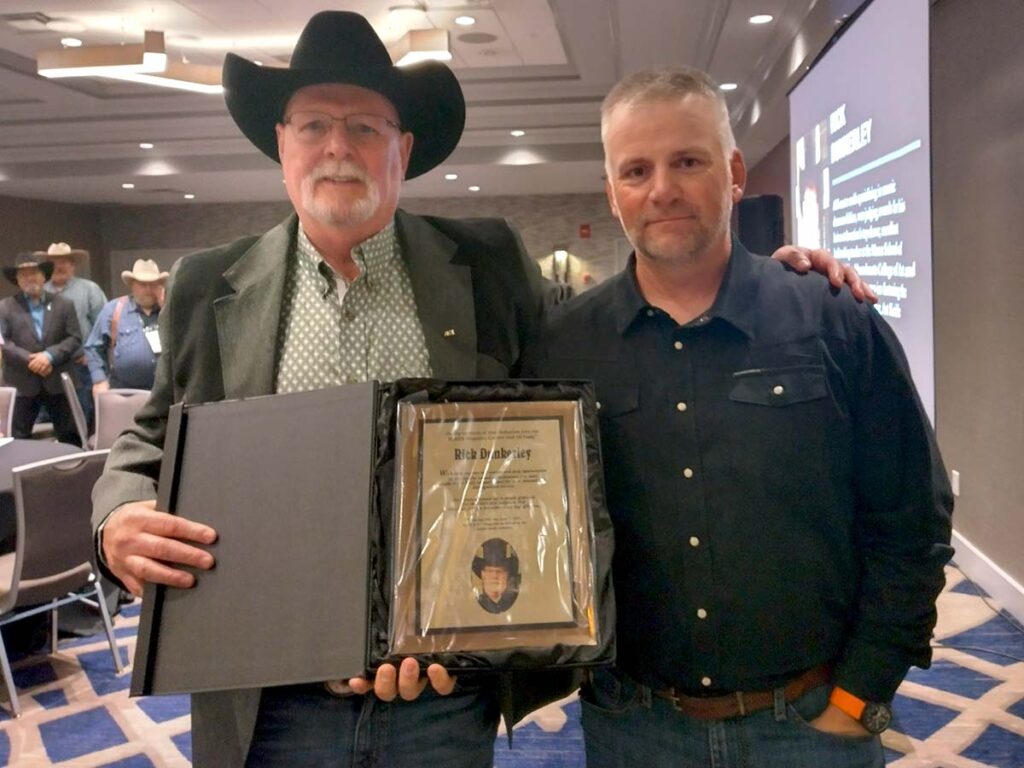
Teacher Rick Dunkerley (left) was inducted by one of his prize pupils, Josh Smith (right).

Rick Dunkerley made his first knife in 1983 and started forging in 1992. He founded the Montana Knifemakers Association in 1993, organizing the state’s first modern custom knife show. He became an ABS journeyman smith and hosted his first hammer-in in 1995 and became an ABS master smith in 1997. He’s taught bladesmithing internationally, in the process earning the Maestro Rating by the Italian Knifemakers Guild in 2006. In 2015 he was inducted into the AKI and later served on the AKI advisory panel. He’s served on the ABS board of directors for nine years and was just re-elected for another term.

According to Rick’s inductor/former student, Josh Smith, founder of Montana Knife Co., “What makes Rick special is his relentless desire to give back and teach … He hosted hammer-ins featuring instructors like Al Dippold, Hank Knickmeier, Rob Hudson, [Cutlery Hall-of-Famers] Wayne Goddard and Don Fogg and other greats. It was through these hammer-ins that the Montana Mafia was born. With Rick as the ringleader, this group went on to shape the landscape in bladesmithing and damascus to this day. It’s because of Rick and others in this era [including Shane Taylor, Wade Colter and more] that pattern-welded steel and the patterns to create it took giant leaps into the future … There’s no doubt the incredible makers we have today are standing on the shoulders of these giants.” Added an emotional Josh, who started learning how to forge under Rick’s tutelage at 11, “That was 33 years ago and I’ve been able to be in this community and build what I’ve built all because he let a kid into his shop. I love him for that.”

Stanley Fujisaka

Stanley Fujisaka made beautiful linerlock folders and fixed blades and was a beloved mentor to Hawaiian and other makers, including Scott Matsuoka, Les George, Cutlery Hall-Of-Famer Ken Onion and many more. Fujisaka played a key role in encouraging Onion to patent his SpeedSafe assisted-opening mechanism, a mechanism that resurrected Kershaw and revolutionized folding knives. However, in his speech inducting Stanley, Onion said it was the “little” things that set the new inductee apart.

“Stan didn’t invent a new category of knives, he didn’t have some crazy invention. What he had was admiration and respect and love for every one of you guys in this room,” Ken noted. “Every time I went to a show I’d come back to his shop and he’d tell me these stories of Schwarzer, of Ruple, of everybody, and they were legends to me, and he was a really great orator about that, a really great story teller, which is really why I got enough courage to come to a [knife] show. You guys were all magical to him.

Stan was one of those guys if you bought a knife from him he would write down your name, your wife’s name, your kid’s name, where you lived, your address, everything, and he would send you coffee, Hawaiian candies, a handwritten card thanking you. He would struggle to look through his book if he saw you walking toward his table so he wouldn’t forget your name. He was the truest form of gentleman, and I think that’s more of what I learned from him. It was not just knifemaking, it was how to … respect everybody, how to conduct myself in an honorable way, and nobody did that better than Stan.”

Dr. James R. Lucie

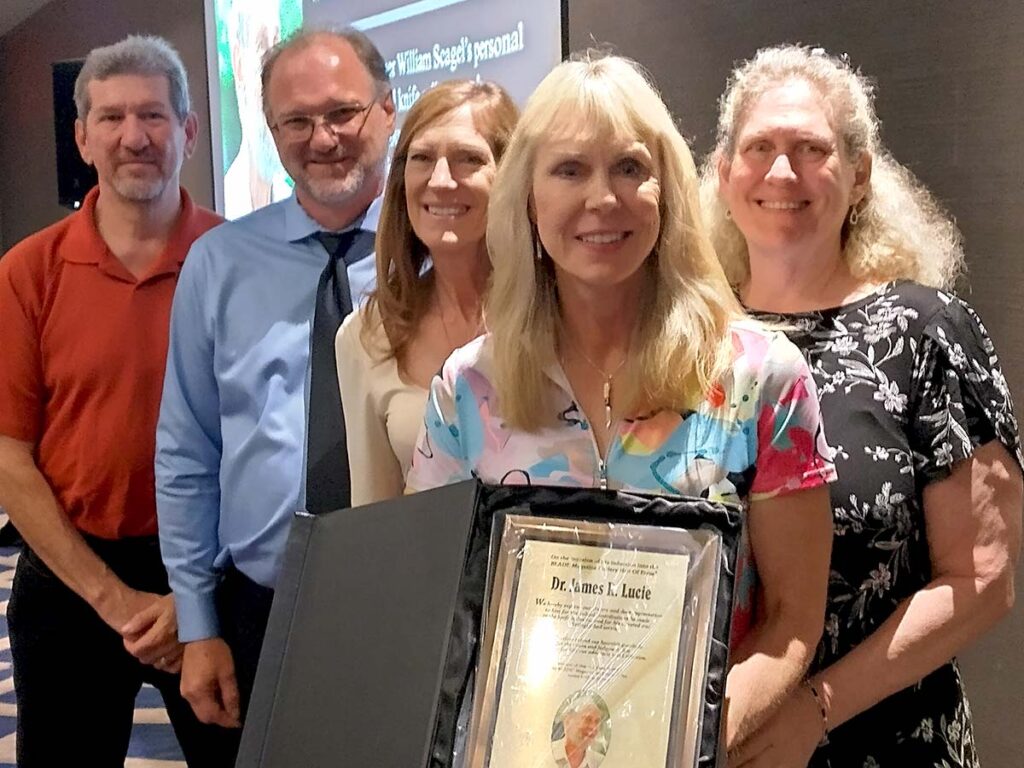
Stephanie Lucie inducted her father, Dr. Jim Lucie, with family and friends as special guests. From left: the inductee’s nephew, Chris Lucie; ABS master smith Kevin Cashen; and the inductee’s daughters, Robin Lucie, Stephanie Lucie and Pam Lafrance.

Dr. James R. “Jim” Lucie was the personal physician of Cutlery Hall-of-Famer William Scagel and signed Scagel’s death certificate in 1963. In her speech inducting her father, Stephanie Lucie said Jim researched Scagel’s life and collected his work for over 30 years, culminating in Dr. Lucie’s seminal book, Scagel Handmade. After retiring from medicine at 65, Jim dedicated his life to making Scagel reproductions. “He recreated Bill’s designs as closely as possible—unless he saw a way to improve them,” Stephanie said. “Ever the physician, he even X-rayed Bill’s knives so he could ‘see what the old boy was up to,’ as he liked to say … His goal was to become an ABS journeyman smith, which he achieved at the age of 71.”

A highlight of his career was making a knife for Willie Nelson and presenting it to him after a concert. It was featured on the cover of BLADE®. In 2001, the ABS created the Dr. Jim Lucie Award, making Jim its first recipient. He hosted a hammer-in at his house that over 500 people attended, and he freely shared Scagel’s techniques at many bladesmithing events. “He helped many beginning knifemakers, just as others had helped him,” Stephanie said. “When it came time to move from Michigan to Texas, instead of selling his knifemaking equipment, he donated much of it to the ABS—enough for each U.S. ABS school.”

In a speech Jim said, “Nowhere does there exist a finer or more helpful cadre of people than the knifemakers and bladesmiths of today. I have not yet found anyone [among them] who was not ready and willing to help impart knowledge or answer questions. I have always believed that we must give something to the society from which we took, and these people are doing it in grand style.”

Daniel Winkler And Karen Shook

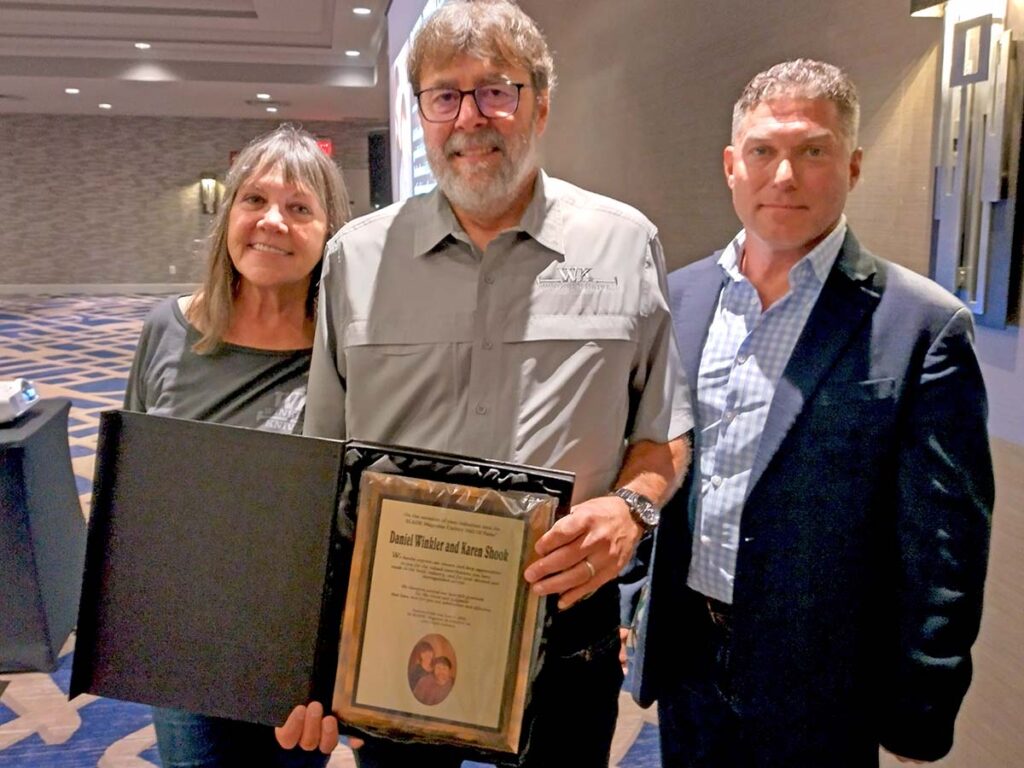
From left, Karen Shook and Daniel Winkler accept their plaque after Kevin Holland (right) delivered their induction speech.

In the late 1980s, Daniel Winkler started handforging period-correct frontier knives and Karen Shook made period-correct sheaths to match. In 1992 the showcasing of Daniel’s period pieces in the hit movie Last of the Mohicans made the pair custom knife stars. The film captured the attention of Kevin Holland, who would go on to serve in both the Naval Special Warfare Development Group/aka SEALs and Army Special Missions Unit. He asked Winkler to make a hatchet for him in 1993, and Daniel complied with a model Kevin carried for the balance of his Navy hitch.

After his discharge and still with hatchet, Kevin was working as a North Carolina game warden when 9/11 happened. He joined the National Guard and worked his way into the Army Special Missions Unit. One day his team leader espied the Winkler hatchet on Kevin’s belt and asked if he could get more. Kevin contacted Daniel, who subsequently filled an order for 15 or so. Then Kevin’s old SEAL unit saw the hatchets and Daniel made them some, too. It wasn’t long before Daniel and Karen had reached a crossroads—make period pieces for collectors, or hatchets and knives for special ops warriors. They eventually agreed that making tools for our nation’s warriors was far more important than anything else they could do.

As Kevin noted in his speech inducting the new Hall-of-Famers, “… they had a higher call … making tools that meant life or death to men in combat. They saw how important that was. They put these tools in the hands of our military and law enforcement, who carry them all over the world now.” Added Daniel, “We’ve been very fortunate to be a part of it, and I couldn’t have done it without Karen.”

Harvey Dean

Harvey Dean enjoys the moment.

As inductor Rick Dunkerley outlined, Harvey Dean made his first knife in 1979—the same year Harvey and Deborah were married. “Harvey said this is the kind of wife I have. She let me sand that first knife on the kitchen table. Harvey has a good backup system there,” Rick smiled. Harvey started making knives full time in 1992 and became the 42nd ABS master smith the same year. He joined the ABS board of directors in 2004, was voted into the AKI in 2007 and served as chairman of the ABS from 2015 to 2019, and continues to serve on the board today. He was inducted into the ABS Hall of Fame in 2016.

Harvey’s taught an impressive number of students all over the USA, including conducting two hammer-ins a year with Johnny Stout for 25 years. “The amount of teaching going on there was pretty incredible,” Rick observed. “Harvey’s won countless awards. If it has to do with a bowie knife, Harvey won it … Harvey does it all. He brings bowie knives to the AKI, he brings slip joints, he’s the consummate knifemaker. He can make whatever he wants and makes it at the highest level. There just aren’t a lot of makers who can do that. And as much as he’s given back, he’s a better man, a better family man, a better father, a better husband than he is a knifemaker.”

In accepting, Harvey said, “In the Bible, Book of Romans, the Apostle Paul says a man should not think more highly of himself than he should, and I’ve tried to live my life and career like that, so it’s hard for me to get it in my head that I deserve this—but I’ll take it.”

See More Award Winners:

Lorenzis, Ruple Join Cutlery Hall Of Fame

The BLADE Magazine Cutlery Hall Of Fame® is proud to announce three most-deserving inductees for 2022: the husband-and-wife team of Mr. and Mrs. Aldo and Edda Lorenzi and Bill Ruple.

All will be formally inducted in a special Cutlery Hall-Of-Fame ceremony and breakfast during BLADE Show 2022 June 3-5 at the Cobb Galleria Centre in Atlanta.

One of the most prolific, long-running supporters of custom knives in modern cutlery history, the Lorenzis forged a name known in knife circles far and wide while operating their G. Lorenzi retail knife store in Milan, Italy, where they sold knives of some of the greatest knifemakers of all time, including Cutlery Hall-Of-Fame members Buster Warenski, Bob Loveless, Michael Walker, Jimmy Lile, Gil Hibben, Ron Lake, Frank Centofante and many more.

Meanwhile, hailing from Pleasonton, Texas, Ruple is one of the most successful slip-joint makers of the 21st century, winning many awards for his traditional pocketknives, and also serving as a teacher and mentor to an entire generation of award-winning slip-joint makers from Texas and elsewhere.

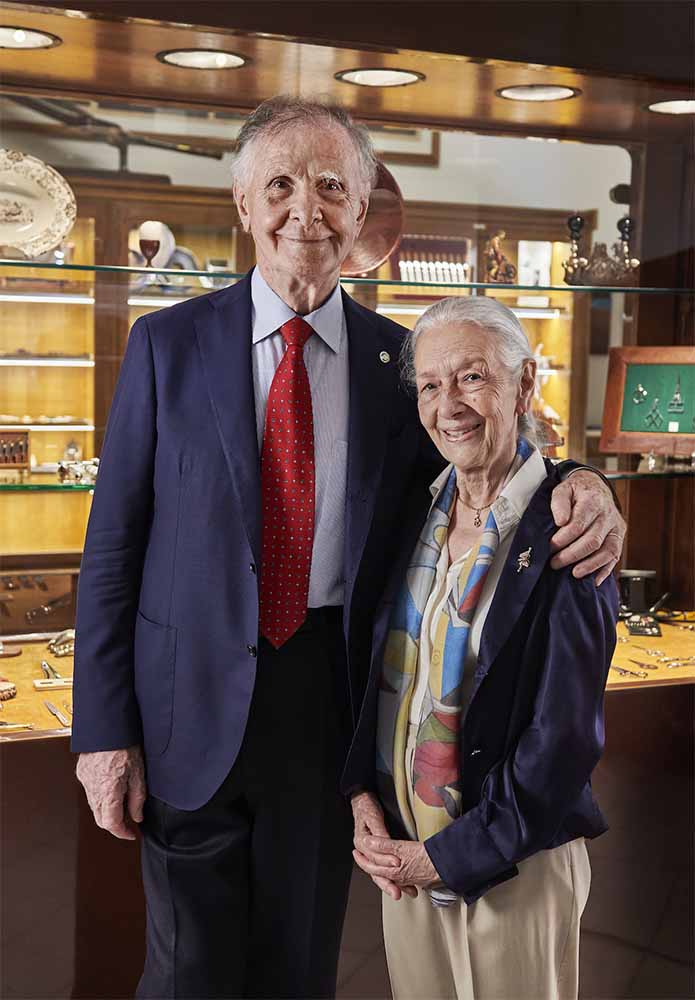
Aldo and Edda Lorenzi (Francesco Pachi image)

Aldo And Edda Lorenzi

Aldo and Edda Lorenzi operated G. Lorenzi retail cutlery store in Milan from 1959 until its close in February 2014. The Lorenzis regularly attended the world’s most important knife shows, buying scores of knives for sale in their shop. They bought so many knives at shows, in fact, that the Lorenzis’ presence often determined a show’s success or failure. The support and exposure they gave to American makers in particular by selling their knives in their store in one of the most exclusive shopping areas in Milan was pivotal in introducing American custom knives to Europe.

In 1995 they won The Knifemakers’ Guild’s prestigious Nate Posner Award “in recognition for outstanding service in the promotion of handcrafted cutlery.” They also won the BLADE Magazine 2014 Industry Achievement Award for their decades of supporting the custom knife industry. For five years ending in 2019, they sponsored the Aldo and Edda Lorenzi Award for the Guild Show and the BLADE Show, with each event’s award-winning maker receiving $1,000 cash and a plaque—10 awards and $10,000 in all. The Lorenzis also are most supportive of the William F. Moran Foundation and are one of the Foundation’s first chartered member couples.

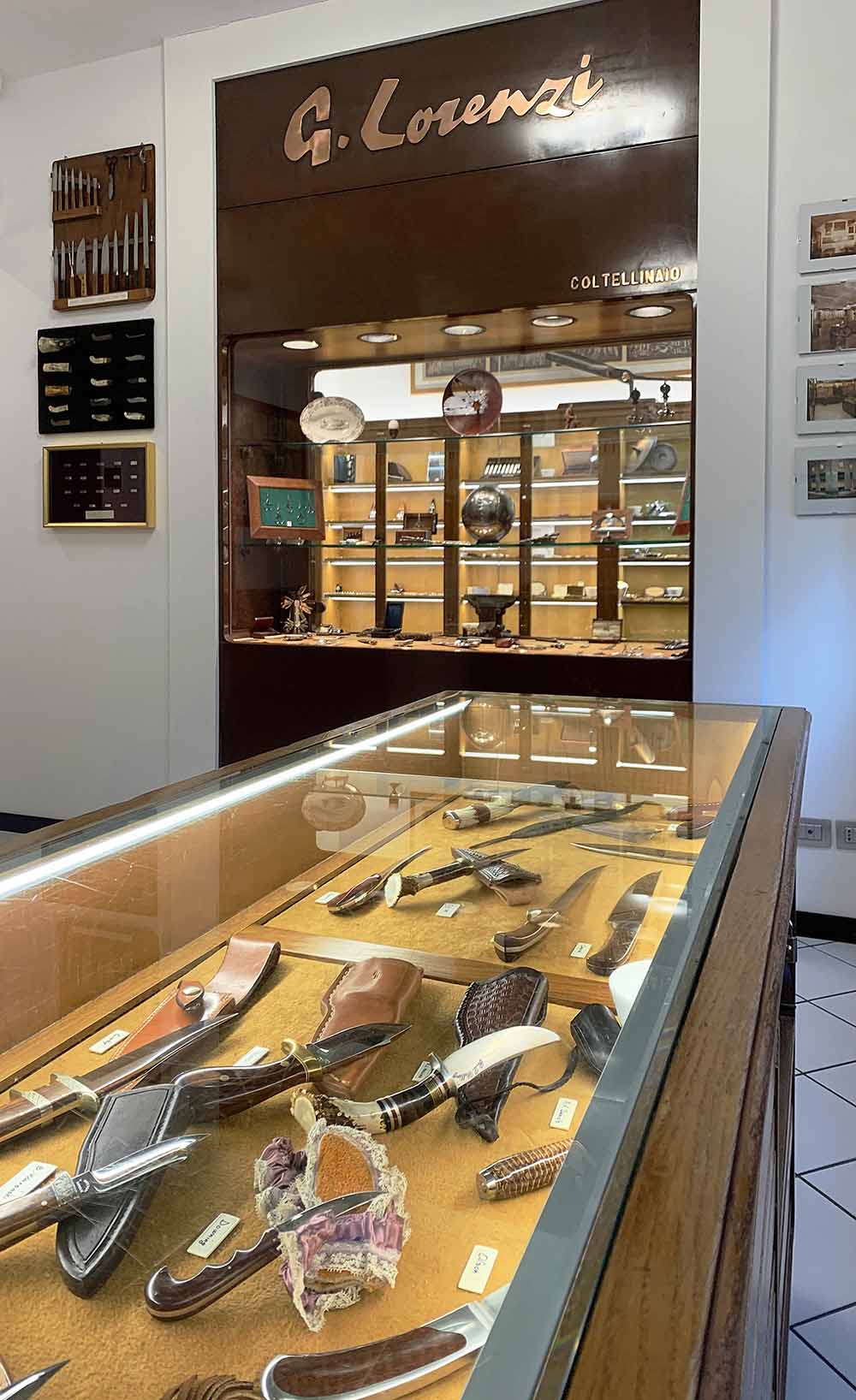
An exterior display window (shown here in the background) from the original G. Lorenzi shop is a centerpiece of the Lorenzis’ new museum. It was one of the store’s six “eyes” that communicated with window shoppers in one of Milan’s most exclusive retail districts, the counters of which, over the years, displayed more than 18,000 types of items. In the foreground is a display case of some of the Lorenzis’ favorite custom knives. (Francesco Pachi image)

“More loyal ambassadors of the art cannot be found,” one sitting Cutlery Hall-Of-Fame member noted of the Lorenzis. “Their store was like a museum, always welcoming visitors and ready to educate them on fine cutlery and custom knives. Several prominent collectors got their start by buying a custom knife at the Lorenzis’ store.”

In fact, the Lorenzis have assembled their massive collection of over 2,000 knives (including 150 custom knives by the world’s best makers spanning the past half century), 700 books, 1,000 magazines and prints, and related items in a new state-of-the-art museum in Milan (December BLADE®, page 60). The museum contains the knives in elegant oak display cases, a recreation of the copper-paneled room that featured the small entrance door to the G. Lorenzi store in Milan, a wooden portable knife grinder used by Aldo’s father and the store’s namesake, Giovanni Lorenzi, almost a century ago, and much more.

Bill Ruple
Bill Ruple

Bill Ruple

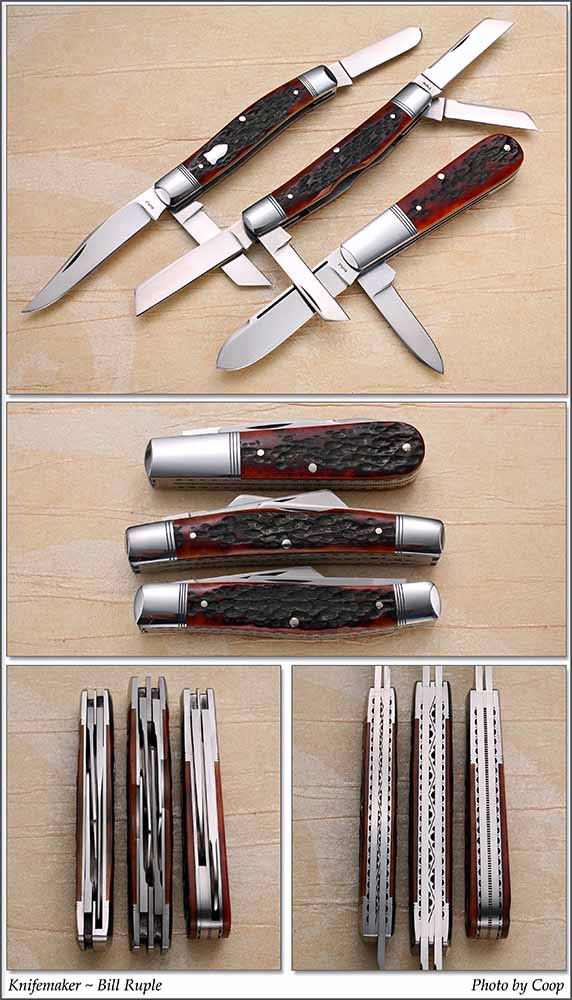
In the eyes of one sitting member of the Cutlery Hall-Of-Fame, Bill Ruple, an award-winning custom knifemaker specializing in traditional pocketknives/slip joints and multi-blades, has done as much as anyone to promote the knife business. Bill served on the board of the Texas Knifemakers Association, taught many how to make traditional knives and is very free with his knowledge. In recognition of this fact, he was presented with the BLADE Show 2019 Aldo and Edda Lorenzi Award. The award went to a knifemaker who excels in terms of teaching and mentoring his or her fellow makers in the art of knifemaking.

Having built knives for 34 years, Ruple is a premier maker of slip joints and possesses a selfless willingness to teach others how to do it, usually in his shop in Pleasanton, Texas, and also at BLADE University, the BLADE Show, BLADE Show West and other venues. He has helped many get started with the slip joint, one of the oldest yet most challenging folders to make. His kindness and patience validates something other makers know all too well—that he is most willing to share knowledge with and encourage, critique and mentor makers everywhere.

A selection of Bill Ruple’s slip joints in an array of open, closed and spine images show Bill’s awesome talent and versatility as a knifemaker. (SharpByCoop image)

Bill has taught quite a few who have become award-winning makers in their own right, including Rusty Preston, Luke Swenson, Tom Ploppert, Phil Jacob, Bubba Crouch, Toby Hill, Enrique Pena and others. A number have gone on to teach also, spreading Ruple’s knowledge to others who no doubt do the same as well. Bill does not limit his shared knowledge to just stock removal makers, receiving the American Bladesmith Society’s President’s Award for teaching ABS members how to make slip joints. Finally, Bill has donated some of his knives to knife shows and other cutlery organizations to raise funds for their various needs.

Hall Of Fame Criteria

Selected by a vote of sitting Cutlery Hall-Of-Fame members, the inductees are selected based on the following criteria: demonstrated extraordinary service to the knife industry; displayed honesty, character and integrity; advanced the industry by the creativity and originality of their works or contributions; as ambassadors or outstanding contributors, have furthered the positive impact of the knife industry on the world at large, and, in summary, have demonstrated a worthiness to be a member of this prestigious group.

The latest inductees exhibit all these qualities and more and represent a most worthy Cutlery Hall-Of-Fame induction class of 2022.

Read About Past Hall Of Fame Inductees:

BLADE Magazine Cutlery Hall Of Fame Welcomes Five New Members

BLADE’s Cutlery Hall Of Fame Welcomed Five New Members In 2021 At Induction Ceremony In Atlanta.

BLADE Magazine Cutlery Hall-Of-Fame® member B.R. Hughes set a most appropriate tone for the Hall’s 2021 inductions early Saturday morning of the BLADE Show in the Kennesaw Room of the Renaissance Waverly Hotel.

“Over the years I’ve noticed one thing about the man and lady selected for the Cutlery Hall Of Fame,” said one of the co-founders of the American Bladesmith Society in his speech inducting Joe Keeslar. “They are not so interested in themselves so much as they are others.”

In addition to Keeslar, B.R.’s words apply equally well to the four other new inductees: Beverly and Billy Mace Imel, Jay Hendrickson and Jim Sornberger.

Joe Keeslar

Joe Keeslar
Joe Keeslar

Speaking of Keeslar, along with Sornberger, Joe was voted into the Hall last year. However, since the pandemic canceled BLADE Show 2020, it also postponed their formal inductions until this year—none of which dulled Keeslar’s appreciation for B.R.’s speechifying ability.

“[BLADE® editor] Steve Shackleford contacted me last spring and told me I would be inducted into the Hall Of Fame … The first thing I did was call Mr. Hughes and asked him to do my induction speech. You can see why. I asked him to give his best $20 speech,” Joe deadpanned to laughter from the 60-or-so gathering of the inductees’ families and friends. “I think I’m going to have to give him a few dollars to make up for that.”

In his baritone voice and measured manner, B.R. outlined Joe’s early history as a United States Marine Corps veteran of the Vietnam War, marriage to Suzanne, making knives and also fine muzzleloading rifles, and getting his college degree. In 1989 Joe earned his ABS master smith rating and it was also about that time Suzanne, who, in her job as a professor at Murray State University, started taking her students to France in the summer to enhance their French language skills.

“Naturally, Joe had to build a shop over there so he could make knives, and he taught many Frenchmen how to make knives,” B.R. noted. “He also was asked to demonstrate at the Thiers Knife Show, the second largest knife show in France. This practice continued for years. He’s been a wonderful ambassador in preserving the art of bladesmithing.”

Joe went on to become chairman of the ABS, serving in the position longer than all but two others, ABS master smiths Bill Moran and Jim Batson, both members of the Cutlery Hall Of Fame. He’s taught knifemaking at the William F. Moran School of Bladesmithing, Haywood College, hammer-ins in Alabama, Arkansas, North Carolina and Ohio, played a lead role in the rapidly expanding ABS youth program, and taught classes for the first four years of BLADE University. He also authored two how-to books: Handles and Guards and Forging and Finishing the Brut de Forge Knife. Joe thanked three people in particular: Suzanne, their son, Kurt, and B.R.

“Suzanne and Kurt have given me so much over the years in terms of support,” he began, “but the thing they gave me most, they gave me time. Time is a special commodity. You can’t put it in a box or on a shelf and come back in a week and retrieve it. The time is gone. You have to use it when it’s available to you. They gave me time to be me, to do what I wanted to do, in this case the knives and some with the guns, too.”

He also credited B.R. for 30 years of friendship. “I trusted his judgment on the things that came up when I served on the ABS board of directors,” Joe said. “He was there as my mentor and savior, he was helping me decide on the things I needed to be involved in, understanding how the ABS works, what our goals are and all the things I needed to know.”

Jim Sornberger

Jim Sornberger
Jim Sornberger

Cutlery Hall-Of-Famer Ken Onion gave the speech inducting Sornberger and outlined Jim’s pre-knife career, which was pretty impressive in its own right. “Guns, knives and tools were the things that molded Jim,” Onion began. “His grandfather gave him a Rudy Ruana knife when Jim joined the Boy Scouts, and his uncle in Redding, California, owned a gun shop with a large knife display. It was there Jim met Harry Morseth in the mid-fifties.”

Sornberger joined the Army in 1963 and became an advisor in Southeast Asia, moving around Vietnam, Cambodia, Thailand, Laos and other countries. After his discharge he joined law enforcement and shortly thereafter became a deputy with the Santa Clara sheriff’s office. From there he became an agent for a federally funded narcotics task force for several California counties, and later worked as a narcotics intelligence officer for military and other agencies in and out of the state.

Following a work-related injury, Jim focused on one of his lifelong loves—making jewelry—while recovering. One of the places that sold his jewelry asked him to make knives. He became a regular attendee and table holder at the San Jose gun show, where he met such storied knifemakers as D.E. Henry, Dave Pitt, Ron Richards and Bob Holt. They and others started a knife show—the Bay Area Knife Collectors Association Show—for which Jim wrote the bylaws. “BAKCA,” as it was known, enjoyed what Onion called “30 years of great shows and wonderful memories.”

Jim joined the Knifemakers’ Guild in 1976 and served on the board of directors, including a stint as vice president. By the late ’70s he’d won several awards for his knives, including his San Francisco-style dress bowies. In 1981 the industry was having quality control issues with 154CM stainless steel, so Bob Holt and Jim started H&S Supply and sold ATS-34 stainless in large quantities, as Onion noted, “essentially introducing it to the entire knife industry.”

Jim gave thanks to his two grandfathers for the time they spent with him and serving as his role models. “It’s really nice to be rewarded for something you’ve done a good part of your life and still enjoy doing—and I’m not quitting,” the 75-years-young Sornberger reassured the audience. “I’ve still got plenty of years left, I think.”
Indeed, for the man Onion called an encyclopedia of the history of the custom knife world, who continues to write for KNIFE Magazine and other outlets, and who travels worldwide, the best may yet still be to come.

Beverly & Billy Mace Imel

Beverly & Billy Mace Imel

Beverly and Billy Mace Imel served as secretary/treasurer on the Guild board of directors for 15 years and were rocks in terms of doing the behind-the-scenes work that was so important to the running of the organization. In fact, when Billy first started making knives in the early 1970s, Beverly did all the bookkeeping for Billy’s knifemaking operation and has ever since, the two celebrating their 61st wedding anniversary June 11. Notably, they are the first married couple to be inducted simultaneously into the Hall. (Cutlery Hall-Of-Famers, Mr. and Mrs. A.G. and Goldie Russell, were inducted separately.)

A tool-and-die maker by trade, Billy was inspired to make knives in 1972 before going on a hunt. He saw a Ted Dowell integral hunter and decided it would be a good knife for the trip, but it cost $100—too much for him to pay for a knife at the time. One thing led to another and Billy tried his hand at making knives, and soon discovered how much work it took to make a good one. Someone saw them and asked Billy how much he wanted for one. “Bill said he never thought about that but he wasn’t charging a hundred because that damn sure isn’t enough, so he said two hundred,” Jim Sornberger winked in his speech inducting the Imels.

Billy joined the Guild in 1973 and the Imels eventually exhibited at shows in Japan, Europe and elsewhere, basically doing everything together. In the process, Billy became one of the world’s best knifemakers. “In the mid ’70s there were several people I was really fascinated with who did a really good job on their knives, the fit, the finish, the detail and the sharp lines,” Sornberger recalled. “And Billy was No. 1 on my list.” A long-time member of the NRA, Billy also made knives for the speakers at the association’s annual convention, including one each for Presidents Ronald Reagan and George H.W. Bush.

In 1984 the Imels were elected Guild secretary/treasurer and Beverly in particular changed forever how the position would be viewed. “She was unbelievable,” Sornberger stressed. “This was in the day before portable phones and you didn’t have a stenographer to take notes, but no matter what we asked her during business meetings—How much did it cost? How many tables did we have? Who made a motion at this meeting?—Beverly had the answer. She’d just tell ya’, boom, who made the motion and who seconded it, and how she got all that stuff I’ll never know. She was the backbone of the Guild for 15 years.”
Regrettably, the Imels were unable to attend the ceremony but sent a heartfelt written thank you instead.

Jay Hendrickson

Jay Hendrickson
Jay Hendrickson

As inductor Johnny Perry noted, when Jay Hendrickson started making knives in Frederick, Maryland, in 1972, it wasn’t long before he learned there was another bladesmith in the neighborhood who just so happened to be the best in the world at it—Bill Moran. Jay met Moran, visited Bill’s shop now and again, and, through practice and dedication, became a bladesmith and joined the ABS.

Jay earned his ABS journeyman smith stamp in 1986—the same year being elected to the ABS board of directors—and his master smith stamp in 1989. Around that time, he was instrumental in establishing the William F. Moran School of Bladesmithing and also taught bladesmithing there, writing and illustrating the manuals used in some of the courses.

He was elected ABS chairman in 1991, succeeding the only chairman the ABS had ever known—Mr. Moran. In all, Jay served on the ABS board of directors from 1986-2018. He and his wife, Nancy, helped develop and coordinate the Bill Moran Hammer-In in 2003 in Frederick and kept it running for two more years before Mr. Moran’s passing in 2006.

Jay was co-chairman of the All-Forged-Blade Expo in Reno from 2003-07 and was instrumental in forming the William F. Moran Jr. Museum and Foundation in Frederick in 2006. He was president of it for 10 years, and today remains on its board of directors. The museum includes a number of Moran’s top knives, “a dressed-up version” of Moran’s knife shop and much more.

“All the effort Jay has put into the museum and foundation is immeasurable,” Johnny noted. “It required years and years of responsibility, but Jay bore it well and got the job done.”

The inductee gave special thanks to his wife, Nancy. “I wanted to thank her for all her help over the years, taking care of all the details, all the flight reservations, all the laundry, all the packing of suitcases. Sometimes when she gets tired she even lets me mow the lawn,” he said to audience laughter.

Jay went on to relate the story of when he was a kid shopping at a sporting goods store with his dad, who told the young Hendrickson to go pick something out for his birthday. Jay went to the magazine rack in the back of the store and saw the Gun Digest Book of Knives.

“I’d been making some knives, nothing big, but I’d been making them since I was a kid, and I looked at the book and it looked interesting,” he recalled. “And I looked down at the bottom and I see the names B.R. Hughes and Jack Lewis. Well, I didn’t know who these characters were but it didn’t matter, so I thumbed through it real quick and said this is a deal!”

Jay’s dad bought the book and Jay read it and told himself, “I can do this.” Looking at B.R. seated in the room, Jay remarked, “B.R., you helped me out a lot with that book and little did I know that one day I would get to meet you, serve on the ABS board with you, and over the years you would help me quite a lot with my knifemaking.

“I remember when B.R. got inducted into the Cutlery Hall Of Fame and he said something like he didn’t think he was worthy of this but he wasn’t going to give it back. Touché—the same with me.”

Read More

Advertisement

Must Read Articles

Read this before you make a knife

Knifemaking 101 – Read This Before You Make a Knife

  by Wayne Goddard My experience has taught me that there's nothing like digging in and getting started. I've often said the hardest part of the...
how to forge damascus steel

How to Forge Damascus

Advertisement
Advertisement