

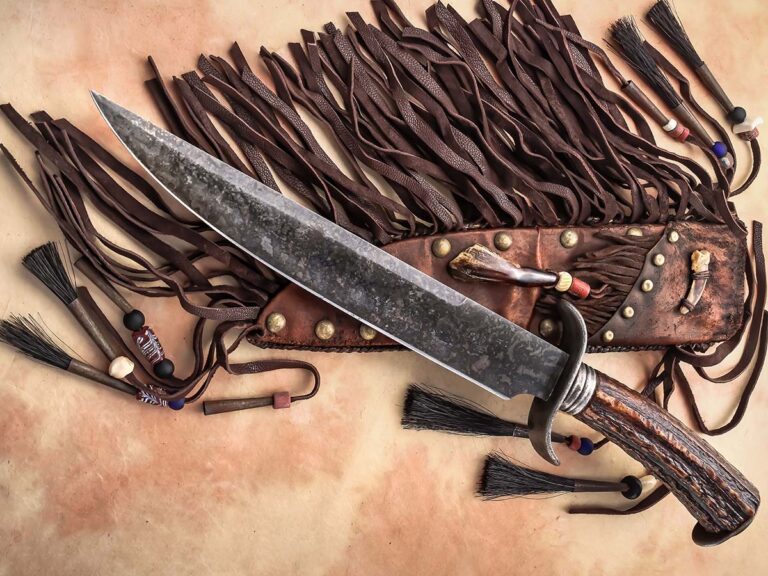
Truly an American design, the bowie continues to inspire today’s makers.
While its roots may be from across the sea, ties to the makers of old Sheffield and elsewhere, the bowie is today distinctly American. And it has been for more than two centuries.
Made famous by BLADE Magazine Cutlery Hall-of-Fame® member Jim Bowie and the fabled Sandbar Fight, no doubt present at the Alamo where Americans fought and died for freedom, and seen in countless photos of soldiers going to war—posing with the burly bowie in a proud moment—the iconic knife was also immortalized on the silver screen with the classic The Iron Mistress and other films. There is no other style of knife that more clearly defines the American spirit.
“Bowies are the quintessential American knife, deeply steeped in the mythos of our collective history,” observed ABS journeyman smith Matt Parkinson of Dragon’s Breath Forge. Shawn Shropshire of SDS Knifeworks agrees. “The bowie is the most iconic or at least the most recognized of American knife designs,” he said. “At the time of the Sandbar Fight, there was no single pattern that was called a ‘bowie knife.’ It varied in size, blade shape and even materials. Cinema later created what most people now recognize as the bowie knife, something with a large blade, clip point usually, with a double guard.”
ABS master smith Lin Rhea commented, “I do indeed believe the bowie knife is America’s knife design. It was created to fill a need. The country was expanding and was very wild and without law and order. The average traveler in the lawless wilderness needed a reliable defense weapon that could be carried on their person, that never misfired and was less conspicuous than a sword. The fact that a large knife was used in self-defense by Jim Bowie in the infamous Sandbar Fight just boosted the design into the realm of legend.”
Wrapped up in fact, fiction, myth, legend and lore, the bowie is a constant in the theme of adventure and survival. Although it does exhibit common attributes—among them impressive size—across the design, there are variations on the theme. To this day, the bowie remains a favorite form of expression for custom knifemakers who tip their creative cap to the history of the design and imprint their own skill, expertise and perspective on this truly American blade.
Barbary Coast Bowie
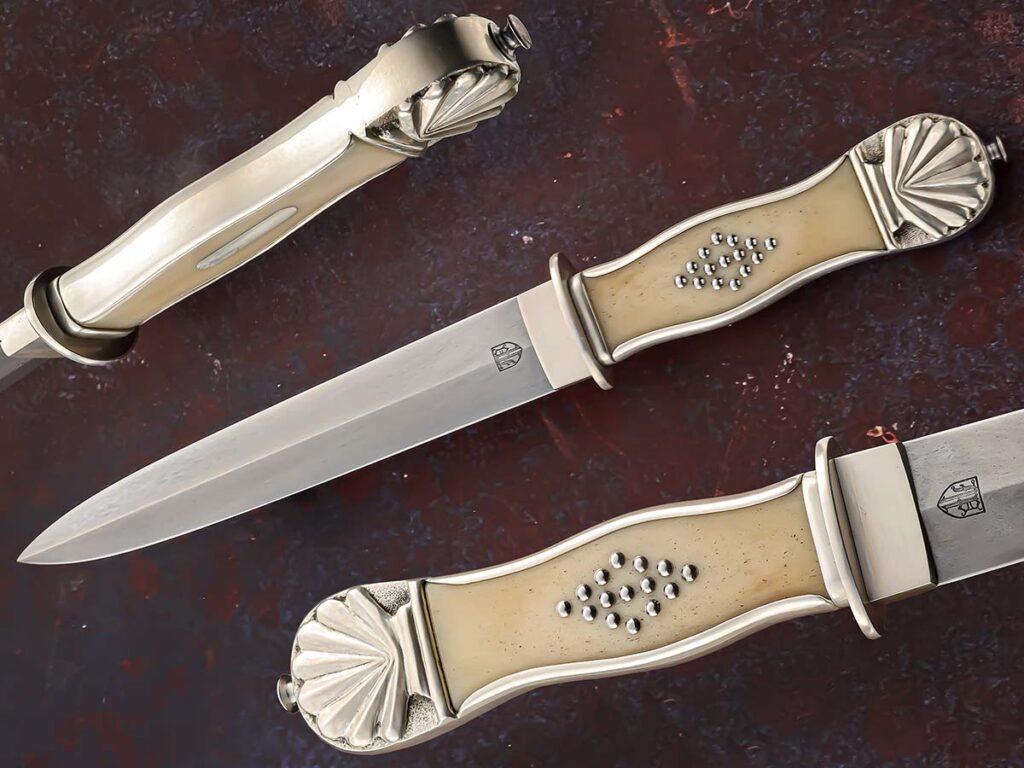
Parkinson chose the San Francisco theme to highlight his take on the classic bowie. Representative of the days of the Barbary Coast and the rough-and-ready youth of a nation stretching from sea to shining sea, the idea captivated him.
“I have long been intrigued with the California- or San Francisco-style bowie,” he remarked. “They are graceful and sleek in a way that many bowies are not. In designing this particular piece, I looked at as many examples of this style as I could, both originals and contemporary. I didn’t copy anything but tried to match the design cues I saw in the originals that made them so iconic.”
Matt’s San Francisco Bowie features a 6.25-inch blade, an overall length of 11.75 inches, a bone handle and generous applications of stylized silver in shell and pin. “The blade is forged from my own wootz steel,” he noted, “and the bolster in front of the guard was cast, as was the shell pommel, and the guard and frame are all fabricated from sterling silver.
“One of the things I most admire about the California style bowies is the uniquely American lineage. Much of the bowie styles we think of are influenced by the Sheffield and London makers …This isn’t the case with the California makers. The knife they made for the 49ers used local materials and was a show of wealth, as much jewelry as a weapon. I kept these ideas in mind in making this one. The cow bone was a logical choice and a nod to local materials, as was the choice of sterling silver over nickel.”
Antiques Actualized
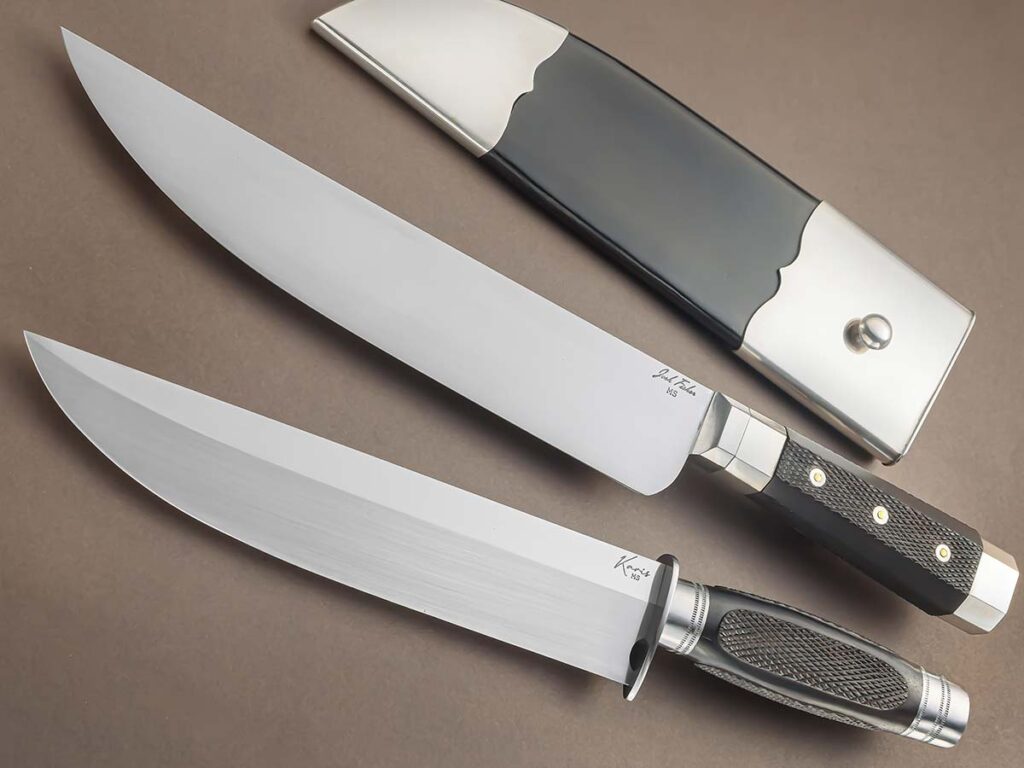
The father-daughter ABS master smith duo of Josh and Karis Fisher share their own interpretations of the bowie with a pair of stunning knives touching the past. Each took inspiration from circa 1830 bowie designs: Josh the Schively-Perkins and Karis a Daniel Searles.
“I kept my reproduction similar to the original and as close in size as I could, so it would look and feel like the real knife,” Karis said. “I was mostly working from photographs, which made studying overall design really important. I also made a few changes to incorporate my own style. I left off the original silver pins and did hand checkering instead. I also changed the ferrule and butt cap. I didn’t use silver wraps. Instead, I used a combination of liners and spacers to match the original while adding my own style.”
“A few techniques that I used on my bowie were hand-checkered African blackwood on the handle and the silver ferrule and butt cap that I had to silver solder together, which was a challenge. It’s definitely a functional knife,” Josh reported. “While it’s on the larger side, it’s very well balanced due to the silver wraps on the ferrule and pommel.”
Capturing the notion of the bowie’s place in Americana, Josh related that his work in 80CrV2 carbon steel and sterling silver is true to such spirit. “It is a reproduction of an actual antique bowie knife,” he stated. “In my opinion, a bowie is a large fixed-blade knife, at least 10 inches in blade length, that is on the thicker side. I think typically they should have a clip point, but there are some exceptions as you can see in mine and Karis’s bowies.”
Small & Spruce
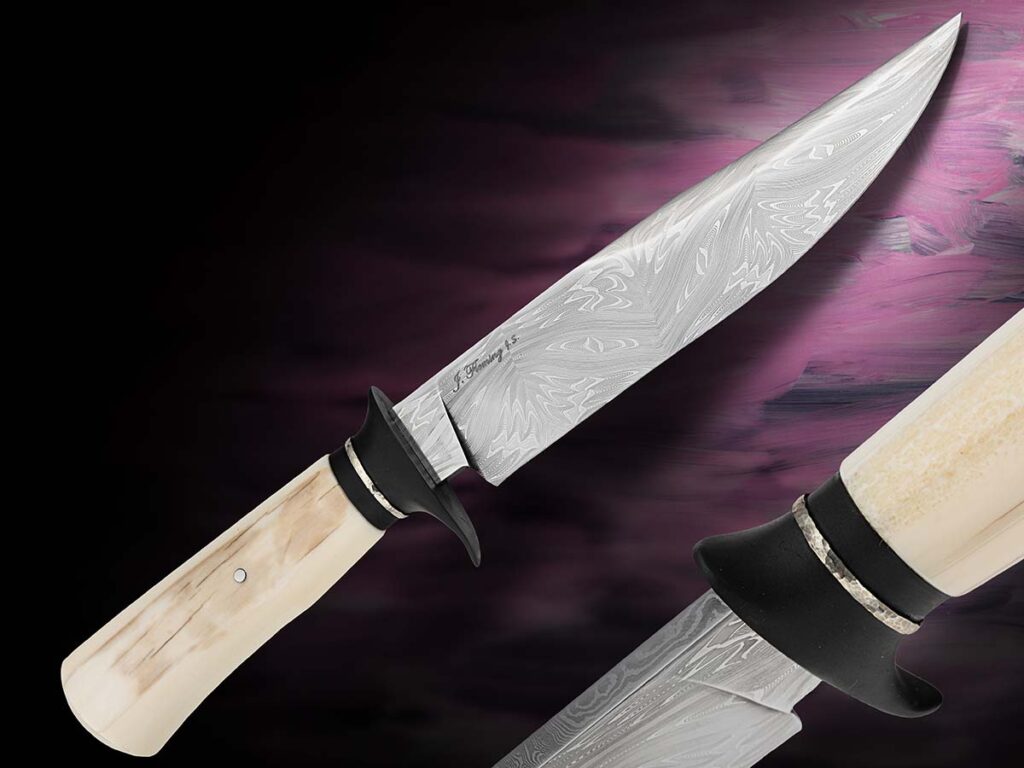
Working at Wasteland Forge, ABS journeyman smith James Fleming has produced a gentleman’s bowie, diminutive in comparison to others but no less representative of the style. The 6.5-inch damascus blade is complemented by an ancient walrus ivory handle with a nickel silver spacer and Parkerized steel bolster for an overall length of 11.5 inches.
“I wanted to make a knife that capitalized on the mosaic damascus pattern,” James explained. “I think the gentleman’s vest bowie complements the pattern. The knife is pretty recognizable as a bowie. It’s not as large as a regular bowie but has the same look and purpose. It fits the term ‘vest bowie’ perfectly. It is small enough to be concealed but large enough for defense in any western saloon. This is the kind of knife you’d see stabbed into a poker table after accusing someone of cheating at cards!”
The damascus pattern came from Fleming’s experimentation with Mareko Maumasi’s pattern-making process. He named it “Nazar,” which translates from the original Turkish as “evil eye.” He added, “I was also inspired by Lin Rhea in the way he makes his fittings. The nickel spacer is domed around the guard and bottom spacer, and it’s hammer textured to give it a nice look and feel in the hand.”
Mammoth Achievement
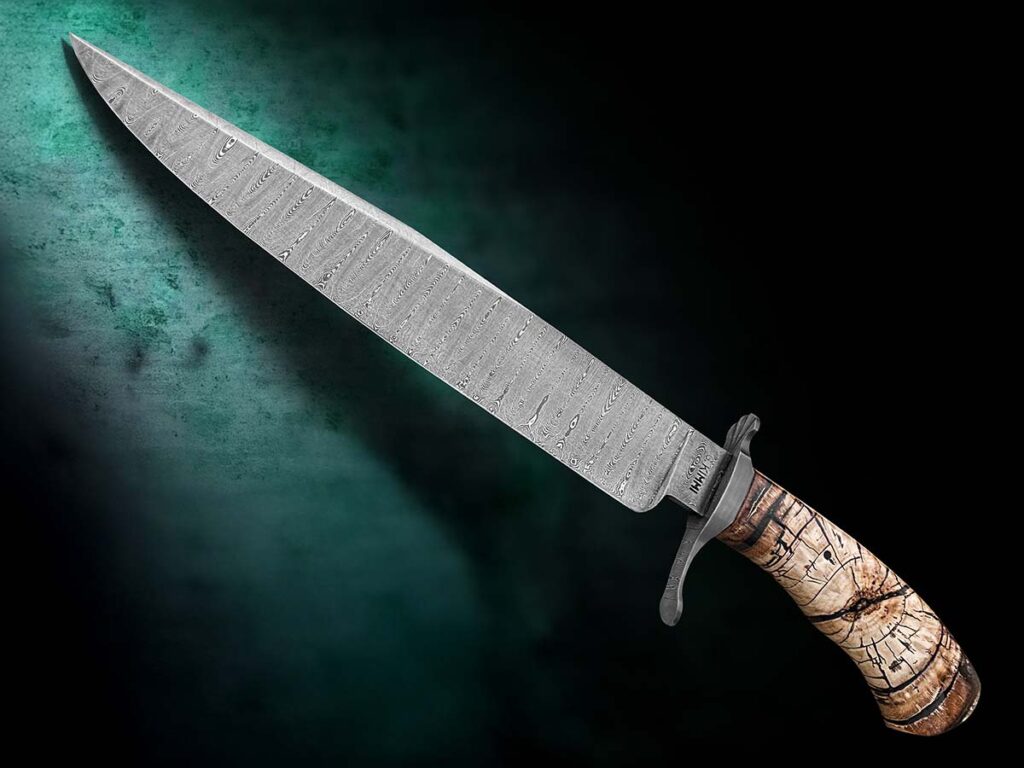
Gene Kimmi was intentional with his contribution to the bowie’s visual discourse. “I have always had a liking for the larger bowie knives,” he remarked. “When I made some laddering dies for my press, I knew one of the first knives I would make out of ladder-pattern damascus would be a large bowie. This one has some clam-shell type filing on the guard that I haven’t done before. The handle is heirloom/museum fit to the guard also.”
Gene’s bowie features the ladder damascus in a 9 7/8-inch blade and crosscut mammoth tusk handle with G-10 black pinning for an overall length of 15.25 inches. “The design is easily recognizable,” he asserted. “Anyone who sees it instantly thinks bowie. The lightness and the fit to the hand are attributes that everyone who handles it comments on. The uniqueness of the mammoth tusk handle adds to the beauty of the damascus. When I think of a bowie knife, I see a straight-backed blade of at least 6 inches. Limits can be pushed on the style and attributes of a bowie, maybe because of the mystery of the bowie knife’s beginning.”
User-Friendly Fighter
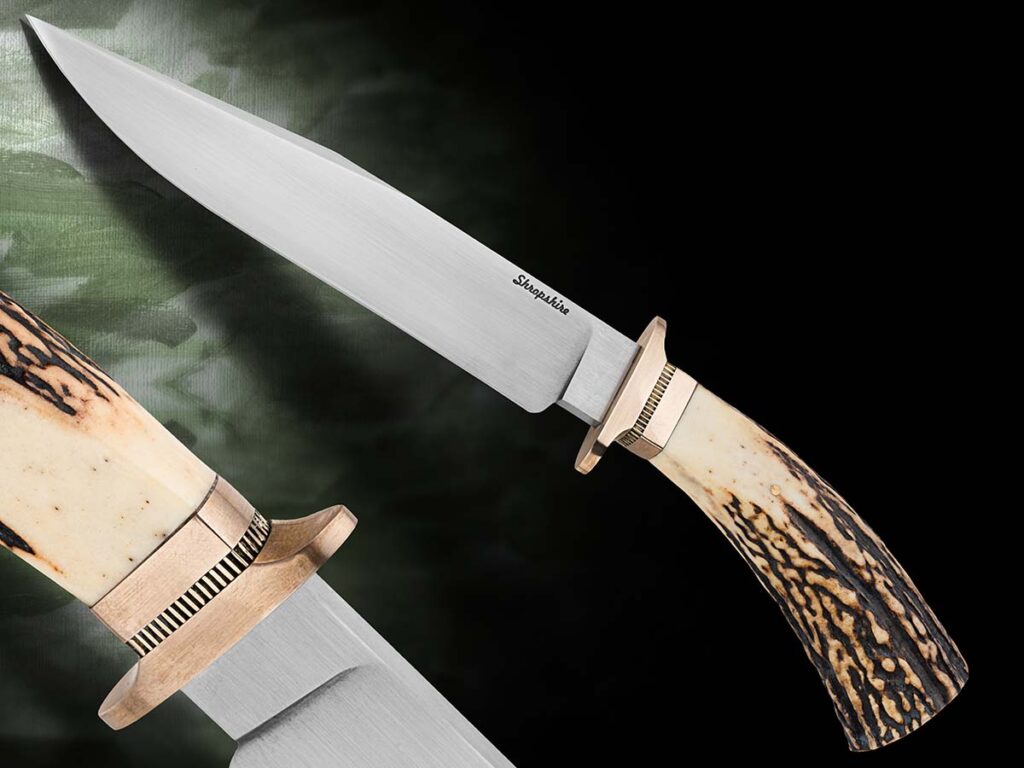
The famed Randall Model 1 provided some context for Shropshire to fashion his bowie of a 7.5-inch, 1084 carbon steel blade and stag handle with bronze bolster and an overall length of 12 inches. The proprietor of SDS Knifeworks blended the pattern with a desired functionality.
“I love making the larger versions of the bowie knife that many people think of, but as much as I enjoy them, they just aren’t very practical,” he reasoned. “This size and style is much more useful and easier to carry. It’s still a classic-looking pattern and functional without being so large that it is cumbersome and difficult to carry. I love the classic-looking lines paired with the look and feel of natural stag.”
After perusing photos of historical blades and the work of other makers, along with hours using a sketch pad, Shawn was pleased with the result. “In my opinion, this particular blade would have been right at home during the mid-to-late 1800s and at any time considered a bowie knife,” he advised. “I think most people today might refer to it more as a fighter because our notions of what a bowie knife is have been heavily influenced by cinema. The movies usually represent bowie knives as larger than life. Some were but many were not. I do think this blade hints at the history of what an American bowie is with the overall shape and the stag grip without instantly screaming ‘bowie knife.’”
Throughout the creation of his bowie, Shropshire kept user friendliness front and center. Aside from visual appeal, he designed it for easy carry with shorter “legs” on the guard and a coined spacer to help break up the smooth lines it exhibited.
The Legend Continues
The bowie theme lives—in thought, folklore and tangible craftsmanship. Staying true to its American heritage, the style has gained lasting fame and a following the world over.
Read More:
- What Knife Would Jim Bowie Carry Today?
- Cool Custom: Robert Burns’ Ancient Iron Bowie
- Best Bowie Knives: In Case You’re On A Sandbar And Need To Fight
- Huber Foxworth Bowie: The Men Behind The Blade
 NEXT STEP: Download Your Free KNIFE GUIDE Issue of BLADE Magazine
BLADE’s annual Knife Guide Issue features the newest knives and sharpeners, plus knife and axe reviews, knife sheaths, kit knives and a Knife Industry Directory.Get your FREE digital PDF instant download of the annual Knife Guide. No, really! We will email it to you right now when you subscribe to the BLADE email newsletter.






It’s NOT an American design….its actually a fantasy dream-up by Sheffield cutleries….because NOBODY really knows what type of knife Jim Bowie used…the closest witness called it a large kind of kitchen ( Chef knife) type!!!
Sheffield was quick of making money with a fantasy product they called a Bowie knife.
So, no it is a American story…but NOT an American design by construction!!
Shefgield fooled all of us!!