

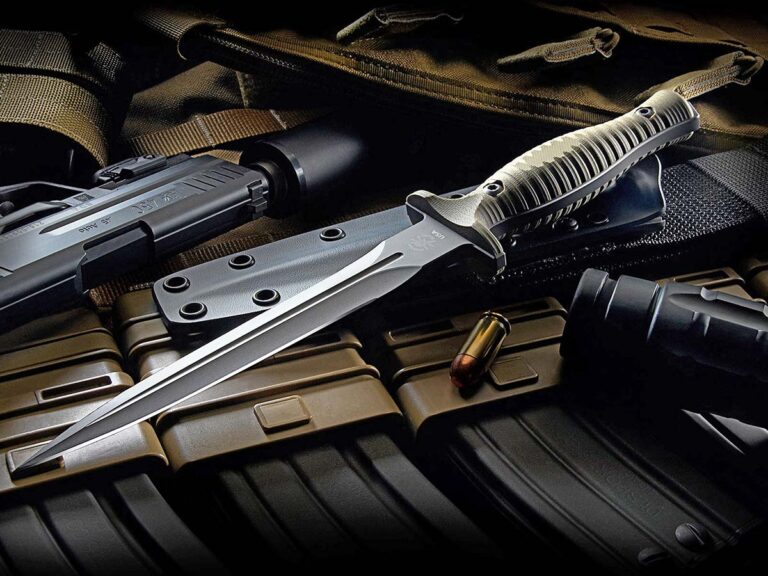
Form, function and purpose of daggers–the most stab-ready knives.
Few weapons are as simple in concept yet as demanding to design as the dagger. At first glance, it is merely a blade—sometimes short, sometimes long, usually but not always double edged—yet every aspect of its form has been refined over millennia for one purpose: stabbing. Unlike blades that balance cutting, slicing or chopping, a dagger’s geometry, materials and ergonomics allow no compromises in pursuit of its one purpose.
From early Bronze-Age thrusting knives to the stilettos of the Renaissance, every angle in any dimension maximizes straight-line penetration. Whether for combat or display, understanding this purpose is essential for anyone who wishes to design, craft or appreciate these edged weapons. Even the most ornate ceremonial dagger should appear “stab-ready” at a glance, communicating the implied threat of the utilitarian tool with a statement of status and opulence.

Dagger Design Points
Every deadly stab starts with three critical design choices that define a dagger’s unwavering purpose. A dagger blade must have sufficient spine thickness and ricasso rigidity to resist excessive bending under thrust load; it should be tapered to an acute but robust point for minimal tip-entry resistance; and it requires flexibility balanced with rigidity so it can reach vital organs, often protected by armor, without breaking.
Early thrusting blades illustrate this principle as far back as the late Bronze Age. A broad base near the guard tapers rapidly to a narrow point, ensuring rigidity at the grip and sharpness at the tip. By the 1st century A.D., the Roman pugio perfected it. With a base often exceeding 5⁄16 inch in thickness and a central ridge tapering to a sharp apex, the pugio shed weight without losing stiffness. In practice, its point could pierce leather, flesh or weak links in chain mail, while its spine endured repeated jabs against shield bosses and bucklers.

Yet precision in stabbing demands more than brute strength, it requires avoiding gratuitous cutting‐oriented features in a thrusting design.
Serrations, upswept points, hooked tips, prying points and even bottle openers can be handy on a knife, depending on the task, but all of these undermine the straight-line force a dagger needs and disrupt smooth entry. If you ever find yourself in a situation where stabbing is required, by all means use whatever you’ve got—just don’t complain when your bottle-opener tip gets snagged in an assailant’s clothing. However, if you have the luxury of time and thought to design and make a dagger, strip away anything that doesn’t serve pure penetration. A dagger’s geometry remains laser-focused on stabbing effectiveness.
Lastly, a dagger must balance penetration depth with material limits. A tip too slender might break or bend against bone or metal, while a tip too blunt simply won’t enter. Ancient workers of bronze and iron didn’t have modern labs or spreadsheets, yet somehow found the Goldilocks Zone that balanced reach and resilience. A well-tempered tip is tough enough to survive bone contact without snapping, yet with correct geometry stays stiff enough to slip between armor plates. Only through precise taper and temper can a dagger achieve depth without sacrificing strength.

Combat Daggers Vs Art Daggers
From the earliest times, daggers fell into two broad categories: weapons of combat and symbols of prestige.
The combat dagger was stripped to essentials—minimal ornamentation, maximum toughness—while the art or status dagger has always been free to bend the rules of pure function to satisfy aesthetic expression and make statements of personality and prestige. Nonetheless, even the most ornate display piece must exude “stab-readiness” at first glance, a silent promise inherited from its lethal lineage.

Surviving examples of Roman pugios from army camps demonstrate the utilitarian design, but gilded pieces from the same era, with elaborate inlays and inscriptions, do not stray far from purpose despite the decoration. All share the same fundamental geometry: a stiff, thick base, reinforced spine and unwavering taper to a sharp, flat-ground point.
The ornamented variants—often gifted as symbols of rank or worn by the wealthy and powerful—could feature ivory grips or gilded fittings without diminishing their stabbing credibility. Regardless of personal status or the knife’s level of ornamentation, no one who saw a pugio drawn in malice would misunderstand the message or the danger. Combat heritage endows art daggers with an unmistakable threat that no amount of embellishment can conceal, though the pugios that did in Julius Caesar probably looked rather nice.

Another example is the pesh-kabz, a Persian-born dagger later adopted and lavishly ornamented by Mughal weaponsmiths. Its single-edged blade featured a thick spine and acutely tapered point, designed to pierce heavy mail and laminated armor. As Mughal craftsmanship flourished in Agra and Delhi, artisans added damascened patterns, jeweled pommels and silk-wrapped grips. Yet even a fully jeweled pesh-kabz retained the same reinforced spine and narrow, forward-weighted geometry as its battlefield ancestors. Worn at court in gilded sheaths, these daggers exhibited status while making it clear that underneath the glamor was a blade as deadly as any used in war. Art and combat, then, remain entwined.

This enduring marriage of lethality and ornamentation sets the stage for a deeper question: what separates an ordinary dagger from one that truly masters its intended purpose? The answer lies not just in history but in the details of profile, geometry, balance and structural refinement—each a mark of a dagger designed to do exactly what it must.
More On Daggers:
- Dagger Design: Point For Perfecting Blade Performance
- Dagger Design: Fundamentals Of Dagger Construction
- Custom Dagger: Double-Edged Gems That Get To The Point
- Cool Custom: Ryan Breuer’s Relic Dagger
 NEXT STEP: Download Your Free KNIFE GUIDE Issue of BLADE Magazine
BLADE’s annual Knife Guide Issue features the newest knives and sharpeners, plus knife and axe reviews, knife sheaths, kit knives and a Knife Industry Directory.Get your FREE digital PDF instant download of the annual Knife Guide. No, really! We will email it to you right now when you subscribe to the BLADE email newsletter.





