Home Blog Page 142

Now You Can Watch The Knife of the Year® Award Ceremony At BLADE Show

0

Knife of the Year Awards BLADE ShowThe factory cutlery industry’s most coveted honors, the BLADE Magazine Knife-Of-The-Year® Awards will be announced during the BLADE Magazine Awards Reception the Saturday night of the show in a new venue for this year: the Garden Court Area of the Renaissance Waverly Hotel (tickets required).

Also new for this year, the public will be able to view the proceedings for free from outside a roped off area.

The Garden Court Area is the large room at the top of the escalators on the second floor of the Renaissance Waverly Hotel. When you get to the top of the escalators walk straight ahead and you can’t miss it.

The categories are Overall; American-Made; Imported; Most Innovative American Design; Most Innovative Imported Design; Best Buy Of The Year; Investor/Collector; Collaboration; Manufacturing Quality; Accessory; Kitchen; Publisher’s; and Industry Achievement.

The factory entries are limited to applicable BLADE Show booth exhibitors, and will be exhibited show Friday and Saturday in a special display in the show lobby.

Get tickets to BLADE Show 2019, taking place in Atlanta, here.

The List: Top 10 BLADE Show Moments

The BLADE Show is the Gigantopithecus of knife events. How did it get there? In chronological order, let’s review.

1) No Top 10 list can start without the start, and the BLADE Show started when BLADE Magazine Cutlery Hall-Of-Fame® members Jim Parker and Bruce Voyles organized the first one at the Drawbridge Motor Inn across the Ohio River from Cincinnati in Erlanger, Kentucky, in 1981.

2) Jim and Bruce’s creation, in 1983, of the BLADE Knife-Of-The-Year® Awards and the BLADE Magazine Hall Of Fame® set in motion two cutlery industry achievements that today are among the most coveted knife recognitions. Announcing them all at the BLADE Show gave—and to give—both the honors themselves and the show more cachet.

3) Moving the BLADE Show to the sprawling Holiday Convention Center in Knoxville, Tennessee, in 1984, to the site of the 1982 World’s Fair announced to the community that Parker and Voyles were determined to host a serious knife show contender.

4) The decision by the American Bladesmith Society to hold its annual meeting in conjunction with the BLADE Show—which the ABS has done every year since—established bona fides with many in the custom knife industry.

5) The decision in 1992 by Bruce Voyles, who by that time owned both BLADE® Magazine and the BLADE Show, to move the BLADE Show to the Renaissance Waverly in Atlanta thrusted the event onto the international cutlery stage. The show has never looked back.

6) The phenomenon that remains The Pit—the sunken lounge in the Renaissance Atlanta Waverly Hotel—became a magnet not only for revelers after the BLADE Show’s daily closings, but also a place where industry movers and shakers brainstorm new knives and knife innovations that shape the cutlery industry.

7) Then-BLADE publisher David Kowalski’s decision in 1997 to move the BLADE Show from the Renaissance to the adjacent Cobb Galleria Centre exhibition halls expanded the show’s look and size dramatically, and completed its ascension to the status of the world’s largest knife show.

8) The entire cutlery industry came together as one at the 2009 BLADE Show to help defeat the scurrilous attempt by U.S. Customs to classify all one-hand-opening knives as switchblades/automatics. If Customs had succeeded, the sporting knife industry—and thus the BLADE Show—would be shadows of what they are today.

9) The wholesale embracing of the BLADE Show over the past five to 10 years by the international cutlery community as the ultimate knife event has elevated the show to unheard of heights. A wealth of exhibitors—including herds of Knife-Of-The-Year and custom knife judging competition winning makers—dealers, buyers/collectors and industry professionals from every continent but Antarctica have taken the BLADE Show from being not only the world’s largest knife event, but also the most transformative global knife forum of all time.

10) Last, but most important of all, are the many thousands of patrons over the years who have made the pilgrimage to the BLADE Show to enjoy knives, knifemakers and each other in all their splendor. In the final analysis, it is the supporters of any endeavor that make the endeavor go. And nowhere does the preceding statement apply more aptly than in the case of the patrons of the BLADE Show.

The Best Way to Hand Someone a Knife

how to give someone a knife
Feel free to to download and share this image. It could prevent an unintended cut. (Please keep the BLADE logo and URLs, though, OK?)

Knife etiquette often overlaps with knife safety, and this is a prime example. The best way to hand someone a knife is also the politest, as nothing is quite as rude as unintentionally cutting open a person’s skin.

The Technique: Make It Muscle Memory

It’s simple: while holding the handle with your fingers, cradle the spine of the blade in the web of your hand between the thumb and index finger.

This allows the recipient to safely grasp the handle. If the blade slides across the giver’s hand, the skin will come in contact with the spine, not the edge. It also forces the recipient into choosing the safest method to release the knife from the giver’s hand, avoiding any meandering edges.

None other than Ray Mears demonstrates what a successful hand off looks like using this technique here:

The dance of two people using any other technique is as awkward as it is unsafe. Committing this technique to muscle memory so it’s second nature will save time and stitches. Plus, you’ll look like a pro.

The Second Best Technique: Setting the Knife Down

The only other technique that’s as safe is setting the knife down for the recipient to then pick up. That’s not always possible, but it’s still better than someone unintentionally shaking hands with an edge.

Placing fingers on the blade to pass or grab a knife is not only not recommended, it’s not how the knife was designed in the first place. The handle is there for a reason.

The Only Exception: Securing the Blade Inside the Handle

If the knife design allows for the blade to be secured inside the handle (folders, autos, etc.), it’s obviously acceptable to secure the blade first before handing the knife off.

In the quick back-and-forths at knife shows, like the BLADE Show, that’s not always convenient. That’s why it’s worth committing the technique in the above picture to muscle memory.

Pass It On!

Don’t keep this information to yourself. Share the image at the top of the page on your social media, blog, website and with anyone who might need it. Feel free to link to this article, too. 

BLADE wants you to be safe! Enjoy your knives. Treat them right, and they’ll treat you right, too.


Visit BLADE Show Each June in Atlanta

BLADE Show tickets online

It’s the world’s largest knife show for a reason. Click here to join us each year in Atlanta

Buy the Best EDC Knife for the Money

EDC knife review
The Kershaw Knockout offers a bigger design than most EDC, but it’s still lightweight enough to stick in a pocket. (Kershaw photo)

Quick Tips

  • Choose a knife that isn’t too small for anticipated tasks, but not too large to carry comfortably
  • Buy inexpensive ($25 or less) knives if you don’t care that they get lost or broken
  • Pay at least $75 for an average quality EDC
  • Better performing knives start at $100
  • Handle the knife before buying if possible
  • Avoid gimmicks
  • If you can’t figure out how to open it by looking at it, it’s not the right fit

Top 10 Things to Consider in Buying an EDC Knife

  1. Quality materials
  2. Top blade steel
  3. Maker/manufacturer and customer service
  4. Application or cutting tasks it will perform
  5. Price point
  6. Type of lock or mechanism
  7. Design
  8. Ergonomics
  9. Size and weight
  10. Ease of carry

The Best Everyday Carry Knives for the Money

Best EDC knife for the money
With Old Red Bone handle scales, the W.R. Case & Sons “Peanut” is a handsome EDC knife, a two-blade folder weighing in at a light, easy-to- carry 1.2 ounces.

How do you get the best everyday carry (EDC) knife for your money? Will a $25 knife from a big-box store suffice? Is there such a thing as a quality $25 knife, or will it be necessary to spend $100, $500 or $1,000 for a blade? BLADE went looking for answers.

Buying EDC Knives Is Like Buying Cars

How to buy EDC knives
Chris Reeve folders are considered quality knives, with ergonomic
designs, thick frames, solid locks and easy-opening, high-end
steel blades.

“Directing a customer to an EDC knife is somewhat like pointing them toward an everyday car. Some think a base economy model suits them well, whereas others want a high-end luxury model,” says Mike Dye of New Graham Knives in Bluefield, Virginia.

“Obviously, a good mid- or high-end blade steel is paramount. And the feel of the knife in the hand—it must ‘fit’ the user,” Dye explains. “Different handle materials can make a world of difference in the feel of the knife. Micarta, G-10, smooth or worked titanium, stainless steel, bone and stag—these choices are of a personal nature.”

Not Too Small, Not Too Large

Kershaw EDC knife
Mike Dye of New Graham Knives says Kershaw makes great knives in every price point. The full lengths of the flipper folders are ergonomic and flowing, including the blue anodized handles.

Though Dye says everyone likes something different, there are keys to finding the right everyday carry knife. One tip, he notes, is to choose a knife that is neither too small for the tasks it might encounter on an average day, nor one too large to carry daily.

Matt Salazar, store manager for House of Blades, agrees and even has a suggestion as to blade length, saying a 3- to 3¾-inch blade is ideal for an EDC knife. He mentions modern blade steels such as CPM S35VN or M390, as those that are more than adequate for everyday cutting tasks.

“Stick with a good, quality brand that has a track record of great customer service,” Salazar recommends. “G-10 and aluminum are great options, as far as handle material goes, although titanium and carbon fiber are widely available if you want something a little more high-end.”

When Does $25 Cut It?

Dye says a $25 knife might be the perfect choice for a farmer, miner or auto mechanic who uses the knife for any task that comes up.

“If broken or lost,” he states, “it’s easier to repurchase a $25 knife than it is a more expensive piece. For others who are less likely to overwork or ask a knife to do chores it’s not designed to do, a higher-end model with ‘prestige’ might be in order.

“As for a quality $25 knife,” Dye continues, “yeah, they’re out there. Over 40 years ago, when I started selling pocketknives, the China-made knives were a joke. That is not the case today. Some factories in China are producing amazingly high-quality knives at popular prices.”

Dye says such companies as Kershaw and Spyderco (the latter specifically in its byrd line) market knives manufactured in China with great success.

Ontario and ESEE have great EDCs at a reasonable price,” he notes, “and they offer support for warranty issues.”

Disadvantages of Budget Knives

Salazar poses the question, “How long do you want the knife to last?”

“In my opinion,” he says, “you are going to be really hard-pressed to find a quality knife for $25. I will say that Kershaw makes great knives in every price point, but I’d also say that $75 to $100 would get you an excellent EDC knife that should last you many years with proper use. You can certainly spend more, if your budget will allow.”

Many steels in lower-end knives will not retain a sharpened edge for as long as high-quality blade steels, which means more frequent sharpening and a shorter life expectancy for a knife.

“Steel quality, in general, would be the biggest drop-off in opting for a lower-end knife,” Salazar explains. “Inferior edge retention is likely the most significant downfall, when purchasing a budget knife. After all, it’s a cutting tool.”

Higher Quality Equals Better Performance

Microtech EDC knife
The Microtech LUDT Auto 135-1 has a premium ELMAX or M390 stainless steel blade (depending on the date of manufacture) with a 6061-T6 aircraft aluminum handle. Featuring top-notch automatic action, it measures 4 5/8 inches closed and weighs 3.5 ounces. Its size, blade geometry and design lend themselves well to a comfortable and capable EDC knife for $235.

High-dollar production knives, such as those available from Chris Reeve Knives, Hinderer Knives and Zero Tolerance, exhibit quality craftsmanship, better steel options and stricter quality control.

“Look for solid lockup, if it’s a locking folder, smooth action and overall quality construction,” Salazar remarks.

“Generally, when the customer has tired of the off brands and low-end offerings at the big-box stores, they come to me asking for a quality knife,” Dye relates. “That said, most of our walk-in folks have a ceiling of around $50 to $100, and there are dozens of excellent choices in that range.”

Tangible advantages to higher-end knives include titanium versus pot-metal knife frames, and handle materials such as Micarta, carbon fiber and natural bone versus plastic grips.

Fit and finish on higher-end knives are rightly expected to be superior,” Dye states. “A customer will have a good experience with a knife that sharpens easily, cuts well and retains an edge. With high-end EDCs, you start to get into quality frame materials, better steels with superior heat treating and locking mechanisms that hold greater tolerances.”

Handle the Knife Before You Purchase It

Spyderco EDC knife
The Spyderco Para Military 2 folder has G-10 handle scales and a 3.43-inch CPM S30V blade. It weighs 3.9 ounces.

“If possible, handle the knife before purchasing it,” he suggests. “Look for lack of blade play on folders, both horizontally and vertically, and examine lockup. Look at fit and finish. Well-made knives at any price will show well in those areas.”

Dye says, “I tend to steer customers away from fancy opening mechanisms, unorthodox locking mechanisms and knives that have obvious marketing gimmicks associated with them.”

Materials to Consider

Zero Tolerance EDC knife
The Zero Tolerance 0450CF Sinkevich Frame Lock Flipper boasts a carbon-fiber front handle scale with a titanium rear scale and a 3¼-inch CPM S35-VN blade that opens smoothly on a KVT ballbearing system. The knife weighs 2.7 ounces.

Stainless as opposed to high-carbon blade steel is a consideration for Julie Maguire and Ryan Thompson of Arizona Custom Knives.

“In order to be an EDC candidate, a knife should have a high-quality stainless blade. There are more stainless steels to choose from today than ever before. Do your research and choose the one that fits your cutting needs,” Maguire says.

“Finding a knife with durable handle materials is also important,” Thompson imparts. “Titanium, G-10, Micarta and carbon fiber are all great options that hold up well in various conditions.”

Conclusion

One thing is for certain. As knife designs, blade steels, materials and mechanisms improve, the perfect EDC will always be a moving target.


Keep Reading

Best books about knives

This article is excerpted from KNIVES 2019, the world’s greatest knife book. Pick up a copy of this essential knife collecting book here.

Are Integral Knives Stronger Than Standard Knives?

1
Integral knife definition
Edmund Davidson’s “Goliath” integral appears here state. The finish is hand rubbed, requiring hours of laborious work. The finished knife weighs in at 6 pounds, a fraction of the original bar’s weight. Jere Davidson did the spectacular engraving. (PointSeven photo)

Are Integral Knives The Strongest Kind of Knife?

Is an integral knife inherently stronger? According to our gurus, strength in numbers—of parts, that is—is not necessarily applicable here.

“The concept is so much different it changes up the whole equation,” knifemaker Edmund Davidson states. “A hard-use integral knife is stronger than a typical fixed blade. There’s nothing to go wrong. That’s not to say some great [non-integral] fixed blades aren’t being made, but you can’t get any stronger than one big chunk of steel.”

“An integral knife is theoretically stronger, but I’ve never had one of my standard knives break at the guard junction through regular use, either,” knifemaker Marcus Lin says. “I destruction-tested one of my Loveless fighter designs several years ago and it took numerous overhead slams from a 50-pound slab of concrete to break it.

“In terms of getting the job done there’s no difference in either method of construction, as both will result in a knife that will last generations. But I can see the allure for the integral knife because of the time and additional skills involved in making it, which some customers can appreciate.”

Integral knife photo examples
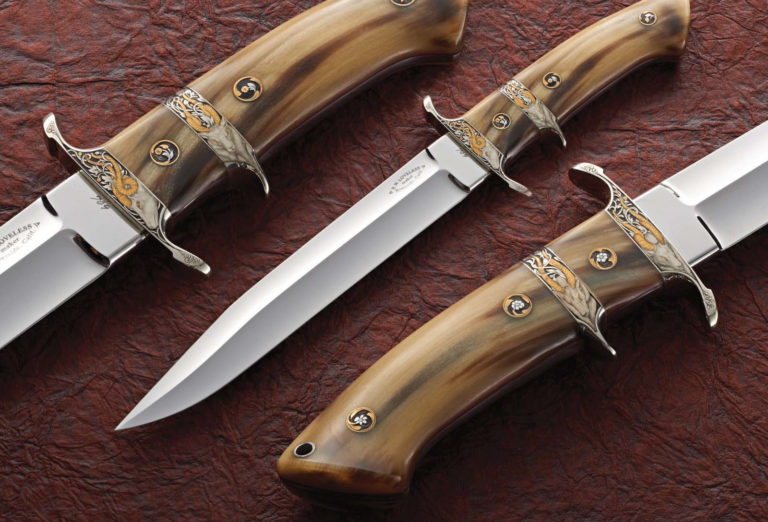
Marcus Lin does the Bob Loveless legend proud with this send-up of the famed integral Loveless Chute Knife. The steel is mirror-polished D2 with a satin finish on the flats of the bolsters. Scales are Sambar stag and a synthetic ivory plug sets off the bolsters. (PointSeven image)

What Is An Integral Knife?

Integral knives, short of the addition of handle scales, are literally sculpted from one piece of steel. Making a knife in this way presents difficult challenges not found in making knives in separate parts, and soldering or screwing them together.

Imagine grinding not only the blade with all its intricacies, but the handle, guard and pommel from one solid piece of steel and sculpting it to perfection. Such a knife is called an integral and any knifemaker who’s ever made one will tell you it’s a whole new ballgame.

How Integral Knives Are Made

“The primary difficulty for me is getting rid of the stock,” Lin relates. “You start out with a couple pounds of tool steel and the finished knife is several ounces. Bob [Loveless]‘s original integrals were made on his horizontal mill. I use a full-size Jet [Bridgeport clone] vertical milling machine, angle grinder, band saw and my 2×72 grinder to make mine. I try to make them as close as possible to Bob’s originals.”

Davidson makes no bones about the difficulty he faces in constructing a one-piece knife.

Integral art knives
Several views of the “Psycho-Tron” integral hatchet from Edmund Davidson’s Safari Trio appear here. This monster was cut from a 7/8-inch-thick piece of CPM 154 stainless steel. Jere Davidson engraved it. (PointSeven image)

“It takes tenacity to build an integral,” Davidson stresses. “You start with a block of steel instead of a strip. You must have the equipment to saw the knife out and machine it. You’re working with all the basics that go into a complete knife in one single piece of steel. The complexities are physically and mentally demanding, and it’s very labor intensive because of the vast amounts of filing and sanding—not to mention hand rubbing the finish.

“There are so many aspects of making an integral that are not associated with making a standard knife.”


See More Incredible Knives at BLADE Show

BLADE Show tickets online

Join us each June in Atlanta for the world’s largest and best knife show. Go to the BLADE Show website here.

Tony Bose, Mel Pardue Inducted To BLADE Magazine Cutlery Hall Of Fame®

Two Longtime Knifemakers Join The Elite Of Cut

Tony Bose and Mel Pardue are the latest inductees into the BLADE Magazine Cutlery Hall Of Fame®. The two living legends of the custom knife industry were voted in by sitting members of the Hall Of Fame, and will be formally inducted at the BLADE Magazine Awards reception during the BLADE Show June 7-9 at the Cobb Galleria Centre in Atlanta, Georgia.

TONY BOSE

Tony Bose custom knifemaker
Tony Bose

When Tony Bose first started building knives, he asked a maker to share a knife pattern with him. When the maker refused, Tony decided that whenever anyone asked him for a pattern he would give it to him, and he always has, sending patterns all over the world.

Few have done more in mentoring and teaching their fellow makers through instruction and by example than Tony, who is perhaps the world’s best-known contemporary custom maker of traditional slip joints. It’s never been his mission to simply make knives. Instead, he aspires to “bring knives back from the dead.”

His love of knifemaking began in 1972, when he made his first custom fixed blade from an industrial hack-saw blade. As he put it, “I’ve been trying to make a knife that I’m completely happy with ever since. It hasn’t happened yet.”

He worked for years perfecting his skills before pursuing a full-time custom knifemaking career in 1990. His impact was quickly felt when he won Best Folder at the 1994 East Coast Custom Knife Show and also at the 1995 BLADE Show.

Tony Bose knifemakerIn 1998, Tony began working as a custom collaborator with Case. Since 1999, among the knives he has designed for Case are collaborations of vintage patterns made in limited quantities on an annual basis. One such offering was the Arkansas Hunter, winner of the BLADE Magazine 2008 Collaboration of the Year.

Tony’s a crowd favorite at Case consumer events, knife shows and swap meets across the country, and he willingly shares his techniques with other makers to keep the art of making traditional knives alive for future generations. He’s also taught classes on knives and knifemaking at BLADE University during the BLADE Show, and for many years made and donated knives for silent auctions at BLADE Shows to raise money for the old National Knife Collectors Association.

This past year, Tony was awarded the fourth annual Aldo and Edda Lorenzi Award at the BLADE Show for his many contributions as a mentor to knifemakers worldwide.

MEL PARDUE

Mel Pardue custom knifemaker
Mel Pardue

Mel Pardue made his first knife in 1952 and has fashioned them on a regular basis since 1956. A voting member of the Knifemakers’ Guild for almost four decades, he served on the Guild’s board of directors in various capacities for 14 of those years, the final 10 as vice president. He received the Ron Little Award in 1992 and is a past winner of the Guild’s Red Watson Friendship Award.

He is the first person without membership in the American Bladesmith Society to teach at the William F. Moran School of Bladesmithing, where he conducted classes on how to make folders. He has taught the same subject at the Batson Bladesmithing Symposium, and has held seminars and classes in the Pardue shop for over 40 years. His numerous designs for Benchmade Knives have been among the company’s most popular and best-selling models for many years.

In 2016, Mel was presented with the BLADE Show’s Aldo and Edda Lorenzi Award for his outstanding work in teaching and mentoring his fellow makers in the art of building knives.

Mel Pardue knifemakerAs one nominator noted, “Mel exemplifies the pure definition of a custom knifemaker. He is a craftsman of the highest caliber who hand makes his world-renowned knives, one by one, without the use of modern technology. He embodies the highest level of personal and professional ethics.

In the nearly four decades I have known Mel, he has demonstrated a true respect for both fellow custom makers and unselfish dedication and love for his craft, sharing hard-gained knowledge and skills. He has helped dozens of up-and-coming knifemakers of all ages.”

Trend Watch: Why Are Custom Slip Joint Knives So Popular?

How to buy a custom slip joint knife
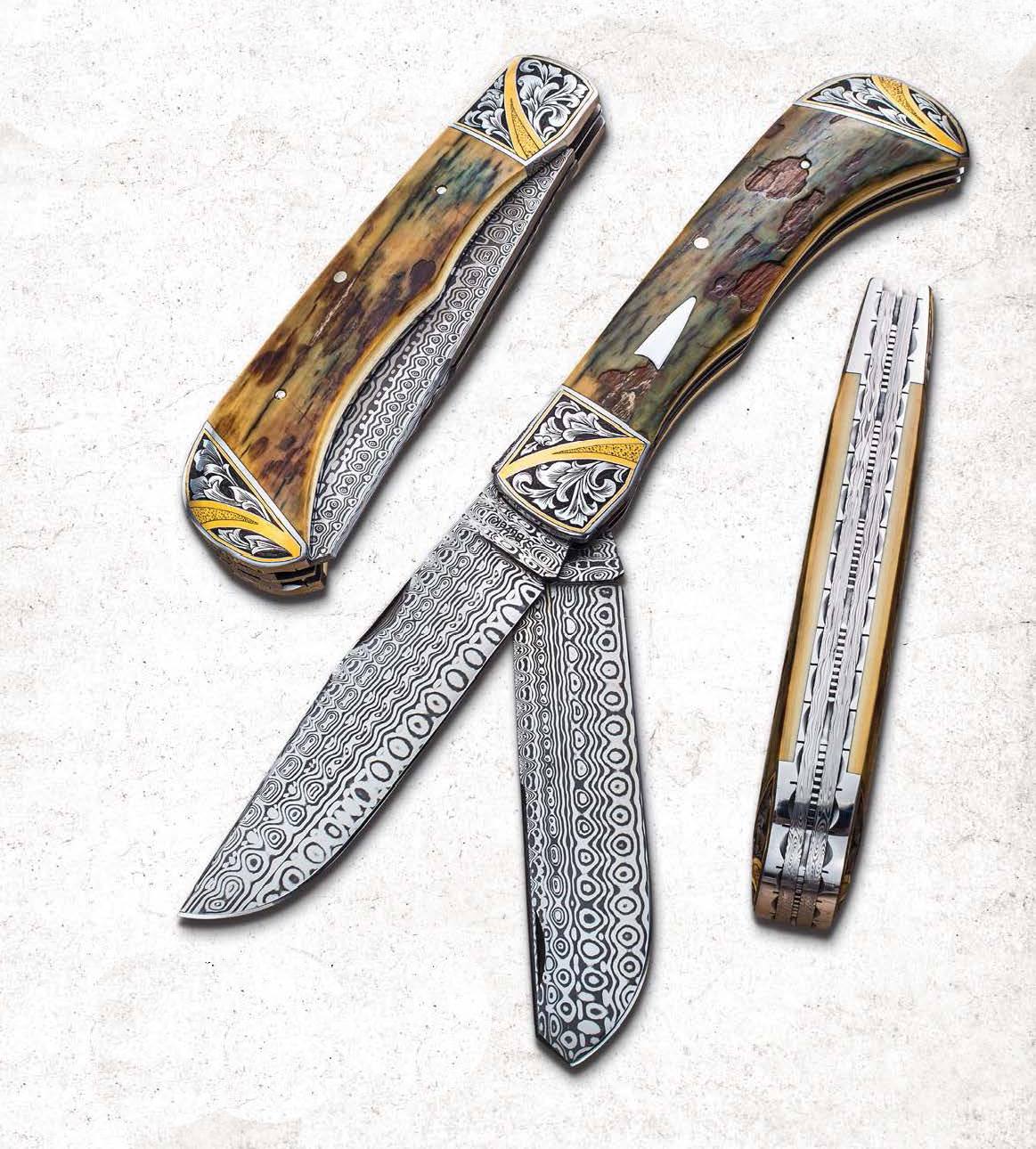
Stan Buzek based his slip joint on a Bill Ruple two-blade trapper. The hollow-ground blades are Damasteel damascus and 3.5 inches each. The fileworked liners are 416 stainless steel. Closed length: 4 3/8 inches. Buzek’s list price to make a similar piece: $1,950. (SharpByCoop photo)

Blade Counts Count

Custom slip joints are hot again and have been for a while. Why are they so hot and how long will their popularity run this time?

“I have seen a bit of an uptick in pocketknife sales in the last couple of years,” notes custom knifemaker Stan Buzek, whose turnaround time on orders is three to four months. “I think this is due to the fact you can have both multiple- and single-blade slip joints,” as opposed to the single blades of tactical and other locking folders (though lockbacks are experiencing somewhat of a surge in sales, too).

Custom slip joint knife
Tobin Hill’s five-blade sowbelly sports feather-pattern damascus blade steel in hollow grinds and a mammoth ivory handle. The maker’s list price for a similar piece: $1,200.

A Bright Future Ahead For Slip Joints

Adds Johnny Stout, who has a backlog of six to eight months, “From what I’m seeing at the shows and online in the past few years, pocketknives are alive and well. I see a bright future for slip joints.”

“I have seen slip-joint groups on Facebook grow by 300 percent in the last three years,” Tracy LaRock states. “I also have a group called ‘Making Slip Joints and Lockbacks’ that has grown a lot recently, with many new slip-joint makers.”

As for his sales, Tracy says, “My books are closed but I intend to open them in early 2020 when I retire from the military. In the meantime I list available pieces in my Facebook group and on Instagram.”

What is a slip joint knife?
Tracy LaRock pushes the envelope of traditional slip-joint design with his Ethan Jack. The 3-inch blade is D2 tool steel and the handle and frame are Timascus™. Closed length: 4 inches. His list price to make a similar knife: $900. (SharpByCoop photo)

Pocketknife Sales Are Up In General

“I think there’s an upswing in pocketknife sales,” Tom Ploppert agrees. “Plus, a strong economy hasn’t hurt anything.”

Tom says he continues to take orders and has no idea how far behind he is.

“I will write an order down. I do not take deposits. I will call when it’s your turn. If you commit, then we will discuss price and I will start on building it,” he says matter-of-factly.

Turnaround time notwithstanding, the exquisite slip joints by Stout, Buzek, LaRock and Ploppert are well worth the wait—though you might want to get a leg up now. The more demand increases, the longer you’ll have to bide your time until you can get your hands on one of these gems.


See More Knife Trends In KNIVES 2019

Get the KNIVES 2019 book here.

Advertisement

Must Read Articles

Read this before you make a knife

Knifemaking 101 – Read This Before You Make a Knife

  by Wayne Goddard My experience has taught me that there's nothing like digging in and getting started. I've often said the hardest part of the...
how to forge damascus steel

How to Forge Damascus

Advertisement
Advertisement