Home Blog Page 281

Ask BLADE®: Japanese-Style Heat Treatment

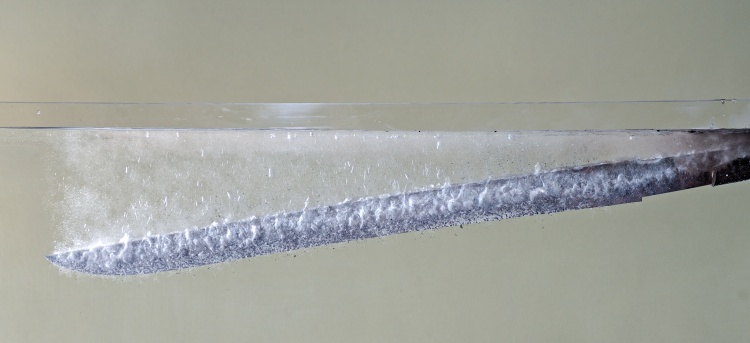
A tanto is plunged into the water during the hadaka-yaki process—yaki-ire, or heat treating, with no clay coating on the blade. (Yoshikazu Yoshihara photo)

Reader questions BLADE® story description of Japanese-style heat treatment

By BLADE staff


    Question: Regarding part three of the “HAMON!” series, page 46, in the November BLADE®: Bladesmithing articles written by observation sometimes lack accuracy. To heat treat tool steel you anneal first, then harden and then temper to change hardness into toughness. That temperature is usually 400°F to 435°F and it is called tempering for about 30 minutes.—Bob Rupert, Pittsburgh, Pennsylvania


    Answer: The author of the series, Leon Kapp, was kind enough to provide the following comments on Mr. Rupert’s letter:

    I described the process exactly as Yoshindo Yoshihara and other swordsmiths in Japan do it (and as I have done it myself). The process is at least 1,200 to 1,400 years old in Japan. It was developed and used for tamahagane—a raw steel made of Japanese iron-bearing sand that requires extensive refinement—and works beautifully for that steel. However, I think a main difference between tamahagane and modern steels is that tamahagane contains only small traces of anything except iron and carbon. Manganese or other elements in the steel might require changes in this process. If done right, the Japanese process hardens the blade all the way through the hamon, and not just near the surface.

    In fact, since all my experience is with Yoshindo and Japanese swords, I am very surprised and do not understand the technical reasons for the complex hardening methods I read about in BLADE or hear about from modern U.S. makers. It appears that Japanese-style yaki-ire (heat treatment) is a relatively simple process, but it does take years of experience to get it right.

    After yaki-ire, the blade is annealed by heating it in the forge, again as described in the story (that is, yaki-modoshi). If that is not done, the blade will be very brittle and even very difficult to polish.

    I think this is a reasonable answer to Mr. Rupert: The article is a detailed description of the process exactly as used in Japanese swords. The process and the steel are both very old and traditional in Japan, and it is done exactly as described—but the yaki-ire process was developed specifically for tamahagane steel.
Anthony Dicristofano (page 12, September BLADE®) has experimented with yaki-ire (Japanese style) for both tamahagane steels and for modern knife steels and told me he can see the differences. (Anthony works with Yoshindo in our backyard forge often during Yoshindo’s visits.) I think an important point to take from this is there are many ways to obtain great results with variations in materials and techniques.

    Oh, and one more point: There is another goal in Japanese and Western hardening. The Japanese method is designed to specifically harden only the edge region. As far as I know, the Western approach usually seems designed to harden or heat treat the entire blade. If yaki-ire were used to harden the entire blade, Yoshindo says the thin Japanese blades would crack or shatter immediately in use.

    Question: How much forging is enough? Is there a point of no return, or even a negative return? I typically start with 1-inch-diameter O1 drill rod for my knives, which I first must reduce to a flat piece of steel in the basic knife shape I want. This takes three-to-four heats to accomplish, and sometimes more depending on the size of the finished knife. Once the basic shape is attained, I then start working in the bevels.

    Is the reduction from 1-inch round to a quarter-inch flat going to give me all the benefits from forging that can be gained? Is the bevel forging simply gratuitous at that point? It occurs to me there must be a point in the process when additional heating and forging causes enough carbon loss to start degrading the steel rather than improving it. (Joshua States, a letter via e-mail)


    Answer (graciously provided by BLADE® field editor Ed Fowler): Starting with a 1-inch round bar should get you up into the 80-point rate of reduction range, depending on the size of the blade. This rate of reduction can definitely get you into the high-endurance performance realm, providing the steel you are using is of decent quality and you do not exceed a temperature of 1,725°F while forging. Forging at low temperatures equals fine grain and no measurable loss of carbon below the surface of the blade—about .002 inch, which is scale that comes off anyway. Forge the blades a little oversized and leave the edge of the blade about the thickness of a nickel for the heat treat (hardening and tempering).

    In our work at my Willow Bow Ranch, we have forged and tested to destruction many 5160 blades from 1-inch round bars (John Deere Load Control Shafts), and can get within 10 percent of the high performance of the blades forged from larger round bars.

    The more forging heats under 1,725°F, the better the performance potential of the steel. I take my bars to only 1,625°F to provide a margin of safety to prevent grain growth. Most of the benefits of forging will come from the round bar to quarter-inch flat bar. Merely forging the bevels only adds another two or three points if you are practicing reduction by forging. You are better off leaving the blades thick to protect the best edge, which will lay under the surface of the “as-forged blade.”

    When I start grinding, I take about the thickness of a dime off the edge of the hardened and tempered blade. The edge surface goes through a lot of thermal cycles and sometimes the best edge lies under the surface.

    As far as I know there is no “point of no return,” but the potential benefits between an 80-point rate of reduction and 99-point rate of reduction are not as significant as a difference between a 10-point rate of reduction and a 30-point rate of reduction. In other words, there is a decreasing rate of benefit, but always a benefit. Picture an ant crossing a table. The first trip he goes only halfway, second trip he goes half the remaining distance and the third trip he goes only half the remaining distance. How long will it take him to get to the end of the table?

    The answer is never. He will always be half the remaining distance to travel to the end, but the length of his trips becomes less each time.

     Send your question to “Ask BLADE,” c/o BLADE, 700 E. State St., Iola, WI 54990, or e-mail [email protected]. We will not print your name if you request it. If your question concerns the value of a knife, please understand it will be almost impossible for us to determine a value from a picture or e-mail image without being able to examine the knife from all angles in person.

    For more on the latest knives, knife legislation, knifemaking instruction, knife trends, knifemakers, what knives to buy and where and much more, subscribe to BLADE Magazine, the World’s No. 1 Knife Publication. For subscription information click on http://www.shopblade.com/product/blade-magazine-one-year-subscripti…?r+ssfb041912#BL1SU.

Knife Of The Day XXII: Don Hanson Damascus Bowie


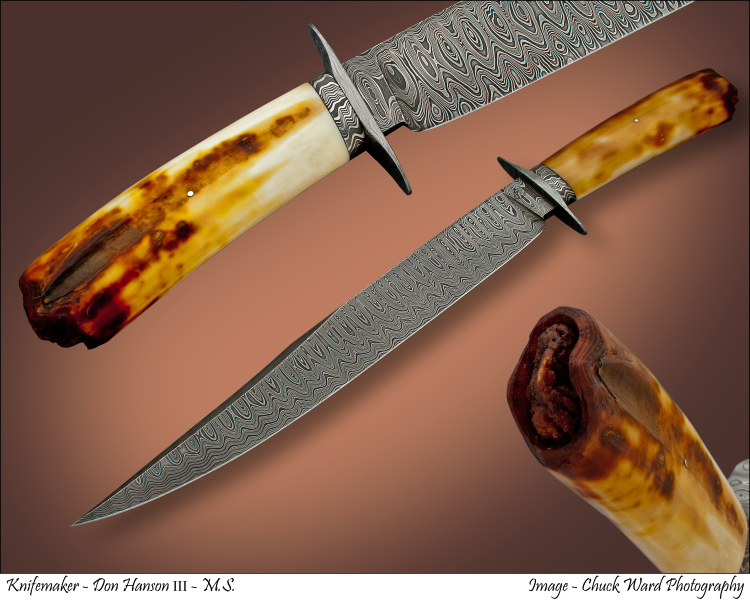
    Our Knife Of The Day for April 18 is ABS master smith Don Hanson III’s bowie in a 12.75-inch damascus blade with a long clip and a most distinctive handle of ancient walrus ivory. Overall length: 17.75 inches. In addition to the blade, the fittings (the guard and ferrule) are damascus, too.

    For more information click on www.donhansonknives.com or visit Don’s table at the 31st Annual BLADE Show (www.bladeshow.com) June 8-10 at the Cobb Galleria Centre in Atlanta, Georgia.

    For more on the latest knives, knife legislation, knifemaking instruction, knife trends, knifemakers, what knives to buy and where and much more, subscribe to BLADE Magazine, the World’s No. 1 Knife Publication. For subscription information click on http://www.shopblade.com/product/blade-magazine-one-year-subscripti…?r+ssfb041812#BL1SU.

A Great Multi-Use Big Knife

Spartan Blades’ Horkos takes everything the author dishes out—and then some.

By MSG Kim Breed, 5th Special Forces (retired)


It is always a good sign when you enjoy the feel of a knife, and that is the way it is with the Horkos from Spartan Blades. Featuring a slim handle and nothing sharp except for the edge, it was very lively in my hand. The edge was extremely sharp out of the box.


Like Peelin’ Taters

The Horkos has a finger-notch choil so you can choke up on the blade for more control. This worked perfect for slicing through plastic board. I had to move my holding hand quickly so I did not shave off part of my knuckle! It was like using a potato peeler—real smooth and fast. I went to regular cardboard and the material did not last very long under the blade’s still razor-sharp edge.

My arm wore out before the edge did on the 3/8-inch sisal rope—160 crunching cuts. Next up: the ¾-inch manila rope. I hit 50 cuts before I started to feel the edge slacken somewhat.

The finger-notch choil came in handy once again as it made whittling pine very controllable and comfortable. After I built a nice pile of curly-cues on the garage floor, I locked a piece of pine in my vise and started whacking. The Horkos chopped very well even though the balance is in mid-knife. I like a bit of blade-heavy balance for chopping. The Micarta® slabs were grippy but did not wear my hand out. There were no hot spots as all the exposed steel is softened/rounded. I like this knife.

I cut some old river cane I picked up during high water this past spring. The cane was covered with silt and sand—just what I needed to challenge the Horkos. It cut the cane with no problem and I finally managed to put a few blemishes in the very tough SpartaCoat finish.


To The Point

The edge was still holding up and it was time to work the point a little. I proceeded to stab the Horkos into and through the Yellow Pages—746 pages plus another 3/8 inch into the underlying plywood bench top. It did not damage the tip and the knife held tight in my hand.

It was time to chop the nasty ol’ seasoned oak chunk. I used the Horkos to beat and whack on the log for 15 minutes without hurting my hand, flinging wood chips all over the driveway. Using my no-mar hammer, I beat the blade into the oak. It was a bad move. The oak grabbed the blade and I had a fit trying to remove the knife from it. I marred up the hammer but not the Horkos. This is a very tough knife.

To gauge the heat treatment, I did the brass rod test. The edge flexed in both directions without chipping or deforming, a sign of excellent heat treatment.

The last step was an old edge test used mainly on forged blades—chopping into a deer antler. After a dozen or so chops, there was a small flaw in the edge. I stropped it a few times and it straightened out. The knife would still shave hair. The knife passed every test, and then some.


I Would Like To See …

… a tad more weight in the front of the knife to make it just a bit blade heavy.


Final Report

The Horkos is a great multi-use knife. Big enough for camping and handy for smaller jobs, it is an exceptional all-around knife.


SPEC CHART


Knife: Horkos

Pattern: Combat/utility fixed blade

Company: Spartan Blades

Blade Steel: CPM-S30V stainless

Blade Pattern: Drop point

Blade Finish: SpartaCoat (DLC black or ZrN flat dark earth)

Overall Length: 10 7/8”

Blade Length: 5 11/16”

Handle: Textured canvas Micarta® (green, black or tan)

Sheath: Ballistic nylon w/protective insert, MOLLE compatible

MSRP: $335 ($365 w/sheath)


    For more information contact Spartan Blades, attn: Curtis Iovito, Dept. BL4, POB 620, Aberdeen, NC 28315 910-757-0035 www.spartanbladesusa.com.


For more on the latest knives, knife legislation, knifemaking instruction, knife trends, knifemakers, what knives to buy and where and much more, subscribe to BLADE Magazine, the World’s No. 1 Knife Publication.


Click here to browse the BLADE-approved knives and tools at ShopBlade.com.

ABS Knife Auction – 2012 Director’s Knife of the Year

One of the 2012 ABS Director’s Knives of the Year was made by Master Smith and Board Member E. Jay Hendrickson.

SOG Tools Featured On Discovery Channel

SOG® Tools was featured on Discovery Channel’s Unchained Reaction, a new show from the hosts of MythBusters.


The hosts chose SOG to be part of the Jack of All Trades episode, which originally aired April 15, 2012 at 10 p.m. EST.


Unchained Reaction is a new series executive produced and judged by Adam Savage and Jamie Hyneman of MythBusters. The show pits two teams of varying backgrounds against each other to build an elaborate chain reaction contraption. In this Sunday’s episode, a team of designers and a team of construction workers square off to build the most impressive multi-step machines using the theme of “tools.” SOG provided the teams with a wide array of tools to use during the episode, including the Hand Axe, Double Headed Axe, FastHawk, Tomahawk, Pocket PowerPlier, PowerLock and the PowerAssist.


SOG was founded in 1986 by Spencer Frazer, a former R&D tool and die maker for the Top Secret Black Projects Division of the aerospace defense industry. SOG’s name was inspired by elite joint services military unit – the Studies and Observation Group – formed in advance of the Vietnam War to conduct covert operations and authorized to develop and purchase their own weapons.


Click here to browse BLADE-approved knives and tools at ShopBlade.com.

FORGE FAVORITES: Adam and Haley DesRosiers

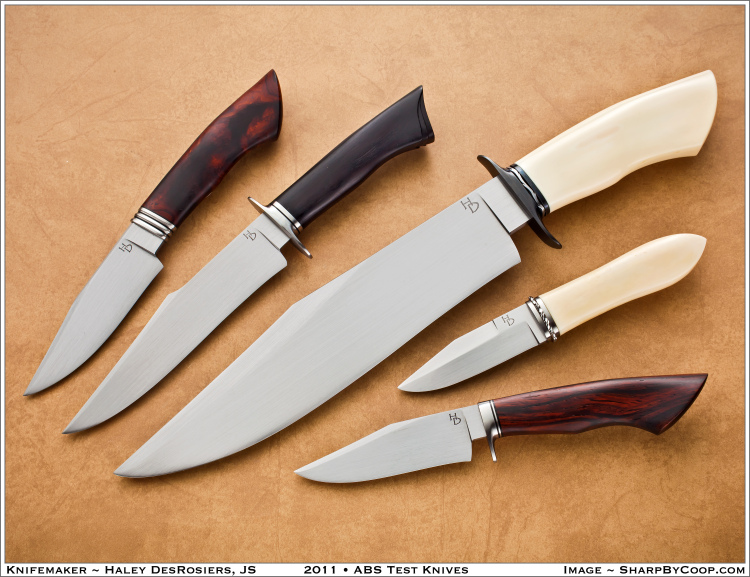
Haley DesRosiers’ five applicant knives for the rating of ABS journeyman smith include the one (center) judged best of all those submitted by JS applicants, thereby winning the 2011 George Peck Award. (SharpByCoop.com photo)


By B.R. Hughes, a founding member of the American Bladesmith Society, a member of the Blade Magazine Cutlery© and ABS Halls Of Fame, and BLADE® field editor


If you are old enough, you may recall a 1954 hit song written by Johnny Richards and Carolyn Leigh that went something like this:

    Fairy tales can come true, it can happen to you,

    If you’re young at heart …

    Don’t believe in fairy tales? After reading the storybook saga of Adam and Haley DesRosiers and the adventures they experienced at the 2011 BLADE Show, you just might alter your thinking.

    Let’s begin with Haley, a winsome lass born in Stika, Alaska, the daughter of a commercial fisherman and a mother who assisted in the family business. The future Mrs. DesRosiers spent many days on her dad’s fishing vessels working as a deckhand, and there were occasions when her boat was at sea for as long as several weeks.

    At 17 she developed an interest in knives, and, inspired by a video, decided to be a bladesmith. Her first forge was a hole in the ground, the air power supplied by an electric hair dryer via a pipe.

    As her skills improved, so did her smithy. One day she decided her beat-up anvil needed repairing. On an Internet knife discussion forum she learned her anvil could indeed be fixed, and ABS master smith Jason Knight e-mailed her about Adam DesRosiers, an Alaskan ABS journeyman smith who might be willing to help. In turn, Jason told Adam of the young Alaskan lady interested in bladesmithing. Adam promptly e-mailed Haley and offered his assistance.

    Setting up the initial meeting between the future husband and wife was not so simple. Both lived in remote areas, approachable only by air or sea, so they agreed to rendezvous at a folk festival in Juneau on April 8, 2008. While there, Adam took Haley’s anvil to the shop of ABS journeyman smith David Mirabile, where it was refurbished. Haley gave Adam some caribou antler and he presented her with a handmade gas forge. At the time, Haley was still using a hairdryer as a blower. Many communications between the two followed. A bit later, Haley’s father offered Adam a job as a deckhand for the balance of the season. He accepted and so, in reality, Adam and Haley’s first date consisted of six weeks of offshore fishing, both working as deckhands.

    Born in Anchorage in 1976, Adam is the son of a commercial fisherman and a nurse. After Adam was graduated from high school, he attended the University of Alaska, studying marine technology.  While there he worked at a local boatyard and, after college, joined the Merchant Marine, serving as a deckhand for three years.

    As for his first memory of making knives, at the ripe old age of 5 he took his mother’s butter knife and “improved it” in his father’s workshop, using the cement floor as a grinder. It must be noted that his mother was not impressed with the “improvements.”

    Adam’s first forge was a galvanized washtub, also featuring an electric hairdryer. In 2001 he attended the William F. Moran School of Bladesmithing in Washington, Arkansas, for the introduction to bladesmithing class, where his instructors were Kevin Cashen and Dickie Robinson. The same year he took a damascus class taught by John Fitch at the school. Adam returned the following year to take another damascus class, one taught by Steve Dunn. In 2006, Adam received his ABS journeyman smith rating. I was the head judge of the review panel that year, and Adam received not one negative vote from the panel.

    As Adam and Haley’s romance flourished, Haley took the introduction to bladesmithing class at Haywood College in Clyde, North Carolina. Adam joined her, deciding it would not hurt to take a refresher course. The instructors were Burt Foster and Jason Knight, the latter the man who initially introduced Adam and Haley. It was on the bank of Jason’s pond in South Carolina that Haley and Adam became engaged on April 12, 2009. 

    They were married Sept. 13, 2009. Haley was borne by a raft down an Alaskan creek to the ceremony. Using the anvil that had brought the bridge and groom together for the first time as an altar, the service was performed by Pastor Berry Byrd. ABS master smiths Knight and James Rodebaugh were among the groomsmen. Adam wore a sword for the ceremony, as did the groomsmen, and their swords provided the arch under which the happy couple departed. (For more, see Haley’s story “A Match Made in Handforged Heaven” in the October 2010 BLADE®.)

    Haley set up bladesmithing in Adam’s shop. There they made their first knife together, featuring a blade of 5160 carbon steel. Adam prefers to make camp knives and Haley likes hunters, which is certainly natural enough since she is a devoted outdoors enthusiast. When I inquired what type of game she most enjoyed hunting, she quickly replied, “Deer, duck, caribou, black bear and brown bear.”

    “Ever been charged by a bruin?” I asked.

    “Once.”

    “What happened?”

    “I dropped him with my .30-06.”

    Verily, a modern-day Diana!

    As the 2011 BLADE Show neared, the DesRosiers were extremely busy. Adam was preparing to test for ABS master smith, while Haley was getting ready for her quest for a JS stamp.

    “Did Adam do anything to help you get ready?” I asked. “Yes,” Haley smiled, “Among other things, he told me to quit playing with damascus!” For the ABS JS review, no damascus is permitted on any of the five applicant knives. Hence, she concentrated on knives featuring blades of 1084 and W2, her two favorite carbon steels.

    During the BLADE Show, each took his/her five review knives to two separate rooms in Atlanta’s Cobb Galleria Center, where judging panels awaited. In addition to passing or failing the applicants, the panels were also required to select the winners of the George Peck Award and the B.R. Hughes Award. The former is for the best knife submitted by a JS applicant, the latter for the single finest knife made by an MS applicant.

    A happy ending for this tale would have both Haley and Adam earning their respective ratings. They did—but there’s more. An incredible conclusion would have Haley winning the Peck Award and Adam receiving the Hughes Award—and they did! (See page 48, January BLADE.)

    If that is not a fairy tale come true, it will do until one comes along.


THE DESROSIERS’ FILE


Adam and Haley DesRosiers

POB EXI

Juneau, AK 99850

907-321-7258

www.alaskablades.com

Adam’s Specialties: Forged fixed blades, especially camp knives

Haley’s Specialties: Forged fixed blades, especially hunters

Adam’s Steels: W2, damascus in 1084 and 15n20

Haley’s Steels: W2 and 1084; damascus

Handles of Both: Natural materials, including the ancient ivories, assorted woods and others

Adam’s Honors: ABS master smith, winner of 2011 B.R. Hughes Award

Haley’s Honors: ABS journeyman smith, winner of 2011 George Peck Award

For more on the latest knives, knife legislation, knifemaking instruction, knife trends, knifemakers, what knives to buy and where and much more, subscribe to BLADE® Magazine, the World’s No. 1 Knife Publication. For subscription information click on http://www.shopblade.com/product/blade-magazine-one-year-subscripti…?r+ssfb040912#BL1SU.


Knife Test: Buck 931 Chef Knife

Buck 931 8″ Chef Knife Review Knife: http://bit.ly/tdJql8 The Buck Knives 931 Chef Knife is amazing. 

Advertisement

Must Read Articles

Read this before you make a knife

Knifemaking 101 – Read This Before You Make a Knife

  by Wayne Goddard My experience has taught me that there's nothing like digging in and getting started. I've often said the hardest part of the...
how to forge damascus steel

How to Forge Damascus

Advertisement
Advertisement