


Four U.S.-made EDC sheath knives take the author’s test.
EDC knives have been influenced by folding designs since the inception of steel, if not before. However, historically speaking, compact fixed blades were daily edged tools long before folders.
Cultures worldwide, both known and no doubt unknown, carried short sheath knives for utility, survival and ceremony. Japan’s tanto pierced with precision and Viking seaxes sliced with status. Native Americans relied on trade knives and ulus for skinning and barter. Indonesia’s badik and short kris blended practicality with spiritual meaning.
These blades reflected local needs and traditions, proving compact straight knives were essential long before EDC became a modern gear category.
Wharncliffe Vs. Sheepsfoot Blades

Wharncliffe and sheepsfoot blades are similar and different. A wharncliffe features a long, straight cutting edge with a spine that tapers gradually to a fine, precise point. This geometry excels at controlled slicing, detailed scoring and utility work where accuracy at the tip is essential. The design allows steady pressure along the edge, making it ideal for carving, whittling and precision-driven EDC tasks.
A sheepsfoot, by contrast, has a straight edge with a spine that curves down sharply to meet the edge in a blunter tip. This greatly reduces the risk of piercing, making it safer for rescue work, controlled cuts and environments where safety matters most.
The wharncliffe offers versatility and precision for fine tasks, while the sheepsfoot provides dependable slicing power, rope-cutting efficiency and unmatched control under pressure. Together, they represent two specialized approaches to cutting—one prioritizing accuracy, the other emphasizing safety and reliability.—by Reuben Bolieu
Montana Knife Co. (MKC) Stockyard

Stockyard Specs
Blade Length: 3 3/8”
Blade @the Thickest: 0.115”
Blade Steel: MagnaCut stainless
Blade Finish: Stonewash
Scales: G-10
Weight: 3.14 ozs.
Overall Length: 7 5/8”
Sheath: Kydex
Country of Origin: USA
MSRP: $300
Pros
- MagnaCut Steel Blade
- Company After-Purchase Support
- Light
Cons
- Expensive
The Montana Knife Co. (MKC) Stockyard is made in the USA and hand-finished in Montana. It embodies the rugged traditions of ranch life and strikes a balance between compact carry and the strength needed for long days in the field. Its MagnaCut stainless steel is known for toughness, edge retention and corrosion resistance, and the blade’s thickness provides durability without excessive weight.
The sheepsfoot blade is designed for controlled slicing and safe utility, excelling in tasks such as cutting twine or trimming hooves where precision is crucial. The stonewash finish reduces glare and disguises wear, while the rugged G-10 scales in green and black ensure a secure grip, even in wet or gloved conditions. The ergonomic handle includes a “subtle hook profile” for extra control and quick deployment.
Each Stockyard comes with a USA-made Kydex sheath, featuring adjustable retention for a secure fit and both horizontal and vertical carry. The design keeps the knife accessible and comfortable, whether you’re riding fence lines or working in the shop. MKC also offers free sharpening, cleaning and repair for life, ensuring your knife remains reliable for years to come.
Bradford USA G3 Wharnie
G3 Wharnie Specs
Blade Length: 3.625”
Blade @the Thickest: 0.14”
Blade Steel: MagnaCut stainless
Rockwell Hardness: 63-64 HRC
Blade Finish: Stonewash
Scales: Natural burlap Micarta®
Weight: 3.96 ozs.
Overall Length: 6.875”
Sheath: Kydex
Country of Origin: USA
MSRP: $259
Pros
- Compact
- MagnaCut Blade Steel
- Excellent Slicer
Cons
- Might Not Be Good At Prying
Skilled makers in Kent, Washington, meticulously craft the Bradford USA G3 Wharnie, ensuring every detail meets the highest quality standards. The compact fixed blade strikes a balance between portability and cutting strength, making it ideal for everyday carry and outdoor use. The blade’s long, straight edge offers both reach and control, versatile enough for slicing tasks and utility work. The blade thickness provides durability without the weight, allowing for agility in the hand.
Forged from premium Bohler M390 or MagnaCut stainless, the blade excels in edge retention, toughness and corrosion resistance. The wharncliffe blade, featuring the straight edge and fine tip, is particularly suited for controlled slicing, scoring and detailed cutting. A choice between a stonewash or tumbled finish minimizes glare while concealing wear, giving the knife a rugged, industrious appearance.
The handle features 3D-contoured scales in a choice of G-10, Micarta, carbon fiber or G-Wood, ensuring a secure grip and long-lasting durability. The ergonomic shape fits comfortably in hand for extended use, whether in the field or workshop. Each G3 Wharnie comes with a taco-style Kydex sheath that offers secure retention and customizable carry options.
Big Idea Design Deano
Deano Specs
Designer: Mak Kelsay
Blade Length: 3.125”
Blade Steel: Nitro-V stainless
Blade @the Thickest: 0.14”
Blade Finish: Graphite black Cerakote®
Weight: 3.6 ozs.
Scales: Micarta®
Overall Length: 7.5”
Sheath: Kydex w/UltiClip 3.3
Country of Origin: USA
MSRP: $325
Pros
- Versatile Blade
- Good Carry System
- Full-Sized Grip
Cons
- Expensive
The Deano from Big Idea Design is made in America with global steel origins. Designed by Mak Kelsay in Chattanooga, Tennessee, it strikes a nice balance between compact carry and dependable working strength. The blade provides versatile cutting power for everyday carry, camping and outdoor use. It also offers durability without unnecessary bulk, keeping it agile in hand.
The Nitro-V stainless blade steel delivers excellent toughness, edge retention and corrosion resistance in demanding environments. The modified drop point emphasizes control and practical utility. It tracks straight, bites clean and handles detail cuts with confidence. A graphite-black Cerakote®/tumbled finish creates a rugged, battle-worn look while reducing glare and concealing wear.
Scales are durable Micarta in black or green, providing a secure grip in all conditions. The ergonomic contour ensures comfort during extended use, whether in the field, workshop or camp.
The Deano includes a scout-carry Kydex sheath with an UltiClip Slim 3.3, offering secure retention and versatile carry options. The sheath system rides comfortably on a belt or pack, keeping the knife accessible and protected at all times.
Bear Forest Knives Stumpy
Stumpy Specs
Designer: Garrett Tremblay
Blade Length: 2 1/8”
Blade @the Thickest: .125”
Blade Steel: Nitro-V stainless
Blade Finish: Raw matte
Weight: 3.2 ozs.
Scales: Various Micarta®/wood/Bearcarta
Overall Length: 5 7/8”
Sheath: By JRE Industries of black leather
County of Origin: USA
MSRP: $200
Pros
- Hand Built
- Grind Options
- Good Ergonomics
Cons
- Smallish Handle
The Bear Forest Knives Stumpy is built by hand in the USA for everyday carry and outdoor reliability. It offers a compact profile that disappears on your belt. The short blade delivers precise cutting power for utility, camp chores and daily shop tasks, and strikes a balance between strength and nimble handling, making it quick and responsive in the hand.
The Nitro-V stainless blade steel provides excellent hardness, edge retention and corrosion resistance in demanding environments. The blade features a full flat grind but is also available with a Scandi grind. It has a 90-degree spine ideal for generating sparks with a ferro rod and for scraping tinder. A raw matte finish gives the knife a resilient, understated look while reducing glare and hiding wear.
Scales are available in Micarta, wood or Bearcarta, each offering durability, comfort and a secure grip in most all conditions. The ergonomic design ensures the knife locks naturally into your hand, even during extended use.
Each Stumpy includes a premium JRE Industries black leather sheath, designed for secure retention and comfortable carry. The sheath rides well on a belt or lanyard, keeping the knife accessible and protected wherever you go.
Real World Tests
There are two teams here, as I see it—straight blades and, more commonly, curved blades. Or, MagnaCut vs. Nitro-V. The blades were all hair-popping sharp out of the box, as expected. This is always the first test of any edged tool I get.
The handles are all unusual. The Stockyard and The Deano have full-sized grips, while the Stumpy and G3 Wharnie have shorter, more compact handles. The latter two also have beefier, hand-filling scales, adding to user comfort.
I had the Stumpy with its full flat grind the longest. It is the only EDC in the batch to have a straight, 90-degree sharpened spine. The continuous curve of the belly aided in making feather sticks for a fire, as did the sharp spine for striking a ferro rod. The smallish handle was comfortable due to the textured Micarta and thick scales. Besides, who doesn’t like a good Mexican blanket print on the scales?
The Deano has a thin handle, as many EDC fixed blades do. The scales are smooth and comfy—sleek. The modified drop point has a slightly clip-point feel and look.
On the utility side, I slashed through mounds of cardboard to break down boxes. I cut cardboard, not tape. (There’s nothing more annoying than a sticky blade on a good knife.) Slicing along the side of a box helps open it up and saves your edge, since it separates a lot of area with minimal gumminess. The light gimping was perfect for my forefinger when slicing down. I never use my thumb on the spine— it’s a bushcraft habit.
Wharny Or Sheepy?
The wharncliffe and sheepsfoot are two similar blade shapes with distinct attributes. I received the Bradford G3 Wharnie in MagnaCut first and rekindled my love for the straight-edge style with a curved spine. Nothing screams utility more than a straight edge similar to that of an X-Acto knife blade. Any box-opener blade fits in with the crowd, as does a wharncliffe. Tip-forward pressure is excellent for drawing back slices.
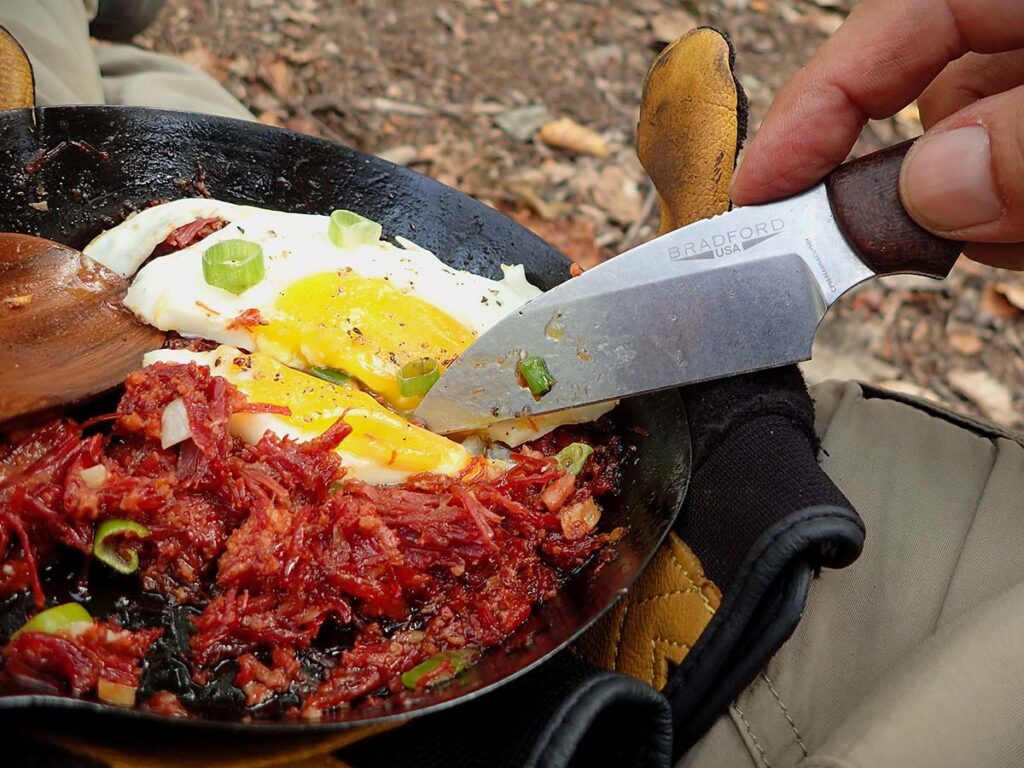
Wharncliffe and sheepsfoot blades allow you to choke up toward the tip and use a forefinger for fine, controlled work. I used the technique on a fried egg eaten right out of my carbon-steel skillet. Only a small amount of steel came in contact with the egg and skillet, as draw cuts use minimal edge.
I ran the MKC and Bradford through identical testing on various fibrous materials for practical EDC use. I sliced scrap leather, nylon webbing, zip ties, phone-charging and lamp cords, and lots of cardboard, all with zero issues. The more challenging materials were plastic packaging banding and 15,000-pound tow strapping. I severed the latter two media on a cutting board, draw cutting and push cutting. The forward leverage obtained from the straight-edge blades was apparent and much appreciated. Both blades sliced through the din with no holdups.
As for the performance difference between MagnaCut and Nitro-V, it has more to do with edge geometry and the materials you’re cutting than anything else. It would take a long time cutting similar materials with identical grinds on two knives to see any real difference. Suffice to say, these are two top-tier stainless steels.
Carry Systems

Besides the Bradford G3 Wharnie, two of the test knives are set up for scout carry with straps. The older model of the BFK Stumpy has one-strap retention for scout carry, which you can adjust to different positions. The MKC Stockyard has a Kydex fold-over sheath that easily attached to my belt while I was already wearing pants. The feature is incredibly convenient for those who often forget to put things on until it’s time to work.
The Deano came with options: scout carry strap set and UltiClip Slim 3.3, like a choose-your-own-adventure book. Bradford sent me a sturdy Kydex sheath without attachments. However, Bradford has order options on its website. I carried the Bradford entry like a slip sheath in my pocket and eventually attached it to a small carabiner to hang on my belt loop.
Check Out More Outdoor Knives:
- NESSMUK KNIFE: OPTIONS IN THE ALL-AMERICAN OUTDOOR KNIFE
- BEST TOMAHAWKS: OUR TOP HAWKS FOR BACKWOODS TO BATTLEFIELDS
- BEST BUSHCRAFT KNIFE: WHEN STEEL MEETS THE WOODS
- BEST EDC FIXED BLADE KNIFE: A CUT ABOVE THE REST
- BEST CAMP KNIVES: OUTDOORS DO-ALLS
 NEXT STEP: Download Your Free KNIFE GUIDE Issue of BLADE Magazine
BLADE’s annual Knife Guide Issue features the newest knives and sharpeners, plus knife and axe reviews, knife sheaths, kit knives and a Knife Industry Directory.Get your FREE digital PDF instant download of the annual Knife Guide. No, really! We will email it to you right now when you subscribe to the BLADE email newsletter.





