

Cream of the custom crop rises to the top.
Along with all other things razor sharp, the BLADE Show attracts the cream of the international custom knife crop. Included are a wealth of the leading forgers of damascus steel, many of whom vie for the show’s Best Damascus Award, with the winner at BLADE Show 2026, Julian Antunes, a superlative example.
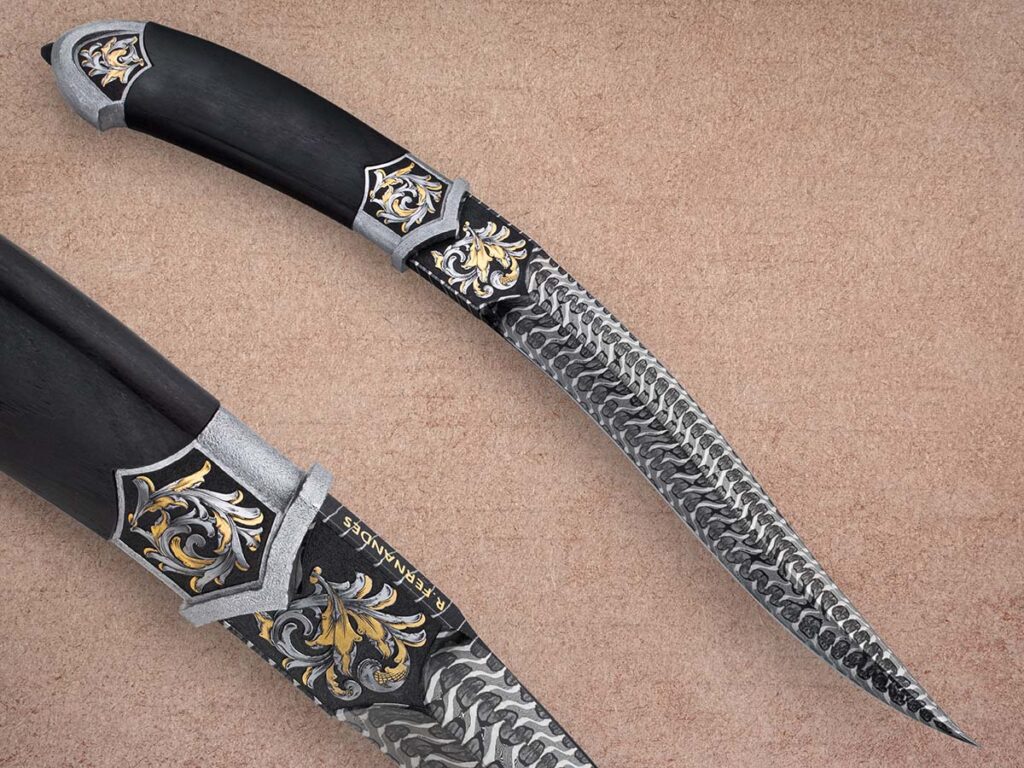
As with all things knife, damascus steel evolves, and a revealing way to observe examples of its evolution is to review some of the BLADE Show’s Best Damascus winners—in this case, from 2021 to 2025: Shayne Carter, Mike Quesenberry, CAS Knives, Ronmell Fernandes and Gabe Fletcher, respectively.
“All five of these knives are excellent examples of very fine damascus patterns. All are well thought out and executed with great control in the forging,” observed Devin “Hoss” Thomas, a BLADE Magazine Cutlery Hall-of-Fame® guru of carbon and stainless damascus. “Most of these pieces are forged to shape, which gives them that extra touch … All are very impressive. I would hesitate to pick one over the other.”
Cutlery Hall-of-Famer/mosaic damascus pioneer Steve Schwarzer, on the other hand, had no such reservations.
“All the blades that won Best Damascus are great examples of fine craftsmanship,” he agreed. “Two are head and shoulders above the rest. The Ronmell Persian Knife is a prime example of excellent design and embellishment woven into a master work. The blade pattern requires very controlled forging and construction. I give it a full ‘10.’”
Steve was just getting warmed up.
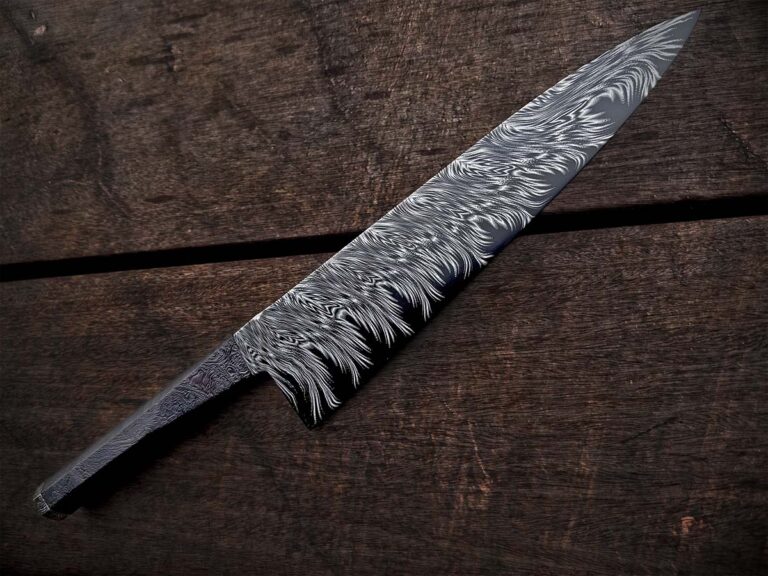
“The Gabe Fletcher chef’s knife winner is, in my opinion, light years ahead of the other blades—not for the chef’s knife construction, which is very well done. It stands alone for the unique patterning technique* recently developed and the choice of blade materials. The difficulty in forging complex, unique pattern welding has eluded modern bladesmiths worldwide for as long as I can remember. This is a mosaic stainless steel construction using very new patterning sequences.”
Fletcher’s damascus “represents a breakthrough event in modern bladesmithing,” Steve continued. “On a 1 to 10 scale of difficulty for the blade material and construction alone, I give it a 12 … The current offerings by Gabe in this unique material and patterns are in my opinion at the pointy end of the spear.”
Forge Control
As each Hall of Famer noted, controlled forging is a common thread in the best damascus. According to Gabe Fletcher, it also was a major hurdle in the successful mixture of crushed W’s and S’s in his award-winning blade.
“The most difficult and one of the most important parts of forging this pattern and most mosaic patterns is forge control,” he related. “It’s so important that you etch the ends of the bars before you weld them together so that all of your lines line up. If you just stack them together, you will see the shift in the patterns where the weld boundaries are, and it doesn’t look like a complete piece. I know that’s not always easy, but that’s one thing I strive for when I make a pattern.”
Forging the bars very clean and to exact and even dimensions so the pattern is not lost when grinding the bars clean for the next weld is paramount for exceptional damascus. “If one end is thicker than the other, or taller, when you grind everything flat, your pattern is not going to mirror correctly and you’re going to see that big shift in the lines of the pattern,” Gabe explained.
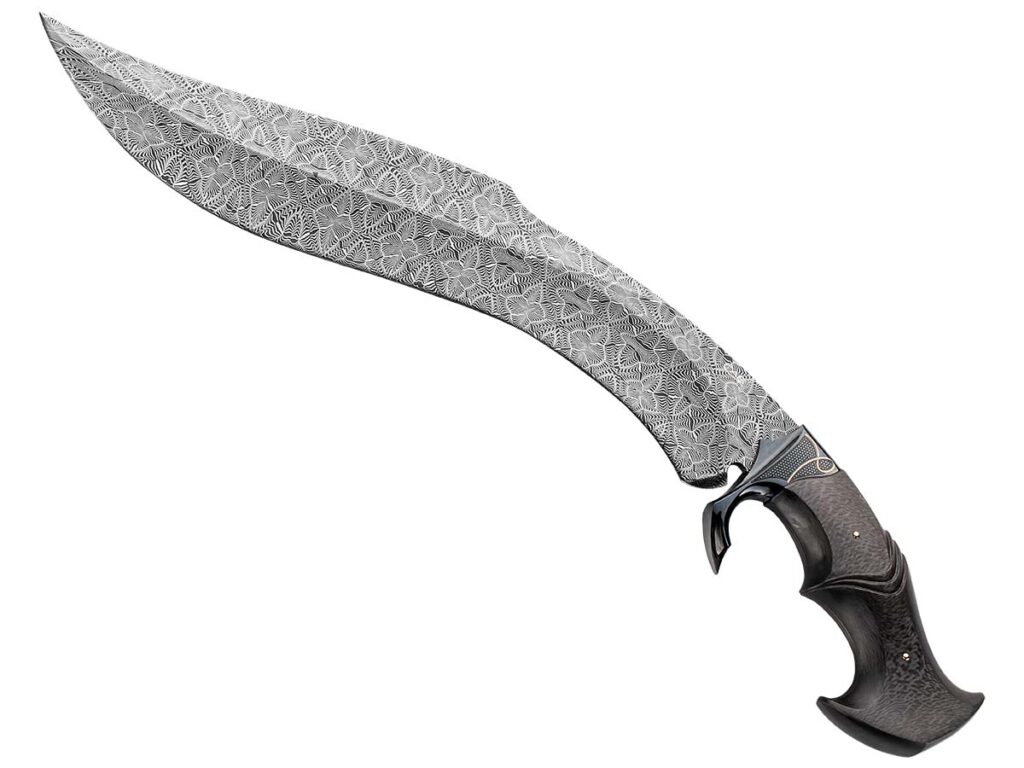
Schwarzer pointed to the CAS Knives kukri in a mosaic damascus as another example of controlled forging. “The CAS blade is a great combination of elements that add up. It is not just the pattern. The pattern is very controlled, requiring precision forging … This blade stands out for finish and overall design and execution. I give it an 8.5.”
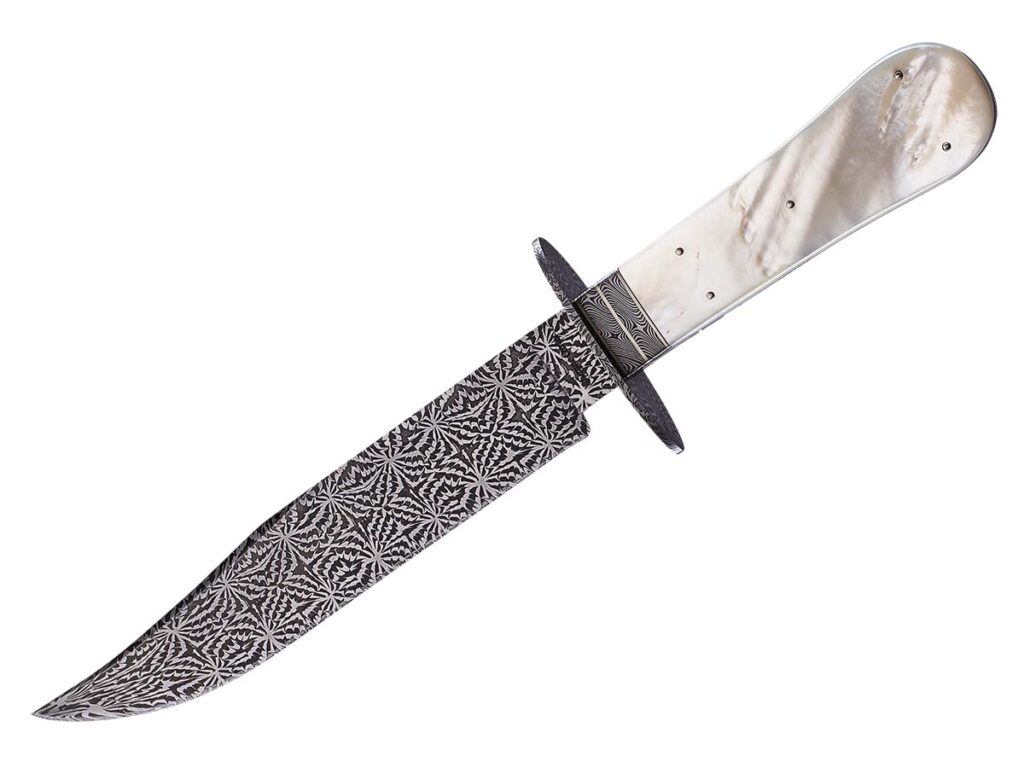
Quesenberry indicated forge control was key as well in the Turkish twist pattern of his award winner forge welded in alternating layers of 1080 and 15N20 carbon steels. “The billet is then twisted very tightly to resemble a machine-thread screw,” he stated. “It is subsequently stacked and forge-welded back together before being forged to its final shape.
“Making the pattern itself is not especially difficult, but maintaining control is the real challenge. You have to carefully control the dimensions, heat and uniformity of the twists throughout the process.”
Forth Of July
Shayne Carter usually doesn’t name his damascus patterns but indicated that if he had to name the one on his 2021 winner it would be Fourth of July. The first weld was a low-layer-count stack and the second one was low-layered W’s. “This pattern was forged on the bias, then four-wayed, four-wayed again, tile welded and finally forged into the blade,” he wrote. Steels: 15N20 and 1084.
“This blade was on the more difficult side because it required four to five welds,” Shayne explained. “Tile welding always adds another level of challenge. At that point in my bladesmithing career, I had not made many mosaic damascus patterns, so this project pushed my abilities.”
It can be difficult to keep track of a new pattern as it develops, so to keep track of his Fourth of July pattern he cut off a small piece of the billet after each weld. This enabled him to reference the size and appearance of the material before four-waying, tile welding and other operations. “Unfortunately, that process also results in a smaller billet,” Shayne noted. “That ultimately influenced the shape and size of the blade. The pattern turned out very well but the finished knife ended up on the smaller side.”
The biggest challenge was knowing when to stop forging. “After tile welding and surface grinding the billet, a quick edge reveal showed that I had something special. I wanted to open up the pattern slightly,” he recalled, “and I also wanted the tip to look intentionally forged rather than overworked.
“Many damascus patterns become over-forged, especially feather patterns. It is difficult to walk away from a blade when you have so much time invested in it, but restraint was important to preserving the integrity of the pattern.”
What’s Hot & Will Be
Shayne indicated that when he won the BLADE Show award in 2021, mosaics, especially in kitchen knives and those in the explosion pattern, were particularly popular. “Most makers producing hunters, bowies and fighters were still working with more traditional pattern-welded designs. Many smiths were actively trying to create and name new patterns,” he observed.
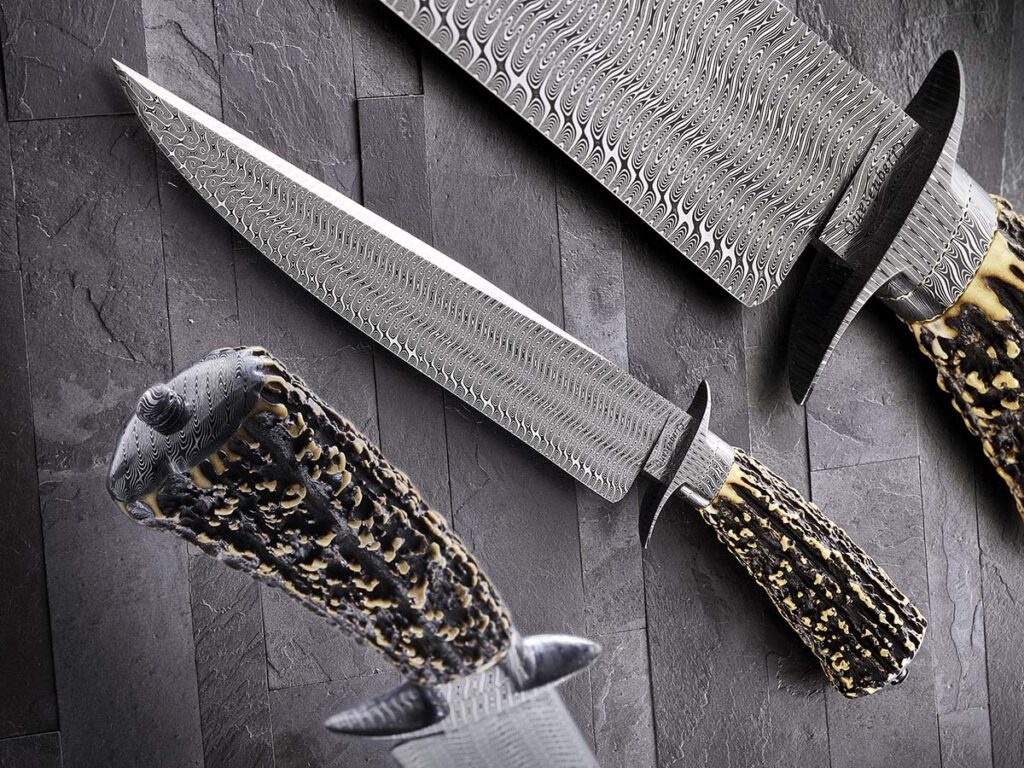
“Feather damascus was extremely popular then and remains popular today. Variations on feather patterns, such as Dragon’s Breath and River of Fire, continue to attract attention, and many folder makers are especially fond of feather designs.”
Agreed Fletcher, “As far as a popular style, I think the feather damascus wins that title. The feather pattern is not my favorite but Josh Prince makes amazing variations of the technique, incorporating all kinds of elements like jelly rolls instead of just cutting W’s down the center.”
While the feather has been and seems to continue to be most popular, other patterns such as the Turkish twist remain hot as well.
“The Turkish twist has been a popular damascus pattern for many years,” Mike Quesenberry opined. “In my opinion, several makers from South America have elevated Turkish twist to an exceptional level. Most achieve the final appearance through a process commonly referred to as fish-mouthing, in which the twisted bars are manipulated and assembled to expose the pattern in a specific orientation.”
Mosaics in general also remain in demand. “Mosaic damascus has been elevated to an entirely new level,” Carter observed. “Latin American smiths are producing incredible Turkish twists, while North American makers are creating some truly remarkable mosaics.” Added Ronmell Fernandes, “The most popular patterns are mosaics because they are patterns that please a lot for their geometry.”
Hoss Thomas pulled the crystal ball from his 10-gallon hat and went full prognosticator. “I think that quilted mosaics will continue to be popular. I see more makers using plug-welded-theme patterns. I like that more makers are doing composite patterns, including Turkish twist. More guys are experimenting with gradient and fading patterns, which I find very beautiful. There are too many smiths doing great work to narrow it down to just a few,” he observed. He added the caveat, “I can tell you that there are many new makers making lazy damascus patterns, which I don’t care for. Too low in layers, not well thought out, etc.”
Further development and expansion into other patterns of the gradient element*, which Fletcher used in his BLADE Show ’25 winner, seem likely. “Created by Mareko Maumasi and Peter Burt, the gradient element will add a lot of dimension and pattern possibilities to almost any pattern ever made,” Gabe noted.
It’s anybody’s guess as to which patterns will rule and what advancements in damascus forging will emerge. At least one thing appears likely, though: whatever they are, they will be equal parts breathtaking and mindboggling.
“I believe the future of damascus is limitless,” Carter predicted. “New patterns will continue to emerge but there will always be a place for timeless classics such as twist, ladder, chevron and raindrop. Bladesmiths will always push themselves creatively, and the excitement of placing a blade into the acid and waiting for the pattern to reveal itself will always feel like Christmas morning.”
*The unique patterning technique Steve Schwarzer refers to and that Gabe Fletcher also mentions, the gradient element mixes the initial steel stack in such a way that the final damascus pattern graduates from light to dark in a kind of fading or shading effect instead of just mixing the steel in an even way. It also creates more depth of field in the pattern on the flat, two-dimensional surface of a damascus blade.
Read More On Damascus:
- Feather Damascus: Blades Forged Light And Airy
- Damascus Steel Quiz: Test Your Knowledge of the Legendary Blade Material
- Damascus Folder: Top Options Straight From The Factory
- Damascus Flaws: How To Spot Imperfections in Custom Knives
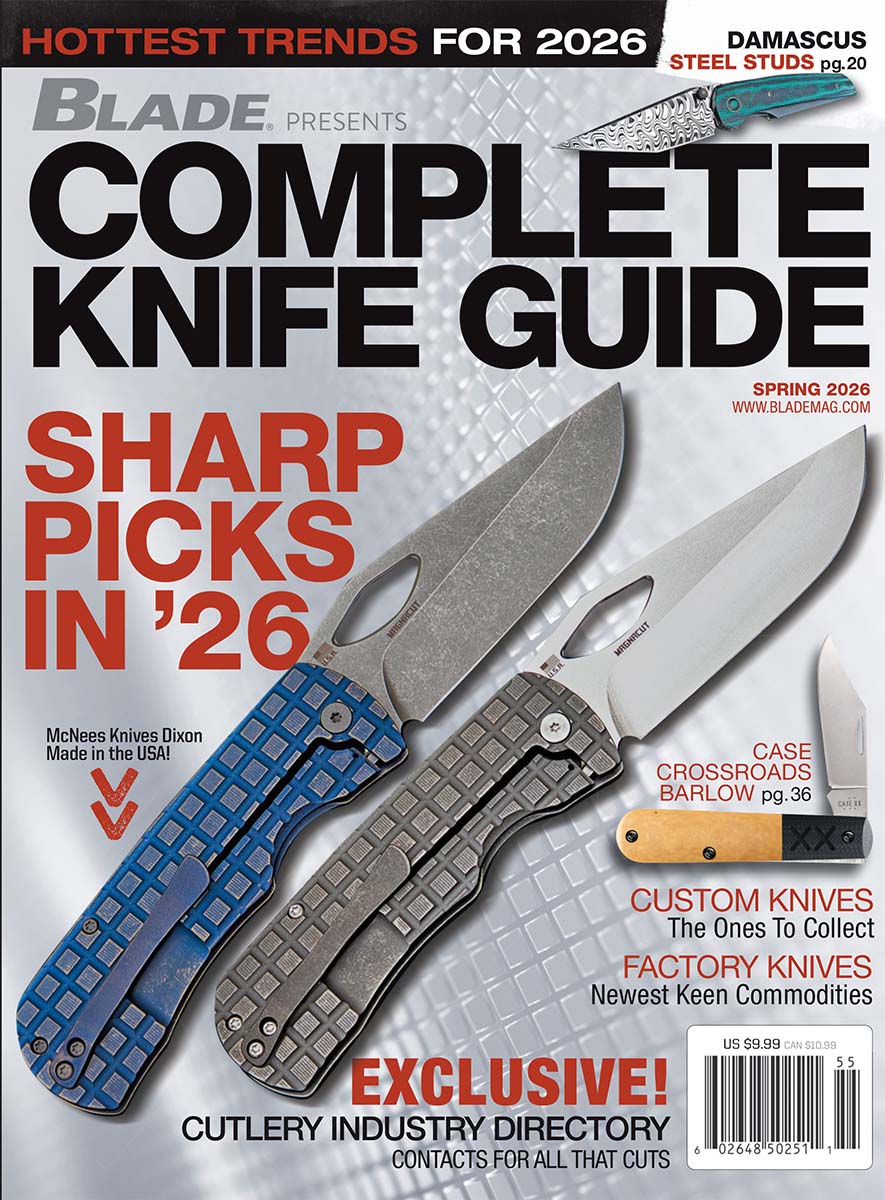 NEXT STEP: Download Your Free KNIFE GUIDE Issue of BLADE Magazine
BLADE’s annual Knife Guide Issue features the newest knives and sharpeners, plus knife and axe reviews, knife sheaths, kit knives and a Knife Industry Directory.Get your FREE digital PDF instant download of the annual Knife Guide. No, really! We will email it to you right now when you subscribe to the BLADE email newsletter.





