What are the Best Knife Sharpeners?
It’s challenging to know which knife sharpeners are junk and which are worth the money. To help, BLADE staff and contributors assembled this list. These are the knife sharpeners that those “in the know” use, but they won’t break the bank.
How BLADE Chose These Knife Sharpeners
BLADE received no compensation for the items that appear on this list. BLADE does not benefit financially from affiliate programs on any of the links. These picks are based on experience, knife sharpener reviews from the magazine, and what’s hot in the marketplace. There are more excellent options beyond this list.
Remember: a sharpener can’t help you if it never leaves the drawer! Buy a knife sharpener you’ll enjoy using.
Top Pick: Electric/Manual Combo Knife Sharpener
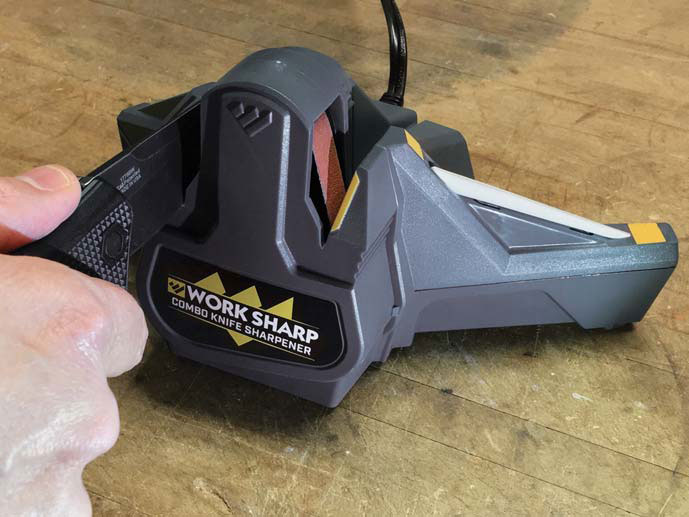
Work Sharp Combo Knife Sharpener
PROS
- For all types of knives
- Simple to use for beginners, but yields advanced results
- Offers electric sharpening (removing metal) and manual honing (straightening metal) in one unit
- Easy maintenance with compressed air
CONS
- Produces metal dust (store it away from food)
- Only offers 25-degree angle for edges
Winner: 2016 BLADE Magazine Accessory of the Year!
Featuring a flexible abrasive belt, the motorized Work Sharp Combo Sharpener (WSCS) from Work Sharp is simple and effective. It uses long lasting abrasive-belt-sharpening technology and puts a convex edge on any blade.
 It has one sharpening angle, one motor speed and one grit of belt only. Simply plug it in and turn it on. Configured in a nice, compact form, the built-in angle guides eliminate the guesswork of holding a consistent 25-degree angle.
Pull the blade through each slot to sharpen both sides. After achieving a sharp edge using the belt, switch to the tapered ceramic rod to further hone the edge to hair-popping sharpness. Rest the blade flat against the yellow pads and move it from tang to tip in one sweeping motion using light pressure.
At an MSRP of $59.95, it’s a bargain.
Kitchen Electric Knife Sharpener
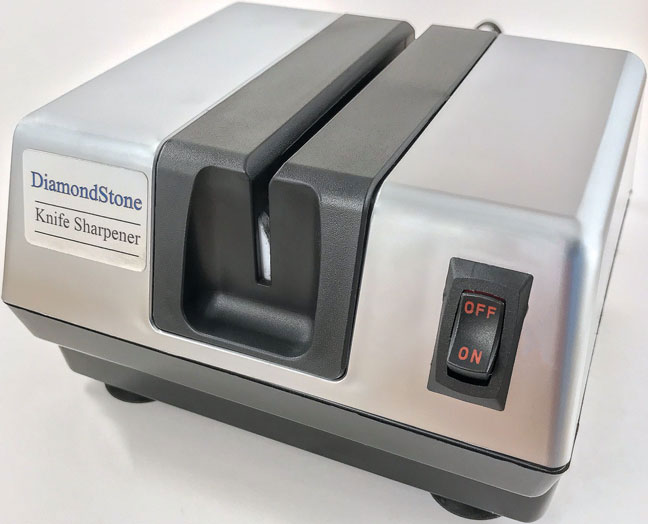
McGowan DiamondStone Electric Sharpener
PROS
- Quick and easy to use
- Works especially well on kitchen knives
- Chrome finish doesn’t look out of place on the countertop
- Design keeps metal dust to a minimum
- Less noisy than other models
CONS
- Boxy design may not be visually appealing to everyone
- Only produces hollow-ground edges
The DiamondStone electric sharpener from McGowan Manufacturing incorporates abrasive wheels that simultaneously sharpen both sides of the blade to create a burr-free, hollow-ground cutting edge.
Housed in a combination metal/plastic housing, the DiamondStone is available in brushed chrome or black. The brushed chrome blends in nicely on a kitchen countertop with other kitchen appliances.
Out of the box, the sharpener looks well built with top-notch fit and finish. It is quite boxy in appearance, with a pronounced slot running down the middle. Inside the slot sits multiple diamond-infused ceramic wheels that interlock and rotate counterclockwise in relation to each other in order to sharpen both sides of the edge simultaneously. The unit runs smoothly with minimal noise.
Place the blade in the slot starting with the tang end and pull straight toward you, using a minimal amount of pressure on the wheels and drawing back at a moderate pace to allow the ceramic wheels to do the work. As you approach the blade tip, lift the handle slightly so you can sharpen the blade’s belly evenly as well. Once you reach the tip, lift the knife out of the slot and repeat. Usually, a few strokes through the DiamondStone yield a very sharp edge.
This is an ideal type of sharpener for novices because there’s only one motion involved—pulling the blade through the machine.
MSRP: $84.95 – GET IT NOW
See also: Chef’s Choice Model 320
Pull-Through Manual Knife Sharpener
AccuSharp Pull-Through Knife Sharpener
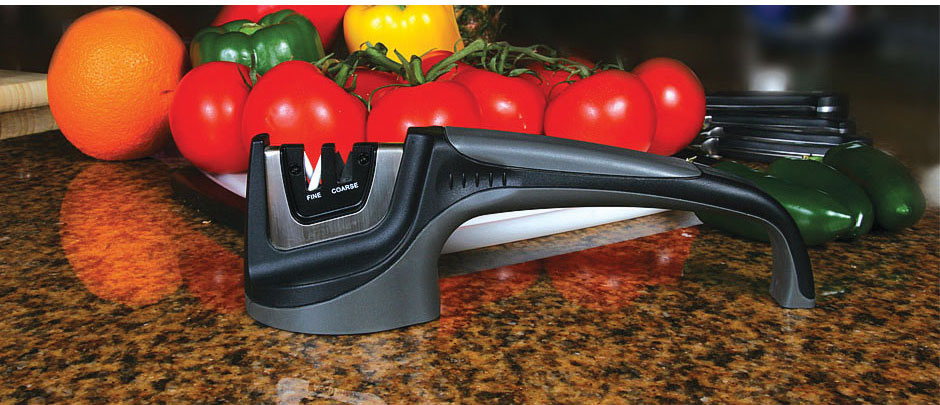
PROS
- Rubber grip for secure sharpening
- Sharpening and honing options
- Heavy duty design
- Compatible with most plain-edge knives
- Could not be simpler to use
CONS
- Sharpener/honer may become loose after years of use (as with most manual pull-through knife sharpeners
- Lacks the “cool factor” of more advanced knife sharpeners
Yes, there are plenty of pull-through, manual knife sharpeners out there. Some of them even resemble the design of the AccuSharp Pull-Through Knife Sharpener. So why did this one make the list?
To put it simply, this is a well-built manual knife sharpener with a sturdy design. That’s really all you need to worry about, because the sharpening technique will be the same. Draw the blade through the sharpening or the honing V with gentle pressure. Let the tool do the work. So long as you can safely move the blade through the V, this manual sharpener will tackle any type of knife (except for serrations).
This is a knife sharpener to keep in the kitchen drawer, the work bench in the garage, at the cabin, or even in a backpack.
MSRP: $19.99 – GET IT HERE
See Also: Just about any other manual, pull-through knife sharpener. Look for solid grips, a sturdy design, and solid construction. It’s OK to pay a few dollars extra for durability’s sake.
Knife Honing Rod Tips
What’s the difference between honing and sharpening knives?
Honing rods refresh an edge, but they do not sharpen. That’s an important distinction. Honing is something that’s done regularly to tune up a blade, such as before preparing a meal, or immediately after sharpening. That’s because honing straightens the existing edge. Sharpening removes metal from the edge, which is why it shouldn’t be done as often as honing.
Confusing this entire category is how some honing rods are called sharpening rods, and vice versa. The key is to look at the material.
Three Types of Honing Rods
Generally speaking, there are three types of honing rods: steel, ceramic and diamond. While each has different characteristics, there are some things to watch for:
- A secure, ergonomic grip
- A sturdy guard that protects your hand
- A ring on the handle for slipping a pinky through in case you drop it
- The rod should be longer than the blade of the knife/knives you intend to sharpen
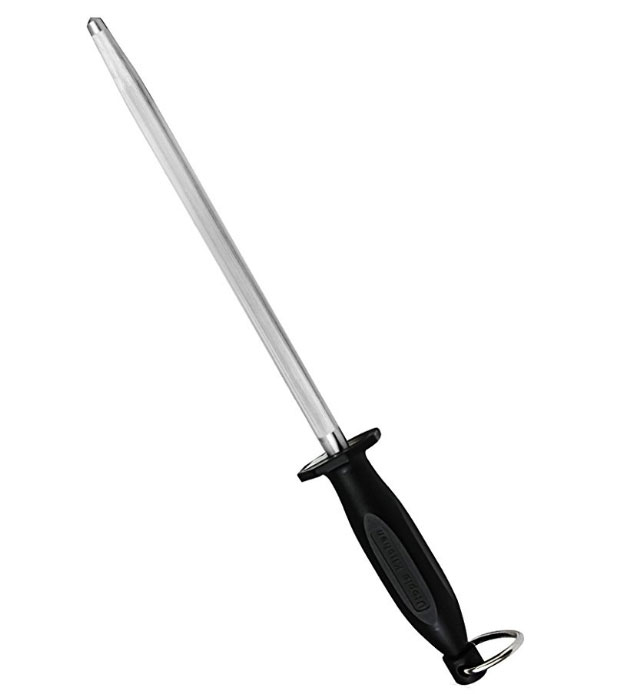
Steel honing rods are the most common type, and the least expensive. Because they’re made from metal that’s softer than what’s typically found on knives, they’re excellent honing tools. Don’t pay more than $20 for one.
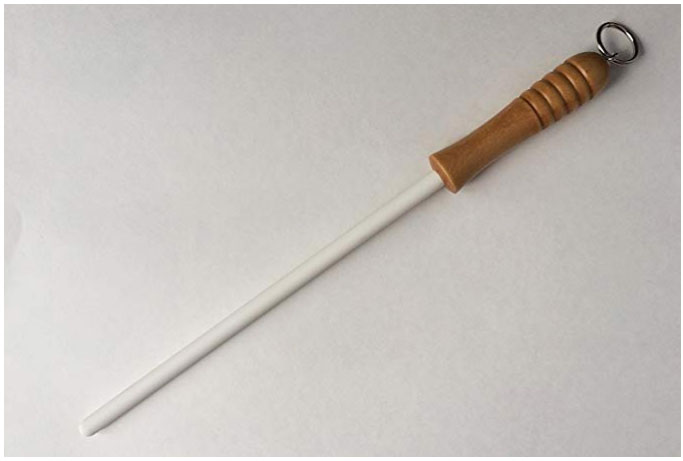
Ceramic honing rods are a bit more aggressive than steel versions. They’ll remove some steel in the process of honing. Isn’t that technically sharpening? Yes! However, if you’re someone who doesn’t sharpen as often as you should, a ceramic honing rod is a way to delay the inevitable. Expect to pay between $30 to $40 for the best value.
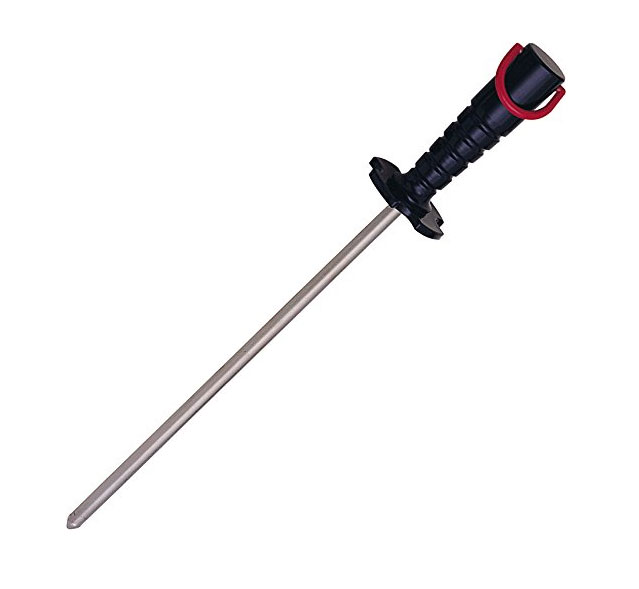
Diamond honing rods remove the most amount of steel during the honing process, which is why they’re basically sharpeners. If you go down the diamond rod route, pick up a steel or ceramic honing rod, too. On the plus side, diamond rods will last a lifetime. Pay $35 to $45 for a nice ROI.
Portable Keychain Knife Sharpener
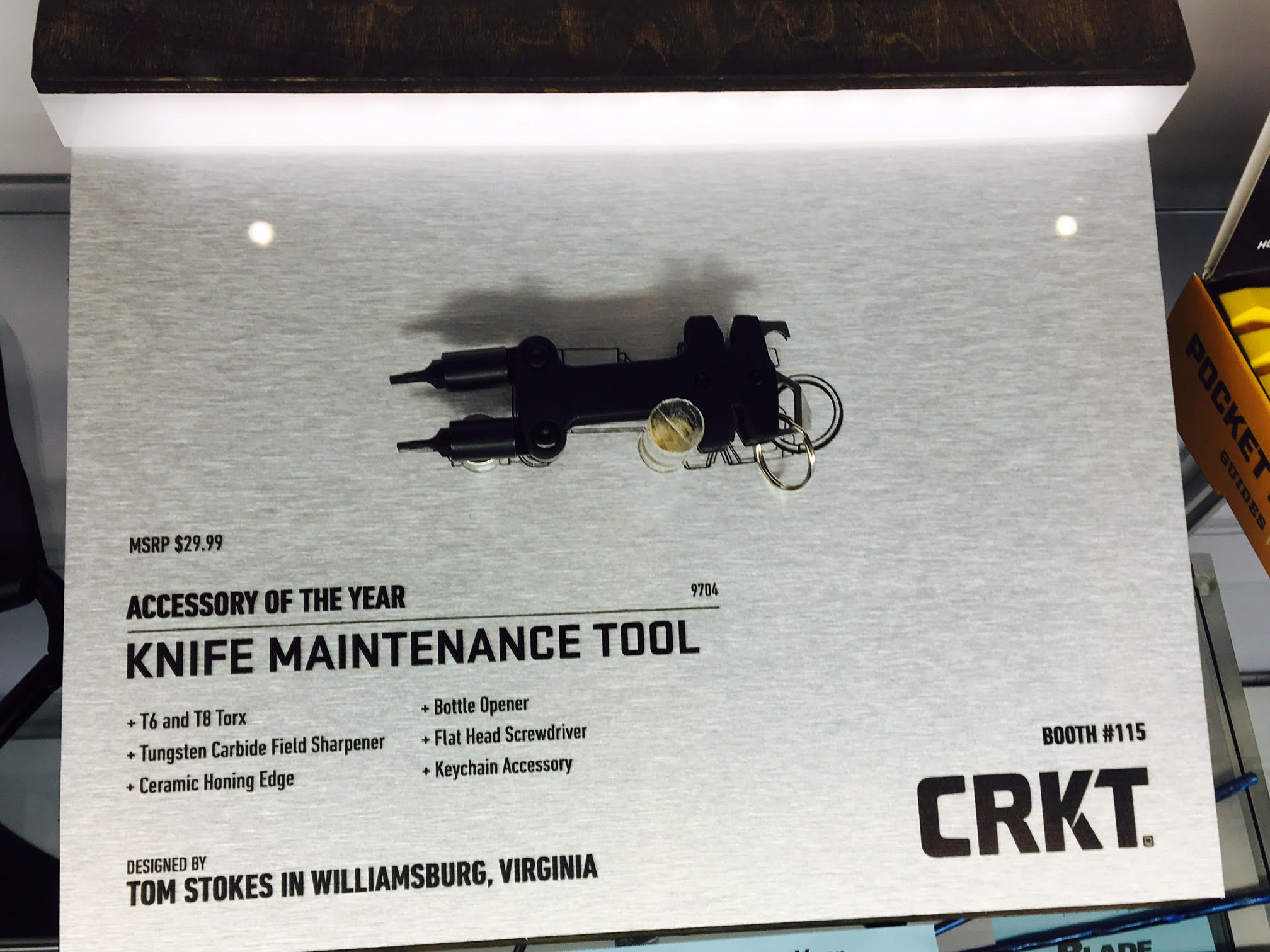
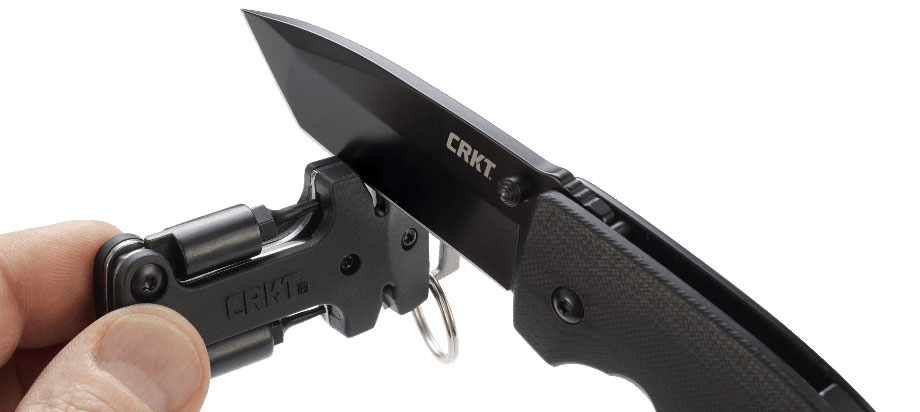
CRKT Knife Maintenance Tool (KMT)
PROS
- Compatible with most folding knives
- Tungsten manual sharpener on one side
- Ceramic honing edge on the other
- Attaches to keychain
- Bonus: T6 & T8 Torx screwdrivers
CONS
- Too small for larger fixed blade knives
- Maybe you prefer a different screwdriver?
Winner: 2018 BLADE Magazine Accessory of the Year!
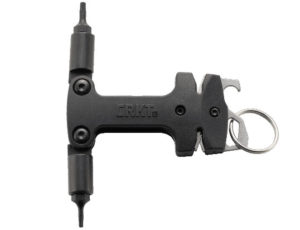
Too many keychain knife sharpeners are garbage. They fall apart, don’t get the job done, or are challenging to hold safely. The CRKT KMT, however, is an exception.
Place the KMT horizontally on a surface, then pull a blade through the tungsten carbide sharpener or the ceramic honing edge. Use gentle pressure, because the classic V will automatically bite into the edge’s preset angle.
The T6 and T8 screwdrivers may seem like filler for a keychain knife sharpener, but they actually offer a nice grip while working the blade.
An MSRP of $29.99 may seem high for a keychain knife sharpener, but consider the abuse you put your keys through on a daily basis, and it’s worth the price.
See also: DMT Mini-Sharp Sharpener
Serrated Knife Sharpener
GATCO Scepter 2.0

PROS
- Tapered diamond rod makes sharpening knife serrations a breeze
- Built-in carbide sharpener tunes up plain edges, too
- Bonus: Magnesium fire starting rod
- Compact design: Both rods fit inside the body
- Rugged body keeps components safe
CONS
- Best used in tandem with a separate, dedicated sharpener for plain (non-serrated) edges
- May not want to pay extra for the fire starting rod

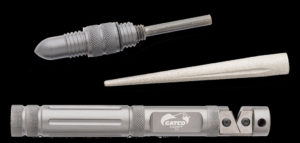
The GATCO Scepter 2.0 leans toward the survival category, but don’t let that turn you away from it. This is an overbuilt tool that should take care of sharpening your knife serrations for the rest of your life. Diamonds are forever.
The tapered diamond rod easily sharpens all types and sizes of serrations on tactical, sporting and kitchen knives. Simply lock the rod into the groove of a serration and lightly run it toward the blade’s edge. The classic V of the tungsten carbide sharpener will handle plain edges, too.
But the real gem in this design is the way the components can all be screwed into the rugged, 6061-T6 aluminum carbide body for secure storage.
Do you really need the magnesium fire starting rod? Maybe, maybe not, but that’s just gravy.
MSRP $39.99 – GET IT HERE
See also: Lansky Folding Diamond Tapered Sharpening Rod
Knife and Tool Sharpener
Spyderco Tri-Angle Sharpmaker 204MF
PROS
- Trusted by “knife nuts” for decades
- Takes the mystery out of sharpening sticks
- Comes with brass rods to protect hands
- Offers 30- and 40-degree angles
- Can handle plain edges and serrations, as well as non-knife items
- Comes with instructional DVD
CONS
- Novices may find it challenging
- Higher price vs. other sharpeners (MSRP $104.95 — although a sharp knife is worth it!)
Spyderco’s Tri-Angle Sharpmaker 204MF has been an industry leader for many years.
“In the 1970s when [Mrs. Gail Glesser] and I started selling knife sharpeners at local fairs, we were buying and selling other people’s sharpeners,” begins BLADE Magazine Cutlery Hall-Of-Fame© member Sal Glesser, CEO and founder of Spyderco. One of the sharpeners the Glessers sold was a V-stick type that they liked, though they identified some of its shortcomings.
“We invented the Tri-Angle Sharpmaker because, while similar to the [V-stick] sharpener, it solved many sharpening challenges/problems the [V-stick] couldn’t perform,” he says.
One of those problems is the V-stick model could not sharpen serrated blades. Enter the Sharpmaker’s triangular-shaped rods, which allow it to address both plain edges on the rods’ flats and serrations using the “points” of the triangle.
Once you set the sharpener up, start your blade from where the edge starts closest to the tang and run it down the hone, at the same time pulling the blade back toward you, ensuring the hone contacts the entire length of the cutting edge all the way to the tip. Hence, you’re doing two simultaneous motions—moving down the hone and pulling the blade back toward you. Do it all with light pressure.
MSRP $104.95 — GET IT NOW
See also: Wicked Edge WE120
Ceramic Knife Sharpener
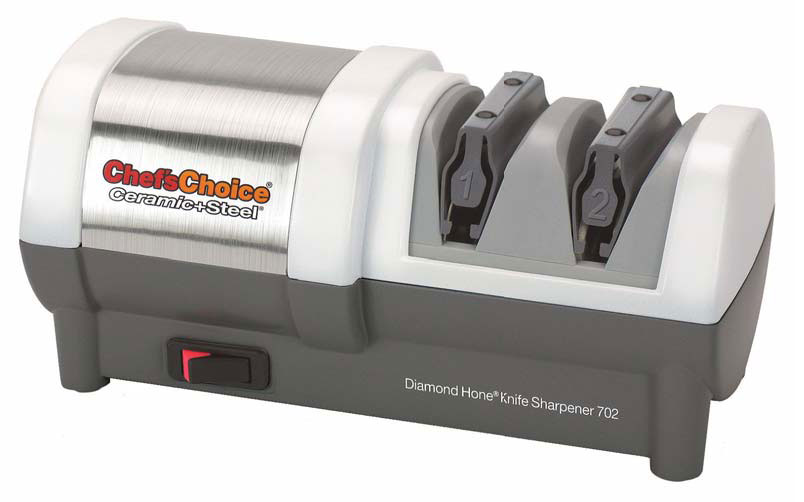
Chef’s Choice Ceramic + Steel Model 702
PROS
- Handles ceramic or steel blades
- Don’t need to mail ceramic knives in for sharpening
- Works with most types of knives
- Simple to use
CONS
- Only offers a convex edge
- Pricier than other sharpening options
As with all motorized Chef ’s Choice sharpeners, the 702 will handle steel kitchen knives. However, it also will put the same quality edge on any ceramic kitchen blade. Employing advanced diamond abrasive technology, the 702 features two sharpening slots that hold the knives at pre-set angles, optimized for the best edge on both ceramic and steel blades. Turn the motor on and, using a steady drawing motion, pull the blade through each slot.
The 702 applies a convex edge, or what the Chef ’s Choice literature calls a “gothic arch,” to either steel or ceramic blades. The resulting grind leaves behind more “body,” which gives the edge added strength and resists chipping, while still remaining very sharp. This translates into a longer lasting edge.
MSRP: $119.99 – BUY IT NOW
See also: Kyocera Diamond Wheel
Knife Sharpening Stones/Knife Benchstones
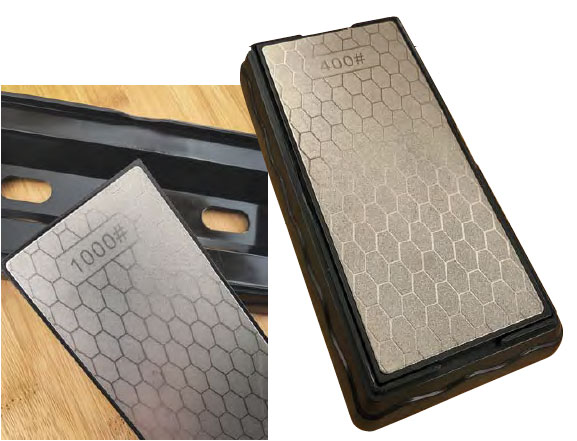
DMD Double-Sided Bench Stone
PROS
- As with all knife sharpening stones, total control over edge angle
- Two sides offer two grits
- You look like a pro
- Sharpens knives and edged tools
CONS
- May be too advanced for knife novices
- Some prefer a larger stone
The DMD double-sided bench stone sports two different grits: a coarse 400 and fine 1,000. The base is molded ABS plastic and features wide, anti-skid rubber feet to keep the sharpener in place while working on a flat table, counter or bench. The sharpening surface sits in a cavity of the base. To change grits, flip the hone over and return it to the base.
A hex-like pattern on both sharpening surfaces removes the tiny metal particles so they won’t collect and clog the surfaces as you sharpen the blade.
Work with the DMD and discover the convenience of a double-sided diamond bench stone, a rarity among such stones. The coarse side easily and quickly re-establishes worn edges to sharp. After you establish the primary edge, flip the sharpening surface over to the fine side and fine-tune the blade.
Pro Tip: Try using a permanent marker to color in the entire cutting edge on both sides of the blade. As you sharpen, note where the ink is removed and where it remains on the cutting edge. By doing so you can adjust your angle accordingly to capture the entire cutting edge and, therefore, keep the angle consistent for a sharp blade.
MSRP: $37.35 – GET IT NOW
See also: Lansky Bench Stones
Rechargeable, Cordless Knife Sharpener
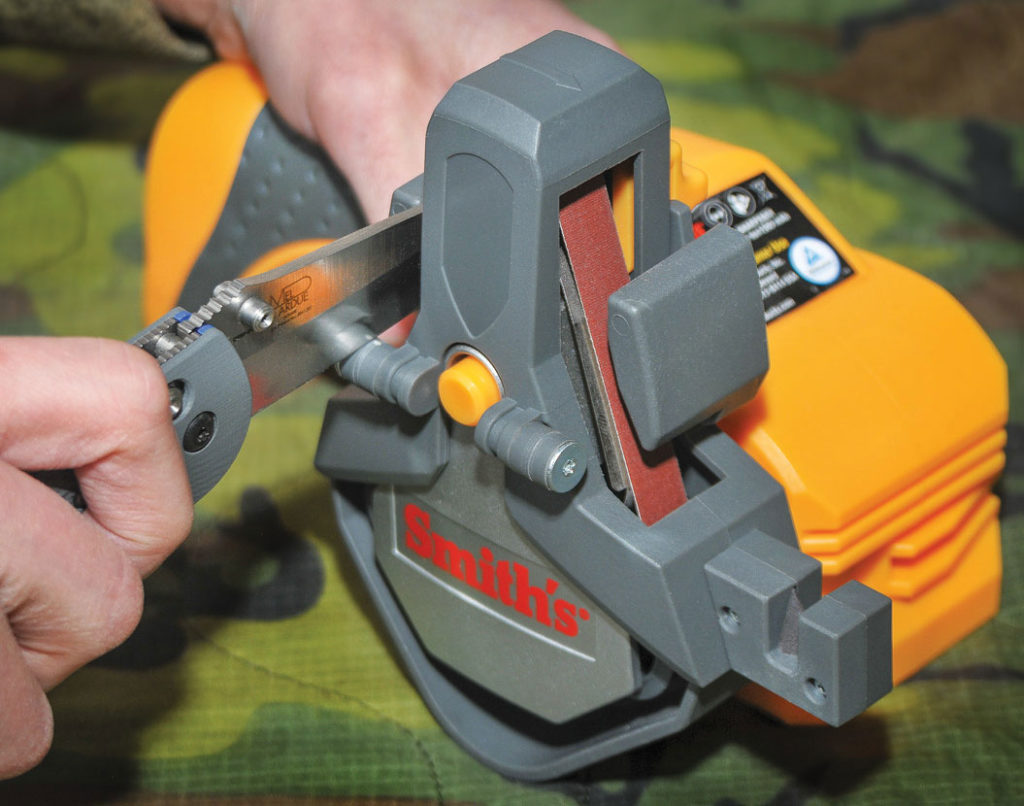
Smith’s Cordless Knife & Tool Sharpener
PROS
- Take an electric knife sharpener anywhere
- No need to replace batteries
- Sharpens knives and tools
- Interchangeable belts for different grits
- Backer plates offer extra safety
CONS
- Belts can wear out
- “Grabby” belts can apply an uneven edge if you’re not careful
- Battery life limits use time
The Cordless Knife & Tool Sharpener represents a new step for Smith’s Products. While the company has sold and continues to sell electric sharpeners, this is the first time it has offered a powered abrasive-belt unit. Moreover, Smith’s added an extra twist by making it cordless and rechargeable. A pivoting head enables the unit not only to sharpen knives, but other cutting and digging tools such as axes, hedge clippers, bypass pruners, shovels and more. It comes with three interchangeable belts in coarse (80), medium (220) and fine (600) grits.
The belts are simple to change and color-coded for easy recognition. In addition to the multiple grits of belts, an adjustable guide maintains a consistent angle throughout the sharpening process. Another cool feature consists of “backer plates” behind the flexible sharpening belts.
“The backer plates prevent the belt from wrapping around the tip of your blade when you pull it through the sharpening slot,” says Ricky Dukes, Smith’s vice president of marketing.
Pull the blade through the slots to easily achieve a very sharp cutting edge. An ergonomic, soft-grip molded handle makes holding the sharpener very comfortable as well as non-slip.
In order to operate the sharpener, depress the rocker switch with your finger. Release the switch and the motor shuts off. There is no trigger lock to enable the sharpener to run continuously. Hence, if you need to stop the unit to regain control, simply release the switch.
One of the unit’s advantages—being cordless and rechargeable—is also a downside. BLADE’s tester operated it non-stop for 8 minutes and 20 seconds before it ran out of charge with no warning. Around the 8-minute mark the motor slowed slightly and 20 seconds later it shut off . There was no gradual tapering off —it simply shut down.
MSRP: $79.99 – GET IT HERE
More Quick Links for Sharpening Knives
- Learn how to sharpen knives using a neat trick.
- Don’t stop at sharpening. Use this guide to complete knife maintenance.