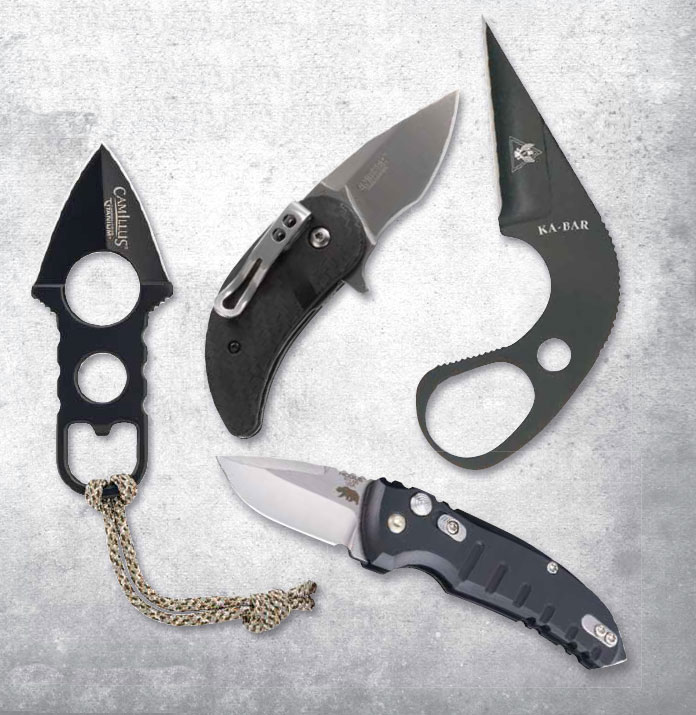
Whether it’s because of knife restrictions, portability or preference, these little blades aren’t too cute to cut.
CRKT Snicker
Camillus Heater
KA-BAR Last Ditch
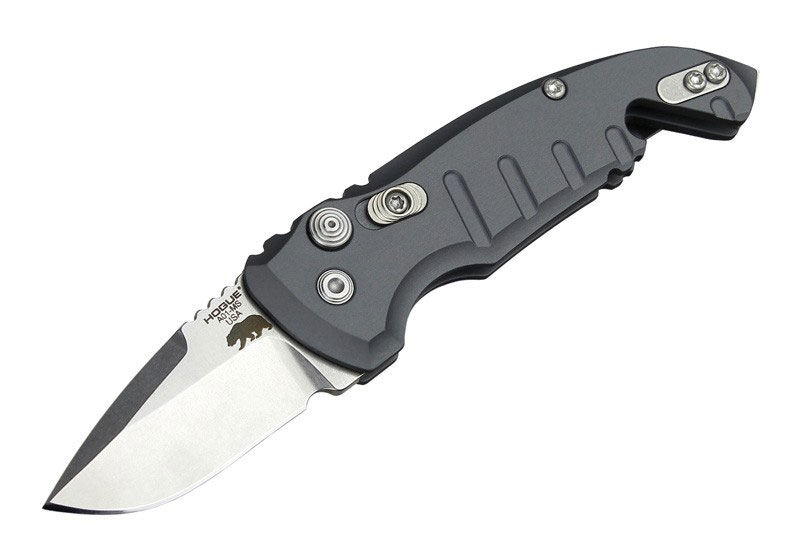
Hogue A01 MicroSwitch
CRKT Snicker
(CRKT image)
The CRKT Snicker debuted at BLADE Show 2017 and exemplifies the growing trend of blades measuring less than 2 inches.
“It serves a niche for those looking for a small blade that will tackle a variety of tasks and is a solid performer for CRKT,” explained company spokesperson Mike May. “Ease of use and ‘approachability’ are two key factors that make blades of this size popular. In areas with strict knife laws, the sub-2-inch blade can also help alleviate any concerns. In the case of the Snicker, its style and ergonomics make it an attractive small knife for consumer pockets as well.”
Blade Length: 1.846″ (46.89 mm)
Blade Edge: Plain
Blade Steel: 420J2, HRC 50-52
Blade Finish: Stonewash
Blade Thickness: 0.106″ (2.69 mm)
Closed Length: 2.938″ (74.63 mm)
Weight: 2.3 oz
Handle: Injection Molded Glass Reinforced Nylon
Style: Folding Knife w/Locking Liner
Overall Length: 4.688″ (119.08 mm)
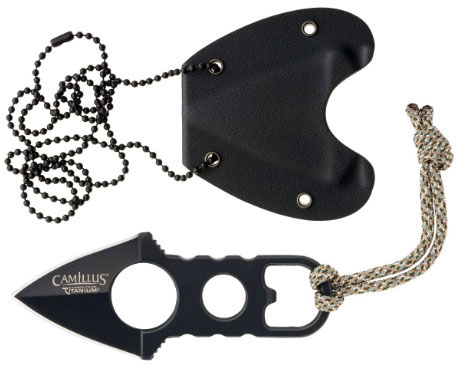
Camillus Heater
(Camillus image)
When Camillus launched the Heater in 2015, the idea was much the same.
“It has and continues to be an extremely popular model since it debuted,” noted Sam Dodge, Camillus senior brand manager. “We can attribute this to two factors: function and convenience. We find that people are purchasing a knife for different jobs or tasks. The fact that the knife comes in a slightly smaller package makes it more convenient to [store].
“There are still purists that will have ‘one knife to rule them all,’ but more and more we see that people want a knife for each activity.”
Blade Treatment: Carbonitride Titanium
Blade Color: Black
Blade Edge: Smooth
Blade Grind: Hollow
Blade Style: Spear
Fixed Blade
Handle Color: Black
Hand Orientation: Left and Right
Includes: Chain, Molded Sheath, Clip
Handle material: Stainless Steel + Paracord
Main Blade Material: 440
Rockwell Hardness: HRC54
Lifetime Warranty
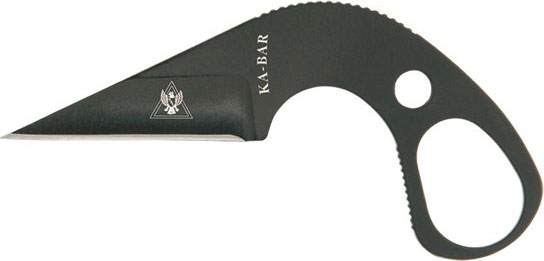
KA-BAR Last Ditch
(KA-BAR image)
The KA-BAR Last Ditch, commonly worn as a neck knife or laced into a boot, hit the shelves in 2008 and has been a top seller ever since.
“I think two of the biggest reasons why knives with blades under 2 inches are popular is due to concealability and ease of carry,” said Joe Bradley, KA-BAR sales and digital content manager. “Many folks don’t like to draw attention, and sometimes even an exposed pocket clips will do that. Small blades offer a tremendous blend of being lightweight with a small footprint.”
Overall Length: 3.625″
Blade Length: 1.625″
Blade Material: 9Cr18MoV
Hardness: 58-59 RC
Blade Style: Wharncliffe
Blade Grind: Flat
Finish: Black
Edge Type: Plain
Handle Length: 2.00″
Handle Material: Stainless Steel
Color: Black
Weight: 2.40 oz.
Sheath: Molded Polymer
Knife Type: Fixed Blade
Hogue A01 MicroSwitch
(Hogue Knives image)
The A01 MicroSwitch has been a hit since it was widely distributed in autumn 2017.
“It has been difficult to keep it in stock since its release,” he said. “It is the smallest knife in the Hogue Knives line, and there has been tremendous interest in it. It moves briskly at trade shows, through dealers and over our retail website.”
Crook considers many factors that weigh in on the wave of popularity in small knives. Among these is the company’s location in California, where he says anything larger in an automatic is illegal.
Blade Length: 1.95″
Overall Length: 5.8”
Closed Length: 3.85”
Weight: 2.7oz
Mechanism: Automatic Button Deployment with Manual Safety
Handle Material (Frame): 6061-T6 Anodized Aluminum
Pocket Clip: Stainless Steel Ambidextrous Tip Up Carry
Blade Style: Drop Point
Blade Thickness: 0.12”
Blade Material: CPM154 Stainless Steel
Blade Hardness: RC 57-59
Blade Treatment: Cryogenically Treated
Blade Finish: Tumbled Finish
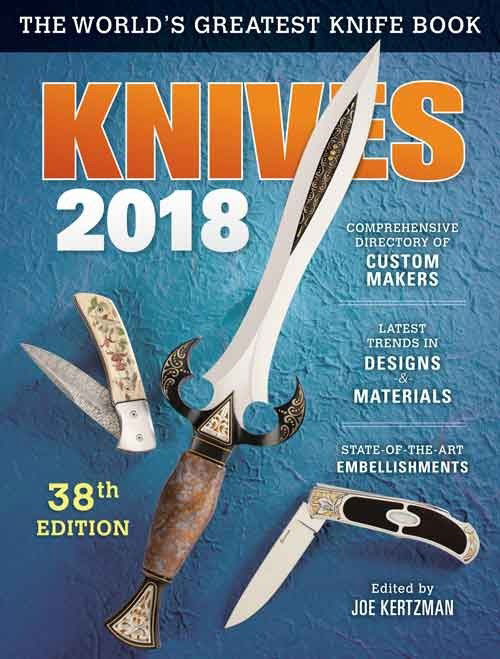
The World’s Greatest Knife Book
The KNIVES annual book is back and better than ever. Here’s what you can expect:
320 pages
Beautiful, full-color photos of knives and accessories
Comprehensive directory of custom knifemakers
In-depth features about knife collecting and making knives
Examples of the latest trends in knife designs and knifemaking materials
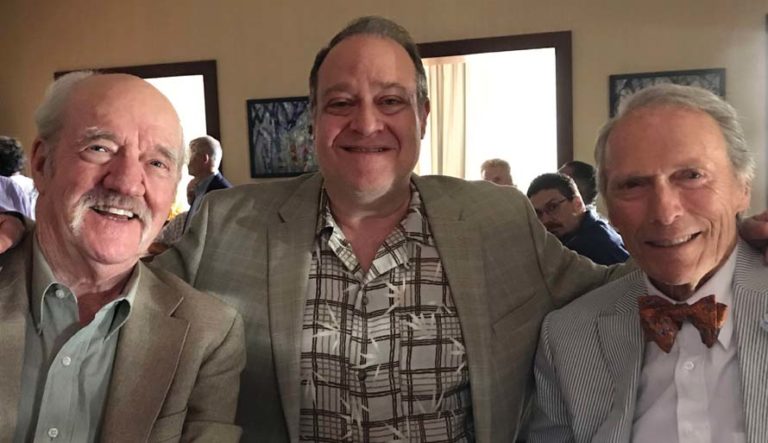
Adam Drescher (middle) during a break between scenes of the upcoming movie, “The Mule.” At right is Clint Eastwood and at left is character actor Richard Herd. Adam owns Adam Unlimited, which specializes in exotic skins for the knife and motorcycle industries, especially rayskin. (Photos by Images courtesy of Adam Drescher)
Adam Drescher, known best to the world of knives for his stingray leather supply company, has enjoyed many highlights in an acting career that spans over 40 movies and TV shows, but his experience in The Mule directed by and starring Clint Eastwood ranks at or near the top.
Released on Dec. 14, 2018, The Mule is about a botanist—played by Eastwood—who unwittingly becomes a mule transporting drugs for a criminal cartel. As with most of his roles, Adam’s character doesn’t have a name.
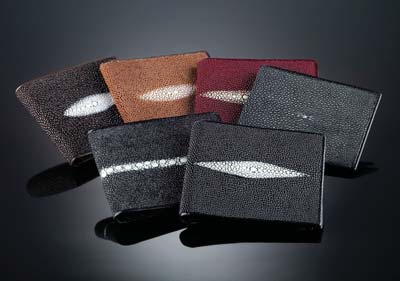
Drescher designs most of the accessories he sells, including these rayskin knife cases made in a factory in Bangkok, Thailand.
“I’m a computer online sales guy trying to talk Clint into taking his business online,” Drescher said. “I’m in two or three scenes that were shot, though I have no idea what will end up in the finished cut.”
The scenes were in a bar, which is where Adam asked the person playing the bartender to photograph him, Eastwood and actor Richard Herd.
“Working with Clint was a dream come true,” he added. “I’m what’s known as a ‘day player’—I work on a film for a day, maybe two days at a time, then I’m done,” Adam explained. “People think they remember seeing me but they’re not sure. I’m usually there and gone pretty quickly, usually just a scene or two, and this thing with Clint is almost like the epitome. Being a day player I don’t know how it could get any better. I got to work with him, got to improvise a little bit, got to actually act, had more than one line, and had a little character part to do. I had some interaction with him. That made my day.”
There are different grades of rayskin and Adam said he uses only the best. “People would come to me and say the interior of their wallet had worn out, and we began using shark skin in the interiors of our wallets,” he noted. “[Shark skin] never wears out.”
So what was Eastwood like as both a person and a director?
“He was pretty much what I was expecting only because I’ve heard so much from other people who’ve had the privilege of working with him,” Drescher said. “He knows his stuff backward and forward, totally in charge, quiet, yeah, he’s the man.
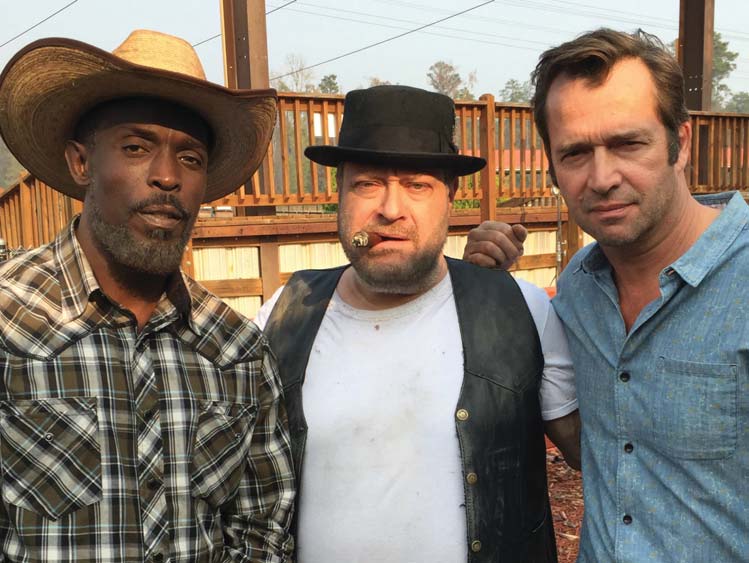
Another of Adam’s roles was as Boss Man on the TV show Hap and Leonard starring Michael Kenneth Williams (left) and James Purefoy (right).
“He never yells at you and from what I gather that goes all the way back to his days on Rawhide [the hit 1960s TV show]. Clint said the director would yell ‘action’ and it would spook the horses before they would start the scene, so Clint got that out of his system and said, OK, real quiet, and the next thing you know you’re doing the scene, you don’t even realize the cameras were rolling. Clint would say ‘cut’ and everything was respectful and really quiet and to the point. I’d heard that he shoots really fast. He did a couple of takes of our scenes, got different angles and got the dialogue right that he wanted. It was a pleasure of an experience for me, a highlight of a career that’s pleasurably been full of a lot of highlights.”
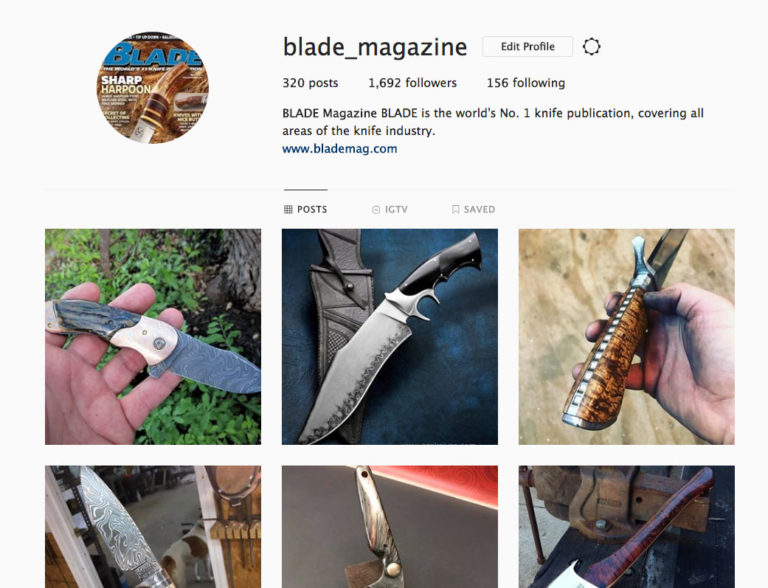
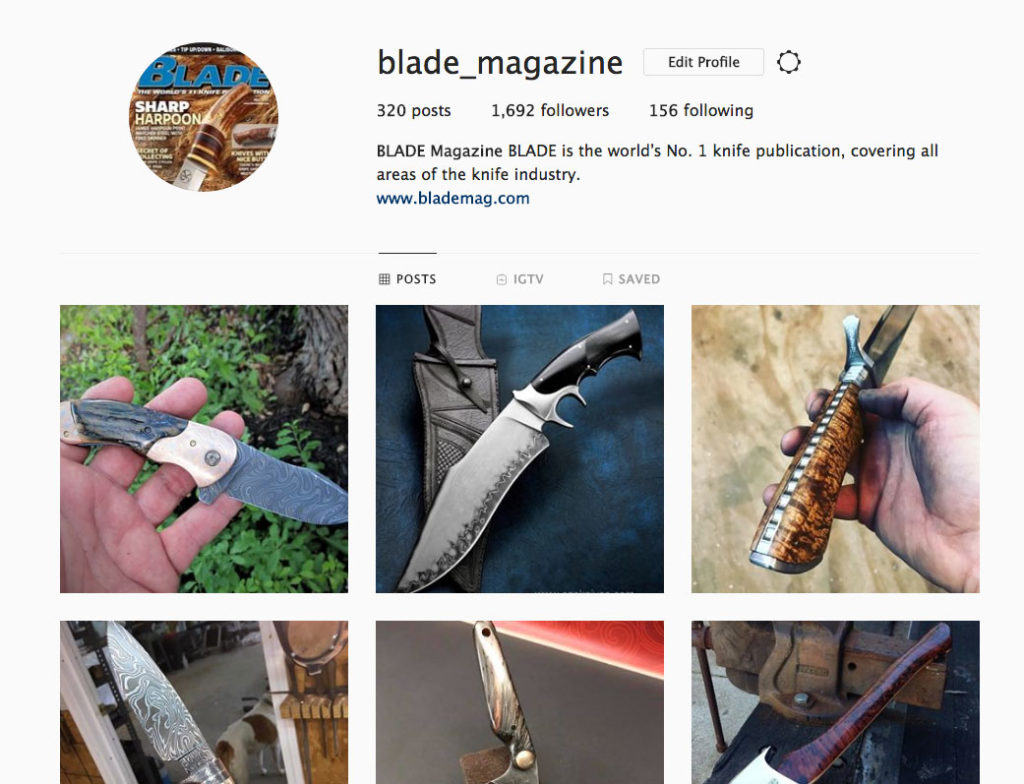
BLADE posts knife pictures on its Instagram account to highlight knifemakers’ work.
Editor’s note: Follow BLADE on Instagram here. Also, anyone buying or selling knives online should take caution when doing so on a social media platform. Recent events have singled out “weapons” content, and Instagram (owned by Facebook) is likely to be no exception. Diversification is key. Remember: In-person knife shows are still the best bet for buying/selling safely and securely.
Instagram Knife Pictures Help Knifemakers Sell and Knife Collectors Buy
A wave of Instagram commerce is building in the knife industry, and there is no indication of a slowdown at this point. Those who have leveraged the platform have seen increased activity that otherwise might have required hours and expenses associated with travel, marketing and promotion.
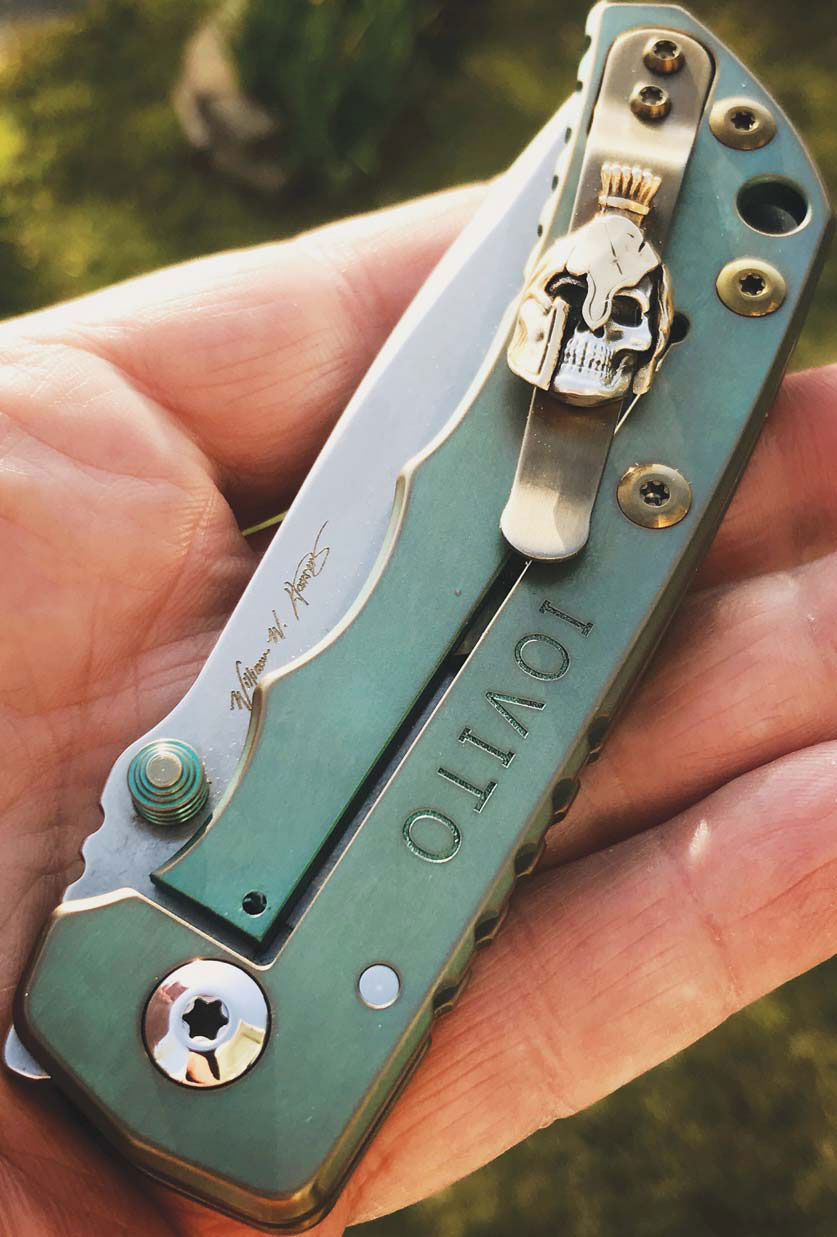
“The impact on the knife community is significant,” Curtis Iovito of Spartan Blades commented. “I can say that this year we have reached more prospective customers and knife lovers than we have on Facebook based on customer responses. It truly is a mix of social responses, providing information and assisting prospective buyers. Instagram has started allowing businesses to sell via the platform, and we plan to do this soon. Sixty-four percent of sales for us are from mobile platforms, so we see this as a plus.”
“I had to come out of the stone age to get with the program, and it has doubled or tripled my business,” asserted knifemaker and BLADE® field editor Kim Breed. “You can put your wares out there for sale, and people comment or order and everything else on one simple site. You can go straight to your cell phone and post pictures and get immediate feedback.”
Curtis Iovito of Spartan Blades said Instagram is a great way to share knife pictures and information, and to do so “in a flash.” (Spartan Blades photo)
Purveyor Neil Ostroff of True North Knives started an Instagram account as a social tool to connect with friends, family and customers, but it soon became apparent that an additional sales tool was at his disposal. He changed his account from his personal name into the True North Knives (TNK) brand. He monitors how posts are received by the public, using the “View Insights” option for real-time metrics.
“As Instagram and other social media platforms are constantly evolving and getting better, I’m finding that Instagram is the easiest to use and provides the most results,” Neil explained. “An example of a result is getting a direct message, e-mail or phone call asking for more information about the product. Although we only post knives that are immediately available for online purchase, it’s always nice to have some practical contact with the buyer. We take pride in our knife images, whether they’re taken by a professional like Jim Cooper or our excellent in-house team. If the picture is not top rate, then it reflects badly on the product.”
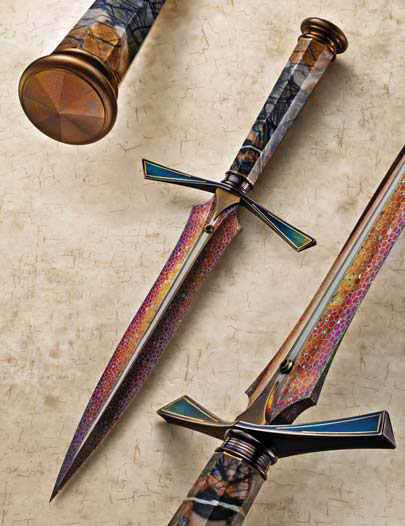
Bertie Rietveld put this image of his Omega dagger on Instagram and received a number of interesting comments, including one that read, “More like OhMyGod Dagger.” The guard is stainless steel with 24k gold. The blade is Rietveld’s dragonskin damascus with Stanhope lens at the base of the fuller. (SharpByCoop image)
More Than Just Knife Pictures
Breed points out that advertising in most any format is expensive. Knife pictures posted on Instagram allow immediate access to potential buyers at virtually no cost.
“Putting yourself out there to hundreds of thousands of people is powerful,” he noted. “If they’re looking for a knife, as soon as they search for custom knife or damascus, all sorts of stuff pops up to choose from.”
Kim refuses to hard sell on the platform. “Buyers just ask ‘how much?’ and it is a process of direct messaging between you and that person,” he said. “Some people post prices out there and everything has a different price to it. [Costs of knife- making supplies] have gone up 20 to 25 percent this year. If you’ve got old stock maybe you can keep prices lower, but if it’s newer stock you’ve got to pass the cost on. People will message me if they’re interested in something and then we talk price.”
After seven or eight months on Instagram, Kim sees an unlimited future for the platform.
“All the stuff you’ve posted from when you first started [on Instagram] is out there,” he observed. “So, you don’t have to continually post the same kind of knife. Just as you make them you can throw them up on Instagram.”
Instagram Cautionary Tales
Though social media is asserting itself in the TNK sales process, Ostroff is warily watching developments. His website is still king with his business at this point.
“In spite of Instagram’s popularity and audience, for True North Knives our website still takes in 90 percent of our sales,” he added. “As with any other shopping-cart-based website, the purchase is triggered by the photos, but then we offer a smooth and easy way to select, pay and order the knife. Instagram does not do that. It merely brings the product to the subscribers but then the hunt begins, and many potential buyers must go through many steps trying to contact the knifemaker, who may or may not be available to take an order.”
Another caution from Ostroff is that Instagram provides any seller with an “escape hatch” to sell a knife to anyone and not necessarily the first customer who steps up to buy. When a traditional e-commerce website operates, the item for sale is listed and directly connected to actual inventory; once it is sold it is gone and marked as out of stock. “Fair game for all!” he said.
“Many knifemakers on Instagram are only offering their knives for sale by lottery or raffle. As I don’t buy knives from Instagram I feel sorry for the people who aren’t always ‘attached to’ their phones, and also don’t have the money to, in many cases, overpay for knives due to the hype,” Neil related. “Many knives are sold at grossly inflated prices by knifemakers who are merely looking for the quick buck with no regard for a potential secondary market”—a secondary market that will never come about when the initial/primary purchase price is way too high.
Still, the luster of Instagram has drawn custom makers, purveyors and purchasers to the platform like moths to a flame.
“Initially, the knifemakers get a large audience, not only from active buyers but also from fans who may not be able to afford these knives but who really enjoy seeing the blade—like eye candy,” Ostroff said. “Knifemakers should assign or hire others to manage their account after knives are posted. Potential clients have questions, most of which never get answered by the knifemaker.”
According to Breed, payment is sometimes a sticky proposition. “When people talk with the knifemaker they should use common sense,” he remarked. “Like the internet, Instagram is a great thing, but it can be ugly at the same time. I let a guy place his order, and when I get close to sticking the handle on [the knife], then he needs to pop a check in the mail. Others pay with Paypal as soon as they order a knife, but some want to see what the finished product looks like.”
Mixed Signals?
No, simply an assessment of the pros and cons of a growing medium in the knife industry, one that cannot be ignored and likely will never go away.
“You almost have to get on Instagram,” Breed offered. “The younger generation that was raised on it will be jumping on other sites, too. I get on the computer once or twice a week because I’m spending most of my time making knives. Instagram is nice because it’s on your phone. If you’re grabbing lunch out or in your shop, you can have a brand new knife posted in less than two minutes and can follow up on what is happening with it.”
However, the traditional opportunity to hold the real knife in your hand is diminished. Buying from knife pictures has its own risks. The situation is always improved when buyer and seller really know one another. Time will tell how Instagram truly changes the buying/selling process.
Editor’s note: The following originally ran in the August 2015 issue of BLADE magazine. All images are from their respective manufacturers unless otherwise noted.
Memorial Day (taking place in 2018 on Monday, May 28) holds a revered place in the hearts and minds of Americans, and knife manufacturers recognize the heritage of freedom that fits well with such a commemoration. Knives have equipped American fighting men and women since the first call for national defense more than 200 years ago, and these modern knives convey a sense of pride and honor for our time.
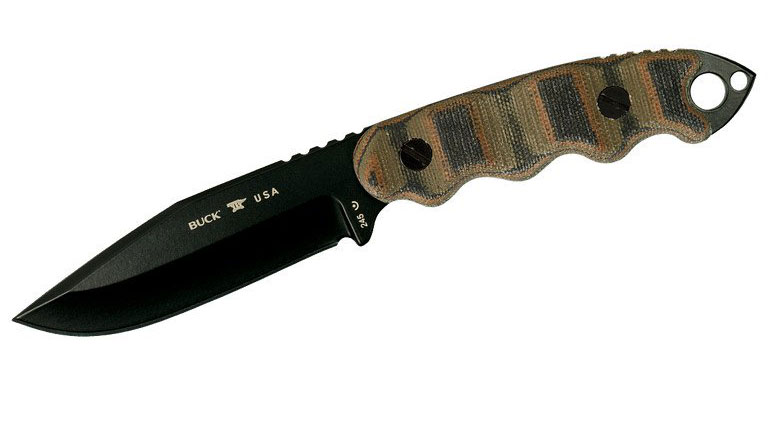
Buck 245 MWG
Buck Knives introduced the 245 MWG at the 2015 SHOT Show to honor the memory of Matthew J. Leathers, a highly decorated U.S. Navy SEAL who lost his life at sea in 2013. Matt was a member of Basic Under water Demolition/SEAL Training class 245, and the knife’s name says it all—245 to honor the class and MWG referring to the simple yet powerful phrase that was the young SEAL’s nickname: “Matt Would Go.”
The 245 MWG represents a partnership between Buck and Matt’s father, Tim Leathers. “During his nine years with the U.S. Navy SEALS, Matthew used many knives, but none that held up to his standards,” explained Stephanie Young, Buck marketing and communications manager. “He decided the only way to find a knife that met his criteria was to build it himself. Matt designed the knife that became a favorite among his fellow SEALS.”
The result of the Buck collaboration with Matt Leathers through his father is a sleek fixed-blade utility/fighting knife with a 5160 spring steel blade and tough Micarta® handle. Other features include the TEK-LOK® belt clip and a Kydex® sheath designed with a low-infrared signature.
A portion of the proceeds from sales goes to MattWouldGo LLC and in turn to the Navy SEAL Foundation.
“We are honored to bring this knife to the market for the Leathers family and happy to give something back to those who protect us,” Young commented.
Two Camillus Fixed Blades
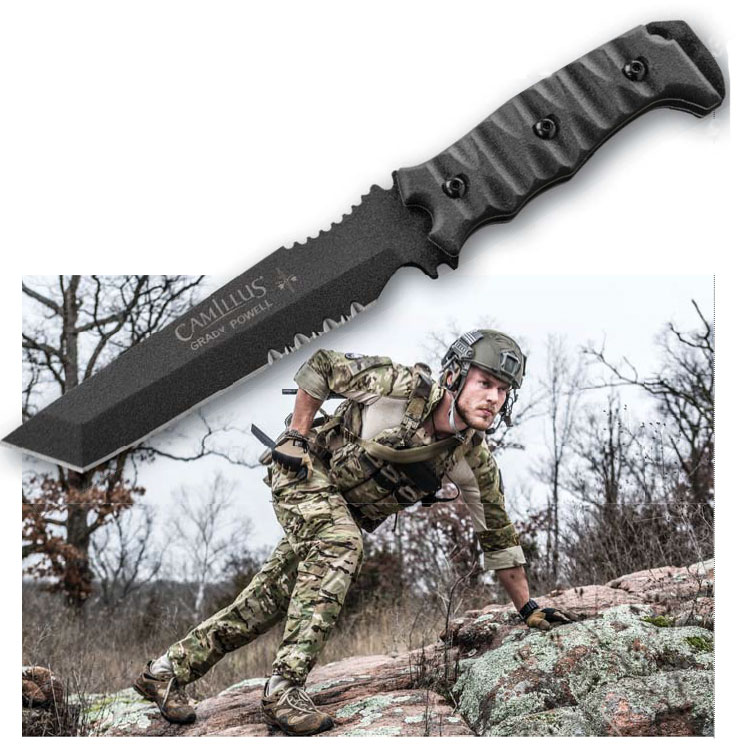
Featured on the National Geographic Channel’s “Ultimate Survival Alaska,” retired Green Beret Grady Powell (above) designed the Camillus Grady Powell fixed-blade tanto. Powell trains military, law enforcement and civilians in survival training.
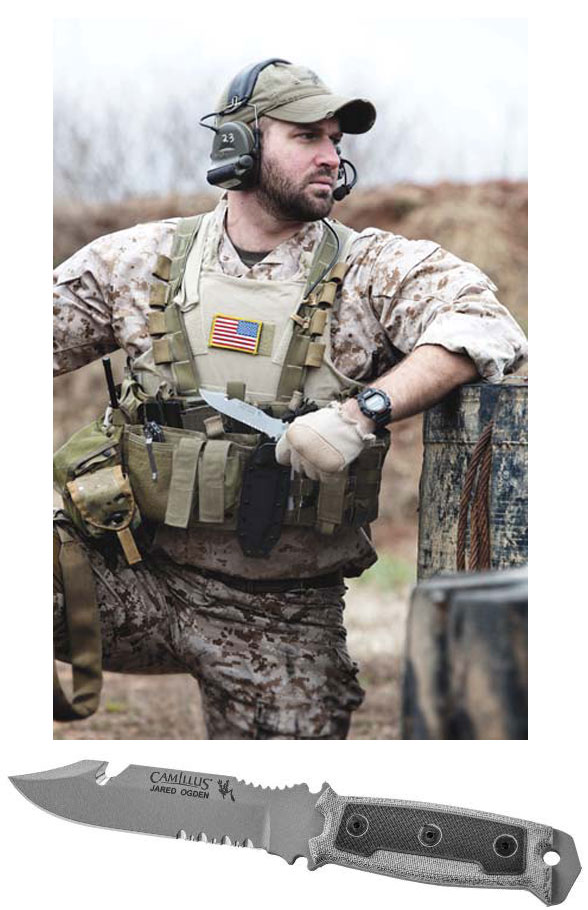
A pair of Camillus fixed blades made to the exacting specifications of retired U.S. Army Green Beret and current military, law enforcement and survival trainer Grady Powell, and of Jared Ogden, a combat-decorated retired Navy SEAL and surface warfare officer, both of whom are featured on the National Geographic Channel TV show Ultimate Survival Alaska, makes great Memorial Day remembrance knives.
“These knives accommodate everything a SEAL or Green Beret would do in their duties,” explained Rick Constantine, Camillus marketing manager. “Both of these men had input on the design of these knives. They are true-life heroes, and that’s why we went after them. We all said we wanted to build knives that anyone would be proud to carry on active duty or elsewhere.”
Both knives feature 1095 high carbon steel blades and custom molded sheaths. Constantine said Powell wanted a knife useful in hand-to-hand situations, while Ogden stressed cutting ability and grip strength—particularly in water.
The Powell model features a half-serrated 4.87-inch blade with a G-10 handle that sports Micarta accents, and a 10.5-inch overall length.
Ogden’s knife includes a 4.75-inch blade with gut hook, a G-10 handle, a 10-inch overall length, and versatility that allows the user to fashion it into a survival spear.
Ogden (above) served as both a Navy SEAL and a surface warfare officer. His military awards include the Combat Action Ribbon and the Bronze Star with “V” for Valor. He is featured on the National Geographic Channel’s “Ultimate Survival Alaska.”
Each knife is serial numbered.
“We have worked with a number of personalities through the years,” Constantine remarked, “but none have been better or more knowledgeable than these guys.”
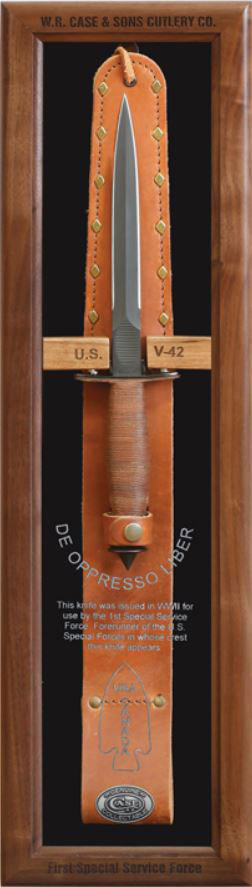
Case FSSF V-42
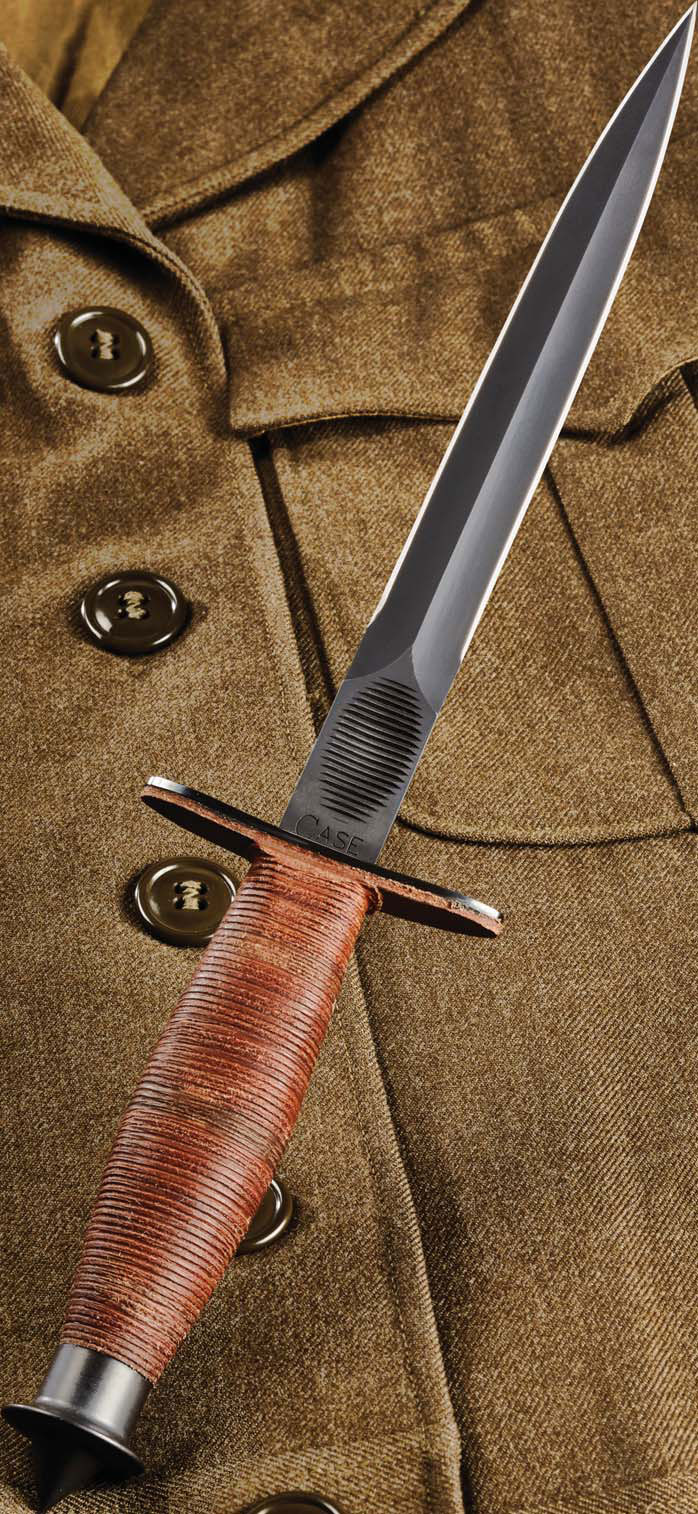
The Case V-42 reproduction is based on the company’s original museum piece. (Kris Kandler image)The V-42 in its display case.
When members of the First Special Service Force Association approached Case about a revival of the legendary V-42 stiletto, the company jumped at the chance.
Special Forces Association Montana Chapter 28 and a large number of knife enthusiasts supported the idea, and the new Case V-42 is true in detail to its heritage. Commissioned by U.S. Army Colonel Robert T. Frederick in 1942, the V-42 was issued to troops of the joint U.S.-Canadian First Special Service Force (FSSF), popularly known as the Devil’s Brigade. These soldiers served with distinction in World War II, and the V-42 was with them all the way. Case evaluated its own original museum V-42 and reproduced that fighting gem with painstaking accuracy.
Though the V-42 has been reintroduced a couple of times in the past, Case officials indicate this rendition is more accurate than ever.
“We really have a greater appreciation for what goes into making this knife,” said Case representative Fred Feightner. “We actually had it X-rayed to see how the handle was put together. We examined the knife from the inside out, and this was done on a much more detailed basis than previous re-releases of the V-42. The project took about five years to complete.”
The V-42’s blade of Case chrome vanadium steel—essentially, 1095 high-carbon steel with added chromium and vanadium—is double concave ground to reproduce the distinctive centerline along its length. The stacked-leather-washer handle is constructed with specialty gimping, and the famed V-42 “thumbprint” is embedded in the ricasso of the 12.5-inch, 7-ounce knife for proper blade orientation/indexing and grip strength. The leather sheath is complete with steel teeth reinforcing the sleeve and brass rivet covers.
“We’re extremely proud and honored to present a reproduction knife that is symbolic of our military elite and the American freedom they fought, and fight every day, to protect,” noted John Sullivan, Case marketing director. “Case knives and the American military share a long and distinguished history dating as far back as World War I, so we’ve taken great measure to ensure that the V-42 reproduction model meets the highest standards and is deemed authentic by the same brave Forcemen who carried the original into battle so many years ago.”
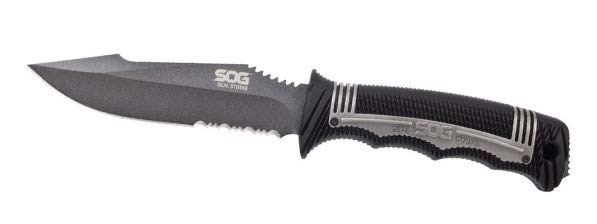
SOG SEAL Strike
The SOG SEAL Strike model SS1002-CP sports a 4.9-inch partially serrated blade of powder-coated AUS-8 stainless steel. The handle is glass-reinforced nylon with a stainless steel overwrap. Weight: 5.6 ounces. Overall length: 9.6 inches.
The new SEAL Strike from SOG Specialty Knives & Tools includes a 4.9-inch partially serrated AUS-8 stainless steel blade with cryogenic heat treatment, and a handle of glass-reinforced nylon.
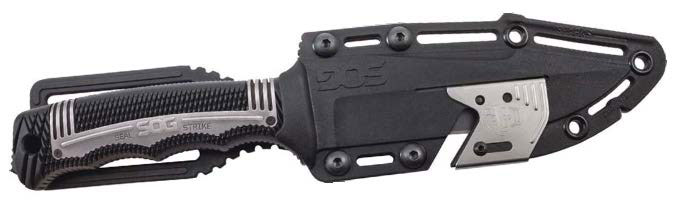
“The biggest differentiator for the SEAL Strike is the sheath,” SOG’s Chris Cashbaugh explained. “It has several features that enhance the functions of the knife. You can use the line cutter to cut cord or webbing without having to expose the blade. The carbide sharpener is in the side of the sheath and can be used to touch up the blade while out in the field. The ferrocerium rod can help start a fire in an emergency situation.”
Boasting the SOG logo etched in steel, the deluxe molded MOLLE-compatible sheath for the SOG SEAL Strike SS1002-CP includes a cutout for cutting line with the knife sheathed, a sharpening notch on the low side toward the tip, and a ferrocerium fire-starting rod.
The SEAL Strike fits the Memorial Day theme well since its design relates to the longtime SOG collaboration with the military and the ultimate goal of producing a knife that fills the bill for troops on deployment or anyone in the field.
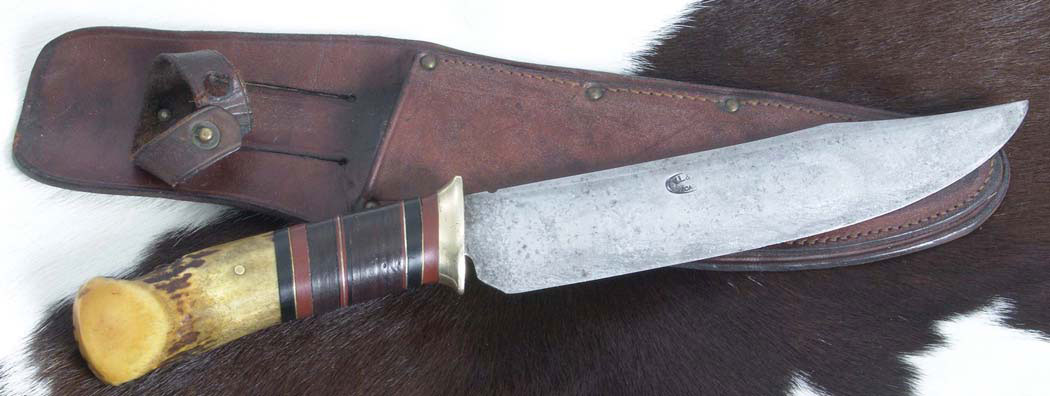
According to Dr. Jim Lucie, Scagel made sheaths for most of his knives and axes, though there were exceptions, such as when he supplied knives to some retailers. His sheaths ranged from simple but functional to ornately embossed. (Mike Carter image)
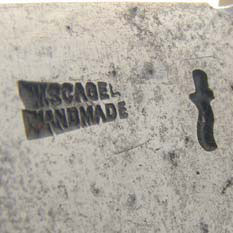
Scagel stamped many of his blades “W. SCAGEL” over “HANDMADE” and with the image of a kris knife. (Mike Carter image)
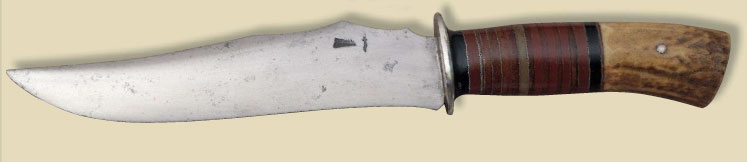
Scagel’s influence resonates across the decades as knives and knifemakers have taken their cue from his mastery of the curve and the spacer, his interpretation of the lines, fit and finish of a knife that stands the test of time, setting a standard for others to follow. Born in 1873, Scagel lived to the age of 90, and during his lifetime proved himself a master metalworker. His wrought iron adorned the windows of banks and other buildings in the city of Grand Rapids, and he participated in bridge building as well. His first knives were made in lumber camps in the Great Lakes area of the USA and Canada, with the earliest examples dating to around 1910.
Th rough the years Scagel made his imprint as a custom knifemaker, selling his wares through Abercrombie & Fitch during the 1920s, raising the profile of the custom knife with his recognizable style of stag and spacer handles. His friends at Brunswick Corp. kept him supplied with scrap pieces of Bakelite (the first manmade plastic and first true synthetic), wood, ivory and fiber from the manufacture of pool tables and bowling balls for use as spacers. He made bowies, hunters, fighters, folders and hatchets that have become coveted collectibles fetching high prices at auctions and private sales. His kitchen knives were second to none, and his paired carving sets were expensive masterpieces.
Meanwhile, those who appreciated a tough working knife that had a distinctive look gravitated toward custom knifemaking. Among them was legendary Cutlery Hall-Of-Famer Bo Randall, who became a protégé of Scagel. In turn, Randall influenced the likes of Cutlery Hall-Of-Famer Bob Loveless and so many others—and the legacy continues to grow.
William Wales Scagel’s personal hunting knife features a silver-mounted guard and a silver cap at the end of the stag. His signature is on the obverse side of the blade. (image from the 1996 Pictorial Calendar of William W. Scagel Knives; knife from the Dr. James Lucie Collection)
Scagel, the Man
Dr. Jim Lucie, Scagel’s longtime friend and personal physician, remembers a matter-of-fact kind of guy.
“He was sometimes quite opinionated,” recalled Dr. Lucie, who achieved status as an ABS journeyman smith in his own right. “He shunned publicity and did not like the public eye, and he was critical of some types of people. He was an atheist by choice and didn’t mind stirring the pot about something. If he liked you, and I spent many delightful hours with him, he would go to hell and back for you. If he didn’t, you only got one chance to take advantage of him.”
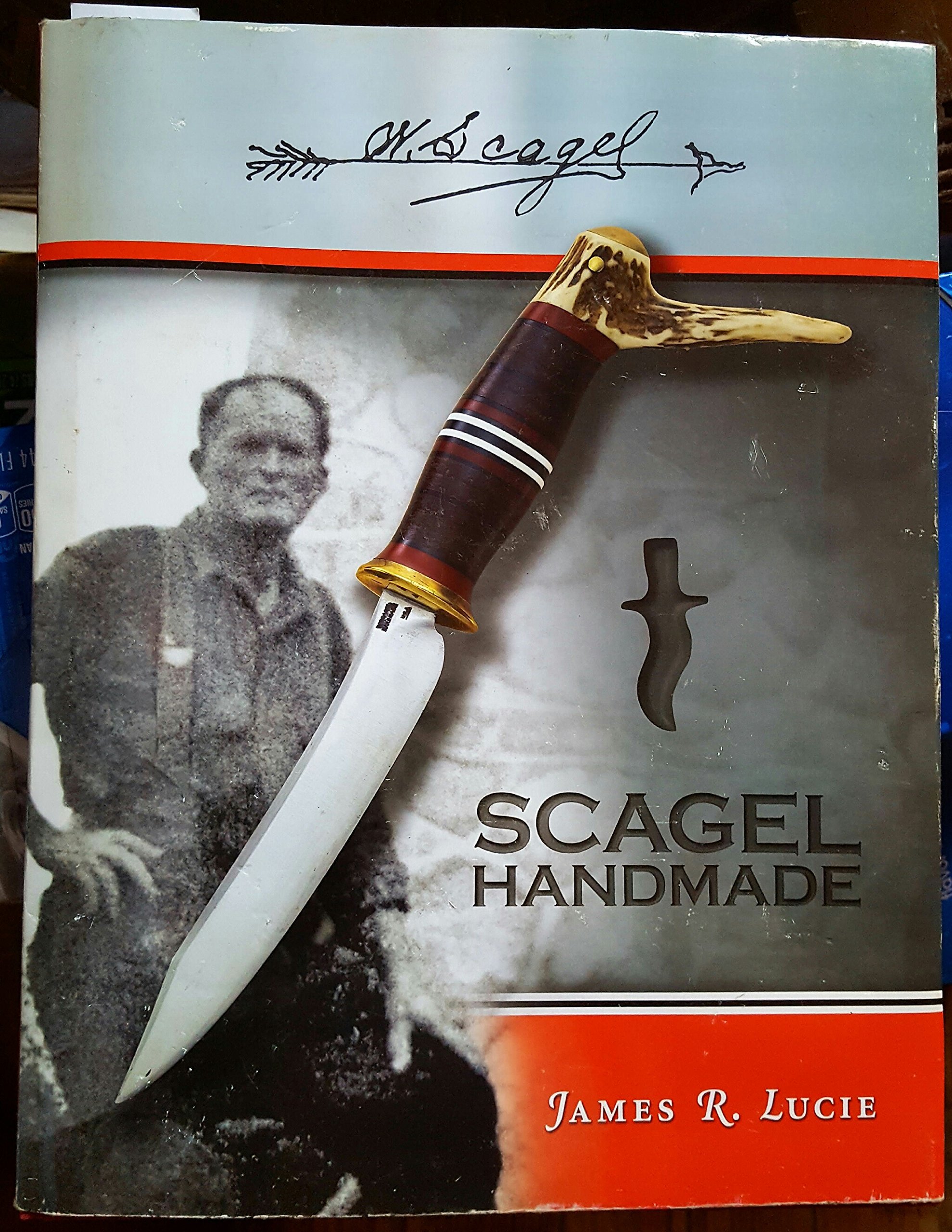
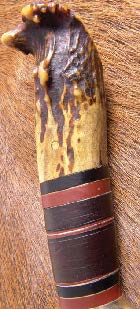
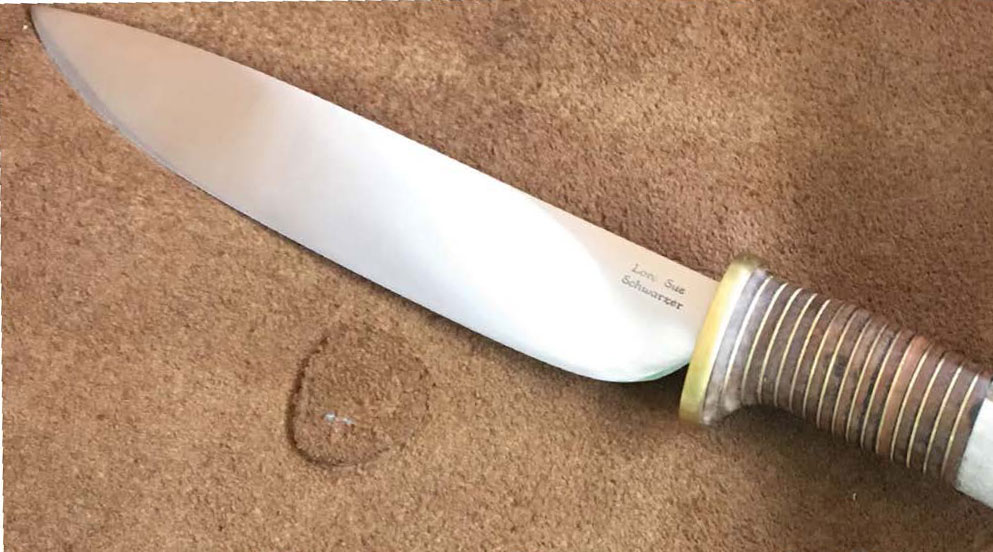
Published in 2010, Scagel Handmade by James R. Lucie is the quintessential book on Scagel. Famous for being reclusive, Scagel had few pictures taken of himself. The fuzzy one on the cover of Lucie’s book is one of the only known pictures of the famous knifemaker.As Lora Schwarzer noted, alternating brass and leather spacers with deer antler at the other end comprised Scagel’s signature stacked handle. (Mike Carter image)
The author of the quintessential book on the subject, Scagel Handmade, published in 2010, Dr. Lucie calls Scagel a “genius with metal work. He was a pioneer. He got Bo Randall started, and the first knives Bo made were around 1937-38, I believe. Scagel’s knives have been copied more than anybody else, more than even the Bob Loveless drop point.”
Scagel’s work has often been imitated, sometimes with dubious results. At other times, however, the style has been replicated with precision. ABS journeyman smith Lora Schwarzer worked in a hospital with Dr. Lucie, who introduced her to Scagel knives.
“Dr. Lucie helped me get started, and I wanted to do Scagel-style knives,” Lora remarked. “They are pretty and easy to hold. They feel good in your hand, and none of them are the same, basically. He might have done a few sets that match, but that was not the norm. The spacers are different and the antlers are different, and they are pretty with their curves and colors.”
Schwarzer started forging in 1996 and has made many Scagel repros since then. Her current work includes a couple with 1084 tool steel blades, brass guards, and leather, fiber, brass, copper and bronze spacers. Her favorite Scagel knife is an unmarked piece.
“If someone brought him a piece of steel,” she explained, “and asked him to make a knife for them, he would do it but not mark it because he didn’t know what kind of steel it was or where it came from. I got this one from Dr. Lucie, who got it from the person Bill originally made it for. Its handle is alternating brass and leather spacers with deer antler at the other end. That was his signature stacked handle.”
One of the great stories Lora likes to tell about Scagel involves a lady who regularly visited the local grocery store. In those days it was common to wrap purchases in brown paper and tie them with string. The lady struggled to break the string, so Scagel made her a miniature knife, which Lora has seen and is pictured in Dr. Lucie’s book, to cut the strings.
“Another thing I know is that Bill Scagel had a kind heart,” she added. “During the polio epidemic in the 1950s, he built braces for people without charging them.”
ABS journeyman smith Lora Schwarzer’s Scagel repro is a work in progress and includes a blade of 1084 carbon steel, brass guard, and brass and leather spacers. She stated she needs to “drill and put in the pin and final finish the handle.” Overall length: 12 inches. (Schwarzer image)
Scagel Knives
Gordon White of Cuthbert, Georgia, has been collecting Scagel knives for about 30 years. Gordon sees the historic significance of Scagel’s body of work as a big reason for his lasting interest.
“Well, the knives are just so unusual and different,” he said, “and he is the father of handmade knives and the first person in the 20th century to start making a custom handmade knife. He forged everything he made, and the unique fact that he made his own machinery and equipment and did everything by hand tells me that there has really been nothing like Scagel before or since.”
According to White, one of Scagel’s most innovative tools was used to place the spacers on the knife handle and then press them together, followed by the stag or brass butt that was then pinned in place. Scagel hatchets in mint condition are difficult to find because they were meant for use, and those who bought them put them to work steadily.
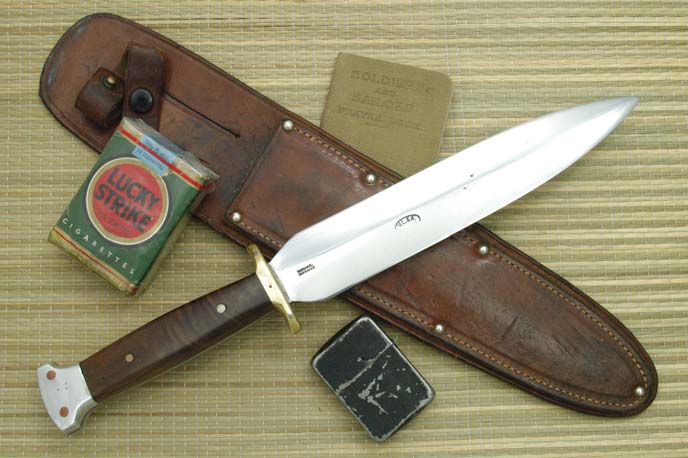
Louis Chow owns three World War II Scagel daggers. Two are forged carbon steel with full-tang handles slabbed in wood. The construction of the guards is unusual with a wrap-around opening to fit onto the tang. “It’s just another aspect of Scagel’s work,” Chow said, “something different.” (Louis Chow image)
Unlike other custom makers who can point to a mentor or individual who helped launch their careers, collector Louis Chow says Scagel stands alone.
“He was unique, you could say, because in my opinion I don’t think Scagel was too much influenced by anyone else in the beginning. Still, there were great knives being made before Scagel. For some reason, he was somewhat of a hermit and didn’t research what other guys were starting to do. Of course, those famous makers had the power tools necessary to make precision knives. Scagel used whatever he had on hand, a small generator and grinder. He didn’t have anything to go by as a sample, no publications to refer to. So, he basically did what he thought a hunter or bowie knife would look like.”
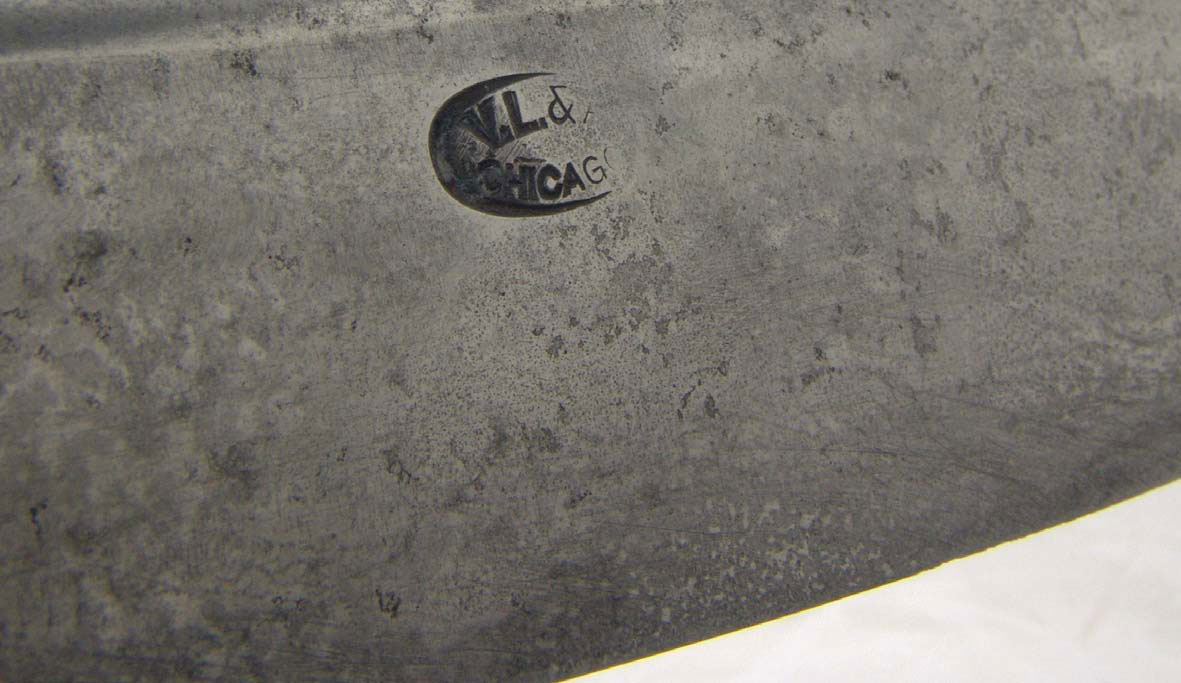
In addition to making knives beginning circa 1920 for retail giant Abercrombie & Fitch of New York, Scagel also made knives for retailers Von Lengerke & Detmold of New York and Von Lengerke & Antoine of Chicago. The blade stamp above is on a knife he made for the latter. (Mike Carter image)
Chow is primarily a Loveless collector, and he acknowledges that the reasons for collecting a particular custom maker are varied. He agrees with White that the history of Scagel is a big factor.
“If I look back at how Loveless got started, as far back as you can go, Scagel is the granddaddy of the industry and influenced everyone else,” Chow explained. “For me, he is the source of what influenced Loveless. My preference is Scagel’s simple daggers that he made during World War II, his contribution to the war effort and the foundation of the current custom knife industry.”
Chow owns three Scagel daggers from the World War II era and a small pocket hatchet that was popularized in the 1950s. The daggers are forged carbon steel with full tang handles slabbed in wood. The construction of the guards is unusual with a wrap-around opening to fit onto the tang.
“Two of the three daggers are made like that,” Chow said. “It’s just another aspect of Scagel’s work, something different.”
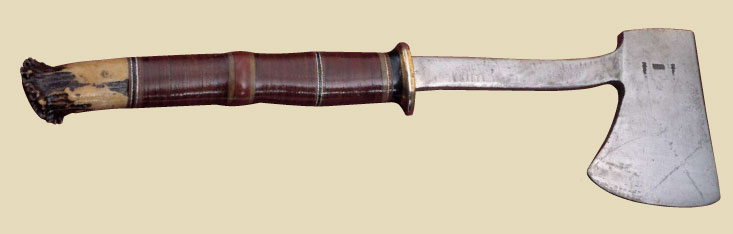
As Dr. Lucie notes in his book, Scagel’s axes are interesting and considered rare. There are two varieties: 1) general camp axes medium to large in size and quite hefty and 2) the hiking or military backpack axe, which is smaller and more petite. The one above is an example of the former. (image from the 1996 Pictorial Calendar of William W. Scagel Knives; axe from the Dr. James Lucie Collection)
Values of Scagel Knives
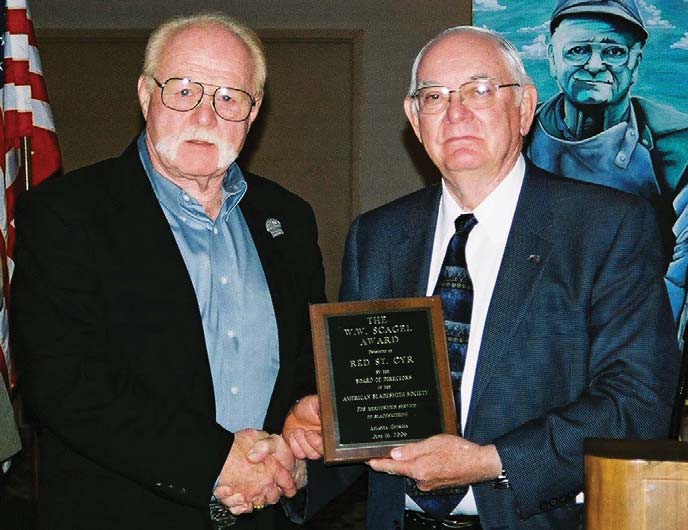
The American Bladesmith Society presents the annual William Wales Scagel Award to an ABS smith for longtime service in promotion of the forged blade. ABS master smith Red St. Cyr (left) received the award from BLADE Magazine Cutlery Hall-Of-Fame member B.R. Hughes (right) in 2006. The portrait in the background is of Cutlery Hall-Of-Famer Bill Moran.
Scagel knives remain popular among collectors, and White considers the prices paid at the 2011 auction of Dr. Lucie’s collection as evidence of the demand.
“That auction is a good meter to go by,” he remarked. “The hunters were averaging from $12,000 to the mid-$20,000 range depending on appearance, and condition has a lot to do with it. Some of them look better than others, and a high-quality sheath with good looks adds to the value. Dr. Lucie had some fighters in his collection, and they probably averaged $28,000 apiece. One fighter brought $41,400.”
Schwarzer sees continuing appeal in Scagel knives simply because there is nothing else quite like them.
“They are different, and I have been at shows and seen people really get excited about them,” she commented. “Some people like them and some don’t, maybe like pizza with thick crust or thin. It is a matter of personal preference, but Scagel knives certainly have staying power.”
Staying power, pioneer power, legendary power: They are each part of the Scagel legacy, one that is like no other in the history of custom knives.
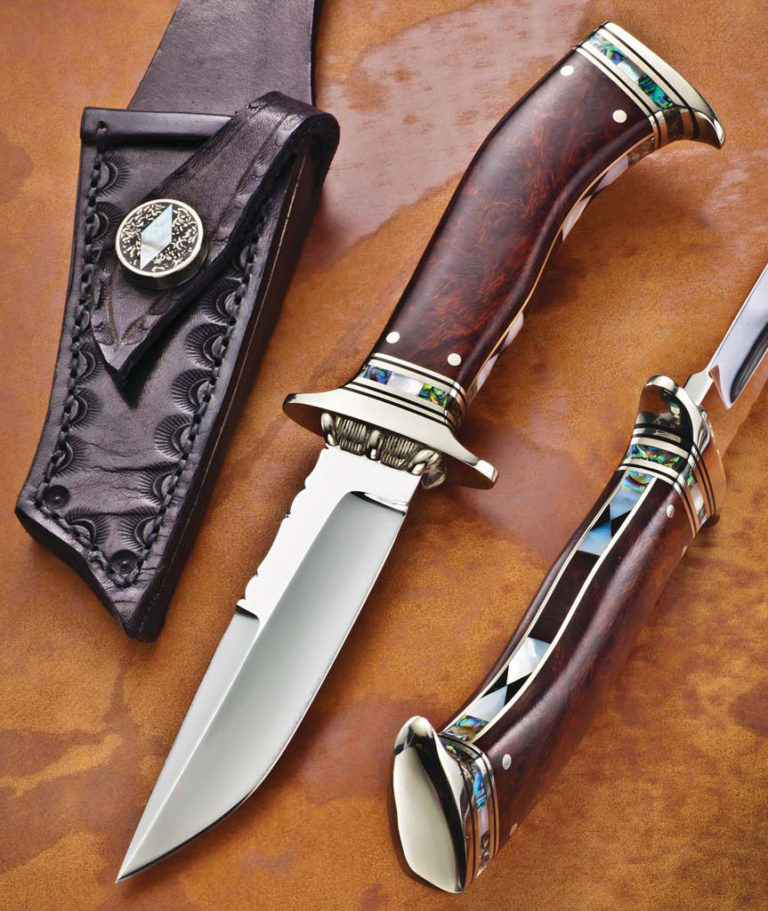
Well-made vintage knives by legendary makers can be very attractive to collect. Lloyd Hale does the honors here in a chute knife sporting an ironwood handle with pearl and abalone inlay. (SharpByCoop.com photo)
Eventually, All Knife Collectors Hit Crossroads
You may face a crossroads, a time of decision involving the realization that interests, tastes and possibly buying power change. In such situations, you may decide to begin collecting a different genre of knives, departing from what you have collected. If and when that time comes, evaluating your situation and making informed decisions is crucial.
Some basic questions loom large, from deciding what to collect to getting the best education on what is available, selling or retaining an existing collection, and, if the choice is to sell, then maximizing the revenue generated.
Should You Reboot? Ask Yourself These Questions
Do you have a very good reason for starting over?
Do you sell or keep your existing collection?
If you sell it, how do you get the most out of it?
Are you trying to recover your initial investment or trying to make as much money as possible to assemble your new collection?
Are you comfortable with the effort and costs it will take to build a new collection?
Do you want to make money or collect, carry or use the knives?
What knives should you collect, and how do you best research them?
How available are they and are they of recent vintage?
Are they still in production or limited in distribution, both of which influence collectibility?
If antiques, where can they be found and can they be found without undue cost?
What are the prices typically asked for the knives in collectible condition?
Are you going to collect only mint or near-mint examples, and can you afford to pay premium prices for them?
Guidelines for Going Forward with a New Collection
If, after answering those questions, you decide to liquidate and start over, keep these guidelines in mind.
Collect what you like or even use.
Chasing trends is a fool’s errand. Collecting knives that are hot now means paying top dollar now as well.
Know which knives are collectible in specific geographic locations of the country.
Inexpensive, low-end knives will never appreciate to any degree.
Well-made, fine-condition knives should not lose you any money.
Don’t buy damaged/poor condition knives unless they are very old and collectible, such as antique bowies and rare military knives.
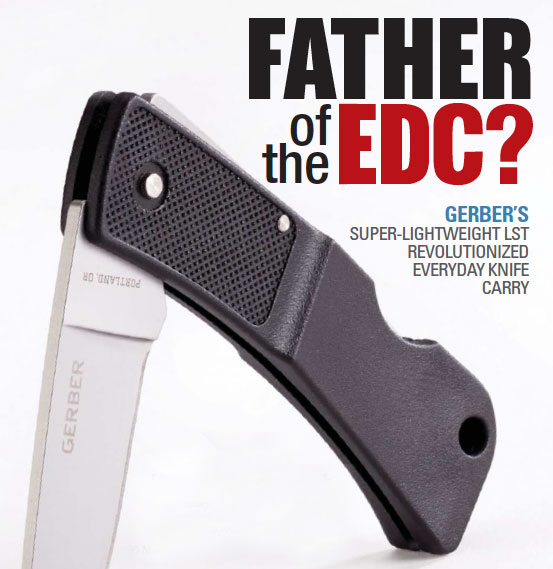
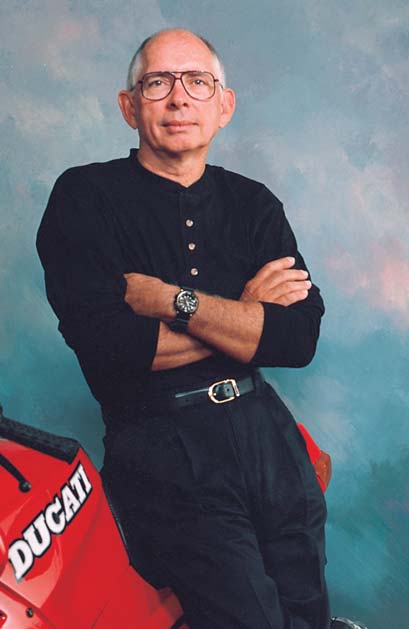
BLADE Magazine Cutlery Hall-Of-Fame® member Pete Gerber knew he was onto something with the FS1, a knife he remembers as “dandy” and one of three in the Folding Sportsman line that debuted with Gerber Legendary Blades beginning sometime around 1980.
“It was just a little heavy,” Pete recalled. “Blackie Collins was working with us on some projects then, and I asked him for help with it. I said, ‘Blackie, this is a nice knife. How can we take some weight out of it and put some pizzazz into it?’”
The knife engineers at Gerber Legendary Blades had been working with Micarta handle slabs, rather labor intensive at the time since the plastic laminate had to be machined to the appropriate shape.
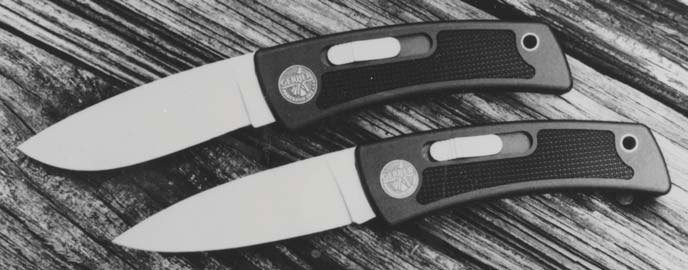
The Bolt Action folders were among the Blackie Collins designs for Gerber that predated the LST. The original Bolt Action is at bottom and the newer Bolt Action hunter is at top.
“We had to mill it out and used brass washers with rivets to attach the slabs,” Pete said. “The original LST was the FS1 in-house design, and Blackie was first given the assignment to put moxie into it using the existing parts. He worked on the design and then put an injection-molded handle on it with nice checkering. Those were his contributions.”
As fine as it was, as long as the slab handles were involved the LST had trouble fully living up to the attributes that provided its name, “Light, Smooth, and Tough.” Collins already had contributed some well-known designs to Gerber, including the Bolt Action folder and the Touché belt buckle knife, and the wheels began to turn in his head.
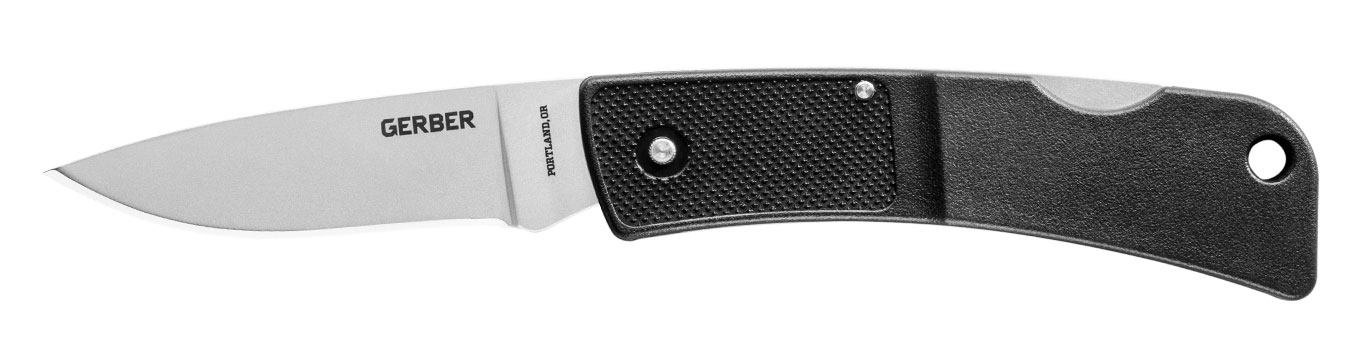
The LST, as offered today on Gerber’s website. (Gerber image)
Blackie had a friend in Gastonia, North Carolina, just outside Charlotte, and that friend ran an injection-molding business. Instead of using riveted slabs as handle material, why not try a one-piece injection-molded handle to reduce both the weight and production cost of a knife design that was already selling pretty well? Just to add to the incentive, injection molding would open up the spectrum of handle colors as well.
After some experimentation, the production LST was manufactured with the glass-filled, nylon-reinforced Zytel as the handle material.
“It was the first time a folding knife was made with a one-piece handle, and it worked,” Pete remembered. “The action was so smooth because we went through an operation called ‘match catch,’ where the blade and the catch were kept together until they were assembled and until they were just perfect. When the knife closed, the blade referenced the catch, and it was as smooth as it could be.”
A New Car for a New Knife
Blackie Collins loved fast cars and motorcycles. When it came time for Pete Gerber to compensate him for his input on the LST, Blackie decided he wanted a Corvette—and Pete made it happen. (Meyerco image)
Almost as sweet as the story behind the LST, which has sold in the millions since the early 1980s, is the back-story of Blackie’s compensation for his input that led to the dynamic little knife’s eventual success. Pete asked Blackie what he wanted in the way of payment for services rendered.
“I didn’t think it could be a royalty knife since it was a modified in-house design,” Gerber explained. “I asked what he wanted for payment, and I suggested that maybe a new car would be something he would like.”
The story goes that the new car turned out to be a Corvette and that Pete’s check for $29,000 made it happen.
Blackie, a Cutlery Hall Of Famer who tragically lost his life in a motorcycle accident in 2011, loved cars and motorcycles and just about anything mechanical, and the idea of new wheels appealed to him. His wife, Jane, remembers well the search for just the right vehicle.
“We went from South Carolina to Jacksonville, Florida, to look at Avanti cars,” she recalled. “He didn’t like the way the new ones handled, so we looked at Corvettes, bought one that was two-tone gold, and drove it home. He owned that car for a few years and then traded it in.”
Pete remembers Collins driving around his hometown in South Carolina in that Corvette with a license plate that simply read, “Blackie.”
Offering items other than money for consulting seemed to work well for Pete, who also once paid Cutlery Hall-Of-Famer Bob Loveless with an airplane.
While Blackie burned up the roads in the Corvette, the Gerber-Collins partnership took the knife market by storm with the LST.
“Blackie used to say that the LST revolutionized the knife industry,” Jane recalled. “He did a lot of work for Gerber, and he really reduced the number of parts on that knife and put the plastic handle on it to make it lighter.”
Taking the World By Storm
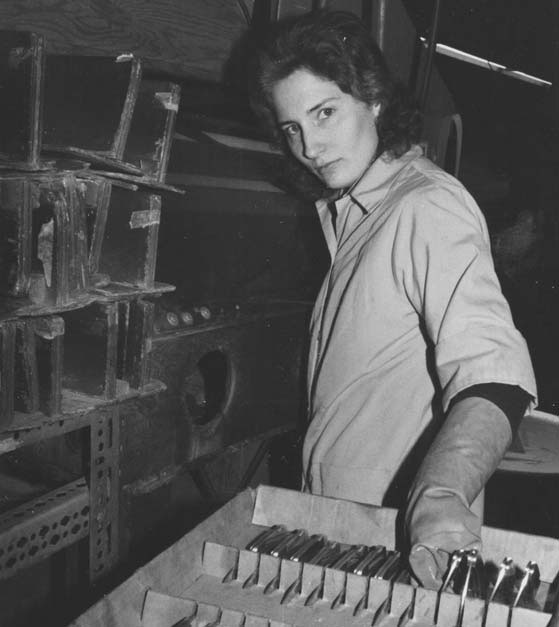
A box of lockback folders in the Gerber factory in the early 1980s shows the thick nature of the handles. The LST not only was lightweight, it was thin, too, adding even more to its ease of carry.
The new lightweight knife was a sensation, and soon other knife companies were taking notice, working on something similar. It was pure gold in itself—with a grand total of six parts to the whole enterprise. Buyers wanted the light, smooth-action, durable and reasonably priced LST, and competitors scrambled to keep pace with Gerber’s trendsetter.
Soon enough, there were similar offerings rolling off assembly lines and onto store shelves. The introduction of LST energized knife manufacturers in a manner seldom seen.
The LST developed its own legacy among the knives that changed knife history, and it is still being manufactured in Portland, Oregon, and sold under the Gerber banner today.
“It was the first true ultralight knife,” explained Dan Delavan of Plaza Cutlery in Costa Mesa, California, “and Gerber had a high-quality blade in that light handle at a good price. You could throw it in the pocket of your swim trunks and go! Lightweight became attractive, and the LST was thin, too. It didn’t bulge in a suit pocket and the checkering gave it a nice grip, just like an extension of the finger. It was the knife that introduced the ultralight, and we sold a lot of them back in the day.”
Lightweight vs. Airweight
Contemporary to the introduction of the LST, Cutlery Hall-Of-Famer A.G. Russell was producing ultralight knives of his own in the Airweight series. Like other knife manufacturers and designers, Russell also worked with Blackie.
He remembers the concept of the ultralight as the shape of things to come in the 1970s.
“I wanted strength but little weight in a knife, too,” Russell noted, “and my Airweight was using a Micarta handle. Blackie had that great idea of molding the handle instead of shaping it, which would have suited an operation like Gerber perfectly. The LST was extremely lightweight and it sold in the millions.”
LST Materials
Pete Gerber recalls using 440A stainless blade steel in the early LST, and says the knife had a good, husky blade that he never saw break—and it was complemented with a nicely polished tang.
“Many other companies were copying it, trying to figure out what we did and how the LST worked so well,” Pete said. “Many of those companies made knives that were quite similar to the LST long after ours was successful. I don’t believe we had a patent on it at all; I don’t think we could get one. The patent area was out of my expertise, but I told our folks to get one whenever we could.”
An Enduring Legacy
Peter Gerber was the headman at Gerber when the LST debuted in 1981. “It was the first time a folding knife was made with a one-piece handle,” he said, “and it worked.”
After almost 40 years, the staying power of the LST is undisputed, and its place as a milestone in the progressive development of knife design is secure. Along with other innovations attributed to Blackie, it stands out among its peers with a timeless depiction of design sense and simple user friendliness.
During the past four decades, the LST has been manufactured in several variants.
DuPont recently celebrated the 50th anniversary of its nylon plastic with a commemorative run of LSTs handled in the company’s Delrin material.
Not long ago, Pete was in a company store in Lincoln City, Oregon, and one of the clerks showed him a Mini LST with a bright green handle.
“I had never seen that bright green before,” Gerber laughed. “It just goes to show you that things can develop that you don’t even know about.”
When the LST hit the market in 1981, the time was right. Since then, it has given Gerber and the knife industry a continuing boost.
“It has sold in the seven figures,” Pete reflected, “and I think it gave us a hell of a shot in the arm.”
Gerber LST Specs
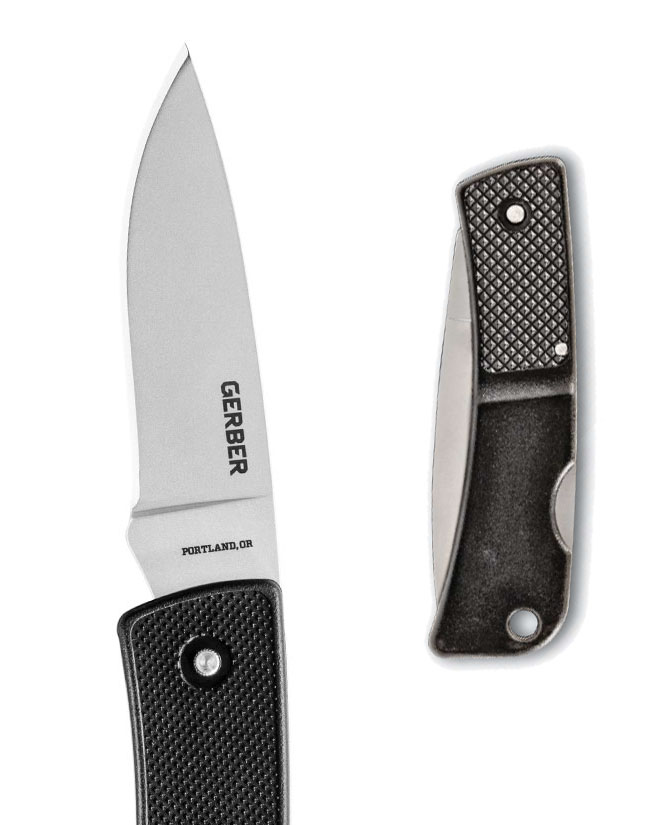
The standard LST sells today on the Gerber company website for a modest $23. The knife weighs a remarkable 1.2 ounces with a drop-point 420HC stainless steel blade of 2.63 inches and a closed length of 3.61 inches. The handle is described as tactile, textured and made of lightweight, synthetic glass-filled nylon.
Light, smooth, and tough, Gerber’s LST has earned its place among the elite products of the modern knife industry.
What Other Knives Changed the World? Find Out With This Download



 The KNIVES annual book is back and better than ever. Here’s what you can expect: