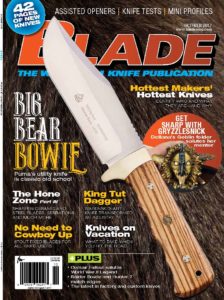
BLADE® will make you sharper. How do we know? Because for almost 45 years now, BLADE has kept the world of knives abreast of all that cuts, slices, dices, severs, skivs, hacks, whacks, perforates and, yes, sharpens. That includes the latest knives, knife trends, knife events, knifemakers, collectors, cutting competitions, hammer-ins, knife awards and all else that stays on, around or anywhere near the edge.
You can subscribe to your choice of the print, digital, Canadian and/or international editions. It will, quite honestly, be the best bang for your blade buck anywhere.
Donate now to USA Knifemaker’s program to assist full-time makers’ shops flooded by Hurricane Harvey.
Help full-time knifemakers whose shops have been damaged or destroyed by Hurricane Harvey through a program initiated by the folks at USA Knifemaker.
A leading supplier of knifemaking equipment, materials, tools and other products used to make knives, USA Knifemaker’s assistance program is designed to help full-time knifemakers—and with floodwaters continuing to rage in and around Houston, Texas, the effort comes not one moment too soon.
“We would like to help our knifemaker brothers that have been wiped out to get back on their feet,” notes Tracy Mickley of USA Knifemaker. “This isn’t about advertising. This isn’t about making us look good. This is about doing the right thing and about helping people in need. If I could do this quietly I would, but I can’t. These guys need your help and I am going to bang the drum as loud as I can to get some help headed their way.”
USAknifemaker.com will match donations up to $2,000 in knifemaking supplies for full-time knifemakers that have lost their shops to the hurricane and flood. “If I can manage more I will but right now it’s the best I can do,” Mickley writes. “If public donations do not reach $2,000 for the match, we will still give out the full $2,000 in the form of gift certificates to USAknifemaker.com. I hope we can max this out to $4,000 plus.
“We will give $250 gift certificates to eight—at the minimum, we hope for at least 16 or more—full-time knifemakers that have had their shops destroyed by floods. It’s not enough to restock a shop. I get that. I also understand there are hundreds, maybe thousands of part-time makers that also have had tragic losses and I wish we could help everyone. Those makers that depend on knifemaking as their primary income can use our help as a community.”
If you know any full-time makers in the Houston area whose shops were damaged or destroyed by Harvey, you can help through USA Knifemaker’s assistance program.
Send a check, cash, use Paypal or a credit card. “We will cover the Paypal and credit card fees,” Mickley notes. “We will total up the donations and match up to $2,000 to be given out as gift certificates to eight full-time makers. If the total of public donations exceeds $2,000, we will compile the extra and give out as many $250 gift certificates as the funds allow. One-hundred percent of donations will be given out. We will recap all activity on Knifedogs.com for full transparency here.
“We are asking you to provide names and contact information of full-time knifemakers in and around the Houston area that you know who have lost their shop or had significant shop damage. We do not need a list of random names of makers in the area. We need to know who got hurt in this. We will have to filter out opportunists so we will require proof of loss in the form of pictures of their shop and a short description of damage. To be clear, we aren’t ‘covering’ any other losses. There are other agencies for that. We are trying to help those that lost their knifemaking shop.
“I am hoping for a lot of interest and support,” Mickley continues. “I will have a thread on Knifedogs.com to track donations, candidates and awards, and to keep this transparent. I welcome your input and suggestions on how the knifemaking community can step up and lend a hand. Post your comments and suggestions here.”
The world’s largest and most important knife event, BLADE Show 2018 will return next year at the Cobb Galleria Centre in Atlanta—and there’s no time like now to make plans to attend the annual edge-stravaganza that true knife enthusiasts can’t afford to miss.
Slated for June 1-3, BLADE Show 2018 will assemble thousands of knife exhibitors and knife enthusiasts from around the globe, and with international attendance increasing every year, it’s wise to make your hotel plans now.
If you have attended the BLADE Show before, you know how fast hotel rooms disappear–not only at the Renaissance Waverly, the host hotel, but at lodging anywhere near the Cobb Galleria. If you’ve never been to a BLADE Show, then you cannot know the mad rush that is BLADE Show planning time. Don’t learn the hard way and get left out–plan and make your hotel reservations now!
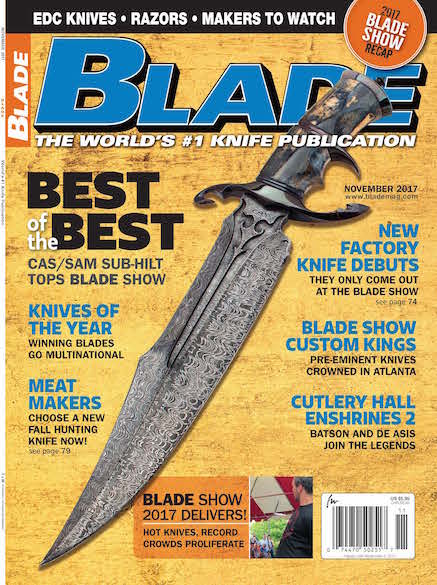
You’ve heard all about BLADE Show 2017 but you can get the inside scoop on the show’s hottest knives and knifemakers and what and who will be hot in the future as a result in BLADE®’s special 2017 BLADE Show Recap issue, on newsstands now! Or, if you prefer a digital copy, click here.
The world’s largest and most important knife event enjoyed its longest lines ever of patrons queuing up to get in, and the patrons packing aisles for much of the three-day event enjoyed the best knives and knifemakers the international cutlery industry has to offer.
Why was the show among the best if not the best ever? What were the demographics of the patrons who attended? What nationalities were represented most in
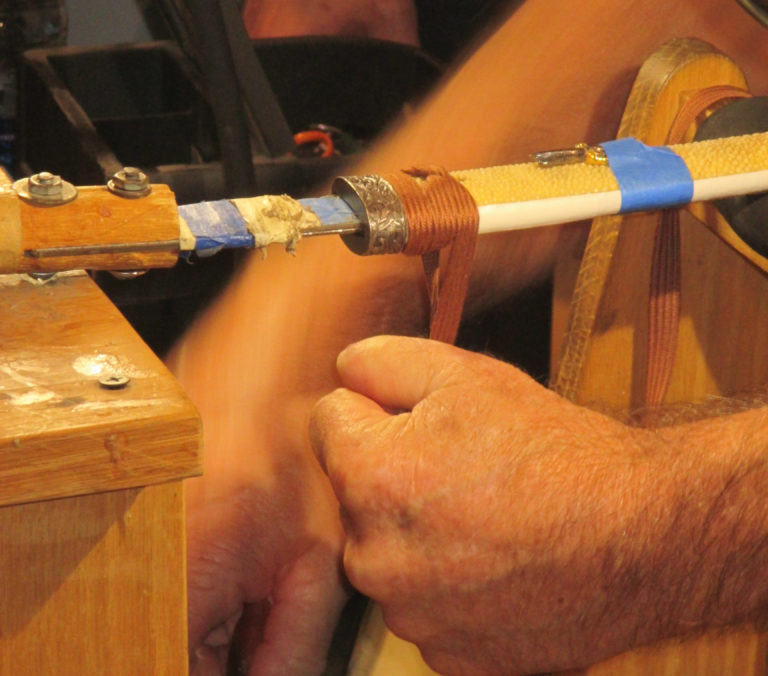
Wally Hostetter showed students how to do the Japanese handle wrap in his BLADE U. class during BLADE Show 2017.BLADE Show 2017 hosted its first-ever balisong competition coordinated by Blade HQ.
what has become a show teeming with knife enthusiasts from all corners of the globe? Did more women attend than ever before, marking a new, unprecedented wave of knife enthusiasts from the female side? How many patrons actually bought knives instead of kicked tires, and how much did they spend?
Speaking of knives, which patterns sold most? What sub-categories of exhibitors—knifemaking suppliers, acc-
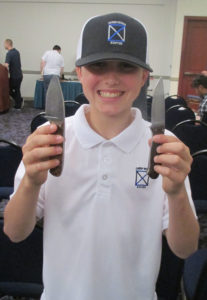
BLADE Show 2017‘s BLADE University featured instruction for young and old, including Zander Nichols, 13, of Clovis, California.
essory makers and others—emerged in terms of high numbers of sales? And what does it portend for the future of the BLADE Show and the knife industry in general? These questions and others are addressed in “BLADE Show Stands Tall & Delivers” on page 12.
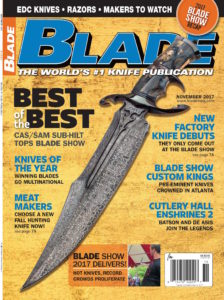
Of course, the BLADE Show is much more, including the BLADE Magazine Knife-Of-The-Year® Awards, the BLADE Show Custom Knife Judging Competition and the BLADE Magazine Cutlery Hall-Of-Fame inductions. Get all the specs and fantastic images of the knives by new Official BLADE Show photographer Chuck Ward in the respective stories “Best Blades of Both Hemispheres” and “BLADE Show Custom Kingpins,” the latter including this issue’s cover knife, the CAS/Sam Lurquin Sub-Hilt that won the Hugh Bartrug Best In Show Award.
The announcement that Benchmade CEO Les de Asis and American Bladesmith Society master smith Jim Batson had been elected to the Cutlery Hall Of Fame was made earlier in the year, but why they were elected was revealed in detail during their official inductions during the BLADE Magazine Awards reception the Saturday night of the BLADE Show. Get the lowdown on their career accomplishments, their induction speeches during the reception and more in the special story on page 42.
The BLADE Show is also the place where factory knife companies introduce their latest knives, though this year’s show may have seen more new knife debuts than ever. Check out the fantastic array of production pieces in “All Blades Pointed to Atlanta.”
There’s more this issue, including a salute to Alfred Pendray, tests of locking folders and drop-point hunters, the new Case/Daniel Winkler collaboration, a retrospective of Cutlery Hall-Of-Famer Michael Walker’s landmark linerlock that changed knife history forever and much more, all in the latest issue of BLADE.
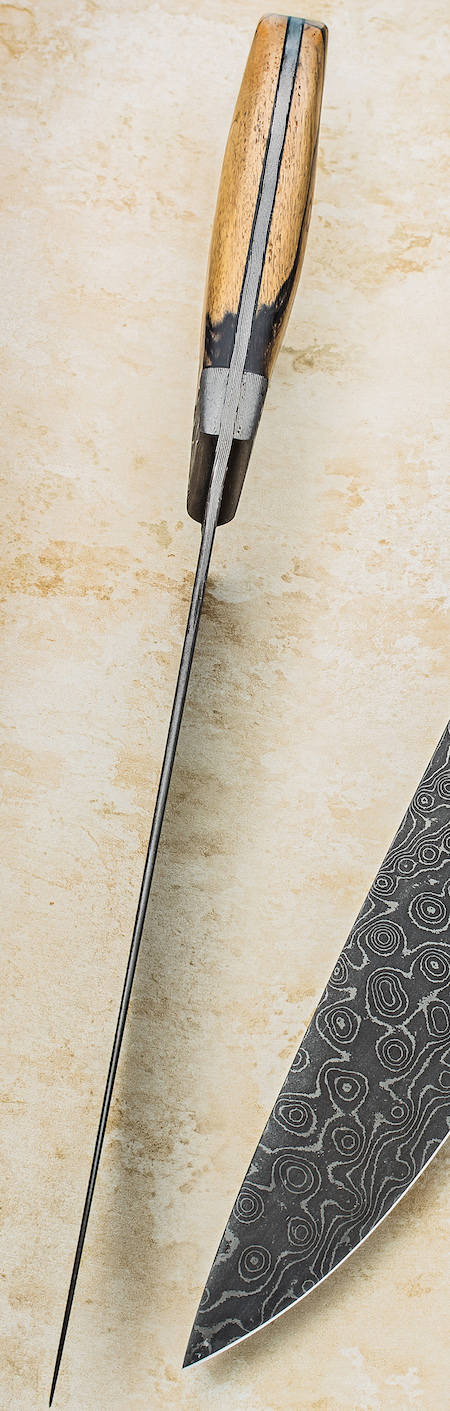
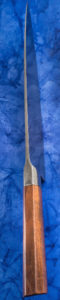
Michael Zieba applies distal taper to the blade of his Brooklyn Made folder. (SharpByCoop image)Note the gradual distal taper of the blade from just above the bolster to the blade tip on Peter Swarz-Burt’s chef’s knife. (SharpByCoop image)
Distal taper makes knives feel more lightweight, quicker in the hand and easier to use. However, the concept affects more than just weight. It also distributes balance so the knife feels neither top nor bottom heavy. In other words, the knife is well-balanced so that it goes where you want it to and cuts how you want it to when you want it to. It looks cool, too.
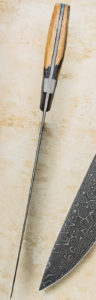
How does distal taper work? It’s pretty simple, really. The maker removes steel, usually by grinding, from each side of the blade beginning at the ricasso, that is, from just forward of where the blade and handle meet, and ending at the blade’s tip. The effect is of the cross-section of the blade gradually thinning, or tapering, toward the tip. Less steel means less weight and, if removed properly, better balance for the knife. Some makers apply taper to the tang as well, beginning the tapering just below where the blade and handle meet and gradually thinning the tang toward the handle butt. However, in general, the concept is identified more with the tapering of the blade than the tang.
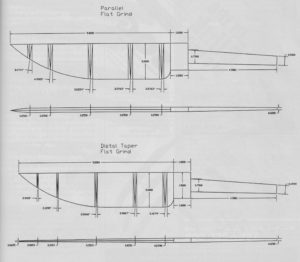
At bottom is the distal taper flat grind and at top is the parallel flat grind. Each image includes both side and overhead views. As you can see, the angle is “blunter” with the parallel spine. The point will be thinner and not as strong with the distal-taper spine. However, unless you simply want to punch holes with your blade, the knife with the distal-taper spine will be more efficient at cutting and chopping (Jim Crowell drawings)
ABS master smith Tim Hancock said tapering is most important on larger, thick blades such as those in the 3/8-inch range that often are heavier and benefit from the weight reduction for quickness and ease of use. “The thinner the blade, the less important distal taper is,” Hancock said. “In fact, full-length distal taper on a bowie blade of a 3/16-inch thickness and an 8-inch length would leave the tip area so thin and weak that, in my opinion, it would be an inferior knife. To me, it’s a process of speed and strength. Some balance between the two must be considered to make a superior knife.” Conversely, ABS master smith Jim Crowell said, if done properly, even a blade with a thin spine can benefit from tapering. “The degree of taper won’t be as much as on a thicker spine—in fact, it will be very subtle—but even then it provides the most efficient cut,” he noted.
Tom Buckner takes what is already a thin blade and makes it even leaner toward the tip via distal taper. (SharpByCoop image)
Larger hunting knives, camp knives, some bowies, fighters and knives used in cutting competitions where quickness and cutting ability are keys will benefit from being tapered. On the other hand, ABS master smith Mike Williams said he did not think distal taper was important for the rope cutting of the cutting competitions except for the balance of the knife itself. “It’s like using a fillet knife versus a butcher knife,” he continued. “When cutting rope you want the weight forward.” Since tapering removes steel toward the end of the blade, the process does not result in a knife with the weight forward such as a khukuri, for instance. Knives designed for cutting meat and paper will benefit from distal taper because it promotes a thinner edge that produces less drag, he observed.
According to ABS master smith Jarrell Lambert, reduced weight, quickness and balance are not the only benefits of tapering. He adds another: flexibility. He indicated distal taper gives the blade more of it and spreads the stress more evenly throughout the blade than one made of the same material but without distal taper.
Crowell added another benefit of tapering: greater edge penetration. “Distal taper allows the cutting edge to have a smaller degree of angle progressing down the blade, resulting in less drag and producing greater penetration into the medium with a said amount of energy,” he explained. “As a result, a blade with distal taper will always cut more efficiently than the same blade with a parallel spine.
“If you want weight in your blade, maybe for chopping, increase the width of the blade, but have a distal taper. This will provide the weight needed but also a lesser degree of angle on the edge. Consequently, you will have the best of both worlds.”
A cool camp cutter is a must to help you fully enjoy the fun and sun of summertime in America. Whether you are wilderness camping or simply spending a leisurely day at the lake, some of the latest models will make your experience easier and more satisfying.
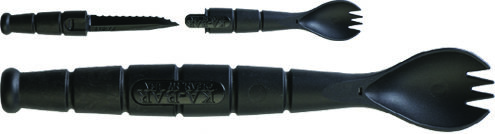
Eating outdoors can be a challenge. Enter the new Tactical Spork from KA-BAR. Featuring the stacked-handle design made famous by KA-BAR’s iconic USMC fighting/utility knife, the Tactical Spork is a fork/spoon combo with a 2.5-inch serrated blade that screws into the handle. The Tactical Spork is made from food- and water-approved Grilamid. MSRP: $8.32.
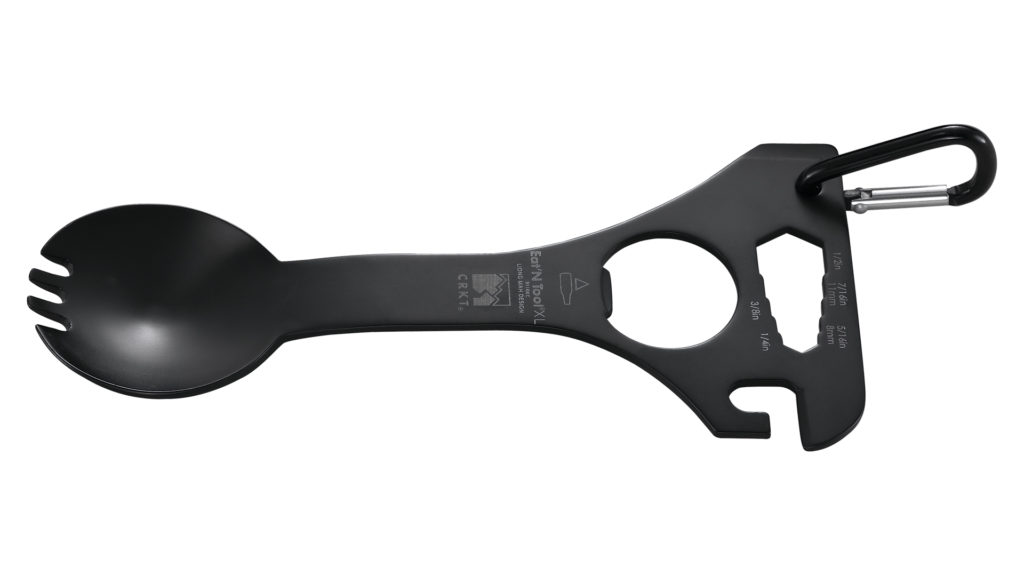
CRKT addresses outdoor dining with the Eat’n Tool XL. Designed by Liong Mah of Palm Bay, Florida, the Eat’n Tool XL consists of a spoon/fork combo and a
lso has a bottle opener, GI-style can opener and a flat screwdriver (6.8.10mm hex), and carries via a non-load-bearing carabiner clip. Made of 3Cr13 stainless steel, it’s 6.13 inches overall and weighs 2.7 ounces. It comes in a choice of silver and black finishes. MSRP: $14.99.
Cool Camp Cutter No. 3: Camp Axe
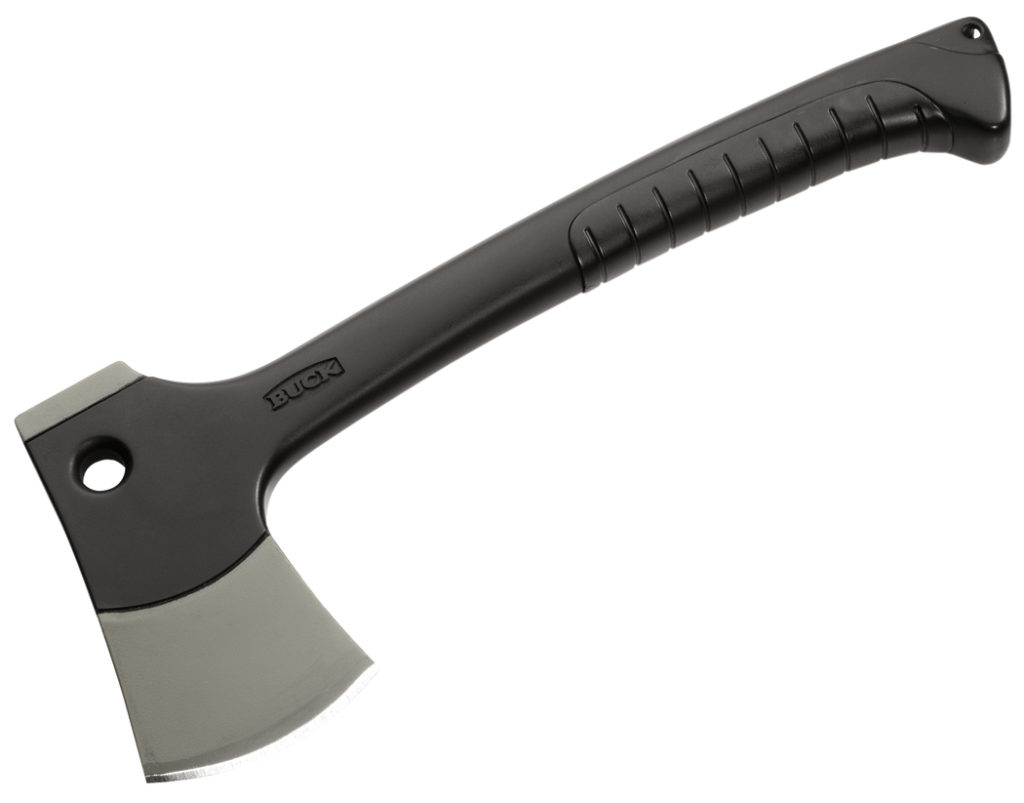
Cool Camp Cutter No. 3: Buck Camp Axe. MSRP: $71.
If you need something a bit more substantial to split kindling, hammer tent stakes or otherwise handle heavier-duty jobs, Buck‘s Camp Axe is the ticket.
At 12.25 inches overall, a weight of 17.2 ounces and including an injection-molded nylon sheath, the Camp Axe is an ideal size for convenient carry and a wide spread of utility jobs. The 3-inch head is forged, powder-coated, high-carbon steel and the ergonomic haft is high-impact plastic. MSRP: $71.
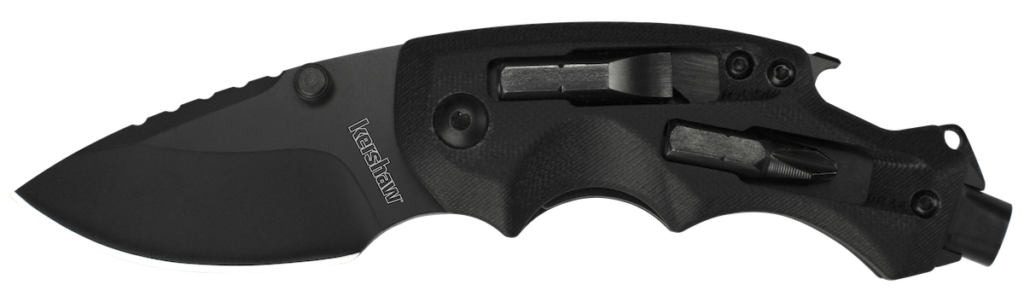
A knife that will cut, double as a screwdriver, comes equipped with a jump ring and also will open a bottle of your favorite beverage is an outdoor necessity, and the Shuffle from Kershaw fills the bill. The short (2.4 inches) but wide blade of 8Cr13MoV stainless steel in a black-oxide coating should be legal in most jurisdictions, and the manual-opening folder features a K-Textured glass-filled nylon handle with a single-position pocket clip. Weight: 3.5 ounces. Closed length: 3.25 inches. MSRP: $34.99.
Cool Camp Cutter No. 5: Hobo
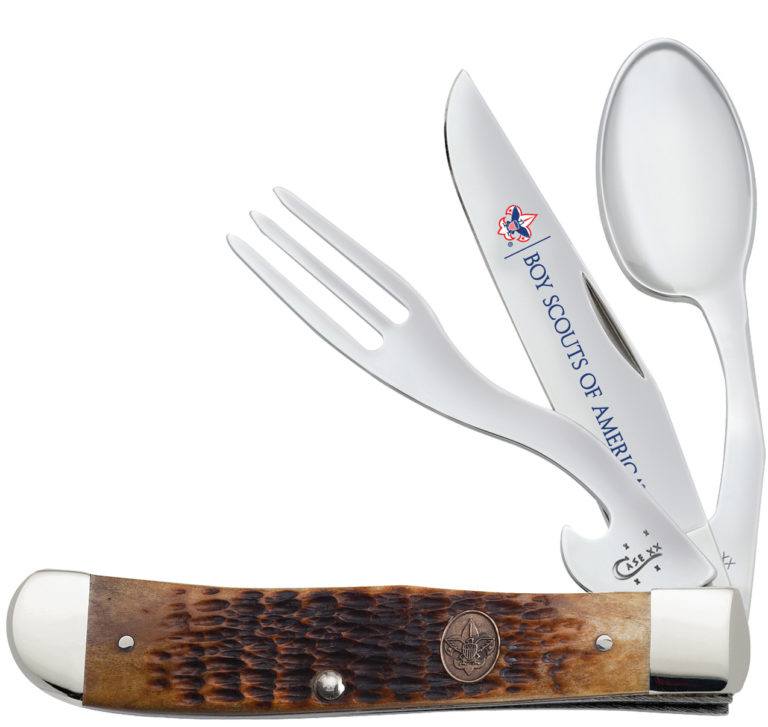
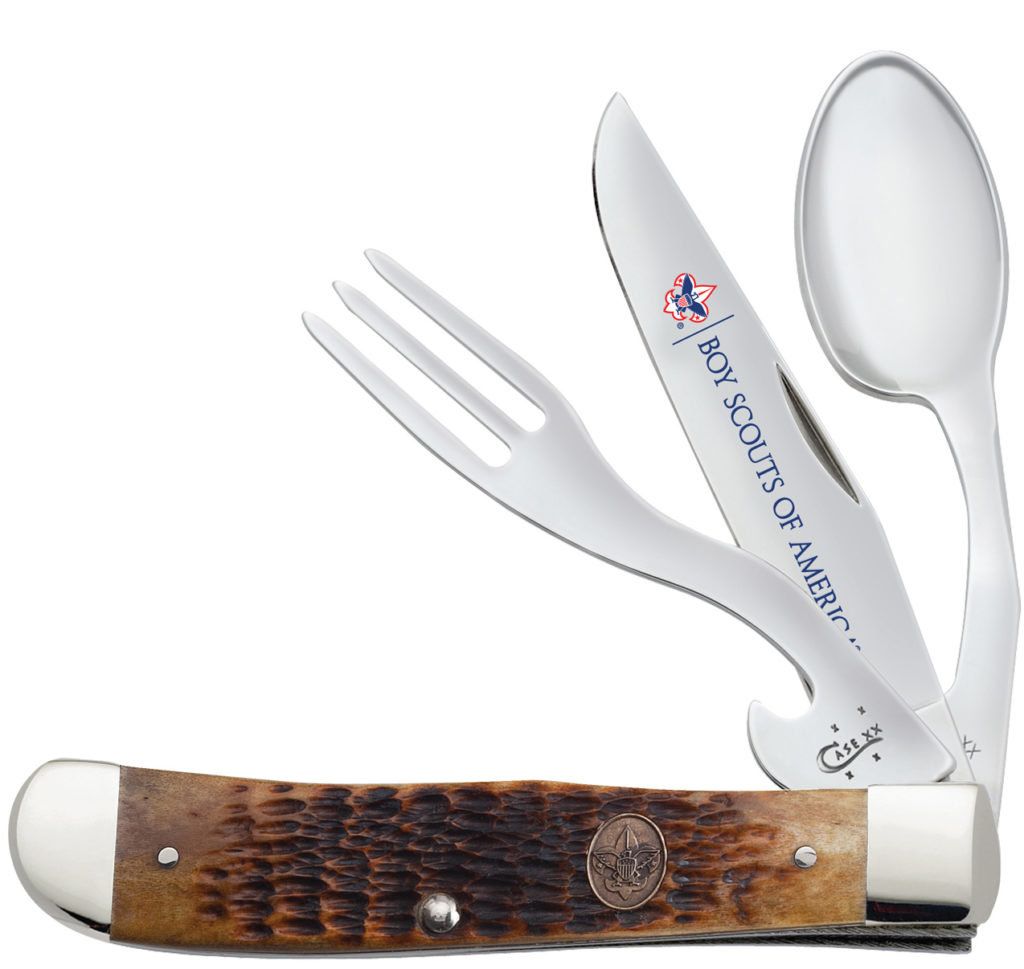
Cool Camp Cutter No. 5: Case Hobo. MSRP: $134.
A traditional pocketknife equipped with a clip blade, fork/can opener and spoon makes the Case Boy Scouts of America Hobo an ideal choice for most any outdoor junket. Stainless steel blades/implements and a natural handle complete this utilitarian classic. Weight: 7.7 ounces. Closed length: 4 1/8 inches.
The knife includes Boy Scouts of America and BSA logo blade etches and a BSA logo shield. MSRP: $134.
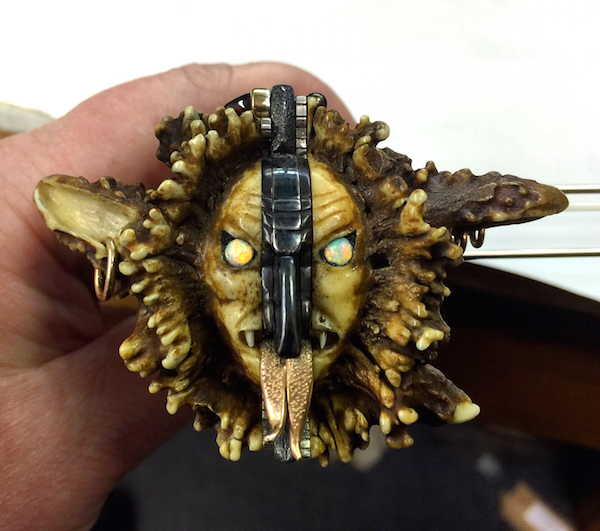
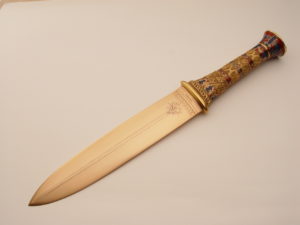
Dellana outlines the challenges of making her first goblin folder, including the goblin face on the butt.Read how Buster Warenski’s King Tut dagger changed the knife industry forever in the latest BLADE®.
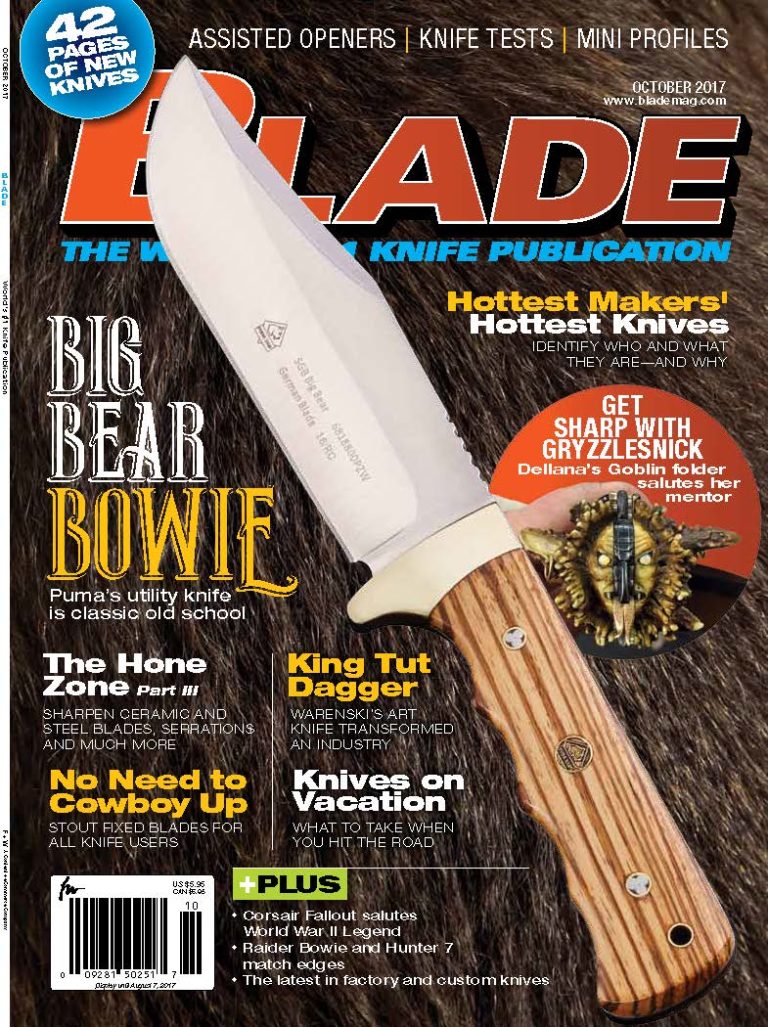
Dellana shows you how she made her first goblin folder, read why Buster Warenski’s King Tut dagger changed knife history, school yourself on the hottest custom makers’ hottest knives and more in the latest issue of BLADE®—on newsstands NOW!
Dellana is known throughout the custom knife industry for her ornate high-end folders and learned a lot under the great ABS master smith Jim Schmidt. Schmidt was known in no small part for his goblin folder, a style Dellana had never tried until approached by collector Larry Marton to complete one Schmidt had planned to before Schmidt passed away. Dellana accepted the daunting assignment. In her two-part story she outlines the challenges she faced in making the goblin folder she christened “Gryzzlesnick,” which includes a stag handle with a butt shaped into the grotesque face of a goblin. Read part one this issue.
A member of the BLADE Magazine Cutlery Hall Of Fame and the top vote-getter in a poll of veteran industry observers for their “Mount Rushmore of Knifemakers” of the modern era—1960 through the May 2015 BLADE in which the applicable story appeared—Warenski spent five years (1982-87) making the reproduction of the gold dagger found in King Tutankhamen’s tomb. Phil Lobred commissioned Warenski to make the knife and liquidated his entire collection of handmade knives to pay for it. The knife featured 32 ounces of gold, the long-lost technique of granulation to embellish the knife’s handle and has been valued at being worth over $1 million. Get the full story on this landmark knife and the trials and tribulations of Warenski in its making in “A Piece of Buster’s Soul.”
Pinpointing the hottest custom knifemakers’ hottest knives is something all enthusiasts of the genre need to stay on top of, and BLADE helps you in the endeavor with the help of top industry observers in “Compound Your Cutlery Interest.”
Dellana details the making of her first goblin folder and much more in the latest BLADE®, on newsstands NOW!
There’s much more this issue, including:
•BLADE Managing Editor Erin Healy’s story on the period-correct knife-and-tomahawk combos by Don Shipman, “Edged Warrior Sets”;
•The best knives to take on summer vacation;
•Rick Barrett‘s custom folder based on and that salutes the legendary World War II Marine F4U Corsair fighter aircraft made famous by the equally legendary pilot Pappy Boyington of Baa-Baa Black Sheep fame;
•Tests/reviews of four of the latest factory utility fixed blades, four EDCs, three assisted openers and a pair of ample straight knives;
•The conclusion of Dexter Ewing’s three-part series on the latest knife sharpeners in “The Hone Zone.”
And much more, all in the latest BLADE, on newsstands now or subscribe to the print, digital, international or Canadian issues here.