Home Authors Posts by Steve Shackleford

Steve Shackleford

BLADE Show Welcomes New Pro-Knife Law

new pro-knife bill signed
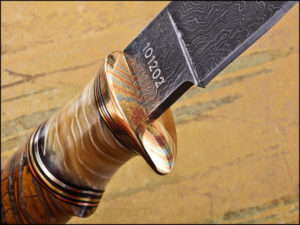
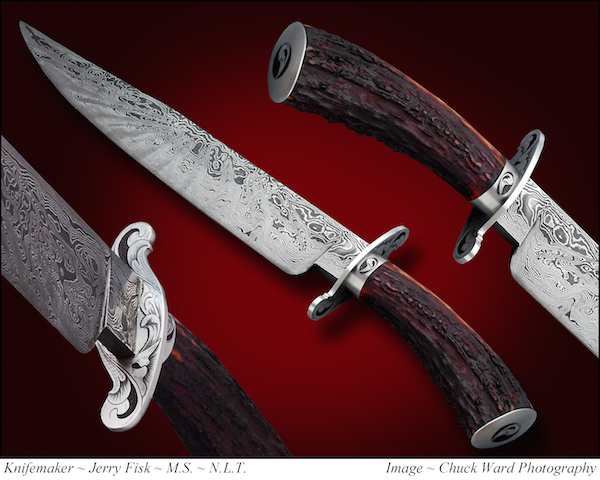
A new pro-knife law expands the blade-length limit for knife carry in Georgia, home of the BLADE Show, to 12 inches. Jerry Fisk’s bowie features a damascus blade and stag handle. (Chuck Ward image)

A new pro-knife law signed into law this week in Georgia comes just in time for the 36th Annual BLADE Show.

Signed May 8 by Georgia Gov. Nathan Deal, the new pro-knife law (HB 292) increases the legal carry length of a knife blade in the state from 5 to 12 inches.

“With the BLADE Show coming up June 2-4, attendees and exhibitors will have more freedom to carry their larger knives without fear of legal entanglements,” Knife Rights reported. It is language from Knife Rights’ Georgia Knife Law Reform bill, SB 49, that is included in the new pro-knife law.

Held annually in the Cobb Galleria Centre in Atlanta, the BLADE Show is the world’s largest and most important knife show and will feature over 1,000 exhibitors from every continent but Antarctica. Thousands of patrons worldwide will invade the Cobb Galleria show hall to enjoy the latest in factory and custom knives, knife collections, knife instruction via the show’s 4th Annual BLADE University, knife demos, the BLADE Magazine Knife-Of-The-Year® Awards, the BLADE Show custom knife awards, inductions into the BLADE Magazine Cutlery Hall Of Fame© and much more. As such, the passage of the new pro-knife law is most welcome news for show exhibitors who sell larger knives like bowies, camp knives, combat knives and other models that fit within the new expanded length restrictions.

The new 12-inch length limit became effective as soon as Deal signed the bill. Since Georgia passed Knife Rights’ Knife Law Preemption in 2012, any lesser length restrictions in cities and towns are now voided by HB 292. Moreover, neither can local jurisdictions enact prohibitions more restrictive than those in the new pro-knife law.

The BLADE Show and blademag.com express their gratitude to such organizations as Knife Rights, the American Knife & Tool Institute and others that fight for common-sense knife legislation. Both organizations will be among the exhibitors at the BLADE Show and blademag.com encourages you to stop by the booths of each for more information on how to protect your right to own and carry knives.


D2 Tool Steel Just Keeps Cutting

Dr. D2, Bob Dozier
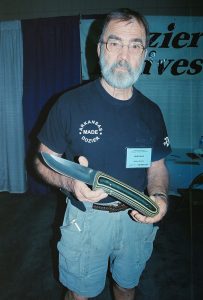
Aka “Dr. D2,” Bob Dozier long has been a proponent of D2 tool steel. Here he holds one of his specially made “over-sized” folders at a past BLADE Show.

D2 tool steel just keeps cutting. It’s been around a long time and enjoys a solid reputation among custom and factory knifemakers and knife users. As with many high-performance steels, it experiences a range of highs and lows in popularity, and at the moment seems to be enjoying a high.

A favorite steel of such long-time knifemakers as BLADE Magazine Cutlery Hall-Of-Fame© member Wayne Goddard and Bob Dozier—the latter has been called “Dr. D2” on more than one occasion—D2 is considered a “borderline stainless steel” because it contains 11.5 percent chromium. To be classified as stainless, a steel must have at least 12 percent chromium. (Note: stainless simply means a steel resists corrosion. It does not mean it is stain proof.) According to Scott Devanna of SB Specialty Metals, D2 also has a very high carbon content—1.5 percent—which lowers corrosion resistance because the carbon “grabs” a lot of D2’s chromium to form chromium carbides. The chromium carbides are good for improving wear resistance—improved wear resistance enhances edge holding—but they tie up chromium so it is not as “free,” and thus reduce corrosion resistance. Free chromium forms a chromium oxide layer at the surface, and the layer makes a steel corrosion resistant. This helps explain why D2 is not stainless.

While D2 may not be stainless, it remains a top performer due in no small part to its high wear resistance/edge-holding ability. “It will hold an edge for a very long time before it will go dull,” says Paul Tsujimoto, director of engineering at Ontario Knife Co.  Combined with its relatively inexpensive price, this makes D2 a favorite of manufacturers and custom makers alike. “For us, it’s the perfect combination of performance and an affordable price,” notes Dietmar Pohl of Pohl Force Knives. Agrees Devanna, “It’s the best bang for the buck because it’s priced reasonably and works well.”

D2 on Hornet
Pohl Force Knives uses D2 blade steel for the Hornet, a Spencer Reiter design.

On the down side, D2’s ample wear resistance also means it is difficult to sharpen. However, a diamond abrasive sharpener should do the trick. Also, the steel’s impact toughness suffers in comparison to some other steels, so D2 is not the best choice for a blade used for chopping and other impact-type cutting chores. And, since it’s not a true stainless, you should wipe it down after use to help keep corrosion to a minimum.

Nonetheless, D2 is an outstanding choice for a hard-use knife and remains popular among custom knifemakers and manufacturers, and knife users as well.

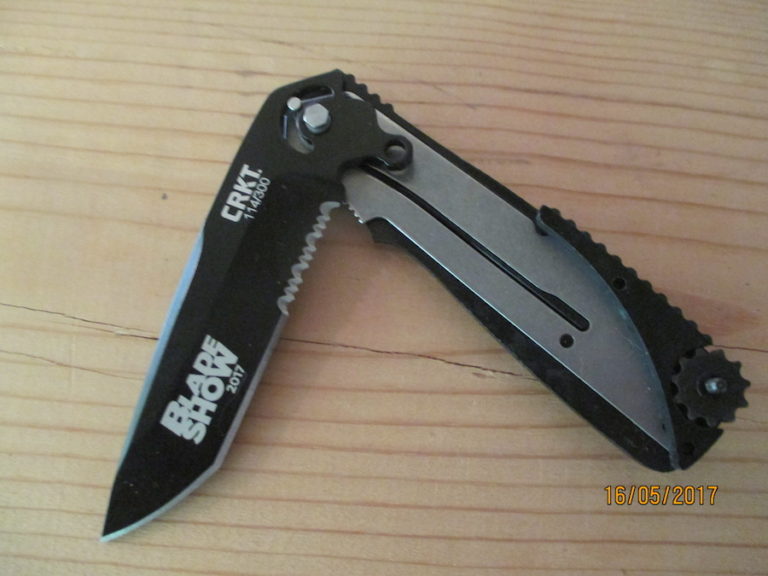
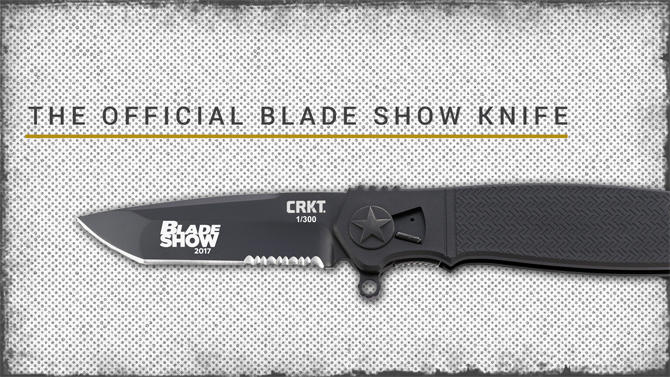
Do You Have Your Official 2017 BLADE Show Knife?

De Asis, Batson Join Cutlery Hall

Watson into BLADE Magazine Cutlery Hall Of Fame
Jim Batson and a young bladesmithing student take a break at a past Batson Bladesmithing Symposium.

Les de Asis and Jim Batson are the newest members of the BLADE Magazine Cutlery Hall Of Fame©.

Both will be formally inducted into the Cutlery Hall Of Fame the Saturday night, June 3, of the BLADE Show at the Cobb Galleria Centre in Atlanta during the BLADE Magazine Awards Reception (tickets required). The BLADE Show will be June 2-4.

According to a fellow Cutlery Hall Of Famer, de Asis has been a major pillar in the knife industry for more than 35 years. He founded Bali-Song, Inc., which later became Benchmade Knife Co. From a fledgling business in a garage to a major force in the cutlery industry, Benchmade is among the top knife manufacturers in the world. Les was a major influence in the renaissance of the butterfly genre of knives, which continues to enjoy a large following of knife fans. He was a founder of the American Knife & Tool Institute (AKTI), one of the earliest and most successful of the organizations protecting the rights of knife enthusiasts and the knife industry, and remains a driving force in the organization. He raised the bar significantly on the quality and function of automatic knives for military, law enforcement, first responders and general use, and Benchmade remains a leading manufacturer of autos today. The AXIS™ Lock designed by William McHenry and Jason Williams and introduced into production by Les helped maintain the revolution in locks for folding knives that persists today.

BLADE Magazine Cutlery Hall Of Fame welcomes Les de Asis.
Les de Asis—here with Roberta de Asis—has been inducted into the BLADE Magazine Cutlery Hall Of Fame©.

James L. “Jim” Batson is one of the world’s most noted bladesmiths and authorities on both bladesmithing and Cutlery Hall-Of-Famer James Bowie and bowie knives. The Batson Bladesmithing Symposium near Bessemer, Alabama, is one of the world’s most respected and best attended annual hammer-ins, attracting bladesmiths, knifemakers and knife enthusiasts from around the world, and has been doing so for almost 30 years now. Through his symposium and his many nationwide seminars teaching the art of bladesmithing, Batson is a standard bearer of the American Bladesmith Society’s stated goal of educating any and all on how to best make knives of forged steel. He has scoured the countryside in Texas, Arkansas and the Southeast, and combed through the archives of dozens of libraries and city and town halls in search of information on bowie knives and the life and times of James Bowie. He also has written extensively on both subjects.

Batson is an award-winning master smith in the American Bladesmith Society (ABS) and two-time ABS chairman. He led the ABS through some of its most successful times in recent years and shows no signs of slowing down. In the February 2014 BLADE®, he was ranked No. 9 among the top 13 knifemakers from 1989-2000. “Jim is a great bladesmith, a great leader, a great historian, a great bowie authority, a great writer and a retired rocket scientist,” wrote one Cutlery Hall Of Famer. “I challenge anyone to match that record!”

Shock and Claw in New BLADE®

Shock-and-claw karambits
Shock and claw karambits help highlight the latest BLADE®, on newsstands NOW!

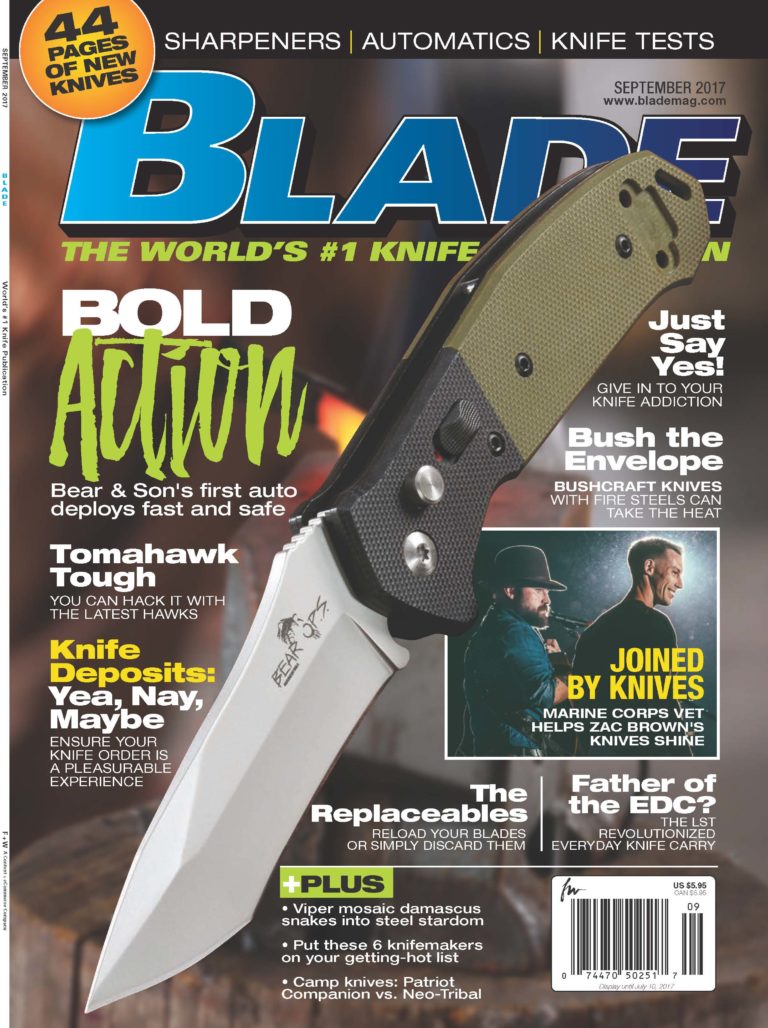
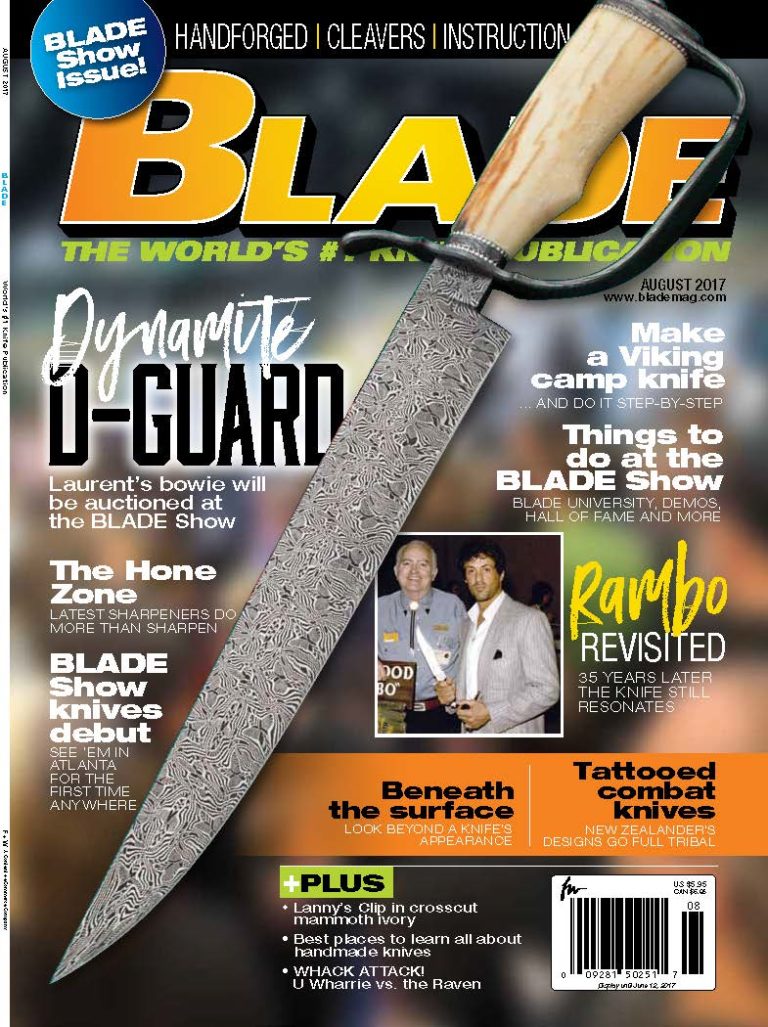
“Shock and claw” karambits, the damascus knives that changed knife history and the complete lowdown on the 4th Annual BLADE University at the 36th Annual BLADE Show are but a few of the highlights of the latest BLADE®, on newsstands NOW!

Boasting a blade shaped like a sickle, the karambit has been adapted for martial arts use today. However, it remains an effective cutting tool as well. James Morgan Ayres tests four of the latest editions in his story, “Shock & Claw.”

BLADE Magazine Cutlery Hall-Of-Fame© member Bill Moran changed the face of the custom knife industry in many ways, but it’s his damascus knives that first brought him not only national fame but worldwide acclaim as well. Join Mike Haskew as he studies Moran’s initial damascus models in BLADE’s latest installment of its “Knives That Changed Knife History” in “A Thunderclap of Steel.”

As the world’s biggest and most important knife event, BLADE Show 2017 attracts the best knifemakers and knife pros in existence. What better talent pool is there to select from as teachers for BLADE University, three days of knifemaking and other cutlery classes on a wide variety of sharp subjects? Check out who will be teaching what and how you can attend in “Back To Sharp School” by this writer.

Also this issue: Pat Covert’s test of four of the latest factory flipper folders; Dexter Ewing’s assessment of some of the newest factory machetes; part two of Frank Trzaska’s salute to the knives used by U.S. soldiers during World War I on the 100th anniversary of the USA’s entry into “the Great War”;  the latest paring knives just in time for Mother’s Day, by Daniel Jackson; some of the top drawknives and how to use them, by Abe Elias; a farewell to ABS journeyman smith Larry “The Hammer” Harley; and much more in the latest BLADE—on newsstands now or subscribe here.

Meet The Editors at The BLADE Show

Fowler at BLADE Show
BLADE® field editor Ed Fowler will hold down table 3N at BLADE Show 2017.

If you are one of thousands of knife enthusiasts worldwide who will attend the 36th Annual BLADE Show June 2-4, it’s time to start making your to-do list for the world’s largest and most important knife event.

In addition to all the knives and knife accessories, BLADE University classes, demos, cutting competitions, knife collections, knife judging competitions, BLADE Magazine Knife-Of-The-Year® awards, inductions into the BLADE Magazine Cutlery Hall Of Fame© and so much more are the people who make the show go.

There are oh-so-many—almost 1,000 booths and tables in all in the cavernous Cobb Galleria Centre show hall—including the world’s top makers, sellers and displayers of all things sharp. Among them will be three who on a regular basis help make BLADE® Magazine the World’s No. 1 Knife Publication—BLADE Magazine field editors Kim Breed, Joe Szilaski and, health permitting, Ed Fowler.

Szilaski at BLADE Show
BLADE® field editor Joe Szilaski will exhibit at Table 3P for BLADE Show 2017.

A retired member of the 5th U.S. Army Special Forces group, Breed’s 20-year military career took him to various world hot spots, including the Gulf War in the early 1990s. It was while there that he wrote a letter to BLADE about his love for knives. One thing led to another and BLADE asked Kim if he would like to write for BLADE on a regular basis testing knives. He took over BLADE’s “Spec Sheet” department and has been testing and writing about knives for the magazine ever since. He also makes custom knives and will be displaying them, along with scrimshaw work by Mrs. Melissa Breed, at table 17G. Stop by and see them—and if you can, do it on June 2. That will be Kim’s birthday. Ask him how old he is—and be sure to duck afterward.

A High-Endurance Performance-Knife (HEPK) master smith, Fowler has been writing for BLADE even longer than Breed—since the late 1980s. BLADE got wind of him after reading a booklet he had written sharing his thoughts on all things knife, including how to use them, how they should be made and much more. Since then in his “Knife Talk” department he has exposed BLADE readers to his distinctive brand of writing and knifemaking, including his preference for 52100 ball-bearing steel, his multiple quenching of his blades, the HEPK courses he teaches at his Willow Bow Ranch in Riverton, Wyoming, and so much more. Visit him and his bladesmithing co-hort, Chris Amos (Chris also has written for BLADE), at table 3N. Also, be sure to attend Ed’s demo, “Choices The Maker And One Who Seeks a Knife Need To Make” show Saturday from 2:15-3:30 p.m. in Room 107. (Note: Ed has been experiencing some health problems of late but both he and we hope it will not prevent him from attending the show.)

Last among three BLADE field editors who will exhibit at BLADE Show 2017 is ABS master smith Joe Szilaski. A native of Hungary who was in-country during the Hungarian Revolution against the Soviet Union in 1956, Joe moved to America and has embraced all things USA, including bladesmithing. He has assumed the mantle of writing the BLADE “Question & Answer” department originally started by Cutlery Hall-Of-Fame member Wayne Goddard, and also teaches knifemaking and tomahawk making in his facility in New York state. In fact, he will teach the BLADE U. class “How To Filework Knives” on show Saturday from 8:30-9:30 a.m. in Room 109. His table is 3P, where he will be ably assisted by Mrs. Lori Szilaski.

Breed at BLADE Show
BLADE® field editor Kim Breed (in ball cap) will be on duty at Table 17G at BLADE Show 2017.

It’s never too early to start planning your BLADE Show 2017 itinerary, and visiting three of the top BLADE field editors who also happen to be show exhibitors is as good a place as any to start. Meanwhile at least three other BLADE contributors—knifemakers Brian Goode (table 19G), David Lisch (13R) and RJ Martin (11M)—will be exhibiting. Also, other BLADE field editors who should be roaming the show hall will be Abe Elias, Dexter Ewing, Cutlery Hall-Of-Fame member B.R. Hughes and Les Robertson. Elias, in fact, on show Saturday in Room 107 will present the BLADE U. classes “Steel: The Heart Of The Knife” from 10:30 a.m.-12 p.m. and “The Best Edge For The Job” from 2-3:15 p.m.

Can You Define Knife Choil?

Choil on pocketknife
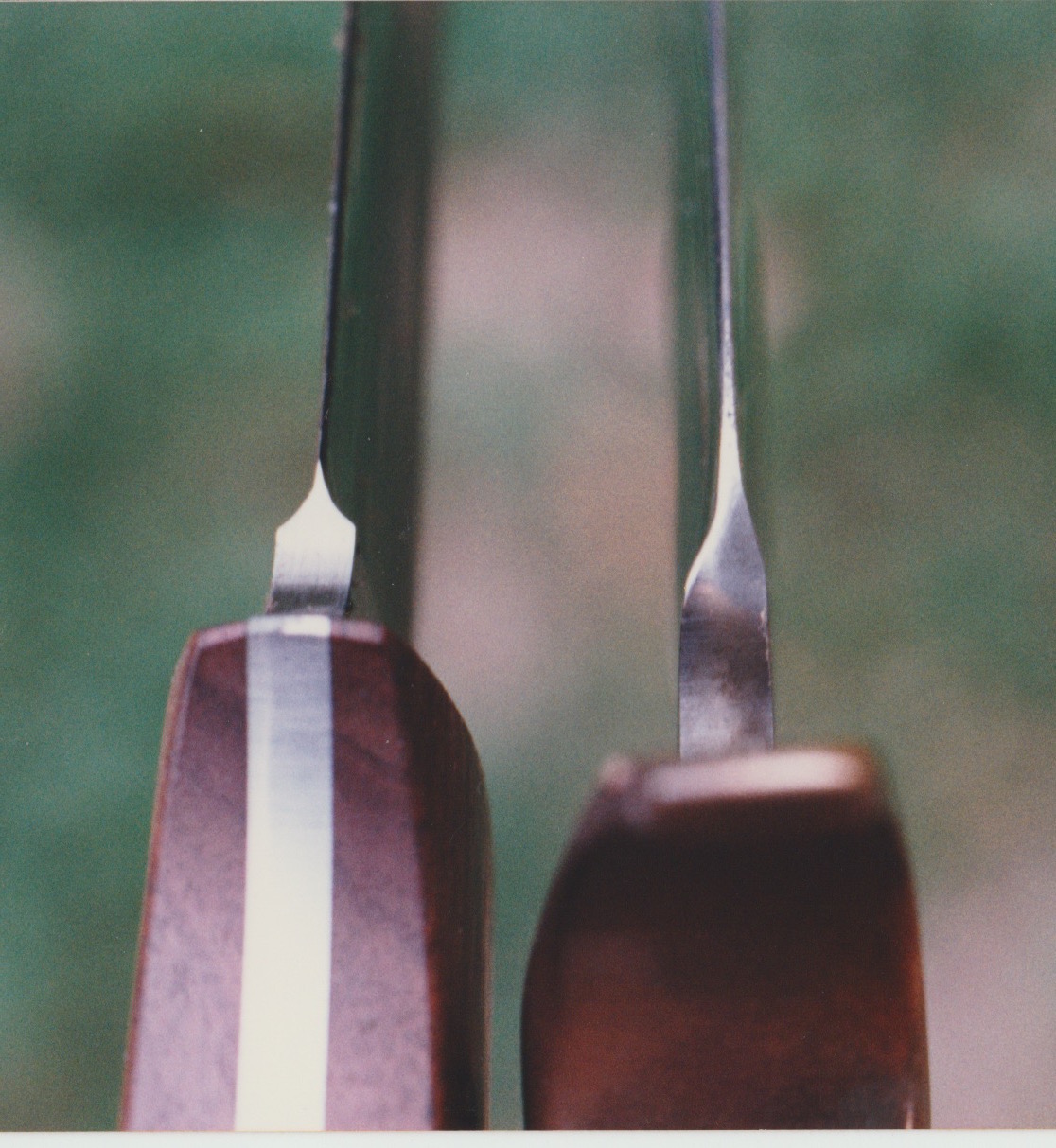
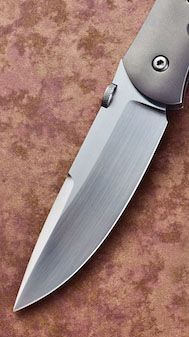
On a pocketknife blade, the knife choil is the notch between the cutting edge and the blade tang and serves to notify you where to stop sharpening the blade.
choil for the knife
When you think knife choil and pocketknives, Case immediately comes to mind.
knife choil
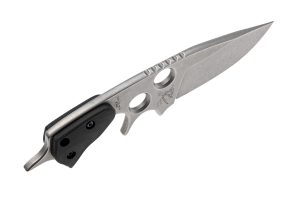
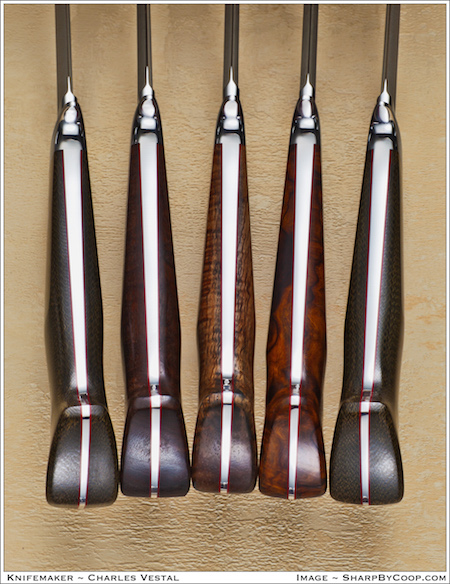
A classic example of a knife choil on a fixed blade is the notch here between the cutting edge and the ricasso or the blade tang of the Baja 3.0 by TOPS Knives.

Is a knife choil a nick, a notch, a finger groove or something else? And besides, what’s the difference between a nick and a notch?

What it is is one of those knife-specific terms that seems to evade proper definition by many, everyone from knife newbies to knife aficionados.

One definition for knife choil from an unknown source describes it as “a small notch between the edge and tang of the blade.” According to the “Knife Encyclopedia” on the website of A.G. Russell Knives, a knife choil is “the cut-away area between the edge and the tang of a pocketknife blade and between the edge and the guard of a straight (aka fixed-blade) knife. The choil may or may not have enough space for a finger. Its true purpose is to allow the edge to be sharpened all the way to the tang in a pocketknife and to the end of the edge in others. Any reference of choil and finger space or choil and handle is improper.” In an old issue of the American Blade, today’s BLADE® Magazine, BLADE Magazine Cutlery Hall-Of-Fame© member Blackie Collins defined a knife choil as “the area immediately in front of the guard at the bottom of the blade. It is occasionally shaped to accept the index finger to facilitate a more secure hold on certain types of knives for various operations. It actually serves a more useful purpose as it allows the full length of the cutting edge to be properly sharpened.”

To expand on the definitions of both A.G. Russell Knives and Mr. Collins, while a knife choil may have enough space to accept a finger for certain types of cutting operations, such a capability is not the choil’s stated purpose. In some instances you may hear the term for such a feature called a finger choil. According to Russell’s definition above, such a reference is “improper.” In fact, sometimes what is incorrectly referred to as a finger choil is really more of a finger groove that spans the undersides of both the handle and the ricasso or the blade tang. Meanwhile, some new factory knives seem to be downplaying the knife choil if not eliminating it entirely.

Be that as it may, the chief purpose of the knife choil, as noted by the definitions of both Russell and Collins, is to allow the full length of the cutting edge to be properly sharpened. In other words, it is simply a small notch between where the cutting edge ends and the ricasso or the blade tang begins that indicates where you should stop when sharpening the blade with a stone, diamond-coated abrasive or what have you.


Spyderco’s Knife That Changed Knife History

Spyderco in BLADE
Spyderco’s knife that changed knife history is a headliner in the latest BLADE®, on newsstands now!

Spyderco’s knife that changed knife history, Creek Stewart of Fat Guys In The Woods fame and his knives, the top knives of the SHOT Show and more highlight the latest issue of BLADE®, on newsstands now!

Spyderco is celebrated worldwide for its signature folders with the hole in the blade and also a pocket clip and serrations. The first-ever Spyderco knife with the hole and the clip was the Worker, which debuted in 1981. Mike Haskew visited with BLADE Magazine Cutlery Hall-Of-Fame© member Sal Glesser for the back story on the knife that changed the way an industry made and used knives forever.

In addition to his TV show on The Weather Channel, Stewart is known for his survival skills—and what’s survival without knives? While Creek gave knives away to the top “survivor” at the end of each episode of his show, he decided he wanted to take things a step further and work with a small American business to produce a line of knives. Whiskey Knives from Hank Gevedon’s Reptile Toolworks are the result and the focus of Erin Healy’s “Samurai Woodsman” on page 12.

Along with the annual BLADE Show—which is set for June 2-4 at the Cobb Galleria Centre in Atlanta—the SHOT Show is the place where many factory knife companies debut their new knives for the year. Check out the hottest knives of SHOT, along with a number of new companies under new flags, in the story on page 26.

There’s much more in the latest issue, including tests of camp knives, custom hunters and the return of an old friend—the newest factory boot knives; the urban survival knife and whether yours meets the demands of your environment; those who forge and sell stainless damascus to knifemakers worldwide; on the 100th anniversary of the USA’s entry into World War I, the first of a two-part story on the knives carried by U.S. Army personnel, aka The Doughboys; and much more, all in the latest issue of BLADE, available in the digital edition and also by subscription.

Advertisement

Must Read Articles

Read this before you make a knife

Knifemaking 101 – Read This Before You Make a Knife

  by Wayne Goddard My experience has taught me that there's nothing like digging in and getting started. I've often said the hardest part of the...
how to forge damascus steel

How to Forge Damascus

Advertisement
Advertisement