Shock and claw karambits help highlight the latest BLADE®, on newsstands NOW!
“Shock and claw” karambits, the damascus knives that changed knife history and the complete lowdown on the 4th Annual BLADE University at the 36th Annual BLADE Show are but a few of the highlights of the latest BLADE®, on newsstands NOW!
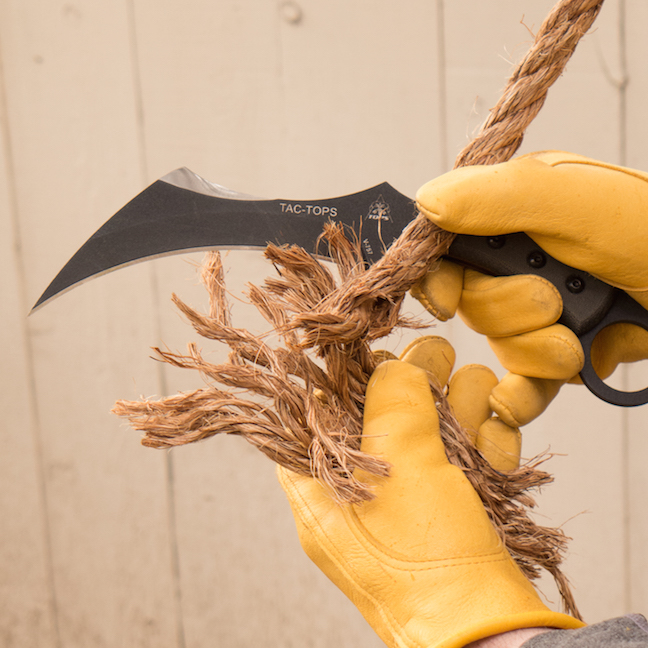
Boasting a blade shaped like a sickle, the karambit has been adapted for martial arts use today. However, it remains an effective cutting tool as well. James Morgan Ayres tests four of the latest editions in his story, “Shock & Claw.”
As the world’s biggest and most important knife event, BLADE Show 2017 attracts the best knifemakers and knife pros in existence. What better talent pool is there to select from as teachers for BLADE University, three days of knifemaking and other cutlery classes on a wide variety of sharp subjects? Check out who will be teaching what and how you can attend in “Back To Sharp School” by this writer.
Also this issue: Pat Covert’s test of four of the latest factory flipper folders; Dexter Ewing’s assessment of some of the newest factory machetes; part two of Frank Trzaska’s salute to the knives used by U.S. soldiers during World War I on the 100th anniversary of the USA’s entry into “the Great War”; the latest paring knives just in time for Mother’s Day, by Daniel Jackson; some of the top drawknives and how to use them, by Abe Elias; a farewell to ABS journeyman smith Larry “The Hammer” Harley; and much more in the latest BLADE—on newsstands now or subscribe here.
BLADE® field editor Ed Fowler will hold down table 3N at BLADE Show 2017.
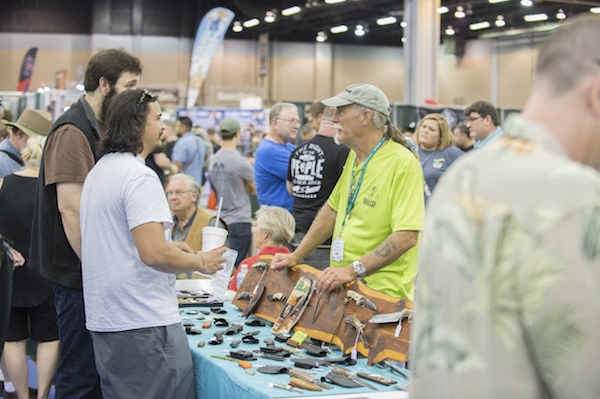
If you are one of thousands of knife enthusiasts worldwide who will attend the 36th Annual BLADE Show June 2-4, it’s time to start making your to-do list for the world’s largest and most important knife event.
There are oh-so-many—almost 1,000 booths and tables in all in the cavernous Cobb Galleria Centre show hall—including the world’s top makers, sellers and displayers of all things sharp. Among them will be three who on a regular basis help make BLADE® Magazine the World’s No. 1 Knife Publication—BLADE Magazine field editors Kim Breed, Joe Szilaski and, health permitting, Ed Fowler.
BLADE® field editor Joe Szilaski will exhibit at Table 3P for BLADE Show 2017.
A retired member of the 5th U.S. Army Special Forces group, Breed’s 20-year military career took him to various world hot spots, including the Gulf War in the early 1990s. It was while there that he wrote a letter to BLADE about his love for knives. One thing led to another and BLADE asked Kim if he would like to write for BLADE on a regular basis testing knives. He took over BLADE’s “Spec Sheet” department and has been testing and writing about knives for the magazine ever since. He also makes custom knives and will be displaying them, along with scrimshaw work by Mrs. Melissa Breed, at table 17G. Stop by and see them—and if you can, do it on June 2. That will be Kim’s birthday. Ask him how old he is—and be sure to duck afterward.
A High-Endurance Performance-Knife (HEPK) master smith, Fowler has been writing for BLADE even longer than Breed—since the late 1980s. BLADE got wind of him after reading a booklet he had written sharing his thoughts on all things knife, including how to use them, how they should be made and much more. Since then in his “Knife Talk” department he has exposed BLADE readers to his distinctive brand of writing and knifemaking, including his preference for 52100 ball-bearing steel, his multiple quenching of his blades, the HEPK courses he teaches at his Willow Bow Ranch in Riverton, Wyoming, and so much more. Visit him and his bladesmithing co-hort, Chris Amos (Chris also has written for BLADE), at table 3N. Also, be sure to attend Ed’s demo, “Choices The Maker And One Who Seeks a Knife Need To Make” show Saturday from 2:15-3:30 p.m. in Room 107. (Note: Ed has been experiencing some health problems of late but both he and we hope it will not prevent him from attending the show.)
Last among three BLADE field editors who will exhibit at BLADE Show 2017 is ABS master smith Joe Szilaski. A native of Hungary who was in-country during the Hungarian Revolution against the Soviet Union in 1956, Joe moved to America and has embraced all things USA, including bladesmithing. He has assumed the mantle of writing the BLADE “Question & Answer” department originally started by Cutlery Hall-Of-Fame member Wayne Goddard, and also teaches knifemaking and tomahawk making in his facility in New York state. In fact, he will teach the BLADE U. class “How To Filework Knives” on show Saturday from 8:30-9:30 a.m. in Room 109. His table is 3P, where he will be ably assisted by Mrs. Lori Szilaski.
BLADE® field editor Kim Breed (in ball cap) will be on duty at Table 17G at BLADE Show 2017.
It’s never too early to start planning your BLADE Show 2017 itinerary, and visiting three of the top BLADE field editors who also happen to be show exhibitors is as good a place as any to start. Meanwhile at least three other BLADE contributors—knifemakers Brian Goode (table 19G), David Lisch (13R) and RJ Martin (11M)—will be exhibiting. Also, other BLADE field editors who should be roaming the show hall will be Abe Elias, Dexter Ewing, Cutlery Hall-Of-Fame member B.R. Hughes and Les Robertson. Elias, in fact, on show Saturday in Room 107 will present the BLADE U. classes “Steel: The Heart Of The Knife” from 10:30 a.m.-12 p.m. and “The Best Edge For The Job” from 2-3:15 p.m.
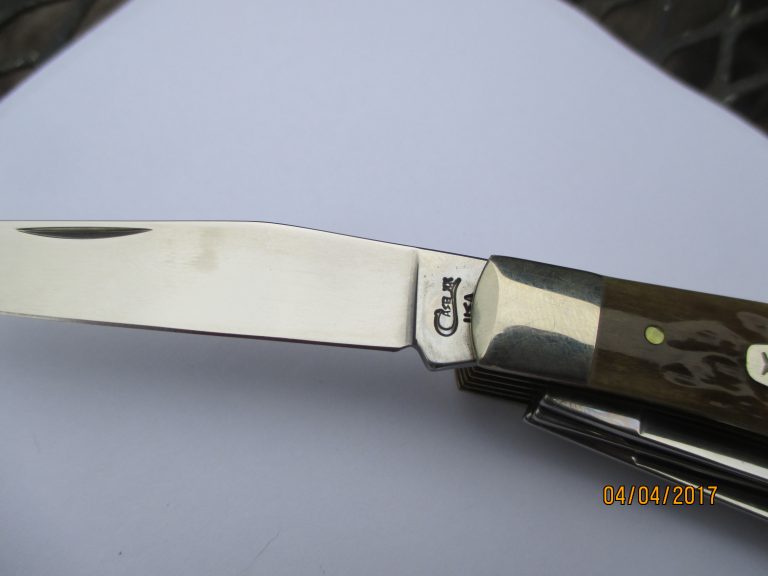
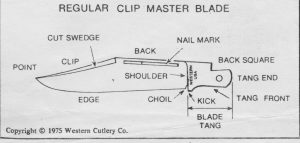
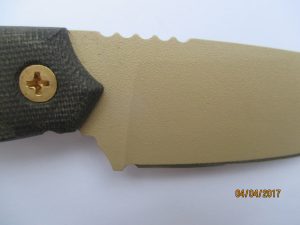
On a pocketknife blade, the knife choil is the notch between the cutting edge and the blade tang and serves to notify you where to stop sharpening the blade.When you think knife choil and pocketknives, Case immediately comes to mind.A classic example of a knife choil on a fixed blade is the notch here between the cutting edge and the ricasso or the blade tang of the Baja 3.0 by TOPS Knives.
Is a knife choil a nick, a notch, a finger groove or something else? And besides, what’s the difference between a nick and a notch?
What it is is one of those knife-specific terms that seems to evade proper definition by many, everyone from knife newbies to knife aficionados.
To expand on the definitions of both A.G. Russell Knives and Mr. Collins, while a knife choil may have enough space to accept a finger for certain types of cutting operations, such a capability is not the choil’s stated purpose. In some instances you may hear the term for such a feature called a finger choil. According to Russell’s definition above, such a reference is “improper.” In fact, sometimes what is incorrectly referred to as a finger choil is really more of a finger groove that spans the undersides of both the handle and the ricasso or the blade tang. Meanwhile, some new factory knives seem to be downplaying the knife choil if not eliminating it entirely.
Be that as it may, the chief purpose of the knife choil, as noted by the definitions of both Russell and Collins, is to allow the full length of the cutting edge to be properly sharpened. In other words, it is simply a small notch between where the cutting edge ends and the ricasso or the blade tang begins that indicates where you should stop when sharpening the blade with a stone, diamond-coated abrasive or what have you.
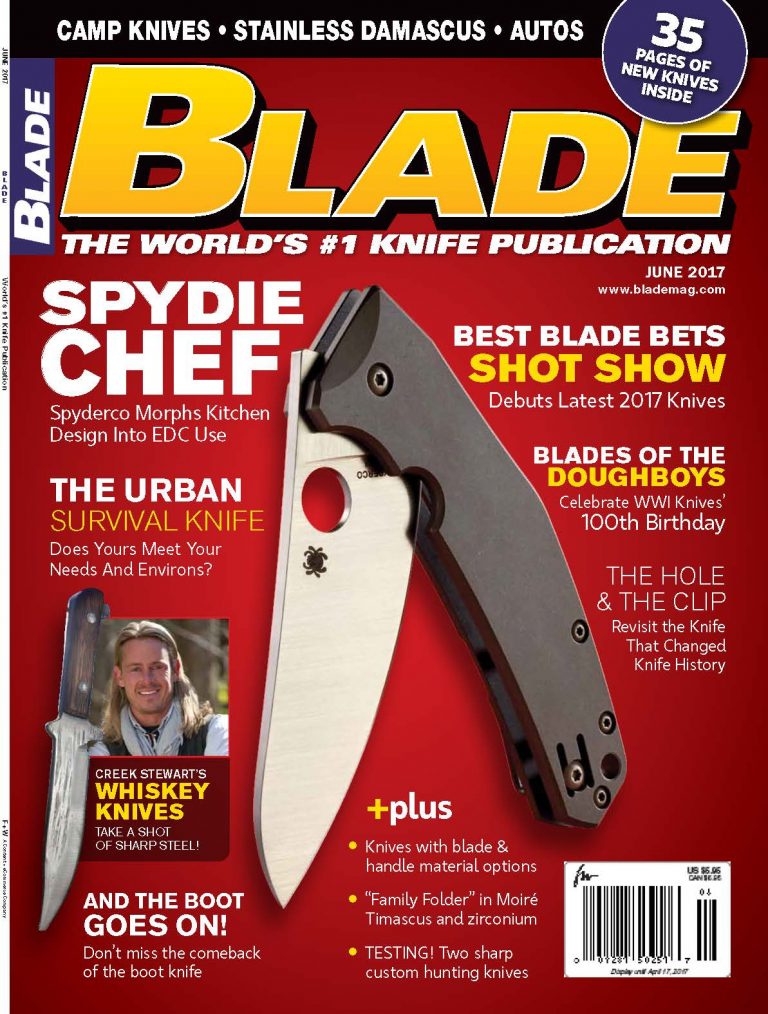
Spyderco’s knife that changed knife history is a headliner in the latest BLADE®, on newsstands now!
Spyderco’s knife that changed knife history, Creek Stewart of Fat Guys In The Woods fame and his knives, the top knives of the SHOT Show and more highlight the latest issue of BLADE®, on newsstands now!
In addition to his TV show on The Weather Channel, Stewart is known for his survival skills—and what’s survival without knives? While Creek gave knives away to the top “survivor” at the end of each episode of his show, he decided he wanted to take things a step further and work with a small American business to produce a line of knives. Whiskey Knives from Hank Gevedon’s Reptile Toolworks are the result and the focus of Erin Healy’s “Samurai Woodsman” on page 12.
Along with the annual BLADE Show—which is set for June 2-4 at the Cobb Galleria Centre in Atlanta—the SHOT Show is the place where many factory knife companies debut their new knives for the year. Check out the hottest knives of SHOT, along with a number of new companies under new flags, in the story on page 26.
There’s much more in the latest issue, including tests of camp knives, custom hunters and the return of an old friend—the newest factory boot knives; the urban survival knife and whether yours meets the demands of your environment; those who forge and sell stainless damascus to knifemakers worldwide; on the 100th anniversary of the USA’s entry into World War I, the first of a two-part story on the knives carried by U.S. Army personnel, aka The Doughboys; and much more, all in the latest issue of BLADE, available in the digital edition and also by subscription.
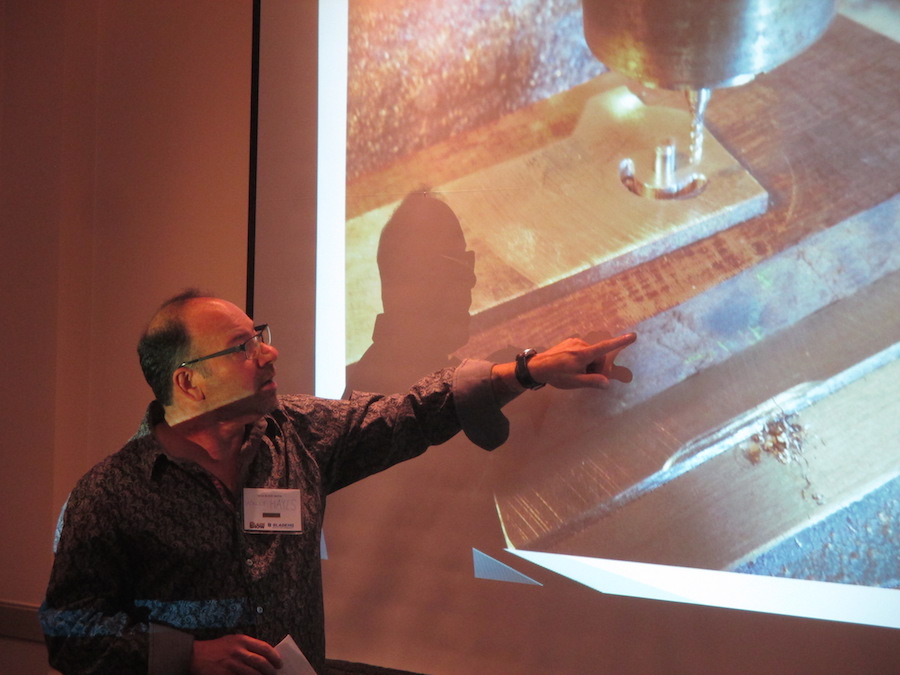
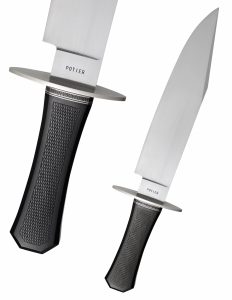
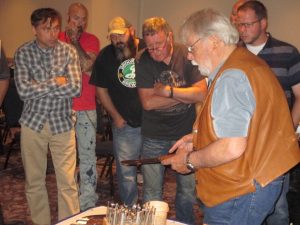
ABS master smith Wally Hayes will show you how to use simple tools to make a throwing knife at the 4th Annual BLADE University. Here he teaches flipper folders at last year’s BLADE U.The 4th Annual BLADE University will feature such classes as how to checker knife handles taught by ABS master smith Timothy Potier.
The 4th Annual BLADE University will offer knife enthusiasts an almost completely overhauled curriculum of classes on the subject of knives and knifemaking June 1-3 in conjunction with the BLADE Show at the Cobb Galleria Centre in Atlanta.
Beginning the day before the BLADE Show and ending BLADE Show Saturday, this year’s BLADE University offers a wide-ranging selection of courses on how to make knives—including blade grinding, handle checkering, embellishment, color-case-hardening knife parts, chatoyance and others—all about blade steels, how to use knives, how to price them and much more.
ABS master smith (MS) Timothy Potier will kick off the instruction in Thursday’s “Knives The ABS Way” with his class on how to checker knife handles, followed by fellow MS Jim Rodebaugh‘s “How To Design A Purpose-Built Knife” and “How To Etch and Polish a Damascus Blade.”
In his fourth appearance for BLADE U., MS Joe Keeslar will show you how to make a brut de forge knife, and ABS journeyman smith (JS) Butch Sheely will end the day’s classes with his tutorial on how to make a pipe tomahawk.
Friday’s instruction will begin with MS Joe Szilaski‘s class on how to filework knives and Tom Krein‘s three-part class entitled “How To Grind a Blade.
ABS master smith Joe Keeslar will teach you how to make a brut de forge knife at the 4th Annual BLADE University.
In the last two parts of his class Tom will demonstrate how it’s done on a Burr King grinder under the Burr-King-sponsored tent in “The Courtyard”—the adjoining parking lot of the BLADE Show host hotel, the Renaissance-Waverly.
Other classes will include two by knifemaker/BLADE® field editor Abe Elias: one on how blade steel is made and blade geometry and how it affects edge retention, and the second on which blade edge and grind is best for which cutting job.
MS/BLADE contributor Wally Hayes will show you how to use simple tools to make a throwing knife, and MS Steve Culver will demonstrate how to design a slip joint with a half stop. Niagara Specialty Metals will wind up the day’s instruction with a class designed for the veteran knifemaker and novice knife enthusiast alike that will include a discussion on the properties of various elements in the steel, proper heat treating, tempering and what it does to the steel, CPM vs. air-melt steels and more.
Saturday’s final sessions will commence with “Knifemaking for Kids” taught by Jason Brous. (Youngsters need not be accompanied by a parent/guardian, though if the youths are so accompanied the parent/guardian will be admitted free of charge.)
Knifemaker Grace Horne of Sheffield, England, will conduct a class on how to make one of her specialties: custom scissors. Knife and sword maker Wally Hostetter will present a two-part class on how to do the Japanese handle wrap, or tsuka maki, and knifemaker/U.S. Marine veteran Les George will show you how to color-case-harden knife parts—that is, the process of adding a multi-colored hard surface to mild steel for use in various knife fittings.
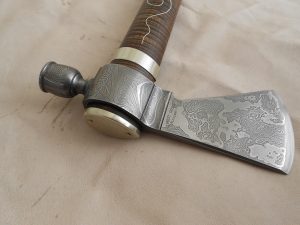
Learn to make a pipe tomahawk in the style of ABS journeyman smith Butch Sheely at the 4th Annual BLADE University.
JS Brian Thie‘s class will cover how to give damascus blades chatoyance—an effect that exhibits an almost mirror-polished look within the damascus pattern itself. MS David Lisch will present a class on how to make the best stag handle, including sharing his “tricks” in working with the material. Knifemaker Johnny Stout‘s class will be on how to price custom knives, including actual costs in building knives, how to price the knives to make a profit (or at least break even) and more. And, finally, knifemaker L.T. Wright of L.T. Wright Handcrafted Knives will present “Draw It, Grind It, Sharpen It: The Beginner’s Guide to Knifemaking,” which will feature knives in various stages of completion to show you how your knife should look all along the way to a finished product, with L.T.’s helpful insights and educational visuals.
Visit BLADE U. for enrollment information, dates, times, classroom locations and more.
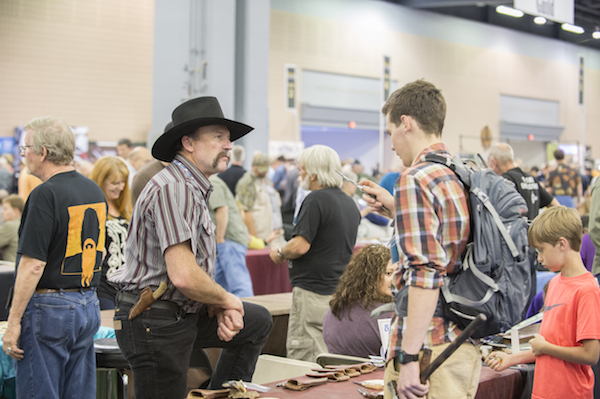
Knife bill SB 49 would affect this year’s BLADE Show and needs your help by Friday. Bladesmith Butch Deveraux (in cowboy hat) waits on a customer at last year’s BLADE Show. (PointSeven image)
A Georgia knife bill that would reform law and impact the 2017 BLADE Show needs your help by Friday, March 3, or it will die.
According to Knife Rights, SB 49 would increase the legal carry length of a knife blade in the state from 5.5 to 12 inches, but before that can happen the Georgia state Rules Committee must release the bill for a vote.
A recent applicable Knife Rights email stated that “efforts to completely eliminate the carry length limit have been stymied due to the manner in which a knife is defined in Georgia law. [If enacted, SB 49 would] make life much better for knife owners in Georgia without hampering future efforts to completely eliminate the carry length limit at some future opportunity.”
That’s where you come in.
If you plan to attend the BLADE Show June 2-4 at the Cobb Galleria Centre in Atlanta or live, travel or work in Georgia, please call or e-mail the Rules Committee members now. Whether you call or email—if emailing, enter on the subject line “Please Move SB 49″—tell them you respectfully request that they please pass SB 49 out of the Rules Committee so that it may be voted on by the full Senate. Also, be sure to thank them after you make your request. As noted in a recent Knife Rights email on the subject, “Please be polite and respectful and remain on point.” Hey, as with any request, sugar always works better than sulphur, right?
Below is a list of Georgia legislators to contact concerning the matter:
A contemporary version of the Mount Rushmore of Knifemakers is one of many feature stories in the latest BLADE®, on newsstands now!
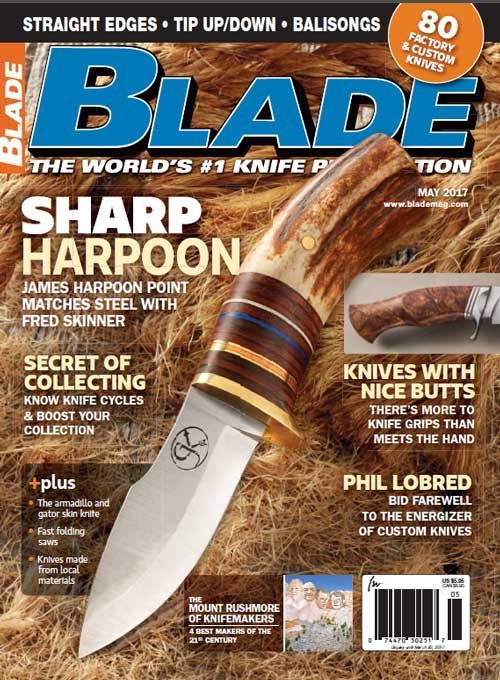
A contemporary version of the Mount Rushmore of Knifemakers, a secret of knife collecting, knives with nice butts, the Bob Loveless knife that changed knife history and more touch up the edge of the latest BLADE®, on newsstands NOW!
BLADE did an all-time “Mount Rushmore of Knifemakers”—the top four makers of the modern era—in the May 2015 issue. Afterward, one of the participants, Dan Delavan of Plaza Cutlery, suggested we do a Mount Rushmore saluting contemporary makers. The result is our poll of leading industry observers that pinpoints the top four makers—four to fit on our Mount Rushmore—from 2000 to 2017. Check out who they are, as well as the ones who just missed, in the latest issue.
Collecting custom knives must be fun and rewarding for you or else why do it? One way to make it fun and rewarding is to be successful at it, and one way to do that is to be aware of the life cycle of popular knife genres. BLADE field editor Les Robertson makes a living staying abreast of the life cycles of hot custom knife genres, something he has been doing for almost 35 years now. Learn what the cycles are, their history and how you can use them to enhance your collection in “The Circle Remains Unbroken.”
In knife parlance the end of a knife handle is called a butt—and knives with the nicest butts often are the kind that attract knife aficionados most. See why this is so and some examples of some of the best of their kind in “Knives With Nice Butts.”