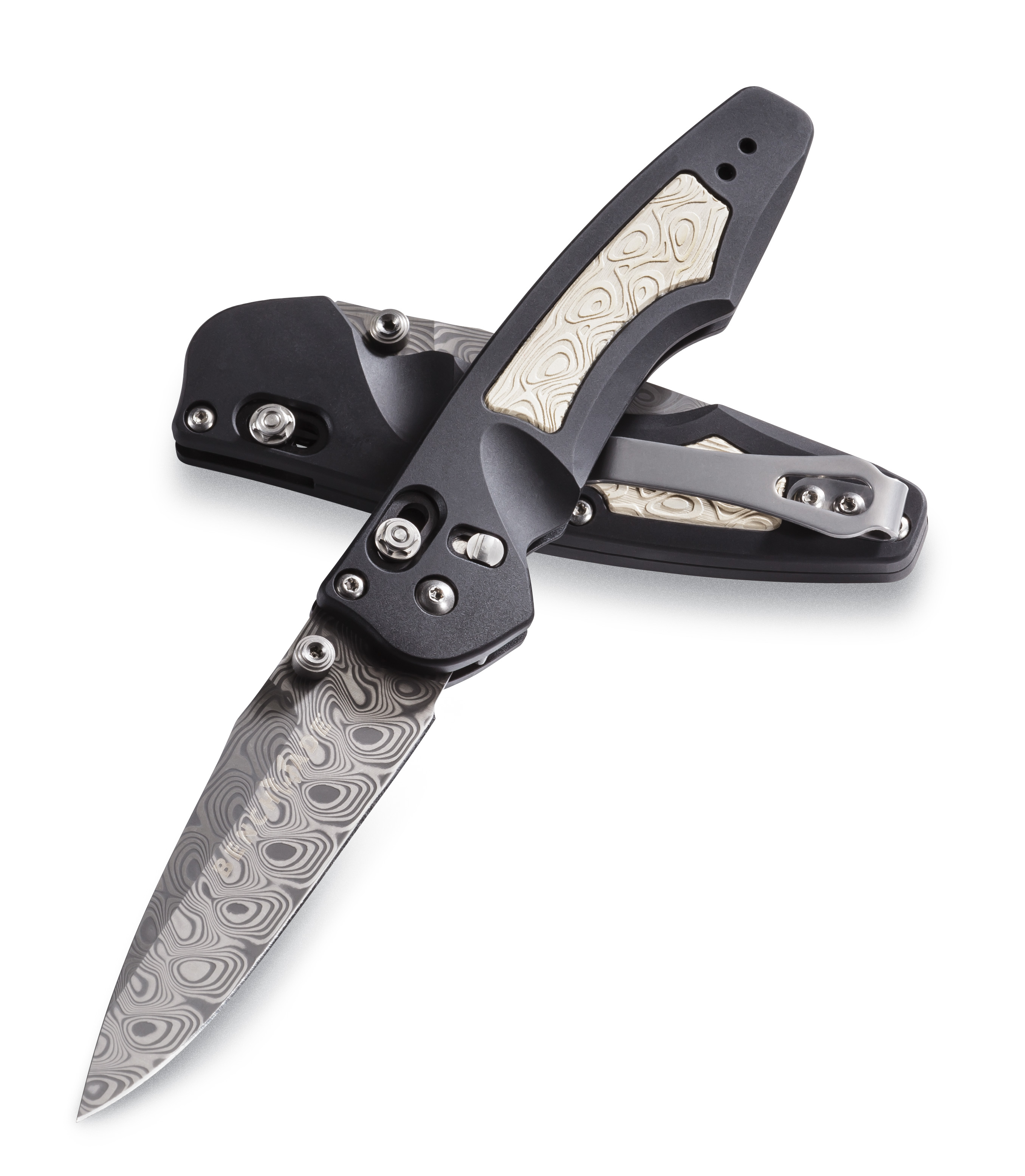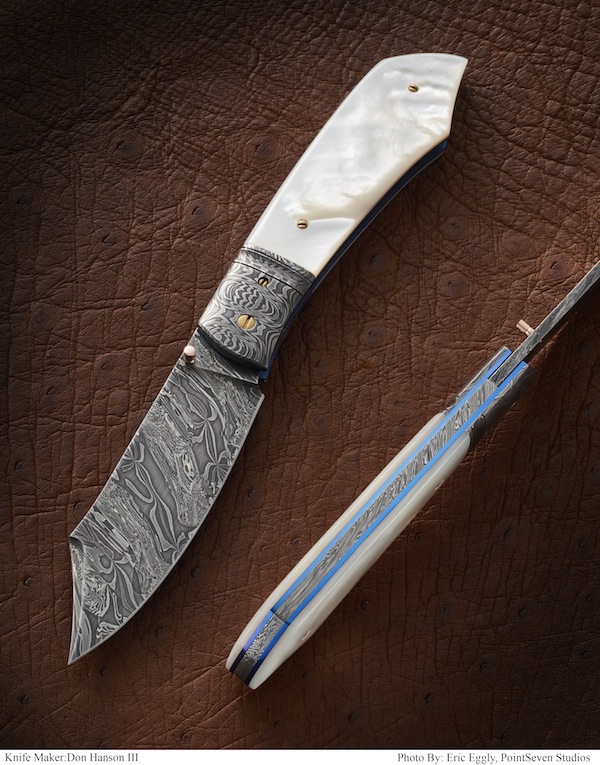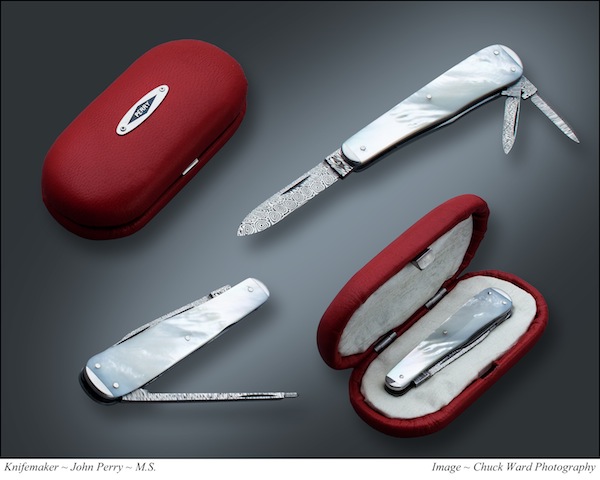
John Perry employs the classic gunstock-lobster pocketknife pattern to showcase the mother-of-pearl. (Chuck Ward image)Gold engraving by Martin Butler borders the stunning black-lip mother-of-pearl inlay in Warren Osborne’s interframe folder. (SharpByCoop image)
7 pearl knives for Dec. 7 somehow seems oh so fitting. Dec. 7, 1941—the date which lives in infamy marked the USA’s entry into World War II and the awakening of a military dynamo that would vanquish Japan and play a crucial role in the defeat of Germany in Europe. Japan’s bombing of Pearl Harbor early that day thrust America headlong into the maelstrom that would change the world forever.
With the 74th anniversary of that momentous event upon us, we thought a fitting way to observe it would be with knives sporting one of the most beautiful of handle materials: mother-of-pearl. Called pearl by most, the material is coveted on higher-end knives and makes for a most worthy edged presentation.
Herein are seven of those knives in memory of Dec. 7. Enjoy!
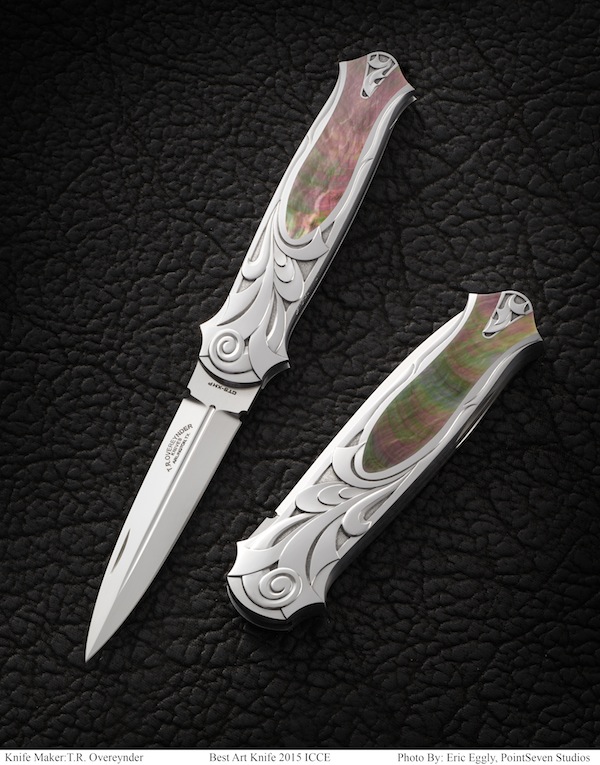
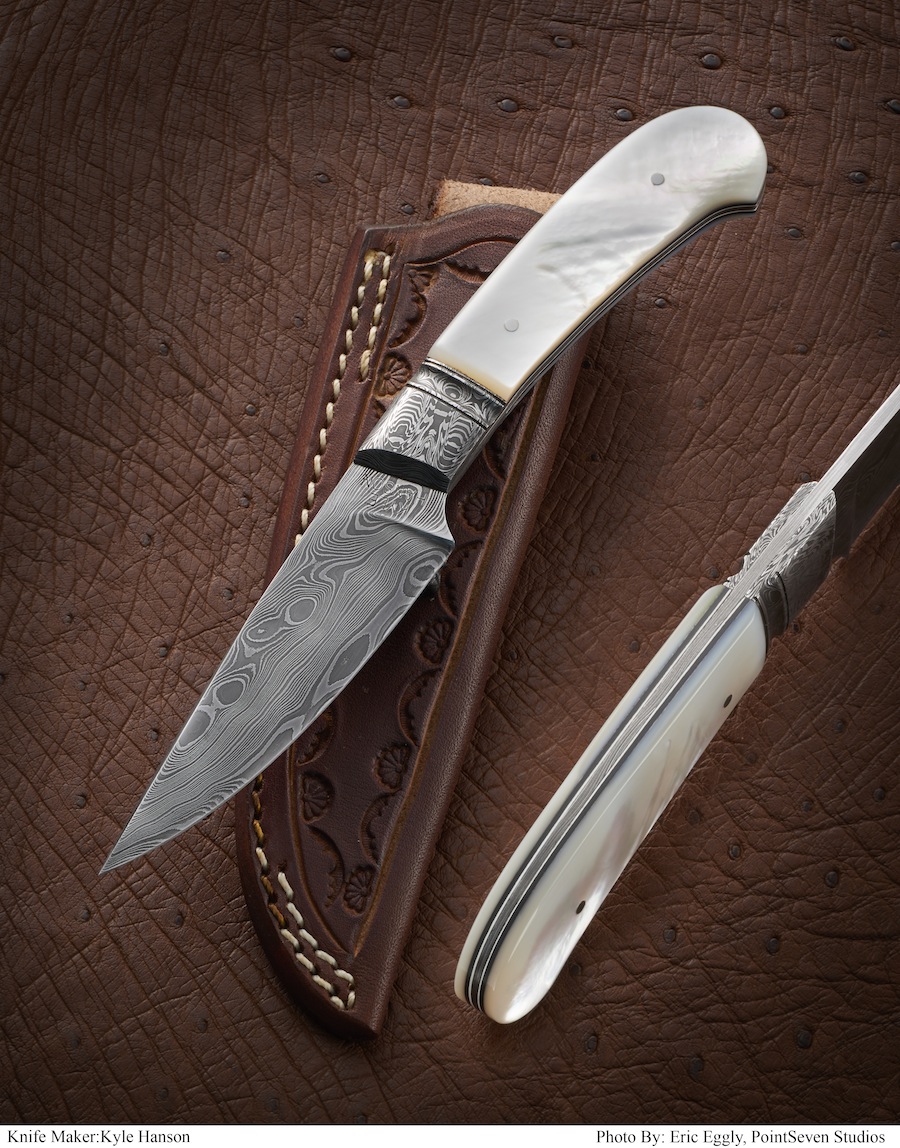
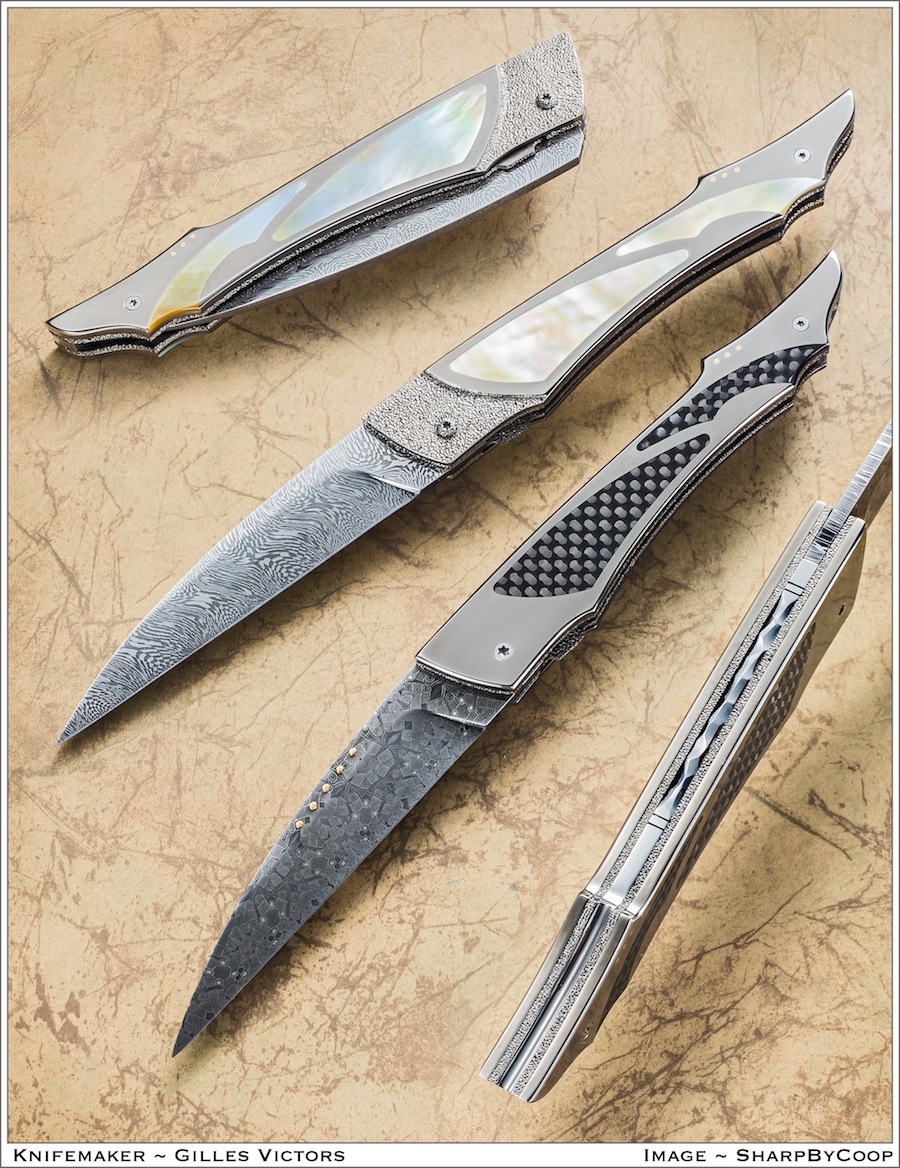
Black-lip mother-of-pearl rarely looks as pleasing as it does on Tom Overeynder’s folding art dagger. (PointSeven image)Don Hanson’s mother-of-pearl folder boasts some of the maker’s forged mosaic damascus for the blade and bolster, and titanium liners anodized blue. (PointSeven image)Kyle Hanson goes the mother-of-pearl route in damascus and with a handsome leather sheath. (PointSeven image)Ken Steigerwalt uses black-lip mother-of-pearl for the inlay on his damascus art folder with a modified tanto blade. Accents in 14k gold add to the mix. (SharpByCoop image)Gilles Victors of Vacquiers, France, offers up his “Zephyr” model in mother-of-pearl as well as a handle of carbon fiber. The damascus blade comes in a modified wharncliffe style.
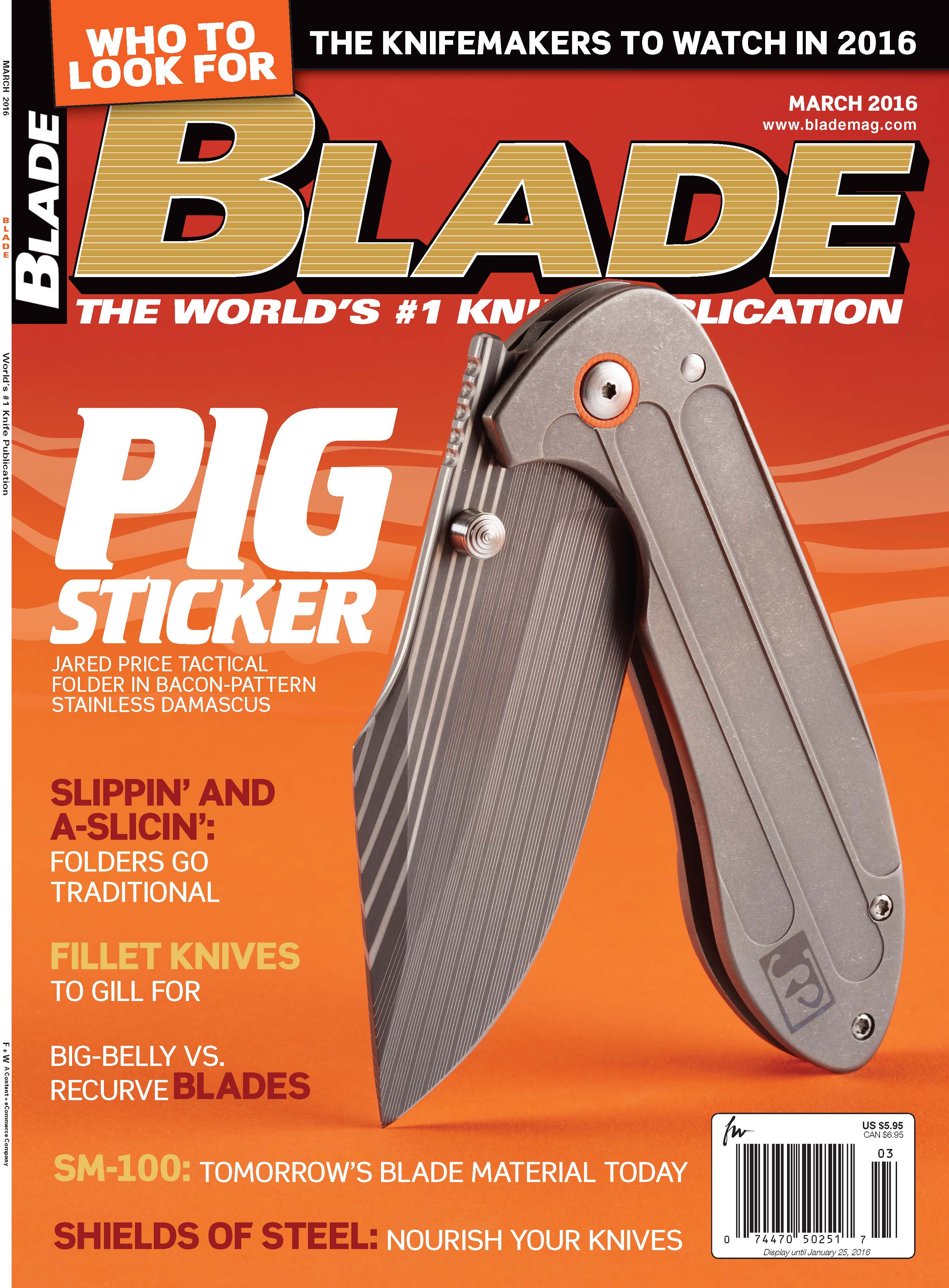
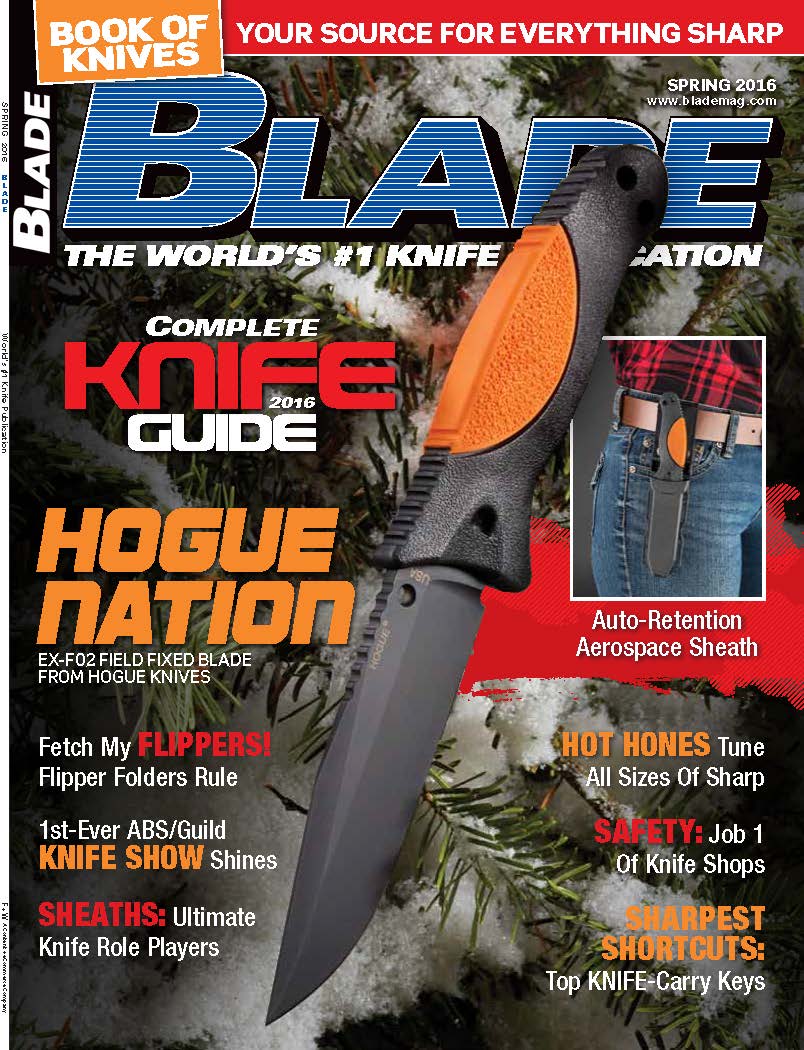
BLADE’s Complete Knife Guide Spring 2016 is your one-stop knife road map for the latest in knives and knife accessories, and how to get them.
BLADE’s Complete Knife Guide Spring 2016 is your one-stop knife road map. It features the latest in knives, sharpeners, sheaths, knifemaking safety equipment, a comprehensive directory of knives/knife accessories and who sells them, and much more—and is on newsstands now!
The first-ever International Custom Cutlery Exposition was held in September at the Downtown Marriott in Kansas City, and BLADE’s Complete Knife Guide (BKG) has exclusive coverage of the historic event. It was the first time members of both the American Bladesmith Society and the Knifemakers’ Guild—the world’s two oldest and most important knifemaker organizations—joined forces to produce and coordinate their own knife show. BKG also examines the latest folding knives for executive wear and some of the most convenient of all knives—the newest in keychain cutters.
For hobbyist, part- or full-time makers, BKG offers tips on must-have safety equipment for every knife shop, as well as an excerpt from knife-and-gun-rights attorney Evan Nappen’s new book “Knife Laws of the U.S.” The excerpt focuses on what to say and do, and, perhaps more importantly, what not to say and do if you get arrested for carrying a knife.
There’s much more, including the latest factory knives and accessories for the coming year, how knife professionals can get the most from social media and other sharp stuff, all in the latest BKG!
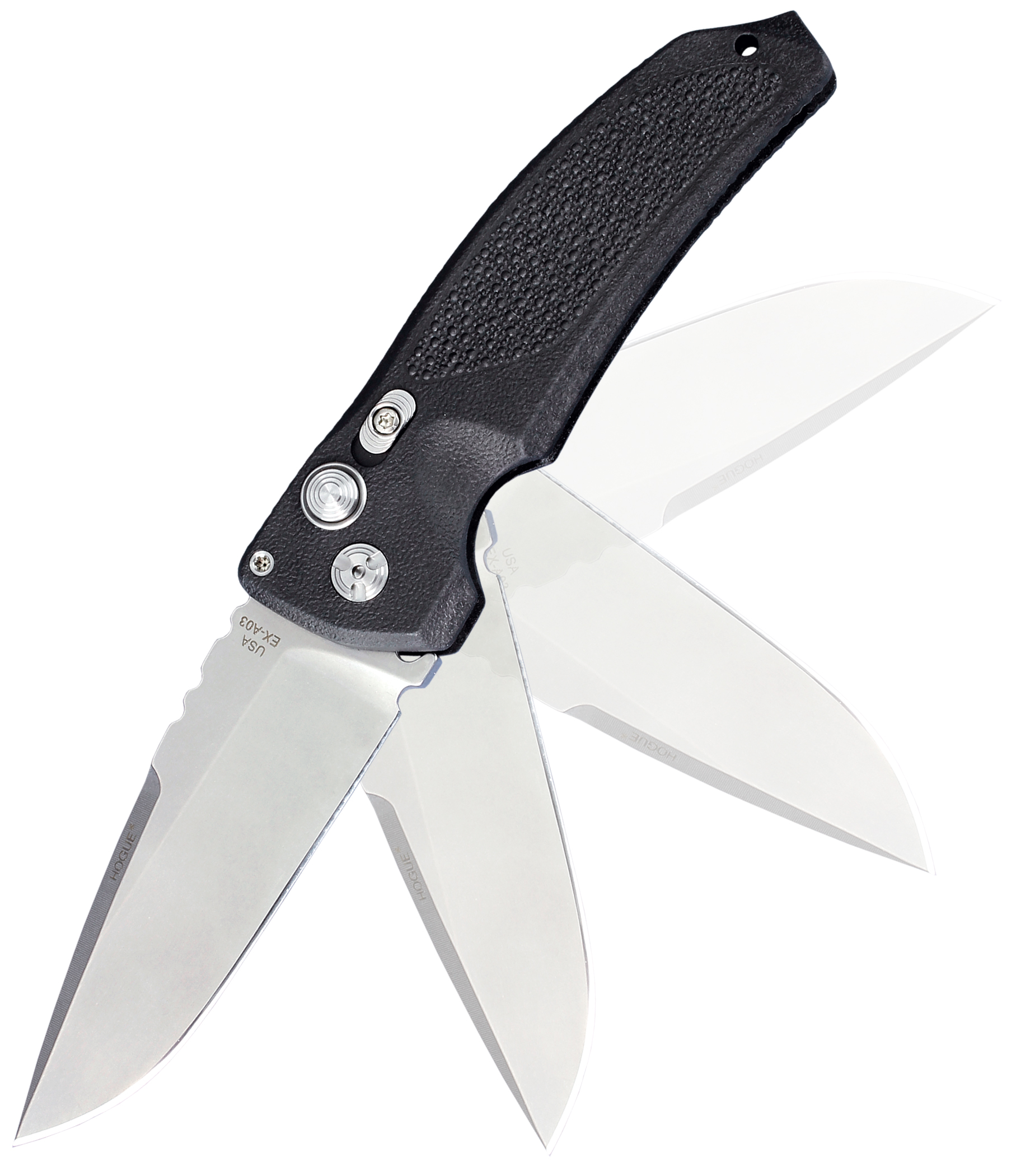
COVER KNIFE: The Hogue EX-F02 features a choice of a 4.5-inch tanto or clip-point blade in a low-glare black finish, and an ergonomic handle with an easy-to-grip insert in a choice of colors. An ambidextrous automatic retention sheath locks the knife in place and releases smoothly with the push of a trigger lever.
Recommended:
Stay abreast of the latest developments on this and many more knife rights issues with a subscription to BLADE.
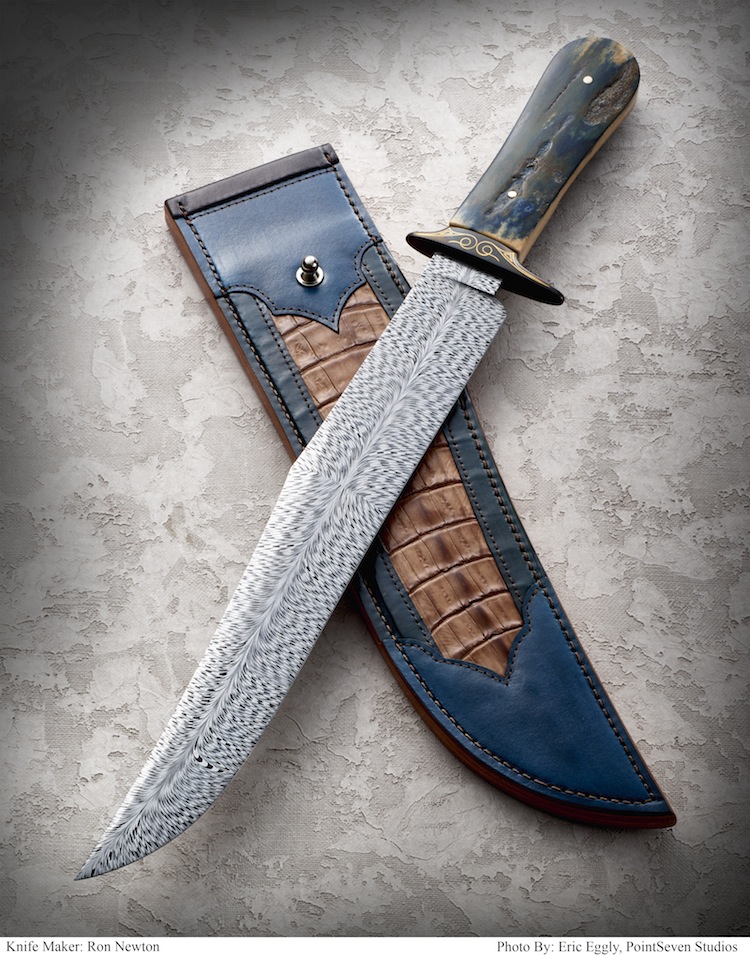
Ron Newton’s bowie features an ancient ivory handle. (PointSeven image)
Massachusetts and New Jersey made advances in the fight against each state’s ivory ban proponents over the past two weeks.
Opponents of the Massachusetts ivory ban outnumbered the proponents in a Nov. 17 hearing before the state’s Joint Committee on Environment. In other words, there were many more legitimate business people there—scrimshanders, musicians, antique dealers, etc.—than animal activists, and that’s a good thing for people interested in maintaining a legal ivory trade in the state.
The ban’s opponents gave many examples of art and culturally significant antiques that would needlessly be rendered worthless under the ban. The committee seemed to acknowledge the beauty and distinctiveness of the antiques that would be outlawed, and that an all-encompassing ban was unnecessarily broad. The activists commented on the “different tone” and the concern the committee showed for scrimshaw and antiques. Many of the questions asked related to creating legal exceptions to the ban.
The Massachusetts developments followed on the heels of the chaotic hearing on the Big 5 African Species ban before the New Jersey Senate Budget and Appropriations Committee on Nov. 10. The oppressive bill heard before the committee would have made possession of ivory a criminal offense punishable by three-to-five years in prison and a $5,000 to $50,000 fine. It also would have targeted other wildlife materials, including varieties of mother-of-pearl, shark’s teeth and many more. Thanks in no small part to the invaluable help of Knife Rights and Doug Ritter, written criticisms of the ban read to the committee helped result in a watered-down version of the bill that, among others, exempted ivory and rhino horn and no longer requires ivory owners to comply with the bill’s new possession prohibition and certification requirements; dramatically reduced the number of species covered from 11,800 to around 10; and slashed the penalty for failing to comply with their certification requirements from felony-level penalties to a civil penalty.
Despite the watering down of it, the New Jersey bill is still a bad one and represents a Pyrrhic victory of sorts. Though ivory was excluded, the bill still constitutes unconstitutional taking by criminalizing commercial trade and possession of otherwise legal private property without just compensation. It imposes taxes on those who lawfully possess wildlife through its certification requirements that remain in place, and manages to include additional species with no evidence of a connection between New Jersey and the targeted items. Finally, its one-size-fits-all-prohibition style strips wildlife of all commercial value to local African countries and communities best suited to protect them.
Also Check Out:
Knives 2016, 36th Edition
The trusted guide for knife collectors, enthusiasts, knifemakers, and dealers around the world, this knife book covers the latest and greatest from front to back. A collection of feature articles explores the latest developments, history, and transformation of knives, swords, and edges of various kinds. Get your copy
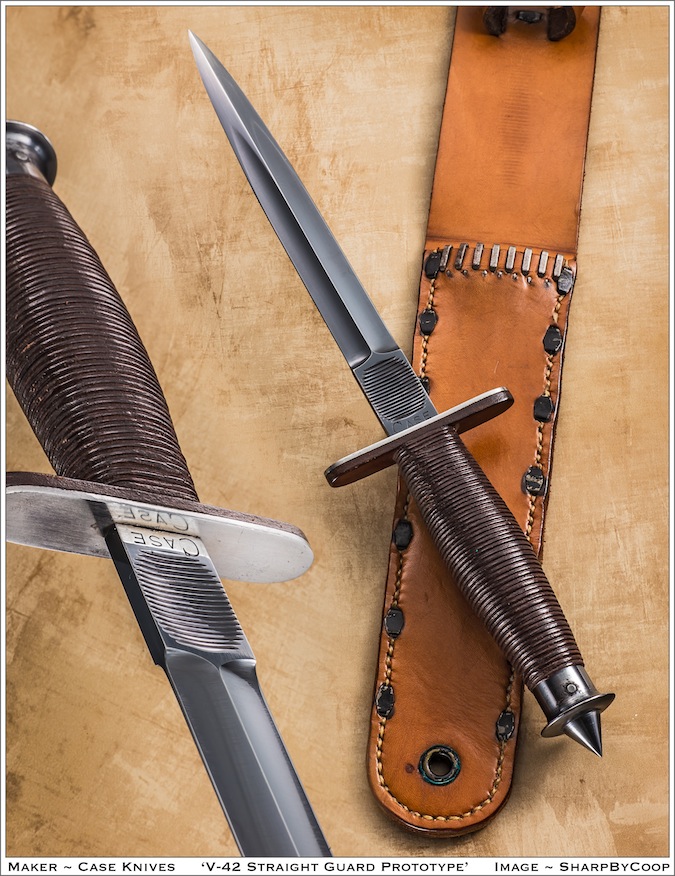
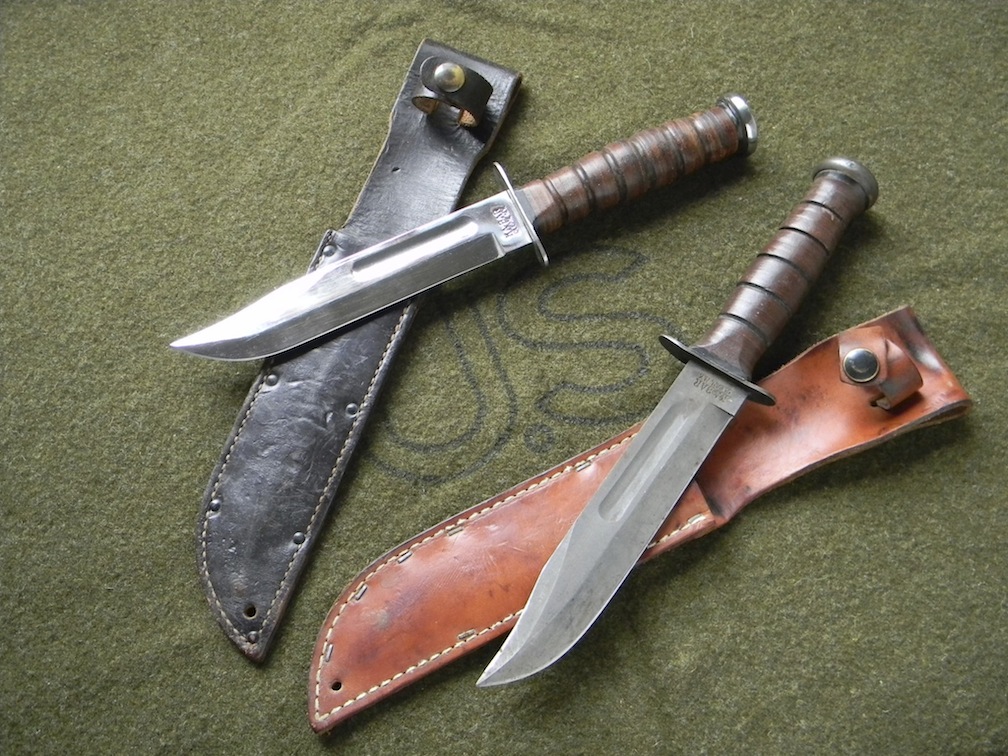
The classic Case V-42 with thumbprint ricasso. (SharpByCoop image)Two Mark 1’s, one by Pal (top) and Robeson (bottom).
In honor of Veterans Day, here are a few of the veterans’ knives that have seen action over the past century in the service of our country:
•U.S.N. Mark 2/U.S.M.C. fighting-utility knife: Known to many simply as a KA-BAR or kabar, it was made during World War II not only by Union Cutlery/KA-BAR but also, among others, Pal, Case, Camillus, Utica, Conetta and Robeson Shuredge. The iconic picture of it on the hips of U.S. Marines on the black sands of Iwo Jima tells it all—it was there and so were the Marines, who, by the way, are also celebrating their 240th anniversary. Semper Fidelis!;
•U.S. Mark I Trench Knife: It has all the trimmings: skull crusher, dagger blade, and the four finger holes in the knuckle guard. It reeks of Doughboys, Over There and Jimmy Cagney’s The Fighting 69th;
•Randall Model #1-8: WIth its stacked-leather grip and flowing blade, slightly dropped handle, double guard and narrow tang opening into a magnificently ground clip-point blade, the Model 1 has some of the most beautiful lines of any knife ever made;
Two Mark 2’s stamped “KA-BAR.”
•Case V-42: Classic skull crusher, cylindrical/swell-center handle, double guard, dagger blade and the clincher, the thumbprint indentation iwth grooved lines on the ricasso alone would guarantee the V-42 a place in any pantheon of military knives;
•Gerber Mark II: The one with the “cat-tongue” handle—so-called because of the feel of the grip created by spraying molten stainless steel onto the aluminum—and the wasp-waisted blade is a favorite from the Vietnam War;
•SOG Recon: The “twin-peak” blade spine readily identifies this military classic from the Vietnam War. “SOG” comprises the last three letters in the MACV-SOG acronym, the seven which stand for Military Assistance Command Vietnam-Studies and Observations Group;
•Ulster Mountain Pocketknife: These utlilitarian pocketknives reportedly were issued to the First Special Service Force during World War II and later to the troops of the 11th Mountain Division.
U.S. Marines land at Iwo Jima, their U.S.N. Mark 2’s/Ka-Bar fighting/utility knives at their sides.
The best knives under $50, how to make one of the industry’s hottest folders, and two custom knife industry veterans doing their best to protect elephants and your legal ivory are among the highlights of the new BLADE®, on newsstands now!
Budget concerns are at the top of most people’s lists these days, including those of knife enthusiasts. Dave Rhea shows you how to save a few bucks and still get an outstanding knife at a reasonable price in “Best New Knives Under $50.”
The best knives under $50 and more highlight the new BLADE®, on newsstands now!
Sandra Brady and Linda Karst-Stone are known throughout the custom knife industry as two of the best scrimshanders. They have a vested interest in the nationwide attack on legal elephant and ancient ivory by the federal and state governments. If you think all Sandra and Linda care about is their livelihoods and not the plight of elephants and the state of legal ivory, you would be wrong. Find out what the federal and state grab on legal ivory is really about in the “Dynamic Duo of Ivory” by Pat Covert.
Protecting a knife from the physical degradations of hard use, the elements and more is one of the reasons many companies coat the blade and sometimes even the handle in a variety of different finishes. Find out what the finishes are, how they are applied and more in Mike Haskew’s “Coats of Many Colors.”
Also this issue: tests of the latest hatchets, neck knives and two new folders, those who forge damascus in quantity for use by other knifemakers and companies, 41 reasons you may be an edgeneck and much more in the latest BLADE.
The tactical folder in the line is the 2-Stage, a Robert Carter design with a tanto blade.Ken Steigerwalt’s new Ruger/CRKT design is the Crack Shot: Compact.
Sturm, Ruger & Co. and CRKT announce new knives designed by a selection of award-winning custom knifemakers.
The designers include Ken Steigerwalt, Ryan Johnson of RMJ Tactical, Bill Harsey, Matthew Lerch and Robert Carter.
CRKT has the knives produced under license from Ruger. They include a selection of EDC, tactical, hunting and utility patterns in an assortment of sizes and materials.
Of the five designers, Harsey designed the most knives: three. His are the “Go-N-Heavy” folder highlighted by a hard-anodized, sure-grip handle and a 3.5-inch blade, the “All-Cylinders” folder with a black, stonewashed 4-inch blade and a “revolver cylinder-style” pivot, and the “Accurate,” a fixed-blade hunter with a reinforced nylon-fabric sheath. The folders have drop-point blades with a choice of plain edge or Veff serrations. The Go-N-Heavy stores in a nylon-fabric sheath.
Bill Harsey’s Go-N-Heavy is highlighted by a hard-anodized sure-rip handle.
Johnson’s designs are the “Cordite: Compact” straight knife sporting a 2.5-inch drop-point blade and a paracord-wrapped handle with a “revolver cylinder style” bead, and the “Powder-Keg” fixed-blade survival knife featuring a 4.75-inch blade and rubber overmold full-tang handle with an inset Ruger medallion. The former has a glass-reinforced nylon sheath, the latter a leather sheath.
The Cordite: Compact has a 2.5-inch drop-point blade and paracord-wrapped handle.
Lerch’s design is the “Follow-Through” flipper folder with a Ruger-inspired, diamond-checkered, glass-reinforced nylon handle.
The locking liner knife has a 3.75-inch drop-point blade and a two-position pocket clip. Steigerwalt’s design is the “Crack Shot: Compact” assisted opener with a 3.5-inch drop-point blade and a Ruger American Rifle-inspired, glass-reinforced nylon grip with pocket clip.
The blade is stonewashed and available in a plain or serrated edge. Carter’s design is two sizes of the “2-Stage,” a tactical flipper folder with a choice of a 4- or 3.58-inch (the “2-Stage: Compact”) tanto blade in a plain edge or with Veff serrations. Each knife has a machined/hard-anodized aluminum and stainless steel handle, and four-position pocket clip.
Matthew Lerch’s Follow-Through flipper folder includes a Ruger-inspired, diamond-checkered glass-reinforced nylon handle.
Sandra Brady of the Elephant Protection Association urges citizens of Washington state to fight against a new anti-ivory initiative.
A ban-all-ivory law supported by billionaire Microsoft co-founder Paul Allen and other 1 percenters is on the ballot in Washington state and will succeed unless you help stop it NOW!
The measure, I-1401, would ban not only elephant ivory but also the ivory of mastodon, mammoth and other extinct species.
Sandra Brady of the Elephant Protection Association said help is needed at the grassroots level to defeat the measure supported by rich billionaires such as Allen and other non-governmental organizations, which have raised more than $2.7 million—including $1.7 million from Allen—in an effort to pass it in the state legislature.
“It really is a David versus Goliath situation,” she observed of the fight against the 1 percenters who are supporting I-1401. She urged those who oppose the bill to write their local newspapers and use social media to voice their opposition. “On the upside we are having an impact,” she said of the grassroots effort. “On the down side, the more states that pass such ridiculous measures, the more likely other states will follow suit. This is why your help to defeat this in Washington state is so important.
“Write letters to the editors of the state’s newspapers, use your voice on Facebook and other social media. Help us get the word out that I-1401 is a bad law and should be voted down.”
A small organization, the Legal Ivory Rights Coalition Committee (LIRCC), is fighting against Allen and the other fat cats who are supporting I-1401. However, the LIRCC has no budget and relies on people contacting newspapers and working social media to spread the word. The good news is that editorial pages across Washington state are calling I-1401 misguided. While acknowledging the noble goal of preserving elephants, many editorial pages recognize the futility of a state law designed to stop crime in Africa and Asia. It would punish the state’s citizenry without stopping poachers. They also recognize the redundancy with existing federal laws that prohibit import of ivory and other endangered species, together with the unnecessary burden it would place on the state’s fish and wildlife officers.
Recommended:
Stay abreast of the latest developments on this and many more knife rights issues with a subscription to BLADE.