Home Authors Posts by Steve Shackleford

Steve Shackleford

Survival Necker

Since the 1095 blade of Jonathan McNees’ Survival Necker is differentially hardened for a hard edge and softer back—which also results in a handsome hamon—a portion of the blade is not hard enough for sparking via the striker. As a result, McNees also includes a fire steel for the purpose. (SharpByCoop.com photo)

McNees’ PSK has the essentials to survive a short-term emergency

Jonathan McNees’ Survival Necker—PSK (Personal Survival Knife) for short—features the bare survival essentials all in one modular system. The 5.75-inch knife has a differentially hardened blade of 1095 carbon steel and a G-10 handle with hollow-tube construction to accept a lanyard. The handle sports a glow-in-the-dark dot for ease of location at night.

    Included are a fire steel and striker, three-phase (high, low and blinking) flashlight, paracord and whistle. The handle of the fire steel is hour-glass shaped to contain two fish hooks wrapped with 30 feet of 30-pound Spiderwire® fishing line, which also can be used for snares and trip wires. In addition to the Kydex® sheath, a two-sided plate with a compass on one side and a mirror on the other rides on a necklace/bead chain. The system also breaks down for belt wear.

Knife: Survival Necker

Maker: Jonathan McNees

Blade Steel: 1095 carbon

Heat Treatment: Differentially hardened

Handle: G-10 w/glow-in-the-dark dot

Sheath: Kydex®

Survival Items: Fire steel and striker, compass, mirror, whistle, flashlight, paracord and fishing line with two fishhooks

Maker’s List Price: $185

    For more information contact Jonathan McNees, 15203 Starboard Pl., Northport, AL 35475 205-915-3254 www.mcneescustomknives.com.

For more on the latest knives, knife legislation, knifemaking instruction, knife trends, knifemakers, what knives to buy and where and much more, subscribe to BLADE® Magazine, the World’s No. 1 Knife Publication. For subscription information click on http://www.shopblade.com/product/blade-magazine-one-year-subscripti…?r+ssfb040512#BL1SU.


FROZEN SHARP! Cryogenically Treated Blades

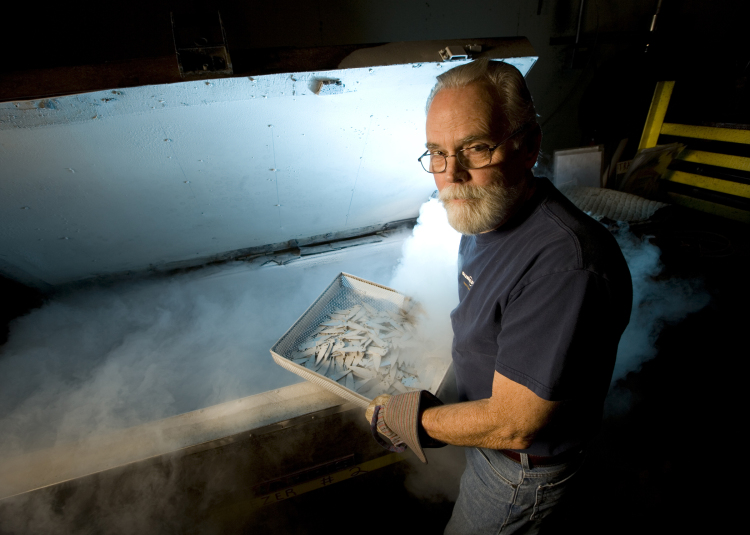
Cryogenic quenching may be performed on a single blade or hundreds at a time. Blade Magazine Cutlery Hall-Of-Fame© member Paul Bos said he may do a single blade or put a large quantity in a basket for immersion at one time, and control the rate of cooling and return to room temperature precisely. (Buck Knives photo)

Given the right steels, cryo treatments can enhance overall performance as well as aesthetics

By Mike Haskew, BLADE® field editor

Whether called cryogenic quenching or the probably more correct cryogenic treating of the steel, the process of freeze treating to help make a steel the best performer it can be is nothing new. Since the U.S. military became involved in cryogenically quenching steels during World War II and required it in the manufacture of various defense-related products, several methods have been evaluated with the same goal in mind: optimizing the amount of martensitic iron in the structure of the steel while minimizing the residual amount of austenitic iron. In turn, the qualities most sought in a knife blade are enhanced, particularly edge holding.

    “There are different ways that cryogenic treating is performed,” explained Scott Devanna, vice president of marketing and product development for Carpenter Steel, “but all methods are designed to accomplish the same goal, although the methods sometimes attain differing degrees of transformation from austenite to martensite. Cryogenic treatment is not a different type of quenching method but is an additional treatment normally used after quenching. It’s used after the quench in an effort to achieve more complete transformation of austenite to martensite [martensite being the hardest of the transformation products of austenite].

    “Most tool steels actually develop their hardened structure, or martensite, during the quench,” he continued. “For various reasons, however, in some cases transformation to martensite may not be complete even at room temperature. In such cases, some of the high-temperature microstructure, or austenite, may be retained after normal heat treating.”

    A2 and D2, as well as other high-alloyed tool and specialty steels, may contain as much as 20 percent austenite after normal heat treating. Cooling the steel to cryogenic temperatures furthers the conversion to martensite. However, the process is specialized and requires close attention to actual temperature, levels of exposure, and the time intervals involved in raising and lowering the temperatures of the steel itself.

    “The newly formed martensite is similar to the original as-quenched structure and must be tempered,” Devanna warned. “Cryogenic treatments should always be followed by tempering. Often the cryogenic treatment is actually performed between normally scheduled multiple tempers. Technically, cryogenic treatments are most effective as an integral part of the original quench, but due to the high risk of cracking, it’s recommended that tempering or a snap temper be performed before any cryogenic treatments.”

    The cryogenic quench itself is performed primarily in two ways: shallow and deep treatments. In the shallow treatment, the blade steel is brought to approximately -112°F for five hours, while in the deep treatment it is reduced to roughly -321°F for about 35 hours. This is most often accomplished through immersion in liquid nitrogen.

    “The term quench tends to imply that there’s a rapid change in temperature,” noted Spencer Frazer of SOG Specialty Knives & Tools. “In the case of cryogenic treatment, the quench term is quite misleading. Due to the severity of the temperature involved, quenching the material would cause it to crack or fracture. For that reason, cryogenic treatment is performed using computer-controlled temperature changes. At SOG, we use a version of deep cryogenic treatment, and some adjustments were made to the standard method to best suit the knife steels SOG uses. We consider it a supplementary process that helps improve the wear resistance of the blade steel.”

Blending In The Clumps

Blade Magazine Cutlery Hall-Of-Fame© member Paul Bos began heat treating knife blades in the 1950s. Back then he worked in the aircraft industry and treated a number of components. He said he also has seen the cryogenic process produce higher performance in guitar strings, women’s nylon stockings, gun barrels and engine parts.

    “I figured if the military wanted it done, then it would be good for knives,” Bos said. “Originally, it was there to get rid of austenite in martensitic steel. Austenite makes steel brittle, and under a microscope you can see what looks like little clumps of carbon. The cryogenic process is like putting stuff in a blender with clumps and pretty soon everything is mixed in a fine solution. Once you do the cryo on a steel, then the austenite dissipates and you are left with a fine grain structure.”

    Bos does a snap temper on high-carbon tool steel and then the cryogenic process at -280°F for about eight hours, and then brings the steel slowly back up to room temperature before a second temper. While cryogenic quenching is not a necessity on high-carbon steels*, its effects are more profound on higher-alloy-content steels, which do not completely transition from austenite to martensite at room temperature.

    “Once the steel gets past -100°F it’s in a state where you aren’t hurting it, but you can’t leave it in there too long,” Bos added. “Some guys go right from the quench into the cryo, but the blade could crack or break, and I don’t do that because I can’t take a chance with my customers’ blades.”

    Both factory and custom knifemakers take advantage of cryogenic quenching, and the process may be performed on a single blade or hundreds at a time. Bos’s career has spanned decades of heat treating blades for Buck and for a vast number of custom makers, including some of the most famous of all time. He may do a single blade or put a large quantity in a basket for immersion at one time, and control the rate of cooling and return to room temperature precisely.

    According to Bos, creating the optimal transformation of austenite to martensite is an integral part of the heat-treating process. To obtain the maximum formation of martensite, two or more complete tempering cycles are necessary following the sub-zero cryogenic quench. He stressed that the blades always should be allowed to cool to room temperature between tempering sessions.

Deep-Treatment Believer

For many custom makers, the benefits of cryogenic quenching are proven in the knife’s overall performance. Bob Beaty is a firm believer in the deep treatment below -300°F. A knifemaker since 1994, he does, however, note that simple steels do not seem to exhibit enhanced performance as a result of the procedure.

    “I do both forging and stock removal,” Beaty remarked, “and basically you find most of the benefit in the more complex stainless steels. I believe the knife stays sharper longer, and I’ve tested that a lot and am still testing it. Once a month I’ll cut rope, cardboard and leather. I always get a big difference, probably a 40-to-50-percent difference in edge-holding capability, as the cryogenic quench refines the grain of the steel.”

    Though he admits there are skeptics, Beaty says the enhancements of the cryogenic quench are real. In fact, he says he has experienced fewer incidences of edge chipping and an easier time getting a mirror finish on a blade after the cryogenic treatment.

    For the custom maker, outsourcing cryogenic treating remains the most efficient method of getting the job done. “I recommend it for those makers using complex steels, and I’m only charged a small amount for the blades I send for cryo treating,” Beaty noted. “One of the downsides of liquid nitrogen is it evaporates, and that would make the process more expensive for me. Not only would I have to buy the nitrogen, but also the tank and other equipment, including an oven. It really does not add much to the overall cost of the knife. Of course, if you wanted to, you could cryo treat something in a thermos bottle. Just don’t put the lid on it, don’t put your hand in it, and don’t do it in your wife’s kitchen!”

A Difference Maker

The choice of steel apparently drives the benefit of the cryogenic quench. From a knife buyer’s standpoint, a cryogenically treated blade could make the difference in performance and easily justify any minimal added expense.

    *According to Paul Bos, high-carbon steel usually is any steel containing anywhere from .6 to 2 percent carbon.

For more on the latest knives, knife legislation, knifemaking instruction, knife trends, knifemakers, what knives to buy and where and much more, subscribe to BLADE Magazine, the World’s No. 1 Knife Publication. For subscription information click on http://www.shopblade.com/product/blade-magazine-one-year-subscripti…?r+ssfb040312#BL1SU.


Washington Governor Signs Pro-Knife Bill Into Law

The SOG-TAC Mini-Auto from SOG Specialty Knives & Tools is one of many knives that will benefit from the new Washington pro-knife bill. (SOG Specialty Knives & Tools photo)

Washington Gov. Chris Gregoire signed HB2347 into law Thursday, March 29, at a signing ceremony at the state capitol. This important legislation makes Washington state more friendly to knife owners and manufacturers by clarifying the definition of so-called “spring blade” knives (automatics/switchblades) so as to clearly make assisted-opening knives legal in the state.

    The clarification allows for both sale and manufacture of assisted-opening knives in Washington. HB2347 also makes it legal to manufacture automatics in the state of Washington. In addition, it would expand the existing law enforcement exemption for possession of automatics to members of the military and full-time first responders.

    Thanks to all who called and emailed throughout the process and helped to make this happen.

    Mike Vellekamp, one of the owners of Fox Knives USA, helped spearhead the effort to get the bill passed and was on hand with the governor when she signed the bill. If it were not for Vellekamp’s initiative and hard work, things would not be moving forward for knife owners and manufacturers in the state. He garnered the support of his 25th District Senator Jim Kastama and Rep. Bruce Dammeier to introduce the legislation that will benefit the state’s knife business, public safety personnel and individual knife owners.

    In testimony before the state house judiciary committee Vellekamp noted, “We need to get rid of the stigma that these are weapons and we need to start calling them tools because that’s what they are. The push for this bill is so that we can ensure the local law enforcement branches, our military and our firefighters get to use these valuable tools because when they get trapped, they need to get out. They need a tool at the ready that’s going to be there without needing another hand to open it.”

    American Knife & Tool Institute (AKTI) Advisory Member Spencer Frazer, founder of SOG Specialty Knives & Tools of Lynnwood, Washington, testified at the house judiciary committee hearing in support of HB 2347.

    “The definition of switchblade needs to be clarified, and this bill does that,” he commented regarding changes that include, “A knife that contains a spring, detent, or other mechanism designed to create a bias toward closure of the blade and that requires physical exertion applied to the blade by hand, wrist or arm to overcome the bias toward closure to assist in opening the knife is not a spring blade knife.” This is the same “bias toward closure” language that AKTI introduced and has been successfully passed in other states and incorporated in to the 2009 amendment to the Federal Switchblade Act.

    For more click on www.akti.org and www.KnifeRights.org.

For more on the latest knives, knife legislation, knifemaking instruction, knife trends, knifemakers, what knives to buy and where and much more, subscribe to BLADE Magazine, the World’s No. 1 Knife Publication. For subscription information click on http://www.shopblade.com/product/blade-magazine-one-year-subscripti…?r+ssfb040212#BL1SU.

Where To Keep Knives In Easy Reach

Though not this particular model, Dan Delavan keeps a Gerber Mark II under his mattress “just in case.” (Gerber photo)

Accessibility depends on use, circumstances and, most importantly, the person’s imagination

By Stephen Garger


    The idea of our car crashing into the water and sinking truly scares my wife. She fears the possibility similarly to the way a person afraid of flying worries the plane will crash. I had known of her concerns for some time but, when I saw her white knuckling the steering wheel while driving on a bridge across a lake in Northern Idaho, it finally occurred to me to do something to ease her anxiety.

    I keep a small hand ax under the car front seat and a Spyderco Assist I rescue knife in the glove compartment, but, since I have plenty more knives, I thought one of them might hold a possible solution to her fear. As I thought about it, I realized should the car flip or an injury occur, it would be nearly impossible or require a great deal of luck to locate the ax. Likewise, the glove compartment could jam shut or fly open and spew its contents, and access to the rescue knife would be lost. 

    After thinking about such things as the position in which the car could end up, potential injuries, water everywhere and the overall impact of the crash, I found the solution in knifemaker Bud Nealy’s MCS II. MCS is short for Multi-Carry System, and the MCS II was part of the package I received when, sometime previously, I bought Nealy’s small, 3.5-inch, reinforced-point Pesh Kabz fixed blade after it was featured on page 117 of the April 2005 BLADE®. Part of the MCS II is a strong adhesive material and a sort of super fabric fastener, which can be used to firmly attach the Kydex® sheath just about anywhere and in any position. 

    I went through the vehicle and finally found a spot on the lower plastic part of the front driver’s seat where I could reach the knife easily with either hand. The location also was situated so the knife could not be seen from the outside with the driver’s door open during a rest or gasoline stop. Together, the small ax, glove compartment’s rescue tool, and the sheathed and attached MCS II largely alleviated my wife’s fears.

    I was relating how we had addressed my wife’s water-crash fears to Dan Delavan of the Plaza Cutlery retail knife store in Costa Mesa, California, and he agreed Nealy’s MCS II lends itself to that sort of thing.

    “It’s also not unusual for people to keep a knife somewhere on their bikes, wherever they can put it so they can reach if it they’re knocked down,” he said. “For bikes, they tend to use knives like those from Columbia River Knife & Tool (CRKT) and Kershaw with it in mind that the odds are they’re never going to use it, but it’s there if they need it.” Delevan had no suggestions as to how the knives are attached, but did mention that people he knows mount a knife under their car dashboard. “Any knife with a Kydex sheath is a good one to mount that way,” he noted. Though he did not say if he kept a knife in his vehicle, he did indicate he keeps an “old original Gerber Mark II under the mattress.”


House Knives

Jeff Hall of Nemesis Knives approached the idea of knives in unusual and easy reach from the point-of-view of where the knife replaces a firearm for home defense.

    “Anywhere people would hide a gun they may hide a knife instead,” Hall began. “Nobody’s breaking any laws, and people uncomfortable with guns will have knives around the house—even the anti-gunners will have a knife.” Nemesis is in California, which has some of the strictest gun laws in the United States and gives perspective to Hall’s view. “People keep knives in their refrigerator, in the bathroom behind the toilet, and hanging from the door knob or above the front door frame, since you don’t always know who’s at the door,” Hall said. “I’ve also heard of knives between the bed linens, attached behind the TV, as well as between the cushions of the couch.”

    Hall did not have many particular examples of what types or models of knives people use in such instances. “Everybody has different tastes,” he responded. “Size may relate to the spot. If it’s a small door frame, then our little Hellion neck knife will work fine.” Hall also mentioned another small Nemesis fixed blade, the 2-Zero, and its titanium pocket clip. “[The titanium pocket clip] reduces the weight and allows you to carry a fixed blade in a shirt pocket, giving it the convenience factor of a pen,” he explained. The idea appeals to me, given how I tend to leave the desk in my study unexpectedly and end up in a room where I need a knife.

    “We have a knife we did for a police department that is mounted underneath the brim of a hat,” observed Mike Fuller of TOPS Knives. It is the TOPS Thumb Nail and can be bought attached to a TOPS cap, which provides pretty handy access while fishing. “A lot of people in the inner cities take our Cockpit Commander and wrap it so it hangs over the steering column and can’t be seen from the window,” Fuller continued. “It’s an excellent tool and you can place just about any neck knife in that location.” TOPS also provides knives with magnetic sheaths which allow for numerous concealment opportunities and several ALRT models, which range in length from 3.5 to 5 3/8 inches and lend themselves to assorted ways to stow the blade, including inside the belt, hanging from a shower curtain ring, or just about any place you may conceive a knife may be needed and in easy reach.

    Brian Huegel of Country Knives retail knife store in Intercourse, Pennsylvania, has a slightly different take on keeping knives in unexpected places with convenient access. There are many seat-belt cutters available for emergency purposes “which provide a marginal amount of success in a crisis,” he opined. Huegel mentioned CRKT as offering a wide range of knife options for any purpose. “[Spyderco’s] idea of a pocket clip makes a folding knife easily accessible,” offered Huegel.  “Lots of people who come into the store want to know how to defend themselves, but you want to be careful not to be construed as providing people ways to hide things for possible criminal purposes.”

    A knife is first and foremost a tool. Like any tool, it must be readily available when needed. Factoring in current knife and carry systems offered, accessibility will likely be determined by the intended use, circumstances and, most importantly, the person’s imagination.


    Editor’s note: Please be sure you are not in violation of your local and state laws when you store knives in out-of-the-way places. Also, be sure the places are such that small children cannot access the knives.

    For more on the latest knives, knife legislation, knifemaking instruction, knife trends, knifemakers, what knives to buy and where and much more, subscribe to BLADE Magazine, the World’s No. 1 Knife Publication. For subscription information click on http://www.shopblade.com/product/blade-magazine-one-year-subscripti…?r+ssfb040112#BL1SU.


Georgia Knife Preemption Bill Passes House—EMAIL & CALL THE GOVERNOR NOW!

Call or e-mail Georgia Gov. Nathan Deal today to encourage him to sign the Georgia Knife Preemption Bill passed by the state house and senate so you will not have to worry about inconsistent knife laws in Georgia when traveling to and from the BLADE Show (www.bladeshow.com). While at the show, which will be June 8-10 at the Cobb Galleria just outside Atlanta, check out the ABS forging demo featuring ABS master smith Jay Hendrickson (standing, background) and ABS bladesmith Tim Carr (forging a blade to shape at the anvil).

Thanks to your calls and emails, the Georgia House of Representatives passed SB432, Knife Preemption Bill 124-46, Knife Rights (KR) reported. “Our heartfelt thanks to Senator Bill Heath and Representative David Knight for shepherding this bill through the legislature,” the KR release stated.

     However, it’s not quite over yet. Now the bill moves to Gov. Nathan Deal’s desk for his signature. Without his signature, the bill won’t become law.  Please use this form to contact Gov. Deal’s office and politely request that he sign SB432 (see instructions below):

     http://gov.georgia.gov/00/gov/contact_us/0,2657,165937316_166563415,00.html 

     Then, please also call Gov. Deal at: 404-656-1776

     When you fill out the online form, DO NOT indicate you are representing an organization or group (unless you actually are an officer or representative acting in that capacity).

     Under “Please choose a category:” select “Legislation-State

     You can click the box “no response is needed” unless you need a form email response.

     In the message box, a sample message appears below.  You can personalize this message if you are so inclined. It does make a difference:

Dear Governor Deal,

    I am writing to respectfully request that you please sign SB432, which makes Georgia’s knife laws consistent throughout the state. Georgia is very important to knife collectors and manufacturers worldwide because it is home to the BLADE Show, the largest knife show and knife event in the world. The show represents millions of dollars and hundreds of jobs for Georgia. SB432 will ensure that BLADE Show attendees will not have to worry about inconsistent knife laws in Georgia when traveling to and from the BLADE Show.


    For more click on www.KnifeRights.org.

For more on the latest knives, knife legislation, knifemaking instruction, knife trends, knifemakers, what knives to buy and where and much more, subscribe to BLADE Magazine, the World’s No. 1 Knife Publication. For subscription information click on http://www.shopblade.com/product/blade-magazine-one-year-subscripti…?r+ssfb033012#BL1SU.

Knife Of The Day XXI: Buck Folding Omni Gut-hook Hunter

The 21st installment in our “Knife Of The Day” feature is the Buck 399 Folding Omni Gut-hook Hunter. The 4-inch gut-hook blade is 12C27Mod Sandvik stainless steel. The handle is Dynaflex rubber in RealTree Hardwoods Green HD camo. The sheath is heavy-duty nylon. Blade stock: .120 inch. Weight: 4.6 ounces. Closed length: 5.75 inches.


For more information click on http://www.shopblade.com/product/m16-14zsf/?r+ssfb032812 #Y4550

Please Help Get Knife Preemption Bill Up For Vote!

Butch Vallotton’s table was abuzz with activity at last year’s BLADE Show (www.bladeshow.com). We need your help to get Georgia Knife Preemption Bill SB432 scheduled for a vote in the coming days or it will not become law.

Georgia Knife Preemption Bill SB432 must be scheduled for a vote in the coming days or it will not become law, Knife Rights reported.

    SB432 makes certain that Georgia’s knife laws are consistent throughout the state. As the home of the BLADE Show (www.bladeshow.com), this is very important to knife owners, collectors and manufacturers and means millions of dollars in business to Georgia.

    The Georgia legislature is in the final hours of the 2012 session and there are a lot of bills competing to be heard before the legislature adjourns, most likely on Thursday.

    It is critical for you to call the office of Georgia’s Speaker of the House David Ralston and POLITELY request that he “please schedule SB432 for a vote as soon as possible.” That’s all the message you need to leave.

    If you are a BLADE Show attendee, or ever plan to be, and even if you are not a Georgia resident, you have a stake in this issue…CALL TODAY!  Phone calls will have the greatest impact.

    Georgia House Speaker David Ralston: 404-656-5020 Email: [email protected]

    For more click on www.KnifeRights.org.

For more on the latest knives, knife legislation, knifemaking instruction, knife trends, knifemakers, what knives to buy and where and much more, subscribe to BLADE Magazine, the World’s No. 1 Knife Publication. For subscription information click on http://www.shopblade.com/product/blade-magazine-one-year-subscripti…?r+ssfb032712#BL1SU.

Advertisement

Must Read Articles

Read this before you make a knife

Knifemaking 101 – Read This Before You Make a Knife

  by Wayne Goddard My experience has taught me that there's nothing like digging in and getting started. I've often said the hardest part of the...
how to forge damascus steel

How to Forge Damascus

Advertisement
Advertisement