Home Authors Posts by Steve Shackleford

Steve Shackleford

Malaysian Men Of Steel

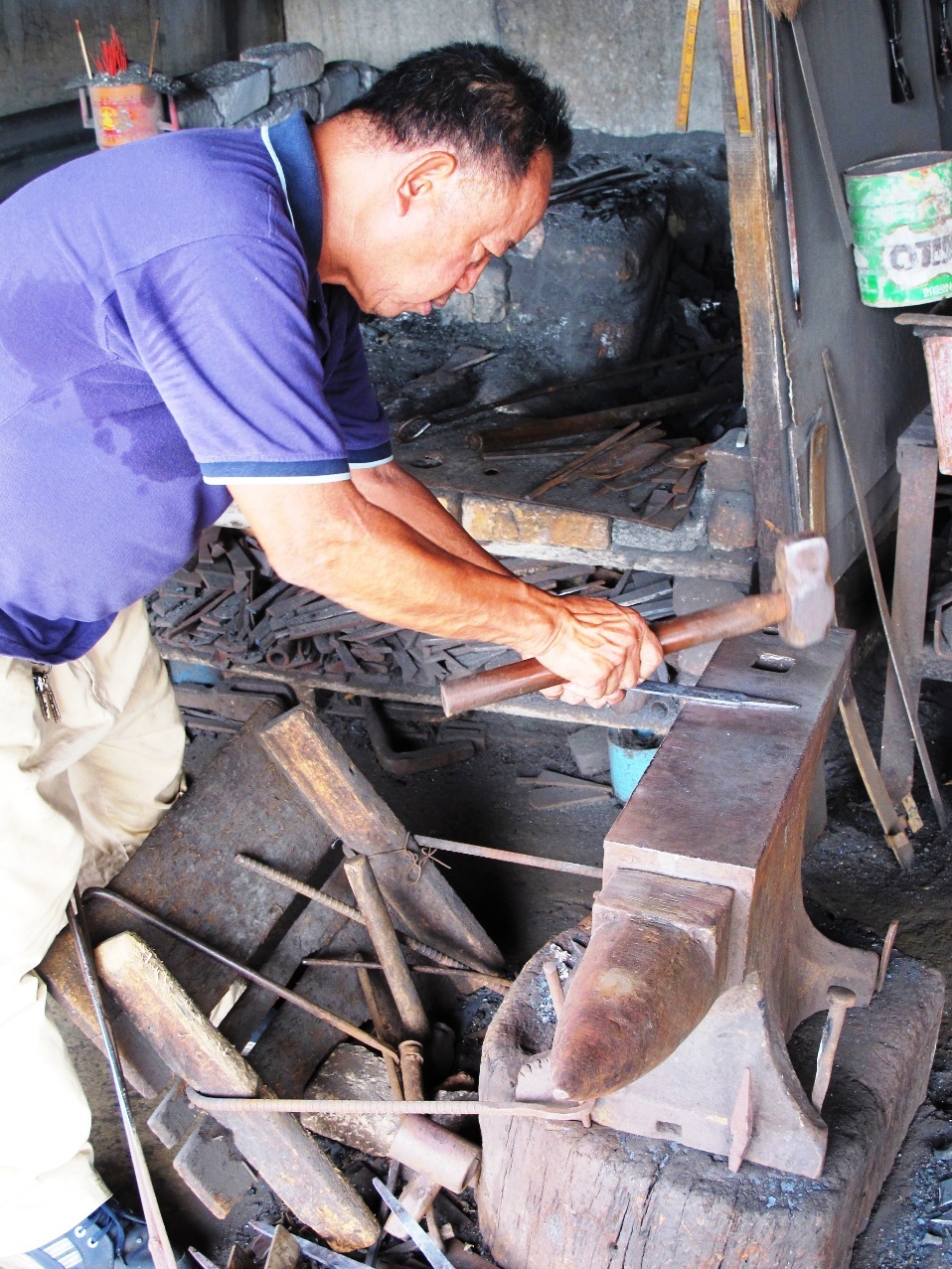
Lim Loong Hoi hammers steel in his old school knife shop in Selangor, Malaysia. (photo courtesy of Philip Lim Chin Guan)


     Every morning, Lim Loong Hoi is at his dirty workshop—it looks more like a shack from the front—at about 8 o’clock. Beyond the open door in the rear, the passage leads to a hallway and a few small rooms.

     The boneshaker of a wooden shop has been home to Lim and his family for decades. He said he has been making utility tools, including parangs, goloks, large fisherman’s blades and sickles, since his school days.

     His instructor and mentor was his grandfather. Back in the day, Lim found time after school to help his grandpa at the workshop. Picture a teenager’s delicate hands with a heavy hammer and a pair of tongs when, during morning hours, he was holding a pen or ruler in school. That was about 50 years ago.

     Called Sin Sam Hup Lee, Lim’s shop still stands firm against fluctuating economic conditions and the ravages of time. His back is slightly bent from the long, dreary years of standing before the furnace or hydraulic pump, pounding away at pieces of elongated steel.

     Pasir Penambang is a small village on the outskirts of Kuala Selangor in the state of Selangor, Malaysia. The locals, especially the Chinese, are mostly fishermen, shopkeepers or fish wholesalers.

     The Chinese fishermen are Lim’s regular customers. The edged tools he makes for them are larger than usual. The blades are similar to huge butcher knives, having a curvature that helps in slicing a big fish in two with one swift, downward stroke.

     The Malay farmers usually ask for long sickle blades used in dislodging oil palm fruits, a.k.a. kelapa sawit nuts. Each sickle is hollowed out at the handle to accept a long pole. The pole enables the user to extend the blade about 7 to 8 feet to harvest the nuts from the palm trees. Each sickle costs $2 to $2.60. The price depends on the quality of the steel and blade size.

     In Lim’s workshop, stacks of Jeep leaf springs used for blade steel rest in a corner. The four-wheel-drive springs are rusty and grimy. The haggard bladesmith likely sourced the spring steel pieces by the ton from an old junkyard. He probably got them cheap, too. Most of the time they are cut to required lengths. It is a low-tech, slightly primitive method of stock removal.

     Practicality and function rule the land. Almost nobody here has heard of CPM-S30V, VG-10 or ZDP-189. The most convincing line Lim uses is, “This is Jeep spring steel.” That alone gives his customers some assurance they are getting quality steel.

     Edged tools used by fishermen or farmers in the fields have no time to get rusty because they are used regularly and on a daily basis. After six to eight years, the parang, golok, fisherman’s blade or farmer’s sickle may be deemed unusable. The user simply buys another one from Lim. After all, it costs just a few bucks. Compared to its long-term usefulness and hardiness, the cost per blade is minuscule—which is why the agrarian folk in Pasir Penambang and nearby villages are Lim’s loyal customers.

     Lim’s assistant is taciturn, works like a well-oiled machine and knows the blade-making process intimately. Like his boss, the assistant relishes the feel of steel in his hands.

     Of course, the untidy workplace is not exactly ideal for a private conversation. Customers determine what they want, haggle over the price and depart with the edged tool they bought wrapped in a newspaper.

     Occasionally, some outsider brings a drawing of the piece he wants made. The bladesmith examines the drawing and then determines whether his outdated equipment and other machines are suitable for the order.

     The volume of edged tools he sells will not even make Lim a member of the middle class. He obviously is not making a fortune, as some people may suspect.


Ah Pee

     A couple of doors away along the same row of wooden shops is another knifemaker, Ah Pee. A sign at the front of his establishment says “Chuan Lee Chan.” Originally from China, he has aged before his time, though his eyes have a certain fire that belies his years.

     Pee said his children, especially his son, have absolutely no interest in knifemaking. “The young men today prefer air-conditioned offices and as little dirt on their hands as possible,” he told me.

     The long hours and intense heat from the furnace are enough to deter most from pursuing such a profession. It is backbreaking work with the added disadvantage of low and slow financial returns.

     After about five decades of using the hammer, tongs and grinder, Pee is long past set in his ways. He probably does not know how to do anything else. Perhaps he feels he is too old to learn and master another profession.

     Not all the edged tools sold at both shops are fashioned by the resident makers. They also stock production parangs and some made-in-China models, both more affordable than the handmade models. Lim’s and Pee’s knives cost more because they factor in labor, time and the type of spring steel used. The sharpness of the blade is guaranteed.

     Sometimes each bladesmith will ask the customers how the parangs or knives will be used. Then he might recommend another type of edged tool. The heavy-duty blades—those for chopping hardwood, the bones of livestock, etc.—are made to different specifications than those for skinning and other light work. The smiths’ skills with iron and steel are invaluable to those who need their tools to make a living.


Heat Treating and Sharpening

     Heat treatment consists of quenching the steel in a trough of water. There is no set formula for giving a hardened edge. Pee said it all comes down to “feel.” The long years of experimenting with quenching a red-hot blade in water have given him the intuition and the right recipe of crucial seconds of sinking a piece of hot steel into a trough, and then lifting it up at just the right moment. I have seen Pee do it on several occasions. He said without the special “water treatment” the blade would not hold an edge.

     Sharpening a parang or any kind of blade is done on a hand-held metal grinder. The way Pee does it looks easy—until you put the same grinder in your hands. A flat grind is apparently the way to go.

     First, he clamps the blade on a table vise, covers his mouth with a piece of cloth and dons plastic goggles. He moves the grinder side to side and applies just the right amount of pressure.

     A shower of bright orange sparks fly past his body but Pee pays them no heed. When he is fully satisfied the blade has the correct grind, he unclamps it and adds the finishing touches to the edge with a smooth stone.

     Again, it is all “touch and feel.” When a man has spent three-quarters of his life sharpening blades, you do not question his judgment. He said, “The blade can easily shave the hair on the arm.” I believe him totally.

     He then gives me a piece of invaluable advice. After the blade has been used, wash it in running water. Do not wipe the water off but put the knife out in the sun to dry. Allow the sun to dry the steel blade and it will remain sharp indefinitely.

     It took awhile before I realized the wisdom of his words. The tropical weather, coupled with the scorching Malaysian sun, acts as a form of heat treatment on the sharpened blade. Perhaps the sun’s rays strengthen the already hardened molecular structure of the blade’s edge? Who knows better—the bladesmiths of Pasir Penambang or me, the end user from the city?


Paying Homage

     There are only two bladesmiths along the main road in Pasir Penambang. Both are advancing in age. This is a dying trade. The youngsters are not interested. Those of us who appreciate all things steel and sharpened tools come to this tiny town, away from the hustle and bustle of the bigger cities, to pay homage to men of steel who live a life of quiet desperation.—By Philip Lim Chin Guan


To read similar stories and all about the latest knives, knifemakers, knife trends and much more, subscribe to BLADE®. For more information click on http://www.shopblade.com/product/blade-magazine-one-year-subscription-us/?r+ssfb141211#BL1SU


 

Buck Prepares To Debut 2012 Knives

POST FALLS, IDAHO–From the time Hoyt Buck made his first knife in 1902, Buck Knives’ goal always has been the same: make knives that will serve the user better, with reliable and superior performance. In the 110 years since, Buck Knives has found many ways to create an expanding line of knives that guarantee exceptional quality, with the needed features and benefits. Now they are finalizing plans for the SHOT Show where they will unveil more advances in 2012, as they celebrate their 110th birthday with innovative new products.

     Among their fresh departures is an answer to the growing demand for women’s hunting knives with the new Haley Heath ErgoHunter Adrenaline Series. As the number of active female hunters has doubled in the past decade and now totals more than 3 million, there is a growing demand for knives to meet their needs and preferences.

     The Haley Heath series was developed in partnership with one of America’s most accomplished female hunters. In the joint announcement, Haley Heath said, “I am excited to be the first female featured with her own line of hunting knives and from the number-one brand in hunting.” Haley and G.O. Heath are the hosts of the popular “Family Traditions with Haley Heath” television program on the Sportsman Channel.

       There are eight basic knives in the Haley Heath series – five fixed-blades and three folding lockblades, offering fixed gut-hook versions and three steel options. All are ergonomically designed for the best grip for women, including a grooved handle.

     “This important series is just one aspect of our new 2012 knife line,” said CJ Buck, president and the fourth generation of the Buck knifemaking family. “We are adding other new hunting knives, of course, as well as tactical/survival knives, knives for campers and hikers, and our annual line of Limited Edition knives with so much appeal to collectors.”

        Among the additions to Buck’s growing line of tactical/survival knives will be the TOPS/Buck CSAR-T Liaison neck knife, a style popular for its light weight, small size and ease of carry, yet providing the solid blade needed quickly in emergency situations.

       Buck also emphasized that Buck Knives will continue to fulfill its American commitment, further reducing the use of offshore outsourcing, making all of their hunting knives in their Post Falls, Idaho, plant as well as the vast majority of their other new products.

     For more on the latest in the hottest knives, knifemakers, knife shows, knife trends and much more, subscribe to BLADE® Magazine. For subscription information, click on http://www.shopblade.com/product/blade-magazine-one-year-subscription-us/?r+ssfb121311#BL1SU

Knife Store Of The Day I

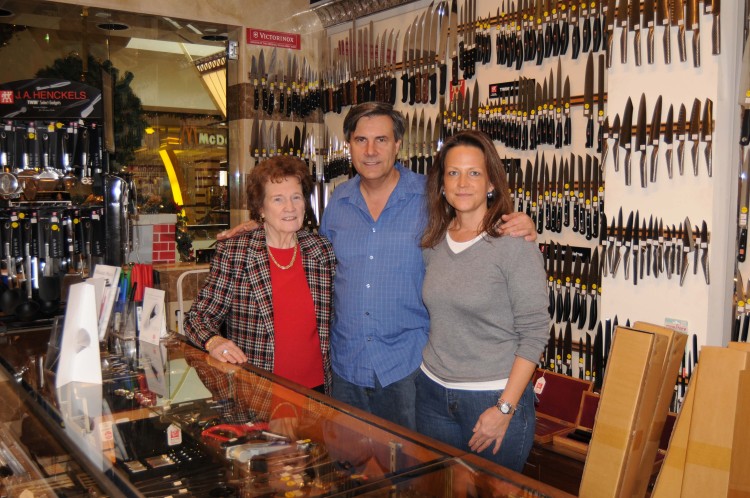
(From left) Lois, Dan and Pam Delavan of Plaza Cutlery in the South Coast Plaza Mall in Costa Mesa, California.

     You’ve seen our “Knife Of The Day” entries. Now it’s time for a new feature: our “Knife Store Of The Day.”

     The first installment is Plaza Cutlery of Costa Mesa, California.

     Located in the South Coast Plaza Mall, Plaza Cutlery is owned and operated by Dan and Pam Delavan and features a wide selection of custom and factory knives. The son of former Case salesman I.A. Delavan, Dan is one of the most knowledgeable people in the business of both custom and factory knives. In addition to selling knives, swords, sharpeners, knife books and much more in store, Plaza also has a comprehensive website (www.plazacutlery.com), carries factory exclusives such as its Chris Reeve Large and Small Sebenza “Doggy Knives,” conducts a biennial knife show that draws some of the world’s top custom knifemakers, and even does special events such as “Meet The Knifemaker” days at the Plaza Cutlery store.

     For more on the latest in the hottest knives, knifemakers, knife shows, knife trends and much more, subscribe to BLADE® Magazine. For subscription information, click on http://www.shopblade.com/product/blade-magazine-one-year-subscription-us/?r+ssfb121311#BL1SU

Knife Of The Day VII

A strong, reliable, feature-packed folder designed for everyday carry, the Timberline Workhorse in a 3.25-inch blade of 440 stainless steel and a black textured G-10 composite handle is our Knife Of The Day for Dec. 12

     The gently curving handle spine is comfortable in the hand and the textured G-10 ensures slip resistance. The blade is titanium nitrate coated to enhance rust resistance and reduce glare. Ambidextrous thumb studs combined with Timberline’s Teflon™ spacer pivot system provides silky smooth action. A left/right reversible clip is included. Approximate closed length: 4.5 inches. Your price: $31.99.


     For more information click on http://www.shopblade.com/product/timberline-workhorse-combo-edge-4301/?r+ssfb121211#Y3337


Englehart’s Dad’s World War II Knife

The author (left) holds his dad’s World War II Warther Commando Knife in the Warther knife shop in Dover, Ohio. At right is knifemaker Dale Warther, grandson of Ernest Warther. Dale passed away in 2010. (photo courtesy of Gene Englehart)


     Editor’s note: On page 114 of the December BLADE®, we ran the story “Ed’s Dad’s WWII Ek” about the knife BLADE field editor Ed Fowler’s dad carried during the Second World War. Along with the story we asked readers to send us pictures and information about their dads’ military knives. It didn’t take long for reader Gene Englehart to supply the following.

     My father, Orville Englehart of Paw Paw, Illinois, spent four years in the Navy as a chief petty officer during World War II.  He was stationed stateside, training aircraft mechanics in Michigan, Florida and Oklahoma.

     I believe it was when he was stationed in Michigan that he ordered a Commando Knife from Ernest Warther in Dover, Ohio. After Dad got the knife, he kept it in the original box and, as far as I know, never used it. It has a 7-inch blade with his name and serial number engraved on it.

     Ever since I was a little kid the knife fascinated me, and I was forbidden to touch it. In 2009, I took it with me on a trip East that included a visit to the Warther Museum and workshop in Dover. I had the good fortune to meet Ernest’s grandson, Dale, and show him the knife. He told me the copper in the sheath came from a local sheriff who had confiscated it from a moonshine still. The brass came from the kick plates on the men’s room door at the local high school. Ernest’s son Dave took it home for the war effort. Ernest made only about 1100 of these knives and sold them for about $15 apiece, which is probably less than they cost him to make.

    Ernest was a genius and an incredibly skilled carver and craftsman. Dale was very gracious to me the day I visited his shop, and I was very sad to hear of his passing about a year later.

     I consider Dad’s Warther Commando knife to be a family heirloom now.


Do you have your dad’s knife or any knife used by any family member—including you—while in the service? Send a photograph or photographs of it and/or of you or the family member holding it, any information/anecdotes about the knife and its use by the family member who owned/carried it, along with the knife’s specs—brand/maker, model, overall length, your family member’s name, rank and branch/years/theater of service, etc.—to BLADE, c/o “Knives Of Heroes,” 700 E. State St., Iola, WI 54990. If digital, the image(s) must be at least 600 K. E-mail it/them to [email protected].


To read similar stories and the latest knife news, forums, blogs and much more, subscribe to BLADE®. For subscription information, click on http://www.shopblade.com/product/blade-magazine-one-year-subscription-us/?r+ssfb111211#BL1SU

Knife Of The Day VI

Award-winning knifemaker Brian Tighe adds to his long line of stunning folders with this blue-streaked flipper model sporting a lock designed by Glenn Klecker. The custom folder is our Knife Of The Day for Dec. 10, 2011.

     For Brian’s contact information, visit his website at www.briantighe.com.

     For the latest on the hottest knives, knife trends, knifemakers, knifemaking how-to’s, knife shows and much more, subscribe to BLADE®, the World’s No. 1 Knife Publication. For subscription information, click on http://www.shopblade.com/product/blade-magazine-one-year-subscription-us/?r+ssfb101211#BL1SU

How Knives Can Save Babies

     The recent tragic death of the 11-month-old infant who onlookers were unable to free from a burning car because no one had a knife to cut the baby free from a jammed seat belt is heartbreaking. First and foremost, a young life was snuffed out in a most painful, terrifying way. My thoughts and prayers go out to the child’s parents and family, as well as those on the scene who were unable to save the infant. The incident will continue to haunt all concerned for many lifetimes.

     The lack of a knife carried by any of the bystanders to cut the seat belt and free the baby was a contributing factor in the infant’s death. The fact it happened in Los Angeles with its strict anti-knife ordinances is even more detestable, where anti-knifers continue to succeed in their crusade against knives. Anti-knife laws indirectly—some might say directly—kept the child from being rescued, and no doubt will prevent others from being saved in future catastrophes as well. (For more, see “For the Want of a Knife” in the “Forum” at http://knifeshowcase.blademag.com.)

     Ordinances designed to keep people from carrying knives and, as a result, from saving the lives of others in emergency situations must be repealed. Of course, organizations like the American Knife & Tool Institute and Knife Rights and elected officials such as New Hampshire Rep. Jenn Coffey are the standard bearers in focusing on the repeal of anti-knife legislation. By joining and supporting them and speaking out on your own, writing your legislators and local newspapers, voicing your concerns on social media like Facebook, Twitter, etc., you can do your part, too. And be sure to voice your concerns in non-knife venues. You are “preaching to the choir” if you do it in pro-knife venues. It is the non-knife ones that need to hear the message.

     In a heartrending way, the infant’s horrific death in a burning automobile magnifies the folly of anti-knife laws. In fact, thousands upon thousands more fatalities occur in car accidents than because of knives.

     In place of anti-knife ordinances that exaggerate the problem, why not institute pro-knife ordinances that not only protect your right to carry knives, but also address the slaughter that occurs on our nation’s highways by enabling you to respond to emergencies such as the one in L.A.? Moreover, why not require the manufacturers of automobile baby seats to equip each of the seats with a seat-belt cutter conveniently placed for a parent or onlooker to use to cut the baby’s seat belt in an emergency? And while we are at it, why not require automobile and truck manufacturers to stock each and every vehicle with a seat-belt cutter?

     Ideally, said manufacturers would take the lead and include seat-belt cutters with their products. Not only would it be a public service, the manufacturers would add value to their baby seats and vehicles. However, in today’s cost-cutting atmosphere, most manufacturers probably will not act without some kind of legislative push.

     A number of knife companies have seat-belt cutters with the edges recessed for safety. Columbia River Knife & Tool offers one—the model also has a window breaker and flashlight—that attaches to a seat belt and is thus immediately accessible in an emergency situation. Seat-belt cutters can be the next best thing to carrying a knife, and are probably better and definitely safer when it comes to cutting a person from a jammed seat belt.

     Repealing anti-knife legislation and promoting a seat-belt-cutter law would save the lives of innocents like the baby in L.A.—and, ironically, given the proper circumstances, maybe even the politically correct idiots who refuse to carry knives themselves.


To read similar stories and all about the latest knives, knife news, knife shows, knifemakers, knife manufacturers and much more, subscribe to BLADE® by clicking on http://www.shopblade.com/product/blade-magazine-one-year-subscription-us/?r+ssfb91211#BL1SU


CAPTION

Columbia River Knife & Tool’s Exitool is a seat-belt cutter, flashlight and window breaker that attaches to a seat belt—where you need it, when you need it. (CRKT photo)


Advertisement

Must Read Articles

Read this before you make a knife

Knifemaking 101 – Read This Before You Make a Knife

  by Wayne Goddard My experience has taught me that there's nothing like digging in and getting started. I've often said the hardest part of the...
how to forge damascus steel

How to Forge Damascus

Advertisement
Advertisement