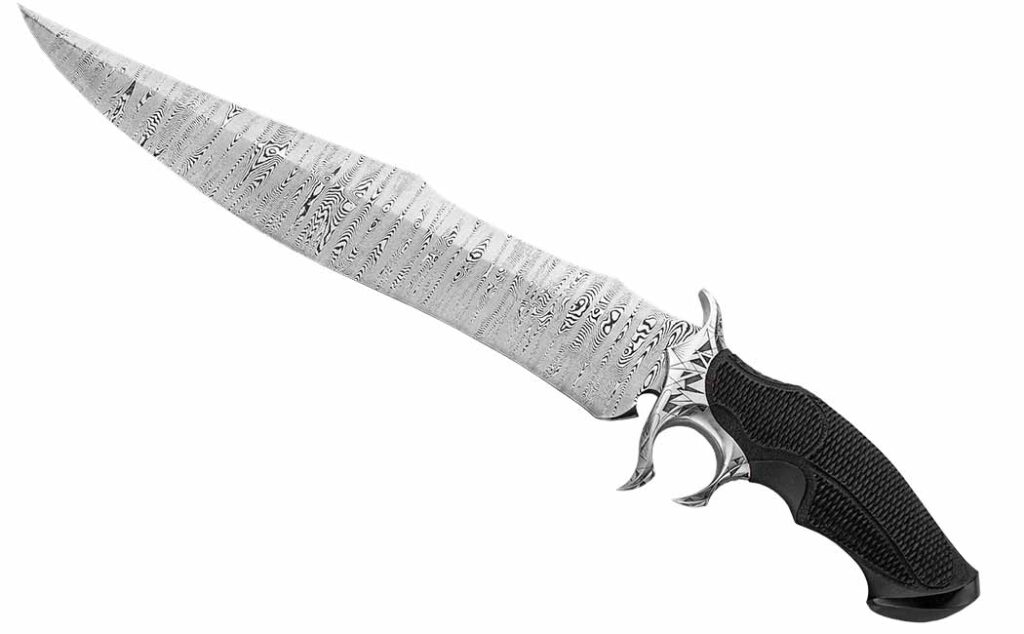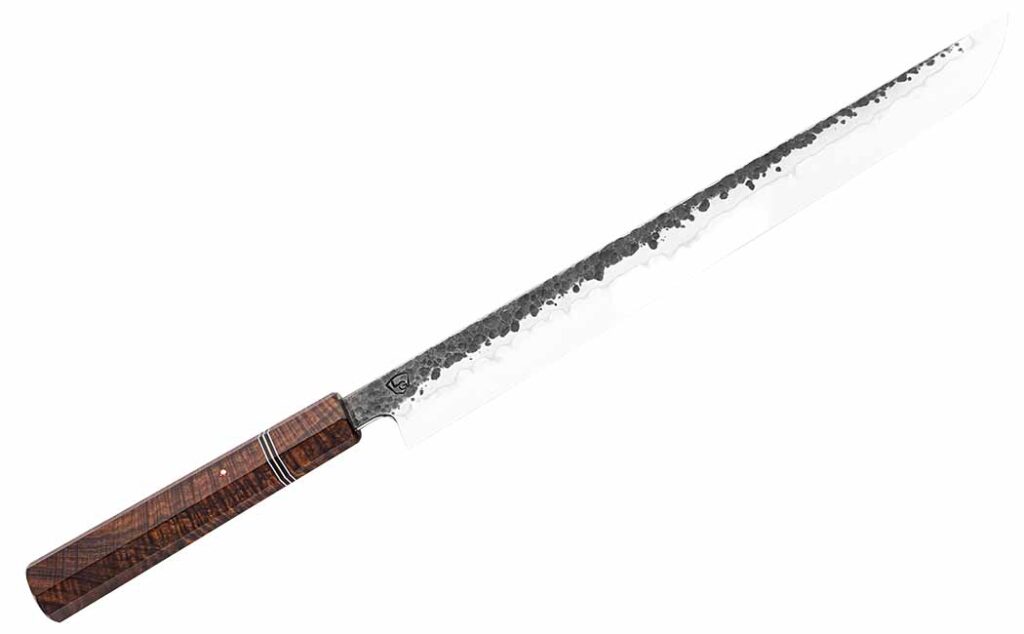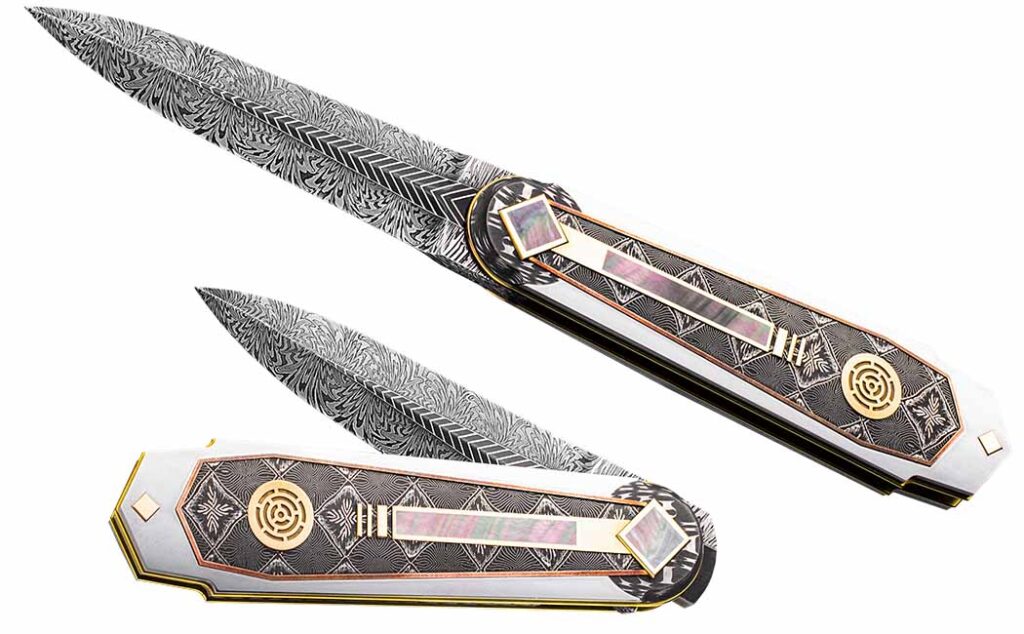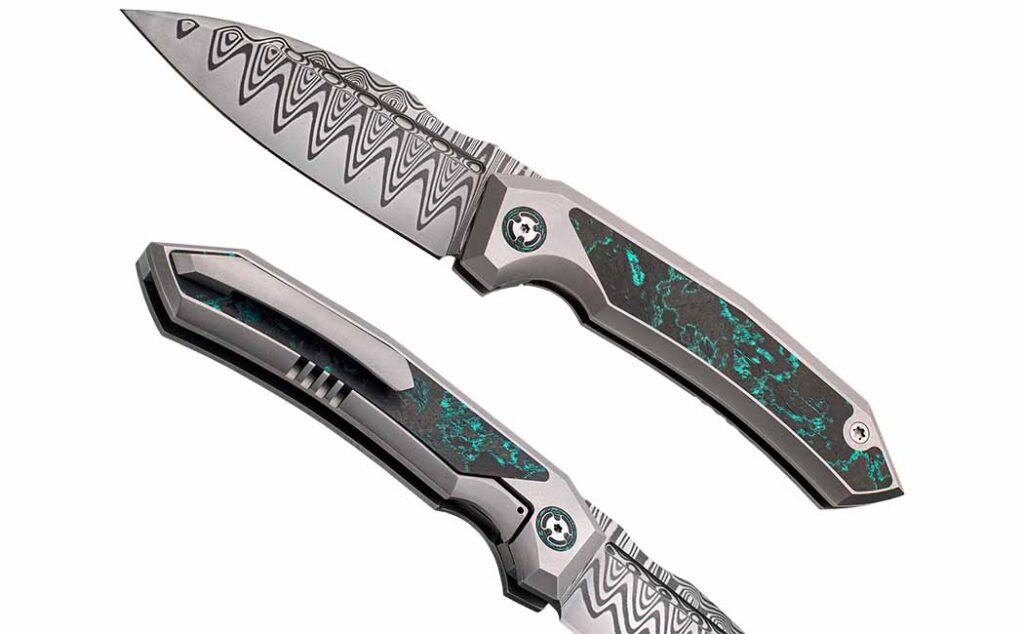




BLADE Show

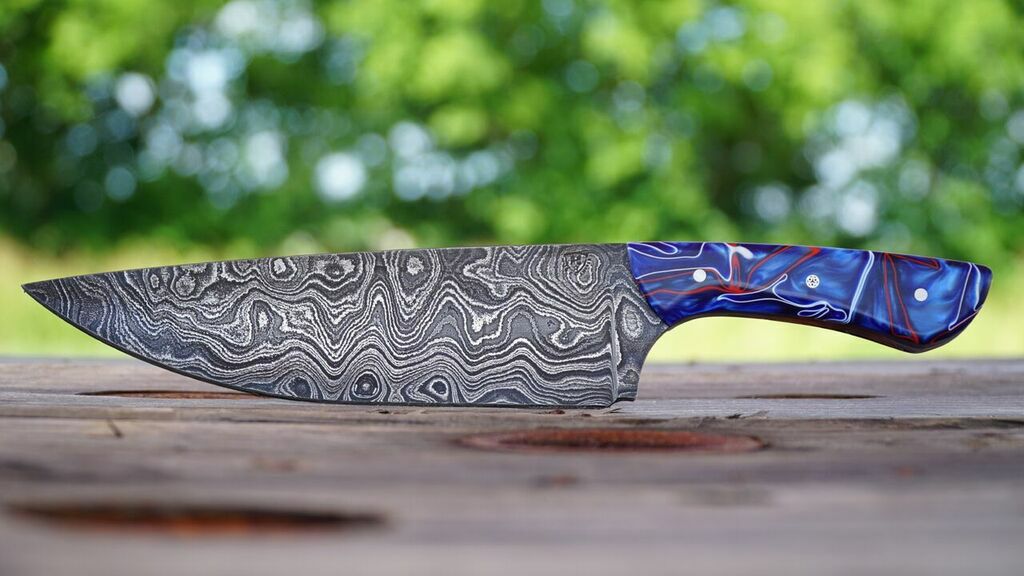
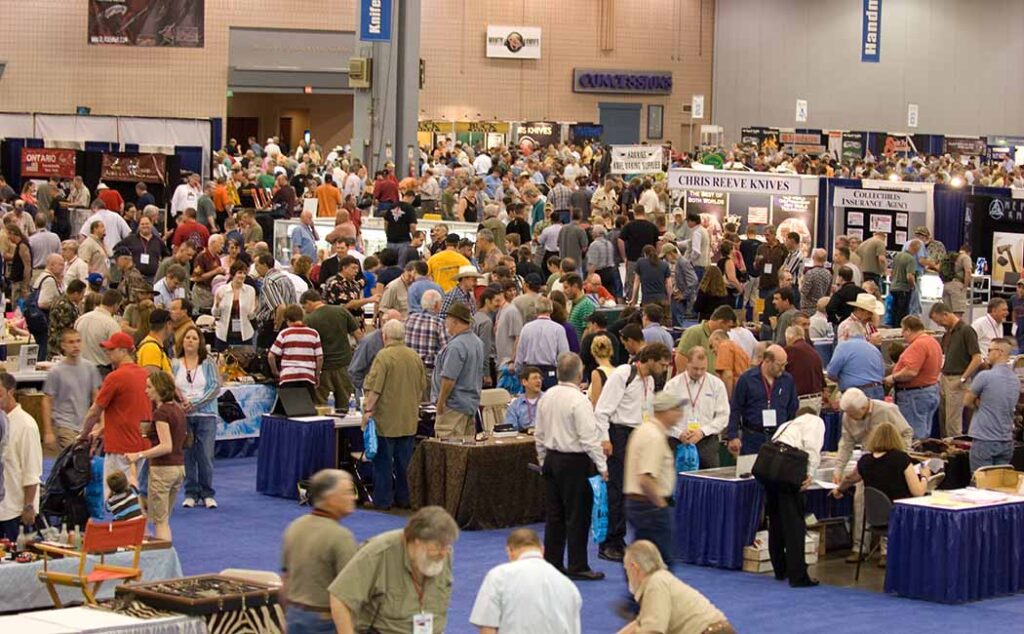
Hosted in Atlanta, Georgia in May or June every year, the BLADE Show truly is the World’s Largest Knife Show. It features the most diverse array of knives from manufacturers, knifemakers, collectors, dealers and purveyors, all under one roof. The BLADE Show plays host to the Blade Magazine Knife-Of-The-YearĀ® Awards, the Blade Magazine Cutlery Hall of FameĀ© induction ceremony, seminars, demonstrations and much more.

Visit BladeShow.com for tickets, travel information, exhibitor registration and sponsorship opportunities.

Cutlery Hall Of Fame Ushers In Thomas, Terzuola And Schwarzer

Cutlery Hall Of Fame ushers in a Hall Of Fame class at the 2023 BLADE Show.

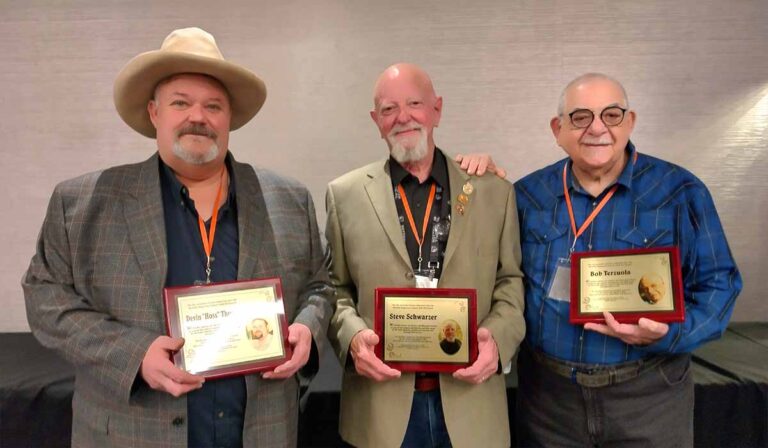
There was much joy tempered by a tear or three as Devin Thomas, Bob Terzuola and Steve Schwarzer took monumental steps in their monumental knife careers with their formal inductions into the BLADE Magazine Cutlery Hall Of FameĀ® during BLADE Show ’23.

Celebrated with a combination breakfast/induction ceremony, the new inductees were saluted by an appreciative crowd of just over 100 that included family, friends, sitting Hall-Of-Famers, world-renowned knifemakers, knife collectors and various combinations thereof in the Kennesaw Room of the show’s host hotel, the Renaissance Waverly.

Providing induction speeches were those handpicked by the new inductees: Cutlery Hall-Of-Famers Bill Ruple and Ken Onion for Thomas and Terzuola, respectively, and award-winning bladesmith Neil Kamimura for Schwarzer. All, including the acceptance speeches, were genuine, entertaining and memorable.

Devin Thomas

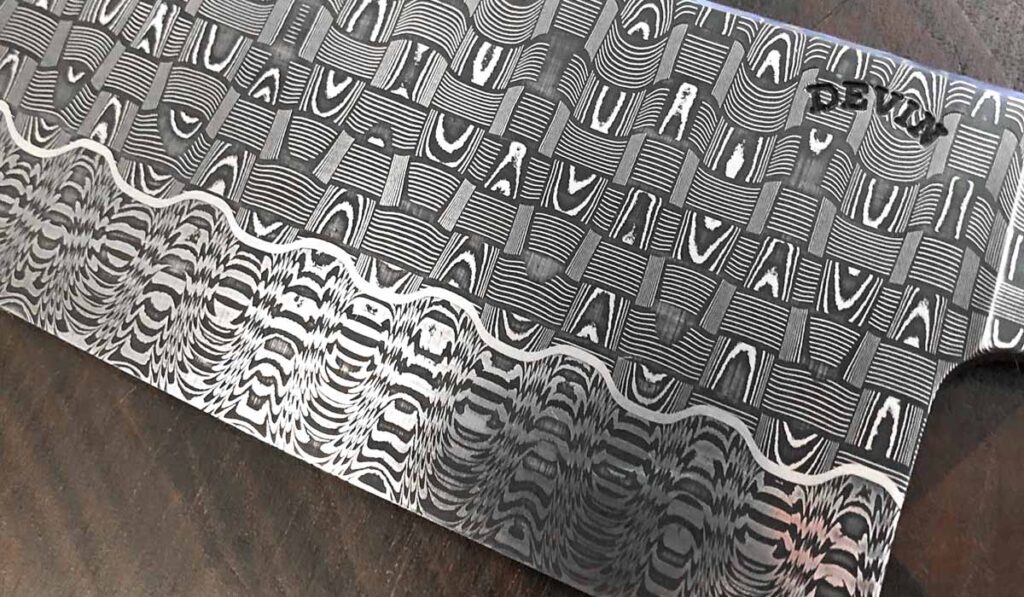
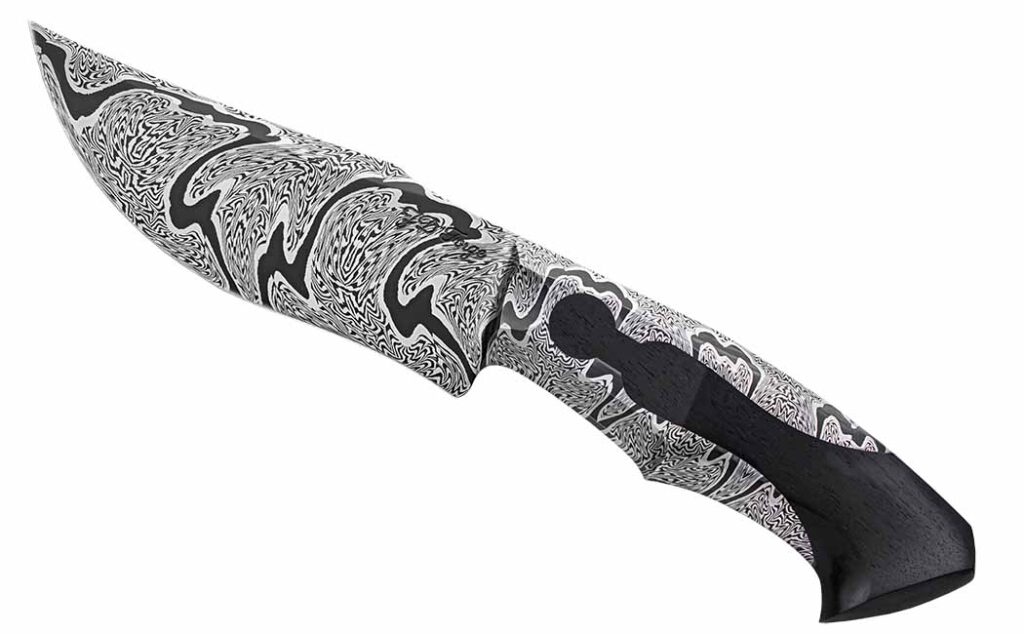
While best known for his damascus steel, Devin’s first love was making knives. ā€œThe best kept secret about Devin is how good a knifemaker he is,ā€ Bill Ruple said. ā€œHe’s known for his wonderful damascus steel, some of the best in the world, but he’s a heckuva knifemaker.ā€

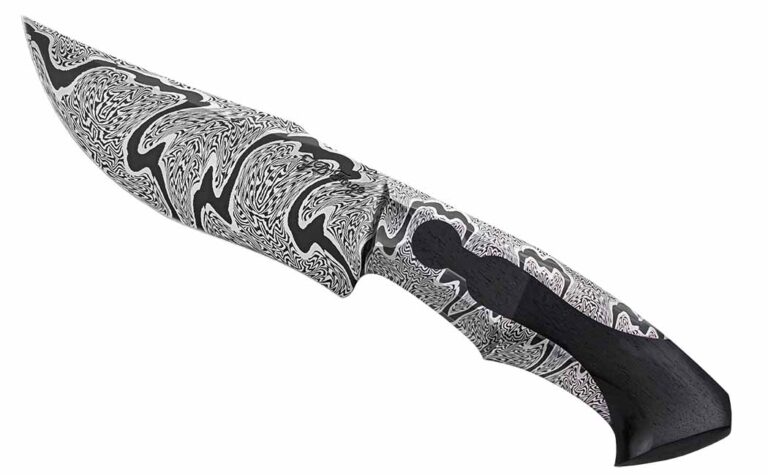
Devin Thomas blade
A Devin Thomas blade of Devin’s stainless damascus. (image courtesy of Devin Thomas)

Using a set of instructions his uncle gave him, Devin made his first knife at 13. At 16 he worked the whole summer making knives with long-time maker Bob Lofgren in Arizona. Devin did so without pay but didn’t care because of his affinity for knives. At 18 he won most impressive knife by a new maker at the California Custom Knife Show. At 21 he married Jackie. ā€œShe knew me in high school and knew I made knives, so when we got married she knew about the knife thing, so I didn’t surprise her or anything,ā€ he recalled. ā€œAnd I told her at the time I’m going to be a world famous knifemaker one day.ā€ Devin and Jackie recently celebrated their 37th anniversary.

One of Devin’s inspirations was Cutlery Hall-Of-Famer Wayne Goddard. Devin read Wayne’s story on cable damascus in KNIVES ’86 and a career was born. ā€œI thought I could forge-weld cable damascus, so I bought me some cable. I didn’t have any idea what I was doing, and I heated up the forge and got [the cable] to stick together,ā€ Devin said. ā€œThat started my damascus career.ā€

His next great inspiration was Cutlery Hall-Of-Famer Buster Warenski. ā€œI kept trying to get him to try some of my steel,ā€ Devin related. ā€œBuster said, ā€˜I’m not trying any of your steel unless you try to make stainless damascus.’ I started making stainless damascus and Buster used a piece in one of his art pieces and I thought, ā€˜I can quit today!ā€™ā€

On the contrary, Devin was on his way.

ā€œAt one time I think I was making more steel than the entire ABS put together, not certain, but I could really pump it out,ā€ he said. ā€œI was doing 50 bars of steel a day on a regular basis. That hammer was wide open all the time.ā€

Family, friends and customers—that’s what it’s all about for Devin. ā€œMy oldest son [Larrin] is developing new steel so fast the industry can’t keep up,ā€ he noted. ā€œHe developed MagnaCut— which some like but a few don’t—but the industry can’t absorb his new developments fast enough.ā€

Better designs, better manufacturing, an upcoming generation of makers that has him very optimistic—Devin sees a rosy future for the industry.

ā€œWe have more talent than we’ve ever had before, and younger talent, and more excitement,ā€ he opined. ā€œWe’ve got a lot of bad designs and bad knifemaking too, but we’ve got to tolerate the good and the bad. We need more domestic manufacturing and we need better abrasives—they’re not keeping up with the steel we’re producing. My only regret? I don’t know, maybe I shoulda bought a truckload of stag scales when they were only two or three dollars a pair.ā€

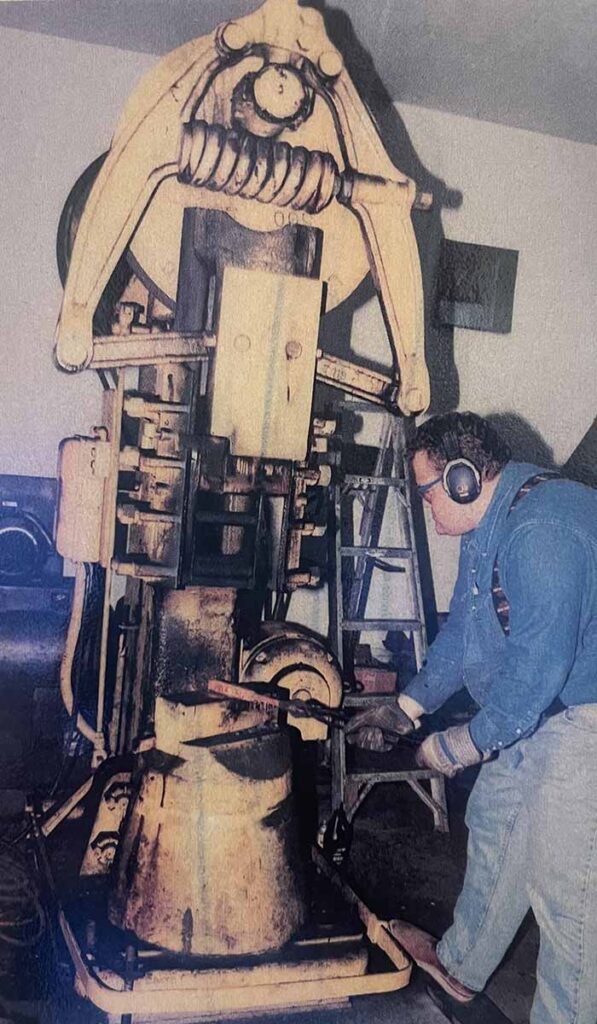
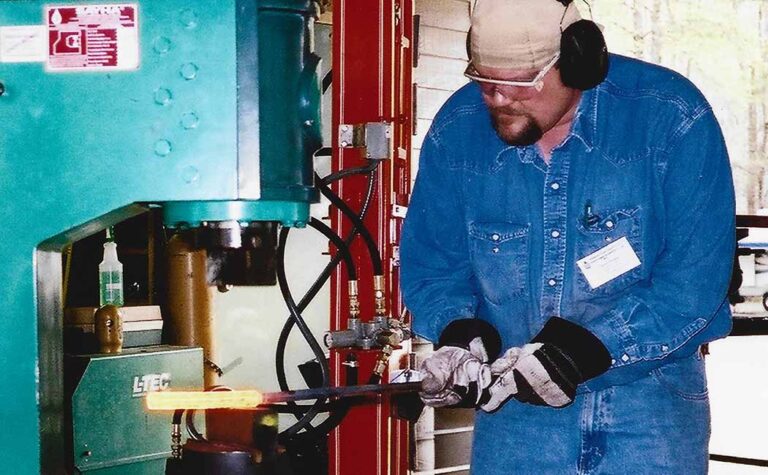
Devin Thomas at a power hammer
Devin Thomas at the helm. (image courtesy of Devin Thomas)

Ruple said he and Devin have a mutual respect based both on friendship and a shared desire to make the best the knife industry has to offer.

ā€œDevin was always my go-to guy when it came to knowing anything about steel,ā€ Bill said. ā€œAnything I needed to know I’d call Devin. I learned a lot from the guy.ā€

Devin is nicknamed ā€œHossā€ for his resemblance to the most endearing member of the Cartwright family on the long-running 1960s-’70s TV show, Bonanza. And, not unlike the TV Hoss, the new Hall-Of-Famer Hoss has never been beyond pulling a rabbit out of his 10-gallon hat. Bill recalled such a time at a long past BLADE Show.

ā€œWe were sitting at my table and this guy from Japan comes up and he’s trying to buy a knife from me and communication is not going well, and all of a sudden Devin’s talking Japanese to this guy and I’m thinking, ā€˜Hoss Cartwright speaks Japanese?ā€™ā€ Bill laughed at the memory.

Of course, the fact Devin is multilingual simply adds to his Hall-Of-Fame pedigree.

ā€œDevin’s the guy who brought damascus steel to the masses,ā€ Bill observed. ā€œThere were guys who made damascus steel but Devin aimed his steel at folder makers. He got it out there in dimensions that guys like me could use. There’s probably more of his steel in high-end collections around the world than anybody else’s. He’s been doing this a long time and he’s one of the best ever.ā€

Bob Terzuola

Bob Terzuola made his first knife in 1979, joined the Knifemakers’ Guild in 1981 and along the way served on the Guild’s board of directors for nine years. His relentless search for ways to improve his knives in terms of design, materials, mechanisms and more helped establish his place as one of the greatest knifemakers of his or any era, with his tactical folding knives at the summit.
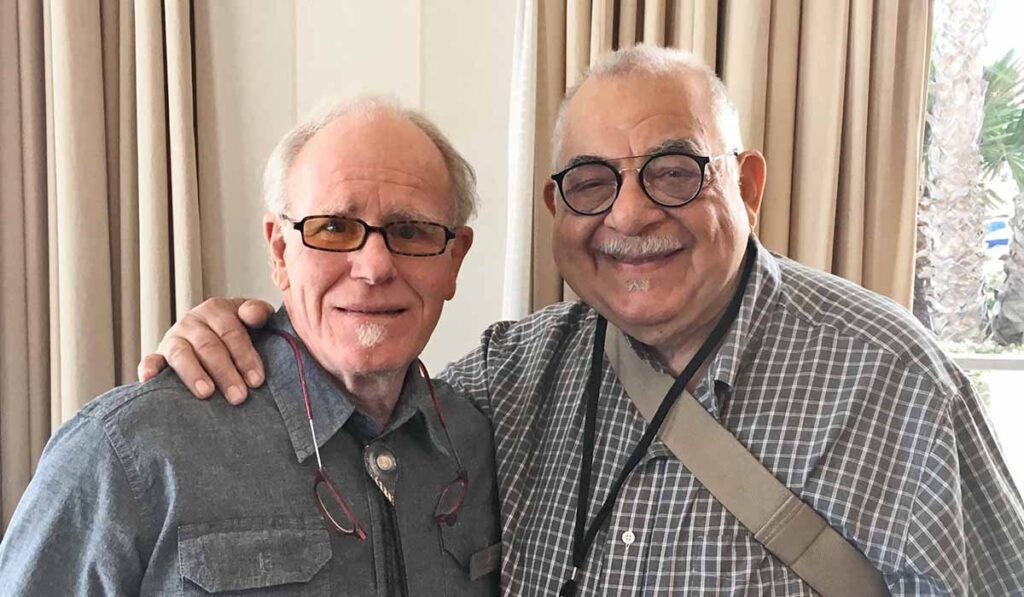
Michael Walker and Bob Terzuola
BLADE Magazine Cutlery Hall-Of-FameĀ® members Michael Walker and Bob Terzuola enjoy the 2019 Art Knife Invitational. (image courtesy of Bob Terzuola)

ā€œIn 1984 Bob moved to Santa Fe, New Mexico, and started making folding knives,ā€ Ken Onion said. ā€œSearching for a hard-use folder that could be used discreetly, Bob developed a model featuring MicartaĀ® scales and bead-blasted titanium bolsters for which he coined the term tactical folding knife, which later evolved into his most popular model, the ATCF … which opened the market for the new category of folding knife, which arguably remains the largest and most popular category of knives in the industry.ā€

As Ken noted, Bob wanted to design a ā€œrobust knife as tough as he could,ā€ so he set out to use G-10, carbon fiber, titanium and other advanced materials at a time when few if any were using them. He was a pioneer of the circular thumb disc for ambidextrous one-hand blade opening, multiple double grinds on folder blades, knives with laser-cut CNC parts and fine-tuned other areas that have molded the modern folding knife.

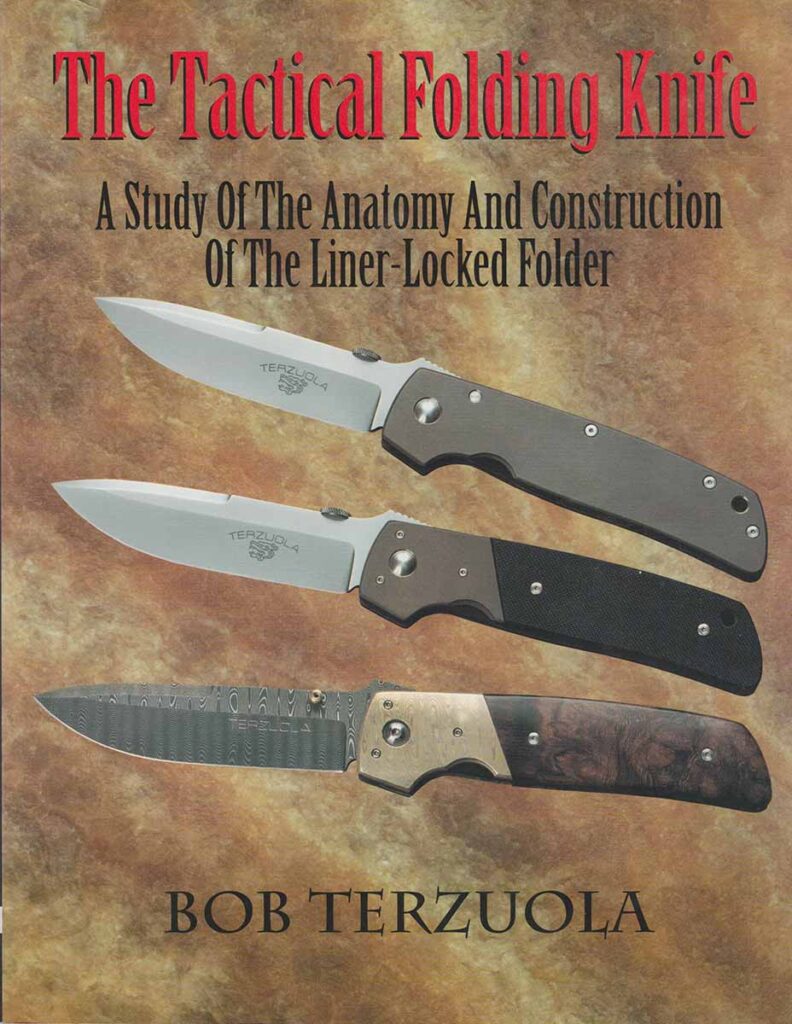
ā€œBob also focused a lot on the linerlock and did a lot of engineering advancements through a lot of trial and error, and then what does he do? He writes a book about it—The Tactical Folding Knife: A Study of the Anatomy and Construction of the Liner-Locked Folder—to teach the rest of us how to compete with him. How many of us have a copy of that book in their shop?ā€ Ken asked the attentive audience. ā€œHow many have a dog-eared, highlighted copy, how many of us reference it regularly, and how many of us have read it more than once? It’s kind of like an important thing for all of us to have. All these contributions and advancements have earned him the affection of us all and title of the Godfather of the Tactical Knife.ā€

Bob Terzuola’s landmark book
The Tactical Folding Knife is Bob Terzuola’s landmark book of which Ken Onion said to an audience of over 100, ā€œHow many have a dog-eared, highlighted copy, how many of us reference it regularly, and how many of us have read it more than once?ā€

Bob reiterated Devin Thomas’s comment about the importance of the human element. ā€œI’ve seen a lot of changes and met a lot of people and made a lot of really good friends, and had to say goodbye to some of them,ā€ he said. ā€œThere were friends who meant a lot to me over the years, people like Bob Loveless, Carolyn Tinker, Howard Viele, Frank Centofante, Wayne Goddard, Bob Lum, Alex Collins. A lot of these names don’t mean anything to a lot of younger makers, but they all helped build the structure that we all rely on to take care of our families.ā€

He also addressed some in the audience in particular, including Cutlery Hall-Of-Famer Michael Walker. ā€œHe introduced me to the alchemy of the linerlock and working with titanium, which back in the mid-1980s was virtually unknown to knifemakers and now is so important not only to tactical folders but all sorts of pocketknives,ā€ Bob noted of Michael. ā€œAnd Ken Onion, who’s been a long-time friend and a guiding light … and I want to thank my children … but most of all I want to thank my wife, Susan, who has taken care of me over many years and … has been a powerhouse of the artistic critiquing of my knives, additions to design and so forth. And thanks to all of you for this honor and gathering here at the greatest knife show there is. Keep up the good work and let’s see where this winding, crazy, twisting road of surprises takes us in the craft of knifemaking.ā€

Steve Schwarzer

An ABS master smith, Steve Schwarzer and the ABS were meant for each other. The ABS is all about teaching and promoting the art of the forged blade, and so is Steve. ā€œI want to say thank you to Billy Ray Hughes and the ABS that really helped me build a foundation,ā€ he said. ā€œThey have a set of standards to follow and it really helped drive my business,ā€ a business that includes a pioneering career in canister damascus, award-winning knives and teaching as many bladesmiths as he can how to forge blades
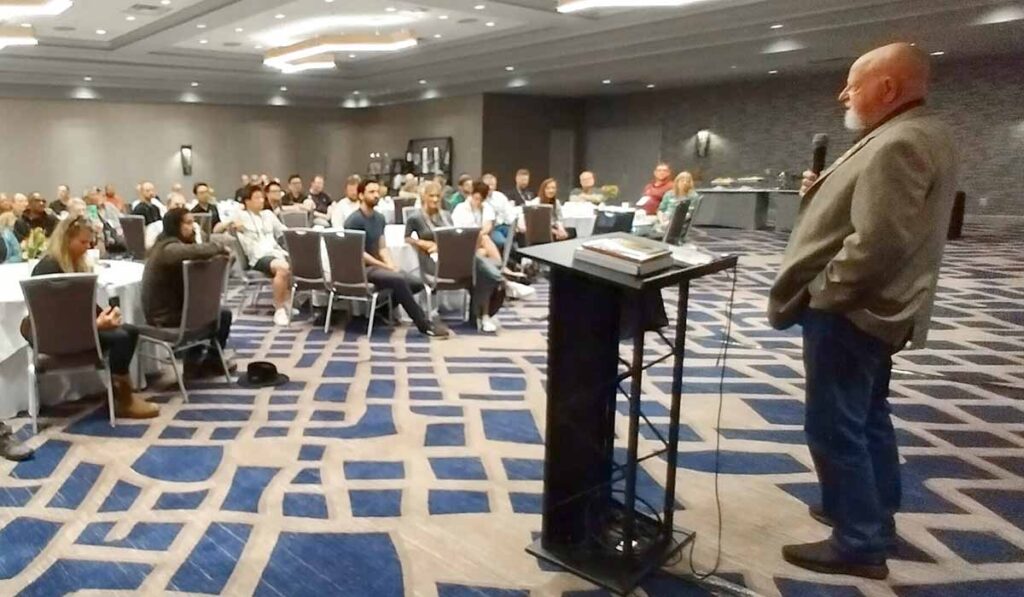
Steve Schwarzer speaking
Steve Schwarzer speaks of ā€œknife-shaped objects,ā€ his teachers, students and other sharp things.

Like Devin Thomas, Steve got a taste of what would become his life’s work in junior high school when he forged his first hot steel. Not long after high school in the late 1960s, he went to work in the aircraft industry and started making ā€œknife-shaped objects.ā€ He called them knife-shaped objects ā€œbecause we took a piece of stainless steel we found on the job somewhere with no idea how to heat treat it or what kind of steel it was, and we’d grind it to what looked like a knife and put a handle on it.ā€

In 1972, he moved to Florida and bought a book by Alex Bealer that had a page-and-a-half on forging knives. ā€œWhen I turned that page and read it, it lit a fire that never went out,ā€ Steve said. He made knives as a hobby and sold them to his fellow shop workers for $15 and $20 apiece. ā€œThey told me I was wonderful and I believed them,ā€ Steve said to a chuckling audience. It was then he learned of Bobby Tyson. ā€œHe was my original teacher,ā€ Steve said. ā€œI loved the guy. He could make two beautiful pocketknives in a day that walked and talked. Tony Bose would’ve been proud of them.ā€

Tyson actually had books on making knives, a novel concept at the time. Steve visited Tyson and learned all he could. ā€œHe put me ahead five years in one weekend and that’s what I try to do with Neil Kamimura and these guys here,ā€ Steve said, pointing to some of his students in the audience. ā€œI surround myself with people doing great things.ā€ It is an approach that inspires Neil.

ā€œSteve says surround your yourself with people that know your value,ā€ he observed. ā€œHe has helped a tremendous amount of people and everybody wants to know his tricks because he’s the wizard of steel. But for me it wasn’t his tricks of welding steel but it was the lessons I wanted to learn, such as how does he keep his passion for that many years? How did he keep his willingness to want to keep on wanting to learn?ā€ To absorb those things from Steve, Neil noted, ā€œis to listen to his struggles, his hardships and the balance he took to maintain such longevity in this industry.ā€

Meanwhile, Steve the teacher remains, and always has remained, Steve the student.
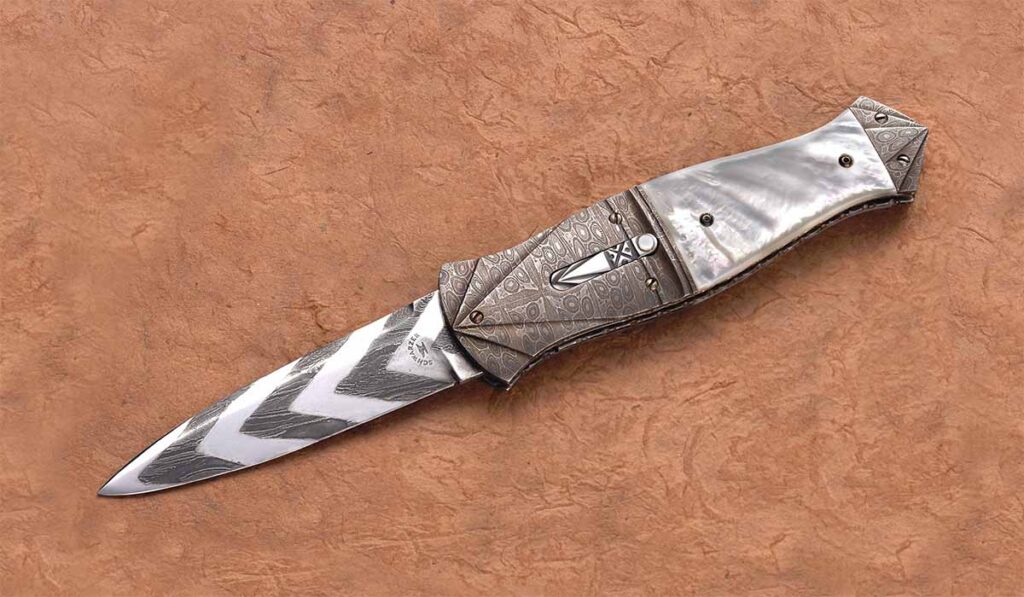
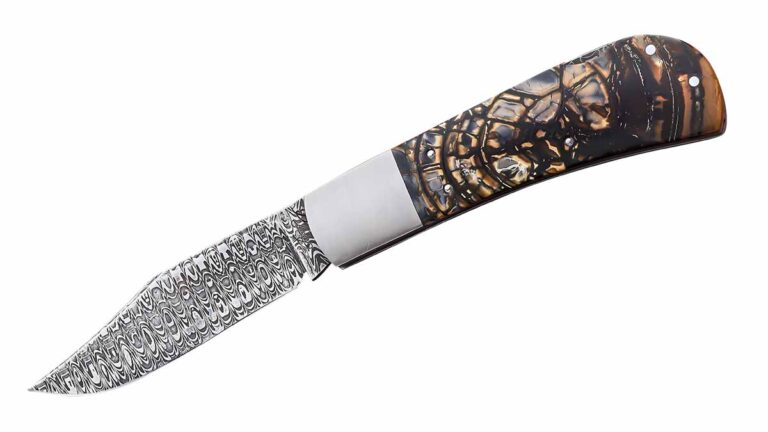
Steve Schwarzer folding dagger
A Steve Schwarzer folding dagger sports a chevron damascus blade, canister damascus furniture and mother-of-pearl scales. (PointSeven image)

ā€œAt 75 I’m hurrying, I promise you,ā€ he stressed. ā€œI wake up in the morning and it’s, ā€˜Man, I’ve got another day. Let’s go do something!’ And that’s what I do and then [my students] explore and come back with information. So everyone you teach in this business doubles your life in the business is the way I look at it. And that’s why I love what I do.ā€

Neil brought it all into full focus.

ā€œHow many careers were started because of him and how many lives he’s touched, many in this room,ā€ he mused.

ā€œSteve Schwarzer has truly changed bladesmithing forever and I believe that … A lot of these young makers and a lot of these Instagram people, we’re nothing without people like Steve and people that have been inducted [today]. So if you don’t know Steve, you should get to know him, and if you do know Steve, you should treasure him like I do.ā€

Read More On BLADE Magazine And Show:

ABS Auction: What Crossed The Block In Atlanta

Top custom makers from around the world showcase rarefied knives at the annual ABS auction.

Each year when the BLADE Show rolls into Atlanta, the American Bladesmith Society (ABS) holds its auction of selected knives forged by ABS master and journeyman smiths. Here is a gander at the knives that crossed the block at the exclusive auction! ABS master smith and instructor Brion Tomberlin serves as a director and secretary of the society, and he handles the ABS auction from start to finish.

ā€œI choose the smiths, mainly from the recent journeyman and master smiths who have gotten their stamps that year,ā€ he explained, ā€œand I also ask other master smiths and journeyman smiths, basically whoever I can get to say yes! The proceeds go to the general fund of the ABS.ā€

Support for the ongoing educational activities and programs of the ABS is vital to the health and future of the craft. Participants are honored to be involved and have their handiwork sold at auction by ABS director Robert Wilson. For years, Wilson has served as the event’s auctioneer, and Tomberlin said he likes to go with experience. For this year’s auction, several outstanding knives, both by American and international bladesmiths, will be available.

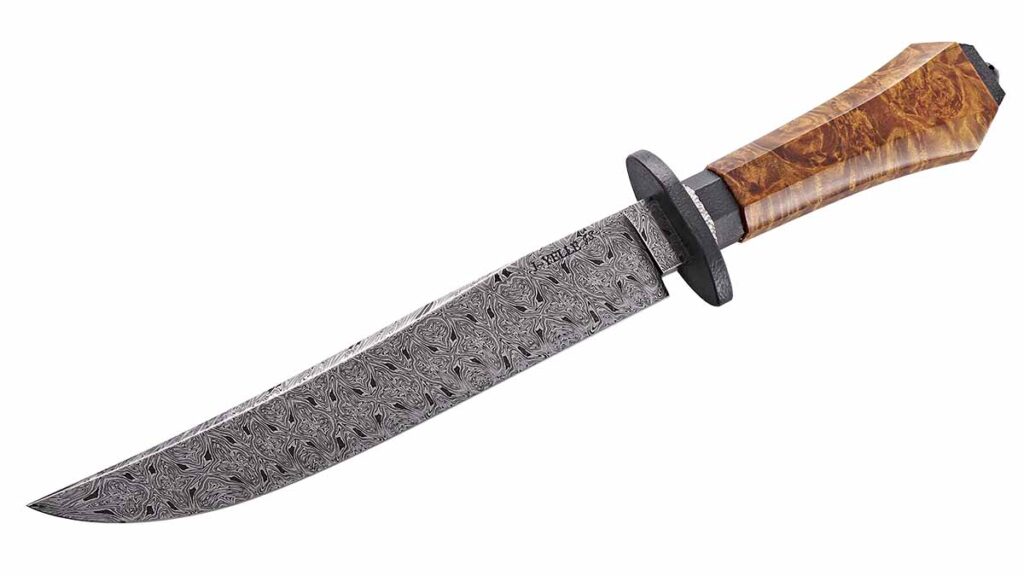
International ABS Journeyman Smith Knife—Jeremy Yelle: Gentleman’s Bowie

ABS Yelle Jeremy

Jeremy Yelle, a 22-year-old bladesmith from Sherbrooke, Quebec, Canada, is excited to be involved and to offer one of two international journeyman smith knife entries. ā€œI truly love the ABS and what it does,ā€ he said, ā€œand I felt like giving it my first-ever journeyman smith piece was the honorable thing to do.

ā€œI personally love the antique and classic look of older knives, which is why I chose to make a coffin-handle bowie. The handle is a coffin shape, which happens to be a partial takedown. It has several lineup pins, my textured and fire etched 416 stainless steel fittings and a 416 textured spacer.ā€

Jeremy has been making knives for about five years, and his mosaic damascus blade was inspired by the process he learned from ABS master smith David Lisch. The handle of Jeremy’s gentleman’s bowie is particularly noteworthy with Canadian maple burl from Maritime Knife Supply that he stabilized and dyed. The knife is completed by a protective case.

International ABS Journeyman Smith Knife
Maker: Jeremy Yelle
Knife name: Gentleman’s Bowie
Blade length: 8.625 inches
Blade material: Mosaic damascus of 15N20 nickel alloy and 1084 carbon steels
Handle material: Canadian maple burl
Overall length: 13.5 inches

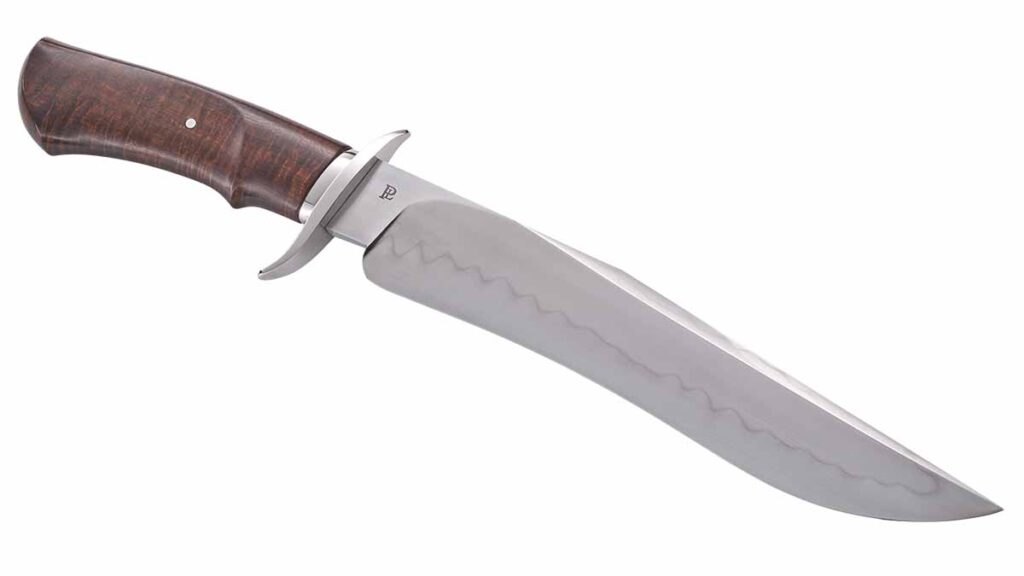
International ABS Journeyman Smith Knife—Pablo Lanaspa: Bisaurin

ABS Ubeira Pablo Lanaspa

The second international journeyman smith knife entry is from Pablo Lanaspa Ubeira from the small town of Berdun in the north of Spain. ā€œI am very grateful to the ABS for bringing me the opportunity to make this knife,ā€ he said. ā€œSpecial thanks to Brion for his kindness and ability to help in every circumstance.ā€

Ubeira has been making knives since 2008, and this piece, a bowie-inspired design, comes with a zippered case. ā€œI was already a collector and then started to make my own blades from recycled steel when I made a rudimentary coal forge and a small belt grinder,ā€ he said of his earlier days. His knife features a blade with a hamon that is clay differentiated and hardened. The blade is also slightly recurved with a full sharpened edge on the back, while the wood used for the handle, Australian ringed gidgee, is a gift from Belgian ABS master smith Sam Lurquin.

International ABS Journeyman Smith Knife
Maker: Pablo Lanaspa Ubeira
Knife name: Bisaurin
Blade length: 12 inches
Blade material: W2 steel with hamon
Handle material: Australian ringed gidgee wood
Overall length: 17 inches

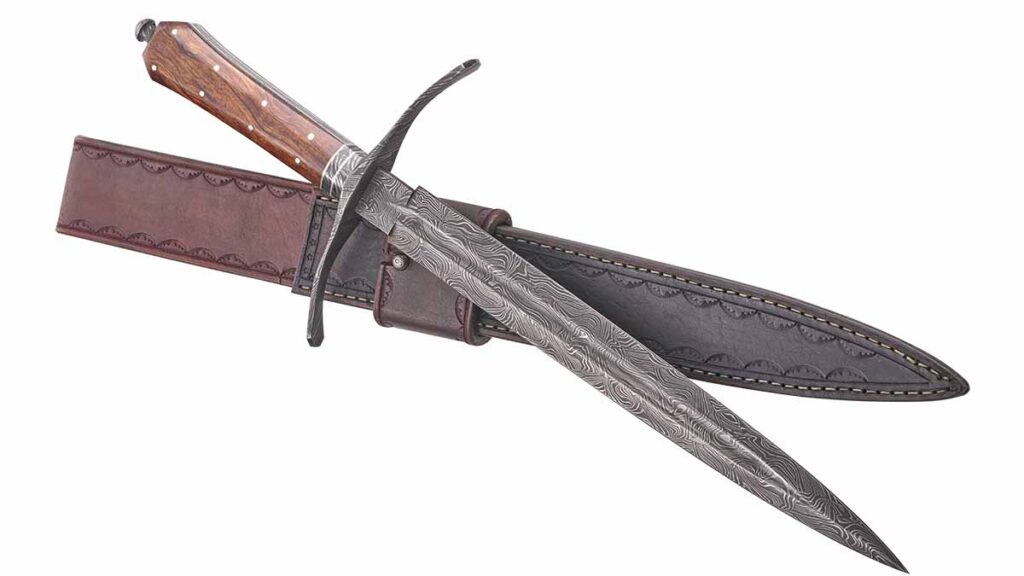
U.S. ABS Journeyman Smith Knife—Joshua States: Stylized Quillon Dagger

ABS States Joshua

Can you think of a better name for a maker of a United States journeyman smith knife than Joshua States? Of New River, Arizona, Joshua fashioned his U.S. JS model as a stylized version of a quillon dagger. ā€œThe coffin-frame handle is a complex build, and the blade is flat ground on the bevels with a central fuller,ā€ he explained. ā€œI took my first class with Tim Hancock, and that was a game changer. Previous to that I had spent about a year trying to do things without any training or reference material.ā€

According to States, his JS knife was originally undertaken as a commission. ā€œA customer had seen a similar dagger I had made in 2014 and wanted a copy of that knife,ā€ he recalled. ā€œUnfortunately, he passed away soon after I had made the blade, and I hadn’t started making any of the other parts. So, I was now free to redesign the handle/guard/finial.ā€

Joshua also made the leather sheath with minor decorative tooling and a multi-color dye job. The leather is 5/16-inch thick in a heavy oak tanned sole bend.

U.S. ABS Journeyman Smith Knife
Maker: Joshua States
Knife pattern: Stylized quillon dagger
Blade length: 11 inches
Blade material: Pattern-welded 1095 carbon and 15N20 nickel-alloy steels, and nickel
Handle material: Pattern-welded frame/desert ironwood scales
Overall length: 16.3 inches
Sheath: Hand-tooled-and-stitched leather

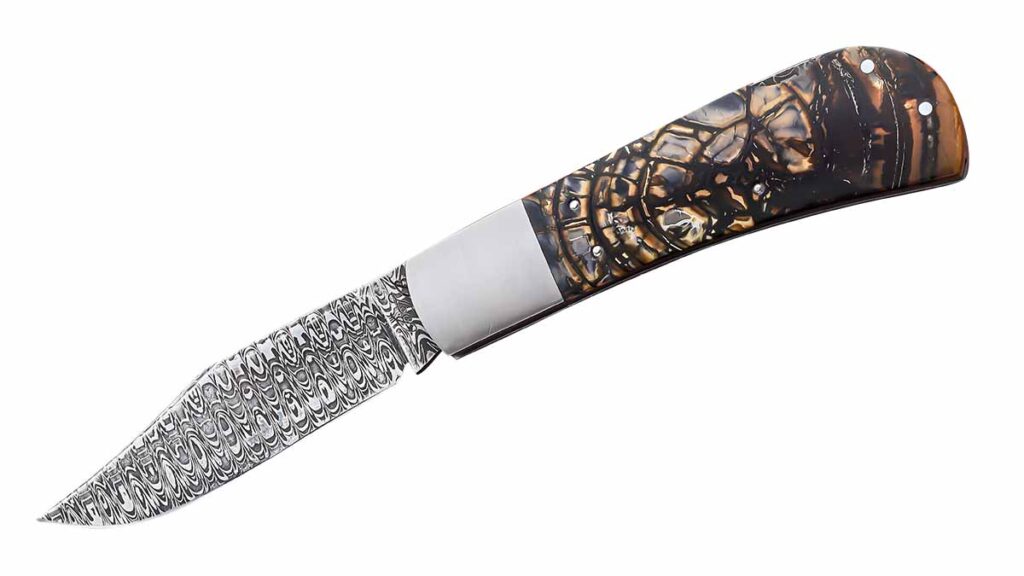
U.S. ABS Master Smith Folder—Bill Burke: Lanny’s Clip

ABS Burke

One of two U.S. master smith knives to be auctioned is a folder from Bill Burke of the Boise, Idaho, area. A custom knifemaker for 25 years, Bill pays homage to the late Tony Bose, BLADE Magazine Cutlery Hall-Of-FameĀ® slipjoint making wizard, with a Lanny’s Clip pocketknife in a shark’s tooth damascus blade and mammoth ivory scales. ā€œA lockbar and spacer of damascus are included,ā€ Bill said, ā€œwith integral liners and bolsters.ā€ The liners are fileworked and the knife comes with a zippered case.

U.S. ABS Master Smith Folder
Maker: Bill Burke
Knife name: Lanny’s Clip
Blade length: 3.25 inches
Blade material: Shark’s tooth damascus of 15N20 nickel-alloy and 1080 carbon steels
Handle material: Mammoth ivory
Lock mechanism: Lockback
Closed length: 4.1875 inches

U.S. Master Smith Knife—Nick Rossi: Hybrid European Chef

ABS Rossi Nick

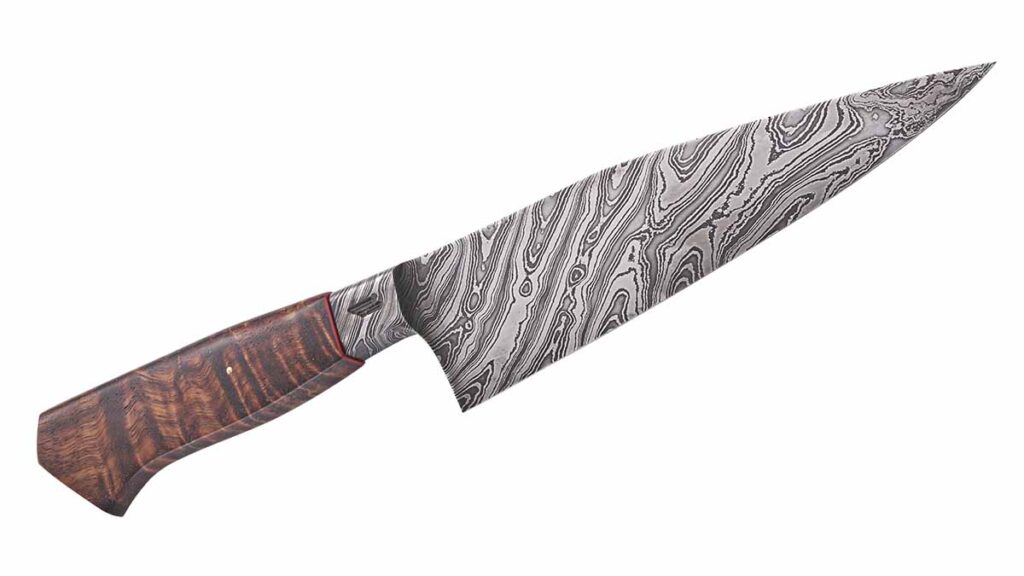
Nick Rossi of Vassalboro, Maine, contributed an integral European hybrid chef’s knife with a 50-layer twist damascus blade and curly koa handle as the second U.S. master smith knife. Both blade and handle are fashioned in the 25-year-veteran smith’s signature styles. The blade is flat ground with a subtle convex edge, and the handle features a bronze domed pin and a G-10 spacer. ā€œThis is my favorite type of knife to make,ā€ he said. ā€œIt features an integral bolster, which makes it stronger and gives it better balance. It was inspired by European chef’s knives with a little Japanese flavor.ā€ The knife comes complete with a padded case.

U.S. Master Smith Knife
Maker: Nick Rossi
Knife name: Hybrid European Chef
Blade length: 7.5 inches
Blade material: A twist damascus of 1084 carbon and 15N20 nickel-alloy steels
Handle material: Curly koa
Overall length: 12 inches

T.O.M.B. Knife—Steve Culver: Fighter

ABS Culver Steve

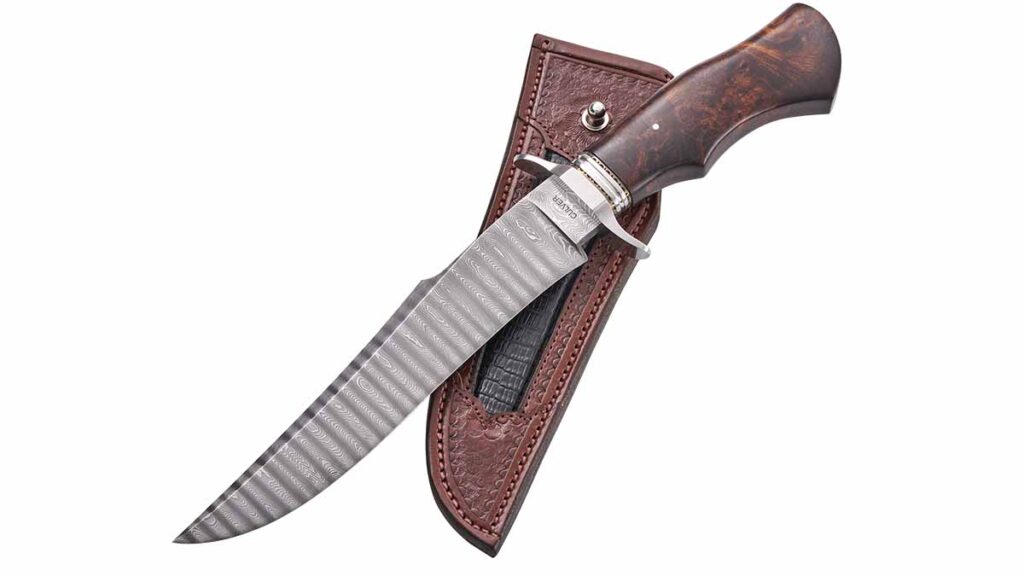
This year’s T.O.M.B. (The Order of the Mystic Brotherhood) Knife is by ABS master smith Steve Culver of Meriden, Kansas. Culver has been an active knifemaker for 36 years, and his fighter was inspired by ā€œall the cool recurve bowies that I’ve seen others make.ā€

In fact, the knife is Steve’s first venture into the recurve blade style. The blade is 220-layer ladder-pattern damascus, while the handle is Arizona desert ironwood with guard and spacer materials of anodized titanium and stainless steel. Steve also made the lined sheath, which sports lizard skin inlay.

T.O.M.B. Knife
Maker: Steve Culver
Knife pattern: Fighter
Blade length: 8 inches
Blade material: Ladder-pattern damascus of 15N20 nickel-alloy and 1084 carbon steels
Handle material: Desert ironwood
Overall length: 13.125 inches
Sheath: Lined and features lizard-skin inlay

More On Custom Knives:

BLADE Show Factory Knife Debuts 2023

Eyeball a few factory knives that will debut at the BLADE Show.

For the knife event where more cutlery companies introduce more of their new knives, the BLADE Show takes a backseat to none—which figures since the BLADE Show is the sharpest shindig of them all.

On this and the accompanying pages are samples of some of the factory knives that either debuted at the BLADE Show or had their consumer show introductions there.*

We didn’t have room for all the debut knives of every exhibiting company, so do some legwork and you’ll probably find new/debut knives you like even better than these.

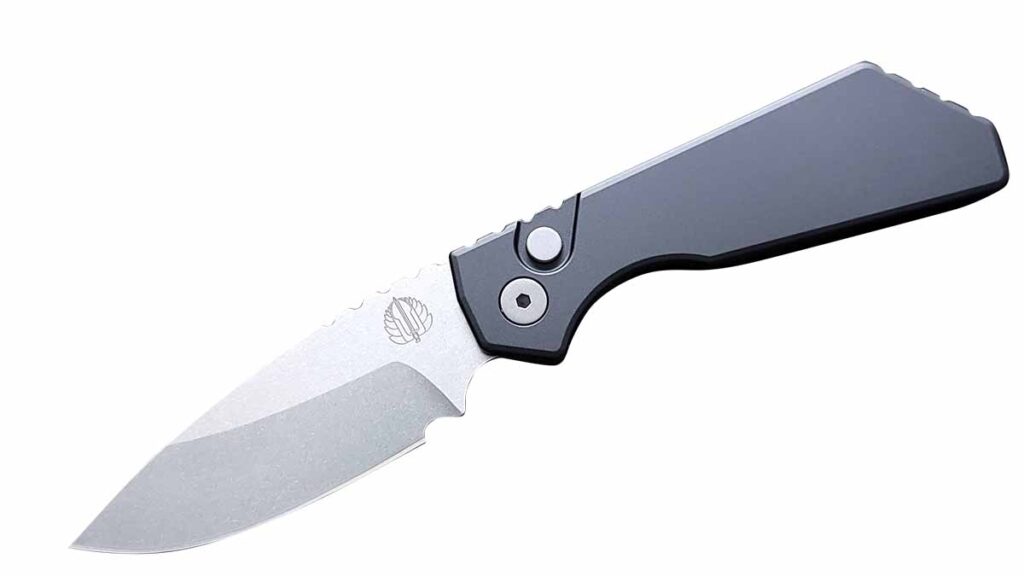
STRIDER PT+ AUTO/PRO-TECH

Strider

Knife type: EDC folder/automaticĀ 
Blade length: 3.14ā€
Blade material: MAGNACUT stainless steel
Blade grind: Flat
Handle material: Lightweight anodized aluminum
Lock/opening mechanism: Push-button autoĀ 
Pocket clip: DLC-coated mini deep carry
Special Features: Strider’s signature design and compact form have been updated to a slightly larger size; the spring has been upgraded to snap the blade open with authority
Weight: 3.21 ozs.
Closed length: 3.96ā€
Country of origin: USA
MSRP: $300
AVAILABLE FOR SALE TO THE PUBLIC: NOW; through the year additional colors and variationsĀ will be available (image by Derek Lawrence)

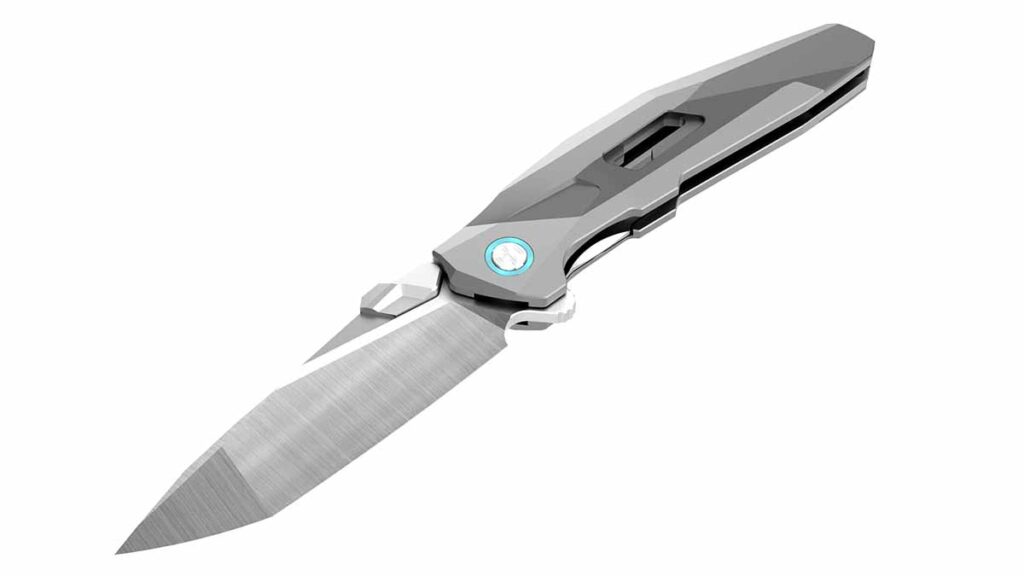
SHADOW/KETUO

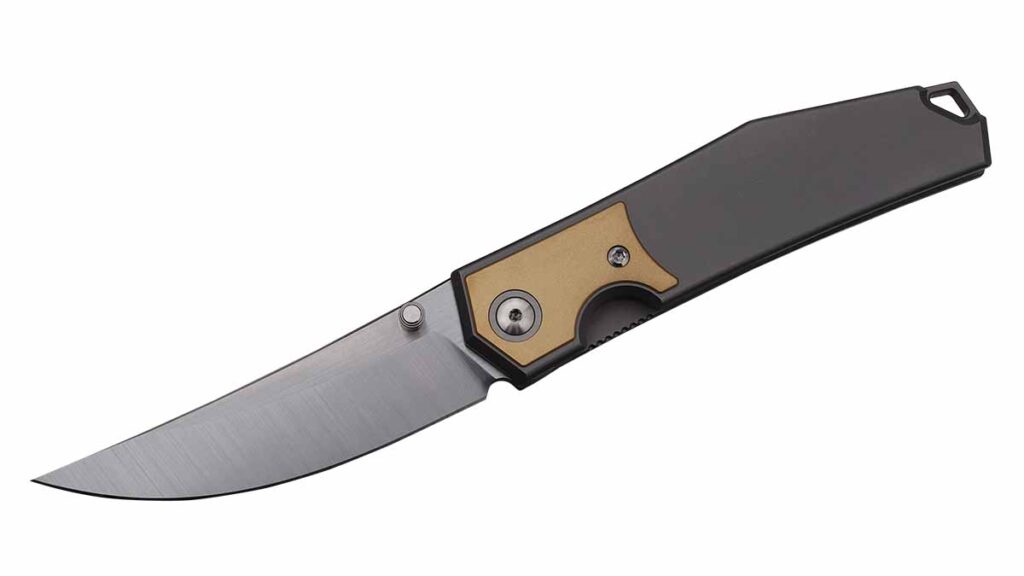
Ketug

Knife type: Flipper folder
Blade length: 3.78ā€
Blade material: Bohler M390 stainless steel
Blade grind: Flat
Handle material: 6Al4V titanium
Lock mechanism: Flipper Lock
Pocket clip: 6Al4V titanium
Weight: 5.29 ozs.
Closed length: 4.96’ā€
Country of origin: China
MSRP: $380-$420
AVAILABLE FOR SALE TO THE PUBLIC: June

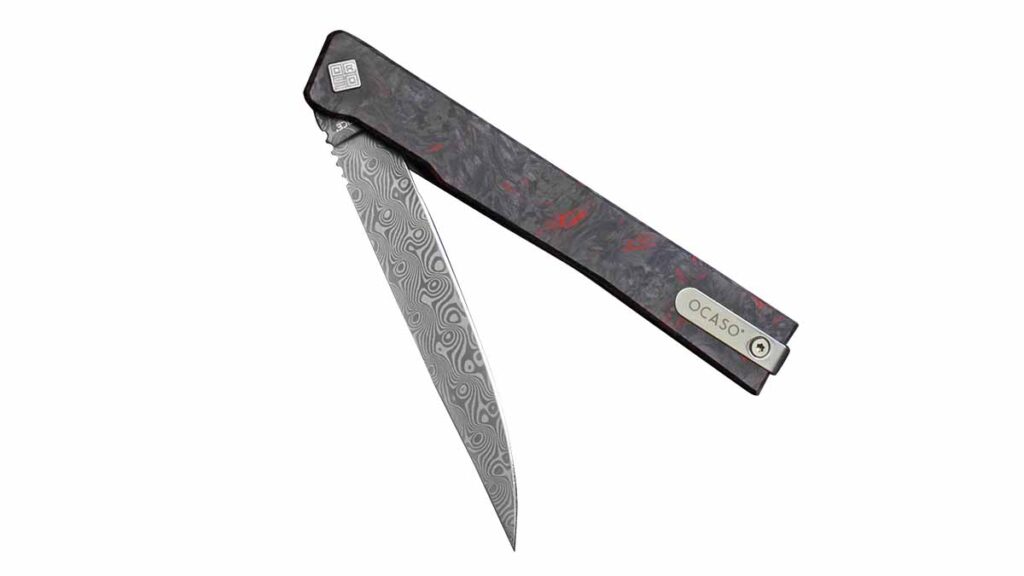
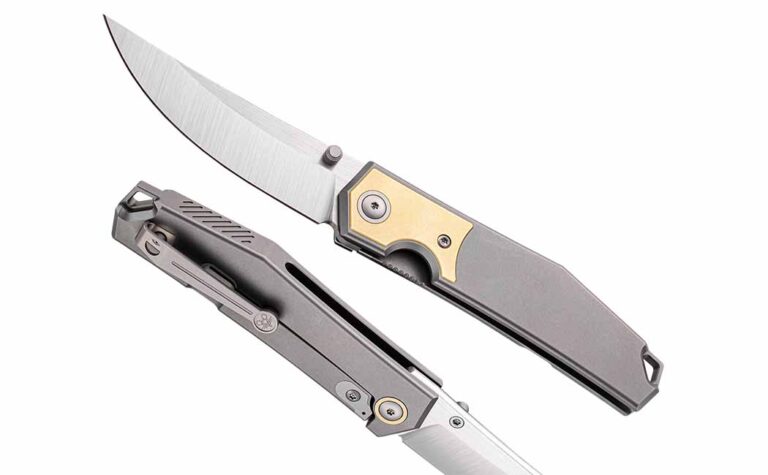
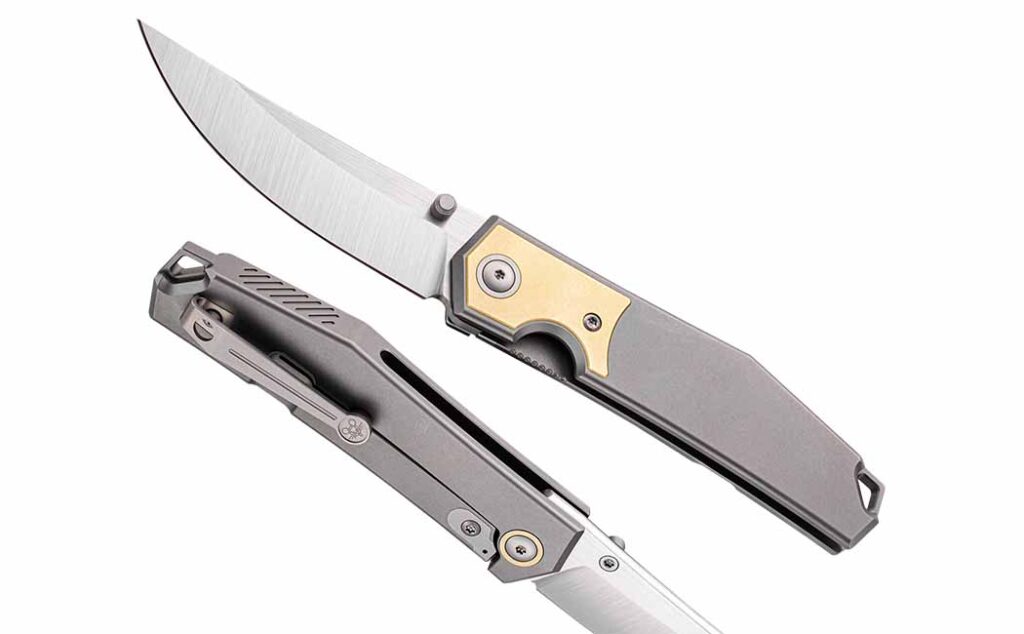
GENTLEMAN’S FOLDER/OCASO

Ocaso

Knife pattern: Gentleman’s folder
Designer: Andrew Demko
Blade length: 3.5ā€
Blade material: Choice of CPM S35VN stainless steel or German damascus
Blade grind: Full flat
Handle material: Carbon fiber, titanium or fat carbon
Lock/opening mechanism: Flipper w/linerlock or framelock
Pocket clip: Ambidextrous stainless steel in a Demko signature fold-over deep-carry design
Action: Stainless-steel caged bearings
Weight: 1.7 ozs. (carbon fiber) or 2.5 ozs. (titanium)
Closed length: 4.26ā€
Country of origin: Taiwan or Italy
MSRP: $209.99-$399.99
AVAILABLE FOR SALE TO THE PUBLIC: NOW

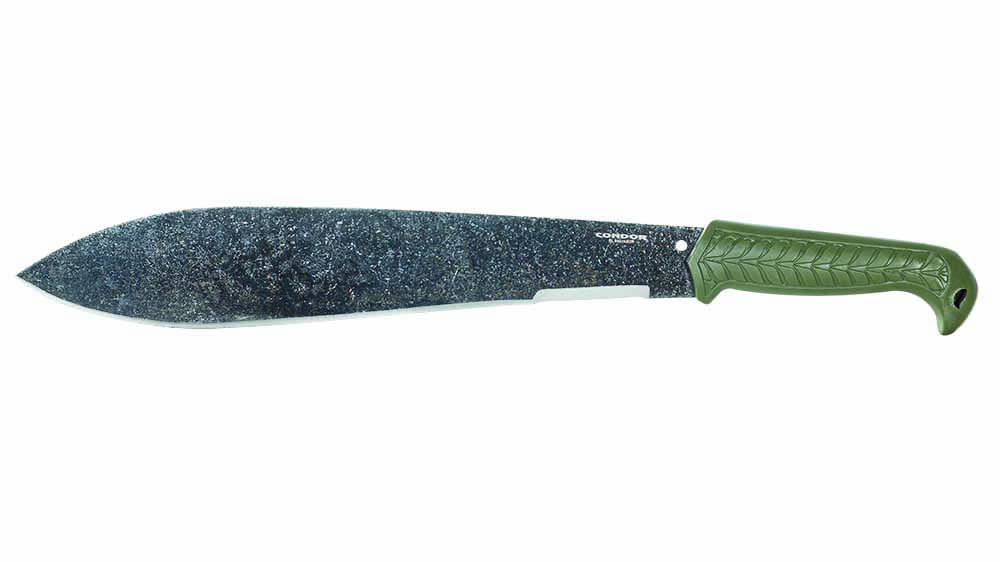
TERRACHETTE/CONDOR TOOL & KNIFE

Condor

Knife type:Ā Bushcraft machete
Blade length:Ā 14.6ā€
Blade material:Ā 1075 carbon steel
Blade grind:Ā Convex
Handle material:Ā High/impact polypropylene
Special features:Ā Near the handle the edge is designed for more controlled carving; extended pommel
Weight:Ā 25.4 ozs.
Overall length:Ā 20.72ā€
Country of origin:Ā El Salvador
MSRP:Ā $69.69
AVAILABLE FOR SALE TO THE PUBLIC:Ā Most everywhere by BLADE Show

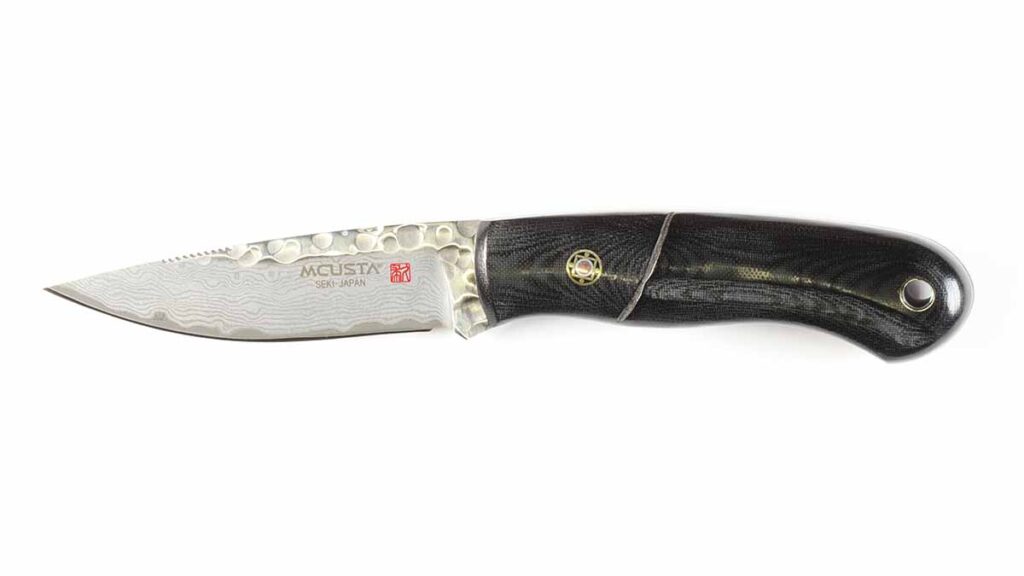
RIE COLLABORATION SPORT 100/MCUSTA

Mcusta

Designer: Mike Irie
Knife pattern: Hunter
Blade length: 3ā€
Blade material: VG-10-core damascus
Blade grind: Hollow
Handle material: MicartaĀ®
Special features:Ā Tsuchime-finished blade
Weight: 3.4 ozs.
Overall length: 6.5ā€
Country of origin: Japan
MSRP: $300
Available for sale to the public: Summer ’23

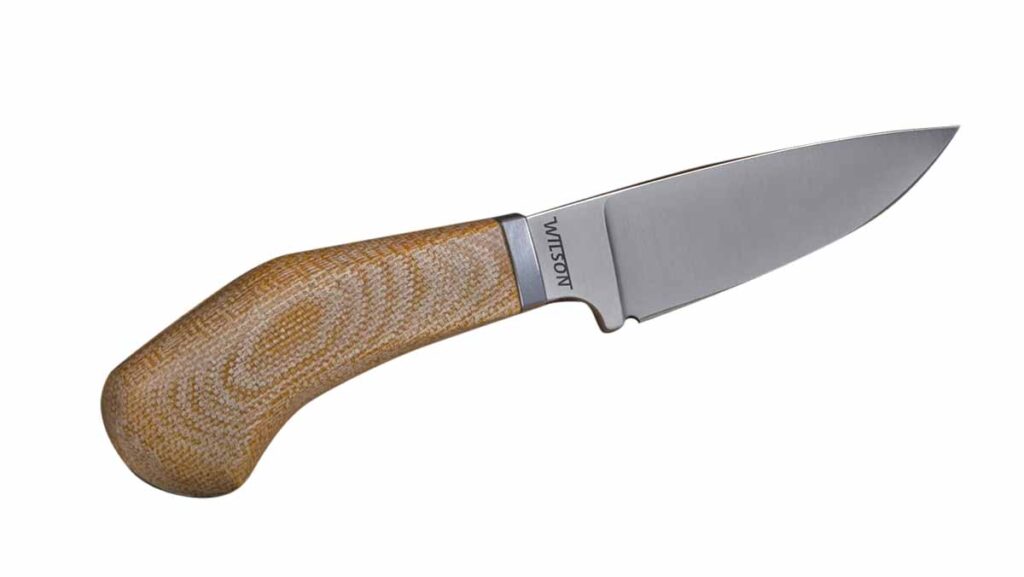
WILLY/LIONSTEEL

Willy

Model type: Fixed-blade EDC
Blade length: 2.55ā€
Blade material: M390 stainless steel
Blade grind: V flat
Handle material: Choice of canvas MicartaĀ®, woods, carbon fiber
Special features: Titanium guard
Weight: 2.04 ozs.
Country of origin: Italy
MSRP: $201.70 (at press time rate of exchange)
Available for sale to the public: June

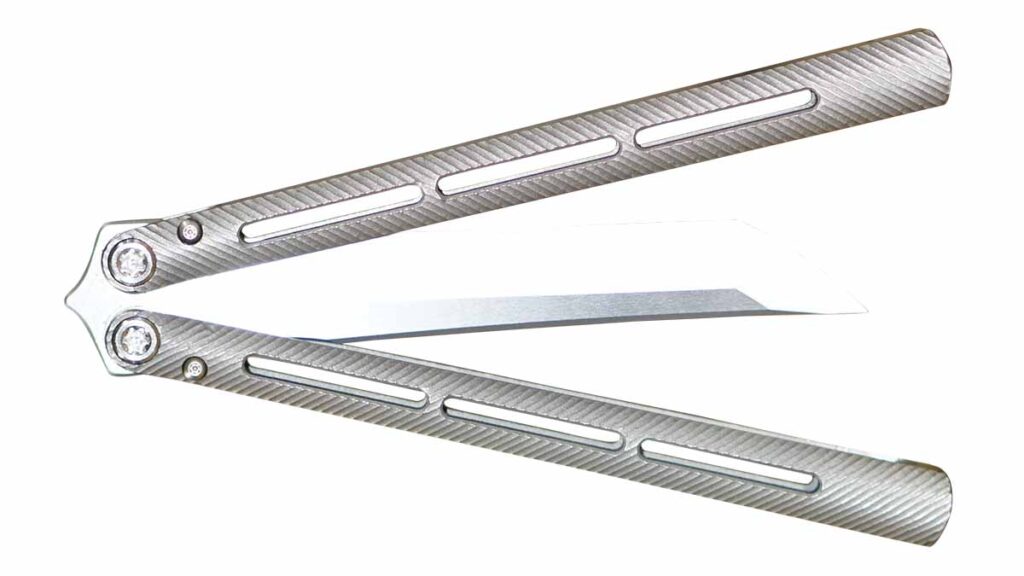
VICEROY/MEDFORD KNIFE & TOOL

Viceroy

Knife pattern:Ā BalisongĀ Ā Ā Ā Ā Ā Ā Ā Ā Ā 
Blade length:Ā 4.5ā€
Blade material:Ā CPM S45VN stainless steel
Blade patterns:Ā  Choice of drop point, tanto, dagger, seax and wharncliffe
Handle material:Ā Titanium
Handle lock:Ā Latchless
Pocket clip:Ā None
Special features:Ā Integral solid channel, zen pin, custom bushings, rounded handles, Chaplin groove, machined handle texture, hand-ground blades
Weight:Ā 4.3 ozs.
Closed length:Ā 5.7ā€
Country of origin:Ā USA
MSRP:Ā $750
AVAILABLE FOR SALE TO THE PUBLIC: At BLADE Show ’23

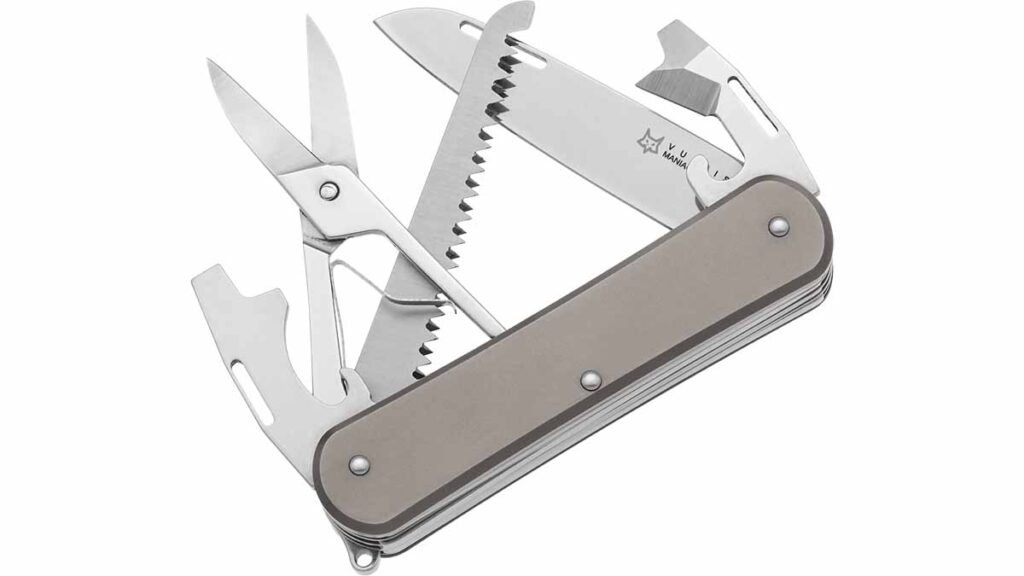
VULPIS/FOX

Fox

Model type: Multi-purpose multi-blade
Main blade length: 5.31ā€
Blade material: M390 stainless steel
Blade grind: Flat
Handle material: Bead-blasted titanium w/lanyard hole
Lock/opening mechanism: Slip joint
Special features: Bottle opener, can opener, flat-head screwdriver, hacksaw and scissors
Weight: 2.25 ozs.
Closed length: 2.94ā€
Country of origin: Italy
MSRP: $119
AVAILABLE FOR SALE TO THE PUBLIC: May

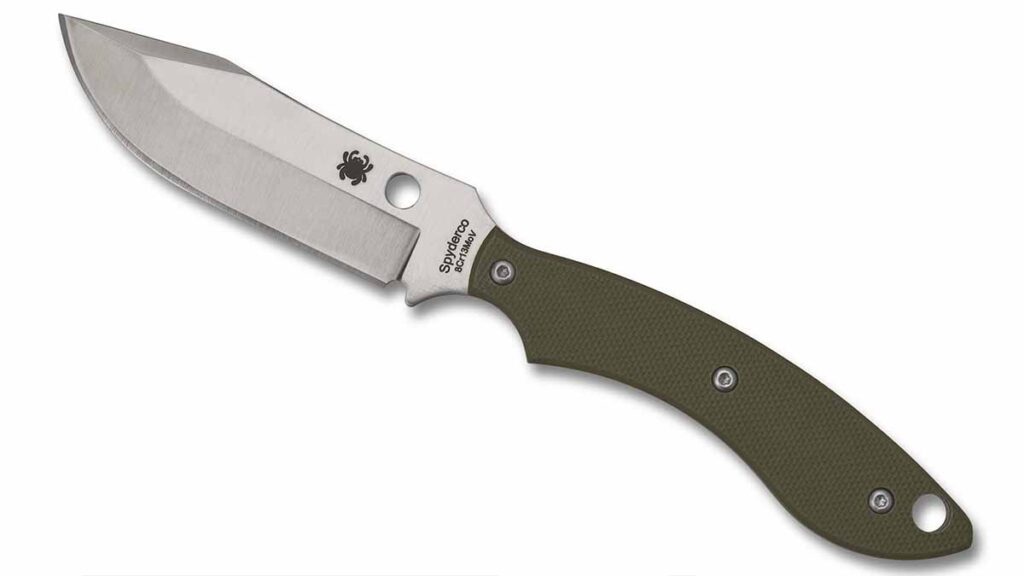
STOK BOWIE/SPYDERCO

Spyderco

Model type: Fixed blade
Blade length: 2.95ā€
Blade material: 8Cr13MoV stainless steel
Blade grind: Saber
Handle material: OD green G-10
Knife to know: Designed as an urban EDC fixed blade
Weight: 2.1 ozs.
Overall length: 6.45ā€
Sheath: BoltaronĀ® w/G-Clip™ attachment for adjustable belt and inside-the-waistband carry
Country of origin: China
MSRP: $100.
AVAILABLE FOR SALE TO THE PUBLIC: NOW

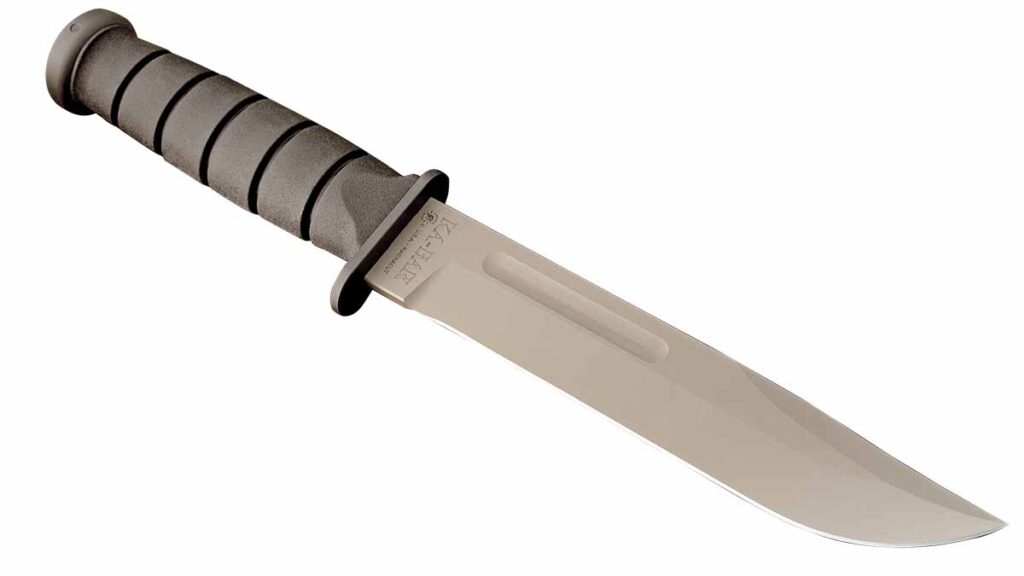
SPARTAN-KA-BAR/SPARTAN BLADES

Kabar

Designer: KA-BAR Knives
Overall length: 12ā€
Blade length: 7ā€
Blade at thickest: .165ā€
Blade material: CPM MagnaCut stainless
Rockwell hardness: 60-62 HRC
Blade pattern: Clip point
Blade grind: Flat saber
Blade finish: Choice of PVD-tungsten DLC (flat black) or ZrN (flat dark earth)
Handle Material: Kraton GĀ®
Buttcap/guard: 301 stainless steel w/PVD-tungsten DLC (flat black) coat
Weight: 10.78 ozs.
Sheath: Leather
Country of origin: USA
MSRP: Starts at $325
Available for sale to the public: NOW

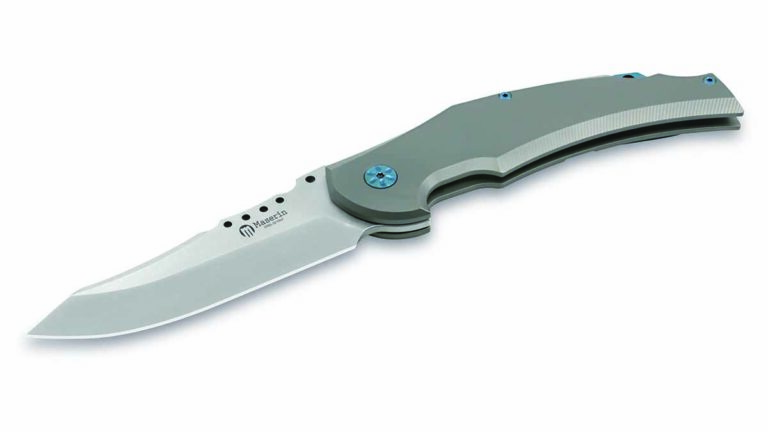
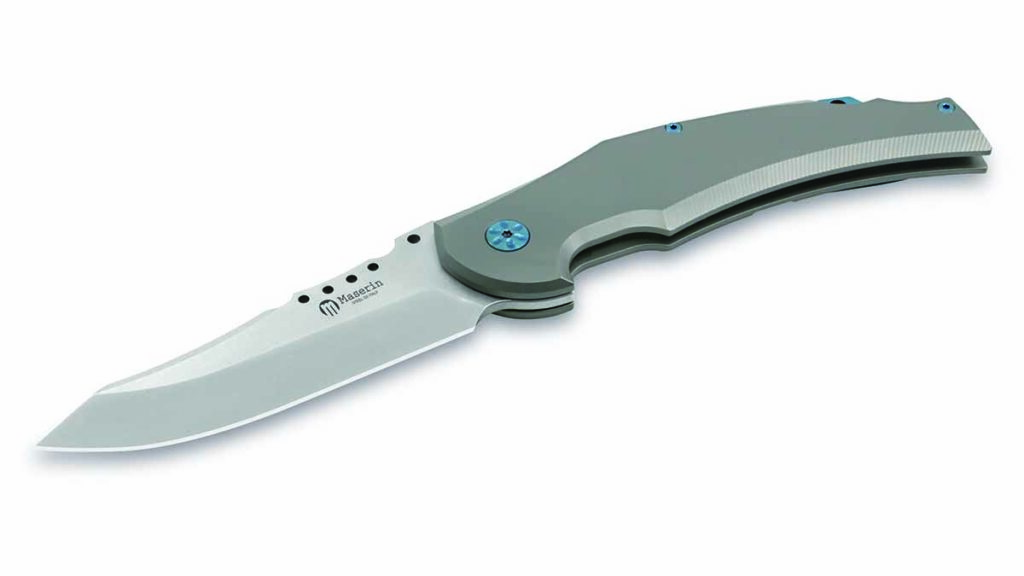
ENERGY/MASERIN

Masrin

Model type: EDC flipper folder
Blade length: 4.133ā€
Blade material: D2 tool steel
Blade grind: Flat
Handle material: Titanium
Pocket clip: Titanium
Weight: 5.926 ozs.
Closed length: 5.23ā€
Country of origin: Italy
MSRP: $328
Available for sale to the public: May

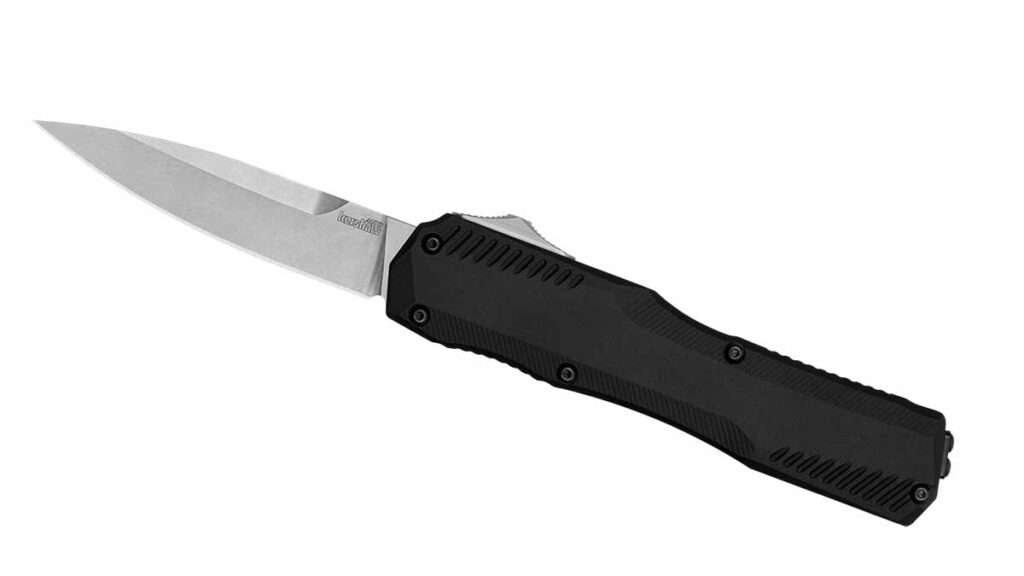
LIVEWIRE/KERSHAW

Kershaw

Model type: Out-the-front auto
Blade length: 3.3ā€
Blade material: CPM 20CV stainless steel
Blade grind: Flat
Handle material: Aluminum
Pocket clip: Reversible deep-carry, steel
Special features: Lightweight button
Weight: 3 ozs.
Closed length: 4.8ā€
Country of origin: USA
MSRP: $380
AVAILABLE FOR SALE TO THE PUBLIC: NOW

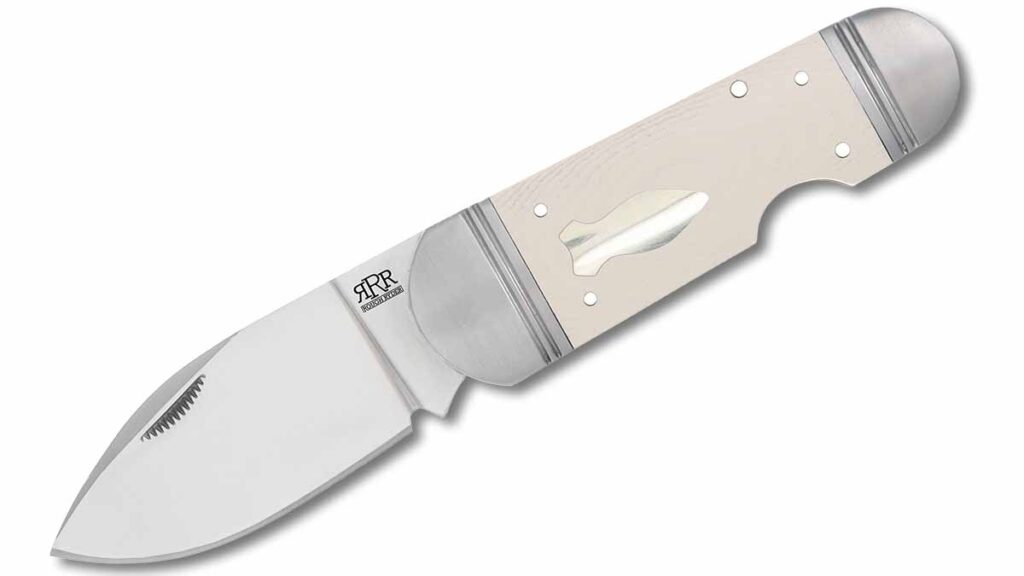
GHOSTFISH/ROUGH RYDER RESERVE

Rough Ryder

Designer: Brian Wilhoite
Model type: EZ-Open sunfish
Blade length: 2 7/8ā€
Blade material: D2 tool steel
Handle material: White MicartaĀ®
Lock/opening mechanism: Slip joint w/half stop
Weight: 5.5 ozs.
Closed length: 3 7/8ā€
Country of origin: China
MSRP: $84.95
AVAILABLE FOR SALE TO THE PUBLIC: Late fall

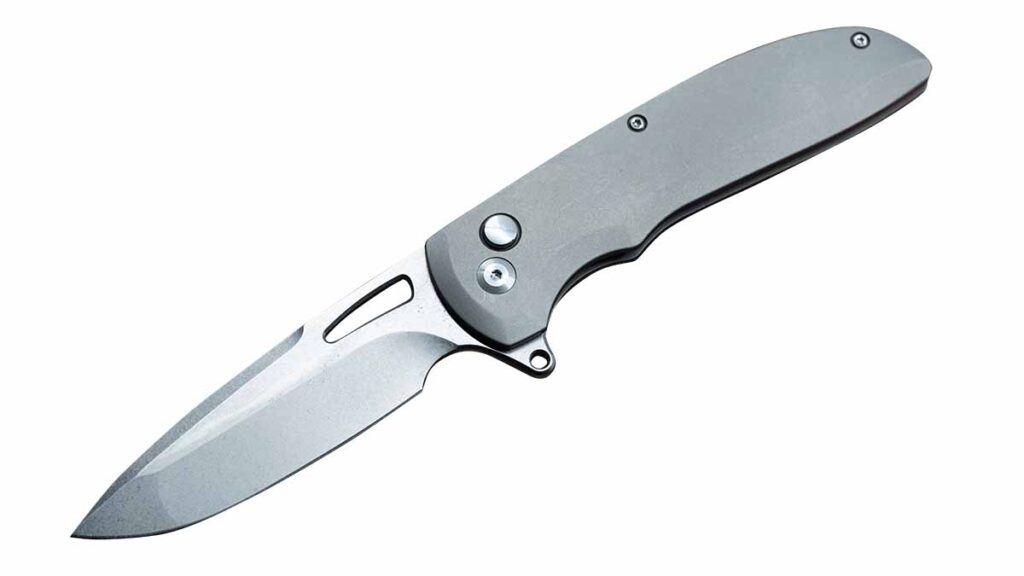
GMX/GIANTMOUSE

GiantMouse

Model type: EDC /outdoor folder
Blade length: 3.25ā€
Blade material: CPM S90V stainless steel
Blade grind: High flat saber
Handle material: Titanium w/brass inlaid bolster
Lock: Framelock
Pocket clip: 3D-machined titanium
Special features: Integral titanium handle
Weight: 3.8 ozs.
Closed length: 4.3ā€
Country of origin: China; manufactured by Reate
MSRP: $445
AVAILABLE FOR SALE TO THE PUBLIC: NOW

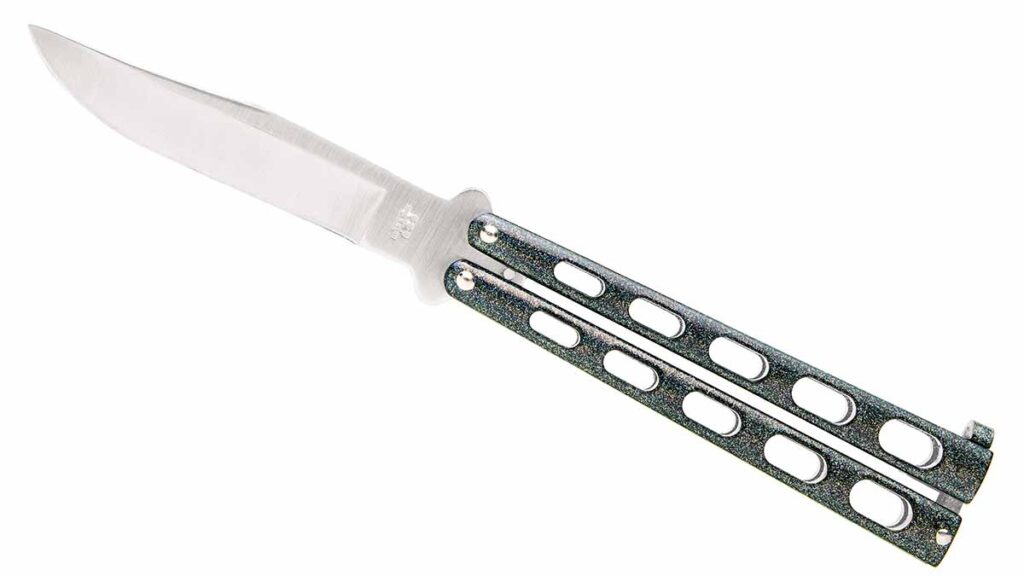
5ā€ GALAXY BUTTERFLY/BEAR & SON

Bear and Sons

Model type: EDC balisong
Blade length: 3 5/8ā€
Blade material: 440 stainless steel
Blade grind: Hollow
Handle material: Zinc w/Galaxy finish
Lock: Latch
Weight: 5 ozs.
Closed length: 5ā€
Country of origin: USA
MSRP: $68.99
AVAILABLE FOR SALE TO THE PUBLIC: NOW

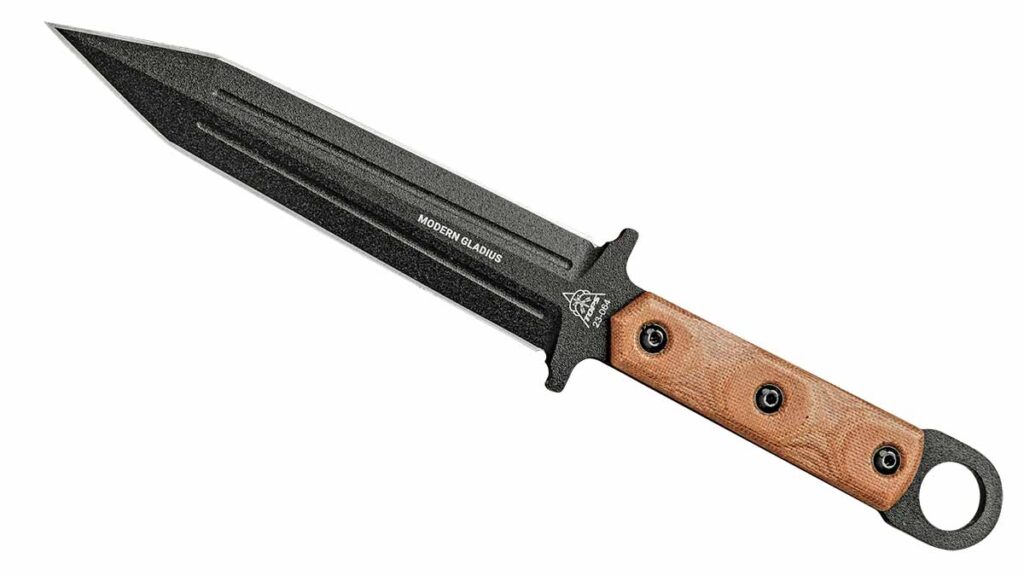
MODERN GLADIUS/TOPS KNIVES

Tops Gladus

Knife type: Tactical Ā 
Blade length: 6.5ā€
Blade material: 1095 high carbon steel
Blade grind: Dagger/flat
Handle material: Tan canvas MicartaĀ®
Knife to know: Blade has a double edge
Weight: 8.3 ozs.
Overall length: 11.5ā€
Country of origin: USA
MSRP: TBD
AVAILABLE FOR SALE TO THE PUBLIC: TBD

YUUKI/LATAMA x VICTORIAM

Yuuki

Model type: EDC flipper folder
Blade length: 3.5ā€
Blade material: CPM 20CV stainless steel
Blade grind: Kissaki-unokubi-zukuri compound; hollow belly and convex tip
Handle material: Grade 5 titanium
Lock: Button lock
Pocket clip: Titanium
Weight: 4.59 ozs.
Closed length: 4 5/8ā€
Country of origin: China
MSRP: $200 (estimated)
Available for sale to the public: May

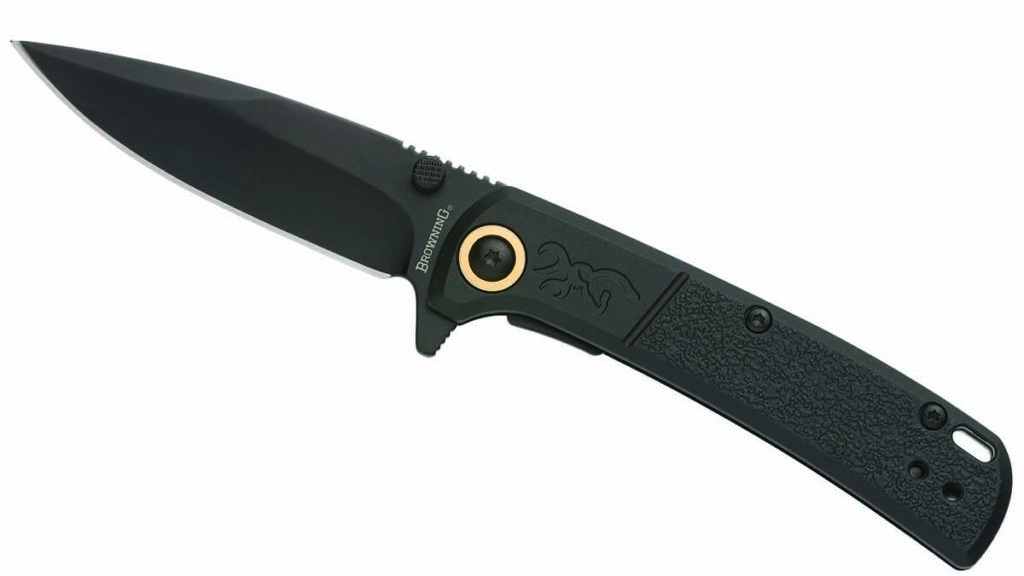
BUCKMARK SLIM/BROWNING

Buckmaster

Knife type: Flipper folder
Blade length: 2.75ā€
Blade material: D2 tool steel
Rockwell hardness: 56-60 HRC
Blade pattern: Drop point
Opening mechanism: Assisted
Pivot action: Ball bearings
Handle: Polymer
Bolster: Stainless steel
Pocket clip: Adjustable
Lock: Linerlock
Closed length: 3.75ā€
Country of origin: China
MSRP: $29.99
Available for sale to the public: NOW

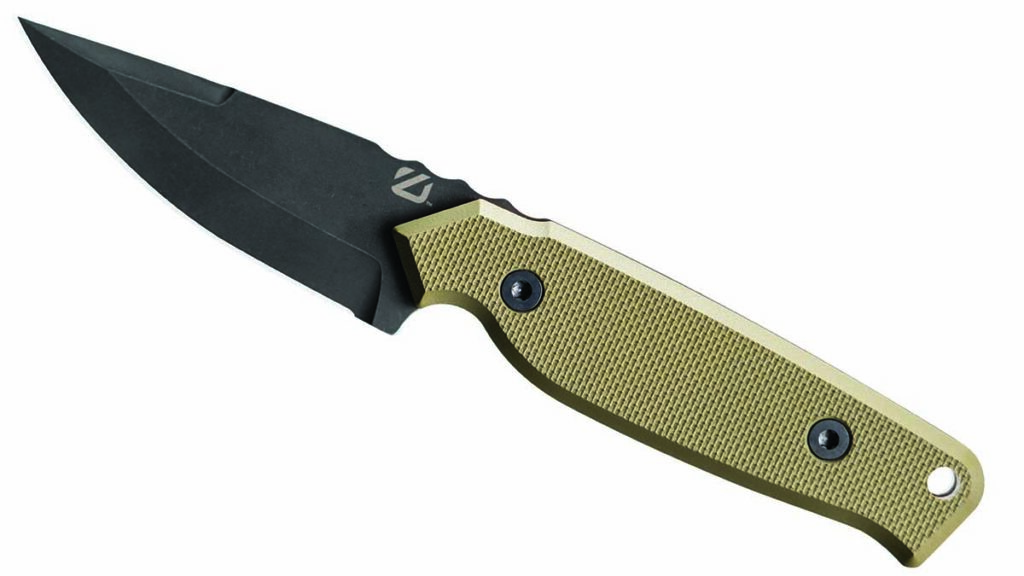
LULBEGRUD/OUTLIER

Outlier

Designer: Craig CaudillĀ 
Category: EDC/outdoors/self-defense
Blade Length: 3.68ā€
Blade material: 52100 carbon steel
Blade at thickest: 1/8ā€
Blade finish: Parkerized and tumbled
Blade pattern: Drop point
Blade grind: Flat
Edge sharpening angle: 18 degrees
Handle: Coarse-textured, layered G-10
Weight: 6.84 ozs.
Sheath: .08ā€-thick thermoplasticĀ 
Overall length: 8.62ā€
Sheathed weight: 8.26 ozs.
Country of origin: USA
MSRP: Approximately $200
AVAILABLE FOR SALE TO THE PUBLIC: At BLADE Show ’23

*Some of the knives shown for the first time at the show won’t be available for sale to the general public until later in the year. Check each individual knife’s spec box for details.

Check Out More Buyer’s Guides:

BLADE Magazine 50th Anniversary: Knife Industry Milestones

Revel in a short list of knife industry milestones that transformed the knife world.

Editor’s Note: BLADE Magazine is celebrating its 50th anniversary of its founding this year. To recognize this milestone, we are running a series of articles looking at the changes to the knife world the publication has been privy to over its history.

Time marches on. And in the cutlery industry, the half century from the early 1970s to the present has been filled with both revolution and evolution.

From the corner of a massive hall at a gun show, the slight mention of a new style of field tool, and the basic everyday factory blade carried in the worker’s pocket, the knife industry, both custom and factory, has blazed its own trail over the past 50 or so years, emerging from a somewhat obscure existence to the mainstream. And along the way have been those moments of discovery, awareness and excitement that have marked the trail.

For reference, a few of those moments include the following.

A.G. Russell and Lloyd Hale
The first ā€œmeetingā€ of the Knifemakers’ Guild basically was the idea of A.G. Russell. What would become the Guild Show was the leading knife show for decades. A.G. (right) discusses a Harry Morseth knife with maker Lloyd Hale (left). (Sid Latham image)

1970s

Though what would become the Knifemakers’ Guild Show was first held in 1970, the show that occurred three years later is still talked about today. That was when Bill Moran reintroduced damascus steel for knife blades, kindling a revival of interest in damascus as the new ā€œsuper steelā€ and generating a wave of collector fervor. Also in 1973, Blackie Collins founded The American Blade, a magazine for the knife industry like nothing that had been seen before. Known today as BLADEĀ®, the publication remains a voice for the industry and a tangible contributor to the life and times of the knife enthusiast.

In the following decade, knife shows increased in number and attendance, including the BLADE Show, the New York Custom Knife Show, California Custom Knife Show and the Guild Show, the latter which led the pack for at least 20 years. At the same time, Guild members established industry trends, including the drop-point hunter and the popularization of super steels 154CM and ATS-34 by Bob Loveless, while A.G. Russell vigorously supported the knife industry through his advocacy, sharpeners, knives and growing catalog business.

Blade Show 2007
Eric R Eggly, PointSeven Studios

In 1976, the American Bladesmith Society was formed, and those who forged their blades and worked in damascus at long last had their own organization to promote training and excellence with hammer-ins and other events that brought people together to learn the art of bladesmithing. By 1988, the ABS opened its own school, the Bill Moran School of Bladesmithing. For the first time, bladesmiths and knifemakers could take advantage of a year-round school that offered instruction in forging, bladesmithing and more.

1980s

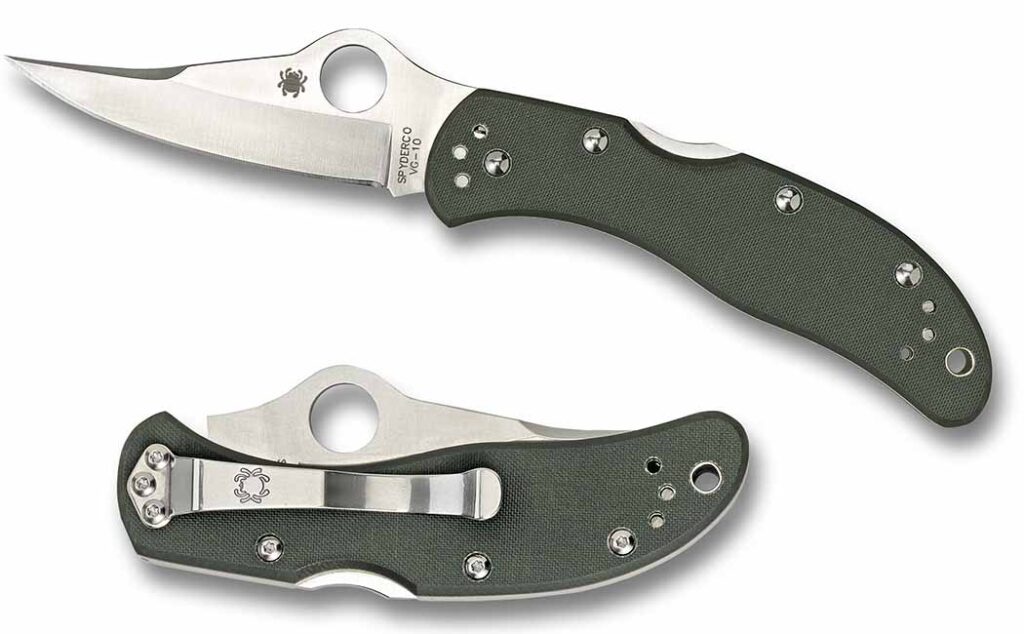
Nineteen-eighty-one saw the introduction of two watershed knife creations by Spyderco and Michael Walker. With the C01 Worker, Spyderco headman Sal Glesser introduced the first knife with both the famed hole in the blade for easier one-hand knife opening and a pocket clip for enhanced carry. Walker, meanwhile, debuted his groundbreaking linerlock folder. The innovations led to a concentration on ease of carry and deployment, focusing the industry on such elements that made the experience of knife ownership something even more special.

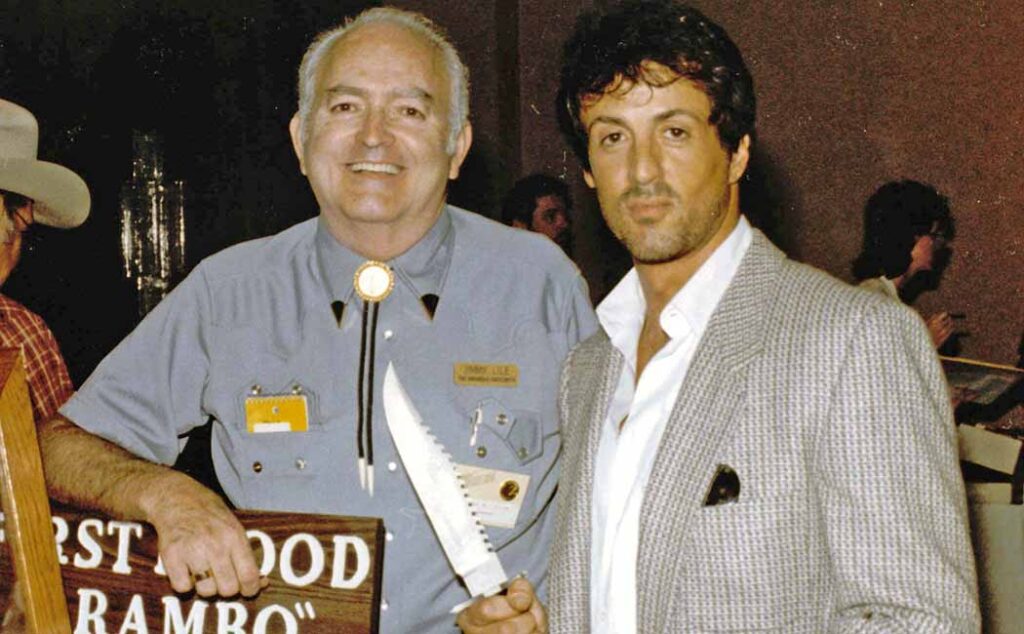
Jimmy Lile and Sylvester Stallone
Jimmy Lile and Sylvester Stallone combined to use Lile’s survival knife in the 1982 movie First Blood, and knives were never the same again.

Hollywood took its turn in the early 1980s with the Rambo series of feature films and the knives that played starring roles. Cutlery Hall-Of-Famers Jimmy Lile and Gil Hibben became celebrities in their own right, and sure enough, other knife-and-sword-oriented films followed, including the Conan series, Commando, Predator and The Last of the Mohicans. These were just a few but the knives of custom makers profoundly influenced the marketplace. Soon enough, collaborations between custom knifemakers and factory knife companies began to flower.

1990s

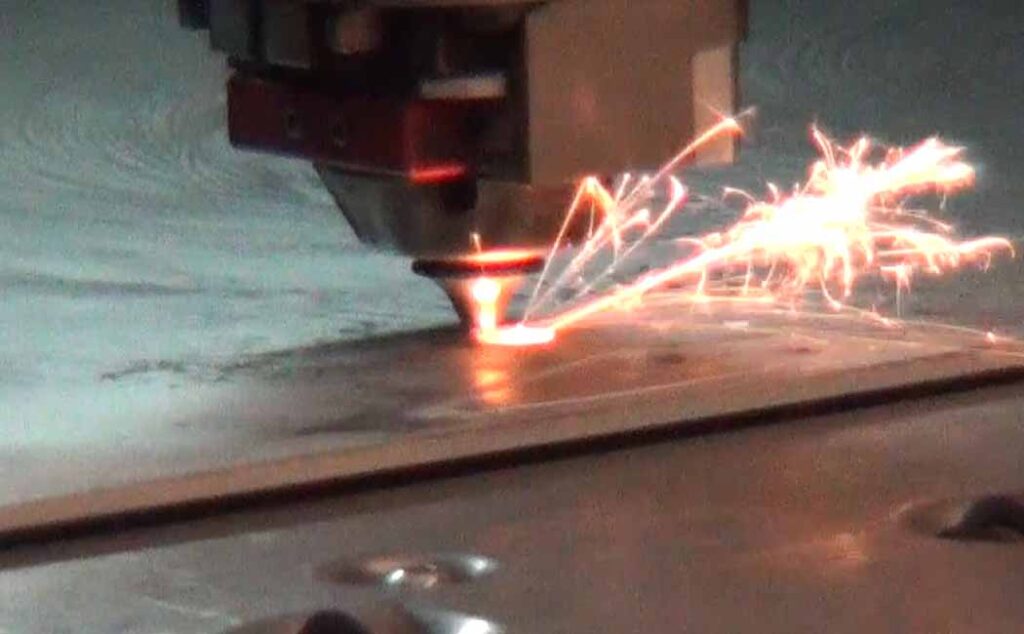
By the 1990s, equipment such as CNC, laser cutters and CAD/CAM entered the knifemaking realm and brought about rapid change in the way custom and factory knives were made. The introduction of such hi-tech equipment into the maker’s shop gave rise to a debate over the very definition of handmade—a debate that continues to this day.

CNC machine
As early as the 1990s, the use of laser cutters—here cutting a hole in a Spyderco blade—CNC machines and other high-tech equipment began to take hold in the making of knives.

At the same time, the emergence of the internet brought the commercial knife market to the world, as custom makers, factories, dealers, collectors and others offered knives for sale on an unprecedented scale. The global reach of the internet led to a burst of information on every aspect of the knife industry, from websites, forums for the exchange of information, how-to videos, online auctions, and even a bit of the dark side—buyer beware! Know your customer and other maxims rang true.

Along with the information explosion, competition was more robust than ever, particularly with the onrush of China’s factory presence, not only in quantity but also, later, in quality. The Chinese influence has redefined notions of affordability, value, and how knives are produced and distributed, and the resulting market conditions continue to impact the buying habits of consumers worldwide.

2000s On

Of course, there are ongoing challenges. Two significant advocacy groups, the American Knife & Tool Institute (AKTI) and Knife Rights, assumed leading roles in responding to knife laws and particularly to the zeal of government regulation, which at times has threatened the livelihood and freedom of Americans to carry one of man’s oldest tools. Pro-knife legislation and the legalization of automatics in many states are evidence of the credible work that has been done, with much of the organized response from the knife industry resulting from the defeat of the 2009 effort led by U.S. Customs to reclassify one-hand knives as switchblades/automatics.

Spyderco knife
With the C01 Worker in 1981, Sal Glesser and Spyderco introduced the first knife with both the famed hole in the blade for easier one-hand knife opening and a pocket clip for enhanced carry. Released in 2014, the company’s C01GPGR Worker Sprint Run paid homage to the original C01.

Knife Innovation

The history of the modern knife industry is one of rapid change and continuing innovation. Long-time maker Tim Britton recalls the influence of Blackie Collins and Blackie’s foray into publishing. ā€œBlackie could sell refrigerators to Eskimos,ā€ he commented. ā€œThe American Blade magazine was one of his favorite projects, and his input and support facilitated the start of the Knifemakers’ Guild. We had one show, the Guild Show, where we could share fellowship and technology. Names like Buster [Warenski], Henry Frank, [W.W. ā€œBudā€] Cronk, Jim Schmidt and Bob Loveless became famous at our annual shows.

ā€œVirgil England took us to another planet and then along came the Chinese industrial monster,ā€ he continued. ā€œTactical knives were their focus and they had no hesitation in copying American designs. The American Bladesmith Society developed a business model whereby rediscovered damascus steel could be taken to all new levels. There was never any question in this group about ā€˜what is a handmade knife’ or who is copying whose design. Knifesmiths flourished, and Forged in Fire has taken us all to a new level. Knifemaking caught on in other countries, and those makers continue to produce some of the finest work imaginable.ā€

Opened the Bill Moran School of Bladesmithing
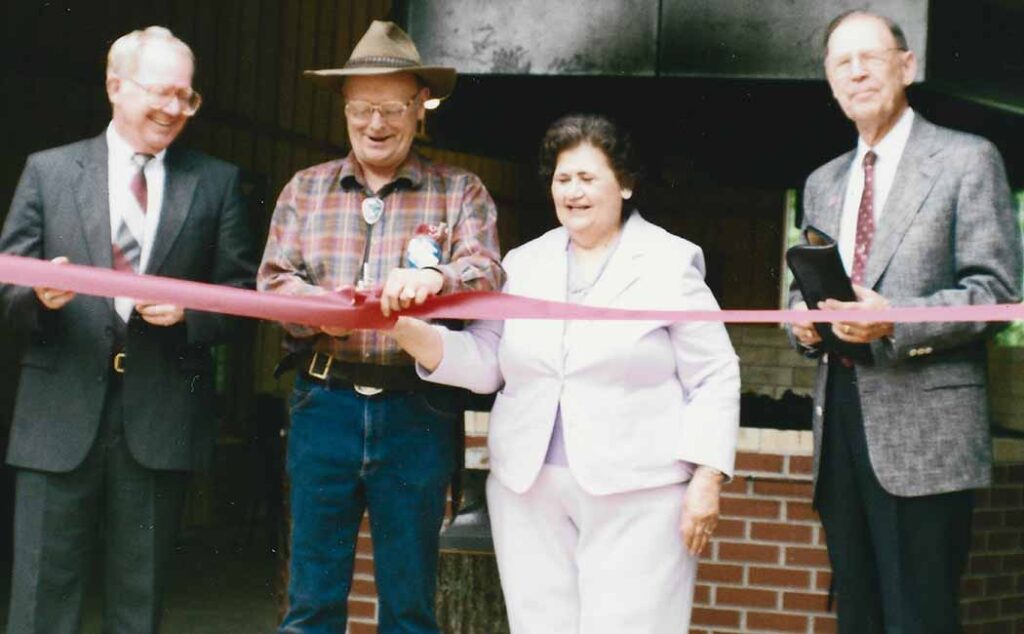
The ABS opened the Bill Moran School of Bladesmithing in 1988. The principals at the school’s ribbon cutting ceremony were, from left: Carl Nelson, president of Texarkana College, Bill Moran and Mrs. Margaret Moran, and Judge James Pilkington.

Custom knifemaker Jim Sornberger well remembers the early days of the Guild and its organization. ā€œThe Guild thing was first discussed in 1970, and that was Bob Loveless and A.G. Russell,ā€ he said. ā€œActually, A.G. bought tables for a bunch of the guys and set that up. He said, ā€˜Let’s have a show and get a block of tables,’ and so he did that. The Guild was the best organization of knifemakers in the world, and it had the biggest knife show anywhere in the world for many years.ā€

As for technology, Sornberger says it is simply a fact of life. Evidence of progress and efficiency are seen in makers’ shops routinely today, including CNC equipment, mills, lathes, ingenious versions of versatile grinders and more. ā€œYou can’t reverse technology,ā€ he reasoned. ā€œThere are always new methods of doing something.ā€

Ron Lake had a huge hand in the evolution of custom knives, introducing his clever tab-lock interframe folder and helping popularize 416 stainless. ā€œIt was a different world back when,ā€ he remarked. ā€œWe had a small corner at a gun show, and Blackie Collins was sitting off by himself 30 feet away from me with a slipjoint knife, and I remember Loveless cut himself with that knife! A lot of people came and went from the knife world back in those days.ā€

Bob Loveless knife
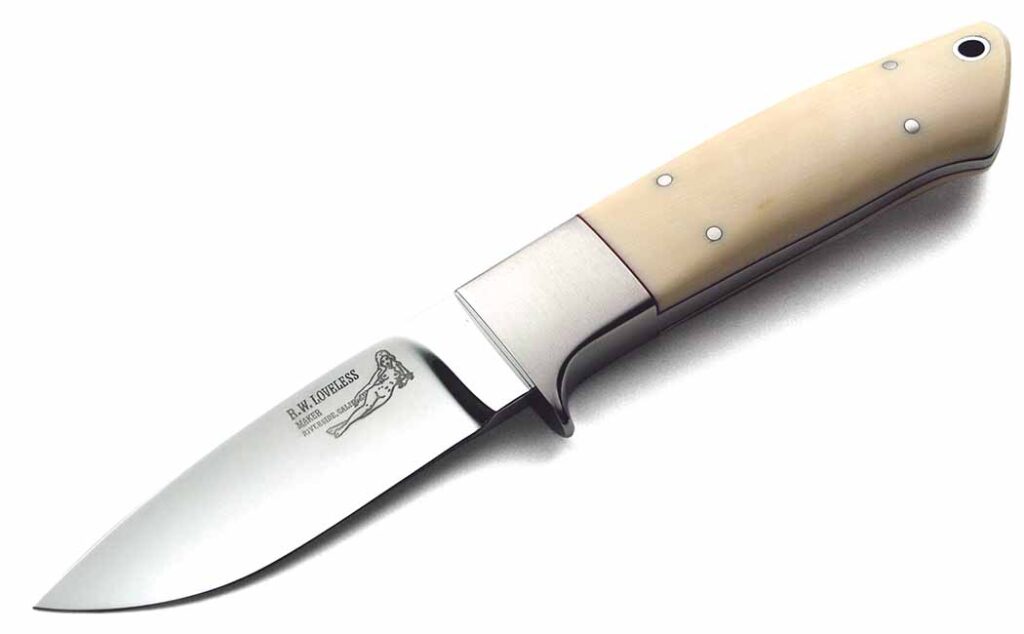
Contributions such as the dropped hunter by Bob Loveless were among the trends started by members of the Knifemakers’ Guild in the 1970s and beyond. (Exquisiteknives.com image)

As Moran brought damascus back into the spotlight in 1973 and other developments were coming along, Lake remembers the growing ranks of the virtuoso custom knifemakers, including Billy Mace Imel, Buster Warenski and others. He also recalls the sudden impact of Spyderco. ā€œI think maybe it wasn’t so much the hole,ā€ he said, ā€œbut the clip. That in itself was a mind-boggling event—maybe not so much at the time, but later as people started using it.ā€

Ron Lake, Bob Loveless, Bill Moran and A.G. Russell

The influential journalistic career of B. R. Hughes has made its own contribution to the modern knife world. Hughes was there in the beginning of the modern era. He planned the first Gun Digest Book of Knives along with Jack Lewis, and it hit the market in 1973.

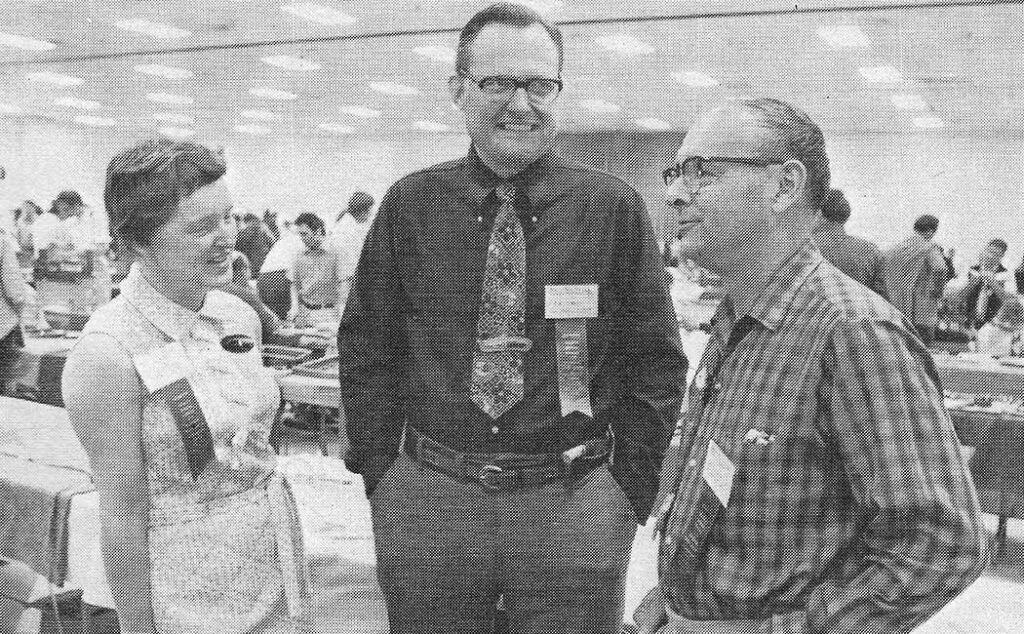
ā€œThat was a meaningful year,ā€ Hughes remembered. ā€œRon Lake, Bob Loveless, Bill Moran and A.G. Russell are the most influential individuals in the history of custom knifemaking, and A.G. played a bigger role than a lot of people give him credit for. He saw the need to organize and there was a meeting in Tulsa in 1970, and the first Guild Show was in 1971, and it grew unbelievably. They met in Houston and there were about 20 or so makers, and then the next year the show was in Kansas City, and there were 40 or 50, and it just kept growing.ā€

According to B. R., damascus was a catalyst for revival in American bladesmithing. ā€œThe inclusion of damascus saved bladesmithing,ā€ he said, ā€œand there were fewer than 15 bladesmiths in America in 1973. The number was going down. There was Bo Randall and then Rudy Ruana as well, but just a few younger bladesmiths.ā€

Bill Moran with Betty and Ted Dowell
The use of a wide range of new materials in the making of knives exploded in the 1990s and continues to this day. One of the latest examples is Bill Moran reintroduced damascus for knives at the 1973 Guild Show and the rest is history. Moran (right) observes another successful Guild Show with Betty and Ted Dowell at the ’74 event in Kansas City. (Sid Latham image), employed here by Gerry Michael on the blade of his Fancy Harpoon model. (Jocelyn Frasier image edit)

Then, he says, the founding of The American Blade weighed in. ā€œThat was immense,ā€ he offered. ā€œI started writing about knives in the early 1960s, and there were primarily just gun magazines. I wrote for Gun Week, doing some knife articles for them, but there was no knife magazine, and the people I wrote about were people I met at gun shows. Without a knife magazine, it made it tough to write about knives.ā€

Hughes added, ā€œI was fortunate to be around the first meeting of the Guild and things like that.ā€ Indeed, B. R. saw and wrote about history as it was made.

Knife Industry Ups and Downs

These days, the world of knives continues to expand, to change, to elicit praise and criticism. Britton has watched much of this evolution. ā€œQuality Chinese repros are available at flea markets and gun shows for $15 to $40,ā€ he observed. ā€œMany knifemakers are designing knives for knife companies, further blurring the differences between handmade and factory/manufactured. The internet is being used extensively for marketing—from very ornate websites to knife forums. The ā€˜Show Calendar’ page in BLADE is crammed full of announcements of shows from San Francisco to Paris. Several knife dealers have created a secondary market, and literally thousands of knives are available for sale 24/7.ā€

Concurrently, Britton is excited about what he notices these days. ā€œWe’re seeing abrasive materials, grinders, CNC equipment, new steels, and exotic types of handle materials from paua shells to hippos’ teeth,ā€ he noted. ā€œCreative craftsmen are exploring new horizons with acrylics and phenolics and stabilized wood burls. We see something new at every show.ā€

Forged in Fire
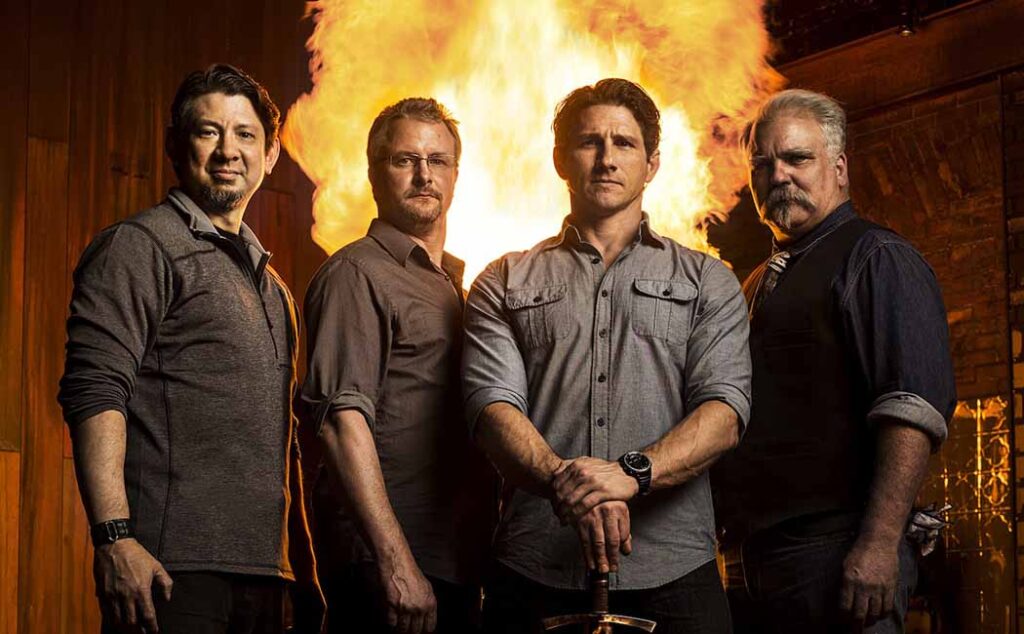
Forged in Fire debuted in 2015 and since then has exposed millions of television viewers to knifemaking and bladesmithing on a weekly basis.

That, succinctly, is a strong indication of an industry, a passion, a way of life that continues to flourish despite the strain and stress that are natural byproducts of absolutely anything and everything that is alive. A half century from now there will be more milestones, more discussions and even greater achievement.

Members of the BLADE Magazine Cutlery Hall Of FameĀ® mentioned in the story and sidebar are Blackie Collins, Sal Glesser, Gil Hibben, B. R. Hughes, Billy Mace Imel, Ron Lake, Jimmy Lile, Bob Loveless, Bill Moran, Bo Randall, Rudy Ruana, A.G. Russell, Jim Sornberger, Bruce Voyles, Michael Walker and Buster Warenski.

25 Knife Industry Milestones

1973 Bill Moran reintroduces damascus for knife blades at the Guild Show
1973 The American Blade debuts
1976 Bill Moran, B. R. Hughes, Don Hastings and Bill Bagwell found the American Bladesmith Society
1981 Spyderco debuts the C01 Worker, the first knife with both a blade opening hole and a pocket clip
1981 Michael Walker introduces a folder with the linerlock mechanism
1982 First Blood and Jimmy Lile’s Rambo knife appear in theaters
1983 Michael Walker first uses titanium in the construction of one of his linerlocks
1987 Buster Warenski completes the King Tut dagger reproduction
1988 The Bill Moran School of Bladesmithing opens in Old Washington, Arkansas
1992 Bruce Voyles moves the BLADE Show to the Renaissance Waverly Hotel in Atlanta, where it opens to rave reviews
1990s An explosion in Crucible Particle Metallurgy and the so-called ā€œsuper steels,ā€ and such materials as carbon fiber, mosaic damascus and more revolutionize knifemaking
1990s Computer numerically controlled equipment, laser cutters and more for knifemaking begin to appear
1990s Internet knife web pages, knife discussion forums, knife instruction videos and more start making their mark
Mid-1990s Tactical folders begin to dominate the custom and factory knife industries
1997 The BLADE Show moves from the Renaissance Waverly Hotel to the adjoining Cobb Galleria Centre and completes its ascendancy as the world’s most important knife event
1990s Chinese companies begin entering the factory knife business
1998 The American Knife & Tool Institute (AKTI), the oldest surviving knife advocacy group, debuts
2001 Terrorists bring down the Twin Towers and the knife industry reacts with a slew of military inspired knives, tomahawks and more
2006 The Knife Rights advocacy group debuts
2009 The knife industry unites to defeat an attempt by U.S. Customs to declare all one-hand-opening knives switchblades/automatics
2010s Social media begins taking the internet knife business to the next level
2010s Knife Rights and AKTI work to overhaul anti-knife legislation, including overturning automatic/switchblade bans and establishing knife preemption laws at the state level
2010s European knife manufacturers such as LionSteel, Fox Cutlery, Maserin and others begin winning more than their share of BLADE Magazine Knife-Of-The-YearĀ® Awards
2015 Forged in Fire debuts and exposes millions of television viewers to knifemaking and bladesmithing for the first time
2020 The pandemic ravages the world and also the knife world, closing knife shows everywhere—including the BLADE Show
2020s The knife industry survives the pandemic, and, thanks to internet sales, even thrives in some segments—and knife shows begin to return

More Knife History:

BLADE Show 2023 Custom Knife Award Winners
See who took home the hardware from the 2023 Custom Knife Awards at BLADE Show.

As usual, the Custom Knife Of The YearĀ® Awards at the June 2-4 BLADE Show at the Cobb County Gallery gather together some of the best examples of bladesmithing in the knife world. The difficulty was choosing which would rise to the top.

In a highly competitive field, a panel of expert judges sorted out the top knives in XX categories for the best of the best. Below are the winners, including the coveted Hugh Bartrug Best In Show.

Hugh Bartrug Best In Show & Fixed Blade: Vince Evans

best fixed blade and in show
Photo: Jocelyn Frasier


Best Fighter: Samuel Lurquin

best fighter
Photo: Jocelyn Frasier


Best Kitchen Knife: Lucas Gumbiner

best kitchen knife
Photo: Jocelyn Frasier


Best Folder: Owen Wood

best folder
Photo: Jocelyn Frasier


Best Tactical Folder: Thomas Gony (Grind Tactical Knives)

best tactical folder
Photo: Jocelyn Frasier


Best Handle: Fabio Barros

best handle design
Photo: Jocelyn Frasier


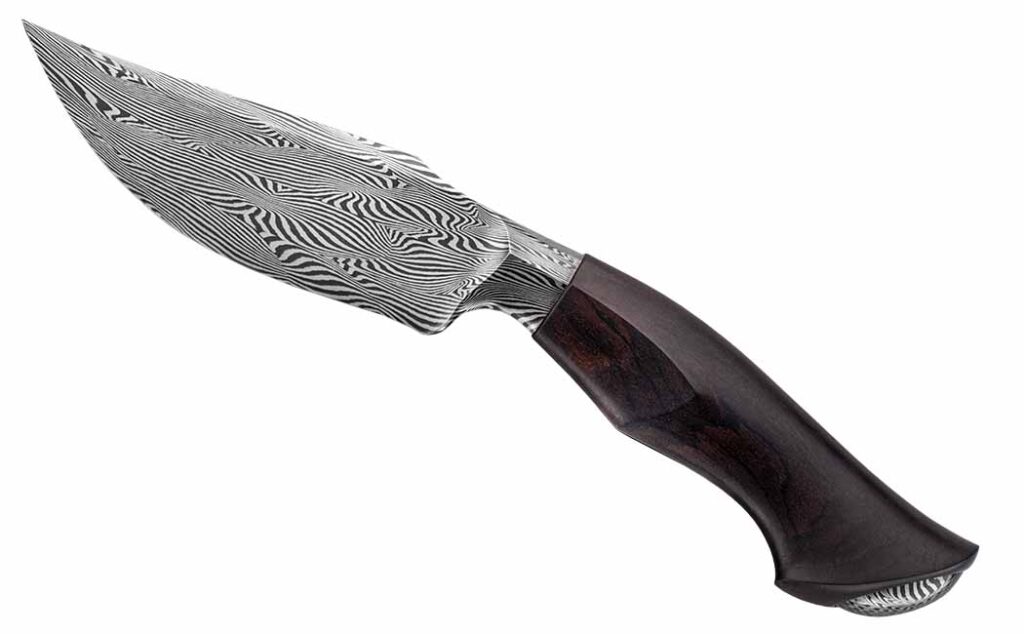
Best Utility Hunter: Oliver Goldschmidt

best utility hunter
Photo: Jocelyn Frasier


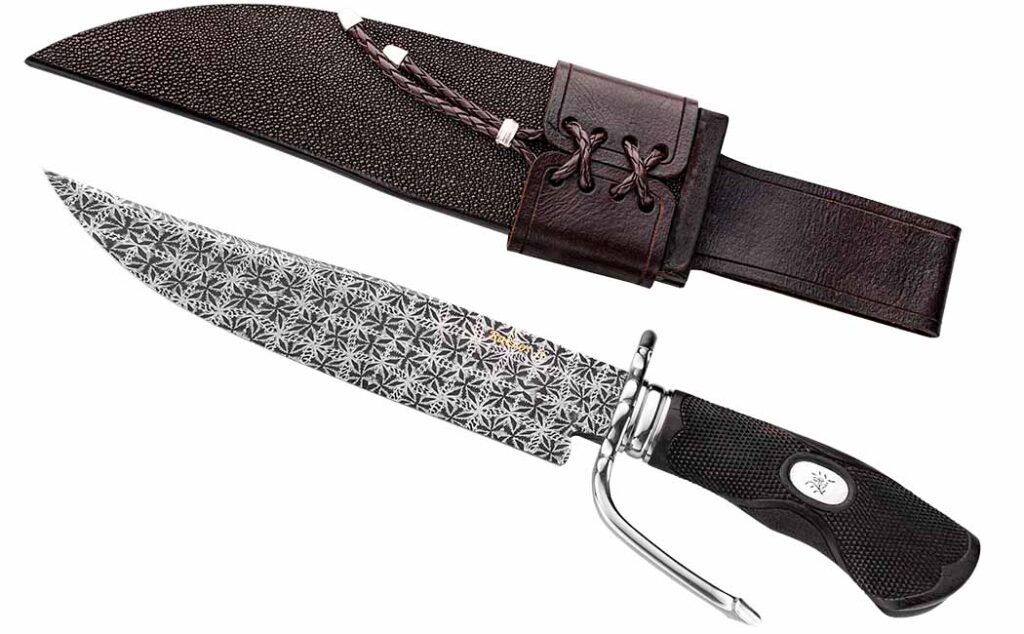
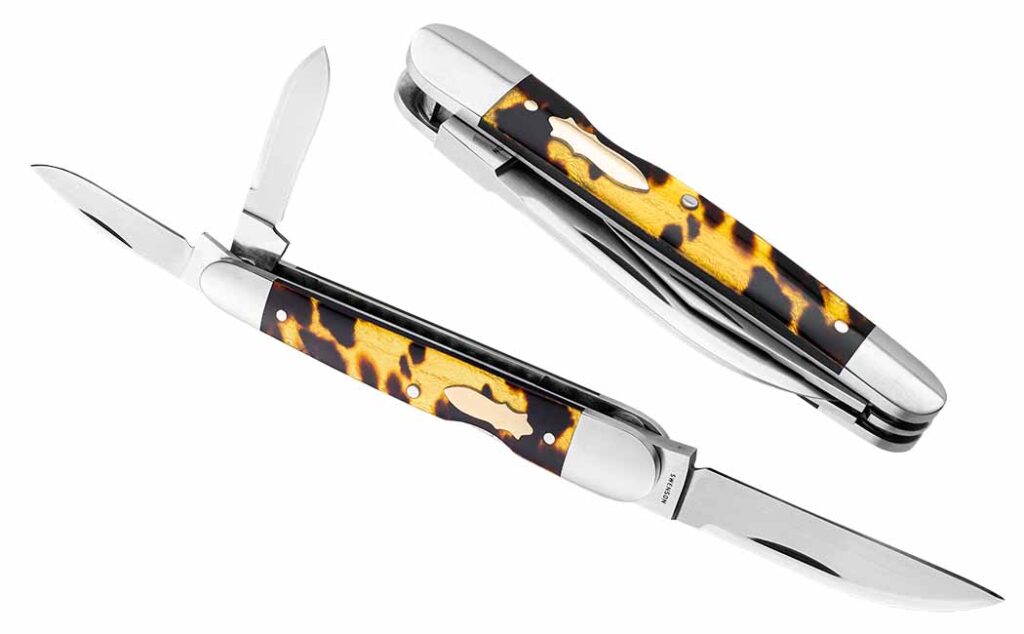
Best Slipjoint: Luke Swenson

Best Slipjoint
Photo: Jocelyn Frasier


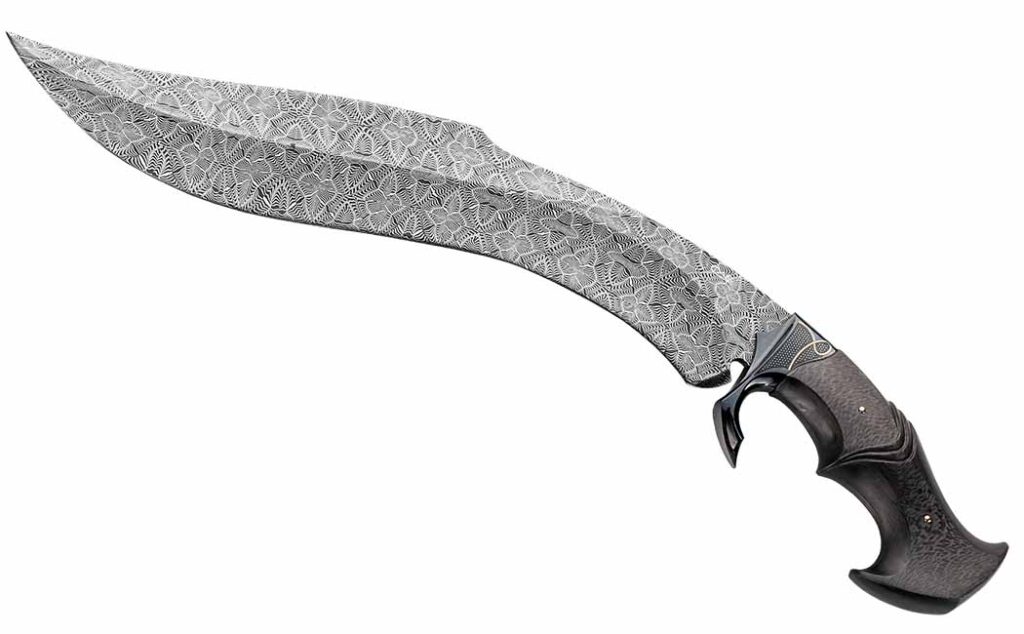
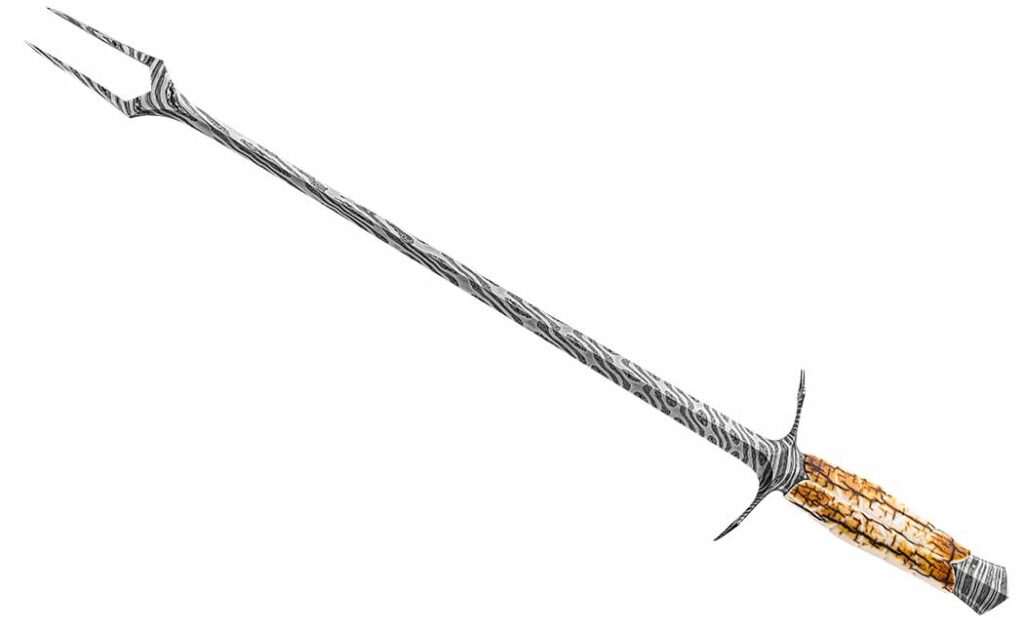
Best Damascus: CAS Knives (Sobral Brothers)

Best Damascus
Photo: Jocelyn Frasier


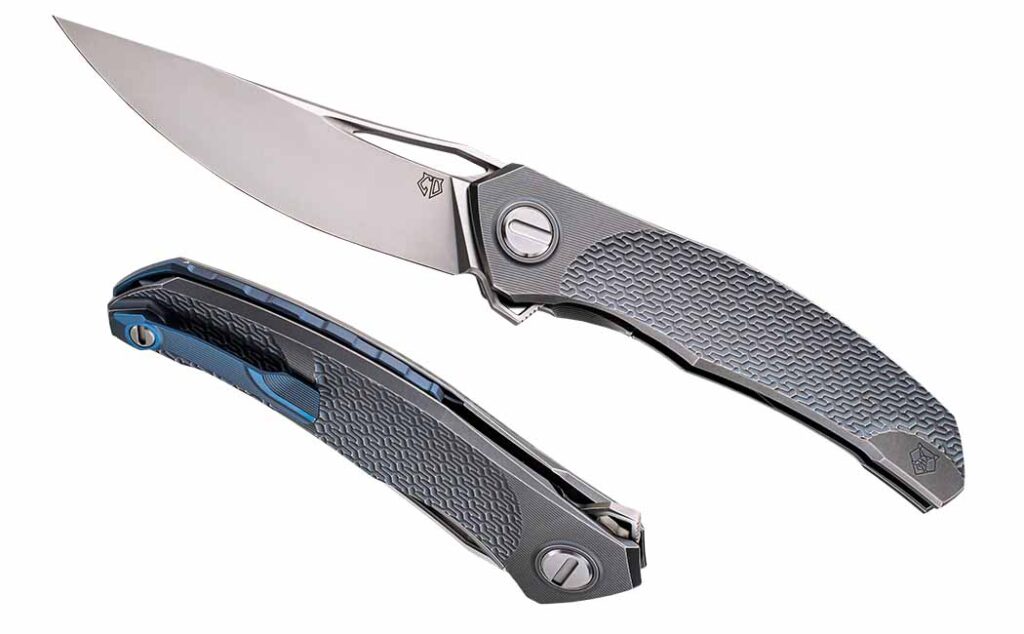
Best M.A.C.K.: Shirogorov Knives

M.A.C.K
Photo: Jocelyn Frasier


Best Collaboration: Raul Sartorial Filho (Engraver) & Fabio Barros (Bladesmith)

Best Collaboration
Photo: Jocelyn Frasier


Best Art Knife: Mauricio Daletzky

best art knife
Photo: Jocelyn Frasier


Best Bowie: Dionatam Franco

Best Bowie
Photo: Jocelyn Frasier


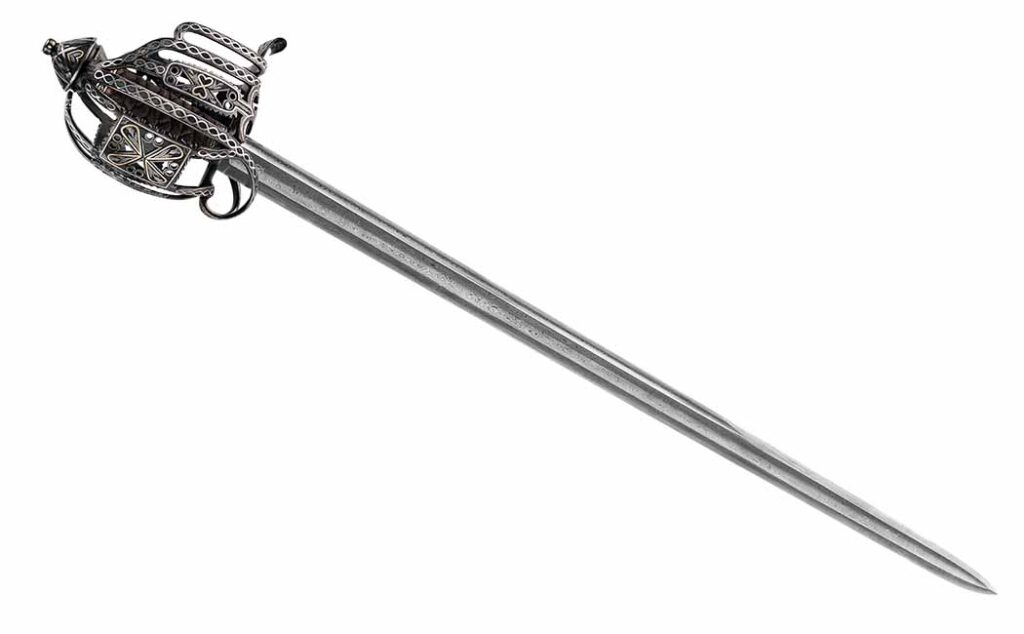
Best Sword: Vince Evans

best sword
Photo: Jocelyn Frasier


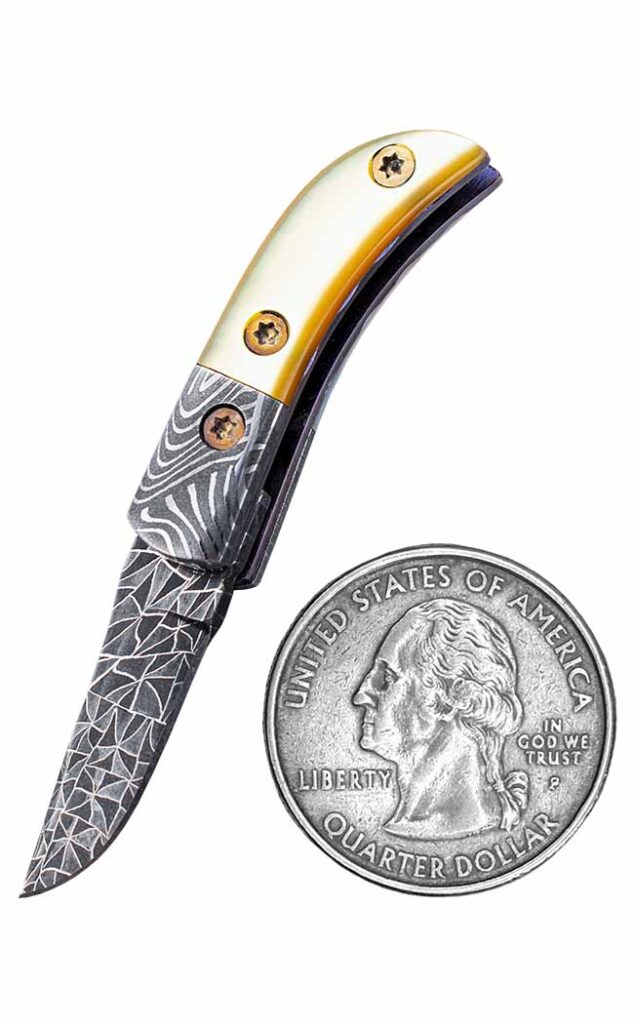
Best Miniature: Chuck Gedraitis

best miniature
Photo: Jocelyn Frasier


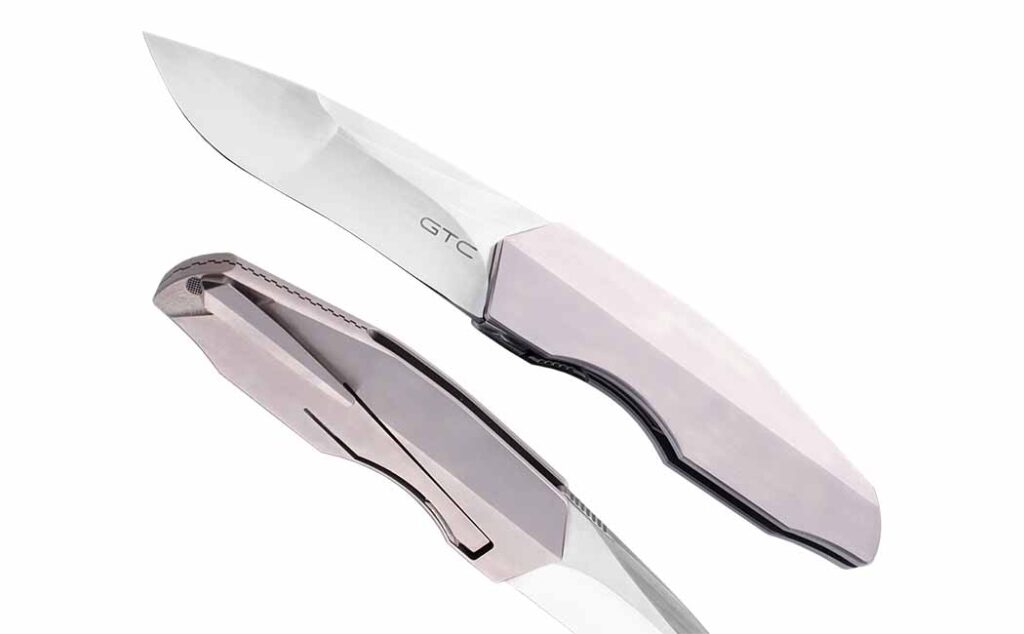
Most Innovative: GTC Knives

most innovative design
Photo: Jocelyn Frasier


Best of The Rest: Will Stelter

Best of the Rest
Photo: Jocelyn Frasier


Best New Maker: Zane Dvorak

New Maker
Photo: Jocelyn Frasier

See Past 2023 Factory Knife Of The YearĀ® Awards Winners:

  • 2022 Factory Knife Of The Year Award Winners
  • 2021 BLADE Show Knife-Of-The-YearĀ® Award Winners & Custom Knife Award Winners
  • 2019 Knife of the YearĀ® Award Winners & Custom Knife Award Winners
  • 2018 Knife of the YearĀ® Award Winners & Custom Knife Award Winners
2023 Factory Knife Of The YearĀ® Award Winners
See who took home the hardware from the 2023 Factory Knife Of The YearĀ® Awards at BLADE Show.

The June 2-4 BLADE Show at the Cobb County Gallery hosted what might have been one of its fiercest Factory Knife Of The YearĀ® Awards competition.

Seemingly every maker—at least a healthy cross-section—threw its hat in the ring to make a run for the coveted hardware. This was evident with the display cases outside the main hall that house the entrants at full capacity and nearly brimming over. Volume, however, wasn’t the lone variable. From knife accessories to the blades making a run at Knife Of The Year, the quality of work, innovation and craftsmanship proved top shelf.

Sufficed to say, the 10 judges—industry experts from knife writers to makers and Cutlery Hall Of Famers—who cast their ballots had their work cut out for them. Below are the knives that lived up to their exacting standards to take home 2023 honors in 10 categories and the overall Knife Of The Year award winner.

Knife Of The Year: GiantMouse GMX

factory - overall knife of the year
Photo: Jocelyn Frasier


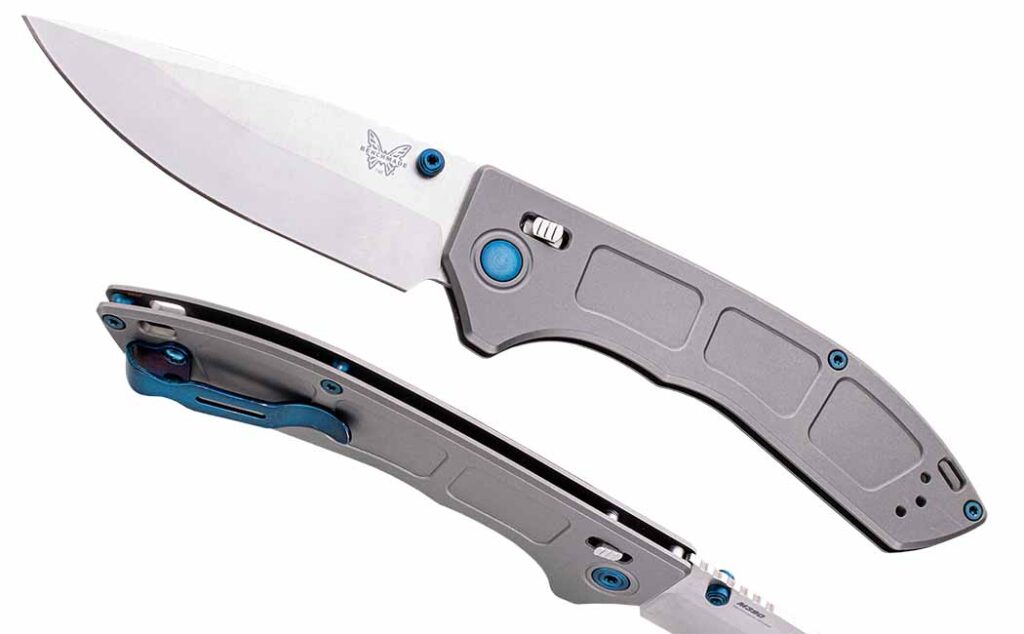
American-Made Knife Of The Year: Benchmade Narrows

factory - american made
Photo: Jocelyn Frasier


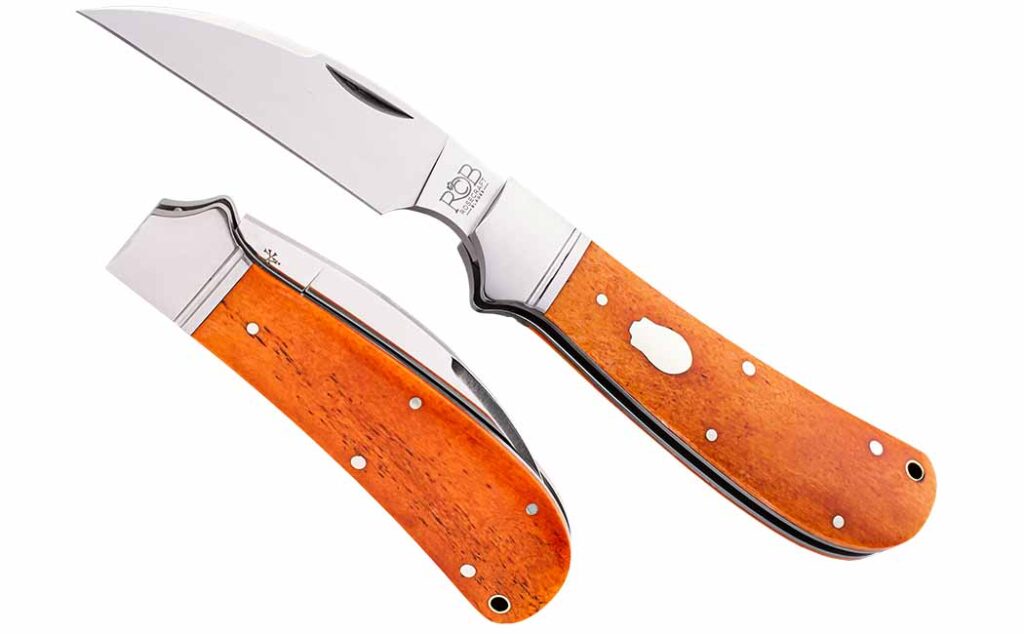
Imported Knife Of The Year: Rosecraft Blades Clinch River Swayback

factory - best imported
Photo: Jocelyn Frasier


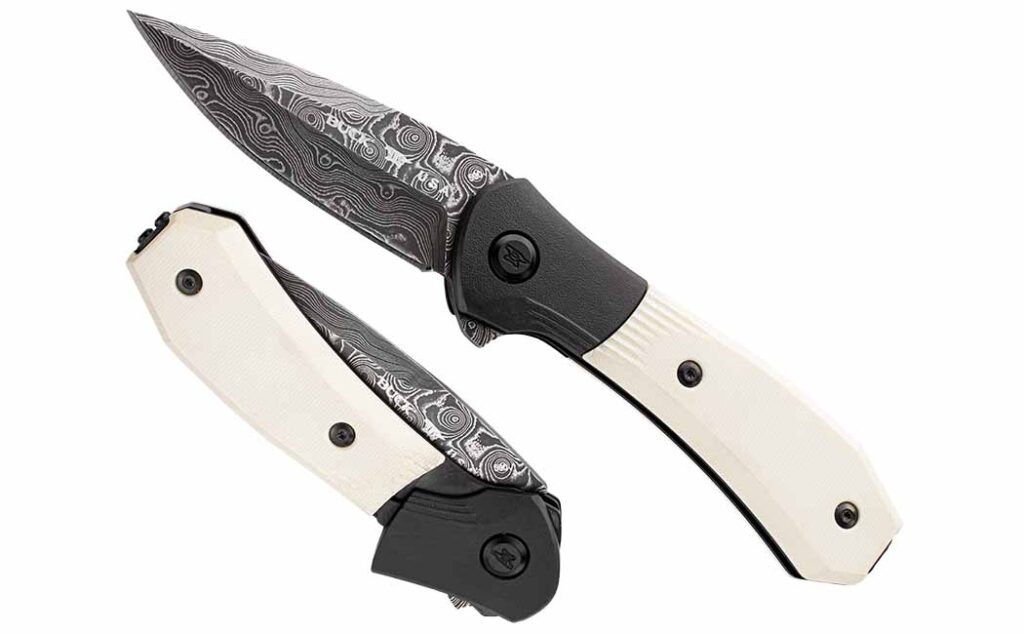
Most Innovative American Knife: Buck 590 Paradigm

factory - most innovative american
Photo: Jocelyn Frasier


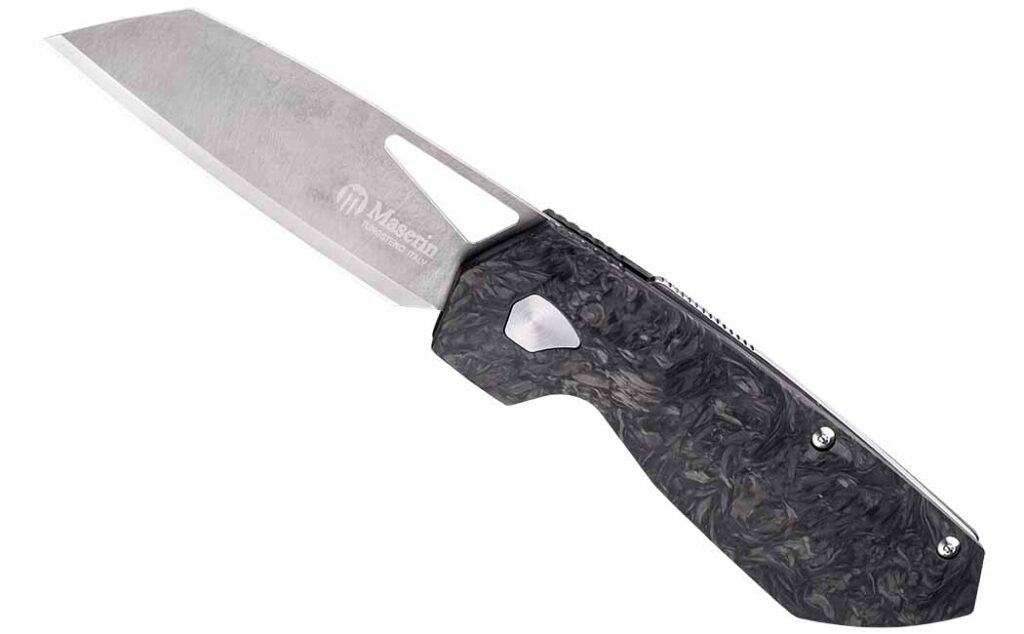
Most Innovative Imported Knife: Maserin W-Lock

factory - most innovative imported
Photo: Jocelyn Frasier


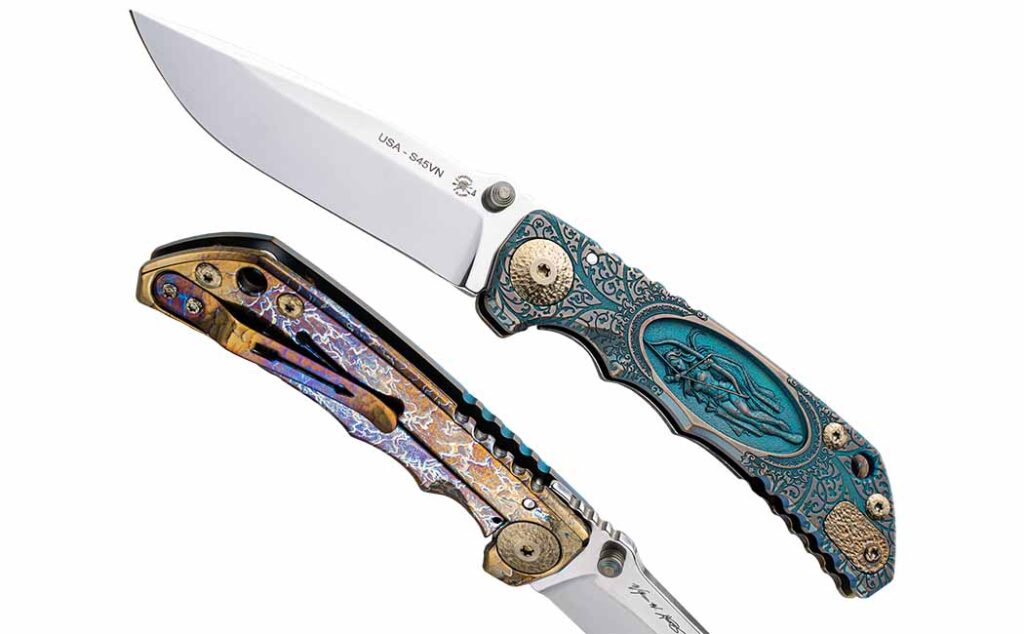
Manufacturing Quality: Spartan Blades Limited-Edition Spartan Harsey Folder

factory - manufacturing quality
Photo: Jocelyn Frasier


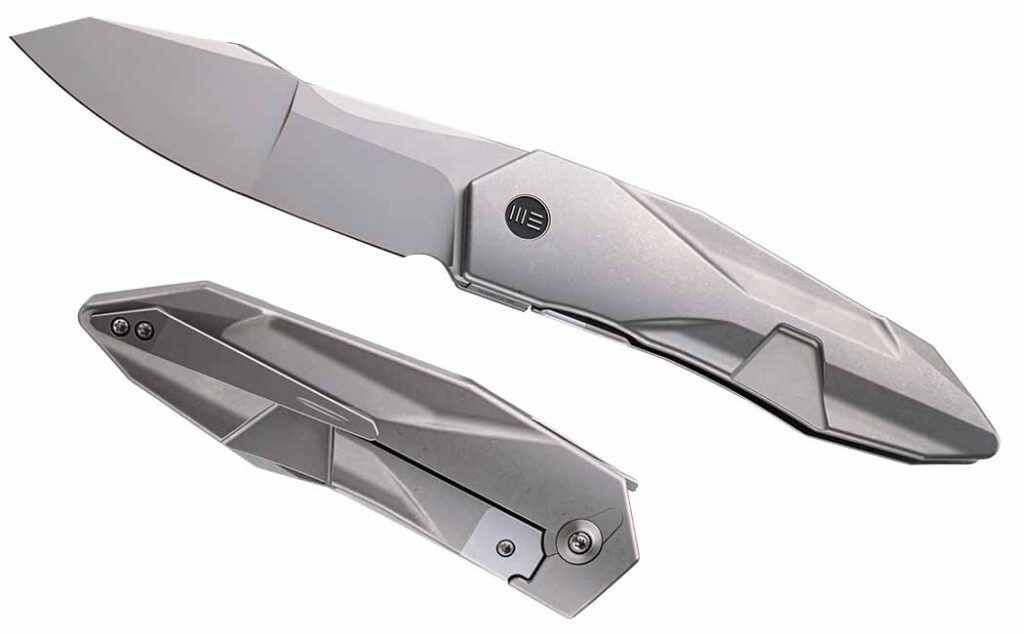
Best Collaboration: WE Knife/GTC

factory - best collaboration
Photo: Jocelyn Frasier


Best Investor/Collector: Shirogorov Knives Mini Quantum CD

factory - best investor
Photo: Jocelyn Frasier


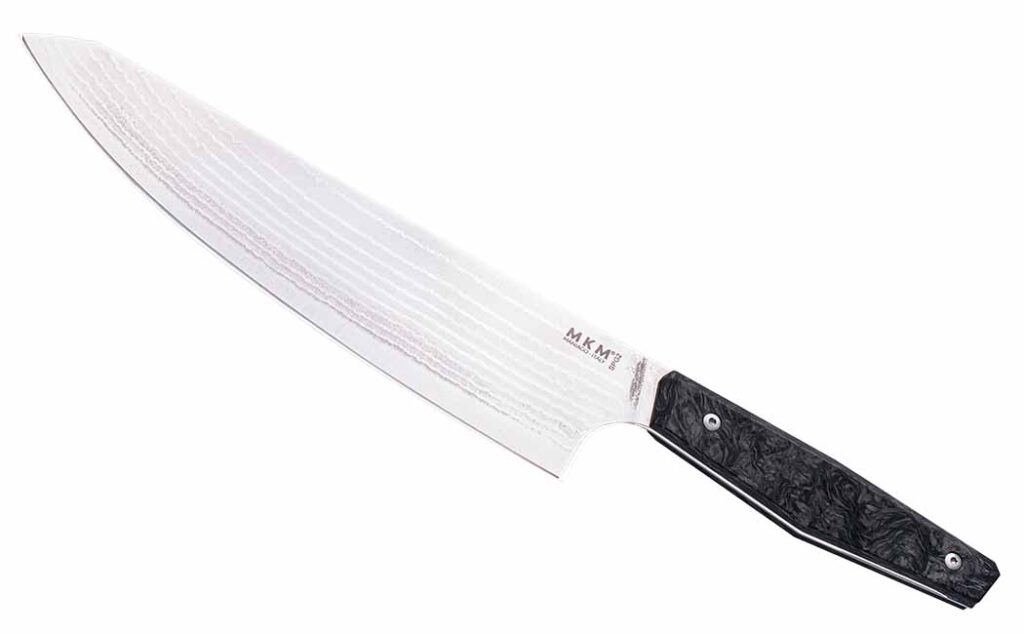
Best Kitchen Knife: MKM Prima

factory - best kitchen
Photo: Jocelyn Frasier


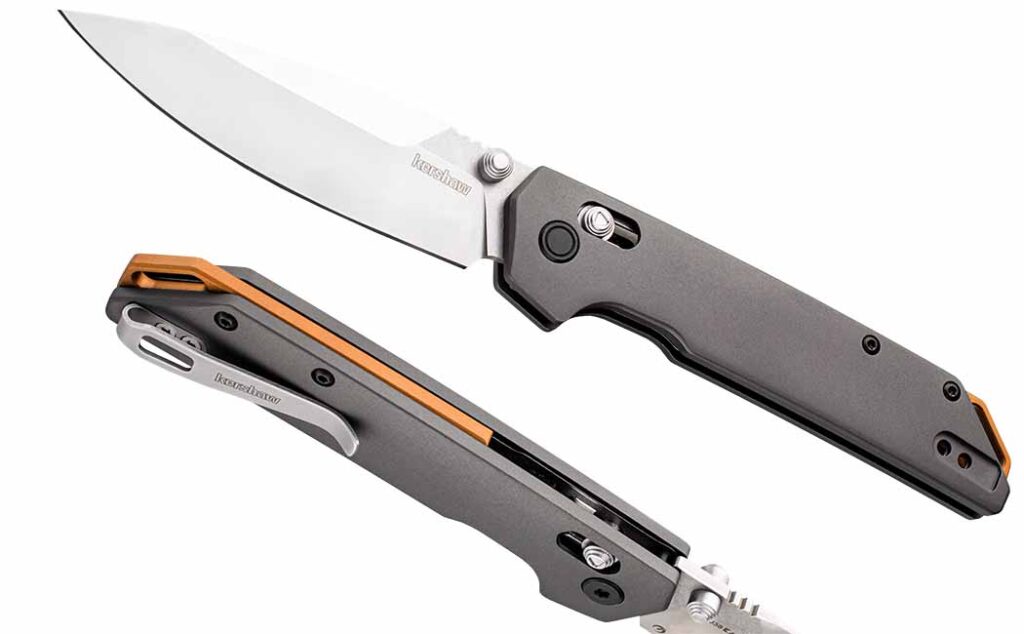
Best Buy: Kershaw Iridium

factory - best buy
Photo: Jocelyn Frasier


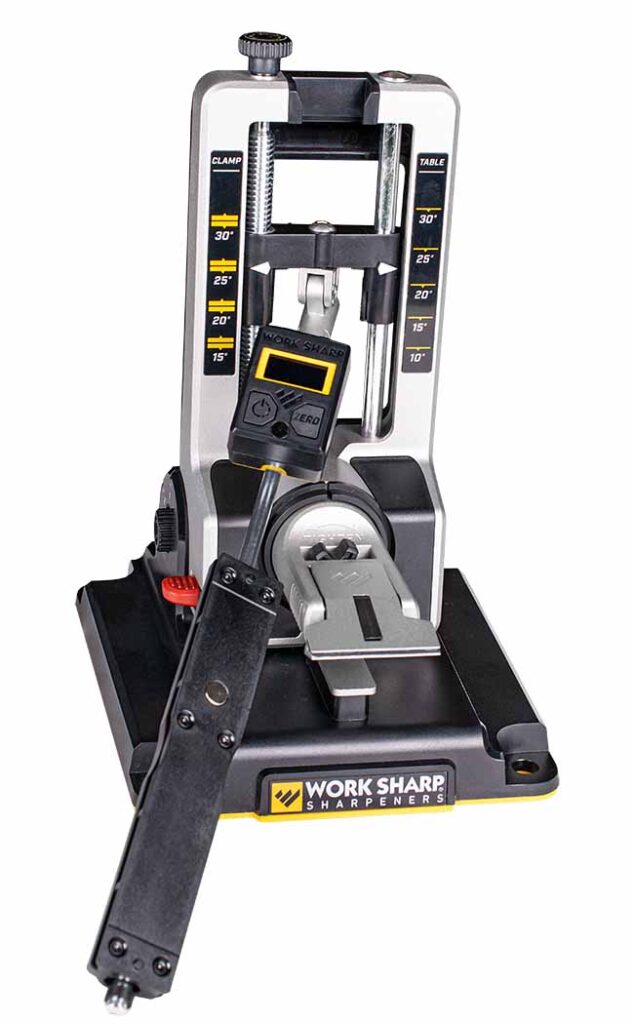
Knife Accessory Of The Year: Work Sharp Professional Precision Adjust

factory - accessory
Photo: Jocelyn Frasier

See Past 2023 Factory Knife Of The YearĀ® Awards Winners:

  • 2022 Factory Knife Of The Year Award Winners
  • 2021 BLADE Show Knife-Of-The-YearĀ® Award Winners & Custom Knife Award Winners
  • 2019 Knife of the YearĀ® Award Winners & Custom Knife Award Winners
  • 2018 Knife of the YearĀ® Award Winners & Custom Knife Award Winners

Major In Knife At BLADE University

0

Summer school never looked so good with the 10th Annual BLADE University.

Cutlery classes taught by Michael Walker, the inventor of the linerlock, Bob Kramer, world-class maker of chef’s knives, and father-and-son damascus wizards Devin and Larrin Thomas are among the highlights of a full slate of knifemaking instruction for the 10th Annual BLADE University.

Sponsored by Work Sharp, BLADE University will be held in conjunction with the 42nd Annual BLADE Show June 2-4 at the Cobb Galleria Centre. Classes begin Friday, June 2, and conclude Saturday, June 3.

While most classes are held in the Cobb Galleria, some also are conducted under the tent in The Courtyard, aka the parking lot of the show’s host hotel, the Renaissance Atlanta Waverly.

BLADE University gathers some of the world’s best knifemakers, bladesmiths and other cutlery professionals to teach a wide range of subjects for the knife aficionado and novice alike. If you love knives, BLADE University has a related topic that will interest you.

Get Your Blade Show Tickets Now!

BLADE University Friday

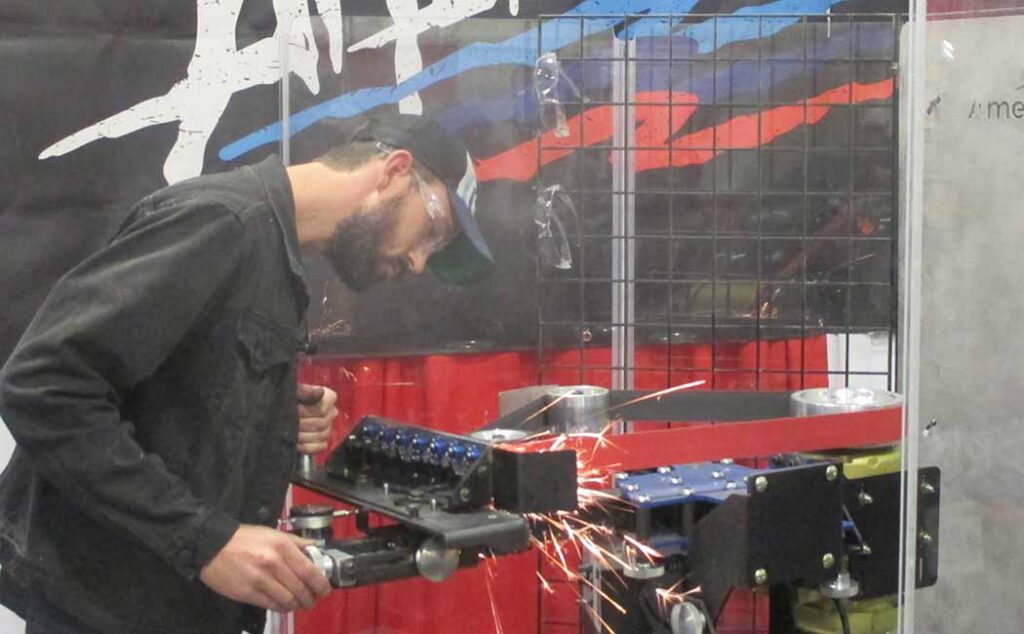
8-9:30 a.m. Fundamentals of Grinding, The Courtyard. AmeriBrade and guest makers provide a general overview on grinds, technique and different equipment. The class is interactive and the AmeriBrade team answers questions and demonstrates suggestions for common grinding issues.

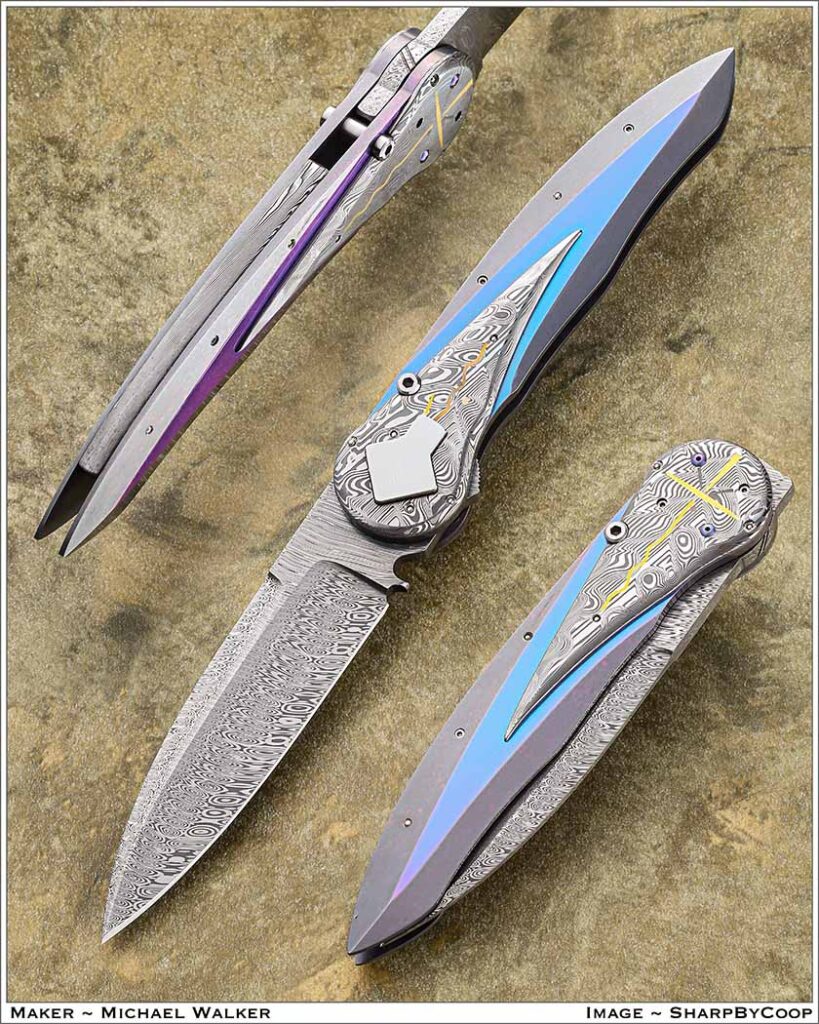
Michael Walker knives
BLADE Magazine Cutlery Hall-Of-FameĀ® member Michael Walker (inset), maker of this stunner in damascus and anodized titanium, will present his first-ever BLADE University class on several topics, including his revolutionary linerlock. (SharpByCoop knife image)

10-11 a.m. Exploring the Performance of Pattern-Welded Steel, Room 103. How does damascus perform? What are the best steel combinations for high-performance damascus? Is there really a ā€œdamascus cutting effectā€? Learn about the experiments Devin and Larrin Thomas have performed on the strength, toughness and edge retention of damascus steel.

10:30 a.m.-12 p.m. Designing Kitchen Knives, Room 104. ABS master smith Bob Kramer reviews some of the considerations to ponder when designing kitchen knives. He explains the path he took to make household cutlery and why he made the choices he did.

1-2 p.m. CRKT Presents Q&A with Michael Walker, Room 104. BLADE Magazine Cutlery Hall-Of-FameĀ® member Michael Walker answers questions regarding the linerlock he developed in 1981 that revolutionized folding knives. He also discusses the evolution of the many other locking systems he designed post-linerlock, how to secure a patent, and his process for fine-tuning details on his knives. Questions are determined in advance, though Michael entertains limited questions from those attending as well.

1:30-2:30 p.m. Dancing with the Devil: Algorithms, SEO and Ecommerce, Room 103. Ben Petersen, co-founder of Knafs, a ā€œgoofy brand of knife-related products and ideas,ā€ explains how to sell knives online and build your brand while navigating Google, Amazon and Meta.

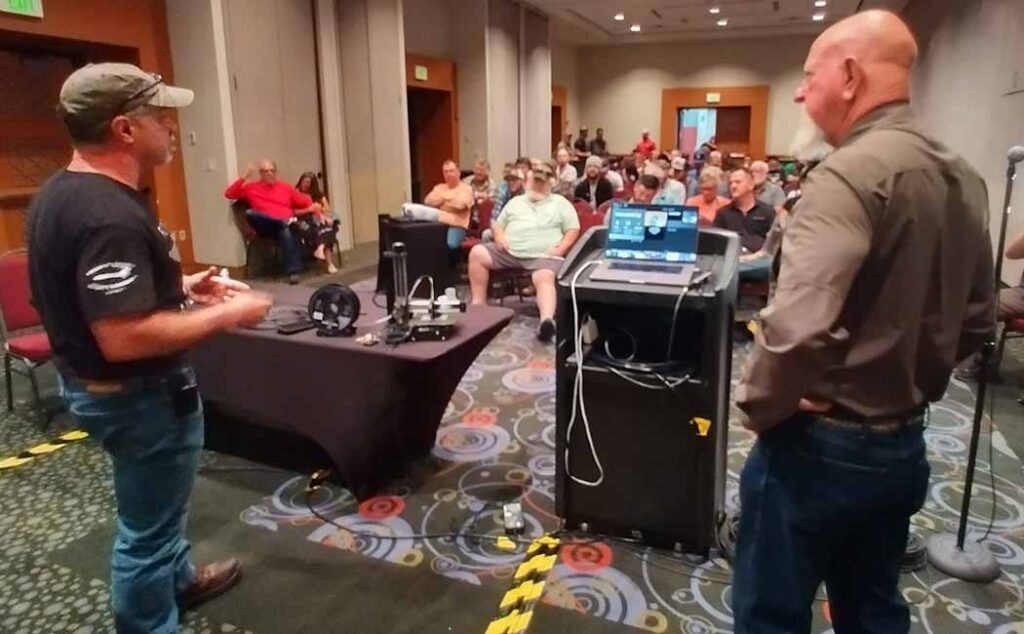
Steve Schwarzer and Ron Hardman
In ā€œ3D Printing for Canister Patterns,ā€ ABS master smith Steve Schwarzer (right) and Ron Hardman (left) show you how to use a game-changing advancement to forge patterns on a budget that were previously unthinkable.

2-3 p.m. What’s Hot in Knife Steels, Room 103. The heart of the knife is the blade steel, and few know steels like those who produce and sell them for a living. Three among the leaders in the field are Mike Norris Damascus, Nichols Damascus and Vegas Forge Damascus. Join representatives from each company as they discuss today’s hottest steels and what makes the steels so much in demand. They explore each steel’s performance, ease of sharpening, looks, other desirable traits and more.

3-4 p.m. Forging Ancient Materials and Why It’s Important Today, Room 107. Hosted by award-winning knifemaker Ilya Alekseyev, the panel explores how and why practicing forging methods used by the craftsmen of old translates into modern materials, and why it is important to establish proper forging techniques with such materials.

3:30-4:30 p.m. Hands-On Knife Sharpening, Room 113. Bring your knife or a borrowed one and learn the progression of shaping a bevel, sharpening and edge maintenance from the team at Work Sharp. You get hands-on practice and experience sharpening blades using a variety of sharpeners and abrasives, from whetstones to belts.

4:30-5:30 p.m. Unlearning Bad Habits: My Unique Path to JS, Room 107. Matt Stagmer focuses on knifemakers that have been in the craft for many years and how the path to becoming an ABS journeyman smith differs from someone learning those standards from day one. Included are tips and tricks to retrain your hands and mind.

BLADE University Saturday

8:30-9:30 a.m. Decorative Custom Knife Filework, Room 113. Knifemaker Kyle Daily of KHDaily Knives shows you his preferred files and the equipment he uses to make his five most popular filework patterns. The class outlines how to lay out your pattern and takes you step-by-step to being successful. Kyle does a hands-on demo and fields more-detailed questions at the end.

 traditional slipjoints
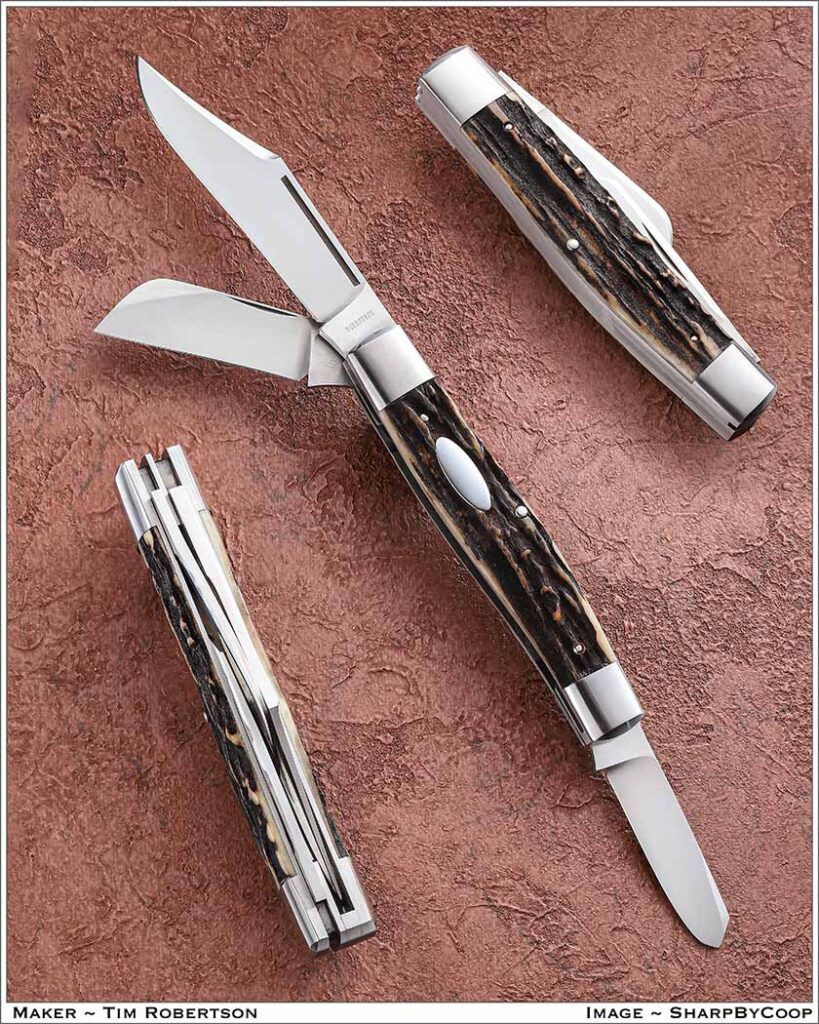
In ā€œReproducing Traditional Pocketknives,ā€ Tim Robertson covers patterning traditional slipjoints from original factory knives in detail, including methods of disassembly, correct scribing techniques and proper hole layout. His three-blade stag slipjoint is a textbook example of his award-winning work. (SharpByCoop image)

8:45-9:45 a.m. How To Forge a Hunting Knife, The Courtyard. ABS master smith Timothy Potier demonstrates how to forge a full-tang drop-point hunter. Using his propane forge, Timothy goes through the entire process, including forging the blade to shape from tool steel. He also discusses heat treating, normalizing and more.

9:30-11 a.m. How To Run a Successful Knifemaking Business, Room 104. ABS master smith Bob Kramer shares his 35 years of experience running a successful knifemaking business and tips to employ along the way.

9:45-10:45 a.m. Reproducing Traditional Pocketknives, Room 107. Tim Robertson covers patterning traditional slipjoints from original factory knives in detail, including methods of disassembly, correct scribing techniques and proper hole layout (including changing the hole diameter). He also covers methods of using paper patterns commonly found on the Internet.

11 a.m.-12 p.m. 3D Printing for Canister Patterns, Room 113. Learn how to leverage 3D printer technology to make mind-blowing canister damascus patterns. ABS master smith Steve Schwarzer and Ron Hardman show you how to use this game-changing advancement to forge patterns on a budget that were previously unthinkable.

Grinding a knife
AmeriBrade and guest makers provide a general overview on grinds, technique and different equipment in ā€œFundamentals of Grinding.ā€

2-3 p.m. Let the Pros Critique Your Knife, Room 104. A panel of top cutlery craftsmen share decades of knowledge and experience in critiquing your custom knife. Award-winning makers Lucas Burnley and Luke Swenson, ABS master smiths David Lisch and Mike Quesenberry, and damascus-forging pioneer Devin Thomas examine your knife and tell you what’s good about it, what’s not and how you can make it better. Bring one knife only. Questions from attendees will be entertained throughout.

2:15-3:15 p.m. Hands-On Knife Sharpening, Room 113. Bring your knife or a borrowed one and learn the progression of shaping a bevel, sharpening and edge maintenance from the team at Work Sharp. You get hands-on practice and experience sharpening blades using a variety of sharpeners and abrasives, from whetstones to belts.

2:30-3:30 p.m. Writing for a Knife Publication, Room 107. Author/knifemaker Jason Fry and a panel of industry insiders share the tips and tricks it takes to get into the knife writing industry. Topics include idea submission and topic selection, interviews and content generation, methods for obtaining quality pictures and more.

4-5 p.m. Folder Design, Room 104. David Carver of Carver Knife Company teaches techniques on making a folding knife that works well, looks good and feels great in the hand/pocket.

Read More About The Blade Show:

Advertisement

Must Read Articles

Read this before you make a knife

Knifemaking 101 – Read This Before You Make a Knife

  by Wayne Goddard My experience has taught me that there's nothing like digging in and getting started. I've often said the hardest part of the...
how to forge damascus steel

How to Forge Damascus

Advertisement
Advertisement