Joe Kertzman's Blog

Knife news, people, top picks and patterns

YOUR Knife-Of-The-Year® Award

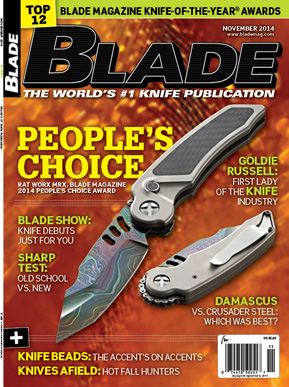
01_1114BladeCoverUS

For only the second time in BLADE Show history, a Knife-Of-The-Year® Award will be chosen by knife enthusiasts just like you. Log on to www.blademag.com/2015-peoples-choice and vote for your favorite knife, as submitted by knife companies and knifemakers that will be at the BLADE Show. The knife with the most votes will win the People’s Choice Knife-Of-The-Year Award, to be presented June 6 at the 2015 BLADE Show in Atlanta.

Show your support, have fun, and tell your friends! Voting is open now!

Everybody Wing Chung Tonight (with Knives 2013 Wing Chung Swords)

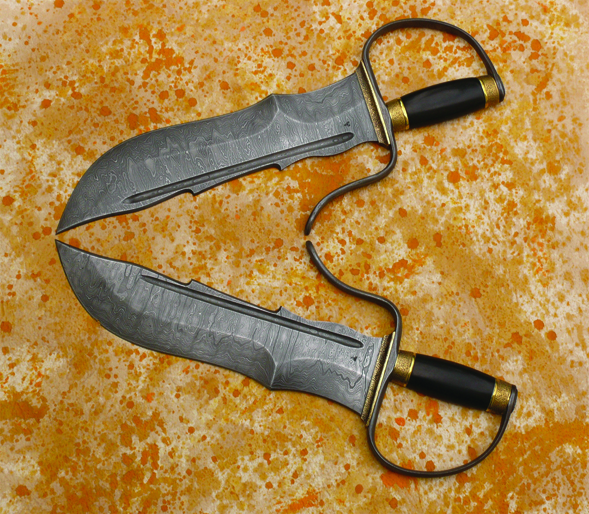
Featured in the “Foray Into the Far East” Trends section of the Knives 2013 book are a pair of Richard Van Dijk “Wing Chung” Chinese martial arts butterfly swords. Rarely do you see knifemakers tackle the pattern, and thus they catch your eye immediately, and then with the inclusion of 400-layer-damascus blades, ebony handles, brass fittings, iron guards and a side-by-side scabbard (not shown), they elevate themselves to one of the “Editor’s Favorites from the Knives 2013 book.”

I especially like how the brass fittings complement the ebony grips, and the D-guards trail down, extending into sword catchers for extra protection.

Neat stuff, Richard Van Dijk!

Knife Trends—Flipper Folders

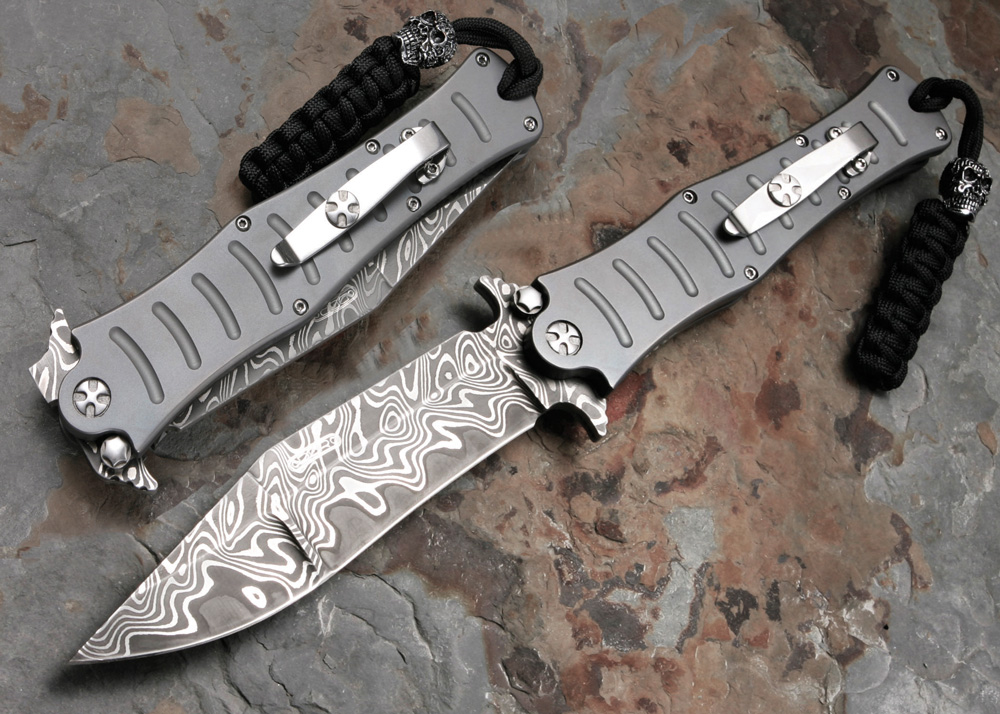
When it comes to big flippers, one of Darrel Ralph’s Madd Maxx 5.5-inch MGB bearing models fills the bill. In this instance, Ralph outfits his big flipper with a blade of PD1-core san-mai damascus forged by Chad Nichols. The knife comes in a run of 25 numbered pieces.

Flipper folders are wildly popular. Aside from adding an interesting visual element to any knife, the flipper serves a few key roles, including as a one-hand opening device, and as a guard.

Just like innovation and technology drive any industry, the same can be said for the knife industry. What’s neat about knives is that they’re often designed by handmade knifemakers, craftsmen, really, and innovations often take the form of folder locks, assisted opening devices, and in this case, flipper folders.

While the Strife, a collaboration between Brous Blades and Dustin Turpin, is a big flipper, Jason Brous said size is not so important as design execution.

There are some monster flipper folders today. As Dexter Ewing writes in the March issue of BLADE®, “Flipper folders, aka flippers, continue to be wildly popular. Aside from adding an interesting visual dimension to the knife, the flipper—a simple protruding lobe at the bottom of the blade’s tang—serves a few roles. One is as a quick and convenient one-hand opening device. Clutch the closed knife’s handle, give the flipper a swift tug with your index finger and the blade has enough inertia to propel itself to the open and locked position. The flipper also serves as an integral hand guard when the knife is open, providing a physical obstruction to prevent your hand from sliding forward onto the blade.”

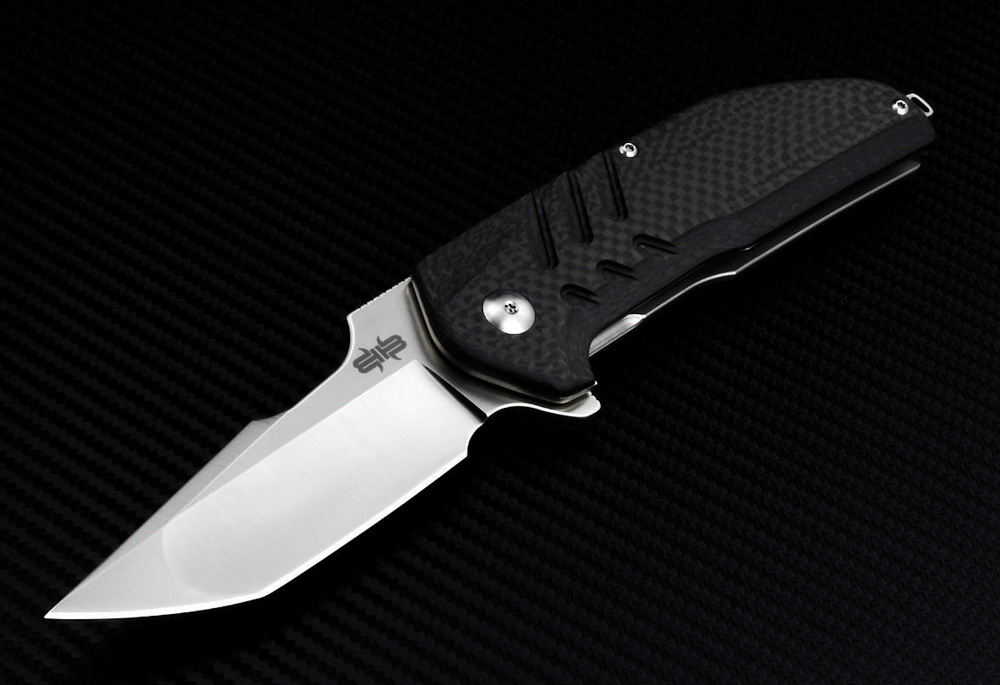
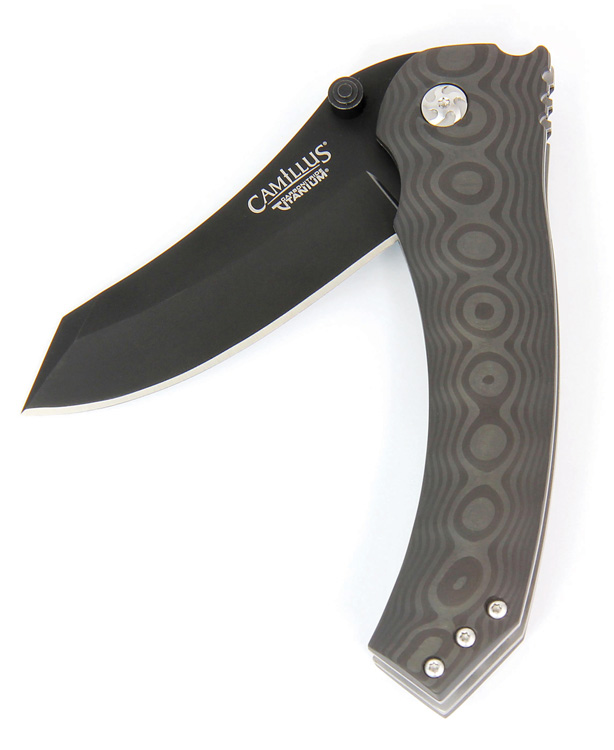
At 8.5 inches long open, the Camillus Jolt designed by Will Zermeno is a big flipper in every sense of the word. The 3.25-inch blade is hollow-ground D2 tool steel and the scales are a carbon fiber with a subtle pattern designed to enhance the frame’s curved shape.

To read the rest of the story, see the March issue of BLADE. 


Recommended for You:

Tactical Knifemaking.Making Tactical Fixed Blades DVD

Learn both basic and advanced knife making techniques with expert instruction from Allen Alishewitz in Tactical Fixed Blades. Allen demonstrates how to craft a double-edged tactical fixed blade knife from start to finish, and creates two knives in order to fully illustrate the knife building process. You’ll learn:

– Profiling and Drilling the Knife
– Tang Tapering on a Grinder
– Tang Tapering on a Mill
– And more!

Order here

Innovative Knives

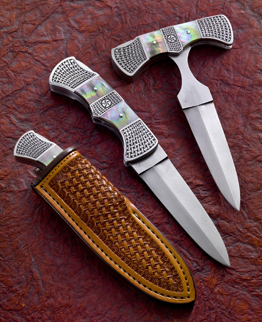
Congratulations to Michael Vagnino for winning the 2014 Wooden Sword award, given out to one custom knifemaker each year on page 7 of the KNIVES annual book. The yearly prize (no trophy, just recognition via top placement and imagery in the book) is awarded to a knifemaker for his or her work that stands out from the thousands of images that pour in annually for consideration. 2_Convertible

As noted in the book where his innovative knives are pictured:

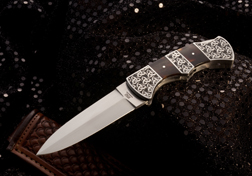
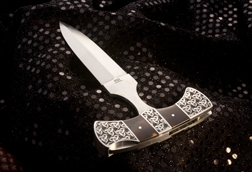
“Michael Vagnino has busied himself most recently with “Convertible Lock-Back Push Daggers.” Yes, that’s correct, he’s fashioning handmade knives that convert from a lock-back fixed-blade position to a locked push dagger and back again. The models shown here sport 3.875-inch blades, one in CPM-154 stainless steel and the other Wootz steel, the former combined with an antique tortoise shell handle, and the latter in black-lip mother-of-pearl. The maker engraved the 416 stainless steel bolsters, and since the push daggers covert to fixed blades, Paul Long sheaths were necessary as fashionable carry options.convert tort1 convert tort2


For all he has brought to the knifemaking table the past few years, his innovation, talent, all-around good vibes, and for these particularly striking examples of his work, the Knives 2014 Wooden Sword Award goes to Michael Vagnino. Congratulations, Michael, and keep up the good work.”

Click here to reserve your copy of KNIVES 2014.

Knives For Mother’s Day

When I think about my mom today, or reflect on growing up and remembering Mom back then, knives weren’t a big part of her or my culture. But the food, oh, the food! That I remember, and Mom always had plenty of kitchen knives from which to choose. What I really remember is her hands, red from hot dishwater, or dry from work and wear, and there was a certain cutlery set she and Dad saved for and eventually bought. I think Mom still uses those knives today.

As far as kitchen knives go, I asked some industry professionals which of the knives in their respective company lines would make nice gifts for Mom on Mother’s day, and here’s what a few of them had to say:

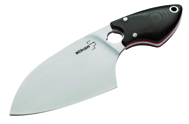
Boker 03BO050

“It just looks cool. On first impression, you just have to pick it up. The compact size of the Boker Sanyougo offers the function of the popular Santoku design in a very compact size. The handle material options—G-10, canvas Micarta® and white Micarta—make it a functional piece for rugged use or a touch of elegance. If Mom cooks a lot, it’s certainly something she would use and most likely does not have.”
—Dan Weidner, Boker USA

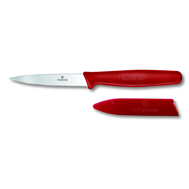
Victorinox paring knife“The $9 price tag on the Victorinox Paring Knife With Sheath is amazing for the quality. The lifetime warranty alone is worth more than that. Also, the peace of mind knowing that you are investing in a Swiss-made quality knife that will remain razor sharp well past when your kids are off to college is a benefit for any parent. The red color is also a market trend.”
—Rob Sterner, Swiss Army Knives

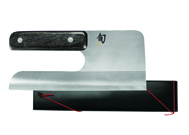
Shun Blue Menkiri“If mom makes homemade noodles or pasta, or has been itching to try it, the Kai USA Shun Blue Menkiri [the “Blue” refers to the blade steel, not the color] is the tool for her. The overall design of the knife is one few people in the U.S. have used, and Shun is happy to be able to offer a piece perfected in the noodle-loving culture of Japan for making noodles and other fresh pasta. The clean, precise feeling as it cuts through noodle dough is a real pleasure.” —Steve Grutbo, Kai USA

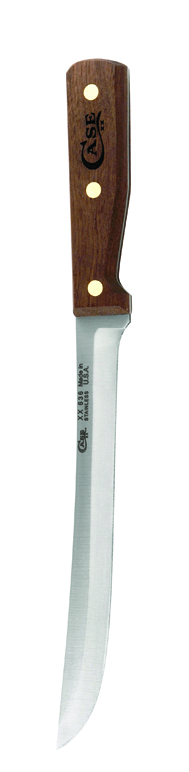
Case 07317_slicing“Very few of the products I write about do I actually use in my daily life after the review. But the handle of the W.R. Case & Sons 9″ Slicing Knife is sturdy and classy, and the blade always cuts whatever I want with precision and ease. All of Case’s knives in the Household Cutlery Set are superior. Rarely do I have to resharpen it, but when I do, the sharpening steel is intelligently included as part of the set.”
—Peachy Deegan, founder and editor-in-chief of www.whomyouknow.com

Well, Mom, and all moms, here’s to you. Happy Mother’s Day. You all deserve it. And if interested in similar knives for mom, or more choices, be sure to visit www.shopblade.com/kitchen-knives or www.shopblade.com. And get Mom a gift she’ll use, appreciate, and one that will last her for the rest of her days.

Fish Knives Combine Form & Function

Here’s plenty of proof that a fillet knife can be put to extreme use, and still be a work of art.

The following is written by Tom Carpenter, and reprinted from the June 2013 issue of BLADE® Magazine.

Filleting fish under wet, sometimes salty conditions isn’t the kind of work or environment you want for your best knives. So you might suffer through with a mass-produced imitation of the real thing. But there’s no need to use an inferior tool. Consider the fish and fillet knives of Phil Wilson, Todd Kopp, Kevin D. Cross and John Cammenga of White River Knife & Tool. First, let’s get right down to the fish knife fundamentals.PhilWilson2
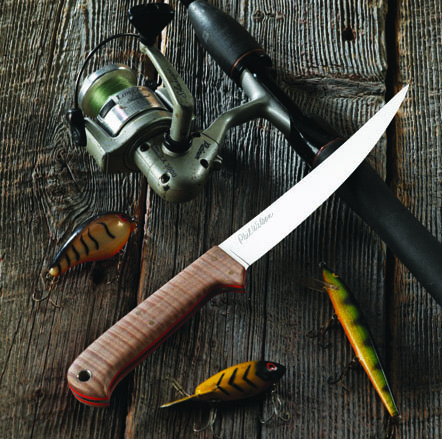
Knifemaker Phil Wilson’s “Shelter Cove” fillet knife (left) sports a 7-inch N690 blade, a fiddleback-maple handle and red spacers. He says a fillet knife should have some flexibility and be ground thin.


The basic features that make for a functional and efficient fillet knife are: a comfortable, secure grip that won’t slip and slide in your hand while doing wet, slimy chores; a sharp blade that is relatively thin and flexible for precision work, and holds an edge; and materials that can stand up to abuse like moisture, blood, and frequent washing and drying.

Wilson, Kopp, Cammenga and Cross craft fish and fillet knives that fit all these criteria and more. Here’s where they put their focus.

Working under the business name Seamount Knife Works, Wilson has been making fillet knives for almost 30 years. “A simple design is best,” he says, “clean and smooth without a lot of holes and crooks and crannies to get packed up with gunk. A good finger guard and a butt end on the handle prevent slippage under wet and slimy conditions.”kc3
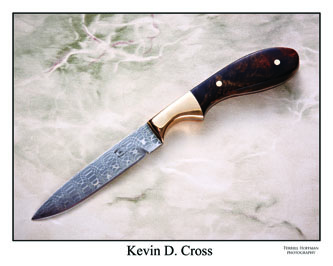
As far as the stainless-damascus blade Kevin D. Cross used for his bird and trout knife (left), the maker says there is a segment of sportsmen who appreciate a beautiful and functional knife. The piece also includes a desert-ironwood handle and bronze bolster. His list price: $400. (Hoffman photo)


As for blade material, “stainless steel is mandatory,” stresses Wilson. “I have used 440C, 154CM, AEBL, CPM-S90V, 12C27, CPM-S60V, CPM-S30V and CPM-154. Yes CPM-S90V—it still makes an awesome fillet knife, but now I feel it is overkill for the application. Given proper heat treatment, they all make a good fillet knife. These days I am using CPM-154, CPM-S30V and N690 mostly. These steels are in pretty much the same category for edge holding and ductility. A [reading] of 60 HRC seems to be the best target hardness for all of them.”

Blade characteristics are important, too. “A fillet knife should have some flexibility and be ground pretty thin,” says Wilson. “I like a springy feel in the first half of the blade from the tip back. Flex is a function of the blade geometry rather than hardness or steel grade.Mike Mooney Best Filet

Mike Mooney’s “Coho” model (left) won Best Fillet Knife at the 2011 Professional Knifemakers Association Show. It sports a 6-inch CPM-S30V blade, a dyed and stabilized redwood burl handle, and a 416 stainless steel bolster. (Buddy Thomason photo)

“Blade lengths from 6 to about 9 inches will handle most fillet work,” he adds, “and also double as boning, slicing and carving knives in the kitchen. Edge holding on a fillet knife is not quite as important as on a hunting/utility knife. A fillet knife can clean a box of fish and then get touched up at home or on the boat later. So a little lower hardness can be traded off for some added ductility on a thin, flexible blade.”


Non-Slip Grips

Handle material is critical. “I’m using mostly canvas Micarta® handles,” states Wilson. “An option is G-10. Both are naturally non-slip and do not soak up moisture.”

Kopp earned “Best Fillet Knife” honors at the 2010 Professional Knifemakers Association Show with his damascus fillet knife. He strayed from traditional stainless steel for his award-winning knife, opting instead for a damascus of 1084 and 15N20 carbon steels.StepUp_8_Maple_02
John Cammenga of White River Knife & Tool offers wood-handle fillet knives like this model (left) with a SM-100 blade and tiger-maple handle. Cammenga explains, “At the BLADE Show and SHOT Show, we introduced the world’s first fillet knife made with a blade of SM-100, a corrosion-proof alloy. This particular custom measures 63 HRC on the Rockwell hardness scale, features a 3/16-inch-thick spine and is still flexible! It is a ‘step-up design’ where the handle is notably higher than the cutting edge. The knife was designed by Steve Geelhoed, and while the original is not for sale, replicas sell at $750 each.”

“I used carbon steel on this because it holds an edge better than some of the stainless steels,” Kopp explains. “It does, however, require more care than stainless blades.”

The attractiveness of the damascus pattern is certainly inviting. “Yes, it’s kind of unique seeing a damascus blade on a fillet knife,” he admits. And what about function? “My brother used it on a fishing trip,” Kopp relates, “filleting 30 or so fish with it, and he was pleased with its performance. In fact, I think it outperformed an electric fillet knife!”Kopp Best Fillet orig
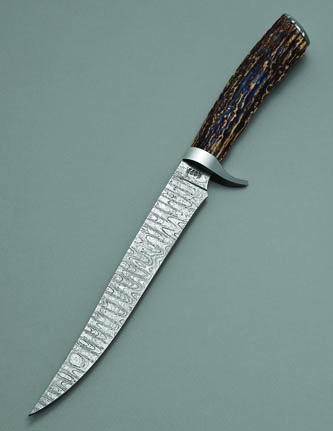
Maker of the Best Fillet Knife at the 2010 Professional Knifemakers Association Show, Todd Kopp chose a 7.5-inch damascus blade and sambar-stag handle for this particular model (left). Note the small details like how he carved the 416 stainless steel buttcap to match the natural grooves of the stag. The maker’s list price: $475. (Buddy Thomason photo)

Cammenga runs White River Knife & Tool, a family-owned business with a full array of fillet knives in its line. “A strong case can be made for many great alloys available today,” he says. “We chose 440C for our Limited Production and Custom Finished versions in 2013. This high-carbon, stain-resistant steel retains our hand-sharpened, leather-honed edge for a very long time. It also provides reasonable corrosion resistance.”

Cammenga uses wood handles on the fillet knives. “The wood is stabilized and will not shrink, swell, or absorb blood or oil,” he explains. “We also offer a cork handle with a wooden pommel. The cork handle with a 6- or 8-inch blade will float [if the knife is dropped in the water]. Also, our unique ‘step-up design’ helps to keep the handle [and knuckles] a little farther off the cutting area, a nice feature when filleting on less than ideal surfaces.”

Flexible On Flexibility

Cammenga says he thinks blade flexibility on fillet knives is largely a personal preference. “At the 2013 SHOT Show, we received some comments that our blades could be a little more flexible, and some that they could be less flexible,” he recalls. “Our current offering tends to be more rigid on the 11-inch blade, moderate on the 8- inch blade and more flexible on the 6-inch.

“That which makes a good knife makes a good fillet knife.”

Bird and trout knives certainly fit in the fillet knife family. Cross uses straight stainless steel on some of his knives, but adds a beautiful twist to others.

“Yes, actually I use both straight stainless and stainless damascus, depending on the customer,” Cross remarks. “With exposure to the water, the stainless aspect is important. As for stainless damascus, it looks a bit classier and there is a segment of sportsmen who appreciate a beautiful and functional knife to go with their Parker shotgun or Sage reel.”

Bird and trout knives have to pull double duty. How does damascus steel perform on the fishing half of that equation? “This knife works well for its appointed tasks,” he concludes. “But as with any short blade, there is not a great deal of flex. It is certainly possible to make the blade thin and flexible, though.”

Cross’s bird and trout knife employs bronze fittings. “Bronze is tough, and stain and corrosion resistant, especially to salt water. It is harder than brass, develops a nice, warm patina, and is easy to care for.” Function plus beauty: just the things knife lovers tend to value.

You make fillet knives do their work under tough conditions. But don’t suffer with low-quality knives. Craftsmen such as Wilson, Kopp, Cammenga and Cross have proven that you can combine function and form in beautiful fish knives.


Greatest Loveless Knife Designs

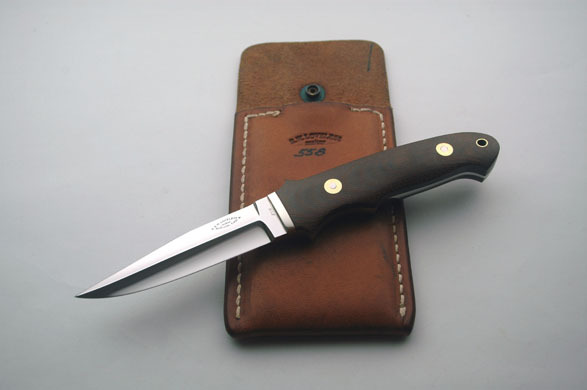
Here’s a fun thread I’m starting today—regularly posting pictures of the greatest Bob Loveless knife patterns/designs. I plan to do this every other day or so until I have 15 or 20.

My first one? Well, how about a New York Special as only R.W. Loveless could fashion it?!
 

This is perhaps the rarest and hardest-to-find of Loveless pieces—the original New York Special with a snap in the sheath. According to Dave Ellis of Exquisite Knives, originally told, there were seven. This is the long-lost 8th!

A big shout out to Ellis, by the way, for supplying me with an image of a New York Special when I needed one (the image, that is, not the knife). You can visit his cool website at http://www.exquisiteknives.com.

Watch for more of the Greatest Loveless designs, and let me know what you think!


Get Two Bob Loveless Books in One Bundle

 
You’ll actually get three great books in one bundle at a great price:

The Wonder of Knifemaking
Knifemaking with Bob Loveless
How to Make Knives (CD version of the classic book co-written by Bob Loveless)

 
Click here to get these great knifemaking books for $34.99 (51% off retail).
Advertisement

Must Read Articles

Read this before you make a knife

Knifemaking 101 – Read This Before You Make a Knife

  by Wayne Goddard My experience has taught me that there's nothing like digging in and getting started. I've often said the hardest part of the...
how to forge damascus steel

How to Forge Damascus

Advertisement
Advertisement