The BLADE Blog w/Steve Shackleford

Knives, knife people, knife news, knife use, knife collecting, knifemakers, knife events, the BLADE Show, BLADE Magazine, and more.

First Family of Swedish Steel

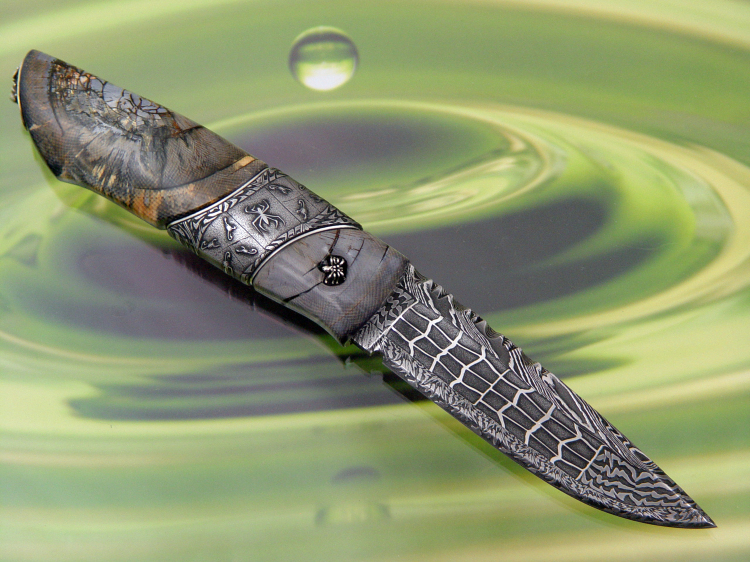
“Mammoth Spider” by Thomas Lofgren features a blade of a net-pattern mosaic damascus forged by Mattias Styrefors, a mammoth ivory and mosaic damascus handle, and sterling silver detail. (Lofgren photo)


Thomas and Claes Lofgren


Among the noteworthy Swedish knifemakers who have burst on the international cutlery scene in recent years, one of the names that stands out is Lofgren—father Thomas and son Claes.

    It is the family’s favorite sport, fishing, which brought Thomas to handmade cutlery. An annual family rite is to spend 10 days fishing—and fishing only—in the Lofoten Islands of Northern Norway. The waters are fish rich and it is not uncommon to pull out one in the 18-to-24 pound range. When you catch them you have to fillet them, which calls for a pretty good knife. Hence, Thomas began making such knives about 20 years ago. The first one cut reasonably well but was so ugly he felt obligated to make another one, and he has not quit making them since. He learned a few things from a book on knifemaking but the real trigger for improvement was an encounter with Roland Stromberg, an experienced maker. Roland taught him how to sew a nice sheath and from there showed him how to improve the general quality of his work.

    Having a technical background, Claes started getting interested in the craft in 2000, which made knifemaking just that much more important to Thomas. Since then there have been many elements of progress, emulation and sharing between father and son in the knife field. Now they are both part-time makers. Claes also works for an industrial company, and Thomas was instrumental in coordinating the 2005 and 2008 Sävsjö International Knife Expo. Thomas also found time recently to write the book, Making a Sheath for a Nordic Style Knife. It includes 150 of his own photos and sold 2,600 copies in its Swedish version, was translated into French and is now being published in German and Russian. Meanwhile, He exhibits at many shows in Sweden, other European cities (Paris, Helsinki, Solingen, Nontron), and in the USA. 

    His knife motto is “What stops growing will soon be dead.” Consequently, Thomas is always trying to improve, learning new techniques—Claes’s contributions are important in this regard—looking for new materials, and experimenting with fresh combinations of shapes and colors. “I like challenges, to walk on thin ice, even if I am not a very good swimmer,” he quipped.

    All his knives are distinctive. Even on models of similar design, he introduces many different decorations of handle and sheath, and combinations of colors and materials. In the past few years he turned toward even more high-quality materials. He is using less wood and more mammoth and walrus ivory, hippopotamus or warthog tooth, giraffe bone, etc. If he uses wood, it is often stabilized and colored. Once in a while he will embellish his knives with gold and silver, or a small precious or semi-precious stone. He prefers mosaic damascus for his blades, especially that of Conny Persson or Johan Gustafsson, or sophisticated damascus by Mattias Styrefors and André Andersson. His knives have won a number of awards in judging competitions at Swedish and American knife shows.


LIKE FATHER …

Claes’s background includes welding, most notably operating a robotic welding machine for three years. As the company he worked for expanded, a part-time position for supervising the planning of materials supply was created. Claes applied for the post and got it.

    For years he knew his father made knives, but Claes was not interested. However, in 2001 he watched his father and Johan Gustafsson board an airliner for the Knife Expo near Los Angeles (Pasadena), and “felt envious when Dad took off.” Wanting to experience the USA and California—and, of course, “California girls”—Claes saw making knives as one way to pay for the trip. His knowledge of metalworking and materials, plus the teaching of the basics by his father, resulted in very quick progress. Five months after making his first knife alone, he entered it in a judging competition at the Ludvika Show in Sweden and won in his chosen category. It was an enormous boost. By February 2002, he already had enough pieces ready to accompany his father to the Knife Expo. Since then it has become a sort of tradition for father and son to attend the Knife Expo and Ludvika Knife Week, as well as several other European shows.

    Claes’s knives share several points of similarity with his father’s. Both makers prefer mammoth bark ivory (the “bark” is the outside crust of the tusk), the same steel suppliers, quality sheaths in the Nordic style, and the same way of naming knife models. Nonetheless, not all the similarities are the result of Thomas’s influence. It is often Claes’s ideas and imagination that inspire his father.

    There are also some differences between the two. “Thomas’s knives are well made and imaginative, but with a more traditional approach. He has a feel for elegant and functional knives,” Samuel Karlsson stated. “Claes’s knives are more daring; his designs are more adventurous and extreme.”

    Being younger and with more of a technical background, Claes probably experiments more than Thomas. “The worst thing that can happen is that it goes wrong and I have to start all over again,” the younger Lofgren observed. “It can cost some material but I think it’s worth a try. I find it exciting to cross the line to find new approaches.”

    I would be remiss if I did not mention that Anna, Claes’s younger sister, also is a very good maker and has won prizes in judging competitions at Swedish knife shows. For the moment her knifemaking career is on hold as she works with her partner on restoring a farm they bought and caring for a 2-year-old boy. Meanwhile, Claes’s partner, Monika Bengtsson, also is making her first knives. “I think that I can retire now, before they all become too good for me!” Thomas laughed. “The only person not making knives in the family is my wife, Ann-Charlotte. But I can tell you that she bought two small blades …”

    Father and son makers are not uncommon, and father and daughter are less frequent. But if you add son, daughter, partner of the son and maybe one of these days the mother, a real first family of Swedish steel is in the making.—by Francis Anglade

Thomas and Claes Lofgren

+4670 834 9229 (Claes)

+46381 135 73 and +4670 69 77 405 (Thomas)

[email protected]

www.lofgrenknives.com

Specialties: Both make one-of-a-kind knives in similar styles and materials

Blade Steels: Mosaic damascus forged by Conny Persson, Johan Gustafsson, Joe Olson and Henry Hilden, and damascus forged by Mattias Styrefors and André Andersson

Handle Materials: Mammoth (including bark) and walrus ivory, hippo and warthog tusk, giraffe bone and woods (the latter often stabilized and colored)

Embellishment: Occasionally gold and silver, and precious and semi-precious stone inlays; some engraving by Jonny Walker Nilsson

Sheaths: Nordic style

Author! Author!: Thomas wrote the book, Making a Sheath for a Nordic Style Knife, which sold 2,600 copies in the Swedish version and has been translated into French, German and Russian

If you’re looking to make your own mosiac damascus, look no further than the Forging Mosaic Damascus Knives download from BLADE. You’ll learn the foundation of this fascinating process to be able to build your own great designs.

 

Click here to get the download for just $4.99.

Cutting Critique: Spyderco Persistence

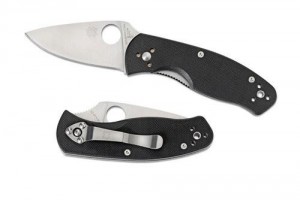
Consider the Spyderco Persistence—a small knife that cuts like a bigger one.
The Spyderco Persistence is a small knife that cuts like a bigger one and gets the once-over in our “Cutting Critique.”

The Spyderco Persistence is one of those compact cutting knives you may or may not like—depending on your tastes in general and how the knife fits your hand.

I have a medium-size hand and if I hold the handle in the standard grip, half of my little finger overlaps the butt. That’s bordering on too small for me.

However, for detail or draw cuts where I place my finger atop the blade spine, the fit is just about perfect. The 2.75-inch blade is 1.25 inches at its widest and tapers quickly to the point. Under 3 inches in blade length is a good thing in terms of many legal length limits. (Be sure to check your local and other pertinent knife laws.)

The G-10 handle material is good and solid and provides a nice abrasive-type feel for sure gripping for most any type of cutting.

The clip is reversible for tip up or tip down right-hand carry.

The plain-edge blade of 8Cr13MoV stainless steel out of the box is razor sharp and is a cutting moose. I like the blade shape, which is along the lines of the Spyderco Caly I carry on a regular basis.

The Michael Walker LinerLock@ is nice and tight and has a good spring to it that makes you work just a bit—though not too much—to push it open. I like that because it reinforces the notion that the lock will not disengage easily—always a good thing.

The Persistence is one of Spyderco’s knives made in China, and as many industry observers are noting, the Chinese are getting better and better at making knives—and the Persistence is an excellent example of this improvement.

At 4 ounces the Persistence may seem a bit heavy to some for a knife of its size (4.125-inch closed length), but not me. I like the overall weight and feel. It’s a small knife that cuts like a bigger one.

For more info on how to get your Persistence, click on www.shopblade.com/persistence-black-g-10-plainedge-w8476?lid=ssfbbl070313

Custom Knife Ambassador Lobred Passes Away

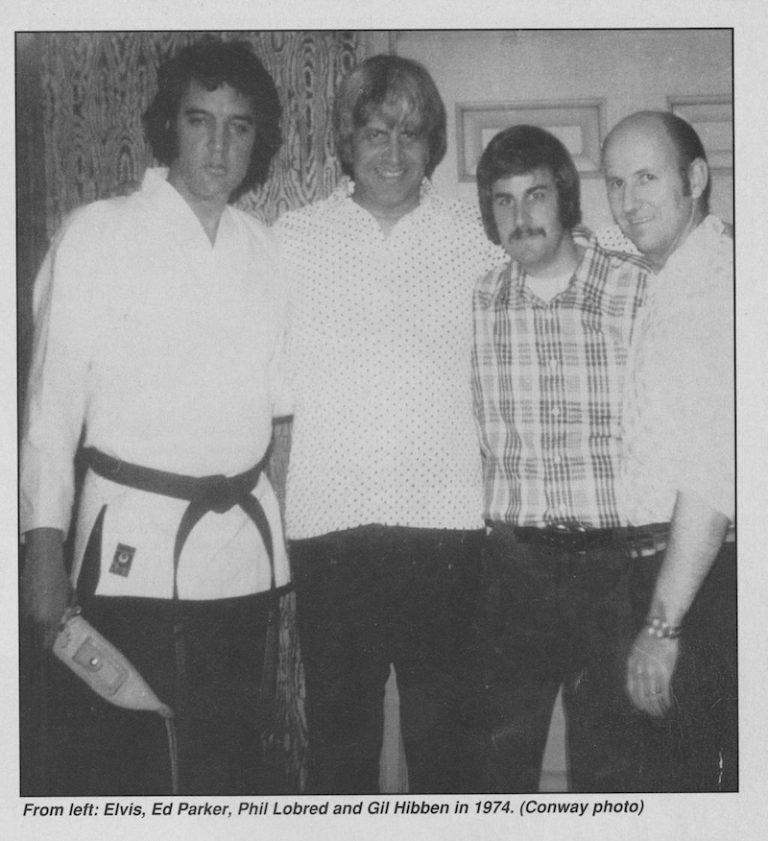
Elvis, Lobred and Hibben.
Custom knife ambassador Phil Lobred joined Gil Hibben in a special audience with Elvis Presley and Kenpo martial artist Ed Parker in 1974. From left: Presley, Parker, Lobred and Hibben. (Conway image)

Custom knife ambassador Philip Carl “Phil” Lobred, the man who commissioned the reproduction of the King Tut Dagger by Buster Warenski and along with Gil Hibben enjoyed a special audience with Elvis Presley, passed away Dec. 14 after a long illness. He was 72.

Lobred was one of the first big-time collectors of custom knives. He began collecting them in 1968 and befriended many of the legendary custom knifemakers of the day, including BLADE Magazine Cutlery Hall-Of-Fame© members Gil Hibben, Bob Loveless, Buster Warenski and Bill Moran, and also such preeminent makers as Jim Schmidt, Ted Dowell, Herman Schneider and many others.

Hibben and Lobred were especially close. Lobred lived in Alaska in the early 1970s and Hibben moved to Anchorage and made knives out of Lobred’s garage. In 1974, Lobred accompanied Hibben on a private audience with Elvis Presley (see “The Elvis Knife,” July 1997 BLADE®). A member of the Martial Arts Hall Of Fame as well, Hibben knew Ed Parker, the renowned Kenpo martial arts instructor, who also had been one of Presley’s bodyguards. Hibben had made a Kenpo knife in which The King expressed interest, so Parker arranged a meeting for Hibben to present one of the knives to Presley. Lobred was invited along.

“I had the privilege to have Phil Lobred in my life, not only as a friend but as a brother for the past 47 years,” Hibben noted. “He was the closest friend I have ever had and I truly loved him. We shared a

King Tut Lobred commission
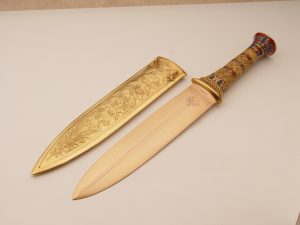
Phil Lobred commissioned the most iconic custom knife of all time, the reproduction of the King Tut Dagger by BLADE Magazine Cutlery Hall-Of-Fame© member Buster Warenski. (SharpByCoop image)
custom knife ambassador Lobred
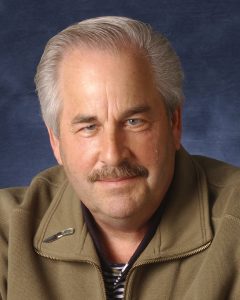
Custom knives had no finer ambassador than Phil Lobred. (PointSeven image)

history that few others will ever know and my memories with Phil will live on forever in my heart. His loss is devastating, not only to his family and close friends but to the many, many hearts he touched in the knife community and around the world. ‘Here’s to you P.Q., we had a great time together.'” “P.Q.” is Hibben’s nickname for Lobred and stands for “Pretty Quick.”

One of Lobred’s crowning achievements is the biennial Art Knife Invitational. The AKI assembles 25 of the world’s finest knifemakers in a special show in which high-dollar collectors are invited and enter their names in drawings to buy the knives of their choice. It was the first successful biennial knife show and at least two other shows—the Solvang Custom Knife Show and California Custom Knife Show—are biennial shows today. As of this writing, this year’s AKI is scheduled for Oct. 28 at the Sheraton Hotel San Diego Bayside Tower. Exactly how Phil’s passing will affect the show’s status is unknown at this time.

Through it all, the thing Lobred probably will be remembered for most is his commissioning of the reproduction by Warenski of the King Tut dagger in 1982. It took Warenski five years to complete the knife, which included 33 ounces of gold, an ancient technique known as granulation for the handle and much more. When the knife was exhibited at the 1987 Knifemakers’ Guild Show it was a sensation, and served as the cover knife for the February 1988 BLADE. The knife has since been valued at $1 million.

Funeral arrangements are under the direction of El Camino Memorial-Sorrento Valley, San Diego, California. Service information is unavailable at this time.

Save

Save

Save

Save

Save

Save

Save

Save

Save

Holy Grail Knives in New BLADE

Holy grail knives in new BLADE.
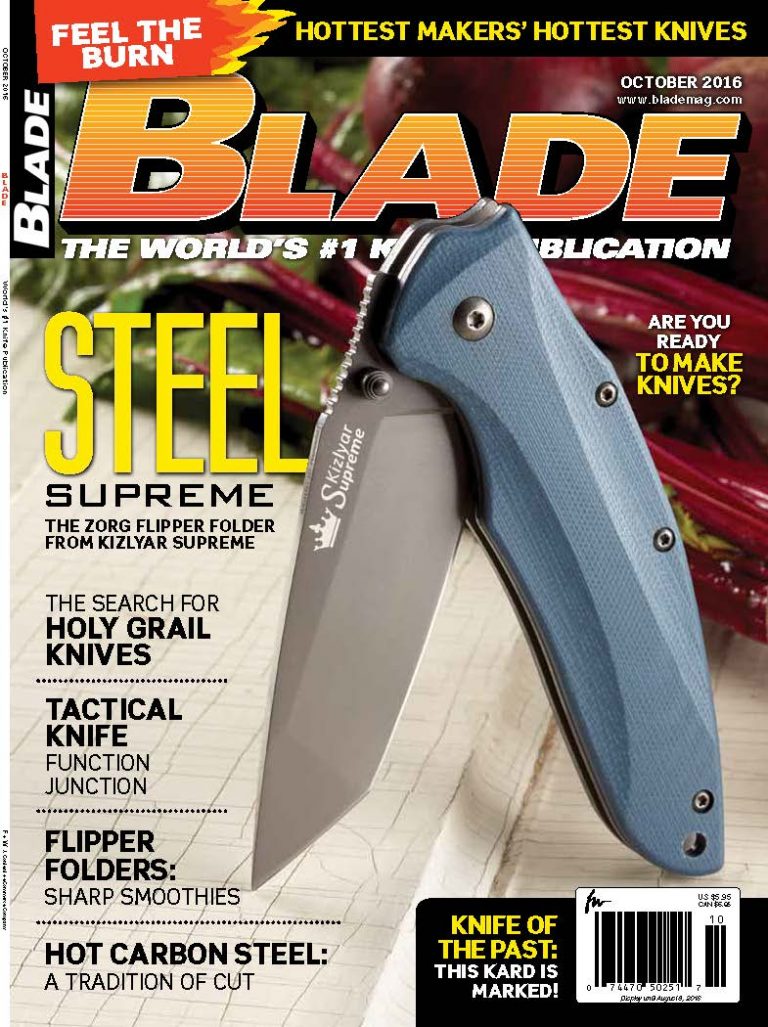
Holy grail knives are one highlight of the latest issue of BLADE®.

Are you in search of your “Holy Grail” of knives or have you found it? Or did you find it and trade it away? Or do you doubt that such a knife exists? The new issue of BLADE®, on newsstands now, examines the topic of holy grail knives in depth with a special story interviewing those who have found theirs and still have them, and another enthusiast who questions whether there even is such a knife.

Also in the latest issue of the World’s No. 1 Knife Publication is our semi-annual story on the planet’s hottest custom knifemakers’ hottest knives. We polled those who buy and sell the top custom knives for a living—custom knife purveyors—for their opinion on the matter, and they list the knives by maker and price in “Feel The Burn.”

Are you ready to make knives? You may be more prepared than you think. Knifemaker Brian Goode has been making knives for 10 years and has written and talked on the subjects not only of getting started in knifemaking but also how to do it on a budget—including a class on the latter at the 3rd Annual BLADE University during the 2016 BLADE Show. Learn his thoughts on the subject in his special story.

Flipper folders, slip joints and tactical fixed blades remain among the world’s most popular knives. Join Dave Rhea for the latest factory flippers, James Morgan Ayres for a test of today’s sharpest tactical straight knives, and Abe Elias as he gauges the performance of some of contemporary cutlery’s most economical slip joints in the latest BLADE.

The question of whether collectible knives also should be used is one that has been debated by knife enthusiasts for decades. Veteran bladesmith/BLADE field editor Ed Fowler supplies the answers as only he can in “Collectors or Users: Who Comes First?”

There’s much more in this issue, including some of the coolest knives from the 2016 Art of Steel Little Rock Custom Knife Show; factory knife companies that continue to offer new knives in a selection of different old-school high-carbon steels; a test by MSG Kim Breed of two utility fixed blades; visits to the shops of Turkish knifemakers who trace their cutlery lineage back over eight centuries; John Doyle’s modern interpretation of an ancient Eastern design known as the kard; instructor Doug Hepler and a class on cold forging he taught to high school students on a lonely atoll in the South Pacific; the knives carried by three BLADE readers; and more, all in the latest BLADE—on newsstands now!

Save

Save

A Special Knife for a President

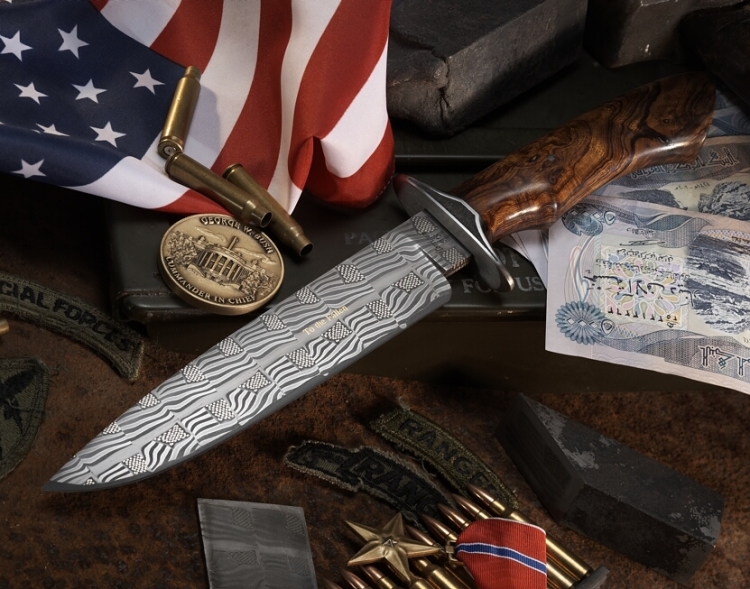
On this Presidents Day, we are honored to show you a knife American Bladesmith Society master smith John Horrigan made for and presented to President George W. Bush on Dec. 4, 2009.

    John’s twin brother Robert, also a knifemaker and a member of the U.S. Army 7th Special Forces Group, was killed in action in Iraq on June 17, 2005. John met with President Bush a week after Robert’s death, and it was then he promised the knife to Mr. Bush.

    A spectacular bowie with a mosaic damascus blade forged with images of Old Glory and engraved with the words “To the Fallen,” the knife remains a reminder of Robert Horrigan and others who have made the ultimate sacrifice for their country.

    For more information contact John Horrigan at www.eliteknives.com.

For more on the latest knives, knife legislation, knifemaking instruction, knife trends, knifemakers, what knives to buy and where and much more, subscribe to BLADE® Magazine, the World’s No. 1 Knife Publication. For subscription information click on http://www.shopblade.com/product/blade-magazine-one-year-subscripti…?r+ssfb022012#BL1SU

Sharp Knowledge: 3 Knife Steel Basics

How the knife will be used, edge geometry and heat treating are all key to deciding which knife steel to choose.
The knife steel you choose depends a lot on what jobs the knife will perform.

One of the questions knife enthusiasts ask most is What is the best steel for a knife? Before you can answer such a question, you must first know exactly what it is you need in a knife.

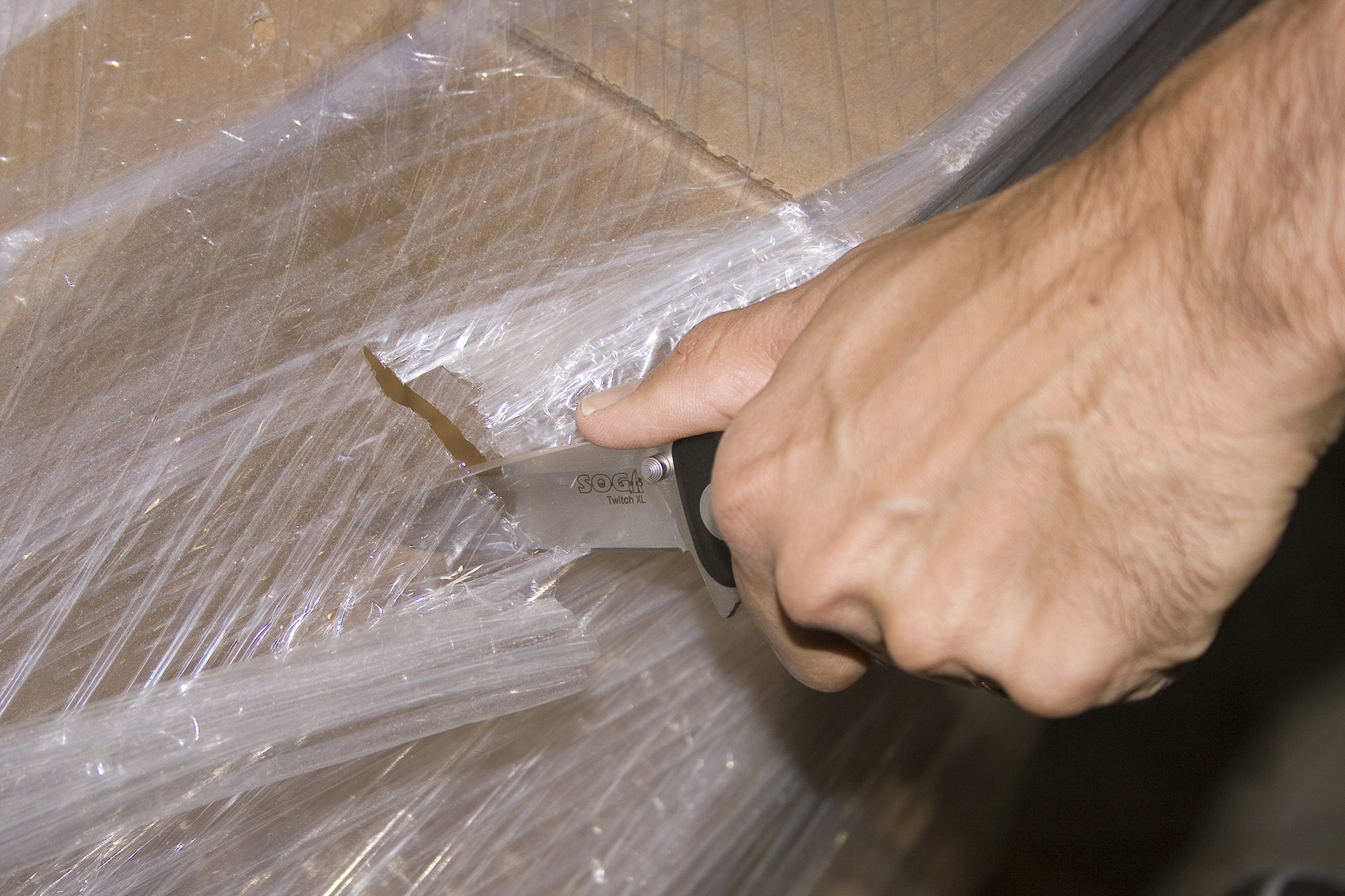
1) Will you use the knife to cut meat, or paper, or rope, or plastic, or a little bit of everything? Much depends on what you will be using the knife for, and just about any knifemaker or knife manufacturer who knows his stuff will know which steel he has on hand will be best for your purposes.

how-to-make-knives-knifemaking-book
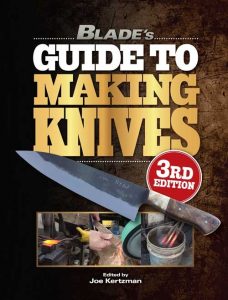
Learn more about selecting steel types and how to make knives in the third edition of “BLADE’s Guide to Making Knives.” The classic is back and better than ever!

2) The steel is just part of the equation. The blade’s geometry is also important. By blade geometry is meant how the blade is ground and tapered from the back (spine) to the edge. If too thick, it won’t slice or cut properly; if too thin, it may chip.

3) How is the steel heat treated? As BLADE Magazine Cutlery Hall-Of-Fame© member Wayne Goddard has written, “A knife of the very best steel may not perform any better than one made of an inferior type steel unless it is heat treated to bring out the full potential of the alloy content.” He also writes, “The reasons for a maker to turn out incorrectly heat-treated blades are too many to list. However, the most common is not having the correct heat-treating specifications from the steel maker.” If you find the maker does his own heat treating and does not go by the heat-treating specs provided by the steel maker, that’s an immediate red flag. In fact, many makers simply have professional heat treaters do their heat treating. Goddard is among them.

These are just three basic things to know about knife steels. There are many others.


Majority Opposes Ivory Ban At Meeting

Anywhere from 50-to-60 people attended the March 20 public meeting held by the Advisory Council to the Presidential Task Force on combatting wildlife trafficking, with more than twice as many voicing opposition to the ivory ban as those supporting it.

Questions remain on feds ability to tell fossil from elephant ivory and vice versa. (Ward photo)
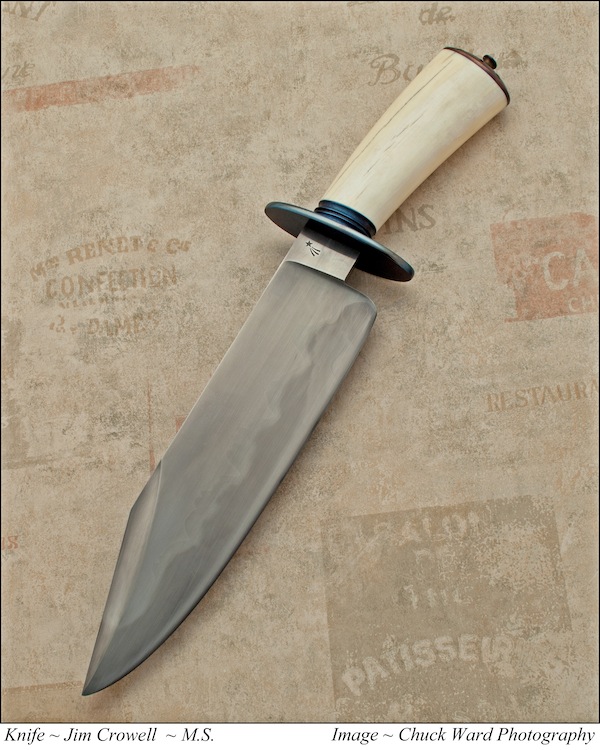
Over twice as many against the ivory ban as for it voiced concerns at the March 20 meeting. Jim Crowell’s fixed blade sports a fossil ivory handle.  (Ward photo)

Among those representing the knife industry at the meeting held in Washington, D.C., were scrimshander Sandra Brady, knifemaker Edmund Davidson and others.

“There were about 27 people who stood up to make statements and only about eight were in favor of the ban,” Brady noted. “Even though the words ‘ivory ban’ were not used at all by the committee, that is the ONLY thing that was talked about.

“We had statements from three antiques people, cane collectors, scrimshanders, musical instruments, a knifemaker and knife rights people, among others. So what I came away with is that the committee didn’t expect such a [pro-ivory] turnout. I can only imagine how many more statements were submitted via e-mail. We may have turned the tide at least a bit.”

On the other hand, the pro-ivory ban forces continued their full-court press, and there is much to be done to fight a number of punitive measures federal officials are considering, including making all illegal ivory sales felony violations. Committee members also talked about requiring violators to pay restitution and basically treat selling ivory as selling illegal drugs. “It was three hours of the ‘for-the-greater-good’ stuff, so that was the bad news,” one observer stated.

Several initiatives were mentioned by the knife industry group against the ivory ban, including finding a congress person to champion the anti-ivory ban cause and also the possibility of setting up an official fight-the-ban organization.

Craig Hoover of U.S. Fish & Wildlife said he expected someone on the advisory council to post more information, perhaps a summary video of the meeting, on its web page at some point. The link to the page is

http://www.fws.gov/international/advisory-council-wildlife-trafficking/

For further developments stay tuned to www.blademag.com.

Advertisement

Must Read Articles

Read this before you make a knife

Knifemaking 101 – Read This Before You Make a Knife

  by Wayne Goddard My experience has taught me that there's nothing like digging in and getting started. I've often said the hardest part of the...
how to forge damascus steel

How to Forge Damascus

Advertisement
Advertisement