

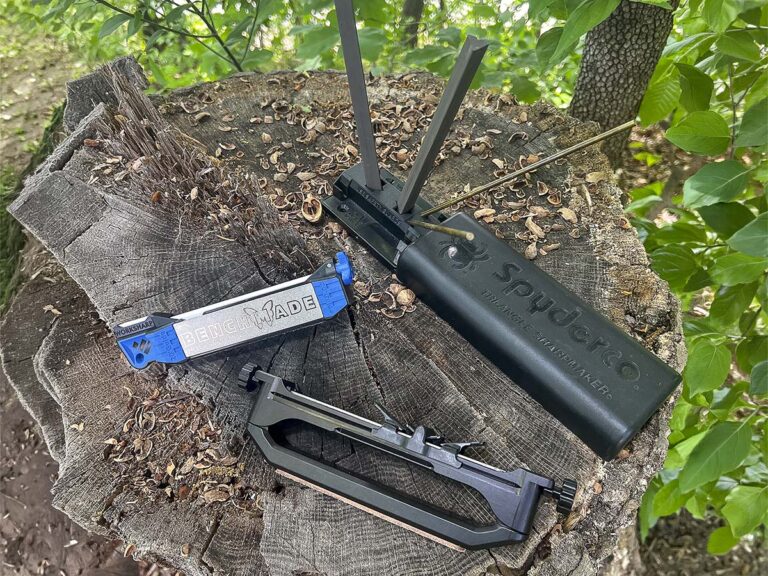
Three options to stay keen when you’re out and about.
Active lifestyles often need specialized tools. Out hiking, camping or hunting, a workbench instrument is out of place. This is especially true for one of the most vital pieces of knife kit—sharpeners.
In recent years, the market has trended toward larger bench-mounted sharpeners that, while dynamite at extracting a precise edge, are all but impractical in the field. Out and about, a solid portable sharpener is more than worth its weight in gold. Even better, for those who take a more minimalist approach to edge-maintenance equipment, most mobile sharpeners are more than capable of serving as primary tools for bringing a knife back to life.
Given this isn’t the time of Charlemagne, this class of sharpeners should have an angle guide integral to their design, eliminating guesswork. And since they’re less elaborate, portable sharpeners should be cost-effective, as well. You do not want to spend a ton on something that might be lost. Most of all, these options should prove easy to tote around, be it in a pocket, tool pouch, vehicle glove compartment, backpack or anywhere else you want to cram one.
There are plenty of portable sharpeners available today, but in our trials, we found the following a cut above the rest.
Wicked Edge Venture Pro WE26
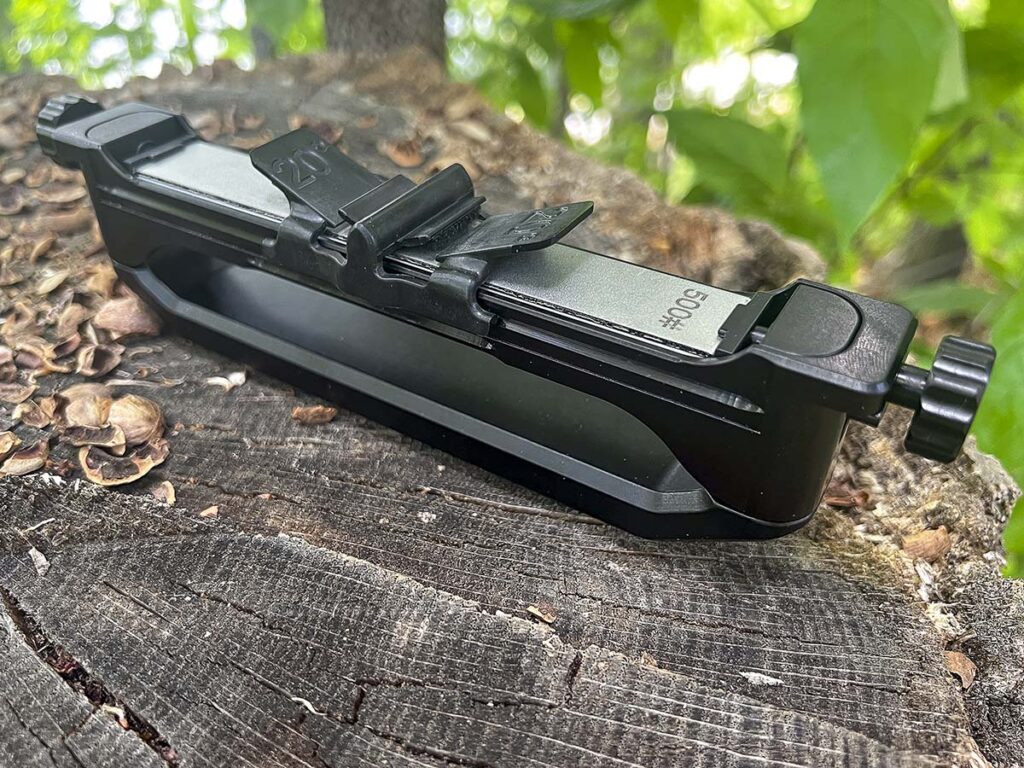
Wicked Edge, primarily known for its high-end guide-honing systems, has recently turned its discerning eye to mobile sharpening. The result is the Venture Pro WE26. While more compact than most everything else the company offers, it is no less effective.
Starting with the build quality, Wicked Edge has constructed a system built to last. The Venture Pro’s frame is sturdy T6-6061 aluminum alloy, keeping the unit relatively light, yet extremely durable. The company holds the system together with stainless steel screws and a tension spring. And the honing surface is a double-sided diamond-coated steel plate—if you drop one, you don’t have to sweat it shattering. A cam system holds it in place and allows a painless switch between sides and grit size—500-grit diamond and a fine-grit ceramic. A plus. Yet this is only part of the sharpener’s selling points.
What really grabs attention is that the Venture Pro is a railed angle guide. The system is slick, essentially allowing you to pull your knife through, while the guide maintains a consistent 20-degree angle over the entirety of the sharpening surface. This element of the system deserves mention in and of itself. It is molded from a thermoplastic blend of POM (Delrin) and PTFE (Teflon), the result is a slick surface that all but guarantees a smooth stroke on each pass. The guide is removable and has a storage position on the rear of the sharpener for easy storage in a more compact configuration. The final perk, the unit includes a leather strop and a built-in guide on the rear side, so you can hone a blade to a mirror finish.
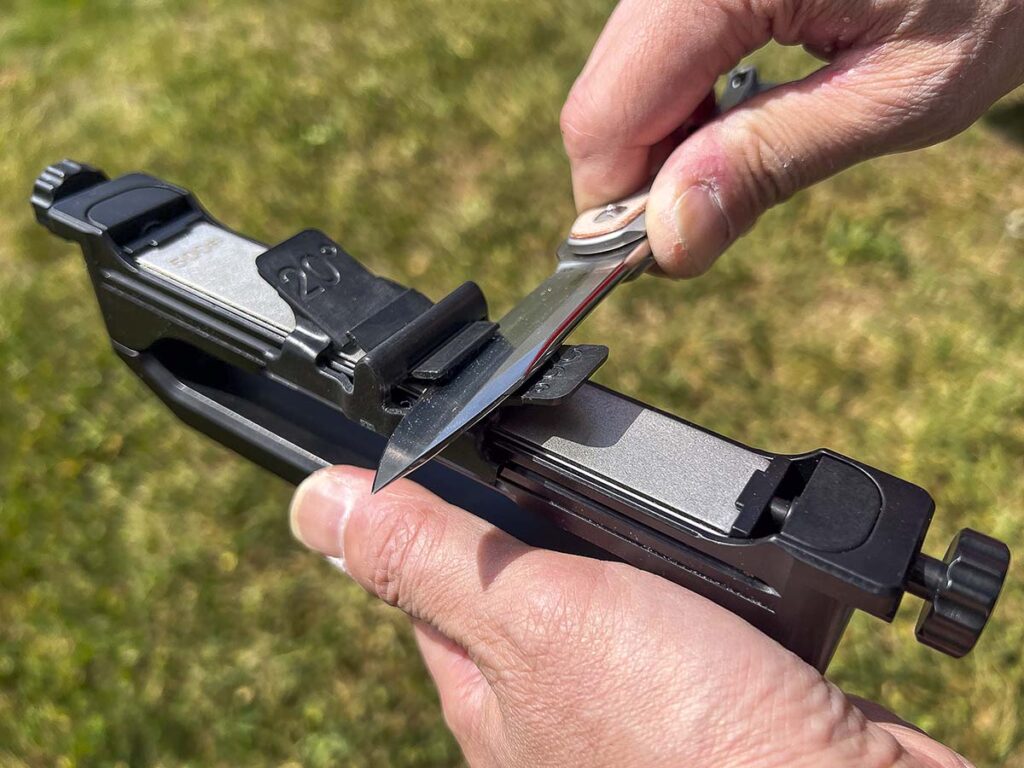
The Venture Pro definitely isn’t pocket-sized, but it is small enough to be considered portable. Its size is a plus in this respect; it’s large enough to tackle a wide range of knife types and sizes. I found the system easy to master over the course of several sharpening sessions with pocketknives, tactical folders, kitchen knives and even scissors. The routine is simple: place the blade into the guide as far up to the tang as possible, draw the knife through while moving forward and repeat on the other side. The angle guide slides so easily across the frame of the sharpener that it almost feels like it’s not even there.
Given that the 500-grit side is diamond, I did not have to apply a ton of pressure to achieve the desired results. And, if you’re sure of your freehand skills, the guide can be removed to speed up the process.
At home, at camp or anywhere, the Venture Pro works every time to provide you with a guaranteed sharp edge. As a bonus, several other plates with different grit sizes are available as well as different angle guides (15, 17 and 25 degrees), in case you have a particular system you want to adhere to. No matter what, this made-in-the-U.S.A. sharpener has an edge.
Venture Pro Specs
Frame Material: T6-6061 Aluminum Alloy
Sharpening Material: 500-grit diamond stone, ceramic hone and leather strop
Weight: 10 oz.
Sharpening Surface: 8.25”
Features: Continuous 20-degree angle guide, integral handle
Country Of Origin: U.S.A.
MSRP: $189
Spyderco Sharpmaker
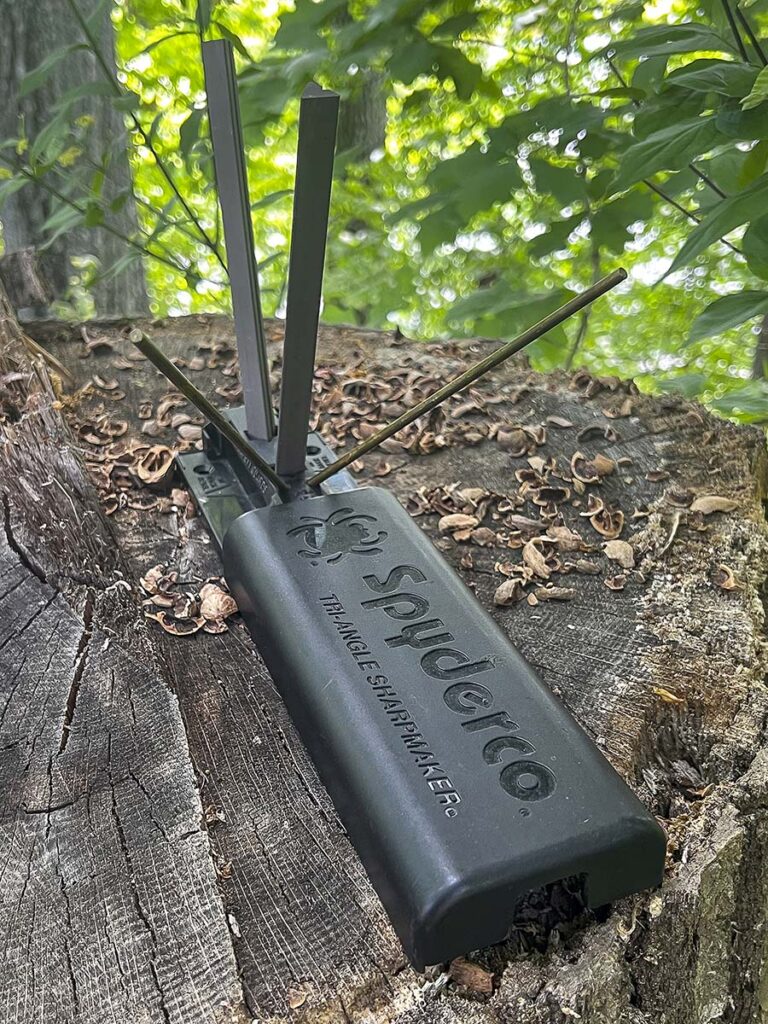
Spyderco’s model 204 Sharpmaker is a versatile, made in the U.S.A. sharpener and could be a primary sharpener on its own. But it’s how it breaks down, with all its hones nestled in the base, and the cover snaps over all of it, fully encasing the stowed sharpener that makes it a top choice for a portable sharpener.
The Sharpmaker utilizes two pairs of alumina ceramic rods—medium grit (brown) and fine grit (white)—held in the plastic base at a 20-degree angle, forming a “V” shape. The proper way to use this is to hold your knife to where the blade is perpendicular to the tabletop and then, starting at the blade tang end, place the blade onto the home and, in one motion, travel down the hone and at the same time pull the blade toward you. Gentle pressure is generally all that is required to achieve a sharp edge. As an added safety precaution, Spyderco includes two brass protection rods that prevent cutting your hand while holding the base.
The Sharpmaker’s design allows you to sharpen on any flat surface—tabletop, workbench, desk or even the tailgate of a pickup truck. Making the tool extremely convenient, the alumina ceramic rods do not require lubrication with oil or water. Though they do require occasional cleaning. The rods darken over time due to swarf collecting on the surface. Scotch-Brite pads and powder sink cleaner make quick work of this fouling and restore the sharpening surface. Another cool feature of the Sharpmaker is the two grooves on the bottom of the base. This allows you to set any two matching hones into the base, with their flat sides up for a makeshift bench stone.
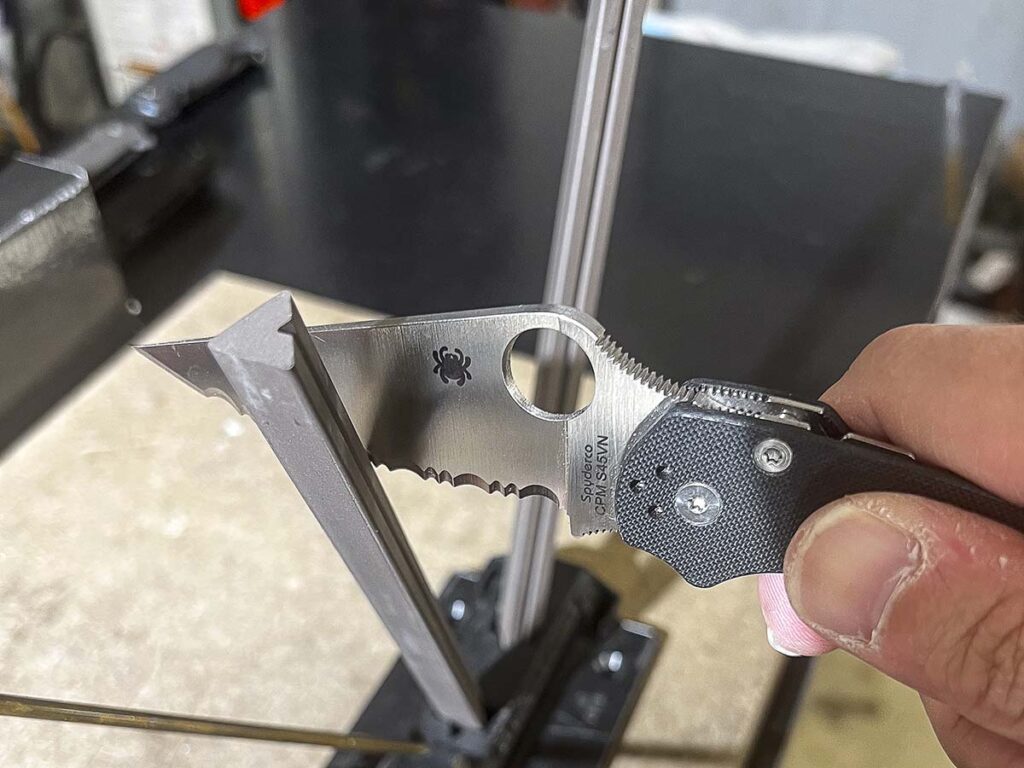
The triangular shape of the hones was done on purpose and is a brilliant design. When you set up the honing where the flat sides face each other, the Sharpmaker effectively sharpens plain-edge blades. Rotate the hones so that the points face each other, and the Sharpmaker easily addresses serrated knives.
How well does the Sharpmaker work? Simply put—very well. It’s a must-have if you own any serrated knives, but as I said earlier, it will work just as well on plain-edge blades. The sharpener is easy to set up and easy to use. There’s no mess since you don’t use fluid for lubrication, and it breaks down into an ultra-compact form factor that stows easily.
Sharpmaker Specs
Frame Material: ABS plastic base
Sharpening Material: Alumina ceramic stones
Weight: 1.4 lbs.
Sharpening Surface: 7”
Features: Plain edge and serrated sharpening surfaces
Country Of Origin: U.S.A.
MSRP: $127
Benchmade Guided Field Sharpener
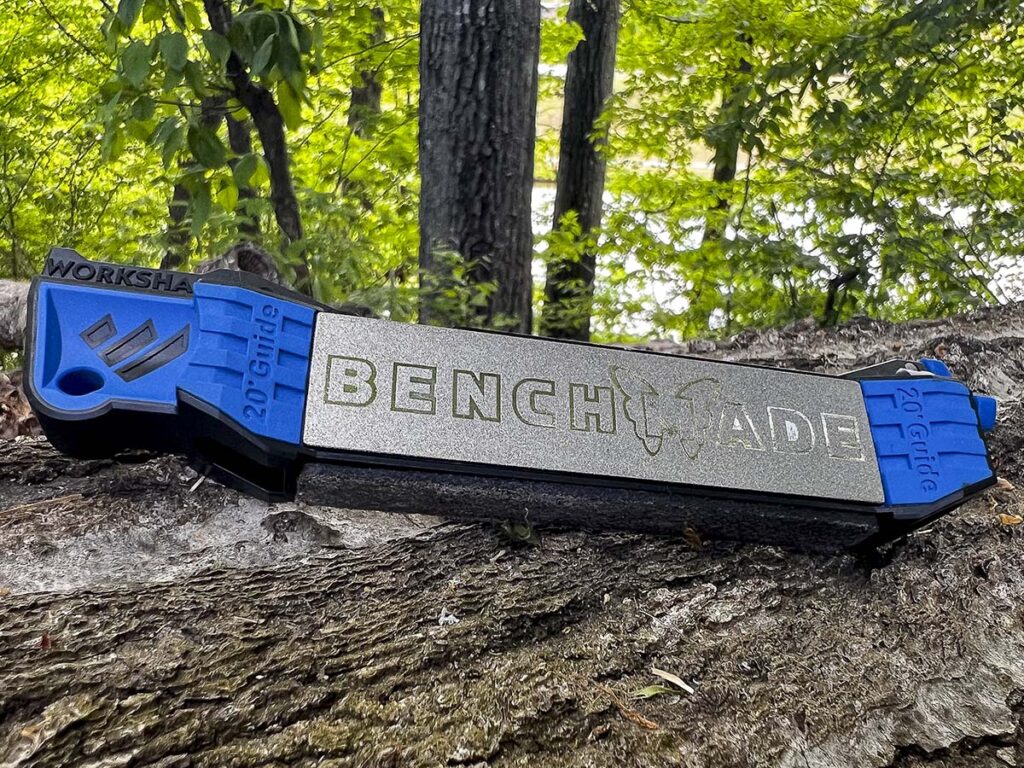
The Benchmade Guided Field Sharpener is the ultimate compact sharpener that is packed with so many features that you must use it to believe it. The unit is manufactured for Benchmade by Work Sharp, so it comes with a pedigree of a company that knows a thing or two about sharp cutting edges.
What you get with the Guided Field Sharpener (GFS) are coarse and fine diamond-coated sharpening plates held onto the body using rare-earth magnets. You also get a fine-grit ceramic rod for quick touch-ups. This rod has two sharpening surfaces—regular and ribbed, which are for more aggressive honing. You also get a smaller diameter ceramic rod, which addresses serrations. On top of all this, the unit has two sets of integral angle guides set permanently at 20 degrees. Finally, at one end of the sharpener frame is a leather strip for the final polishing of your edge. Folks, what you have right here is a comprehensive sharpening system in a pocket-sized form factor.
While the Guided Field Sharpener works very well on folding hunters, tactical folders, multi-bladed pocketknives and some smaller fixed blades, it also handles larger blades, such as kitchen knives, as well. You must be mindful when working with a larger blade on a smaller sharpener and move the blade more efficiently to cover the entire cutting edge in one stroke.
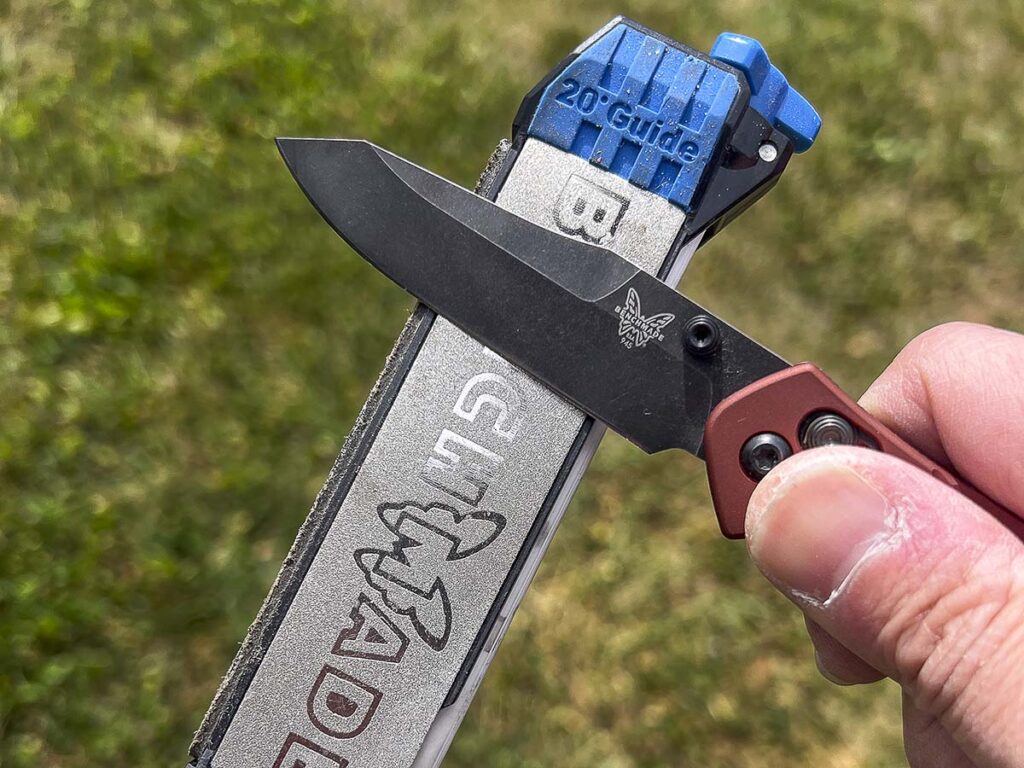
Using GFS is simple, you lay your blade onto the angle guide, then hold the handle steady and move the blade across the surface of the plate. You do need to remain conscious of your angle, as the guide only starts you at the right incline. Generally, you’ll start with the diamond hone to establish the edge, followed by the fine grit to define it. Finally, a few swipes on the ceramic rod, along with a finish on the leather strip, result in a hair-popping sharp edge.
Overall, the Benchmade sharpener is sized perfectly for everything from a rucksack to a coat pocket. It’s a powerful tool in a compact package, and a value. To this, it’s worth noting that the GFS is assembled in the U.S.A. from foreign and domestic components.
Guided Field Sharpener Specs
Frame Material: Polymer
Sharpening Material: Diamond plates, ceramic rods and leather strop
Weight: 4.7 oz.
Sharpening Surface: 6.87”
Features: Integral 20-degree angle guide
Country Of Origin: Assembled in U.S.A. from domestic and foreign components
MSRP: $50
More On Sharpening:
- Pros’ Secrets To Sharpening Knives
- Best Sharpening Stones To Keep Your Edge
- Stropping: What It Is And How It’s Accomplished
- How To Determine The Best Angle To Sharpen
 NEXT STEP: Download Your Free KNIFE GUIDE Issue of BLADE Magazine
BLADE’s annual Knife Guide Issue features the newest knives and sharpeners, plus knife and axe reviews, knife sheaths, kit knives and a Knife Industry Directory.Get your FREE digital PDF instant download of the annual Knife Guide. No, really! We will email it to you right now when you subscribe to the BLADE email newsletter.





