

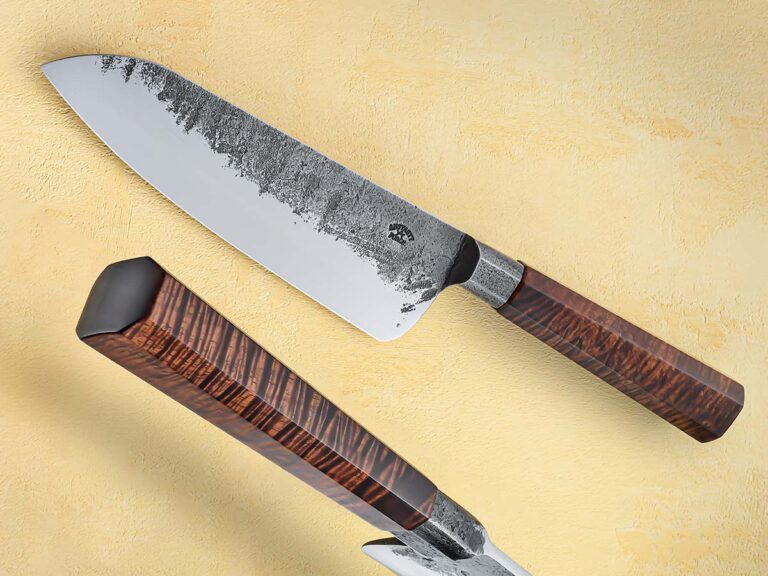
User-friendly custom takes on the classic Japanese knife handle abound.
The Japanese influence in kitchen knives is more or less a given. Those who work in food preparation, an art form unto itself, appreciate the style and utilitarian feel that the Japanese culture exerts on their vocation.
The kitchen knife has seen a wave of custom makers taking that context a step further. The knife is an extension of the hand and that extension starts with the handle. So, here again the ergonomics of Japanese influence emerge. The wa handle brings comfort and confidence to the kitchen user while also providing a sense of form, function and artistic expression for the custom maker.
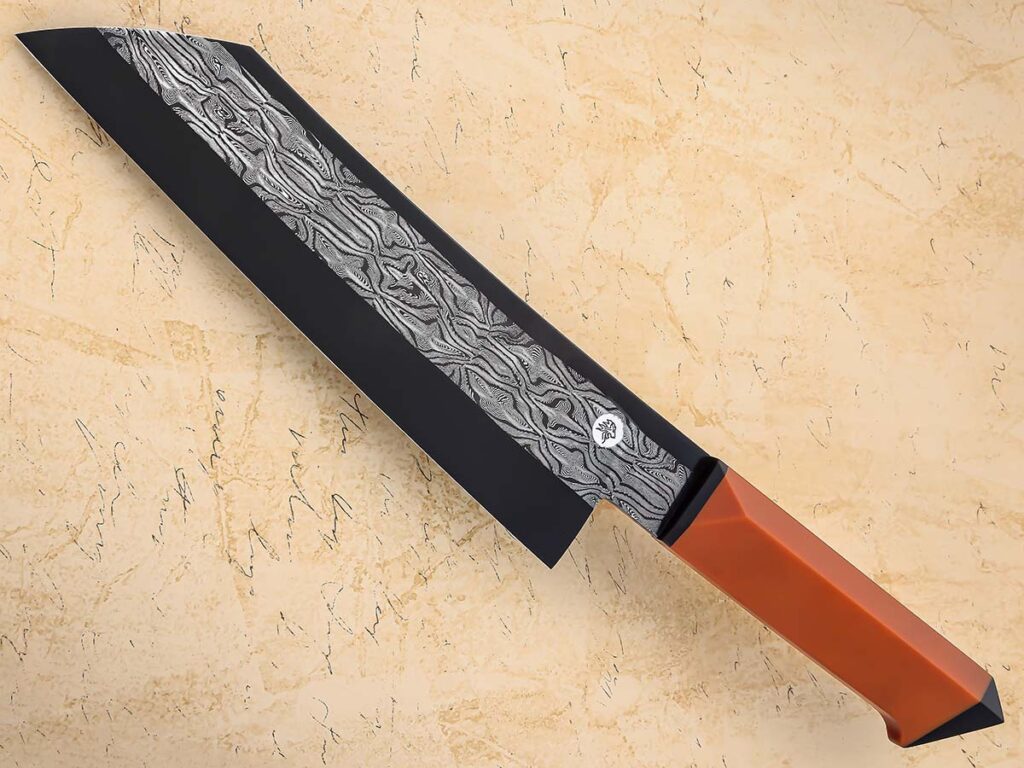
According to maker Jacob Anstaett, the name itself is rooted in the Japanese language.
“Wa comes from the Japanese language and broadly translates as ‘harmony’ or ‘balance,’” he explained. “In knifemaking, it refers to the traditional Japanese handle style, which emphasizes simplicity, lightness and an ergonomic connection between the handle and the blade.”
Anstaett further defines the wa handle as “lightweight with forward-balanced design. Typically, it is either octagonal, oval or D-shaped in cross-section. The handle is crafted as a separate piece that fits onto a hidden tang rather than a full tang. The construction is what gives the blade its distinct balance, where the cutting edge feels alive in your hand instead of weighed down.”
A resident of Plano, Texas and a custom knifemaker for eight years, Jacob says his wa handle is an interpretation of the Japanese style.
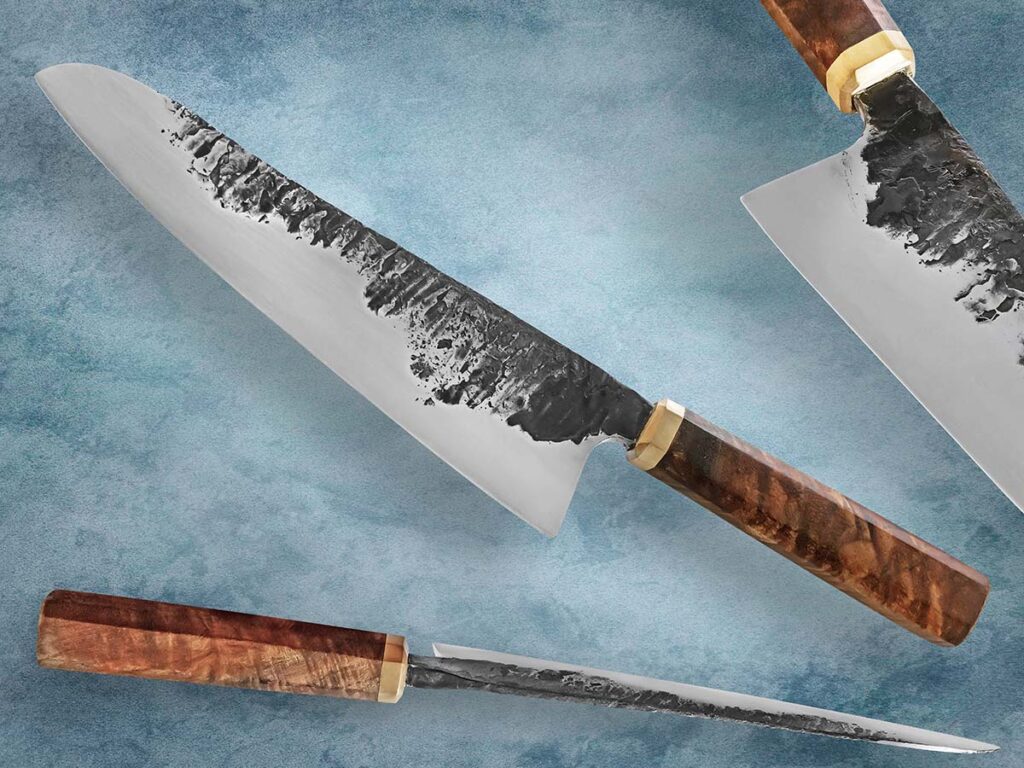
“It’s best described as a variation of the traditional wa,” he explained. “I keep the core geometry usually as an octagon cross-section, but I adapt the dimensions slightly for comfort. Western chefs often prefer a little more thickness and resilience, so I adjust proportions while preserving the forward balance that makes wa handles so effective.”
Jacob devoted extensive time to the study of traditional Japanese wa handles and then embarked on his road to interpretation.
“Over time I developed my own hybrid approach,” he commented. “My reasoning was simple: I wanted to honor tradition while building something that stands up to modern kitchens. For instance, I blend traditional shapes with stabilized woods or composites, ensuring they can handle daily use in a busy Western kitchen without losing the essence of the Japanese design.”
What Makes A Wa Handle?
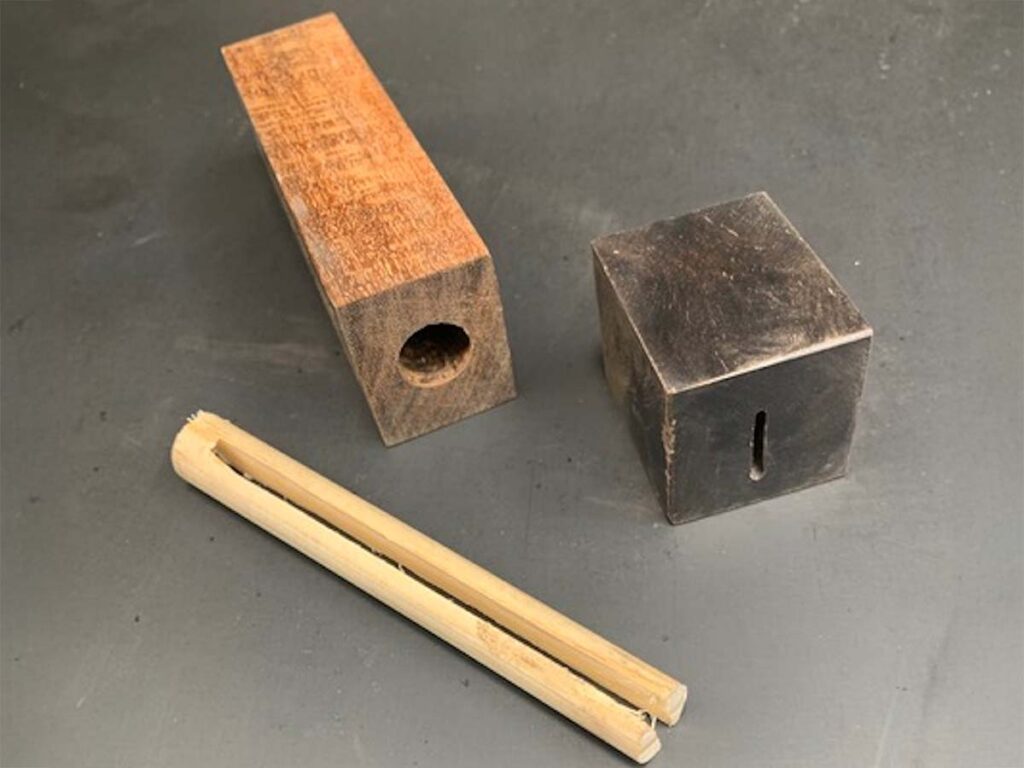
Elaborating on the spirit and style of the wa, Aidan Garrity of Iron Lion Blades in Madison, Connecticut remarked, “There are two schools of thought for what exactly categorizes as a wa handle. One is that the handle’s construction involves a hole the width of the knife’s tang being drilled into the handle, and the tang being enclosed in a slotted dowel to tightly fit into that round cavity. The other is that it is simply the style of the handle, usually slimline and often having angular geometries. For questions like these, I always answer with the understanding that it is just the style of the handle, but I personally consider the true wa handle to be one utilizing the dowel bedding construction.”
Australian custom knifemaker Mert Tansu follows the wa tradition with his own interpretation. His perspective includes a geometric aspect that broadens the possibilities with the style.
“Wa handles come in a few different geometries,” he related, “from round to oval, to semi-octagonal to full octagonal and D-shape. Compared to their Western counterparts they are not sculpted and flat. Most of the traditional wa handles will have a horn ferrule and magnolia wood body.”
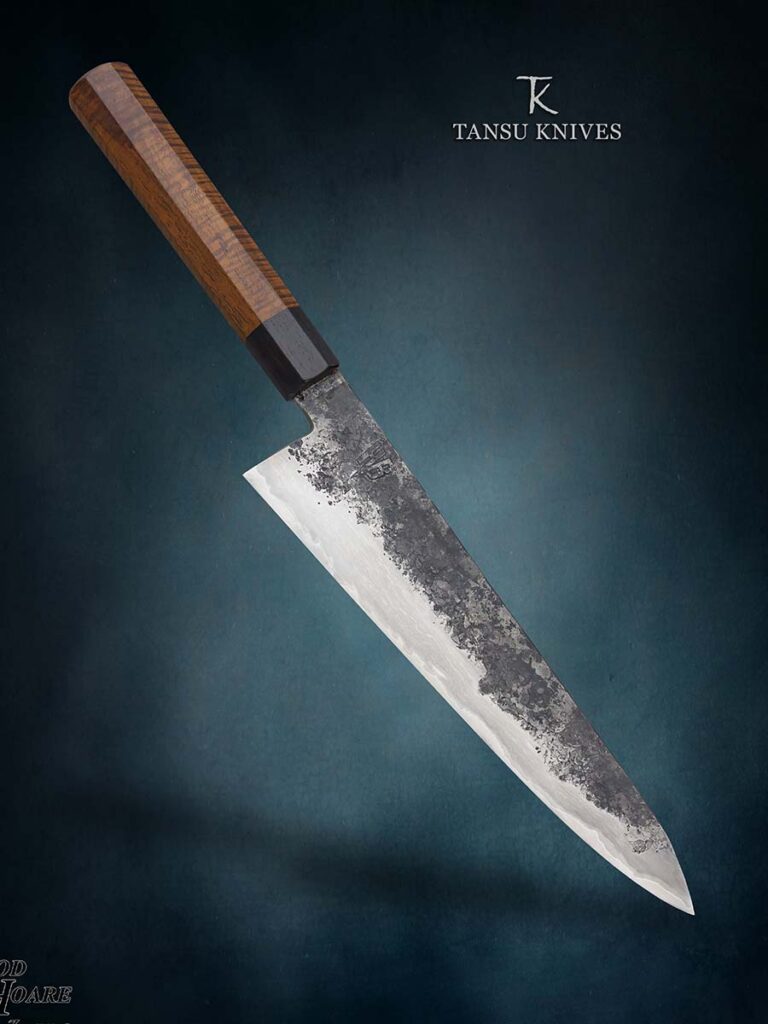
Mert’s featured knife is a gyuto from his Hunter Valley Blades series of traditional Japanese chef’s knives with forged finishes and usually san-mai construction. He employed a dowel-bedding construction for the wa handle (page 16). He characterizes his chef’s knives as affordable and less time consuming to make than other custom types.
Specific features of the wa handle style translate into precision and control in the kitchen. He says that the flats allow the user to index the knife with ease. Despite the “stop sign” shape, the octagonal handle is quite comfortable and fashioned with precision on his disc grinder. Optimal length is a subjective question, but Mert likes paring knives with wa handles no longer than 4.7 inches, while handles of 5.3 to 5.5 inches work best in larger chef’s knives with overall lengths of 9.5 inches. For long slicing knives of overall lengths of 10.5 inches, he indicated he prefers a handle between 5.7 and 5.9 inches.
Wa Handle Interpretations
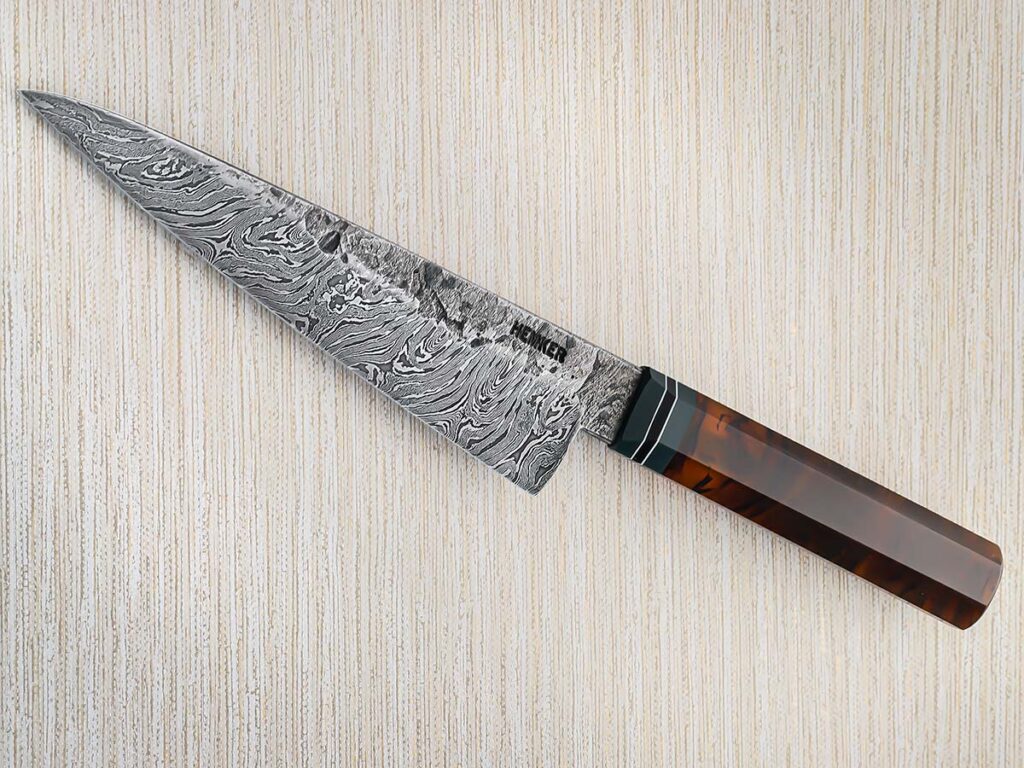
A custom knifemaker for seven years at his home near Melbourne, Australia, Alex Töpfer appreciates the employment of the hidden tang in his knife construction, and he says the wa-inspired handle works in both the active and aesthetic aspects of kitchen use.
“Obviously, I’m inspired by various styles of wa handles, specifically octagonal ones,” he commented, “and also the use of brass bolsters and guards in the Western context. The flats here are more to provide context with the organic, curved aspects of the wood grain and forged texture.
“I do think it’s important to have a flat [handle] surface that aligns with the blade, but the upper parts are more for looks. There is also the question of what an individual user likes. Personally, I prefer to use oval hidden-tang handles, but I do the occasional faceted one for practice and a change. I’ve only had problems when the tang is not long enough. So, I tend to go 2.75 to 3.15 inches of tang. That will support the handle during use. I have had issues with burl where the grain didn’t provide any strength, but a longer tang on that knife would have avoided the problem. Also, fancier materials might be easier to sell even if they’re not ideal. I like recycled ironbark but it doesn’t have that bling factor.”
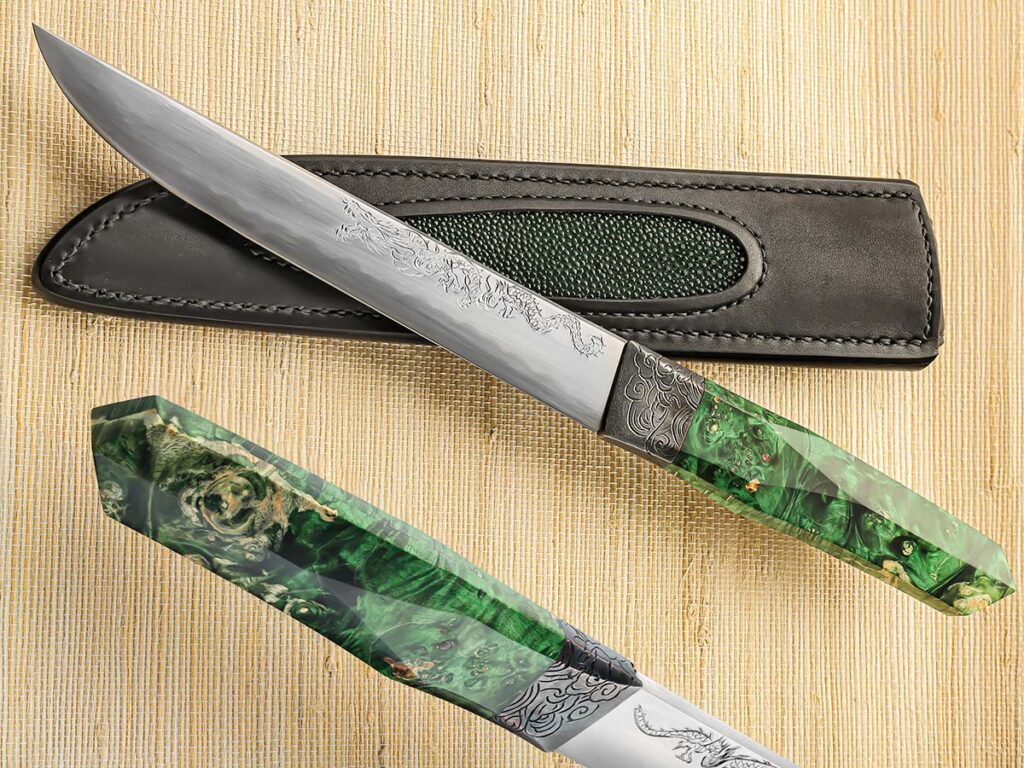
Garrity demonstrates his skill with the wa in his mosaic damascus santoku blade that combines 1095 and 52100 carbon and 15N20 nickel-alloy steels. He used the Ferry Flip method* and then placed the multi-bar construction to be framed by a monosteel edge and spine bars. Aidan’s santoku has a sister blade, a nakiri featured on the cover of the March 2024 BLADE® (page 13). He made the nakiri with the same bar of mosaic damascus as his santoku.
“This handle is of my own design. It has largely parallel sides to the width of the ricasso with a small ‘beak’ at the bottom for hand retention, as well as aesthetics. It wasn’t based on any particular style,” he noted, “but it does categorize as a shield-shaped wa handle. The flats lend themselves to helping the user maintain proper edge alignment while cutting, as an overly round grip doesn’t offer much [user feedback]. In addition, the flats are somewhat easier to bring to a high finish.”
In constructing a wa handle, Aidan leans heavily on the length of the blade.
“Typically, 4½ to 5½ inches is seen as a natural range to balance average length and weighted blades,” he remarked. “Thicker and wider blades like nakiri and bunka will often be more forward weighted compared to the more generalist shapes like santoku. The handle is often too slim with poor retention for any large chopping blades or fighters. It’s best to stick to kitchen knives for this type of handle design.”
The where, why and how of the wa are revealed in various interpretations, put to work with enthusiasm in the kitchen, and exhibit style and beauty whether in the midst of meal preparation or displayed for all to see. Their aesthetic is timeless, but so is their capacity to make the work of the chef an adventure in creativity.
*Editor’s Note: Named in honor of its creator, award-winning bladesmith Tom Ferry, the Ferry Flip is a variation on the canned steel technique. It basically consists of cutting slices at a 35-degree angle off the end of a damascus billet. The resulting tiles are rotated and forge welded together to form a new billet. As a result, instead of the pattern showing on the end of the new billet, the pattern repeats itself along the new billet’s face.
More Kitchen Knives:
- Best Tomato Knives: Top Picks For This Delicate Job
- Affordable Chef’s Knives: Options That Are A Cut Above The Rest
- Best Gyuto Knife: East And West Meet Over Dinner
- Best Cleavers: Hot Choppers
 NEXT STEP: Download Your Free KNIFE GUIDE Issue of BLADE Magazine
BLADE’s annual Knife Guide Issue features the newest knives and sharpeners, plus knife and axe reviews, knife sheaths, kit knives and a Knife Industry Directory.Get your FREE digital PDF instant download of the annual Knife Guide. No, really! We will email it to you right now when you subscribe to the BLADE email newsletter.





