
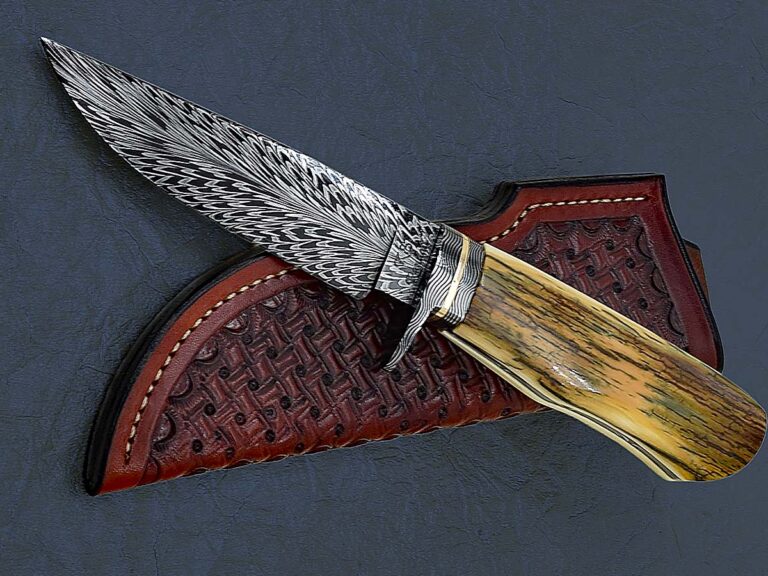
Hidden value of damascus frame-handle hunters.
In 1994, I attended a custom knife show in Little Rock, Arkansas. For the first time, I saw what I thought was a forged knife with a fully exposed tang. American Bladesmith Society master smith J.R. Cook explained to me that what I was looking at was a frame-handle knife. The technique differs from a full-tang knife, where the tang itself forms the handle outline, and from a hidden-tang knife, where the tang is enclosed inside handle material.
Most forged blades are made with a hidden tang, in which a hole or slot is drilled into the handle material for the tang of the knife to slide into. Usually, the tang is held in place by glue or pins. The other common type of build utilized by custom knife makers to attach the handle material to the tang is called a mortise tang. This is a specialized method used by custom knifemakers to build a hidden tang handle. It bridges the gap between a standard hidden tang and a full tang. In a mortise-tang knife, the tang is completely enclosed within the handle material, but the handle itself is assembled from multiple pieces that have been precision-channeled to fit the steel. A third way is the much more complex frame handle.
Frame Job
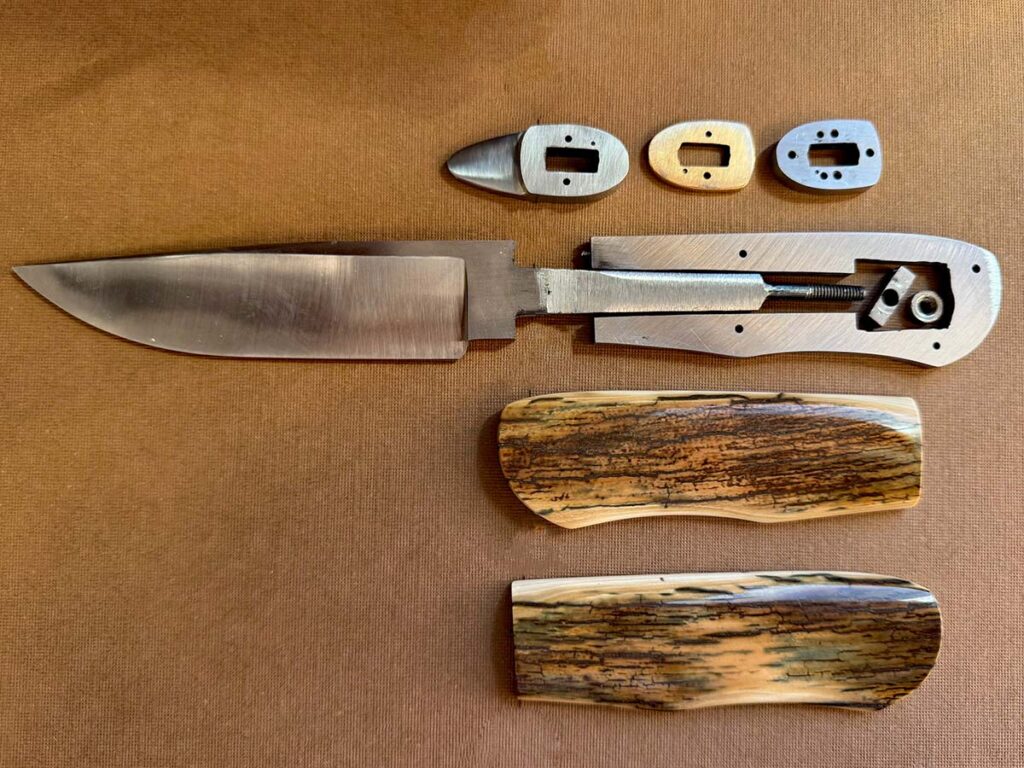
The frame-handle construction technique for a custom knife is considered an advanced knife-making method. The look of a knife with an exposed tang is created by building a metal frame; the knives featured in the article all have damascus frames. This frame surrounds the hidden tang and incorporates several parts to finish the handle.
These knives features five key elements: tang, guard, frame, scales (handle material) and pins. Sometimes the makers use spacers in the handle, which adds one more layer to the handle build. In the preceding photo, master smith Steve Randall shows an important aspect of the frame-handle construction: a threaded tang and a locking nut to further strengthen the handle. Additionally, you can see the pinholes running through the spacers and into the guard, which further help align the frame and the guard, helping to keep the blade centered.
The technique has its advantages, such as:
- Appearance: As I wrote at the beginning of this article, I saw something that was not what I thought it was. Frame-handle knives immediately stand out from those utilizing hidden or mortise-tang construction. If you are unaware of what you are looking at, your curiosity immediately draws you to that knife, as it did me.
- Scarcity: This is primarily due to the level of skill required to create this type of knife. Many collectors and makers often associate this with high-end art knives or exhibition pieces.
- Structural strength and stability: The metal frame reinforces the handle. Properly built, the frame helps minimize the movement of natural handle materials due to humidity changes.
- Fit and finish potential: A skilled knifemaker can create transitions that appear almost seamless between the frame, guard and handle material.
With that said, there are disadvantages of the frame handle construction:
- Cost (only a disadvantage if you do not understand why): As you saw in the Steve Randall photo, there are many parts to this build. The creation and fitting of all the parts can add hours to a build compared to a full or mortise tang construction. Once you understand why the knife costs more due to the work put in, you gain a new appreciation for the price tag.
- Additional weight: Adding the frame will increase the knife’s weight. The trade-off for that weight will be a more stable handle, especially compared to the mortise-tang construction.
- Fit issues: Because of the complexity of the build, you may find knives with gaps, uneven transitions between parts—e.g., guard and spacer(s)—and potential differential expansion between materials. It requires tighter tolerances, which makes this type of knife more challenging to build.
Collector’s Sweet Spot
We have discussed the complexity of the build and the commensurate skill required to build a frame-handle knife. But what attracted me to this type of knife was its uniqueness. Without a doubt, the most collected custom knife in the world is a hunting knife. For many collectors, it is the first custom knife they buy due to its utilitarian nature and cost. Consequently, for many makers, a hunting knife is one of the first knives they attempt.
Having just returned from the BLADE Show, I can tell you there were hundreds of hunting knives in all shapes, sizes, materials and styles. For those of you who have bought forged bowie-style knives, you know the prices have gotten expensive for even a base model. So, the forged-blade market did what all sectors of the custom knife market do—it adjusted. Many of the forged hunters are now very utilitarian with no frills. The quality is still there, but without the bells and whistles so many collectors like on their custom knives.
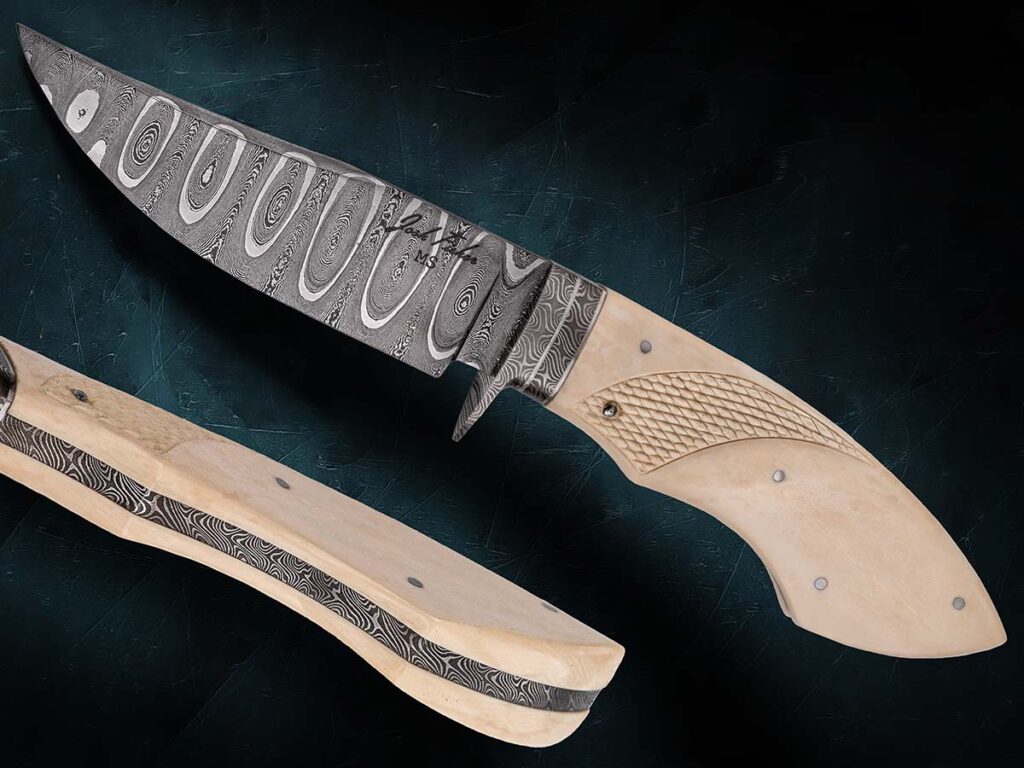
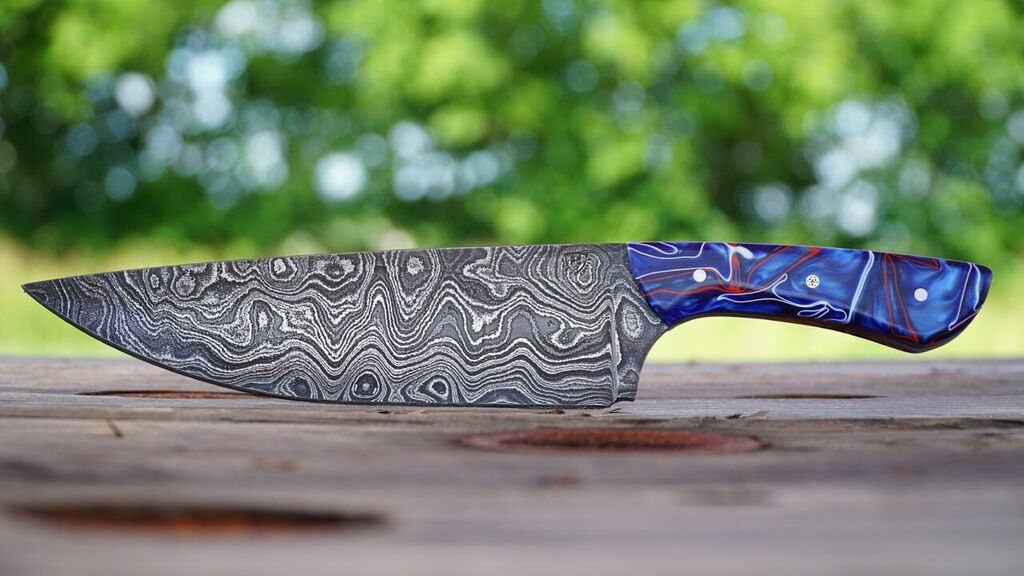
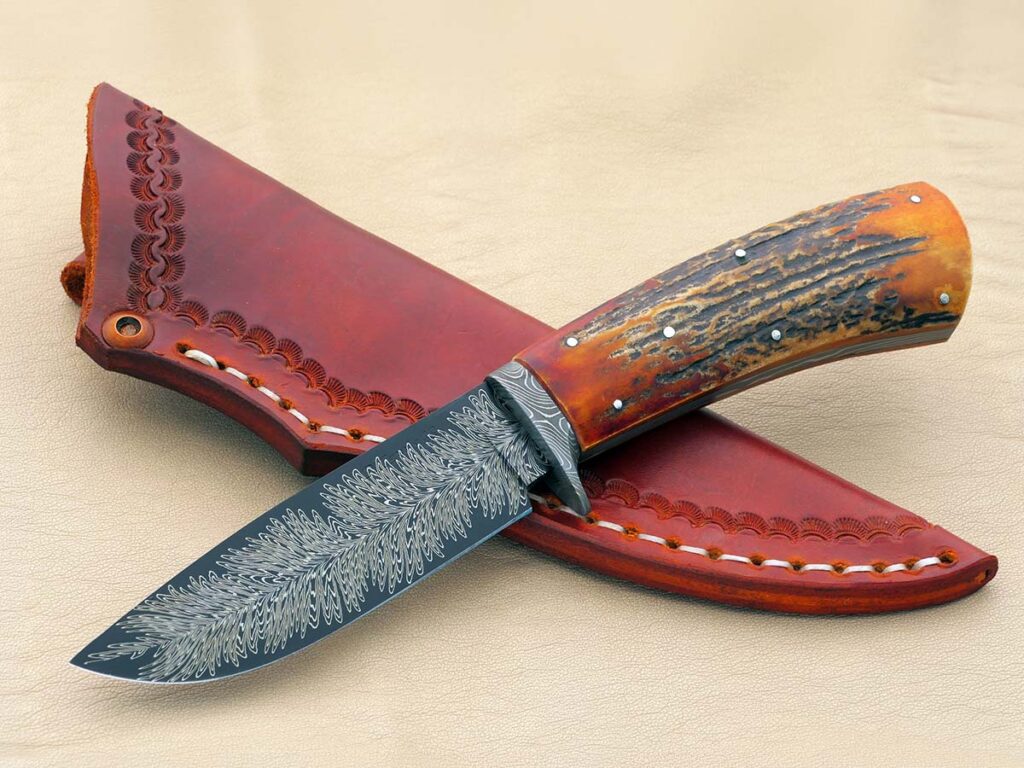
What I like best about the frame-handle hunters is that you can get a knife that borders on museum quality. That offers so many options, blade steel, guard and frame steel and a wide variety of handle materials. The photos of the knives featured in this article will give just a glimpse into what is possible. The damascus patterns that offer so much detail in a short blade. The balance of the knife and the handle ergonomics that each maker can create complements not only the utility of the knife, but the unique look that every frame-handle damascus hunter has.
For many collectors, these knives provide a sweet spot between a utilitarian hunter and that out-of-reach damascus bowie. Given the skill required to build a frame-handle knife, when you compare it to one utilizing full or mortise-tang construction, you may come to look at these hunters as a bargain!
Maker: Steve Randall
Model: Frame Handle Hunter
Blade Length: 4.75″
Blade Material: Feather Pattern Damascus
Guard and Frame: Feather Pattern Damascus
Handle Material: Mastodon Ivory
Overall Length: 9.5″
Sheath: Leather custom-made by Steve Randall
Price: $1,600
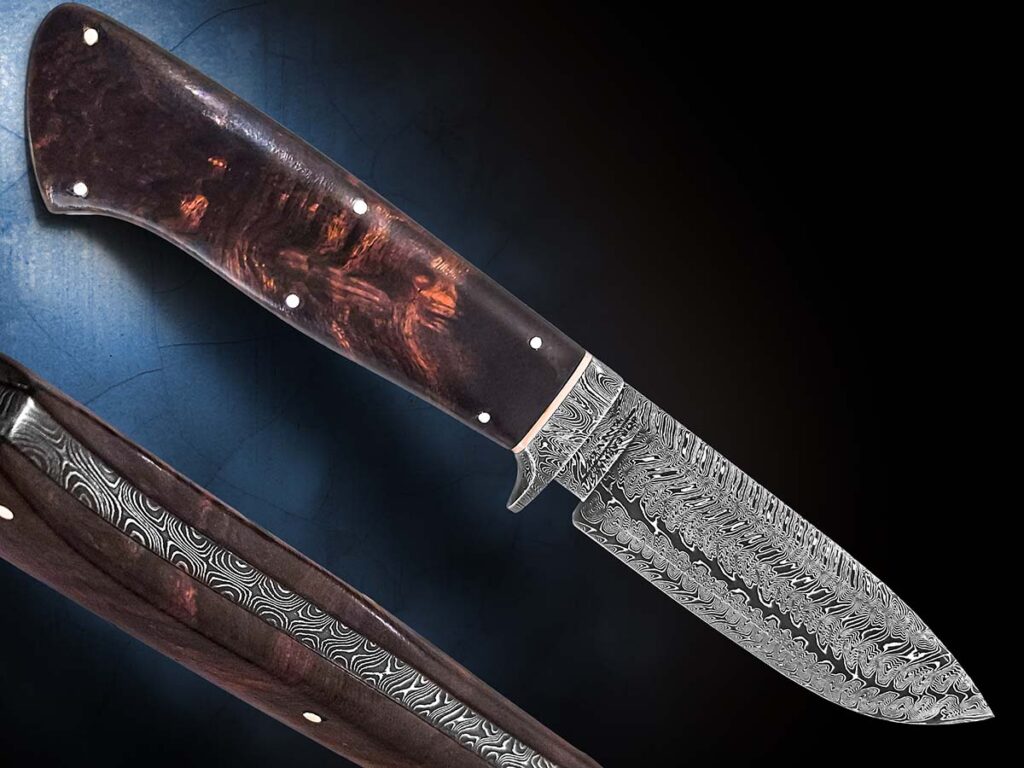
Maker: Bob Earhart
Blade Length: 4.5″
OAL: 9.5″
Blade Steel: Forged Turkish Twist Pattern Damascus
Guard, and frame: Turkish Twist Pattern Damascus Steel
Handle: Presentation Desert Ironwood with a Bronze spacer and domed stainless-steel pins.
Sheath: Custom-made leather sheath by the maker
Price: $975
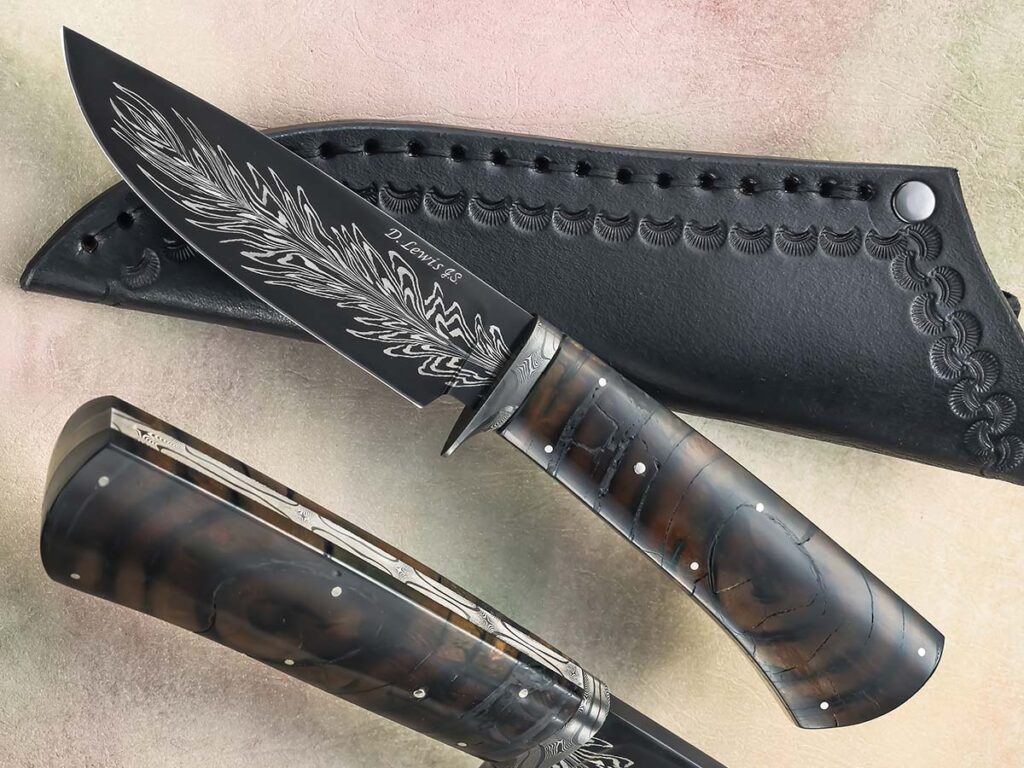
Maker: Dan Lewis
Blade Length: 4.25″
Overall Length: 8.75″
Blade Steel: Forged Feather Pattern Damascus
Guard and Frame: Forged Damascus
Handle: Cross Cut Mastodon Ivory
Sheath: Custom-made leather sheath by the maker
Price: $1,175
Maker: Josh Fisher
Blade Length: 4″
Overall Length: 8.75″
Blade Steel: Forged Ladder Pattern Damascus
Guard and Frame: Forged Damascus
Handle: Mammoth Ivory with checkering
Sheath: Custom-made leather sheath by the maker
Price: $2,000
Maker: Dan Lewis
Blade Length: 4.25″
Overall Length: 8.75″
Blade Steel: Forged Feather Pattern Damascus
Guard and Frame: Forged Damascus
Handle: Amber Stag
Sheath: Custom-made leather sheath by the maker
Price: $975
Check Out More Outdoor Knives:
- BEST TOMAHAWKS: OUR TOP HAWKS FOR BACKWOODS TO BATTLEFIELDS
- BEST BUSHCRAFT KNIFE: WHEN STEEL MEETS THE WOODS
- BEST EDC FIXED BLADE KNIFE: A CUT ABOVE THE REST
- BEST CAMP KNIVES: OUTDOORS DO-ALLS
 NEXT STEP: Download Your Free KNIFE GUIDE Issue of BLADE Magazine
BLADE’s annual Knife Guide Issue features the newest knives and sharpeners, plus knife and axe reviews, knife sheaths, kit knives and a Knife Industry Directory.Get your FREE digital PDF instant download of the annual Knife Guide. No, really! We will email it to you right now when you subscribe to the BLADE email newsletter.