

From razor-thin slicers to heavy-duty choppers, here’s how edge geometry and grind thickness impact real hunting performance—and what makes the perfect hunting knife.
Whether it’s a secret lure, special scent, backwoods honey hole, a custom-tuned call, or even camo boxers or lucky socks, all hunters have some kind of secret weapon, superstition or technique that they believe will give them an edge over their quarry. But when it comes to the actual edge—the blade of your knife—are you that particular? Are you that picky, that much caught up in hype or that much committed to tradition? Let’s explore the “hunter’s edge” as we consider what kind of grind and edge geometry makes a so-called perfect hunting knife.
Hunting is a game of tradeoffs. If you hunt the field, you can’t hunt the hill. You may be stuck at work on the nice weather days and sitting in the trees in the rain on Saturday. You may sit one time and kill a record buck, or you may sit all season and not see a single “shooter.” There’s seldom a way you can have it all at the same time.

The hunter’s knife is no different. In general, “small game, small knife, large game, large knife” holds true, but what characteristics make it so? A big knife can be an advantage or a small knife can be sufficient, depending on whether you’re hunting whitetails in Saskatchewan or Texas. Do you want to use the same knife for wild pigs and moose?
Hunters want a knife that will stay with them through thick and thin. But should the knife’s edge be thick or thin? I have hunted and harvested game since I was a boy, but it was not until I was nearly 40 that I put a caliper to a knife edge. A knife just was, an omnipresent tool taken for granted. Some worked better than others, though I had never thought about why it was that way. Let’s talk a little about edge thickness and numbers.
Optimal Hunting Knife Edge
An experienced hunter may want a knife to chop trails and trim brush, do camp chores or fire-building tasks, or split a deer’s pelvis or sternum. Those tasks lend themselves to a larger, heavier knife with a thicker edge. The heavy-use knife may be 10 or 11 inches overall of 3/16-inch-thick steel and maybe forty thousandths (.040) of an inch or more behind the edge.
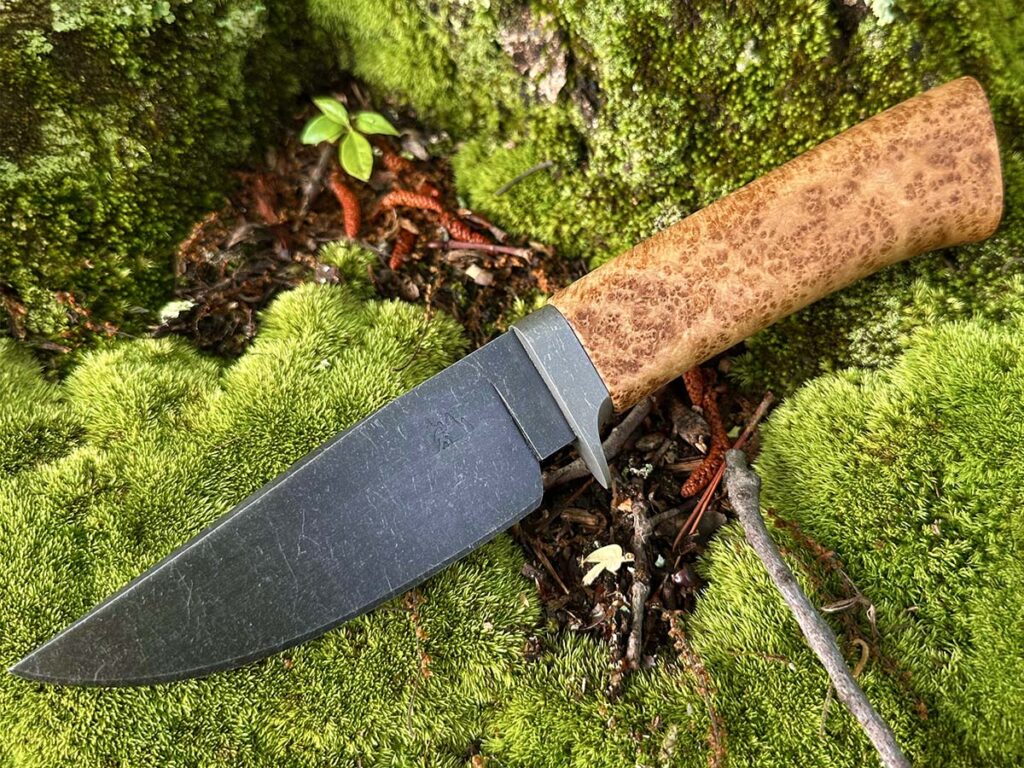
The grind is more likely to be full flat with a convex edge, or even full convex. The tradeoff is no matter how sharp such a knife gets, it won’t excel at fine work like making the initial cuts through fur or opening the abdomen. It’s not impossible to field dress a deer with a thick-edged knife, it’s just a bit more difficult.
Another hunter of equal skill may carry his knife on his belt or in her pack, only taking it out for the finer tasks of skinning, quartering and deboning. Such a knife could be as little as 3/32 inch thick and as short as 7.5 inches overall. The grind could be full flat or hollow, and somewhere in the 15-to-20 thousandths (.015-to-.020)-of-an-inch-thick-range, or even thinner.

On a small knife, you may not have the handle or blade length to give you the leverage you want to easily split the sternum on an elk. No matter how sharp the small knife is, it won’t excel at chopping or tasks that require leverage. It’s presumably not impossible to field dress a grizzly bear with a small, thin knife, it’s just a bit more difficult at some points in the process.
My “eyecrometer” doesn’t measure very precisely. As a simple frame of reference, 10 pages of BLADE® are roughly .020-inch thick. If you use a caliper, you’ll need one that measures down to the .001 (thousandths)-of-an-inch level.
Well, that was a nice theoretical discussion. Now let’s look at some concrete examples.
Different Hunting Knives
I asked a group of knifemakers to send me examples of knives that fit the hunting knife description. I was part of the judging panel for the Knifemakers’ Guild awards at the BLADE Show and got the chance to handle a wonderful knife from Guild voting member Alex Harrison of Night Watch Knives. Of all the knives in the judging, this one really spoke to me as an excellent hunting knife.
First, there are the intentionally muted textures and tones. It’s all dark, rough and tough, and even the bright orange G-10 has subtlety from the combination of the ground-in divots and blasted grain of the material. Next, the shape was pleasant in the hand and the blade was all business. At first glance it’s a fairly standard drop point but it has all the small details: the short-serrated section near the ricasso, the swedged point, the ground edge at the top of the point. Underneath it all, the hollow grinds are simultaneously effective and pleasing to the eye.
“This knife is hollow ground, probably ‘ten thou’ behind the edge. That’s the sweet spot for me,” Alex explained. “Everyone loves a razor blade but people do stupid [stuff] with their knives, and even skilled users aren’t always gentle. I often have requests for serrations for game processing, so I taught myself how to grind them in such a way that they still slice paper.” I dare you to try to slice paper with the serrations on the standard big-box store hunter! Added Alex, “The ligature notch is meant to be a safe way to conduct an aggressive gross motor skills reverse cut and sever a ligature under tension.”
Guild probationary member Chip Carlisle’s take on a hunter is a bit bigger, a bit beefier and a bit more traditional. The Wagu Cattleman from Chip’s Skjeggmenn Knives is 9.5 inches overall with a 4-inch blade of 3/16-inch-thick stonewashed 8670 carbon steel. A precise, full-height flat grind comes to a thin .020-inch edge. The clip point is swedged, giving the blade a sleeker look than its height would automatically provide. Carlisle said the knife “delivers uncompromising performance where it matters most—at the edge of work and wilderness.”
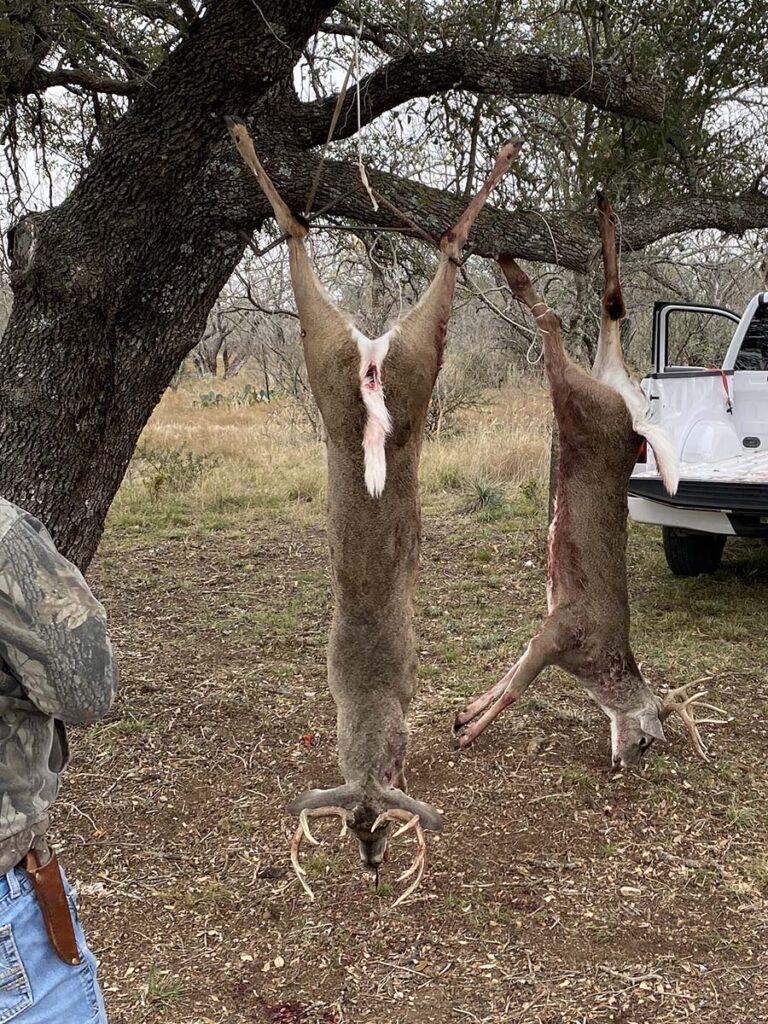
Newly elected Guild board member Paul LeBatard executes the traditional hunter with modern materials and an eye for precision. The 3.5-inch blade of his Field and Stream model is 3/32-inch stock hollow ground on a 12-inch wheel to an edge thickness of .020 inch. Overall length: 7.75 inches. The same design comes in two larger sizes called the Personal and Personal Plus. The profile reminds me of the old Case and Western hunters from years past.
Critiquing Work
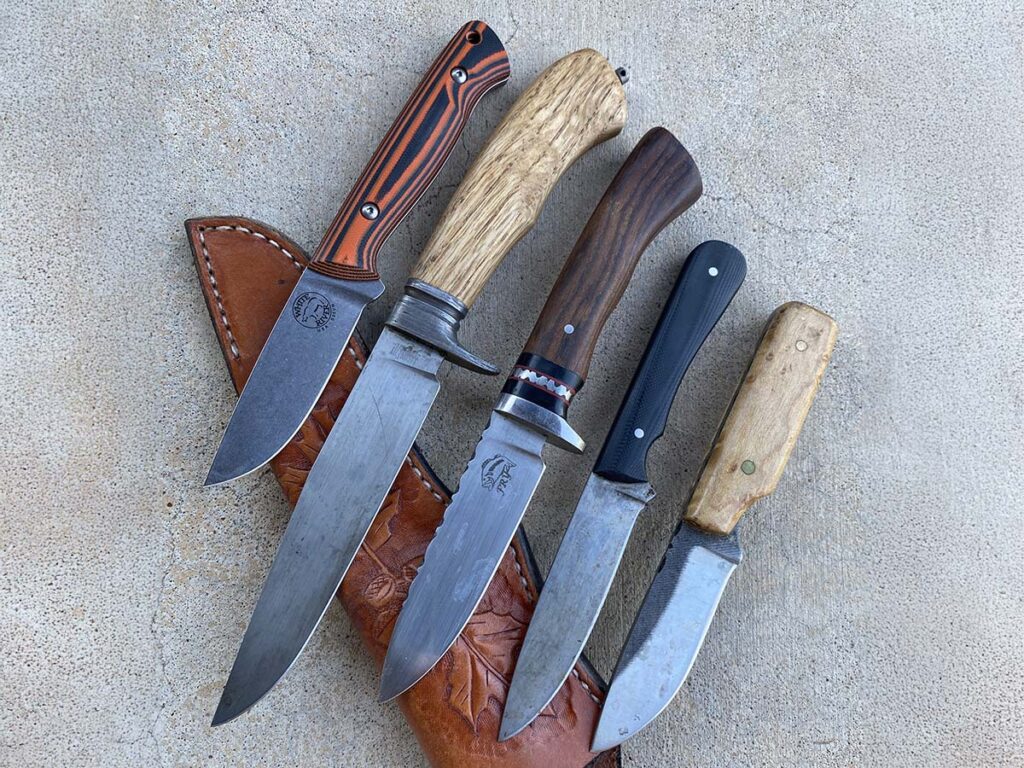
One of the unspoken rules of the knifemaking world is to not offer unsolicited criticism of another maker’s work. Now that I’ve put that rule in writing, I’ll be consistent and point out some flaws in some of my own early work to illustrate some points of error to look for.
At far right in the accompanying image (above) of my five knives is the first knife I ever made, stock removal from a file, that I enthusiastically called the Triple D for Deer Disassembly Device. I was a bit delusional. Although I’ve processed many deer with this knife, the handle is too short for the blade, which causes problems with leverage while splitting the sternum. Also, the knife was made with files and sandpaper, not a grinder.
The original edge thickness was somewhere beyond .060 inch. Eventually, as my skills improved, I re-ground the knife a bit, pushing the edge back to a slightly more respectable .035 inch. The knife doesn’t slice well at all, mostly as a function of the thick geometry, but also of the shorter bevel grinds on thicker stock.
Next from right in the image is my 50th knife, stock removal, ⅛-inch-thick 1084 carbon steel. This one also has handled its share of game. The edge thickness is .025 inch and works great but the handle is too thin. With ⅛-inch-thick steel and ⅛-inch-thick G-10 scales, there’s just not enough handle for my aging hands. The center knife is my 100th circa 2010.
I was into D2 and filework at the time, neither of which are particularly suited for a hunter, and the handle is fat and boxy. Next is my first real forged knife, from a drag harrow tooth from my grandfather’s ranch. The handle is 1955 white oak floorboards from my house at the time.
The knife is the best of those pictured in many ways, with a thin edge at .010 inch, a large enough handle, easily sharpenable steel, and a great story of how the original customer gave the knife back to me before he passed away. The full flat grind and distal taper make it a pleasure to use.
At far left in the picture is what I’ve settled on as my hunting knife of choice, the Jason Fry Hunter I designed for White River Knife & Tool in a full-flat-bevel-ground blade of S35VN stainless and black/orange G-10 scales. It’s just shy of 8 inches overall with a 3.5-inch blade. The handle length is enough to provide the necessary leverage, and the blade length is enough to do the cutting.
I’ve made this design for a decade by hand, both one-offs and small batches. For a general-use hunting knife for mass production, I wanted to split the difference between thin razor and beefy chopper. I specified the thickness at .020 inch and the White River guys nailed it.
The Perfect Hunting Knife
What makes the perfect hunting knife edge? It must be sharp. It has to be thin enough to slice fur yet burly enough to split a pelvis or sternum. It must have a handle big enough to provide leverage. It has to hold an edge through its primary tasks. Most of all, it must be with you when you hunt, an integral part of the package of secret weapons that set the hunter above the prey.
More On Knifemaking:
- D.I.Y. POWER HAMMER: DO YOU REALLY NEED ONE?
- STAINLESS DAMASCUS: CHALLENGES IN FORGING
- STROPPING: WHAT IT IS AND HOW IT’S ACCOMPLISHED
- DIY ENGRAVING VISE OR BLOCK
 NEXT STEP: Download Your Free KNIFE GUIDE Issue of BLADE Magazine
BLADE’s annual Knife Guide Issue features the newest knives and sharpeners, plus knife and axe reviews, knife sheaths, kit knives and a Knife Industry Directory.Get your FREE digital PDF instant download of the annual Knife Guide. No, really! We will email it to you right now when you subscribe to the BLADE email newsletter.





