Home Blog Page 110

New England Battle Of The Bladesmiths

0

Four Young, Talented Bladesmiths Battled The Clock Under The Sweltering Maine Sun To Craft A Knife In Two Hours.

It was brutally hot under the Southern Maine Sun on the campus of the New England School of Metalwork, It was made even hotter when a pair of forges were fired until they were an electric glowing orange. It was all part of the build-up to the Battle Of The Bladesmiths as part of the New England Bladesmithing Symposium.

The rules were simple: given a one-foot bar of 1084 steel, four bladesmiths had two hours to make a knife at least 7-inches long. This meant forging the blade, sculpting the guard, making the handle, and assembling it all within the allotted time.

The theme for the contest was young guns as the youngest competitor was 19 and the oldest was just 24.

“We pick people that are at an equal level of skill,” NESM director Dereck Glaser said. “We had 25 applicants, and we picked these guys based on a moderate level of skill, they’ve all been making knives around the same length of time. And I wanted to get an [similar] age range. I didn’t want big old-school guys coming in against people nobody knew.”

Who Hammered In The Battle

Leo Potter shows off his sword before the battle. Blade: 1084. Guard & Pommel: 1045. He dried local birch for the hilt core.

The foursome was from all over.

There was Leo Potter, already an accomplished smith from New Hampshire who came with pieces to proudly show off and display. Up from Martha’s Vineyard with his parents was 20-year-old Luke Nivala, and down from Quebec was Jeremy Yelle. Kemper Feuerzeig rounded out the field, and he had flown in all the way from California.

Glaser said he was excited to have the field he had and was thrilled to see the battle return for the first time since 2019 due to the COVID pandemic.

“We started doing the battle in 2010 or 2011, and shortly after, Forged in Fire caught on,” Glaser. “That’s where the show came from, this whole battle concept. The ABS was doing this at their events long before the show existed.”

In The Thick Of It

The contest started fast as everyone got their steel into the heat within the first minute. Like dancers, the smiths bounced back and forth from their stations to check on their steel. Every second was used to the fullest.

The smiths used different techniques to make their blades. Feuerzeig forged and ground his blade with authority and was ahead of everyone when he quenched just 30 minutes in. By contrast, after forging the blade to shape, Yelle put his blade in the vice to normalize so he didn’t quench until 70 minutes into the competition.

Nivala kept a steady pace throughout and didn’t let the pressure get to him, or at least kept a cool, confident face. His mother was beaming the whole time with pride in her son.

Lisa Nivala captures video of her son Luke as he competes in the battle.

The contest was to be judged by a trio of renowned smiths, Emiliano Carrillo, Matthew Parkinson, and Lin Rhea. Other legends of the field like Mace Vitale watched on intently and tried to help guide the younger smiths when given the opportunity to do so. 

It was great to see the camaraderie as day turned to night not only between the competitors but among the judges, staff, and other symposium attendees. No one wanted anyone to lose. Everyone was cheering for four successful knives.

Potter putting all his weight into making the handle work.

However, bad luck hit both Potter and Yelle. The former’s first attempt at a handle didn’t work, putting him way behind on time. He tried mightily to get the handle married to the blade but it wasn’t to be.

“I made the hole way too big so when you stuck it on the knife there was a big gap,” Potter said after the contest. “You could see the gap around the guard.”

Yelle’s attempt to normalize the blade put him behind on time and he wasn’t able to get the most out of grinding.

The two youngest competitors, Nivala and Feuerzeig, were a sight to behold. Kemper’s forging and grinding was magic and Nivala’s ability to maximize every second at the grinder was great to see. Both of them made beautiful knives.

Testing The Knives’ Mettle

After the contest concluded, the knives were all put through a series of three tests. They had to poke and pop a water balloon hanging from a piece of twine, push cut through a piece of rope, and slice through a rolling paper.

Feuerzeig (left) and Nivala (right) grinding away at their blades.

Nivala and Feuerzeig’s knives performed the best although none of the knives were able to fully cut through the rolling paper. Carrillo chipped in to help cut so the competitor’s adrenaline-filled hands, didn’t play a role in the slice.

All the knives were judged on a scale of 25 points and Feuerzeig beat Nivala for the win, and the $5,000 prize by a single point. He said his strategy was to keep things straightforward so he could put all his energy into the process and not have to re-design on the fly.

Kemper Feuerzeig’s winning knife.

“This is the first Bowie I’ve done in forever so I just wanted to do something very simple,” Feuerzeig said. “The one mistake I made on the knife was the ricasso got a bit longer than I would like. I think it’s not super elegant; in the future, I’d try to do that better. I wanted something where I wouldn’t have to think about the lines too much.”

Feuerzeig with his winnings, the judges, and the staff from the NESM

Even though he didn’t win, Potter said that the battle taught him a lot about himself as a smith and showed him new ways he can go about making blades.

“I think it sped up a lot of my other work,” Potter said. “I figured out yeah, I can cut this. I don’t need to be so careful if I’m making the back of my guard exactly flat because I can take it to belt grinder, and I can make it as flat as I need. It’s little things where you try it and you realize it’s doing the same amount of work as when you spend 20-30 hours getting it just right. It’s really taking that time to blow through it. I like to do things big and it teaches you about the little bits. When you go and slow down you know can take some time and here you can act with reckless abandon and blow through it.”

Final Cut

You can watch Forged In Fire, but nothing prepares you to see the process up close. It’s remarkable watching four people take the same rod of steel in the same amount of time and all come to vastly different ends. The crowd loved it, the judges loved the knives, and everyone had a great time as day turned to night in the Pine Tree State.

The New England School of Metalwork in Auburn, Maine offers courses in blacksmithing, bladesmithing, and welding. You can learn more here.

Editor’s Note: This article was written by Mike Ableson.

Return Of The Tactical Fixed Blade

0

It Never Disappeared, But The Tactical Fixed Blade Has Long Been Overshadowed By Other Knives. Now It’s Back In A Big Way.

When developing a new product or their version to enter an established market, most industry professionals rely on product lifecycle management. The basic version has four steps—development and introduction, growth, maturity/stability, and decline—and applies to most all products that are sold, including custom knives. 

However, trends must be accounted for in the cycle with the added step of saturation, a step that is particularly applicable to custom knives. As a result, the lifecycle for custom knives has five steps: development and introduction, growth, maturity/stability, saturation, and decline.

The most recent example of saturation in the tactical folder was seen over the past 10 years, even though the knife began to take off in the early 1990s. Tactical folders featuring new openers, stabilizers, bolsters, and handle materials were all the rage. The growth was spurred when both makers and collectors who had been respectively making and collecting other types of folders came into the market. 

Prices spiraled upward and it seemed the good times would never end. In the case of tactical folders, market maturity and saturation occurred almost simultaneously. The decline began when those who overpaid for a tactical folder hoped there would be the next collector to sell or “flip” the knife to. They found out that the next collector wasn’t there and they were now the owner of a knife on which they would never recoup their investment.

Custom Knife Copies

When a collectible or a market gets hot within custom knives, makers want to join that market sector, as the path has already been made. I have always been struck by the dichotomy of many of the custom knifemakers I have dealt with over the past 30 years. Many perceive themselves as artists, yet are quick to embrace a trend or flat-out copy other makers’ work.

A case in point: those who make their versions of knives created by BLADE Magazine Cutlery Hall-Of-Fame® member Bob Loveless. Without a doubt, his custom knife designs are the most copied in the world. Why don’t those who reproduce Loveless designs build their own designs instead? The answer is simple: the path has already been made.

Without a doubt, the custom knife designs of BLADE Magazine Cutlery Hall-Of-Fame® member Bob Loveless are the most copied in the world. Why don’t those who reproduce Loveless designs build their own? The answer is simple: the path has already been made. (SharpByCoop image)

It is much easier to copy someone else’s work and then compete in that very saturated market. With few exceptions, most such makers get lost in that market as more and more enter it every year.

The idea of a custom knife is that it is made by a craftsman who can incorporate your ideas into a piece that will meet your needs, and not just create a copy of a knife others made famous.

Rising Tides

The aphorism “a rising tide lifts all boats” is associated with the idea that an improved economy will benefit all participants. This is exactly what has happened to the custom knife market over the past decade. In other words, the high prices many tactical folders received over the past 10 years made other market sectors seem like a bargain. Meanwhile, the prices realized for every other sector of the custom knife market also rose.

Currently, this is obvious in three sectors: slip joint/multi-blade folders, chef’s knives, and forged blades. As the realized prices for these knives continue to increase, the market is becoming saturated. 

The commonality with the three markets is that all are seeing booms in numbers of makers. Conversely, they are not bringing enough additional collectors to support the makers in the increasingly saturated markets. Makers are quicker to pivot to new markets than collectors, primarily due to the makers’ ability to potentially increase their sales.

Cyclical Nature Of Knife Trends

The custom knife market is a circle. The top half is folders and the bottom half is fixed blades. We knife enthusiasts have all witnessed the circle moving from folders to fixed blades. Almost without exception the reason it moves is because of pricing. Most custom makers do not know their position in the market. Subsequently, they do not price their knives commensurate with the market. The custom knife buyers will sort that out. 

Bob Terzuola made this tactical fixed blade for a U.S. Army Ranger before the Ranger’s deployment in the Gulf War in 1991. One of Bob T’s modified M18 Combatmaster models, it features D2 blade steel.

Demand and value for the money will separate those makers who continue down the market sector path and those who do not.

One of the trends I noticed at BLADE Show 2021 was the reemergence of tactical fixed blades. Like most custom categories, tactical fixed blades never went away completely. Instead, they were just overshadowed by the more popular market sectors.

The Meaning Of Tactical

Sometime around 1995, the marketing term tactical was created to identify the look of a particular knife market sector. The concept was a simple one: it was primarily the look of the knife. The blade had a non-reflective finish that could be bead blasted, tumbled, coated, etc. 

Unlike the latest iteration of tactical folders, if a tactical fixed blade had a damascus blade, it was a damascus bowie, fighter, hunter, etc. If the blade had a mirror finish, it was a presentation or art knife. The tactical definition indicated that if the knife had a guard, it also should feature a non-reflective finish. The handle material would be synthetic, that is, Micarta®, G-10, carbon fiber, etc. A natural handle material on a tactical knife would move the knife into another category.

Tactical fixed blades can range from practical to fantasy, neck knives to huge choppers. I bought my first custom tactical fixed blade in 1984, so I’m a fan! I am also a user and collector of knives from this market sector.

Today the advantage of the tactical fixed blade market sector is it offers knives for all budgets. The knives also offer the biggest steel selection of any market sector. Stainless, powdered, and carbon steels are all on the menu.

It will be on you to do your homework about what different steels will and won’t do for your tactical fixed blade. Rockwell hardness and heat treating will also come into play, as these knives are designed and built to be used. Hype is very pervasive in this market sector. This is why homework is necessary for the user/collector. Do not rely on the thousands of internet commandos and “experts” for your information. 

Experienced and entry-level makers alike in the market build tactical fixed blades that feature a blade and two pieces of handle material combined in a utilitarian design featuring a cool look that catches the buyer’s eye. With such knives be sure to check for unwanted sharp edges usually found in squared-off integral guards, etc., and also price. These knives should generally sell for $500 or less.

Options For Collectors

One of the trends the author noticed at BLADE Show 2021 was the reemergence of tactical fixed blades. A maker whose tactical fixed blades have always been in demand exhibiting at the show was Walter Brend (left). (Whetstone Studio image)

For custom collectors, numerous options are available dating back to the 1930s. To not step on anyone’s toes, I will say these are the tactical fixed blade makers I have or have had in my collection: RJ Martin, Rod Chappel, Bill Luckett, Bob Terzuola, GW Stone and Ralph Bone, and Cutlery Hall-Of-Famers Jimmy Lile, Dan Dennehy and Gil Hibben. There are plenty to choose from.

Before you start writing to the editor complaining about my glaring omission, I intentionally left Walter Brend off the list above. While I do have Walter’s work in my collection, it is not a collectible per se. The knife is in far from mint condition. It is the knife I have had with me since 1986. 

For high-end users, I can assure you it is the finest tactical fixed blade in the world. I do not make this statement lightly. Having handled more than my fair share of custom knives, I feel very confident in my statement. While I understand that most who buy Walter’s work put the knife in a collection, for those of you who own one of his knives and have never used it, more the pity.  

Buy The Knife For You

Whether you are looking for a good, solid budget-conscious user, a collectible, or the best the category has to offer, I recommend you check the emerging knives in the tactical fixed blade market. Do your homework to help with hype and enjoy using your knives. After all, that’s what they’re meant for!

Read More

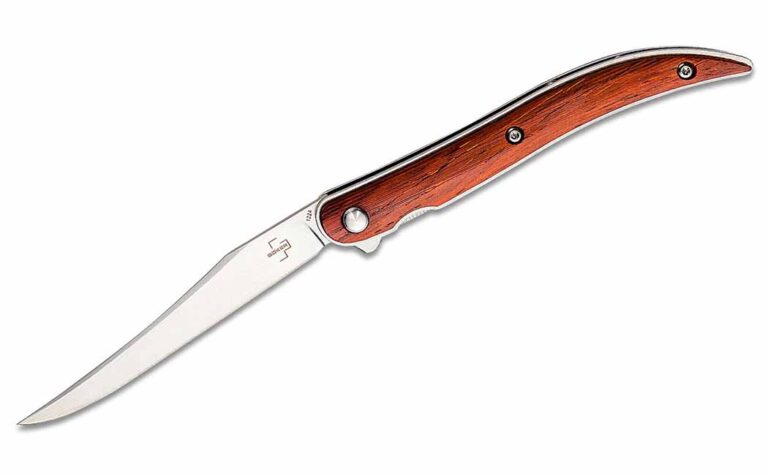
First Look: Boker Texas Tooth Pick

The Texas Tooth Pick Was Common In 19th-Century Texas. Today, Boker Has Taken This Historic Blade And Given It A Modern Revival.

The Texas Tooth Pick was used by people of all types in Texas during the 19th century. Everyone from farmers and fishermen to lawmen and outlaws, the Texas Tooth Pick was a common knife due to its versatility. And now, the team at Boker USA is reviving this Lone Star classic and giving it a modern look at a flipper. 

The VG-10 blade stays in place thanks to a linerlock and, as its name suggests, is narrow like a toothpick. The stonewash finish gives it a clean look, and the curved, textured G10 handle scales provide excellent grip.

Thanks to its narrow design, the piece is incredibly light. At just 1.52 ounces, there are many competing models out there where the blade itself weighs more. Thanks to the quality of its construction, this new Texas Tooth Pick is just as dynamic as the original but far more durable.

MSRP: $127.95

Editor’s Note: This post was written by Mike Ableson.

Read More

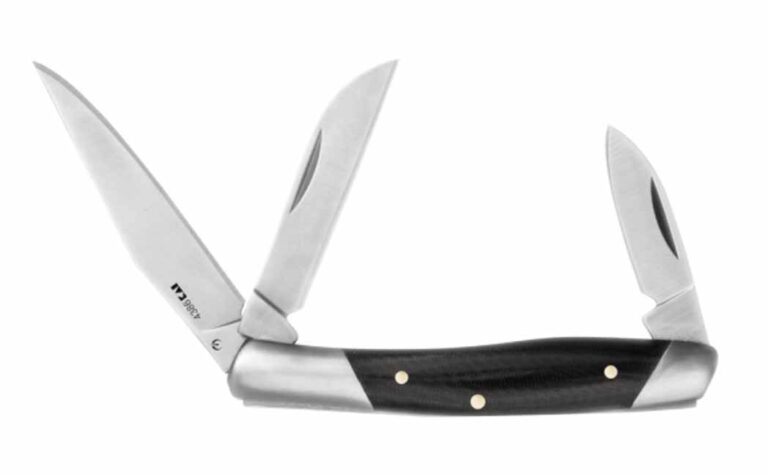
First Look: Kershaw Iredale

The New Iredale Is A Quality Multi-Blade Slipjoint That Stands Out As A Classic-Style Knife With A Minimalist, Modern Look.

The eternal debate of “classic vs modern” has been had across society for centuries. In the world of knives, that can come down to mechanical choices as well as design. Kershaw took the best of both worlds with its new Iredale.

Named for the Peter Iredale, a sailing ship that ran aground on the Oregon coast in 1906, the Iredale is a sleek knife for the 21st-century explorer. The model has three blades (a clip point, Wharncliffe, and Spey blade) all contained in a handle with black, polished micarta scales.

The non-locking slipjoint design allows for flexibility in the position of the knives so even with three blades, there are endless ways to position them to get the most from them. The blades are all made from 7Cr17MoV stainless and satin polished for a clean, traditional look. All three blades open with a nail nick for quick deployment. 

The shipwreck of the Peter Iredale can still be seen in the sands of Fort Stevens State Park so you can take your new Iredale and explore around its namesake on a warm summer’s night.

MSRP: $47.99

Editor’s Note: This post was written by Mike Ableson.

Read More

5 Of The Best Chef’s Knife Options Available Today [2022]

If You Can Only Have One Knife In The Kitchen, The Chef’s Knife Is The One To Get.

When it comes to knives in the kitchen the alpha and the omega, without question, is the chef’s knife. A quality chef’s knife can do just about everything from butchering a side of beef and dicing up vegetables to crushing garlic and skinning a salmon filet.

Whether Japanese or German, stainless or high-carbon, forged or stamped, there are an amazing variety of chef’s knives available today, and there will be one at the right price for you.

History Of The Chef’s Knife

Humans, and their ancestors, have been eating hunted meats and foraged fruits for millions of years. The first predecessor of the chef’s knife, in the most liberal sense of the term, dates back 2.5-million years to what is now Ethiopia. Known as Oldowan knives, these sharp stone pieces were made by smashing rocks together to form fragments with razor edges to cut through game. 

The first proto-knife found with protein residue on it dates back 250,000 years and was discovered in the Azraq Oasis in Jordan. It had the residue of horse, cow, and rhinoceros on it.

As time progressed, knives evolved along with humans. The discovery of fire along with different types of metals allowed the creation of the earliest forged pieces. The bronze and iron ages saw more quality metals turned into knives by skilled artisans.

Each new material allowed for better, more durable knives and paved the way for the steel models we have today. Chef’s knives, as we know them now, have been found dating back to before the Roman Empire and were modified versions of swords and other weapons.

Why Should I Buy A Chef’s Knife?

Look, if you want to try and cut through a medium-rare ribeye or slice veggies with a standard butter knife, good luck. 

A quality chef’s knife will make your life in the kitchen much easier than if you tried to force it with a standard dinner knife. Will the chef knife be more money? Absolutely, but, as you’ll see with our list, it’s incredibly easy to find a strong, capable model without breaking the bank.

So you should have a chef’s knife in the same way you should have proper running shoes if you are a marathoner or a good driver if you golf. You could do those things without the right equipment, but it’s much easier and enjoyable when you have the right tools for the job.

5 Best Chef’s Knives

Chef’s knives, Japanese or German, should make you feel comfortable and secure in the kitchen, as well as make work there easier. This list has a little of everything from pro-quality damascus blades, to stamped models strong enough to be an everyday workhorse.

Misen Chef’s Knife

Misen Chef's Knife
Misen Chef’s Knife

Award-winning cookbook author J. Kenji Lopez-Alt called this knife “the holy grail of inexpensive chef’s knives.” The 8-inch blade is made from Aichi AUS-10 high-carbon stainless steel, is ground to a 15-degree edge, and has a 58 HRC.

The sloped bolster and handle design encourages a safe grip while chopping. It’s light in the hand at only 8 ounces in weight and can mince herbs and cut through chicken bones just as easily.

An added bonus is that there are four choices for the handle color (blue, red, gray, and black). For a budget knife, this piece from Misen really is about as good as it gets.

MSRP: $65

Wusthof Classic Ikon 8-Inch Chef’s Knife

Wusthof Classic Ikon 8-Inch Chef’s Knife

An icon of German engineering, Wusthof has been making knives in Solingen, Germany since 1814. The Classic Ikon is a timeless all-around blade that makes an excellent addition to your home, while also having the chops to cut it (pun intended) in a professional kitchen.

The forged blade is triple-riveted to the black synthetic handle and has a 58 HRC. The half bolster cuts down on weight while also making it easier to sharpen. When you buy a Wusthof you can trust in the two centuries of work that has built the company into what it is today, and this model won’t disappoint.

MSRP: $200

Mac Knife Pro Series 8-Inch Chef’s Knife With Dimples

Mac Knife Pro Series 8-Inch Chef’s Knife With Dimples

This professional-level Japanese chef’s knife is a popular choice for chefs and home cooks alike. The 8-inch hollow-edge blade is made from alloy steel and a Pakkawood, triple-riveted handle.

What sets this knife apart from the rest on our list are the dimples on the blade. Known as a Granton edge, these dimples are more common on a Santoku knife than on a chef’s knife. Regardless, they allow for food to more easily slide off while cutting so you don’t have to deal with the frustrating task of peeling bits off the blade when you’re cutting stickier foods like potatoes or apples.

Made in Seki, Japan, the traditional home of Japanese knifemaking, Mac Knife has made something modern built with techniques developed over centuries.

MSRP: $195

Victorinox Fibrox Pro Chef’s Knife

Victorinox Fibrox Pro Chef’s Knife

The lowest-priced knife on our list punches above its weight and is a great addition to your kitchen. The price is kept down because the blade is stamped, but don’t let that fool you. This model has the same quality you would expect from everything else Victorinox offers.

The eight-inch stainless blade is married to an ergonomic, non-slip handle that feels great in the hand. Made in Switzerland along with the brand’s famous Swiss Army knives, the Fibrox Pro is easy and efficient to use. While it is listed as dishwasher safe, we recommend hand-washing and drying it as that will preserve the blade for longer.

An added bonus of the stamped blade is that this is the lightest knife on our list, coming in at just 6 ounces.

MSRP: $42.95

Miyabi Chef’s Knife

Miyabi Chef's Knife
Miyabi Chef’s Knife

This is a professional knife and it looks the part. Made of 100 layers of damascus steel around a Cryodur-hardened SG2 micro-carbide steel core, it is topped off with a Masur birch handle. The damascus blade has a ridiculously hard 63 HRC and is ground to an edge between 9-12 degrees using the traditional Japanese three-stage honbazuke process. That sees the blade polished twice on custom whetstones and polished to a mirror finished on leather wheels.

This is one of the highest-quality kitchen knives on the market today. It’s also a love note to Japanese knifemaking from its tip to the end of the handle. Miyabi’s whole set of chef’s knives is of similar quality and if maintained properly, can last you a lifetime.

MSRP: $342.99

Read More

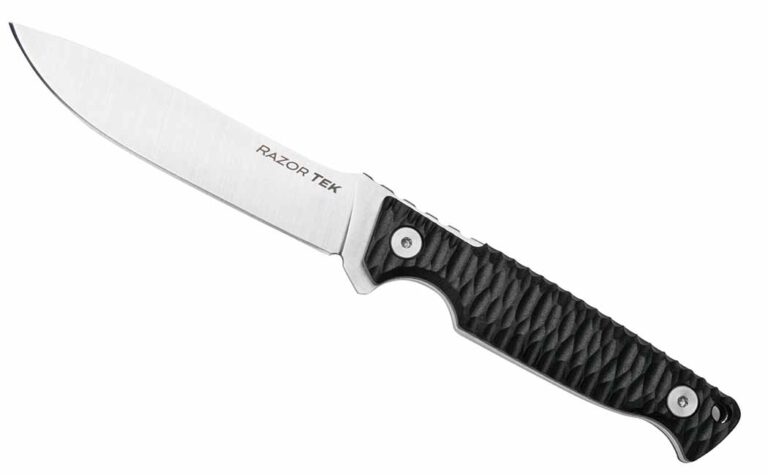
First Look: Cold Steel Razor-Tek Four-Inch

Cold Steel’s Newest Fixed-Blade EDC Is A Multi-Purpose Tool That Is Perfect If You’re Looking For A Knife That Works Just As Well In The Kitchen As It Does In The Forest.

Sometimes you want an EDC that’s a bit beefier than a folder or a multi-tool. The Cold Steel Razor-Tek is a high-quality piece that can slice through branches like it can a cucumber. 

This four-inch variety, one of three models to carry the Razor-Tek name, is made from 4116 steel and has an included sheath that can be carried on your neck or belt or lashed to your pack. The textured GFN scales on the handle allow for a confident grip and will stay secure in your hand.

Unlike the larger Razor-Tek models (one has a five-inch blade and the other a 6.5-inch blade), the four-inch is not a recurve and instead features a plain-edged clip point blade.

Overall, the entire knife is just eight inches which makes it great for cutting in close quarters and nimble enough to work precisely when fine slices are needed. And best of all, it comes at an affordable price that will keep your wallet happy. 

MSRP: $59.99

Editor’s Note: This post was written by Mike Ableson.

Read More

The Victorinox Swiss Army Knife

Few knives are as immediately recognizable as the Swiss Army knife. The small red multi-tool has been manufactured for over a century and is known around the globe for its versatility and durability. Still made in Switzerland today by Victorinox, the Swiss Army knife has evolved as a tool since the founding of Victorinox in 1884.

History Of The Victorinox Swiss Army Knife

Victorinox was founded in the small town of Ibach in the canton of Schwyz in central Switzerland by Karl Elsener. It was initially just a small cutler’s workshop run by Karl and supported by his mother Victoria.

Just seven years later, Elsener was able to deliver his first major batch of knives to the Swiss military, and six years later patented the original “Swiss Officer’s and Sports Knife. That set the stage for a whole range of knives, each of which would be included under the umbrella name of Swiss Army knife, or SAK for short.

The Victorinox brand name came into existence in 1921. After Victoria’s passing in 1909, Karl chose her name as the brand name, but 13 years later the innovation of stainless steel swept through the knifemaking world. At the time the steel was known as “Inox,” and by combining that with his mother’s name, Karl created the brand name of Victorinox that has endured for more than a century.

After World War II, American GIs stationed in Europe took a liking to the Swiss Army knife and bought many of them, turning them into a popular souvenir to bring back to the states. 

Since then, and the brand has continued to grow. Victorinox now makes other types of cutlery along with outdoor gear and watches. Rival maker Wenger, which also made a claim to the Swiss Army knife, was acquired by Victorinox in 2005, and its knives were absorbed into the Victorinox brand eight years later. The Wenger brand lives on through watches and other licensed products.

In 2017 the company produced its 500 millionth Swiss Army knife, a testament to the quality and popularity of the brand.

What Is The Best Swiss Army Knife?

That question depends on what you want out of your knife. Most all operate the same way, a slip joint with tools coming out of both ends of the knife thanks to a special spring system innovated in 1897 that every Swiss Army knife still uses today.

If you’re looking for a tool that can solve simple, everyday problems, there are many smaller models that will handle your needs. Many of those even fit on a keychain.

If you’re more of an outdoors person or just want something more rugged and diverse, there are many models that have dozens of different tools in them. You’ll see one with 73 tools in it shortly. Regardless of your wants or needs, Victorinox will have a knife for you.

Swiss Army Knife Options

The Victorinox Swiss Army knife is a living, breathing tool. New models come out regularly, and the team in Switzerland continues to find ways to create new tools and designs for the knives. Below are a trio that shows off what the SAK is capable of, from something simple to the opulently extravagant.

Signature Lite

Signature Lite
Signature Lite

This is a prime example of how much can be deftly fit into a space so small. The Signature Lite is 2.3 inches long and weighs just .8 of an ounce. Even in those tiny dimensions, there are seven tools including a ballpoint pen, screwdriver, knife blade, and scissors. This is a quintessential Swiss Army knife. It can fit on a keychain and follow you wherever you go.

MSRP: $39.99

Trekker

Trekker
Trekker

The Trekker shows how robust a Victorinox Swiss Army knife can be. This model features a dozen tools including three different screwdrivers, a can opener, and a wood saw. It’s designed for the outdoorsman, the hiker, the person camping under the stars. The Trekker does have a keychain loop although it’ll probably be better folded up in your pocket. At 4.6 ounces it’s far heavier than the Signature Lite but still far lighter than many other factory knives.

MSRP: $69

Swiss Champ XXL

Swiss Champ XXL

Last on our list is the most expensive model sold by Victorinox not including limited edition pieces. The XXL has so many tools in it that it doesn’t feel real. It’s 3.6 inches long, and in that space there are 73 individual tools. That’s not a typo. 73 tools.

Seven screwdrivers. Six blades. Three wire strippers. Too many wrenches to count. All that’s missing is the partridge in a pear tree.

The XXL also features some of the most unusual Swiss Army knife tools made today. That includes the pharmaceutical spatula, watch opener, fish scaler, and hook disgorger. 

At 12.5 ounces it is a beast, and it even comes in a lined, branded case. While it might not be necessary for you, the Swiss Champ XXL flexes the design and manufacturing capabilities that Victorinox has developed in its decades of existence.

MSRP: $379

Editor’s Note: This post was written by Mike Ableson.

Read More

Advertisement

Must Read Articles

Read this before you make a knife

Knifemaking 101 – Read This Before You Make a Knife

  by Wayne Goddard My experience has taught me that there's nothing like digging in and getting started. I've often said the hardest part of the...
how to forge damascus steel

How to Forge Damascus

Advertisement
Advertisement