This New Sharpener From Spyderco May Revolutionize Portable Knife Sharpeners Thanks To A State-Of-The-Art Superabrasive.
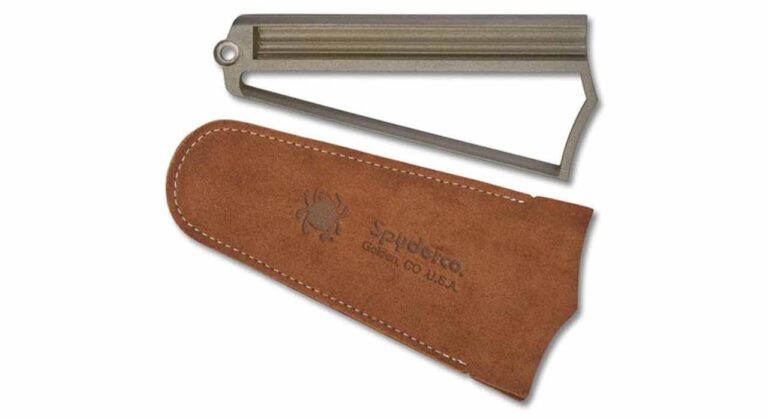
Coming soon from Spyderco is the Webfoot Sharpener. Small and compact, the Webfoot may turn the knife sharpening world on its head thanks to its construction.
The sharpener is made from a single piece of carbon steel coated in Cubic Boron Nitride which is a state-of-the-art superabrasive second in hardness to only diamond. The CBN coating can sharpen without oil, water, electricity, or any clamps or stabilizing devices. And it can all easily fit in your pocket.
Place the Webfoot on a flat surface and rock it side-to-side to align the outer edges for a perfect 40-degree angle, ideal for utility knives. When it’s on its side, the sharpener gives a perfect 12.5-degree edge, perfect for shears and scissors of all types.
Yes it’s small, but the Webfoot contains 15 square inches of surface coated in abrasive, giving you multiple angles to sharpen whatever blade needs a once over, including those with a serrated edge. The included suede pouch acts both as a handy carrying case and a non-slip work surface when needed.
MSRP: $85.
Editor’s Note: This article was written by Mike Ableson.
Growing In Popularity, The Serbian Chef’s Knife Has Gained A Reputation For Strength And Versatility.
When many think of kitchen knives it falls into two categories: Japanese-style knives and German/Western-style knives. However, there is slowly a third type of knife gaining popularity: the Serbian knife.
Also known as an Almazan knife (or just an Almazan), the Serbian chef’s knife has a unique history when compared to other blade styles. Rather than evolving and adapting over time, the Serbian chef’s knife is tied back specifically to Almazan Kitchen.
Almazan Knife And Kitchen Backstory
The company was founded by two men in Serbia, uncle and nephew Boban and Aleksandar Almazan. Essentially, clever marketing and a unique look have vaulted the knife into the limelight.
Despite Almazan’s and other knives’ bucolic charm, there is little attaching the style to a particular historic Serbian design. Instead, the moniker comes from the Almanzan clan hailing from Serbia. In some corners of the globe, the knife is simply known as an Almanzan knife … makes sense.
Interestingly, the Almanzans seemed able to harness to disparate trends in the knife world with the Serbian chef’s knife. On one side, was the ever-growing interest in cooking, the other the rise of cleaver-like knives for bushcraft. They must have had some passing inkling of this crux, given they marketed their knives to both communities, as well as played up the wilderness and food prep in their marketing.
Serbian Chef Knife Design Points
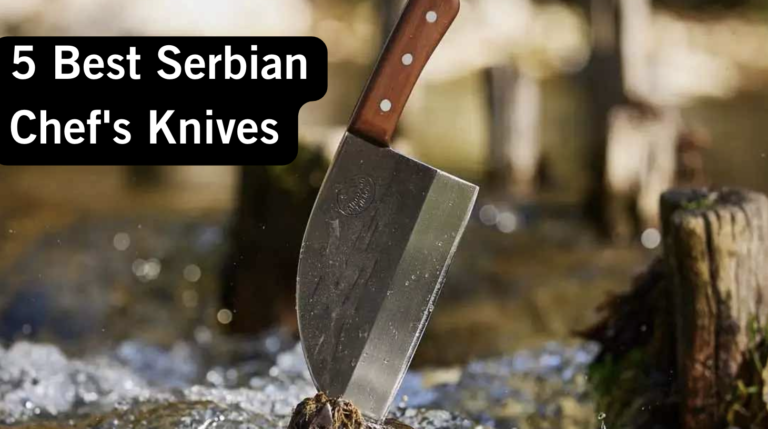
Unless you’ve lost your glasses, it’s fairly apparent what sets the knife apart from its counterparts–its huge hooking blade. If we’re honest with ourselves it’s a cleaver with a tip–somewhat reminiscent of a large deba bōchō, but overall heftier.
Generally, most Serbian chef’s knife makers tout their wares as handmade–of course at factory scale, with all that entails. Most of the blades have a very thick spine giving them the chops to tackle heavy-duty jobs. Though, most lack a defined belly, lending them better hacking jobs.
By and large, Serbian knives are constructed of carbon steel and have won some kudos for maintaining a good edge. Furthermore, almost all makers favor a wood handle of some sort, most likely because it maintains the rustic, outdoorsy aesthetic Almazan originally pioneered.
Should I Get A Serbian Chef’s Knife?
Honestly, like all things knives, that’s up to you. Maybe the Serbian chef’s knife is the kitchen or backwoods tool you’ve been waiting for or perhaps is all online hoopla. There are many who fall in the latter category and are vocal about it.
Despite this, it does seem the cleaver-style design has a place in the galley, particularly if you happen to process chuck wagons full of meat. The large width of the blade makes it ideal for hacking, particularly joints and bone. Additionally, boasting a tip, it could potentially tackle basic kitchen jobs in a pinch.
That said, as a catch-all chef’s knife, most cooks are likely going to find themself more comfortable behind a traditional design. The large blade is unwieldy for basic cooking jobs, such as chopping and mincing. Furthermore, the lack of a belly on most examples slows the knife down considerably on general tasks.
Bushcraft? Sure, there’s the potential. A Serbian chef’s knife certainly has the ability to work in a hatchet’s stead. Outside of that, well, things get dicey. It’s not exactly the style of blade you’d reach for to skin a buck or whittle fuzz sticks. Not to mention, do you really envision toting one of those beasts in your kit? (Add a pound to your ruck, not mine!)
Of course, this is coming from a more traditional mindset of kitchen and backcountry work and utility. And much like beauty, utility is often times in the eye of the beholder.
5 Top Serbian Chef’s Knives
Almazan Kitchen Original Serbian Chef’s Knife
Almazan Kitchen Original Serbian Chef’s Knife
The blade that started the craze. The Original from Almazan Kitchen set the standard for every Serbian knife that’s come after it. Hand forged in Serbia, and weighing a shade under 1 pound, this blade is a menace in the best possible way.
The carbon-alloy blade is tempered to a 58-60 HRC. The full-tang construction features a triple-riveted handle for grip and gives the user a sense of confidence. The uncle-and-nephew team that founded the company, Boban and Aleksandar Almazan, wanted to make a knife that would be as comfortable in the forest as it would be in the kitchen, for some they’ve succeeded.
Beyond just the knife itself, Almazan also sells accessories including leather sheaths, cutting boards, and kitchen equipment made from olivewood.
The knives have also benefitted from the company’s wildly successful marketing, in particular the Almazan YouTube channel. Fueled by more than 3 million subscribers, the company and its knife have blown up in recent years.
MSRP: $152.92 (There is also a stainless version for $30 less)
Damas Knives Bushcraft Serbian Knife
Damas Knives Bushcraft Serbian Knife
This model from Damas Knives is emblematic of the new(ish) design, with its wide blade and rustic handle. The knife is hand-forged from a single sheet of XC75 high-carbon steel with a 59 HRC and ground to a 21-degree angle.
The blade’s strength and the Rosewood handle’s sturdiness allow the user to butcher big cuts of meats, nimbly dice veggies, and even slice right through small bones. Beyond the food uses, this piece can tackle cutting wood and brush on a hike.
MSRP: $145
Imarku Butcher Knife
Imarku Butcher Knife
From one of the most trusted names in kitchen knives comes a budget Serbian chef’s knife that swings far above its price point.
This knife from Imarku features a hammered design and is hand forged. The blade is made from high-carbon, high-manganese German X50CrMov15 steel. The hard 56-60 HRC steel holds a razor edge and has good rust resistance as well. You can see the spots from the hammering up and down the blade, which gives it its signature look.
The knife comes with a leather sheath and, like other Serbian knives, has the strength to cut through bones and butcher large meats.
Imarku stands apart from other Almazans due to the price. The company has found a way to make a top-tier example for under $100.
MSRP: $59.99
Kopala Original Kitchen Knife
Kopala Original Kitchen Knife
Now for a little something different from Kopala. Its original kitchen knife is made in the Serbian style but in a far different shape from the other knives on this list.
Instead of the rounded cleaver-esque design, Kopala has made a smaller, swooping blade–reminiscent of a scimitar–attached to a triple-riveted Rosewood handle. The high-carbon blade is balanced enough to cut through raw fish and other assorted meats.
The main drawback on the knife, unlike the others on this list, is the company did not design it to cut through bone. That takes away the versatility that makes the traditional Serbian knife so beloved. However, as the most inexpensive knife on our list, if that’s a compromise you’re willing to make then the knife is more than worth it.
MSRP: $29.88
HDMD Serbian Chef Knife
HDMD Serbian Chef Knife
Rounding out our list is a fine all-rounder from HDMD Knives. Handmade from high-carbon steel and pakkawood, this blade from HDMD is an excellent middle ground if you have any interest in a Serbian knife.
It follows the construction of knives like the original Almazan. It’s hand forged, roughly six inches long, and has a 56-58 HRC. It weighs about .75 pounds and can handle whatever you throw at it in the kitchen.
Where it stands apart is in the price. This blade is under $100, which makes it a perfect entry point for this style of knife.
For Anyone Interested In Learning How To Use A Balisong, A Trainer Butterfly Knife Is Extremely Important.
Not all knives are built the same, and no knife embodies that more than the butterfly knife. Also known as a balisong, this blade opens with a flourish, and creating tricks and moves to open and close the knife has become a passion for many.
Take a look at this video below for just a small sample of some of the more basic balisong tricks. Even at this level, the smoothness needed to execute them is remarkable.
Why A Trainer Butterfly Knife
In order to perform tricks, and well, you need to put in hours of practice. Well, practicing slinging a butterfly knife has its pitfalls because you are rapidly moving a razor-sharp knife.
That blade isn’t for show. If you hesitate, swing the knife the wrong way or simply shake your hand at the wrong time, that could mean the difference between successfully pulling off a new move or slicing your finger wide open. That’s why several states and countries have banned the knife in the name of public safety (at least by they’re telling).
That’s where the trainer butterfly knife comes in. It flows and moves like a traditional balisong, but it has no sharp edge. Some are metal, some are plastic, and all of them allow you to try out moves without the threat of a trip to the ER.
Instead of a traditional blade there is a steel or plastic rod in its place. This helps with the visuals of the knife as it moves and it keeps the user safe. The worst-case scenario with a trainer butterfly knife is that the blade replacement knocks into your knuckle. Sure, that might be sore for a minute, but it’s a lot better than a dozen stitches.
Best Trainer Butterfly Knives
Boker Plus Balisong Trainer
Boker Plus Balisong Trainer
Boker is a fine maker of knives, and also a fine maker of knife trainers. Their balisong trainer is well-balanced and robust thanks to a high-quality construction. The whole trainer, blade and handle, is made from stainless and the G-10 scale feels good in the hand. You can even choose between red and blue scales to customize the look of your trainer. Featuring the same mechanism as one of the company’s actual butterfly knives, this trainer may be as good as it gets when trying to learn the ways of the balisong.
MSRP: $85.95
Good Worker Butterfly Knife Trainer
Good Worker Butterfly Knife Trainer
If you’re the type of person who practices hard and gives their trainers a beating, this model from Good Worker may be your best bet. Made completely from 420 stainless, this tool can take a beating. One of the lowest-priced trainers on our list, you won’t have to feel guilty if it flies out of your hand performing tricks or takes its lumps over time.
MSRP: $10.99
Squid Industries Squiddy
Squid Industries Squiddy
How about plastic? This trainer from Squid Industries provides everything you want from a butterfly knife trainer but is made from CPVC. In fact, it’s the first-ever CNC-machined plastic balisong trainer. Pretty cool.
Don’t worry, this isn’t a flimsy toy. The high-impact, heat-resistant CPVC (chlorinated PVC which makes it more durable) ensures a robust trainer. And it’s just as balanced as a traditional steel trainer. This would be great for a younger person interested in learning how to manipulate a butterfly knife. And it’s made and assembled in the USA.
MSRP: $44.99
Bear & Son Butterfly Trainer
Bear & Son Butterfly Trainer
This model from Bear & Son is the most knife-like of the trainers on our list. The dulled blade is in the shape of a clip point and is made from 440 stainless. At a glance, it looks like a real, working knife so this may not be the best trainer to buy depending on the laws where you live. However, it works like a charm.
The zinc handle opens easily and the weight of the steel gives it a good balance while it’s rotating. The handle comes in three different colors so there’s a level of customization with this balisong.
MSRP: $65.99
Bbbarfly Pro V3
We wrap our list with something a bit out there. What if your butterfly trainer was also a bottle opener? That’s what you get with the Pro V3 from Bbbarfly. This model features a high-quality steel construction. The blade/opener is made from a polished 410 stainless steel and aluminum handles. The CNC-machined washers and hardware provide a smooth opening every time. Sure, this is a great tool for party tricks and start conversations, but it’s built to be a high-quality balisong trainer as well.
Thanks To The Internet, Straight Razors Are Back In Style. These Trio Of Blades Can Keep You Looking Sharp And Feeling Smooth.
Mastering shaving with a sho-nuff handheld straight razor is a lost art that has recently become more popular thanks to social media shaving gurus and those who like a good challenge.
Straight razors never went away, the internet just has a knack for making old things new and cool again. Let’s look at a trio of current offerings and shave them through their paces.
Boker King Cutter
Boker King Cutter
Boker has been producing straight razors since 1869 and the company offers many models today. The King Cutter, the company’s most popular razor, features a carbon steel blade with a deep hollow grind. The handle is a black polymer with a brass Boker Tree Brand logo escutcheon. The King Cutter was the lightest of the three review pieces, tipping the scales at a svelte 1.47 ounces. It features a monkey tail tang for quick blade access.
Being the most expensive of the test lot by a long shot and from a company that has been making straight razors for over 150 years, you’d expect the King Cutter to perform well. Simply put, it did. The blade was, ahem, razor-sharp right out of the box and glided through my two-day stubble clean as a whistle. I never had to back up and go over an area to get it smoother.
The thinnest of the review blades, it got into tight spots a bit easier. However, a word of warning is in order. An extremely sharp blade like this will cut you faster, too, so take your time! The King Cutter’s high price tag may scare some away, though there are other straight razors out there that cost much more.
MSRP: $189.95
Rough Ryder Cinnamon Bone Stag Razor
Rough Ryder Cinnamon Bone Stag Razor
Rough Ryder’s Cinnamon Bone Stag Razor has all the trappings at a budget price, including the good looks of a traditional straight razor. The cinnamon bone stag handle, replete with an acorn escutcheon, is downright handsome—and Rough Ryder does bone stag well.
The cutting portion of the blade has a light yet distinctive damascus pattern running across its face, and a barber’s notch at the point aids in safely opening and deploying the blade. A monkey tail tang completes the package.
Right out of the box, the Rough Ryder entry shaved the stubble straight from my face. The blade was plenty sharp and I was able to get into tight spots with good results. When you get down to the nitty-gritty, there are differences between this razor and an expensive one like the Boker.
There is a tad more drag on the blade and I had to back up a few times to get the area I was shaving totally smooth. To be honest, I expect this from a razor at this price point, and you should, too. That said, the Rough Ryder Cinnamon Bone got the job done and was no slouch. I recommend this razor to those who want to get their feet wet before taking the plunge on a high-dollar cutter. And, by golly, it was the most attractive of the bunch!
MSRP: $29.99
TOPS Knives Tac-Raze 2
TOPS Knives Tac-Raze 2
The TOPS Knives Tac-Raze 2 is designed as an EDC and not billed as a straight razor. Nonetheless, we threw it into the fray to see if we could shave with it, letting the chips fall where they may.
A full 2.625 inches of the blunt-tipped blade has a slightly bowed edge. There’s a rat-tail tang reminiscent of the old friction folders, though not forged. The Tac-Raze 2 has a deep choil below the blade edge that splits time with the handle. TOPS includes a dark brown leather slip and a small bottle of protectant.
Would an EDC with a razor-style blade shave? Given how many YouTube videos there are of guys shaving with everything from bowies to kitchen fare, I figured why the heck not? A cursory check right out of the box with the blade warmed up and a light coat of shaving cream on a cheek gave me surprising results. Not only did the Tac-Raze 2 shave my stubbled skin with ease, it was darn smooth! Next, I cleaned the blade up and stropped it, and the shave was as smooth as I could get with a standard straight razor.
As I worked around my face I found some gremlins with the TOPS EDC. The handle is not nearly as nimble as a standard straight razor, which is to be expected since it’s not a standard straight razor. I found getting into tight areas like the crack between my upper lip and cheek particularly dicey. Bottom line? What you lose in dexterity with the Tac-Raze 2 you gain in versatility since, after all, this is an EDC knife with all the benefits—and it comes with a slick leather slip.
MSRP: $139
Scoring The Straight Razors
All three in our razor trio had their strengths and weaknesses, but all got the job done. The Boker King Cutter is the pro razor of the bunch. The Rough Ryder Cinnamon Bone is a nice entry-level shaver, and the TOPS Tac-Raze 2 is certainly the most versatile.
One final note: don’t be afraid to try a straight razor. As a knife enthusiast, chances are you’ve already developed a healthy respect for sharp blades. Wade in slowly and carefully—once you get a feel for the straight razor, it will feel right at home in your hand. Happy shaving!
The New Flash MT Is A Sleek, Contemporary Take On The Multi-Tool. With Seven Tools, The Flash MT Is Strong And Compact.
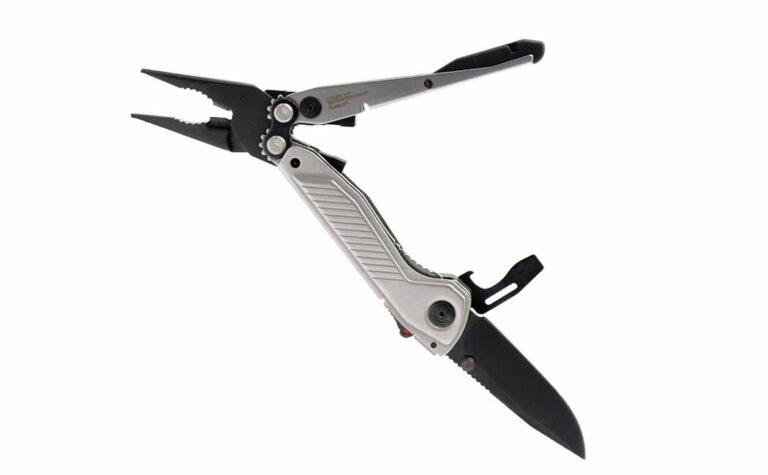
A good multi-tool is worth its weight in gold. The new Flash MT from SOG is a durable modern version of what a multi-tool can be.
It all starts with the blade. The Cryo D2 steel blade is a 2.4-inch clip point with an assisted opening. No nail nick or slip joint for this knife. The compound leverage pliers are beefier than on many other multi-tools and are up to whatever challenge you throw its way.
The magnetic bit holder snugly holds the two-ended 4mm driver bits so you’ll have both a Phillips and a flathead at your disposal. A bottle opener and wire cutter round out the implements in the Flash MT.
When it folds away it looks like a thick EDC knife. It’s easy to use and not cumbersome to hold or deploy. SOG really hit it out of the part with this new piece.
MSRP: $69.95
Read More
Editor’s Note: This article was written by Mike Ableson.
Knifemakers From Around North America Came To Auburn, Maine For The 2022 New England Bladesmithing Symposium
The 12th annual New England Bladesmithing Symposium brought nearly 100 knifemakers and enthusiasts together for the first hammer-in since 2019.
The event ran from July 15-17 in Auburn, Maine at the New England School of Metalwork and featured classes and workshops galore. Throughout the weekend there was something to scratch any itch you may have had about knives.
Master Smith Lin Rhea presented a tutorial on how to make his dynamic X-Rhea knife. There were workshops on everything from how to build out your knifemaking business to forging recurves.
It was a brutally hot Saturday in the Pine Tree State, yet it didn’t dampen spirits, particularly for the main event– the Battle of the Bladesmiths. The 2-hour competition to pushed four makers to their limits, and drew the largest crowds and interest.
Learning From The Best
The classroom at the NESM is covered wall to wall with tools and other metalwork made by past students just like this.
During the afternoon I was able to drop into a few of the classes. The one I got the most out of was led by Master Smith Christoph Deringer.
Derringer class about the anatomy of the knife was a joy, particularly the care he gave answering questions. His wry sense of humor even out, like when he called flux a crutch pertaining to forge welds. In that particular case, he suggested simply listening to the metal and letting it guide you when you forge weld, no flux is needed.
He taught everyone a neat trick for adding patina to a blade, as well. The crux, you hang the knife above a piece of heated copper. Heating the copper causes it to emit gasses that rise up and patina the blade to an almost bronze color.
A Successful Weekend
It was a big weekend for the school, gathering makers from the Northeast, Eastern Canada, and even as far west as California. For NESM director Dereck Glaser, it was a successful weekend, particularly given the COVID-related lapse in the symposium the past few years.
“The school, in general, draws from around New England,” Glaser said. “I’m excited to see more Canadians here, to be honest. We can’t forget we have a whole other country on our border. I can’t be pulling students out of the Atlantic Ocean so Canada’s a really good option.”
It’s important for anyone with even a passing interest in knifemaking to visit their local school and learn. Not only can you save yourself toil and trouble, but supporting the broader community of makers helps it survive and thrive even in the lean times.
Journeyman smith Mace Vitale runs a workshop on handle shaping.
“It saves exponentially the number of years,” Glaser said. “Indebting yourself to a week and about $600 could potentially save you 3-5 years of trial and error on your own. The amount of compressed skill and support you get in 4-5 days of a course, answering those questions that’ll take 3-5 years to figure out on your own.”
Glaser said that even with the uncertain economy, he believes the future of the school and knifemaking is bright because the passion is boundless.
“The fiscal issues we’re having is making it rough. It’s 90+ percent an enthusiast kind of hobby and craft for most people,” Glaser said. “Where inflation and cost of living’s gone, everyone’s seeing a toll in the crafts. We’re even seeing it in the welding, which is an employment-based skill. But on a whole, I think the energy is still there. The love for it is greater than ever. A lot of people did a lot of things to better themselves in it through the pandemic, so I think coming out on the other end I think people are kind of stronger.”
The Passion For Knives
A nice bit of camraderie. Two of the battle contestants Leo Potter (in the hat) and Jeremy Yelle share a fun moment ahead of the contest.
As informative and enlightening as the classes were the attendee’s conversations. Everyone was excited, whether it was to learn from a particular smith, show off a piece they made, or for the battle at night, everyone was open and welcoming.
A Previous winner of the Battle of the Bladesmiths, Emiliano Carrillo (owner of Sun and Stars Forge), was particularly poetic in what he said about the process of making his own steel.
“When I started the smelt earlier in the day the sand runs through my fingers, and by the time the day’s done it’s a lump of material that can be turned into something,” the owner of Massachusetts-based Sun and Stars Forge said. “It goes from being this throwaway material to something that’s actually useful. I think that’s crazy. It really is alchemy to me. It’s addictive. You do it and it works and you do it again and again and it breaks your heart, and then you have some successes.”
The day ended with the battle. Four young smiths were tasked with turning a one-foot bar of 1084 into a complete knife in just two hours. You can read all about the contest here.
In total, the symposium was absolutely worth the trip and should be on your checklist if you’re a serious maker in the Northeast U.S. or Eastern Canada.
To learn more about the New England School of Metalwork, click here.
Cigar Cutters Come In Three Distinct Styles. Picking The Best One For You Is A Matter Of Personal Taste.
Few gentlemen’s pastimes are as nuanced as the art of smoking a cigar. The choice of stogie, cutter and method of carry are, for better or worse, an indicator of just how serious an aficionado the person in question is. The little things can say a lot about the owners, and a lack of appropriate accoutrements is all some need to pass judgment on a peer.
I sat down with Alex Gregorian of Georgetown Tobacco & Pipe in Washington, D.C. He was kind enough to provide me with some choice cigars from the shop to use in this review. Gregorian first took up stogies as a hobby a decade ago and has since proceeded to transform his avocation into a job that benefits from his peerless expertise.
Georgetown Tobacco & Pipe has catered to many in government and a slew of celebrities, including actors Pierce Brosnan and Arnold Schwarzenegger, among others. Being in the nation’s seat of government affords Gregorian the opportunity to rub shoulders with an incredible clientele of cigar smokers, and I take his word as fact when it comes to picking out the right tools for enjoying a proper smoke.
“The first thing you’re looking for is something that will last longer than five cigars. The quality of the blade, like any cutting edge, is important,” he notes. “The cap, the portion where it is folded over on the end, is the most delicate part of a cigar. If you cut too far down the cap you risk losing smoke quality, and the cigar itself may become unwrapped. You want the cut to be small, just a nip off the end. No cigar should be completely flat or square on both ends. You’re not looking to make a cylinder; the cap end should have a taper to the mouth.”
While Gregorian’s store may or may not stock the three test pieces, the general basis for cutters falls into three main styles: scissor, guillotine and knife. One of each category is demonstrated here and I will later give my thoughts on their use and features.
Picking The Right Cigar Cutter
Each cutter is paired here with the cigar it cut. Note that the 208 (middle), a friction folder, caused some crushing. The author stated it is difficult to maintain a good cutting angle with consistent pressure when cutting a cigar with a friction folder.
“The scissor-style cutter is effective,” Alex opines. “It is basically a double guillotine and is much easier to make a flat, clean cut with. The scissor cutter is better in that it is far less likely to cause crushing or pulling apart of the tobacco at the cap. A single-blade cutter can get dull faster and can very much damage the cigar; two cutting surfaces will stay sharper longer and give a better cut.”
This is not to say that single-edge cutters are of no use, rather they require a steady hand and deliberate pressure on the cut. In my limited experience, at least compared to Gregorian, I have used single-bladed cutters and have generally failed to find one that works well enough to keep it in my rotation when I socialize in the few places that still allow smoking in my area.
“Things to watch out on single-bladed cutters are the angle of the cut and the edge type,” Alex advises. “Many cheap cutters end up just ripping or pushing the cap off, and this is no good for a nice smoke. You really want a good, thin, razor-sharp blade that goes through quickly and cleanly; you don’t want loose tobacco coming out in your mouth when you smoke.”
In closing with Gregorian, I wanted to see what a seasoned tobacco man smoked. Since you’re reading BLADE® I assume you’re cultured and have fine taste, and this advice will no doubt encourage you to pick up some cigars that befit those qualities.
“I recommend Davidoff for cigars. They are the top quality cigar made today. [Davidoff officials] are extremely selective on the tobacco they use, and each cigar is a work of art. It shows on each one you take out of the box,” Alex says. “The standard Davidoff runs about $25—not bad for a great smoke. Padron [cigars are] another I highly recommend. They are made with Nicaraguan tobacco.”
Fox Cutlery’s Acid-Etched Figaro Cigar Cutter
Fox Cutlery’s Acid-Etched Figaro Cigar Cutter
The lightest and most compact piece tested was Fox Cutlery’s Acid-Etched Figaro Cigar Cutter. It is an incredibly stylish and minimalist scissor-style tool, so light that you can easily forget it is in your jacket. It is also the lightest on the wallet of the three test models, though it cuts far above its price point and delivers great results. As a dedicated cigar cutter, it has no additional function.
What I really like about the Figaro is that it doesn’t try to be anything other than great at its job. It has no bells or whistles and slices nice and clean. It also offers a very precise slice as the cutter itself is so thin, there is no guessing where both blades are indexed. The larger test cutters are thick like a pocketknife and it is easy to overestimate angle, or how far the cap has been inserted through them when cutting.
MSRP: $75
TOPS Knives 208 Clipper Cigar Cutter
TOPS Knives 208 Clipper Cigar Cutter
While the 208 Clipper Cigar Cutter from TOPS Knives is advertised as a cigar cutter, I suspect this has more to do with skirting knife rules than it does its true role as an EDC multitool. While the 208 certainly can cut cigars, it does not do it as well as the other two test models. However, the other two cutters cannot be used for self-defense in non-permissive areas like the 208 can, either.
The TOPS entry has the most features of the group, but this comes at the cost of weight and safety. It is a friction folder and, unless carried in a sheath, is somewhat prone to unintentional opening.
The 208 is highly functional and also features a bottle opener on the tang. As a general utility tool that pops bottle tops, clips cigars, slices a seat belt and impresses your buddies, it’s great. As a dedicated cigar cutter it is somewhat wanting. The blade grind is very steep and thick, almost chisel-like in profile. This causes tobacco to tear as you cut with it, though for some, having the extra features and ability to use the 208 as a knife supersedes a rough stogie slice.
MSRP: $230
Benchmade 1500 Cigar Cutter
Benchmade 1500 Cigar Cutter
The Benchmade 1500 Cigar Cutter is a luxury item. It has no ability to function as a knife, but, unlike the Fox Figaro, easily can be mistaken for one—even up close. It features Benchmade’s AXIS lock system, a handy feature that is sure to draw interest.
As a dedicated cutter it functions extremely well. It is easily the sharpest of the review group and effortlessly passes through cigar caps. I experienced no tears or bad cuts, though it was very easy to sever the cap too far up if I didn’t take my time.
There is no doubt the 1500 is a very high-quality tool; for many it could be considered a status symbol. It is marginally more expensive than the TOPS 208, though it has none of the tactical vibe. Benchmade collectors I know drooled over it, so I figure the 1500 is something that at least stokes envy among the initiated.
Beyond the coolness factor, the Benchmade is truly a dedicated cigar tool, and its uses are limited to that arena. You would need to decide if so high end a cutter is worth it considering that a world-class tool like the Figaro can be had for a fraction of the cost and weight, and offer basically equal performance. If you enjoy several cigars a day or week, I can see how you would like the luxury of the 1500.
MSRP: $250
Gent’s Prerogative
The style and features of a man’s personal effects often tell you a great deal about what he prioritizes. Purely for cost and effectiveness, the Fox Figaro is hard to beat. I value this because I’m an amateur tobacco enthusiast. I’m not aiming to impress with my tools; rather, I just want to have something light and easy to keep on hand for that rare evening out with friends around the campfire.
Editor’s note: Don’t smoke tobacco—it can cause cancer. Secondary tobacco smoke also can cause cancer, so if you must partake, do so in a way that best protects the health of those in your immediate area.