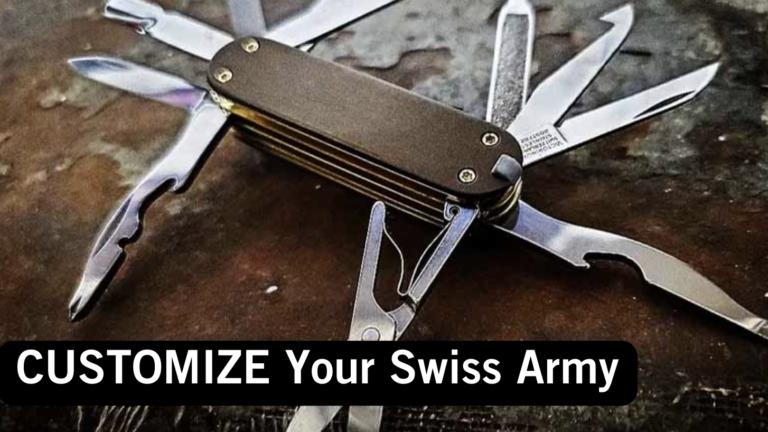
An Icon In And Of Itself, You Can Still Customize Your Swiss Army Knife To Make It Your Own.
There are few, if any, knives as instantly recognizable as the famous Swiss Army knife. The multi-tool is beloved around the world for its versatility and quality construction.
While the famous red color is a global icon, there are far more ways to make the knife look how you want it. Some of these customizations are offered by Victorinox itself while others are more DIY.
Either way, there is no shortage of ways to create a unique custom Swiss Army knife wholly your own.
Factory Customizations
Victorinox calls them “personalizations” and there are many ways you can find a Swiss Army knife that fits your needs and make it your own.
Different Sizes
The Swiss Army knife comes in a variety of sizes. Small knives weigh less than an ounce while the largest models can come with their own carrying/display case. Different sizes mean different types of blades and tools so you can pick the knife perfect for you.
Scales
Another excellent option from Victorinox is the ability to change the scales on many of their knives. Yes, every option defaults to the famous red but you can choose from many other colors and designs. You can choose camouflage, flags, and even transparent scales among a whole variety of solid and textured colors.
You also have the option of custom engravings on the scales to personalize them for yourself or a friend.
Specific Tool
While no two Swiss Army knife models are exactly alike in terms their tools, it’s possible to go a step further and order custom implements. For instance, Victorinox filled an industrial-sized order in Europe for a batch of knives featuring a toilet-paper holder key.
True enough, this isn’t something you’d need on a single knife for yourself. But, having the option for custom bulk purchases set the knife apart.
Knifemaker Customizations
There are makers today that make custom Swiss Army knives. Some stick to the aesthetic and make scales from exotic materials or designs. Others turn the knife on its head and make their own tools for the knife. Regardless, there are brilliant craftsmen creating one-of-a-kind Swiss Army knives around the world.
Chris Custom Works
Black Cerakote Grooved Soldier. Price $202.37
Based in Germany, Chris Custom Works specializes in detailed custom Swiss Army knives to order. From a handmade set of scales from wood or other materials to a fully modified suite of tools, the sky is the limit. As you can see above, the company’s Black Cerakote Grooved Soldier, not only are the scales one of a kind but the tools are finished with black Cerakote to match the micarta handle.
Andrzej Woronowski
Woro Knight: $221.95
Woronowski is based in Gdansk, Poland and makes beautiful custom scales for Swiss Army knives. His designs aren’t as loud and eye-popping as some other makers, but his craftsmanship is remarkable. With the help of his brother Kamil, Woronowski works with metals such as titanium, brass, and copper to create custom SAK models that are elegant and stand out.
Sean Dooley
74mm Spydernox Clipitool Saw Executive.
Through his Sak Custom 58mm brand, Dooley has thumbed his nose at the traditional Victorinox designs and created magical works in their place. For starters, he removes the famous spear point blade from many of his builds and replaces it one-to-one with a blade from Spyderco.
This “Spydernox” hybrid, and Dooley’s creativity, are on full display with the knife above. The Spyderco blade and neon yellow G10 liners, the whole construction could convincingly seem like a completely different model, not a custom Swiss Army knife. It’s truly remarkable what Dooley has been creating from his shop in Connecticut.
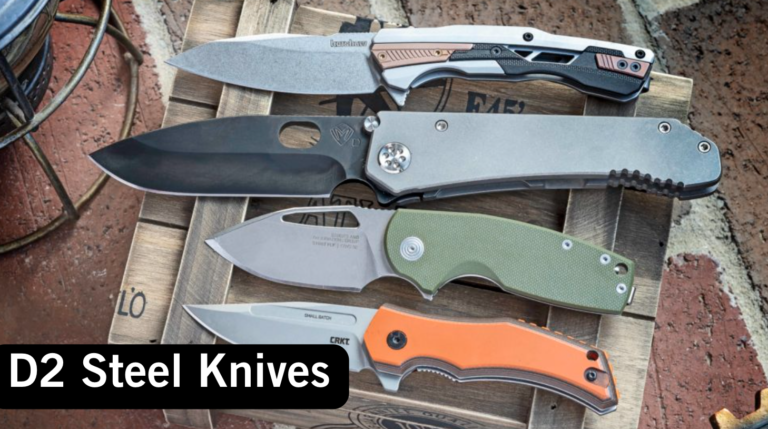
D2 Delivers In Edge Holding, Overall Performance, And Affordability. These Four D2 Knives Are Emblematic Of The Toughness Of The Material
Even if you haven’t used a knife of D2 tool steel, you’re no stranger to it if you have been into knives for any length of time. Many knife manufacturers use D2, as have numerous custom knifemakers.
Why is D2 so popular? Two reasons are it offers the best bang for the buck in terms of edge holding and overall performance. D2 is regarded as a step up from basic, low-grade stainless steel and is often found in entry-level to mid-grade production knives. One drawback: D2 is not a stainless steel so it will require a bit more care. Still, the performance advantages outweigh that drawback and you get a knife with enhanced edge-holding power that handles tough cutting chores.
D2 comes from the metalworking industry. There it is primarily used to make steel cutting dies, so that tells you all you need to know: It basically is a steel used to cut steel. Think about that for a minute. D2’s chemistry in percentages is 1.4 to 1.6 carbon, .7 to 1.2 molybdenum, 11 to 13 chromium, and 1.1 vanadium. It can be hardened past 60-61 HRC on the Rockwell scale without being brittle. BLADE Magazine Cutlery Hall-Of-Fame® members Jimmy Lile and Wayne Goddard used D2 a lot in their knives, as does Bob “Dr. D2” Dozier extensively in his outdoor models. Top production knife companies such as CRKT, Kershaw, SOG, A.G. Russell Knives, Ontario and KA-BAR are but a few that have multiple offerings using D2.
CRKT Fawkes
The CRKT Fawkes is an excellent choice for a stylish EDC folder, featuring flipper operation and IKBS pivot bearings for smooth opening and closing.
Maker Alan Folts designed the CRKT Fawkes to be a stylish, colorful EDC linerlock folder. The knife’s name is derived from the Harry Potter movie franchise, specifically the phoenix that appears in the series.
With a closed length of just 3.76 inches the Fawkes carries comfortably, and the blade deploys fast and easy thanks to the IKBS-ball-bearing pivot and assisted-opening spring. The two work in conjunction to provide swift, smooth deployment, and the assist helps detent the blade in the closed position.
The multi-layer orange G-10 handle generates visual excitement and a splash of color. The ergonomic design provides a comfy grip for cutting tasks. The 2.74-inch, clip-point blade is flat ground and sports a swedge as well as a milled-in fuller, which creates a bit of attitude. A flipper tab helps initiate blade deployment. The knife carries securely thanks to a deep carry, fold-over-style clip that holds the closed Fawkes blade tip up and as low as possible in a pocket.
The handle shape is striking. A pronounced finger groove near the pivot helps index your grip, while chamfering eliminates harsh edges and hot spots. The matching orange G-10 handle spacer sports a series of large notches that help seat the knife in your grip. Blade action is quick and authoritative. The linerlock engages the tang with zero movement. CRKT will make the Fawkes a regular production knife model this year, with the only change being a switch to 1.4116 stainless for blade steel.
Made in Taiwan, the MSRP for the Fawkes is $89.99.
Kershaw Endgame
The high flat grind of the Kershaw Endgame makes it a great choice for a working utility knife.
Kershaw‘s Endgame flipper folder features a highly usable modified drop-point blade, along with an ergonomic handle featuring modern design elements, all translating into a classy EDC that opens easily via the flipper tab.
The 3.25-inch flat-ground blade incorporates a distinctive humpbacked swedge for an aggressive look. A notched rest on the spine allows comfortable thumb placement for greater blade control. A stonewashed finish seals the tiny pores of the steel’s surface to fight corrosion as well as give the blade an industrial look. It also hides scratches from use pretty well and reduces glare.
A stainless steel framelock ensures solid lockup. The large finger recess at the pivot end helps index your grip. The handle curves aid in secure purchase every time.
The handle’s aesthetics are interesting. There’s bronze PVD (physical-vapor-deposition)-coated steel accents, textured FRN (fiberglass-reinforced-nylon) scales and a window cutout. The multi-layered visual adds more subtle color to the otherwise gray blade and handle. I do not care for it—it seems too busy. I don’t mind one type of overlay or even some machined-in grooves on the handle surface—both achieve function along with a sensible appearance. A deep carry pocket clip positions the closed Endgame nice and low in the pocket away from probing eyes.
While ergonomic and comfortable, the handle is a bit lacking in the midsection. For extended use, I would not recommend this knife. My hand grips the handle tighter to make up for the lack of bulk in the midsection. The answer is to redesign the handle and give it more mass. However, for tasks requiring choking up on the blade and handle for extra control, such as wire stripping, the Endgame is ideal. I felt in full control of the blade and was able to make precise cuts easily. If you do a lot of detail cutting, this might be the knife for you, or even if you need a folder for mundane slicing tasks. It’s got a great blade shape that is stylish.
Made in China, the Endgame has an MSRP of $107.99.
Medford Knife & Tool 187DP
At 5 5/8 inches closed, the biggest knife of the test bunch is the Medford Knife & Tool 187DP. Its hollow-ground drop-point blade makes short work of most any cutting task. The half-titanium/half-G-10 handle is equipped with a framelock.
Medford Knife & Tool specializes in manufacturing hard-use knives in the USA. These are not safe queens—they are engineered to hold up in real-world survival situations. The 187DP heavy-duty framelock folder is a representative example. The hollow-ground blade is 3.75 inches and comes in a utilitarian drop-point pattern. Closed length: 55/8 inches. An oblong hole facilitates easy one-hand opening. Dual thumb studs function as the blade stop in the fully open and closed positions.
The blade is 3/16-inch thick. Make no mistake, the 187DP is quite a chunk! The grip is ⅝-inch thick, and you will know when it’s in your pocket. A milled titanium clip carries the closed knife blade tip up but is not reversible. Any company using milled clips gets bonus points in my book. Regular stamped steel clips do a very good job at holding your knife at the top of the pocket for easy access, but, in my opinion, are not much on style points. Milled clips look more stylish and also hold the knife securely to the pocket lip.
If you are a rough user and use your knives outdoors or just plain beat them up, the 187DP is for you. Its rock solid build and bulk stand up to the heaviest use. I like the way the handle tapers toward the butt end, enabling you to get a secure hold. A series of traction notches machined close to the butt further assist in obtaining a solid no-slip handhold. It feels fixed in your hand and instills confidence in controlling the large blade. The steady grip allows you to bear down on the blade to power it through cuts.
Many who favor tactical folders will tell you a framelock is best for hard use. The 187DP’s framelock engages quite securely and disengages with a firm push. A milled-out section on the lockbar accommodates a thumb to disengage the lock—nice touch by the Medford crew. The blade cuts aggressively and dispatches most any material and food with aplomb.
Out of the box I really liked the factory edge. The ultra-strong lockup makes the knife feel like a fixed blade. Consequently, user confidence is high and you don’t have any reservations about putting it through the toughest jobs. While a large tactical folder, it can easily be tamed for precise cutting by making use of the choil to choke up on the blade and handle.
There’s also about an inch-and-a-half-long run of traction notches on the spine just above the blade hole. Your thumb rests comfortably there and you can execute controlled cuts easily—a very nice touch and positive attribute.
The only complaint I have about the 187DP is the size and, therefore, the weight, both of which exceed the limit for what I consider an EDC folder. You can feel its bulk and presence in the pocket, especially when you bend over.
MSRP: $475.
SOG Stout FLK
The SOG Stout FLK is definitely stout! Don’t let this compact folder fool you—it’s built for heavy work. It can get down to precise work as well, such as stripping wire.
The SOG Stout FLK is configured in collaboration with Danish maker Mikkel Willumsen. In appearance, the framelock folder lives up to its name and has a 2.62-inch drop-point blade. Closed length: 3.38 inches.
If you’re looking for an inexpensive work knife, the Stout FLK is it. It’s big enough to handle most cutting chores but not too big to be in the way or too cumbersome to carry. With its flat grind and short swedge, the blade shape is utility friendly. An oblong hole permits you to thumb the blade open as you would any one-hand folder, or you can use the flipper tab instead.
A pronounced choil enables choking up on the blade for more exact control and works with the large finger recess in the handle as well. Spyderco does this sort of thing, too. It’s a way to make smaller knives feel large in the hand and provide more blade control.
The handle is in the familiar half-and-half framelock construction, using textured G-10 on the presentation side. This saves weight as opposed to having an all-metal handle and also adds traction for sure handling. A matching steel spacer provides balance as well as structural rigidity.
The deep-carry pocket clip is ambidextrous and holds the Stout FLK low in the pocket while keeping it easily accessible. The clip is attached to the butt end and comes over the side. SOG calls it a bayonet-style clip, a style used quite a bit in the company’s line.
Made in China, the MSRP for the Stout FLK is $54.95. Finally, SOG will release the knife as a slip joint this year.
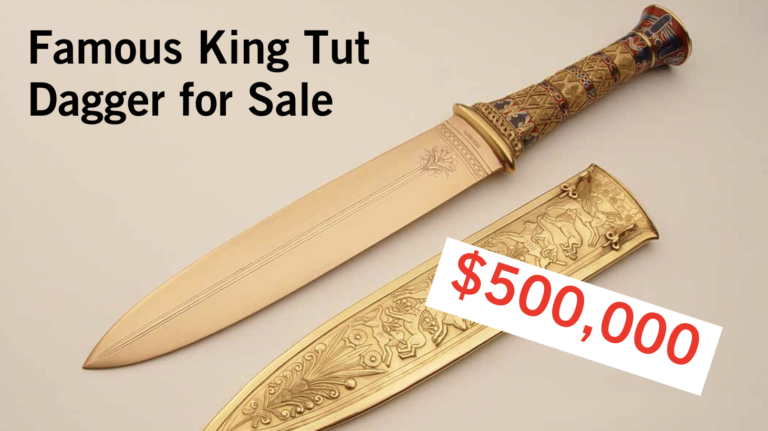
Perhaps the most iconic handmade knife ever can be yours for the right price
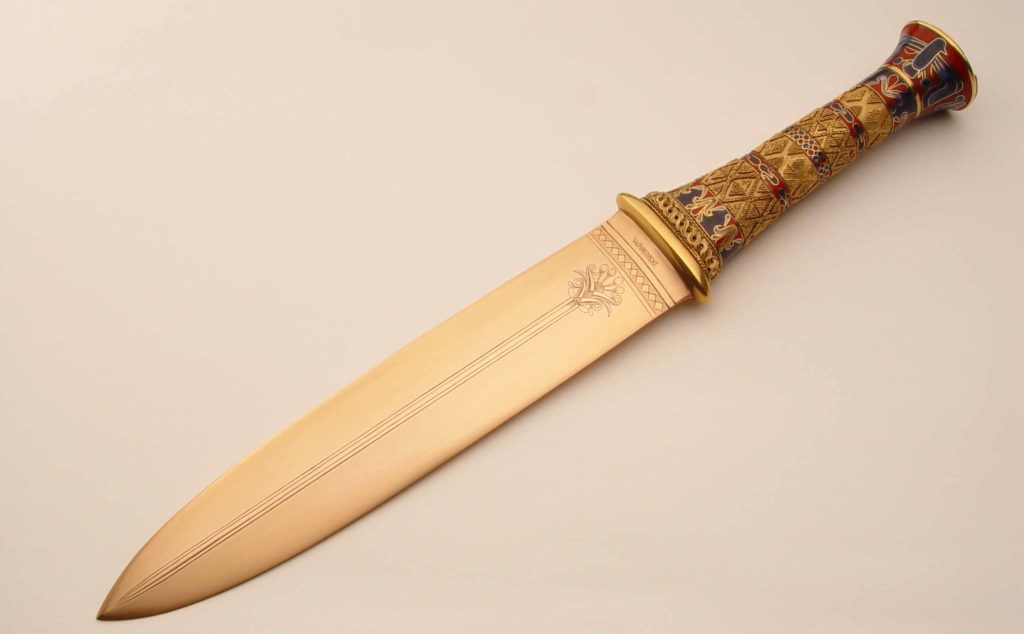
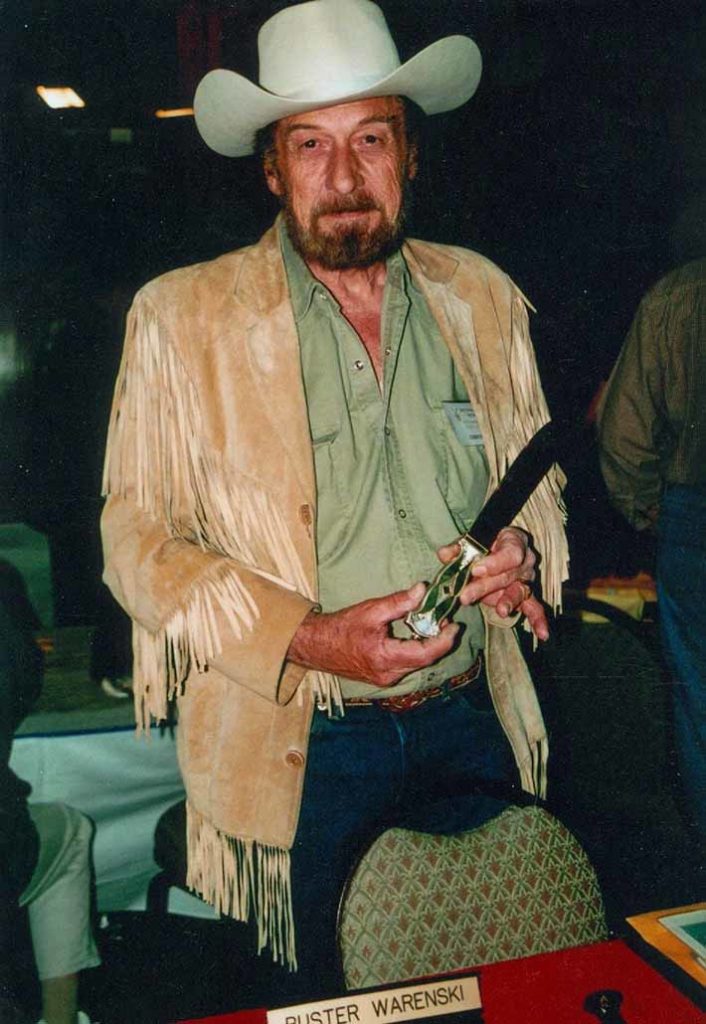
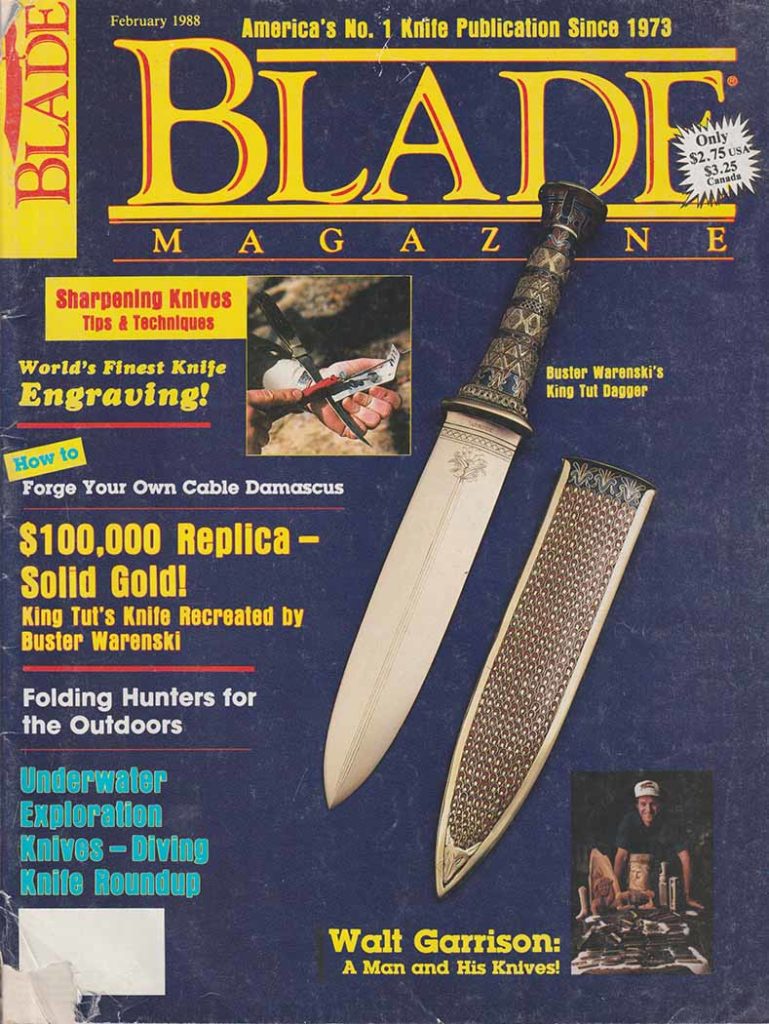
It may be the most iconic custom knife ever and it was made by perhaps the best knifemaker ever. The King Tut Dagger reproduction by BLADE Magazine Cutlery Hall-Of-Fame® member Buster Warenski is available for sale through Exquisite Knives.
Buster Warenski’s reproduction of the King Tut Dagger took over five years to complete and, including the sheath, contains over 32 ounces of gold. (SharpByCoop image)
Commissioned by Cutlery Hall-Of-Famer Phil Lobred in 1982, the knife took Warenski over five years to complete. A pioneering collector of custom knives and 19th-century dress bowies and founder/creator/coordinator of the Art Knife Invitational, Phil had kept the dagger in a safe ever since, displaying it on rare occasions at select knife shows or for private viewings. He passed away in 2016. On Aug. 1, his widow, Judy, contacted Dave Ellis of Exquisite Knives and asked him to handle the sale of the famous piece.
Buster Warenski is widely recognized as one of the best knifemakers if not the best ever. He passed away in 2005.
Once valued at over $1 million, “the most famous contemporary handmade knife ever,” according to Ellis, has an asking price of $500,000.
LEGACY IN STEEL
The first of Warenski’s three “Legacy Knives”—the other two being the Gem of the Orient and Fire and Ice—the King Tut Dagger is a reproduction of the knife from the tomb of the Egyptian boy king, Tutankhamun, uncovered by archaeologist Howard Carter in 1922. It contains over 32 ounces of gold and took Warenski, widely recognized as one of the best knifemakers if not the best ever, over half a decade to build.
During that span he suffered through the trial and challenges of recreating the iconic dagger. Among them was the cold forging and fullering of the knife’s gold blade, learning such ancient techniques as cloisonné—a highly technical enameling process—and the granulation of the handle. The solid gold scabbard rivals the knife in terms of beauty and the many hours it took to make. A special handmade display stand comes with the dagger, both of which are in mint condition.
The King Tut Dagger repro was the cover for the February 1988 BLADE®.
PRICED TO SELL
The current sale will be the second time Ellis has had a go at moving the Tut dagger repro.
“A few years before he passed, Phil Lobred asked if I would find a buyer for the Tut. His asking price at the time was $1 million. I had a number of interested parties but Phil was set on his price and I could not swing the sale,” Dave wrote. “Now, over six years since Phil passed, Judy contacted me about selling the King Tut Dagger. After deciding on a more realistic price—not that a million was unreasonable but few if any contemporary knives have attained that lofty status—I am marketing the piece on my Instagram and Facebook pages and on my website.”
An ABS master smith now retired from bladesmithing, Dave is a top collector and dealer of fine custom knives. He stated that to be able to offer his clientele such a special piece is indeed an honor.
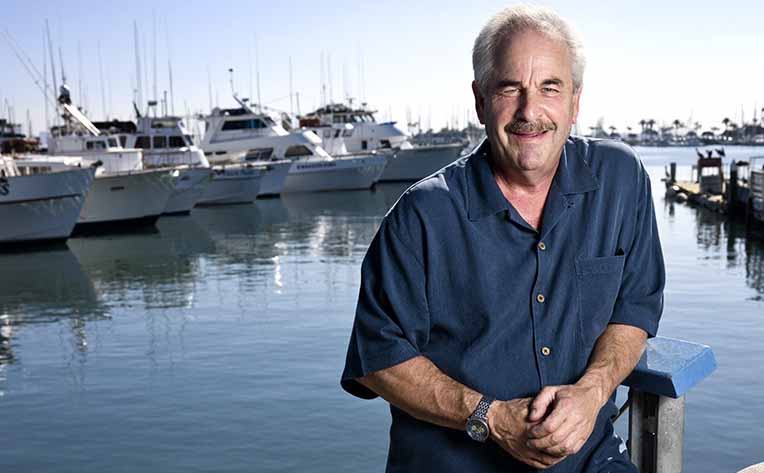
Phil Lobred commissioned Buster Warenski to make the King Tut dagger repro in 1982 and Buster completed it in 1987. Phil, here on a dock in San Diego, created/founded the Art Knife Invitational in 1983. He passed away in 2016.
Perhaps the only things better would be to a) sell it and b) own it.
For more information on the sale of the King Tut Dagger repro, visit exquisiteknives.com and click on ‘art knives’ on the home page.
Fishing Season Means Finding A High-Quality Fillet Knife You Can Trust, And The New 149 Hookset Breaker From Buck Can Handle The Abuse Of The High Seas With Ease.
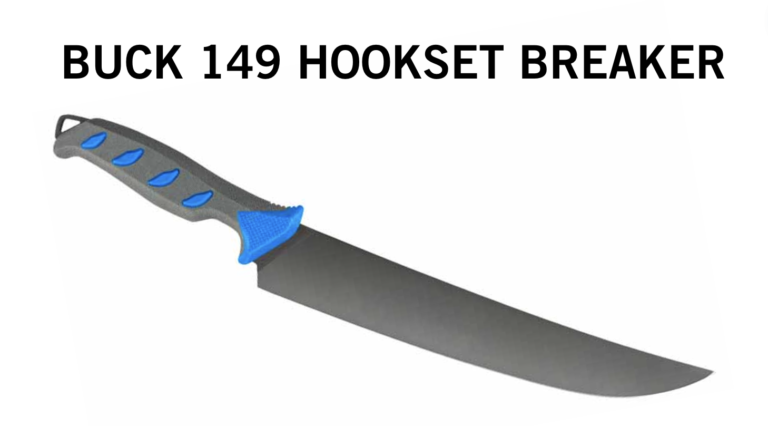
Processing fish cleanly may be one of the hardest tasks you can do with a knife, and having the right equipment is so important to whether you slice off a clean filet or are left with chunks only good for a stew. The new 10-inch 149 Hookset Breaker is Buck’s newest fish fillet knife designed for use sailing the ocean or out on the lake.
It all starts with the handle. It is glass-reinforced polypropylene with TPE rubber and provides a confident grip in all weather situations so you can slice with authority every time. The handle connects to a 5Cr15MoV blade coated in titanium for excellent corrosion resistance.
The blade is protected by an injection-molded sheath with an integrated belt loop for easy carry. The whole piece is 15.83 inches long from the tip of the blade to the butt of the handle.
This New Fixed-Blade From CRKT Is Everything You Could Want In An EDC And More. Designed By Alan Folts, The Spear Point Is An Absolute Winner
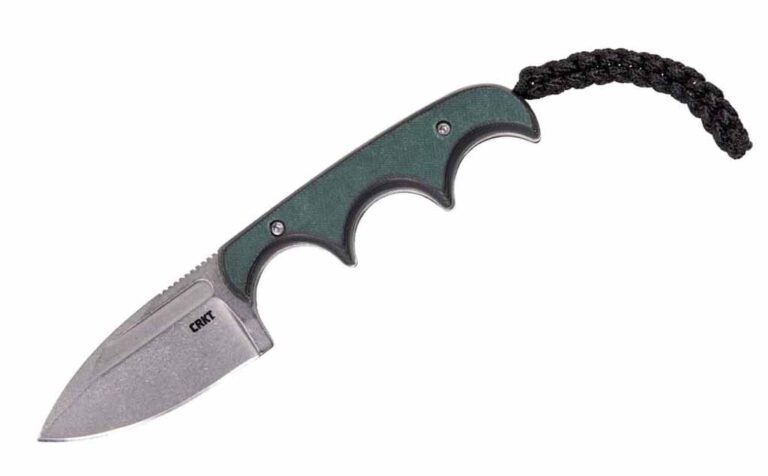
The new CRKT Spear Point is an excellent fixed-blade knife. Designed by Florida-based maker Alan Folts, and part of the company’s Minimalist line, the Spear Point is compact, rugged, and can cut through almost anything.
The piece is just 5.2 inches long and weighs a light 2.1 ounces. An included thermoplastic sheath keeps the stonewashed 8Cr13MoV blade safe and secure in transit. The high-carbon stainless steel retains its edge well, making this a great knife to bring with you camping or keeping it in your shop. It can get into tight places that larger knives, both folders and fixed blades, simply won’t be able to.
And it looks great thanks to the resin-infused fiber handle that has a rich, dark green color. The handle also has three finger notches built into the handle for easy, secure grip.
The CRKT Spear Point continues a long line of successful knives from one of America’s top factory makers. At an excellent price point, the Spear Point is, without question, worth the investment.
Handmade Kitchen Knives Reimagine What A Kitchen Knife Can Be
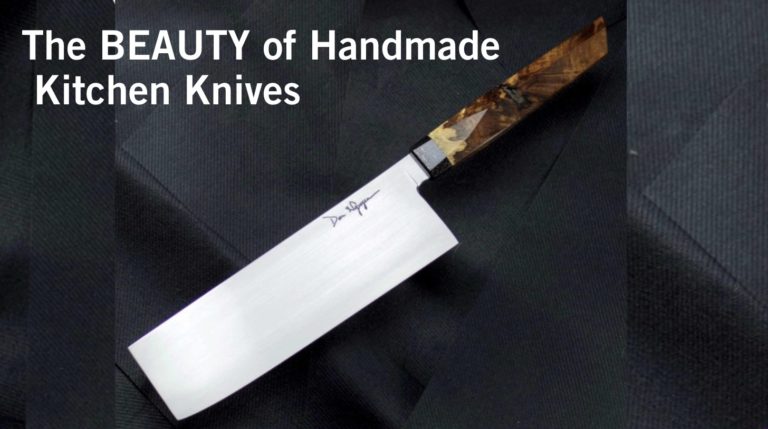
Don Nguyen didn’t know what he wanted from life when he was in college. An evening cooking at a friend’s apartment changed him forever. He was frustrated using his friend’s subpar, dull knives and wanted something better.
“It was that weird moment sharpening at a friend’s place where I said ‘I’m tired of this,’” Nguyen recalled. “I watched a bunch of YouTube videos, and those videos led me from sharpening to seeing Japanese makers make knives. I didn’t know what I wanted to do in life at that point so I was like OK, I want to do this. I dove in from there.”
Dive in he did, and now Nguyen has been making handmade kitchen knives, also commonly called custom kitchen knives, since 2017. He’s one of many makers entering the growing kitchen knife space and finding success.
Custom Kitchen Knife Advantage
Of course, the biggest difference between factory makers and custom makers is scale. A company like Wusthof can turn around hundreds of new knives every month. By contrast, Nguyen and his assistant complete a knife every one to two weeks. This allows for more delicate work when it comes to the actual knifemaking and makes getting different steels much easier.
Large Carbon Gyuto. Steel: 52100. Price: $3700
“Right now we’re probably averaging one knife every two weeks depending on the complexity, but we’re working on multiple knives at once so it’s hard to dictate how long a single knife takes,” Nguyen said. “I have an assistant and he helps me work on a bunch of stuff. We’re juggling projects all the time.
“I don’t have a lot of steel that I need to go through, and the steel choices I tend to use aren’t exotic steels. I go with 52100 for the most part for carbon steel knives. When I go with stainless I go with AEB-L or RWL-34. Those are fairly accessible. They’re usually in stock.”
Why Buy A Handmade Kitchen Knife?
When you talk to him, Nguyen’s passion is clear, and even with that passion, a big question remains: why should someone spend money on handmade kitchen knives instead of buying from a well-known factory maker?
He spoke honestly about how handmade kitchen knives won’t be for everyone, but for those who want them, they want only the best.
“Custom knives are made for a specific type of person,” Nguyen said. “They need to have food as their hobby. If they don’t like cooking all that much, they aren’t the intended audience for that. But if you love food, you follow it, buy books, read up on chefs, then you get into custom knives. Then you get knives in the [top] percentile of performance that are unique, made by someone you admire.”
Steel Sharpens Steel
As more makers enter the market, finding out ways to make your knives that are little bit better than your competitors has become the key to knifemaking. So much so that, according to Nguyen, many makers are working on what the knife does after it cuts the food.
“There’s a lot of interesting trends in knifemaking and the pursuit of the last 1 percent in performance,” Nguyen said. “A lot of makers now are working on food release. Being able to cut the food and having it pop off the [blade] without any effort at all. That’s a huge difference between a knife you buy off the shelf and a custom-made knife.”
Nguyen is one of the highly-skilled makers producing handmade kitchen knives. The below makers are also making exciting knives.
Best Handmade Kitchen Knife Makers
Mert Tansu
Nine-inch Damasteel gyuto in Heimskringla pattern. Price: $1,100
A former executive chef, Mert Tansu has been making remarkable kitchen knives in his native Australia for several years, learning to forge san-mai and damascus, and officially hung up his chef’s coat in 2018 to focus solely on making knives.
His current knives are made in the Japanese tradition and fetch a tidy price, but the craftsmanship is clear from the moment you lay eyes on the blade.
Located in Washington state, Maumasi apprenticed under Bob Kramer, who we’ll talk about shortly, and makes multiple types of knives. He’s made many a wild damascus piece as well, and is a magician at working the steel to create exciting patterns.
“I think he’s one of the best makers out right now,” Nguyen said of Maumasi. “I talk with him all the time about business strategy, techniques, everything we’re going through.”
Bob Kramer
Meiji 10″ Chef’s Knives by Zwilling J.A. Henckels. Price: $379.99
He worked as a professional chef for a decade before asking himself “why can’t I and other chefs keep our knives sharp?”
That question led him down the path to becoming one of the most accomplished makers of custom kitchen knives in the country. Kramer earned the title of ABS master smith in 1998, and since then he’s been “devoted … to the single-minded pursuit of crafting the perfect kitchen knife.”
His Kramer Knives not only turns out top-tier blades, but now features a small team to help keep the company strong and growing for decades to come. Additionally, his company has licensing agreements with a handful of major knife companies including Zwilling J.A. Henckels.
Andreas Kalani
The Dahlia. Price: $175
Andreas Kalani spent nearly a decade teaching himself the craft of knifemaking. He took his lumps and learned from his mistakes. Those years of trial and error have paid off as Kalani is now an accomplished knifemaker.
He makes beautiful Japanese-style knives as well as other kitchen utensils. Kalani even makes hunting knives and tools for skinning and processing your hunt. It all started with a dream for Kalani, and it has paid off handsomely thus far.
Will Brigham
Pattern-welded Sepharim Knife
Knives from Will Brigham are just as much art as they are kitchen tools. He specializes in pattern-welded damascus and mokume-gane knives. His sells his knives through his company, The Artificery, and he’s pushing hard to make the most distinctive damascus designs and highest-quality blades.
“Will Brigham is making crazy stainless steel damascus,” Nguyen said. “I think he’s kind of the pioneer of modern stainless steel damascus.”
Just As Important As Knowing What To Ask A Knifemaker When Looking To Buy A Knife, Is What To Not Ask A Knifemaker.
Editor’s note: Last time we outlined the questions you should ask the maker. This time, we cover some of the things that you either probably should not ask—or at least should think through thoroughly before doing so. You can read part 1 here.
Custom knifemakers are, for the most part, reasonable people. Actually, they’re a pretty likable lot. Engage one in conversation and it’s likely to be a pleasant experience.
Ask a maker about a knife and the discussion enters another dimension, particularly if it develops into one between a seller and potential buyer. Questions are part of the exchange of information, and just about any inquiry is fair. However, it pays to be courteous and respectful and to remember that courtesy and respect go both ways.
So, are there questions that are off limits when discussing the merits of a custom knifemaker’s work, their background, experience, or perspective? What are the potential hot buttons and how much is too much when it comes to probing a maker? Well, if you have to ask yourself whether a question is appropriate, then think twice about asking it. If it might not sit well with you on the receiving end, just remember those principles of kindness and respect.
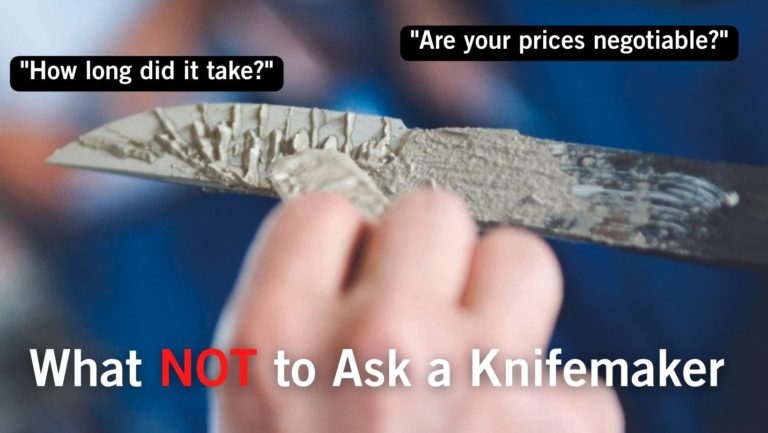
How Long Did It Take?
“Asking a maker how long it took to make a knife is not polite etiquette,” offered veteran Vince Evans, “and it could also be misleading. An experienced maker may take 40 hours to make a really nice piece, whereas a beginner may spend 100-plus hours and come out with a poorly executed knife. On more complex knives and swords, the process may take months, or even years, to complete. So, a maker may not keep track of how many hours he has in a piece.”
David Broadwell has more than 40 years of experience making custom knives, and the time factor is always a bit contentious for him. “This is probably the most often asked question of me,” he said candidly. “I don’t know how long it takes! I don’t punch a time clock on each project. Most of my knives are fairly complex, and I do each step or operation until it’s right, regardless of the time. Simpler knives are easier to track with regard to the time involved.
“Another thing related to time,” David continued, “is that it’s easy for someone to start believing that because I, for example, with four decades of experience in grinding, can make a knife more quickly than another maker, so I should charge less per hour. But that’s not a fair comparison. I have all that experience, so some operations are quicker for me—but I should be paid for that experience.”
Before asking if a price on a knife is negotiable, take stock in the possible outcome of the query before making it. “In some cases, you will insult them,” said custom knife purveyor Dan Delavan (right), here with fellow purveyor Dave Ellis at the 2021 BLADE Show West. “But on the last day of a show, some makers may give a better deal.”
From a practical standpoint, BLADE Magazine Cutlery Hall-Of-Fame® member Dan Delavan of plazacutlery.com added, “It doesn’t hurt to ask, but most makers make knives in batches, so it’s hard to say.”
Even if the potential purchaser is bold enough to ask about the investment of time in a particular knife, the response may not be helpful. “It may not give you the answer you’re looking for,” commented longtime purveyor Les Robertson, “Why? Often the time to make a knife will depend on the maker’s experience level, the equipment in their shop, and the complexity of the knife. There is no set time for how long a particular knife should take to build.”
How Did You Make It?
Beyond the time element, looking at a particular knife may prompt questions of a sensitive nature, particularly about the process itself. When credibility is on the line, what should the potential buyer do?
“Hmm, I’d say watch his eyes and study his body language,” Broadwell advised, “and, of course, a buyer needs to educate himself to be able to spot fakery.”
It’s up to the buyer to educate himself in order to judge the truthfulness of answers concerning how a knife is made. One way to do that is to attend such knifemaking classes as those at BLADE University at the BLADE Show. Wally Hostetter shows students how to do the Japanese sword handle wrap at a past BLADE U.
Most often the knifemaker’s work speaks for itself and to an educated buyer the quality or lack of quality in a handmade knife is readily apparent, but there are telltale signs when the presenter is blowing smoke. “If he or she does not look you in the eye, it’s a good indication,” Delavan related. “Hesitancy in the voice is a tip-off as well.”
Developing rapport is a big part of any relationship, and becoming friendly with custom knifemakers is often part of the enjoyment of buying and collecting their work. Still, personalities vary. The outgoing, talkative individual and the introverted, quiet one may accept inquiries on a different level, and of course, there are the pressing factors of time commitment—particularly during shows. Monopolizing a maker’s table time is bad etiquette when he or she has other customers or prospects to interact with. So keep it polite and to the point with an awareness of the clock.
What Knife Do You Carry?
One of the more interesting questions for a custom knifemaker might revolve around the knife the maker carries. You may be going out on a limb, putting the maker on the spot, or even offending him if you want to know what’s in his pocket. Ask at your own risk!
“I’ve always been surprised to find out a custom folder maker was carrying a factory knife,” Robertson observed. “This made no sense to me. Carrying a folder made by them would allow the makers to field test their knives regularly. For makers who build larger fixed blades, it can be difficult to carry these knives regularly. However, if they hunt, camp or fish, they should be using their knife, again to field test it. I feel it gives the maker more legitimacy when they tell what their knives can and cannot do.”
Broadwell added, “This is very important to me. Personally, I believe if a maker carries on his person a knife from another knifemaker or a factory, he is saying, especially to the newer and less educated buyers, that knife is better than the one he makes. That is not good salesmanship and marketing of your own brand.”
Are Your Prices Negotiable?
If the makers hunt, camp or fish, they should be using their knife, again to field test it. “I feel it gives the maker more legitimacy when they tell what their knives can and cannot do,” Robertson stated. Ed Burke’s big fixed blade should be right at home in camp. (SharpByCoop image)
Possibly the biggest question of all relates to pricing. Is it OK, fair, chippy, or downright irritating to ask a custom knifemaker if a price for a certain piece is negotiable? Once more, depending on the depth of the existing relationship between maker and potential buyer, take stock of the possible outcome of the query before making it.
“In some cases, you will insult them,” Delavan said bluntly. “But on the last day of a show, some makers may give a better deal.”
Robertson sees a subjective exercise in the dollar dilemma. “Pricing is something each knifemaker must figure out for themselves,” he remarked. “As the buyer, you need to educate yourself as to what it takes to build a particular style of knife. This will help you determine what you feel the price of the knife should be. My advice to knifemakers is to price their knives according to their position in the marketplace they are competing in. By doing so, you are offering your work at a fair price, and you should not lower your price. As the buyer, you can ask the maker to lower their price, but don’t do so just because you think you should haggle on the price of a knife. You are not buying knives at a flea market.”
Tact and diplomacy work better than the “ready, fire, aim” approach. Knowing something about the knifemaker may indicate whether the door is open for negotiation. “This is a tricky question,” Broadwell said. “If the buyer is polite and respectful, it’s all right to ask. However, if the maker does not want to bargain, it should be dropped. What ticks makers off is a potential buyer who says he will just give such and such for a knife and that that’s all it’s worth. That’s arrogant and disrespectful!”
Concerning guarantees and 100-percent buybacks—the latter involving the maker buying the knife back from you if you buy it but then don’t want it—consider the accountability on both sides.
Choose Wisely
Like so many interactions between two people, the questions asked and answered relating to custom knives revolve around the delivery. Mutual understanding is essential. One individual is plowing his or her hard-earned money into the purchase of a knife, while the other is expected to accept payment for the time that is gone forever, and for the cost of materials, equipment, shop, and general overhead.
Choose words and ask questions wisely—always.
Editor’s note: In the final analysis, it’s your money that’s involved in a knife purchase, and the questions you ask a maker about their knife you are considering buying are up to you. One thing to remember: If it’s a knife you simply must have and you ask a question that is out of bounds and upsets the maker, the chances of you having that knife may be nil to none—not to mention the chances of you buying any knife directly from that maker in the future.