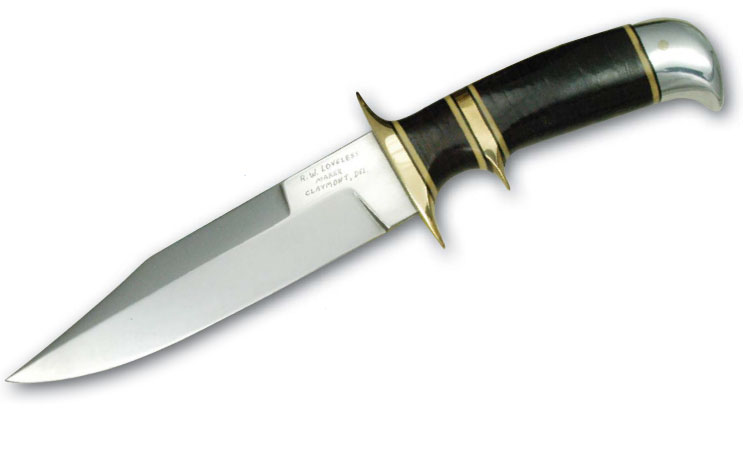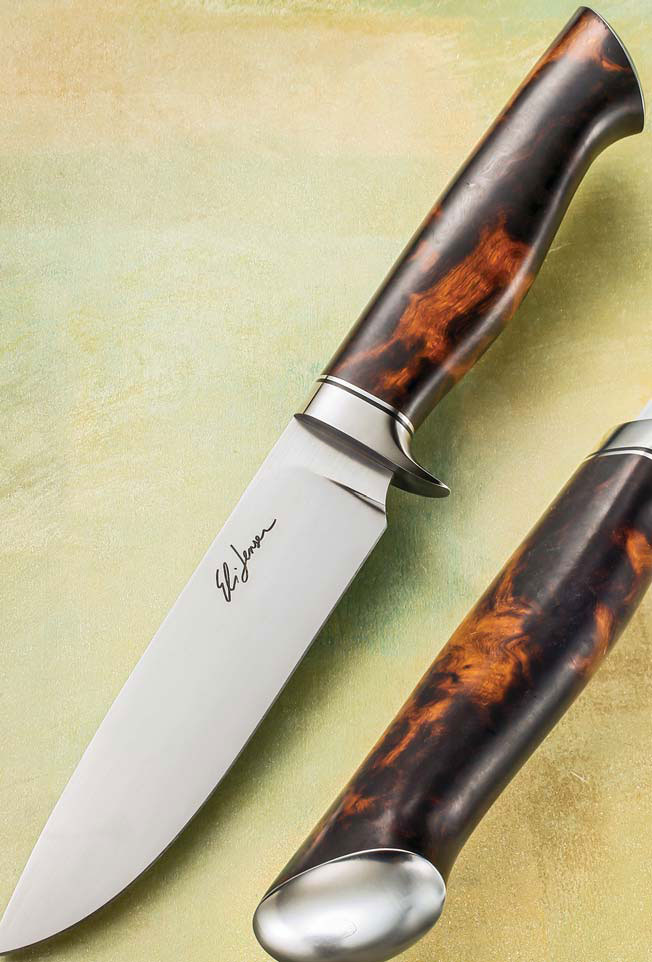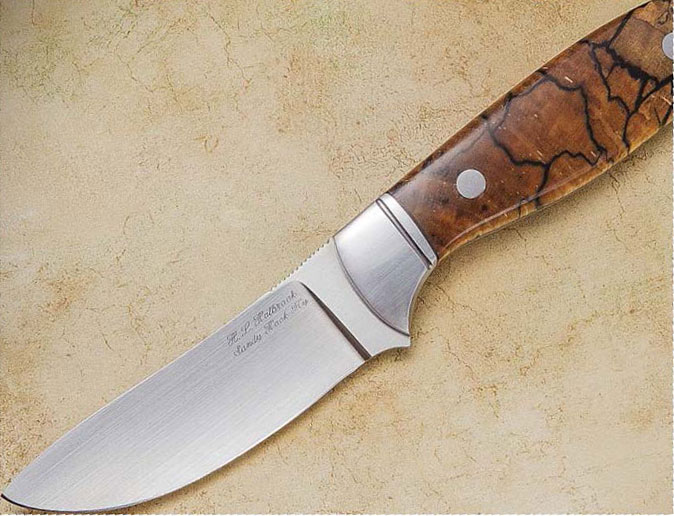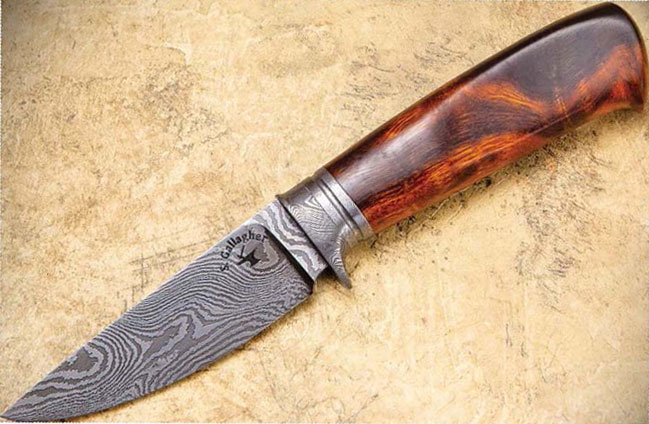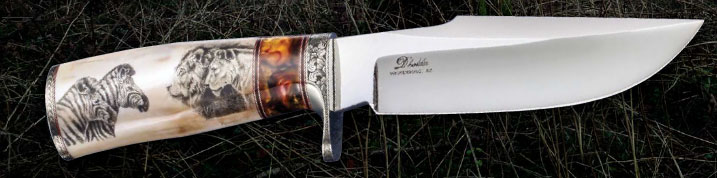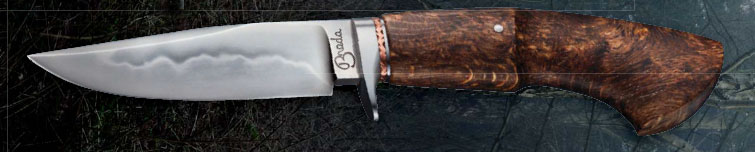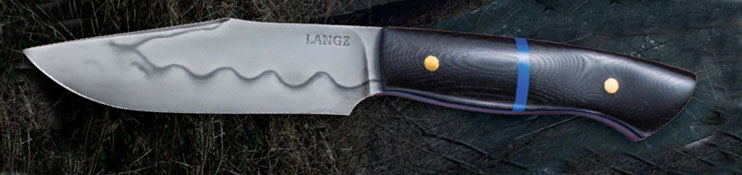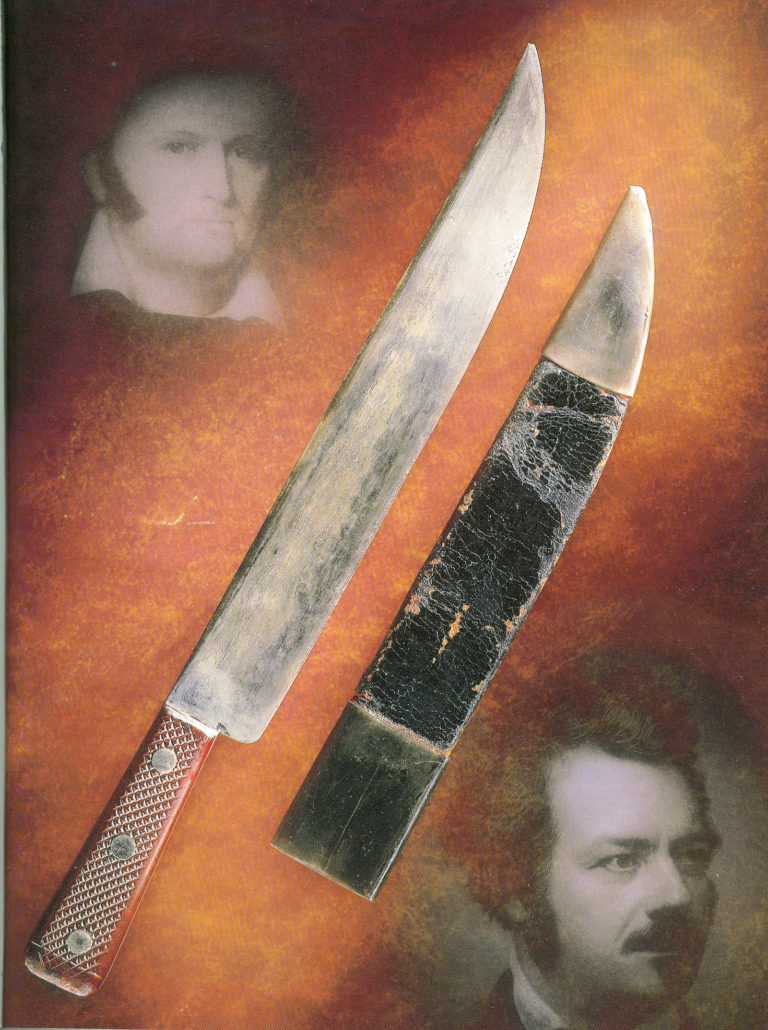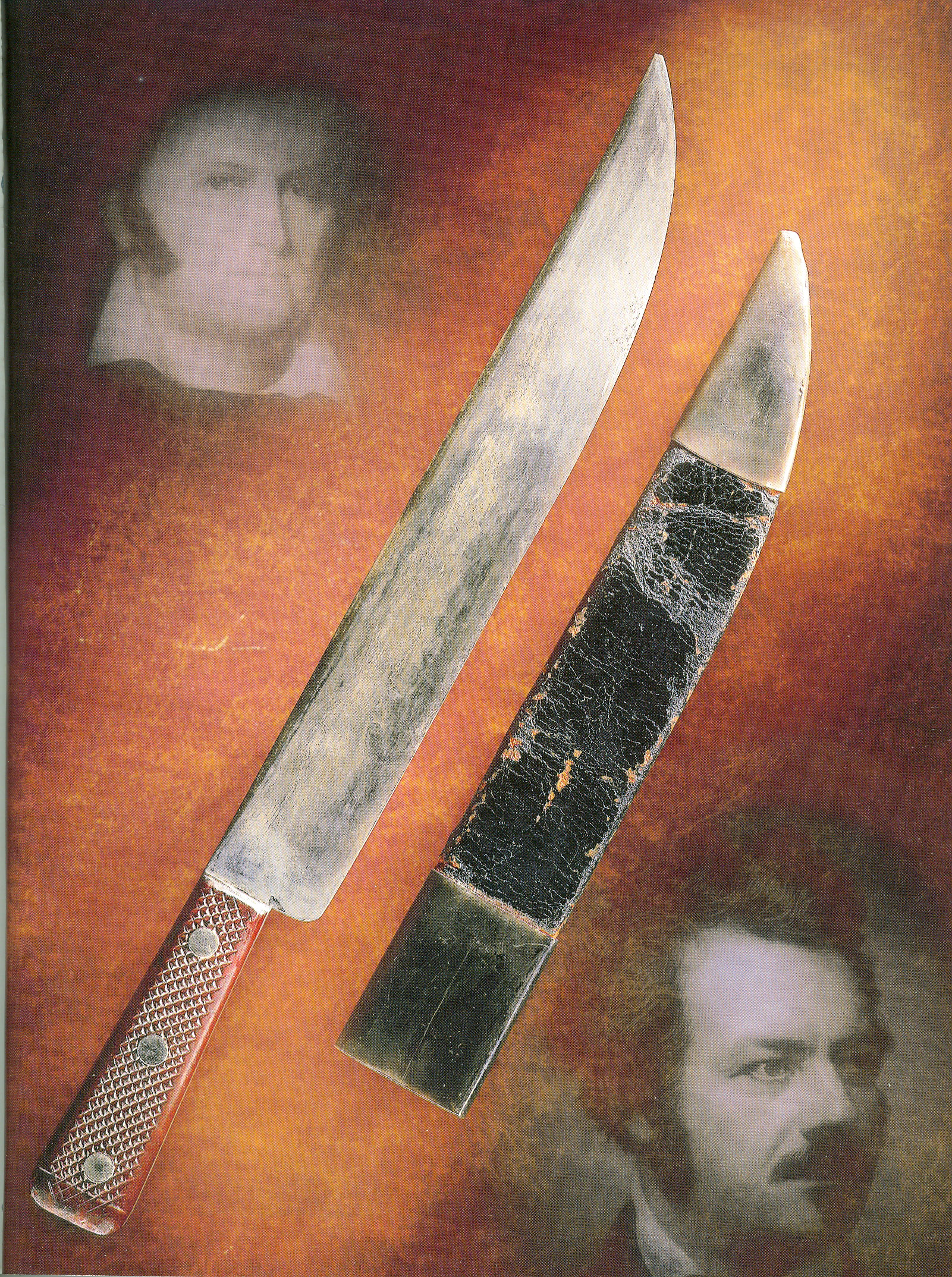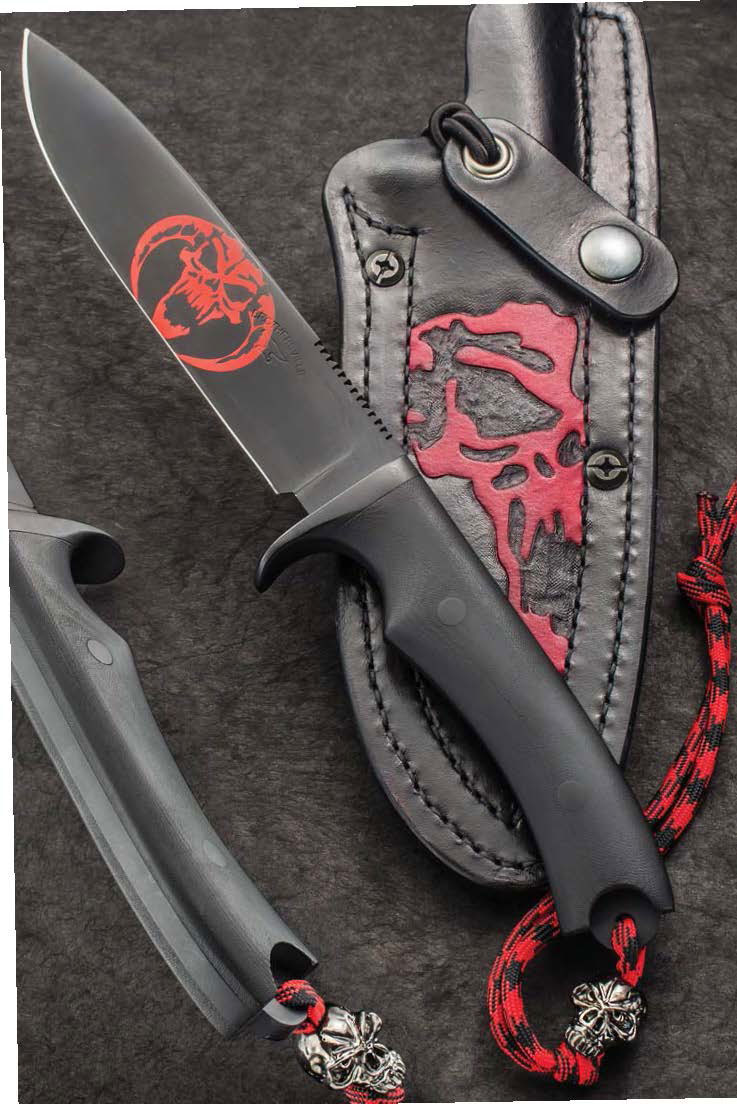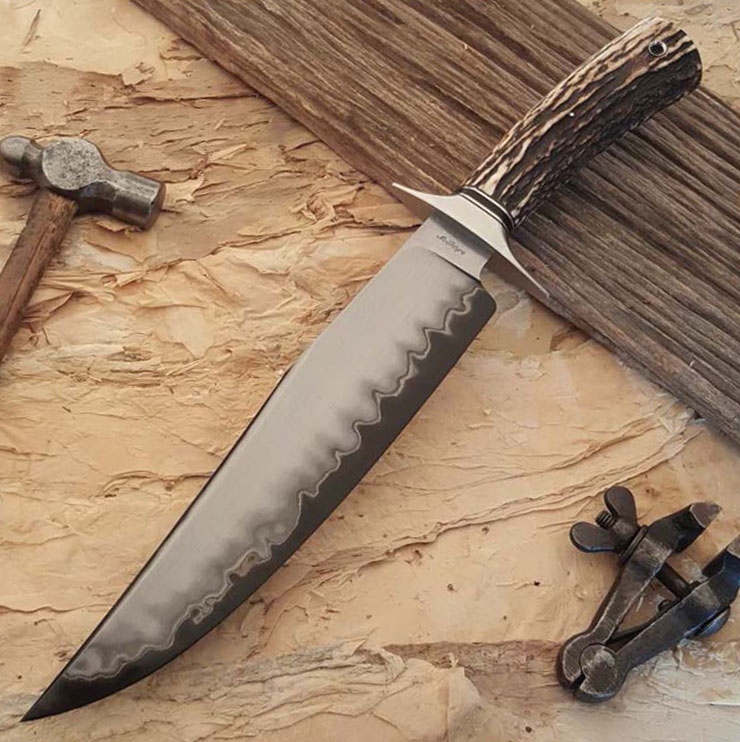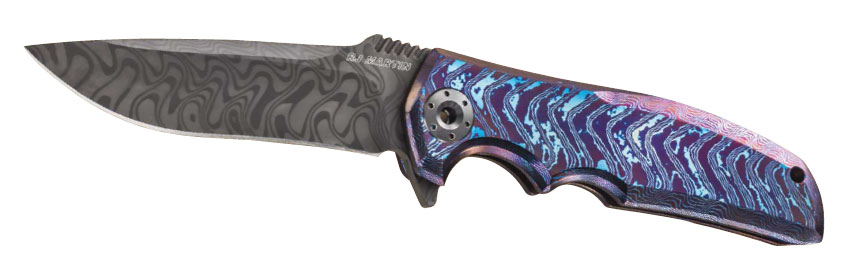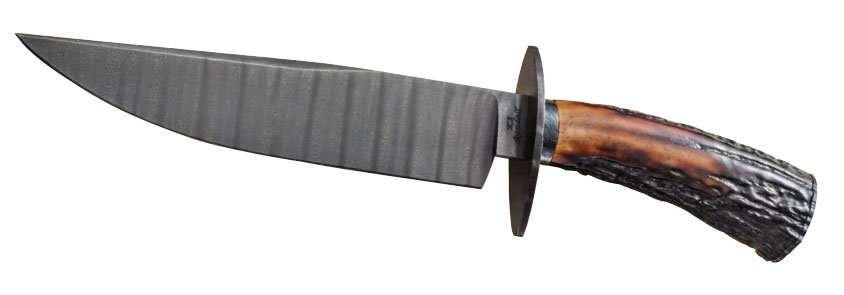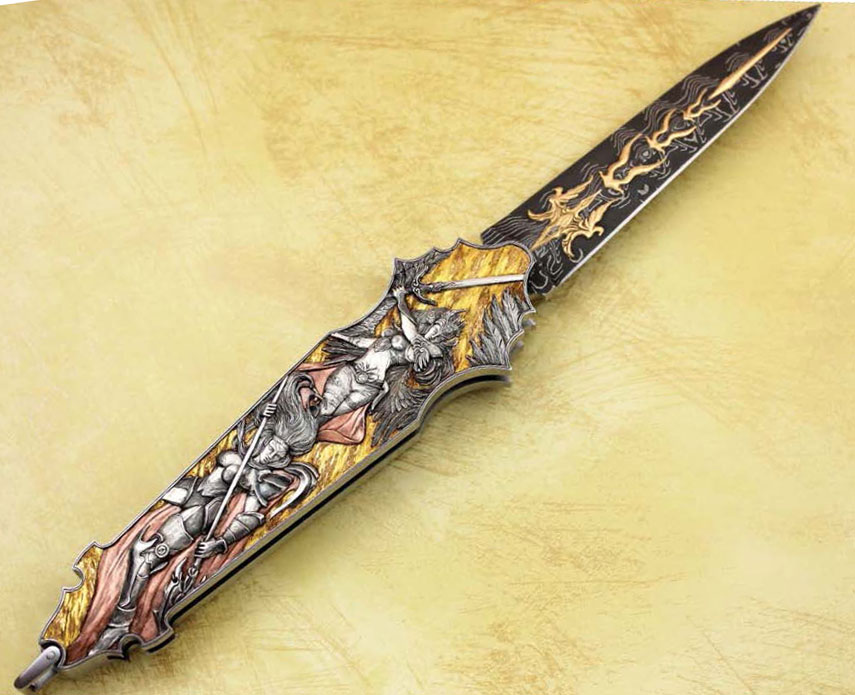
Schneider’s art knives remained among the most coveted in the industry right up to his passing. (SharpByCoop image)
Herman Schneider, one of the most talented of the pioneering custom knifemakers of the 1970s and beyond, passed away Jan. 26. He was 87.
Perhaps best known for the spiked dagger in the 1986 Sylvester Stallone movie, Cobra, Schneider made some of the cleanest knives anywhere. Among them were hunters and skinners in his early days to art knives and reproductions of 19th-century dress bowies in the style of Michael Price as Schneider’s style evolved.
Herman Schneider holds the spiked dagger he made for the Sylvester Stallone movie, Cobra. (image from K.L. Byrd’s Facebook page)
The workmanship of Schneider knives was second to none. As long-time knife collector and the headman of the Art Knife Invitational (AKI), Phil Lobred, once noted, “Herman Schneider’s knives lifted the industry up two notches in the fit-and-finish department.” Schneider was among the very first group of elite knifemakers to be invited to the AKI, and exhibited at the premier event for a number of years.
Of all Schneider’s impeccable knife creations, it was his art knives that stood out. “Herm Schneider built beautiful art knives,” observed Dave Harvey, owner of Nordic Knives retail knife store and coordinator of the biennial Solvang Custom Knife Show. “Many of his blades featured complex grinds that many of the most talented makers would not, or could not, pull off themselves.”
An interesting back story about the Tut dagger repro: As part of Lobred’s instructions for the making of the legendary knife, the blade had to be solid gold. Warenski struggled with finding a way to harden the all-gold blade. After repeated failed attempts, he enlisted the aid of Schneider and Jim Hardenbrook, and together they were able to harden the blade successfully.
In a poll of the greatest custom knifemakers from BLADE®’s first 15 years (1973-88), Schneider did not make the top 10, though he didn’t miss by much and made the honorable mention list. And in the Top 10 custom knives from the same time period, Schneider was the only maker Lobred mentioned for his entire body of work instead of just one piece.
An early member of The Knifemakers’ Guild, Schneider not only was a great knifemaker but was also close to many in the knifemaking and knife fraternity. Along with Buster and Joan Warenski, Cutlery Hall-Of-Famer D’ Holder and Bob Gladstone, Schneider was instrumental in helping Dan and Pam Delavan get the first California Custom Knife Show up and running in the early 1980s. Many thought a lot of Schneider, not just for his knifemaking ability but for his friendship and kindness as well.
BLADE®, the world’s No. 1 knife media brand, announces the all-new BLADE Show West in Portland, Oregon—the Knifemaking Capital of the USA. The 3-day show will open its doors at the Oregon Convention Center on Friday, Oct. 5, 2018.
BLADE Show West is presented by BLADE® Magazine, which also hosts the Annual BLADE Show in Atlanta, Georgia June 1-3 at the Cobb Galleria.
Why Portland?
“There’s no better place to have a new BLADE Show than in the backyard of Blade City USA,” said Steve Shackleford, BLADE® Magazine Editor in Chief. “Knife enthusiasm is at an all-time high, and there are many thousands of knife aficionados and knife makers in the West. We’re eager to see and showcase all the great blades out there.”
Reasons to Attend
The new BLADE Show West will feature the works of prestigious knife manufacturers large and small, as well as handmade knives made by skilled custom knife makers. And Portland is the perfect city.
See knives of all types and designs—fixed blades, folders, automatics, swords, daggers, tactical knives, throwing knives, art knives and more
View custom knives designed, forged, and finished by individual knife makers, and new models by renowned manufacturers
Visit knife dealers, purveyors, collectors, and knife enthusiast organizations at more than 200 booths and tables
Shop for knives priced from $10 to more than $10,000, knifemaking supplies and machinery, and accessories from sharpeners to cases
Vote for the Best Knives of BLADE Show West
See knives entered in the Weirdest Knife Contest—in line with the region’s unique Keep Portland Weird! slogan
Does This Change Anything About the BLADE Show in June in Atlanta?
Nope! The BLADE Show in Atlanta that takes place every June will continue as it has in years past.
Editor’s note: This article is the conclusion toMake a Bowie Knife in 10 Steps. Read that one first if you’re interested in making a complete knife from start to finish.
1) Choose the Material
For handle material, I chose olive drab G-10 with a simple red liner for a little flair. The choice for your handle material is up to you.
While the material used, the rasp, is classic and traditional, the handle material will be more modern. I’ve chosen olive drab G-10 with a simple red liner for a little flair. Any material you like would be fine. It’s your knife and the handle is the easiest place to express your personal taste.
2) Lay Out the Scales
Trace the handle profile. I use a black magic marker since the G-10 won’t absorb the ink.
Now that we have our materials it’s time to start laying out our scales. Trace the handle profile. I use a black magic marker since the G-10 won’t absorb the ink.
If you use a natural or unstabilized material, a pencil might be a better choice to avoid staining or permanent marks.
3) Mark the Holes
To help ensure your holes will line up, make a light mark with a hand drill and finish in a drill press to help ensure the holes are square and true.
Mark the holes you need to drill on one side of the pair of scales. To help ensure your holes will line up, make a light mark with a hand drill and finish in a drill press to help ensure the holes are square and true.
4) Sand, Drill and Glue
A simple light sanding will flatten the scales and rough up the surface for a better bond. Drill the holes in one scale, place a drop of Super Glue® on the flattened inside surface, and glue the two scales together.
One important thing to remember when doing anything is to never assume. While the handle scales look flat they in fact are not. A simple light sanding will flatten them and rough up the surface for a better bond.
Using the drill press I drill the holes in one scale, place a drop of Super Glue® on the flattened inside surface, and glue the two scales together. This ensures the scales will stay perfectly matched up as you drill your holes and do the rough shaping.
5) Profile the Scales
Profile the front of the scales while they are attached by the light glue bond.
Another important step is to profile the front of the scales while they are attached by the light glue bond. First, it is very difficult to clean up the front once it is attached to the blade without scuffing and scratching the blade. Second, it ensures that the faces of the scales will match up just like the holes do.
6) Pop them Apart
Place the edge of a blade on the seam between the scales. A light tap will pop them apart easily and you are ready to add any spacer material if so desired.
Once the holes are drilled and the rough shaping is complete, simply place the edge of your everyday carry blade on the seam between the scales. A light tap will pop them apart easily and you are ready to add any spacer material if so desired.
7) Trace, Cut and Glue
Trace the handle shape onto the spacer material, cut to rough shape and then glue to the inside of the scales.
Trace the handle shape onto the spacer material, cut to rough shape and then glue to the inside of the scales. Super Glue or epoxy is fine for this. Different materials will need different bonding agents. I use Super Glue here because the materials are very non-absorbent. If you choose antler or unstabilized wood, an epoxy is probably a better choice.
Once the material dries, clean up the edges and drill through to match the existing pin holes. A hand drill is fine for this as the holes in the scales will guide the bit.
8) Assembly
Now you’re ready for assembly. For pins the author uses two simple brass bolts. Use the pins themselves to clamp the scales in place by simply adding a nut and snugging it down after applying epoxy.
Now you’re ready for assembly. I’m going semi traditional and keeping the build simple. For pins I use two simple brass bolts. The advantage is I can use the pins themselves to clamp the scales in place by simple adding a nut and snugging it down after applying epoxy.
Also, the threads on the bolt help add an extra mechanical bond to the handle assembly.
Once you’ve checked the fit of the parts, give them a good spray with brake cleaner to be sure they are free of dirt and oil and to ensure a clean bonding surface.
9) Get the Pins Flush
Clean off the head of the bolt and then extra length of bolt body on the nut side, and your pins will be flush.
After the epoxy dries, take your angle grinder or whatever you have been using—a file or hacksaw will do as well—and clean off the head of the bolt and the extra length of bolt body on the nut side, and your pins will be flush. When doing this be sure to work slowly! Brass heats up very quickly and that can compromise the bond of the adhesive if you’re using power tools.
10) Clean and Shape
Jump into the rich tradition of knifemaking with this collection of essential books from BLADE. You’ll save a bundle with this bundle!
You’re almost to the finish line. All that’s left is to clean up your handle and shape it to fit your hand. When you do this, again, take your time.
Once you remove any material, you can’t put it back. Go slowly and check the fit often till it fits like a glove, an extension of your hand.
Do some cutting and chopping with the knife—this will let you know what, where and how much material you need to remove.
Work through your sandpaper grits to whatever final finish you desire and voila! Your personal vision of knife perfection is in your hand.
I hope you enjoyed this journey of steel as much as I have. Now get out there and put that knife to work!
Pro-Tech’s new Chris Kyle Frog Collection is anchored by the Model 752, a spin on the Godson Tuxedo. The Chris Kyle “Legend” logo is lasered into the ivory Micarta inlays. Proceeds benefit the Chris Kyle Frog Foundation.
Stubby blades designed for the Golden State may also hold appeal for those elsewhere. That seems to be the thinking behind SOG’s discreet California Special, which could be described as an entry model for new collectors.
This series won’t hit shelves until May 1, but it’s worth keeping an eye out. This USA-made auto is slated to retail for $125.
Final specs aren’t available yet, but the series will offer S30V blades and four style options.
Benchmade Coalition® Family
The models in this series (or family) aren’t necessarily distinct variants. Instead, buyers can choose from plain or serrated edges, and satin or coated finishes. That makes for four possible combinations for this EDC auto.
The job of a scribe was to copy the text from an existing manuscript using a quill pen and an inkhorn. When they made mistakes, they had to scrape the ink off the page with a sharp knife, a painstaking job that could easily ruin a piece of parchment.
How well can a knife made out of wood perform? Pretty dang well.
This video details how a man in Japan, identified only by his YouTube channel Kiwami Japan, shaped a knife from a wooden blank using sandpaper and whetstones.
Here’s the video, featuring a few cutting tests:
The key is the lignum vitae wood the man used. It’s “the densest and hardest wood known,” according to the Forest Legality Initiative.
New Hollywood Steak Restaurant Will Feature Knives Made In-House
Adam Perry Lang gained renown for running a barbecue smoker outside the studio of Jimmy Kimmel Live in Los Angeles. Now, Lang is set to open a steak restaurant with something sharp on the menu: knives made by the chef himself.
Walking into Lang’s man-cave/test kitchen, the first thing you spot is the double-barreled smoker rig that Lang tows to various barbecue events. The next thing is the forge. Glowing at something like 2000 degrees, the renowned pitmaster heats a piece of vaguely knife-shaped raw steel until it glows bright orange, puts it on the anvil and gives it a dozen or so good thwonks with a mallet on the way to making a sharp edge. Making Damascus steel knives by hand is just one of his clutch of obsessions — and APL diners will be able to slice into their aged steaks with Lang’s own carefully-forged blades.
Knifemaker Turns Out Blades with 14-Year-Old Grandson
The Tribune-Review out of western Pennsylvania recently profiled a grandfather/grandson combo keeping the tradition of bladesmith alive. The article was originally about a heart attack the grandfather experienced, but to BLADE that’s second to the fact a multi-generational pair was pounding steel in the first place.
From the article:
After his heart attack, Eyth had three stents placed in his major coronary artery. But, he said, “It didn’t stop or slow me down much. They wanted me to take it easy for a month or two.”
The pace of production at Eyth’s forge has slowed some, mainly because his son doesn’t participate as much, he said. But his 14-year-old grandson, Joe, has stepped in to help fill the gap.
“We’re still turning out 120 to 130 knives in a year,” said Eyth, who puts some of his knives to use when he hunts deer.
Forged in Fire will go down as one of the most significant television programs to knife enthusiasm of all time. Here are eight things you may not know about the show, as sourced from BLADE interviews with contestants.
1) The Set is Hot
Despite the Forged in Fire staffs’ efforts to reduce the heat in studio, the combination of forges and overhead lighting for filming makes for piping-hot working conditions.
The forges are lined up four abreast so you are sandwiched between fires. The stage is fireproof, which means it’s vented to prevent asphyxiation, but not as you would vent a home forge, drawing heat up and away. This is where you see contestants collapsing. Add to that the heat and brightness of the lights needed to adequately film the show, and you’ve got an extremely hot environment.
2) Knifemakers Need Reminders to Drink Water
The staff is great about providing thermoses of water, but often the makers are driven and forget to drink.
3) Filming Isn’t Like a Casual Hammer-In
Everyone who appears on Forged in Fire undergoes a telephone interview, a Skype interview and a background check. The participants are flown to New York City and set up in a hotel. The filming takes place in a studio in Brooklyn.
One knifemaker thought it would be cool to hang out after the show, “light a fire and make stuff,” but due to insurance liabilities there was no resemblance to a relaxed hammer-in.
4) It’s a Competition With Yourself, Not Others
One knifemaker who appeared on the show told BLADE there is no backstabbing, no negative talk about other smiths. It is very stressful, but it’s about doing your personal best and reflecting well on the industry.
5) Knifemakers Have to Speak in Present Tense
To a man, each bladesmith found filming the interviews a long, challenging process. Those need to be conducted in the present tense, which is hard to remember when you’re talking about something that’s already past.
6) The Show Format Changes Based on Knifemaker Feedback
Although knifemaker JW Randall was contacted early on to be on the show, he didn’t like how it seemed to take advantage of people and their situations. Randall caught up with Forged in Fire judge J. Neilson and expressed how off putting the original format was to him. The show evolved.
7) Not Every Knifemaker Jumps on the Chance to be on TV
Mace Vitale (featured in the latter half of the video above) of Vitale Knives in New Haven, Connecticut, received an email invitation to interview for selection on Forged in Fire. A batch of emails had been sent to noted smiths in the industry.
“We were all talking about it,” Vitale said of the reaction within the bladesmithing community.
Some thought it was going to be the ruin of the craft ; others saw the potential. Vitale passed but then changed his mind.
“I didn’t care about being on TV,” he said. He wasn’t concerned about promoting his knives or his business. He decided to try it because it was a personal challenge. He wanted to know if he could compete with his experience and skill set and beat the competition.
8) The Twists in the Show are Surprises to the Knifemakers, too
In episode eight of season one, Vitale and his competitors were told to pick what they wanted off “a table of junk.” There were shovels and hoes, mid-carbon steel; horseshoes and railroad spikes, no carbon steel; and ball bearings, most likely 52100.
This is where experience came into play. Vitale grabbed some ball bearings and began making a 9- to 12-inch knife that would have to survive a coconut chop and another sharpness test, which turned out to be cutting a reinforced sand bag, though the contestants didn’t know it at the time.
Get Started in Knifemaking for $50
If Forged in Fire gave you the itch to try making a knife, start with Wayne Goddard’s classic knifemaking book, $50 Knife Shop.
BLADEShow.com is ready to rock ‘n’ roll with online ticket purchases, exhibitor information, travel arrangements, schedules, and more. BLADE Show 2018 takes place June 1 to 3 in Atlanta, Georgia, but you don’t want to wait. The earlier you lock in, the better.