The sword is 2,100 years old. Click for a larger view.
A rare Roman cavalry short sword made before the time of Christ that has been preserved in its entirety and still cuts is one of several recent highlights of the Celtic Collection Program in Milner, Georgia.
The ancient short sword is from the La Tène III (circa 2nd to the 1st century B.C.) timeline. It was in the H. Liebert private collection, Cologne, Germany, and was acquired during the 1960s and ’70s.
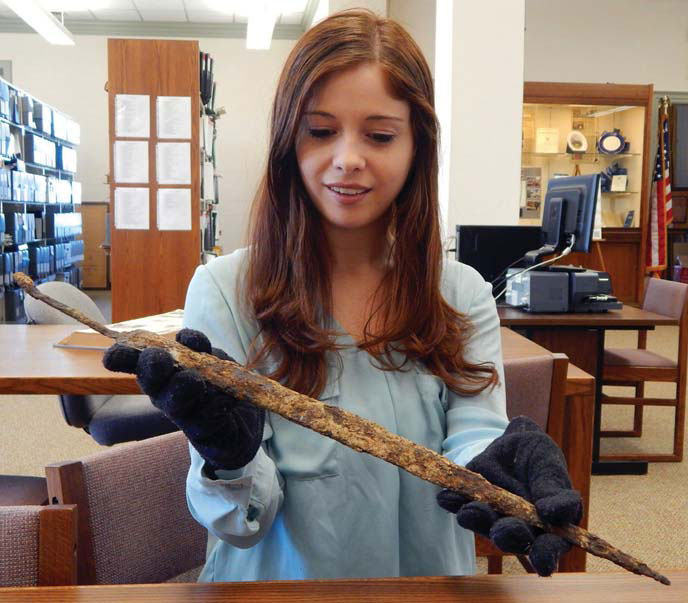
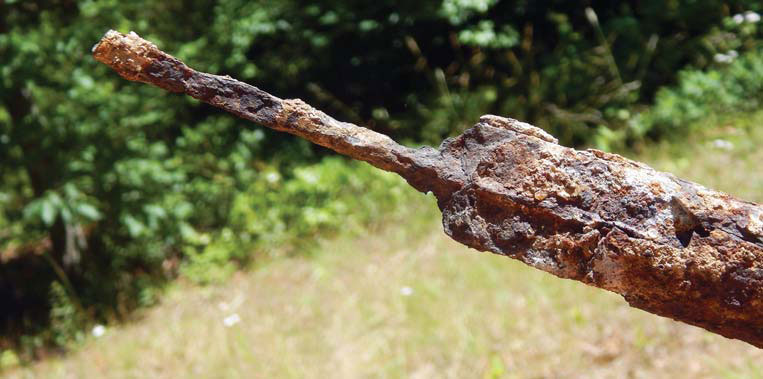
The iron sword is completely intact and is 20.5 inches long. Over time it has become permanently attached to its iron scabbard, and the buckle remains from where it once hung from a belt. Its thin hilt, which terminates in a small pommel, would have once been encased in wood.
According to a spokesperson, the sword has a double-edged blade still sharp enough to cut.
Though the ancient sword is believed to be from Gaul (modern France), Peter Connolly reports comparable swords in his book, Greece and Rome at War.
Similar swords reportedly have been recovered from Switzerland, France, the Thames in London, and Embleton, England.
The sword belonged to either a male or female warrior specializing in close combat tactics, a spokesperson stated.
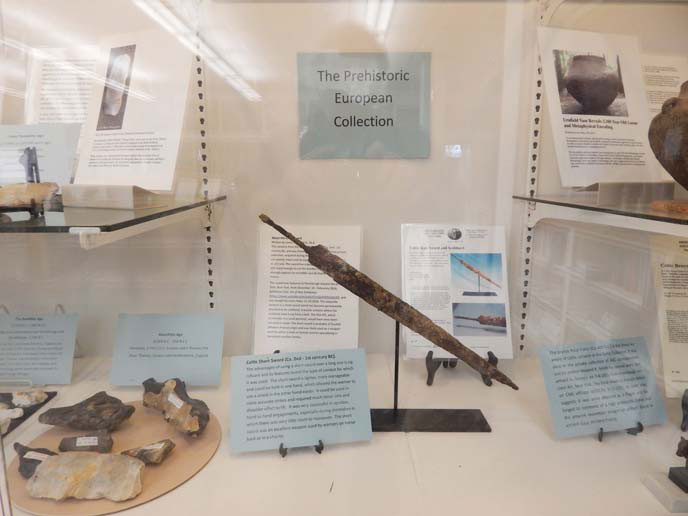
Jamesan Stuckey, director of the Thomaston-Upson Archives, examines the Roman short sword relic. (Lewis Hales image)The sword’s thin hilt, which terminates in a small pommel, would have once been encased in wood. Part of the sword’s edge, which has remained sharp all these centuries, is exposed above the guard. (Lewis Hale image)The buckle remains from where it once hung from a belt. (Lewis Hales image)The sword relic as contained in the Prehistoric European Collection at the Thomaston-Upson Archives. (Lewis Hales image)
Learn More About Knife History
BLADE gathered 14 years of Knives annual books into a single collection. Get it here.
The Cutlery Hall Of Fame is the only such body to recognize all members of the knife community. Nominated and voted on by living Cutlery Hall Of Famers, the inductees must have a) demonstrated extraordinary service to the knife industry; b) displayed honesty, character and integrity; c) advanced the industry by the creativity and originality of their works or contributions; d) as ambassadors or outstanding contributors furthered the positive impact of the knife industry on the world at large; and e) in summary, demonstrated a worthiness to be a member of such a prestigious group.
Dan Delavan
Dan Delavan
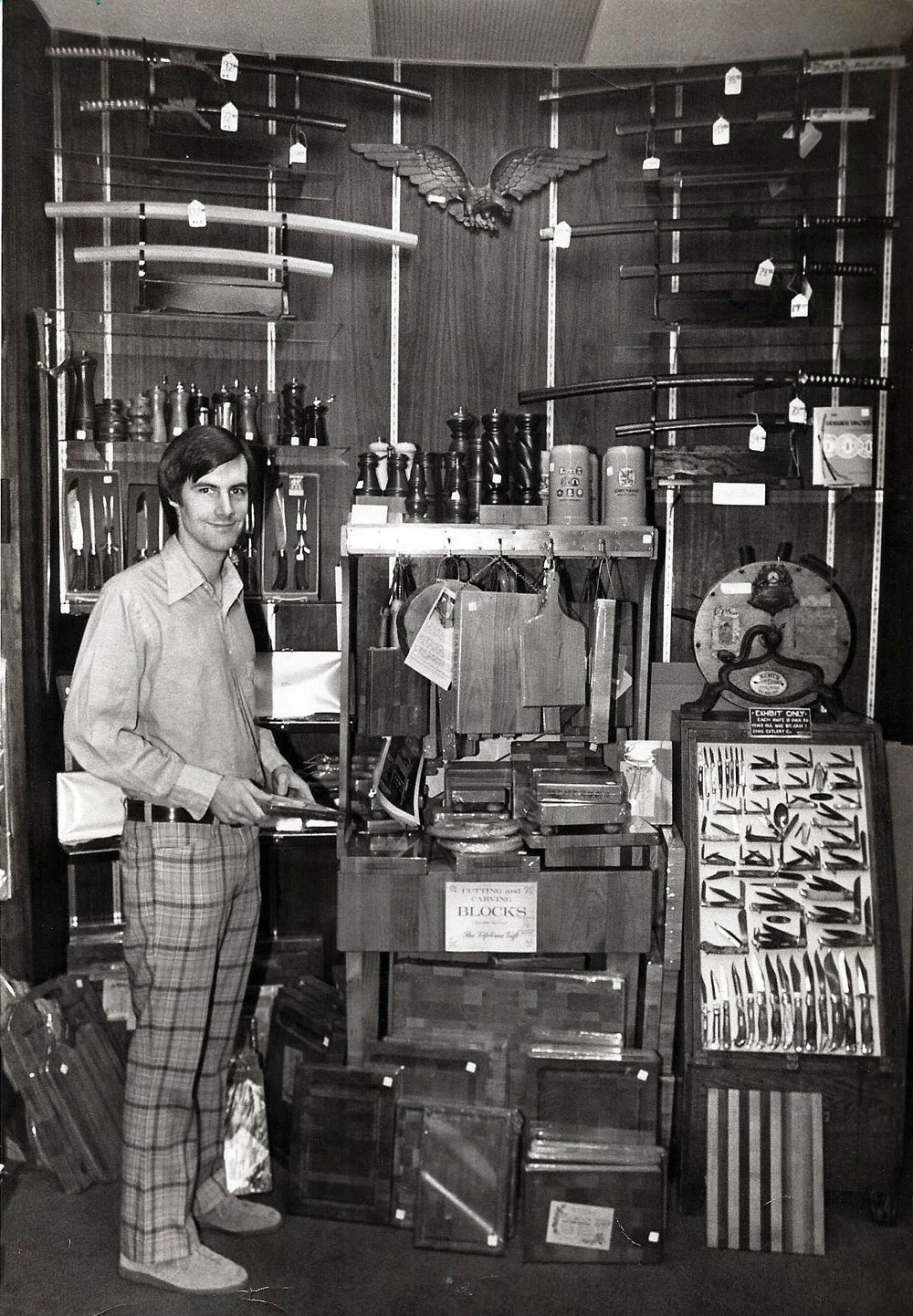
Along with his wife Pam, Dan closed the Plaza Cutlery retail knife shop in the South Coast Plaza Shopping Resort in Costa Mesa, California in January after 44 years as one of the world’s most forward thinking of brick-and-mortar cutlery stores. Dan was in on the ground floor, helping his parents, Del and Lois, open the store in 1974.
From the outset, Plaza was a pioneer in selling knives in a mall setting and custom knives in general—the latter at Dan’s insistence and something only a handful of stores at most did at the time. Plaza was a leader in hands-on customer service; sharpening while you waited; in-store meet-the-knifemaker events; custom and factory knife exclusives; the latest factory knives, swords, kitchen knives and assorted knife accessories; and later and through to today, online knife sales, including Randall knives and customs.
The Delavans started what would become the California Custom Knife Show in the early 1980s and made it into one of the industry’s premier cutlery events, including a visit from Sylvester Stallone that helped pave the way for the Rambo knife revolution that transformed the knife culture in general. Dan and Pam sold that show and started another one that was very successful. They recently sold the latter and it will continue under new management.
Dan also helped start the National Independent Cutlery Association, a buying group for domestic cutlery shops that boasted 100 member stores at its height. NICA helped its members in their business relationships with knife manufacturers and importers, had an annual knife and knife exclusives, and otherwise aided in furthering the availability of fine cutlery to its members’ customers nationwide.
An image from 1975 of Dan Delavan in the old Plaza Cutlery knife store one year after it opened.
Phil Lobred
Phil Lobred
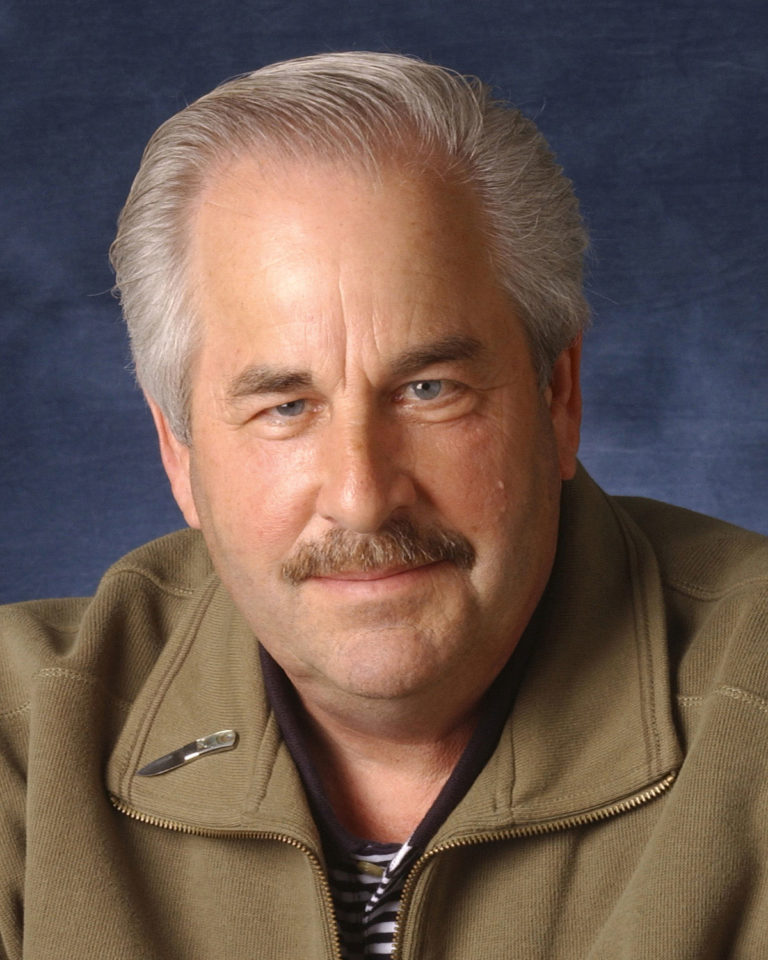
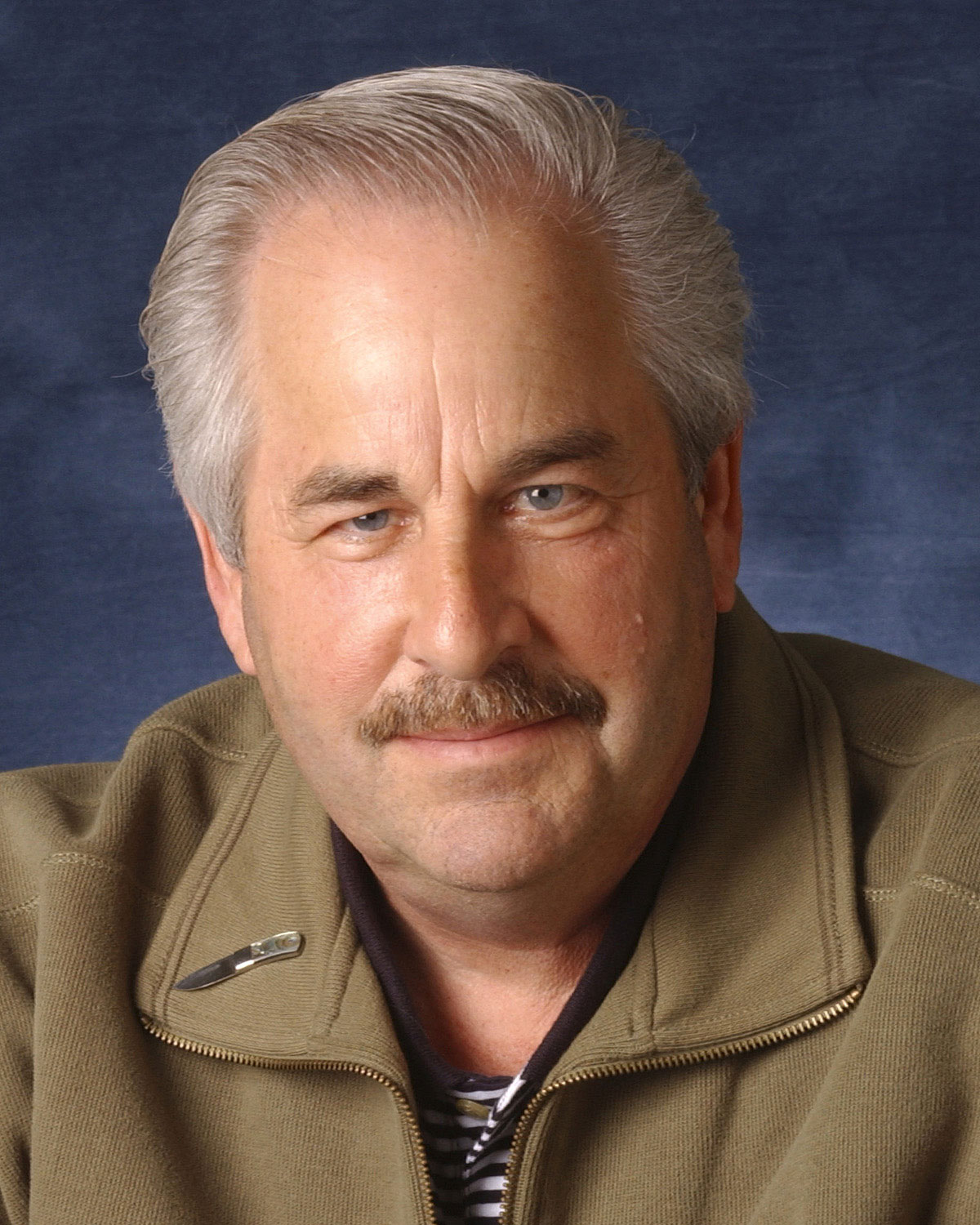
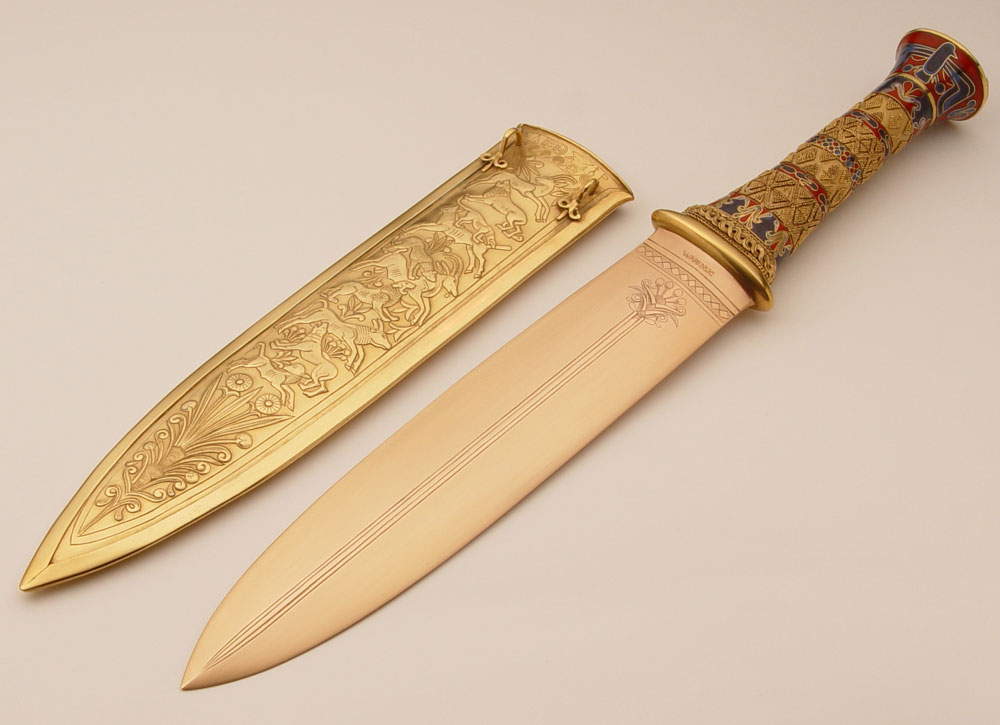
Phil may be best remembered for commissioning what is arguably the most important knife of the modern custom era: the King Tut Dagger Reproduction by fellow Hall-Of-Famer Buster Warenski.
Beginning in 1983 Phil coordinated the annual Art Knife Invitational, an intimate gathering of the world’s elite knifemakers in San Diego, who in turn offered their knives for sale to the world’s elite custom knife collectors. The show took about a 10-year hiatus but returned as a biennial event and continued to draw the elites worldwide. It continues under the direction of Phil’s daughter, Sandee.
For a time in the 1970s Phil shared his home with Hall-Of-Famer Gil Hibben. Hibben made knives in Phil’s garage, with Phil by his side. Later, with Phil in tow, Gil enjoyed an audience with a special fan of Hibben knives: Elvis Presley. Phil and Gil visited with Elvis until the wee hours, a meeting that remains the stuff of legend.
Phil’s vast knowledge of custom knives and also 19th-century dress bowies proved an invaluable source of information for many, including BLADE. Perhaps Phil’s most important contribution was his faithful patronage and support of the custom knife industry. He bought and collected the knives of many makers from the early 1970s on at a time when the industry needed such buyers/collectors desperately to survive. As a Hall-Of-Fame nominator noted, “Phil was the definition of a knife collector, always talking and promoting knives. Then he started his Art Knife Invitational and that changed the custom knife industry forever.”
The King Tut dagger repro Lobred commissioned Buster Warenski to create.
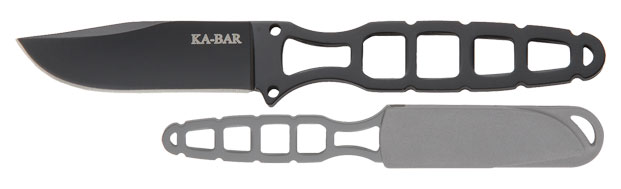
SHEATH: Tri-Composite System Kydex w/3” nylon webbing, Box X stitching, stainless hex fasteners and liners; locks blade in; MOLLE system sheath also available
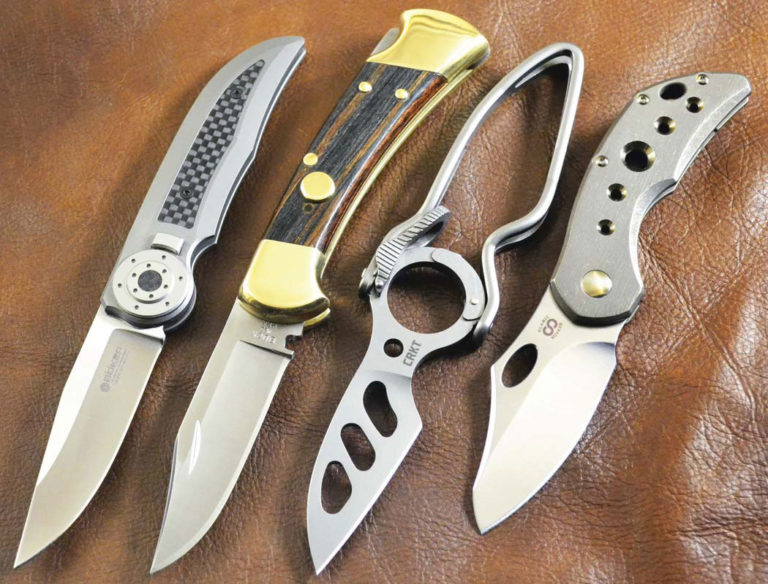
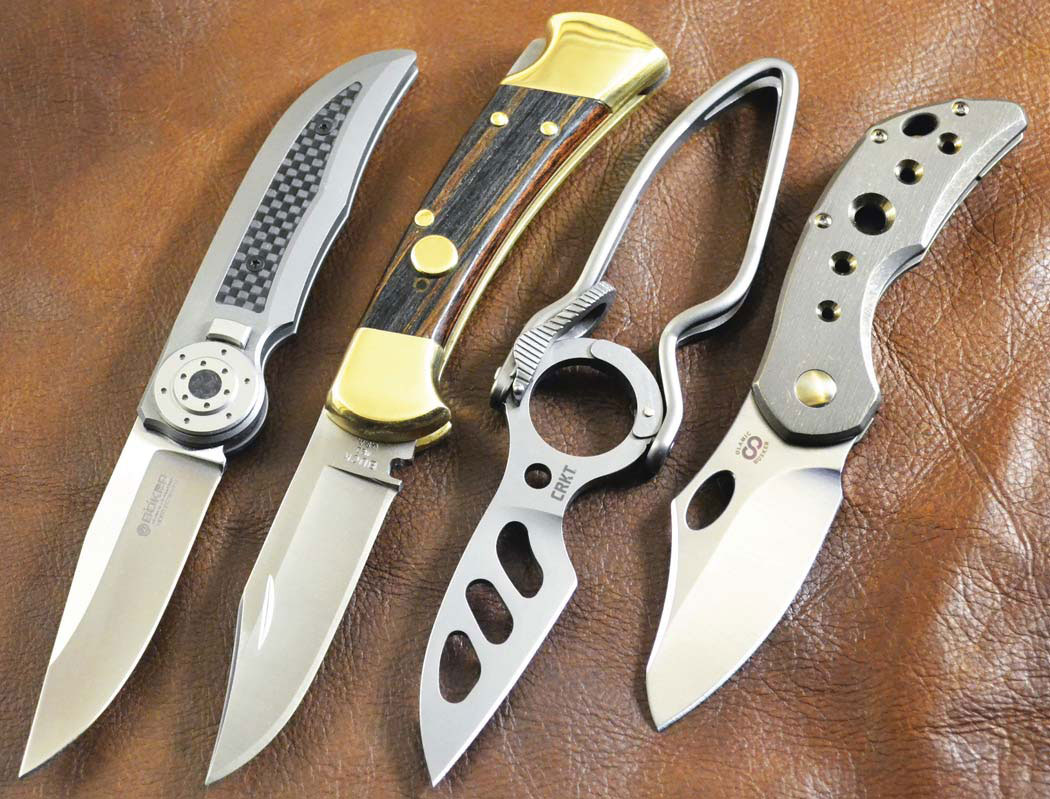
Here are four folding knives that employ unusual opening mechanisms.
“Cool Factor”
Some knives have a “cool factor” that makes your eyes pop out. Whether sporting creative designs, spine-tingling handles and blade shapes or—in this case—ingenious mechanisms, such knives always have that special something which sets them apart.
Cool can be anything from a notable mechanism to a standout design. From left: Boker Tucan, AIK Buck 112 Ranger Double-Action Auto, CRKT Daktyl and Olamic Busker Semper.
Boker Tucan
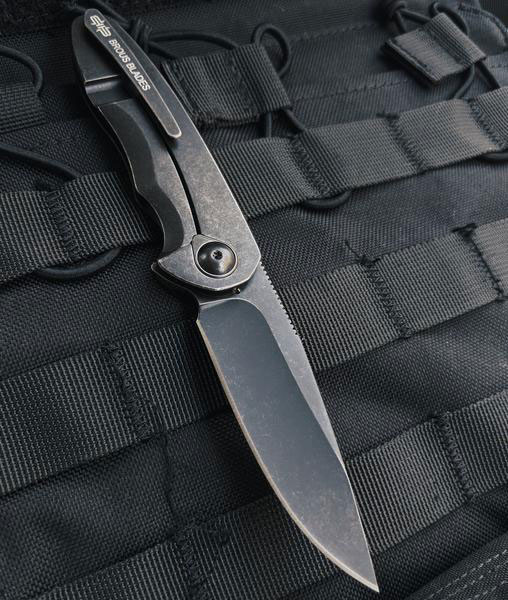
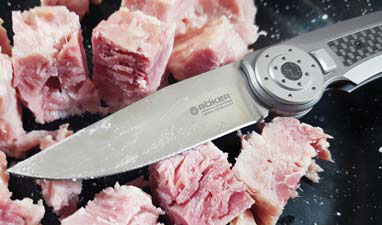
The Boker Tucan is a stately looking folder, but its 3-inch blade of Bohler N690 stainless steel is all business.
Boker’s sleek Tucan would be cool on its design alone, but designer Wilfried Gorski’s innovative blade-release mechanism puts the folder over the edge. A slide release just below the oversized pivot pops the blade out of the frame so it can be opened manually, and the release also serves to deploy the blade. Simply thumb it down and the blade is ready to fold into the frame.
Everything about the Tucan is upscale, from its stealthy 3-inch Bohler N690 stainless steel clip-point blade to its beautifully sculpted 3.875-inch titanium frame with carbon-fiber inlays.
There is no pocket clip but no matter—the Tucan is meant for loose pocket carry. At a weight of 2.82 ounces that is not a problem.
MSRP: $339.
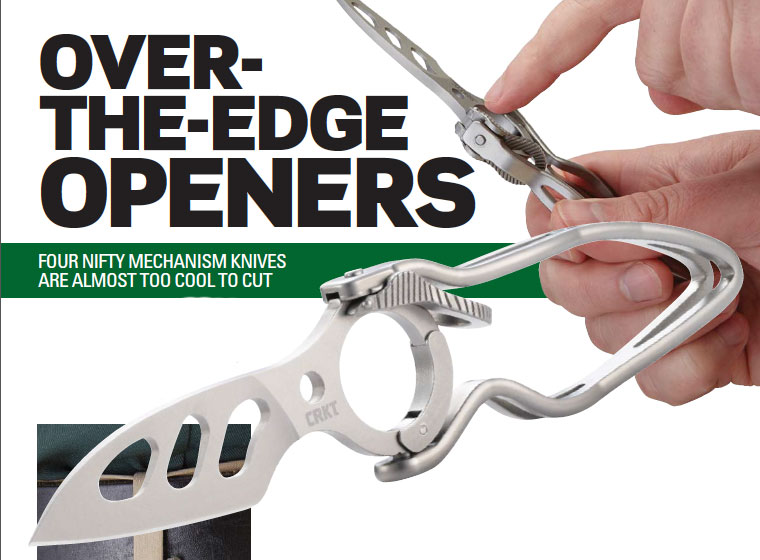
CRKT Daktyl
(CRKT image)
The CRKT Daktyl is a revised version of the Tom Hitchcock “Hole In One” design.
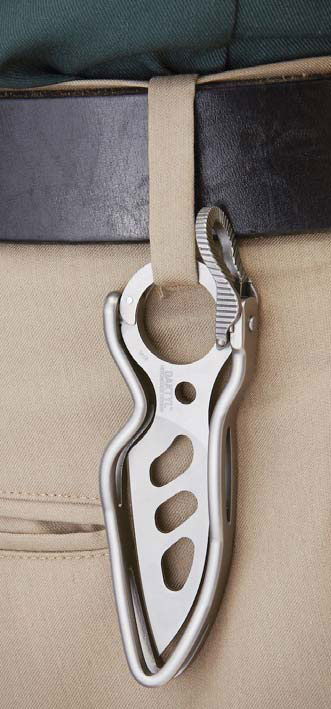
Every bit as enigmatic as the original, if not more, the Daktyl has a 3.05-inch 420J2 stainless steel blade that rotates out of a 4.42-inch wire-frame handle.
The fun begins trying to figure out how to release the blade via Hitchcock’s Slide Lock mechanism, which requires sliding and tipping back the thumb lever.
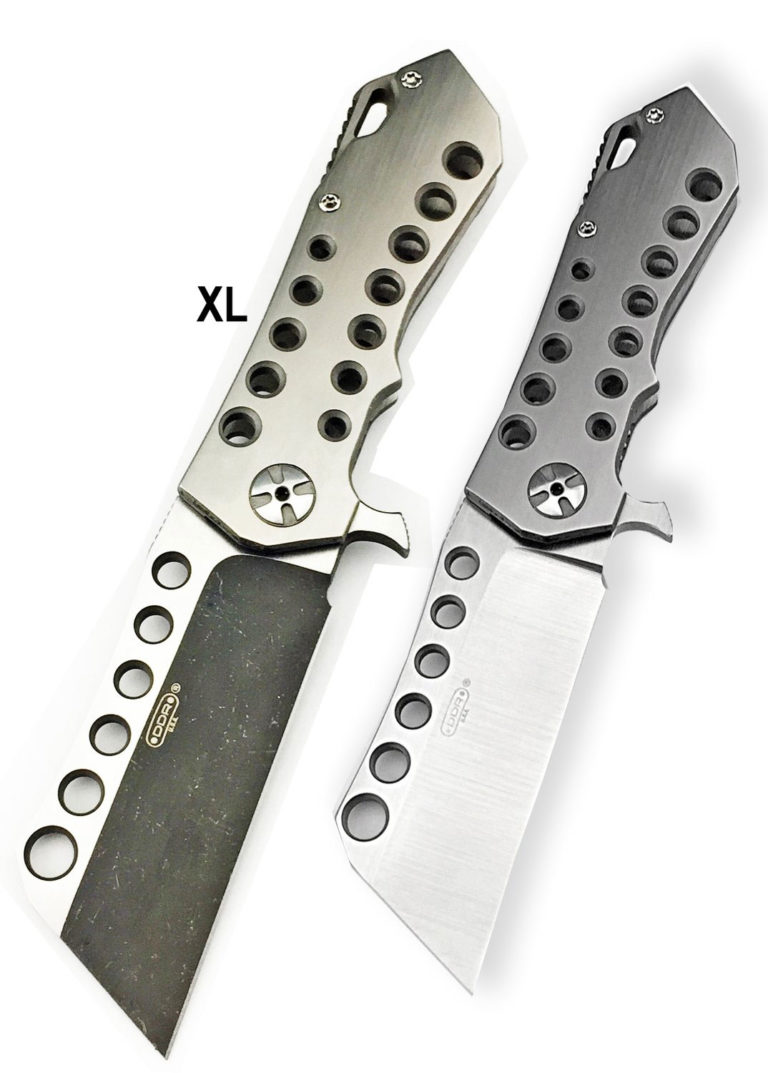
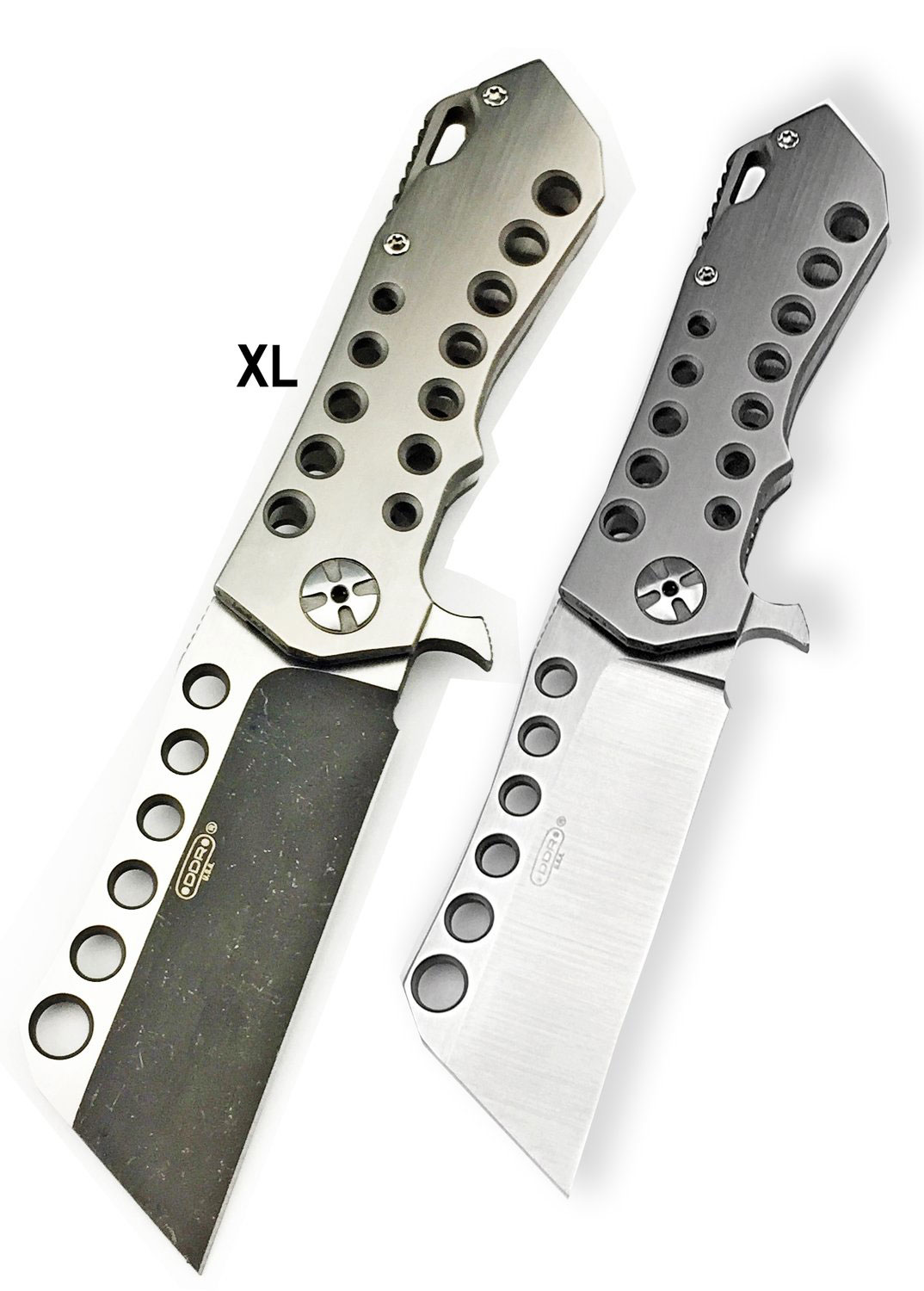
Once you get the hang of it the Daktyl is pure fun and will amaze your friends. The modified wharncliffe blade has cutouts for lightening and a round carabiner at the base allows you to clip it to a belt loop, keychain or pack and—get this—pop a beer cap.
The Daktyl has a pleasant beadblast finish overall and weighs in at 2.4 ounces.
MSRP: $59.99.
Buck 112 Ranger DA Auto (Adams International Knifeworks conversion)
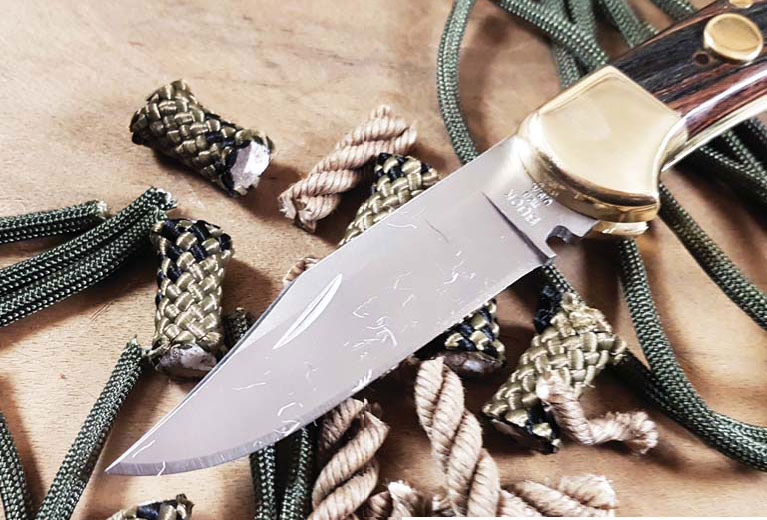
Adams International Knifeworks Buck Ranger 112 DA Auto has all the traits of the original. The 3-inch 420HC stainless steel blade whipped and sliced through paracord, 3/8-inch rappelling rope and tough waxed lasso rope with ease.
Unlike the new Buck 110 Auto, the AIK version of the smaller 112 Ranger differs in that it is a double action—opens both manually and automatically—and uses a leaf spring on the spine as opposed to a coil. The blade is employed via a flush brass button on the front, which matches the bolsters nicely.
Blade deployment is via the standard lockback on the rear base.
Everything else is Buck 112 Ranger, from the Dymondwood lockback grip to the 3-inch 420HC stainless steel clip-point blade and black leather belt sheath.
MSRP: $160.
Olamic Cutlery Busker Semper
Olamic Cutlery is known for making fashionable knives and the Busker Semper model, designed in-house, exudes coolness on every level. The folder sports curvaceous lines from stem to stern, including its ability to open 10 different ways (see above video), including a top-mounted flipper.
It is a small knife—6 inches open—featuring a 2.375-inch Bohler M390 modified wharncliffe blade and a 6Al4V titanium framelock handle. Other features include a machined pocket clip, caged bearing pivot system, stainless steel lockbar insert with an over-travel stop, ceramic detent ball, and ceramic pocket clip retention ball. In a nutshell, this is the good stuff!
The test model was delivered with a deep-brushed surface texture and gold anodized accents.
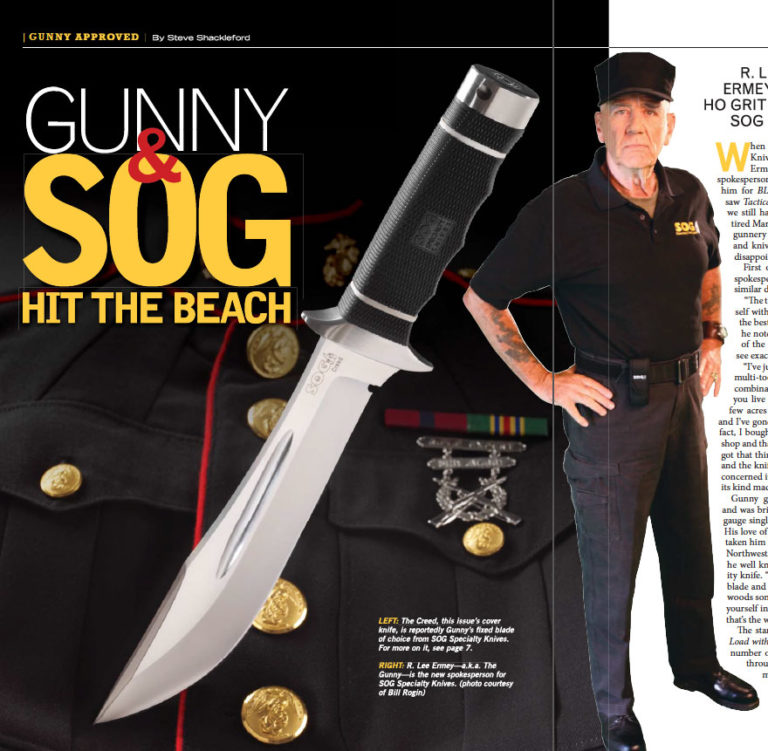
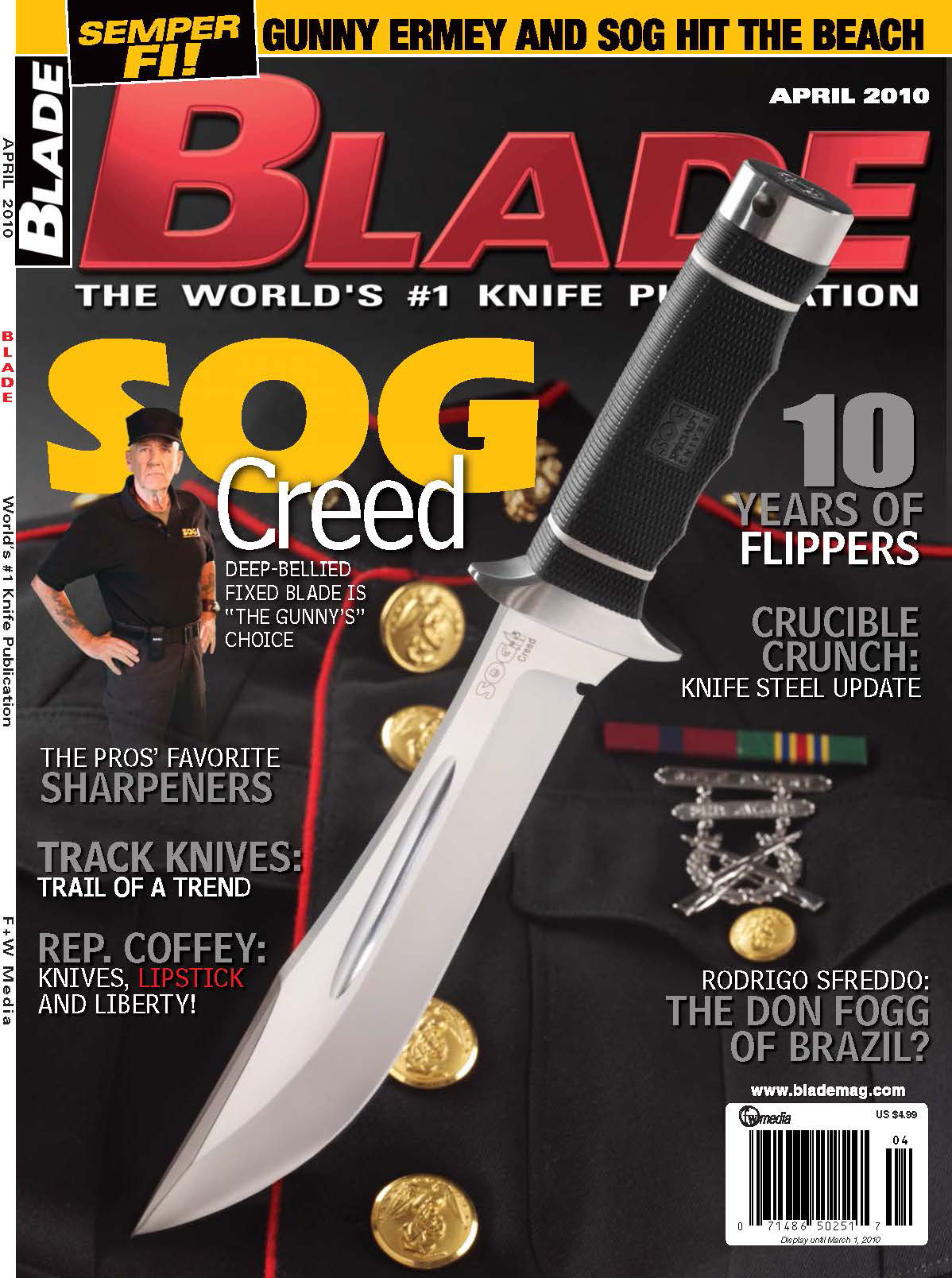
R. Lee “The Gunny” Ermey appeared on the cover of the April 2010 issue of BLADE.
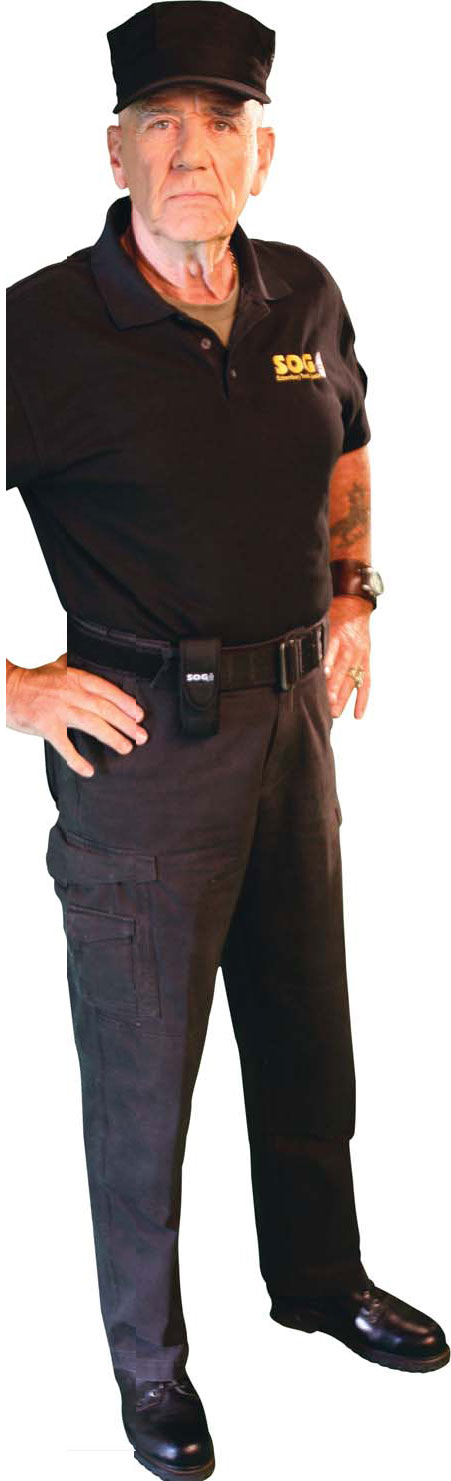
Editor’s note: The following article is from the April 2010 issue of BLADE. At the time, R. Lee “The Gunny” Ermey had signed on as a spokesperson for SOG Specialty Knives & Tools. Here he talks with Steve Shackleford about knives and his career in films.
Ermey, best known for his portrayal as Gunnery Sgt. Hartman in Full Metal Jacket, died April 15, 2018, at age 74.
The Gunny, the Knife Enthusiast
R. Lee “The Gunny” Ermey made frequent appearances at BLADE Show on behalf of knife companies.
Gunny comes by his love of knives honestly. He has over 100 custom and factory pieces in his collection, including his great grandfather’s pocketknife. First and foremost, though, he uses his knives.
“I’m a firm believer that the only thing a dull knife is good for is cutting yourself, because that’s exactly what you do with a dull knife,” he said. “I believe a man ought to be able to shave with that knife and after he shaves with it, he ought to be able to fold it up and then go chop a tree down.”
He also keeps up with the news and is outraged at the way knives are portrayed by the media.
“What really upsets me, I’ve seen this young Eagle Scout [Matthew Whalen],” Gunny began. “Because he had a knife, a little pocketknife in a survival kit in the trunk, they put him out of school. What the hell kind of a survival kit have you got without a knife? You’d be a dead man.
“When I grew up, I was probably 6 years old, I started carrying a pocketknife and I’ve carried one ever since. It’s a tool, you know. I grew up on a farm and I went to school and I can’t ever recall any kid pulling his pocketknife out at school and wanting to do harm to another kid. Times have changed. We need to start taking responsibility for our actions, we need to teach our children a bit of discipline.”
Gunny was just getting warmed up.
“My Swiss Army knife, what, they’re 2 inches long these little guys. I travel constantly, and I’ve had about 20 of those little knives taken away from me at the airport. I finally took one and just broke the knife blade off it and there’s still a big debate if I can go on board because there’s a scissors on it.
There’s a toothpick and a tweezers and I use those tools constantly. After a meal I have to use that toothpick. Society’s gone to the dogs as far as I’m concerned. They need to pull their heads out of their butts and realize that a Boy Scout carrying a pocketknife that’s got a spoon and a fork on it is just a tool, it’s not a weapon.”
A Standup Guy
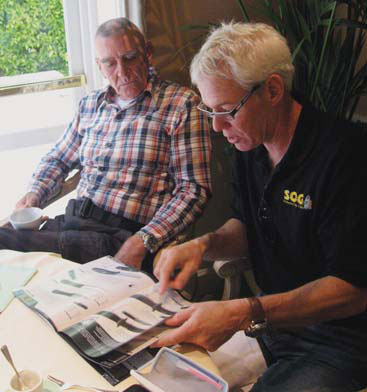
Spencer Frazer (right), SOG founder and president, and Gunny go over the company catalog. (photo courtesy of Bill Rogin)
Gunny enlisted in the Marines in 1961 and was medically retired as a staff sergeant in 1971 for injuries incurred during his tours, which included 14 months active duty in the Vietnam War, and, as you might guess, as a drill instructor (at the Marine Corps Recruit Depot in San Diego and Parris Island, South Carolina). In ’Nam he carried his issued Ka-Bar USMC fighting/utility knife, using it for everything from cutting threads off his uniform to opening “C” rations. He also carried a pocketknife and, of course, his trusty machete.
He said many of his fellow Marines bought their own fixed blades and folders in addition to the issue Ka-Bar.
Did he ever use a knife as a weapon over there?
“No. And I hope I never have to. I would just leave the area,” he laughed. “I would go get my gun. I don’t care for the up-close-and-personal stuff.”
Like most fresh out of the military, Gunny was unsure of what to do after his discharge, so it came as no surprise when he fell back on his Marine background.
“I didn’t have any formal training that would improve my lifestyle and I looked around and thought, what can I do, and I found out,” he recalled. “I was basically pretty much a standup comic when I was in the Marine Corps. I was an instructor, and in order to be a good instructor you have to be able to keep the troops awake. It’s almost like being a standup comic.
Gunny made a number of visits to the troops in Iraq and Afghanistan for the U.S. Navy Department of Morale and Welfare. Here he is with a group of Marines in front of Saddam Hussein’s palace in December 2008. (Rob Scott photo)
“So, when I retired, I wrote a couple of scripts and I went off to Hollywood. I did some of the comedy clubs and was pretty successful at it, and then I found out they were going to start shooting a Vietnam war movie in the Philippine Islands.”
Gunny boarded a military transport, flew to the Philippines where The Boys in Company “C” was being filmed in 1978, landed the part of a Marine drill instructor and his acting career had begun.
However, it was 1987’s Full Metal Jacket that, as Gunny put it, “kicked all the doors open.”
In it he established his onscreen persona as the gung-ho drill instructor, Gunnery Sgt. Hartman.
Not only did the role earn Gunny a nomination for a Golden Globe Award as Best Supporting Actor, it played a key part in his receiving an honorary promotion to gunnery sergeant from the Commandant of the Marine Corps. According to Wikipedia, it made Gunny the first retired military member in the history of the Corps to be promoted. Wikipedia, it seems, needs to check its sources.
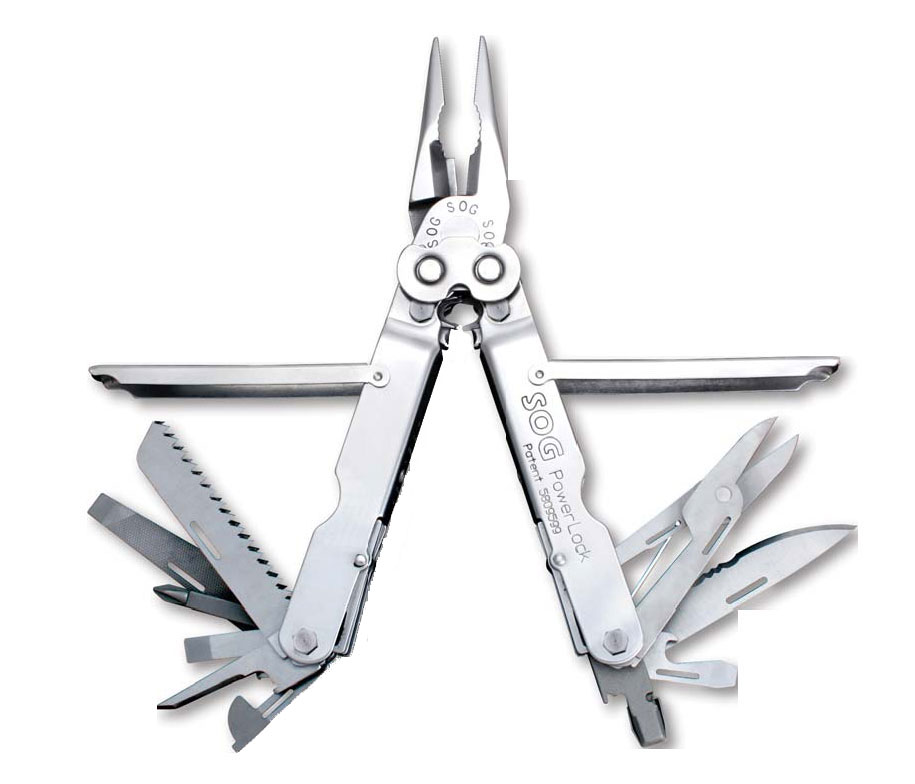
Gunny carries a SOG PowerLock multitool. It includes a pliers/gripper, hard wire cutter, crimper, double-toothed wood saw, a partially serrated blade, three-sided file and more.
“I’m not just the first but the only,” retired member in Corps history to be promoted, Gunny noted with pride.
He continues to be active in supporting young Marines, making morale-building visits to Iraq and Afghanistan when he can, as well as Guantanamo Bay and Okinawa, Japan. In between comes his acting and promotional work.
“I spend 90 percent of my time working with the military,” he said. “The other 10 percent I have to do shows and movies and whatever it takes because I have to support the 90 percent.”
The new SOG spokesman would seem to have his priorities in order. And, luckily for his new employer, SOG is one of them.
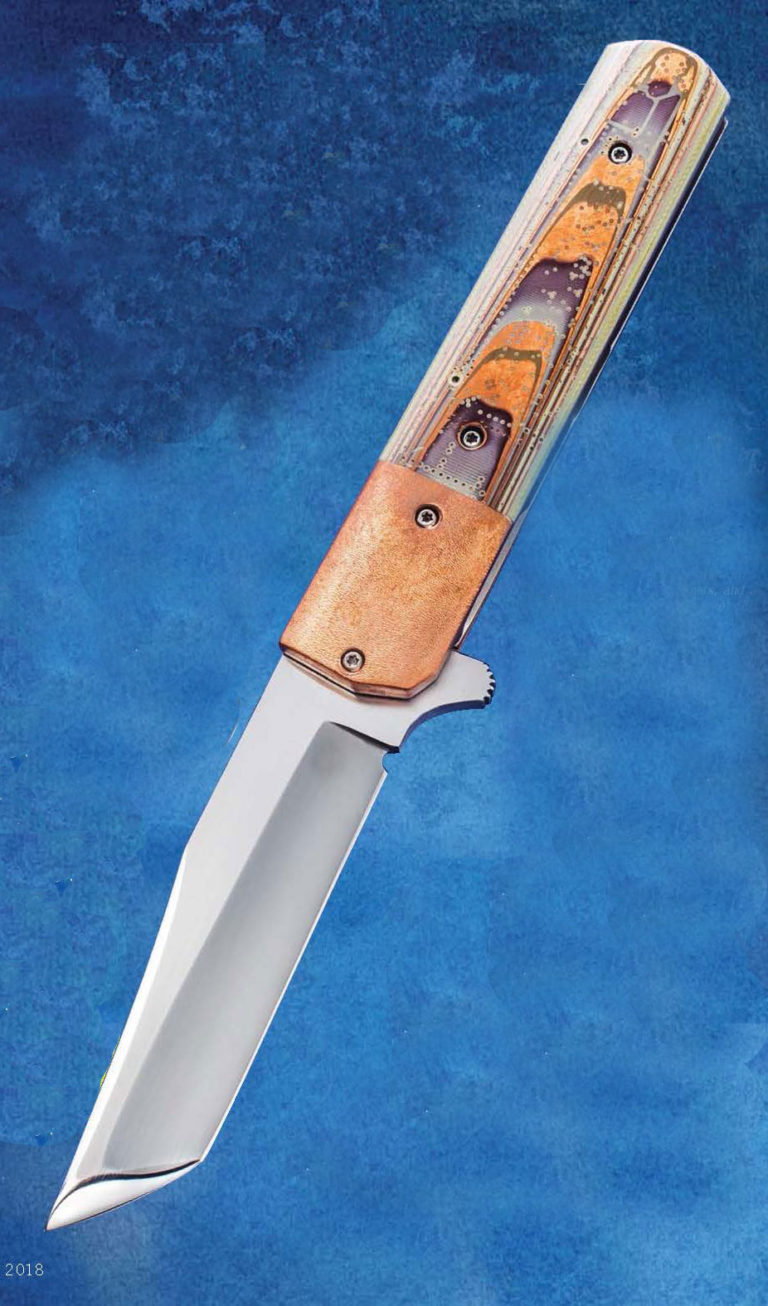
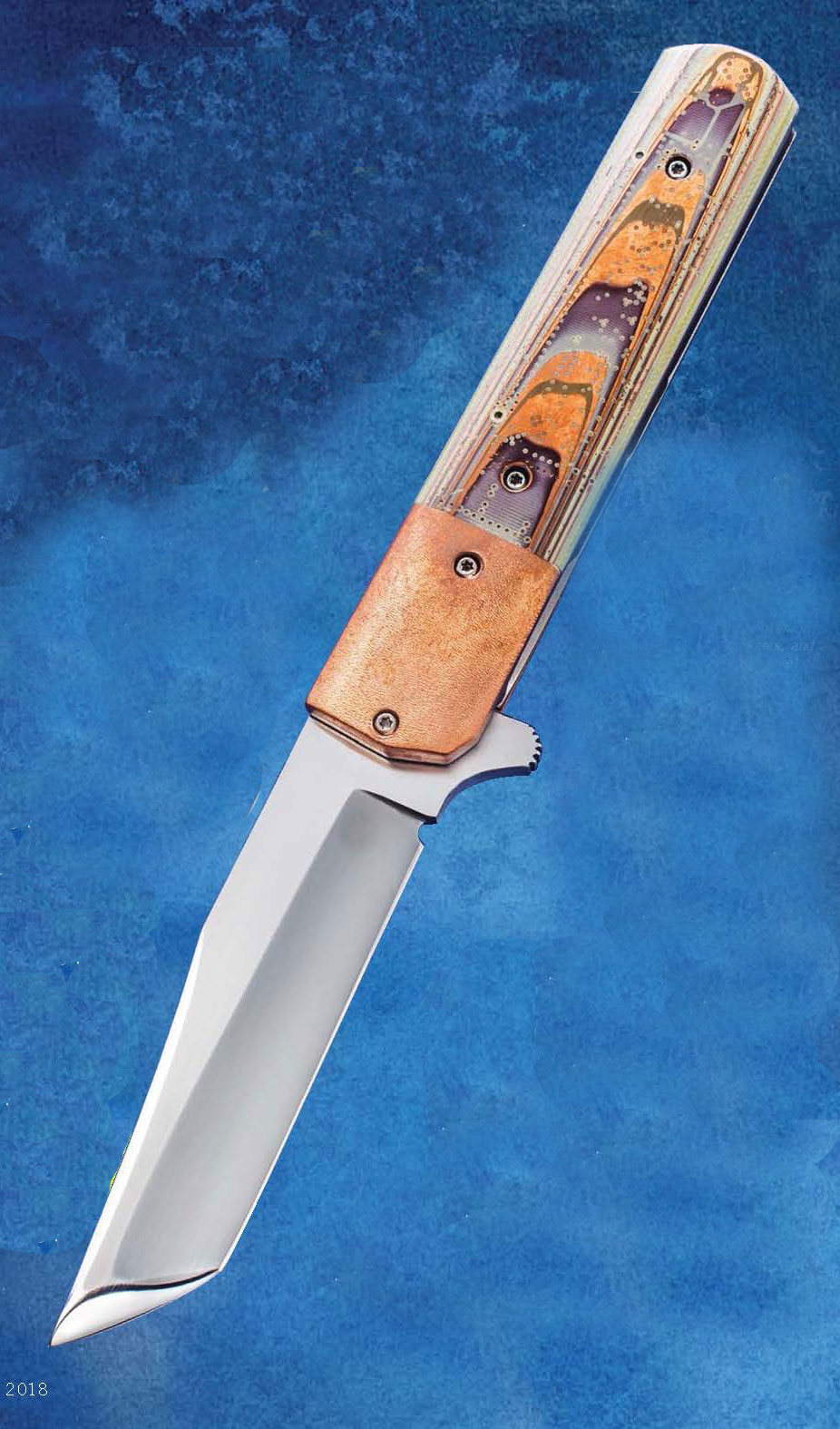
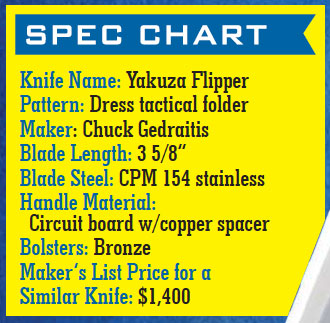
The Yakuza Flipper by Chuck Gedraitis includes a hand-rubbed blade finish, titanium frame and liners, and a Timascus™ pocket clip. Yakuza is a nickname for “transnational organized crime syndicates”—i.e., the mafia—in Japan. Click for larger view. (SharpByCoop knife image)
Chuck Gedraitis Flipper Meshes Modern Materials with Traditional Style
The Yakuza Flipper by Charles “Chuck” Gedraitis meshes classic styling with an unusual modern handle material in a folder that reflects both the traditional and the modern. The traditional is the Japanese-style instead of an American-style tanto blade.
“The American style would have more of a straight cutting tip,” Gedraitis noted. “This one has a little curve to it.”
The modern is the circuit board scales. Gedraitis highlights the copper of the circuit board with the bronze bolsters and a copper spacer, the latter two both in an orange-peel finish. He exposed the pattern of the circuit board by grinding into it, thus revealing the copper in the different layers of the scale material.
For more information contact Chuck Gedraitis, Dept. BL4, 444 Shrewsbury St., Holden, MA 01520 508-963-1861 [email protected], gedraitisknives.com, Facebook/Instagram: @gedraitisknives gedraitisknives.
Meet the Maker at BLADE Show
Balisongs are a Chuck Gedraitis specialty and he will show you how he designs and makes them in his special class “How To Make a Balisong” at 2 p.m. June 2 at BLADE University in the Cobb Galleria Centre in Atlanta.
Held in conjunction with the 37th Annual BLADE Show June 1-3, also at the Cobb Galleria, BLADE U. is the most comprehensive array of classes on knives and knifemaking of any knife show. Click here for more information.
Here’s a look at a movie knife classic, First Blood, and a movie that tried to rip off Rambo. Spoiler alert: ripping off Rambo is never a good idea.
Knife Use in First Blood: Rambo-esque, but Not Ridiculous
After I saw First Blood, the first Rambo movie, some buddies and I started to look at it with a critical, knife-centric eye.
Nothing that Rambo does in the movie is impossible. Some of the feats require a very well-trained man who’s in excellent physical condition, not to mention one who’s stubborn as hell. The feats also require a great deal of luck.
I’ve always been critical of fight sequences where the hero beats up 10-15 opponents all at one time. You can see the bad guys hanging back, each waiting his turn. That doesn’t happen in real life.
However, in First Blood, each person Rambo fights is physically isolated, so Rambo can take each one on one-on-one. It could work that way. The movie was very well thought out choreographically.
At one point Rambo leaps from a cliff and falls through a pine tree, breaking tree limbs on the way down, and survives. Tricky and tough—and yet possible. I once fell out of a pine tree, breaking pine limbs on the way down, and wasn’t hurt at all except for my 18-year-old ego. It was about a 20-foot drop, not anywhere near what Rambo fell, but long enough to convince me that it was possible to survive it.
Rambo’s use of the knife in First Blood is excellent. He knows what he’s doing. One of the first things he does is use the knife to make a spear, which is a good idea because a spear is a better hunting tool and a much better weapon than a knife. For one thing, a spear has reach and speed over a knife alone.
First Blood is an exciting movie. If you haven’t seen it, rent it. It’s worth it.
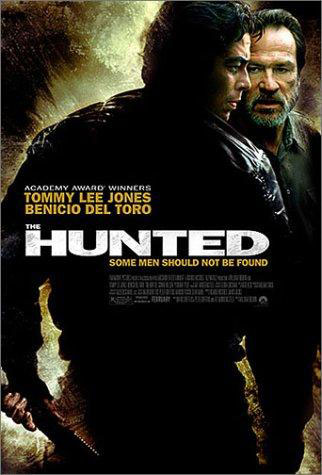
Knife Use in The Hunted: Ridiculous
Several of my friends saw The Hunted and told me that it was the MOAB (Mother Of All Bombs). However, having seen The Musketeer, I didn’t believe them. While The Hunted isn’t the MOAB, I would put it in the 2,000-pound category.
The Hunted isn’t a remake of First Blood but copies it—and does a lousy job at that.
The movie opens with a hellish scene in Kosovo, with Serbs killing Albanians right and left, especially women and children. I think the viewer is supposed to get the impression that all the Kosovo violence has driven the villain, Aaron Hallam— played by Benicio Del Toro—crazy.
I realized that I was in a fantasy movie very quickly. Tommy Lee Jones, who portrays L.T. Bonham, is running through a forest that’s deep in snow when he sees a wolf caught in a snare. He catches the injured animal, frees it from the snare and then dresses its paw. The animal doesn’t bite Bonham or, for that matter, make any threatening moves whatsoever. Heck, my wife rescued a four-week-old puppy a few months ago and was bitten!
(image via imdb.com)
The plot is that Hallam is a real killing machine whom Bonham has trained. The main action takes place in the dense rain forest of Oregon—sound familiar?—and starts with a scene of two deer hunters. The hunters are equipped with bolt-action rifles sporting monstrous telescopic sights. Stupid is such a harsh word, so let me just say that it makes no sense to use telescopic sights in underbrush so thick you can’t see 10 yards in front of you!
Anyway, Hallam threatens the hunters, telling them they have no reverence for life, and they have to match their guns against his knife. Needless to say, he kills the hunters, and subsequent photos show that he chopped them up like butchered deer. Meanwhile, it turns out that he also has killed a couple more hunters. Since the movie never offers any other reason for Hallam’s behavior, I guess he must have joined a radical arm of PETA (People for the Ethical Treatment of Animals).
Bonham is an amazing tracker and expert knife fighter who’s called in to capture the killer. He starts out after Hallam and, of course, doesn’t take a weapon. Hallam immediately finds Bonham, they have a brief fight and the chase begins.
I can’t begin to tell you how incredibly stupid this movie is. For one, in one scene a thrown knife goes all the way through a tree trunk that looks to be about 3 inches in diameter! Bonham knaps a flint blade to use as a weapon, never thinking to simply buy a knife instead.
One of the most startling scenes is when Hallam breaks off chunks of leaf spring. He starts a small fire and then forges a knife using the chunks of leaf spring for steel, and another chunk as a hammer. After he rough forges the blade, he hardens it and then files it! I have no idea where he gets the file, let alone how an open fire that size develops the heat necessary to forge steel.
In certain segments, The Hunted is a direct steal of First Blood, right down to Bonham repeating a quote from the Stallone movie about how many body bags will be filled in the quest to nab Hallam.
The knife fighting and the scenes showing the training aren’t so much stupid as just silly. Some guy stands still as someone pretends to cut his throat, chest, stomach, brachial artery, and then moves down to cut both femoral arteries! I mean, what’s the point? How many times does your opponent need to bleed out? It’s like blowing up a rabbit with a stick of dynamite—the furry little critter can only die so much!
The final fight sequence between the two principals is very poorly choreographed. It bears no resemblance to a real fight. For those who have read my reviews about movie knives before, you know that I feel a fight must follow the flow of the film. In other words, it need not necessarily be a “real” fight but one that must be consistent with the plot. In that respect, the final fight does follow the plot—both are total and complete nonsense.
Don’t waste your time or your money on The Hunted. This time I did the suffering for you.