Editor’s note: This article originally appeared in the July/August 1994 issue of BLADE magazine.
Knife History: George Washington’s Penknife
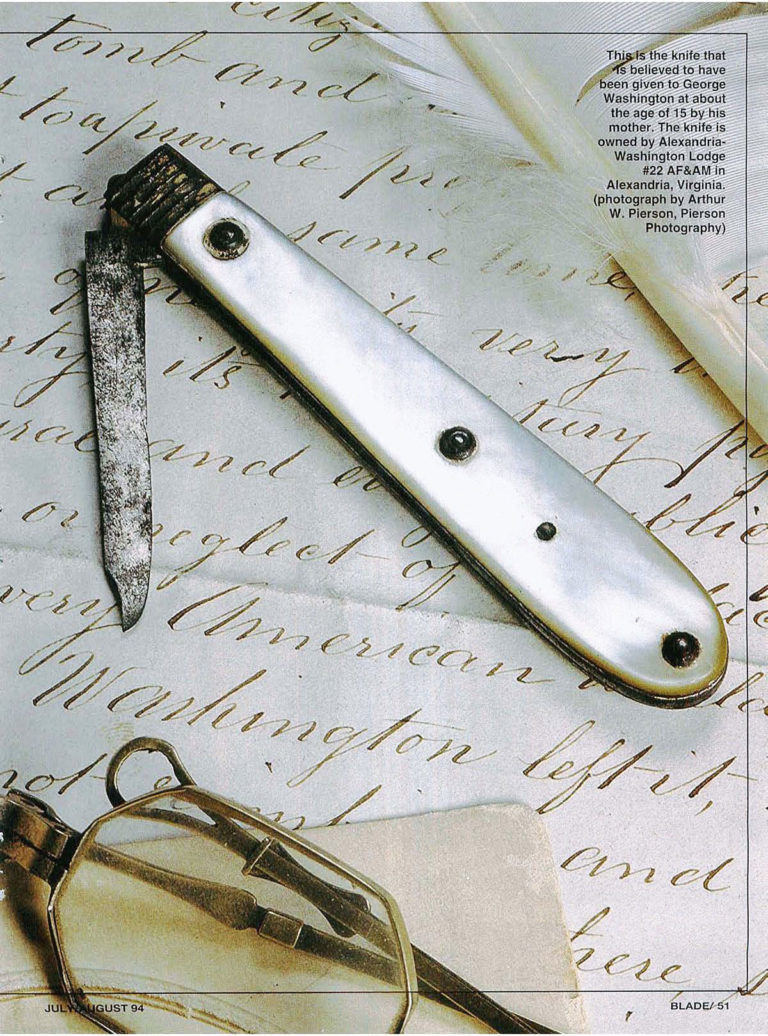
On display at the Alexandria Masonic Lodge in Alexandria, Virginia, is a simple penknife. Its closed length is 3 inches; its handle appears to be mother-of-pearl. the single blade is 1 3/4 inches long.
The claim to fame of this otherwise nondescript cutlery antique is that it was in the possession of George Washington for 56 years. More significant than the knife itself, however, is the story it inspired, a fascinating tale of devotion to duty and strength of character.
Gilbert Stuart Williamstown Portrait of George Washington.
Following the death of his father in 1743, a young George Washington, then only 11, went to live with his half-brother, Lawrence. While repairs were being done to the family estate at Mount Vernon, George stayed for a time at Belvoir, the home of William Fairfax, a close friend of the Washington family and also Lawrence’s father-in-law.
“William Fairfax became very fond of George and gave the young man access to his elaborate library,” explained Dr. Claude Harris, archivist of the Alexandria Washington Masonic Lodge, which is located in the George Washington Masonic National Memorial. “Through the influence of his brother and the Fairfax family. George obtained a commission as a midshipman in the [British navy].”
According to Jack Rudell, curator of the replica room of the George Washington Masonic National Memorial, Martha Ball Washington, George’s mother, corresponded with her brother, John Ball, who lived in England.
“John Ball said that the British navy was a floating hell,” commented Rudell. “So [Washington’s mother] was convinced not to let George go.”
Though the details had been worked out and all preparations made, young George respected his mother’s wishes, surrendered his commission and returned to the study of mathematics and surveying.
George’s mother ordered supplies from England annually, and in her next order was a request for one good penknife, which she intended to give to her son as a token of appreciation.
“This she presented to young George as a reward for his submission to her will with the injunction, ‘always obey your superiors,’” remarked Harris. “He carried the token with him through life as a reminder of his mother’s command.”
The Penknife Steps into History
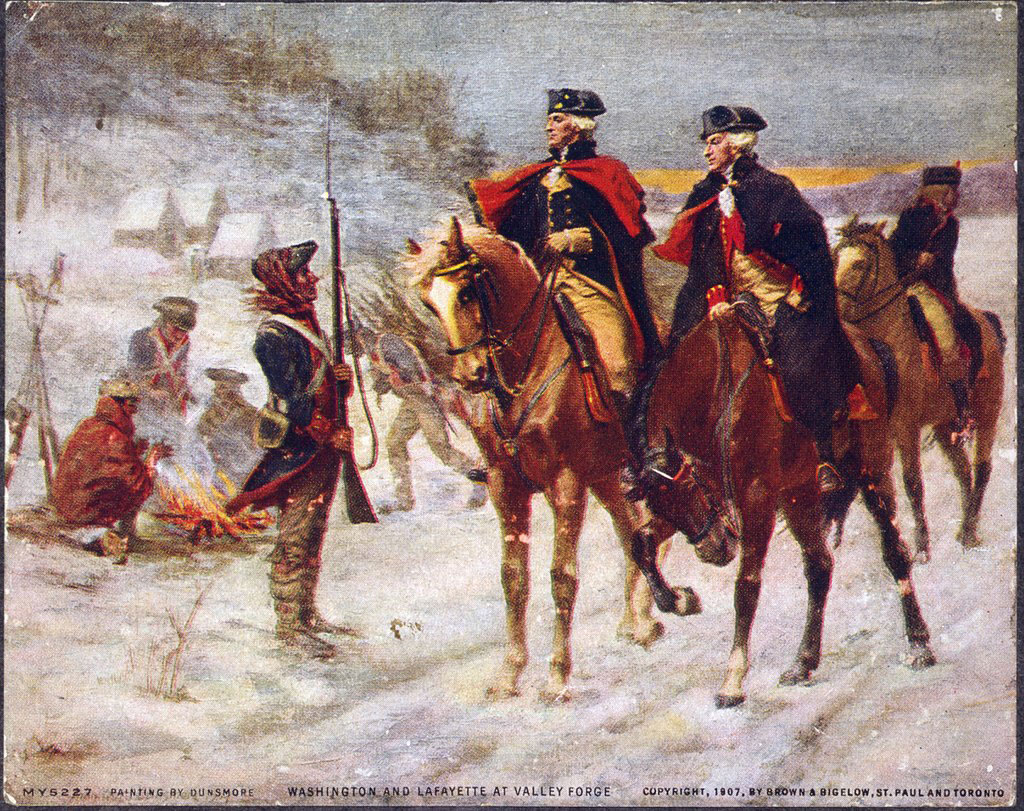
A painting of Gen. George Washington and Lafayette at Valley Forge. (John Ward Dunsmore)
Later, during the Revolutionary War, Washington supposedly recounted the knife’s history in a conversation with one of his most trusted subordinates, Gen. Henry Knox. It was Knox who would later play a key role in Washington’s military future.
As the commander-in-chief quietly deliberated over the situation that bleak winter at Valley Forge, it could scarcely have been more critical. His soldiers were fighting for their very lives against the mightiest military power in the world. If they failed, then along with them would perish an ideal.
“When a timid Congress failed to provide food for his starving and ragged army, in desperation yielding temporarily to his feelings, and in sympathy for his men and disgust with Congress, Washington wrote his resignation as commander-in-chief of the Continental Army and summoned his staff to notify them of his actions,” remarked Harris. “Among the officers present and sitting in the council was Knox, who reminded him of the knife and his mother’s injunction ‘always obey your superiors. You were commanded to lead this army and no one has ordered you to cease leading it.’”
Washington paused and said, “There is something to that. I will think it over.”
Half and hour later he had torn up his resignation, determined to fight to the end. Thus, a penknife may have meant the different between life and death for the USA.
As True as the Cherry Tree Story?
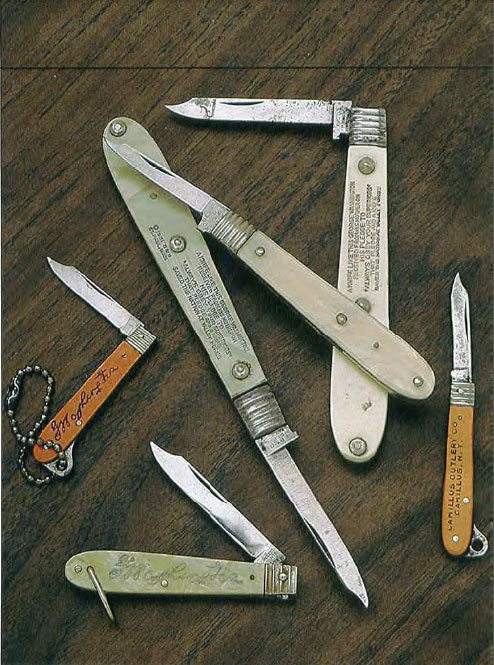
According to “The ABCA Price Guide to Antique Knives,” by J. Bruce Voyles, several reproductions of Washington’s penknife were made in 1932. On the handle of the larger size is the injunction given Washington by his mother; on the scales of the smaller size is Washington’s signature. Clockwise from bottom left are repros by Camillus; unknown; B&B of St. Paul, Minnesota; Robeson; Remington; and Camillus.
Whether events actually transpired as recorded is as much a matter of opinion as appraisal of fact, but indeed the story of the knife should rank in American folklore with that of the cherry tree and the famous phrase, “I cannot tell a lie.”
Love History and Knives?
Load up on more stories like this one with BLADE‘s collection of back issues. One download gets you 25 years of magazines, all conveniently presented in PDF format.
HBO’s Vice News Covers New York Gravity Knife Laws
If there’s one issue in the world of knife laws that transcends the knife community, it’s the way New York handles illegal “gravity knives.”
The state’s generous definition of what qualifies as a gravity knife lands thousands of New Yorkers in hot water each year. Were they in the act of committing a crime, that’d be one thing. However, those most affected by these laws are people who use knives for work, like construction workers and chefs.
In New York City, that is especially true for people of color, as documented here. One minute they’re trying to do their jobs, the next minute they’re looking at felony charges.
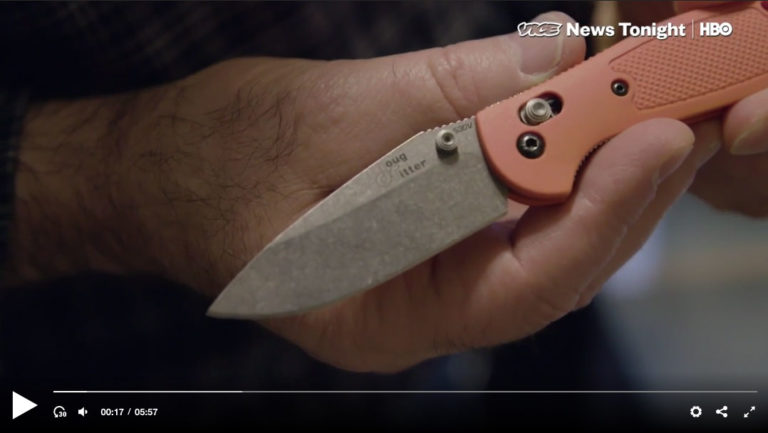
It’s outrageous, and it caught the attention of Vice News. The producers tapped Doug Ritter of Knife Rights for putting this into context. Ritter does a great job explaining the situation. Here’s the clip:
“Many home cooks stand side-on to a chopping board,” when they should “stand front on, with a good stance,” about five centimetres from the chopping board, Gonsalves says.
The article also features another good tip: forget about how much a knife costs. What’s important is the feel. An inexpensive yet comfortable knife is better than an awkward high-end blade.
Yes, You Can Survive a Stab in the Back (Warning: Graphic Images)
A man in Brazil stabbed in the back with a kitchen knife survived long enough to make it to the hospital for treatment, as the Daily Mail reported. Not only that, he walked around with the handle sticking out of him for some time, acting cool and calm despite the gruesome injury.
BLADE won’t post images here, but you can see more in the article if you’re morbidly curious.
Thankfully, the knife was removed and the man survived. Your lunch, on the other hand, may not.
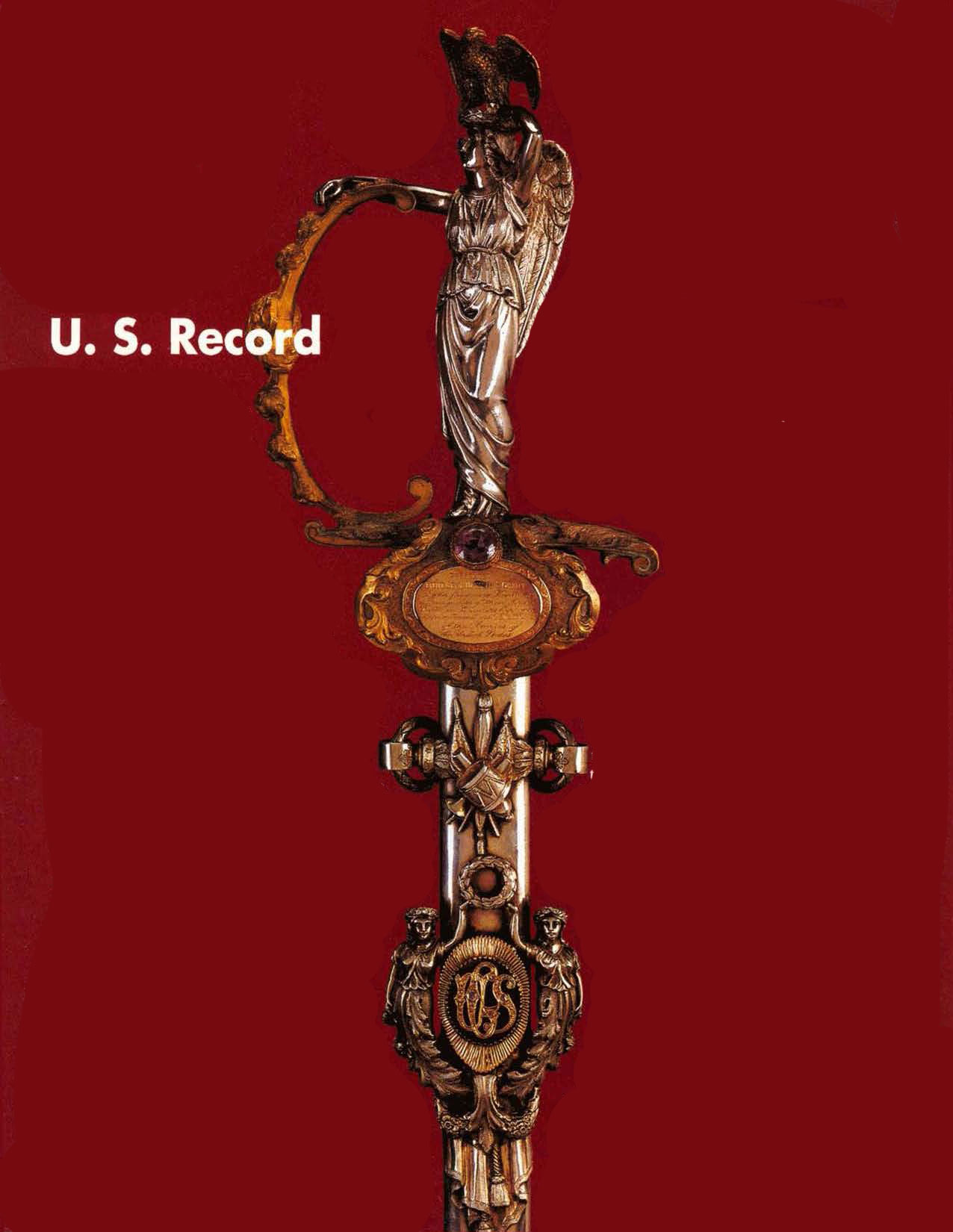
The Grant presentation sword sold of $330,000 at auction. It was originally presented to the Union general when he took command of the Federal Army in 1864. (Butterfield image)
Editor’s note: The following appeared in the July/August 1990 edition of BLADE magazine. Note that the record-setting price is now outdated. Read more from the archives with this collection.
The value of a sword owned by a United States president depends first on whether the item’s provenance can be confirmed. Popularity of the president can also play a role. The more popular, or at least well known, the president, the higher the price. The significance of the sword in history matters as well. The materials used in the sword can be important, but context matters most.
Here’s one example.
Ulysses S. Grant’s Sword Sells for $330,000
A jeweled sword originally presented to Gen. Ulysses S. Grant recently set a world record for auctioned American swords when it sold for $330,000 at the San Francisco gallery of Butterfield & Butterfield Auctioneers and Appraisers.
As much as the sword fetched, however, the dollar amount does not approach the world auction record for all swords of $51.2 million for a sword that belonged to the Duke of Windsor, according to Greg Martin, one of the organizers of the San Francisco event.
Part of a Larger Antique Sword Auction
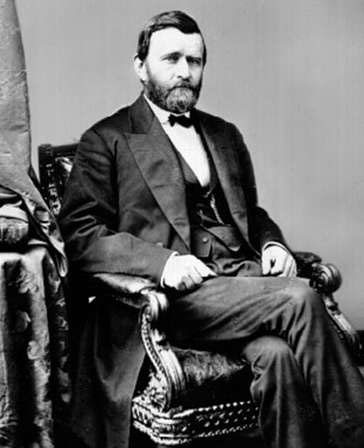
Ulysses S. Grant served as the 18th president of the United States. (public domain image)
The Grant piece was but one of 210 swords – which Martin said may be a record for the number of swords bought at one auction – sold in San Francisco. All told the sale brought about $900,000 in bids and included pieces from the Revolutionary War period up to the turn of the century.
“It was a historic sale because it involved three sword collections in one,” Martin explained. Those collections included 30 pieces that one belonged to Jay Altmayer of Mobile, Alabama, presentation pieces every one, including the Grant sword; 70 eagle head swords from the collection of E. Andrew Mowbray, who has written a book on eagle head swords; and 110 swords – including a sword presented to Col. Charles C. De Rudio of Gen. George Armstrong Custer’s 7th Cavalry that sold for $42,500 (plus 10 percent) at auction – from the collection of Peter Buxtun, a sword-collecting veteran of 30 years.
Origins of Grant Sword
But it is the Grant sword that grabbed the headlines. The sword’s ornate silver handle is fashioned in the shape of the winged Goddess of Victory, a laurel chaplet held in place by her left hand, over her head a spread American eagle. Medallion-like counter guards form at the goddess’ feet, where a gold-mounted amethyst sets atop a gold plaque that reads: “Presented to Lieut. General Ulysses S. Grant by his Friends in Kentucky in Recognition of their great Faith in Leadership and Appointment as General in Chief of the Armies of the United States.”
Made by Canfield & Co. of Baltimore, the piece’s hilt and scabbard are in excellent condition, while the blade has some small pitted areas and overall light rust. According to the auction program, the inscription on the presentation plaque was possible freshened at one time.
The Civil War and Grant’s Sword
Learn more about knife history in this collection of BLADE back issues, dating back to 1973.
Grant’s Kentucky connection is significant. Educated in Maysville and having relatives that settled in the Bluegrass State, Grant was determined to keep Kentucky in the Union. On Sept. 5, 1861, he learned of a Confederate plan to invade Paducah, Kentucky, located at the juncture of the Tennessee and Ohio rivers near the mouth of the Cumberland River.
That evening, he assembled an expedition that landed federal troops the next day at Paducah before the Rebel invasion. On Sept. 7, the Kentucky Legislature voted to keep the state in the Union. Grant had prevented the South from claiming Kentucky and establishing the Confederate northern border on the Ohio River. It was his first major victory.
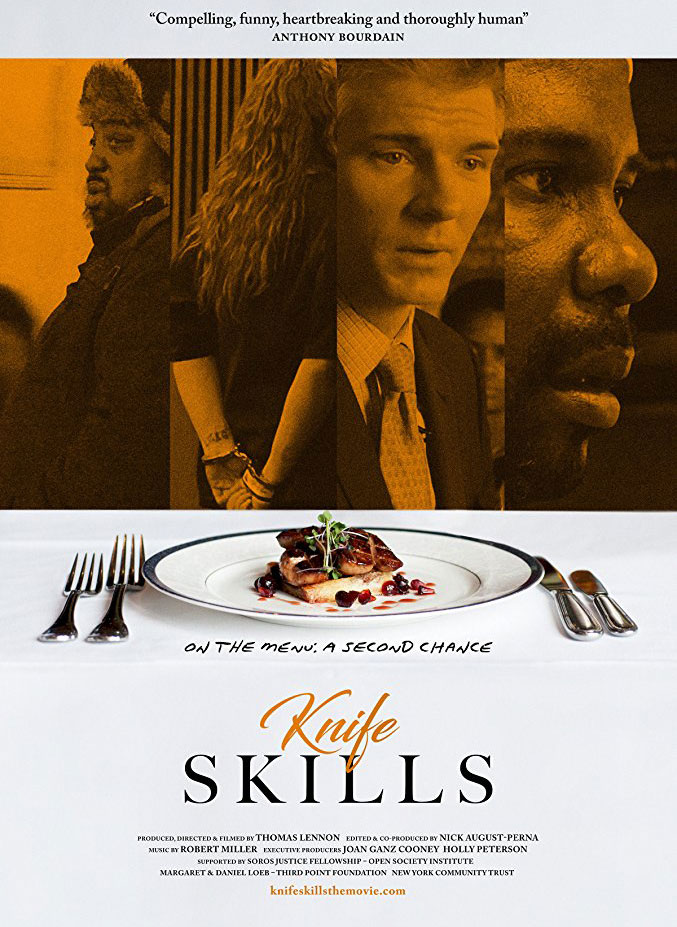
On the knife front, the larger point to be made is about the intentions behind the use of a knife. Here is a group of people with serious criminal records. In another context, that could be dicey, but here it isn’t. It takes the air out of arguments for regulating knives according to specs.
Knife Skills also shows how knives can create collaborative spaces for the sake of art, business or leisure. Can a restaurant function without knives? Why do the best chefs on Earth also seek the best knives? You can’t separate food and people so long as there is a tool with a cutting edge, and that means knives. The relationship is so essential that even convicts can be trusted to preserve it.
The documentary caught the attention of more than just BLADE, too. It received a 2018 Oscar nomination. We’ll see if a knife movie brings home the big award on March 4, when the awards ceremony takes place.
Knife Skills didn’t hit theaters in a wide release, but you can stream it on Amazon Prime for a couple bucks.
Heads up: The trailer above contains some coarse language.
Happy 30th Birthday, Outdoor Edge
Denver-based Outdoor Edge turned 30 years old last month, which means it’s still clinging to the spirit of its 20s but contemplating middle age while holding down a mortgage and a couple kids. (In lieu of a birthday card, BLADE respectfully submits that joke.)
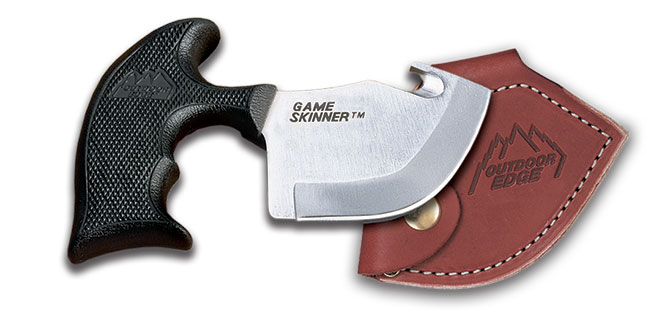
Outdoor Edge won a BLADE Magazine Knife Of The Year® in its debut year at the 1988 BLADE Show in Knoxville, Tennessee, with the Game Skinner. As BLADE‘s Steve Shackleford points out, that went on to be one of the most knocked off knives ever. No good deed goes unpunished, I guess.
Outdoor Edge exploded onto the scene with the Game Skinner. (Outdoor Edge image)
Less copied is the way Outdoor Edge got its start, simply because it’s so challenging to build a knife company from the ground up. From its news release:
From its humble beginnings as a one-man show with four prototype samples, [David] Bloch’s company, Outdoor Edge, has grown significantly in the past thirty years. Currently, the company has 24 employees and offers more than 120 products. Originally based in Boulder, Colorado, the company moved to a larger facility in Denver in 2010.
BLADE wishes Outdoors Edge 30 more great years of success!
Choose a few high-quality knives instead of a knife block set, as sets tend to have a lot of filler knives that you don’t need. Wirecutter suggests three different knives for the average cook: chef’s knife, paring knife and serrated knife.
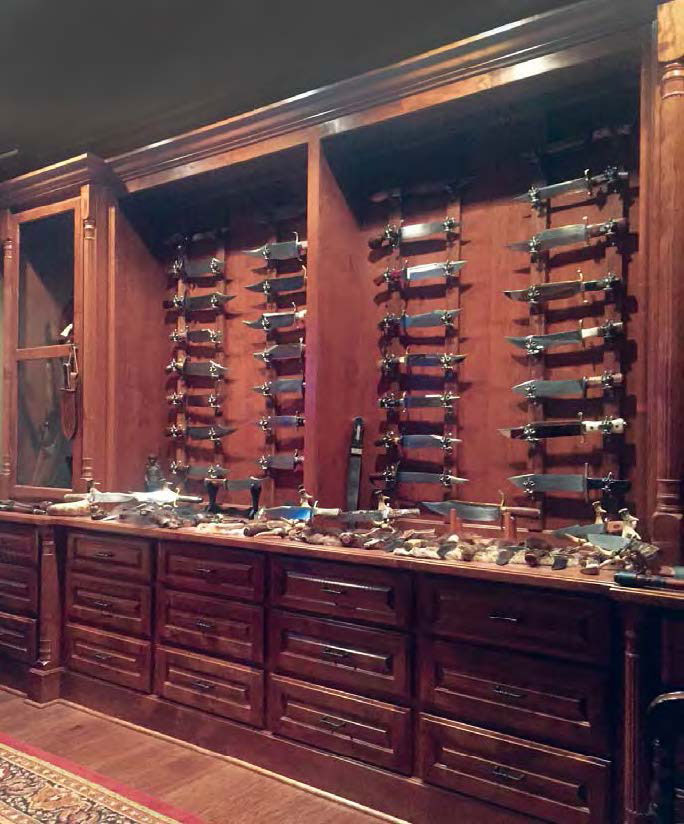
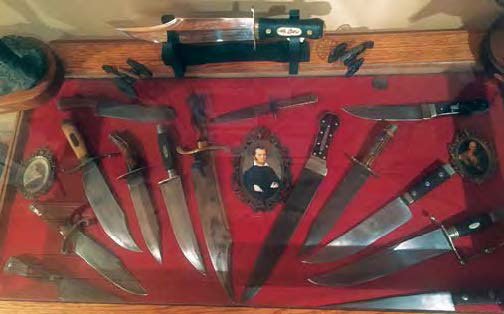
Chris Nolen’s collection of custom repros of antique bowies tops 200. Here are some of them in his 7×14-foot display vault made of alderwood, including 18 drawers full of bowies at the bottom. (All images by Chris Nolen unless otherwise noted)
Editor’s note: This article originally appeared in the February 2018 edition of BLADE.Download the issue here.
A Bowie Knife Collecting Obsession
The trail of the fabled bowie knife is long and winding. From the Sandbar Fight to the Alamo and beyond, its fact, mystery and myth have become the stuff of legend. The trail extends nearly 200 years, and for half his life Chris Nolen of West Monroe, Louisiana, has traveled down it.
For sure, he’s gone further than most.
At 65, Chris remains heavily engaged in a custom embroidery and screen print business called Reflections with his daughter, Lori Rockett, while another daughter, Lindsey Sanders, lives in Chattanooga, Tennessee. A retired telecommunications worker, he has sought and bought knives since his days mowing lawns for money so that he could run to the local hardware store and buy the knives that caught his eye.
“My mother still kids me about not having any money in those days because I was always buying knives,” he smiled.
A close-up of Nolen’s display is a bowie buff’s delight.
Cutlery Hall-Of-Famer Jim Bowie’s legendary encounter at the sandbar, his final hours at the Alamo, the association of numerous knives that bear his name with the history of Texas, its link to the Civil War, and its stretch across the Atlantic to beginnings in the cradle of quality knifemaking—Sheffield, England—made the bowie irresistible.
“It seems like every time I went to a show I was attracted to the big bowie knives,” he recalled. “Sometimes, you might say, ‘What are these good for?’ but I saw them as art in steel.”
Today, the Nolen collection of bowies tops 200, and a fortress-like display room keeps them safe and allows their owner to show them to visitors. One of Chris’s primary pursuits has been the history of the bowie along with a desire to own reproductions of some of the most significant bowies in history. He has worked with several top-notch custom knifemakers, pored over documents and traveled to various locations, the results of which are nothing short of spectacular.
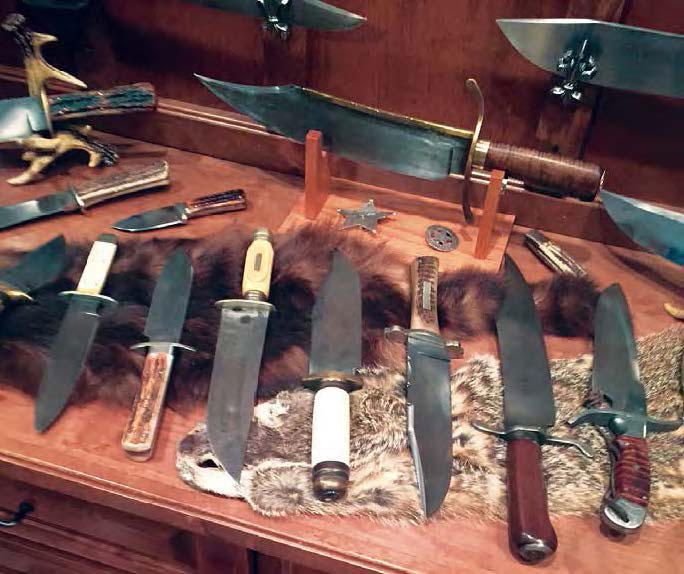
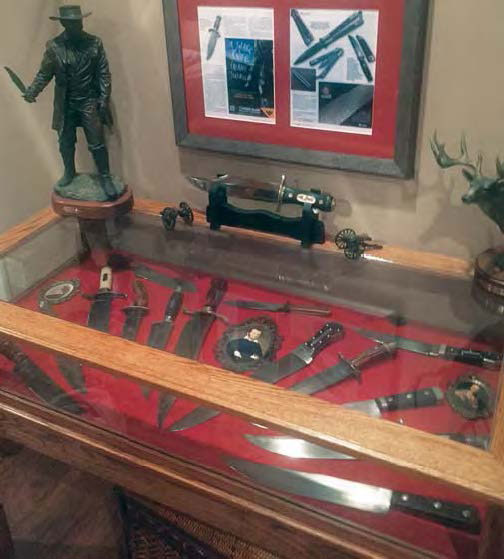
A look at a different angle down into “The Bowie Knife: Fact-Myth-Legend” display reveals custom repros of classic antique bowies. From lower left to right: Jesse Clift Knife; Bart Moore Bowie; Noah Smithwick Bowie; Huber Steel Bowie; Searles-Fowler Bowie; Musso Bowie; Bowie No. 1; Berrera-Campbell Bowie; Schively-Perkins Bowie; Juan Seguin Bowie; and Edwin Forrest Bowie. Across the top, from left: Caiaphas Ham Knife, Madame Candelaria Knife and James Black Knife. At top: the Iron Mistress.
Among his bowies are repros of the Searles-Fowler bowie (the original of which is on display in the Alamo), the Joe Musso brass-back bowie, the Iron Mistress, the Jesse Clift bowie, the Juan Seguin Bowie and Bowie No. 1, to name a few.
“No Turning Back”
In 1986, Chris contacted knifemaker Jerry Berry of Natchitoches, Louisiana, after sketching a bowie. He asked if Berry could actually make the knife from the drawings. Of course, the answer was yes.
“That knife has a 9.5-inch blade with a slight recurve,” Nolen said, “with brass and nickel-silver trim and a solid stag handle with a hidden tang. The blade is ATS-34 stainless steel. That is one of my favorites because it was one of the first. Once I got it there was no turning back, and for the last 30 years I have pretty much stuck with the big bowies. Robert Blasingame of Kilgore, Texas, helped me get started on the making of copies of antique knives before he passed away in 2010. He was quite a historian.
Bringing Bowie Knife History to Life
“It was about 10 years ago that I got this wild idea to track back the bowie and its origin,” Chris continued, “and Linda and I visited 12 museums and met curators, who were all such nice people who even let us hold some of the original knives that were associated with the Bowie family.
“For example, we went to the Alamo and actually got the dimensions of the original Searles-Fowler knife. Now, we’ve researched and had reproductions made of pretty much every knife associated with the Bowie family.”
Nolen’s “The Bowie Knife: Fact-Myth-Legend” glass display with a statue of Jim Bowie atop it at left. The framed magazine pages on the wall are from a story that included Nolen as a source in a past issue of BLADE®.
Through the years Chris has developed a reputation as something of an expert on bowie knives, resulting in his traveling exhibit aptly named, “Bowie Knife: Fact, Myth, and Legend.” In 2014, he traveled to the Historic Arkansas Museum in Little Rock, where more than 200 genuine bowies were on display.
“They had my reproductions at the entrance there in a big black case,” he remembered. “There is probably more legend than anything surrounding these knives. Jim Bowie didn’t leave us much to go on, and I have studied him for years now. His brother, Rezin, was a big promoter of the bowie knife and gave a lot of them away as gifts. These reproduction knives have been everywhere, and I get a kick out of it.”
Along with the history lesson that the bowie repros convey, visitors can begin to grasp the tremendous skill that is required to produce a high quality bowie.
“It’s hard for a maker in today’s time to get into the head of a maker from 180 or 200 years ago,” Chris offered, “and most of them want to put their own artistic spin on a knife. But along with Jerry Berry, I narrowed it down to Rich McDonald and Mark Banfield who do a lot of work for me, and Cowboy Bob Giles of Whitefish, Montana, who has probably made 15 of them for me. These men are unbelievable artists.”
Musso and Musician Phil Collins
The Joe Musso Bowie repro by Mark Banfield with the brass back and “S” guard on the stand serves as a centerpiece for one section of Nolen’s display.
Mention of the Musso Bowie conjures some of the theory and conjecture surrounding its authenticity.
According to Chris, Joe Musso sold the original knife to Phil Collins of the rock music group, Genesis, who in turn donated the original to the Alamo, where some metallurgical testing has been done and some believe the “JB” mark on the guard ties the knife to Jim Bowie.
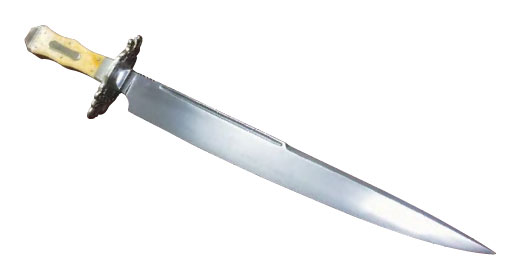
“That is one of my favorite reproductions because Mark [Banfield] went the extra mile and even copied the stains on the blade,” Chris commented, “and it is the only authorized true copy of the Musso knife. I have some Samuel Bell copies and one of my favorites was just done by Giles. It is an exact copy of the Charles Congreve knife done in Sheffield around 1835, a big swayback bowie trimmed in silver.”
Among others, Nolen is a big fan of 19th-century bowie maker Samuel Bell. Mark Banfield reproduced this Bell bowie.
A “Dazzling Display” of Bowie Knives
A couple of years ago Chris and Linda decided to build their dream house on a tract of land they had owned for a while. The move brought to light several knives that had been packed away for 20 years or so. Thinking about the future of his collection, Chris decided to make space available to display it properly.
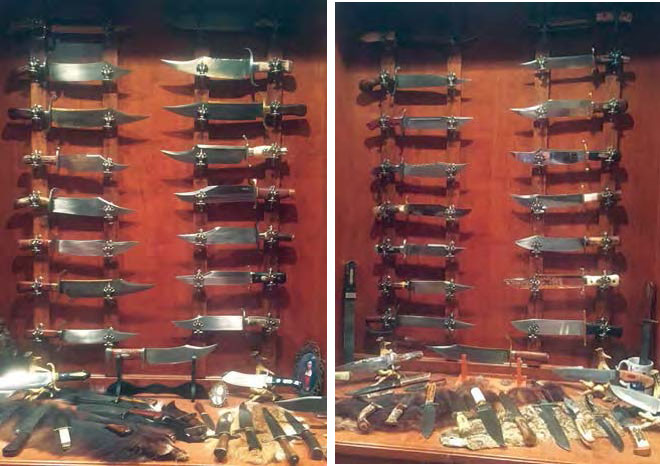
“I always wanted to have a secured room to display the knives in,” he remarked, “so we designed this room 20 by 18 with no windows, solid brick, and with concrete next to the brick. It would take a tank to get into this thing. There is also a solid steel security door, so it is pretty much a vault. Lori’s husband, Marc, owns a custom cabinet shop. He cuts wood with a laser, and he cut out an entire wall and put in a cabinet for guns to go on each end and 18 drawers at the bottom. You can pull out the knife displays. There are two center panels, and the display is 14 feet wide and 7 feet tall. The center panels have 32 pewter hangers in a fleur-de-lis design that hold 32 bowie knives. At the bottom is a 3-foot shelf that holds about 40 bowies.
“It isn’t everywhere that you can see 70 or 80 bowie knives in the open,” Chris added. “People come in and they have to catch their breath. I also have a coffee table with a glass-top display that holds about 20 knives and is kind of my dedication to Davy Crockett. The other side of the room is a glass display of the ‘Fact, Myth, and Legend.’ The cabinetry is all of alderwood.”
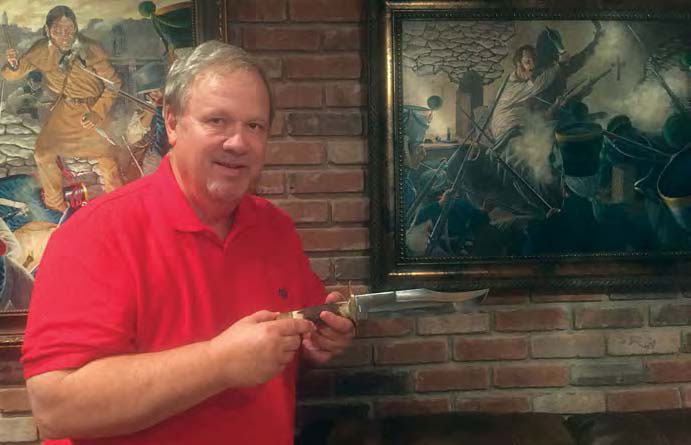
To complete the dazzling display, Nolen commissioned three paintings depicting the epic of the bowie knife during the desperate, heroic stand at the Alamo. The first painting depicts the death of Jim Bowie, slashing defiantly at Mexican soldiers from his cot.
The second depicts the death of Crockett, a death which is surrounded in controversy. The artist allows the viewer to decide Crockett’s fate, depicting the legendary Tennessee long hunter and adventurer standing but exhausted.
The third depicts the death of Col. William Travis, commander of the doomed Alamo garrison.
Although it might seem to the casual observer that the Nolen journey down the bowie trail is complete, such is not the case.
Chris continues to add to his collection. Mark Zalesky, editor of KNIFE magazine, recently pitched in to assist with the recreation of a Samuel Bell knife located in Knoxville, Tennessee, and Mark Banfield completed the addition.
Who says domestic knife manufacturing is dying? Alabama-based knife company Bear & Son Cutlery will grow its Jacksonville facility and add new jobs. From The Anniston Star:
Bear & Son Cutlery in Jacksonville plans to take a stab at expanding production and adding more jobs.
The knife manufacturer expects to buy equipment and hire around 25 people over the next two years to meet growing customer demand.
Assisting with the expansion is a local tax abatement, as well as a generous knife pun on behalf of the Star.
He’s never done learning. Never done perfecting his craft.
“A simple score in music, right? A simple score is just a few notes and it’s very straightforward. Nothing fancy,” Grosvenor said. “When you get into a forged blade, the score can be Beethoven. I mean, it’s just where do you want it to end?”
In other words, knifemakers don’t know how to stop. An appearance on a popular TV show isn’t the peak. It’s another stop on the journey into the craft of knifemaking.
Grosvenor likely isn’t alone. Contestants, as BLADE reported here, experience a boost in sales after appearing on the show. They don’t rest on their laurels for long.
A Steak Knife that Looks Like a Scalpel
On Feb. 19, new knife company Skalpel will launch a Kickstarter to prime the pump for its steak knife. The twist? It looks like a scalpel.
While some most Kickstarter knives should be taken with a grain of salt, the Skalpel is backed up by an actual knifemaker, Stuart Mitchell, out of Sheffield, England. Each knife is made from “high carbon, surgical grade steel,” per the website.
No word yet on whether there will be a matching fork.
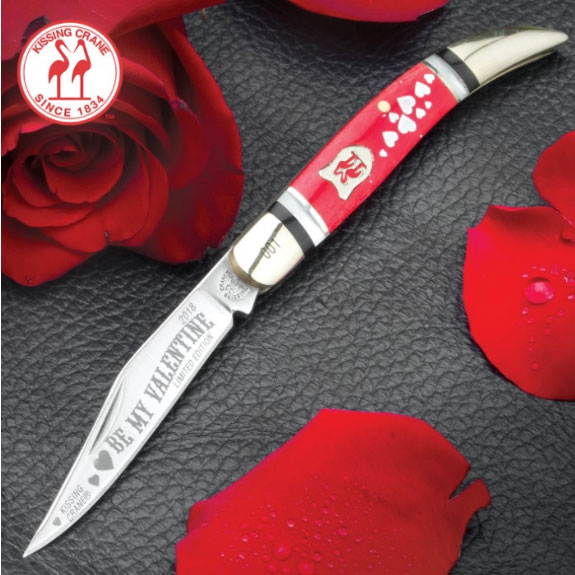
Kissing Crane 2018 Valentine’s Day Toothpick Pocket Knife (image via BudK)
Help celebrate Valentine’s Day by telling BLADE about the knife you love the most. Which knife do you love best? It can be one you carry, one from your past, one you wish you had, one someone used to save a life or otherwise do something significant, etc.
Use the form below to explain why the knife is so special to you. Include a picture if you have one.
BLADE will choose the best stories for a feature here on blademag.com.