by Wayne Goddard
My experience has taught me that there’s nothing like digging in and getting started. I’ve often said the hardest part of the most difficult project I ever completed was getting past the decision to get started. Once I get started, it becomes a matter of problem solving and never giving up. The great inventor Thomas Edison wrote, “Many of life’s failures are people who did not realize how close they were to success when they gave up.”
I have some strong opinions about how a new knifemaker should get started. I recommend the first knives be made with simple and even makeshift tools. That’s the kind of thing that lets you ease into knifemaking without spending a lot of money. If the simple method is not for you, it won’t hurt my feelings—just grab your checkbook and credit cards and head for town. Don’t forget the list of basic tools.
Old School
I’m what you would call an old-school knifemaker. That’s because I never learned CAD (Computer Aided Design) or CAM (Computer Aided Manufacturing). I don’t work with titanium or drill and tap a lot of holes in order to put knives together with screws.
To me, “old school” is riveting together the handle and blade tang, giving the knife a unique personality by hand finishing all the parts. There are no square corners—everything is rounded, smooth and friendly.
About Design
It’s been said that good designs evolve, and I believe it. When I got started in knifemaking, I didn’t have one clear thought about design. I grabbed the only suitable knifemaking material I could find and went to work grinding on it. There was no thought as to knife proportions or design principles. I had built myself a grinder, and the thrill of shaping steel drove my activity.
The result was a blade that wasn’t practical and a handle that was too short. See the related illustration. The knife models I’ve developed to date are good designs because they evolved. It just isn’t possible to get everything right the first time. A maker starting out today has some advantages. He or she typically has access to books and magazines full of good knife designs to study and analyze. Today, there isn’t much of an excuse for making ugly knives.
Perhaps the best thing I can teach about design is to consider the flow of the lines that define a knife’s shape. Don’t do things that disrupt the flowing lines of the knife. The new knifemaker should try different styles, shapes and sizes when starting out in this field. With experience he or she will fi nd a unique style.
Blade and Handle Length
Years ago, I settled on a length of 3 7/8 inches as the ideal size for a hunting knife blade. A blade that stretched 4 inches seemed a bit too long, but a similarly shaped blade at 3 3/4 inches was too short. Splitting the difference gave me a blade length of 3 7/8 inches and I was comfortable with that size.
When you become accustomed to using a knife with a 4-inch blade and then switch to one that’s slightly shorter, or longer, you’ll notice a difference, and you might not feel comfortable. I’ve offered a basic hunting knife blade of 3 7/8 inches to my customers as a standard size ever since deciding on it and they seem to be comfortable with that length.
An ideal handle length can be difficult to determine, mainly because people’s hands all come in different sizes. I’ve got short arms and small hands for my height, and at first, I made knife handles that were too short for some folks. I finally learned to make the handles longer to accommodate the general public. On occasion, I might even go oversize on handle length in an attempt to keep the grip from being too short.
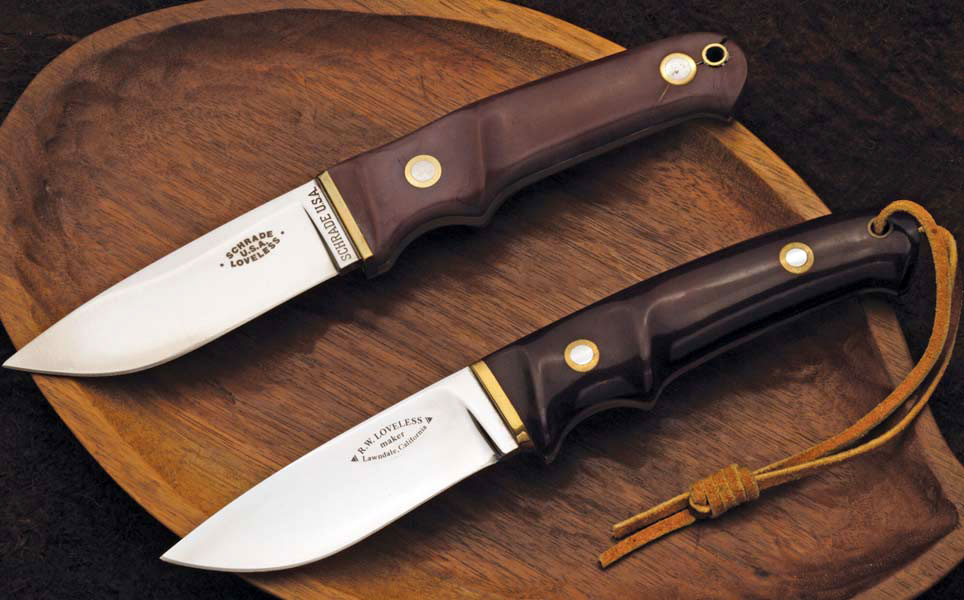
I outfitted the “project knife” for this book with my standard 4 1/4-inch handle. A knife handle of this size can be used on blades that are up to a half-inch longer than the project blade. See the accompanying photo for two versions of the knife. The knife on the right in the photo is the full-sized project knife, and on the left is a computer-enhanced version with a slightly shorter handle. Use your judgment on handle length but don’t opt for a grip shorter than 4 inches.
Over the years I’ve received many beautiful drawings of proposals for both fixed-blade and folding knives. Many of the fixed-blade drawings were not practical to make because the handles, as drawn, were too short.
Knives on paper look quite a bit different than they do when mocked up in wood or cardboard. The folding knife drawings were often attractive in appearance but had blades that would not fit into the handles when folded. For these reasons, it’s always good to make mock-ups of new designs. This gives you non-working models to hold in your hands, and that’s just one more step towards real knives of good designs.
Paper drawings don’t work out too good for me because I can’t draw a straight line or an evenly curved one. What I can do is use the belt grinder to grind straight and curved lines that are what they should be.
A drawing can be scanned into a computer and then printed out to whatever size is wanted. Once the design on paper is finalized and printed out, I use rubber cement to glue the printout to a piece of thin hardboard or plywood. The pattern is then sawed, sanded or whittled to shape. The physical pattern gives me something to hold in my hand and some idea as to proportion and size. This is where needed changes become more obvious and can be made. If the pattern isn’t right, I’ll use whatever parts of it are right to make another pattern that will get me closer.
Once the hard pattern is satisfactory, it is transferred to steel and the real work starts. I keep a lot of the hard patterns I make. Having a collection of rough models on hand gives me a head start on size proportions when I have a new design to develop. Storage of the physical patterns has become a problem, so for the last several years I’ve kept many of them as tracings in a big book.
I’ve found it useful to have a collection of handles. My customers furnished some of them, while others came off of knives I customized, and at least three came from broken knives. There are lessons in all of them, both good and bad. Often, a new design comes together quicker because I have an actual handle to work from.
The Computer as a Design Tool
A scanner hooked to the computer is a valuable design tool. Drawings, illustrations or photos are scanned into the computer where they can be scaled down, scaled up, modified or just stored for future reference. Microsoft Publisher is not only a great program for desktop publishing projects, but also a valuable tool for resizing knife designs.
A drawing or picture appears in Publisher with a marquee that has eight “handles” when it is selected with the curser.
let’s say the picture is of a knife. Depending on which handles of the marquee are dragged one of several ways with the computer curser, a knife in a picture can be lengthened without being widened, widened without being lengthened, or made larger or smaller proportionately.
Microsoft Publisher will allow you to set up your page at any size. When I’m working on a bowie knife design with a 15-inch blade, I set up a page that’s 24 inches wide. I can then work my pattern full size and print it out. It comes out of the printer on two or more sheets of paper and it’s then necessary to cut and paste them together. See the photo showing three sizes of the same knife printed out from Publisher.
The Everyday Working Knife Design
The design for the project knife is practical and simple from a construction standpoint. Although a simple knife, it’s also a good working knife. History is on our side because it was simple working knives that got meat from the hoof and into the kettle. And, there were all the other cutting chores required for those living close to the land. A fancy design or beautiful finish wasn’t required; all that was necessary was a sharp blade with a good handle to grip.
It’s been said that the perfect design is achieved when everything that isn’t necessary has been stripped away. Therefore our project knife won’t showcase fancy file work, gold plating, inlays, attached guards, bolsters or a pommel cap. It will employ only that which is necessary to get the work done.
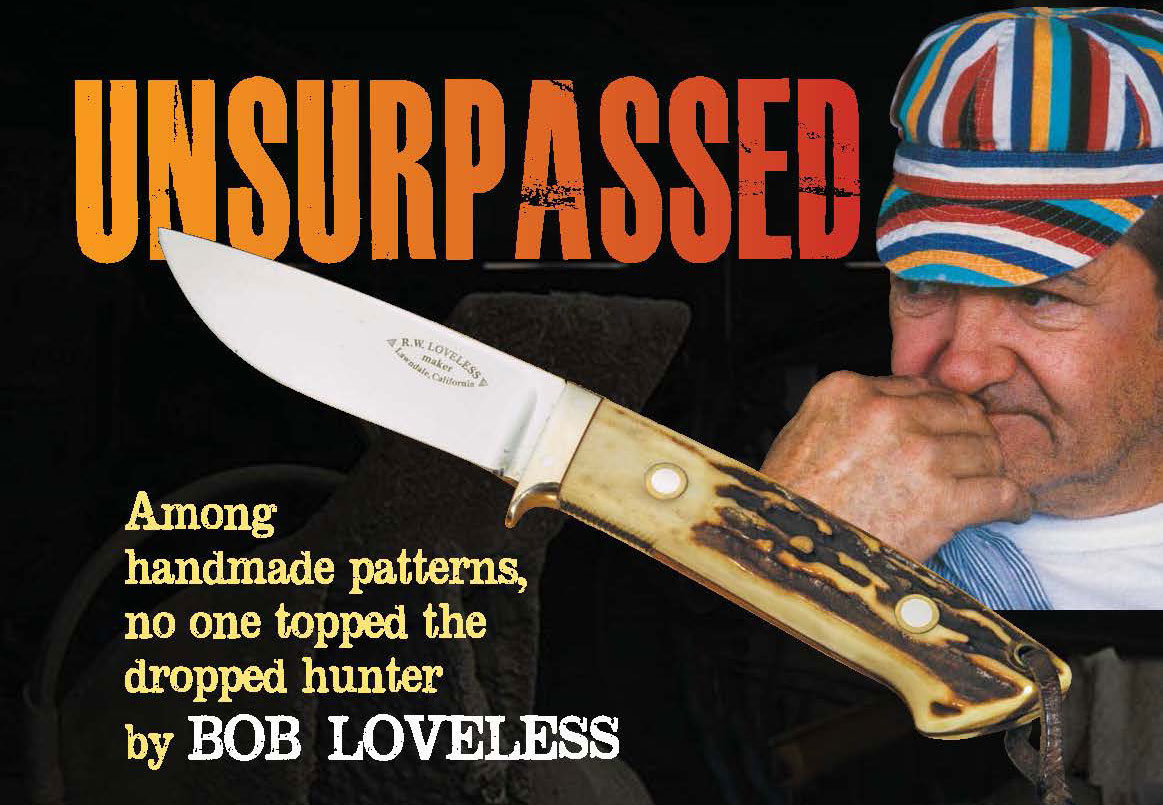
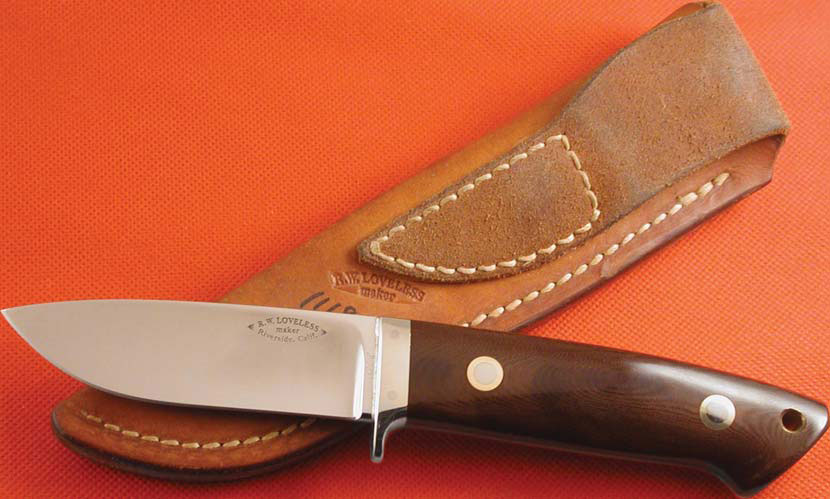
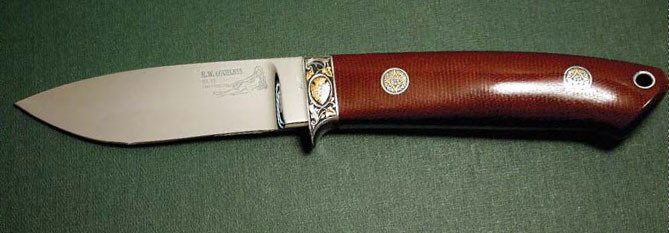
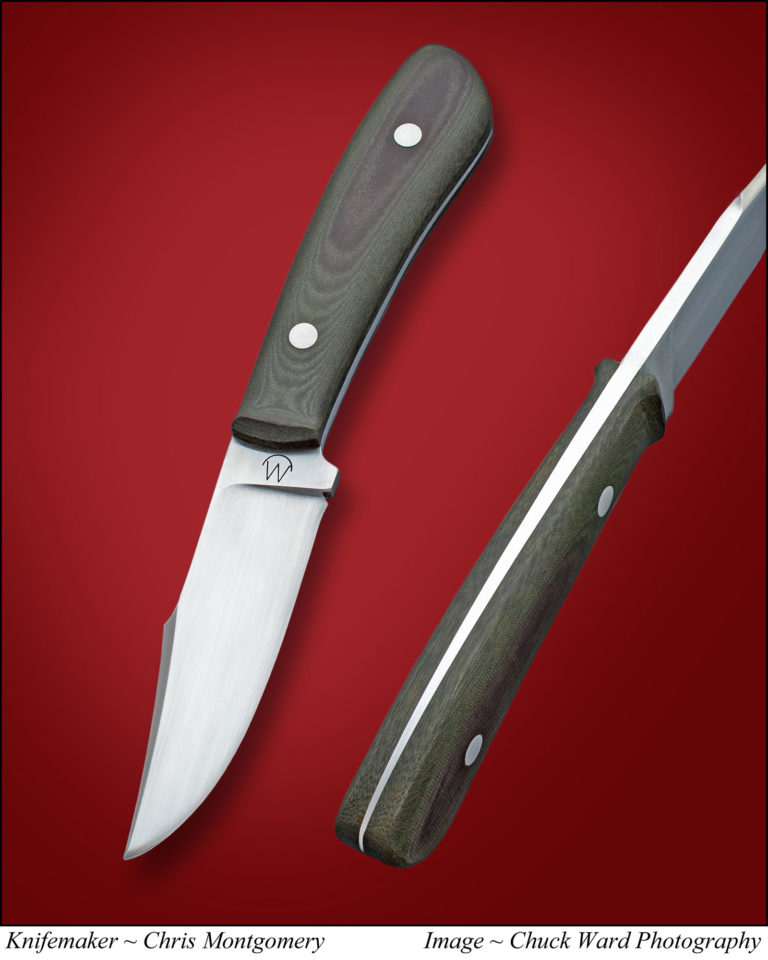
The blade is known as a “dropped point.” I call it a utility shape. If you look up “utility” in a dictionary, you’ll find something like, “the quality of being of practical use.” The advantages of the drop-point blade are many when compared to the upturned point on some commercial and handmade knives.
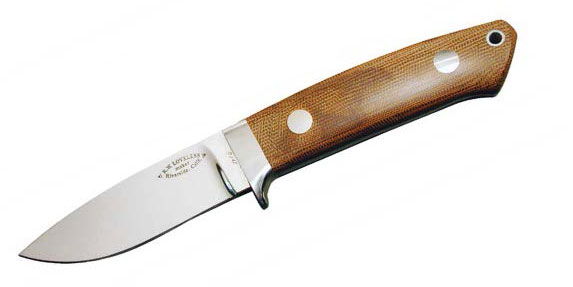
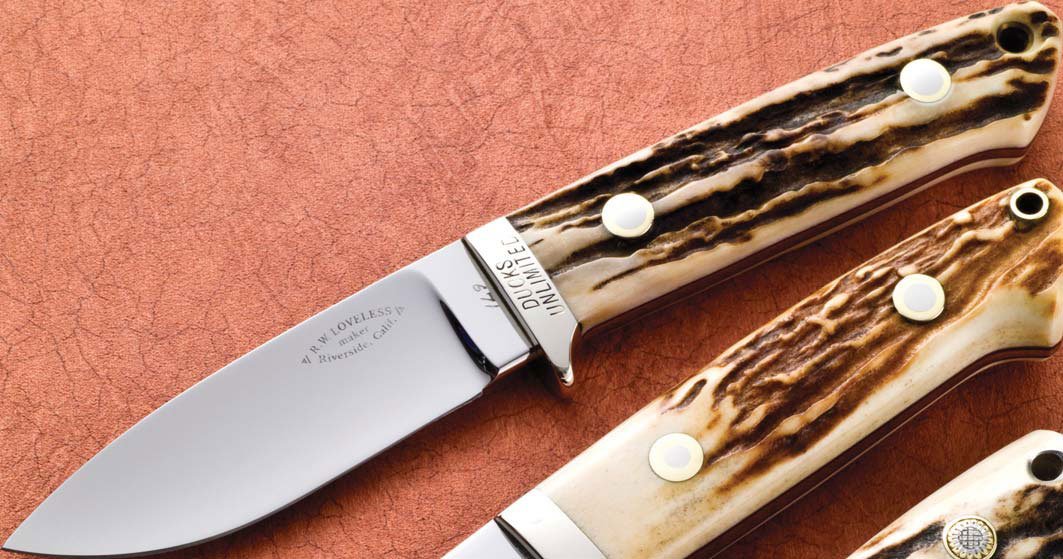
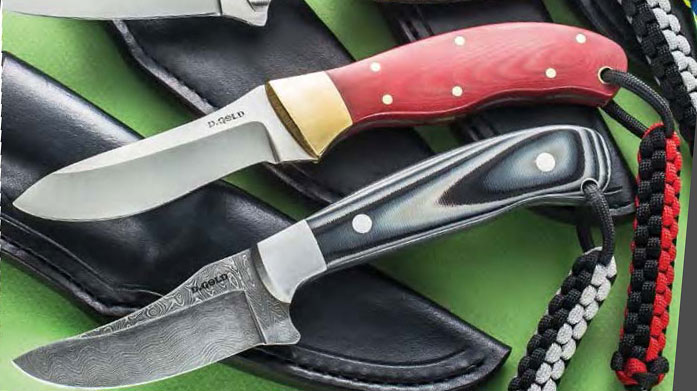
I’ve always figured that upturned points were left over from the bowie knife era. The drop-point blade is not only stronger but also more useful for almost every job of which I can fathom. The drop-point blade allows the opening cuts on game animals to be made without the point digging in. When it comes to skinning or processing meat, the drop point, or the slight modification known as a “semi-skinner,” is hard to beat. See the related photo.
The guard of the project knife is integral to the handle—the guard and handle are one piece—and this simplifies construction. I’ve offered hunting and utility knives without guards for 35 years. An attached guard must be ordered from me as an extra. An attached guard has become an accepted design element of the modern hunting knife, and it serves as a safety feature, keeping a knife user’s fingers away from the edge.
My opinion is that thinking you won’t cut yourself with a knife that has a guard on it is like thinking you won’t have an automobile accident if you wear your seat belt all the time.
Handle Materials
The modern hunting knife should be built to last. First class, beautiful handle materials might raise the cost of making a knife but are well worth the difference. I have seen many knives sold, not only by me, but also by others, to customers who were actually buying the handles. The blades were secondary.
A modern knife is apt to have a plastic-based handle material. These materials are waterproof, strong and dependable.
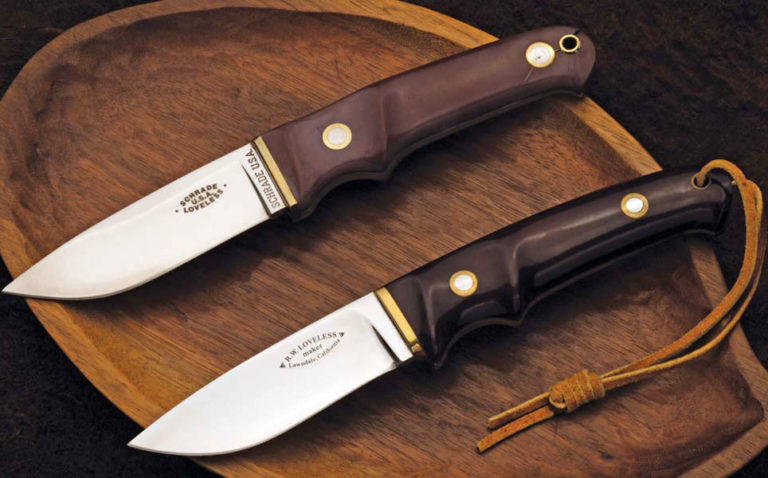
Sharpening will eventually wear out a blade, but of the countless elements that can attack natural handle materials, few, if any, will have an effect on Micarta®. A knife with a stainless blade and a Micarta handle could outlast its owner. My favorite material for a foolproof handle is Micarta, which is in the family of thermoplastics and includes more than two dozen types of material.
Traditional materials for handles depend somewhat on the country of origin. Wood, ivory, horn, antler and bone were, and are, still used for handles. A disadvantage to using natural materials for knife handles is that they are subject to cracking, or attack by bugs and animal teeth. (I’ve had to replace several handles, and also some sheaths that were chewed by dogs.)
Natural materials have the ability to soak up moisture when wet, then shrink and sometimes crack when they dry. The trend today is towards using wood that has been stabilized. Wood can be stained nearly any color and then stabilized.
Hardwoods should be cut just a bit oversized as compared to the projected dimensions of the finished handles, and then be stored in a dry place for a minimum of six months. A year is better. The wood in the center of a 2-by-4-inch chunk of hardwood will have quite a bit of moisture in it compared to the outside layer. Like almost everything else, I learned this the hard way.
About 25 years ago, I bought a beautiful piece of Macassar ebony that was 2 inches thick, 8 inches wide and about 18 inches long. I got it from a wood dealer who had the large board it was cut from for more than 15 years. I had no reason to suspect that it wasn’t dry enough to use. I brought it home and sawed off enough pieces for a matching bowie and Texas toothpick set I was making.
The knife set was finished and delivered. Within four months, one of the handle slabs had shrunk enough to cause cracks to develop around the pins at the ends of a five-pin pattern. One slab had shrunk very little; the other three slabs had shrunk to varying degrees, and I had to replace three of the four handle slabs.
Let’s pretend that I numbered those slabs from one to four as I cut them off the chunk. Number one was the first one off the outside (the driest) of the ebony section. Number four was closest to the center of the ebony and it was the one that shrunk enough to crack. I had cut my slabs off of the end that was fresh cut by the wood dealer. The other end was sealed with wax so there was no way for the wood to be free of excess moisture. The moisture came out fairly quick once the slabs were exposed to the warm air of an Oregon summer.
I check the moisture content of new wood by weighing a small piece (1/2-inch square) on a scale used for measuring powder for reloading cartridges. I write the weight on the test piece with pencil and then put it under my epoxy curing light. The light is adjusted so that the temperature is around 120 degrees Fahrenheit. The wood sample is weighed every 4-to-6 hours until such a time that there is no more loss in weight. This shows me how much moisture it has to give up. At this point, the material is drier than it should be. If attached to a knife in the dehydrated condition, it will probably swell as it becomes normalized to the average humidity and temperature of its new home. The trick is having material on hand with average moisture content (5-8 percent), then, with luck, it will stay close to the same size and remain attached to the steel of the knife tang. I’m told that stabilized wood solves this problem.
The Project
Our project is to make an everyday working knife. The knife we decide to carry for our daily cutting chores will depend on our experience and the type work we do. An electrician working in the mild climate of Eugene, Oregon, will need a very different knife than that used by a rancher from Wyoming. On the other hand, my experience is that most folks actually get the work done with whatever knife they have, regardless if it is truly suitable for the job. The governing principle is that when real work has to be done, any knife is better than no knife.
I’ll be taking the approach to making the working knife as if it will be the first project for a new maker. I’ll use simple equipment and methods to work my way through the basic project knife. Along the way, I’ll explain how it would be done with more sophisticated tools.
The project knife will have a narrow tang with a two-piece handle that is carved out to receive the tang. This is a handle that requires no attached guard, and can be done with all hand tools. I like the lightweight feel of knives put together with this method and employ the process often for every type of knife, from small utility pieces to larger camp knives. See the drawing showing the profile of all the knife parts, and use it as a pattern for pieces necessary to complete the project knife.
Setting up Shop
I recommend easing into the purchase of major tools. I’ve heard of new knifemakers giving excuses for sloppy workmanship because of poor tools. Frankly, it was not the tools but the makers’ own lack of skill that was the problem. Give a new maker all the tools in the world and it will be a long time before he or she is turning out consistently good work.
I’ve been digging around in the handmade knife scene for 42 years, and I’ve rarely seen a “talent for knifemaking.” It’s all about practice and it takes weeks, months and sometimes years to develop the skills necessary to make knives good enough to holdup in the marketplace.
It will be all right to use more advanced tools if you have them. I’m in favor of anything to make the work easier and quicker. Always remember, being quick isn’t good for the sake of being quick. Neat and accurate work is what will make you a good knifemaker. It’s better yet if you can be quick and do good work.
Don’t wait until you have a dream shop. The idea is to get started with what you have. My first knives were in made in 1973 on the sun porch of a rented apartment. My first work station was a discarded bookcase that supported my homemade grinder. An old wood chair without a back served as a platform to hold things on for drilling with my electric drill. I didn’t have much but I had a real bad case of that incurable disease named “I want to be a knifemaker.” My workbench in 2005 is a big improvement over the chair and bookcase on the sun porch.
You can make knives if all you have is a sharp pocketknife and some scraps of soft wood. Employ the design process described earlier, then draw your dream knife on a piece of wood and carve it to the finished shape. You’ll learn how to look at a piece of material to see if it is being kept symmetrical as you progress. You’ll learn how to shape a nice radius on the handle surfaces. You may not want to be a wood carver but this exercise will get you started on your journey to being a knifemaker. A bonus is that it will also give you practice sharpening knives.
You’ll have more than enough to get started if you have some of the things commonly found in a home shop, such as a bench grinder, drill press and a vise. An abrasive cutting wheel on a bench grinder or homemade grinder as shown in the photo will save a lot of time compared to cutting the steel with a hacksaw.
You’ll need some type of workbench. I used an imported version of the Black & Decker Work Mate while making the project knife. It cost less than $10 on sale at Harbor Freight. I attached a heavy tabletop to it. It was still not real solid so I made a shelf to sit on the cross supports for the legs, and I put a lot of heavy stuff on it. If a work table wiggles too much when draw-filing or hand sanding, just back it up into a corner of the room so it can’t get away.
Small Tool List
1) Safety glasses, goggles or face mask; This is a faithful replica of the first homemade grinder that the author made in 1963.The sandpaper cutting jig will make 1-inch strips of square sheets, at 8 inches by 8 inches, for use on the author’s flat-disc machine.
2) Dust respirator, either paper or deluxe. Any protection is better than using nothing;
3) Homemade grinder, store bought grinder, angle grinder or whatever you have access to;
4) Drill press (electric or hand drill) with drill bits to match the pin sizes;
5) Flexible disc sanding attachment with both wood and metal working disks. Look for the ones that use the sticky-back discs;
6) Vise with soft jaw inserts. In my opinion, top of the line Wilton vises are the strongest that can be found, and also the most expensive. I’ve been fortunate to have a nice collection that I found in used condition at reasonable prices;
7) Propane torch. A BernzOmatic® model JTH7 is the best;
8) High temperature, soft fi re bricks to make a one-brick forge;
9) File for steel;
10) Optional wood rasp for rough-shaping handles;
11) One or two C-clamps;
12) Scribe for marking metals (made out of an old triangular or round file);
13) Center punch;
14) Thrift store toaster oven with an accurate oven thermometer;
15) Telescoping magnet from a dollar store;
16) Sharpening stone. Wet or dry paper will work if you don’t have a stone;
17) Flexible disc sanding attachment with assorted discs; and
18) Ball-peen hammer.
Gather the Following Materials
1) One or two gallons of oil for quenching the blade. I call it a “goop quench.” Used motor oil, cooking oil, cooking fat saved from the kitchen, automatic transmission oil or hydraulic oil will suffice. Various mixtures of some or all of the oils or fat will also work. The oil or fat should be in a metal container with a lid so that any potential flame-up can be snuffed out. Used for hardening the blade, my goop quench for the project knife consisted of one-third cooking fat saved from the kitchen, one-third paraffin and one-third hydraulic oil or automatic transmission fluid;
2) Blade material—precision-ground flat stock, lawnmower blades or worn-out files;
3) Handle material—wood or Micarta;
4) Coarse, medium and fine sandpaper;
5) Duro Quick Set epoxy;
6) Fine steel wool;
7) Knife board made of scrap hardwood, 3/4-inch thick, 2 inches wide, 12 inches long, shown being used in the accompanying photo;
8) Push sticks for backing up sandpaper. Note the variety of materials and shapes shown in the related photo;
9) One or two C-clamps; and
10) Wire for pins, (welding wire, nails, a coat hanger, whatever you have.)
Major Tool List
1. A 2-inch-by-72-inch belt grinder, which is the standard of the handmade knife industry for many good reasons. For that size of a belt grinder, excellent, quality belts are available in any grit and type you would ever need. The Coote belt grinder gets my vote as the most machine for the money. It comes without a motor. With some luck, a suitable motor can be found for a fraction of the cost of a machine with a motor installed. The Coote 2-inch-by-72-inch grinder with a 10-inch contact wheel is around $400. The Coote is available from the manufacturer, no middleman, and that saves dollars;
2. A drill press—the imported type for $75-150 will be adequate. See the accompanying photo for the author’s collection of drill presses;
3. A decent bench grinder can be purchased for $75 or less. Check with Sears, Costco or one of the import places. You might not want to use a grinding wheel that much, but with one end set up with an abrasive cutting wheel, it just might become one of your most-often used tools;
4. A used, 1/3-to-1/2-horsepower, 1,750-rpm, double-ended motor with work arbors attached will make a good enough buffer. That’s what I use. Knifemakers supply companies sell these adapters, as does Sears. You’ll need some 8-inch or 10-inch buffi ng wheels and compounds from one of the knifemaker supply companies. The author sets his up as shown in the related photo; and
5. Band saw for wood. A small one from Sears or an import place will do to start with.
A Homemade Bench Grinder
I did 90 percent of the work on the project knife with my homemade hard-wheel grinder. Making a grinder isn’t for everyone because it takes time and a certain amount of money to fashion one. If you consider your time to be worth something and you have the dollars in your pocket. it is wise to purchase rather than do with makeshift tools. I got my start in 1963 with a homemade grinder. See the photo of the faithful replica of that machine, which was used for the making of the project knife.
I’ve made two knives using only an angle grinder, also called a disc grinder. The only good thing I can say for it is that the belt grinder was not needed. The blades were forged to shape, rough ground with a hard abrasive disc and then finished with the flex disc attachment. Nothing beats them for taking the scale off of forged blades or damascus billets. These grinders come in a wide variety of sizes and price ranges.
The Flat Disc Machine
The flat disc machine makes it possible to create an absolute tight fit between matching surfaces, something that is not possible with a belt grinder. There are two necessary things to get the most out of a flat disc machine—the disc has to run extremely true, and the on/off switch needs to be the foot-operated type.
When material is pressed against a disc or belt that is running, one end of the material will be slightly tapered because the initial contact was in that area. This is eliminated with a foot switch, which allows the material to be applied to the disc prior to turning it on. The material is kept in contact with the disc until it stops turning after the foot switch is turned off.
I built my 8-inch, flat-disc machine with parts designed for lapidary work. The type of arbor that I used is no longer available, but the threaded aluminum discs are still in production. If you can find the discs, then the search is on to find an arbor on which to mount them. The place to look for the discs is at lapidary supply stores. See the photo.
A paper-cutting jig cuts a full sheet of sandpaper so that there is not so much waste. See the photo. The strips created are used for the hand finishing required in much of knifemaking. The 8-inch square piece of sandpaper that is formed is just the size for a flat-disc machine. Once the sandpaper is adhered to the disc, a sharp knife is used to cut off the waste. The paper is held in place with 3-M #08054 Spray Disc Adhesive. This is a great product because three or four disc changes can be made before it needs to be renewed.
My friend, Craig Morgan of Morgan and Daughter Knife and Tool, just built a nice double-disc machine for less than $350. He purchased the discs from Texas Knifemakers Supply, but the arbor and pillow blocks were purchased locally. The 9-inch discs run on a shaft supported by ball-bearing pillow blocks. The advantage of the double discs is that they allow for left- and right-hand rotation. This makes it much easier to refine the grind termination on both sides of a blade. The 9-inch size allows the user to cut discs from standard-sized sandpaper.
Forming the Blade
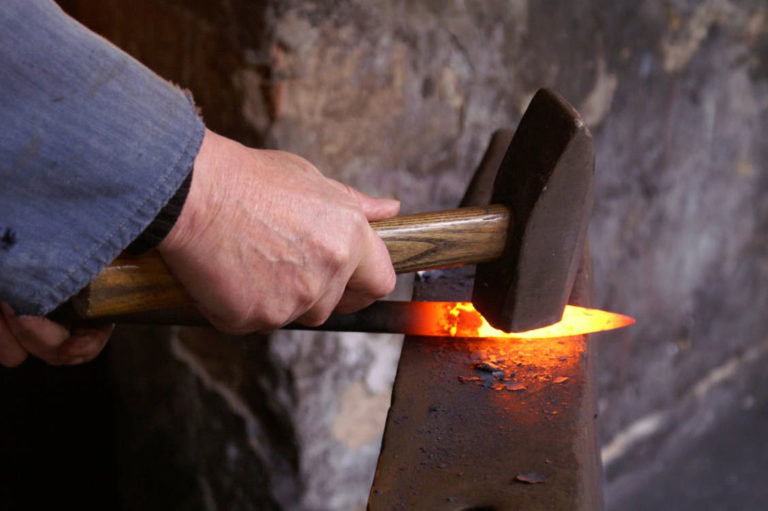
There are two ways for the beginner to shape blades—stock removal and forging. The forged blade is shaped by heating the steel to the plastic stage (1,800-2,100 degrees F) and then using a hammer to work it close to the final shape.
There was a time when all blades were made by forging. Steel was expensive and even rare in those days. Stock removal wouldn’t have been feasible because it would have wasted enough material to make another knife or two. Two blades can often be forged from the same-sized piece of steel that would make only one full-tang stock-removal blade. The invention of manmade grinding wheels opened up the possibility for steel to be removed quickly, and stock removal became feasible for making knives.
The tang is iron that was forge-welded onto the steel blade. This sounds like a lot of work for those of us who have unlimited piles of steel with which to work.
The welding of scraps to make bigger pieces was business as usual for the tribal smith who made this knife. Note the branch from a tree that was used for a handle and the crude bolster to keep the handle from splitting. The hole for the tang is the exact shape as the tang and that shows that the tang was burned into the handle.
A novice knifemaker who opts to forge a blade does not need a grinding machine, assuming the blade is forged close to the final shape. The forged-to-shape blade can be finished with files, stones and abrasive paper. This allows the new maker to get started making knives with a bare minimum of equipment.
An advantage, for myself, to forging is the energy created by the process. I get sick and tired of grinding and sanding inside my shop. Grinding creates smelly grit that permeates the skin and clothing. Fine steel and wood dust fills the air and settles in every nook and corner.
I prefer the fresh air of my smithy, which isn’t much more than a lean-to hooked onto the back of my shop. I love to retreat to the smithy, fire up the forge, get some steel hot and start swinging the hammer. This gets the juices flowing and I get the energy to work another hour or two. That energy thing is hard to explain; it must be experienced.
The Stock-Removal Process
Stock removal has been defined as taking a bar of steel and grinding away everything that doesn’t look like a blade. That sounds good to me. The profile of the blade is sawed or ground to shape, and then the wedge-shaped cross-section that tapers to the cutting edge is ground in with abrasive wheels or belts. The steel bar stock selected for the stock-removal blade should not be much wider and thicker than is necessary to make the blade. It will save you a lot of grinding time if you take time to find material of the proper size. For the beginner, a blade thickness of no more than 1/8 inch is good because there is not as much material to grind off.
The tendency today is to make hunting and utility knives out of 1/4-inch-thick steel. I don’t agree with this and usually choose 1/8-inch- or 5/32-inch-thick stock for my working-type knives. The width of the project knife blade is 1 inch, and since I had that width of bar in 1/8-inch-thick stock, it worked out perfectly.
I prefer flat grinding for hunting knives, even though hollow grinding is more popular. My opinion is that hollow grinding is necessary when using 1/4-inch-thick stock. The way I do things isn’t necessarily what anyone else should do. I won’t defend my ideas or methods except to say, “That’s just the way I do it.”
Profiling of the Blade
Clamp your pattern onto the steel, drill the two holes for pins, place trial pins in the holes and scribe the outline into the steel. Cut the material to length by using either a metal-cutting band saw or abrasives cut-off wheel, or grind the whole profile from the bar stock. The accompanying photo shows three ways to cut the blade from of the bar.
Another way to cut the blade off of the bar stock is to drill a series of holes and then break it apart. A properly sharpened drill bit will remove metal quite rapidly. You will find that drilling and breaking is probably faster than using a hand-powered hack saw. At top in the related photo is a steel bar scribed to show the points of two blades. At, bottom the bar has been drilled and broken apart.
Another way to separate the blade from the bar is to scribe two blades on the bar stock, with the point of the first blade meeting the point of the next blade on the bar stock. As shown in the accompanying photo, grinding the profiles will separate the two blades.
It’s important to have a nice, smooth radius where the tang meets the body of the blade. A good way to establish the radius is to use drilled holes.
Once the blade is separated from the bar, the profile is carefully ground right down to the scribed line. A hard-wheel grinder works fine for shaping the profile, however, half-dull ceramic belts, like the Norton SG Hogger on a belt grinder, will remove steel at least four times faster. The bevel-grinding process is constantly creating half-dull belts that are perfect for profile grinding.
Grinding the Bevels
There are two stages to any type of blade grind. The first stage occurs prior to heat-treating the blade, and the second is after the heat-treat process. It’s best to leave approximately 20 percent of the steel to take off after the heat treatment. Edges can warp or crack when they are too thin going into the quench process. Leaving some material to take off after heat-treat makes the quench operation a lot safer for the blade.
Blades can, and do, warp during the quench operation, and the extra material will allow some straightening to be done with the grinder. The grind prior to the heat-treating process doesn’t have to be exactly precise. The odd little things that are not quite right can usually be fi xed in the final grinding process.
The stock-removal knifemaker starts with a rectangular cross-section of steel and turns it into a wedge shape, which can be arrived at with several different methods.
Hard-Wheel Grinding of the Bevels
The stock-removal method can be completed several ways. The most common and best is with a belt grinder using either a flat platen to make a flat-ground blade or a contact wheel to make a hollow-ground blade. An adequate job can be done with a bench grinder, sometimes called a hard-wheel grinder. The wheel leaves a lot of little tracks that need to be evened out by draw filing, using hand stones, or with a powered flat disc or flexible disc.
When I got my start in knifemaking, all I owned was a homemade hard-wheel grinder to profile and to grind the rough bevels. At first, I smoothed blades up using a flexible-disc attached to, and rotated by, an electric drill. Before long, I had mounted an electric motor on an upright frame and attached the flexible disc to the shaft, which put the disc in the horizontal position.
This allowed me to control the blade with both hands and see what I was doing. I ruined more than a few abrasive discs by jamming them on the sides of blades where the discs were cutting towards the edges. With this type of setup, it would have been nice to have a reversible motor. I made close to three hundred knives with such a setup before I had a belt grinder.
Once I built my first belt grinder, I only used the grinding wheel for rough-grinding blade profiles in order to save on sanding belts. The time required cancelled the savings in belts. It was actually kind of foolish if I would have considered my time to be worth money.
Sharp, new belts are required for getting the bevels set up accurately. Many grinding errors that new makers make are caused by trying to work with dull belts. Make up your mind that each hunting knife is going to cost you the price of at least two new belts. To build a bowie knife takes as many as five belts.
It’s time for an adjustment to the thinking process if you worry about the expense of materials for knifemaking. Materials are free when you figure their cost into the sale price of your product; it’s your customer who buys the material. The only time the expense comes out of your pocket is if you can’t sell the knife.
The Flat Grind
When using a belt grinder, the flat surface is relatively easy to establish. That is not so easy using a grinding wheel because it takes lots of different “tracks” to make the wedge, and then the tracks have to be blended into the surface of the steel with a disc sander, or by draw filing.
Use a red, waterproof marking pen to ink in the blade prior to each new grit size. I use 60-grit belt for rough grinding the blade, then go to a 120-grit belt, which creates a fine enough finish prior to heat-treat. Use an OptiVISOR or other headband magnifier o check your progress. Any grinding scratches that remain will show up easier because of the red ink. Check for those remaining scratches under a good light. Look at the blade from tip to tang, then from edge to back. The flat grind is easy to get right when using the belt grinder with a flat platen.
Sequence for Grinding the Bevels
1) Double-check the blade profile to see if it is correct;
2) To establish the thickness of the edge, I like to make two lines with approximately 1/32-inch between the two. Grinding to the line from each side will leave approximately the correct thickness at the edge to make it safe for the quenching operation. If the bevels are brought down to a thin, nearly sharp edge, the edge may crack or warp during the quench. The photo on page 38 shows two ways to mark the centerlines;
3) Mark the place on the side of the blade where the bevels will end, sometimes called the “plunge grind” or “termination point;”
4) Grind a flat bevel, at approximately 45 degrees, down to scribed line on each side of the blade;
5) Next, grind a series of shallow grooves, or tracks, the length of the blade until the width of the bevel is established and fairly flat. As an alternate method, you can create a convex blade shape as you go along. Use a straight edge to check the progress of either the flat or convex grind. If you find that you are having a lot of trouble with the grinding it would be appropriate to get some mild steel on which to practice;
6) Be especially careful to not grind past the drawn lines that mark the termination point of the grind. Also, don’t grind so high on the back as to make the back of the blade thinner than you want;
7) Grind several passes on one side of the blade and then grind the same amount on the other side. This keeps the stress in the blade more uniform. Taking off all the material from one side of the blade before the other side is ground can cause it to warp;
8) Once more, do not make the edge too thin prior to heat-treatment. You should leave approximately 20 percent of the steel to take off after the blade is hardened and tempered;
9) Put together a blade-wedge-checking jig made of wood or other material. See the related photo. Adjust the jig on a knife blade that has a wedge that you like, lock the wing nut and then put the blade you’re working in the gauge to see if it is thin enough;
10) If you don’t have a belt grinder, use a disc sanding setup to smooth up the tracks from the grinding wheel. If the grinding wheel was 36-40 grit, start disc sanding with an 80-grit disc, then go to a 120-grit disc, and then to a 240-grit disc. That will be fine enough to go into the heat-treating sequence. The self-adhesive discs are used here; the flexible disc attachment was made for them. See the accompanying photo. Trim off any excess disc material so that a fairly sharp corner can be created;
11) You may find that your blade is slightly convex, but that is fine as long as it isn’t too thick;
12) Smooth up the back of the blade, or leave it square, the latter of which, to me, seems a bit unfinished. I always create a false grind, or simply round the back of the blade. The working knife will have a rounded back that is first rough shaped with a file, then finished with a grooved stone. The photo shows how I use a medium Crystalon stone with a groove in it to get a nice radius on the back of the blade;
13) Use a fine stone or sandpaper to get all coarse grinding marks out of the edge, with the movement of the stone or sandpaper being from the blade ricasso (between the blade and tang) to the tip and back. This eliminates any “stress risers” that might lead to an edge crack during the quenching process. Use your fingernail to feel for coarse grinding marks, nicks or anything that’s not smooth. They’re called “stress risers.” The stress created in the quench can cause a crack to form at a stress riser, and they must be eliminated;
14) Do not use the flexible disc on the ricasso. That should be done with a fi ne belt on a platen or flat disc, or by hand as shown in the picture. The photo shows how a sheet of wet or dry paper is folded in half, clamped to a flat piece of steel and the ricasso is finished with handwork. This method takes a bit of time but the results are nice when taken down to a 600-grit finish; and
15) Be sure that there is a rounded junction where the tang meets the ricasso. Give the whole blade a once over and it is now ready for the heat-treating sequence.
Draw Filing
Draw filing is an old-school technique that allows a surface to be worked extremely flat. It is a good skill to develop if you don’t have a belt grinder. With knife work, the draw filing is used to get the blade flat prior to heat-treating the blade. The blade will be too hard to draw file after being hardened and tempered.
The file is held at both ends and is alternately pushed and pulled across the work. The action of the file on a blade would be to draw it the length of the blade.
When the file is pushed, as in normal filing, the teeth are more apt to dig into the work and leave a rough finish. A standard mill bastard file works best for getting a smooth finish. A double-cut file will remove material quicker but will leave small ridges that have to be worked out with the mill bastard file.
A light touch is best because it keeps the teeth from digging too deep. Keep a file card close by, and every so many strokes, use it to keep the teeth free of filings. When the teeth are allowed to plug up, it can cause galling of the surface and that will only make more work for the draw filer. If the file is lubricated with chalk dust, it is supposed to help keep the teeth from clogging. I’ve tried it both ways and don’t notice much difference; it may depend on the type of material being worked.
There are plenty of cheap, imported files for sale. I’ve tried some of them and found them to be a waste of money. It pays to buy good, quality files and Nicholson is the brand that I prefer. Time is money and they will make the work faster and smoother.
Heat-treating
Civilization as we know it would not be possible if man had not learned how to utilize iron and steel to the high degree of which it is employed today. Steel is unique and useful because it can be treated so that it is extremely hard, springy or relatively soft.
As knifemakers, we can utilize the extreme forms that steel can be heat-treated to for our advantage. The best example of this is a blade that has been either selectively hardened or selectively tempered. Such a blade can have an extremely hard edge, yet withstand a 90-degree flex test. This is possible because the edge is hard, the center section of the blade is spring tempered and the back is relatively soft.
Heat-treating can be described as certain time/temperature treatments performed on a metal to gain specific strength, ductility or other properties. The heart of any knife is the heat-treatment the blade received. The heat treatment will be considered a success when the blade is capable of doing the work expected of it.
If a blade is too soft, it will not stay sharp and could actually bend from being used for hard work. If it is too hard, it will chip or break in normal use. The successful knife heat-treatment leaves the blade just right, not too hard but not too soft. The ideal hardness is best worked out by trial and error by comparing blades with new types of steel or heat-treatments against blades of known value.
There are three elements to any heat-treating process—heating, cooling and time. A little difference in temperature can have a big effect on the results. The element of time is perhaps less important, but it is always the correct combination of time and temperature that is necessary to accomplish the transformations that give the desired results. Each steel type has its own unique combination of time/temperature cycles that will result in a blade of superior strength and cutting ability.
Edge-holding ability is almost entirely dependent on a relatively high hardness. I would estimate that 95 percent of handmade knives are between 57-61 Rc on the Rockwell hardness scale. The specifi c alloy elements in some types of steel will allow them to have more strength than other types at the same hardness. The intended use for the knife will determine the maximum hardness that will be acceptable.
I’m often asked what steel type is best, or what steel type I prefer. My usual answer is that it depends on the heat-treatment. As a general rule, proper heat-treating is more important than the steel type. A relatively simple steel, when properly heat-treated, will outperform a more sophisticated steel that has a defective heat-treat. I’ve proved this many times.
The Quench
When heated to a certain point and cooled quickly, the steel becomes hard, brittle and full of stress; this is called the quench. This form of steel is known as “martensite.” Martensite, as it comes from the quenching process, is brittle, full of stress and unsuitable for a knife. Heating the martensite to a lower temperature will soften it somewhat, relieve the stress, and if the temperature was correct, the result will be a serviceable product. The low temperature treatment, usually between 375- 500 F, is called tempering, or drawing the temper.
Heat Sources
The heat source for the quenching process must generate an even heat and the temperature needs to be controllable. If the heat source is too hot, it will be difficult to get a slow and uniform heat on the blade. When the blade is brought up to temperature too fast or in a heat source that it too hot, the thin sections usually overheat. The gas forge is an excellent source of heat for the quenching process when it can be adjusted to the temperature range required.
Here’s how a gas forge works: A flame heats the liner of the forge or furnace and the radiant heat from the lining heats the material. A burner-tube or torch burning in the open air to heat a work-piece wastes what I would estimate to be 200 percent or more of the potential heat.
When the flame is contained in a heat-chamber or something as simple as the heat trapper described below, the result will be a more even heat and a larger work-piece can be heated. The flame from the torch or burner should never aim directly at the work piece, but instead should be directed so that the flame can wrap around the work, heating the forge liner at the same time.
My first homemade, tube-type “Dragon Breath” forge was built primarily for forge welding in a temperature range of around 2,300 F. It had a forced-air burner that was not adjustable over a wide range. The solution for me was to build a second forge that was designed to run at lower temperatures suitable for heat-treating.
That meant it had to have a smaller chamber and a smaller burner tube with a proportionally smaller orifice. The smaller forge has worked out well for heat-treating and forging. The bonus is that I’m not bothered with the borax flux contamination of blades the way I was when I used the welding forge for forging and heat-treating.