Editor’s note: This article originally appeared in the December 1994 issue of BLADE. Read more from BLADE‘s extensive archive here.
Again and again, when knives hit the silver screen, they become characters unto themselves. Some knives take that more literally than others. Here’s one example.
A Movie Knife with Tibetan Influences
The Phurba, the knife from the 1994 motion picture, The Shadow, breaks new ground for movie blades because it’s the first to take advantage of new computer-generated special effects. For the dagger in The Shadow, that means the creation of a living, breathing character, so to speak.
“It growls a couple of times, flies through the air, sprouts legs and even bites Alec Baldwin’s hand,” United Cutlery’s Kit Rae said of the knife. “They used a lot of computer graphics so the face on the handle moves, and the handle twists around.”
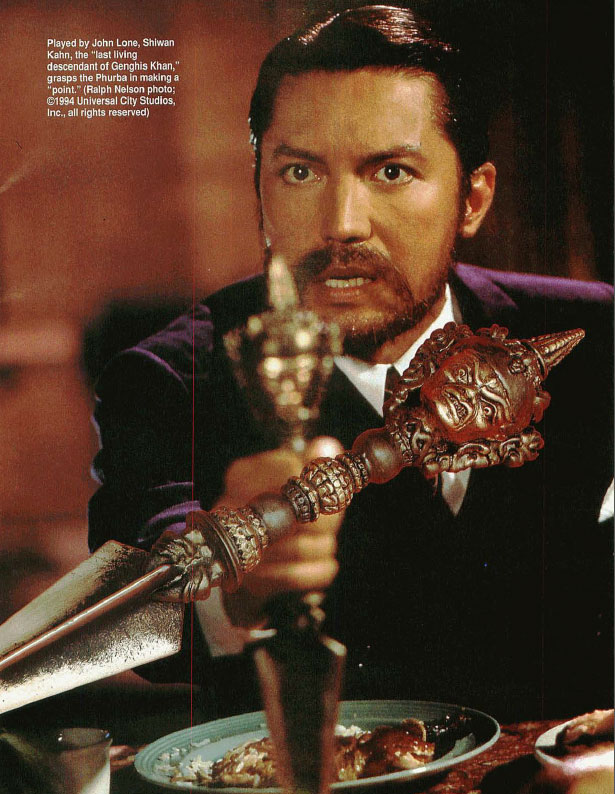
Designed for the movie by Joe Nemec III, the Phurba – or “Phurbu” as it is also spelled – is based on an actual Tibetan exorcising knife or “ghost dagger” used by lamas (Buddhist monks) to drive out evil spirits. The Phurba dovetails with the theme of The Shadow since the movie begins in Tibet.
The Phurba from “The Shadow” sports a three-sided blade.
A Three-Sided Blade
According to A Glossary of the Construction, Decoration and Use of Arms and Armor, by George Cameron Stone, the original Phurbas had, “a three-winged blade and a hilt made up of lamaistic symbols. The pommel is usually a head with three faces crowned, with an animal’s head and neck projecting from the top. Thunderbolts (vajras), dragons and dragon’s heads are frequently present. Usually the blades are made of iron and the hilts of brass; sometimes the entire knife is of brass, and occasionally of wood.”
Played by John Lam, Shiwan Kahn, the “last living descendant of Genghis Khan,” grasps the Phurba in “The Shadow.” (Ralph Nelson photo; 1994 Universal City Studios, Inc., all rights reserved)Read more articles from BLADE’s archives with this collection of 25 years of back issues.
Nemec couldn’t get an authentic Phurba, so he based the movie knife on research, Rae said. The movie Phurba is true to the original knife in looks, right down to the three-sided blade. The main difference is in the number of faces on the handle, which was sculpted by Nemec. Where authentic Phurbas have three faces, the movie version has but one.
“[The movie’s officials] decided on a single face because it fit in with the idea that the knife was a living character,” Rae said.
Editor’s note: The following appeared in the February 1993 issue of BLADE magazine. You can read more from BLADE‘s extensive archive here.
Knifemakers keep the candle lit for traditions going back generations. It’s no wonder Hollywood would turn to these keepers of history when making movies set in centuries past.
Winkler, who lives in Boone, North Carolina, (the movie was filmed in the nearby North Carolina mountains) read about a casting call for the movie in a local newspaper. A maker of period pieces for and a participant in mountain man rendezvous, Winkler and his knives would seem a good match for the movie’s mid-18th century time frame, but not even he and his business associate, Karen Shook, could have foreseen the good fortune that would befall them when they met with movie prop master Ron Downing.
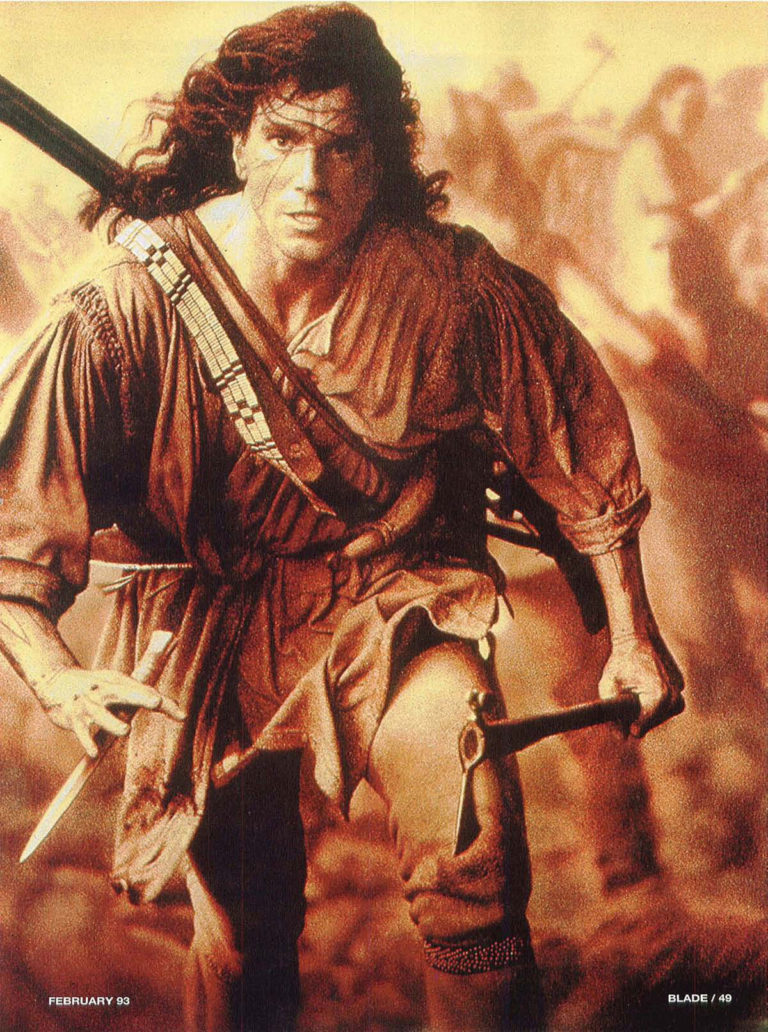
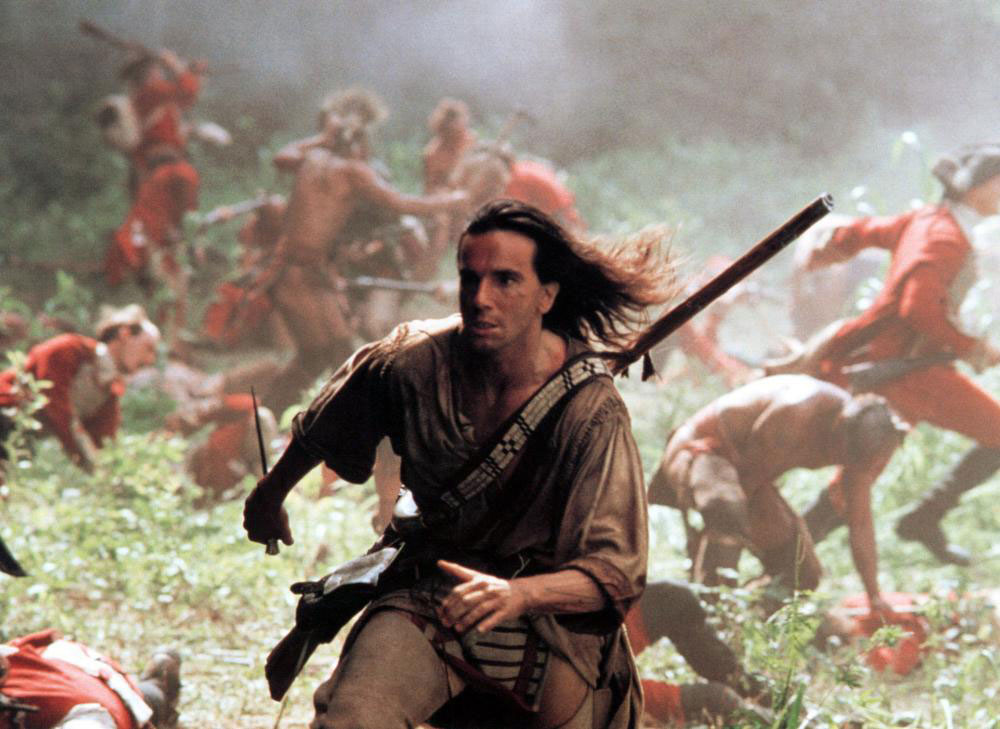
Hawkeye (Daniel Day-Lewis) carries the knife Winkler made in this scene from “The Last of the Mohicans.” (Image via imdb.com)
“Karen and I introduced ourselves to Downing’s secretary and got a map to his office,” Winkler recalled. “We spoke with Downing and he told us he had a meeting that night with the movie’s director, Michael Mann, at which time he was supposed to show Mann the knives that were to be used in the movie.
“But Downing didn’t have any knives! Karen and I ‘happened’ to have a suitcase full of knives and Downing asked if we would stay for the meeting with Mann. Though no specific knives were agreed upon at the meeting, they decided our knives were appropriate and gave them some idea of what they wanted.”
Designing, and Re-Designing, the Knives
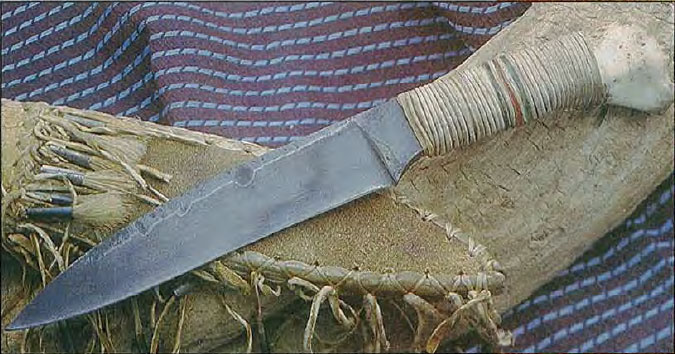
The knife Hawkeye (Daniel Day-Lewis) carries is shown above. Made by Daniel Winkler, the piece is 11 inches long overall. The blade is forged from L6, a steel Winkler said he chose to show “the right-age patina “for the French and Indian War time period. He said the blade design is not an exact straight edge because of its slight upswept tip. The handle is deer leg bone wrapped in rawhide and red and green bands, also inspired by handles from the mid-18th century.
From there, Winkler learned just how tough a job he had taken on. He met with production officials to decide on a specific knife design. From that design Winkler made a knife and brought it to the next production meeting, where movie officials suggested more changes.
“I went to six weeks of meetings and they’d change the knife at every meeting. They continually changed the design until the final knives were an evolution of changes,” Winkler said.
Once the final designs were agreed upon, he had to make three of each knife in case any one was damaged or lost, all of which had to look alike.
“It was difficult to get the same shape bone for each handle,” he noted.
The knife can be seen in the first few seconds of this video clip:
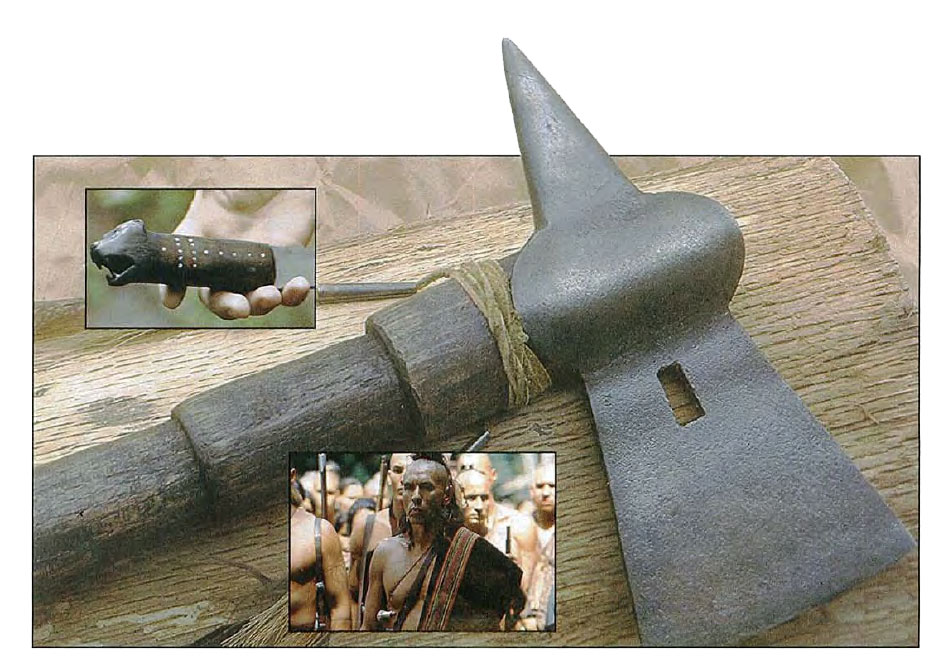
Winkler made the knives for Hawkeye (Daniel Day-Lewis) and his adopted brother, Uncas (Eric Schweig), and the tomahawk for the movie’s villain, Magua (Wes Studi). Magua’s tomahawk was one piece Winkler didn’t have to change. It gets the best close-up shot of any of the movie’s edged pieces early on when Magua attacks one of the English soldiers escorting Cora (Madeleine Stowe) and Alice (Jodhi May) Munro to see their father. Winkler said it was copied from a design on display in a French and Indian War museum in New York.
“(The movie officials) didn’t change the reproduction I made,” Winkler said. “When they got it, they liked it.”
King: It Started with Breakfast
King can thank his father for his opportunity to make the movie knives.
“Jim Morgan, the assistant prop master, ate breakfast where my Dad does every morning,” said King, who lives in Asheville, North Carolina, also near where the movie was filmed. “They got to talking and Dad said I made knives they could use in the movie. Jim said to send me down.”
The next thing King knew, he was making movie knives.
Hiding “Blood Bladders” Inside Knife Handles
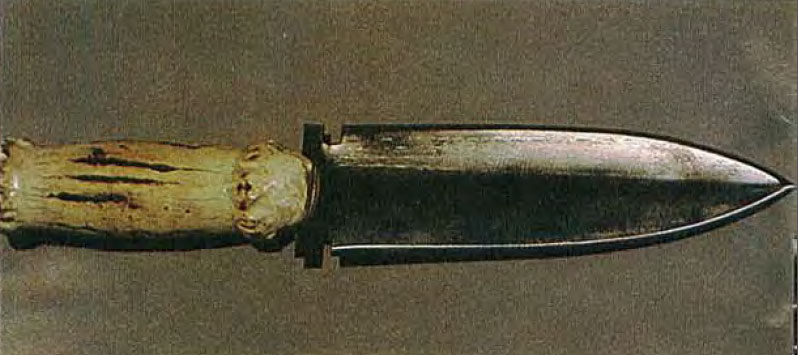
Randall King made Chingachgook’s English dagger from a design by movie prop master Ron Downing. Like all of the knives made for the movie’s stars, King had to make two duplicates in case any of the knives were damaged or lost. To duplicate the stag handle, King sawed a piece off a moose antler 2 inches in diameter, sanded it down to the same shape as the original, and cut the same “character lines” in the stag with a Dremel tool. Finally, he burned the slabs in places for the brownish stag effect.
The knife King made for Chingachgook (played by Russell Means) is a combination of two knives-an English dagger blade with a handle designed by Downing. Like Winkler, King had to make several copies of the knives.
“Do you know how hard it is to duplicate a piece of stag? I took a moose antler and sawed a piece from it about 2 inches in diameter,” he explained. “I sanded it down to the same shape as the original and took a Dremel tool to cut the lines in it and then burned it in places for the stag effect.”
King also had to duplicate the carved bear-head handle of Magua’s knife, and made two special effects knives for Magua with removable handles that hid “blood bladders,” which squirted fake blood when squeezed for the movie’s action scenes. King also made the knives and sheaths for the movie’s extras.
Winkler said the huge gunstock war club that Chingachgook cames in the movie, as well as the other tomahawks used by movie extras, were made by in-house prop people. A lot of the tomahawks were based on authentic designs illustrated in blackpowder catalogs, he noted.
Magua’s tomahawk gets probably the best exposure of any edged piece in the movie early on (Magua is at bottom, played by Wes Studi). Daniel Winkler carved the handle from hickory and hand forged the head from L6 steel. He reproduced it from an authentic piece provided by Ft. Meigs, a restored fort from the French and Indian War period located in upstate New York. (Magua picture courtesy Twentieth Century Fox)
Working with the Stars
Read more articles from BLADE’s archives with this collection of 25 years of back issues.
Both makers said they got to meet the stars and were impressed with how cordial they were, King even to the point of having his picture made with Studi and Day-Lewis.
Though neither maker “got rich” from the money they made-King used the proceeds to make himself a new knife shop-both viewed the experience as educational.
“Working on a movie production is not something I would want to do very often,” Winkler admitted. “It was fun but it took a tremendous amount of time. They wanted everything right away. I had to put off some of my custom orders and missed some knife shows to meet their deadlines, and a lot of what I did for them was put on the shelf. We (knifemakers) are suppliers, not actors.”
The makers may not be actors but, in a way, the knives and tomahawk were. And if the past is prologue-as with the Rambo knives that helped boost the knifemaking fortunes of Gil Hibben and the late Jimmy Lile-Winkler and King may reap even more benefit to their knifemaking careers from the pieces for The Last Of The Mohicans.
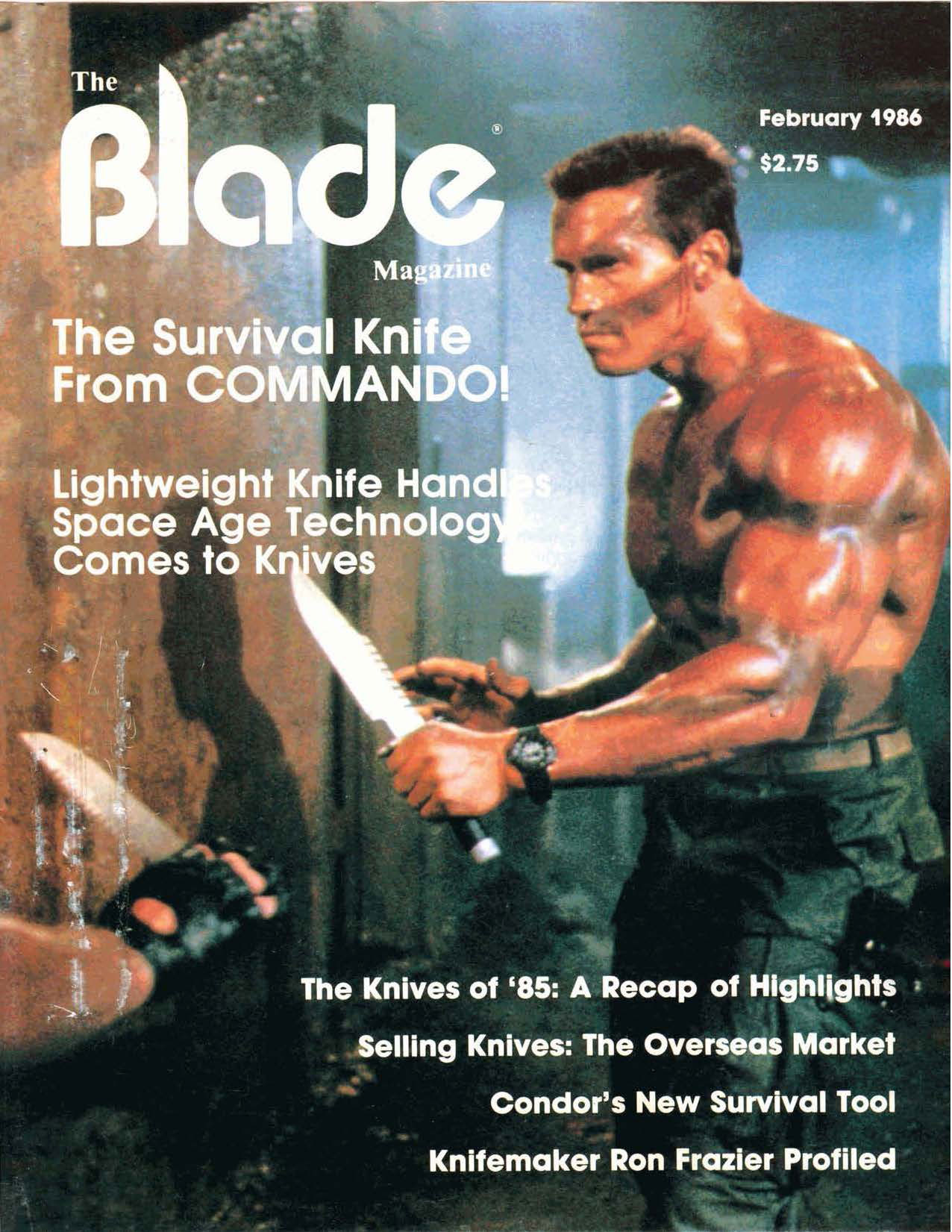
The cover of the February 1986 issue of BLADE magazine.
Editor’s note: The following originally appeared in the February 1986 issue of BLADE magazine. Read more from BLADE‘s archives in this collection.
Jack Crain passed away in September 2016 at the age of 70. He’s best remembered for the knives he supplied for many Hollywood movies, including Commando, Predator, Road House, Predator 2, Demolition Man and Executive Decision.
However, it was Commando that solidified Crain’s reputation as a knifemaker to Hollywood. Here is the complete article about his work for that action film.
Hollywood Loves Custom Knives
Hollywood is sold on the custom knife, and knifemaker Jack W. Crain of Weatherford, Texas, has reason to be pleased.
Why? Because one of Crain’s knives has recently “co-starred” in a Hollywood production. The knife, a model Crain calls the “Life Support System I,” was recently featured in the popular motion picture Commando starring Arnold Schwarzenegger.
The knife also appeared in the Airwolf television series, and later this season it will appear in an episode of The Fall Guy.
Knives on Silver Screens Inspire Knifemakers
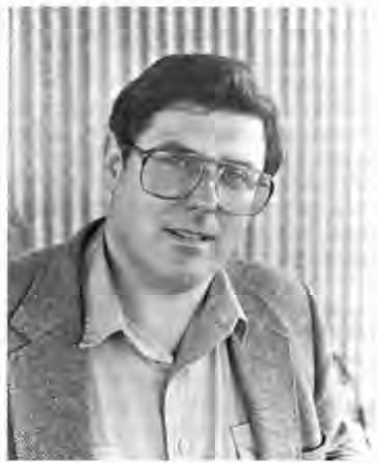
Jack Crain, as photographed in 1986.
Indirectly, explains Crain, the relationship between Hollywood and the custom knife began about three decades ago with the motion picture The Iron Mistress. That film, a romanticized biography of James Bowie starring Alan Ladd, had a tremendous impact on the early custom knife industry. Knife collecting became more popular, and several of today’s prominent makers readily concede that their careers were launched by that movie.
Crain was building knives before he ever saw the film.
“I can’t remember a time when I wasn’t making knives,” he states. But he admits to having watched The Iron Mistress “several hundred times.”
And since he prefers to make Bowie knives over all other styles, he assumes that the movie influenced his career as well.
Occasionally a knife will surface which purports to be the Bowie knife used by Alan Ladd in The Iron Mistress. Of course, it will be accompanied by a formidable price tag. Crain admonishes would-be investors that these knives are almost certainly fakes.
All of the Bowies from The Iron Mistress are in a private collection, and they are not likely to be sold in that collector’s lifetime.
The Renaissance
Handmade knives flourished in the years following The Iron Mistress and Jack Crain was part of the ensuing Renaissance of custom cutlery. He sold his first knife in 1969. A decade later he became a full-time maker and joined the Knifemakers Guild.
Initially, Crain forged his blades. Later, he adopted the stock-removal method. He occasionally returns to the forge to make a damascus blade.
He has produced folders and hunters and fancy daggers, but Bowie knives remain Crain’s primary interest. His fellow knifemakers have cautioned him that the popularity of the Bowie is waning.
“Perhaps they can’t sell Bowie knives, and perhaps I couldn’t sell the kinds of knives they are making,” declares Crain, “but I’m having no difficulty selling my Bowies.”
Limited edition commemorative Bowie knives have become Crain’s specialty, because they allow him to merge his talent for knifemaking with his passion for Texas history. In 1982, he introduced a 13-piece set in which each knife represented one of the 13 days of the heroic siege of the Alamo.
Then came a 20-piece series commemorating Isaac Millsap, one of the Alamo defenders. The Bowies for both sets were loosely patterned after the Bart Moore knife, which allegedly belonged to Jim Bowie.
A Bowie knife found on the San Jacinto battlefield (and currently on display at the Texas Ranger Hall of Fame in Waco) provided the design for the Captain Jack Hays series of 20 knives. Hays was a legendary Texas Ranger during the period when Texas was a Republic.
Another series commemorated Noah Smithwick, a blacksmith who fought in the Texas Revolution (and left a detailed account of his exploits). Smithwick actually made Bowie knives-Jim Bowie bought the first one-and the knives in this set replicated the only known Smithwick Bowie in existence.
Survival Knives Get Hot
In 1982, Hollywood released a motion picture whose impact on the custom knife industry rivaled, or surpassed, that of The Iron Mistress. That film was First Blood, and it showcased a handmade survival knife built by James B. Lile. Suddenly the market was flooded with both factory and custom knives featuring sawteeth and hollow handles.
Crain also felt the movie’s impact. He received numerous requests to produce his own version of a survival knife. Since such knives are essentially modified Bowies, the task would appear simple for a Bowie knifemaker. But Crain perceived some inherent challenges in those modifications. He would not replicate Lile’s design or any other pattern. Rather, he would incorporate his own notions of what a combat-survival knife should be.
The LS-1 is Born
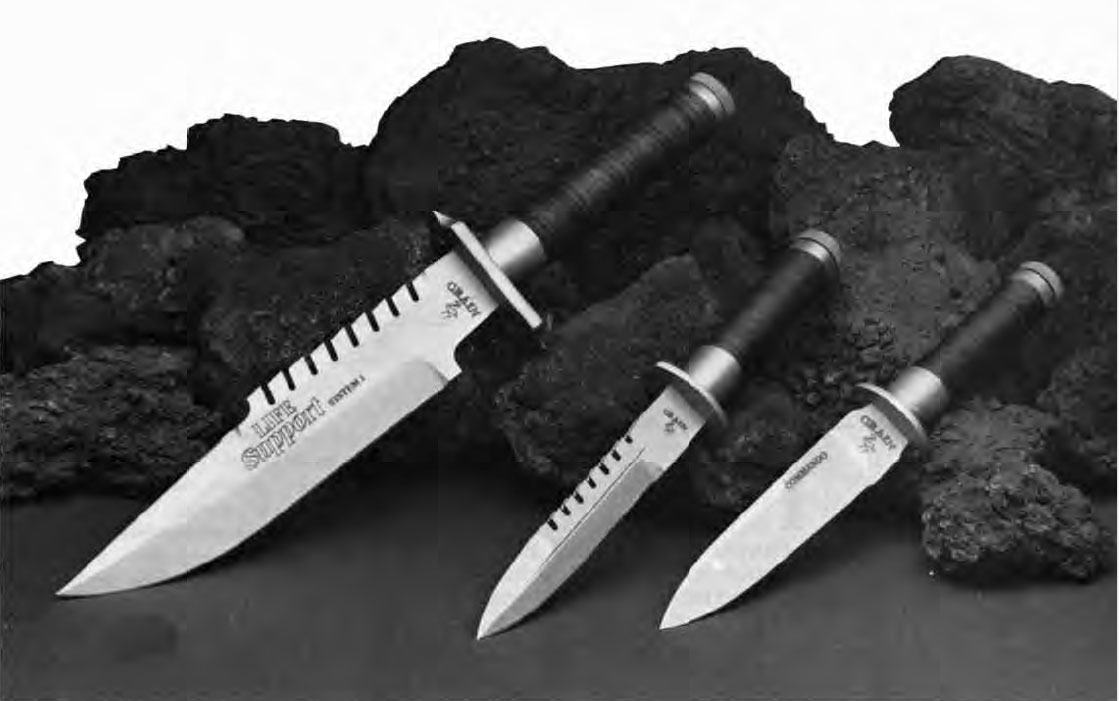
The LS-1, Scorpion and Commando are pictured from left to right, respectively.
The end result was the Life Support System I, which featured a nine-inch by two-inch by 1/4-inch blade, flatground for strength. When this knife was introduced in 1982, Crain offered it with either a 440-C blade in a matte finish or a 1095 spring steel blade with a black finish.
However, Crain became dissatisfied with the quality of the 1095 and later substituted 01 steel on the black-finished knives. He has also added D-2 as an alternative steel for the knives with a matte finish.
A single row of sawteeth is standard on the LS-1. Crain says that, in general, a single row of teeth cuts better and binds less. However, he offers a double row of teeth as an option. The knife is also available with either a square or sharpened back instead of the sawteeth.
Another distinctive feature of the LS-1 is the cut-out at the choil. This indentation accommodates the index finger. This grip provides the knife’s user with better balance for close-up work or more leverage for difficult tasks. It also affords room for a two-handed grip.
In designing the LS-1, Crain recognized that a critical area was the junction of the blade to the handle. On many survival knives, the tang is a short, thin rattail which is merely epoxied or bolted into the handle. Thus, these knives are liable to break at the guard. Crain attempted to correct this problem by strengthening the tang and then welding it into the handle.
Quality Control
However, during strenuous testing he discovered that his blades were still vulnerable at the junction. Through his research, he learned that the airhardened 440 steel had actually been weakened by welding the blade after it had been heat-treated. He successfully resolved the problem by welding the blade into the handle first and then heat-treating the steel.
When Crain discovered the internal flaw, he had already sold a number of his Life Support knives. None of them had been broken and returned. However, he assumed the responsibility of recalling and replacing every knife he could locate. Some knives had changed hands and were lost; a few collectors had prototype knives and refused to return them.
The hollow handle of the LS-1 provided other problems. At first, Crain experimented with the same kind of tubing used on other survival knives. But he determined that the wall thickness of the tubing was too thin. He also discarded the notion of casting the handles (or any other parts of the knife). The alternative was to fabricate the handle out of a solid block of steel.
Because Crain does not possess a lathe or milling machine, he found it necessary to subcontract the production of the handles. They are manufactured to his exacting specifications. Otherwise, Crain performs all of the construction: from free-hand grinding of the blade, to hand-cutting of the sawteeth, to hand-fitting of the guard and handle.
The LS-1 Reaches Arnold Schwarzenegger and the Commando Movie
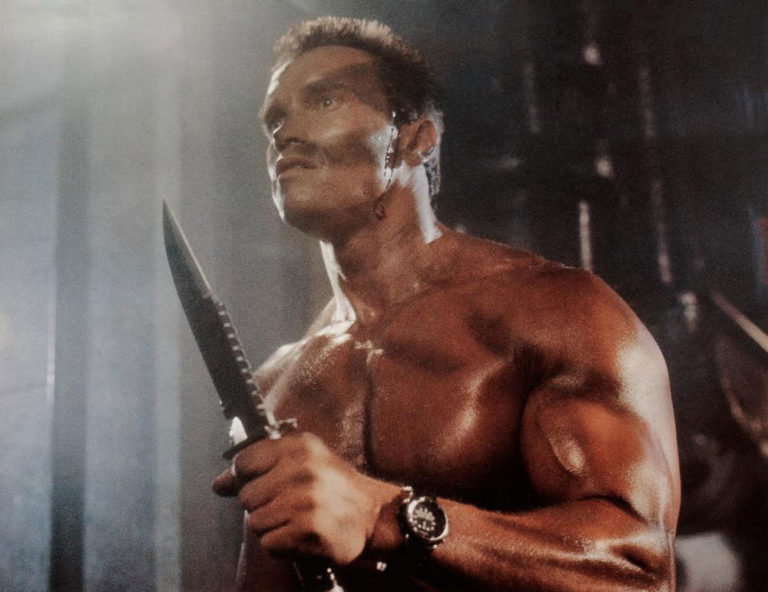
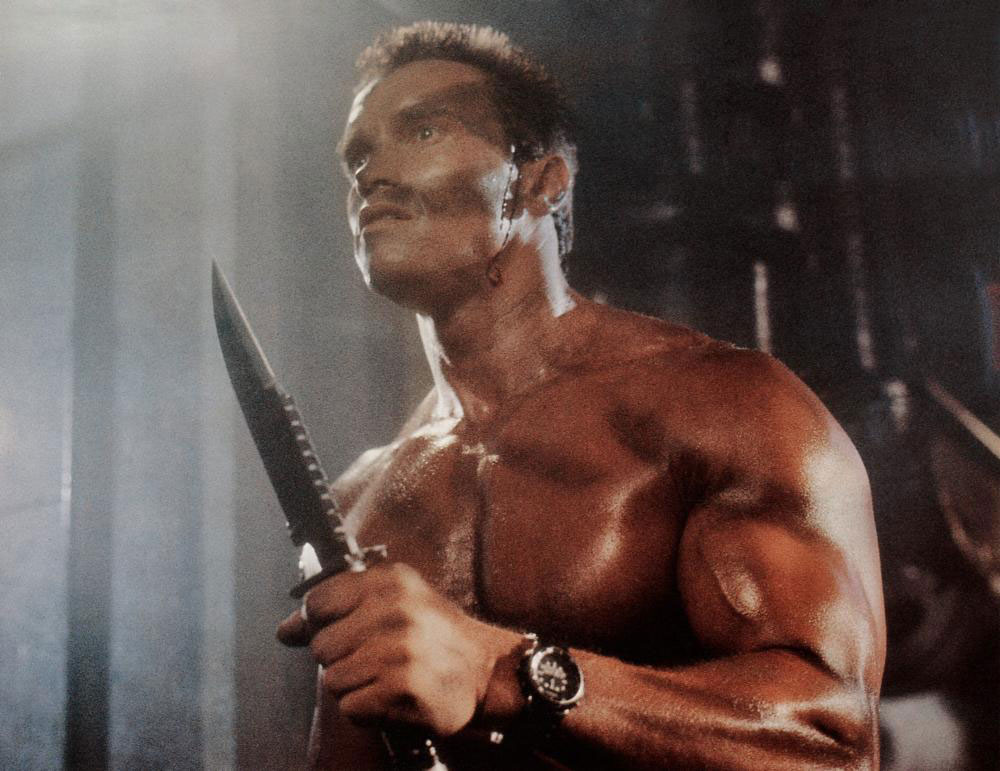
Arnold Schwarzenegger as Col. John Matrix squeezes Jack Crain ‘s LS-1 in Commando. According to Commando propmaster Tom Shaw, Schwarzenegger liked the LS-I so much that he wanted it included in the movie. (image via imdb.com)
Crain’s agent took several Life Support knives to California. It was a model with a black finish that was “discovered” by Hollywood and featured in the Airwolf series.
In January of 1985, Crain’s agent was contacted by Tom Shaw, the propmaster of a soon-to-be-made motion picture which would be called Commando. The movie would star Arnold Schwarzenegger, who had used custom swords made by Jody Sampson in the Conan films. Shaw reported that Schwarzenegger had seen a Life Support knife. He liked it and wanted to include it in the movie.
“The thing that impressed me,” remembers Crain, “was that these people were trying to get actual working guns and knives-no dummy props.”
Crain was asked to supply three matte-finished Life Support knives and six scabbards for the production. (Schwarzenegger’s character, Col. John Matrix, only carries one LS-I; the extra knives and scabbards were required as back-up.) Then the movie folks requested that Crain design a “small and concealable stiletto-type” knife for Matrix to carry.
Crain complied by developing the Commando model. The single-edged, spear-point blade is flat-ground and measures six inches by one and one-quarter inches by three-sixteenths of an inch. It is affixed to a hollow handle by the same sturdy method as the LS-1.
Three Commando knives were sent to California. The film producers were delighted with the model, but they decided that Col. Matrix would carry two small knives instead of one, and they asked Crain for yet another pattern. Within the movie’s limited production schedule, there was simply no time for Crain to design and construct another new knife. However, he had previously been commissioned by a private company to develop a limited edition of 50 small “all-around survival knives” to be called Scorpion.
These knives featured a six-inch by one-inch by three-sixteenths-inch blade with a sharpened top edge and a double row of sawteeth. Crain secured permission for the Scorpion to be used in the movie, and serial numbers eight and nine were shipped to Hollywood.
Key Scenes from Commando
In the released version of the film, the Commando and Scorpion knives appear very briefly. Matrix jerks them from his scabbard and flings them simultaneously into two attacking “bad guys.”
The LS-1 is displayed much more prominently. Matrix carries it on the front of his combat vest throughout the second half of the movie and utilizes it in the final confrontation with his arch-nemesis, Bennett (portrayed by Vernon Wells).
Contrary to the film’s publicity, Crain did not make the D-guard combat knife carried by Bennett in the movie. That knife, explains Crain, was composed of a factory blade attached to the handle of a 1918 trench knife.
Crain’s Rules for Knives in Movies
Read more articles from BLADE’s archives with this collection of 25 years of back issues.
In fact, Crain will not permit one of his knives to be used by the villain in a film.
“Knives have a bad enough reputation,” he states. “People associate them with street gangs and psychopathic killers in the ‘slasher’ movies. I don’t want to see my knives doing that sort of thing.”
He stresses that knives are sometimes favored by the “good guys,” too.
Crain has another rule which applies whenever he is asked to design a knife for a movie. He requires creative input from the filmmakers, either the producer or director or the actor who will carry the knife.
“I had several pleasant conversations with the producer of Commando, Joel Silver,” states Crain.
“They treated us real well,” he recalls. “It was quite enjoyable working with them.” Crain adds that Twentieth-Century-Fox provided him with the movie’s press kits and forwarded all inquiries about the knives directly to him.
Crain thoroughly enjoyed watching Commando, noting that it was “fast-paced and fun.” However, he does not recommend that his customers try to emulate Matrix by throwing their Scorpion and Commando knives.
“Blades that are tempered hard enough to take a good edge are generally too brittle for throwing,” he observes.
Limited Supplies
He also notes that it would be extremely unlikely for anyone to find one of his LS-1 knives in an army surplus store, as Matrix did in the movie (above). To date, only about 80 have been made. None of Crain’s knives are mass produced.
He has no employees other than his wife, Toni, who answers the phone so her husband can get some work done in the shop.
“We’re not trying to make a whole lot of knives,” he explains, “just a few good ones.” (Crain also states, with justifiable pride, that Toni is rapidly developing into a talented engraver).
“Actually, the movie has slowed my production,” Crain reports. More people are writing and calling. Some of them want to come to his shop and select a knife from his stock. Crain politely informs them that he has no stock. Every knife is custom ordered and shipped upon completion.
Crain is pleased that Commando was a commercial success and that it has generated more interest in his work. However, he regrets the film’s timing.
“It would have been more convenient if the movie had come out last year-or next year,” he states.
He will have less time to devote to his survival knives in 1986, the year of the Texas Sesquicentennial, and Crain has been commissioned to make commemorative Bowies honoring several Texas cities, including Dallas, Fort Worth, and Houston.
Collecting Jack Crain Knives
The fact that Crain’s knives have become “movie stars” has not affected their price. The Life Support System I still costs $450 (in 1986 prices). The Commando sells for $300.00 (in 1986 prices).
However, Crain has introduced a special limited edition set containing both the LS-1 and the Commando. The series, restricted to 50 numbered sets, sells for $1,500. Sets have been presented to Arnold Schwarzenegger and producer Joel Silver.
Crain also makes the Life Support System 11, a scaled-down version of the LS-I with a seven-and-three-quarter-inch by one-and-three-quarter-inch by one-quarter-inch-blade. Although it has not yet appeared in any movies, Crain reports that the LS-2 has been more popular than its big sister with campers and backpackers and others who actually want a using knife.
Will there be more Jack Crain knives “starring” in future motion pictures? Crain thinks so.
There may be a sequel to Commando he states, adding, “We’ve been approached to make some knives for other movies. We’re considering it.”
Editor’s note: With news of Canada ending imports of folding knives rocking the knife world, here is another important issue taking place at international borders.
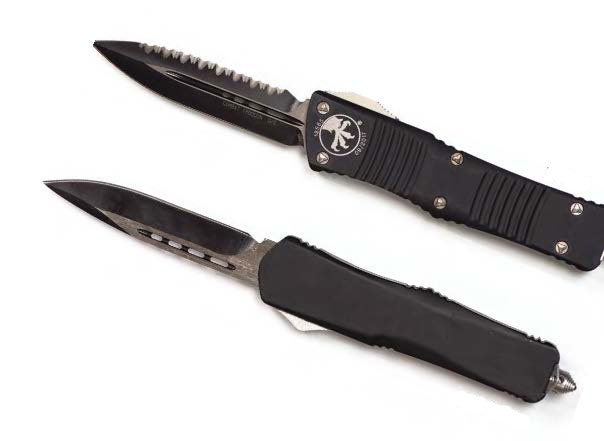
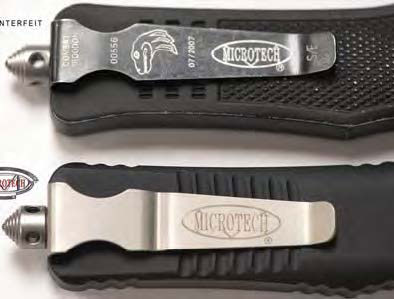
U.S. Customs and Border Protection recently seized a dozen counterfeit Microtech knives attempting to enter via Alaska. Note the difference between an authentic Microtech Trodoon (above, top) and a counterfeit of it (bottom). (Microtech image)
Knife Companies Get Proactive
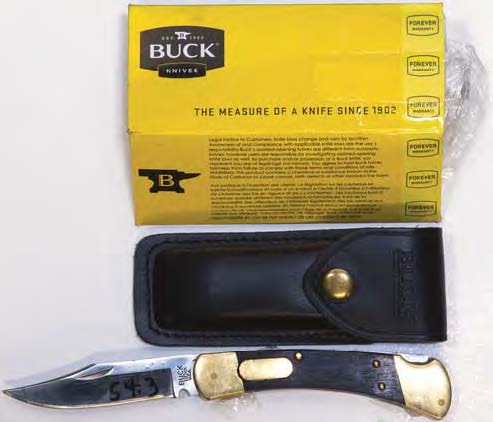
As part of his duties at Buck Knives, Joe Houser clicks through e-commerce websites like eBay, searching for fake Buck knives. When he finds a listing where someone is pedaling a counterfeit Buck, Houser works with the website to take the listing down and perhaps banish the seller from the site.
A few years ago, Buck didn’t have someone doing this job. But more and more fans of Buck Knives were sending their blades to the company’s warranty department only to learn their cherished knives really weren’t Bucks at all. Someone had ripped off the designs, piggybacking off Buck’s name and reputation to sell a shell of a knife to a swindled customer.
Counterfeiting may be the most recent challenge to adversely affect the knife industry. Over the past year or two, counterfeiters have gotten smarter, mimicking knife designs better. And thanks to the rise of international e-commerce websites, it’s harder to stop shipments of illegal knives entering the country because many come through in onesies and twosies, sent direct to the buyer through FedEx, UPS and other shipping outfits.
Bad for Collectors, Bad for Business
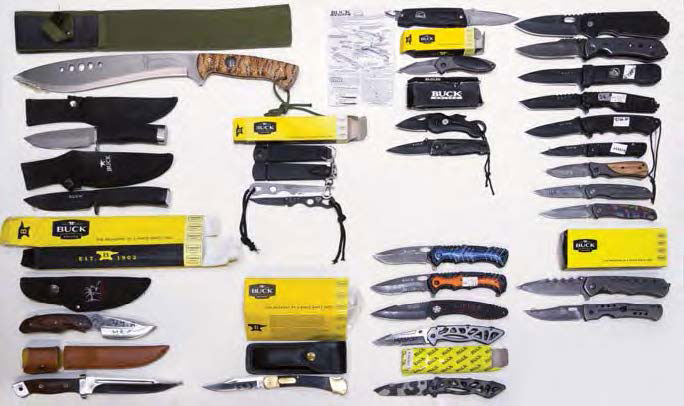
Buck Knives took a dozen Buck knife counterfeits and gave them a Rockwell hardness test. “None of the blades, not one, were made of hardened steel,” noted Buck’s Joe Houser. “They are very cheaply made and fall apart quite easily.” A display of Buck counterfeits (above) reflects the scope of the problem. (Buck image)
Buck took a dozen of the counterfeits and gave them a Rockwell hardness test.
“None of the blades, not one, are made of hardened steel. They are very cheaply made and fall apart quite easily,” Hauser wrote by e-mail. “I know of one model of Buck’s that I see counterfeited where the producers of the knife did not even install the linerlock. The blade had nothing at all to hold it open or closed.”
Research by the American Knife & Tool Institute (AKTI), a leading organization fighting for common-sense knife laws, indicates U.S. manufacturers lose 10 percent in sales annually to counterfeiting.
As a result, AKTI officials estimate counterfeit blades siphon about $95 million from the knife industry every year. It’s enough to erode the bottom line of knife manufacturers providing American jobs. And if the problem is to be solved, it will take the whole of the knife industry, AKTI officials say.
U.S. Government Struggles to Keep Up
U.S. Customs and Border Protection made 31,500 seizures in 2016 of products it found to have violated intellectual property rights—52 percent more in fiscal year 2016 than in 2014. (U.S. Customs and Border Protection image)
Gregory Moore, public affairs specialist with U.S. Customs and Border Protection (CBP), said Customs made 31,500 seizures in 2016 of products it found to have 77 violated intellectual property rights—52 percent more products in fiscal year 2016 than in 2014. The increase presents a challenge for the agency.
“With the global rise of e-commerce and online shipping, the number of small packages containing counterfeit goods continues to rise,” Moore wrote. “Ninety percent of the seizures in fiscal year 2016 were small packages shipped through express carriers or international mail. The increase of [goods infringing on intellectual property rights] in the small-package environment creates both a logistical and enforcement challenge for CBP.”
The best way to make sure the knife you order online is legitimate is to buy from retailers that specialize exclusively in knives. ShopBlade.com is one of them. Click to browse a selection of genuine knives.
Counterfeit knives make up less than 1 percent of the products Customs seizes that it considers a threat to health and safety, a category that also includes counterfeit pharmaceuticals and sporting goods. After all, poor steel can cause a blade to snap, a pivot to fail, etc., increasing the chances of injury or even death.
Besides, seeing a knife being ripped off and made with poor materials stinks.
“Well, it’s frustrating,” said Doug Ritter, executive director of the other leading organization dedicated to common-sense knife laws, Knife Rights. Ritter also has designed knives for CRKT and Benchmade.
Most honest knives are derivatives of older knives, Ritter said, where knifemakers seek to improve the designs and make a better knife.
“That’s the way stuff develops,” Ritter said.
Meanwhile, the organization spearheading the effort against counterfeit knives is AKTI.
“We encourage them in their efforts and hope they are successful because these counterfeits hurt everyone in the knife community,” Ritter wrote.
Counterfeiters Get Smaller, More Numerous
Some of the counterfeits go so far as to copy the knife right down to the blade mark and product box with literature, as here with a fake Buck 110. (Buck image)
CRKT President Rod Bremer’s interest in counterfeit knives began to grow about five years ago when he started noticing more and more counterfeits from Southeast Asia. Today, he noted, most counterfeit knives originate from China.
Bremer, who chairs AKTI’s anti-counterfeiting committee, said most counterfeiters have small operations—simply working out of a garage—making them hard to track down. Sometimes they copy manufacturers’ knives right down to the packaging and warranties that are honored for genuine models only. Often, the counterfeiters try to catch the eye of buyers looking for a deal.
Compared to legitimate knives, Bremer said, counterfeits are usually priced at 50 to 70 percent of the MSRP of the genuine article. For example, one American knife company manufactures a fixed blade for $425 of which a Chinese e-commerce site recently listed a counterfeit—complete with the company’s logos on the packaging—for about $41.
Some counterfeiters have become so sophisticated that knife companies must look at machining marks and other small details to identify the real thing, similar to identifying counterfeit currency.
These details are kept secret by the companies lest the knowledge falls into the hands of counterfeiters.
What Can be Done?
A close-up of the pocket clips of the genuine Microtech Trodoon (bottom) and a counterfeit (top) reinforces just how far counterfeiters will go to copy the genuine article. (Microtech image)
Bremer said the knife industry’s most comprehensive strategy is to play a full-court press, including being vigilant in asking e-commerce sites to remove listings of counterfeit models. If the knife industry as a whole makes it a “pain in the butt” to sell bogus knives, he said, then the bad actors may move to more lucrative products.
“Counterfeiters are not particularly selective,” Bremer observed. “They just want to knock somebody’s brand off, sell it and make a lot of money.”
Can the federal government build a virtual wall of blue-gloved U.S. Customs officers opening boxes and targeting shipments coming in from outside nations? Unfortunately, as Bremer noted, “I don’t think they have the manpower to catch all the shipments.”
Stop by any major port, such as San Francisco or Savannah, and you’ll see container yards of goods miles and miles long. But not all is doom and gloom.
“China has gotten more aggressive on intellectual property,” Bremer said. “The new president of China has gotten pretty harsh on people that are knowingly ripping off patents, but the effort is clearly not as aggressive as most of us would like. And it’s going to take time.”
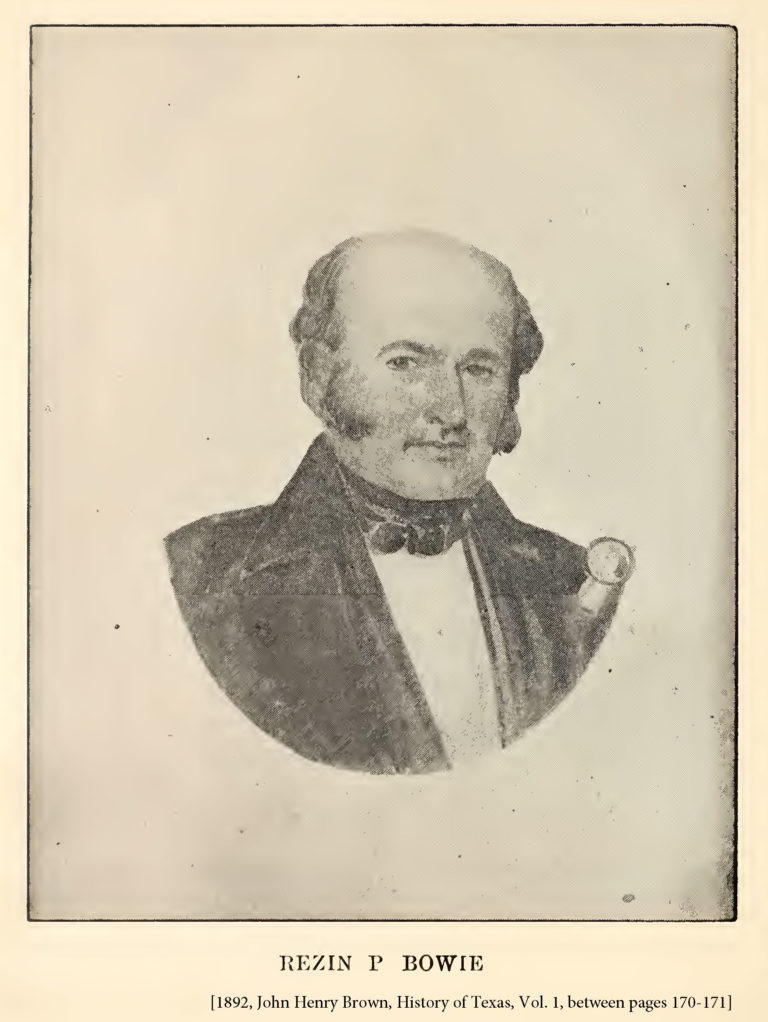
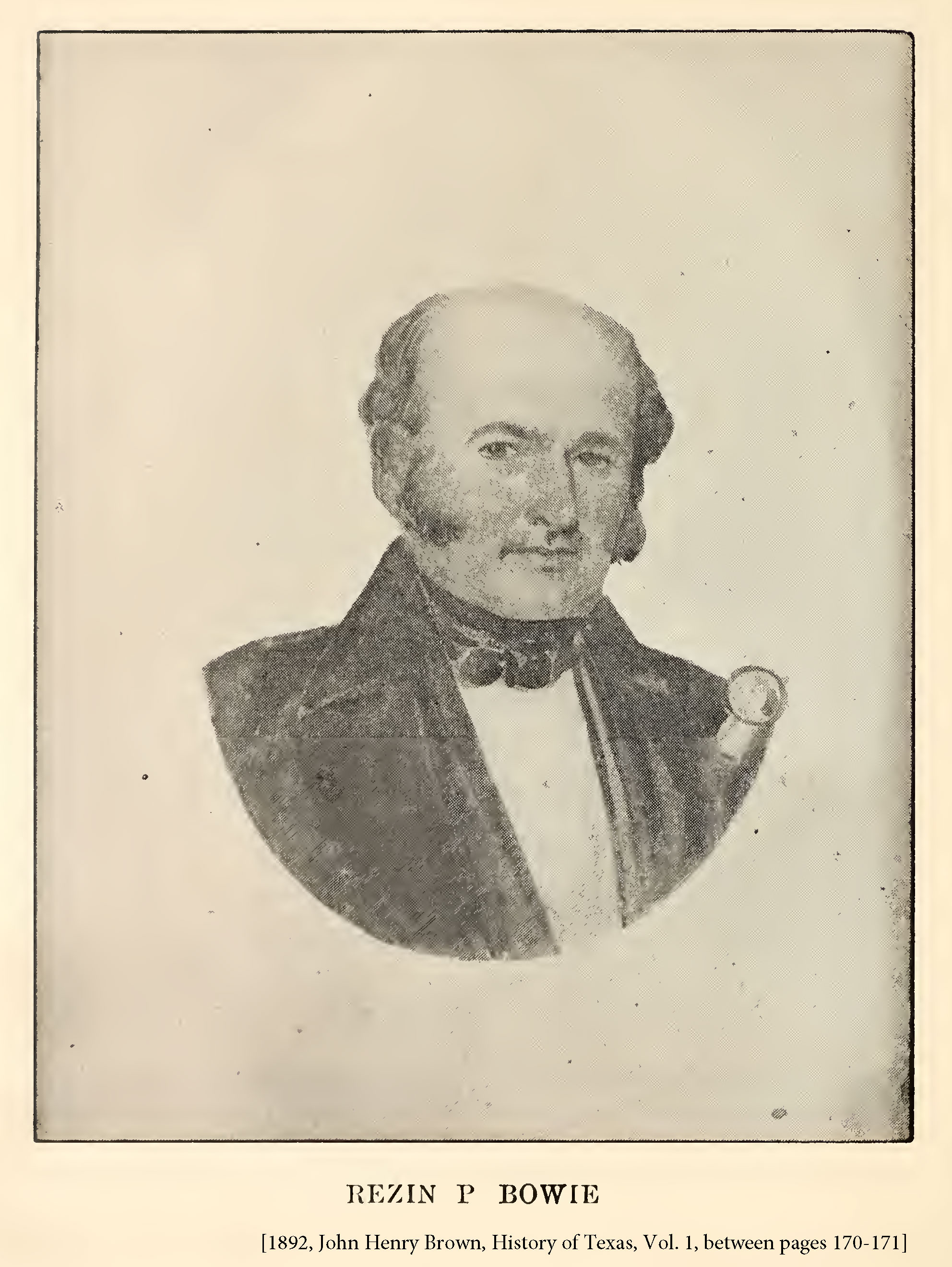
A portrait of Rezin Pleasant. (public domain image)
Is This Jim Bowie’s Brother’s Knife?
A few times a year, a knife with a supposed James Bowie connection pops up, usually leading historians to raise a collective eyebrow. It’s the Elvis, or sasquatch, sighting of the knife world.
The latest entry can be found in Waco, Texas, where a bowie knife donated to the Texas Ranger Hall of Fame and Museum bears the inscription, “R.P. Bowie to Capt. Wm. Y. Lacey,” per the Waco Tribune.
The “R.P.” could be the initials of Rezin Pleasant Bowie, older brother to James Bowie, who gave knives as gifts.
Johnson said it would not be unusual to find a forged inscription on a Bowie knife, but it seems unlikely that a forger would have chosen William Lacy as the recipient.
“There’s only about half a dozen historians who have heard of William Lacy,” he said.
That the knife’s previous owner didn’t seek money from the museum is no indication of authenticity. Neither is the circumstantial evidence supporting its origins. The truth could split either way.
By default, BLADE takes a skeptical view with these sorts of claims, and this case is no different.
Knife Rights reports that it’s working alongside legislators to move HB 924 forward in Mississippi. The bill, introduced by Rep. Gary Staples, would strike bowies, dirks, butcher knives and switchblades from statutes governing deadly weapons.
As an aside, it’s surprising that butcher knives would be restricted in, of all places, Mississippi.
Concealed Carry of Fixed Blades Proposed in Washington State
It’s not currently legal to carry a concealed blade longer than six inches in the state of Washington, but the could change. If signed into law, HB 2600 would decriminalize just that. Here’s more from Knife Rights.
This Knifemaker Learned from Autopsies
By Ralf Roletschek – Self-photographed, FAL, https://commons.wikimedia.org/w/index.php?curid=29775777
It doesn’t take much to imagine where Dr. Stephen Pustilnik, of Houston, developed an appreciation for knives. He performs autopsies for a living. It’s only natural that he’d try his hand at knifemaking, too.
He is now working his way through a year-and-a-half-long waiting list of chefs, home cooks and pathologists willing to spend hundreds of dollars on knives that hold an edge and make clean work of anything from gnarly vegetables to sinewy flesh.
This line takes the cake:
Pustilnik, after spending years examining human bodies, speaks easily of the particular mechanics of the hands. He measures his customers’ palms and observes where the metacarpophalangeal joints—the hinges at the knuckles—rest on a knife handle.
You, too, can reach that level of expertise, if you put in enough corpse time.
Buy low while you still can, Canadian knife collectors.
New CBSA Rule to Drive Prices Up
If you live in Canada, expect the price of most folding knives to go up, especially in secondary markets. Collectors may want to start stock up while prices are still at par.
The culprit is a new rule by the Canada Border Services Agency (CBSA), in effect now, that prohibits the import of assisted openers and any manual folder that opens with centrifugal force. (Automatics were already restricted, but the rule covers them, too.) This only applies to imports, not knives already legal to own in Canada. Both businesses and individuals are impacted.
As BLADE reported here and here, it’s that centrifugal force qualifier that will especially limit Canadian knife enthusiasts’ choices. An inspecting CBSA official may open a blade halfway, give a flick of the wrist and determine the knife is prohibited.
If a knife can open with one hand, it’s not going to make it into Canada.
Existing Stock Will Dry Up
This wide leeway effectively ends the flow of fresh folders imported into Canada. That includes popular brands from the United States.
Imported folders already in Canada will remain on shelves and are not banned from purchase or possession. However, retailers won’t be able to reorder them.
More Investment Options than Ever Before
If anyone will benefit from this new CBSA rule, it’s enthusiasts with assisted openers and manual folders already in their collections. Mundane assisted openers and folders not originally thought of as collectibles are now investment pieces.
Collectors have more, safer bets in categories never considered before. That $50 flipper doesn’t look so insignificant anymore.
How High Could Prices Go?
It’s hard to say, but prices will only go in one direction in 2018. Beyond that is less certain. Rising prices reflect a market adjustment. Expect that prices will find a ceiling, then drop to a new normal. The trick will be to catch prices in secondary markets on the upswing before the fall happens.
Caution
The CBSA, a federal agency in Canada, cannot make laws. However, it can issue rules based on interpretations of existing law.
The rise in prices may press some Canadian collectors to try their luck with the CBSA and order folders/assisteds from outside the country. However, authorities are already working to stay one step ahead.
“The way the Canadian government figured out all the tricks on how to get knives into Canada was reading blade forums and watching YouTube where all these people were bragging and giving instructions on how to get knives into Canada,” Neil Ostroff, owner of True North Knives, told BLADE in an e-mail. Ostroff is originally from Canada, but now resides in the U.S.
The Bottom Line: Buy Low Now, Sell High Later
If you’re a knife collector in Canada, it’s time to start buying new assisted openers and folders while you still can. Hold on to them and wait to see where prices go in secondary markets.
The new rules prohibit assisted opening knives, automatics and any manual knife that can open by centrifugal force from entering Canada. The restriction doesn’t extend to the rest of Canada. It only impacts imports, as well as individuals or mail crossing into Canada.
As a result, knifemakers and knife companies not based in Canada can no longer offer most types of folding knives to Canadian customers. A more detailed summary is available from BLADEhere.
It isn’t only the knife world in the U.S. reaching out to these organizations.
“I have gotten about a hundred emails and calls from Canadians about this,” noted Doug Ritter, chairman of Knife Rights. “I have offered to help with advice and such based on our experience if they put together a Canadian organization, but I can’t do it for them. Way too much to do just here in the U.S. So, no time, lack of resources, and quite frankly, it wouldn’t be taken well for a U.S. organization to come try and fix Canadian law. Bad idea.”
Restrictions Severely Limit Options for Canadian Enthusiasts
Neil Ostroff, owner of True North Knives, and someone who relocated to the United States from Montreal, told BLADE in an e-mail that his options for Canadian customers are now limited.
“Vendors outside of Canada, like me, will no longer ship any knives to Canada other than slip joint, lockback or fixed blade knives,” Ostroff said in an e-mail. “Even the old trick of tightening the pivot down by the shipper so the knife barely opens until the pivot is released by the buyer will no longer work.”
That’s because of how much leeway the CBSA can now use.
“In the law they can now go so far as to open the knife halfway and then flick it open, making it inadmissible,” Ostroff said. “Example: Chris Reeve folders. These cannot be flicked or opened by centrifugal force, but if the officer opens it halfway and flicks it, then it can be determined illegal.
“So any examiner will be allowed, by law, to make any legal knife a prohibited weapon.”
Canadian Knifemakers Impacted, too
If it sounds like these rules could insulate Canadian knifemakers from competition, few are making that case.
Brian Tighe, an award-winning knifemaker from Ontario, Canada, expressed frustration with how his international work will be shut down.
“This will impact the knives I have designed with CRKT. They are now prohibited weapons and can’t be imported into Canada. Bass Pro, etc., can sell what stock they have, but they can’t reorder,” Tighe told BLADE in an e-mail.
“We can’t import [those knives] into Canada unless they were shipped in pieces and assembled in Canada,” Tighe said.
An Exception to the New Rules? Not Really
Holders of a specific type of Firearms Business Licence (FBL) are exempted from the new rules. In theory, a knifemaker or knife company could obtain such a license. However, that’s not the case for those who tried to do so.
“No one in Canada has [that type of FBL] except RCMP [Royal Canadian Mounted Police] and cops. I tried to get one and there was no way,” Tighe said.
Ostroff agreed. “To get a Firearms Business License in Canada is almost impossible and no knife store will be able to do it,” he said.
There was similar confusion about this license outside Canada, too.
“There does seem to be an out for importers, distributors and retailers, but I have no idea what is required to get a license to import ‘prohibited weapons,'” Ritter said.
Could Canada Repeat U.S. Success?
If this scenario sounds familiar, it’s because a similar situation came about nearly a decade ago in the U.S. That led to an amendment of the 1958 Federal Switchblade Act.
However, there isn’t a Canadian equivalent to organized knife advocacy in the U.S.
“Whether the knife community in Canada can rally the resources is yet to be seen. They may not have quite the same level of influential friends in Ottawa,” Ritter said. “And, they also need to find someone to lead the charge; no small thing itself. It takes a huge commitment of time and effort and the right attitude. We [Knife Rights, AKTI and the U.S. knife industry] spent a small fortune in 2009. It takes a fortune. They will need to raise a ton of money.”



 The Phurba, the knife from the 1994 motion picture, The Shadow, breaks new ground for movie blades because it’s the first to take advantage of new computer-generated special effects. For the dagger in The Shadow, that means the creation of a living, breathing character, so to speak.